ArgoKnot

knitting

Scenes

It’s been a challenging couple of weeks in this part of the Caribbean, with lots of wind and lots of rocking and rolling. I have not been able to weave or knit, and sometimes not even able to read! Luckily I have a long queue of audio books that I often neglect. I was able to close my eyes and listen to a relatively new book, Stolen, recently published in English. It’s written by Swedish author Ann-Helen Staestadius and translated into English by Rachel Wilson Broyles. When I went to find the link I saw that it will soon be a Netflix film. It was good on a number of levels and it helped me pass the time. I am not a patient person when it comes to waiting out bad weather in order to get some work done! Basically, I am not patient when waiting for anything! It’s odd because whenever I demonstrate any kind of fiber work, people always say that they’d never have the patience to do any of that. Well, there are plenty of things I have no patience for doing! Waiting is just one of them!

My mood has gotten darker as each day passed with no way to work on any of the projects I brought onboard this year. Poor Bob. For two days, in Ste. Pierre, the rolling was so violent that we had to lock our cabinets and drawers so that the things inside, bashing against the cabinets doors in one direction, then bashing against the hull, and back again, would not come flying out of the cabinets. We’ve had that happen on passage in the past. One of our drawers once came flying out of its cabinet in the galley, sending forks and spoons and knives flying. We had not noticed that drawer when locking down everything before a passage. These are things we prepare for when we are sailing. This is the first time we’ve had to batten down our cabinets while at anchor.

But, on the bright side, we’ve had some beautiful sunsets. In the Caribbean it’s a tradition to blow your conch shell right after the sun falls below the horizon. Don’t have one? That’s a priority when you spend time in this part of the world. Bob got his during our first winter in the Bahamas. It’s nice tenor conch. Smaller conchs have higher pitches; bigger conchs have a lower pitch.

Since color on different monitors is so varied, I wonder if the green flash will look green on other devices than my own! I hope some of you will weigh in on what you see.

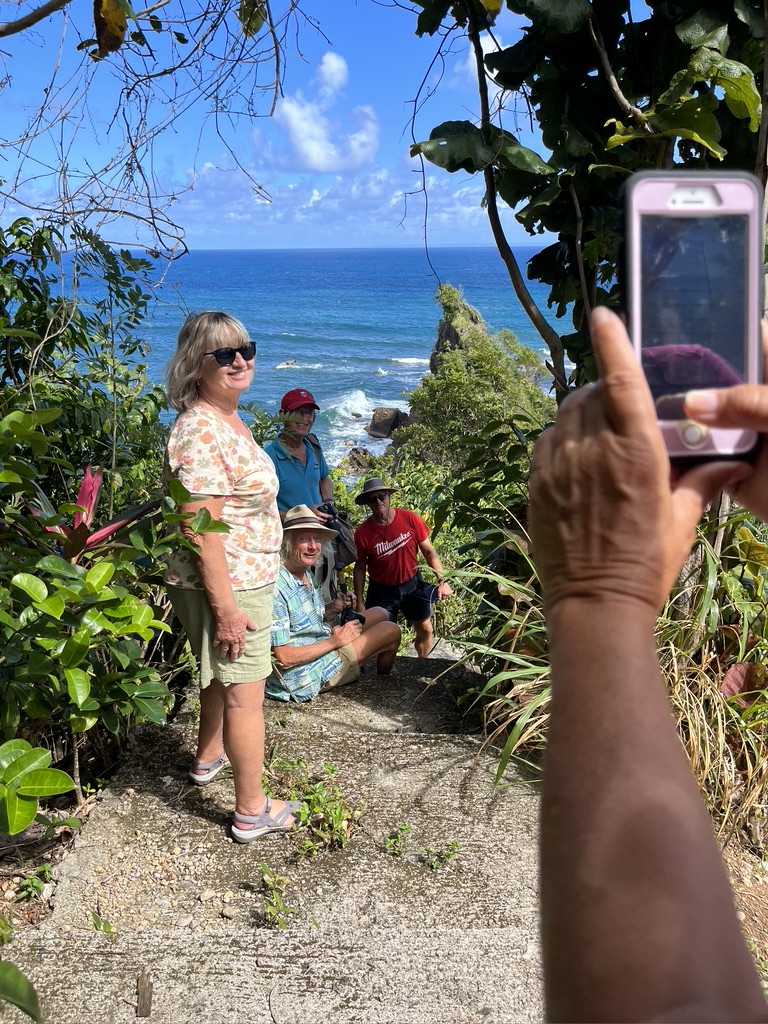
Back in Dominica, we took a tour of parts of the island with our friends from sailing vessels Kalunamoo and Roxy. It was an interesting day. I have always enjoyed taking photos of loved ones taking photos, as you may have noticed over the years. Here is Lynn from Roxy taking a photo in the foreground, as I took the same photo. Maureen and Bill from Kalunamoo are in the front, followed by Bob and Mark (from Roxy.) We’ve been cruising friends for more than a decade at this point.
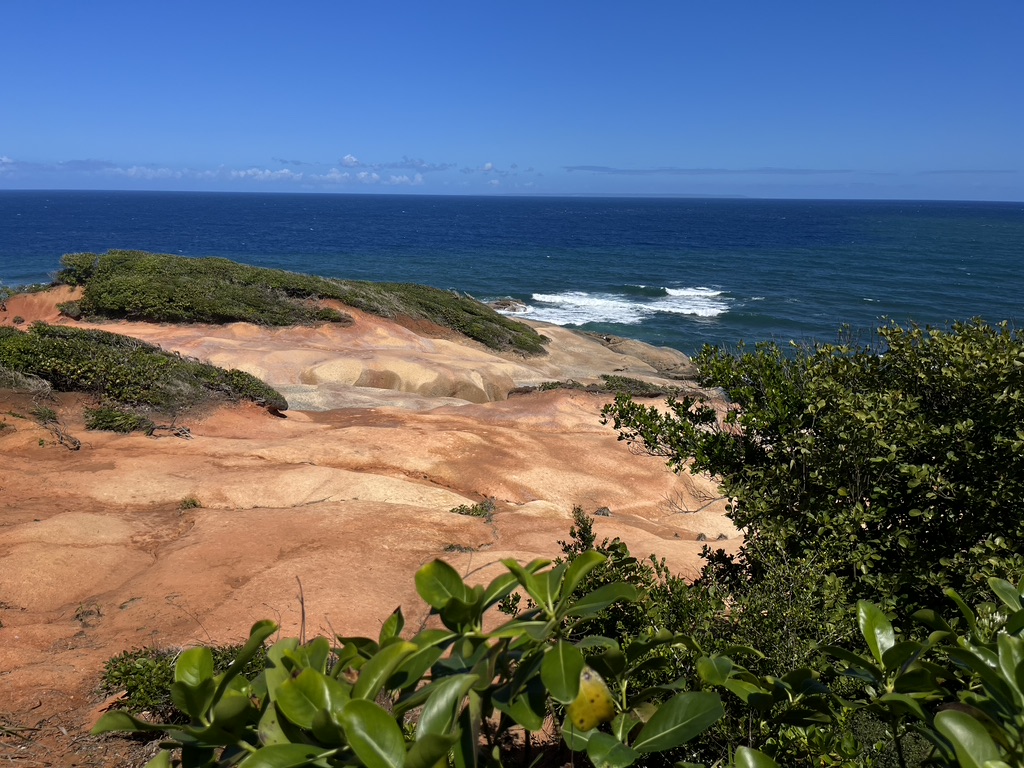
This is the coast line we visited on the Atlantic side of Dominica.

The hard, smooth coastline here is hardened clay.
There is a rather interesting stairway carved into the rock. I can’t imagine it’s natural, but what do I know? Not much! Mark could not resist climbing down these steps. I was holding my breath too tightly to take a photo, and he got back up safely.

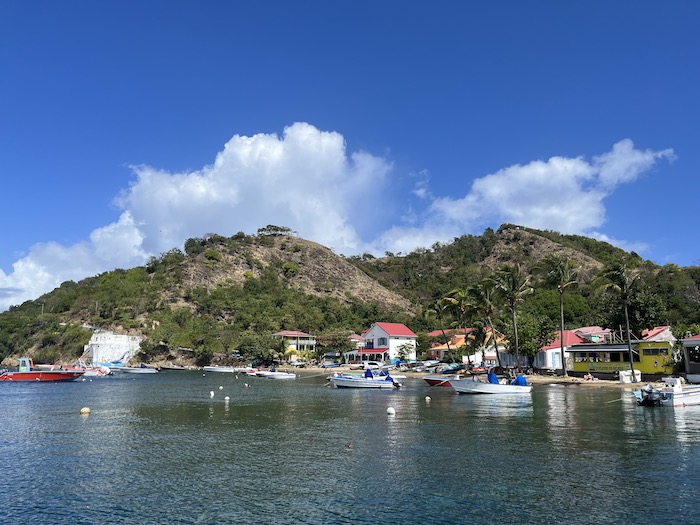
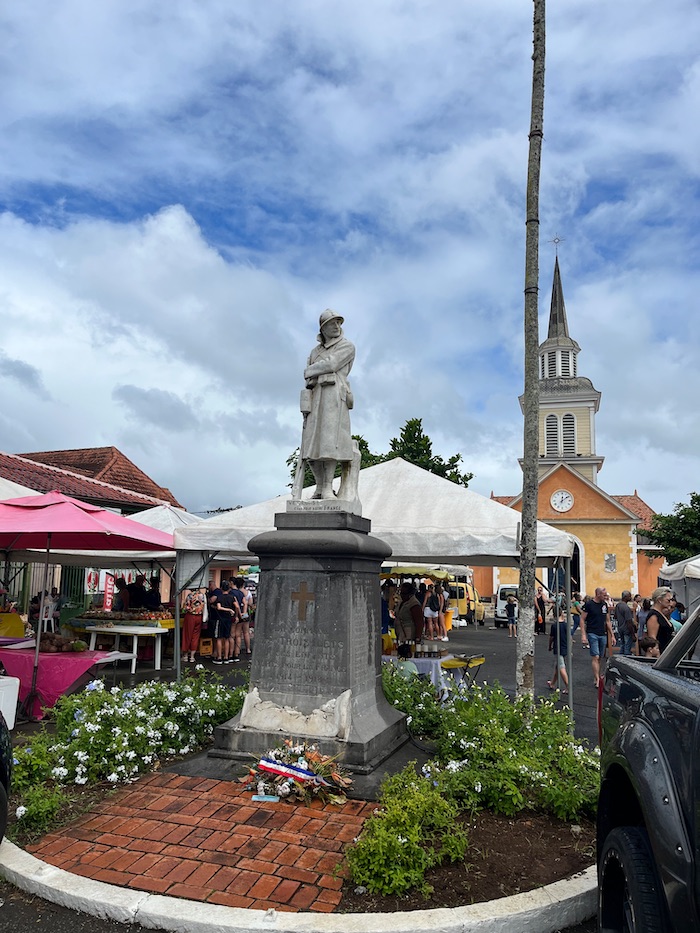
After Dominica we sailed to Ste. Pierre, and somehow managed to spend two nights there, which is where we had the worst rolling we’ve ever experienced. We decided to escape to Fort de France for the beginning of Carnival, but the anchorage was too crowded for us, and it was pretty roll-y there as well. We tried to anchor six times, and in the process bent our stainless steel spade anchor. That will cost a pretty penny to replace, and until we get to Le Marin to do that we have to be pretty careful about anchoring. So, we headed across the bay to Trois Islet. It’s been windy, but the three islands and shallow waters have lowered the waves to a chop. This is the village of Trois Islet–quite charming. This is the Saturday open air market in village square.
When Bob writes his next post there will be some stunning photos of the Martinique Yolo regatta which took place here in Trois Islet, as well as great photos of Carnival in Fort de France. We took the ferry there for Sunday’s festivities. Today is the last day of Carnival, but I’m happy to stay aboard. Our friends from Kalunamoo and Roxy have gone to see the last day’s parade.

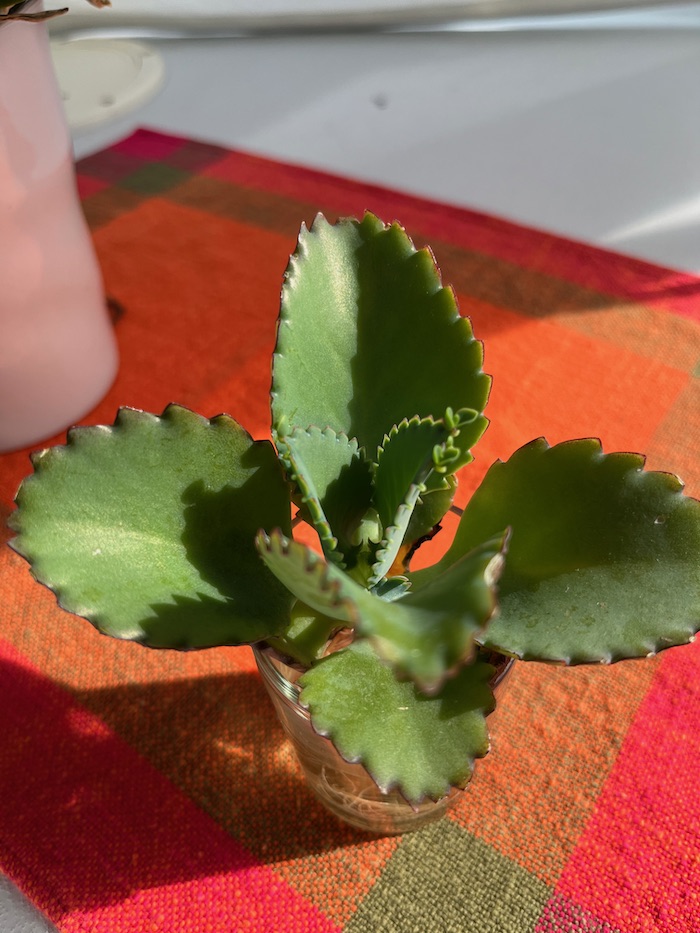
And on Pandora, small things are happening. Our little unidentified succulent plant is making babies on the edges of its leaves. Can you see them on one of the inner leaves, to the right of center? Quite fascinating!
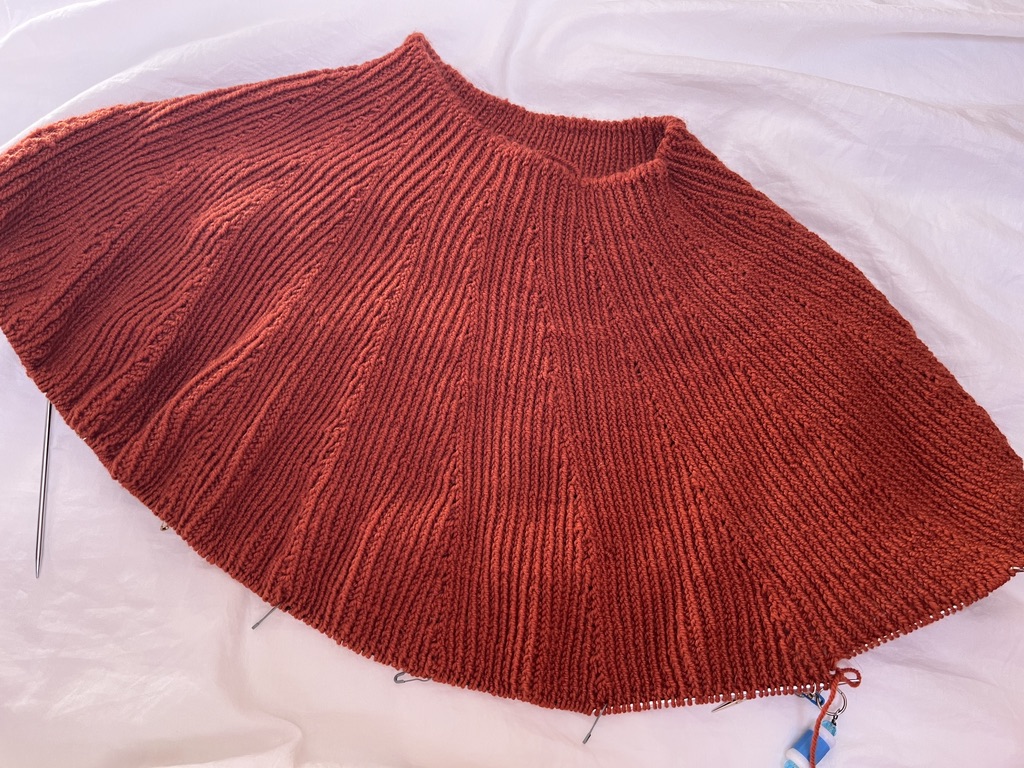
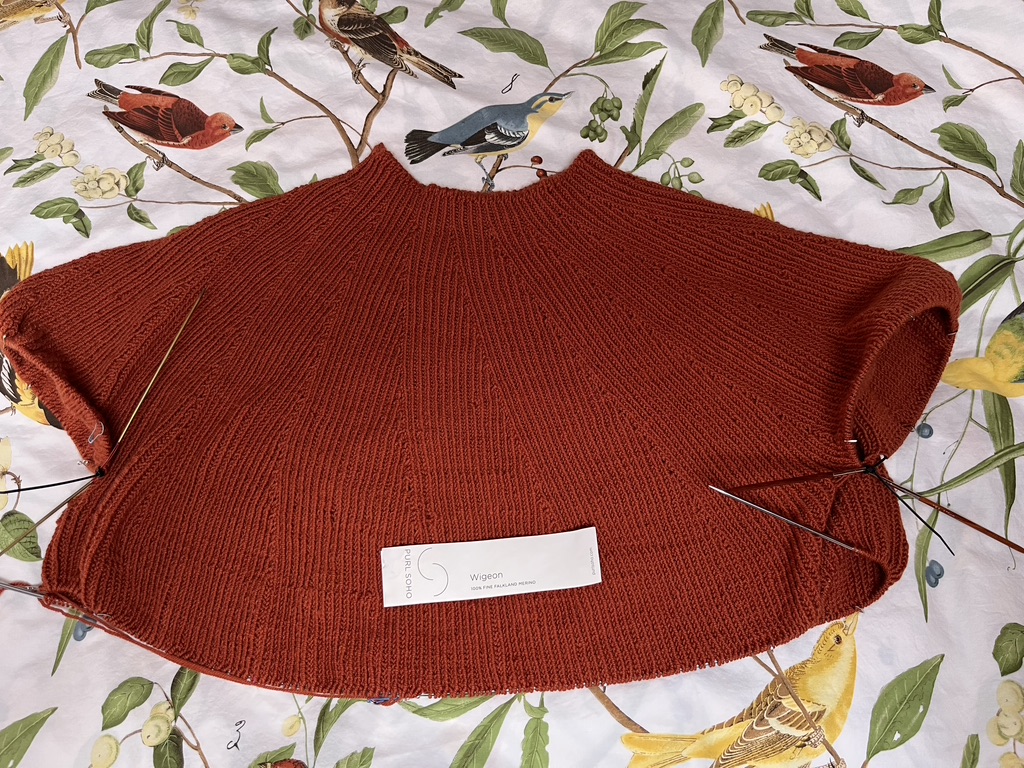
And here is my almost non-existent progress on my “Amphora” sweater from Purl Soho. It’s only grown about 3″ in length on the body, below the sleeve stitches that are waiting on spare needles. Slow and steady….can you see the swirls that create the increasing shape of the yoke? That’s what drew me to knit this design! You might have to ‘bigify’ this image to see the swirls.
When we get to Ste. Anne, the harbor should be reliably calm. Fingers crossed. In the meantime, we may stop at Anse d’Arlet for a night or two. I hope it will be calmer than where we’ve been the past two weeks.

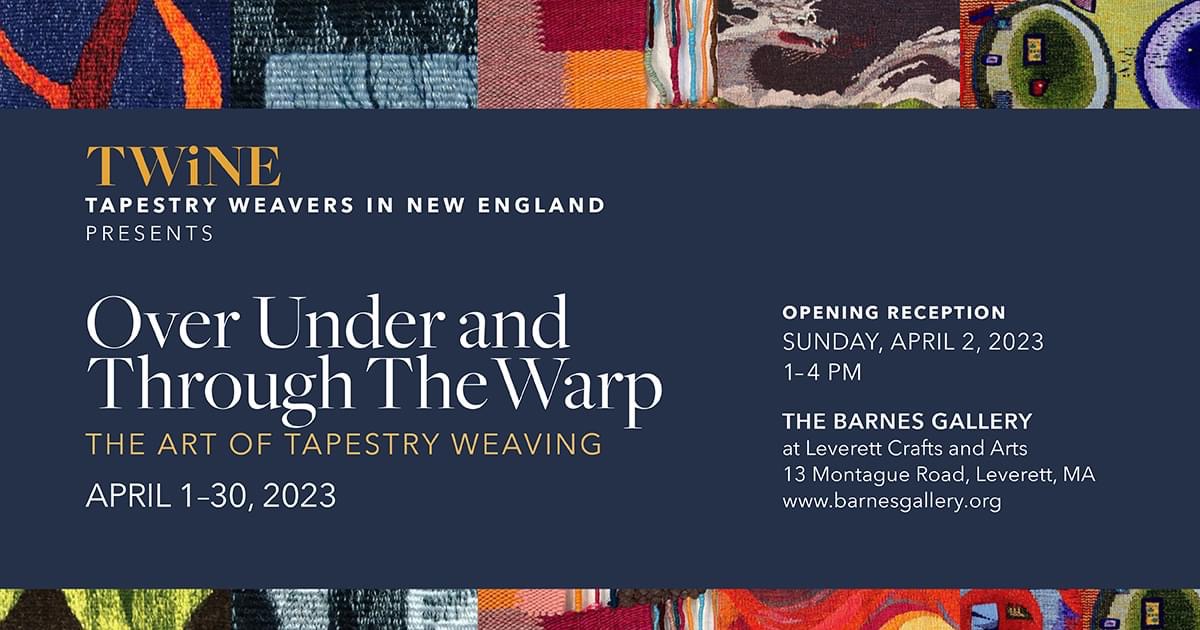
News from home: the wonderful volunteers in TWiNE (Tapestry Weavers in New England) have been hard at work toward an exhibition of members’ works that will open on April 1, the day I fly home. I hope to get there shortly after the opening! If you’re in the area around Leverett, Massachusetts, I hope you will visit this exhibit.
So…although there hasn’t been a lot work accomplished here over the past weeks, there have been quite a few good scenes. Hopefully there can both from now on into March.
Working Remotely in Remote Places

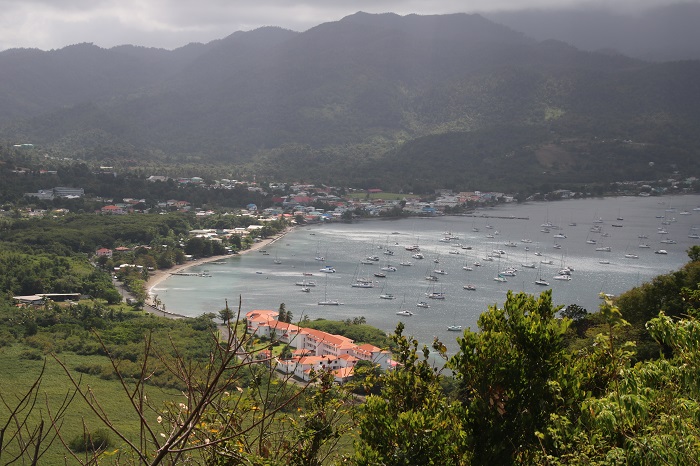
A couple of weeks ago Rebecca Mezoff’s email newsletter mentioned that since she traditionally works at home, when she works ‘remotely’ it means that she has traveled somewhere. It’s the first time that I realized I work remotely every winter. Many people think Bob and I are on vacation when he sails south for the winter, but it’s really our ‘other’ home. We live our every day lives, full of chores and responsibilities, from our 2nd home, which happens to float. I always bring ‘work’ with me, and am often disappointed that I’m missing some vital color for a tapestry, or a particular size of knitting needle, or some other item that derails for my plans for work. At my first home I can quickly go online and replace almost anything I’m missing within days. That is never the case here. This is a view from Shirley Fort overlooking Portsmouth Harbor. Pandora is out there!

We are in Dominica now, and have been moored in Portsmouth for the past four days. Bob’s sailing group has arranged for an impressive number of outings on this island, known as ‘the nature island.’ Most of Dominica is rain forest. Most of the hikes here involve hiring a guide. Perhaps the most intensive hike on this island is called the ‘hike to the boiling lakes.’ This hike, which I have not done and Bob regrets not doing, takes people to the edge of the volcanic caldera where the sulfur lakes are literally boiling. It’s not easy getting up to those heights, and this week’s trip was particularly hard for the hikers because it rained most of each day in heavy downpours, which made the paths and rocks quite slippery in addition to being quite steep. The hikers walked along the steep rock walls of three caldera that looked down into the boiling lakes.

From Wikipedia: The Boiling Lake is a flooded fumarole located in Morne Trois Pitons National Park, a World Heritage Site on the island of Dominica. The lake, located 6.5 miles (10.5 km) east of Dominica’s capital Roseau, is filled with bubbling greyish-blue water that is usually enveloped in a cloud of vapour. The Boiling Lake is approximately 200 to 250 feet (60 to 75 m) across and is the second-largest hot lake in the world after Frying Pan Lake, located in Waimangu Valley near RotoruaNew Zealand.

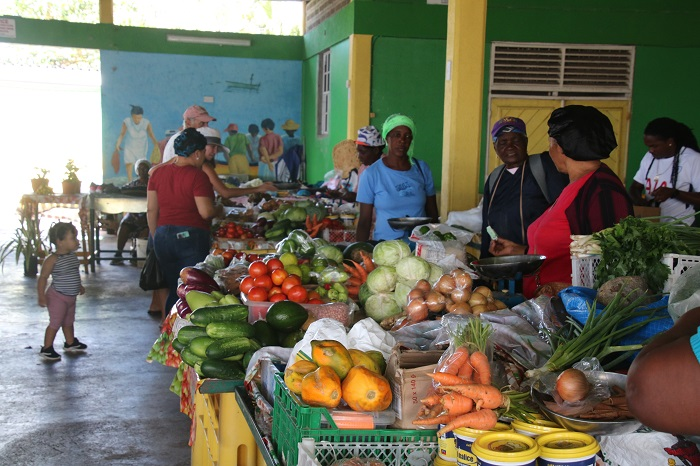
In the rainforest people clear small plots to grow all kinds of veg and fruit, and the rest of the West Indies is indebted to Dominica when the supply boat arrives in the other islands carrying produce grown here. They even grown coffee here in the higher elevations. The melons and bananas are unbelievable! I’d forgotten what non-GMO avocados taste like, and these bring back memories of the first avocados I ever tried, as a teenager, years before Haas avocados had been developed. I’m a big fan of the real ones now. And, as it happens, there are numerous varieties of avocados. We’re about to try some that are quite tiny. The one thing I cannot find–and don’t even seem to know how to ask for–is cilantro! There is an herb grown on some of the islands called “chadon beni” that’s pronounced more like “shadow benny.” It does not look anything like cilantro, but it tastes like it! It roots easily, so I was able to grow my own the only year I found some to buy.

I know that some cultures call cilantro ‘coriander,’ which is what I call the seeds of the cilantro plants. At the local Saturday market here in Portsmouth, I tried asking for cilantro, coriander, and ‘shadow benny,’ but I got no hits. I even had an image of chadon beni open on my phone for clarification. The only response I got was an offer of some flat leafed parsley! Oh well. I can’t make the guacamole of my dreams, but I am enjoying eating avocados in other ways, including the way I first ate them in junior high school, with canned tuna salad stuffed into the place where the pit was removed in the big avocados! And when you root one of these avocado plants you will get fruit on your tree, unlike Haas, which are sterile. I am making do quite well with a healthy, rooted Caribbean version of basil which is growing like it’s on steroids.

The Saturday Market in Portsmouth, Dominica

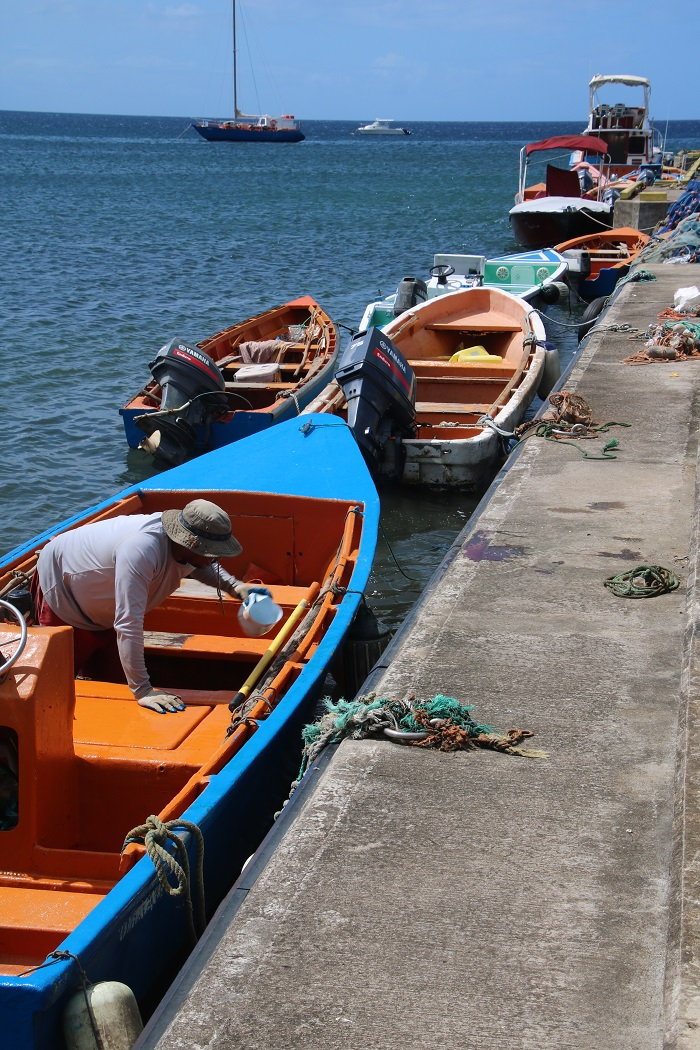
The entire Caribbean is a colorful world, as Bob captured in the fishing fleet on the dock.

At the moment I am licking my emotional wounds that I have a major set back on my Caribbean ‘postcard’ tapestry. I don’t have any white or cream weft yarn to weave the iconic church in Deshaies, Guadeloupe. I have other options, you know, necessity being the mother of all mislaid plans. I can weave a different scene from Guadeloupe to eliminate this church entirely. I’m feeling a bit negative about that since drawing the rough cartoon was quite an effort for me, with no option to resize some of my images with a printer, or even stopping into a Staples store for help. In the end I have four pieces of paper glued together to create my cartoon, and it has angel fish and turtles swimming around the postcard of the church. I just continue ‘to sleep on’ the idea of tossing out this idea.
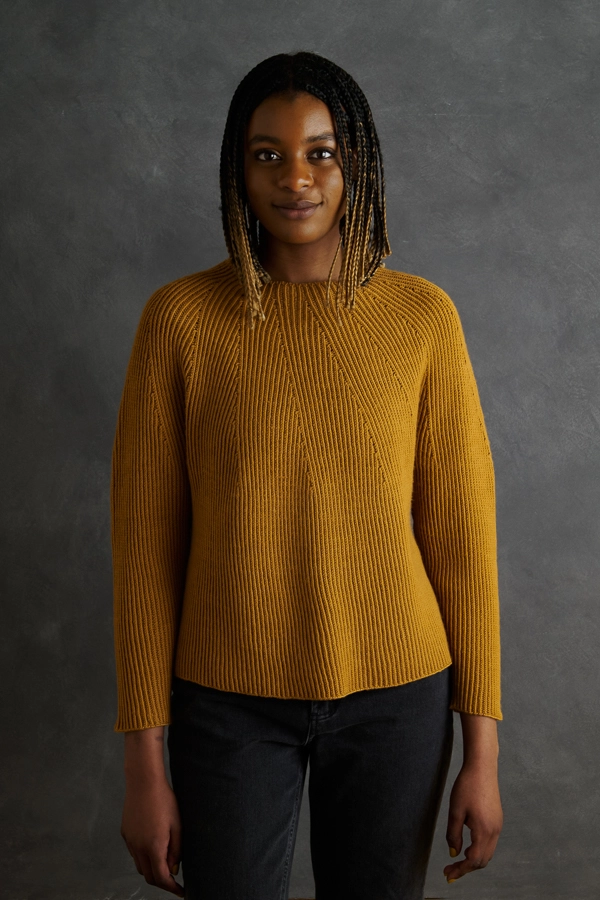
So I’ve turned to my current sweater in progress, a design by Ainur Berkimbayeva for Purl Soho called “Amphora Pullover.” It is a top/down sweater with fun increases through the neck and shoulders that create swirls. Quite attractive on the model! Now that I have put the sleeve stitches on holders and am about to continue on the body only, I am going to test some ideas of continuing some of the swirls to create a swing style body. I can never just knit a design as instructed. Patterns are jumping off places for adding our creativity to a garment! I hope my idea works.

The “Amphora Pullover” by Ainur Berkimbeyeva for Purl Soho.

Looks like I have an opportunity to start my own small business here in Dominica!

During the past week I have been challenged by an exceptional idea that is currently keeping me awake at night, with all kinds of possibilities running wild through my mind. If you don’t know me, you may not know that I have recently begun teaching tapestry at a non-profit organization in Connecticut that is near and dear to my heart. The organization is Hartford Artisans, and their mission statement is what captured my attention: The Hartford Artisans Weaving Center is committed to being a welcoming, accessible community that actively works to create a kinder and more equitable world for everyone. Our diverse community unites people from different backgrounds and experiences to learn from each other and uncover their own unique skills. We challenge assumptions about disabilities and aging and show that everyone deserves an opportunity for creative expression. We recognize we have a responsibility not only to open our doors wider, but also to understand and work to change the racial and gender inequities that hurt us all. 

The director of this organization recently got a letter from a blind weaver in the Southwest, asking if there were any audio sources for learning to weave tapestry. I have done a preliminary search and found nothing. Yet there is one weaver out there who wants to do this. There is, or was, a weaver at the Artisan Center who wove a tapestry that hangs on display in the hallway. I don’t know whether that weaver is still with the Center, but if so, I’d like to her/him. The piece is more texturally interesting and is not based on imagery. It has striking merits. As we all know, there is no one way to describe or view tapestry, and no one correct way to achieve an idea. While I was thinking through ideas, Bob googled textured tape to see if there is a tape that has bumps or some kind of measurement device done in texture rather than in visual marks. By Jove! There is! I thought about how to describe the process of making an Archie Brennan copper pipe loom without any visuals, how to describe the seine twine I’d recommend for the first few warps, and at some point, how to describe various techniques. I thought about describing the warping process in words only. Are you now thinking too? If so, I hope you’ll get in touch. Creativity should be accessible to all people, and it falls to some of us to make this happen. In the meantime, I’m going to proceed, hopefully talking to some of the visually impaired artisans about what kind of instructions make the most sense to them. I am hopeful.
I’m looking forward to getting back to my ‘real’ home, my first home, where I can be more connected and less remote! I’m halfway there: six weeks to go! And it will be almost time to garden again.

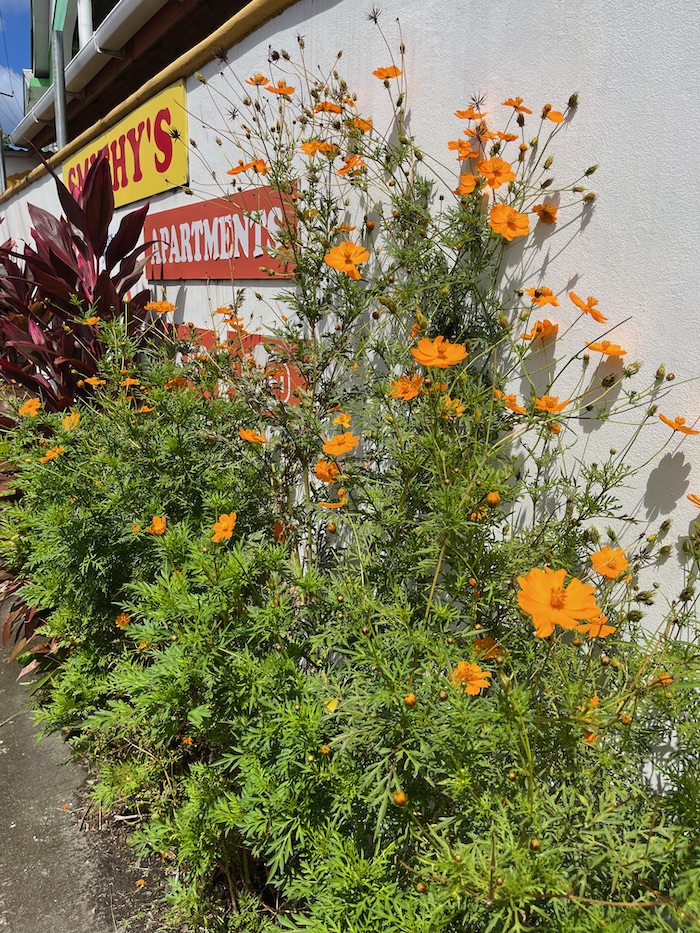
species cosmos in bloom against a wall in Portsmouth, Dominica

Weights and Measures Onboard

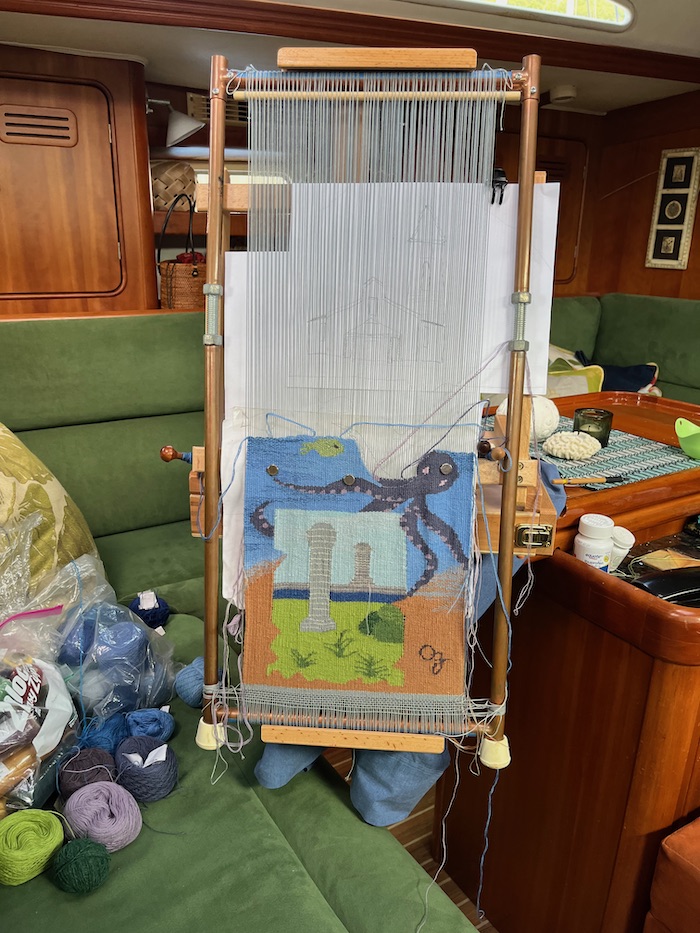
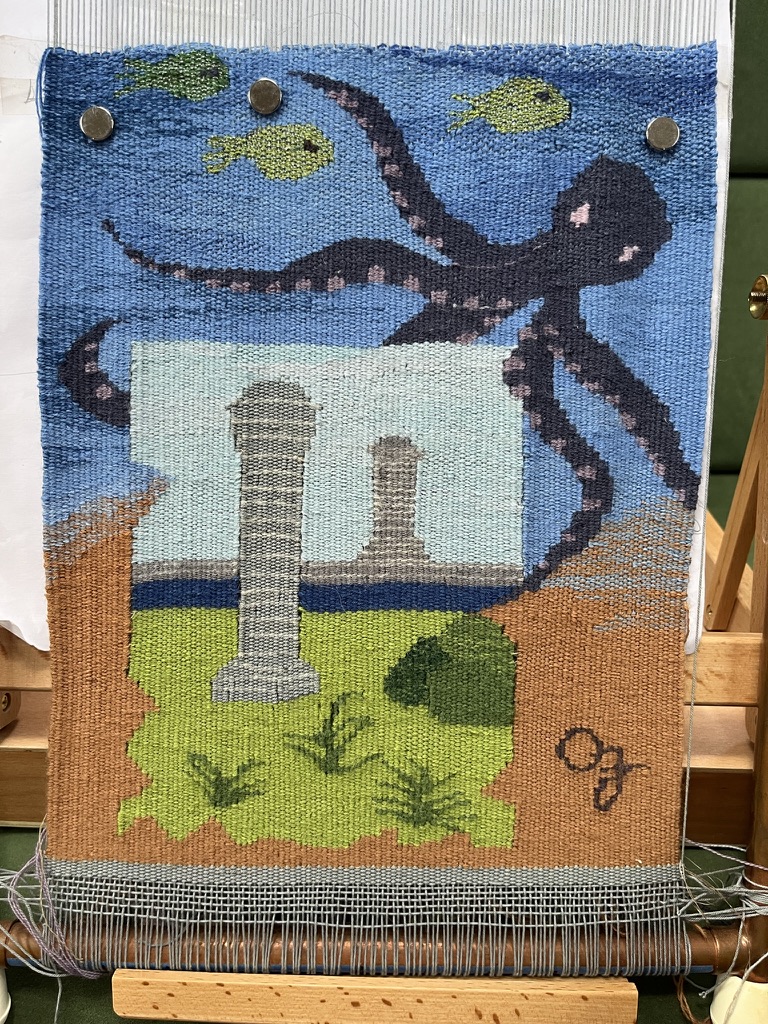
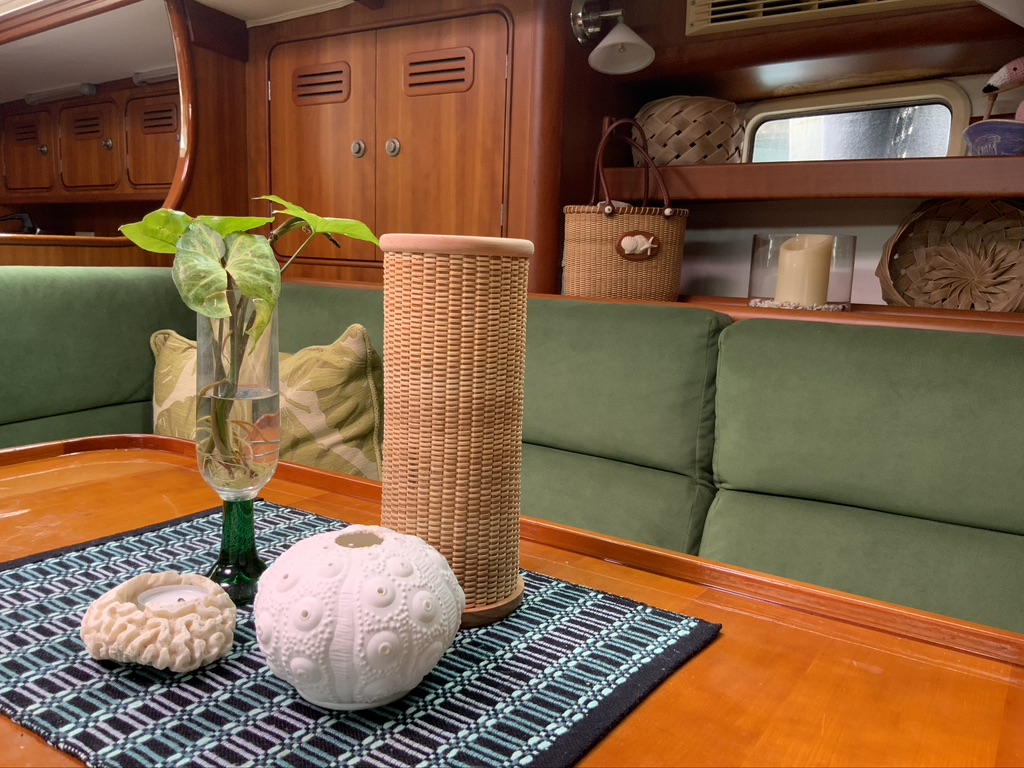
Here is my working space onboard. In yacht parlance it’s called the main saloon (I have always pronounced that ‘salon’), and it is the main living space down below on Pandora. It is connected to a small galley, and there is an aft cabin toward the stern, and a ‘main stateroom’ forward of this room. That’s a glamorous phrase for where we sleep. It doesn’t seem ‘stately’ at all.! I am very good at making a huge mess of our limited living space. We had a couple of days of calm conditions in Deshaies, and I took good advantage of it to finish the first part of this tapestry that I started in May of 2020–more than 2 1/2 years ago. My heart has not been in it, perhaps because of some bad memories of that year. The odd thing is, when I sit down and work on it, I enjoy it. Go figure.

Now I am ready to slide the woven section partially around to the back of the loom in order to keep weaving. I hope to do that today, when I finish this post. The conditions in Les Saintes are not nearly as calm as they were in Deshaies, and that is why I have not gotten back to work on this piece. I’ve been lucky to knit, which was only once. Otherwise, I’m just trying to keep my balance onboard!

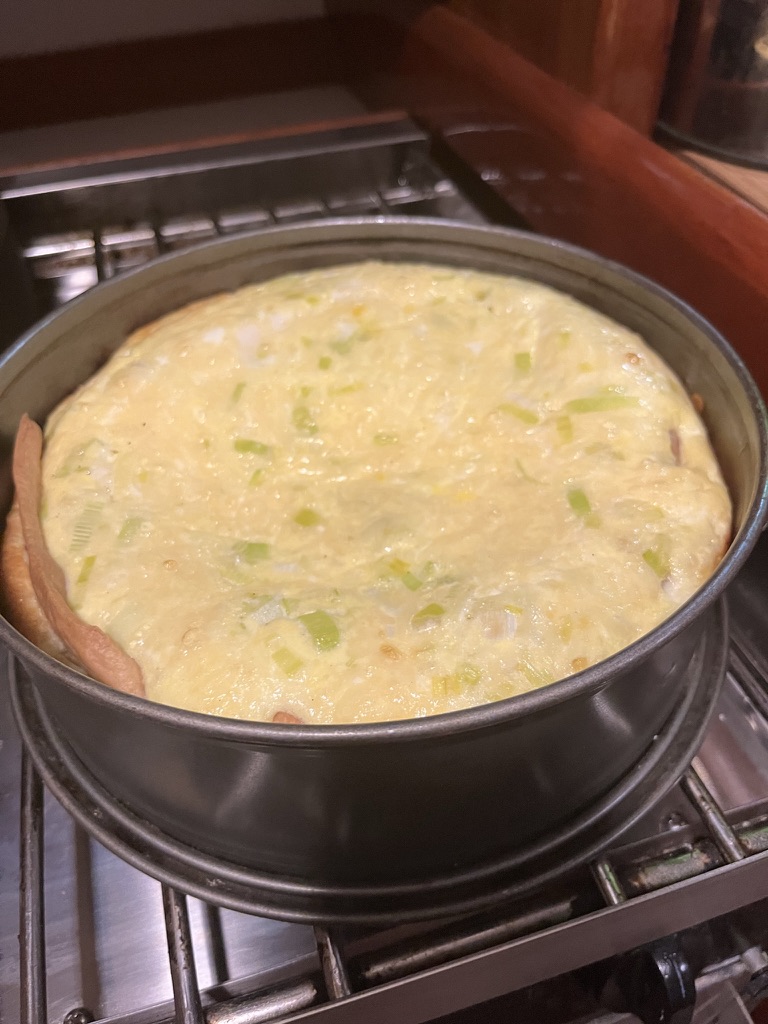
Weights and measures have factored rather significantly over the past few weeks. First I attempted to weight the merino/silk top I was spinning because I wanted to have an equal amount of singles spun on each bobbin in order to have equal amounts to ply together into finished yarn. Have you ever tried to weight something on a boat? The gentle, and not so gentle, up and down movements on a boat raises havoc with a scale. On the scale the read out for my merino/silk to cycled up and down by about 10 grams. I usually just try to pick the number in the middle. When baking a cake it’s far more important to get it right! Here was my guess for baking a quiche. It was not perfect, but we certainly thought it was good.

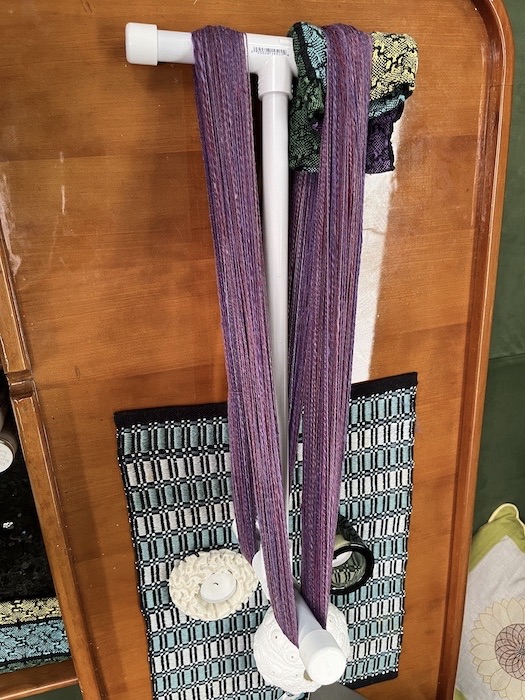
I also wanted to measure the length of that newly spun and plied yarn. Luckily Bob found PVC pipe at a hardware store just outside Falmouth, Antigua, and he made one that has a central arm of 18″. The yarn winds four times around that central core, for a total of 2 yards per single go ’round. I was able to measure that my merino/silk skein is 840 yards, plus or minus probably 10%. I can’t measure this accurately until I get home. Winding on a niddy noddy, or anything else, depends on the tension you use to wind. Too tight, and you’ve got quite a bit less yardage than you think. It’s hard to wind too loosely because of the nature of this repeated action. In general, we all tend to get tighter and tighter even when we are trying to avoid that. I took my time and tried to ‘stay loose.’ We’ll see.

This niddy noddy absolutely will not come apart, even though it is not glued. I wonder if that is due to the heat and humidity of the tropics. I padded one of the arms with a folded napkin, hoping that would give me some ‘wiggle room’ to get the yarn off when I finished winding. It worked.

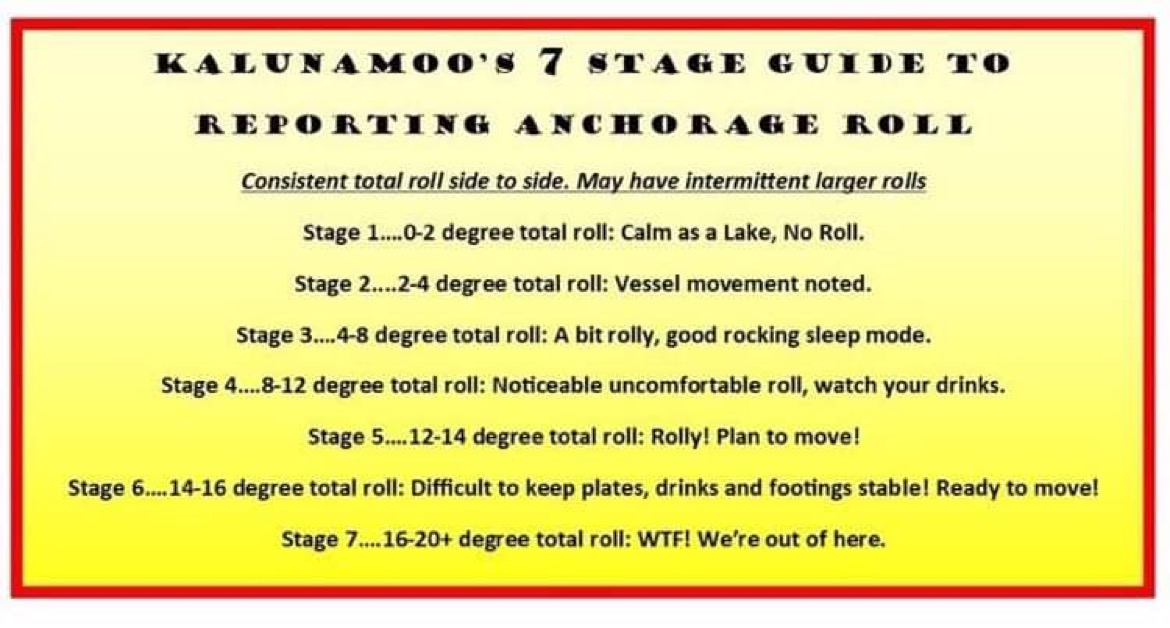
We’ve been in Les Saintes for three days. The conditions here are rough, but the place is scenic. You can’t have everything. Below is a chart that our good friend aboard Kalunamoo created to measure of how UNcomfortable the ‘harbors’ down here can be. Most places are not harbors at all, simply coves or bays in which you can throw down your anchor, but there is no protection from the sea conditions. In Antigua, we were in real harbors, both in Falmouth and English Harbour. That’s a great way to start a winter of sailing, and really quite a come down for the rest of the trip. Deshaies, Guadeloupe is between a 3 and a 4 on Bill’s chart. In Les Saintes, we rarely get a mooring ball right near the village on our arrival, so we have to spend at least one night anchored between the islands of this archipelago. The roll conditions are consistently between stage 5 and stage 7. It’s awful. One night while I was sleeping a book jumped right off the shelf above me and clobbered me in the head! It was a rude awakening. The next morning I discovered that my glasses came down with the book, and I had fairly mangled them by tossing and turning all night on top of them. Bill Woodroffe writes a great blog about the lifestyle of living on a boat here.

Luckily we only spent one night on anchor, and early the next morning we were ready to head closer to shore in the village (Haute de Terre) to grab a mooring from anyone who was heading out. We were on a mooring by 7am.

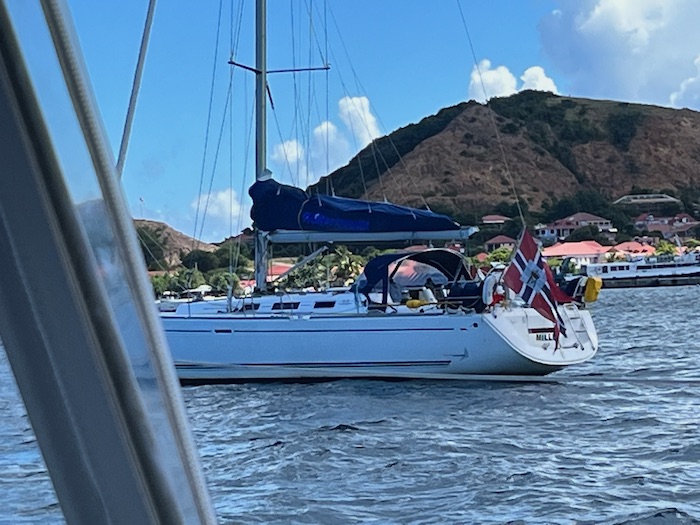
One thing I measure while we are traveling aboard each winter is the home ports of all the boats that are anchored or moored nearby us. Antigua had a predominance of Union Jacks, in all the varieties that signify the colonies and protectorates of the UK. There were some number of French flagged boats, as well as Canadian, and Norwegian/Swedish/Danish, with only a few Dutch flagged boats. I saw a few Swiss and German boats in the mix. The past decade of sailing in the Caribbean has honed my flag recognition abilities. In the French islands, the French flags outnumber the British, as do the Scandinavian boats. I’m used to looking up the variations of the Union Jack when I’m curious about exactly where some of these boats call home. Yesterday I saw a variation on the Norwegian flag that caught my eye. It is currently the most beautiful flag I have seen!

I know it’s hard to see the detail on the flag. It was waving in a fairly strong breeze, as I attempted to catch it mostly open. It’s a Norwegian flag with a triple swallow tail, something I’ve never seen before. Usually swallow tail flags are associated with yacht clubs. This flag is the ensign of the Royal Norwegian Yacht Club. It’s a beauty, even though the boat is not.

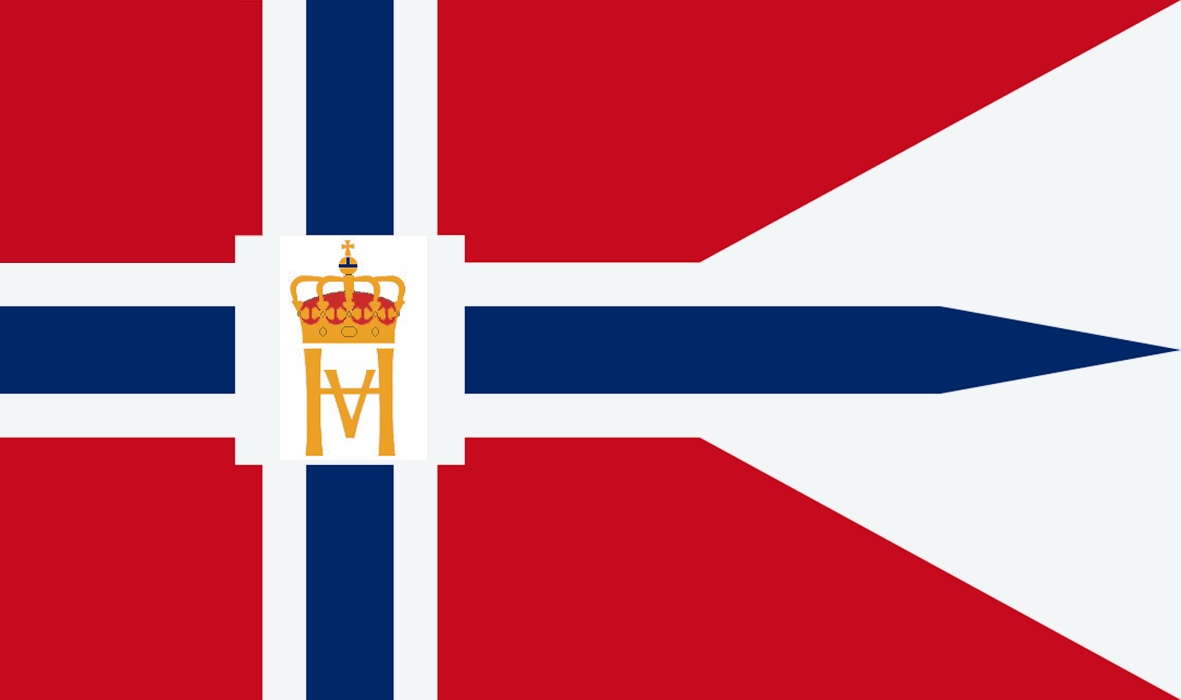
The beautiful center crown and IVI design was Haakon II’s royal emblem, which he granted for use to yacht club members starting in 1906. This image shows a standard flag. The triple swallow tail has the two red points and center blue point with a narrow white outline. This image is from wikipedia.

Identifying the flags of countries in all the places we visit keeps me entertained. In these islands not many natives speak English, so using my almost non-existent French keeps me on my toes, and is something I am attempting to improve–therefore, another form of measurement. Food words are somewhat easier than everything else, since I have a moderate familiarity (and love) for French food! Everything outside of food is quite a challenge for me!

Bob measures more things than I do. He’s constantly tracking how much electricity we have made with our solar panels and wind generator, and when we are motoring, how much power the engine made. He weighs that constantly against our usage. We now have a star link gadget for the internet and that is big energy guzzler. We need to make hot water for showers, we need to make that water (!), and we need lights at night and energy to run our gas stove to cook. It all adds up, and Bob spends a lot time measuring the input and output of energy. He says he enjoys living off the grid. I say give me a light switch and instant access to heat and electricity. It’s quite a process to start cooking on Pandora, not to mention taking a shower or any of the many things we want to do daily. I am not an ‘off the grid’ kind of girl.

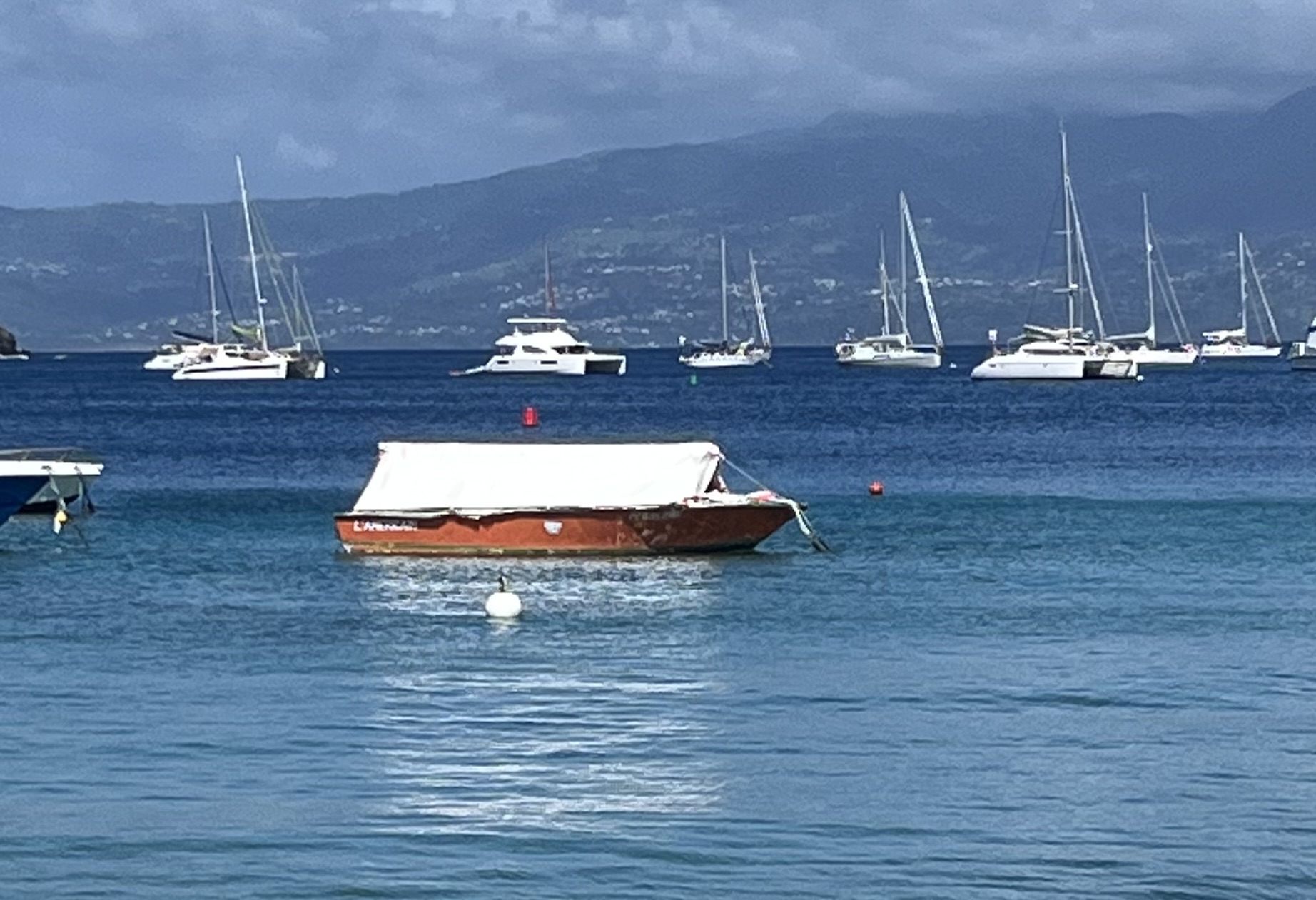
Here are some scenes from Haute de Terre, in Les Saintes. This was the view from our table at breakfast this morning.

Pandora is out in the distance. She’s light grey and just forward of the bow of the boat in the foreground

How about a close up?

Pandora has a light grey hull, in the distance, just forward of the bow of the boat in the foreground.

This is an idyllic place, and it would be perfect without the wind and the rolling conditions. Photographs are also a measurement of sorts. We take the ones we love, and sometimes we share them. Au revoir for now.

Views of the New Venue

Like many people, my work space is my living space onboard. I’ve posted plenty of photos over the years of projects underway in the main saloon or cockpit of Pandora when she herself is not underway! I cannot work when we are sailing, only when we are anchored or at a dock.

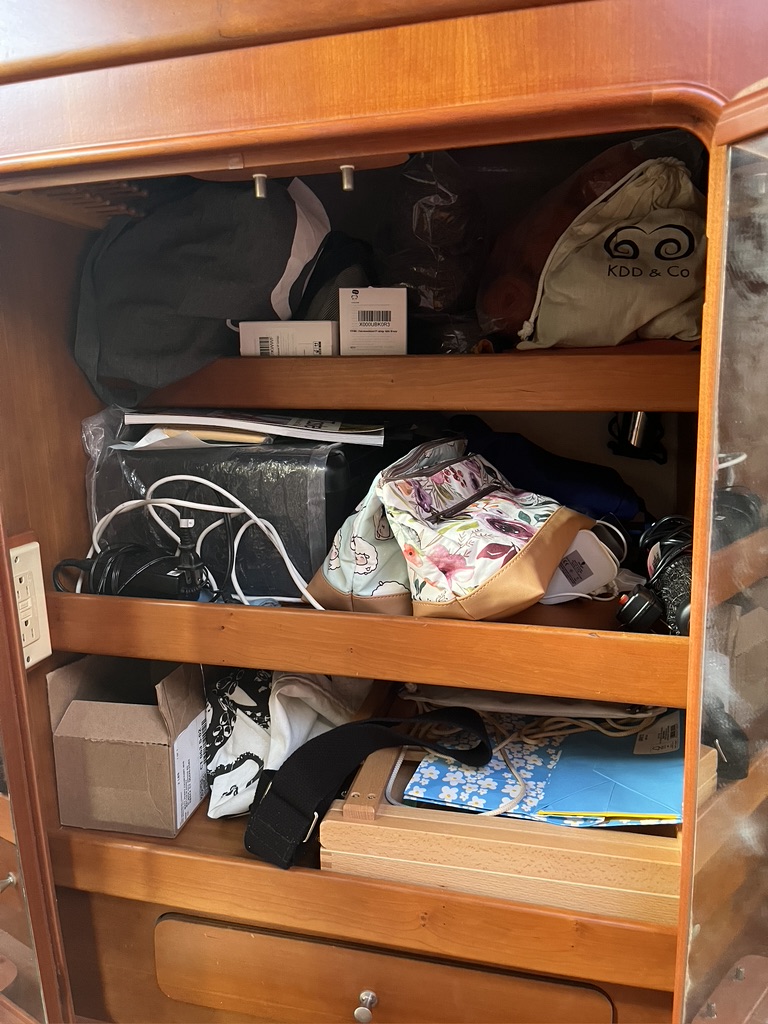
Here’s a look at how I manage my projects onboard. This is where most of my supplies are stored. This 3-shelf cabinet extends back further than I can illustrate in a photo. This year it is holding three knitting projects–the hot water bottle cover and two sweaters– my little Nano 2 e-spinner plus merino/silk fiber to spin, a rather large supply of tapestry yarn for weaving as well as another pile linen yarns for experimenting on a new tapestry design, and various tools. I have two copper pipe frame looms onboard, and they are stored in the hanging locker that holds Bob’s clothes. They couldn’t possible fit in my hanging locker, and luckily Bob is a very good sport about my need for equipment and stash!

On the bottom right of this photo there is a folded maple contraption that is my new tapestry stand! I have great expectations that this will make weaving onboard more comfortable. There will photos in the future.

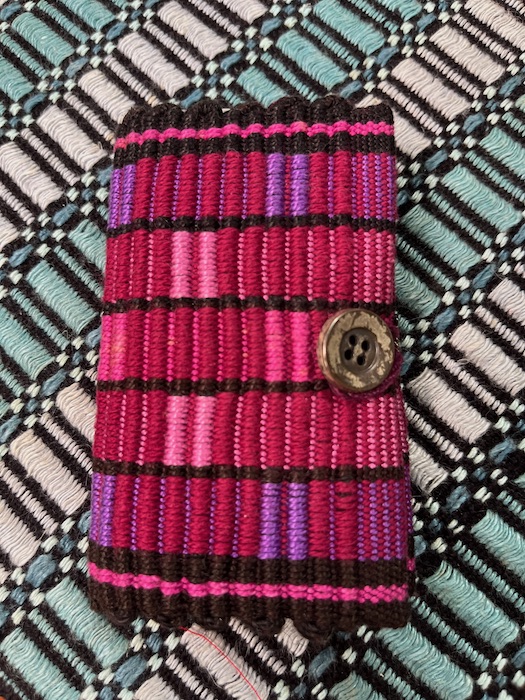
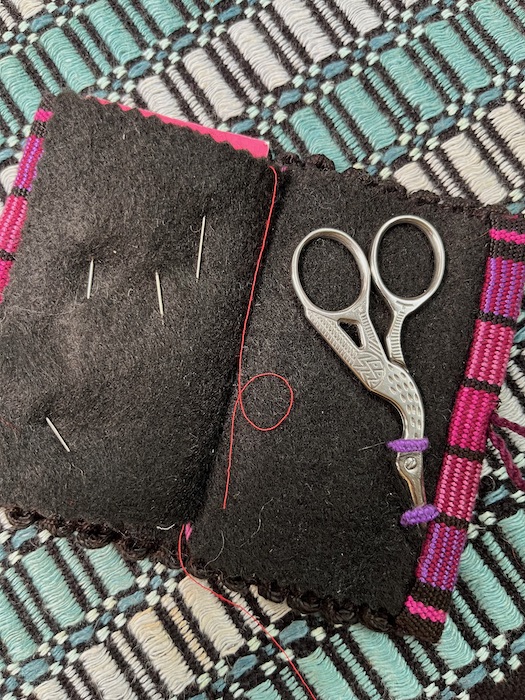
Here are two little gems that hold tools. The first is a wonderful woven envelope by Lucienne Coifman (of rep weave fame), who is a member of my weaving guild. I have a number of small items from her that she makes from samples. Her hand finishing is exquisite.

There is a embroidered loop for the button similar to the loops that hold the scissors in the next photo. Lucienne’s finishing work is equal to her fine weaving.

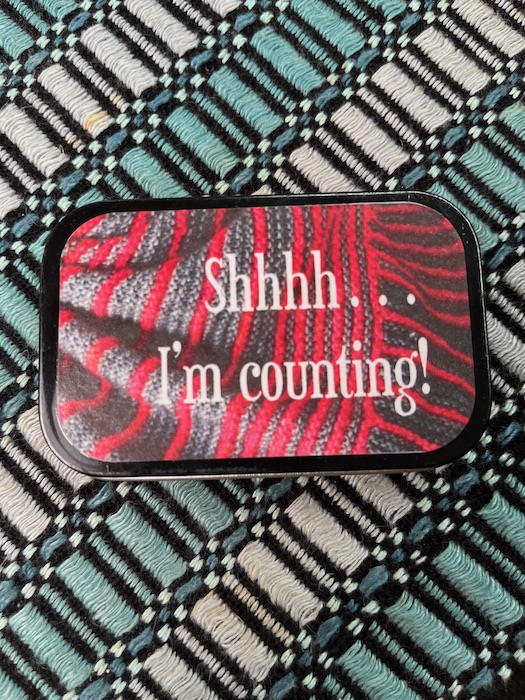
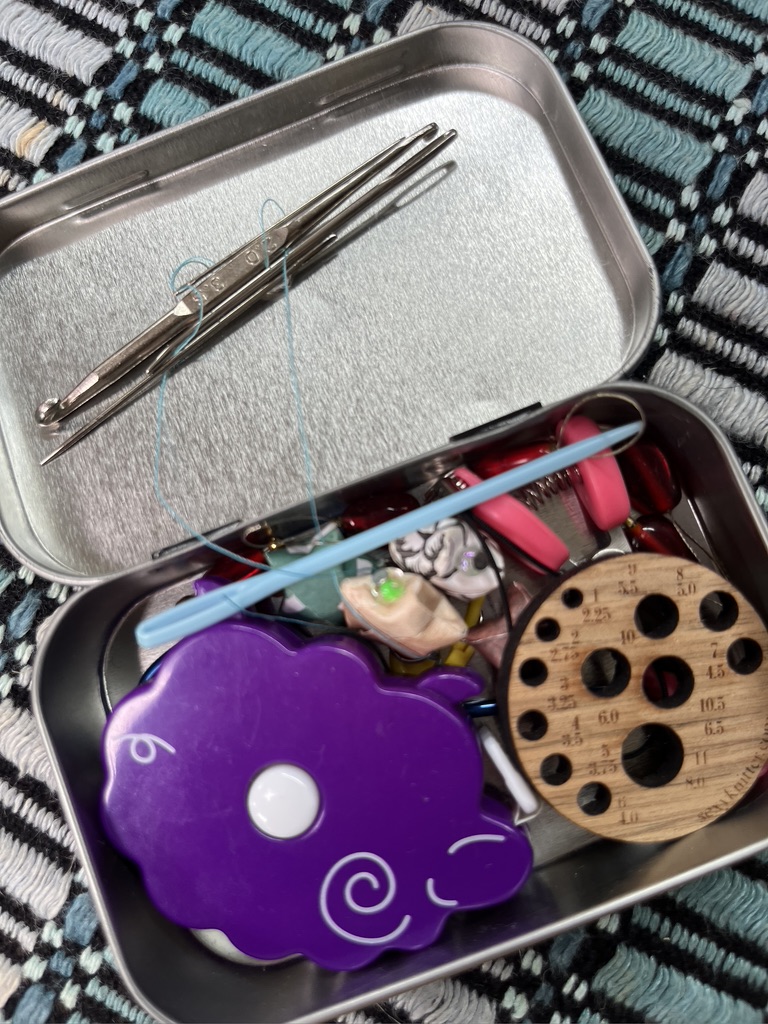
Then I have this small tin full of handy tools.

This is the best small tool kit I’ve ever owned. It even has a ridiculously tiny pair of scissors. Can you see them? On the upper right of the tin, with pink handles. You can see that there is a tape measure, a needle gauge and various needles, along with a small crochet hook for picking up dropped stitches (although I never pick up stitches that way). What you can’t see are various stitch markers.

Having extra knitting needles onboard along with tools is worth far more than their tiny weight and size. Ellen, who started the knitting group, has given me a little envelope of dental floss threaders which will get added to this tin.

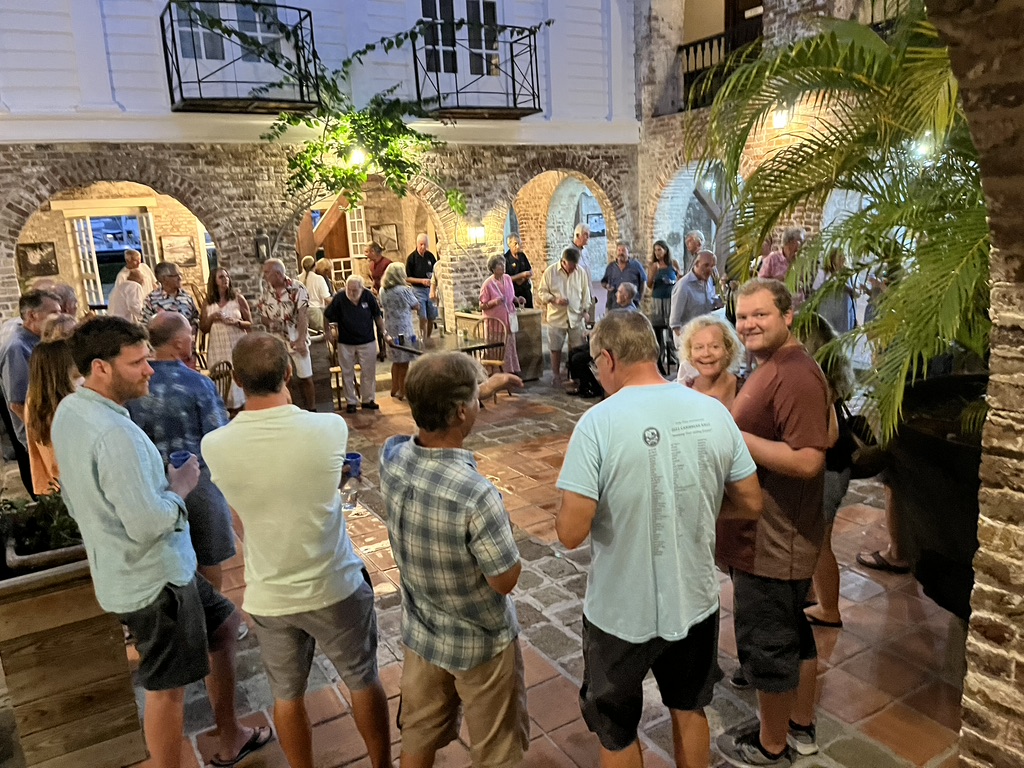
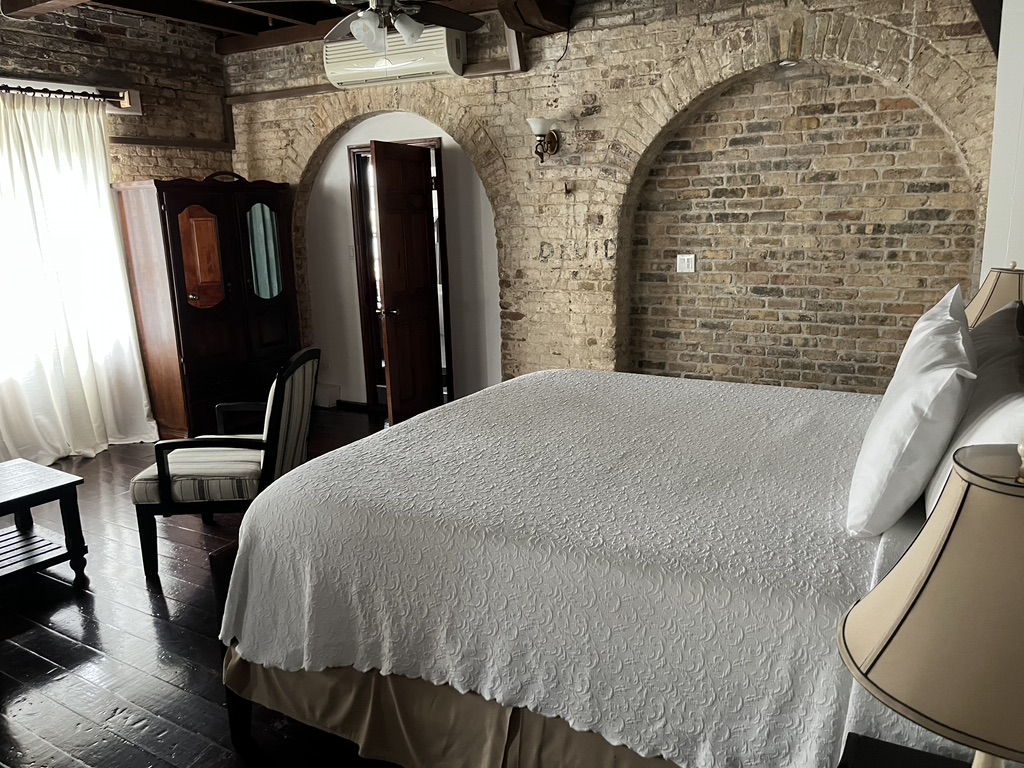
We’ve also had a change in venue for two days last week, which merits showing. Life onboard can get pretty small. I’ve always called it “Living small, with a big view.” Back in November when all of the sailboats that rallied together arrived in English Harbour, the national parks administration here threw a celebratory dinner to commemorate the arrival of so many sailboats. You can see some great photos of this on Bob’s blog. At that event the Minister of Tourism gave Bob the gift of a two-night stay at the historic Copper and Lumber Inn that is part of Nelson’s Dockyard. It’s a place where the Tot Club meets weekly, and this is a photo I took when Bob invited the fleet of our boats to be guests at a tot.

Tots take place in the courtyard of the Inn. I have only been up on the balcony once, last year, to get a similar photo before the tot ceremony began. This year it was a thrill to actually get to stay in this beautiful, historic spot.

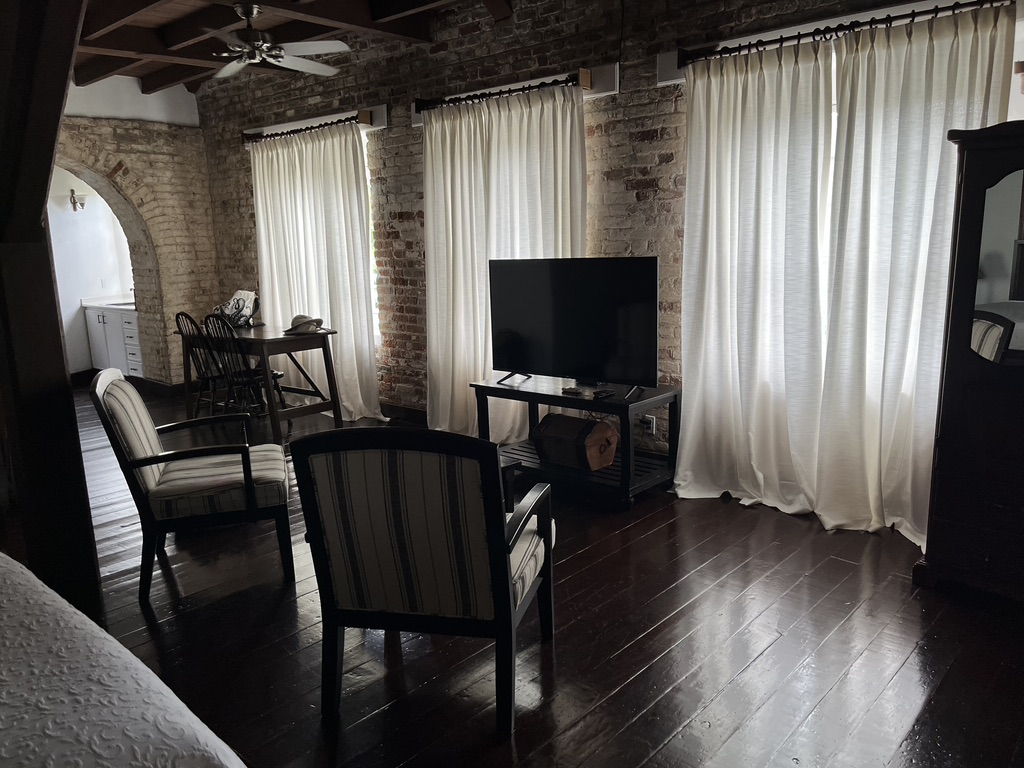
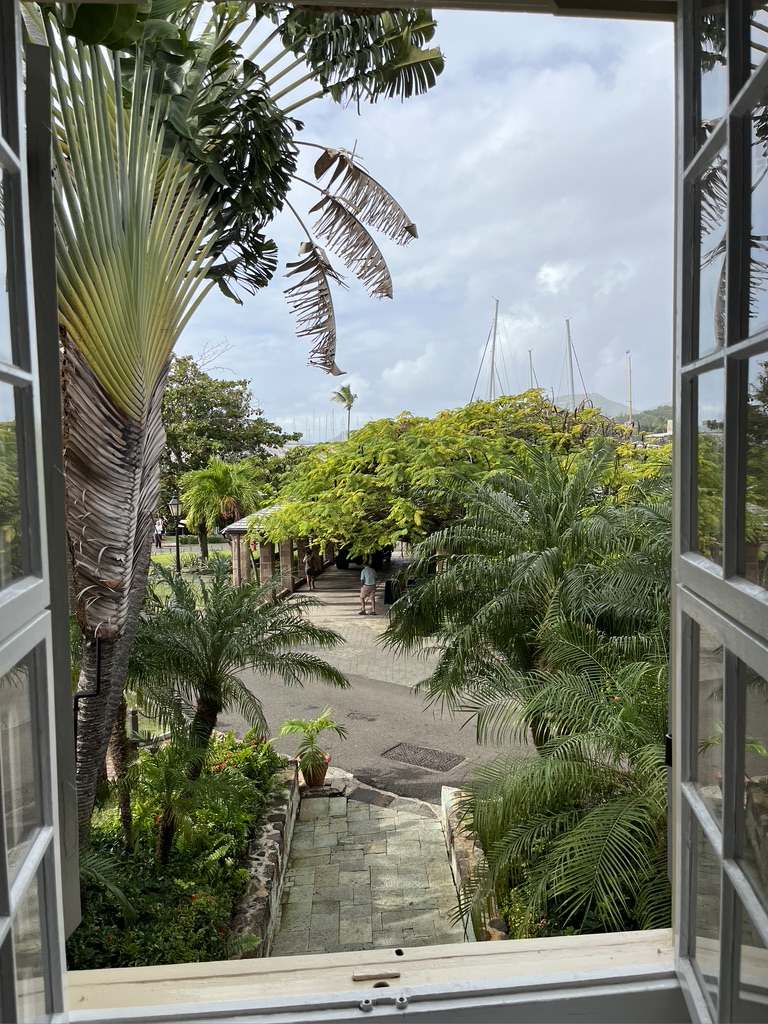
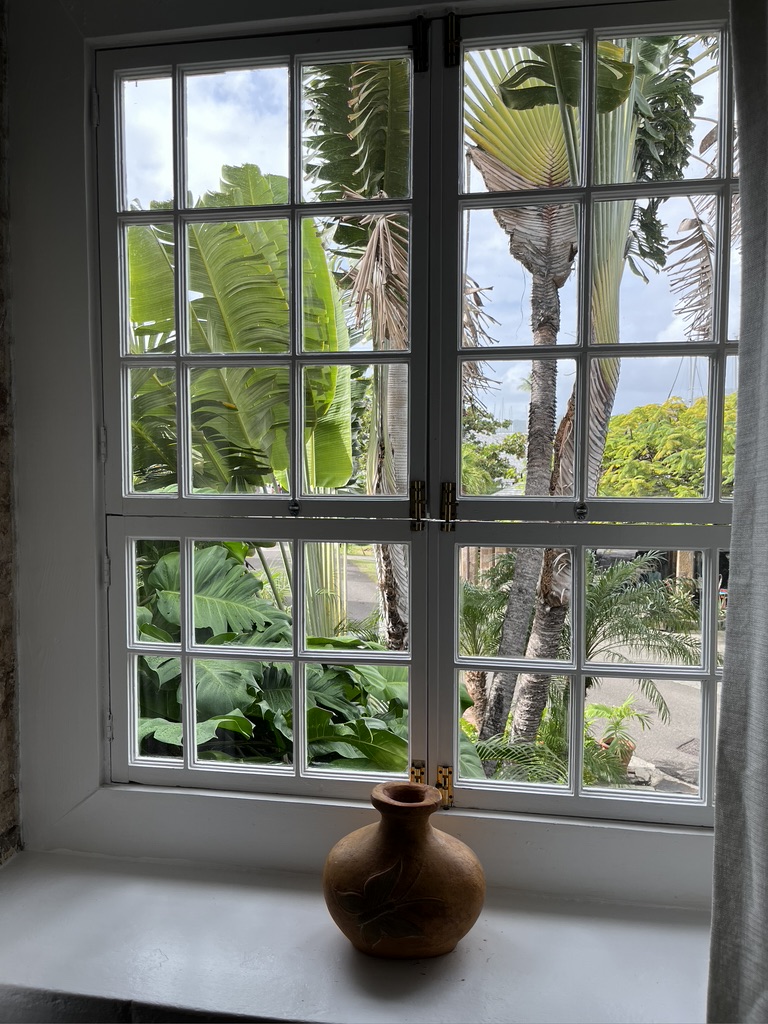
There were three large double windows, which had stunning views. In the previous photo the drapes are drawn because the light completely washed out the interior. But of course the views were the best part!

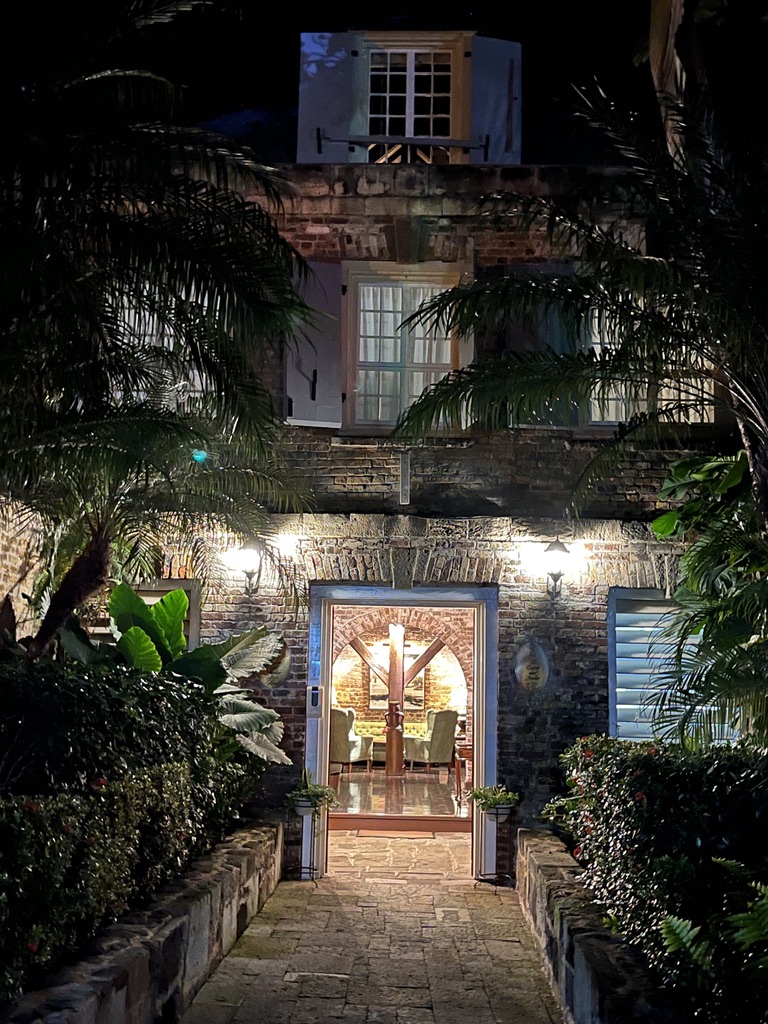
Copper and Lumber is particularly beautiful at night. Above the entrance are the three windows of our room.

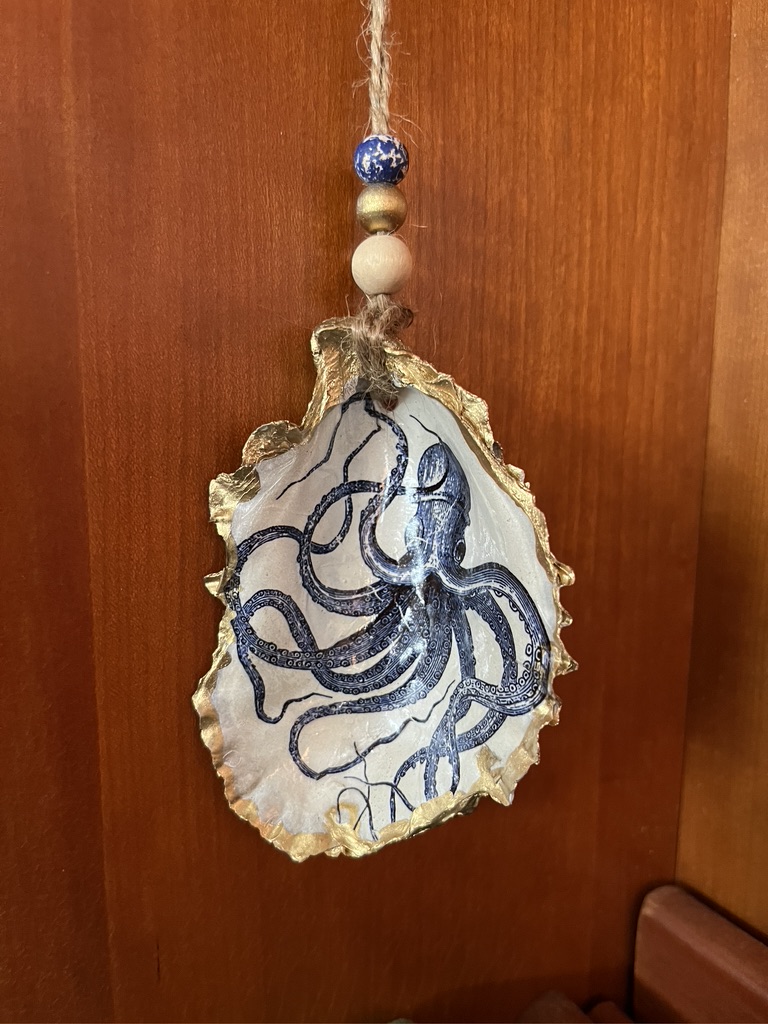
And back on Pandora, we have some new views this year. I brought one Christmas ornament from home since I wasn’t ready to give up the holiday when we came back here.

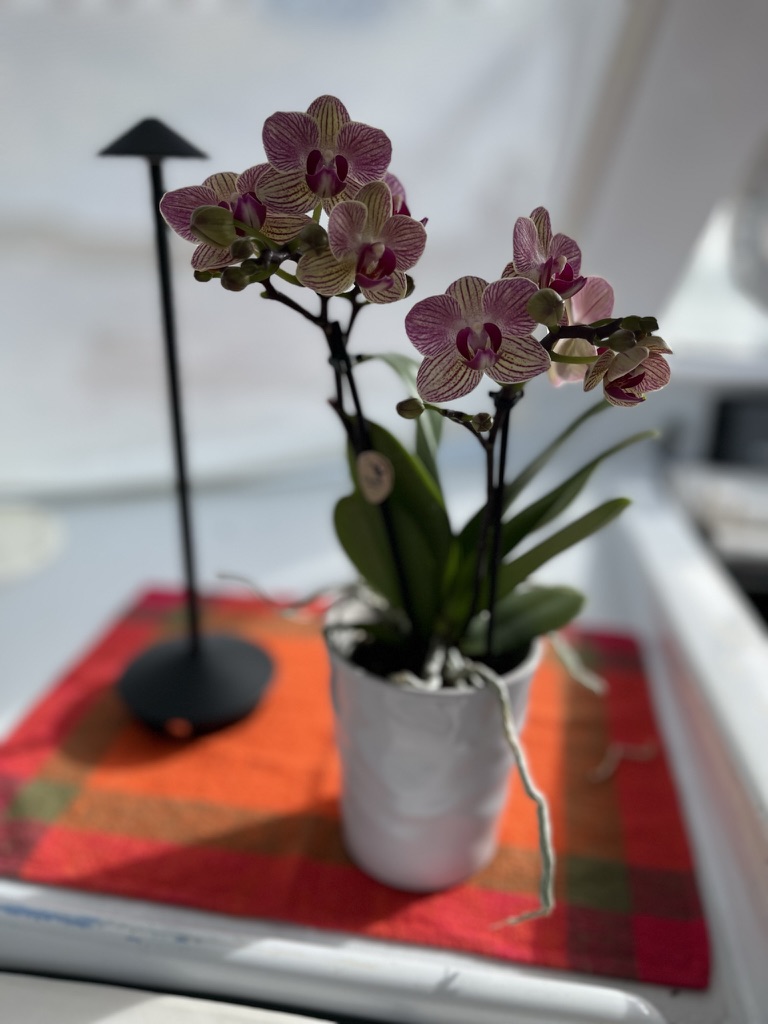
We also found orchids for sale at the local market! We could not resist getting one since we left our little family of phalaenopses and a paphiopedilum at home in the care of Melody and Chris.

I’ll close with a video Bob took of how my little Nano 2 spins. I am enjoying it, and I’m using the time to think about how to proceed with the tapestry experiment I want to try. Soon.

Life onboard is well underway this year. I hope it will be productive.

Mother Nature Always Has the Final Say

The pre-modern world is still very much on my mind after seeing that ancient, worn piton and imagining the fearsome sea monster it would have seemed to an ancient sailor. Lately I’ve been thinking how ridiculously removed I am from nature in the modern world. I turn up our heat, turn down our air conditioning without a thought, I store our food in near perfect conditions in our freezer and fridge–even on a boat! I mostly leave home in the cocoon of my little mini cooper, so that there is not much weather that keeps me confined at home. Anyone who camps or lives on a boat knows that weather rules everything we do.

This morning, while having breakfast at a cafe right on the dock in English Harbour, Antigua, we all felt the wind gather speed. One person at every table jumped up to run back to boats to close hatches so our beds would not get wet in the coming squall. Meanwhile, we all continued to sit at our dockside tables, out in the weather, rain or no.

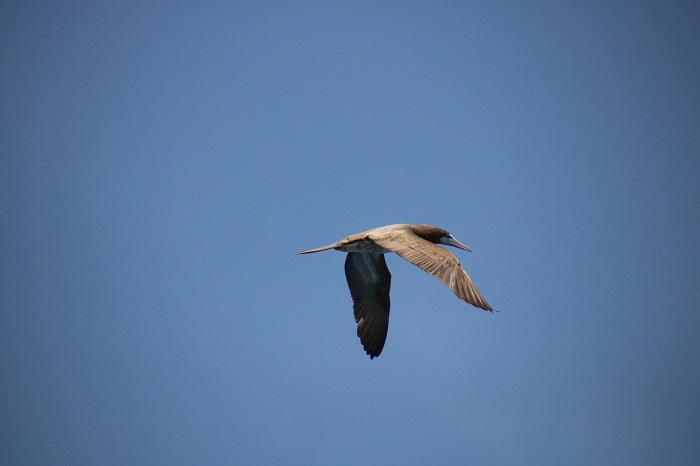
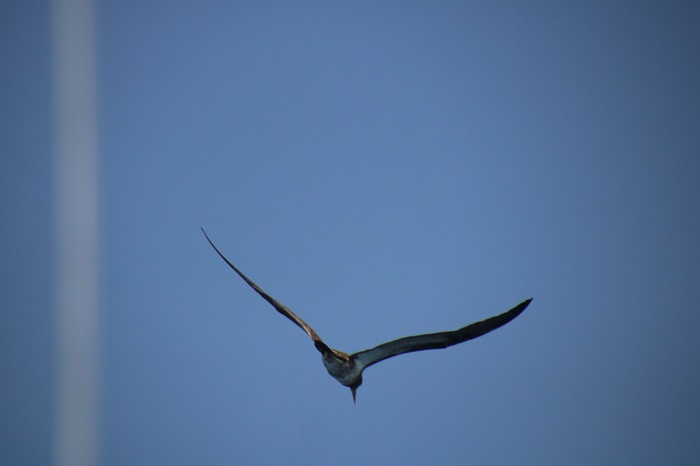
On our sail back to Antigua from St. Lucia we experienced a moment of epic nature that has stayed with me over the past two weeks or so. The low angled light of morning is perfect for watching flying fish jump out of the water as the keel of Pandora slices through their fishy schools. It’s amazing to watch them leap out of the water, their winged fins flapping furiously. In that perfect light their fins sparkle like diamonds and remind me of what fairie wings might look like, similar to a dragon fly’s wings, but entirely white. I’ve never seen a dragon fly with white wings. Some of these fish can fly so far, it is quite remarkable, like skipping stones made of faceted diamonds. I spent a lovely hour watching them glide above the water as Pandora’s bow sliced through the waves. Shortly after the fish started flying we were visited from above by several brown boobies. I thought they were gannets, but I’ve now found out better.

There was such a symmetry between watching the fish glide through the air, skimming over the surface of the indigo water, while birds glided high above us and swooped down so close to our bow and our sails. Those birds are great navigators maneuvering so close to Pandora. I wished I could see in all directions at once to follow the swooping birds and keep an eye on the flying fish. It was not possible. I saw that Bob had our camera out, trying to follow the exciting trail of just one bird.
If only Bob had gotten a photo that showed how close these birds got to us. They are so agile. In this photo you can see the blurry outline of our forestay.

I don’t think I do anything as hard as what the boobies and flying fish were doing as I watched. All that work for a such a small meal of fish with very little meat and so many tiny bones. And all that work for such tiny fish to fight for life–avoiding the giant boat hull lumbering at them, escaping from the depths to be attacked from above. What a hard life!

This has been an exciting season for experiencing nature’s extremes. The cruisers down here have all noted how much windier it’s been this year. Almost all of us have been visited by porpoise on our voyages, and several cruisers have seen whales. Bob and I think we saw a whale breach…in the far, far distance. No photo.

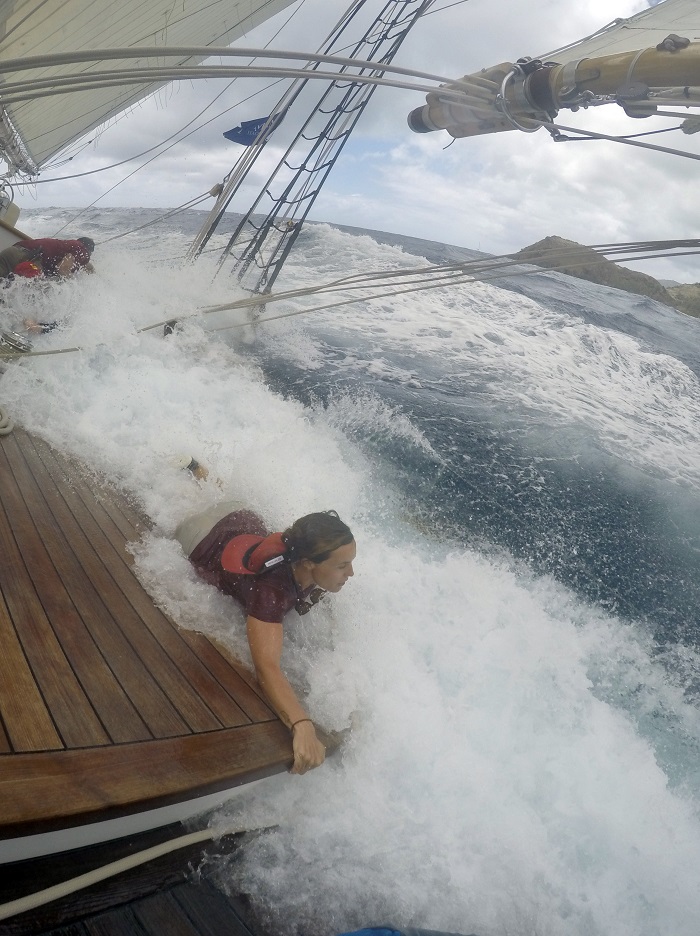
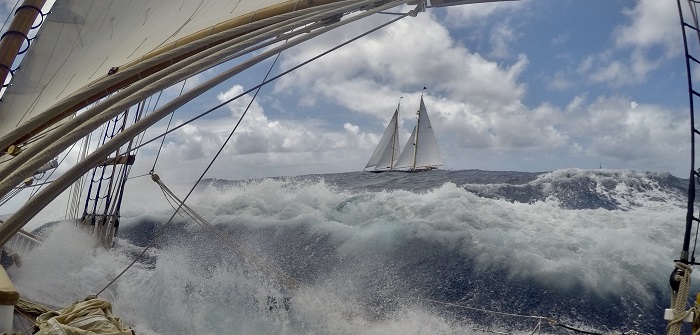
Bob is currently writing about his extreme experiences racing in the Classic Yacht Regatta aboard Columbia. That was extreme sailing! Everyday a few of the crew were swept down the deck by the force of the waves crashing over the bulwarks. The experienced crew were well versed in grabbing people as they slid by. Bob got tossed down the deck on the first day of sailing and was caught by a crewman who apologized for getting so ‘personal.’ Bob was thankful to be grabbed. A friend of ours got swept away on the 2nd day — not overboard, but he did have his pants ripped off entirely, and he got a nasty rope burn down his chest (and etc.) from the line he was desperately clinging to as he made that voyage down the deck.

One of the professional photographers sent these two images to Bob. No one is in charge at all, except the force of nature!

I can’t even tell where the bulwark is in this photo!

The islands of the West Indies are extreme in the best and worst that nature offers, although nature doesn’t make judgments like that. Nature just is. There are volcanic mountains and remains of pitons, rainforests, incredibly blue waters, skies and rainbows, and hurricanes. And when things go down it’s on a different scale entirely than when I decide to head home in my car, park in the garage, and get inside my house for comfort. Safety isn’t even on my radar. I just want to be warm and dry!

And thinking of home, we head home in three days. On Sunday night I’ll sleep in my cloud bed, and when the sun rises on Monday, I’ll be outside checking my gardens. With a little luck my flower boxes might hold miniature daffodils and grape hyacinths. The daffs at the top of our hill might be starting to bloom. I have to start preparing for Easter the things I want to share with our NYC kids and our grandchildren in Maryland. We have a short tour of the Eastern seaboard to take within a week of getting home. It’s all pretty exciting to this weary, and reluctant, sailor.

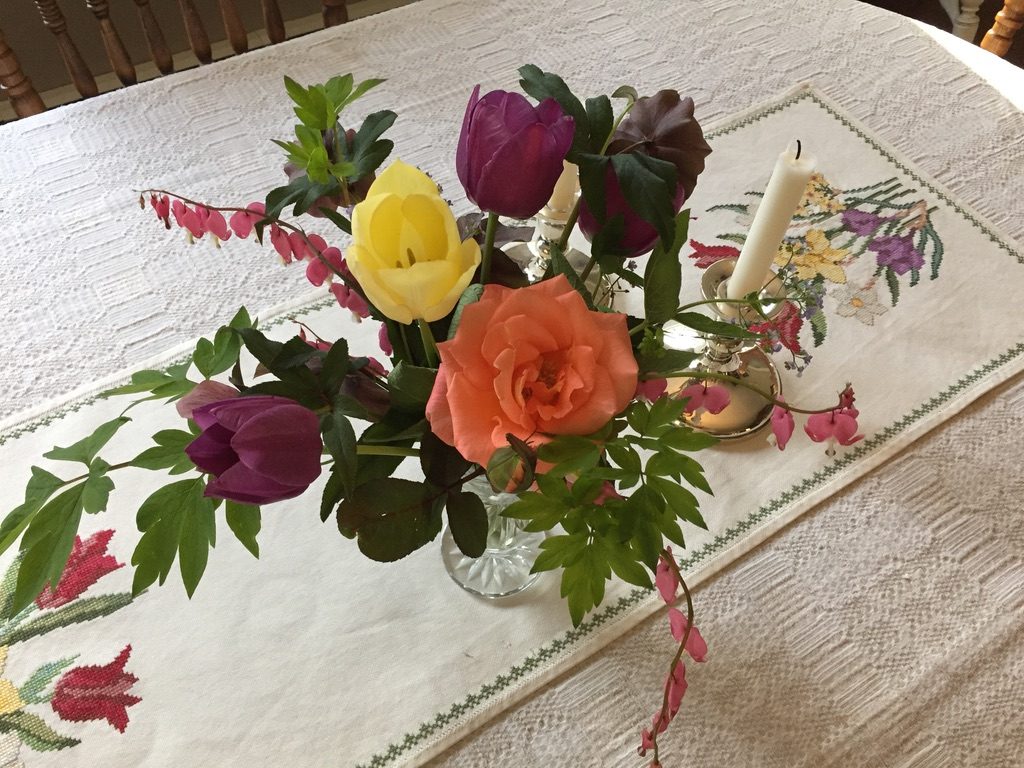
Earlier this week I looked at a few years’ worth of garden pictures, missing home, but also getting psyched for the return. I found this photo of a bouquet of my first rose of the season, with other spring flowers, from a few years ago–hellebore, tulips, bleeding hearts. I’m looking forward to all of these!

Ever the goal seeker, I have to make an accounting of the projects I have finished during the Caribbean season. I finished that blue sweater, knitted sideways, from cuff to cuff, more than a month ago. I have finished the orange vest, but cannot bring myself to put it on for a photo. For one thing, it really needs wet finishing to complete the look of the knitted lace. And I don’t have the proper clothing to set off this pretty vest! Some time ago I finished a Nanucket basket vase that needs a bit sanding and a coat of varnish at home. Not a bad showing for four months away from home.

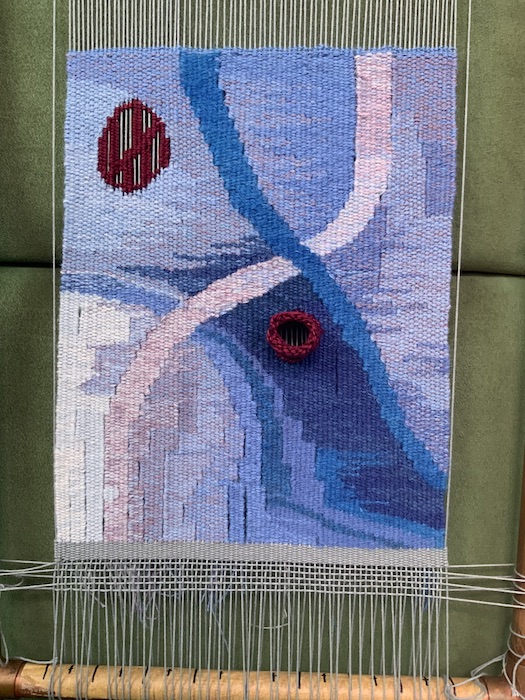
The bigger news is that I have completed everything I can do down here on my small tapestry. I now realize that I love embellishing things! The last time I added ‘bling’ to a tapestry was in 2015, when the Wednesday Group made portraits on chop stick warps that Archie made for each of us. I did a triptych of Greek characters: Artemis, Theseus, and the Minotaur. The best part of that project was thinking up non-woven ‘accessories’ to add to the weaving. Now, I am having the same fun embellishing my current small tapestry. I’ve added needle weaving and knitting so far. At home I will make a length of kumihimo in a pattern I know that uses three colors and looks a bit like snake skin. There are slits in this tapestry, and I plan to thread the braids through various slits.

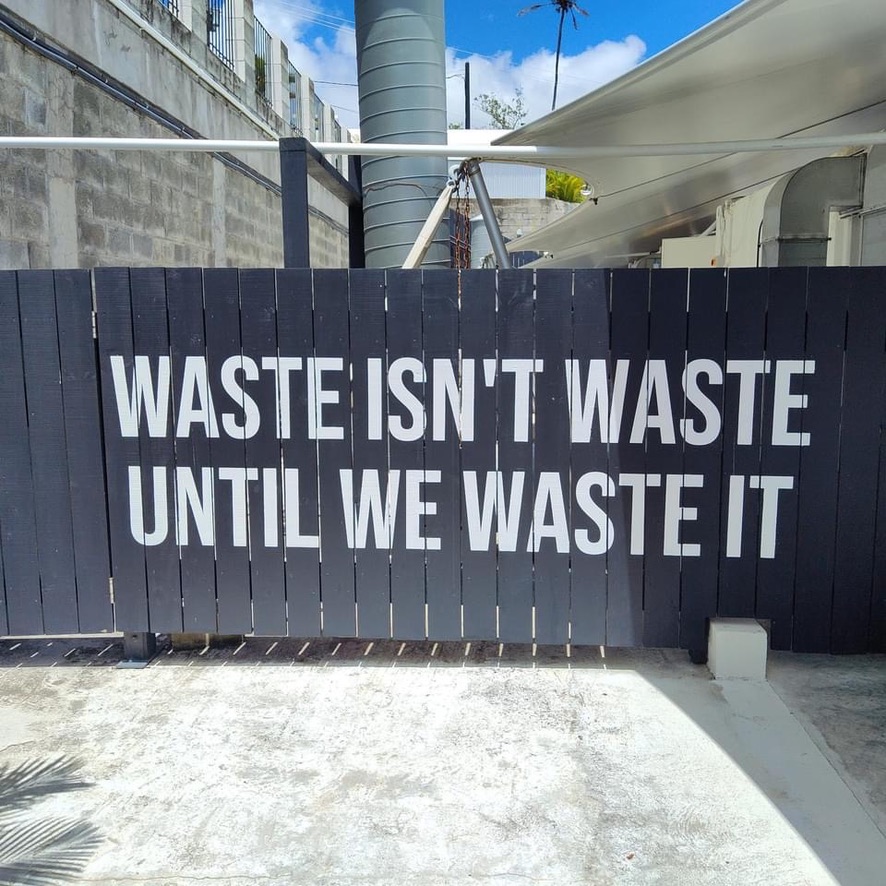
And one final thought on nature. My friend Stephanie on Hero took a photo of this sign we both saw during our time together in St. Lucia. So true.

Homeward bound, back to modern life.

Scroll to Top