ArgoKnot

bobbin lace

On the Weavers’ Trail

Over the weekend I visited the Working Weavers’ Studio Trail in Massachusetts, with my friend Jody.  We only had part of the day on Saturday, so we chose three studios that are about 1 1/2 hour drive from our part of Connecticut.  All three studios we visited were in Florence, Mass, just north of Northampton, the home of WEBS.

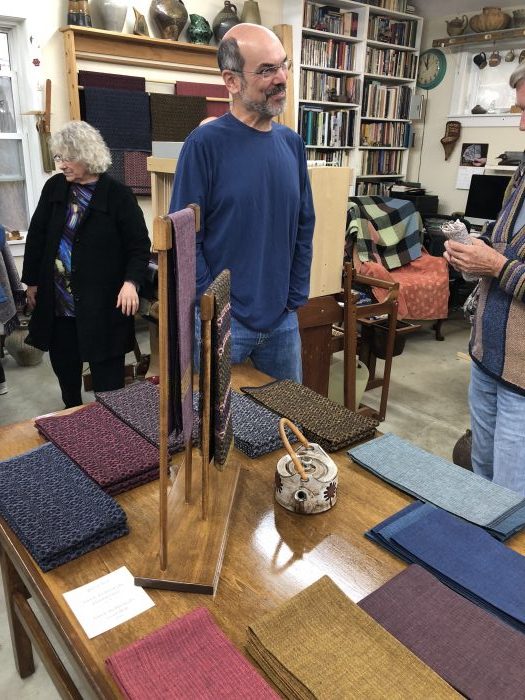
First we stopped at Scott Norris’ studio, which he calls Elam’s Widow.  He works mostly with linens which he dyes himself with fiber reactive dyes and mordants with soda ash and salt.  I am curious to try dyeing linen, and he generously offered to give me some tips to help me get good results. He weaves linen towels in several sizes, including large bath towels–in wonderful color combinations.
2017-10-14 10.59.48

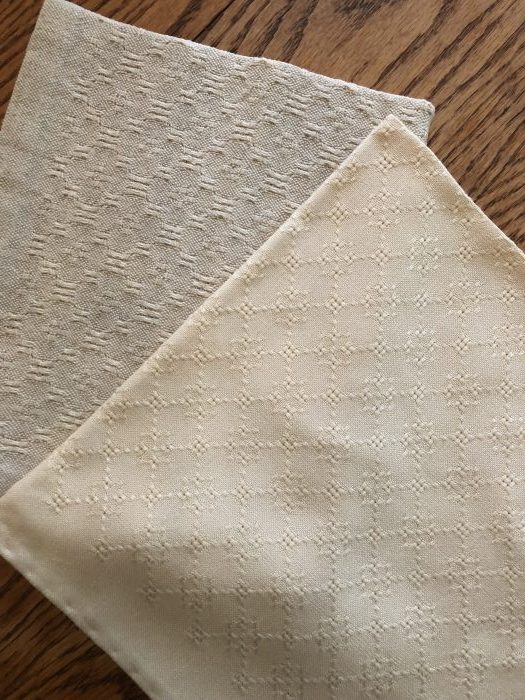
Jody and I both bought plain weave hand towels, like the ones in this photo.  I also bought a silk handkerchief–can you imagine?  Such a luxury, that I’ll never actually use!  It happened to be a huck pattern that is similar to one I’ve woven myself as napkins, in 40/2 linen.  Here is a photo of the two together.  This pattern really sings in silk! I wish you could touch it too.  Amazing!
2017-10-16 11.42.41

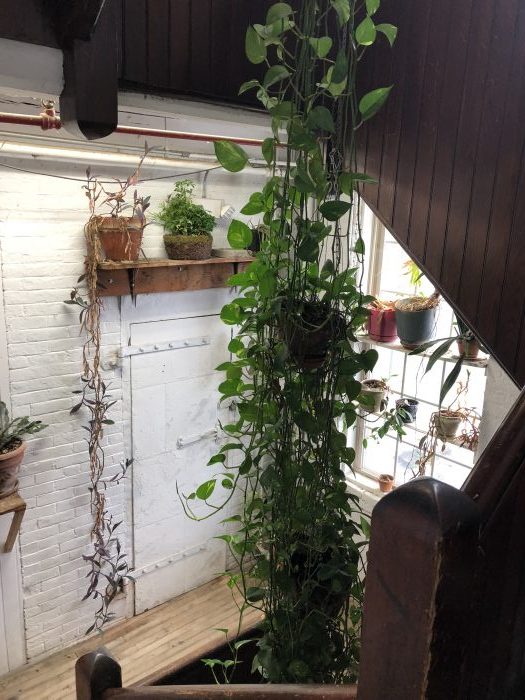
Nearby was a wonderful old manufacturing building, called the Arts and Industry Building, that has been turned into artists’ studios.  Two weavers have studios there, Christina Hammel and Paula Valeta.  Chris’ studio is on the 3rd floor and the stairwell is part of the experience of visiting.  The stairwell is full of light where plants are growing, and the stairs and banisters are original vintage, well worn wood.
2017-10-14 11.17.32

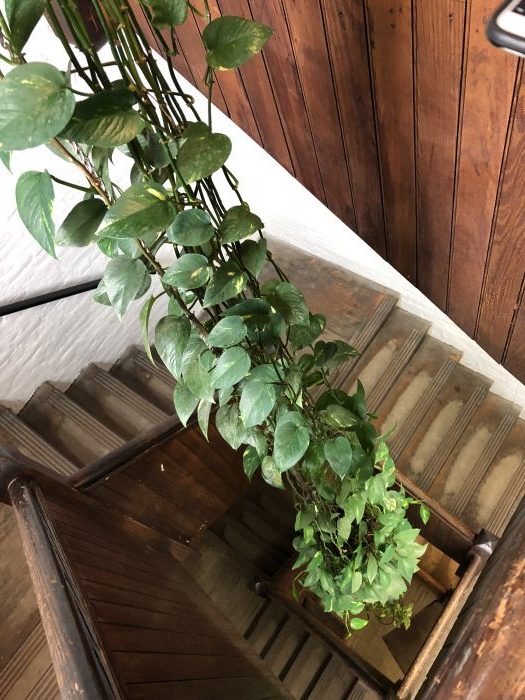
There is a philodendron ivy that hangs from the 3rd floor and has grown all the way down the stairwell.
2017-10-14 11.18.01

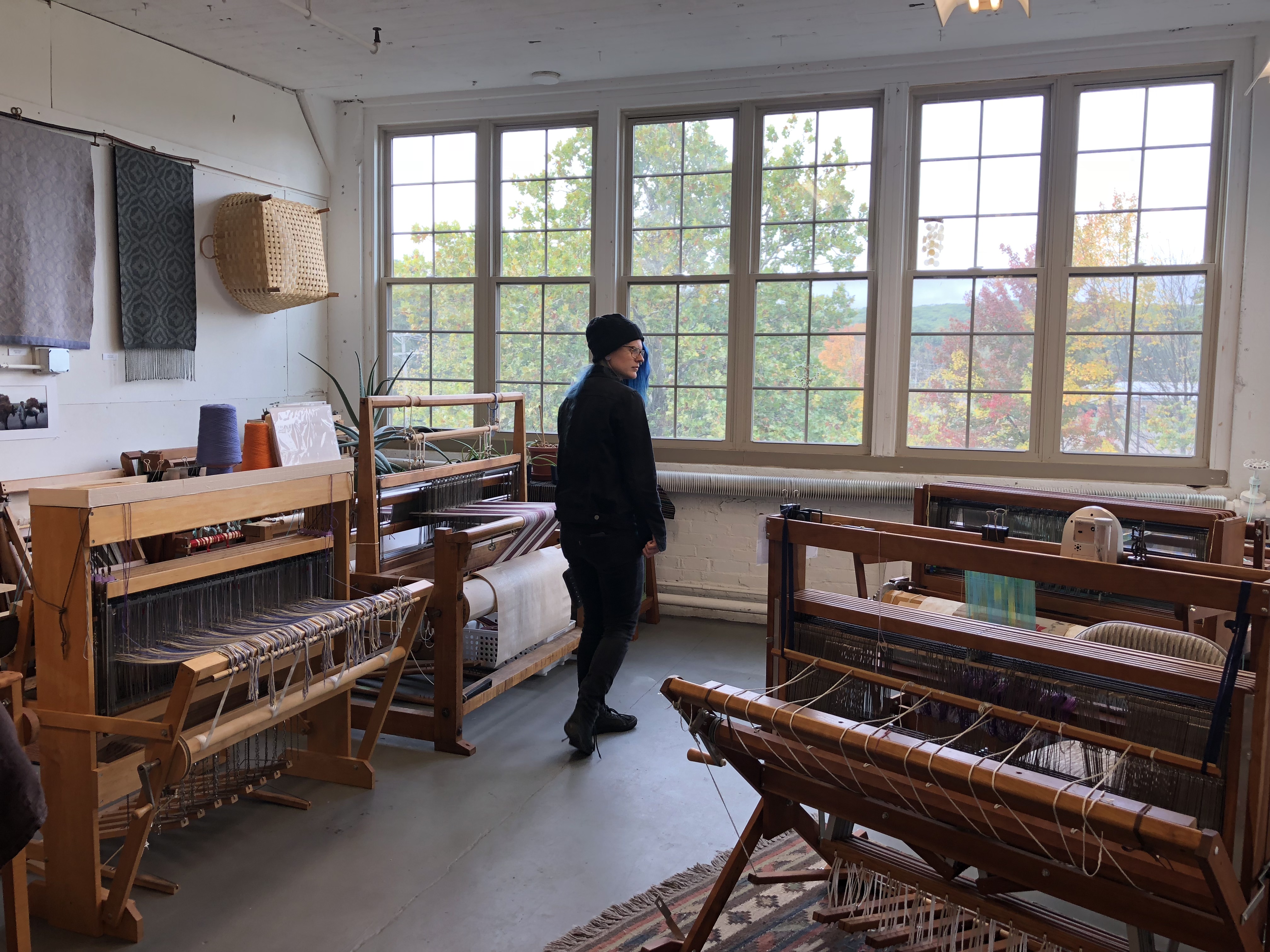
Chris Hammel’s studio has lovely views of the far hills.  What a great place to work!
2017-10-14 11.24.51

Chris is an instructor at the nearby Hill Institute, and maintains her own studio in this historic building.  Along with items for sale, she had a display of various weaving techniques for visitors to see.  I loved these shadow weave table linens, especially the orange borders!
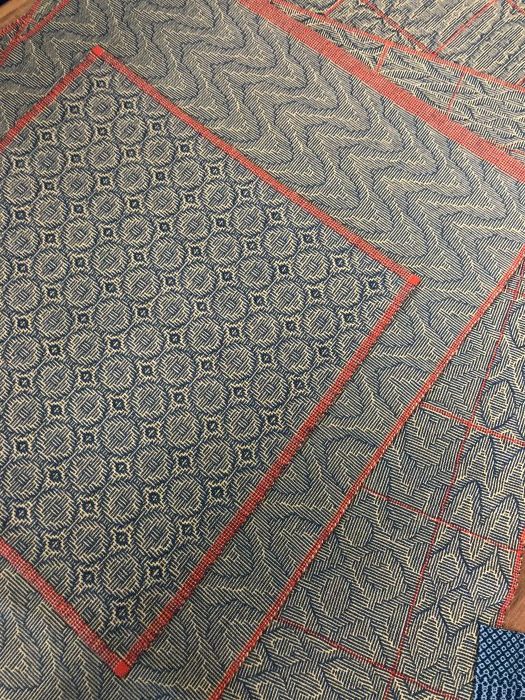
2017-10-14 11.31.18

I love the color choice in these towels and the little woven turtle in the book.
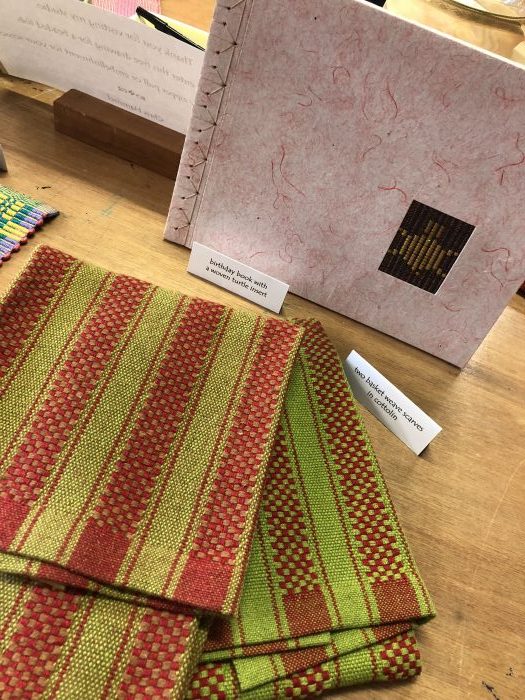
2017-10-14 11.31.35

This little top for a child has inspired me to think of things I can make for Tori as she grows.  At one point Chris had considered starting a clothing line of handwoven garments for children.  I will consider it a great accomplishment if I can keep my own little one in handwoven outfits!
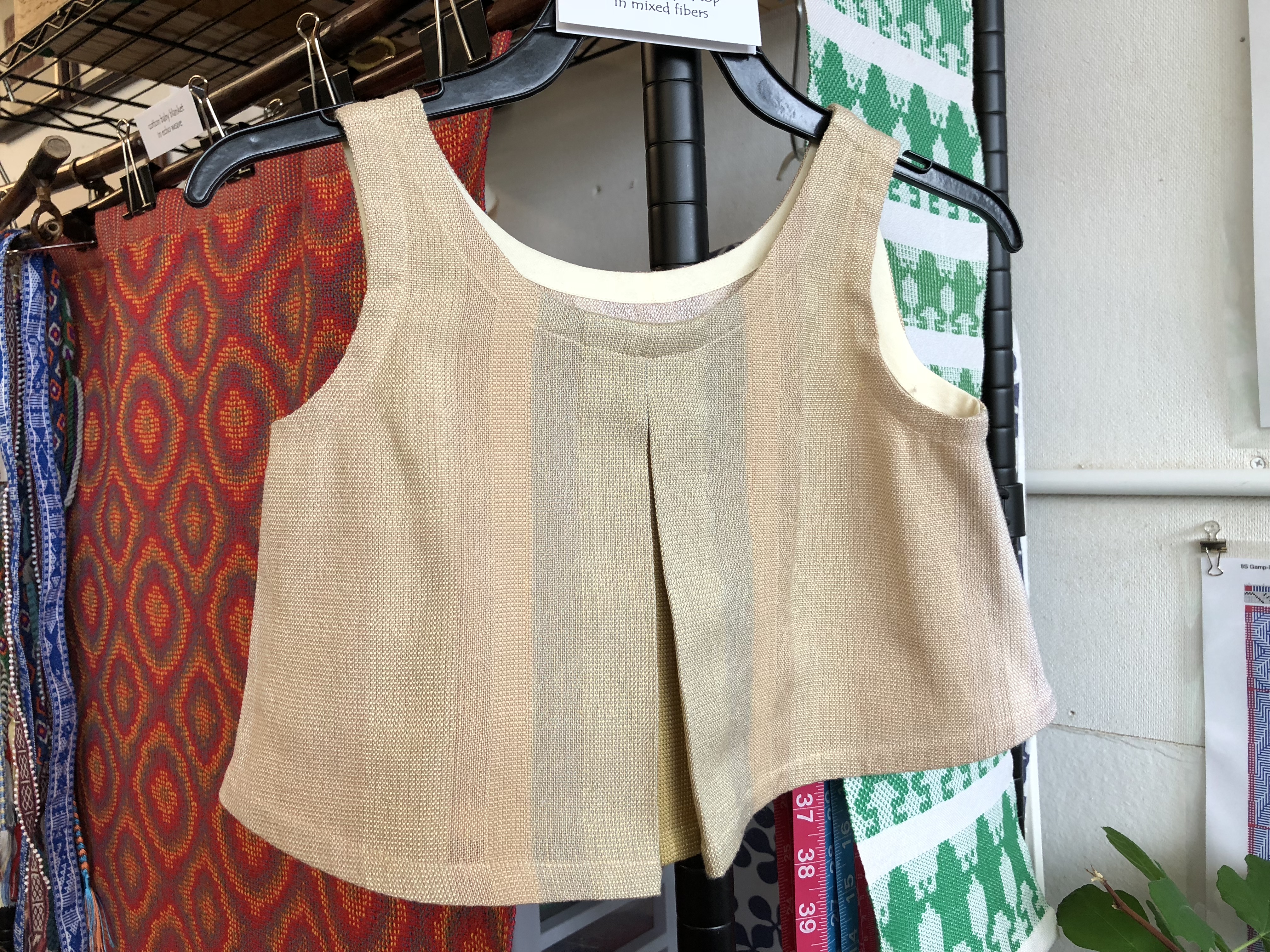
2017-10-14 12.51.23

At the left hand corner of that photo you can just see a bit of shadow weave and some small woven bands, both Andean pebble weave and kumihimo.  Here is a better look.
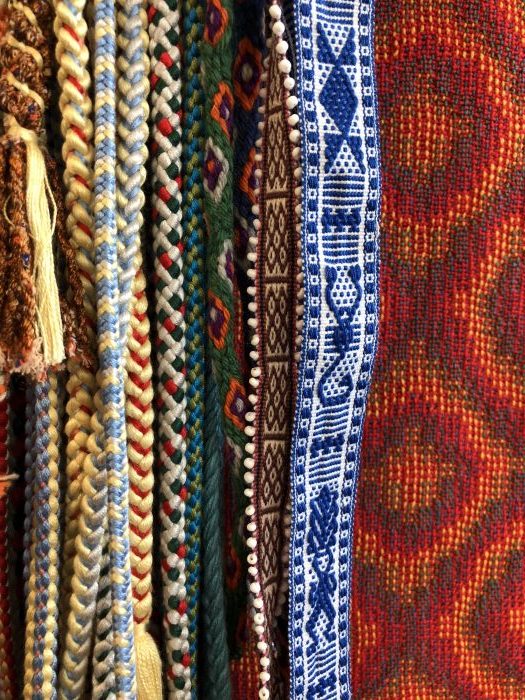
2017-10-14 12.54.08

Along with looms, Chris has a taka dai set up in her studio.  Her husband made it for her from plans by Carol Miller Franklin.  My husband started building me a taka dai about five years ago, based on Rodrick Owen’s plans.  That project got set aside when we packed up and moved to Connecticut.  He has had problems with it anyway, since some of the details require metric tools that he cannot find here.  Carol Miller Franklin’s taka dai measurements call for tools that are more readily available here.  I am excited by the possibility of finally getting a taka dai of my own–even if I have to wait for Bob’s return to woodworking next spring.

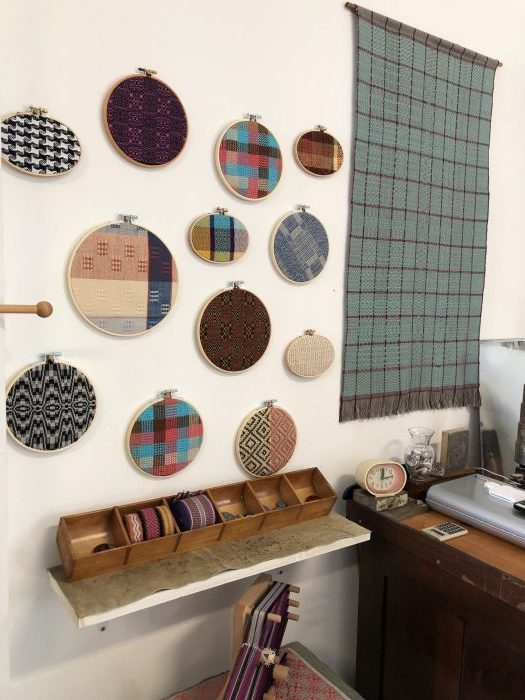
A short ways down the hall and up a half flight of stairs brought us to Paula Valeta’s studio.  She also has large windows with views of the surrounding hills that are starting to glow with autumn colors.  She has created a wonderful display of her woven samples, using embroidery hoops.  This is a great idea that I plan to use in the future.
2017-10-14 12.13.23

If life weren’t so crazy these days, I would have taken the whole weekend to visit all seven studios on this Weavers’ Trail.  They plan to do it again next year, and I plan to make time for the whole thing!  There is nothing like a bit of contact with other weavers and a good dose of inspiration to fuel ideas for future work.  We saw weaving acquaintances from other guilds, and I had the happy surprise of bumping into my New Hampshire friend, Emily! Jody and I topped off the day with lunch at Paul and Elizabeth’s restaurant in Northampton.

This weekend I hope to have another dose of inspiration when I take a field trip with my bobbin lace guild to visit the Windham Textile and History Museum in Willimantic, Connecticut.  I may not be weaving much these days, but I am stocking up on inspiration for some future ideas.
 

The Toroise and the Hare

Sometimes it’s bit off-putting when my husband Bob recites his long list of accomplishments at the end of a day and then asks me what I did.  Most of the time I can only reply that I wove a couple square inches of a tapestry, or made one inch of lace.  Sometimes I feel more like a slug than even a tortoise!

If I had this conversation with other weavers and lace makers we’d all be high-fiving each other for getting such a LOT of good work done in a day!  Wouldn’t we?

The slow march to having enough lace for Tori’s christening gown is enjoyable time for me, except when someone else tells me the 10 things, or 100 things they’ve done in the same amount of time.

–Which brings me to the list I made ages ago on the relative amount of time it takes to do various handwork.  Here it is, in my order of fastest to slowest.

  1.  Machine sewing!  It’s down right warp speed compared to all the others!
  2. Loom controlled weaving.
  3. Kumihimo/Knitting….zoom, zoom–I think it’s a tie.
  4. Embroidery
  5. Tapestry weaving
  6. Bobbin Lace

Sometimes I get a little down that I am attracted to doing things that move so slowly.  Sometimes I don’t care at all.

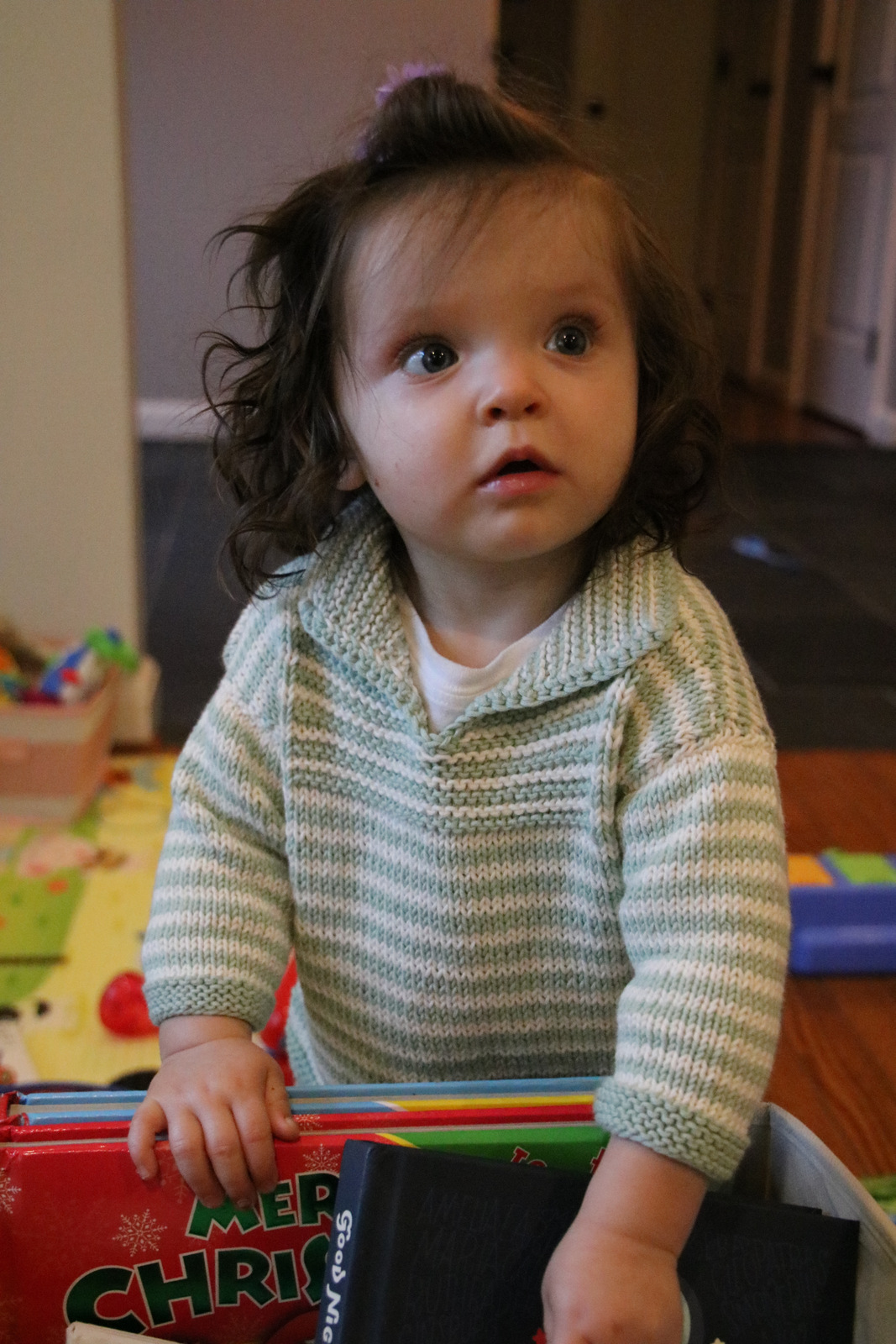
During September and October we spent almost two weeks with Tori.  She is a bundle of giggles and smiles interspersed with an occasional stunning tantrum.  I love every minute of being with her!  Here she is wearing the Debbie Bliss sweater that I knitted last spring.  She has almost outgrown it, so it’s time to think of her next sweater!

2-10-13-17a 323

I often see a lot of Tori’s mother in Tori, but this photo seems all ‘Butler’ to me.  I see my father, my sister, and even me!–so, of course that means I see her father too.

It’s time to find the next knitted garment to make for her.  Years ago I bought the pattern and yarn for this Dale baby sweater.

I have had this pattern for years and have hesitated to make it, wondering if it’s a bit too busy for such a small person. I think it might be cuter as a dress, knitted from the top down, with raglan shaping so the shoulders fit better.  The ladybug pattern would have one repeat around the torso and upper arms and another near the hem of the dress.  I am leaning toward the bright green for the background color, with perhaps the little Fair Isle pixie stripes here and there with yellow background.  One ladybug pattern on the purple background, and the other on the bright aqua.  I have to take a look at the yarn I purchased for this sweater and adjust the amounts since I would be changing so much of the design.  Luckily Dale baby yarn is super wash so Tori’s mom won’t have to be too careful with caring for this.  I’m getting a bit enthusiastic, so I’d better make the plan and get the yarn onboard before we leave!

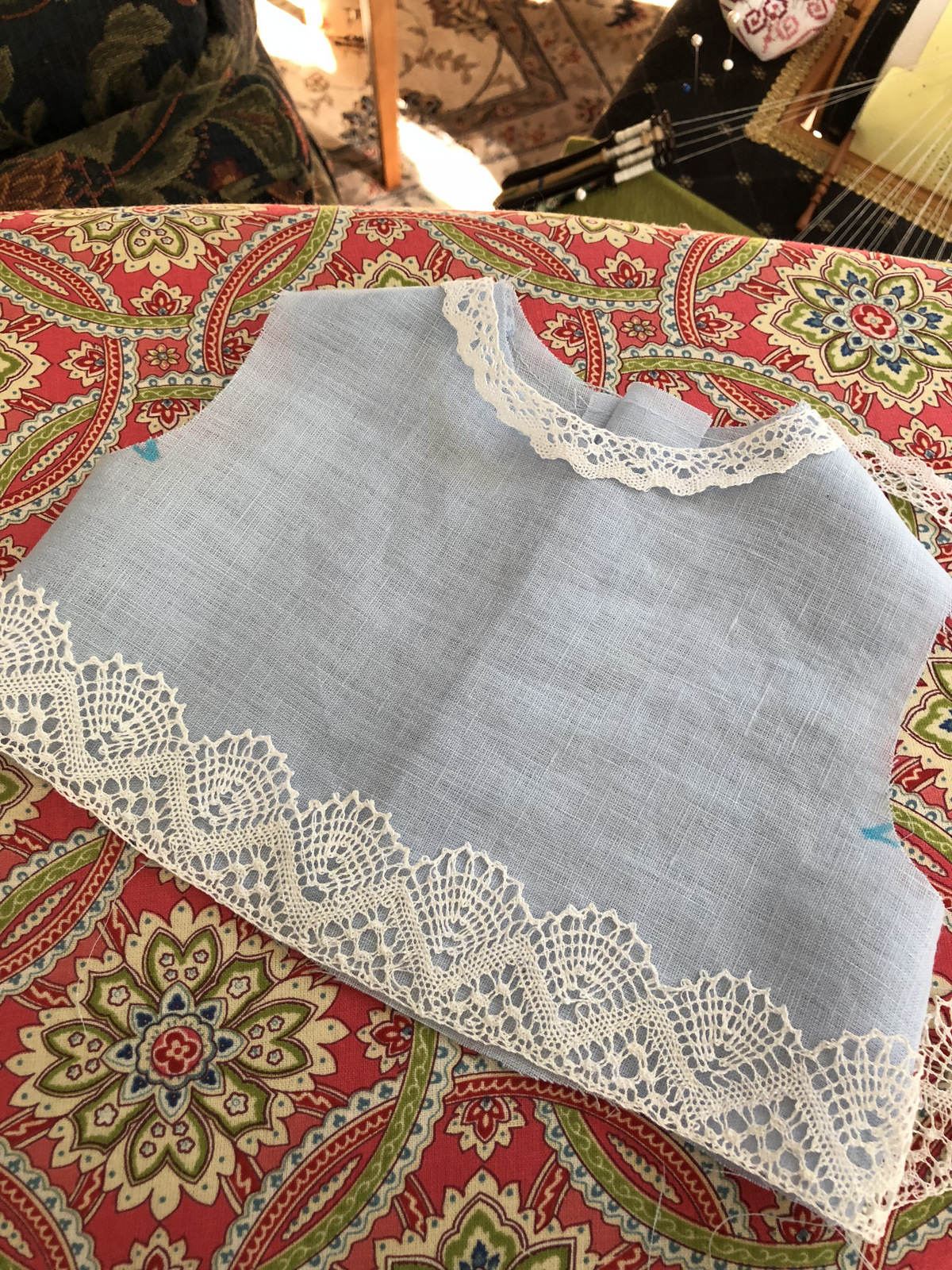
Meanwhile, I have started the actual christening gown now.  I have 49″ of the larger lace and am trying to make an inch or two each day now.  By the end of next week I should have all the lace finished!  The fabric that Kandice chose for the dress is stunning!  I originally bought white linen at Britex, but Kandice sent me a photo from Pinterest of a dress made of silk shantung that she loved.

It is beautiful fabric!  On our way down to visit them last week, I made a quick stop at Banksville Fabric in Norwalk and was thrilled to find they had it!  The dress in this photo is basically the same as the pattern I’m making, with a slightly fitted bodice and an attached gathered skirt.  Now can you picture this with my lace?  I might put the larger lace along the hem as well as at the lower edge of the bodice.

1-2017-10-01 15.24.04

Well, talk is cheap….I’d better get to work on making the last few inches of lace.  The tortoise only succeeds by keeping at it!


So Late….So Little!

NORMASWeavingShowCard (1)

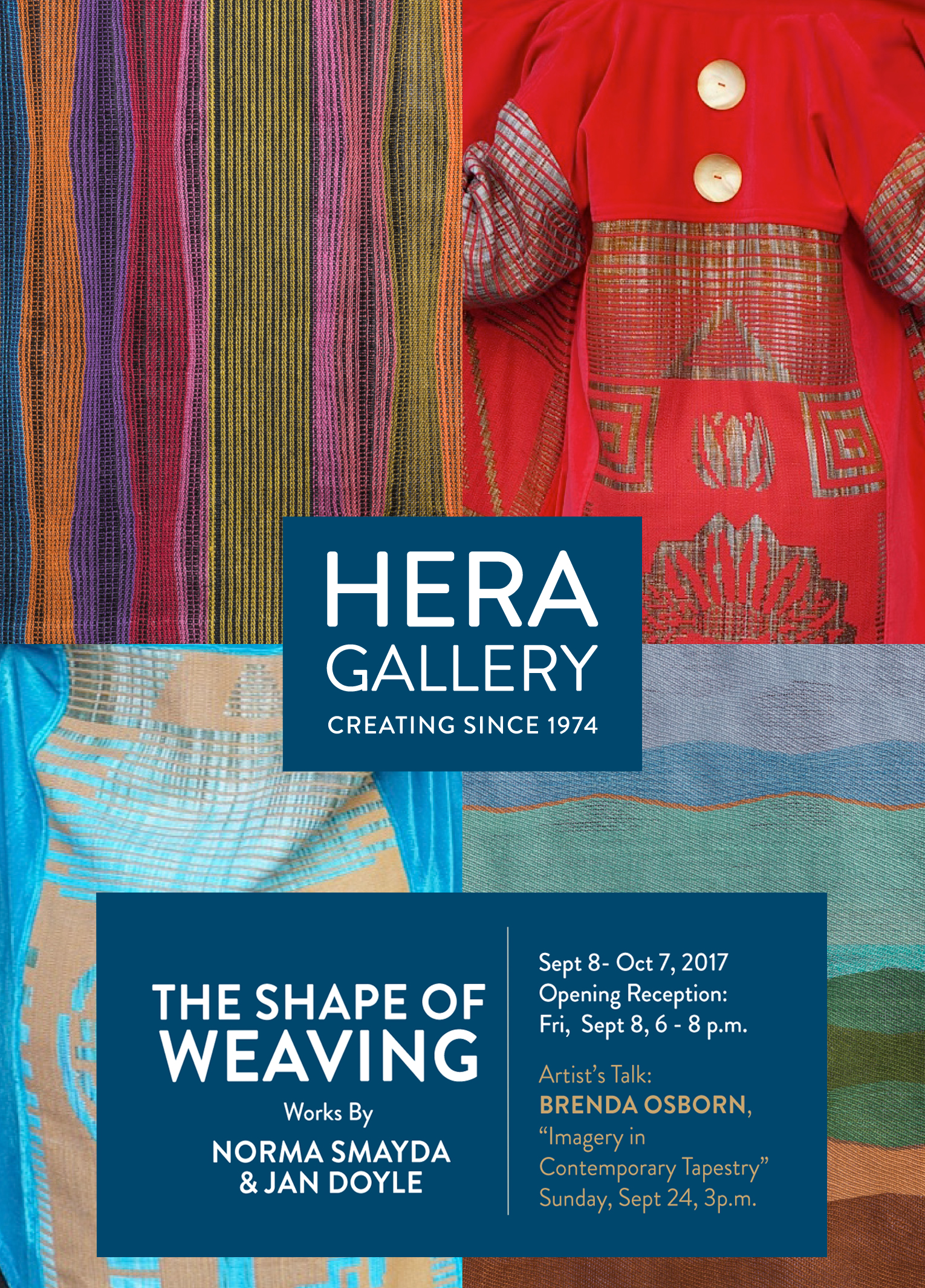
There is only week left to see this exhibit!  That’s bordering on cruel and unusual treatment for me to write about this so close to the end.  Sorry!  I loved the exhibit and just didn’t get to my computer in time.  Two weavers, Norma Smayda and Jan Doyle, have a beautiful display of work at Hera Gallery in Wakefield, Rhode Island.  It’s a women-founded, artist-run, non-profit endeavor that started over 40 years ago.

IMG_4287

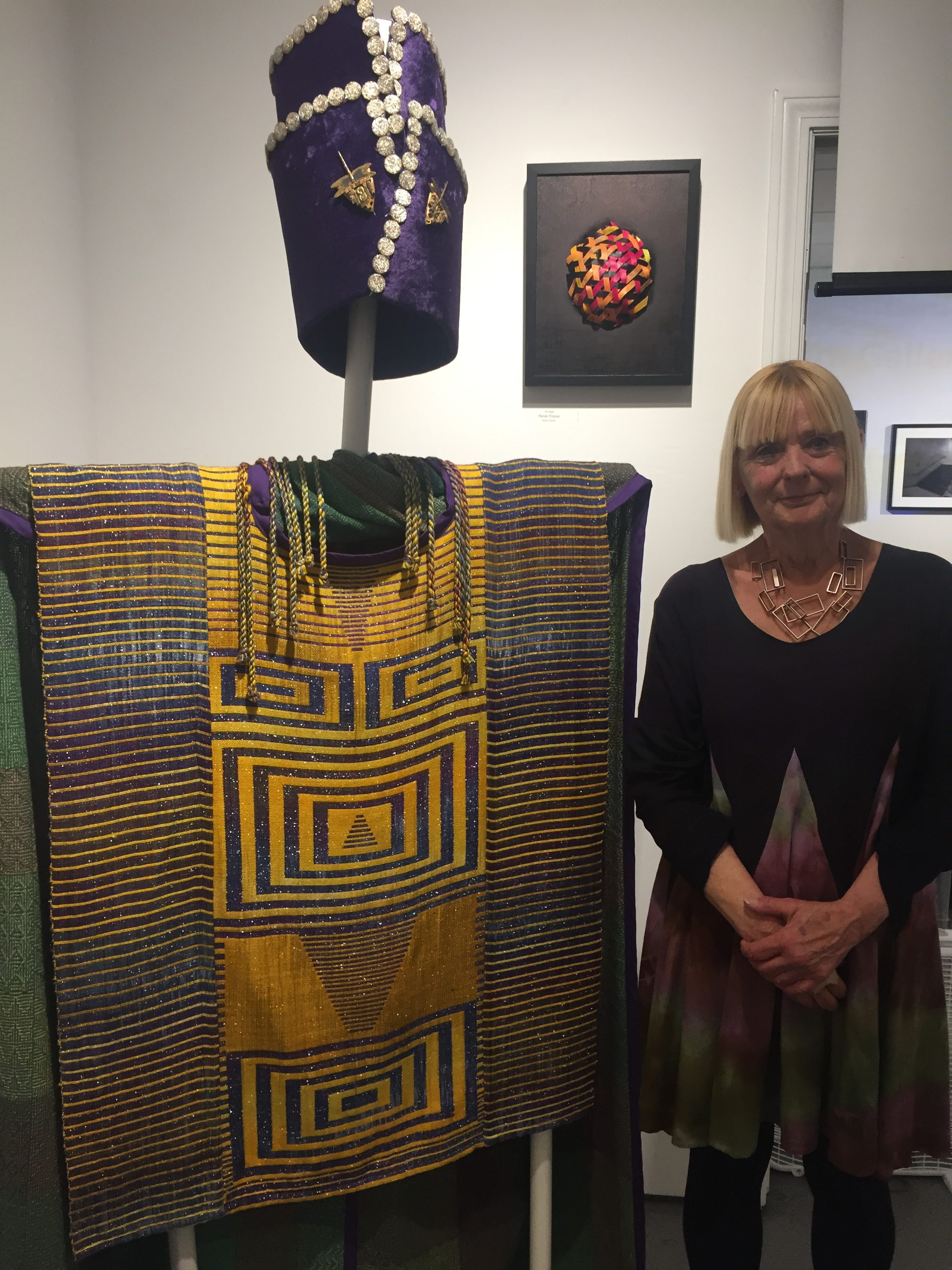
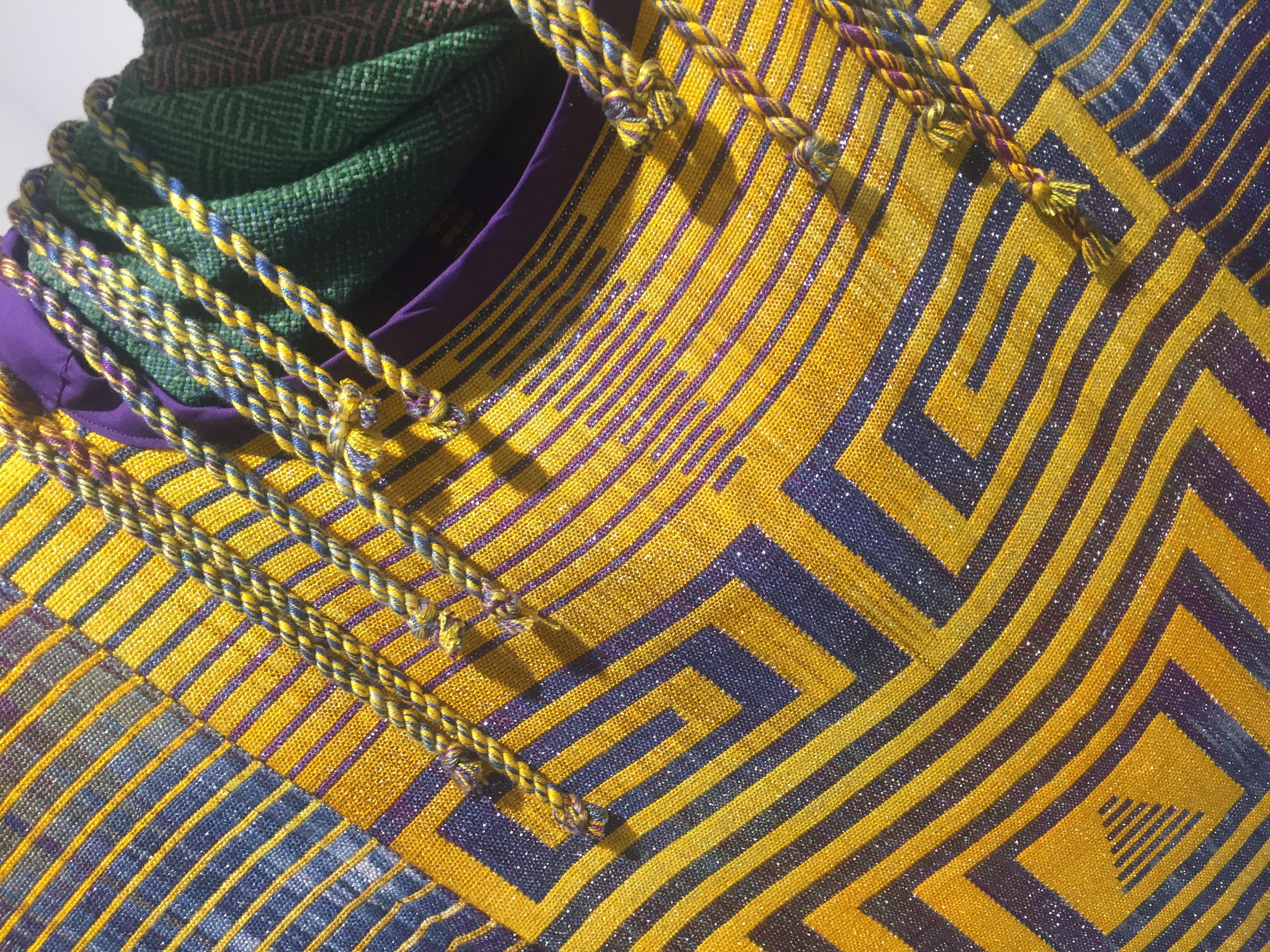
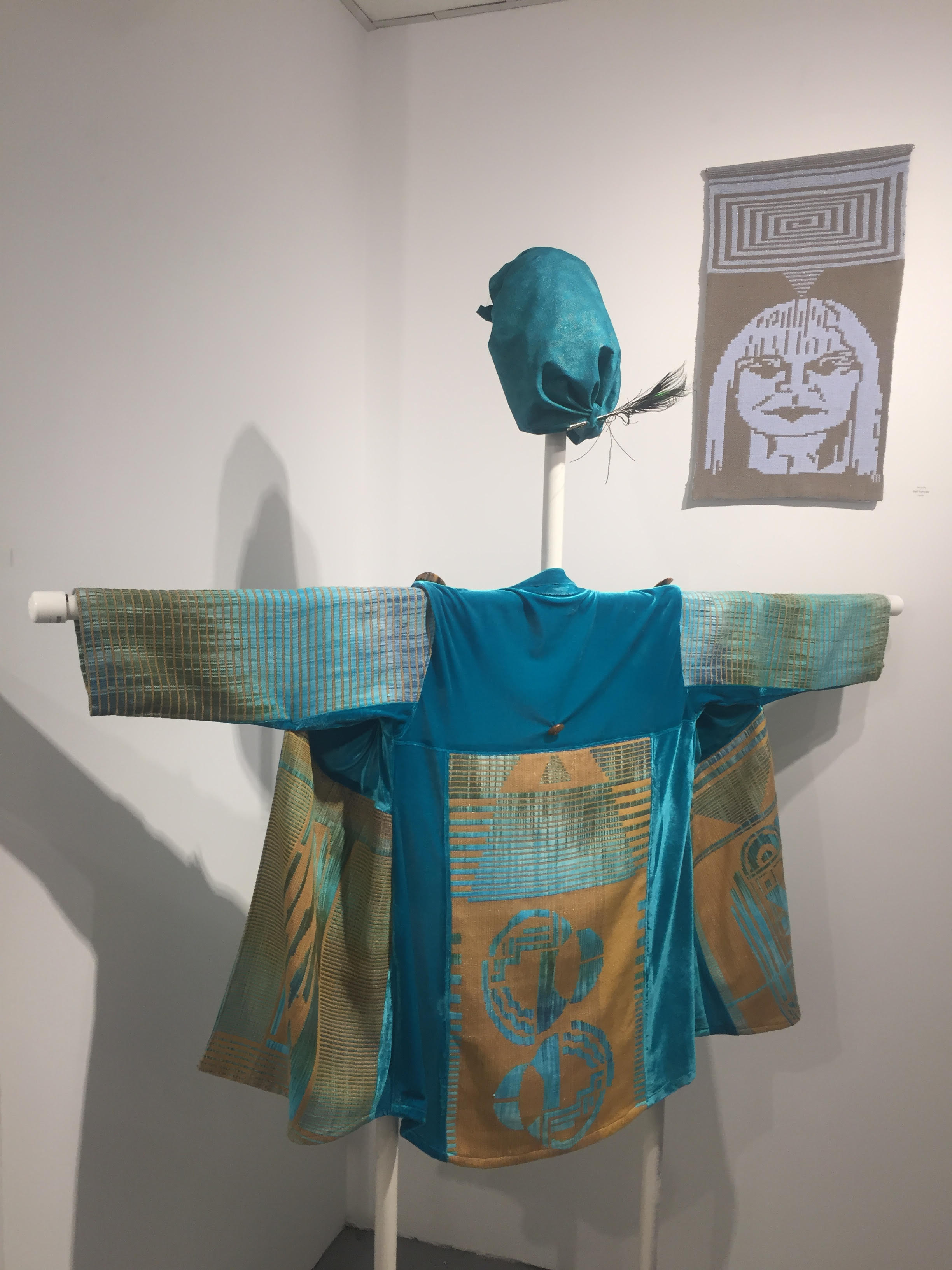
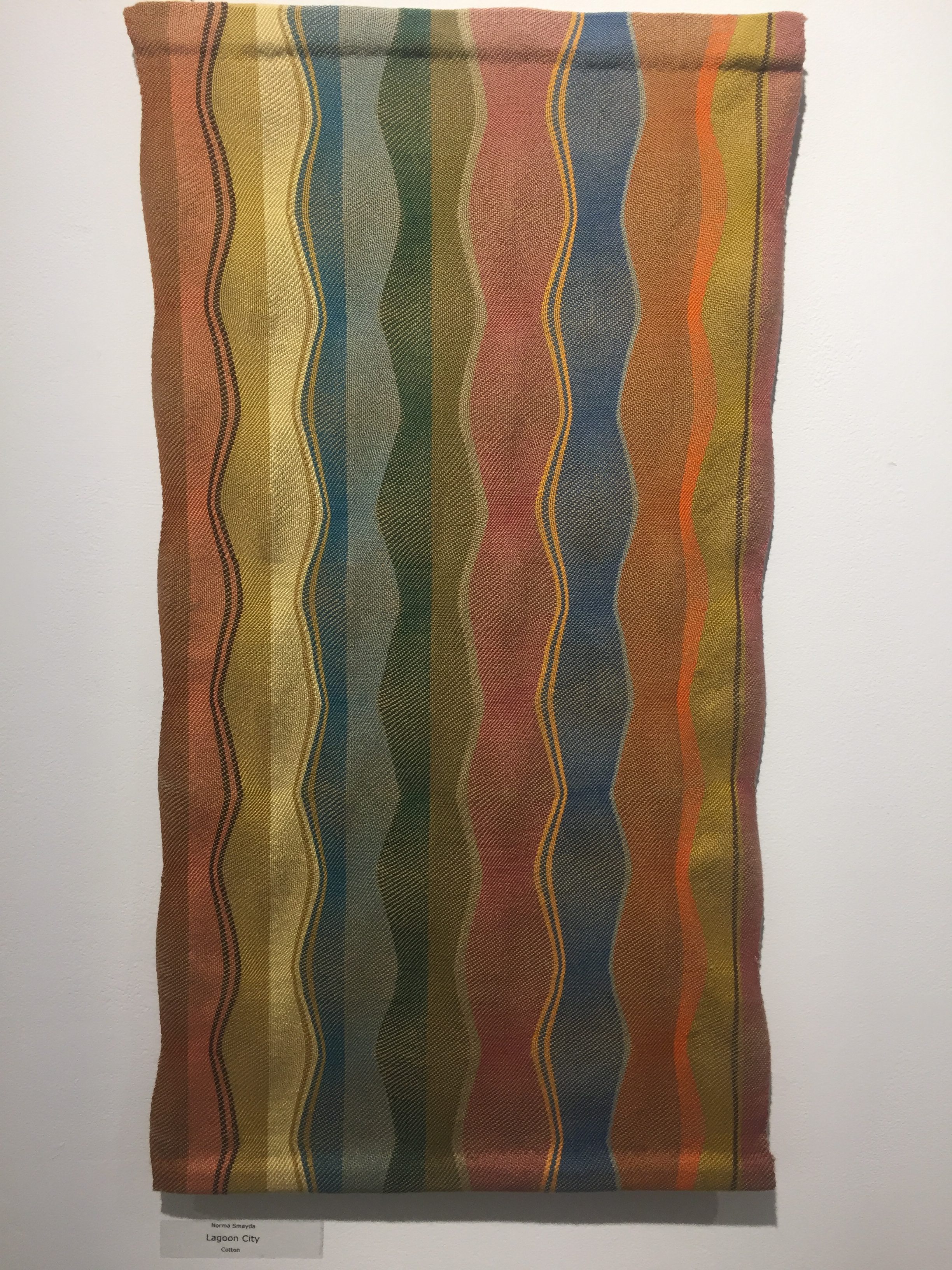
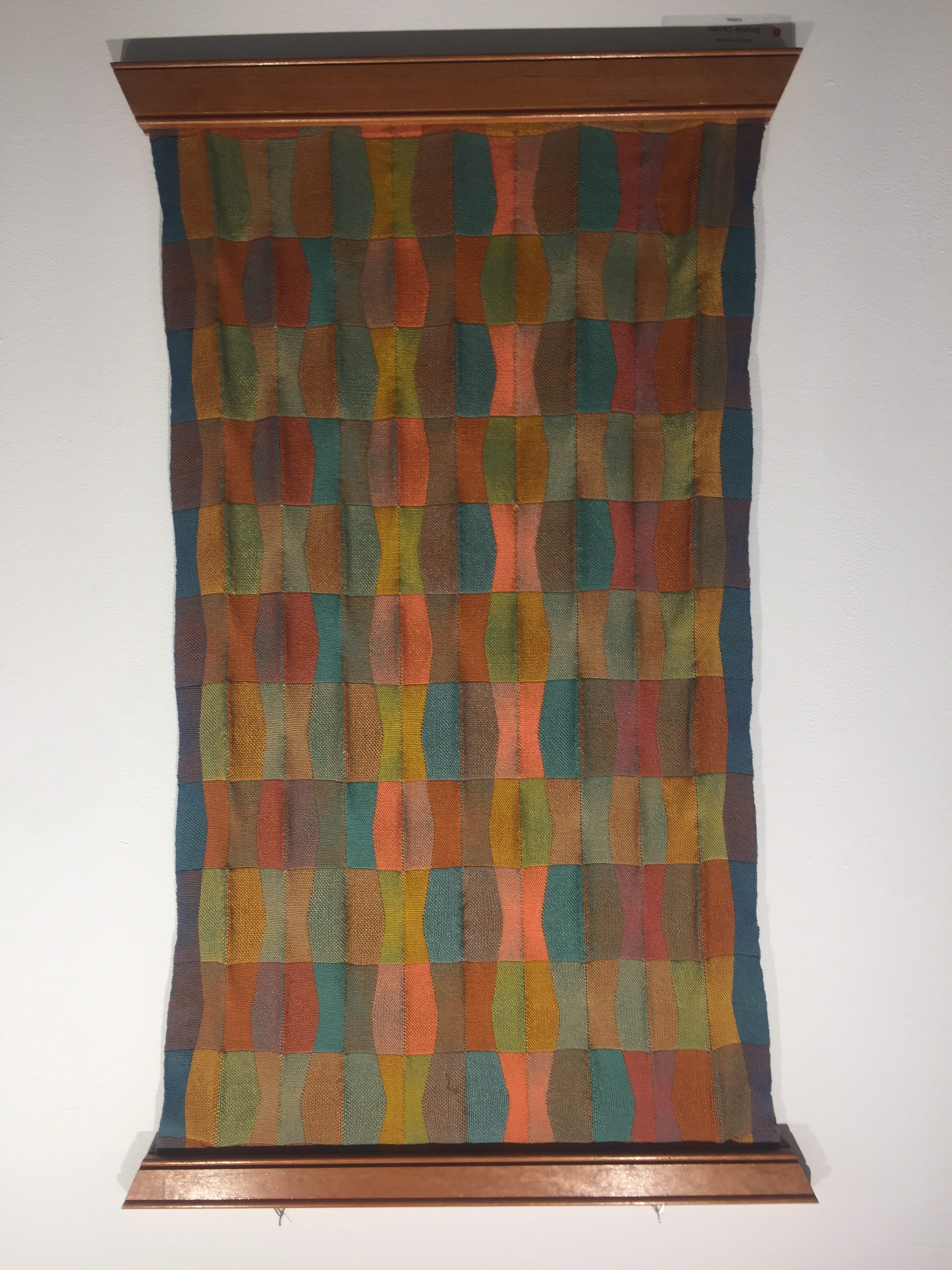
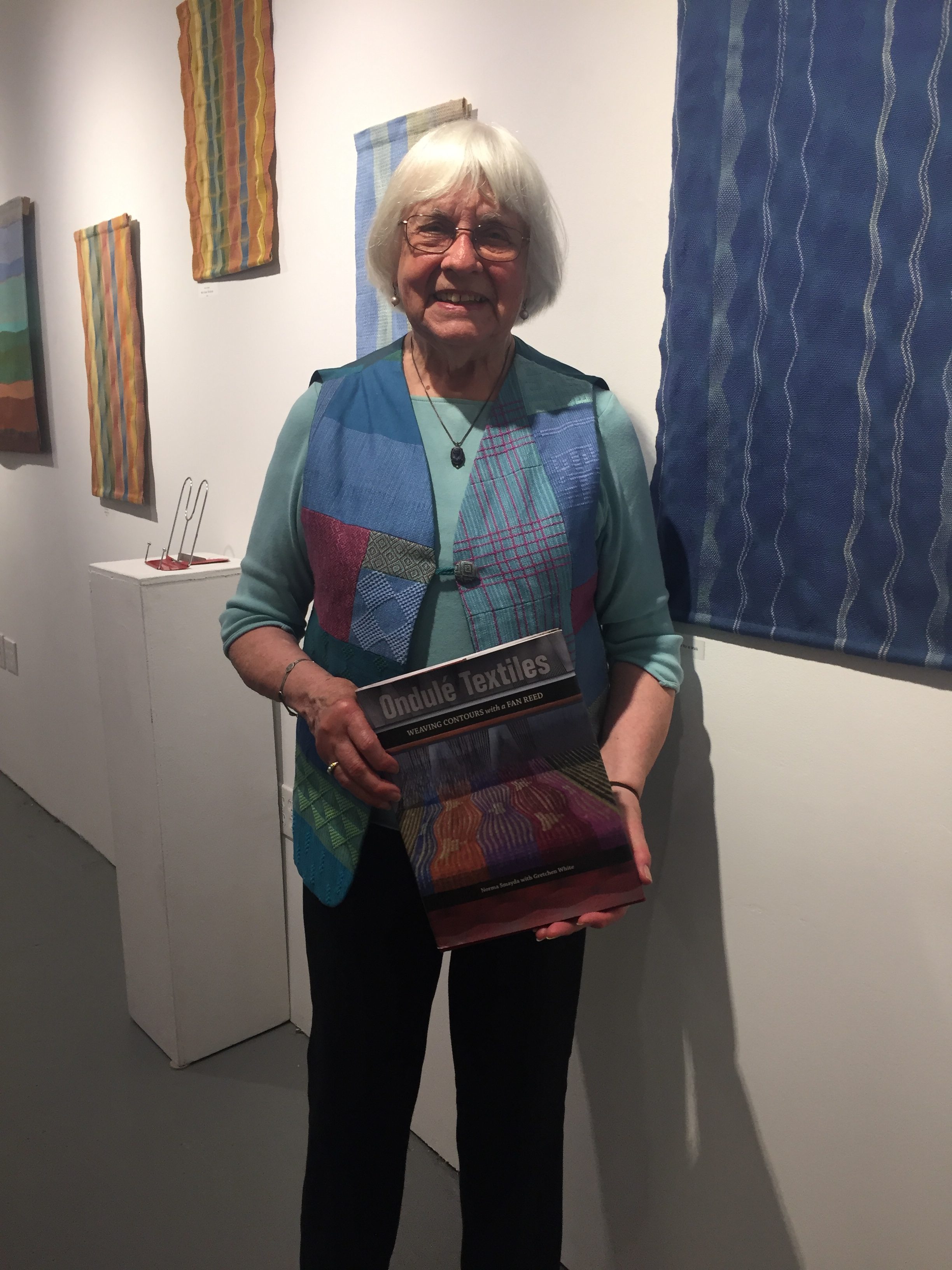
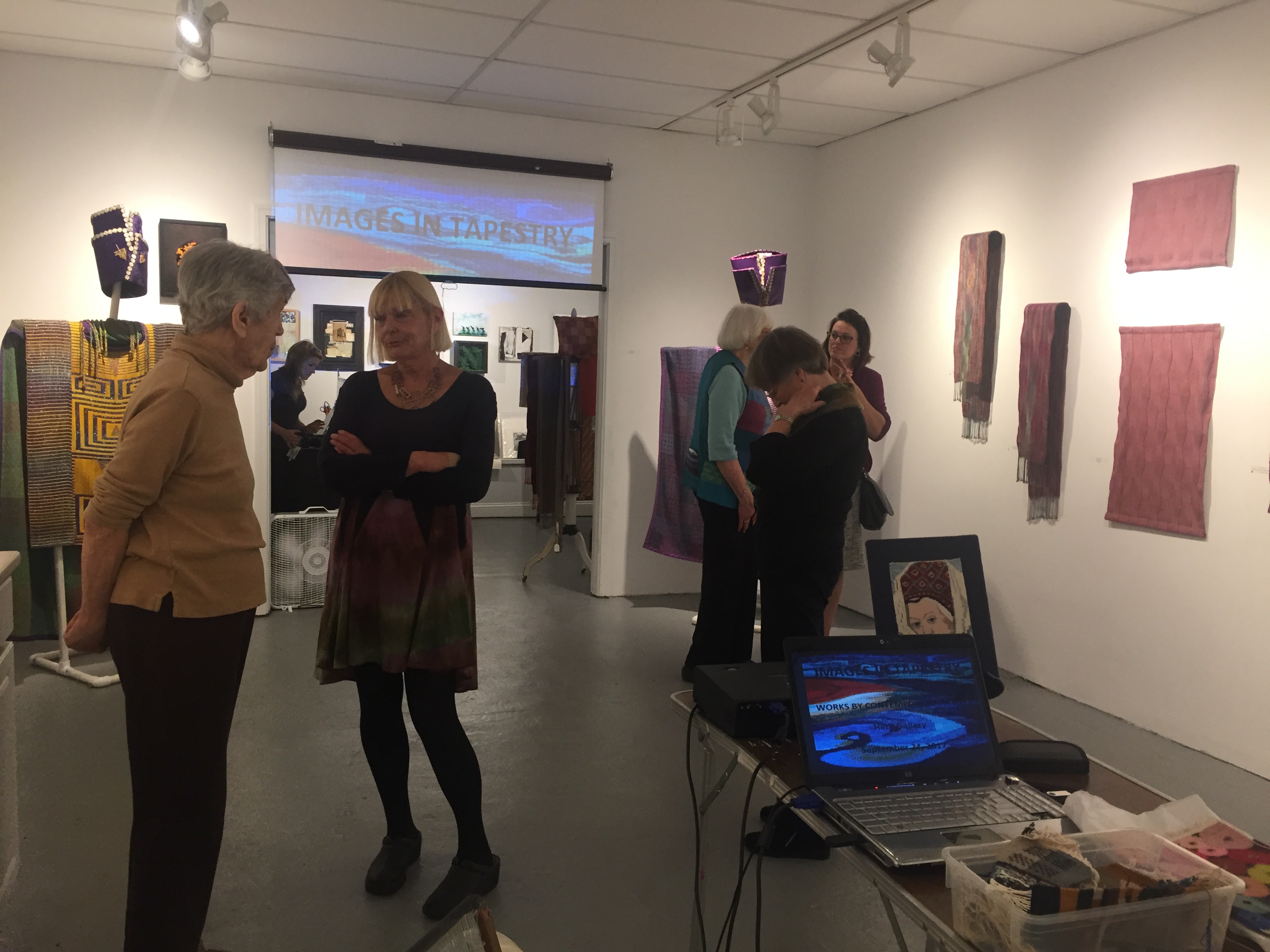
Norma’s and Jan’s work hang well together, with Jan’s signature large, mantle-type coats in each corner of the room, while Norma’s undulating wall hangings flowed across two long walls.  Jan works in a traditional Finnish double weave, and she had some smaller pieces on the walls along with her impressive coats.  Here is Jan standing in front of one of her garments.

IMG_4293

Up close…look at all that work.  I can’t imagine how long it would take to weave this.  It is stunning!

IMG_4290

Here is another one of Jan’s coats/mantles wtih a self portrait on the wall nearby.  Now that’s a double weave masterpiece!

Jan Doyle

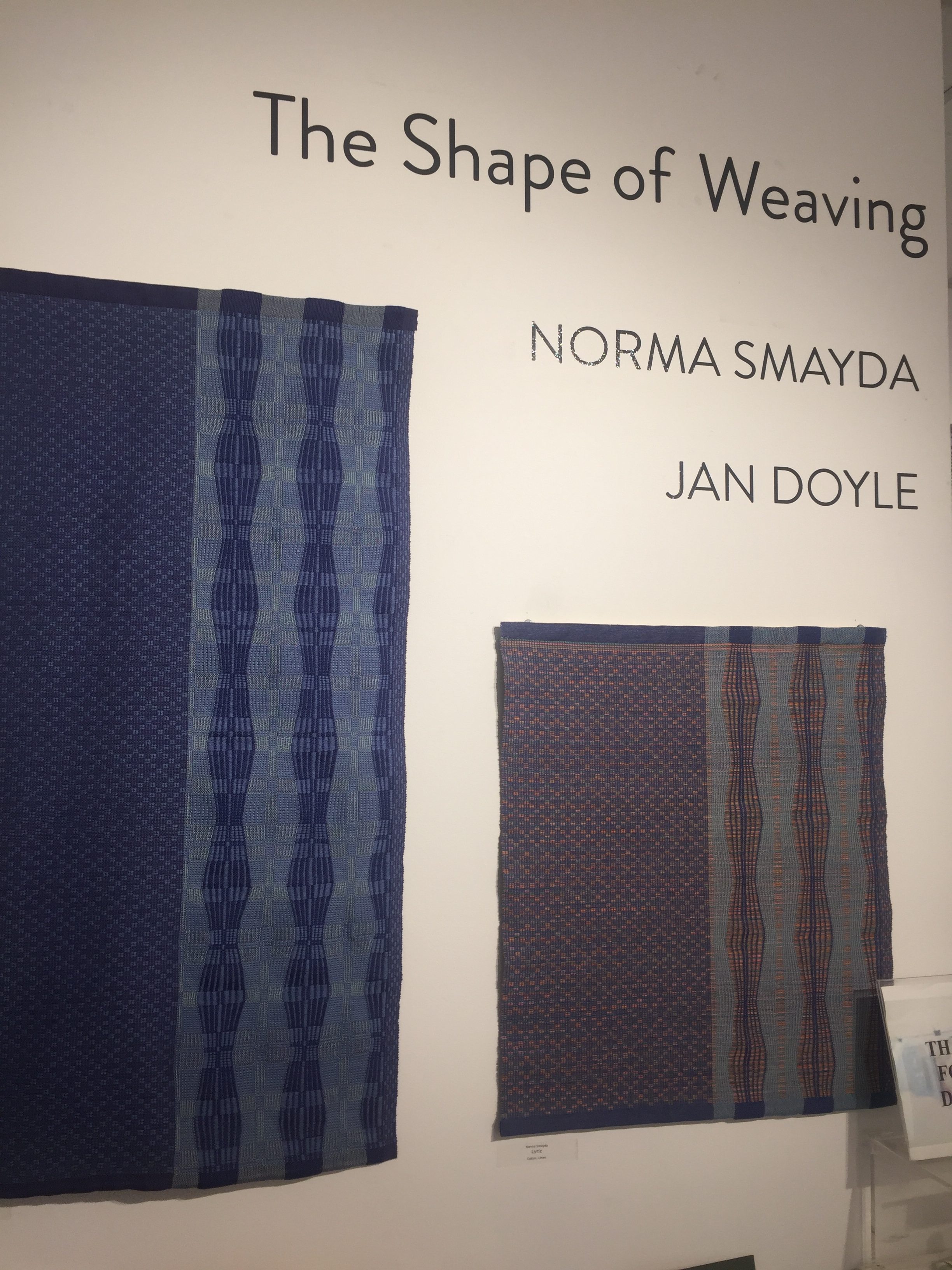
Norma has been working with an ondule reed for several years now, and she has experimented with various weave structures while also writing a book about this.

IMG_4289

IMG_4288

Norma’s book should be available in November.

IMG_4292

So, as you can see this mix of works made a striking exhibit.

IMG_4291

Back at home, I’m nearing the end of the lace I’ve been making for little Tori’s christening dress.  Bob and I will be visiting our son’s area later this week to participate in some of the events at the Annapolis boat show–in specific Bob will be presenting what he has put in place for the long distance sailors when they arrive in Antigua in November–so, after that, we will be spending most of the weekend with our family.

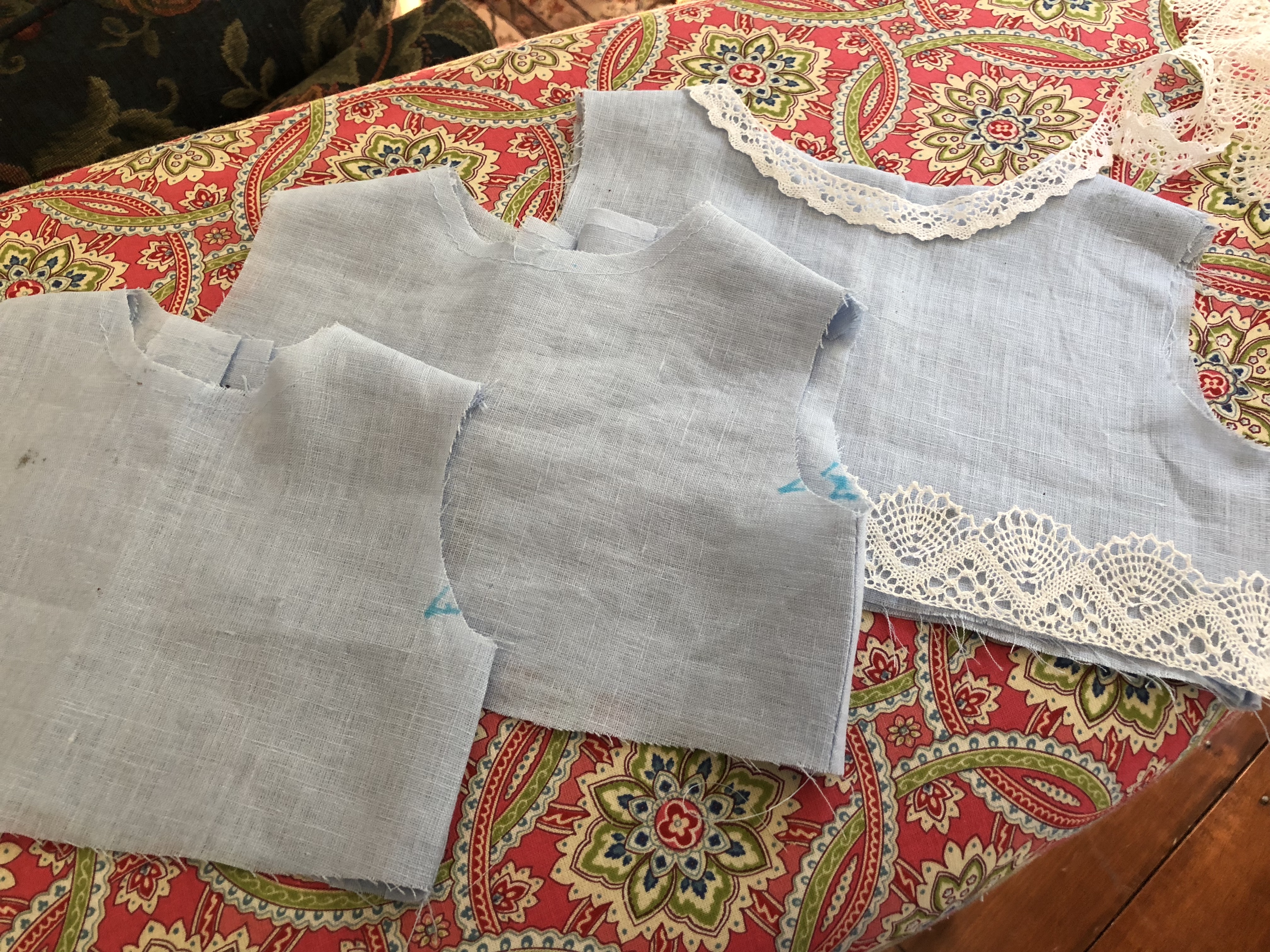
Today I made a mock up of three different sizes for the bodice so I can try them on Tori to see which size is the closest match for her.  Hopefully, there won’t be too much to adjust! I dragged the ironing board over to my lace pillow to see what the lace (still attached to the pillow!) would look like.  I am happy!

2017-10-01 15.20.22

I tried out the narrow lace around the neck, and the wider lace for the bottom of the bodice and for the hem of the dress.

1-2017-10-01 15.24.04

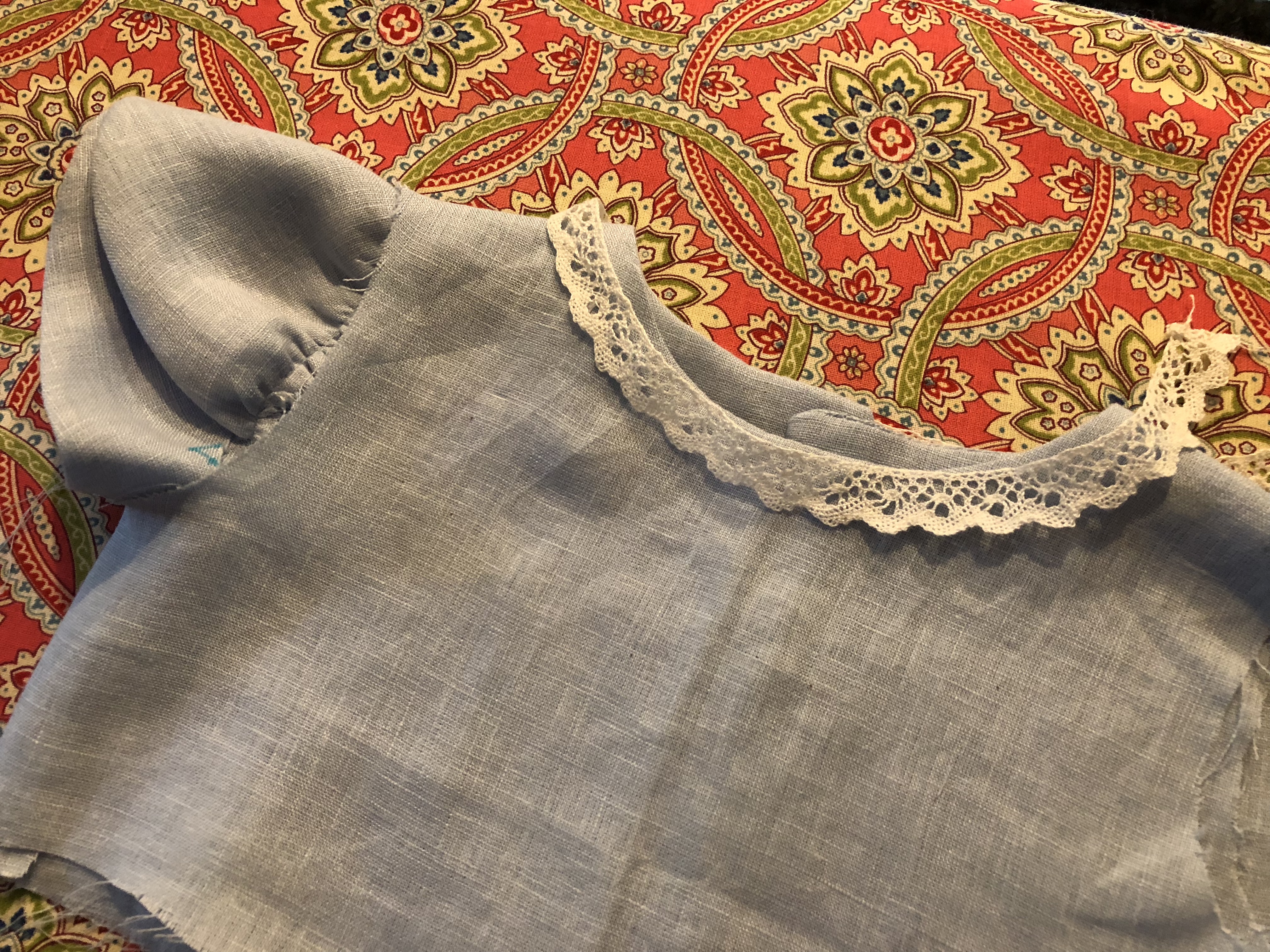
Here is the petal sleeve that comes with this pattern.  I don’t know if Mom likes the sleeve yet.  I think it is SO sweet!

2017-10-01 16.26.58

My rather obscure title refers to how late I am in writing about the weaving exhibit and how tiny little Tori’s dress will be, whichever size ends up fitting her.  It’s a challenge for me to sew on that small a scale!  Hence, so late, so little!  Off to Banksville Fabric on our way south tomorrow to hopefully find a beautiful white fabric for this dress, since the white linen I bought at Britex did not get chosen.


Women’s Work

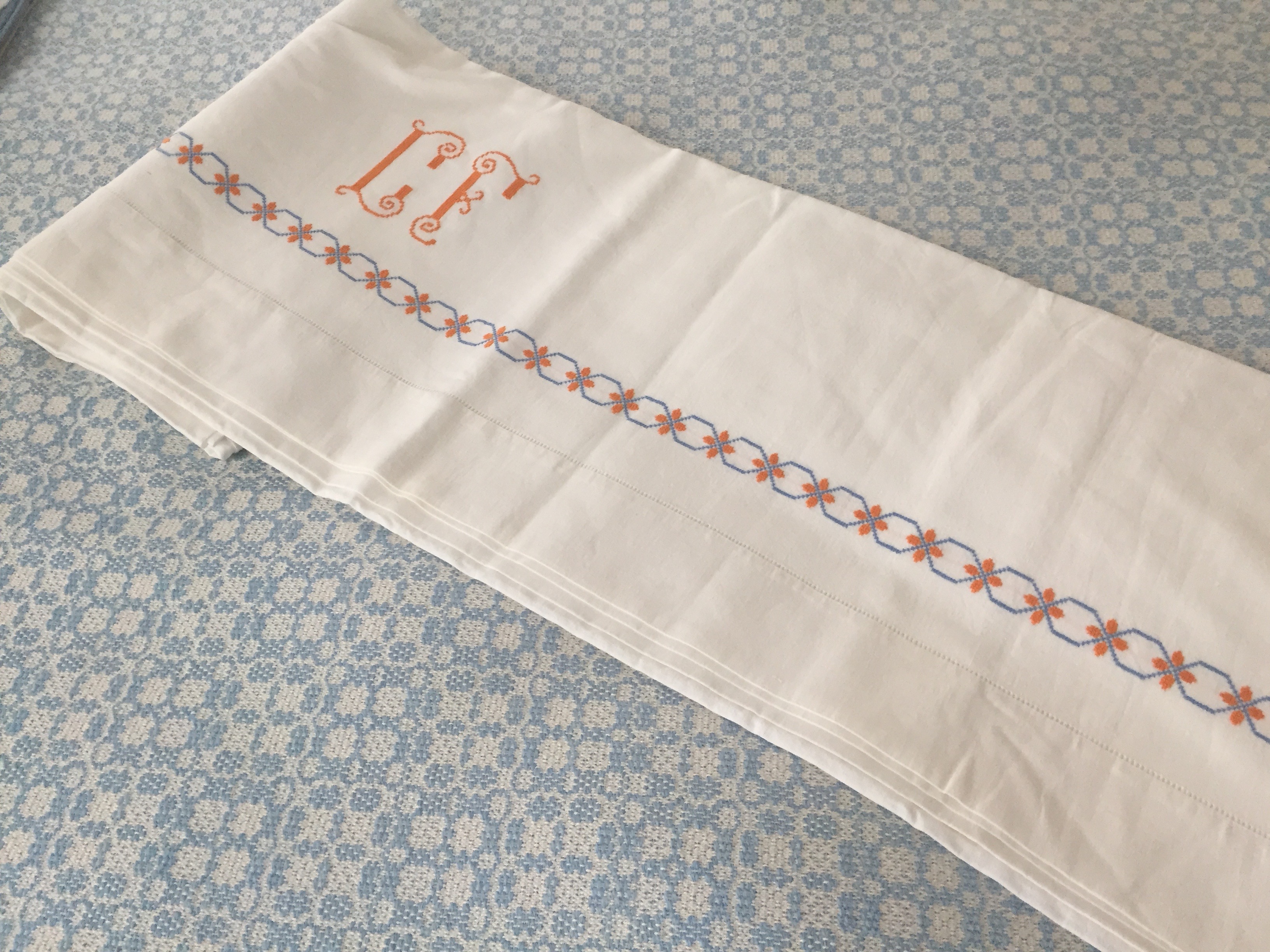
Today’s mail held a treasure I’ve been looking forward to seeing!  Last week on Etsy I found a vintage bedsheet with matching bolster pillow that had been embroidered in counted cross stitch and bordered with laddered hemstitch.  The sheet itself is a luxurious, heavy weight French ‘metis,’ which is 65% linen and 35% cotton. According the to vendor, Hanky Heiress, this fabric blend was developed to be an ‘easy-care alternative’ to 100% linen sheets.  Look how beautiful it is!

IMG_3512

Here it is opened up across my bed.  The blue and orange cross stitch look wonderful on my vintage, machine woven, overshot bedspread!  I’m thrilled!

IMG_3511

The seller of this sheet and bolster set believes it’s from the 1960s, and she speculated that that they have never been used.  Now that I’ve seen it firsthand, I agree with her.  Who knows where it originated; by the time I found it, it was residing with an Etsy vendor in Cheshire, England. What a sad thing that it may have spent 50 years in a drawer or closet.  I have been imagining various scenarios in which this might happen, and the only that makes sense to me is that someone made this as a gift for someone else.  Perhaps it was a wedding gift, with the two initials signifying the union of two different names.  I can only imagine that the woman who did this put so much love into this gift.  It is truly a treasure!  And I’d like to think that the woman who received it loved it so much that she was hesitant to actually use it.  Well, I intend to use it, and I intend to enjoy it.  I will always think of this story that I have created to go with it.  I feel it has good potential for being true!

It amazes and inspires me that women (and men too) have been making and embellishing textiles since the dawn of humanity.  There’s a reasonable chance that textiles are older than pottery, as Elizabeth Weyland Barber has speculated.  It seems we are hardwired to surround ourselves with the work of our hands.

In early April I learned that our friend Hank, had arrived in Havana on his boat and would soon try to deliver all the all donations of lace-making materials to the woman I met last year.  I wrote about the lace makers last year while Bob and I were visiting Cuba on our boat. Due to lack of communication in Cuba as well as while sailing offshore, I did not get confirmation of the delivery until mid-May.  What an emotional moment that was for me!  And I understand there were few tears shed by Hank and his wife, along with the women who received this bounty, and even the male interpreter!  I cried myself when I saw the photos and this wonderful video that Hank and Seale made for me.

When Bob and I first hatched this idea of sending materials to Cuba, neither we nor Adriana fully realized the effort involved.  I had been quite saddened to see the poor quality materials women had access to–sewing thread used in multiple plies for embroidery and crochet, and poor quality knitting and crochet yarns that looked like some Russian version of Lily’s “Sugar N Cream” yarn–and only available in one color  —  Ecru!  Mailing gifts is simply not possible, since all mail is opened and usually the contents are ‘re-purposed.’  Even making a face to face delivery had a high degree of risk for confiscation.  Adriana and Hank worked out the best plan they could come up with, and still both of them were worried about being discovered.   It is forbidden in Cuba to have guilds or groups, so the women who meet to do various types of lace together have to be quite careful.  I am so relieved that this venture was a success!

This is now my favorite photo of Adriana, where she looks like a young woman again, full of excitement for the many projects that lay ahead for her and all the other women she tutors in lace techniques. I can almost see the ideas starting to swirl in her head!

Screenshot 2017-06-01 12.50.07

Here is photo of the stash before Bob and I packed it up in four extra-large vacuum seal bags.  In early January, Bob sailed to the British Virgin Islands, where he transferred the stash to Hank’s boat.  In early April, Hank sailed for Cuba as the leader of a rally of sailboats that would spend two weeks in Havana.

1-12-17 004r

Best of all, here are some photos of Adriana’s lace work that I bought from her last April.  First a Torchon  doily that I gave as a present at my lace group’s annual holiday party.

1-IMG_2988 (1)

And two pieces of Adriana’s tape lace that I kept for myself.

IMG_3513

The work of our hands–across the decades– and across the world.  And this is just the tip of the tip of what is out there in the world.


Textiles in the Caribbean

Time to get back on track a bit and talk about textiles!  It IS the driving force of my visits to any location, so I’m always on the lookout for any kind of textile handwork.  And I have not been disappointed this winter!

Some of the places that are well known for handwork have not fallen in our path this winter.  They will be on my list for future visits, but I’ll still mention them here.  Perhaps the most intriguing place is the island of Saba, which lies off the coast of St. Martin.  It is one of the many volcanic islands that make up the Lesser Antilles, and may be the mmost dramatic.

It does not have a good harbor, so sailors must carefully choose a weather window for visiting.  That did not happen for Bob and me this year, although we could have taken a day trip by ferry to visit.  This island has underwater volcanic mountains with coral reefs, so it is also known as an excellent dive site.

In our sailing guidebook (Cruising Guide to the Leeward Islands) I read that Saba is only 5 square miles but rises to 3,000 feet in that small area.  It was settled by Dutch, Scottish, and English farmers, along with their African slaves.  Over time they all worked side by side to eek out a living on this steep and rugged island.  These settlers became fisherman and farmers and boat builders.

Until the 1940s, all ships came into Ladder Bay, on a dangerous shore that provides little shelter from ocean swells, where access to land was via an 800-step track that was cut into the rock.  Really!  I’m almost afraid to visit and be found to be the biggest cream puff the Sabans may ever encounter!

In the 1950s, some Dutch engineers determined that the island was too challenging to build roads, so one elderly local took the initiative to study road building via correspondence class and shortly after, with his knowledge, the Sabans hand-built their road, finished in 1958. I guess they don’t easily take ‘no’ for an answer.  The women have become skilled in needle lace which they originally learned from lace makers in Venezuela.  Since living on Saba is very isolated, over time their designs have taken on a specific nature that makes it truly theirs.

I found some images online and links to information about lace making on Saba, but most of them will not open since we have slow internet here.

The inactive volcano on Saba is named Mount Scenery, and I bet it is quite a scenic place!  There is a museum on island that I look forward to visiting someday. You can read about the museum here and their collection of lace here.  And, lucky for me, since it is a Dutch museum, I bet the information will be in English!–a nice change from the French islands where English is not an option.
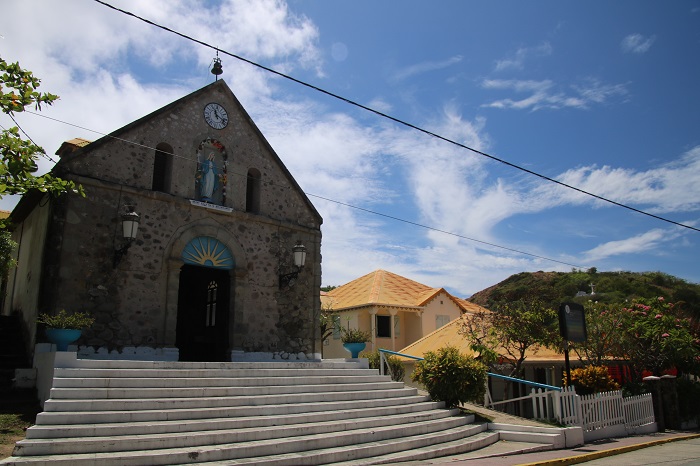
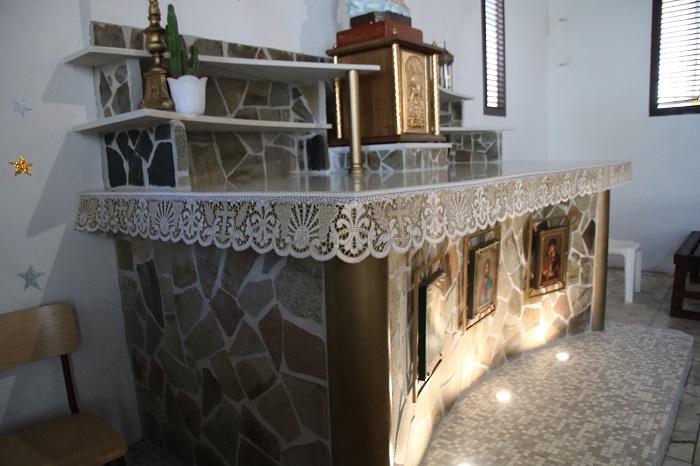
I should mention that although Iles des Saintes and Marie Galante (the islands just south of Guadeloupe) were discovered by Columbus, they have been French since very shortly after they were colonized.  Until recently, the fisherman here used boats like their fishing forbears from Brittany used.  I am sorry I did not get to see a fleet of those boats. When we arrived on Terre de Haute a few days back, I took some photos of the textiles inside the church in the center of town.

3-26-17a 042

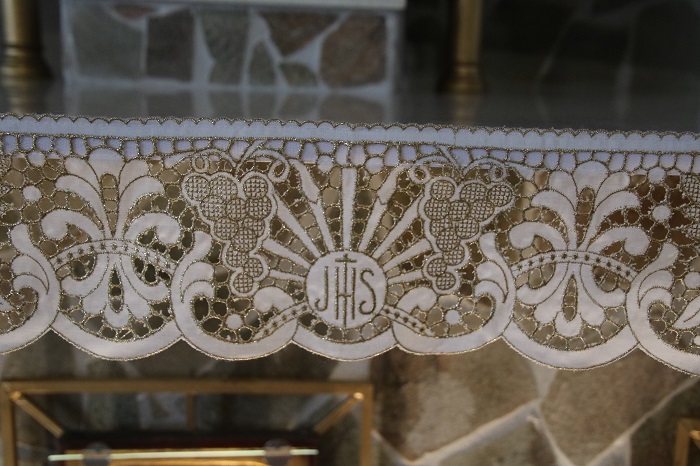
From the back of the church seeing this altar cloth drew me right in.

3-26-17a 045

3-26-17a 046

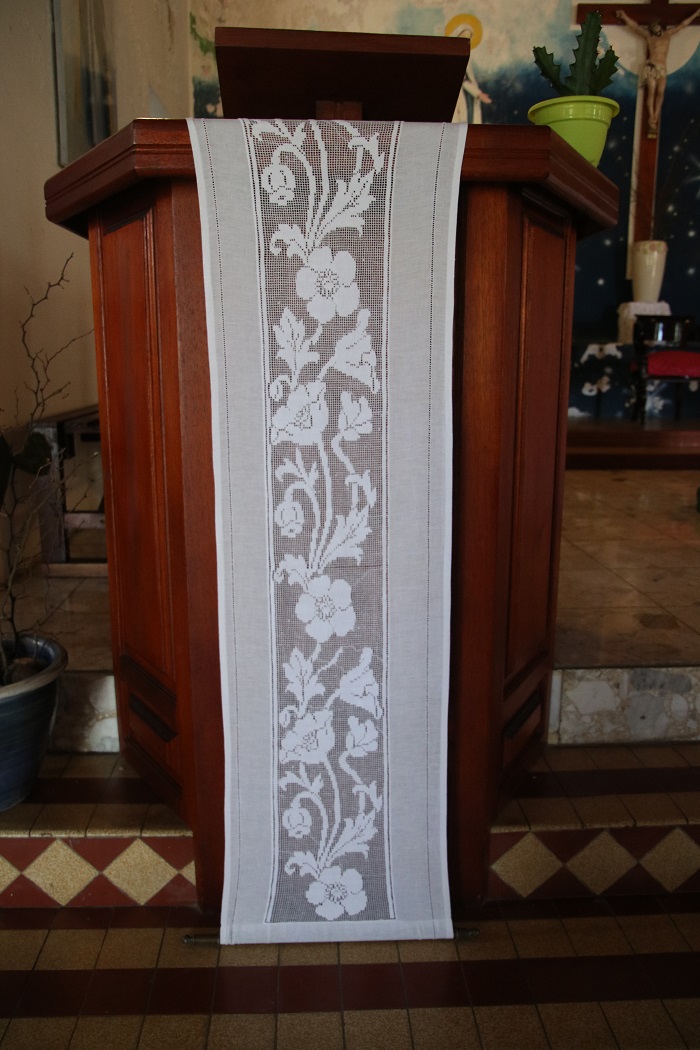
and from the back entrance I thought the pulpit drape might be filet crochet.  I’m glad I took a closer look because it is needle lace.  I have no idea how Saban needle lace differs from other needle laces, such as this, and hopefully I’ll learn a bit more about that on future visits.

3-26-17a 047

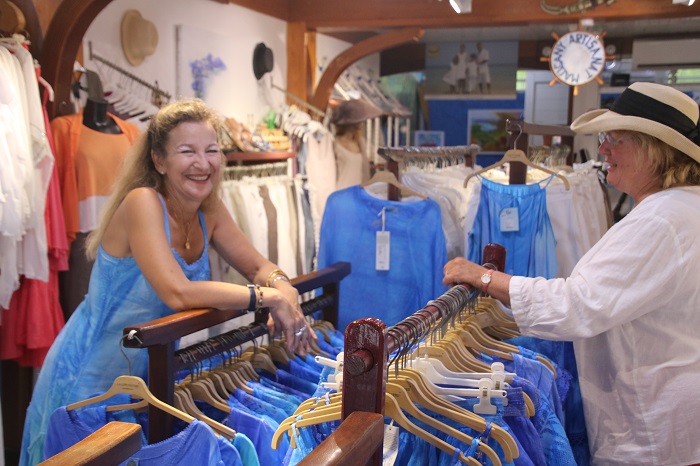
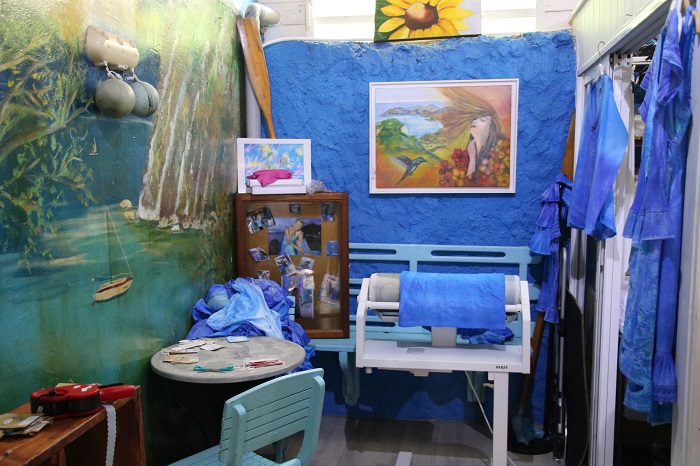
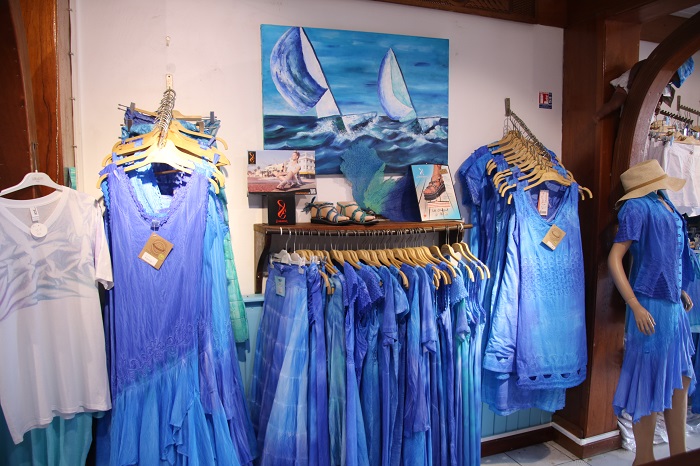
Along the road to the church there are many shops, and one of them is a clothing and accessory shop, called Maogony where everything is dyed blue.  The two owners, Annie and Chakib, use three colors of blue dye to create garments that reflect the colors of the Caribbean waters that lie right outside their store.  Annie and I talked a bit, and I tried my best to understand her excellent English.

3-26-17a 033

When she described her process, using blues she called cobalt, indigo and turquoise I began to think she and her partner might be using Pro Chem MX dyes.  She said they set the colors in the sun and then finish with a hot mangle before washing them. Their mangle is against the back wall in this photo. They work with garments made from cotton, silk and linen.

3-26-17a 038

3-26-17a 034

Just east of Iles des Saintes is an island called Marie Galante.  According to legend, Columbus had already used the names of all the saints that he cared about, so had to resort to some other source for a name for this island. Marie Galante was the name of one of his ships.  There is an indigo dyer on Marie Galante, and I believe she uses the natural plant dye for her work.  I know nothing about her, but am certainly hoping that I’ll meet her next year!  She has a website and a facebook page called Maison de l’Indigo.

Another island we did not get to visit this year is Montserrat, which still has an active volcano on it, Soufriere Hills–the only active volcano in the Leeward Islands, and perhaps in the Caribbean. The original settlers were Irish, and today Montserrat is known as the ‘other emerald isle.’

I have heard there is a mother/daughter weaving team here who weave with sea island cotton. I found Sophie Bufton’s description about her visit to the weavers. This photo is from Bufton’s site.

What I learned from this limited and torturously slow internet search is that the sea island cotton on Montserrat had the longest fibers of any cotton in the world, and that was due to the volcanic soil on this island.  The cotton plants and the spinning factory were destroyed in 1995, the first eruption of Soufriere Hills which destroyed the capitol city of Plymouth where the spinning mill for the cotton was located. This eruption not only destroyed the cotton crop, but also two-thirds of the island.  In the early 2000s, the dome of the volcano collapsed, after a few more years it seemed that the volcano had become inactive.  In 2006, there began to be activity, and another eruption in 2008, has put that theory to rest.    Yet it appears that the weavers are still working with sea island cotton.  I’ll write more when I can get better access to the information.
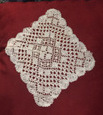
The internet can be such a treasure trove.  I found this stamp with an image of a spinning ginny and a young Queen Elizabeth.

Madras fabric, originally from India, is considered the national dress of several of the islands in this area — Guadeloupe, Martinique and Dominica.  You can buy almost any kind of souvenir in madras, including plastic key chains and serving trays.  Our granddaughter Tori will be getting a madras sun hat in a couple of weeks.

This part of the world holds a fair amount of geographical confusion for me.  We are in the Caribbean at large, but the particular area we have traversed this winter is known by several labels:  the West Indies, the Lesser Antilles, the Leeward Islands (as opposed to the Windward Islands).  It’s a lot to comprehend, and I just keep looking at the charts to orient myself.  We are in the southeastern part of Caribbean island chain, just before the chain heads due south ending at Trinidad, near Venezuela.  These islands are known as the West Indies because there were slaves brought here from India, and that culture has lived on in West Indian traditions such as food and music.  There is plenty of African cultural influence which melded with the India culture to create something entirely new.  There are so many labels that include ‘west’ and ‘east,’ and also also ‘leeward’ and ‘windward’–how can I keep up??

Scroll to Top