ArgoKnot

weaving

Directions for a handwoven tote bag

8-SHAFT HUCK LACE TOTE BAG
IMG_1480

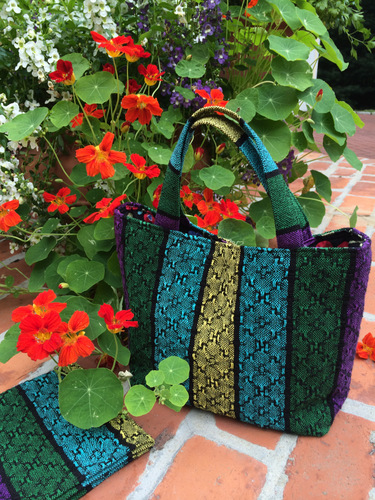
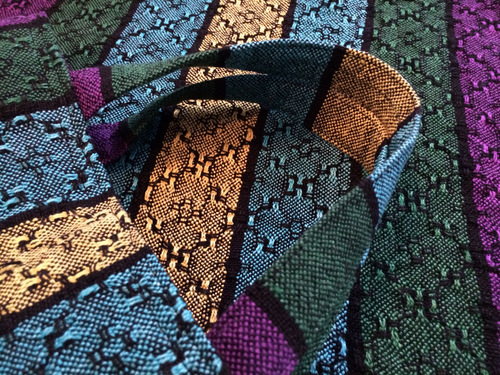
 This fabric is based on a well-known huck lace pattern that is available in a number of places.  It is included in the The Best of Weaver’s Huck Lace, edited by Madelyn van der Hoogt, on page 12 in the pattern section (by Ruth Morrison), and in the project section starting on page 51.  This pattern is also used as the end plate on the right-facing page at the beginning and end of the book.

 You can also consult Madelyn van der Hoogt’s informative digital workshop on lace weaves which you can preview here: http://www.interweavestore.com/weaving-lace-with-madelyn-van-der-hoogt.

Here is my version of this project:

Warp:  16/2 linen (Bockens Lingarn) in five colors:  1 spool each, 125 grams
# 522 black
# 485 purple
# 4060 dark green
# 40 bright turquoise
# 2030 lemon yellow

The tote fabric requires about a yard of fabric, and each napkin requires ½ yard of fabric, so plan your warp length accordingly.  I wove one yard for the tote and 2 ½ yards for five napkins.  I put on a 5 yard warp to allow some sampling and loom waste.

Weft:  16/2 linen in #522 black, 2 spools (in addition to the one used for warp)

Sett:  20 epi, width in the reed about 17.5” (finished width about 16.5”)

Threading:  There are 7 repeats of the huck pattern with 4 extra plain weave threads in black at each selvedge.  I also threaded two threads together for the first thread at each selvedge.  Total warp threads:  365 ends

Weaving:  to balance at 20 epi

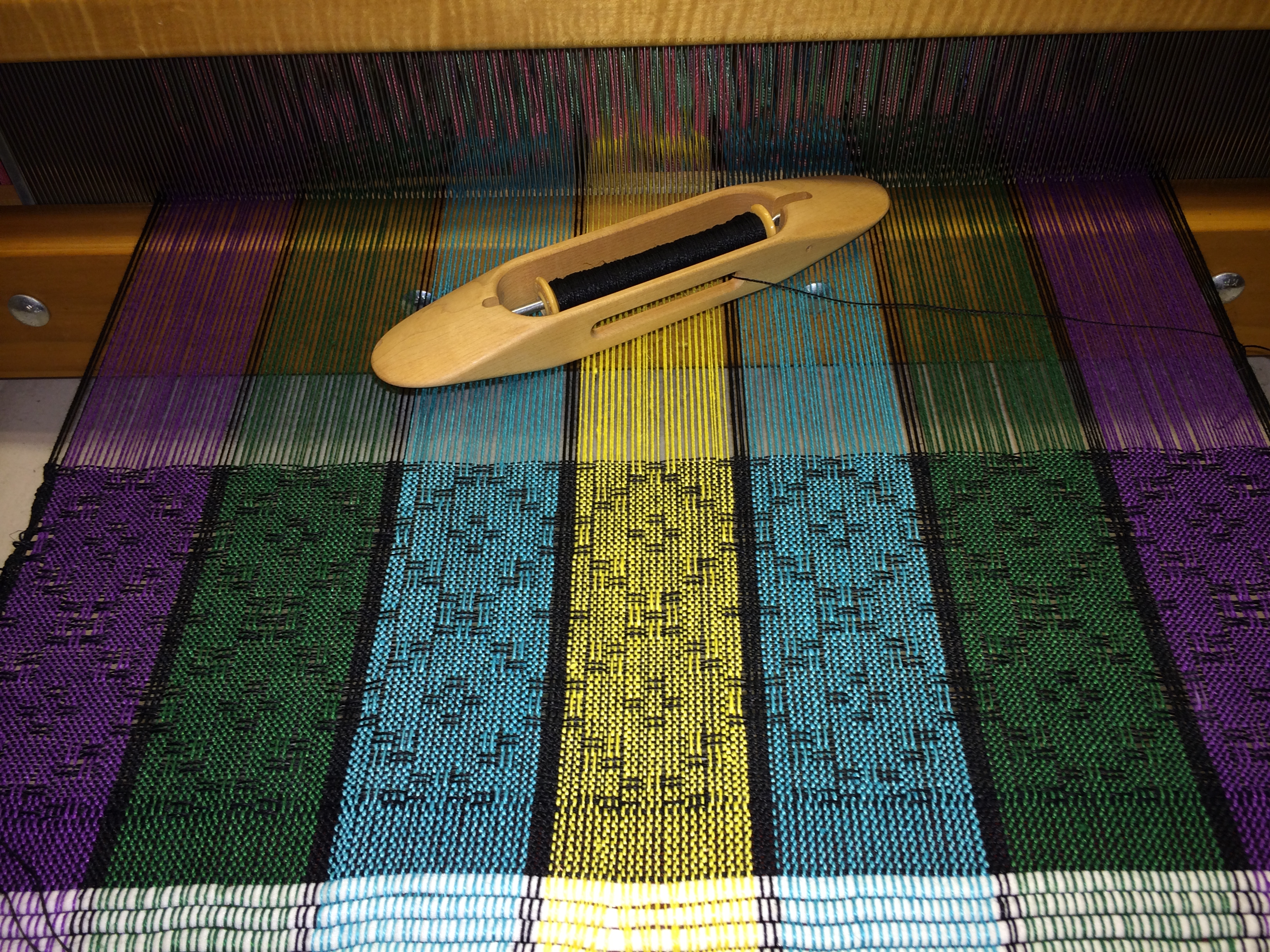
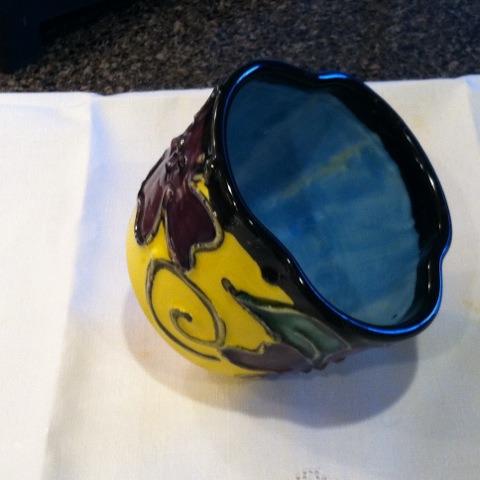
The full pattern repeat is 50 threads.  Each color stripe is 45 threads with 5 black threads at the beginning of each pattern. I placed a stripe of five black threads at the beginning of each repeat to emphasize only one column of the flower motif, as in reality there are two columns of staggered flowers.  (Unfortunately, all huck looks geometric until it is wet finished.  So my flowers look like diamonds in the drawdown.  Consult the detail photo at the end for what happens after wet finishing.)  By having a small black stripe of 5 threads, I minimized the appearance of the staggered flowers so that one straight column of flowers would stand out.  I chose to do this in order to better coordinate with the mug I was using as inspiration for the tote.  At finer setts the staggered floral motif shows up well, but not at the sett I needed for fabric that would be sturdy enough for a tote bag.

Finishing: Off the loom, I machine washed the entire length of fabric in the washing machine on ‘normal’ setting, warm water.  After smoothing the fabric by hand, I let the fabric air dry and then steam pressed it before serging the edges between all the cuts.

Huck Lace Lunch tote final as woven (this link will bring up the pdf file)
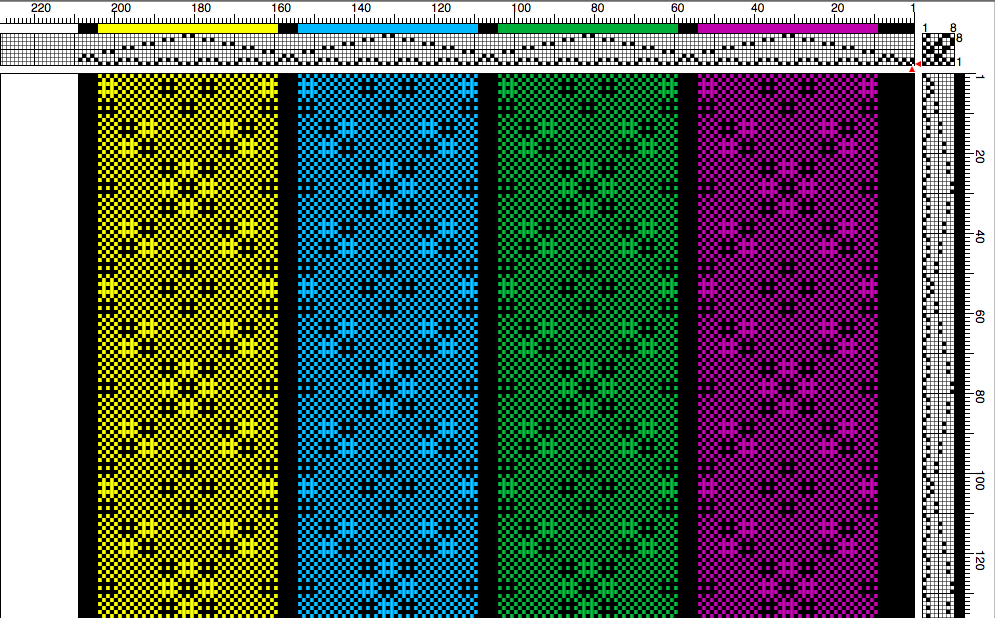
Screenshot huck lace tote bag final as woven

In this drawdown I have also included 4 extra plain weave threads at each end of the warp. You might add even more. Huck lace gives a lovely scalloped edge to fabric when it is not bordered by plain weave; however, at such a loose sett of 20 epi I found that the scallops look rather clumsy.  They are lovely at finer setts, but for this project I wish I had used a plain weave border, so I’ve included that here.

The drawdown should be followed until the end of the yellow stripe, then worked in reverse color order back through the blue, green, and purple.

The mug that inspired the tote bag:
Weaving mug exchange

 SEWING THE TOTE BAG

 Materials Needed:

 Tote bag fabric:  15” x 27” plus extra for straps if using this fabric
Lining fabric:  15” x 27” plus more for pockets and possible straps
Pockets from lining:  2 pieces, 7” x 15”
Light Weight fusible interfacing:  14” x 22”
Fusible Fleece:  14” x 22”
Cotton webbing straps if you don’t wish to use handwoven or lining fabric for this

  1. Cut pieces to size.
  2. Fuse the light weight interfacing to the wrong side of your handwoven tote fabric, centering the interfacing so that there is ½” margin on each long end, and 2 ½” margins at the short ends.
  3. Fuse the fleece to the wrong side of your lining fabric, centering the fleece as you did with interfacing on the main fabric.
  4. Sew the pockets:  place right sides together and sew around pieces leaving one short edge open.  Turn right sides out and press, pressing under ½” seam allowance that did not get sewn.  Top stitch around all 4 sides, which will close and finish the edge that was left open for turning. Place the pocket on the right side of the lining fabric about 4” down from the raw edge of one of the short sides.  Sew along the outer edges and bottom of the pocket, attaching it to the lining.
  5. Then top stitch a pocket divider, either by sewing directly down the center of your pocket, or by sewing 1/3 in the distance on the long side.  I opted for the 2nd choice so that one pocket would be larger than the other.
  6. Fold the lining (with attached pocket) in half along the long edge, right sides together, and sew the side seams.
  7. Make a flat bottom for the lining as follows:  with the wrong side of lining facing out, position one side seam so that it is in the center of the fabric, and so that the end of the seam forms a triangle at the bottom of the tote:
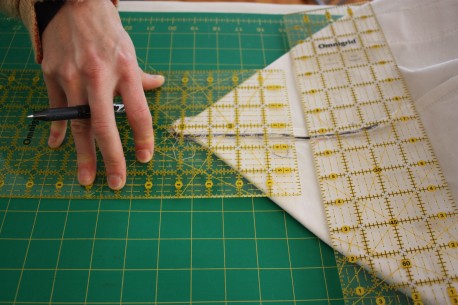
tote bag square bottom Measure 2 ½” up from the point and draw a sewing line across the bag that should be 4” across.  Sew across this line.  Repeat this on the other side seam.

8.  Repeat this process of folding the long edges of the main fabric in half (right side together) and sewing the side seam.  Then repeat the process for making a flat bottom for the main fabric.

9.  Put the lining inside the bag, with the right side of the lining facing inward and the right side of the main fabric facing outward.  Turn the triangle flaps on both lining and main fabric so that they face into the bottom of the bag.

10. Fold down the top edges of the lining and main fabric toward the inside of the bag, and so that each fabric is now folded along the edge of either the interfacing or the fleece.  Match the edges and pin.

11. Make your handles.  If you are using the handwoven fabric your handles will only be about 16” long.  Take the hand fabric and press ½” in on the long sides.  Fold in half and top stitch along the pressed edge and then around the entire handle to finish.

12. Insert the handles into the pinned top edge of the tote bag so that each end of each handle is about 1/3 in from the end of the bag.  The finished bag is about 13” wide.  Divided in thirds (4 1/3”), you would place your handles to center on 4” and 8 ½” roughly.  Pin the handles in place with at least 1 ½” down in the seam.  Top stitch around the top of the bag.

FOR NAPKINS:

I wove 18” of huck lace pattern with 2” of plain weave at the end of each napkin.  I wove two picks of a contrasting color of weft in plain weave between each napkin. I turned under a hem at each end so that the plain weave was not showing on the face of the napkin, and hemmed the napkins by hand with black thread.
IMG_1477

A Trip along the Hudson River and Huck Weaving

This week was a beautiful time to be along the Hudson River Valley.  I drove up to participate in the Wednesday Group monthly class.  It was a stunning drive there and back, and it was beyond wonderful to be back in class after being away for several months.

I took my spool tapestry, hoping to finish it or at least draw the finishing line across the top.  After everyone took a look at it, the general consensus was to have a shaped ending.  I really liked that solution, mostly because it meant I only had one more spool to weave!  So….it is done!…well, except for all the finishing work.

2014-06-09 13.45.22 Now I can get back to my medieval spinner and an intriguing idea that has been on my mind for a while.

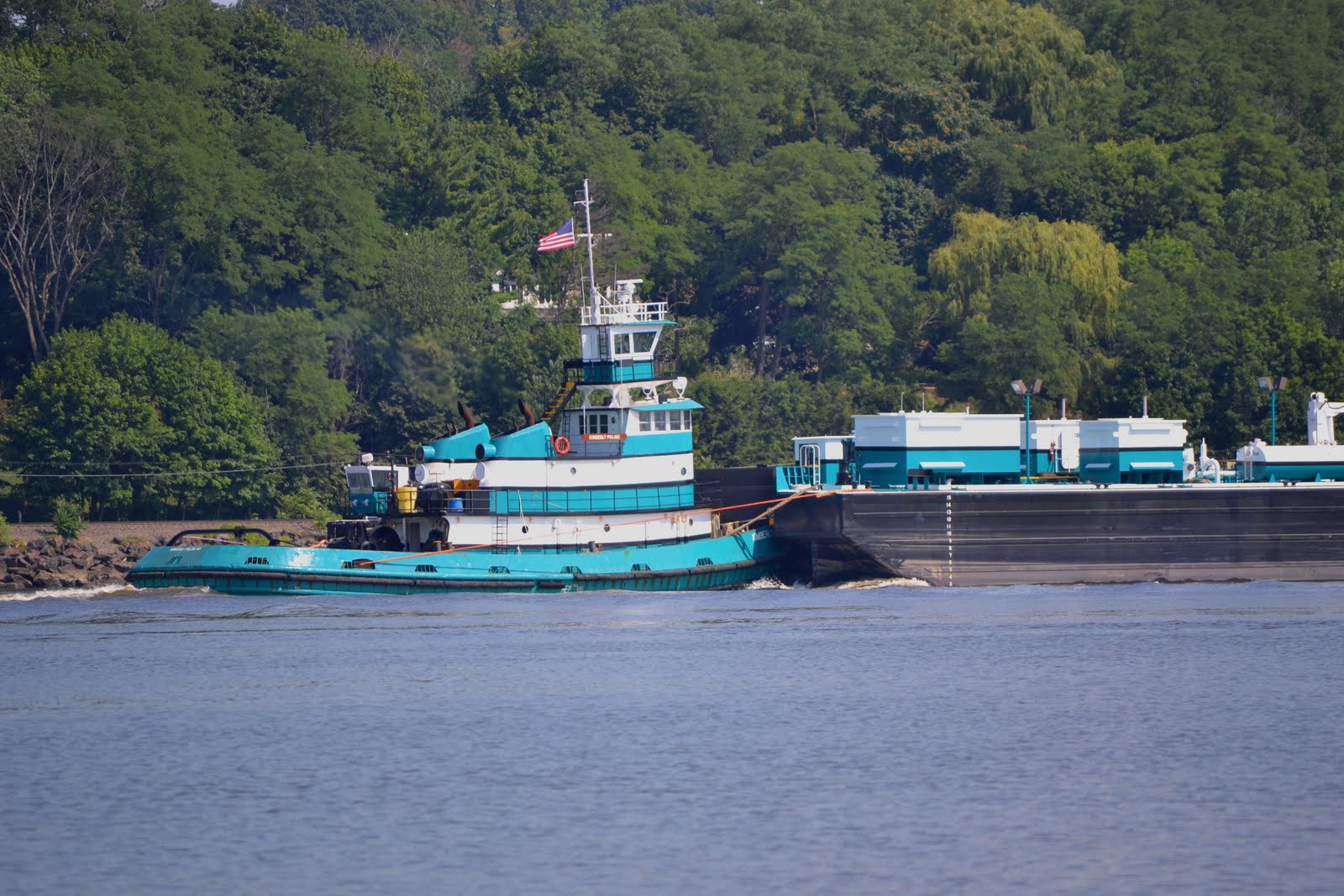
In the mornings before class, and in the evenings, I was so lucky to stay in place with magnificent views of the Hudson…..and to be in the company of two wonderful friends.  There is a lot of big ship traffic on the river, all day and through the night.  Very impressive!  And now that it is approaching summer there is plenty of pleasure boat traffic as well.

Alta view hudson river

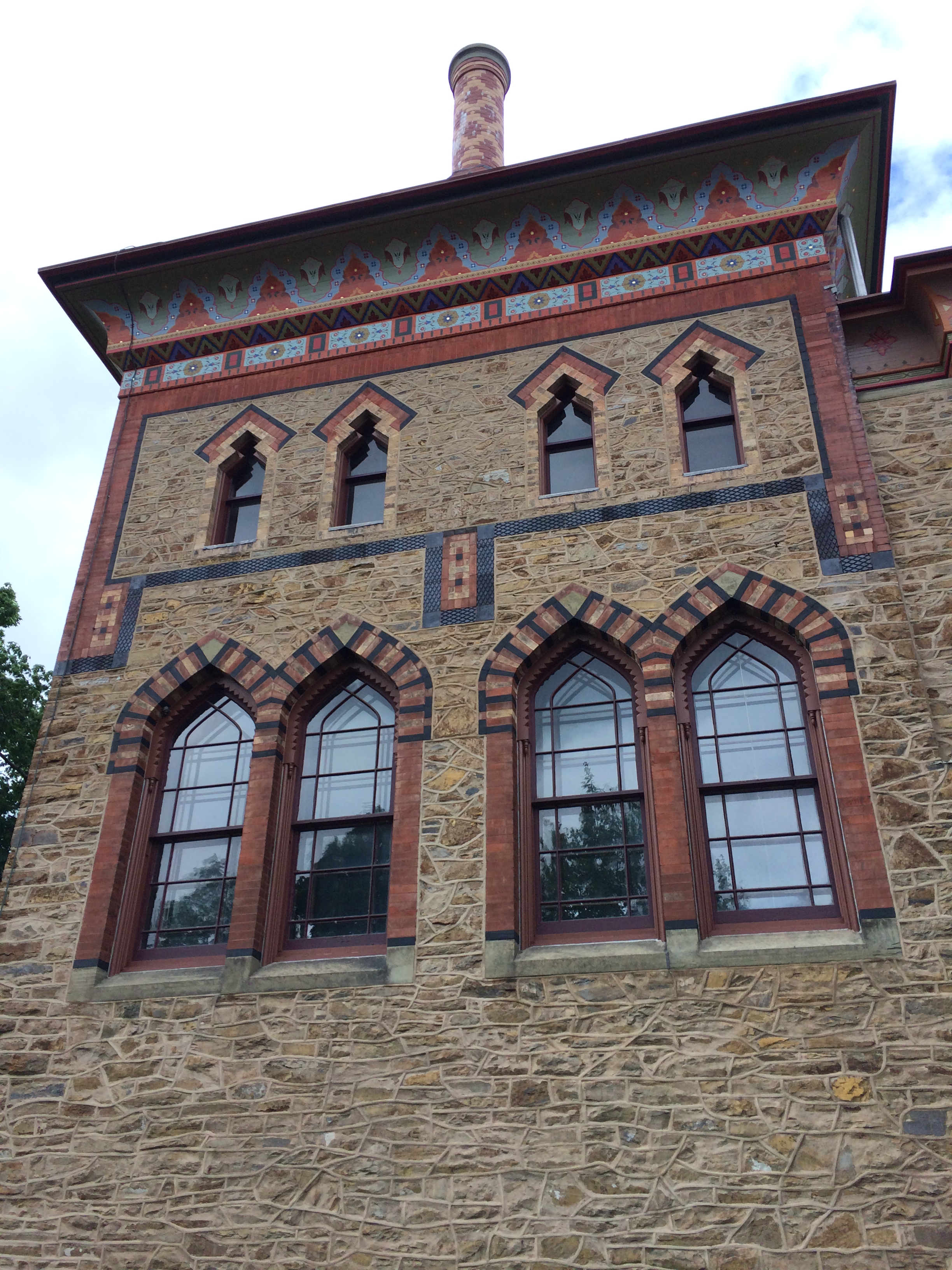
On Friday my friends and I took a trip to the eastern side of the river to visit the OMI Sculpture Park, in Ghent.  First we made a quick stop at Frederick Church’s “Olana.” The Turkish inspired tile work is phenomenal, and I don’t know how all this tile work survives the climate here in upstate New York.

2014-06-06 10.30.16

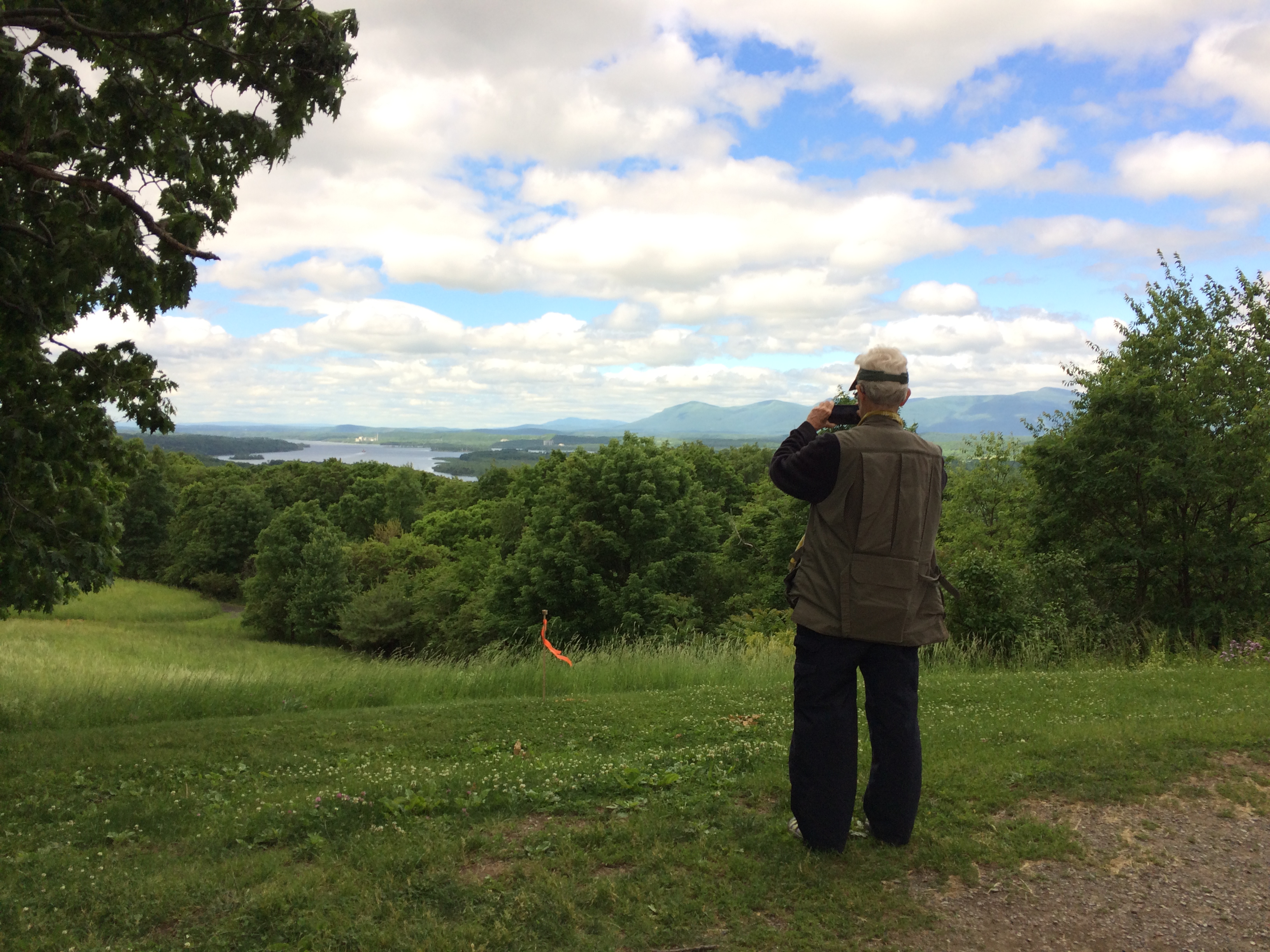
The views of the river and the Catskills were as compelling as the views of the house and grounds.

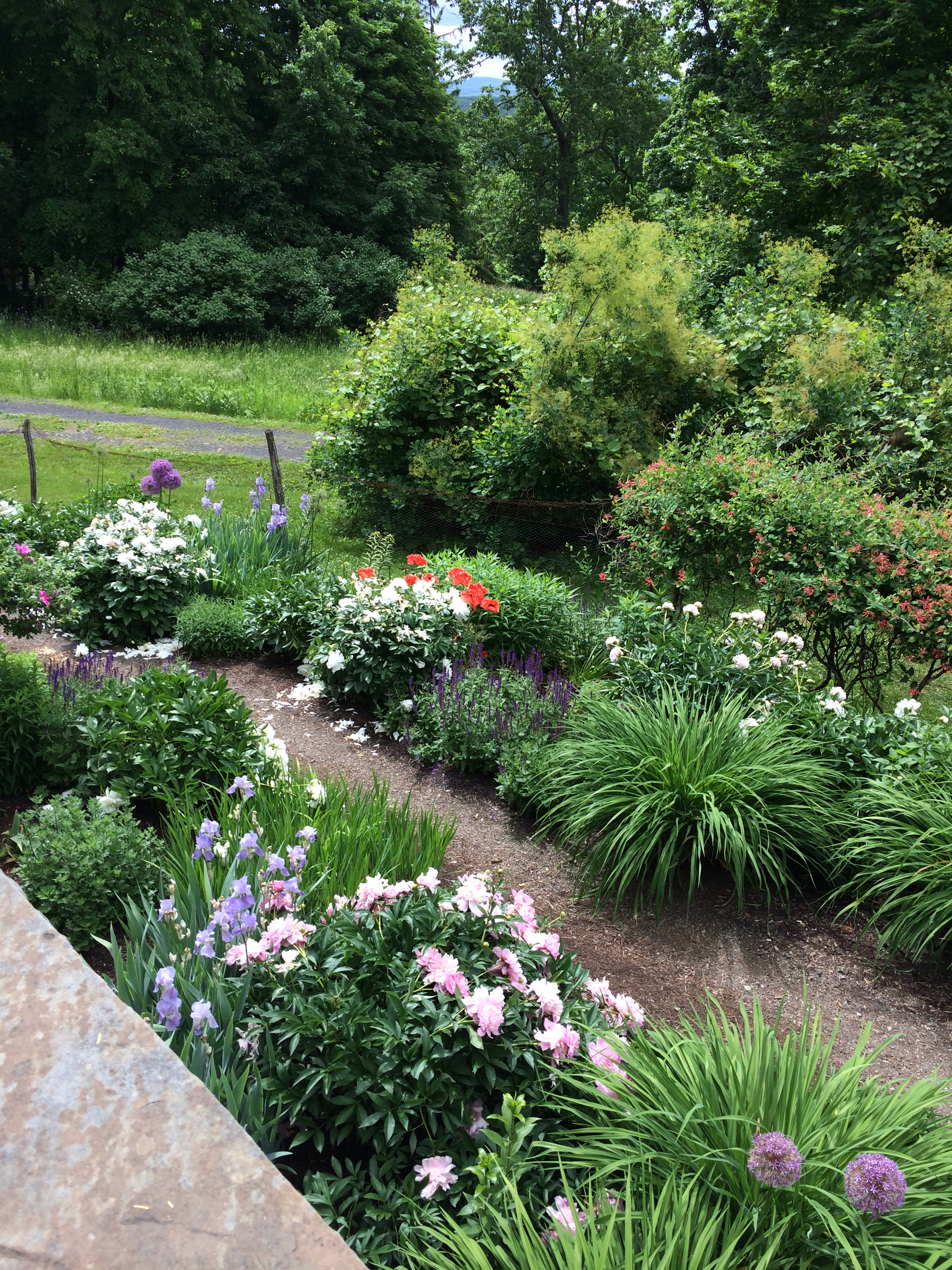
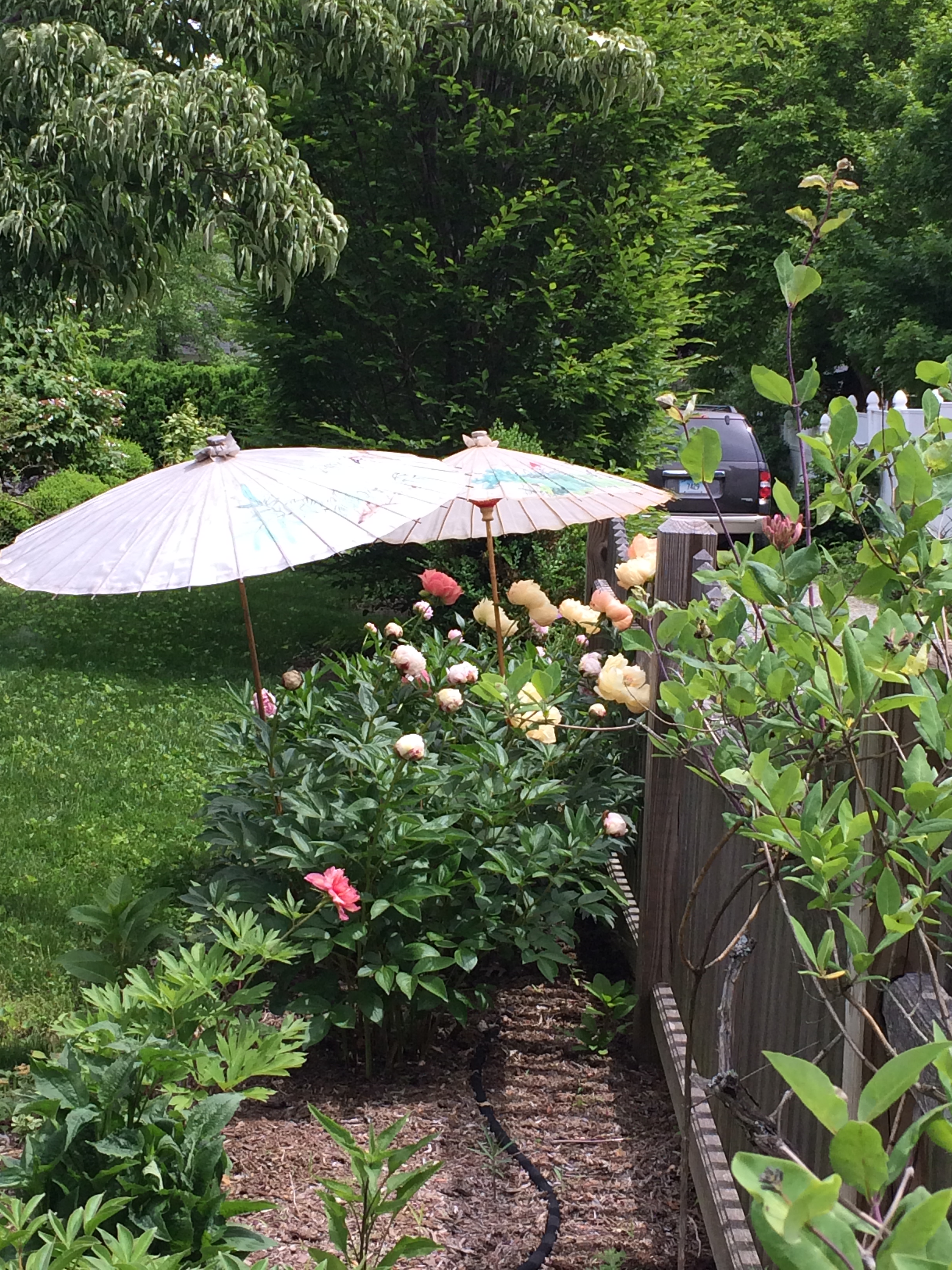
2014-06-06 10.31.14And there were gardens, bursting with poppies, peonies, and iris…

2014-06-06 10.34.52

At OMI there was quite a bit of construction going on as they began installation of some new pieces.  The older pieces mostly looked really dated to me.  But in spite of the big equipment digging holes and moving artwork, and the noise, we managed to have a great time.  The weather was perfect June….

2014-06-06 12.17.26


2014-06-06 13.13.36

Then, back at home, Bob and I took a walk along our own Connecticut River and enjoyed the beautiful gardens that are full of peonies.

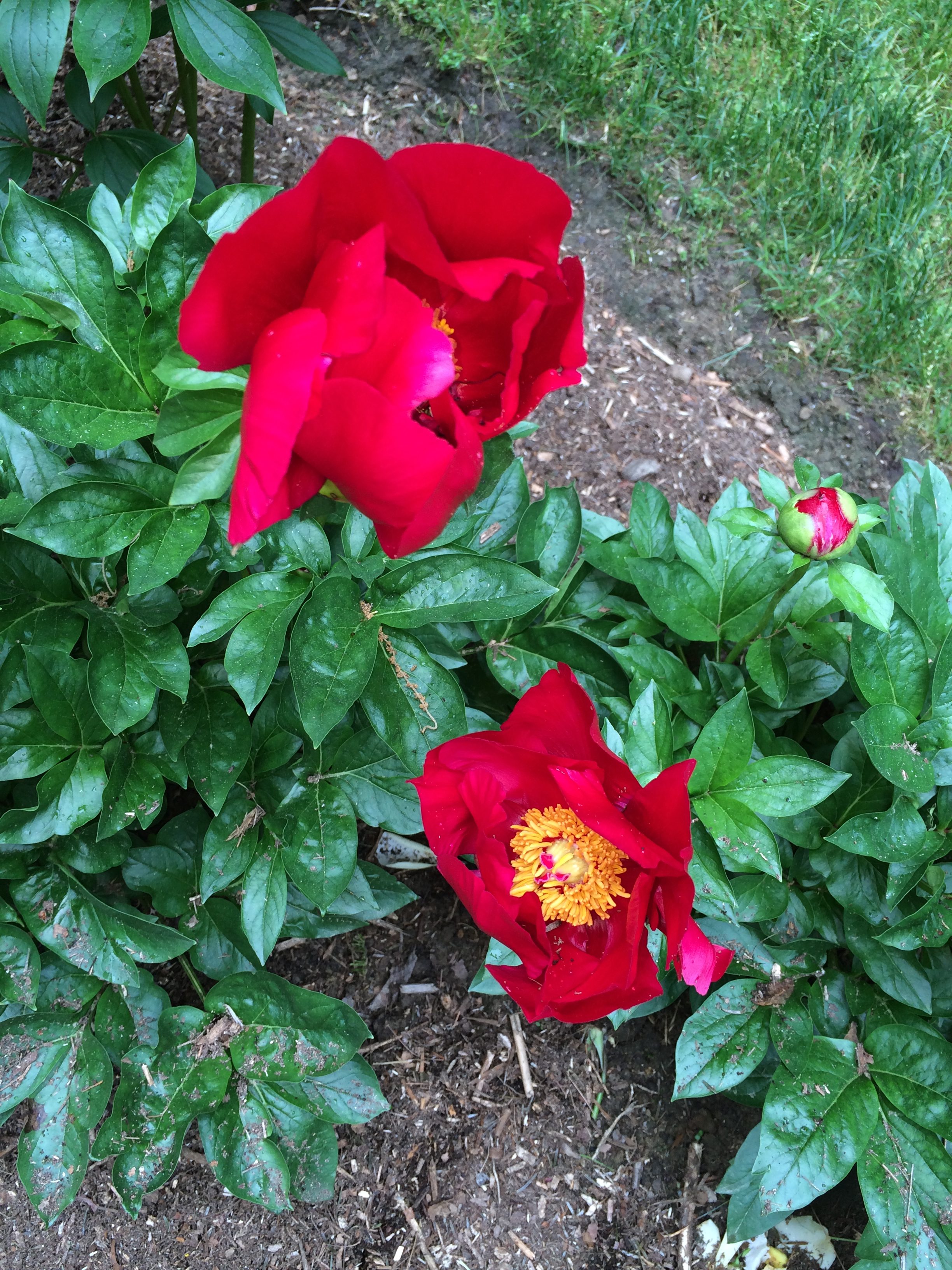
2014-06-08 11.13.31My own deep red “Blaze” peonies have opened, right next to my “Knock Out Julia Child” yellow rose.  It’s a glorious time in the garden these days!

2014-06-09 12.25.08

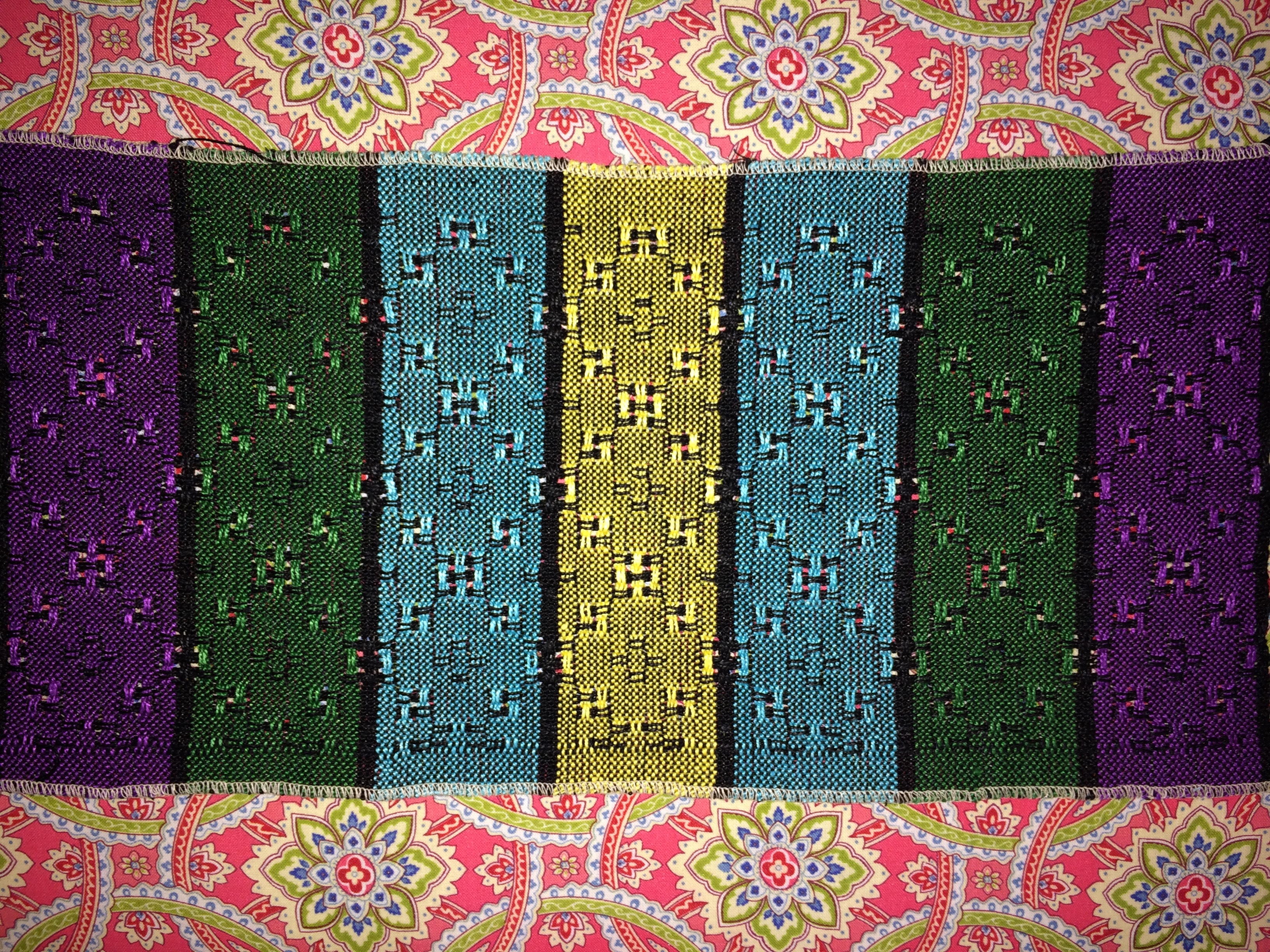
While I’ve been writing this a sample of my huck lace fabric has been going through my washing machine.  It has fulled nicely in the wet finishing (no dryer).  I blotted it in a towel and have just ironed it. I’m happy to see that the pattern is square!  Three yards to weave to make a lunch bag with matching napkin as a gift, and four napkins for me!

2014-06-09 13.11.38

Here is the mug that inspired the fabric.

Weaving mug exchange

Pegging Dobby Bars….

It’s been a good, productive day.  I actually posted on Archie’s blog for the first time in longer than I will admit (although the dates are there for everyone to see….to my shame!).  He and I have been working on things all along….just not posting.  If you love tapestry check it out!

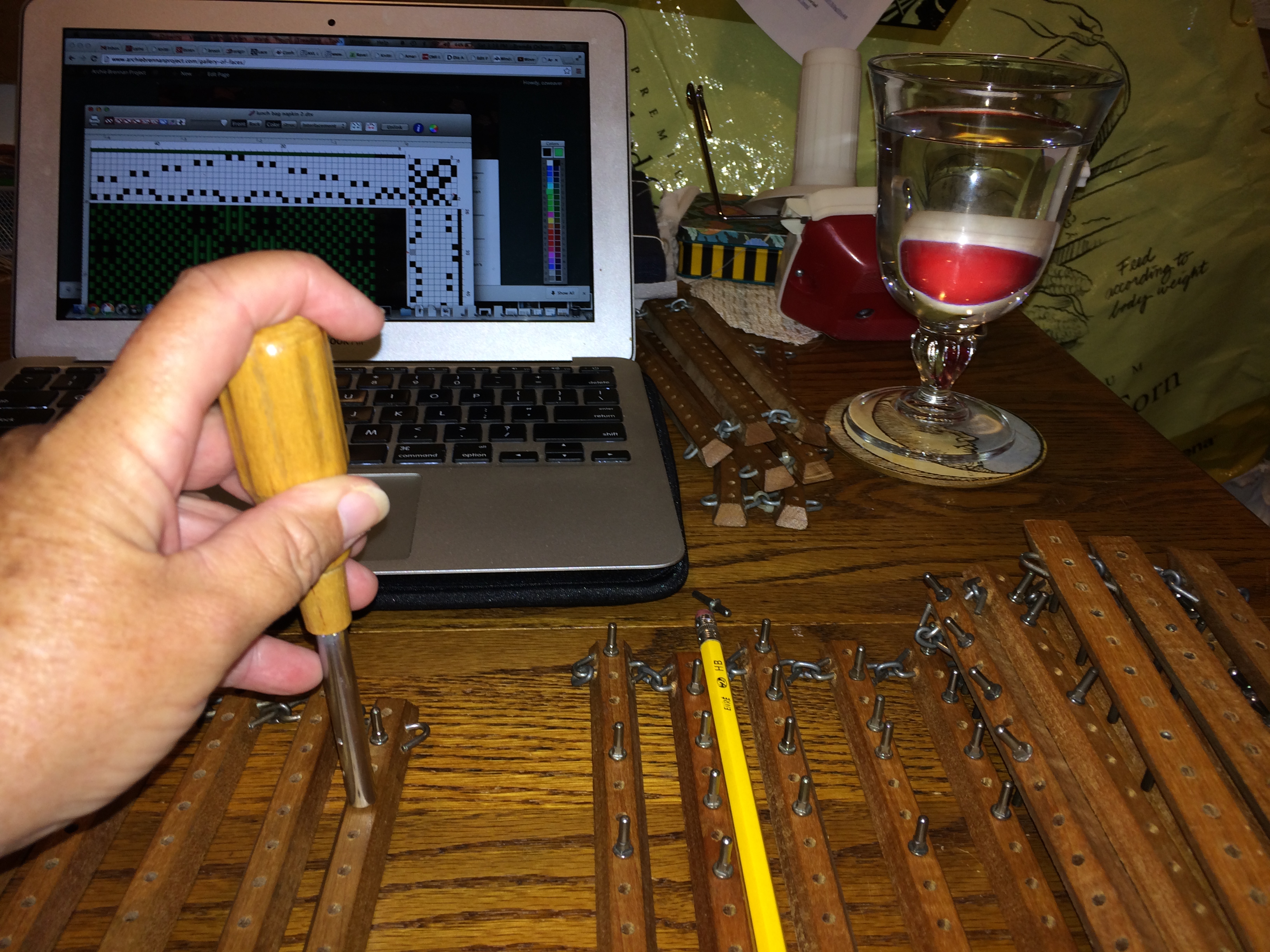
And I wove some plain weave on my huck threading to look for threading or sleying errors.  All is well so it was time to peg up 50 bars for my pattern.

2014-05-31 15.20.01Notice anything wrong with this picture?  I certainly didn’t…..until I’d gotten about the 2/3 through the pegging and ran out of pegs.  So I went scavenging through my bars to undo some pegs.  And that’s when I noticed that the pegs go in the flat side, not the angled side.  So….out with the bad and in the the good.  Almost twice the work, but at least it’s done now….
Just started to weave and the bars are not advancing well on the dobby arm.  I’ll have my devoted handyman Bob take a look at it.  Be back shortly…

2014-06-02 11.28.21

Now it’s Monday…  Bob got the dobby arm to work in one direction, but not both.  The manual says not to fiddle with adjusting the dobby arm, but to call AVL for advice.  Well, they are in California and I’m on the East Coast, so I could not call over the weekend, and cannot call until this afternoon.  So, moving forward only, I tried the pattern.  There were lots of misfires with the bars, but I managed to get two pattern repeats by going forward only.  After wet finishing these diamonds will soften into rounded flowers.  I am happy!  Now, hopefully I can get the dobby arm to work properly so I can speed up a bit!


Spring on the Farm….circa 1750

Yesterday there was a lovely event at a local historic farm in Old Saybrook.  It was a wonderful way for me to celebrate being home and to enjoy the glories of spring!

The house at Bushnell Farm was built in 1678, and is the third oldest house in Connecticut (now I want to find the two older homes!).  Isn’t it a beauty?

It is privately owned by a couple who live in my town, and they are doing a fantastic job of maintaining this property as well as continually bringing various areas of the farm back to the conditions of its early history.

Several times a year they open the property to the public free of charge.  The spring opening celebrates the farm’s production of textiles which was such a vital part of life at that time.

One of the barns has a large loom in it dressed with linen toweling.  There are a number of flax wheels, lots of tools for spinning and weaving, along with all the other tools and equipment that would be in use on a farm of this age.  The Clarks have done a stellar job of collecting the daily items that would be in use on this farm.

For yesterday’s event the Clarks had arranged for two spinners from New Hampshire to come demonstrate at the farm.  The first demonstration was on processing flax into linen, and it was the main event for me.

Gina Gerhard does 18th century textile demonstrations throughout New England and she certainly knows a great deal about growing flax, harvesting it and processing it for spinning into beautiful line linen.  While I know the various stages of preparing flax stalks for spinning, I had never seen the entire process done live, right before me!  Gina made it look easy, but she has had a lot of experience, and she was only processing one bundle for us. I’m sure an entire harvest would be a huge undertaking.

Amazingly, she grows her own flax, starting with about 5 lbs. of flax seed.  In her area of New Hampshire an historic flax pond has been identified, and she hopes to use it in the future to rett (or rot) her flax bundles.  At the moment she uses a large outdoor tub to rett her flax, and it takes about 4 to 6 weeks.  Having a pond that can be dammed with shallow, still water with a bed of stones at the bottom gets the job done much faster, perhaps only 4 to 5 days if things are perfect.

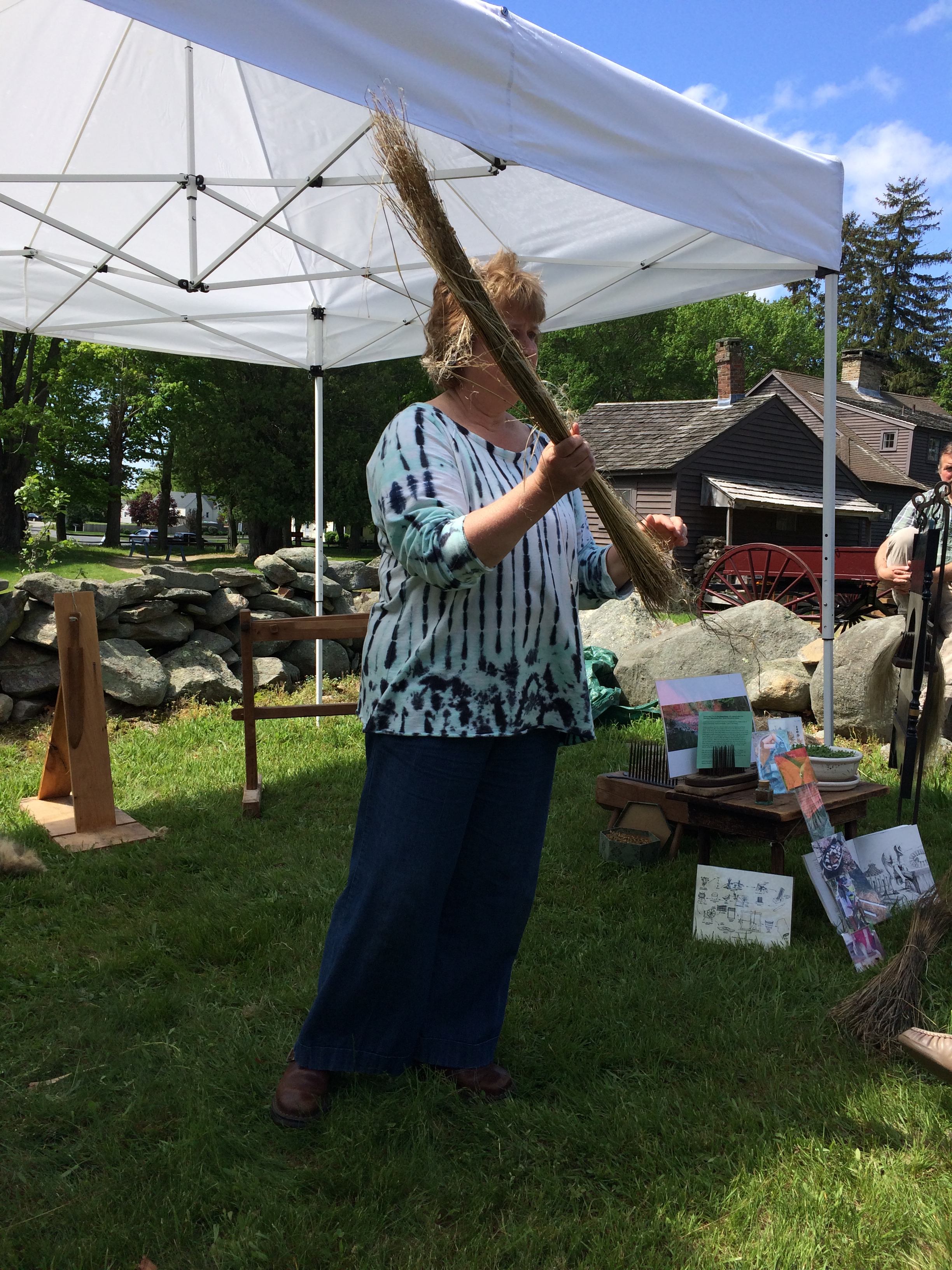
Here is Gina holding one of her flax bundles.  First the bundles were dried and then retted and then dried again.  In her northern climate she harvests the flax in late Sept or Oct.  Since that is not a great time for beginning the retting (rotting, and it does get stinky as it rots!) process, she lets the bundles dry over the winter and begins the retting process when the weather gets warm, like now!

2014-05-24 10.33.00

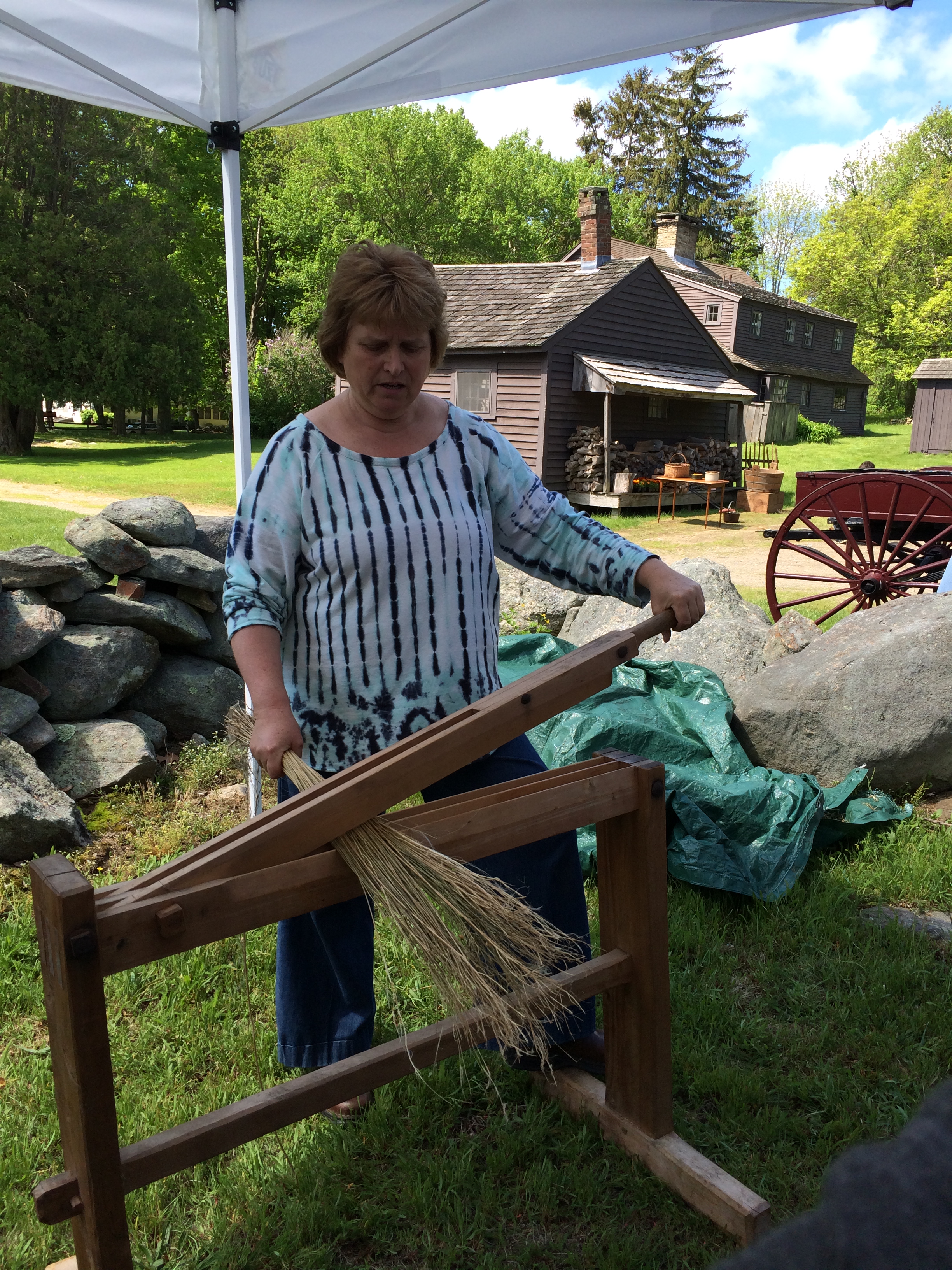
The first step in preparing flax for spinning is breaking the flax stalks, which removes the outer and inner harder ‘straw’ that protects the fibers.

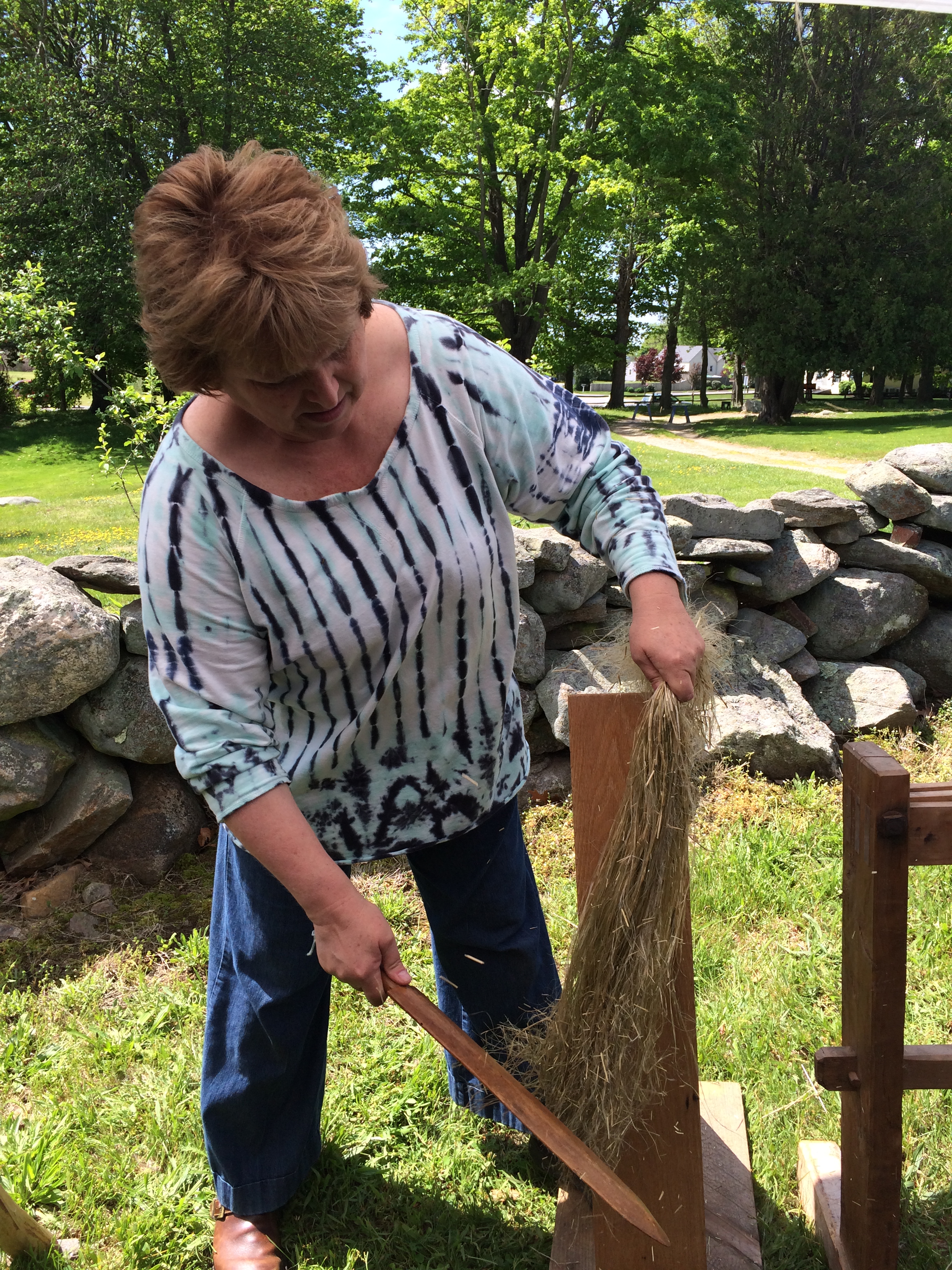
2014-05-24 10.38.26The next step is scutching which also removes more of the tough casings that protect the flax fibers within.  Gina is standing next to a scutching board with her wooden scutching knife.  The technique is to lay the bundle against the board and beat the bundle in a downward motion with the knife.  It is a motion of beating and scraping down the stalks.  She mentioned how often she sees these tools mislabeled in antique shops.  She said the scutching knife is often labeled a toy sword!

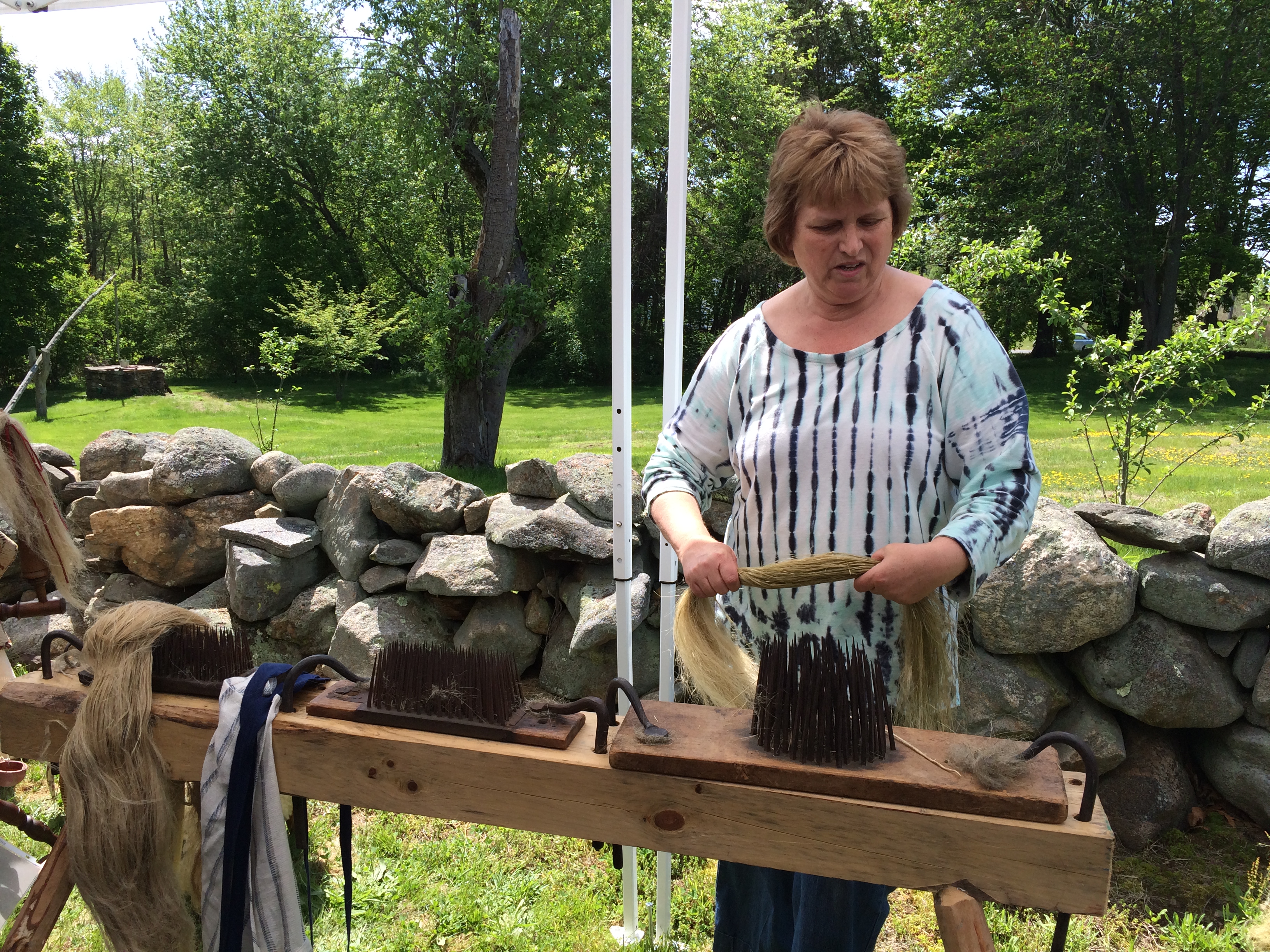
2014-05-24 10.43.39Then she moved on to her hackle stand, a saw horse with three hackles attached to it (with bench dogs, my first exposure to these marvelous tools.  Why has the modern world switched to C-clamps when bench dogs are so much faster to use and so much prettier too?).  The first time I saw hackles I understood our phrase “getting one’s hackles up!”   Sometimes an image is worth more than a thousand words!

This photo shows Gina’s three hackles (all up!), getting finer as she progresses through the hackling.  Aren’t her bench dogs great??  I talked to the blacksmith in one of the nearby barns about getting a set.

2014-05-24 10.47.19When Gina was done hackling, she had a beautiful linen strick to spin.  She could twist it into a bundle and continue processing other flax bundles, or she could put the the strick on her distraff and begin to spin.

The great take away lesson for me during this demonstration came now, dressing the distaff.  I have never understood how to dress the ‘birdcage distaff’ that we see all the time.  It just seems to me that after preparing this perfectly combed strick of linen putting it around the birdcage just gets too many of the fibers out of alignment.  Then spinning only messes up the aligment further.  Well, clearly I don’t understand it because it is the traditional way of preparing  flax to spin.  Luckily there are other traditions, and Gina uses a straight distaff on which she ties her strick so that it stays in a straight bundle.

Here are the two distaffs:  birdcage on the left, straight on the right

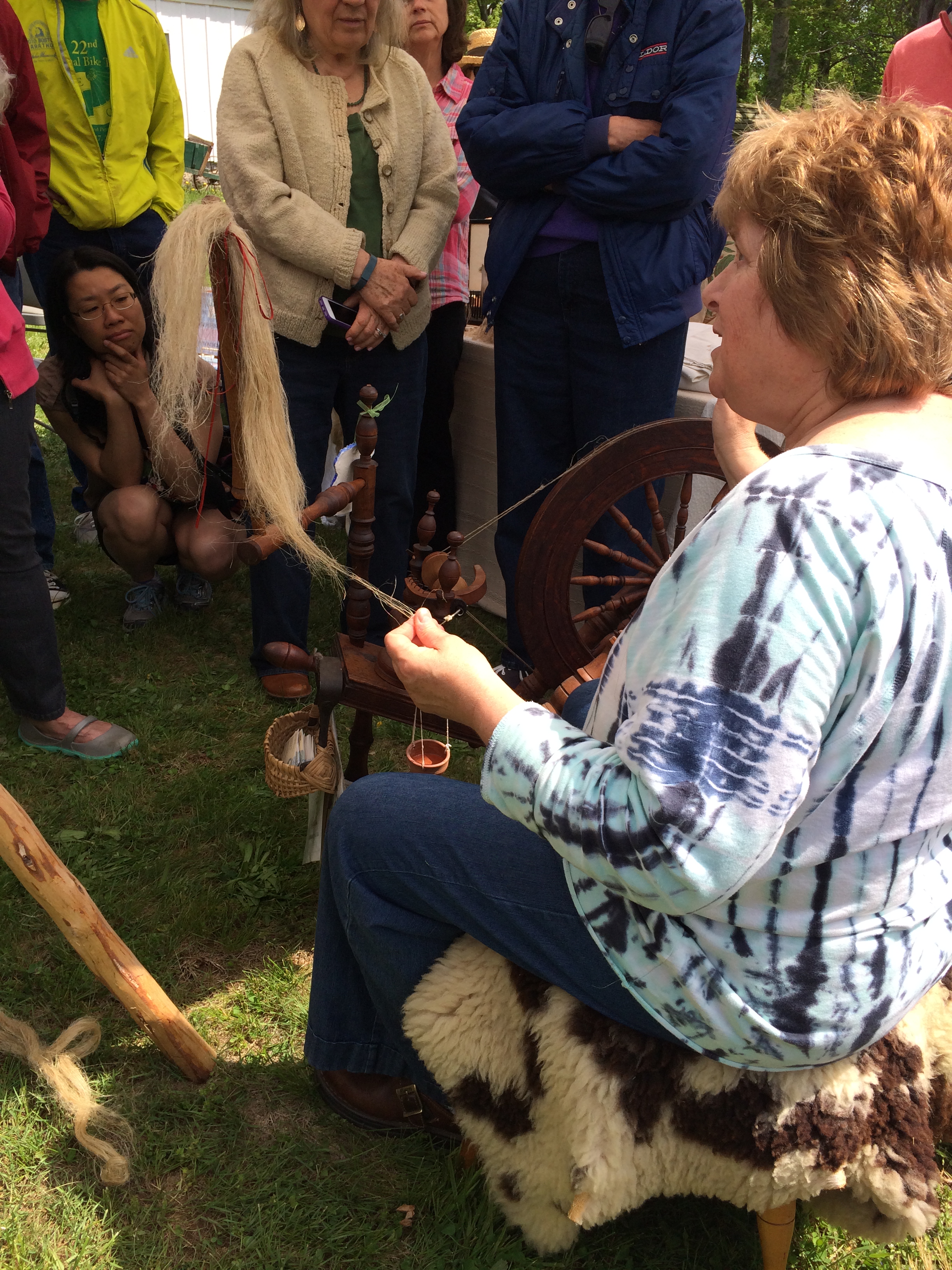
Here you can see how she has tied her strick to her simple distaff and is preparing to spin by pulling out just a few fibers.

2014-05-24 10.58.06Gina describes her flax as good quality (and that is easy to see!), but not as fine as the linen grown in Belgium or northern France.  She says farmers there have mastered what is necessary for producing the finest flax fibers, which includes sighting the flax field in a very sheltered place, safe from wind.  Flax plants have very shallow roots and the plants can get knocked down by wind or driving rains.  Once they are down they cannot be staked up again.  In general, in northern Europe, summer weather is mild and rains are not violent in the way that our summer thunderstorms in New England can be!

Gina spins a yarn that would make a wonderful heavy weight smooth linen fabric.  You can see just how few fibers she draws in to her yarn.

2014-05-24 11.00.40Along with her demonstration she had a lovely display of linen items.  It was such a treat to see her working, to see her display and to get to know her.  I hope our paths cross again!

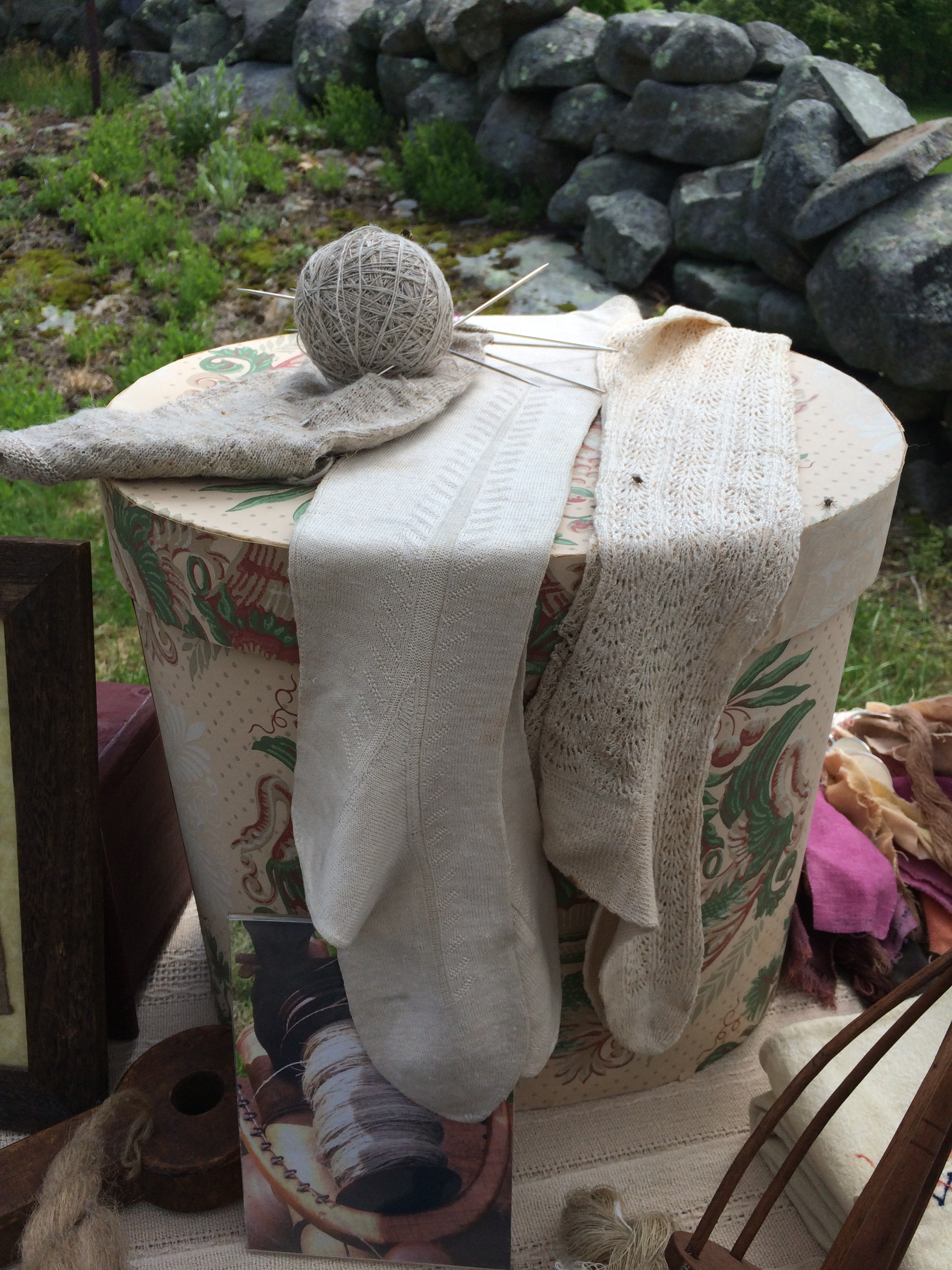
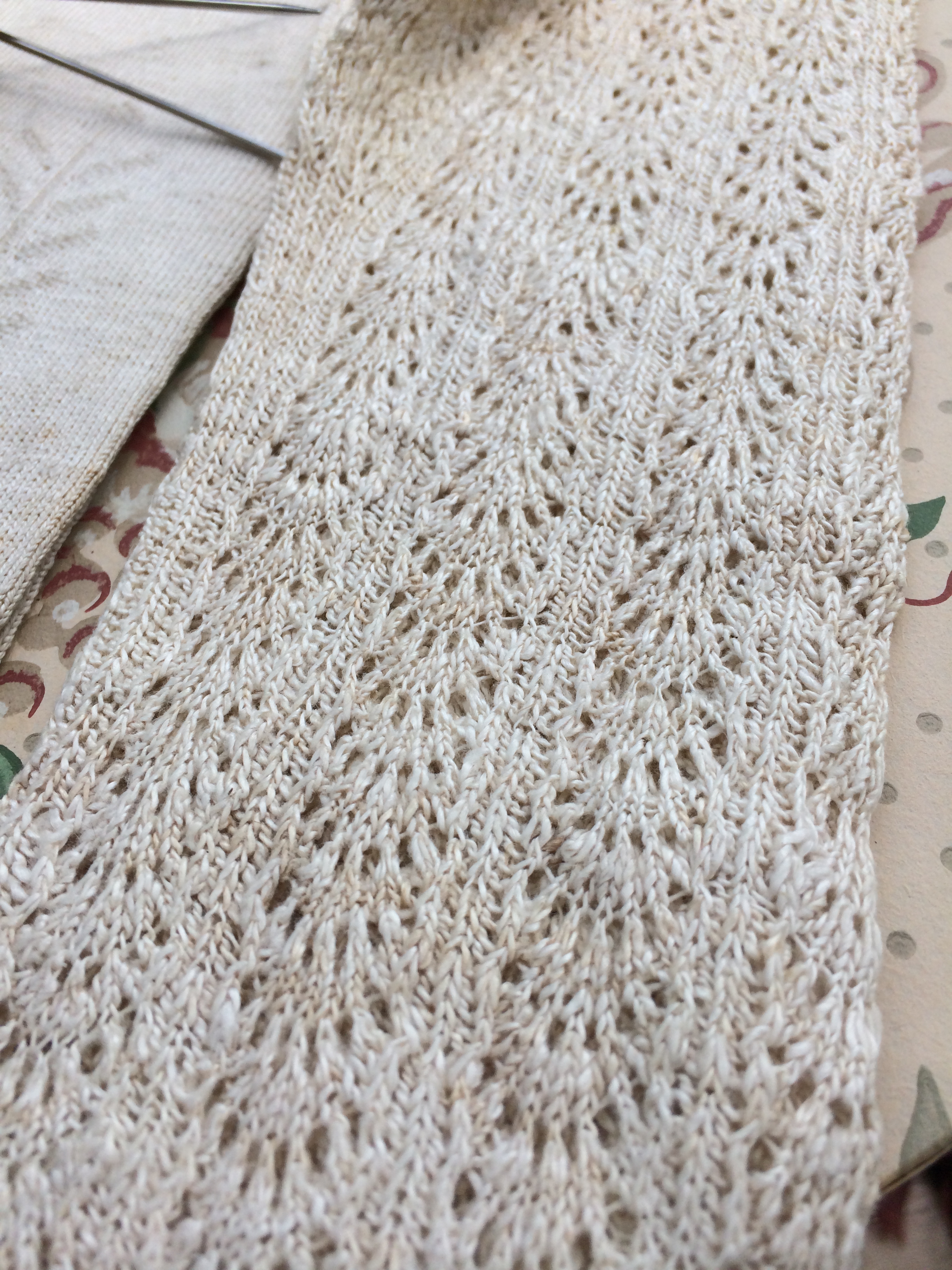
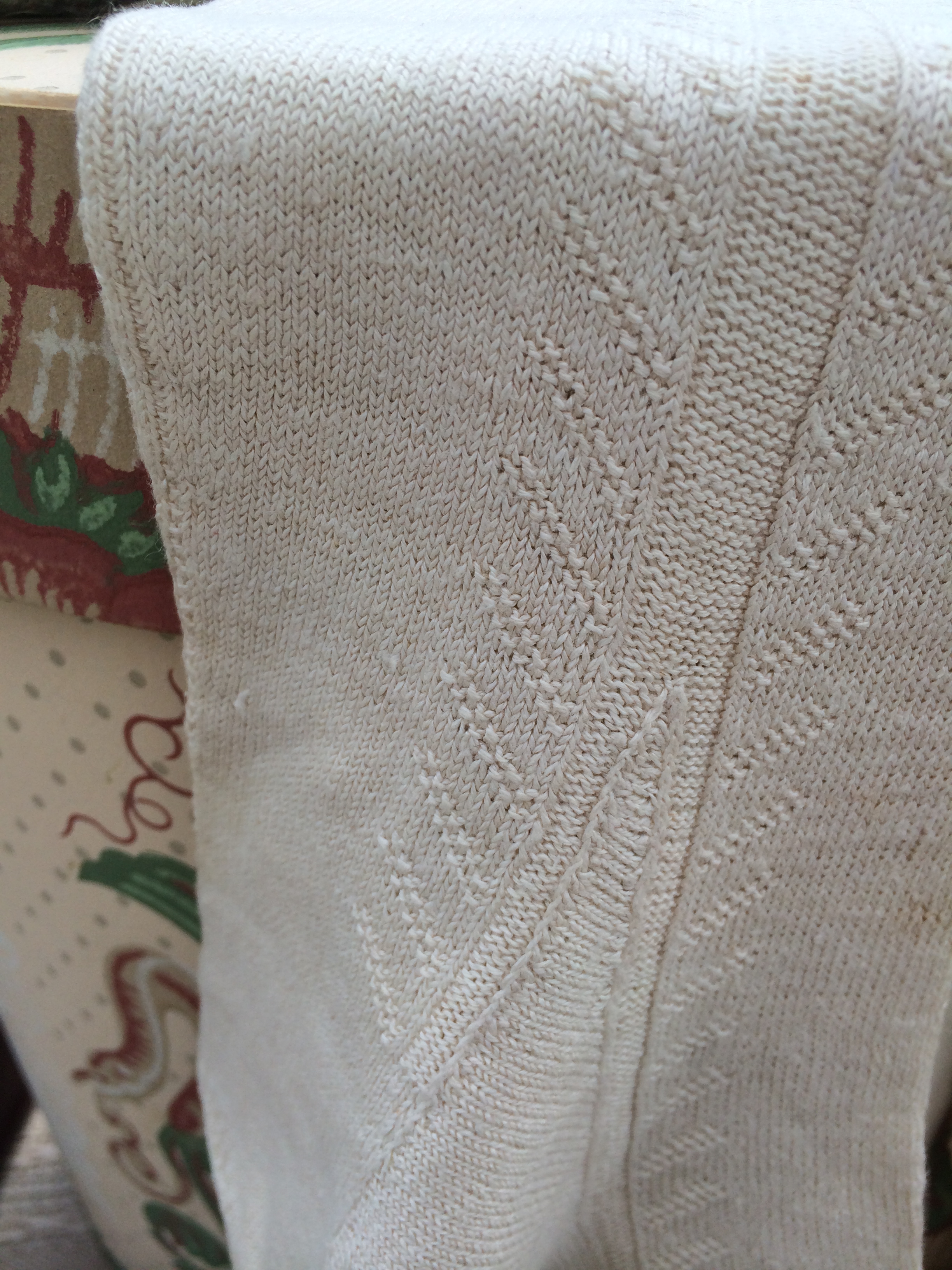
Linen socks!  I’m not sure I believe these are handknit!

2014-05-24 11.13.53And a close up of each of these beauties!  First, feather and fan (okay, close up I can believe this was handknit):

2014-05-24 11.14.00…but not this one! Boy, I would love to try these on!

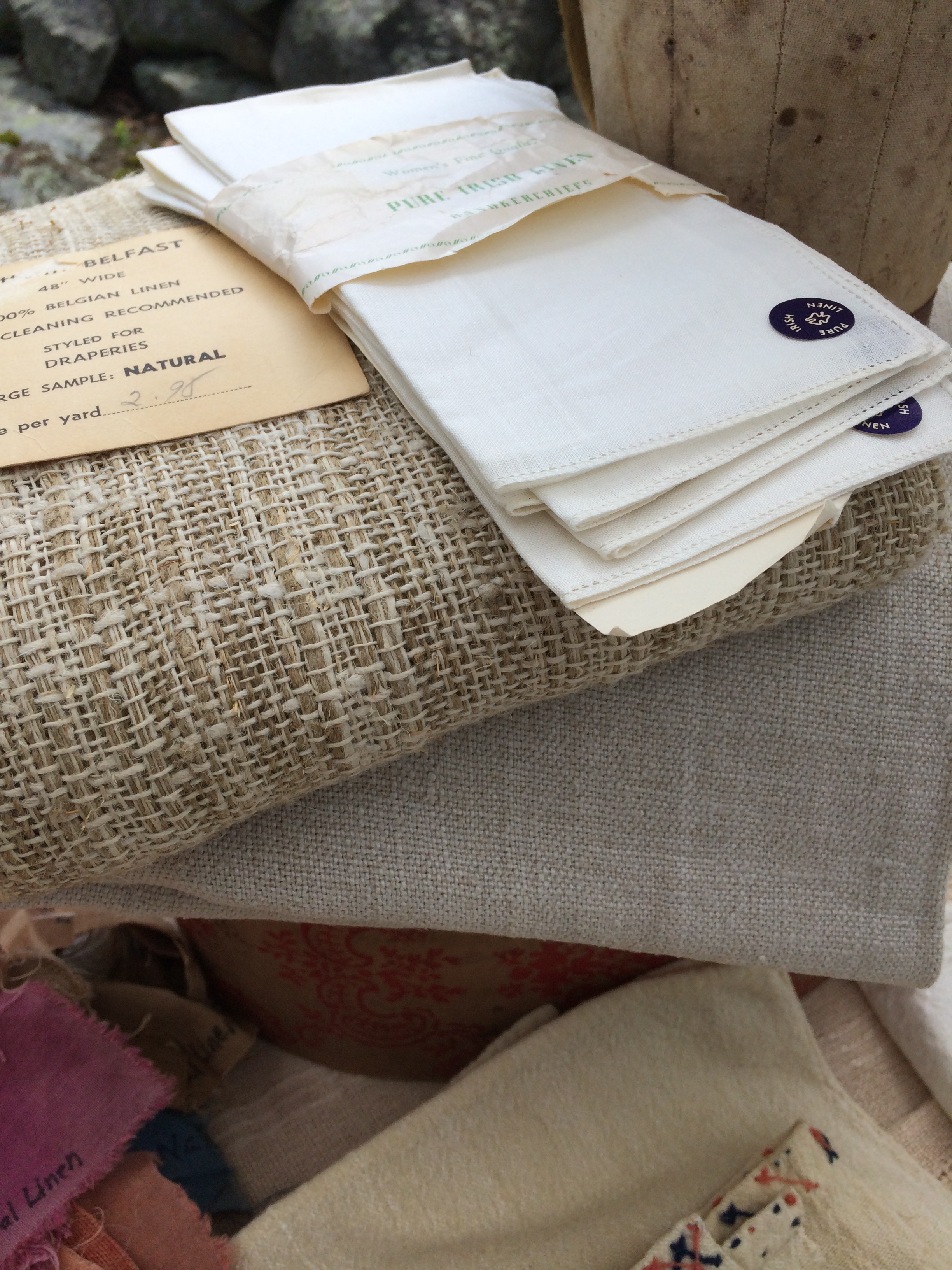
2014-05-24 11.14.07She had a plenty of linen fabrics to see and touch to show the difference in fineness and color.  In the stack of three fabrics at the top of this photo, you can see a set of very fine, bleached linen handkerchiefs, followed by quite a coarse fabric woven of  linen singles (perhaps tow linen), and last a heavy weight fabric of line linen which I believe is very similar to what Gina was spinning for us during her demonstration.

2014-05-24 11.14.44At the very bottom of this photo you can just see a bit of embroidery and the folded part of the fabric behind the embroidered edge.  This fabric was wonderfully soft to the touch;  it is a length of antique linsey woolsey.  Wow!

So, that was the highlight of my visit!  And of my Memorial Day weekend.  I just want to get back to my linen spinning project!  Gina has given me some great ideas on how to improve, and I’d like to get to it!

Meanwhile, other things were going on on the farm.  Wool preparation and spinning, horsedrawn wagon rides, sheep shearing.  Most of the out buildings on the propery were open.  One of them has been set up as a general store, which is not original to the farm, but makes an intriguing display of 18th century items that the owners have collected.

Some of my fellow guild members were on hand demonstrating and showing their wares.  It was great to catch up with them and watch them talk to onlookers.  There was a great turn out for this event.

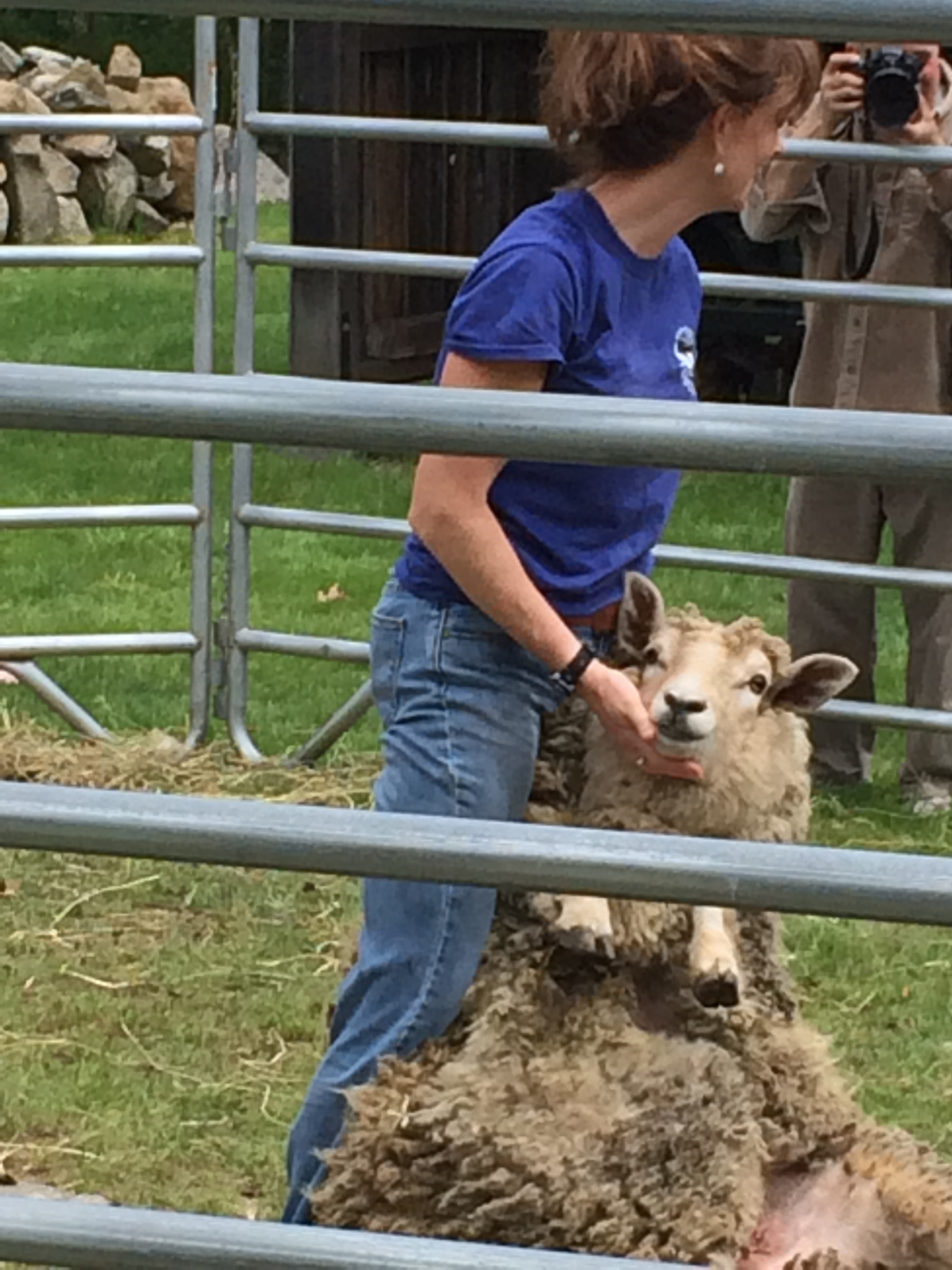
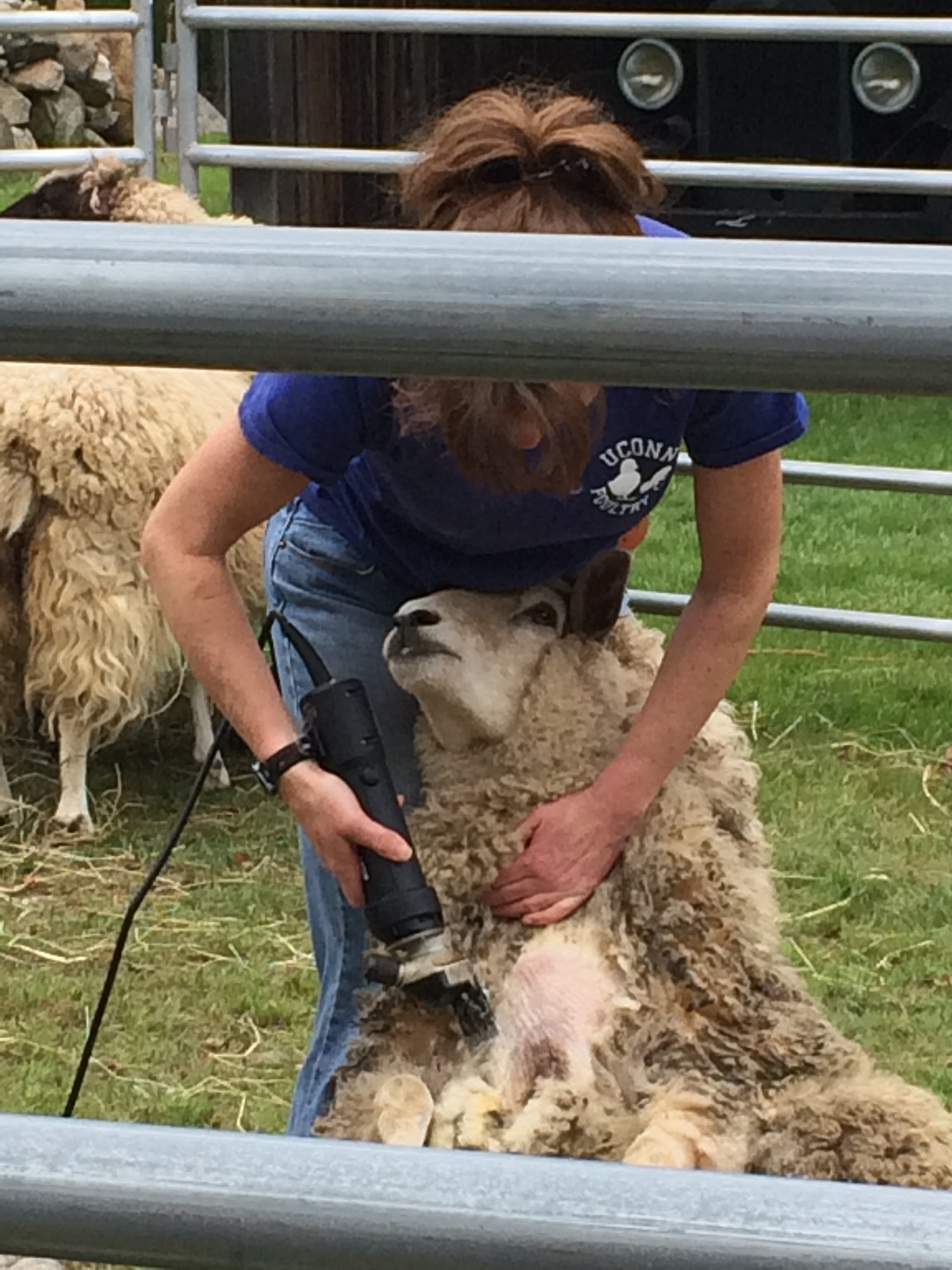
The sheep shearing was almost as thrilling as the flax demonstration.   Certainly it was very thrilling for the sheep….they did their best to avoid it. The shearer was a woman, of very slight build, and rather young it seemed to me.  She handled herself with such confidence, the sheep never gave her a moment’s trouble once she corralled each one.  She sheared all the sheep, but I only documented the first one.  She never made a knick on the sheep, and the two year old ewe was perfectly calm.  Who wouldn’t love a face like this?

2014-05-24 12.21.59

And so the shearing begins…. 2014-05-24 12.28.45

Moments into the shearing I realized I was watching a master, so I had to tape it!


Now it’s Sunday morning and I am full of ideas and inspiration from my day on the farm…. although I want to spin some flax, I am partway through making that colorful warp for yardage for the napkin and lunchbag fabric that is due at next month’s guild meeting.  I’d better stick  to that today!

It’s nice to have enthusiasm for so many fun textile projects!  See you later, hopefully with photos of my finished warp!

A Month Aboard

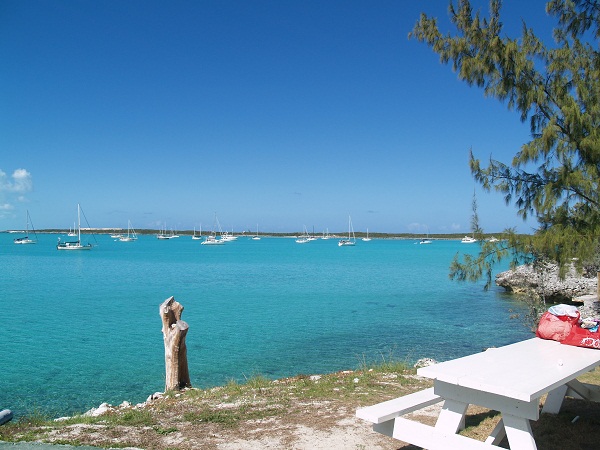
As I write this Bob is ashore doing our laundry…..yes, it’s almost unbelievable, but I promise….it’s true.  How lucky is that?  We are in Black Point Settlement on Great Guana, where you can get a haircut and do your laundry and have conch fritters, all at the same place that overlooks the little bay where all the boats are anchored. I am suffering from a cold, the last person onboard to get it….just when I thought I had missed the nasty little germ.  So I get to stay aboard and take a nap. Oh well.

This is where you sit to get your haircut while your laundry is going inside

OLYMPUS DIGITAL CAMERA

After Chris left last week we had big plans to sail up to Compass Cay and spend a day or two shelling.  On the morning we wanted to depart our anchor would not come up. While we were wondering what was wrong a large power boat arrived and anchored right next to us…..very close, which worried me because I had a bad feeling we’d get tangled with them undoing our anchor problems.  The short version is that after trying to get the anchor up from different angles, Bob put on his shortie suit and free dived down about 25 feet to take a look.  I have to add that he was in the throes of his own cold then so I know this was not his first choice of how to remedy our situation.  He discovered that the anchor was caught on a limestone ledge.  A second dive allowed him to tie a rope around the anchor (he was intending to pull it out by tying the rope to the dinghy and driving forward), but then, while he was down there, he thought he might as well see if he could just free it  by lifting it with his hands.  That worked….so when he hit the surface he let me know that the anchor was free.

In the fast moving currents, it didn’t take long for us to start skimming our way over to that big powerboat.  So there you go!  I was onboard alone at the wheel, Bob was in the water quickly getting left behind as he struggled into the dinghy and got the dinghy anchor up.  I’m headed toward a 70-foot luxurious powerboat, and I’m dragging along a 65 lb.  Bruce anchor as I go.  Well, it was a lot of excitement, and I’m happy to report that there was no loss of life, or any other irreparable damage.  Whew!

But all the yanking on the Bruce anchor before Bob went down to look a look, did cause some damage…. that long shank on the anchor used to be straight!

OLYMPUS DIGITAL CAMERA

So instead of heading out, we motored a short distance to some nearby moorings and picked up one.  Then Bob spent a couple of hours undoing our damaged Bruce and replacing it with a gargantuan Fortress that we keep onboard as a spare.  By the end of that, with his cold raging, he was too tired to think of going anywhere….and that was fine with me too.  I can only handle so much excitement in one day.

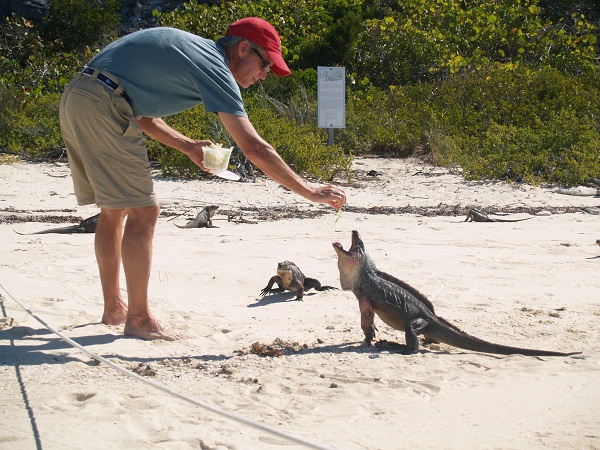
So, when we did finally tear ourselves away from Staniel Cay, we headed south to an idyllic spot that doesn’t seem to attract many visitors.  Lucky us!  We were the only boat at Bitter Guana, and it is quite a spot.  I hope it continues to be unpopular!  We were alone with a stunning white beach, a large limestone outcropping, and about 16 wild iguanas.  The winds have been pretty calm, after a week or so of too much!

OLYMPUS DIGITAL CAMERA

OLYMPUS DIGITAL CAMERA

Speaking of wind: I have a love/hate relationship with it.  Yes, a good breeze is just what you need when the temps get in the upper 80s F…. but far too often it just blows too hard down here.  At anchor the boats roll from side to side and buck up and down (at the same time) and it’s about as challenging as being underway in rough conditions.  It’s no fun.  And the sound…. There comes a point when I’d give anything to turn down the volume.  I just want some quiet.  So wind is often the thing that is most challenging.  Anyway…..just had to whine a bit about wind.

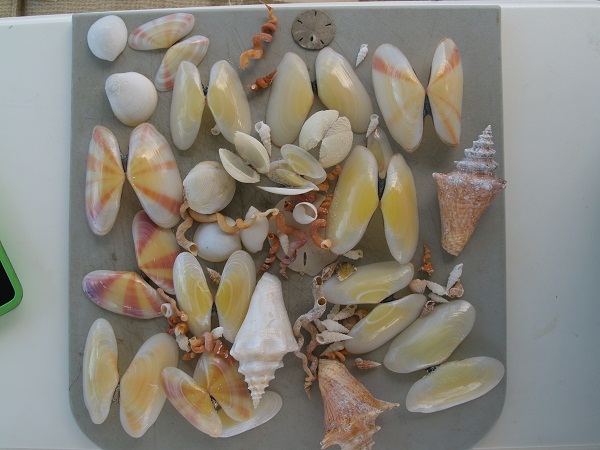
We’ve done a little shell collecting and illegal iguana feeding, and I’ve been suffering through my cold.  Last night’s sunset gave us another green flash!  That makes four so far!  Last year we only saw it once!

OLYMPUS DIGITAL CAMERAOLYMPUS DIGITAL CAMERA Here’s what you miss when you sleep in due to being in a Nyquil-induced fog.  It turns out there are lots of tropical long tails nesting on Bitter Guana along with the iguanas!  They fly out in formation first thing in the morning and return at dusk.  Sorry I slept in….

OLYMPUS DIGITAL CAMERA And about my projects:  things are not as good as I’d first thought.  In fact, I’m wondering if I am going to end up starting every single one of them over.  I guess that’s a bit of an exaggeration.  I do have the one Oktoberfest sock.  And I have these two newly finished embroidery projects.  They hardly count though, because each one only needed a few areas of work to be finished.  I think both these little cross stitch projects have been languishing in a bag for about a decade …. And now they are finished!

OLYMPUS DIGITAL CAMERA

I am on the fence about the tapestry.  It has too much black space, meaning the space between the spools.  That might work out for being at the top of the piece, but it seems to me that the spools on the bottom of a shelf are the ones that are the most crowded and perhaps even squashed into less round shapes.  They are bearing the weight of all the other spools. I realize I could turn the piece upside down when it’s finished, but I’m also not happy with my first two spool colors, which are in the lower left so they would be upper right if I turned it upside down.  I love to blend colors on the bobbin, but now that I’ve done a bit of work on this piece, I think what’s called for is unabashedly blazen, full saturation color.  It’s a very graphic piece, lots of circles and circles within circles, and I think the shapes are quite happy shapes….so it needs happy colors.  I’m not crestfallen about undoing the weaving….I’m just sad that there is so little time when the waters are calm enough to work. It’s a shame to spend a perfect, calm day un-weaving rather than weaving.  Oh well.

When all else fails, I bake!

OLYMPUS DIGITAL CAMERA

Scroll to Top