ArgoKnot

Author name: ozweaver

A Tapestry Tutorial on Using Goblins-Style Bobbins

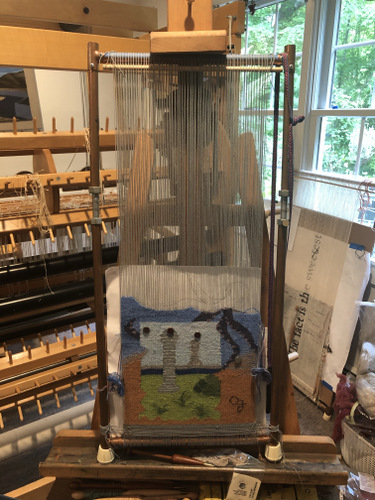
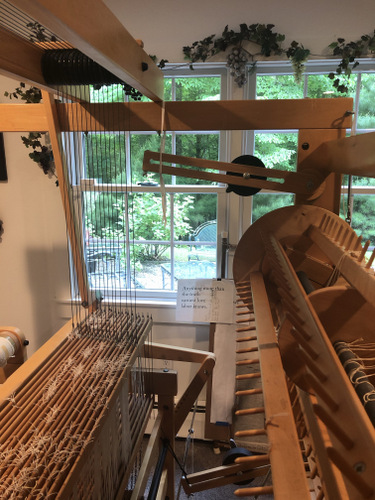
I’ve written this short tutorial for a friend who would like to start weaving, although we are far apart at the moment and not able to visit during these strange times of the Covid-19 pandemic. At the moment I am living on a boat, far from home, so I do not have access to the loom or the materials that I’d use to do this. Since I do not have access to my studio, I am using a loom that already has a project in progress on it. I’ve covered the work in progress so it will be less distracting, but there is a bit of my cartoon showing in the photos I’ve taken. Try to ignore it! Also the warp is fairly fine at 12 ends per inch. At home I have a sample loom set at 4 ends per inch which makes the techniques far easier to see.

Hopefully when I return home, I will replace these photos with new ones taken of my sample loom with the big, fat warp at 4 epi! I hope my friend finds this useful, and I hope you do too!

Winding a Bobbin: In order to begin weaving, you need to fill a bobbin with weft yarn.  There is a left/right orientation to doing to this, and in the photos below I am showing it being done for left-handers since I am one myself, as is my friend.

Although the photos show winding a bobbin for a left-hander, the description is written for either handedness. With the bobbin in your dominant hand, you want to turn that hand in an outward motion so that you do not cause any wrist strain.  Start with the bitter end of the yarn parallel to the bobbin’s neck, with the rest of yarn facing upwards over the top of the bobbin.
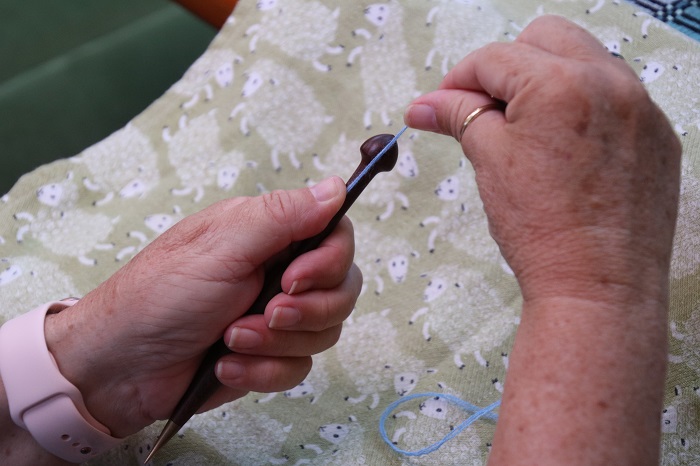
 Make a wrap or two with the yarn in the direction that will allow your dominant hand to turn outward.  Then wind the rest of the yarn onto the bobbin by turning your dominant outward over and over again, while your non-dominant hand guides the placement of the yarn. 
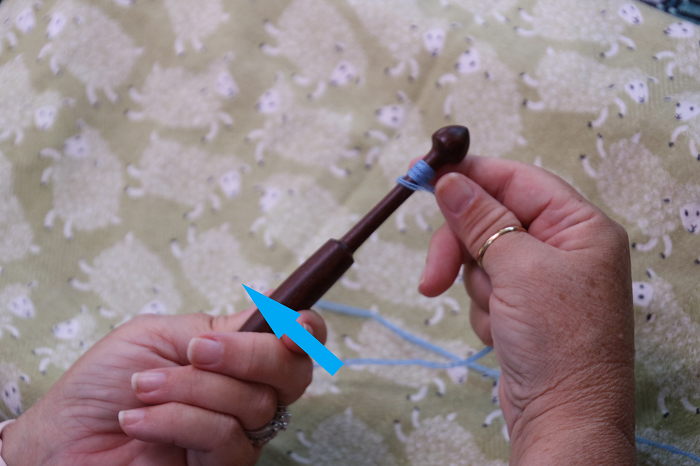
Winding a bobbin for left handed weaving

Doing this allows the yarn to wind on with no extra twist. Winding bobbin with a left or right orientation allows the yarn to spool off the bobbin properly for your handedness.

Some people have hand and wrist injuries that may make this procedure uncomfortable.  If so, you can use your non-dominant hand to wind the yarn on the bobbin in a ‘round and round’ motion.  This does put some added twist into the weft yarn, but saves any discomfort.

How to hold the bobbin for weaving:  Always hold the bobbin in your dominant hand, no matter which direction you are weaving.  Making the effort to master this will enable you to weave consistently and to weave faster in the long run.  In the beginning one direction will be easier than the other.  Although I am not the type of teacher who gives ultimatums, I will tell you that I never break this rule myself. 

Hold the bobbin in a similar manner that you would hold a knife:  with your index finger extended down the shaft of the bobbin and your thumb nearby, as shown.  The rest of your fingers curl around the bobbin for support.  In this position you can beat in your weft using a motion that comes from your arm. 
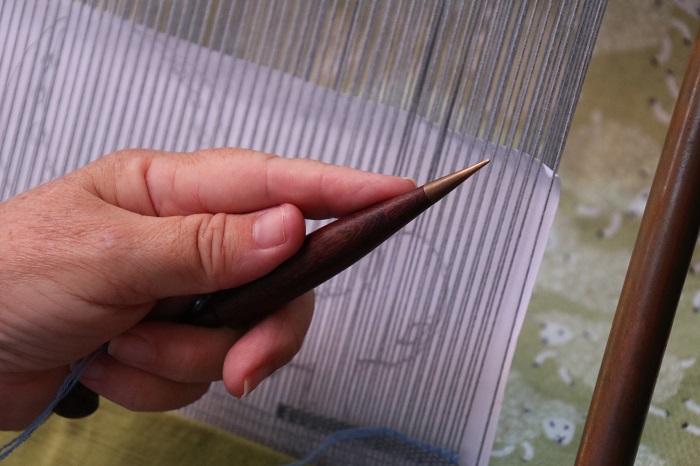
The proper way to hold a bobbin

I’ve seen students hold the bobbin as they would hold a pen or a pencil.  When you use the bobbin to beat in the weft in this position it is far less effective.  It is a weak way to beat in the weft.  Do not hold the bobbin this way!
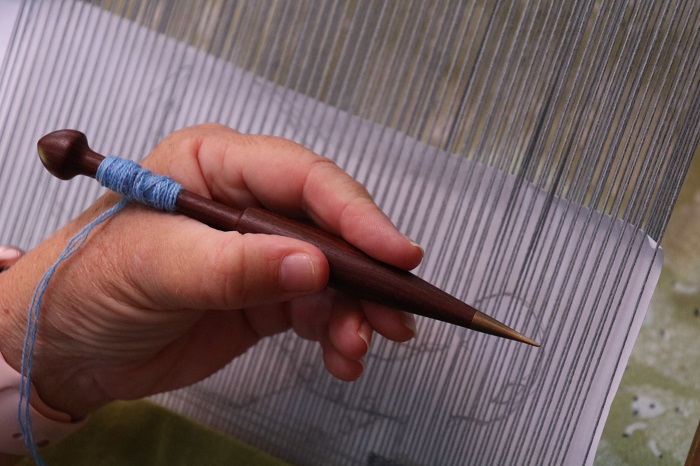
Do not hold the bobbin like this!

You will pick up weft threads with your non-dominant hand and use your dominant hand to pass the bobbin through the shed you have created, putting the head of the bobbin in first.  Keep the bobbin in your dominant hand as it exits the shed. 
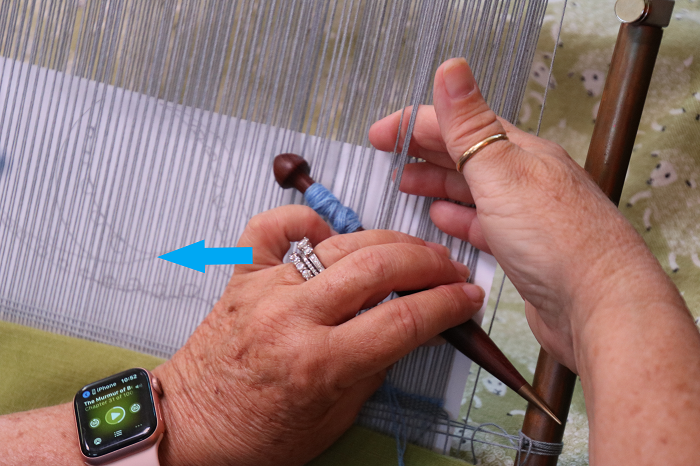
How to insert the bobbin from right to left in a shed.

–Do not make a bubble of weft!  Meaning: do not make a curve of weft before beating. Leave the unwoven weft rising up from the fell of the cloth at about a 30-degree angle.  Holding that weft with your non-dominant hand, beat the weft in place with the point of the bobbin (in your dominant hand), while adjusting the amount of weft in the shed as you beat toward the last warp thread in your shed. 
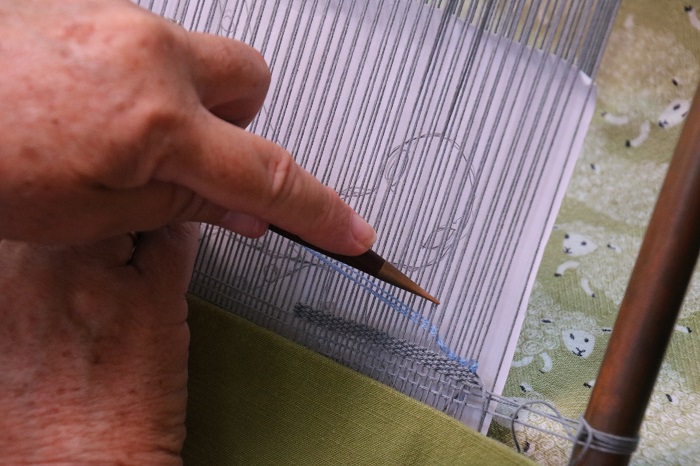
In this shed I am weaving from the right selvedge to the left. My non-dominant hand is underneath tensioning the weft as my dominant hand beats the pick into place.

–In one direction of weaving you will be picking your shed in the direction you are weaving, and this will feel logical and normal.  Going the other direction you will have to pick the shed in the opposite direction of your weaving.  It may seem awkward at first, but with practice it will start to feel as normal as the other direction feels.  Keeping the bobbin in your dominant hand will make for more consistent tension and better-looking weaving.  The hand that is picking the shed will quickly learn to go in both directions.  Trust me on this!

Begin Weaving: Based on the loom you are weaving, you will have some kind of foundation weaving before starting your woven design. On the copper pipe loom I am using I have a scaffolding of warp yarn going across the warp as well as a section of foundation weaving using warp thread as weft. It looks a bit disheveled because I have just added it to a project that is already underway. For a real project I would also have added a row of double knotted soumak in thread before starting the weaving for my project. These are procedures for warping a copper pipe loom, which needs its own tutorial. To start weaving you need to put a half hitch of weft around the first warp thread of the area you plan to weave. 

In the photo below I am pointing to the selvedge where I will begin weaving. The two outer warp threads show a high and low. The edge thread is a low, which means it is not covered by the foundation weaving. The second thread in is a high; it is covered with weft of the foundations weaving.
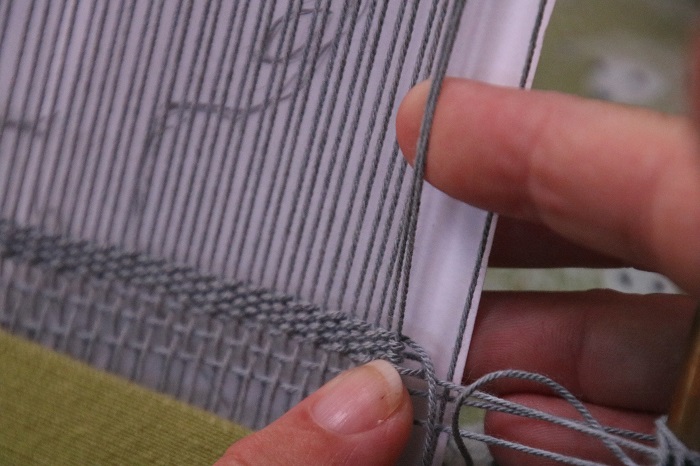
The bitter end of the half hitch always goes under the weaving that will commence.  It will lie between the fell of your foundation and the first row of weft.  Later when you hitch off in order to start a new bobbin of yarn, that bitter end of yarn will also lie between the fell of your woven cloth and half hitch you are making.  In this way, the half hitch will always be well secured by the weft rows that pile up on top of it as you weave.

I have placed the bitter end of my weft between the first two warp threads. To begin weaving I will bring the bobbin around the outermost thread as well as behind the second warp thread which needs to be a low. In other words, I will pick up both the edge threads and put the bobbin behind both of them. That will give me a covered edge thread and uncovered second thread, which matches what I need to weave to continue the plain weave I established in the foundation weaving. After picking these two thread together, I can continue across the row picking every other thread, as normal.
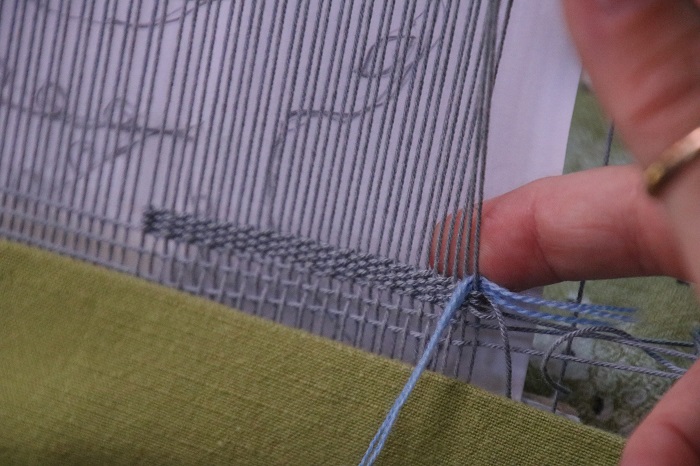
Starting to weave by making a half hitch to secure the weft.

–During weaving you will only pick 1” or less of warp threads.  If you pick more than an inch of warp you are likely to have tension problems, especially as a beginning weaver. Your practice warp is set at 8 ends per inch.  To pick a 1” section of warp you will only pick up 4 warp threads at a time, pass the bobbin and beat, then pick up no more than 4 more warp threads.  Repeat. This is the other ‘rule’ that I never break.

–Selvedges are a little fussy.  In reality you need to have slightly more tension as you turn the weft around the last warp thread.  This may not be a noticeable difference that you can observe, but eventually you will feel it.  Too much additional tension will pull in your selvedges and the weaving will get distorted at the edges.  Too loose tension at the selvedge will cause some bumps and bagginess.  This is true of the shapes you’ll make in weaving. Small shapes need a bit tighter tension than large shapes. Getting your tension just right takes practice, practice, practice! 

–While weaving, it helps to pay attention to the space between your warp threads.  If a section of warp is getting closer than the original sett you will begin to have trouble packing in the weft.  That area of weaving will start to rise higher than the rest of your weaving.  When it gets too tight you will begin to see warp threads through the weaving.  This is called ‘lice’ because it looks like little white spots.  (I guess medieval weavers immediately thought of lice, rather than some other small white dotted thing, like snow flakes or grains of salt.)  In normal weft faced cloth, the most recent pass will have some warp showing because there is not yet enough weft to cover the warp.  After two or three passes of weft the warp should be completely covered, and there should be distinct weft beads covering each warp.

–There are simple solutions to warp space problems, especially if you catch the problem early on before you start to get warp spots showing.  Try using your bobbin to strum across the warp before continuing to weave.  In the next few picks of weaving use the tip of your bobbin to go a bit deeper into the warp as you beat in the weft. The tapered tip of your bobbin will spread the warp a bit if you put the tip in deeper than you’ve done in previous passes. If you need a bit more adjustment, you can take both hands and pull on that section of warp threads.  You’ll be pulling horizontally across the warp, each hand pulling outwards to pull the warp threads apart slightly. Continue weaving paying close attention to the area that got too tight.

–The warp in my photos is sett at 12 epi and the section I am weaving a section 3″ wide. At this sett, that is a bit wider than I would normally weave with one bobbin. I would weave this space with two bobbins of the same color weft. To weave with multiple bobbins in any given row you must weave each section of the row in opposite directions. That is called weaving in opposing sheds.

My initial weaving was done in the open shed with the bobbin going right to left. Your loom may not have an open and closed shed, but you can check which shed you used to weave with the first bobbin. You need to go in the opposite direction with the second bobbin in that same shed.

I am holding the open shed in this photo, and it matches the weaving in the shed that goes from right to left. Therefore, to start a second bobbin, I need to weave left to right in the open shed in order to be going in the opposite direction. To do that I will start my 2nd bobbin on the left side of my warp and weave in the open shed toward the right.
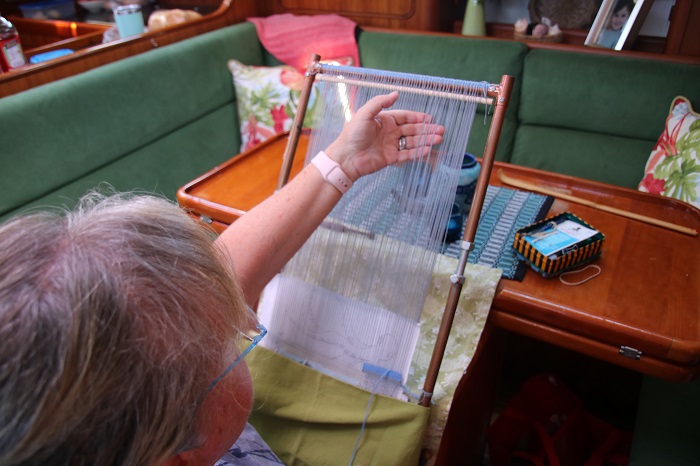
I am holding the open shed in this photo, and it matches the weaving in the shed that goes from right to left. Therefore, to start a second bobbin, I need to weave left to right in the open shed in order to be going in the opposite direction. To do that I would start my 2nd bobbin on the left side of my warp and weave in the open shed toward the right.

I will demonstrate this now using a different color of yarn to make a small angled shape. As you can see the final warp thread needs to be covered since in the shed below it was an uncovered warp (a low). To hitch on, I put the bitter end of the weft between the first and second warp thread to the back. I then picked up both the first and second warp thread and placed the weft behind both threads. This allowed the first warp to be covered (a high) and the second warp to be uncovered (a low). Also the hitch lies between the previous row of weaving and the new row which will secure it in place. Now I can weave across the row picking every other thread, as normal.
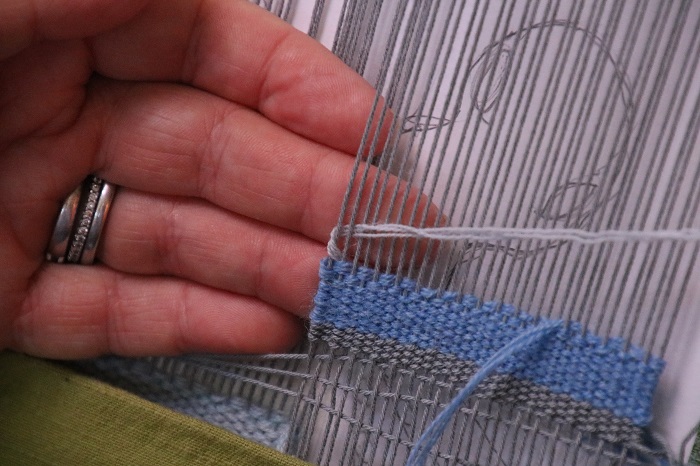
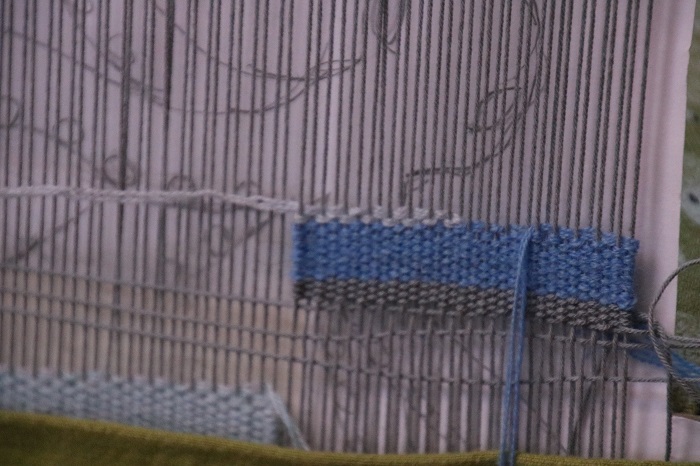
This is the first pass of the second weft bobbin.

If you notice I have worked the second bobbin to place where I wanted to turn to make a new shape. When I turned the weft to complete the pass, the warp thread where I turned is covered, which is called a ‘high.’ You may need to open this image in a new tab and enlarge it to see that I turned on a high, or covered the first warp of the new row. When I weave the first color to meet it I should turn on a low, which will be an uncovered warp thread. This will maintain the high/low plain weave structure across the whole warp.
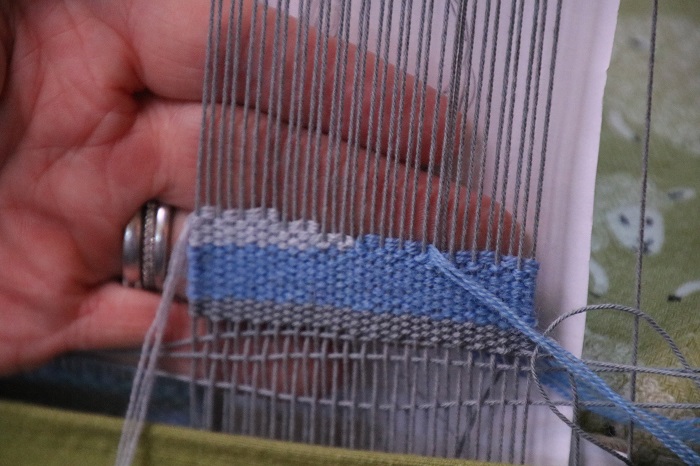
Here the first bobbin has been worked over to meet the lighter color on the 2nd bobbin.

If you look closely you can see that the plain weave high/low is constant across the warp. This will allow me to weave the dark color to meet the next turn of the light color.

Here you can see the first pick of the next pass of the dark color. The weft is on an angle, not bubbled (!), and I will beat it in place with the bobbin in my dominant hand.
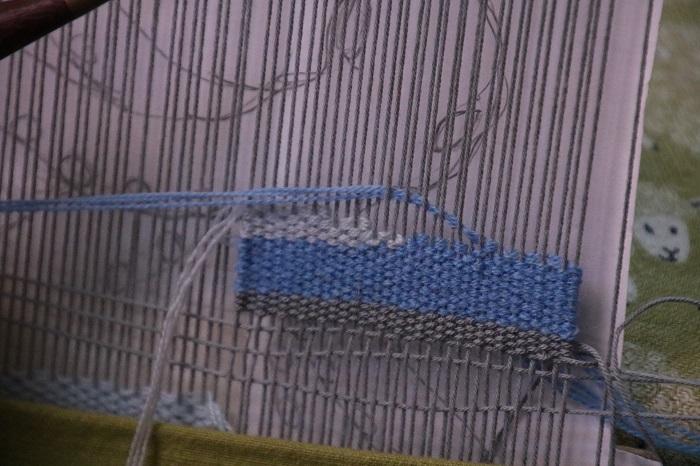
Here I have completed both shapes, and the wefts have now returned to the place where they each began. I can continue to make this angle or do something else.
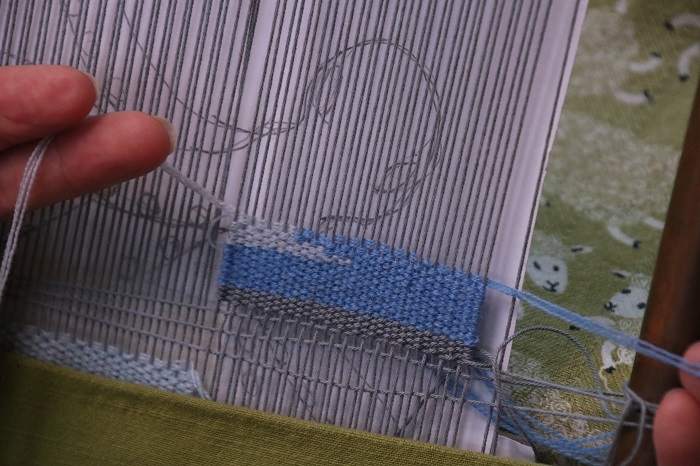
–Let’s look at the selvedges. On the right where my weaving started, the selvedge thread is a high because when I turn the weft around it that thread is covered by weft. At the other side of this warp, you will see that when I turn the weft around that last thread it is not covered in the new pick. It is a ‘low.’ Take note of how this makes the two selvedges look quite different from each other.

First Exercise: The first sample to weave is to make a warp about 4″ or 5″ wide, set at 8 epi. Put in whatever foundation is required for the loom you are using, then begin to weave with one bobbin across the entire warp for about 2 inches.

After that, divide the width of the warp in half and weave one half with one bobbin and the other half with a second bobbin. Don’t try to work completely across the warp with both bobbins. Weave one shape and then the second. Don’t forget that the second shape must be woven in the opposing shed from the first shape. Do this for another 2″ – 3″.

Keep a close eye on the selvedges for both shapes. You now have 4 selvedges. There will be slit between each shape. As you weave the internal selvedges that fall in the middle of the warp, try to keep the weft from taking up more than half the space between the warp thread where you are turning and the warp next to it that will be the selvedge of the second shape. Weave until these two shapes are about 1″ – 2″ high.

Next divide the warp in four sections across the width, in order to weave 4 squares across the warp. Complete each shape before moving to the next bobbin. Keep track of how to do this so that each shape is woven in the opposing shed from the shapes on either side. Make each shape in a different color from its neighbor.

Let me know how you get on with this little exercise!
Home

The sweetest word in my vocabulary. I thought I knew how much I loved home each spring when I arrived here from a long winter of sailing. This year it is doubly sweet. I am long overdue returning, and the journey to return was harrowing.

I really don’t want to relive the trip home in these pages. I’m sure Bob is writing about it as I write about being home. I may have to give some reference points to his version of the passage, so I’ll consider that.

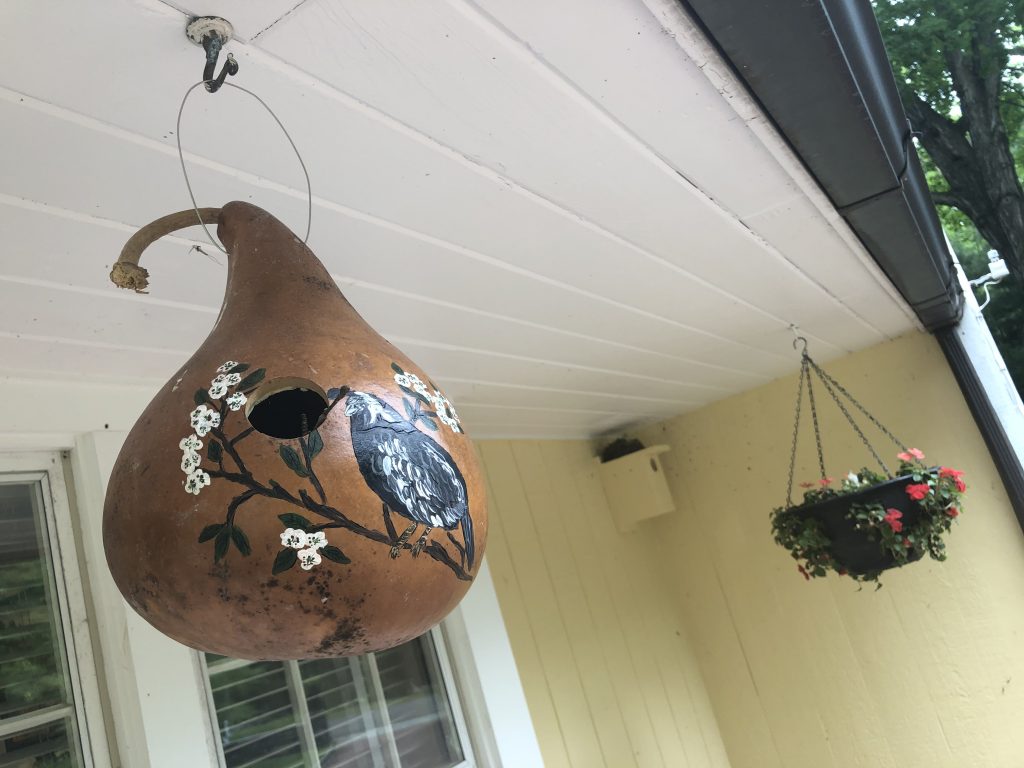
Meanwhile, it’s mid-spring here. I have missed the daffodils and crocus, the tulips and lilacs. But there dogwoods blooming, and my peonies are still in bud. The roses are budding. Our yard is full of tulip poplars that have yet to bloom. House finches and wrens have made nests in all the outdoor light fixtures as they normally do. They’ve even deigned to use the birdhouses that Bob made, hoping they’d stay away from the light fixtures. His efforts have just attracted other bird families. Last fall I bought a painted gourd at a festival down in Maryland, and there are wrens in it now. Life is bursting here, and I’m so glad to be back in time to enjoy it!

Here’s the painted gourd with the wren family, and notice that there is a nest above one of the birdhouses that Bob built in the center of the image!

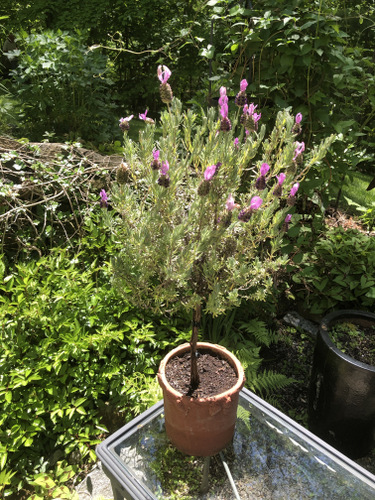
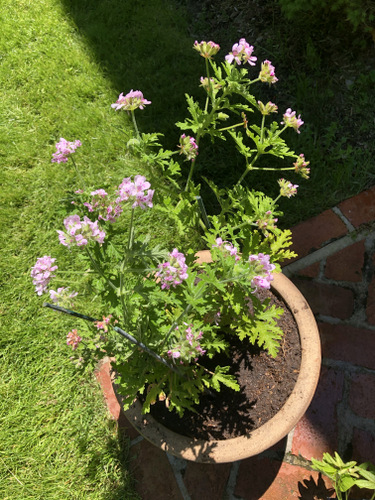
In December last year, we found a local nursery that was willing to take some of my larger plants to overwinter in their greenhouses. What a thrill that was, not to lose some of my cherished herbs and plants. Bob and I got them back on Tuesday, and I was so moved to find that several of them are in bloom! My French lavender and rose geranium are already just past prime, but I’m so happy to see them bloom at all!

My olive tree not only bloomed but now has quite a few tiny olives on it. I’m holding my breath until they get a little bigger. The plant did not seem big enough or old enough to bear fruit. There must be some good karma at that nursery!

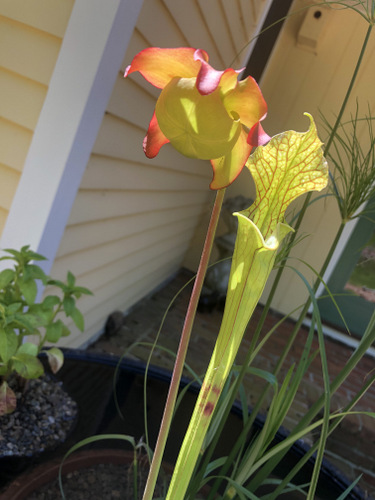
We also started up our two water gardens with new plants, and one water lily that we overwintered from last year. We both could not resist this beautiful pitcher plant in flower for the water garden out front.

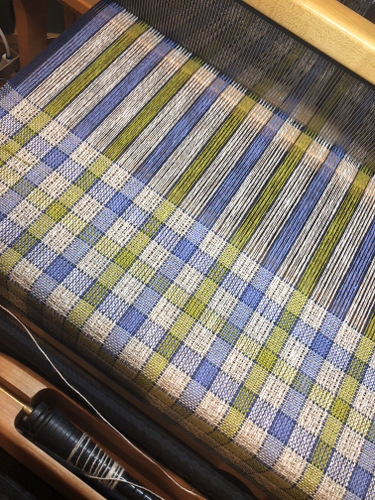
I have not yet managed to unpack. I have things strewn on one of the beds in the upstairs guest room, and I have plenty of things strewn around my own bedroom. Poor Bob, who is far neater than I am. Truly I am Oscar to his Felix. But instead of putting my things away, I have been weaving! This is a set napkins for Chris (our son) and Melody. I managed to weave and hem two in time to gift them for Christmas. These are the last four on the warp. I wove two between yesterday afternoon and today. Only two more to go, and then I’ll be making a new warp for the next project!

My small tapestry made it home with no damage. It went through a LOT to get here. It is better to have it safely on its easel in my studio that bashing about through the Caribbean aboard Pandora!

With all the good surrounding our arrival home, do I want to dredge up the awful trip home? Maybe just a couple of highlights, which are really lowlights–just to balance whatever Bob is upstairs writing at the moment!

I made quite a few meals ahead of time, in an attempt to make a good effort for this trip. I made Asian barbecued chicken thighs. I made ziti. I made meatballs. Yes, homemade meatballs. The meatballs occurred because I couldn’t find frozen meatballs in the Caribbean, even before the lockdown. Anyway, I love making them and of course, homemade is better. We managed to eat one portion of the meatballs and one portion of the chicken (I made enough of each for two meals. It was hard to eat any of this, and the ziti never made it into a bowl. It was too rough for eating. We were lucky to get some cream cheese on crackers, and I don’t know how Bob managed to get anything out of the fridge or cabinets, or even how he could spread the cream cheese. He could barely carry them up the companionway, even though they were in a bowl rather than on a plate.

Have I mentioned it was rough? There were many points when the waves looked like something from a movie– a documentary about storms at sea, or even some of the scenes from “The Perfect Storm”–although not that final scene where the fishing boat does not make up that last horrific wave. The seas were confused, so they did not come from one direction. They were hitting mostly from the stern, but both starboard and port. There was no place to sit comfortably without bracing ourselves, and no comfortable place to sleep.

We can never sleep in our own bed on passage, or even use the master bathroom (stateroom in nauticalese), since both of these are too close to the bow. I made up a ‘go bag’ with some changes of clothes and my toiletries so that I would not have to enter our stateroom during the passage. I have to say our hygiene was less than stellar during the passage. I think I managed to wash my hair three times in thirteen days. Again, we were just lucky to brush our teeth twice a day–in the galley sink at the bottom of the companionway. Using the head (toilet) was such a feat of getting in there and then hanging on to everything possible while trying to accomplish that feat. There was one night when I was so tired that I tried to sleep on a settee (that’s an upholstered bench, like a couch) down below. As I mentioned the waves were hitting us both port and starboard. Bob did not want me to use a lee cloth because it might get ripped off the wall (a lee cloth is similar to the barriers that toddlers have when they graduate out of a crib). Well, that was the only time I attempted sleeping down below. I was actually thrown out of bed. I woke to find myself in mid air, and then promptly hit the hardwood floor. I didn’t break any bones, but I was bruised. I won’t even talk about seasickness. So much for the myth that everyone gets over it after three days! Ha!

I really don’t know who can possibly like making long passages. Sure, the weather might be better, but it’s never calm enough for living a normal life aboard. I don’t ever plan to do it again. I’ll leave all the details of wind and speed and way points to Bob. I only mean to convey that it was difficult and scary. As we approached the entrance to Fort Lauderdale I began to think that we would die within sight of destination. Bob would not agree with that, but he did say it was the roughest passage he’d ever made. And he has made 14, or maybe a few more, of them. Just sayin’….

I’ll take a loom with a view, thank you. There is no place like home!

On Passage: My first journey of 1,000+ miles, mostly all in one go

Our long passage home began on Monday, so this is Day 5, and it has gone better than I expected. I’ll never be a sailor, but Bob sure is. If you ever have to go on a long voyage against your will, I highly recommend Bob as your captain and Chris Parker as your weather router. You cannot do better!

Day 1: (Monday, May 4) We left Caneel Bay, St. John, at 1pm. We were wallowing a bit in following seas with the wind directly behind us. I got out my sketch book/notebook to jot down a few impressions of each day, and on this day I noted that I was having a hard time writing. I was worried that writing would make me seasick, so I kept it rather short. By 5pm we had left the Virgin Islands behind us. By 10pm we could lights on Culebra and we could see Puerto Rico faintly in the distance. There were big swaths of sargasso everywhere, and a big clump of it was tangled on the rudder of our windvane. There were big, dark squall clouds all around us, and from 2am – 5am we sailed through a number of them. Seeing big squall formations on radar was was intimidating for me. We also saw one ship in the dead of night. My anxiety level was high. I was no help at standing watch since I kept falling asleep–a sure sign of mild seasickness!

Day 2: (Tuesday, May 5) Low wind, wallowing in following seas. I was looking forward to seeing Puerto Rico, but during the day I could not see any of it. Our course took us from about 25 miles off the coast to 40 miles off the coast. During the morning we sailed over the deepest part of the Atlantic Ocean, the Puerto Rico Trench. It’s over 27,000 feet deep there, which is more than 5 miles deep. Just a bit further west is the Old Bahamas Channel that has some of the shallowest shoals I’d ever imagine to find in the middle of the ocean. What a strange world! Our view was 360 degrees of water. It is a deep indigo color verging on purple, like what we see all through the deep waters of the Caribbean. When night fell we had non-stop squalls, especially from midnight ’til 8am. I slept through most of this, leaving all the work to Bob for a second night in a row.

Day 3: (Wednesday, May 6) Squalls. Uncomfortable! Are they ever going to stop? On the one hand, the winds have been light, and seas are down. I told Chris Parker I wanted a flat sail home. I wanted to feel like we were just sailing across a lake. He’s done a great job of finding those conditions for us. If only the squalls would stop! Bob has always said that he finds Day 2 of a passage to be the hardest. On Day 2 he often wonders how he will endure the entire trip. For me, that day came today, on Day 3. I struggled with a sense of feeling imprisoned in a small space with a view of a vast seascape which was not at all soothing. The Dominican Republic was to our left, but we could not see it, even at night. I was fairly depressed this day, unable to pass the time reading or knitting. I have a few audio books, and it was helpful to recline in one of our adjustable cockpit chairs with my eyes closed, listening.

During the night we had a parade of ships, likely due to being in the vicinity of the Mona Passage and Windward Passage. I don’t know why I hardly ever see a ship during the day; then they all seem to pass by us during the night. It’s stressful. On the positive side, I was able to stand a 2-hour watch so that Bob could sleep. Progress!

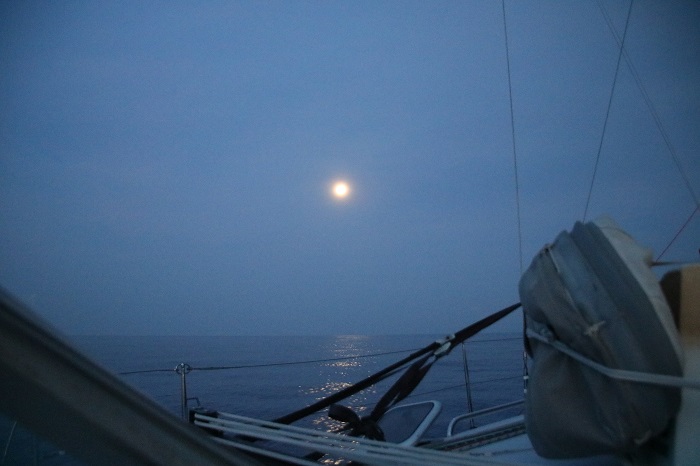
We are traveling during the time of a full moon, which does make for a a few moments of excitement in that otherwise endless view of water and more water. The nights have been overcast due to the squally weather, but the moon has been a lovely gem.

Here is the moon setting, no longer silver but a stunning golden orb from the rising sun.

The water in the foreground is a perfect study in calm seas. Bob took a close up for me.

Day 4: (Thursday, May 7) We’ve now gone more than 350 miles. There has been no sight of land, which is rather depressing. I had hoped to see some of the Dominican Republic, and maybe even a bit of Haiti. Still following winds directly behind us, but calmer seas so that we are not wallowing today. I can read!– and I actually spent a good deal of the day knitting!

We learned that bad weather is headed our way. A cold front is forming that will bring near tropical storm weather right to our route home. Our weather router is urging everyone in our flotilla to get shelter on the southernmost island in the Bahamas, Great Inagua. The Bahamas is closed to boating traffic at the moment, even for boats seeking shelter, so our shoreside volunteers in the Salty Dawg organization did some terrific work in getting our homeward bound flotilla boats permission to land at Matthew Town on Great Inagua for as many days as we need to avoid the bad weather. We cannot check in to the Bahamas, or go ashore, but we can anchor and wait out the storm. We could not have managed this individually, so help from these volunteers is priceless. They are working hard to get us safely home. What a relief.

The night was challenging for me. There were squalls all around us with violent lightning on both sides of the boat. I stood two watches this evening, so Bob got more sleep than he’s had in three days. It was frightful to me. Like desert mirages and visions in the fog, after a while I began to see things in the haze. The radar showed that there were two boats that would soon cross our paths, all of us headed to shelter in Great Inagua. As hard as I looked into the gloaming to find their running lights, I could not see them. I saw all kinds of other things instead! I saw various ships and strange lights, and I heard ominous sounds. After 3 1/2 hours, I could not stand the stress any longer, so I woke Bob to take my place.

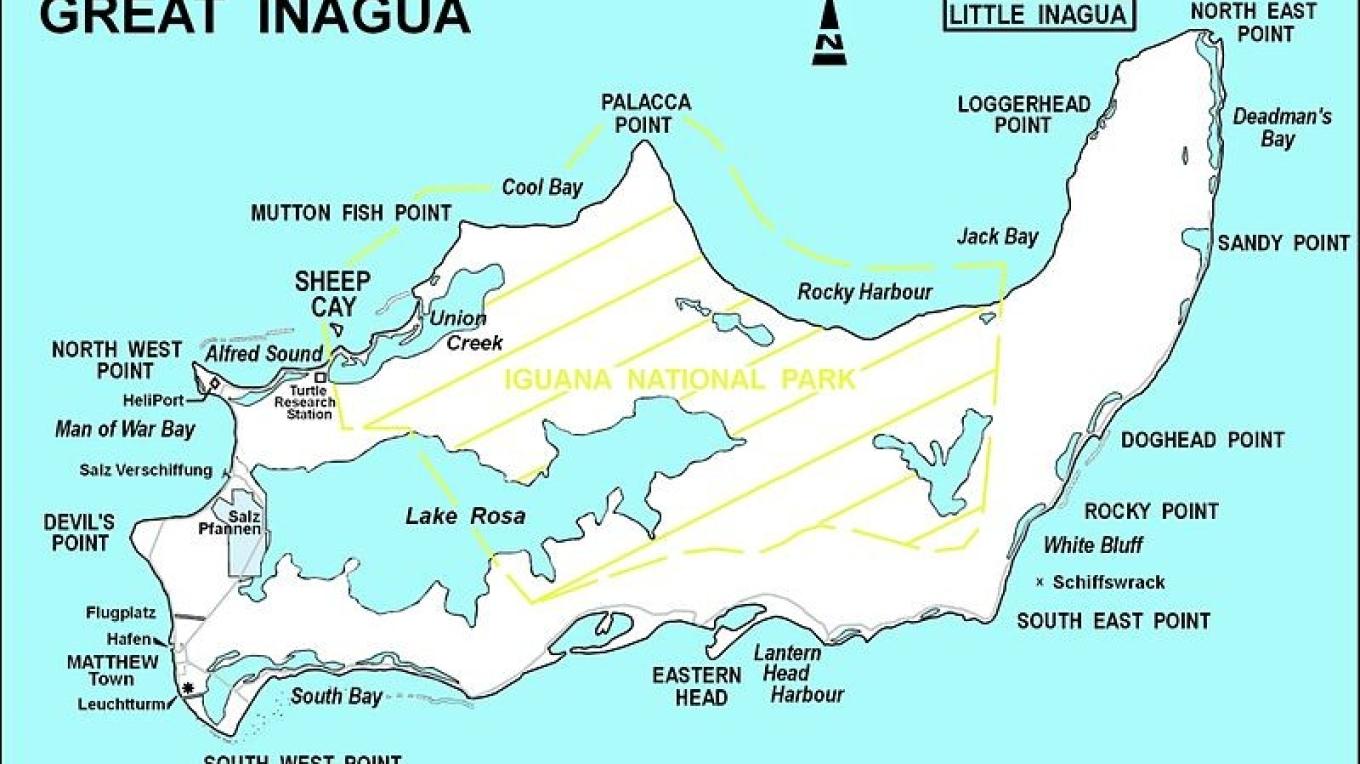
Today is Day 5. (Friday, May 8) We have sailed 537 miles, which is close to half the way to Florida. This has now become the longest passage I have made. It’s seems like a great time to take a break, but this is not the break I’d like to have. There are no harbors on Great Inagua; boats simply pull up to the shoreline and anchor. The Bahamas is notorious for ‘clocking’ winds, which means that every few days the wind direction shifts around the entire compass. We arrived here with westerly winds which is the worst direction for anchoring here, as you’ll see on the map. In westerly winds this is called anchoring on a lee shore, which means if your anchor drags you’ll drift right onto a shore that will be a challenge to get off since the wind is pinning you on that lee shore. Not good! The winds are slowly shifting eastward, but the westerly ocean swell will continue to roll us about. We are now facing northeast, with northwest waves rocking us sideways. It will be hard to sleep tonight. As I often say about sailing, “out of the fire and into the frying pan.” I wish this weren’t always the case.

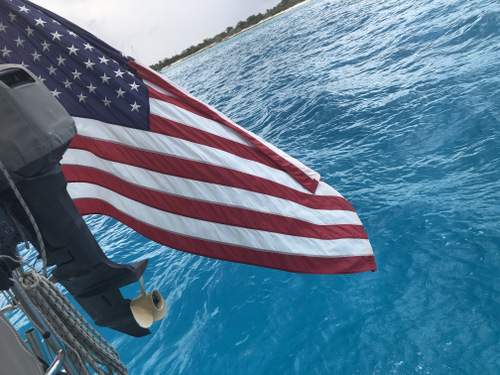
And here we are newly anchored off Matthew Town on Great Inagua. This is the memorable Bahamian blue one finds in about 20 feet of water. Stunning.

We have been granted permission to anchor in either Matthew Town, where we currently are, or in Man of War Bay, just north of Matthew Town. You can see neither of these locations is protected. The wind is gradually shifting to the east, but the waves continue rolling in from the west. It feels just like our first two days of wallowing in following seas. Ugh.

We cannot go ashore here, but I should mention that there is a big salt pond on the island, where Morton Salt makes their sea salt. On the map you can see this salt pond right at the lower left hand corner, just inland of South Bay. There is a gate that can be opened to flood the pond with sea water. Then the tropical sun causes the water to evaporate and leaves behind the salt. It’s terrifically hot here. I can imagine turning into a block of salt myself. I am so ready for some temperate New England weather!

There is also a protected flamingo rookery here. We won’t be seeing any flamingos on this visit, since we cannot go ashore. I guess I’m happy to be here. It’s uncomfortable, but it has to be better than riding out a tropical storm.

From the Washington Post. The largest breeding colony of West Indian flamingos .

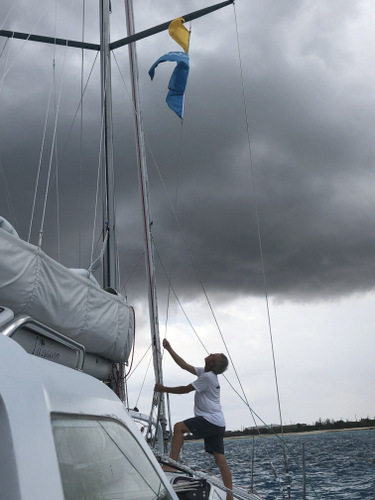
I’ll close with this photo of Sailor Bob, ever ready to take on a long journey and make the best of whatever conditions Mother Nature throws at him. He’s hoisting the “Q” flag (for quarantine) and the giant Salty Dawg rally banner. Do you see that threatening black cloud above us? That’s another squall in the making. Bob is not worried about it. He set the anchor well and now intends to open a cold beer and get some well deserved R&R. As he sat down to enjoy himself, he got a wonderful air show of a US Coast Guard helicopter landing on the airstrip in Matthew Town. I was so tempted to hail them on the radio and ask for a ride home!

.

Departure

The time has finally come! While I haven’t had nearly as much experience with long passages as Bob has, this is what I always encounter: We provision and wait for the weather window. Our provisions grow low in the waiting so we provision again. We wait again. On and on. Inevitably, we get the word to “GO!” now, right when we need to provision again! The waiting is a killer. I feel like I’ve been holding my breath for ages, and feeling anxious. By the time we really do ‘GO!,’ I’m exhausted. I’m exhausted now. So, naturally, it’s time to go. And wouldn’t you know, we need fuel in our extra jerry cans and we are a little low on fresh food.

I put a scopolamine patch on last night hoping to stave off any seasickness ahead of time. Fingers crossed. It should take us about 7 days to get to the Lake Worth inlet on mid-coast Florida. We could not get a marina reservation in Fort Pierce because they are already full. But some of those boats will be heading north as soon as mild spring weather arrives in the North Atlantic, so hopefully we won’t have to wait too long.

The closer I get to home, the more excited I’m getting for projects. Temptations arrive in my inbox daily. This winter I stumbled on KDD designs, a site with so many interesting facets–poetry and writing, knitwear design, even yarn from local sheep (in Scotland), where that yarn is also spun and dyed locally. It’s not local to me, but it’s in my DNA to need and want textile-y things from Scotland.

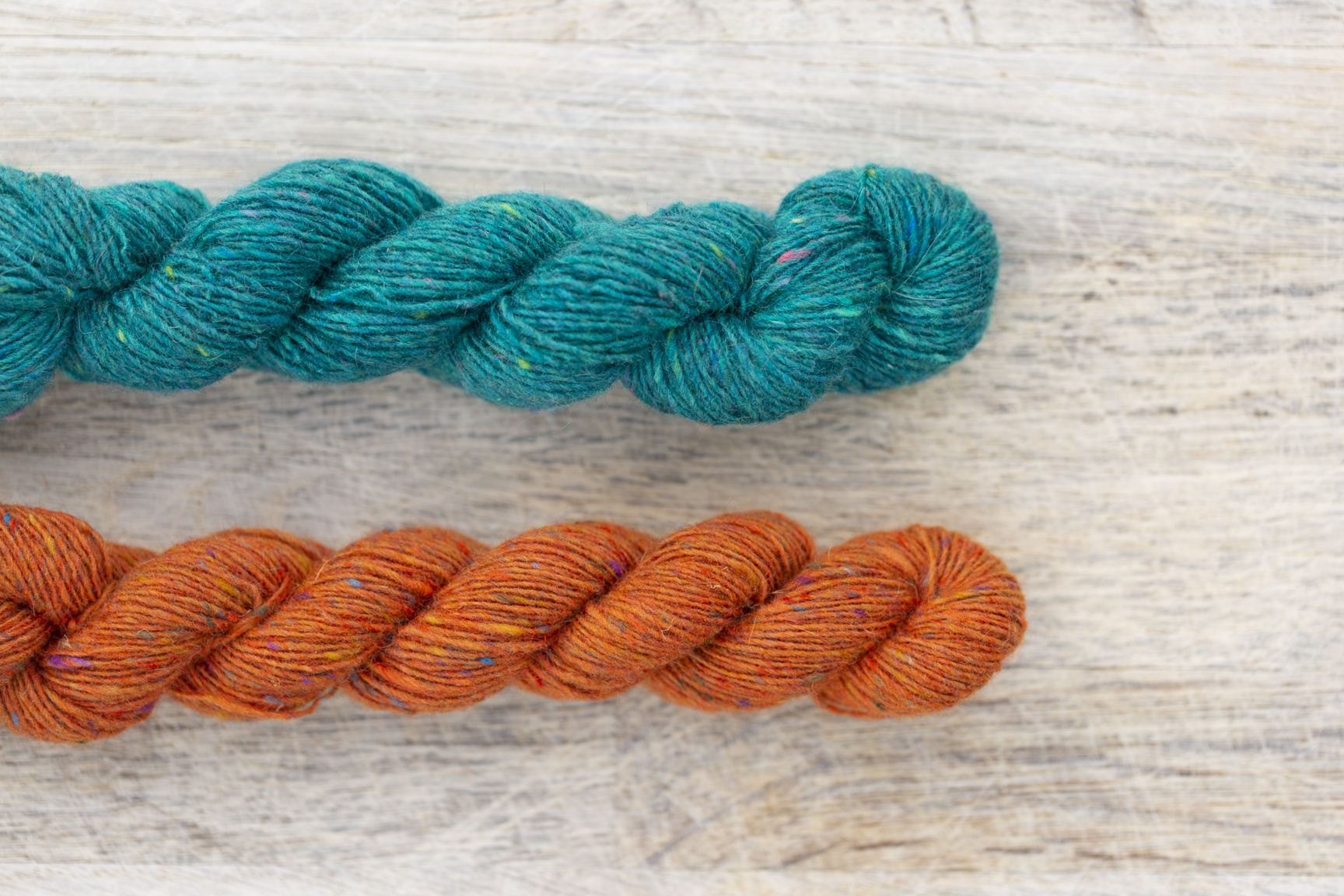
I’m in love with this amazing color of orange! I’ve loved the color orange for years, although I do not have a favorite color. The color of this yarn, with the little bits of other colors in it, is a show stopper for me. The teal is wonderful too, but that orange! Oh my!

I’m ready to start knitting this vest, also designed by Kate Davies (of KDD)! It’s called “Con Alma,” after the Dizzy Gillespie recording from the early 60s. Temptations are wonderful things, aren’t they? I put a kit for the project in my shopping cart, without giving it more than two seconds’ thought. Sadly, this yarn is already sold out. Sigh…. I hope I can order it soon, so that it will be winging its to me as I wing (hopefully) my way home.

I’m enjoying the possibility of what other sea creatures will work their way up the warp on my current tapestry. Sea turtles and rays for certain. Maybe a couple more ‘post card’ moments. I have to start drawing soon because the next creature will get added before the octopus is finished. Adding any more ‘post card’ images might involve weaving buildings again. The church tower in Deshaies, Guadeloupe (pronounced Day/A) is such an iconic landmark. Tempted for sure, but I should know better.

So, it’s time to leave, and here I sit. Am I stalling? Probably. Bob has taken the dinghy into the nearest town to fill the last couple of our jerry cans so we can have enough fuel to add to our tanks as the trip wears on. Supposedly there will be so little wind between here and Florida that we’ll have to motor a good deal of the time. As long the seas are flat, I’ll be very happy to motor, thank you!

So to pass the time ’til Bob returns, I will forge ahead on my Wrist to Wrist sweater from Purl Soho. Great color, isn’t it? But it’s not orange.

I hope I can knit during our passage home. I have a couple of audio books to listen to when I stand watch in the middle of the night. I am praying I can do that this time. It’s all Bob requires of help, so he can get a little sleep. A week without sleep is a long time. Off we go! Shortly I hope I’ll walk through the side door on our porch, and have a good cry of joy to be back. Welcome home!

Plan C, D, E…etc.

All we do these days is make plans for getting home before the hurricane season starts down here. I was going to write about these plans, but they are mutating too fast for me, faster than shifting sand trickling through my fingers. We’ve now gone well beyond Plan C, D, and E. I started this while we were still in Antigua, but now nothing from that post is relevant. Lots has changed, but nothing really has.

We left Antigua last week, on Thursday, to sail through the night to St. John, in the USVI. We arrived on Friday afternoon. My medications are waiting for me in Red Hook, and Bob is taking the ferry there now to get them, as I write this. We tried to make landfall there on Friday afternoon, but it was so rough in the harbor that I did not think I could handle Pandora while Bob picked up the mooring lines. We have been in Caneel Bay on St. John since then.

I was frightfully sick on the passage here, and that has given me quite a concern about making the much longer passage home. People love to tell me that everyone gets better after three days at sea. I’m sure that’s true most of the time. But what about those three days? How is Bob supposed to get through three long days without help? The 2-night trip to Antigua in early March was a terrible burden on him. He had no help from me at any point on that trip. And it happened again on the way here. I’ve been sailing with him for 45 years now. We’ve made some long passages and we’ve covered a lot of ground between Maine and Florida on the east coast of the US, and on to the Bahamas. I don’t just get mildly sick; I get incapacitated-ly sick. It’s a risk to have me onboard. That is weighing pretty heavily on me. (I have a huge stock of different seasickness meds, trust me!)

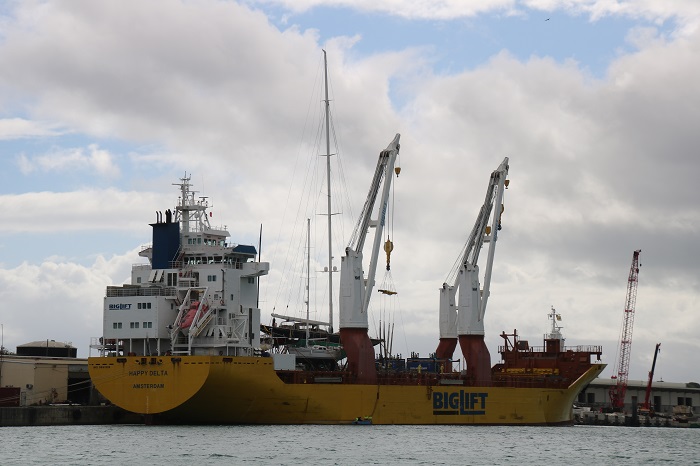
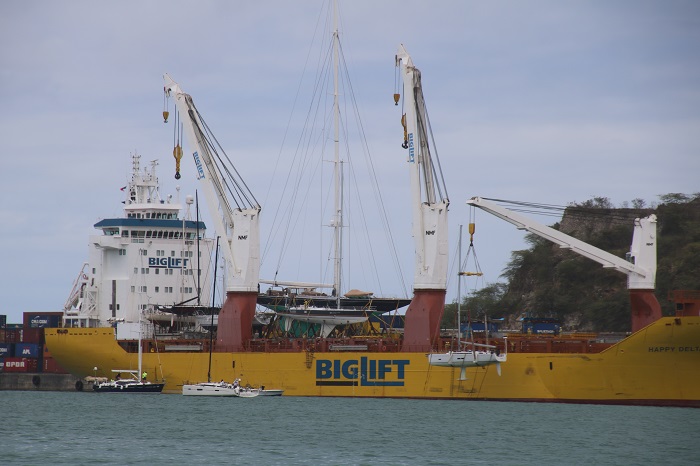
The day we sailed to St. John, capital of Antigua,–not the island where we are now– to clear out, we saw this ship carrier in the harbor. You cannot imagine how much I wanted this to be our plan! Just take Pandora to Newport, and let us go! The cost of $20,000 to take her was a bit sobering. Still, I was tempted. Bob was not.

Here you can see boats lining up to wait their turn in the crane. Too bad Pandora couldn’t get on line.

The stress of worrying about this is taking its toll. I feel I am burden onboard, but no one else can get down here to help Bob. What to do? We talk to our weather router off an on over the months we are down here. Last week when Bob told him how sick I was with the following seas on our way here, he suggested that we consider the ‘northern route’ home, which would take us far out to sea, east of the Bahamas to make a straight shot to the Carolinas or even all the way to Connecticut. This route has more easterly winds and would put the wind and sea state coming across the middle of our boat, which is called a beam reach. This is the route Bob always takes each year. But that terrifies me. It’s so far from anything. Once again this morning we called the Venerable Chris Weather Router to ask if there was a way to get home in flat seas. This may be a possibility. The ‘southern route’ would take us north of Hispaniola (DR and Haiti) and into the Old Bahamas Channel. The winds and waves would be from behind, my least favorite direction, but if we pick a window when there is very little wind, the sea state should be flat. We’d have to motor most of the way to Florida. Horrors to real sailors like Bob, but that sounds pretty nice to me. Bob is in favor of doing whatever makes me less fearful. He is on a hunt for some diesel cans so we can carry extra fuel. Wouldn’t you know that all those sailors who sheltered here before we arrived bought up all the diesel cans at every store within walking distance in both Red Hook and St. John. I’m amazed that any of these chandleries are still open. (But that is another story)

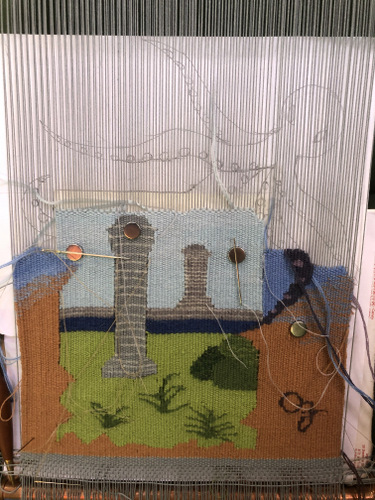
In my distress over how I’m going to get home, I have returned to some of my projects that were so boring to me weeks ago. Now I relish anything that will take my mind off what lays ahead. On my small tapestry I have finally made it past the pillars in English Harbor. Really, I have no business weaving buildings. I need to imprint that on all my bobbins–No Architecture!! Now I’ve started the octopus that wraps around the little postcard scene of Nelson’s Dockyard, so I’m having considerably more fun.

I’ve joined in a couple of Rebecca Mezoff’s “Change the Shed” get togethers on youtube through live streaming. It’s been one of the best diversions I’ve been able to find. I weave my own tapestry while she weaves and talks to the weavers who send her questions or comments through live text messages. It’s fun. Lately I haven’t had enough connectivity to do it, and I miss it!

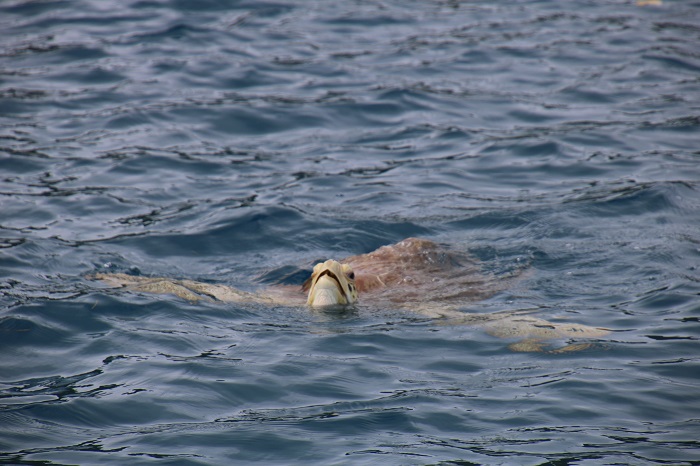
St John has some nice distractions too. There are lots of turtles here, and they are not nearly as shy as most sea turtles. One of them checks us out throughout each day. We must be sitting on top of his favorite patch of turtle grass. In fact, in Caneel Bay you may not anchor because anchors and chain tear up the grass that is so necessary to the turtles. There are moorings here, and now that the island is a bet less crowded, we were lucky to get one.

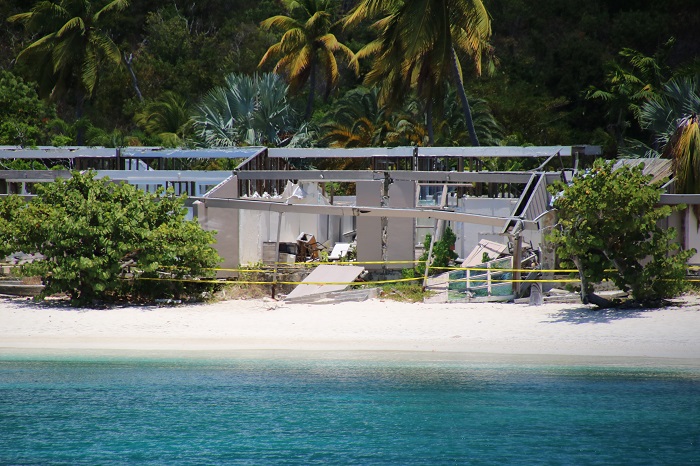
Our mooring is just off the beach of a derelict resort that was started by the Rockefeller family back in the 50s. It made it through all those decades and then was destroyed in 2017, by Hurricane Irma. Now, only 2 1/2 years later, it looks like it’s been out of commission for many years, not just a few. A local resident told us that the property’s 99-year lease will be up in two more years. There’s a rumor that a big resort company has bought the resort and will rebuild when the lease runs out.

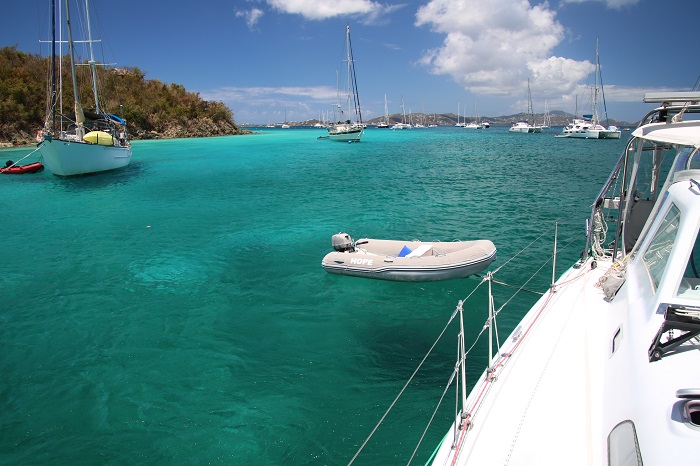
The view from Pandora right now is quite spectacular. It’s hard to imagine that you can have tough decisions ahead and a hard trip home while sitting in such a place.

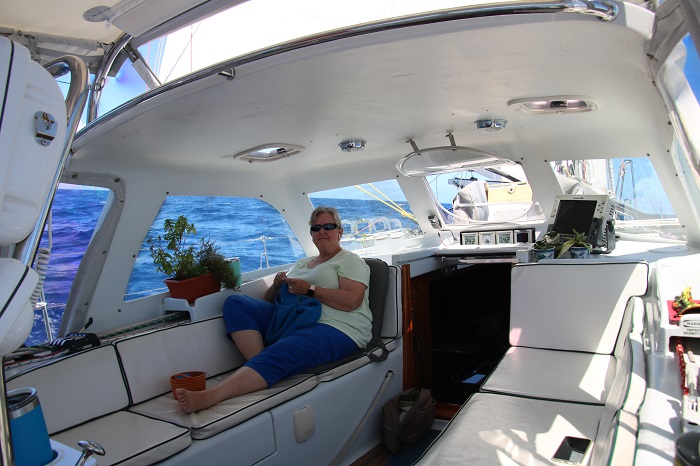
It took me a full day to get over the trip here, but as you can see, I am relaxing while I can, before we have to head out again.

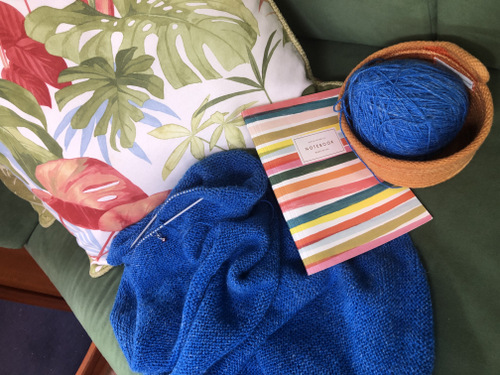
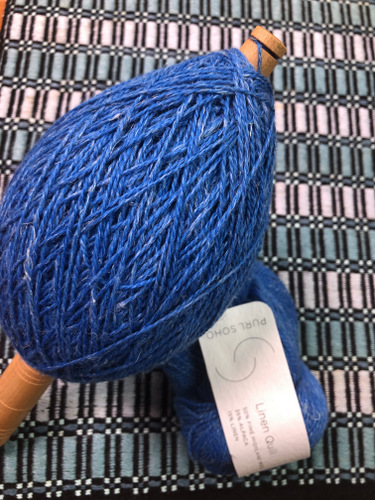
I am working on a sweater design that Purl Soho offers on their website, called End to End Pullover. The yarn is also theirs, called Linen Quill. It is a blend of merino, alpaca, and linen. It is about the weight and grist of Shetland jumper weight, but so luscious due to the alpaca, and heathery, due to the linen. I’m enjoying the feel of it, and the Caribbean blue, even though the knitting has grown boring. I am almost half done.

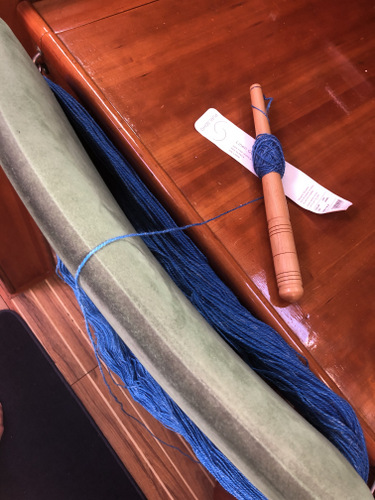
I’m not sure that I use my nostepinne correctly, but I wanted to knit from a center pull ball. I have to drape the skein on our navigation chair, which is a bit too small. Of course at home I make balls with a ball winder and it goes at least 10 times faster.

My balls always turn out like eggs!

And I am baking and cooking, like everyone else on the planet right now. Even though I have a pound of yeast in the freezer onboard, I miss making sourdough. I thought I’d find out what wild yeast in the Caribbean would be like. It’s very healthy! It must love the salt air and warm temperatures. Playing with sourdough also has been a little ray of contentment during my worrisome days.

And the best balm for my fearful days has been the connection with friends who are checking on me daily. It’s been so therapeutic for me to know that friends are thinking of me. Somehow that is always such a sweet surprise! –to hear that people take the time to think about me when their own lives have a full share of worries. I feel wrapped in the love of people who are routing for Bob and me to have a safe trip home. Thank you immensely!

Scroll to Top