ArgoKnot

Penultimate

On the penultimate day of 2025 I find myself thinking about the Outer Hebrides and what the weather is there at this darkest time of year. They seem to have stunning sunsets and sunrises, and rainbows. Somehow I’ve gotten myself connected to more facebook sites about Scotland than I ever imagined. The images of these northern places in December has been thrilling to see every day. I dearly hope I can make another trip to Scotland in the next year or two.

The second half of my visit to Scotland in July was a private tour of the Outer Hebrides. My friend Kari found the tour service that we chose. The tour was just for the two us, with sites chosen by us. The tour company (McKinley Kidd) made all the train and ferry connections for us, all the lodgings, and most of the meals. On each island we had a driver who had a list of sites that we had chosen to see as well as a list of sites we shouldn’t miss. I had seriously considered the idea of visiting the islands on our own. I’m relieved that I got onboard with having the luxury of this tour company taking care of almost our every need. We took a train from Glasgow to Oban to board a ferry to the southern most island of Barra. I had no idea that the ferry alone would be five hours. The map made the trip look like a mere hop and skip. From there we went to South and North Uist, then Bernaway, and lastly the combined island of Lewis and Harris.

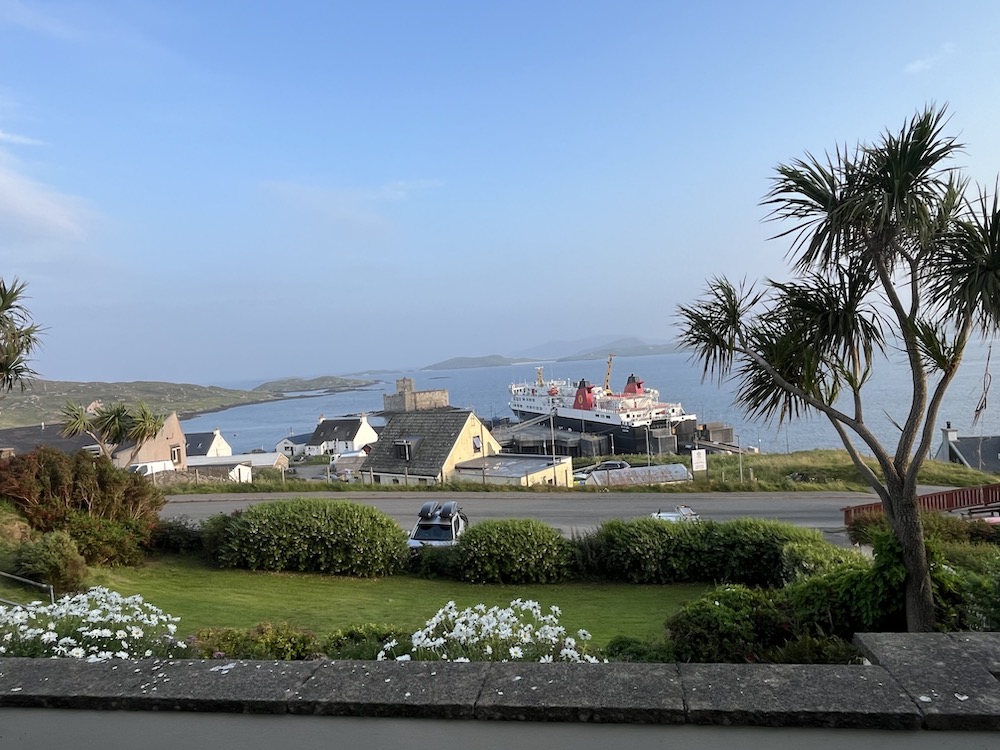
Here is our ferry arriving on Barra after the five hour trip from Oban
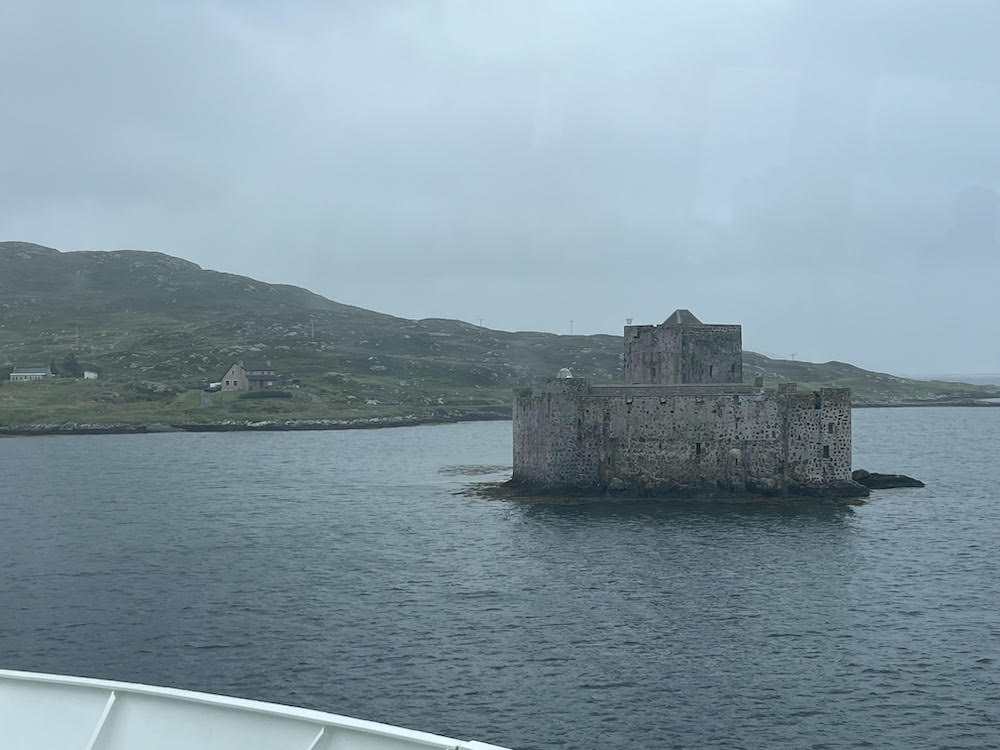
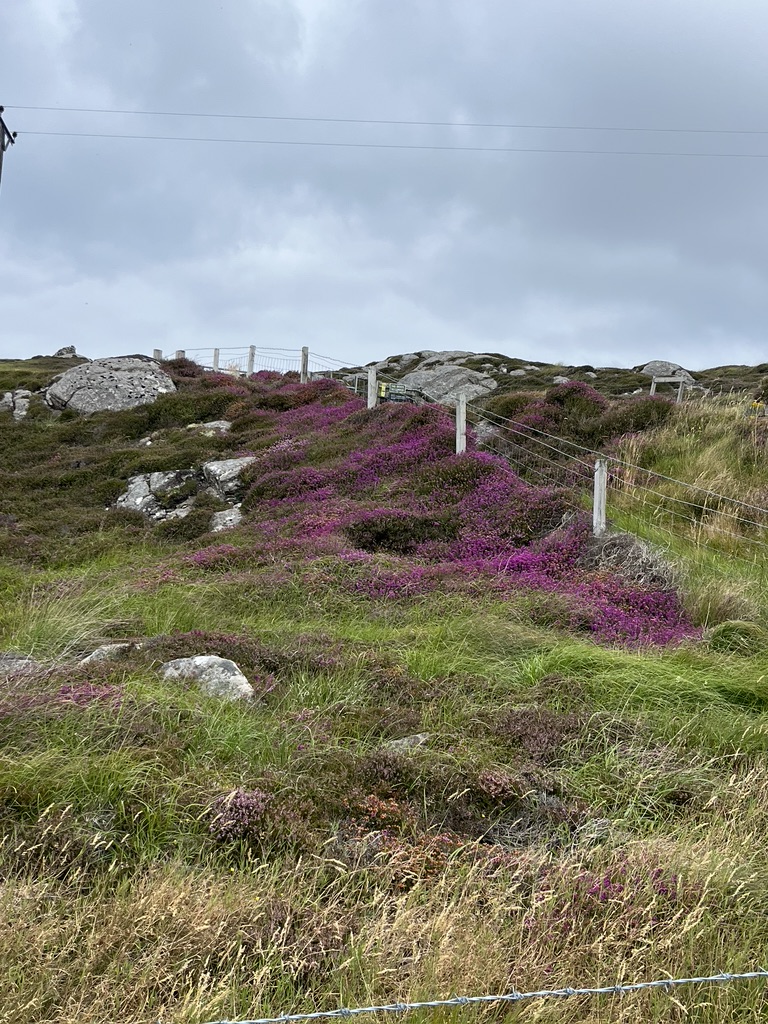
The heather was just beginning to bloom in souther part of the islands.
The ferry terminal in brighter weather.
We stayed here at Hearthbank, where we were unfortunately not able to get dinner! The owner was leaving for the mainland and would have to close and lock the dining room. On the other hand, she arranged for a chef to make breakfast for us the next morning, which was memorable! Perfectly poached eggs on toast.
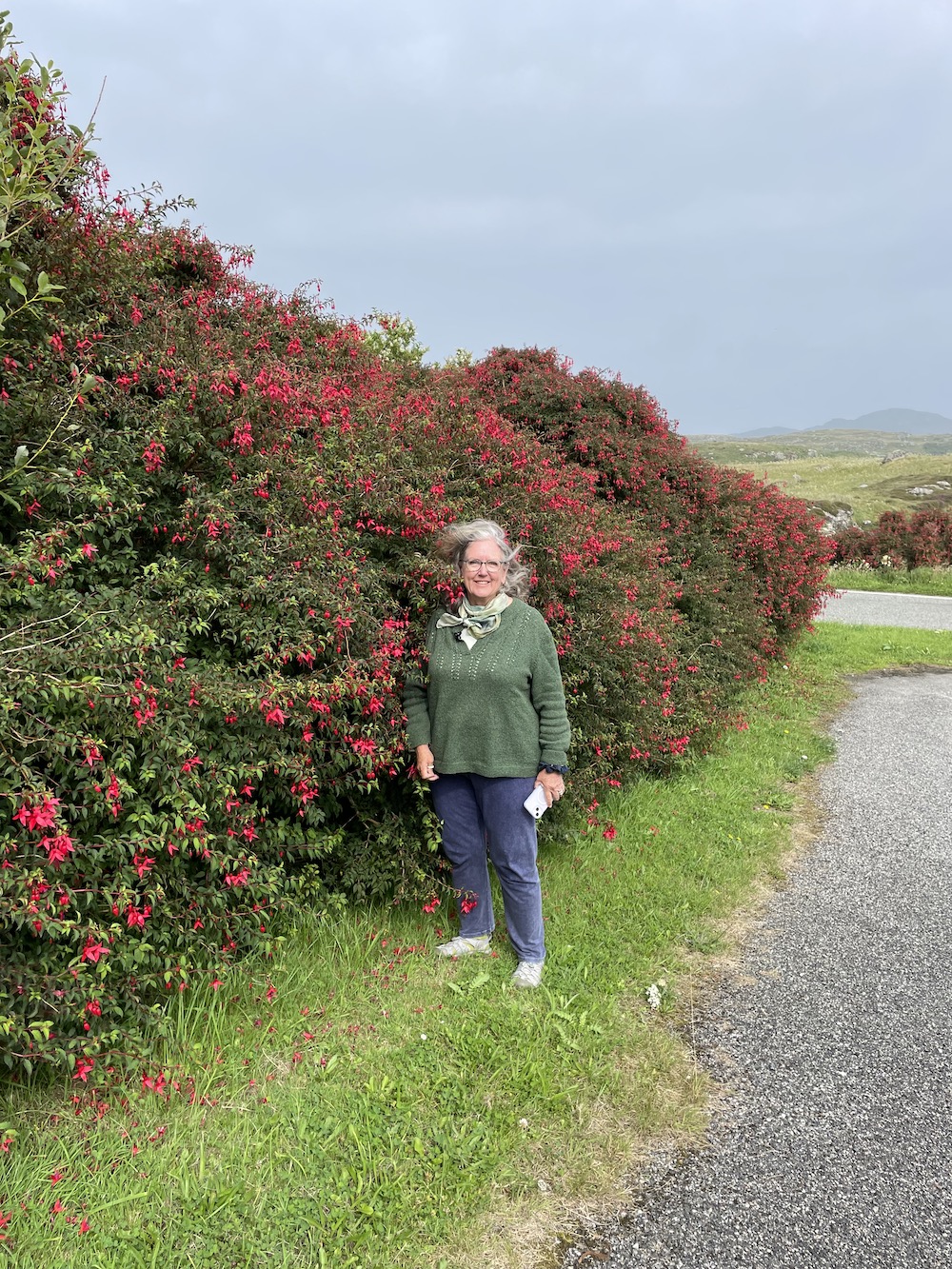
There was a massive hedge of fuschia long the driveway just outside the right side of this photo. Yes, it was windy!
Barra’s airport is on the beach, and the planes take off and land at low tide. That is something to see! We saw both this landing and then the next take off. It was truly something to see passengers deplane onto the sand.

While I didn’t see any wool related things on Barra, this was quite an exciting way to start our week in the Outer Hebrides. From here we went to South and North Uist (is that Grimsay?) I can’t manage the names of towns vs islands. Maybe both islands together are known as Grimsay. Feel free to enlighten me!

We had a wonderful driver/tour guide on South and North Uist. He was keenly aware that I wanted to see sheep and wool production on these islands. He also wanted us to see the mostly buried standing stone sites on these islands, as well as a couple of monuments. He is a budding bagpiper, while his brother is well established and plays at all the local festivals. During one of our walks off the beaten path he picked a handful of locks from the local white sheep. The locks were caught in brambles. They are still in the pocket of my raincoat.

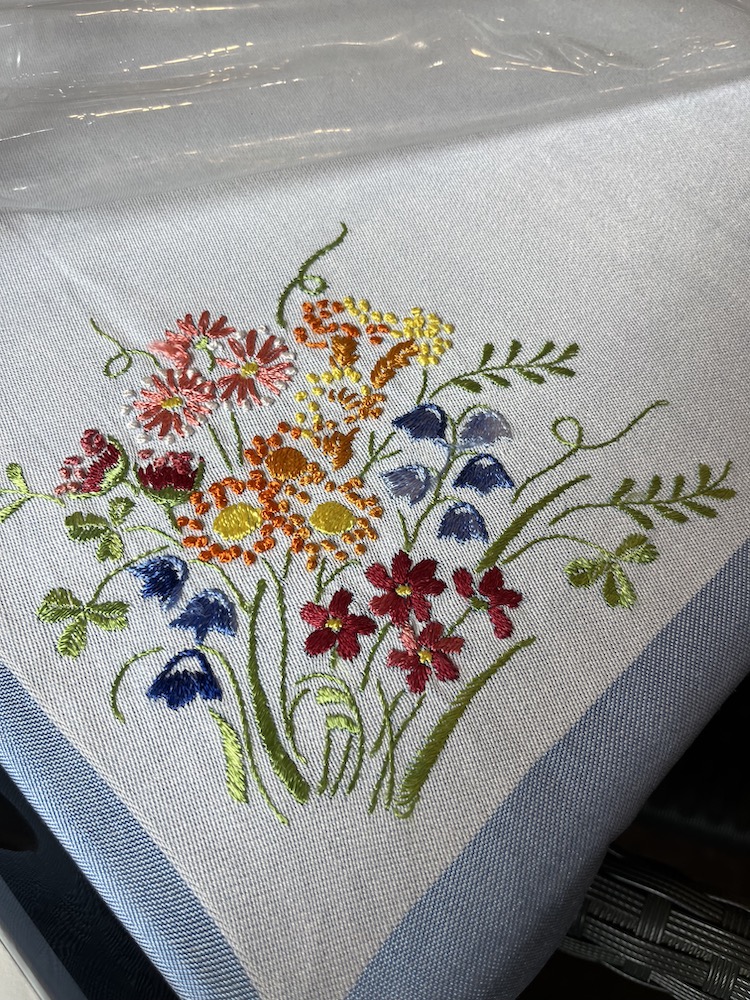
He took us two wool producing places, and equally impressive was the scandinavian bakery near Scotvein where Kari and I had lunch. Every table had an embroidered tablecloth on it, covered in plastic to protect the lovely handwork. I couldn’t care less about the cake! I just want you see the bit of embroidery at the borders of the photo!

Here is our table. I pulled aside the plastic cover to better enjoy the embroidery that was done on each corner of the cloth.
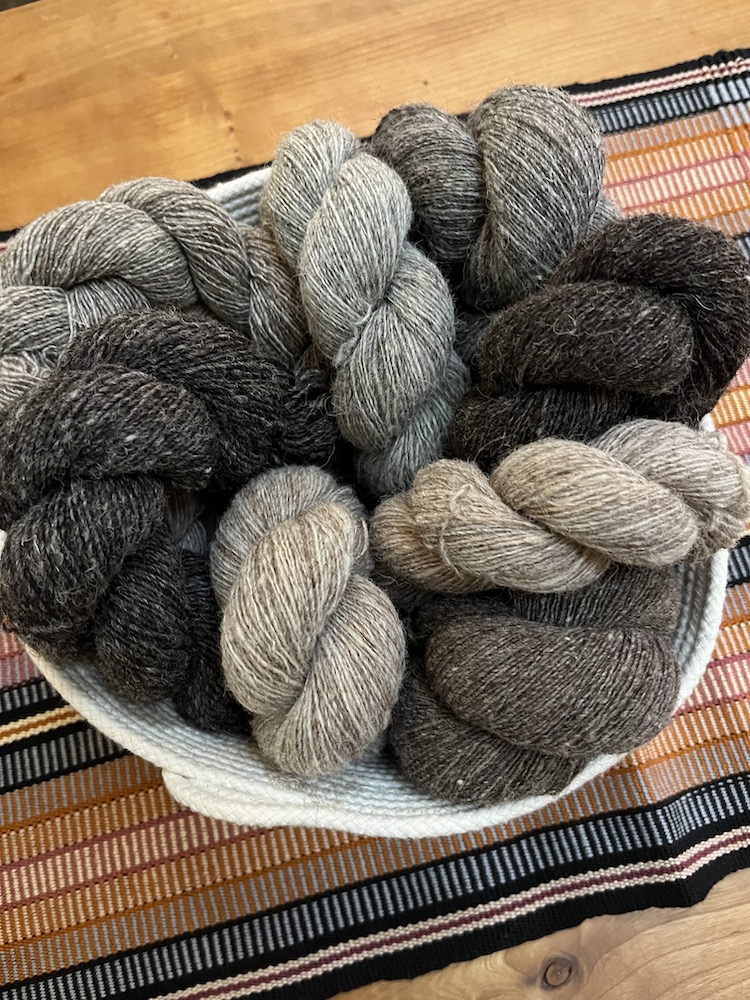
We had two days on South and North Uist, and we saw a wool spinning mill where I bought some exciting things, including a batch of single spun Hebridean wool in natural colors. They spun this wool for someone’s specific project, and what I bought was all there is. I am planning the warp right now, which is pretty prompt of me, only five months after buying it! I also bought three ‘cakes’ of pencil roving that shades from the darkest natural to almost white. I gave away one cake and have spun the other two….not sure what that will become.

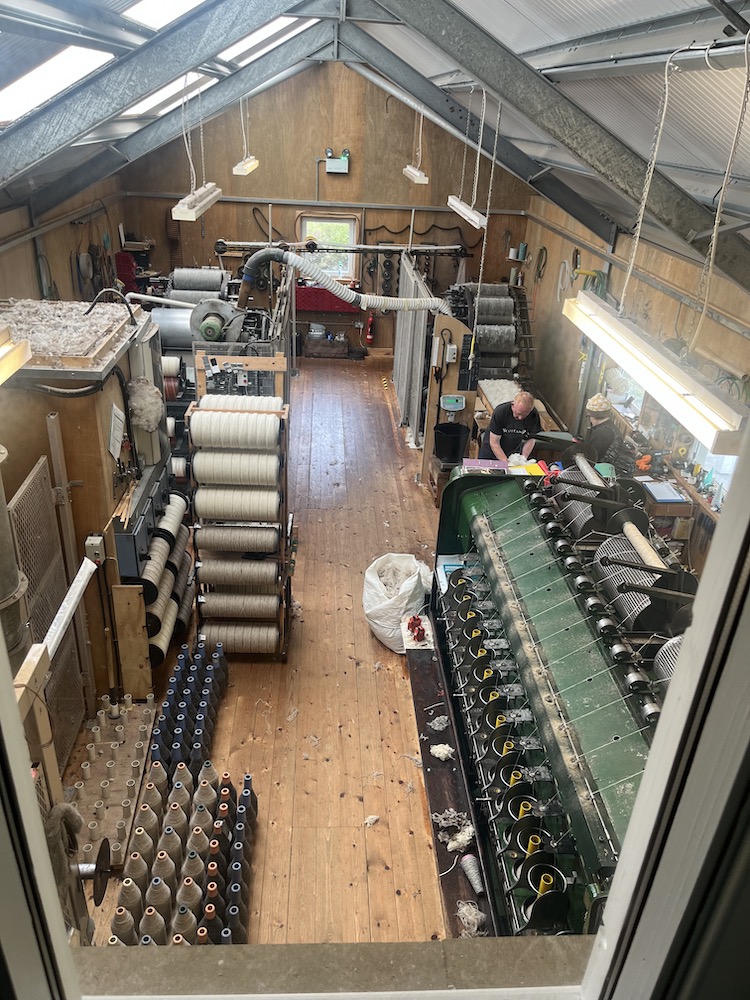
We were not allowed into the spinning room at Uist Wool, so we looked down through a large glass window. The website is stunning.
My treasures. I plan to weave fabric for a lightweight ruana.
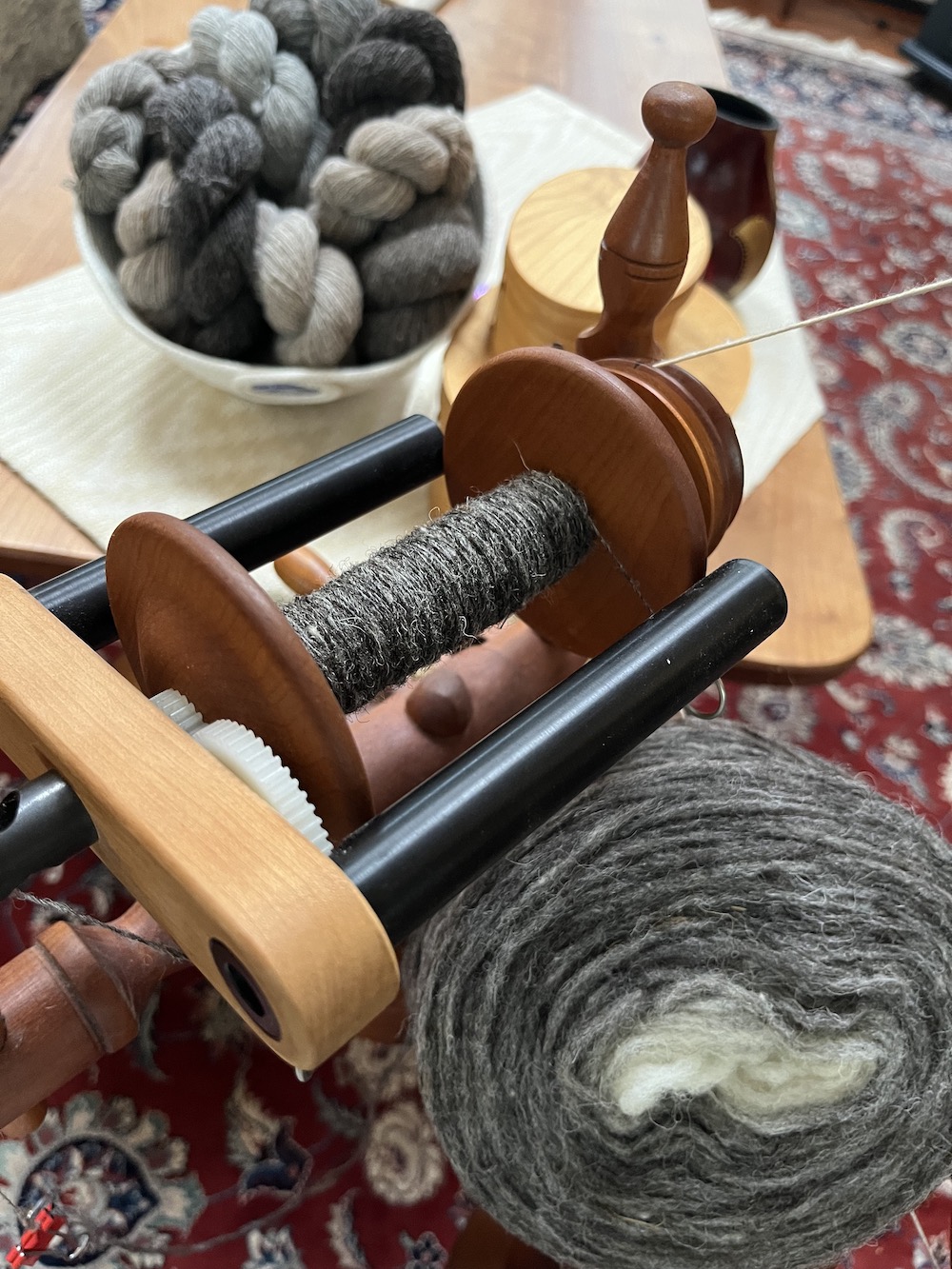
Here is one of the wool cakes I spun, possibly to add to the project.
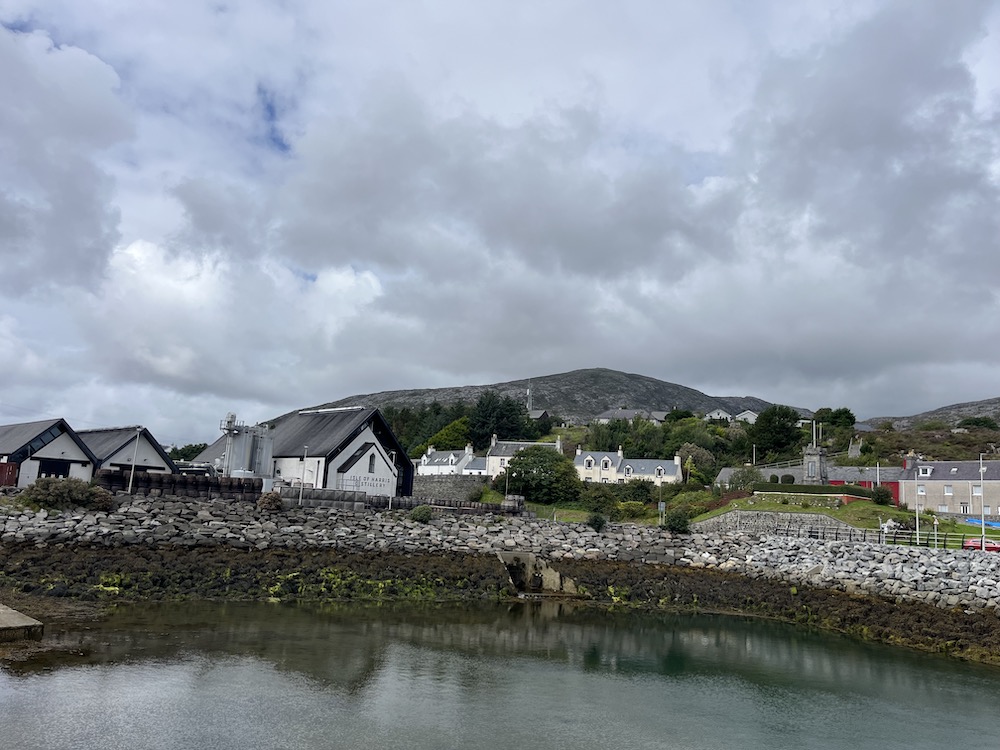
Our guide on the islands of South and North Uist took us to a museum, an historic boatworks location, as well as beaches with cows (and no people!), a somewhat submerged standing stone site, and a couple of monuments. He was thorough and understood exactly what would appeal to any visitor as well as to those of us who love history, and in particular the history of sheep raising and wool culture. I had never heard of Uist (and struggle a bit pronounce it still), and now it is high on my list. I hope to go back someday.

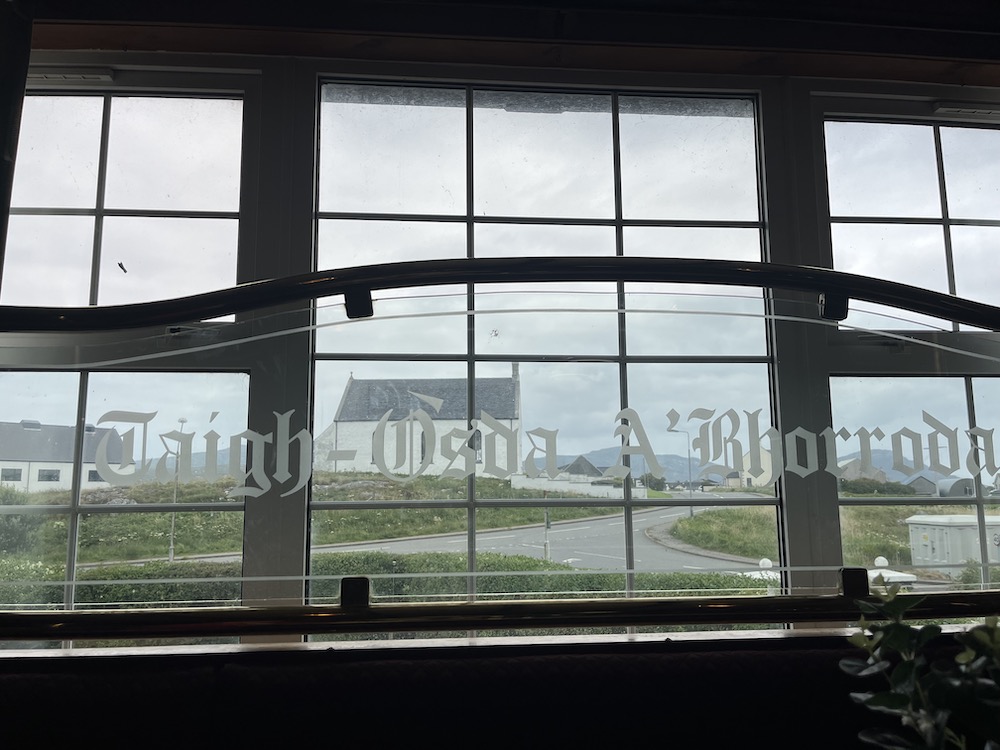
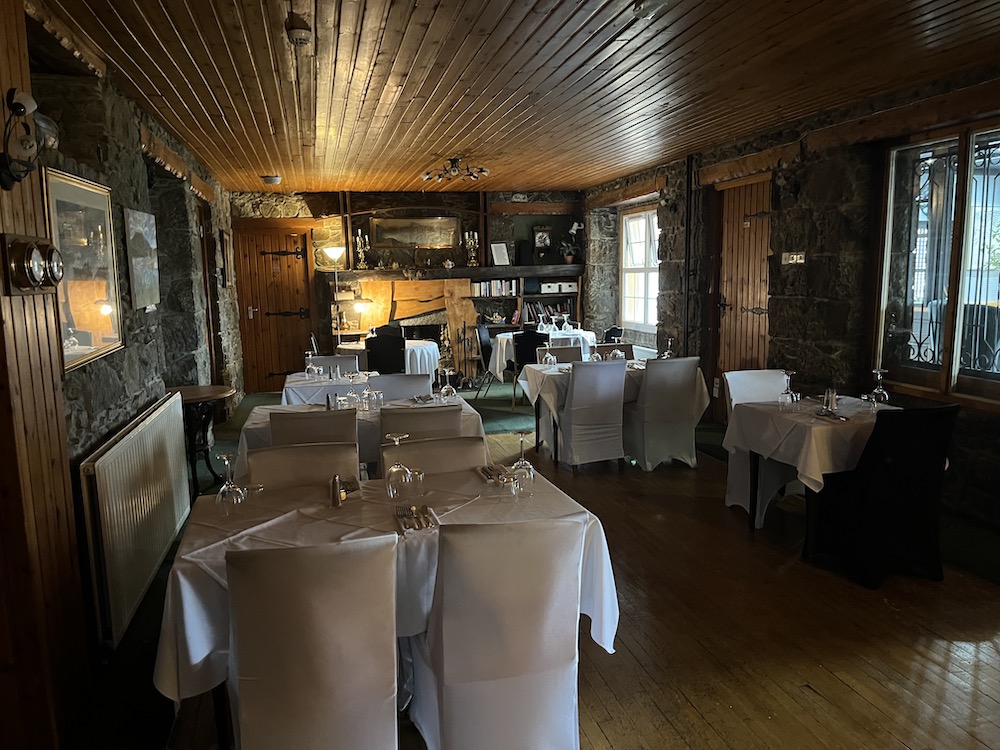
Welcome to Bhorrodale on Uist. This is the window in the pub. The dining room was closed while we were there, but the pub was a charming spot for our dinners.
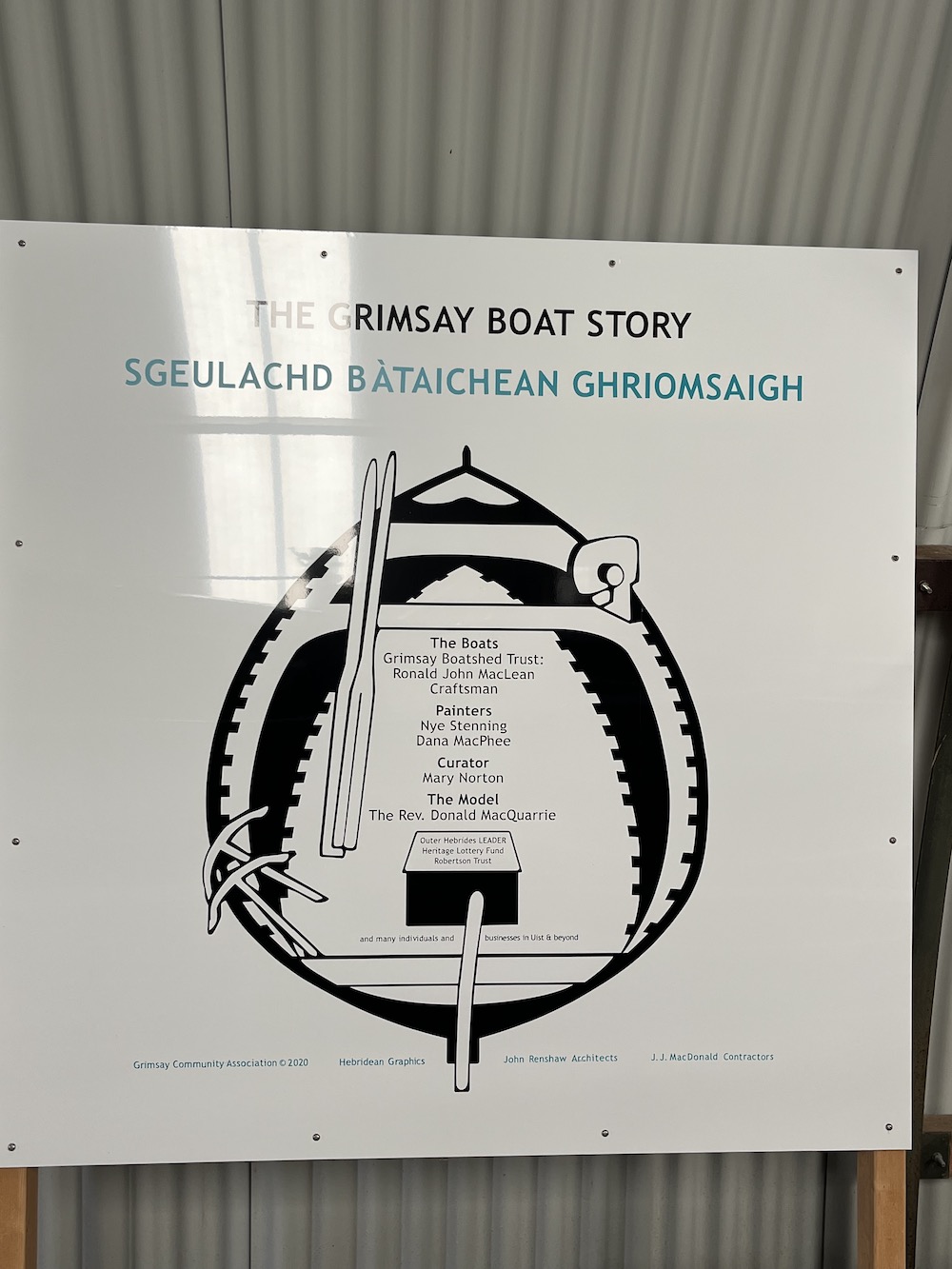
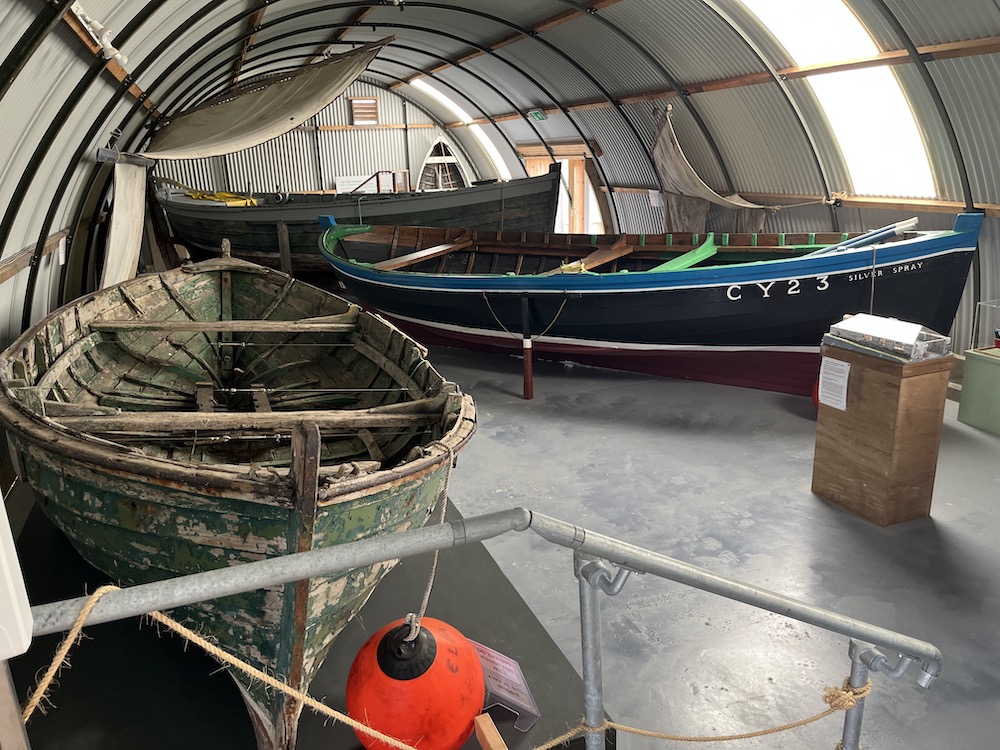
A small museum devoted to the history of small boats in this area.
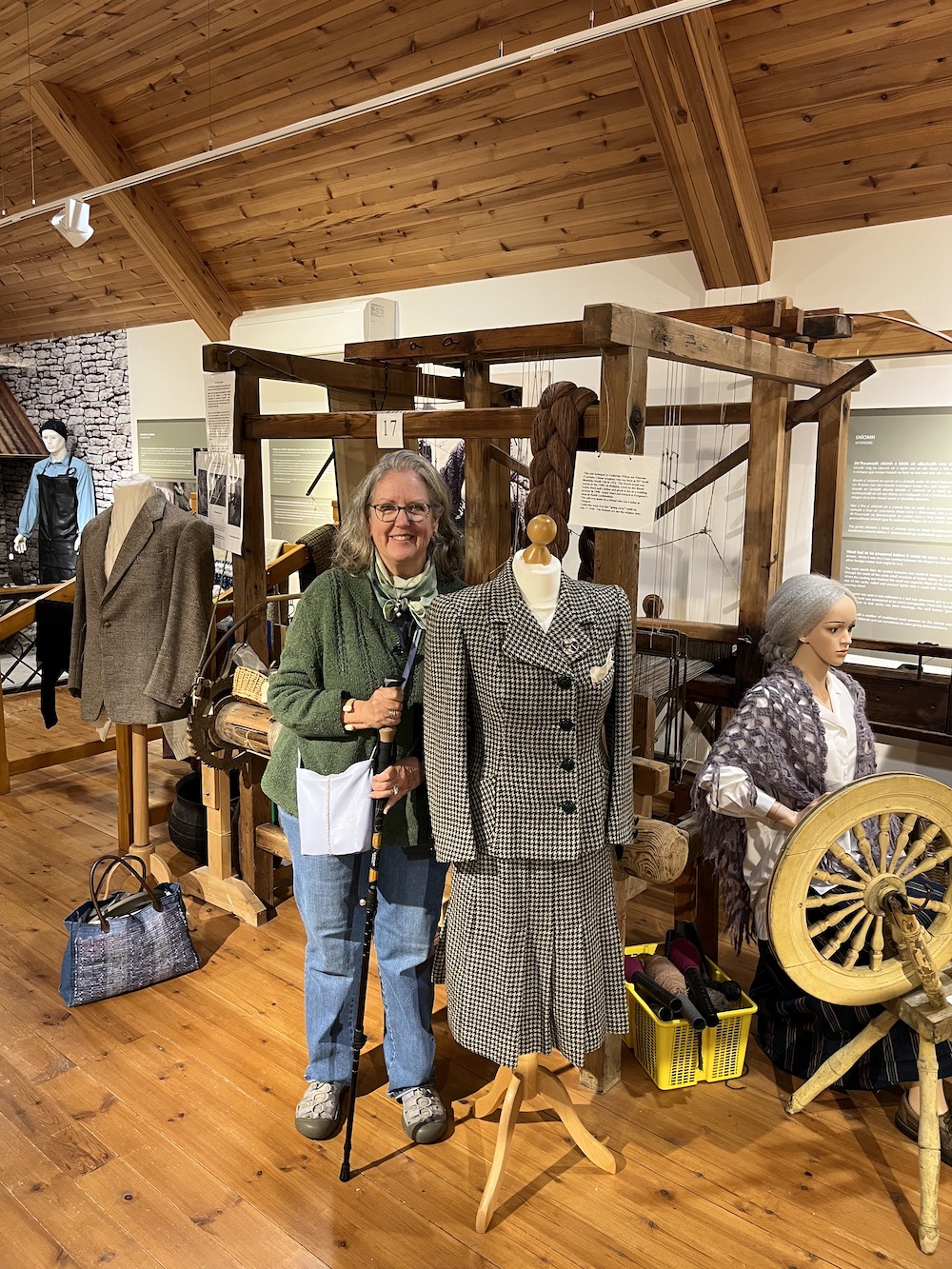
The cultural museum in Kildonan on the Isle of South Uist.
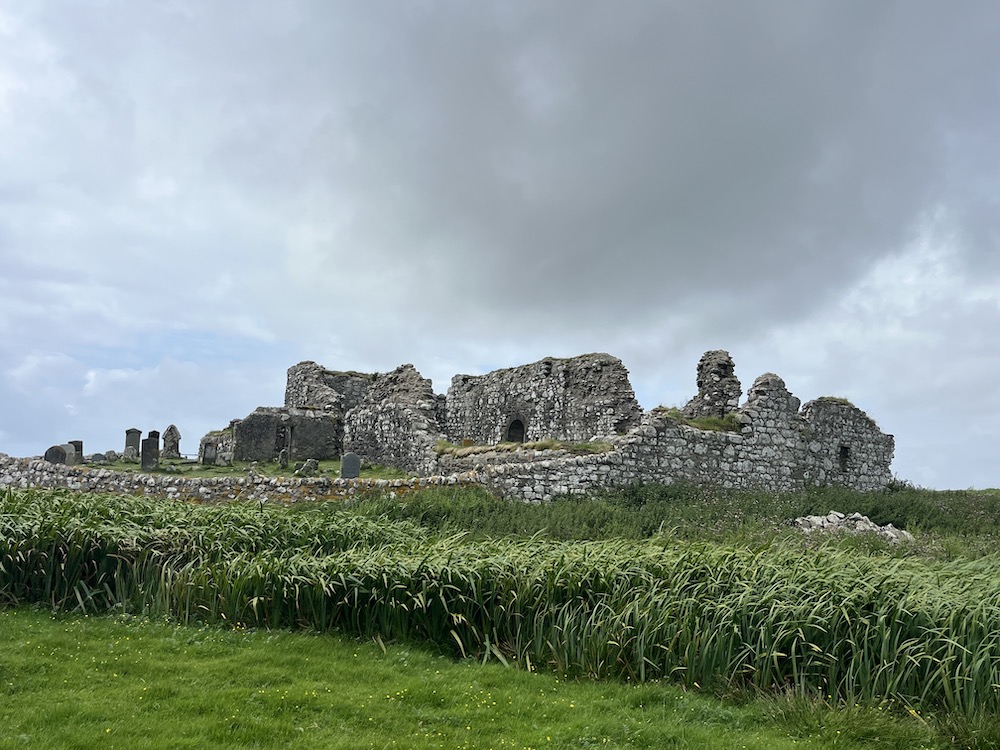
The round houses predate Viking settlements that were long houses. An entire community plus animals lived in these round houses.
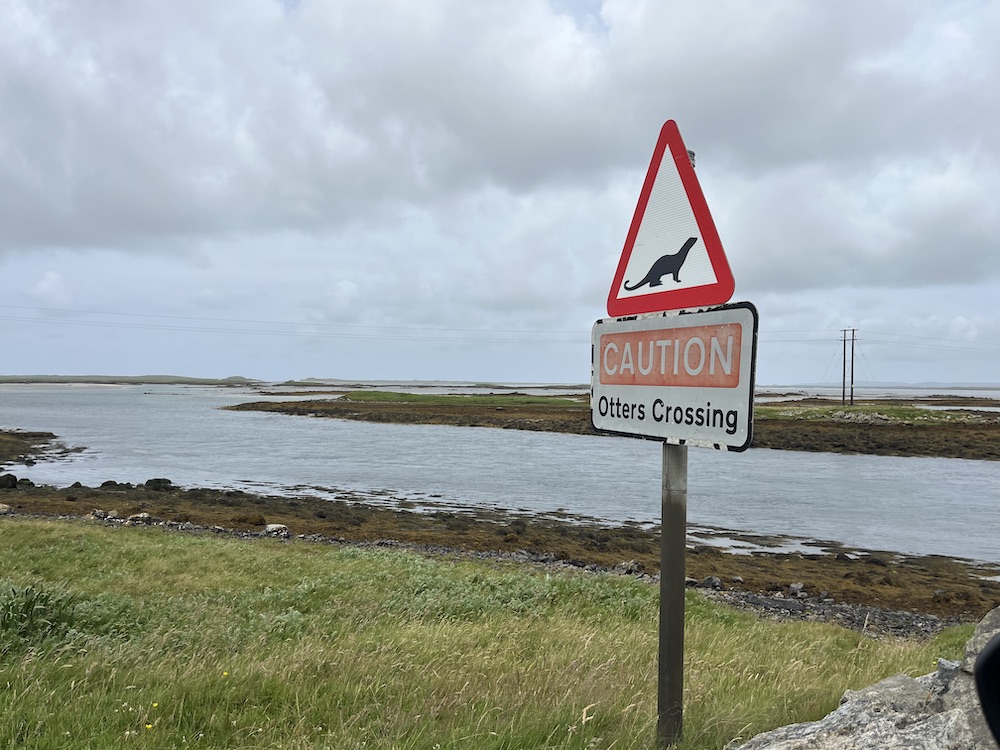
Driving across causeway between South and North Uist. Didn’t see any though.
And then it was time to visit Berneray, where the Berlinn Wool Company was closed. I was sad, but I also knew we’d been awfully lucky with what we did see.

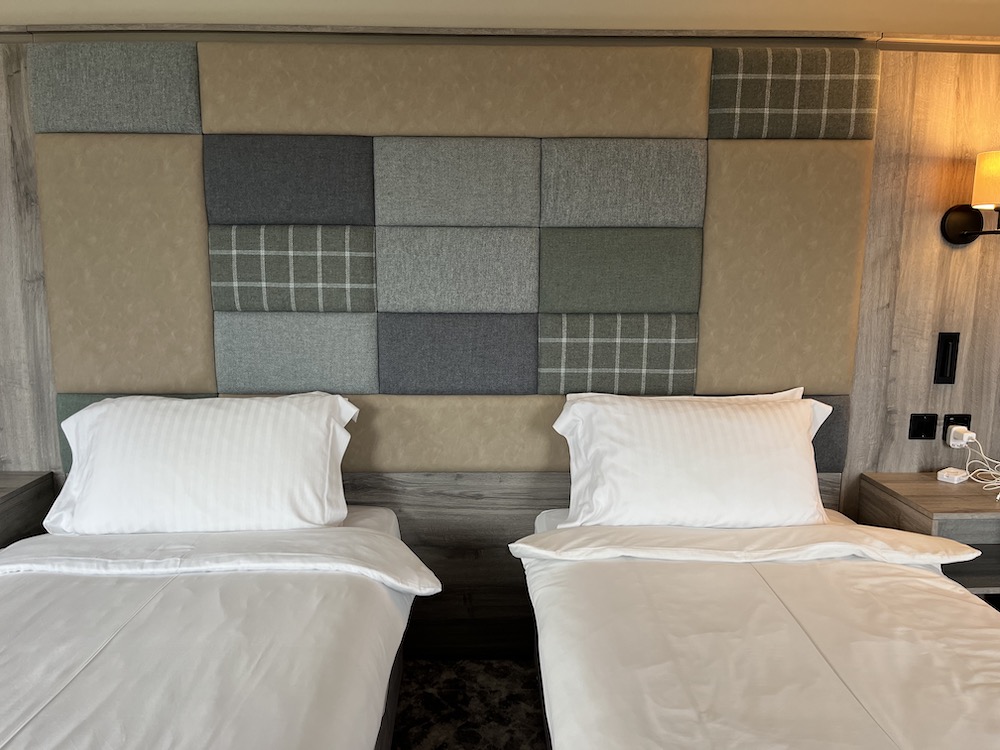
Off we headed to our last island destination, the dual island of Harris and Lewis. If ever there was a celebration of Harris Tweed, this is the place to enjoy it. Now you might well think I’ve taken leave of my senses. I went a bit overboard taking photos of Harris Tweed on every chair and wall that I came across during our stay! This is the wall in our room at the Hotel Hebrides.
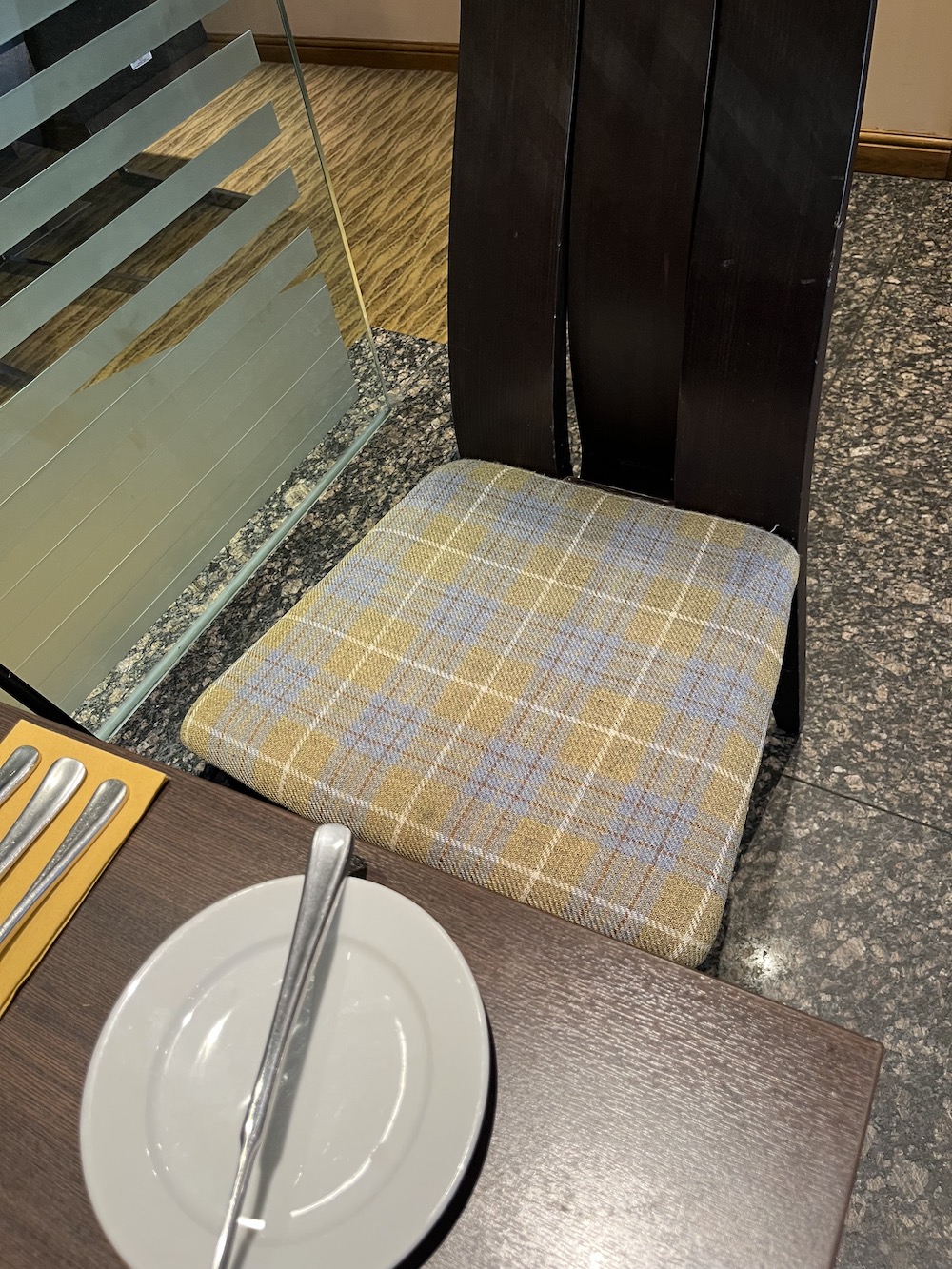
Breakfast and dinner at this hotel featured dining chairs with Harris Tweed fabrics, as well as handwoven napkins (although not wool).
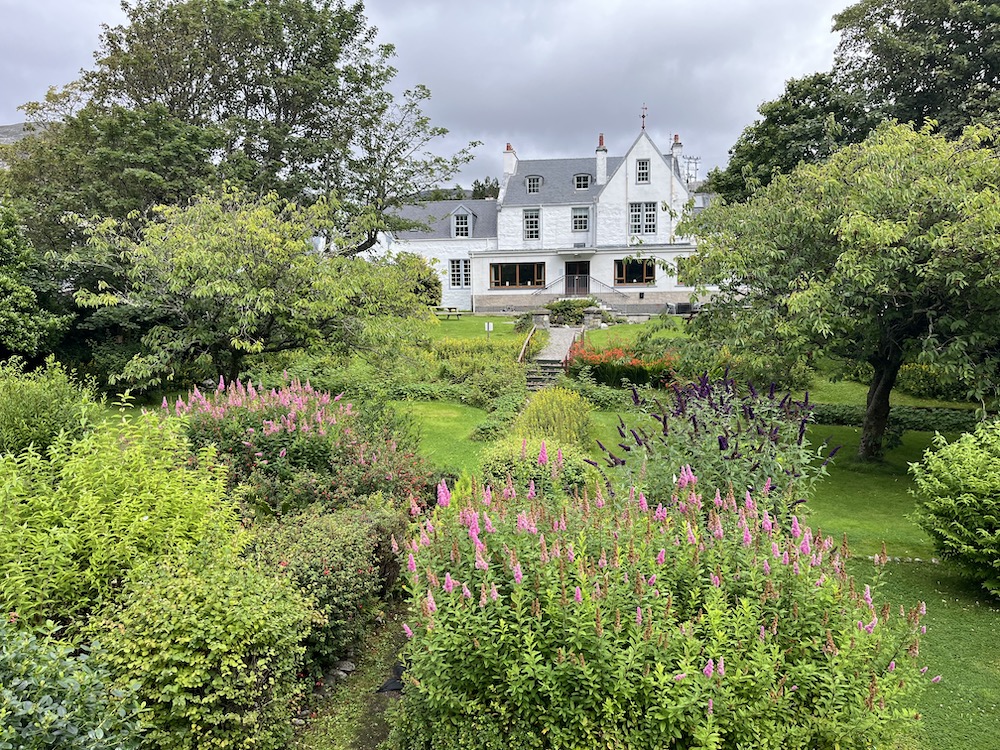
When we arrived we decided to have afternoon tea at a lovely spot within walking distance of our lodging. This is the Inn at Harris. We enjoyed the gardens along with Harris Tweed decorated dining room.
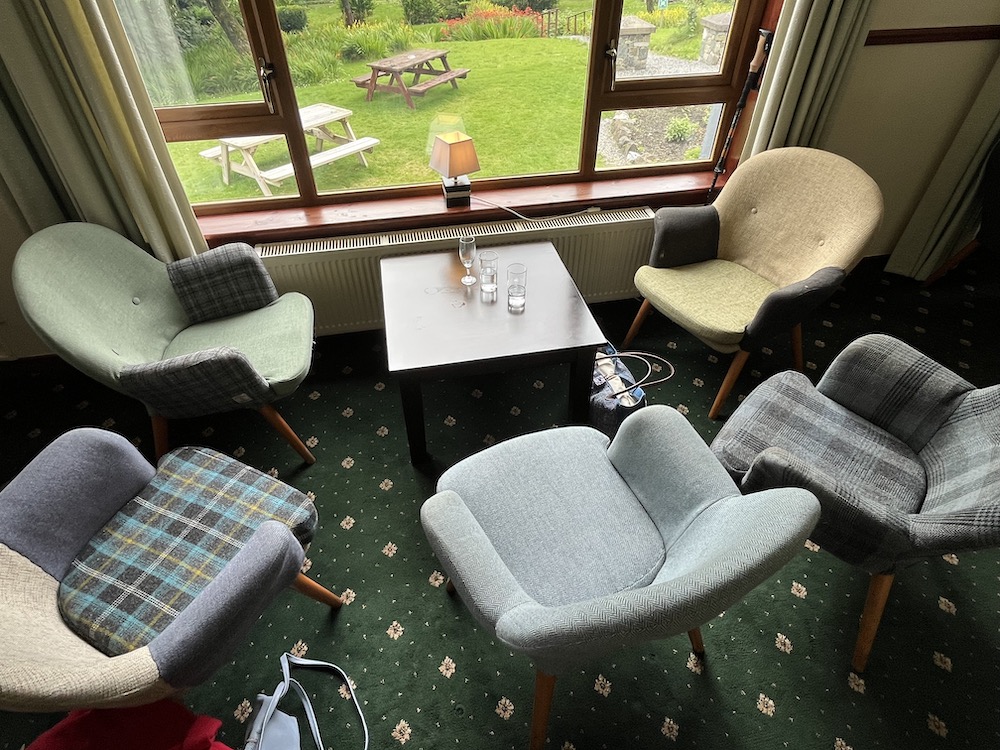
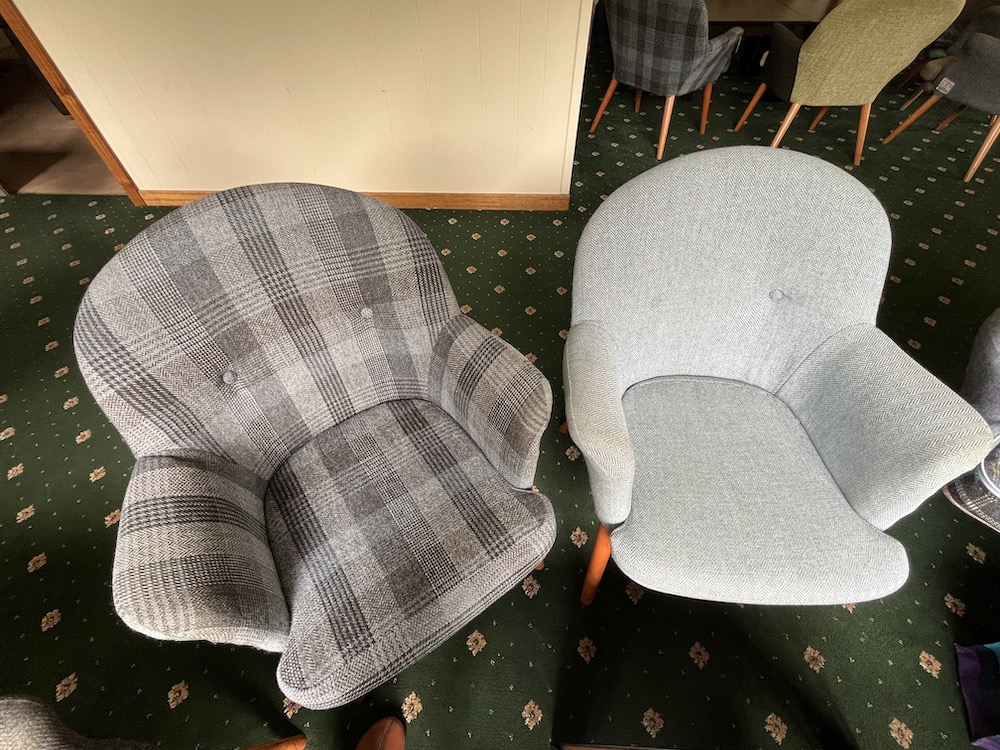
I know some of you will believe how it was for me to choose a chair to enjoy my tea!
And then a stroll back to our hotel took us by Harris Tweed company. This is the building that houses nothing but bolts of fabrics. It was hard to choose, but I managed to buy two lovely tweed fabrics.
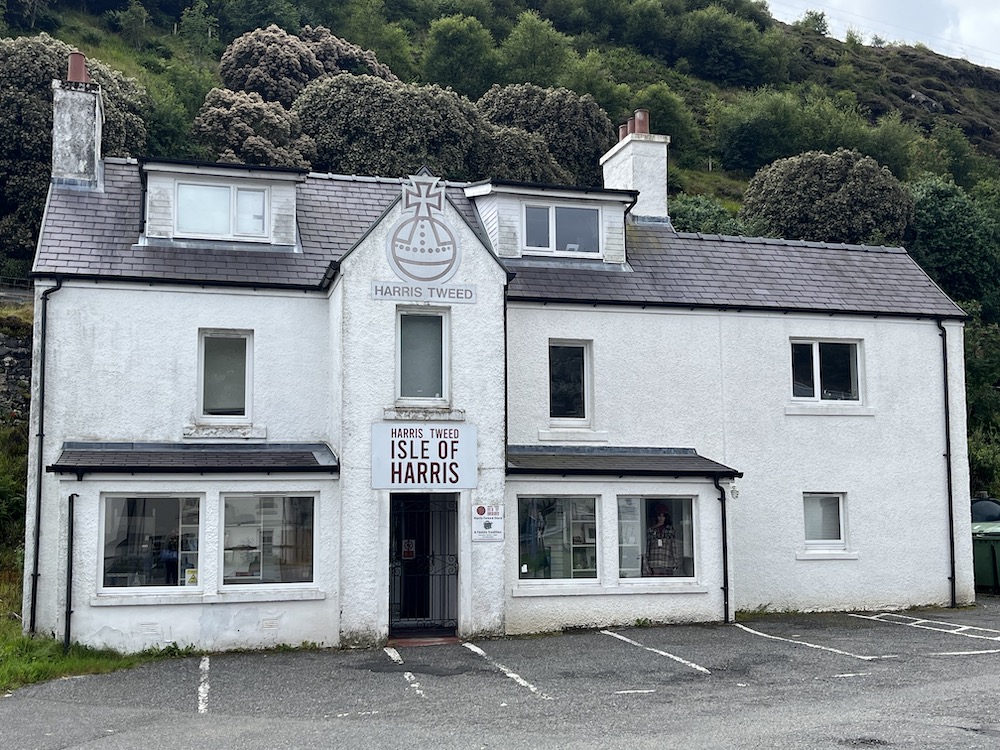
Across the street from the fabric shop was the gift shop. I had waited to visit this shop in order to choose a Harris Tweed handbag. I had seen one in Edingburgh that I loved, but I needed to make sure there wasn’t something even more entrancing at the actual shop in Harris. As it turns out that bag in Edinbtugh won my heart. Even though I had taken a photo of the bag, I neglected to note which shop had it! I was lucky to find it quickly when we returned to Edinburgh for only half a day.

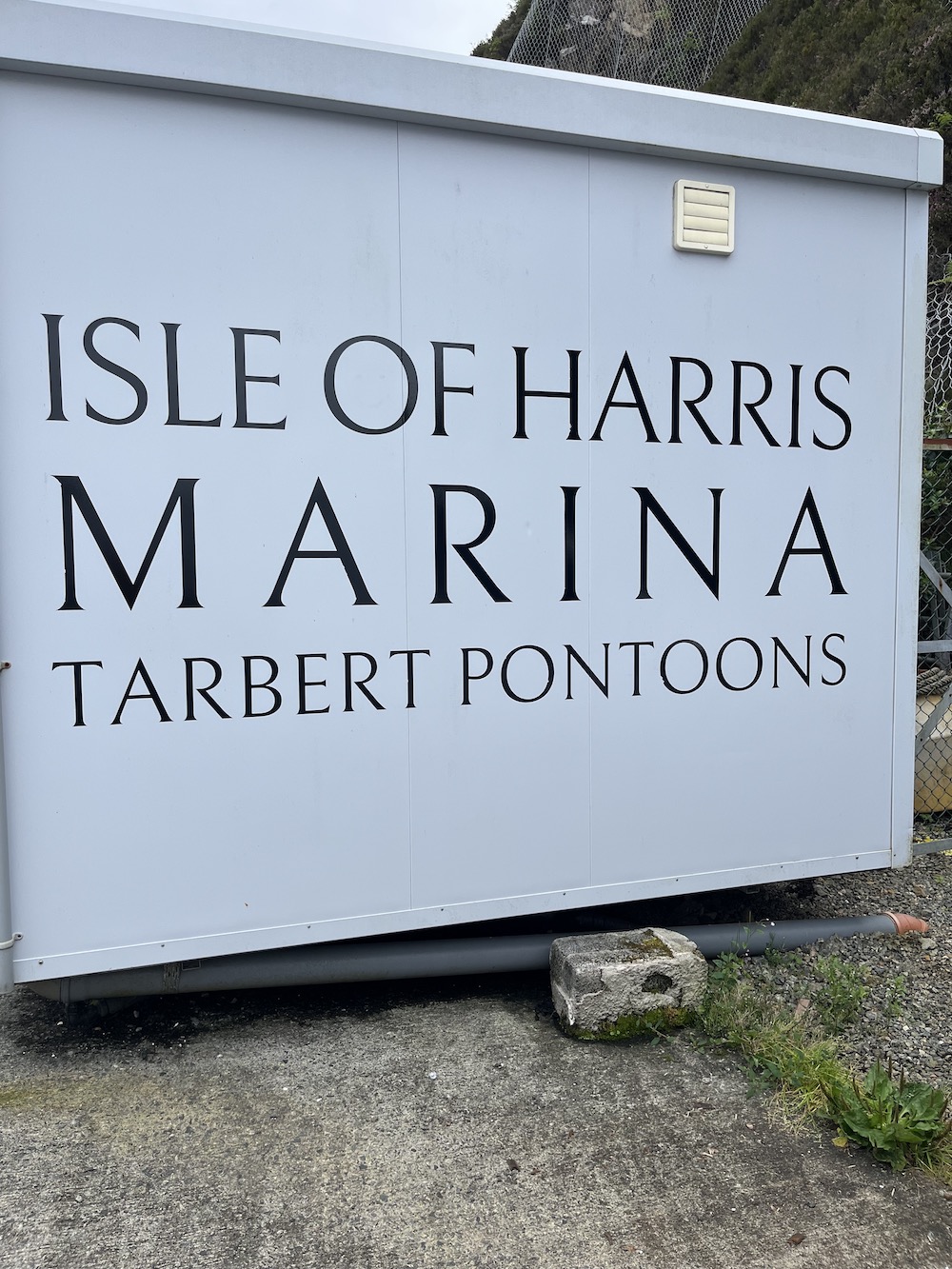
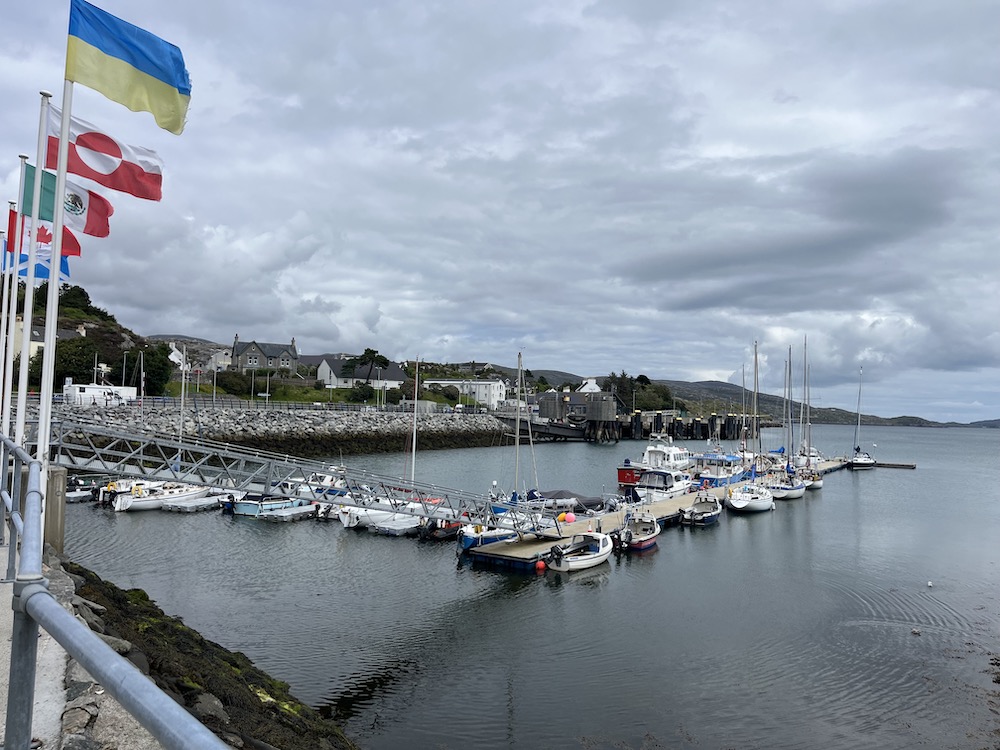
I took a walk along the harbor on my way back to the Harris Inn. There is a very small marina. It is a late July day, and it’s quite chilly. I really cannot imagine visiting here by boat, but clearly a few other hardy souls are doing it. I wish Bob could have joined me here. He would have gone straight down onto the dock to meet some of these sailors.
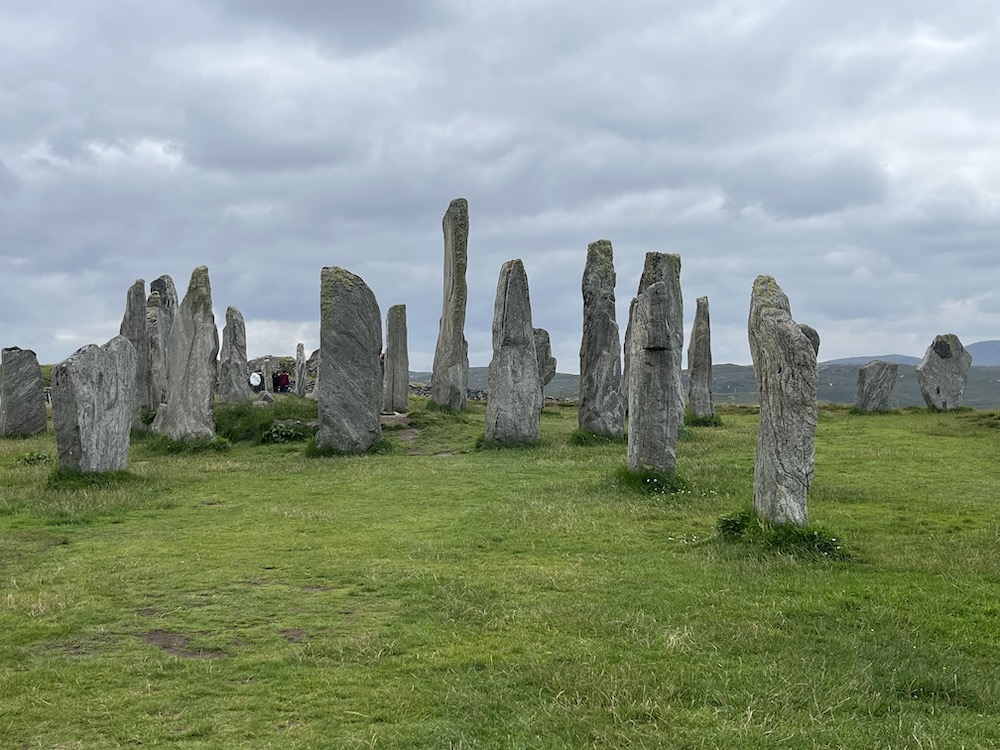
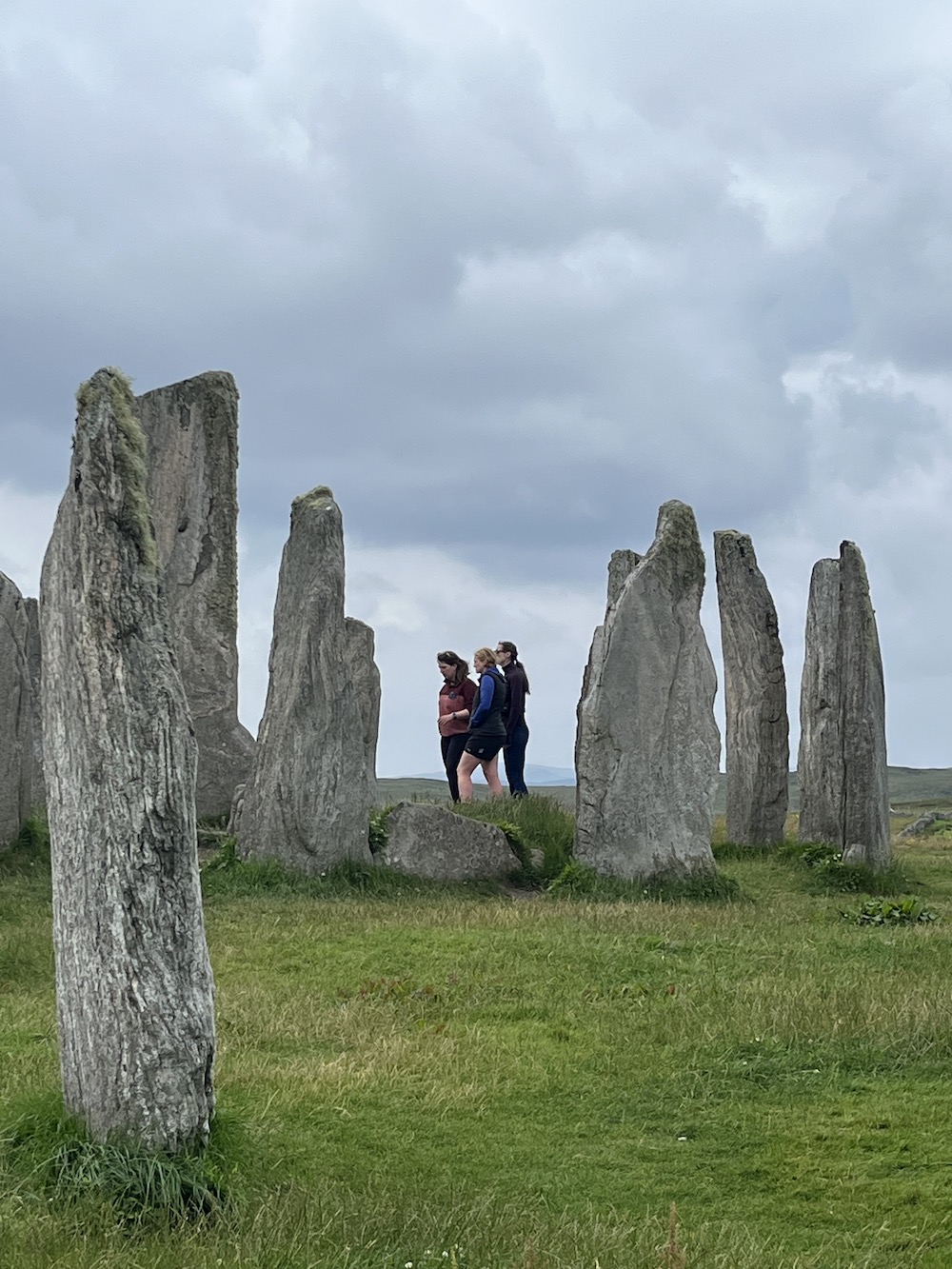
The rest of our visit to Harris and Lewis was quite dramatic. We saw the Callenish standing stones and our guide was well versed in telling us the history of that place. It is supposedly older than Stone Henge, and is roughly the age of the pyramids. I was fascinated by the stones that were chosen. They are metamorphic rock, which is the hardest hardest. Somehow the ancient people here moved these stones and set them up so that once a year on the winter solstice the sun moves straight down the path between the stones that run north/south and east/west. Several times a year the sun has a different interesting path through the stones. There is an altar at the north end of the standing stones. The patterning in these hard stones is magnificent, almost like petrified wood grain.
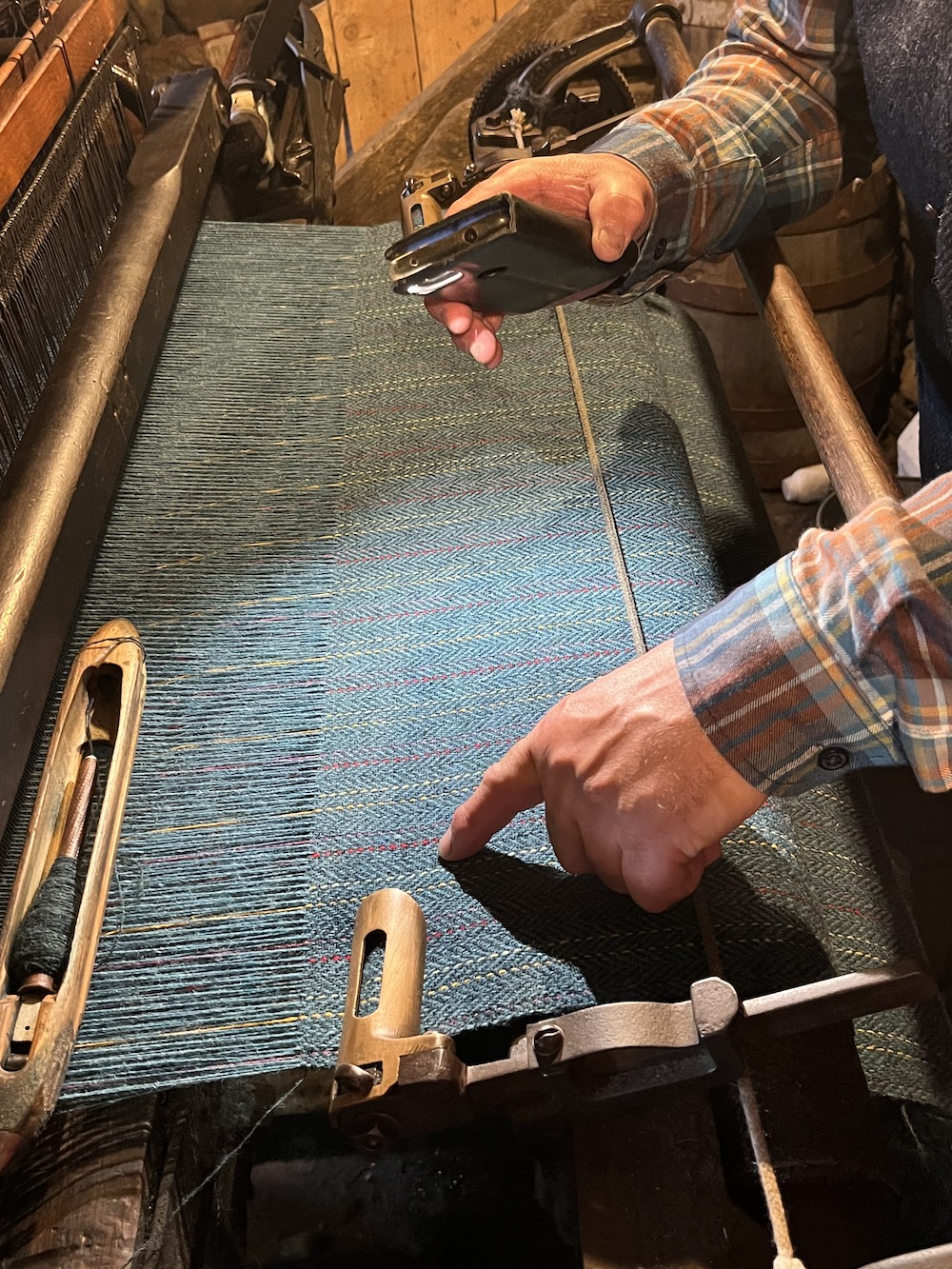
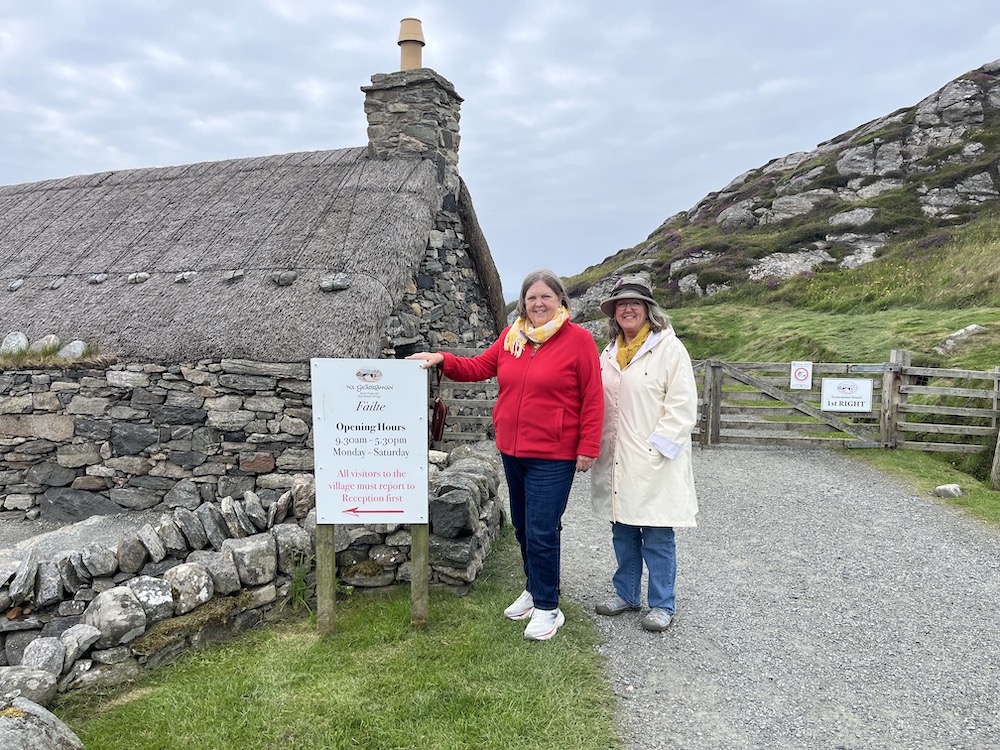
We visited a round house and an entire village of black houses that has been conserved as a museum. They have been well cared for over the centuries, and still have their stone walls and thatched roofs. Our guide is a Harris Tweed weaver, and the loom he uses is in this black house village. These are the style of buildings brought here by the Vikings. They are called ‘black houses’ because they generally had a central hole in the roof for the smoke from the fire to rise, and had no windows so the inside walls turned black over time.
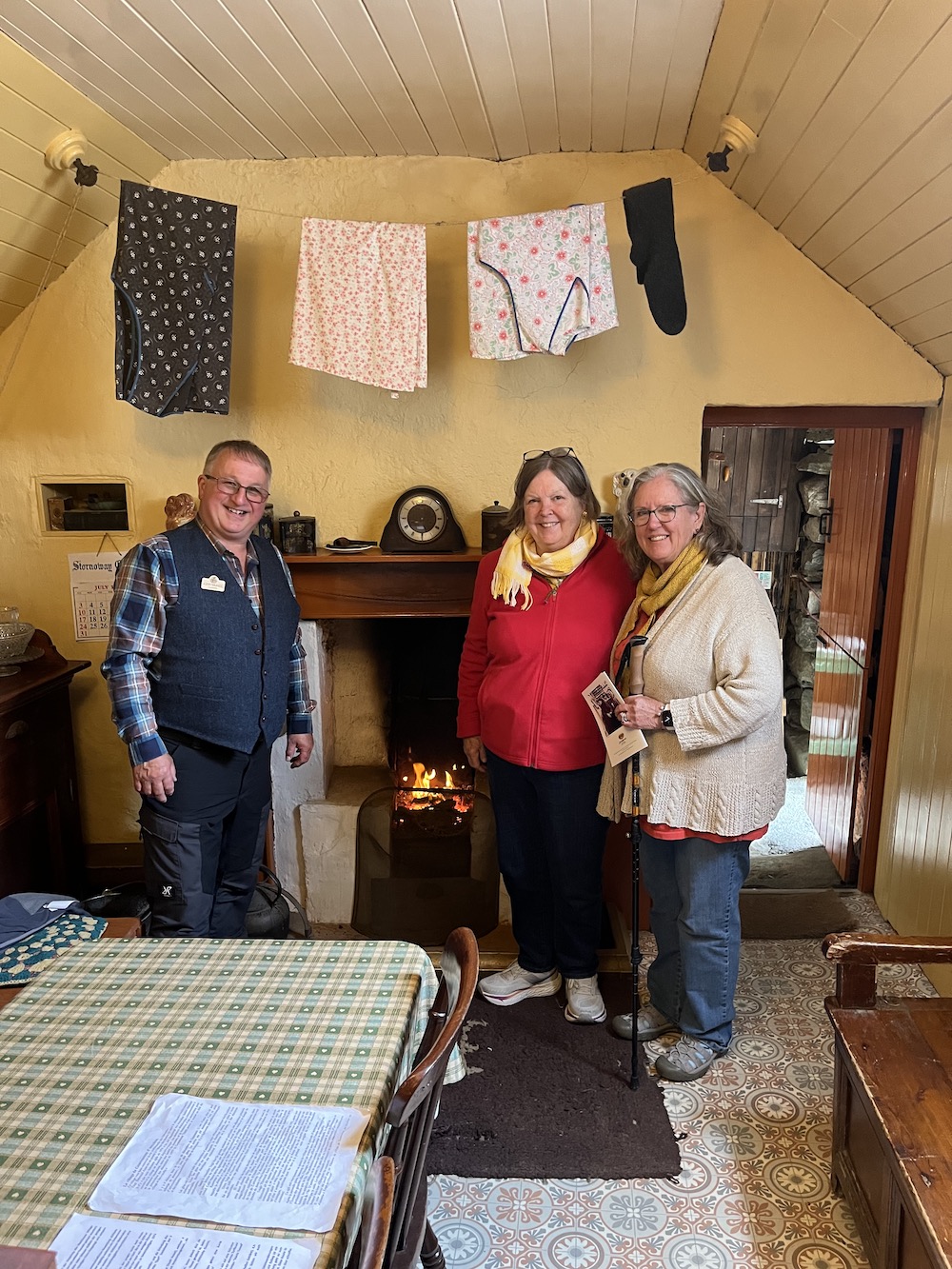
We are inside the black house where there are several docents who are friends of our guide (Tom MacMurray), and where his loom resides in a separate building. This particular house has been left with items from its last occupants, in the 1950s. These houses date much earlier but were in continuous use for centuries.
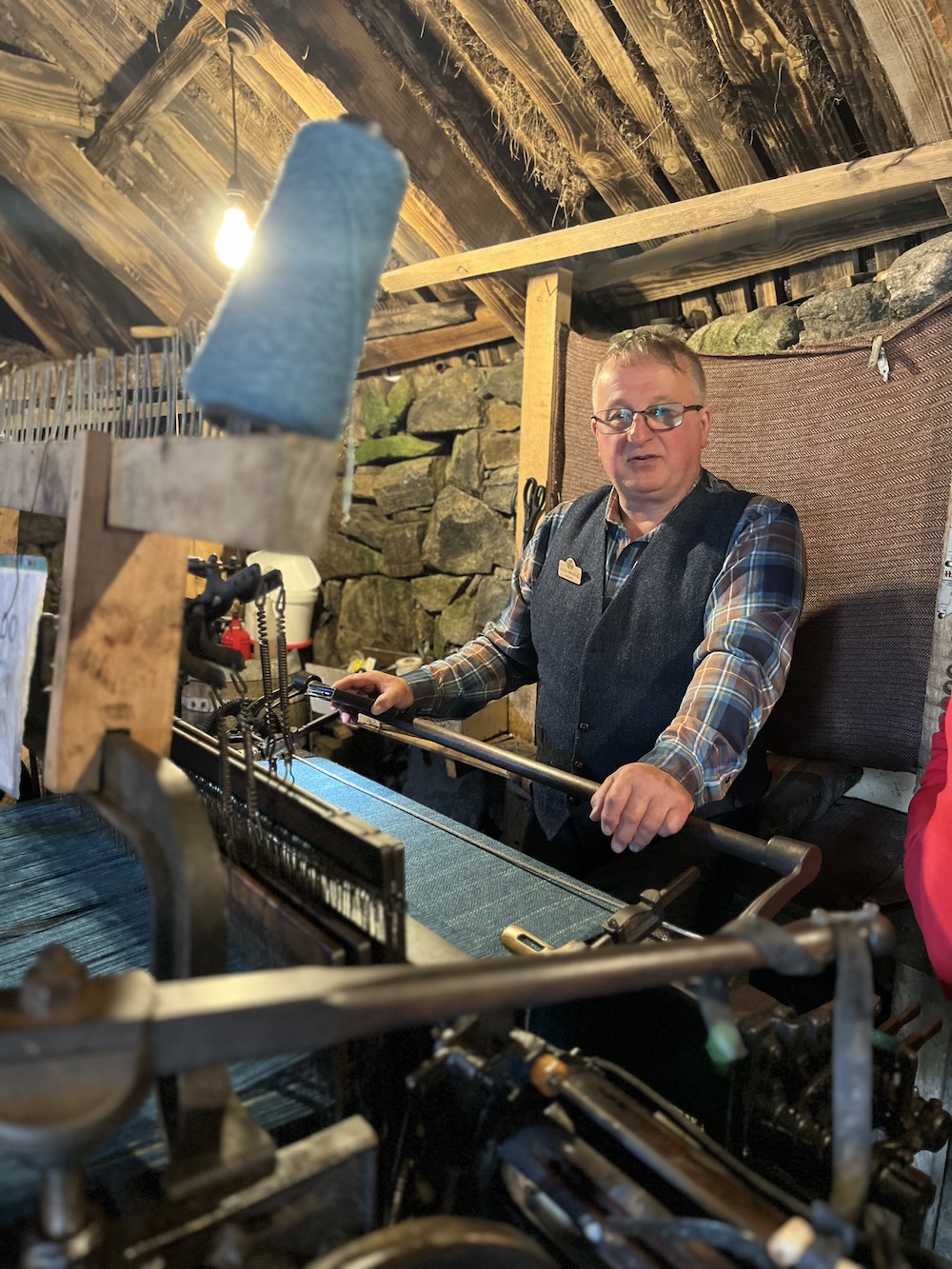
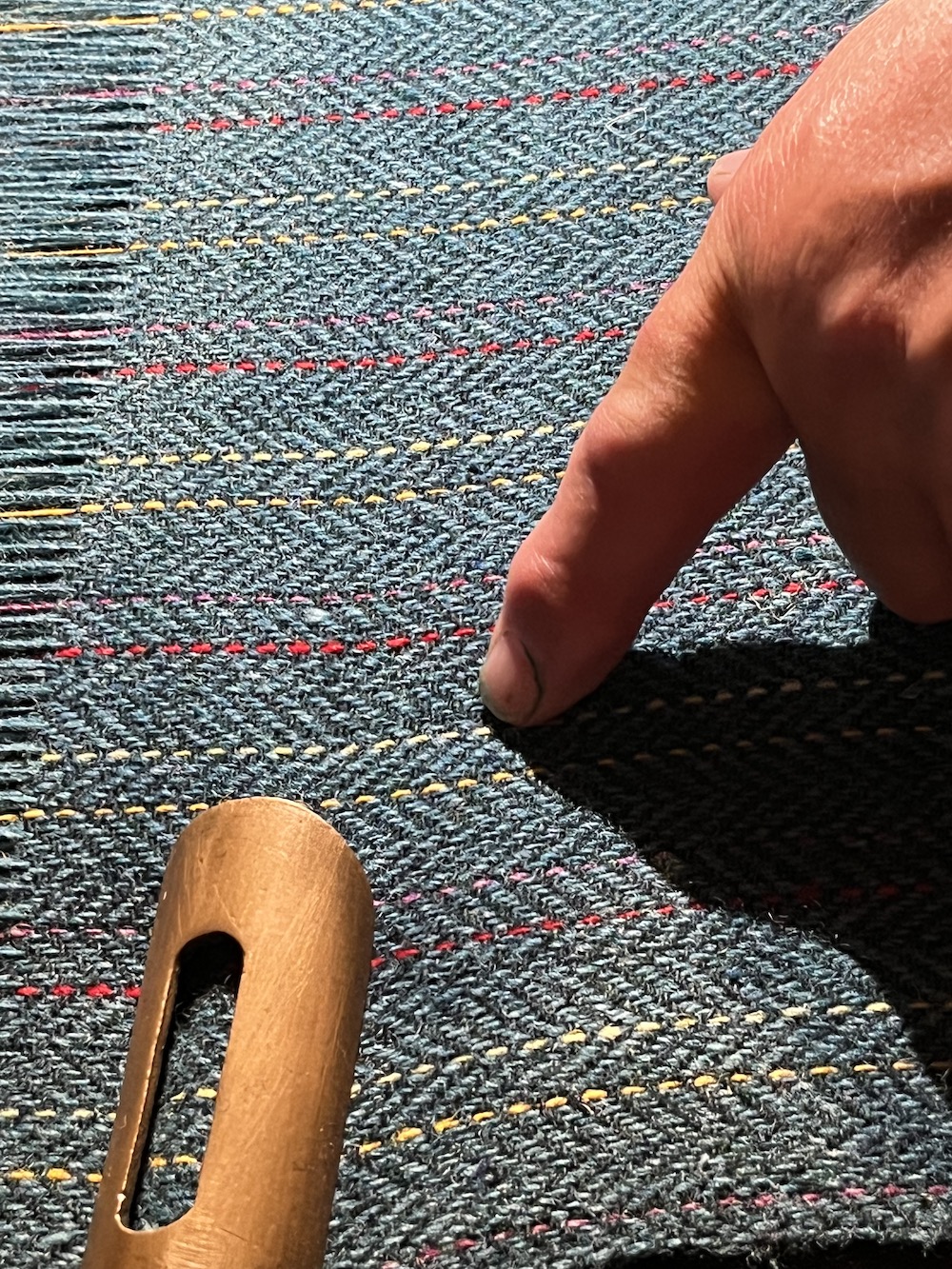
I’m giving this fabric serious attention while I attempt to design the fabric for my Hebridean ruana.
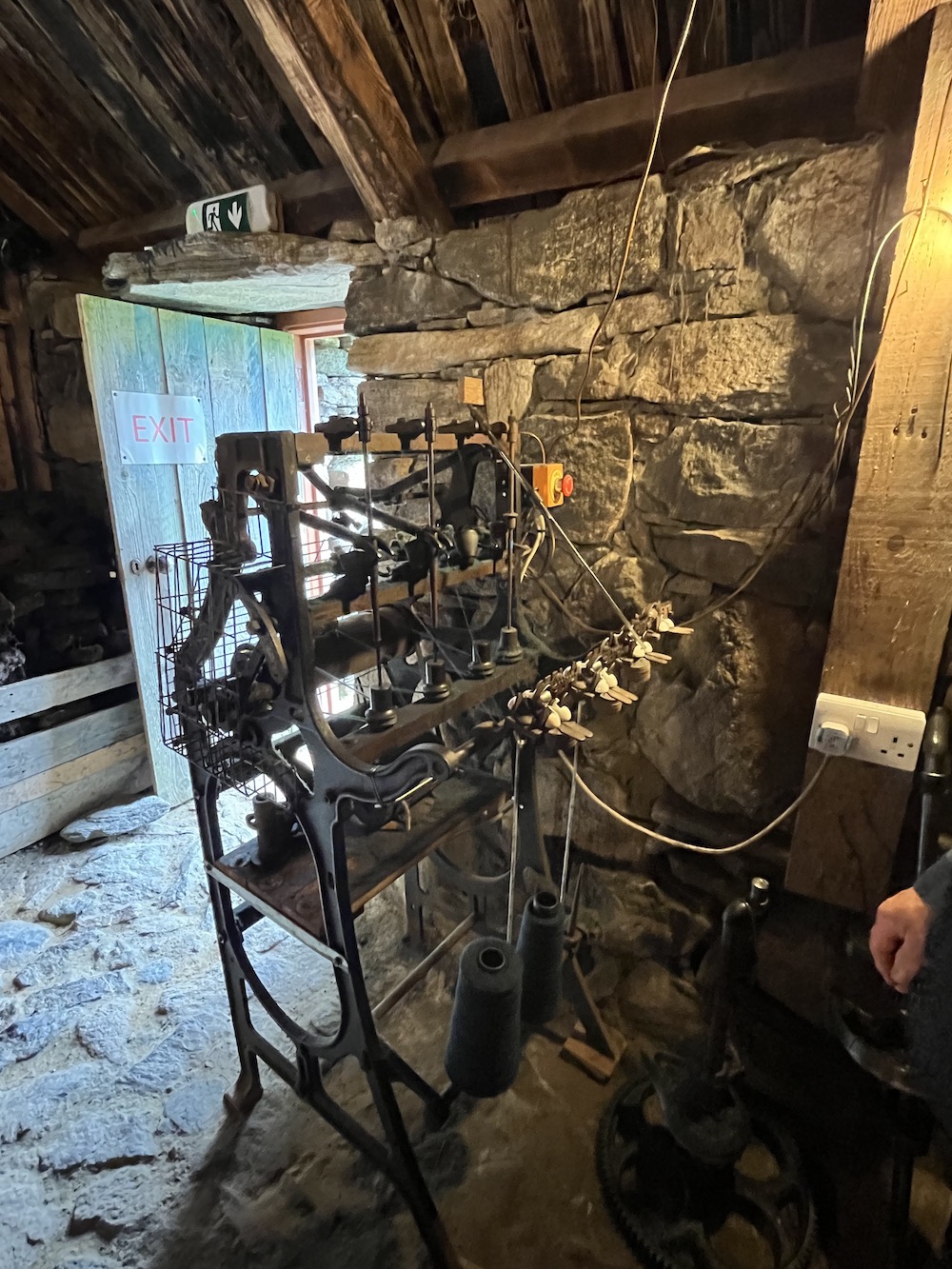
This is John’s bobbin winder. His recently deceased wife used to wind the bobbins for him. She could wind a whole set of bobbins in about 10 seconds. Hard to imagine (but yes, it is electric).
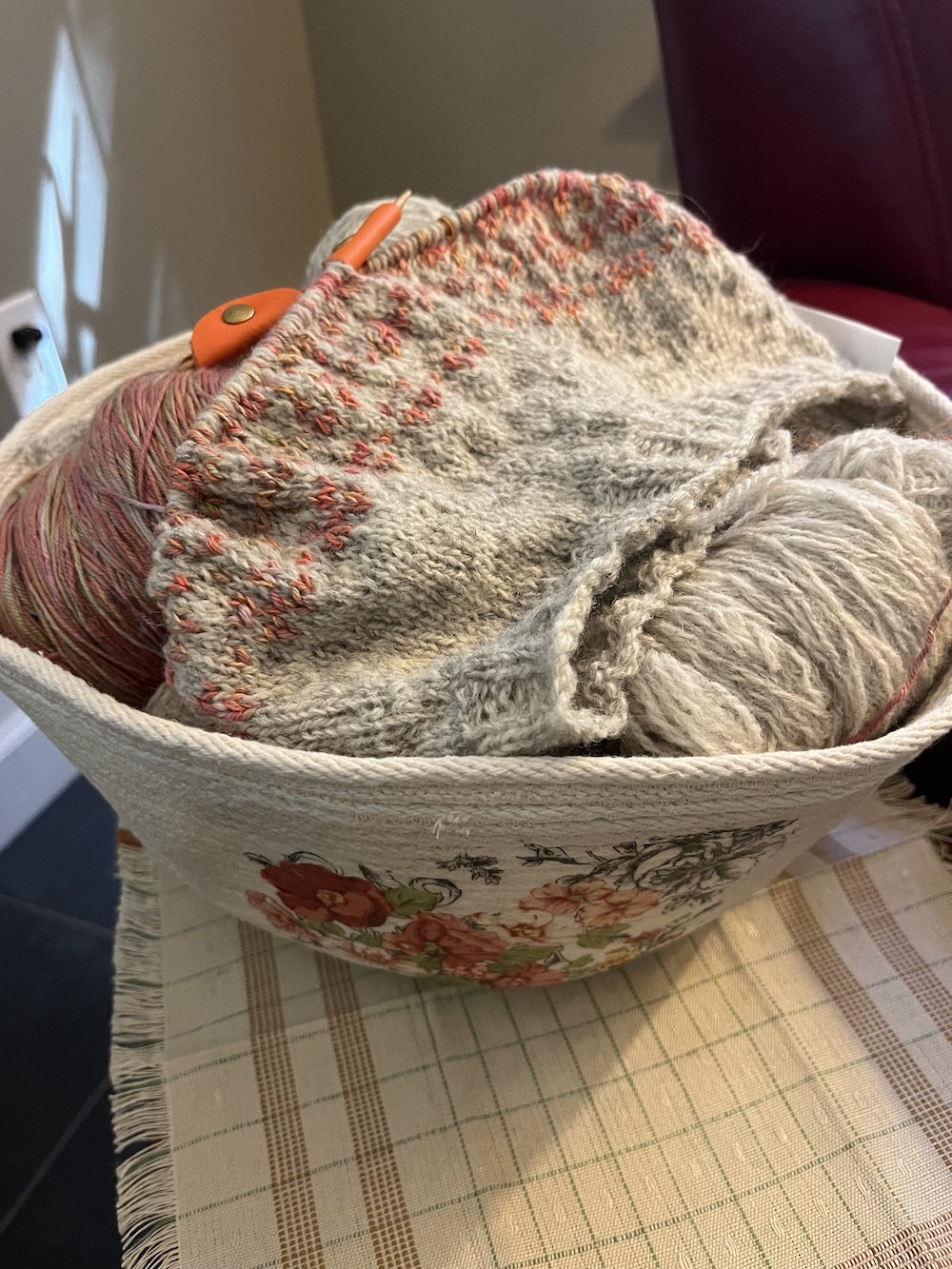
Tom wanted us to meet another Harris Tweed weaver who has left the company to start her own business, Three Sisters’ Weaving Shed. Since I’ve been home I’ve enjoyed following these three sisters, one husband, and one small daughter through the photos they post on Facebook. I bought a hand painted merino/silk skein dyed by the sister in this photo, who is also the mother of the little girl and the wife of the man in the group. I’m using it in a knitting project, “Golden Poppy” by Elenor Mortensen. I’m almost finished (not obvious in the photo) which will make another project bought and executed in a rather brief space of time! The rest of the yarn is Jamieson “spindrift.”

For those of you who have made it to end of this post, I sincerely thank you for sticking with me on this trip down memory lane. I hope the photos made up for my longwindedness! If you’ve been to this part of Scotland I hope I’ve brought back some good memories for you. I’d love to hear about them. For those of you who have never been to the Outer Hebrides, I hope this whets your appetite for going. My friend Kari had been in Scotland 50 years ago, and her plans to get to these islands did not happen. Never too late. We both loved every minute of our visit.

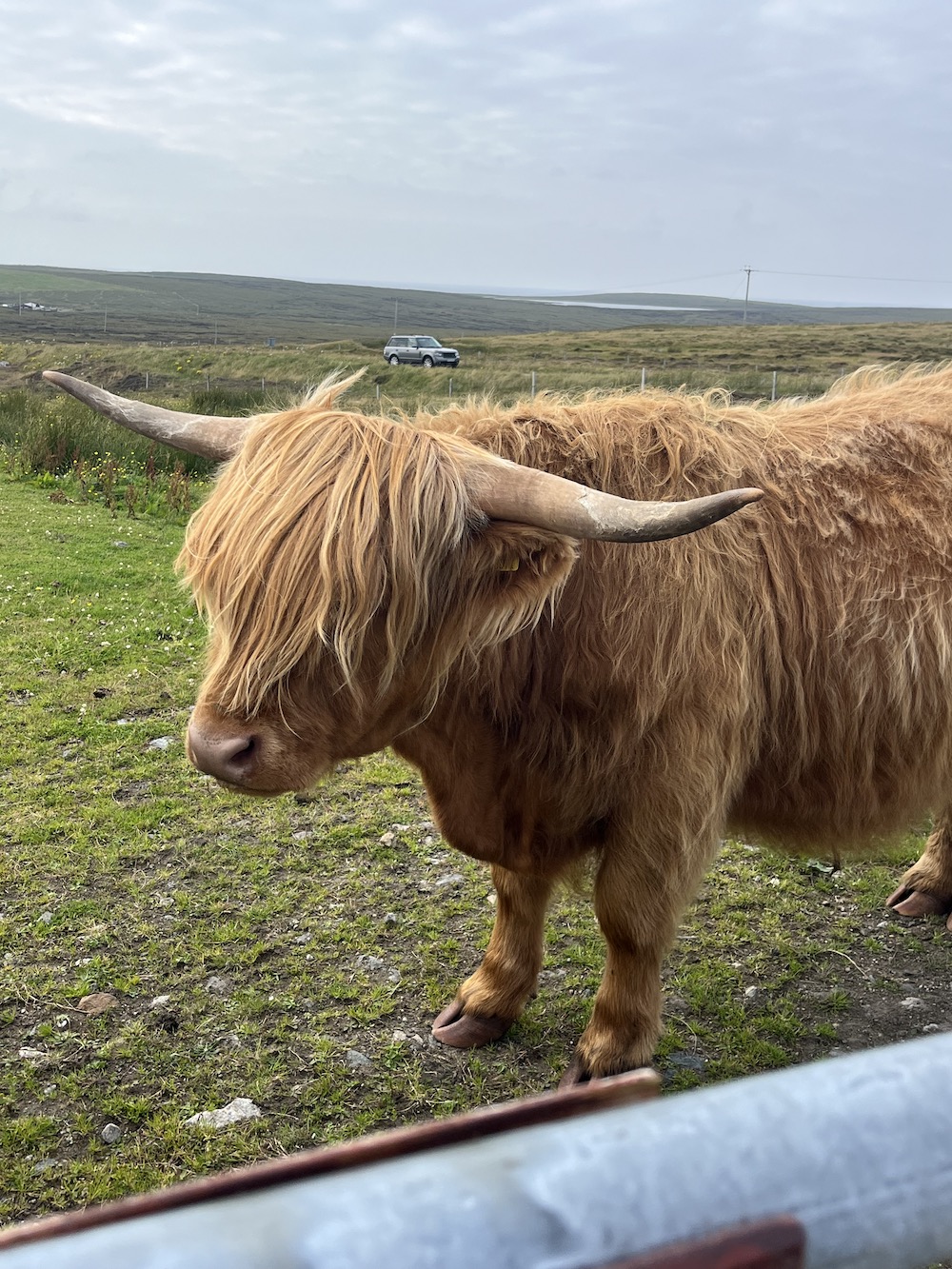
I’ll leave with with an image of a highland cow that I took on Harris.
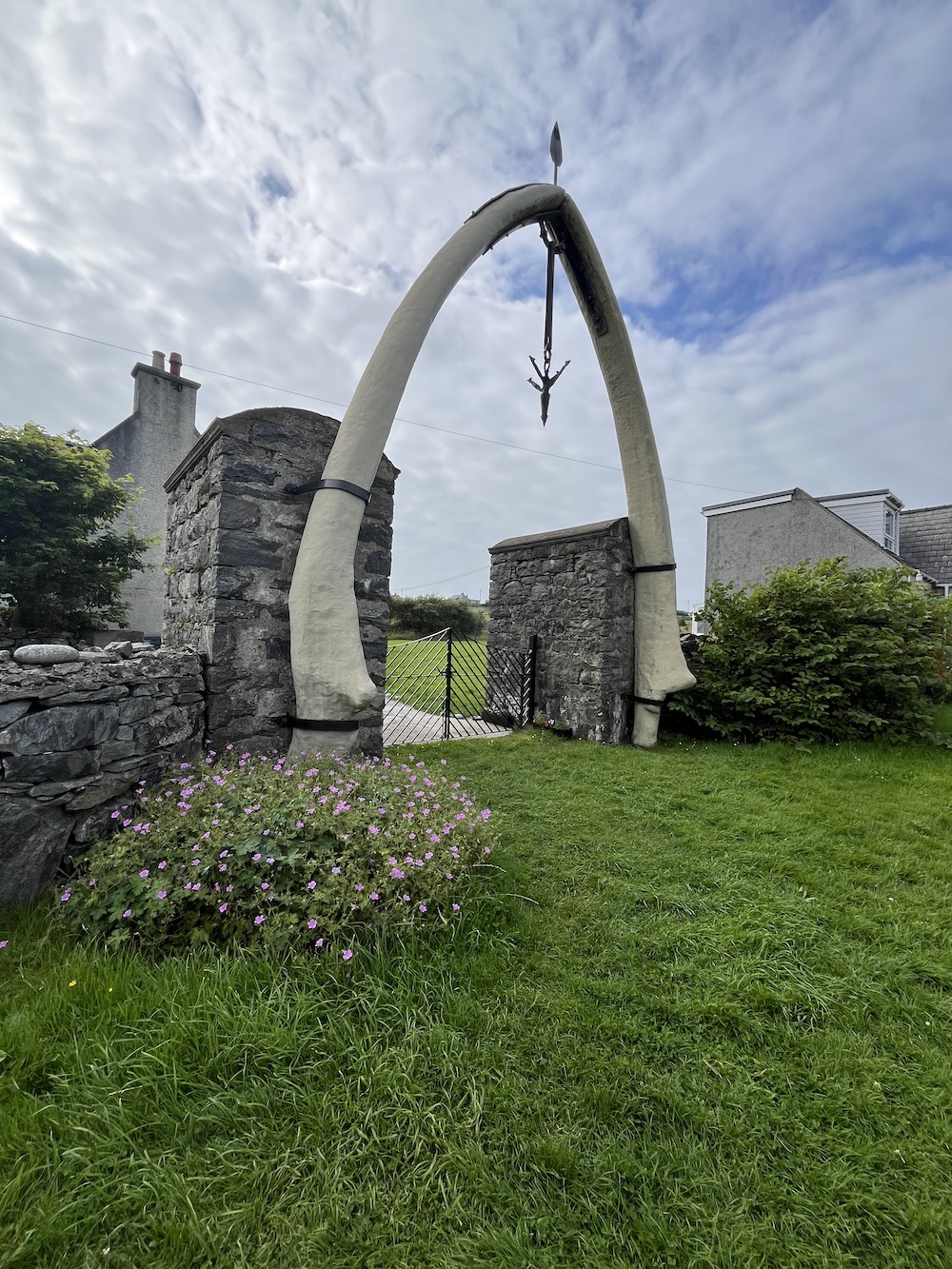
…and two of Kari and me visiting the large whale jaw bone installed in the village of Bragar on the Isle of Lewis.
Be well, take time to work with your hands, and enjoy the new year.
High Summer in Scotland

Today is Hallowe’en, a far cry from July in Scotland. This morning I drove to the library to pick up a book I had reserved, and I encountered lots of preschool age children arriving for a holiday event. It was exceedingly windy due to the effects of the most recent hurricane, and leaves were whirling all around us. The children all had that exuberant bounce in their steps that is so iconic for children. They were hopping, and I couldn’t help think how many decades it’s been since my own kids walked with that joyful bounce, not to mention how long it’s been since I had that myself. When does that exuberance to get somewhere leave us? Now I feel that every joint in my body would cry out in pain. Ah well. It was wonderful to see all the children excitedly arriving at a Hallowe’en event. But I digress…

In July I visited Scotland for the 2nd time, but most of it was entirely new to me so there were a lot of ‘firsts.’ I had made an appointment with National Museum of Scotland to see the newly acquired tapestries of Archie Brennan. I had also been asked to give a talk about Archie at the Dovecot Tapestry Studio right after I arrived. These two opportunities by themselves would make the trip the highlight of my year…or decade. But Scotland has endless charms so I had two weeks of singular experiences that I won’t soon forget.

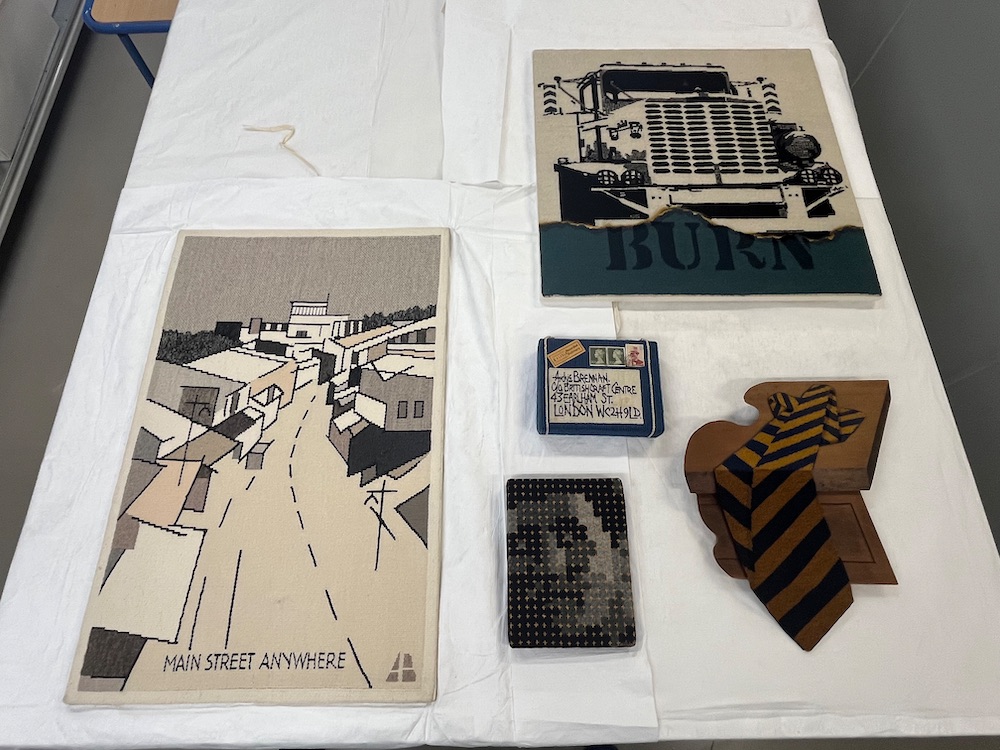
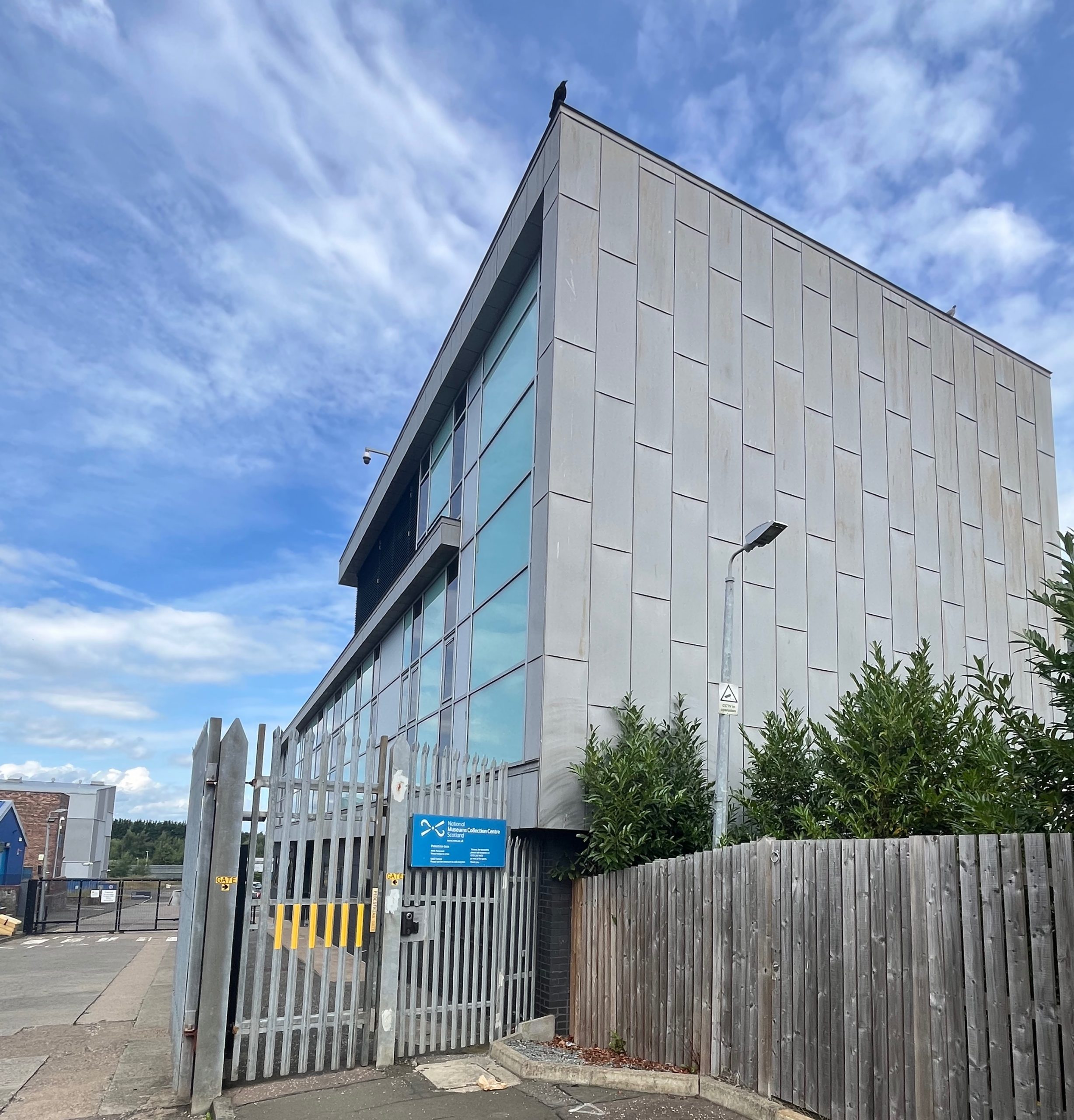
Cecilia Joicy, who is director of textiles at the National Museum, invited me into the storage headquarters of the museum, which is right on the shore of the Firth of Fourth, on the day after I arrived, along with my good friend Kari who was traveling with me.

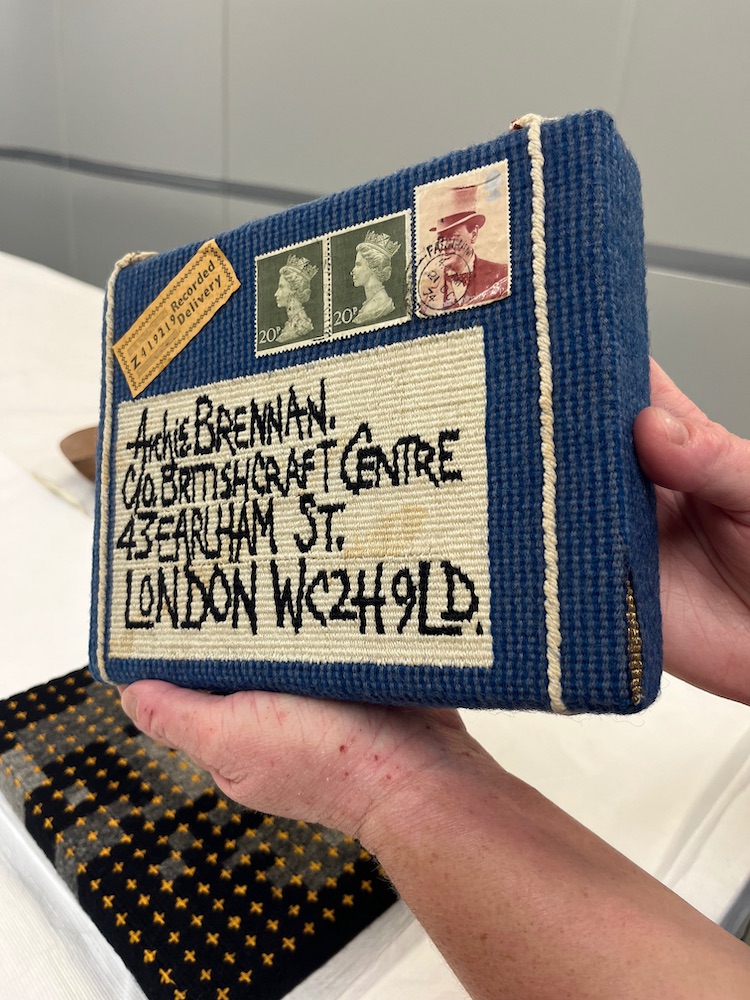
Here Cecilia is showing me how Archie wove the illusion of a tear in this piece. As you can see he actually mailed the tapestry without packaging it. It is a package itself afterall.

I thought the museum had acquired more pieces than seven, but that is all they have. They have one of my favorites, a piece Archie was weaving while the Wednesday Group was meeting with him in the 2000-teens. It’s called “Main Street Anywhere,” and it is a huge postcard. He covered the front of the piece with white paper before mailing. All his normal sized postcards were mailed without any protection, and he says none of them were ever lost or damaged, except the one he dropped somewhere on the streets of Manhattan on his way to the post office.

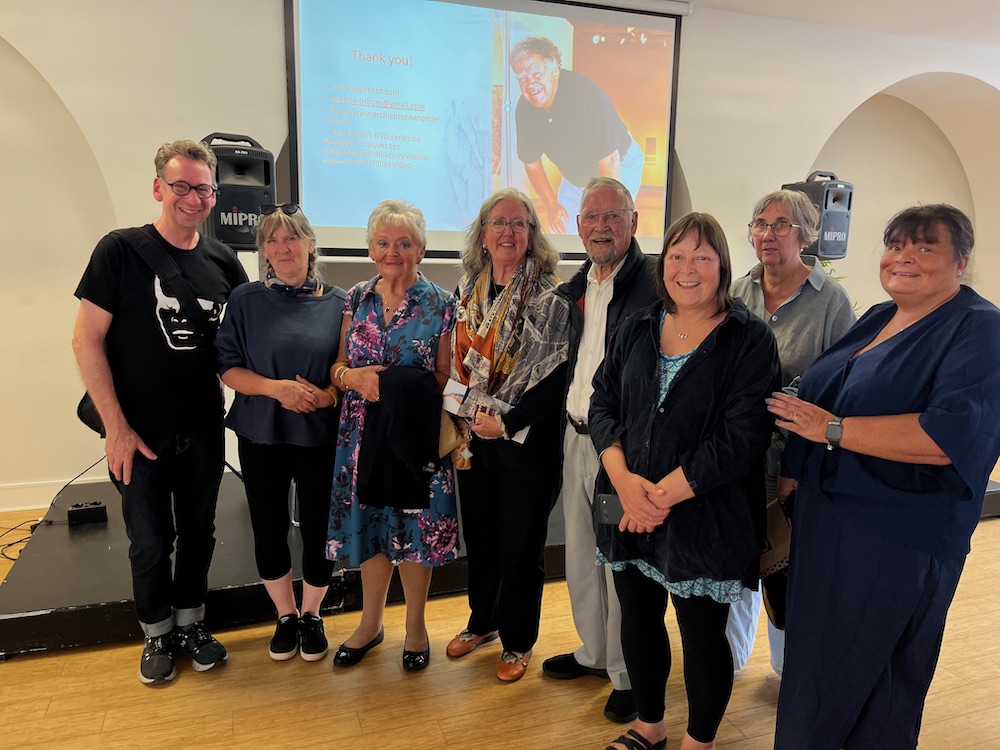
Two days later I gave my talk about Archie at the Dovecot Studios. As I was standing at the podium about to begin, a group of people walked in who had saved the front row for themselves. They were seven members of Archie’s family. Only one of his siblings is still living-his youngest sibling, Robert. One of Archie’s sisters in law was there, Elizabeth, and a number of his nieces who are the children of the sister in law. I even met Archie’s godson. And look at us all standing in front of one the slides from the presentation. Archie is looking down on us.

Not everyone made it into the photo. I am in the middle (with the big scarf) and Robert is on my right in the photo. To my left is Elizabeth, with her two daughters all the way to the right. On the very left is Archie’s godson. Standing somewhat behind the group (between the two nieces) is Elizabeth Radcliffe! She is one of Archie’s earliest students. I had asked her to join the group photo, but she stayed back a bit. It was such an honor to meet these wonderful relatives of Archie. I am still deeply moved when I think of it. Later, after I returned home in mid-August, I heard from one of Archie’s daughters, Sarah, saying she was on vacation out of Edinburgh when I gave this talk. I would love to have met her as well. Hopefully someday.

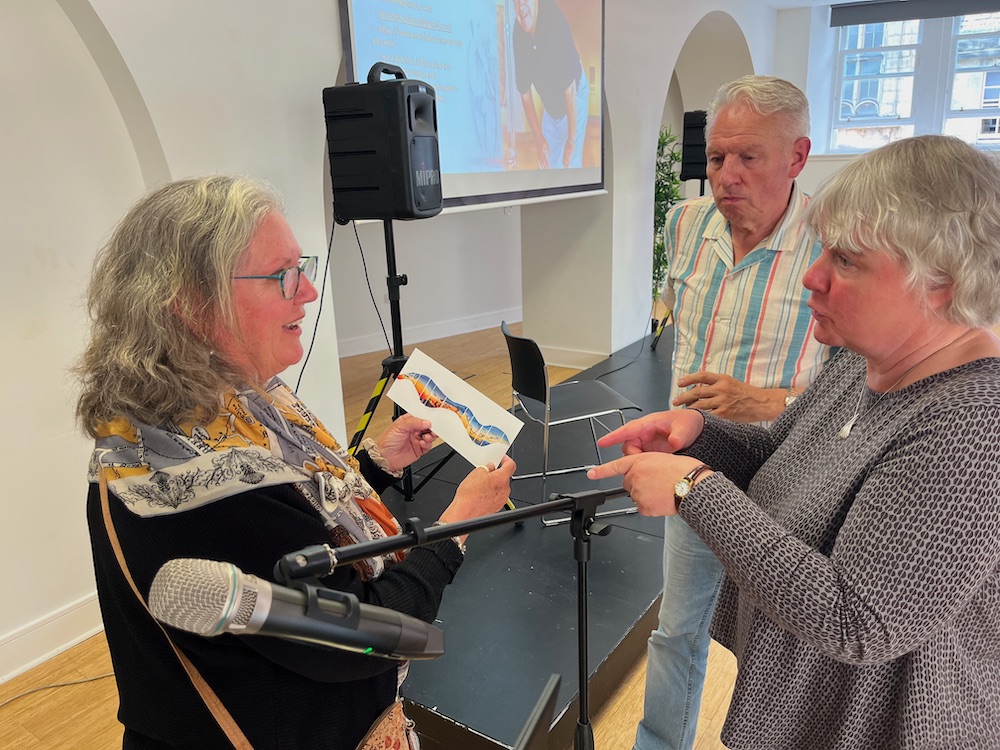
And another moving moment of this day was meeting John Brennan and Anna Wetherell. John was also one of Archie’s first students. I was one of his last, yet we are are rather close in age. John and Elizabeth and Anna have had a lifetime of weaving tapestry. I have had a lifetime of weaving, but I didn’t come to tapestry until just before the turn of the century–a mere 25 years ago or so. In the photo Anna is giving me a large format postcard of the Murmuration Collaboration which I have been following for some time now. I was able to buy the catalog, and the group has a substack site with detailed images and essays by the weavers who participated in this project.

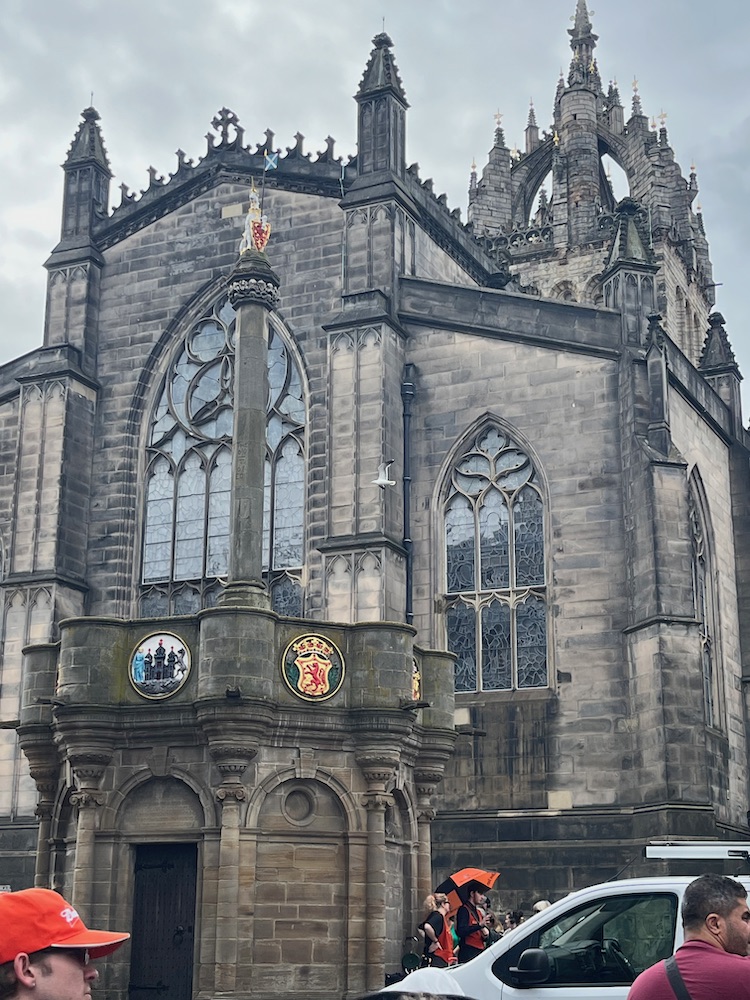
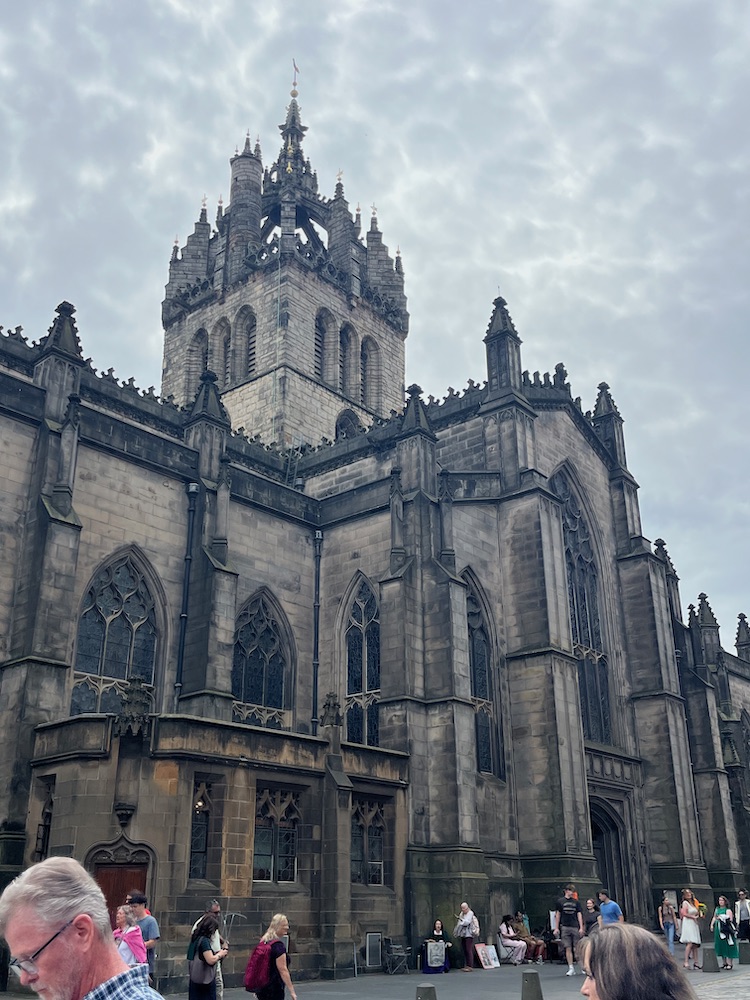
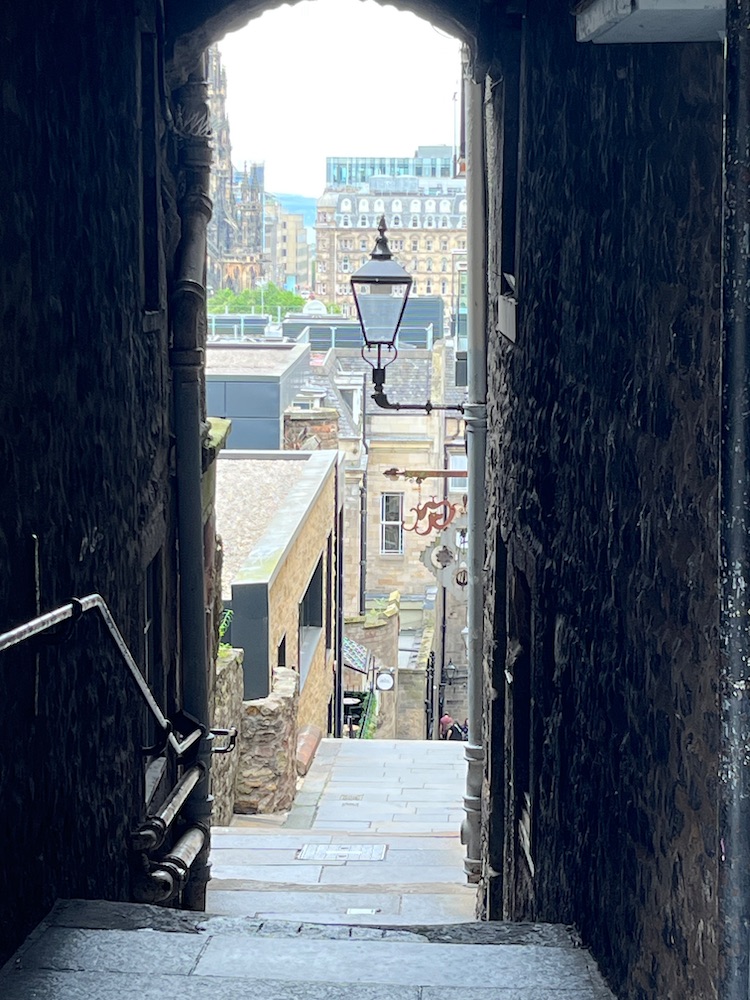
So it would be impossible to surpass these two experiences, but I have to say the rest of my time in Scotland was still a terrific experience. Edinburgh is so picturesque. There is so much Gothic architecture and the city is so steep that it is a bit of challenge to see the many facets of this place. I have not been in such a steep city before.

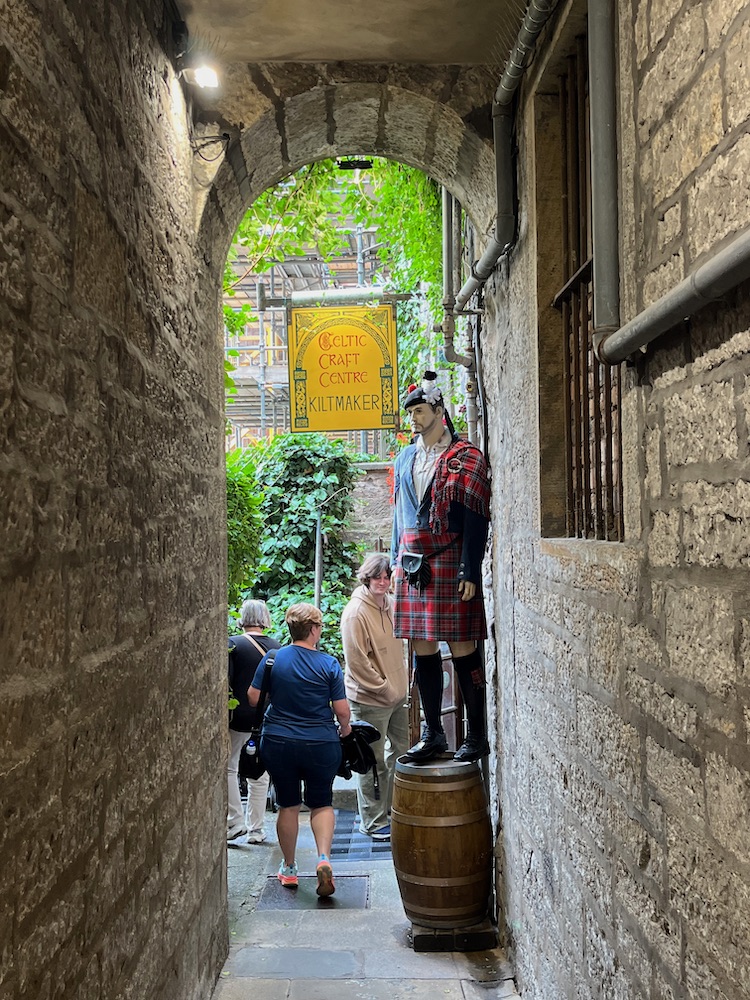
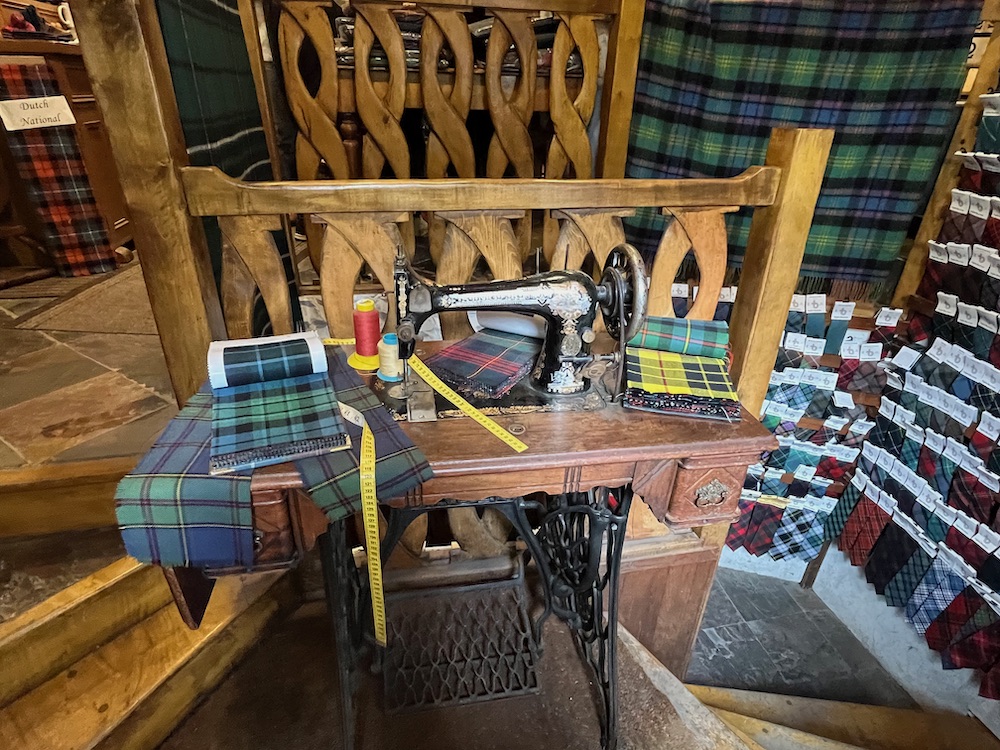
The alleyways are called closes, and there are many of them. I went down the rabbit hole of going into a shop that weaves tartans.

This shop was impossible to pass by.

They had a encyclopedic reference book of clan tartans. I looked up Brewer and Macbeth (both for a friend) as well as Bob’s Norse name Osborn that uses the Cameron tartan. I avoided committing to buying anything, but it was tempting. And speaking of tartans, two women have started a campaign for justice and a memorial for the thousands of women accused and executed for witchcraft. They now have a tartan for the Witches of Scotland. The podcast on this site is worth a listen.

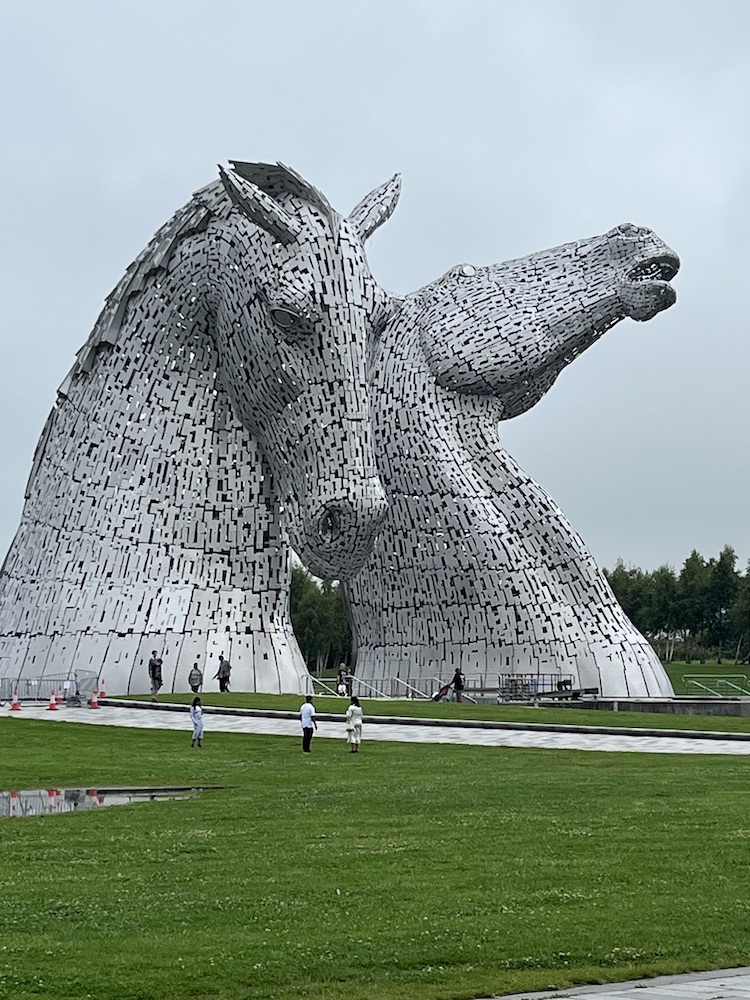
Heading out of Edinburgh toward Glasgow by train we stopped in Falkirk to make our way to see the Kelpies, and even better, to meet up with my dear English friend who joined us for this part of the journey.

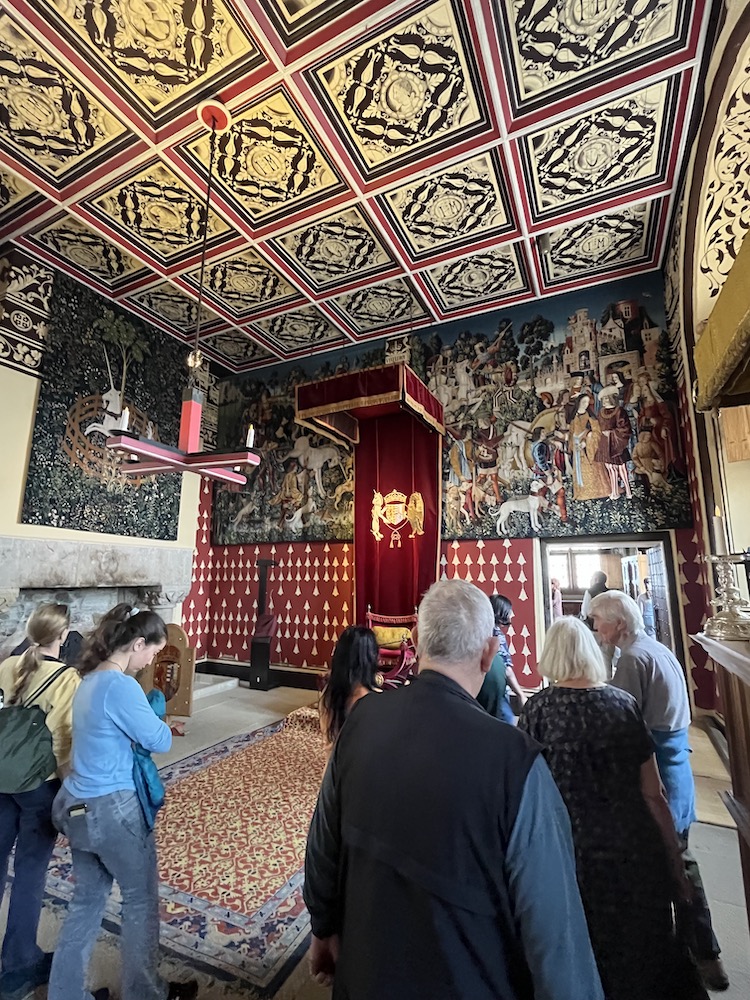
My goal during this short travel to Glasgow was to visit Stirling Castle for the sole purpose of seeing the reproduction tapestries of the “Hunt for the Unicorn” series based on the originals that are housed in the Met Cloisters. I had met the weavers of this daunting project in the mid-2000-teens when they visited the Cloisters to make decisions about warp sett and weft colors. For more than a decade I have hoped to see the finished tapestries. I was disappointed! The tapestries are stunning, and I actually prefer them at the coarser sett used for the reproductions. But…they have been hung so high in the Queen’s Quarters that it is hard to see them well. The walls were already decorated in the style of the period, which fights with the tapestries.

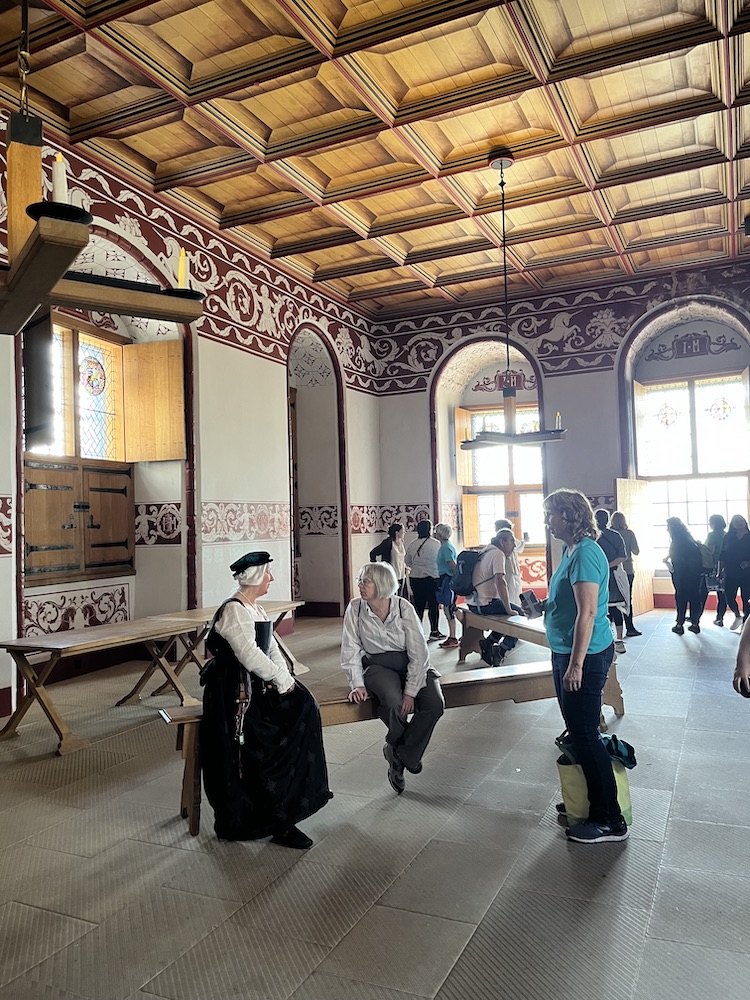
Although I took numerous close up photos of these tapestries, the perspective is odd because of the angle at which I had to take them. I enjoyed the docents who were dressed in period in the anteroom.

Most of all I enjoyed seeing the exhibit about the weaving process of recreating these tapestries, and the walk through the stone tunnel with Lesley to get to the exhibit.

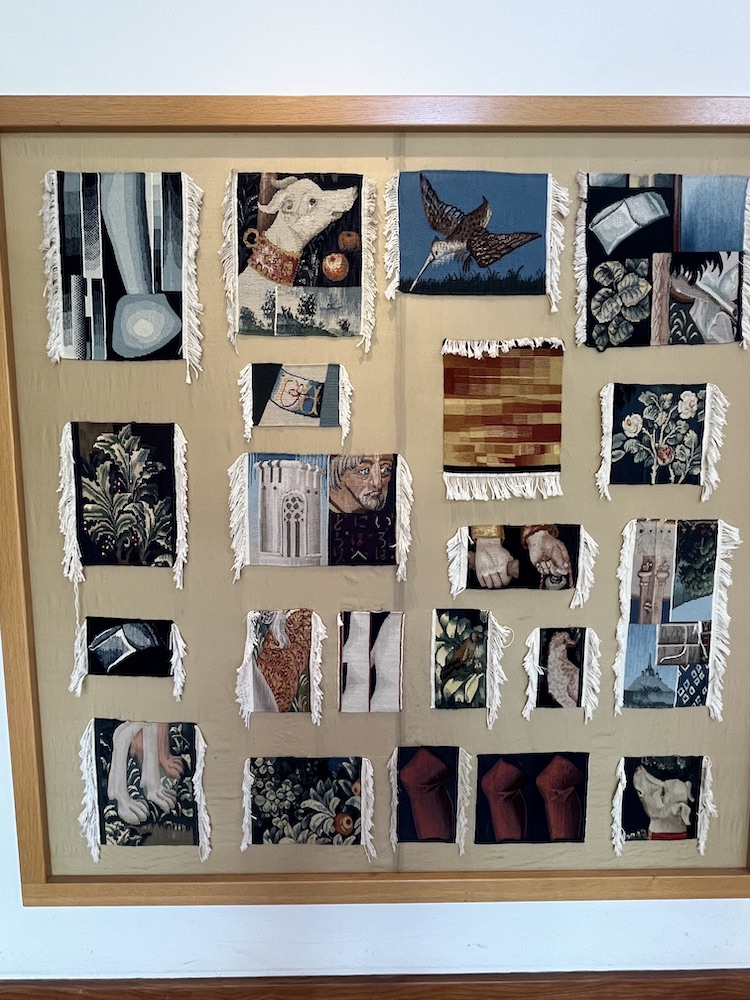
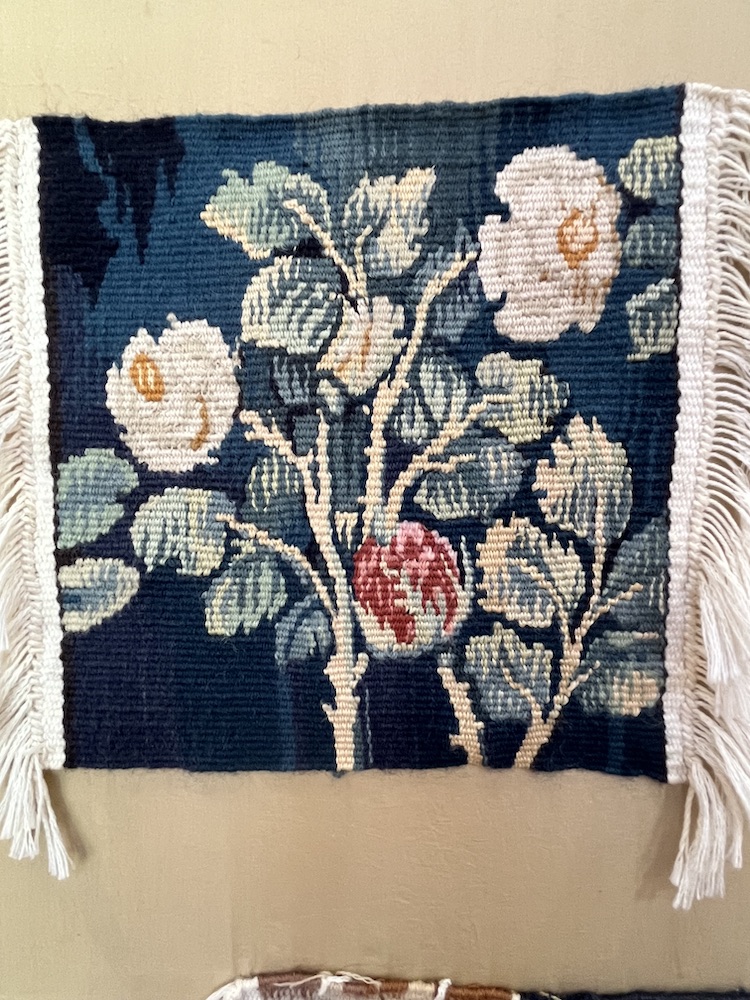
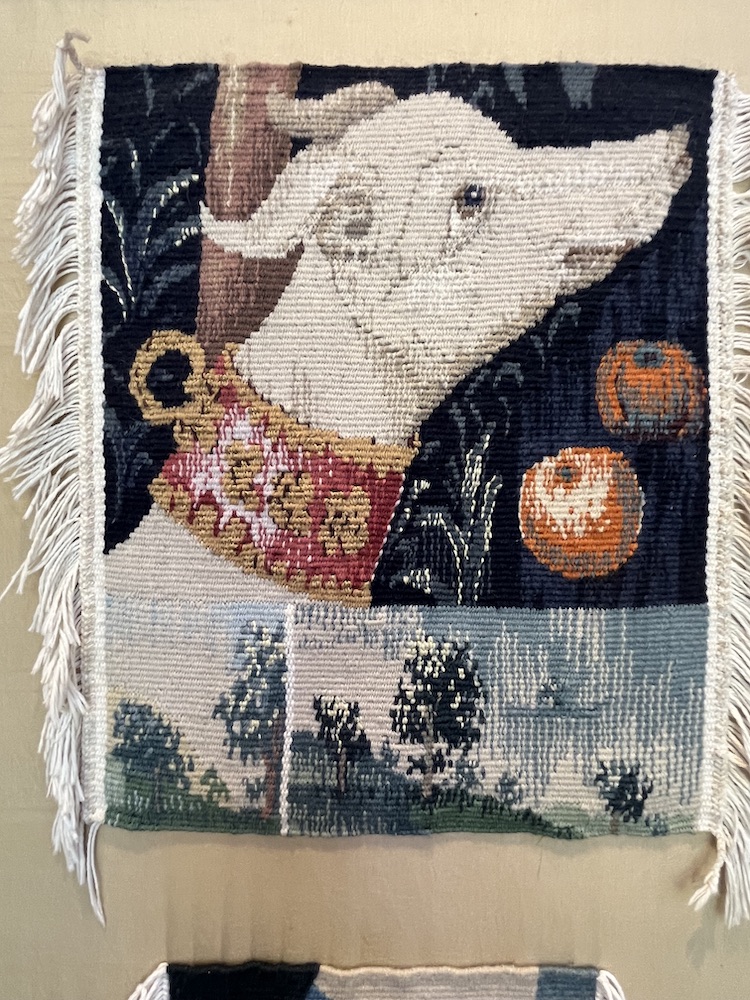
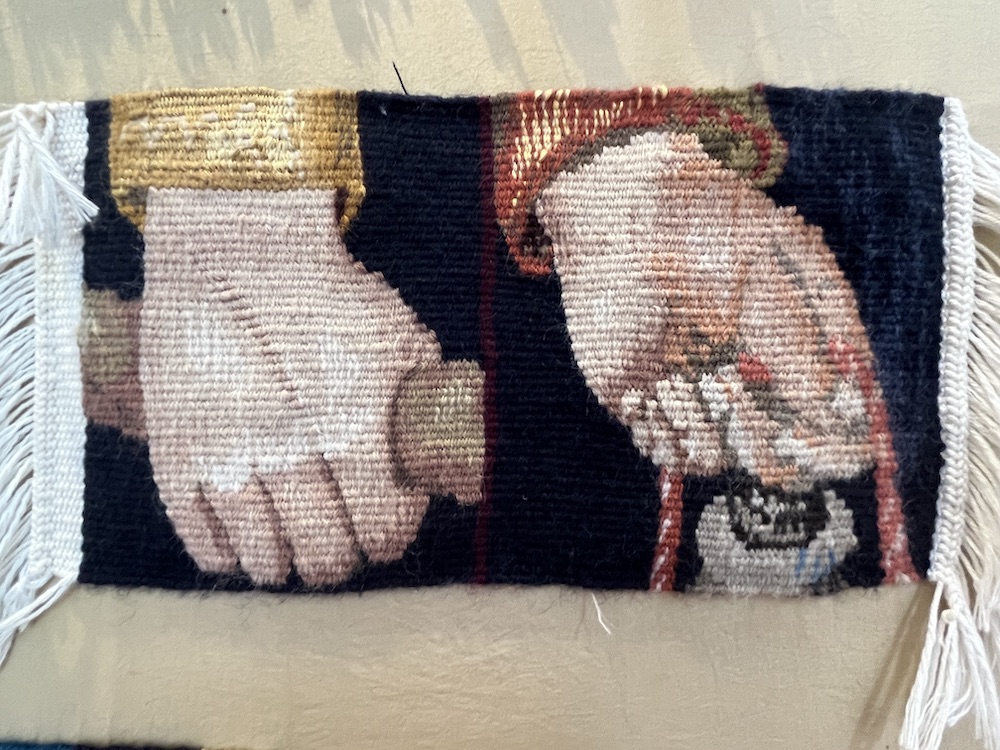
The best part of this exhibit was seeing the small trial tapestries woven to practice details from the original tapestries that would be translated at a coarser warp sett. While this display shows 21 small woven samples, the weavers actually wove over a hundred small samples.

Here are some close ups of the samples

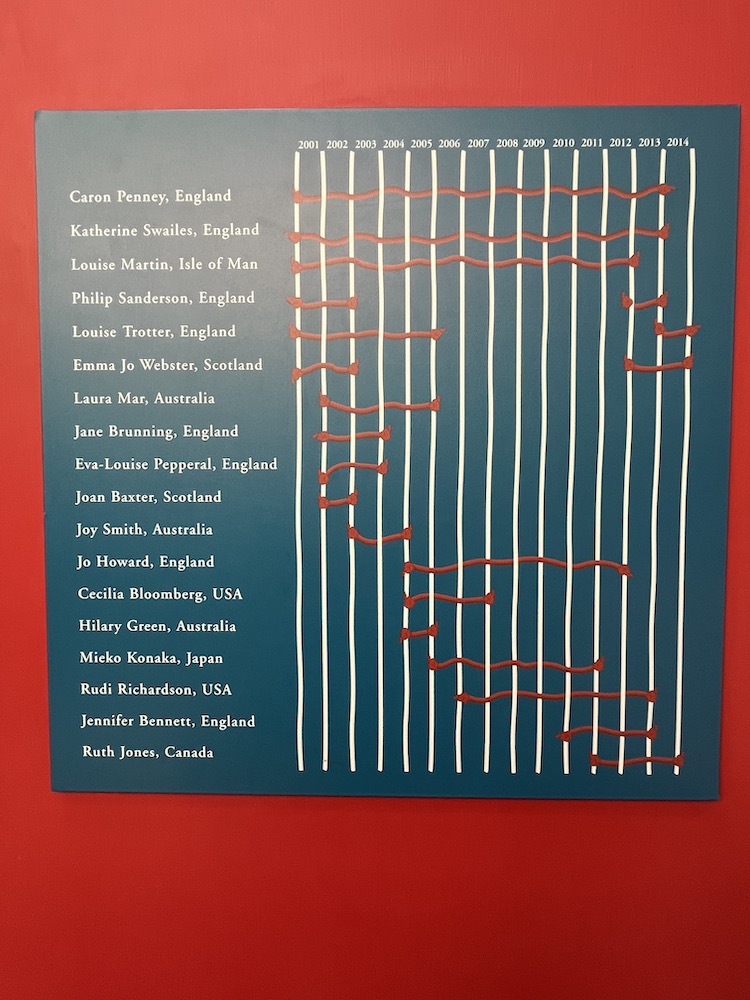
And lastly, it was touching to see this list of the weavers describing the time they each put into this massive undertaking.

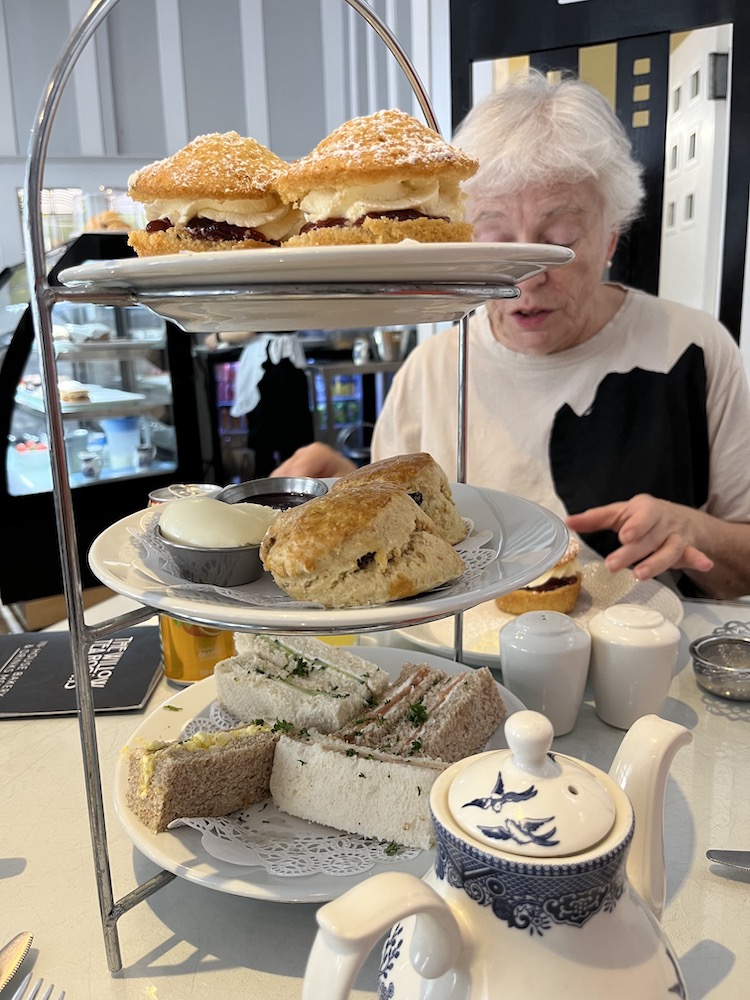
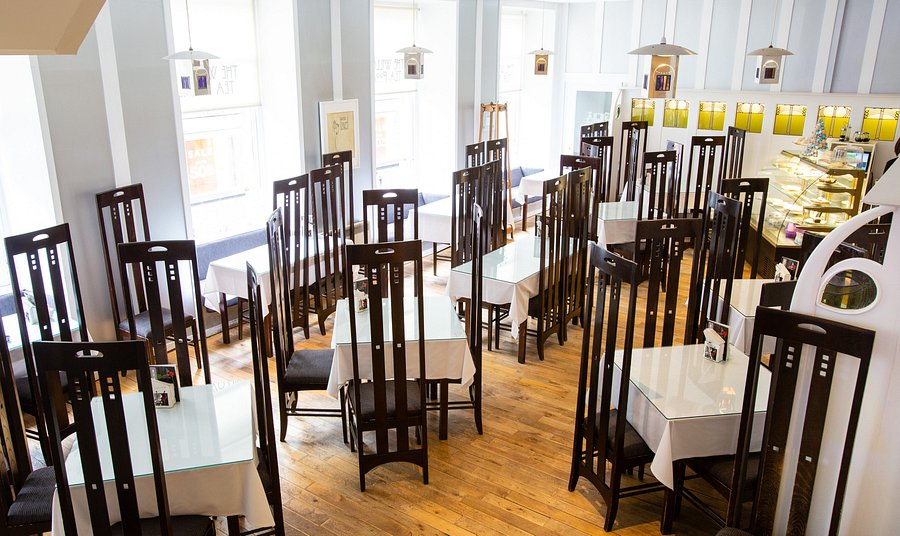
It wasn’t easy to get to the castle the day we visited. The parking on the castle grounds was completely full by late morning, and finding parking in the center of Glasgow was no easy feat. But after driving around a bit (thank you, Lesley!) we parked and made the steep trek up to the castle. Lesley, Kari, and I stayed in a charming small hotel that evening, just a short drive to the Charles Rennie Mackintosh Museum in Kelvinggrove Park. Lesley has visited Glasgow a number of times and recommended that no lover of Charles Rennie Mackintosh should miss having tea at one of his original tearooms.

My favorite part of a cream tea is the sandwiches, and these did not disappoint!

It was a short visit together, but in such iconic places! Lesley headed on for her holiday on the western coast, and Kari and I began our next adventure. We took a train to Oban where we boarded a ferry to the Isle of Barra in the Outer Hebrides. It was the beginning of a week long tour of the islands through the tour firm McKinley Kidd. High summer in the Hebrides was as glorious as on the mainland. When I look through these photos I don’t know how I didn’t hop and skip my way through this dazzling time. I must practice adding an exuberant bounce to my step, for the world is so full of places that require it.

A Day of Textiles and Materials in the Açores

Late last week we sailed to São Jorge. It was a short sail, only 20 nm, but I did not do well. It’s been a long time since I’ve sailed anywhere and clearly I’ve lost my ‘sea legs.’ In another day or two we will sail to São Miguel, and that will be 150 nm, and will take about 20 hours. I am not looking forward to that. What I’d like to do is take something that would keep me asleep for the entire trip. Wishful thinking.

In Horta there was a fabric/knitting/embroidery shop called Retrosaria where I bought some cotton yarn for a vest pattern I got from Bare Naked Wools. After making a small knitted sample I realized that pattern really needs the softness and slight halo of wool. Oh well. The shop was small and did not have any fabrics that tempted me, but oh! The yarns! I’ve now learned that the Portuguese yarn company, Rosarios, sources all their wool and processes it all in Portugal. The wools are from Portuguese merino sheep and a few other breeds, all raised in Portugal. The combing, spinning, and dyeing is also done in Portugal, using eco-friendly processes. I think I bought a color card for this yarn about a decade ago in a little yarn shop in Coimbra. I regretted not buying any yarn that day. Now I will rectify that mistake!

Here is a quote from the Rosarios website:  We like to create value, which is why we look to nature as an example and inspiration, and we focus on natural or naturally-derived fibers as a path towards greater sustainability. We like to create yarns because we believe that knitting, crochet and embroidery makes people happier. And we have been doing what we love since 1979. You can read about their history here.

The wall of sewing and embroidery threads!

I wanted to buy wool to make a vest pattern by Bare Naked Wools called Black Oak Vest. Sadly, Retrosaria did not have enough of any of the wool colors I liked. I could have made it in black or in a medium mauve, but these are not colors that excite me-or look good on me. I bought a medium gray cotton. After making a test swatch of the lace pattern I decided that this pattern needs wool yarn. The cotton was the right gauge, but it didn’t look the way I wanted it to look. All in all, I was sad not to get some Portuguese wool.

There are numberous Rosarios shops throughout the Açores, and I passed one yesterday on our drive around São Jorge. It was a weaving shop that also sold yarn. They are only open Monday-Friday, and yesterday was Saturday. There were woven items on display as well as several looms with works in progress. The reflections on the glass kept me from getting any photos of the temptations inside. There are several Rosarios shops on the island of São Miguel, so I know I’ll have another chance to buy some Portuguese wool to make that vest!

As luck would have it, I did meet a weaver yesterday! Her family has a coffee plantation in Faja dos Nimes (faja, pronounced ‘fazhah, is Portuguese for a flattened area that was created by lava flow. São Jorge is known for these volcanic flattened areas), and they have a small coffee plantation where they get about 400 kilos per year. They roast the beans and serve coffee at their Cafe Nunes (pronounced Nooneesh. They take visitors to see their coffee plants, right behind their house in terraced gardens. It’s small but they have the distinction of having the only coffee plantation in the Açores, and possibly in Europe (this may be old information now).

When we arrived I feared the only way up to the cafe was through this garden, climbing two ladders! It was a bit daunting. But down the street a short way was a driveway up to the cafe. Whew! The cafe was on the ground floor, and the weaving studio “De Artesanato” was upstairs. To the left, mostly outside the photo, is the family home. The coffee is growing behind these buildings, on terraces.

The mother of the family, about my age, is the weaver. She has a weaving studio, separate from the house and from the cafe, where she has four looms and an interesting spinning wheel. I think her name is Maria. Have you ever seen a spinning wheel like this? I could not ask Maria about it because she spoke no English. Her adult daughter who helps with the plantation and serves people in the cafe, was busy, and I know her mother relies on her to translate. Here is the wheel.

It’s not a great photo, but hopefully you can see that it is a parlor wheel, yet has a spindle rather than a bobbin. I’m guessing that you sit at the wheel and spin doing long draw, then wind on from the point, like a charka or a great wheel. She works with cotton, so maybe she spins some of it? I managed to tell her that I also spin, but I could not navigate that I spin on a different type of wheel.

Maria mostly does a type of weaving called “weft loop.” Many of you who are my age will remember bedspreads made of this type of weaving. Maria makes those bedspreads, as well as runners, in this technique. Our friend Linda, who lives on this island has bought a number of Maria’s weft loop designs. Linda has a bedspread as well as this runner.

I bought a simpler woven runner as well as this blue and white placemat. I only bought one placemat to use as a center on our table on Pandora. I hope you can see the ‘turkey track’ design between the larger blue stripes. I love it!

The weft loop runner is quite long, with the loop design at both ends of the runner. I think I will turn it into a long bolster pillow for our bed at home, which has a machine woven coverlet made at the American Textile Museum when they were still in operation. I think the runner is as wide as our bed.

This is Maria’s largest loom that requires two weavers and has two sets of treadles. The center of this project is solid wool loops with the large borders woven in plain weave. The wool loops designs are all hand manipulated since this loom has only two shafts that are counter balance.

This is a photograph of an image of Maria and the 2nd weaver using the loom together. Slow work
for sure! What I found puzzling about all of Maria’s looms is how high the warp beam sits above the shafts and the reed. I think they have to push the beater back in order to throw the weft shuttle.

During the visit to the coffee growing area behind the house, Bob got this photo of Peter (as in the current Peter of Peter’s Sport Cafe in Horta-what a surprise to see him here and to have him recognize us) and me looking at the coffee plants. Maria, the weaver is on the left in this photo. It’s the only photo we have of her.

The rest of our day included a drive to the northern most point on the island where there is a lighthouse no longer in operation as well as a whale lookout, also no longer in operation. The way the lookout worked was that a spotter stood up there watching for whales, and when he saw one he would set off a firework that could be seen from the port. I’m not sure how he indicated the location of the whale. Maybe I’ll learn that before I write the next post. Too bad this photo does not show how long and steep the path to this lookout is, and how high it is.

The drive out to the whale lookout was a long, straight dirt road that passed through corn fields and cow pastures. There were fields where the hay had been harvested, and the many bales were stacked in the fields.

On our way back to the harbor in Zelas (pronounced Zehlash), we passed the Forest Reserve which we knew was not to be missed! I’ll just post a few images of that magical place.

Tree ferns, the oldest of plants, growing with hydrangea in this forest.

There was a small chapel in this forest.

….and oddly, a large stone laundry. I have no idea how old this laundry is.

At least there is a beautiful tile depiction of how this laundry was used.

To come back to knitting with the cotton yarn I had set aside, as luck would have it I saw a tempting pattern in an email from an Australian dyer. She offers patterns to go with her locally sourced Australian yarns that she dyes. This is also a vest pattern, or a simple top to be worn on its own, designed by Elenor Mortensen. It’s called “Eowyn Tee.”

Amazingly, the yarn specified is the same gauge as my Portuguese yarn, and the same color. This was too good to be true, so I immediately cast on and am now almost ready to put the sleeve stitches on a holder and continue with the body. The top down shaping is unique and was fun to do! And didn’t I find a cute yarn holder when I bought this yarn.

We leave for São Miguel today, where I will spend a week before heading to Scotland. I know there will be yarn purchases during my time in Scotland, but I’m glad I discovered ecologically produced Portuguese yarn while I was here. There is a Rosarios shop in São Miguel, so I am not yet finished looking at yarn in the Açores.

The Azores: Faial and Pico

Tomorrow we may sail to São Jorge, an island near Faial. I’ve been in Azores for more than two weeks, on the islands and Faial and Pico. Here’s a little photo journal of what I’ve seen on these two islands.

Flowers! The Azores are famous for having miles and miles of hydrangeas. They were introduced here centuries ago and have thrived. You can drive for miles with lace caps and mopheads lining the roads in all the shades of hydrangea–pinks, deep purples, a mix of pink/blue purples, and of course, blue. We were a little early for the full show, but you can see how many buds are on the verge of opening.

This is a wall of deep blue morning glories on Pico, with my friend Lynn standing in awe of the display. She lives here part of every year and told me that people are now encouraged not to plant morning glories. They do appear to be rather invasive, but what a breathtaking view.

And then there are fields and fields of lantana, nasturtium, and purple clover. These have been the source of our bouquets onboard.

June is a month of festivals throughout the islands. We got to participate in one on Faial and one in a small village on Pico near our friends’ house. The first festival we saw took place in Horta and was called “Maravilho,” which means “wonder.” The word is a combination of the word for sea (mar) and the word for island (ilhos); together they create the word “wonder.” It was a grass roots kind of festival with people selling handmade wares and food, and there were free rides on homemade creations like a bathtub swing, a stuffed chair swing, and best of all (!), a bamboo contraption that was a kind of rudimentary whirl-a-gig!

One of the vendors was screen printing tote bags from his small booth. I bought this one fresh off the press.

They spent a good deal of time balancing the size of the kids on this homemade whirl-a-gig, otherwise the ride would not twirl. Note the smallest child is in a bucket!

A week later we went to a festival on Pico. People brought food to share, and there was music planned but it was too windy to play Azorean guitars which are quite fragile instruments. They are shaped a bit like a mandolin and have 12 strings, although this one appears to have 8.

Instead they played recorded folk music and performed some of their folk dances, which include a caller to guide the dance. The wind was howling. Notice how lightly dressed the women are. I was wearing long sleeves, long pants, and a sweater. No was chilled except me!

While we were visiting Pico another festival took place on Faial, in Horta. It may have been Semana do Mar, Sea Week. The fish decorations were in the air, on the ground, and on walls. The day before we left for Pico I watched a crew of men drive a cherry picker down the road to get all these decorations up on the power lines.

Did you know that Portugal is paved in mosaic walkways? I learned this when we visited mainland Portugal about a decade ago. I did not know I’d find more of them in the Azores. It’s mesmerizing to walk the streets seeing so many different designs. Here are a few. Even the simplest designs are a delight to see.

My favorite!

Sometimes the designs are white on black, sometimes black on white.

There is so much to celebrate here: food, art, fine craft, museums, boats in the harbor, including whaling boats that are no longer used for whaling but get launched often for rowing and sailing practice. We will not be able to take advantage of everything here before we leave for the next island, São Jorge, probably tomorrow.

Unusual Craft in the Azores, and Quite a Hunt to Find Them!

It’s be one week since I arrived in Horta, on the island of Faial in the Azores. I landed at the airport on Sao Miguel, after quite a few mishaps. If something—anything!—could go wrong on my journey, it did! But since I arrived all those mishaps have faded into memory, except the strange allergy or virus that came over me as I walked down the stairs of the plane onto the tarmac in Sao Miguel.

Although I had the longest trip ever to JFK airport (with a driver who made me quite uncomfortable for the duration of our 4 hour drive together) my flight was hugely delayed so my late arrival at the airport did not cause a problem. My luggage stayed in NY as I traveled to the Azores, but it also arrived the next day, in spite of the fact that SATA airlines does not fly JFK-Ponta Delgada every day. I lost my purse for a short time in the Ponta Delgada airport (Sao Miguel) and that was truly a panic for me, since it contained my passport, and all my important ‘cards.’ The cleaning lady had taken it and hung it on her cleaning cart. Luckily she was still nearby when I came back. What a stroke of luck for me!

For months before I traveled here I looked into what handwork is done on these islands. I worked myself into quite a frenzy of anticipation to see embroidery, lace, weaving, and basketry. Right before I left I learned that there is a technique used here for creating tiny gems with fish scales. The fish scales are collected, sometimes tinted with dyes, often cut to shapes, and sewn together to create mostly floral arrangements. Since I belong to a group of women who make Sailors’ Valentines, led by quite an expert in that field, Sandi Blanda, I thought they might be interested in knowing more about this technique along with me.

I had no idea it would be so hard to find examples of this work! I found an artists’ co-op (I think that’s what it is) outside of Horta, called Centre de Artesanato. We rented a car late last week, checking the hours the center would be open and the route on Google Maps, only to find the place closed. We arrived in the morning, then toured the island for a few hours before going back in the afternoon, since many shops observe a midday siesta here. No luck. The place is beautiful, and I was sad that I could not get in to see the wares.

We will try again this week. I won’t be deterred. Meanwhile, I’ve asked everyone who might help me about finding some of the handwork done on this island. Everyone knows of it, but not where to find it. It’s quite a mystery. Perhaps people make these things for their own satisfaction, which I completely understand since I do the same. But I am determined to see these works, hopefully understand a bit about how these works are made, and perhaps take something home with me! On the Centro de Artesanato website I found one fish scale artist who lives right outside Horta. This is the photo she put on the website; she is Zelia Freitas.

The fish scales appear to be sewn together with a fine silver thread, and some of the petals may have been dyed, or perhaps the fish itself had these delicately tinted scales. Zelia has offered for us to visit her home studio tomorrow afternoon.

Yesterday Bob and I found a small market on the side of Horta where the ferry terminal is. There were mostly bakeries, green markets, and one butcher in the market, as well as one small booth with ‘souvenirs.’ Among the inexpensive items was a glass cabinet that had some fish scale pieces in it! At last! After a week of searching I found six examples of this technique. The framed piece on the left is made from fish scales, and the artist signed the piece MJ Melo. The one on the right is something entirely different.

Last week we visited the Horta Museum, an interesting and somewhat odd collection of things that supposedly cover the history of this island, but only manages to cover very brief moments in the long history of the Azores. One of the galleries was full of intricately carved pieces made of some white material. It was definitely not whale bone, of which there are many examples here of scrimshaw and whale bone carving. Bob and I learned that one of the traditional crafts here is carving the white pith at the center of fig branches. I’ve never heard of this, but the Azoreans have made quite an art of it.

The most renowned carver is Euclides Rosa whose works fill an entire gallery in the museum. He has carved village scenes with buildings and people and trees, as well as individual items. Here is one example from the museum website.

The white pith at the center of fig branches is soft until it becomes a bit hardened over time. Even in its hardened state, it is softer to carve than bone or wood, but requires very fine tools and great dexterity. Layers of carved pitch are glued together with gum Arabic, and that has to be expertly done because over time the gum Arabic turns yellow, while the fig pith remains white. The glue has to be well hidden and carefully applied. The framed piece on right right above is a tiny cluster of roses carved in pith. The artist did not put his/her name on the piece. On a previous visit to Portugal (2014), I learned that there are associations of craft techniques, like guilds, and that in order to put a name on a piece that artist needs to achieve a certain level of expertise and be judged by the association. But the little arrangement of roses is so delicate and finely done I can’t imagine this carver would not be able to sign the work!

And so begins my search for how Azoreans express their creativity with the materials at hand on these islands. Bob and I will visit the island of Pico over the weekend where there are many walled gardens, like the cloistered gardens from the Middle Ages, where micro climates are created by protecting the gardens from the harsh Atlantic winter storms. There are walled vineyards which we hope to visit! There are two other islands we hope to visit before we spend our last week in Sao Miguel in early July, before I fly to Scotland.

Scroll to Top