ArgoKnot

Lace

Knitting to the Rescue!

It’s sad for me to report that my looms are in the same condition as when I arrived home.  Life has gotten in the way of my plans…

While I was determining the most pleasing way to thread the pattern for the JOY (Just Our Yarn) yardage project, I had my semi-annual visit to the dermatologist and discovered that a worrisome spot on my arm had become melanoma.  I noticed this spot had changed to something of concern back in January, but I could not get to a doctor then since we had already sailed away to tropical waters.

Still, the news was a bit shocking to me.  I was already beyond Stage 1, so removal of lymph nodes was mandatory on top of removal of the offending spot which ended up being much bigger than what shows on the skin.  It’s all behind me now.  I got a consultation with a surgeon at Smilow Hospital at Yale, and the surgery was only a week later.  Whew!  Two weeks later I got the news that my lymph nodes are clear and that the surgeon got clear borders around the malignant cells.

Yet I’m still not weaving…. The long cut on my arm and the smaller incision in my underarm severed quite a few nerves, and regaining use of my arm is going to take longer than I imagined.  That’s a small price to pay for getting rid of the melanoma, and I can certainly knit and also do bobbin lace.  And every day I am doing arm motions to improve my dexterity.  Very strangely, I have all kinds of odd sensations in my arm all the way down to my hand:  burning, stinging, numbness.  It’s very strange.

Meanwhile,  back to talking about weaving.  Diane and Cathy from Just Our Yarns gave a program to the Connecticut weaving guild last November, in which they demonstrated using two completely different handpainted yarns for warp and weft.  One of the slides showed a scarf woven with a warp of one of their skeins painted from the cool side of the color wheel–mostly blues and purples.  The weft was a brilliant contrast of oranges, yellows and peaches.  You cannot always purchase colorways that you see and like in JOY yarns since they do not repeat any of their handpainted designs exactly.  But I found two contrasting handpainted that should give a similar effect.

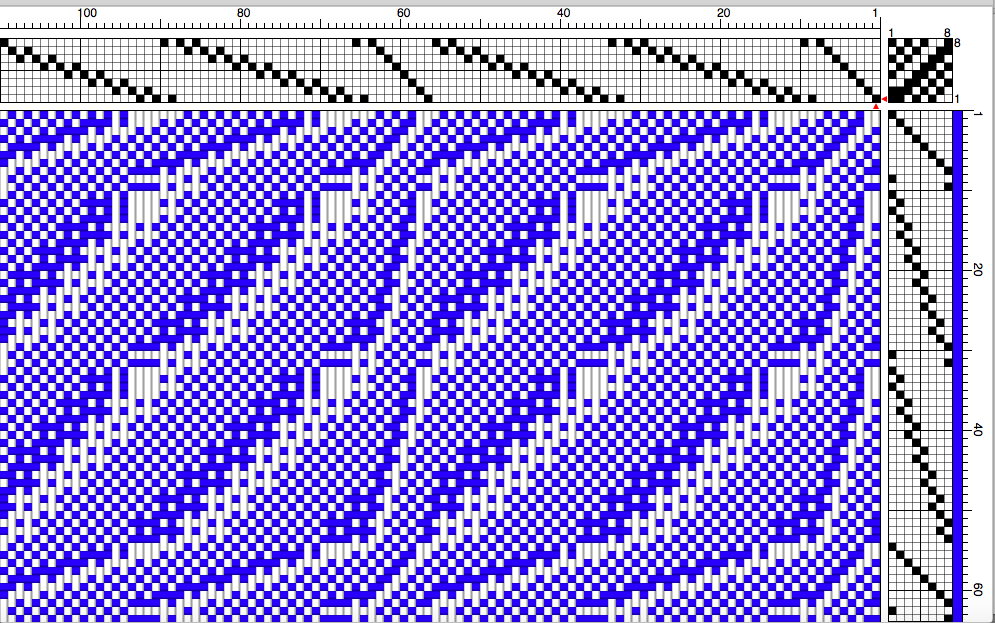
I chose a twill weave structure called “Raku” by Carol Bodin from the book Sixy Scarves for Sixty Years from the Weavers’ Guild of Greater Baltimore.  Here is a partial view of my plan.
Screenshot 2016-06-27 07.48.25

The long warp and weft floats should show off the color contrast of the warp and weft nicely. My warp is mostly muted greys, purples and blues, while my weft is a blend of peaches and creams. The sett will be 35 epi so those floats won’t be too long.

Now, the BIG question:  Should I flip the threading at the center of the warp and have the second half of the threading lean the opposite way?  Should I flip every other repeat of the sequence??  Should I just thread the whole thing in one direction and cut the fabric and turn it as needed for whatever I end up making?

I’ve favored each of these ideas at different times, and at the moment I’ve come full circle back to leaving the threading alone.  It would certainly help if I already knew what I will make with the finished fabric.  Typical of me, I have focused on the intrigue of working with this yarn rather than what I might do with fabric.  The warp is 17″ wide on the loom and I plan to weave 5 yards.

Meanwhile, as I ponder what to do about that threading,  I’ve been knitting and doing some Idrija lace on a bolster pillow.  I don’t even have to prop up my right arm on pillows anymore in order to knit, so I’m definitely improving.  This baby blanket is moving along nicely.  Interestingly, after looking at innumerable lace patterns, I ended up choosing a Eugen Buegler pattern.  He has designed lace patterns for many years and you can see many of his designs at the link above and on ravelry, as well as in numerous books by XRX.  He designed the first lace shawl I ever knitted, over 20 years ago.  I actually went to the local knitting store as I felt myself coming down with the flu in order to make sure that I had something to knit while I would be stuck in bed.  I still have that shawl…. in butterscotch colored, fine merino yarn from Grignasco.

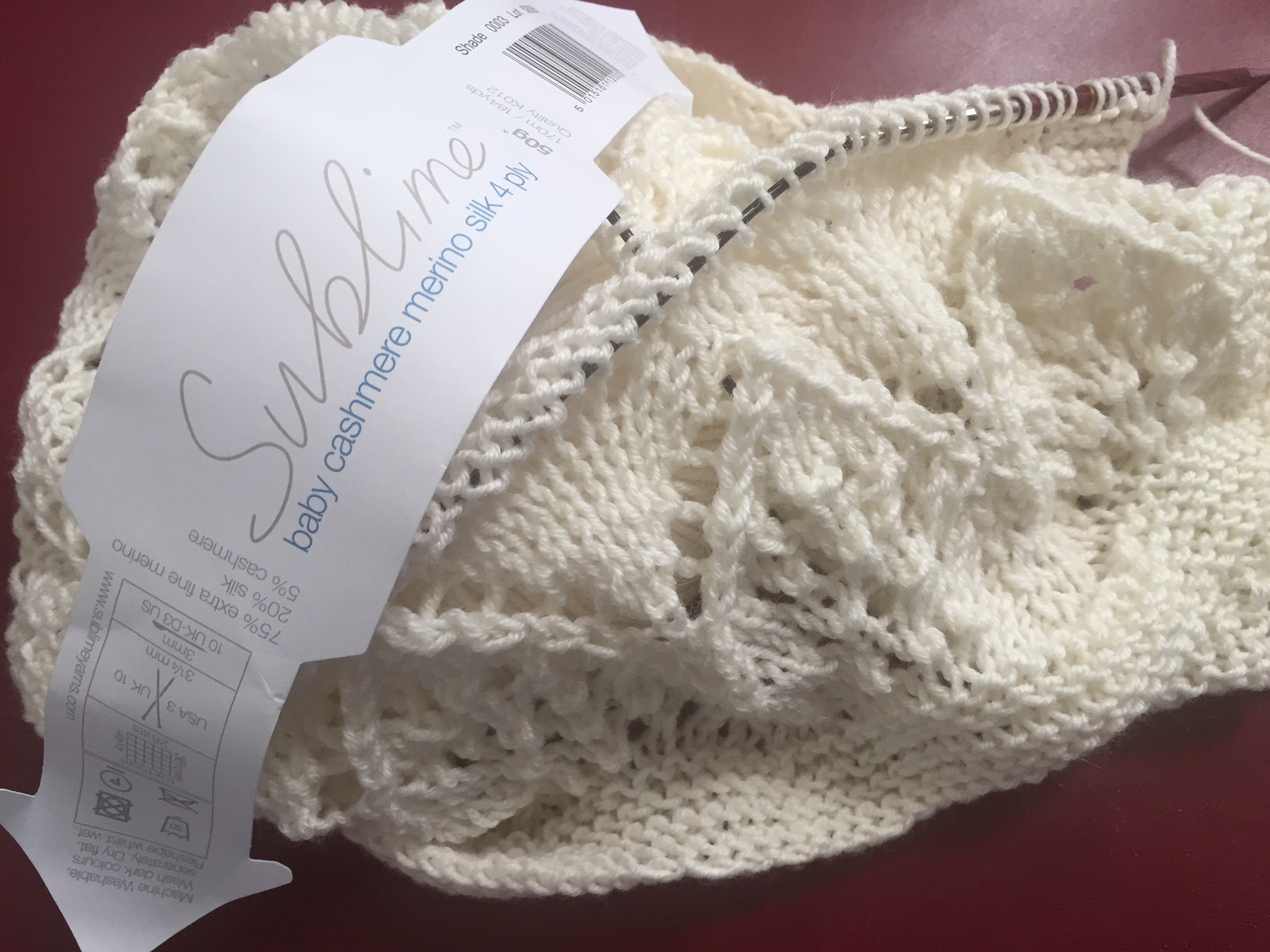
But back to knitting for little baby Ozzie.  Here is the baby blanket as shown on Ravlery. It is called “Lace Plumes Baby Blanket” and is available as a downloadable pattern from Fiber Trends. Thank you, Eugen!  I’m using “Sublime Baby Cashmere” which I ordered from Jimmy Bean’s Wool.

I’m now further along than this photo shows because I work on it almost every evening, and then I realize that evening is not a good time for getting a photo.
IMG_2357

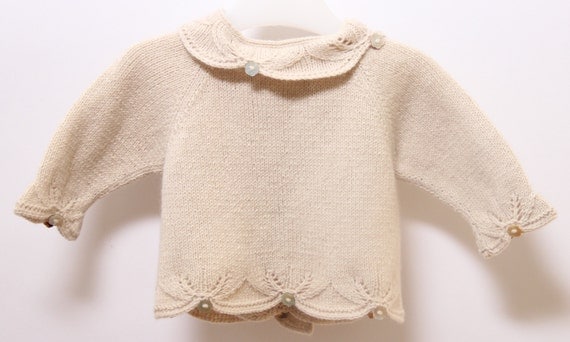
Next up will be this adorable sweater from Little French Knits on Etsy.  It’s a bit feminine, but, since I am so smitten with this little gem, I am clinging to the fact that, should our little bundle of joy be a boy,  they have traditionally dressed in rather delicate clothes as newborns.  This is just too lovely to pass on. Oui?
I have not yet shown a photo of the first sweater I made for our future little one.  The pattern is a design by Sephanie Pearl McPhee called Nouveau-ne.  It is delicate and fun to knit without being overly feminine.  I used Plymouth Yarns “Perlina” which is 100% merino which I bought at my LYS, Saybrook Yarns. The pattern has a matching bonnet style hat that I have finished but did not photograph yet.  There are also booties which I have not yet started.
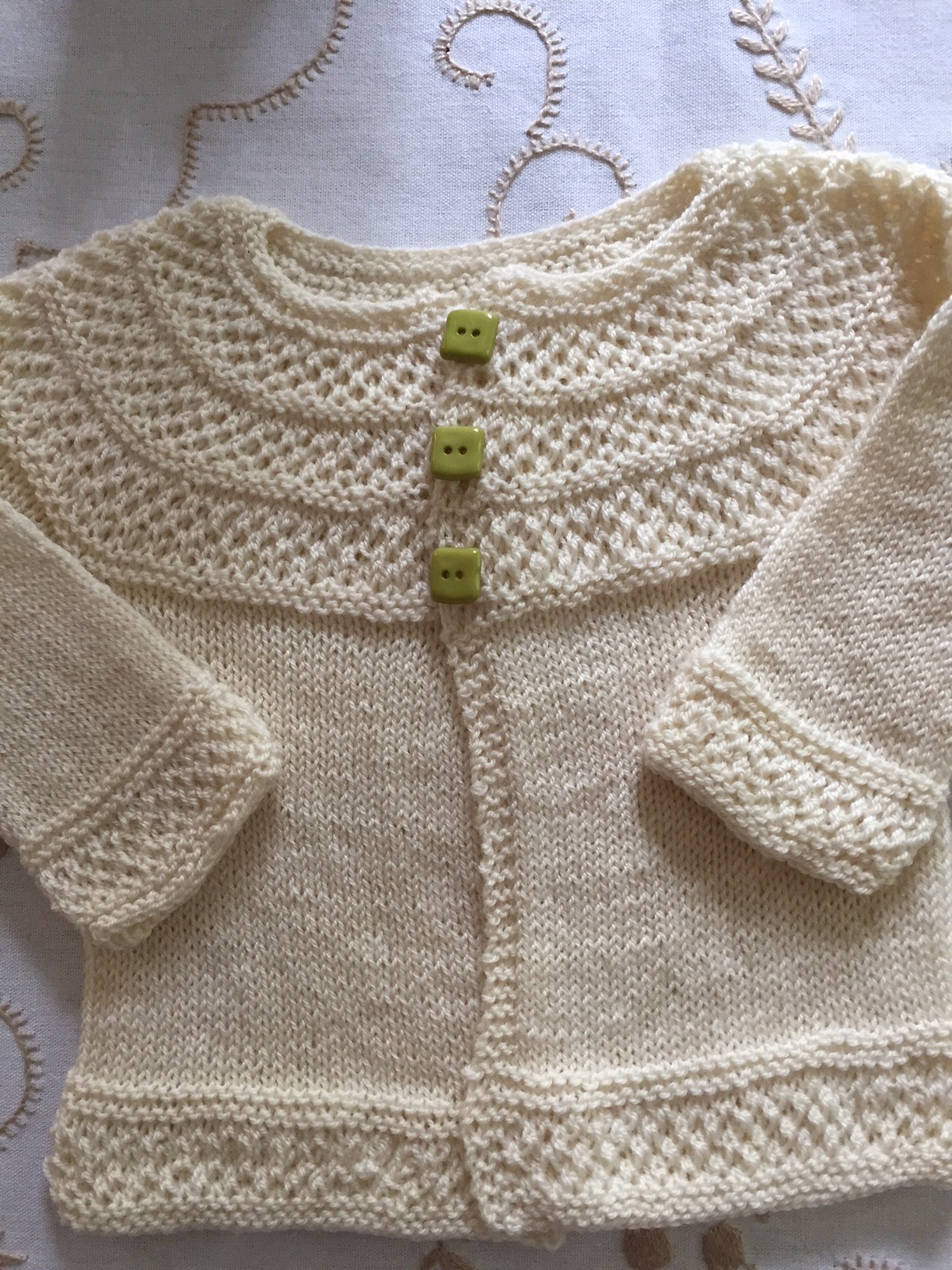
IMG_2352

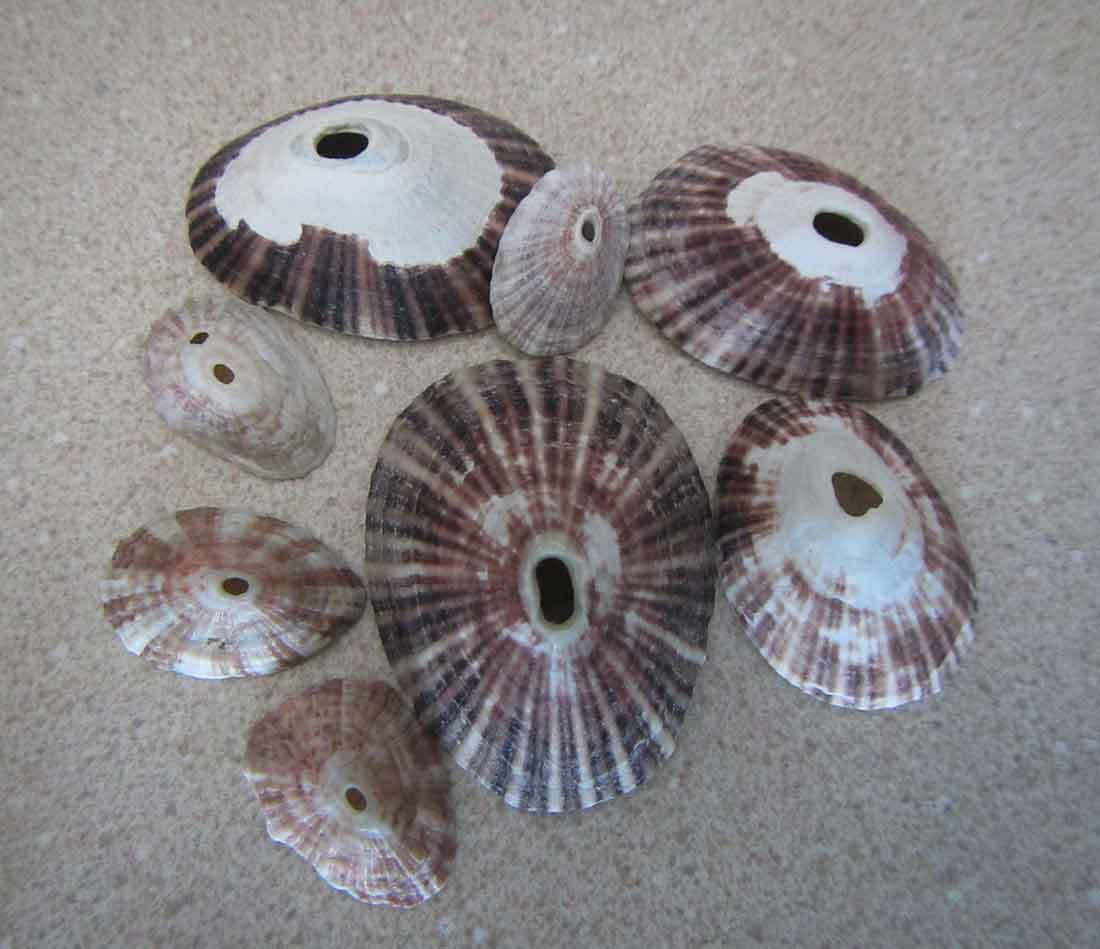
I have little limpet shells from the Bahamas that I will use as buttons instead of what I’ve shown here.  I lent my stash of limpets to a friend, and as soon as I get them back I’ll pick out the tiniest ones for buttons on this sweater.  I think it will be wonderful to have a little embellishment from our travels on our grandchild’s first sweater.  Aren’t I clever??
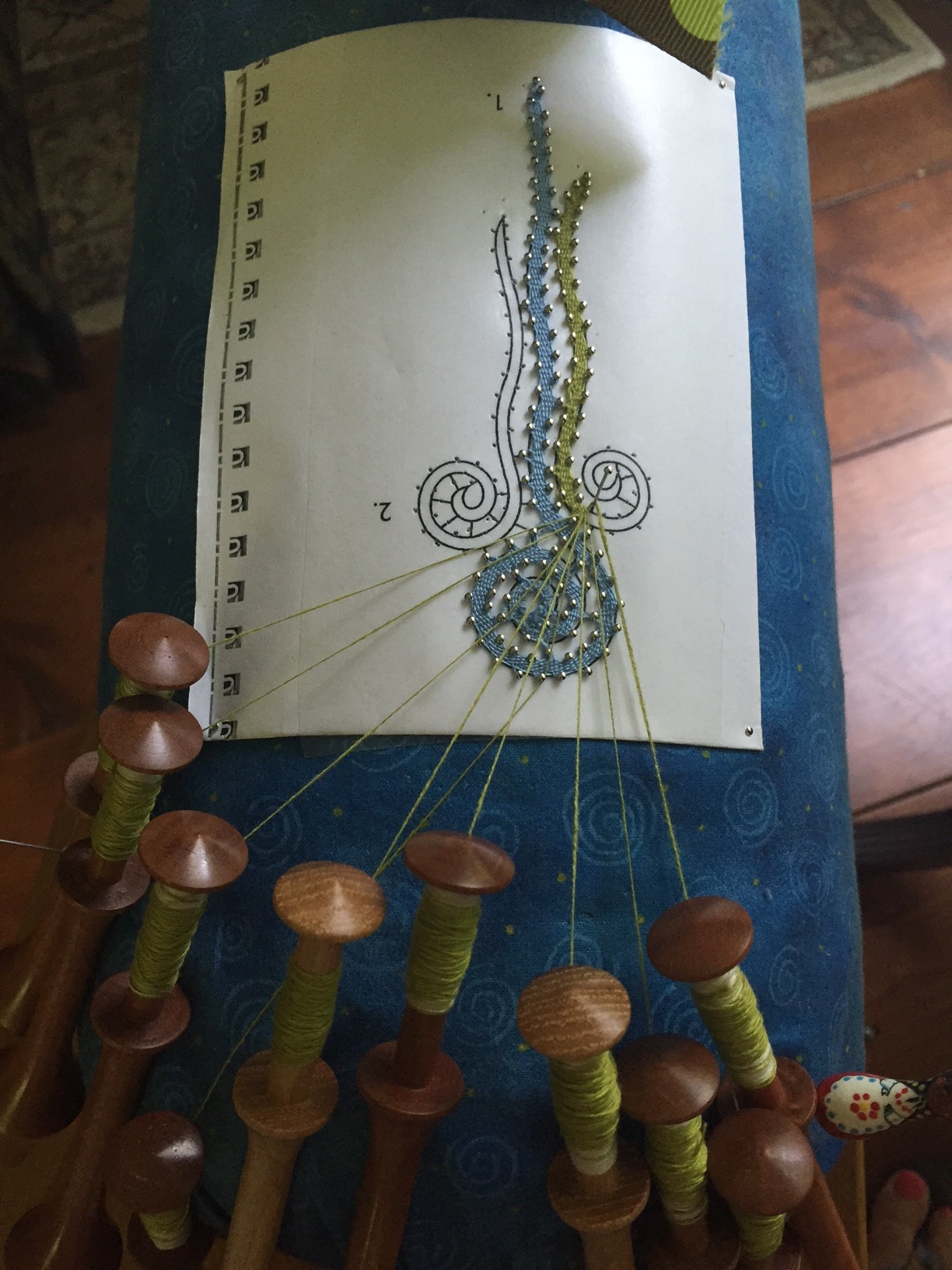
And I turned my attention back to the little Idrija lace ‘doodah’ that I started at the lace retreat back in May.  This little organic shape reminds me of a fiddle head fern or some kind of sea creature.  I’ve decided to make this two more times in a combination of blue and green.

IMG_2362 (1)

Second fiddlehead doodah in progress.  As you can see, the piece is woven upside down. On the next version I will make the central ‘squiggle’ in green and the side ‘squiggles’ in blue.  Then I plan to attach them to one of my summer tops.  Hopefully soon!
IMG_2365

So the past month has been taken up with the excitement of a first grandchild and the fears of having cancer–cancer that managed to progress past stage 1 before I got diagnosed.  It’s been an emotional roller coaster, and as usual, handwork– mostly knitting– has saved the day.  It took a full month to get diagnosed, have an initial consult with a surgeon, have the surgery, and get the pathology reports.  Waiting may not be the hardest part of being sick, but it’s certainly not easy.  Making these little projects and dreaming about future projects is what kept me sane during those long weeks.

Today I stumbled on this book of animal themed pom-poms made by a Japanese woman. She has captured the essence of each animal. After making each pom-pom with a mix of colors to imitate the animal’s fur, she adds details with needle felting.  I looked for the book online, hoping to order it, but so far I only found it on Japanese Amazon with no ability to order from the US.  I shall try harder.

And here’s a video of the author making a bear and teaching others the technique.

Just another little idea for Baby Ozzie to tuck away.  I hope I can find the book!
Basket Man

Yesterday may have been our last day to visit Old Havana, and I’m so glad I didn’t know it then because I would have felt a need to rush about more. Luckily we had a relaxing day and enjoyed some kind of holiday celebration that was happening.

We are trying to figure out the best ‘weather window’ for leaving Cuba. We knew we’d get the window some time this week, and now it looks like tomorrow is the day. So, here is our loose game plan. The winds are opposing the gulf stream a good deal of the time right now, but for the next couple of days those winds are pretty mild from pre-dawn until midday. So we will leave early in the morning, and sail in the gulf stream until the afternoon, when hopefully we will be near Key Largo. At that point we’ll head toward shore, out of the stream, and sail near the Florida coast until early the next morning when the winds die down again. We’ll head back into the Gulf Stream to Ft. Lauderdale, where we hope to clear in. By doing this we get a boost of speed from the northbound currents in the Gulf Stream while the opposing winds are mild, and when those opposing winds are stronger during the afternoon and evenings, we’ll slip out of the stream into the calmer waters outside the stream. I’m sure I’ll be sick, but hopefully less so than during some of our passages this winter.

The US Coast Guard sent us an email the other day (right after Bob had just composed a message to them) to ask if we were still on schedule for returning to the US by May 1. Bob responded, and we are hoping to hear back on whether we can clear in to Ft. Lauderdale. I have my fingers crossed about this because it will be more convenient for us to arrive in Ft. Lauderdale than in Miami. My flight home is Tuesday morning, out of Ft. Lauderdale.

Bob has just heard that the no-anchoring bill in Florida will indeed go into effect on May 1, so our plans for arriving in Ft. Lauderdale have to be adjusted. We will go to Miami instead, not a first choice for either of us. I guess we will rent a car to get to my Ft. Lauderdale flight. That’s boat life for you….you can make all the plans you want, even at the last minute, when you think you’ve got everything in hand, but the powers that be just laugh and laugh.

Yesterday we went back into Old Havana to look for the headquarters of the Women’s Federation for Handwork. Over the weekend we found the retail shop where the garments are sold, but the workshop where women take courses and make things for the shop is closed on the weekends. Yesterday we had a bit of a run around trying to find the workshop. When we did find it, we learned that all the ‘professores’ were gone since classes only take place in the mornings, while we arrived in the early afternoon. Maybe it’s just my imagination, and a leftover feeling from my visit to the workshop in Santiago, but I got the distinct impression that there would be complications trying to get anyone to see me. Yesterday I got to speak to a custodian and a language teacher, but when I asked for a ‘manager’ they both responded that ‘this was not possible.’ After meeting the open and generous women on the Paseo del Prada, and sharing such an excitement for handwork in spite of our communication barriers, I just couldn’t muster enough energy at this point to care if I met the administrators of this federation. I don’t think their goals are quite the same as mine. Admittedly I do not have the ‘whole picture,’ but from my limited perspective I believe their goal is to promote traditional clothing and make a successful business training women to keep these techniques alive and make the garments ‘saleable.’ It is a business venture that needs to succeed, and I hope it does succeed because that just makes handwork more valuable to everyone. But my mission is to meet women who love handwork and want to share what they do. I found that in spades with the group of women who surround Adriana Martinez.

It was some kind of holiday yesterday, but I never understood what! Several people wished us a ‘happy holiday,’ and museums were open in Old Havana that had been closed during our previous visits. While we were in the ceramic museum, I asked our guide what holiday was being celebrated, and she replied that it was the national holiday for ceramics. Bob and I are not at all sure we understood this properly. All kinds of museums were open that have been closed during our previous visits…maybe the holiday was really about Cuban heritage. Anyway, our guide still maintained that it was a ceramics holiday.

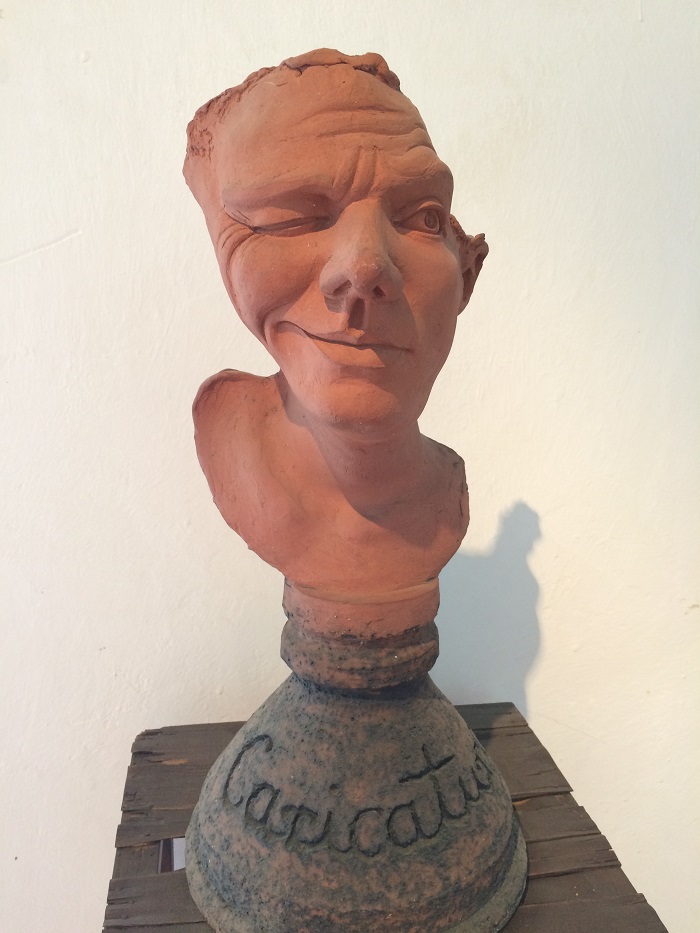
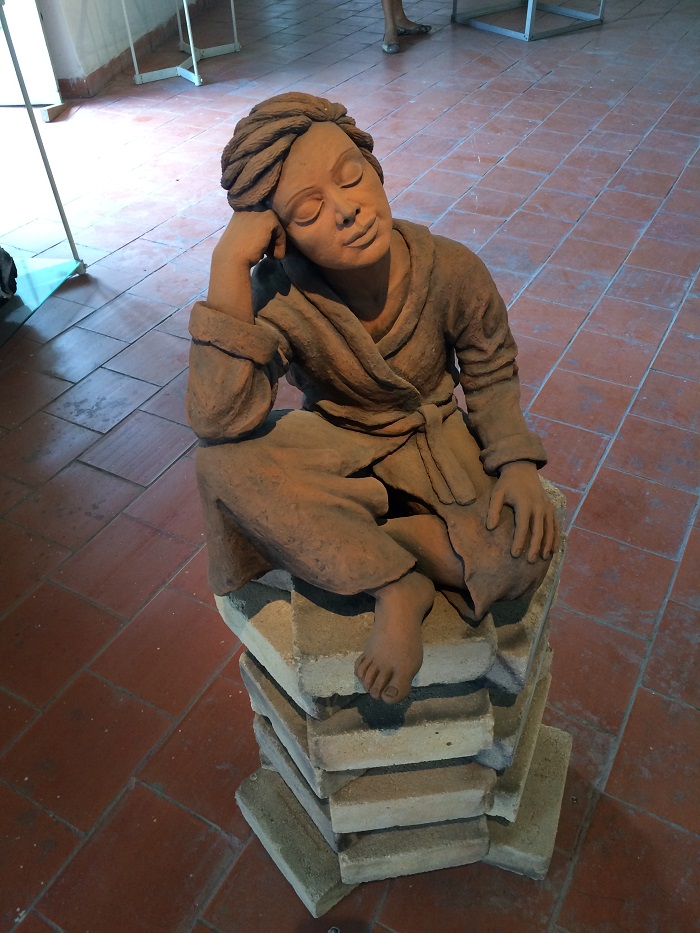
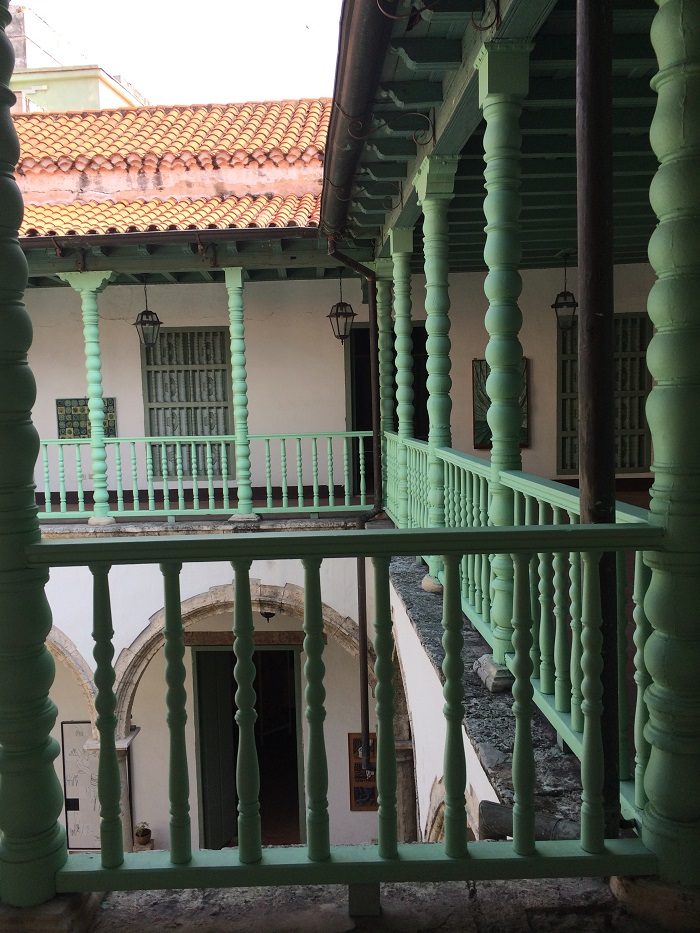
The ceramic museum was in the home of an historic ceramic artist who had a workshop and shop on the ground floor and living quarters for his family on the upper floor. The building was from the late 19th century with a central courtyard, and it made a wonderful museum for a history of Cuban ceramic artists. Each room featured a different time period of artists’ works. The courtyard was devoted to vessels and large figures.

4-27-16a 020

Our guide understood enough English for me to tell her that one of my good friends is a ceramics artist who does large figures in terracotta. I took these photos for her.

4-27-16a 019

4-27-16a 018

Somehow in our conversation it came about that our guide loves to knit. She took us to the entrance of the employees lounge and asked us to be very quiet since her boss was in there. She went in and came back moments later with a little bag of her knitting. It was the same ecru cotton floss type thread that the women on Paseo del Prada were using to crochet and make lace. I wonder where they get this material. Our guide told us she’d like to knit all day long, but can only find a few minutes here and there during her breaks at work. She said she never gets any time to knit at home because she has to cook and take care of her family. Sound familiar?

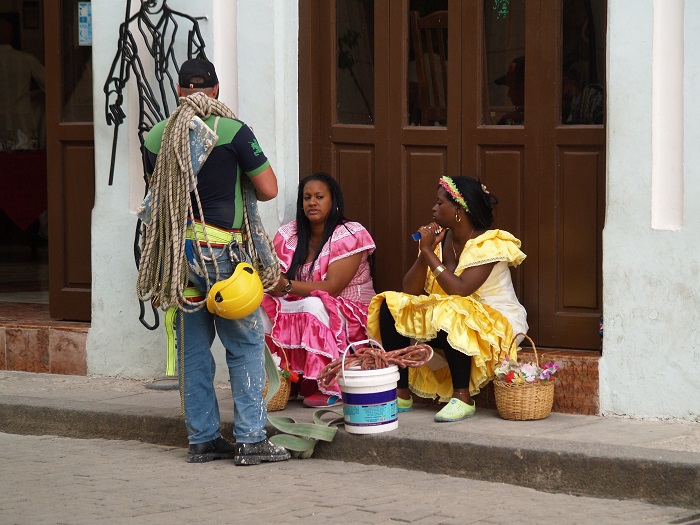
There were so many places open for touring or for business that had not been open all weekend long. It was a festive day, and there women dressed in traditional costumes on many street corners. You could take a photo of there for $5 CUC, which seemed a bit dear to us. Near the end of the day, Bob managed a discreet photo from a distance.

OLYMPUS DIGITAL CAMERA

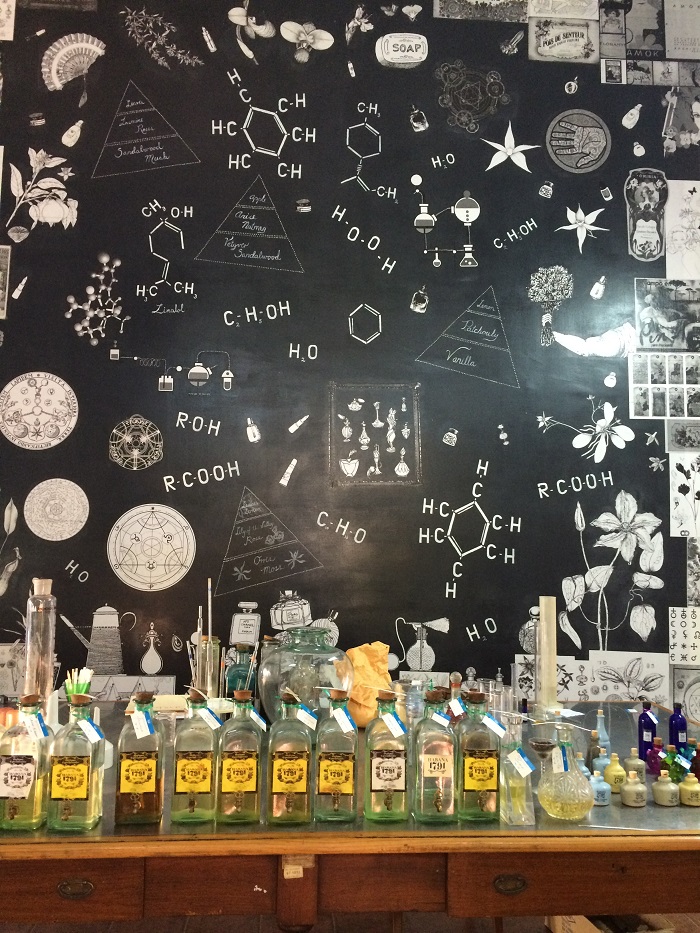
One of the places that had been closed over the weekend was a perfumerie. We had looked through the windows of this museum/shop and admired the antique brass containers used for distilling fragrances, the wonderful colonial furniture and display cabinets, and the glass apothercary jars that held the fragrances. I was thrilled to get into this shop to see things at close range! Bob took some photos while I smelled the fragrances and bought a ceramic jar of violetta for myself and lavender for my sister.

4-27-16a 015

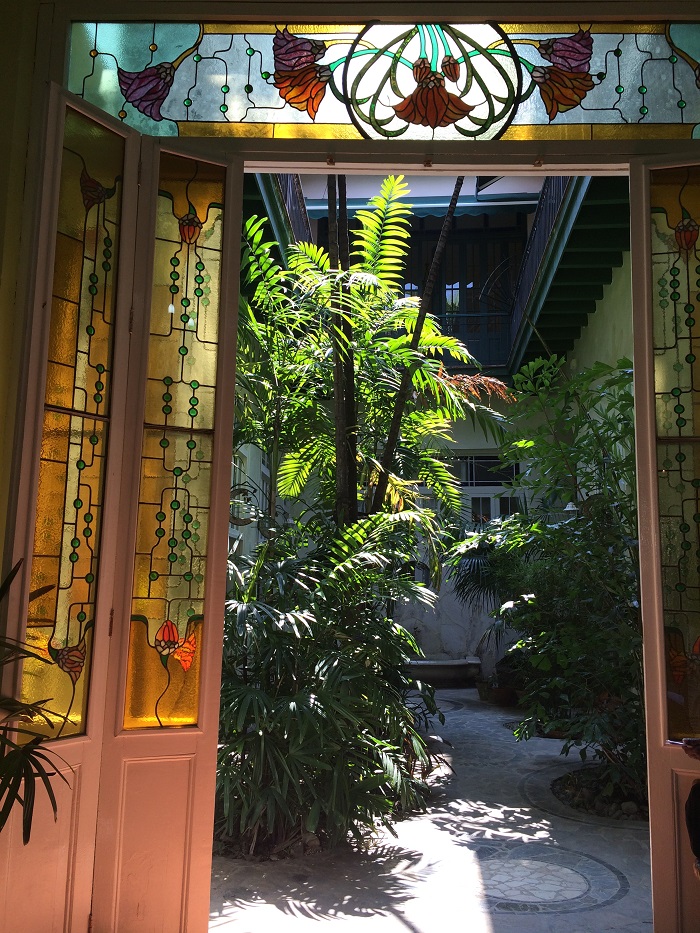
Every store has a beautiful courtyard since they are housed in historic buildings. This is the courtyard of the perfumeria.  Bob and I had been admiring the stained glass every time we walked by this building over the weekend.

4-27-16a 013

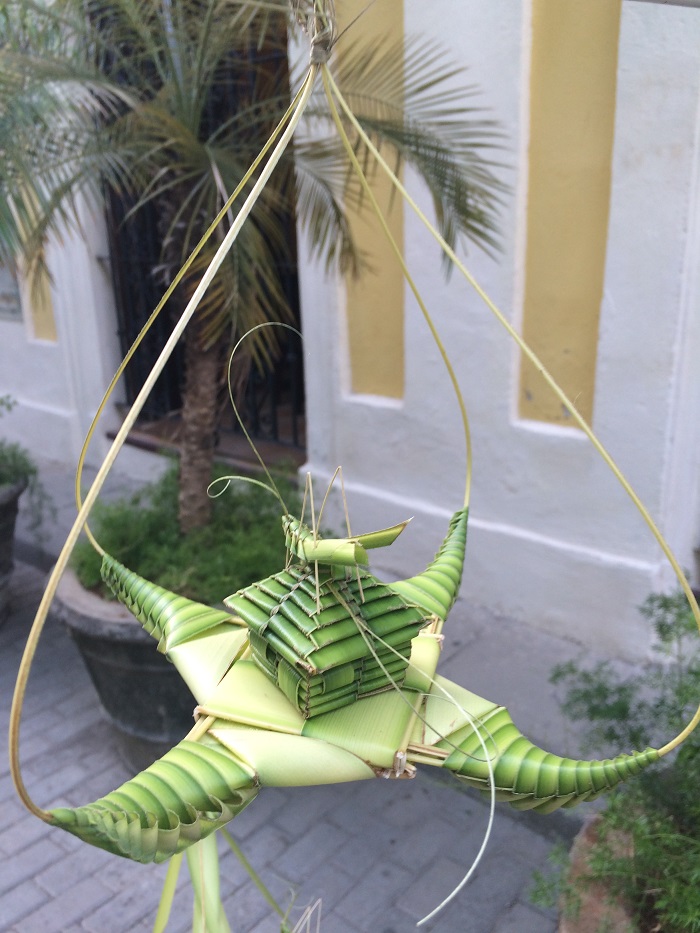
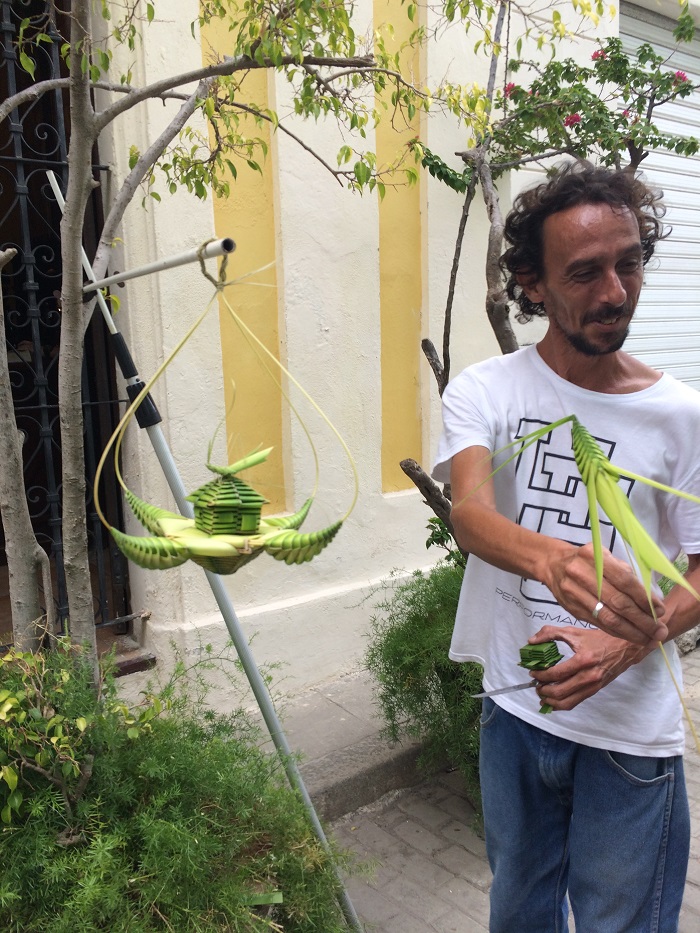
In the late afternoon yesterday, Bob and I happened upon a young man making baskets from palm fronds. In his large basket he had a number of exquisite, small items made from the fronds….birds, and a little house with a cricket on top.

4-27-16a 057

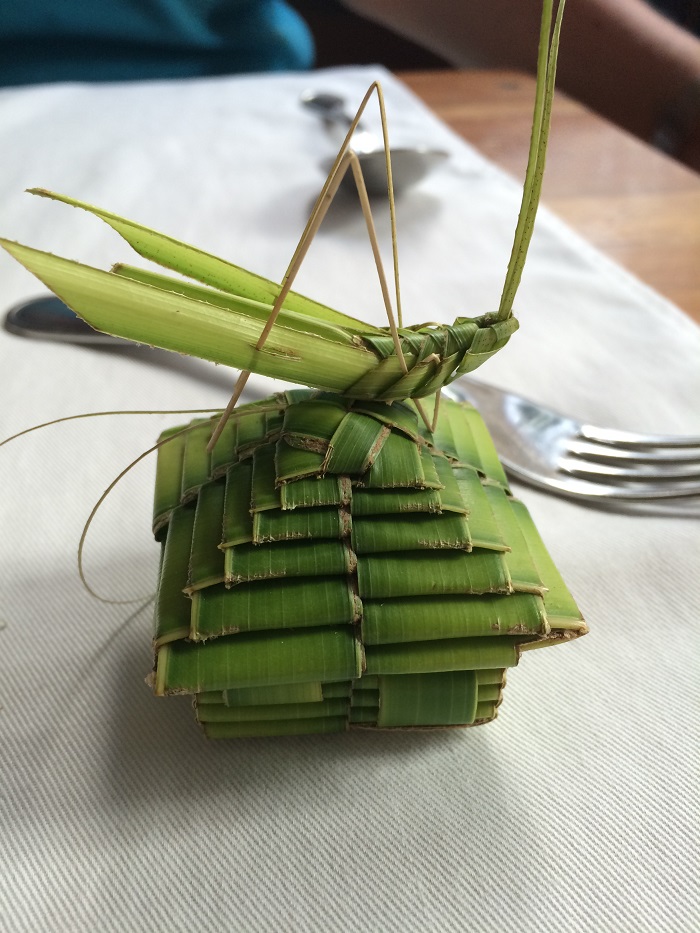
He was easy to talk to and knew enough English that we could communicate quite well. As Bob and I were marveling at the fineness of these tiny basket creations, he offered me one of his ‘birds.’ It appeard that he was giving me a gift, but I wasn’t entirely sure. Here again was someone offering a gift and letting fate take his generosity where it would. I put the bird back in his large basket and asked him for the little house with a cricket on top. Buying that took a bit more time and frustration than we’d anticipated! First, Bob could not find his money, and as he searched we had the sickening feeling that maybe we’d lost all our money. After a few heartstopping minutes he did find his stash of money, but then we did not have exact change to buy the little cricket. The basket maker could not make change for us. So Bob went in to the local bar to ask for change, but they did not have it either. Then the basket maker left his spot to go buy a beer which would give him change. (You can walk about the streets in Havana with alcohol). He came back smiling, and yet he still did not have the necessary change! In the end, laughing, he accepted somewhat less than his price, and he still handed me the little bird as a gift.

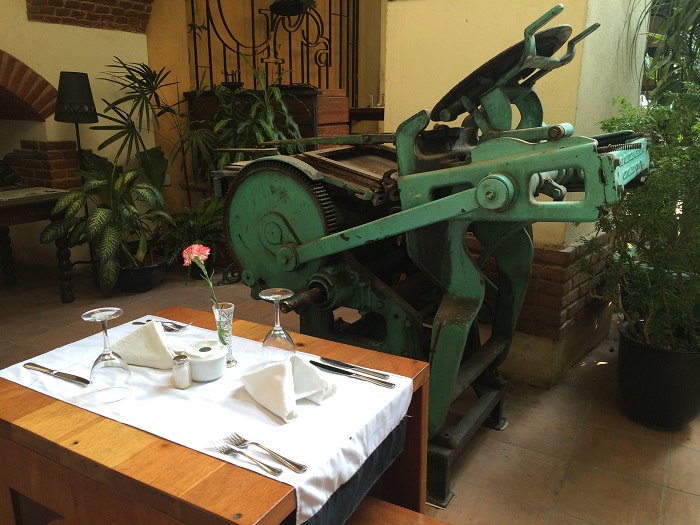
Bob and I went to dinner with my little house with cricket and my birdie sitting on the table before us as a quirky centerpiece. We kept admiring both these baskets, and I decided I had to have another little house with cricket as a present. I hoped we’d still find our basket maker on the street where we left him by the time we left the restaurant—which was a beautiful courtyard that had once been a print shop.

4-27-16a 035

Restaurant Imprenta:

4-27-16a 037

4-27-16a 039

When we got back to the spot where we’d seen the basket maker, the other street artists had just finished packing up their wares and were headed home. Likely the basket maker would soon be doing the same. But we’d gotten there just in time to ask if we could watch him make a little house with cricket on top, and he seemed happy to oblige even though he still had one already made. It took about 20 minutes for him to make, and we had a wonderful conversation with him as he worked.

4-27-16a 032

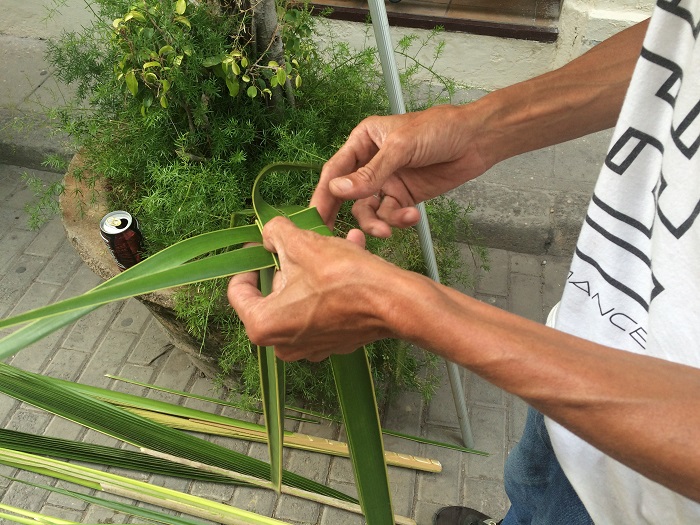
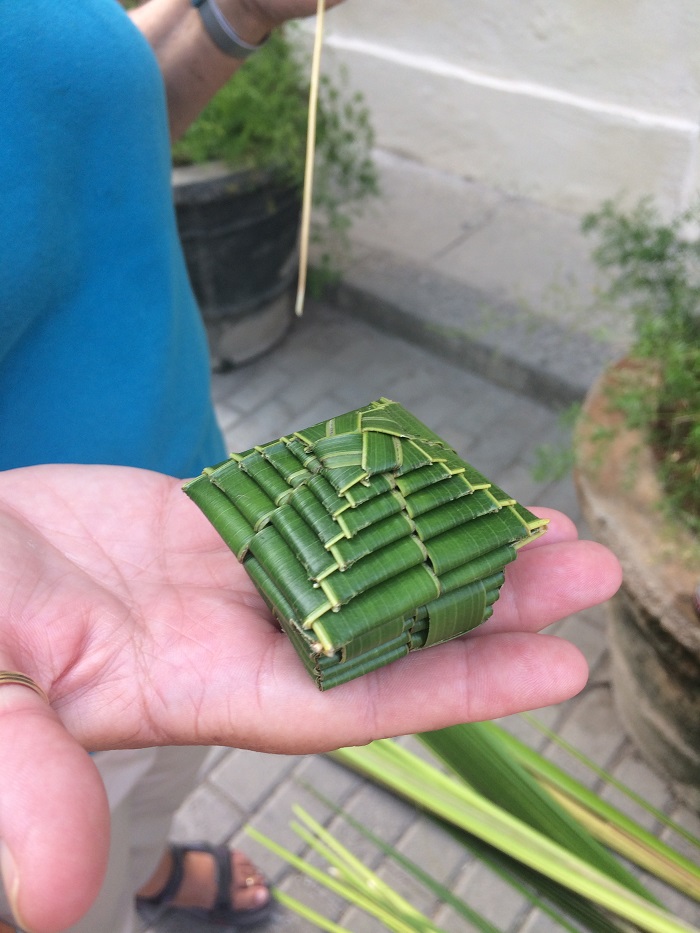
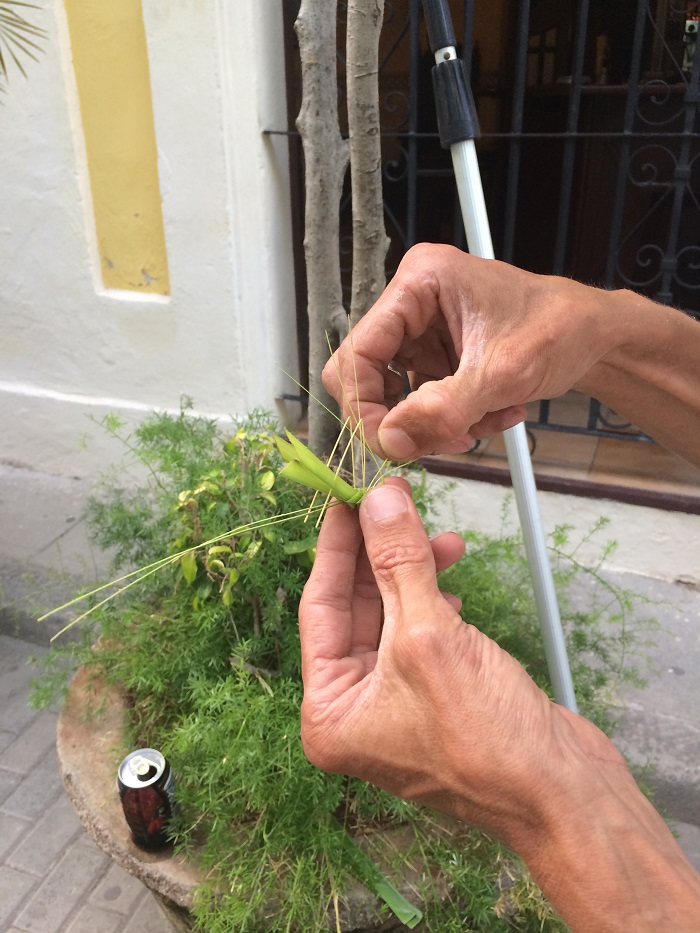
He started with two long palm fronds and crossed the fronds (north/south/east/west) over each other in the middle of the frond lengths. Starting with the ends that taper down to points, he began to fold each frond over the other in a consecutive direction. Since the fronds were tapering down to their outer ends the little box he was making got smaller and smaller, tapering like the fronds themselves. This made the roof of the house.


4-27-16a 043

Then he went back to the other half of the fronds that led to the base of where they’d been cut from the tree, and he made the same consecutive folds for making a square. This made the house itself. Very clever. He cut some frond strips to insert into the box for doors and windows.

4-27-16a 051

The exquisite litte cricket!

4-27-16a 059

As he worked we talked…. He loves to make baskets and these little figures are things he ‘invents’ himself. He is always thinking of ways to make some kind of little structure or animal out of the traditional basket making techniques that he uses to make regular baskets. He took out his phone and showed us photos of his baskets. If he’d had any of these with him I would have bought some too! He does careful work that results in beautiful baskets!

I told him that I sometimes make baskets too, but not from palm fronds since there are no palm trees where I live. Bob took my phone and began showing photos of my weaving and bobbin lace since he could not find any photos of my baskets. When Bob showed a photo of my tatting the basketmaker’s face lit up and he said his wife does this! I asked if his wife also does crochet and ‘tejer,’ and of course he said yes! He said she loves these techniques and loves to work with her hands. We had a little discussion of how it feels to let our hands work the repetitive motions of these crafts while our minds are free to ponder. Making things with our hands allows our brains time to contemplate many things.   He also told me he plays the piano and the violin. Someday he’d like to have a cello. He loves the cello most of all.

After giving me the little house with cricket he’d just made, he asked if I’d like him to make a snake. Naturally I said yes. I was curious to see what other techniques might be used to make these little figures, and the snake involved a different kind of manipulation of the fronds. When he finished he gave me that too. He really was most generous!

The only downside of our visit with him happened when a woman stopped for a moment to watch while he was making little cricket on top of the house for me. He offered her the one that was already completed. When he told her the price ($3 CUC) she said, “Big city prices….no thank you!” and walked away. We were all stunned. Yes, there are vendors who have high prices for things and who expect you to bargain, but these are mostly vendors who sell things that they have bought to sell. The artists we’ve encountered sell their work for very little, and I cannot imagine haggling with them. Perhaps I’m wrong about this, but how can you expect to pay even less for such an exquisite concoction of creativity? $3 Cuc for 20 minutes of work? Also, as a craftsman myself, I have stood in my own booths over the years and overheard people say that handwoven items are too expensive—that you can buy something just like it in a store for far less.

Well, you cannot buy a little basket woven house with a tiny cricket on top in any store that I know of. I was disappointed in this exchange. It would have been better for her to acknowledge what a little gem he’d just handed her, but that she could not spare the money at this time. It’s such a sad commentary that she felt she had to devalue his work in order to get away.

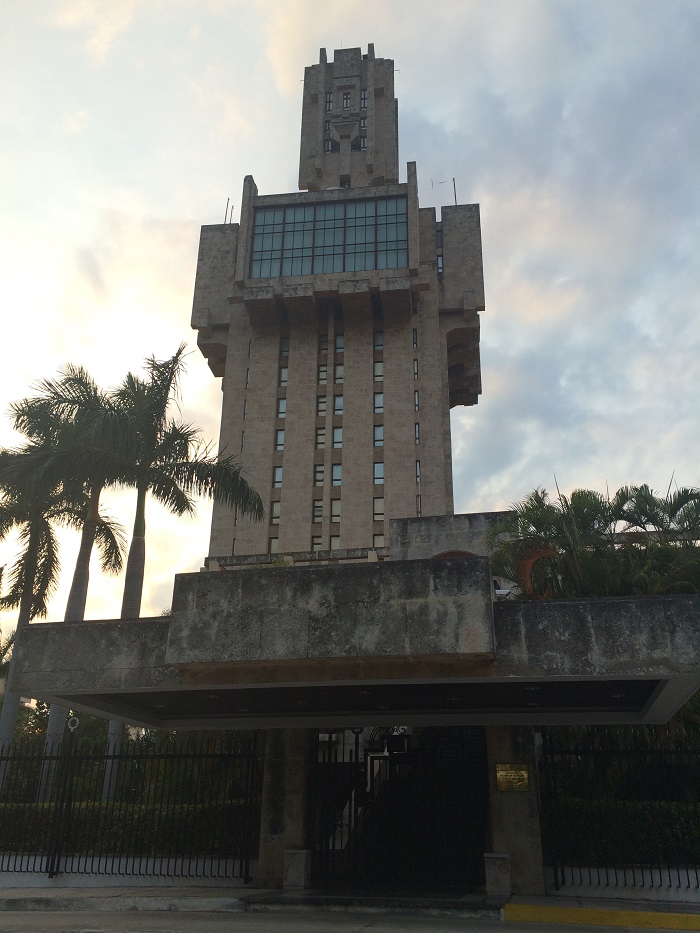
During all our cab trips to and from Old Havana we drive through modern Havana, including Embassy Row.  The US Embassy is newly opened and has never been on the avenue where all the other embassies are.  Most of the embassies are in historic colonial buildings and are quite a sight.  The Russian Embassy is the exception, although it too is quite a sight!  It is an wonderful example of Soviet architecture.

4-27-16a 065

Tonight we’ll have drinks around the pool here in Marina Hemingway with some of the other cruisers we’ve met in the last few weeks, along with Lars whom we met as we arrived in Cuba two months ago.  Some of us will walk to a local Spanish restaruant in the nearby town (Jaimentio?–something like that) to have a final dinner together.  Then is farewell to Havana and to Cuba.  It’s been great, but home is beckoning.  Bienvenidos Florida by this time on Friday!


Adriana, Nancy, Dazmira, Hidalgo!

Everyone turns out on Sundays in Havana. The weather is always fine, so why not? I found more women crowded around Adriana late Sunday morning., and we had another session of exciting talk about handwork.

Since Adriana’s table was not covered in other people’s work in need of her advice, she showed us the progress she has made on her lace blouse. She is more than half finished. Very soon I became too involved in conversations to take any photos, so I’m glad Bob took a lot!

4-25-16a 003

Look at the wonderful work these women are doing. A beautiful bobbin lace (bolillo) piece.

4-25-16a 005

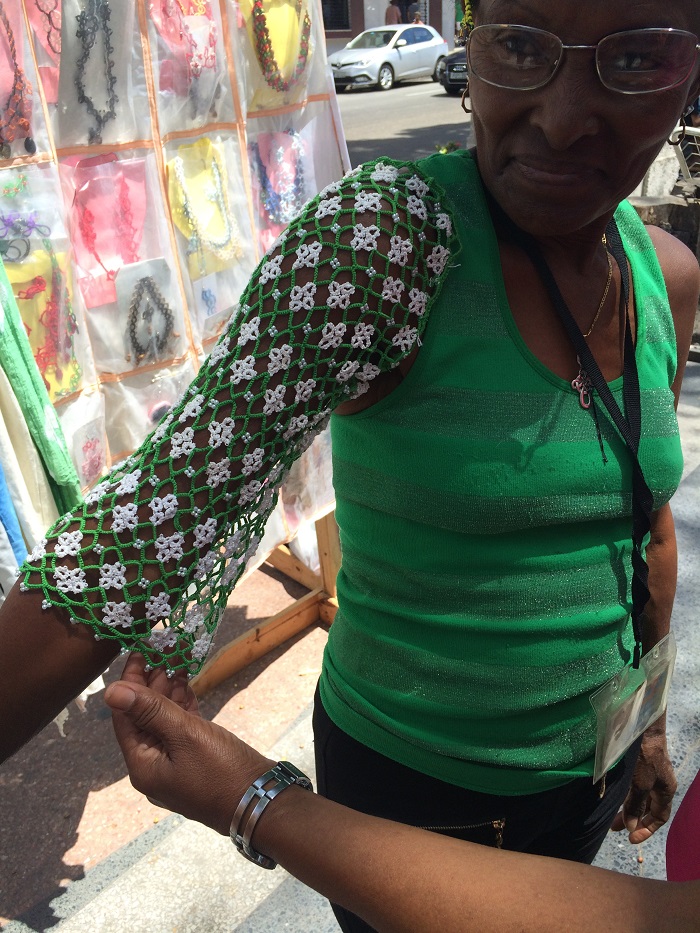
Tatted sleeves, anyone? I would never have thought of it! This is tatting with pearl beads, and is a stunning piece. In black and white it would make the most elegant eveningwear, attached to a silk tunic. The tatting was perfectly done. Doesn’t it look fabulous on Adriana? She did not make it, but since she was wearing the perfect green tank top she had to model it!

4-25-16a 026

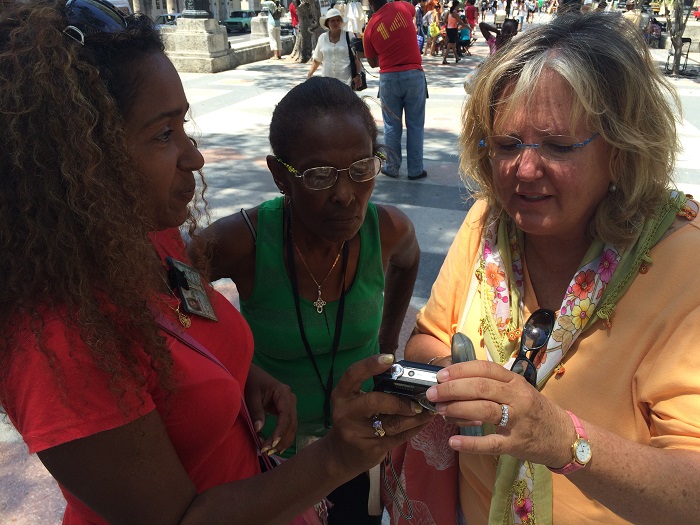
I happened to wear one of my Turkish scarves, which all the women loved. They asked to take photographs of it because they want to try their hands at crocheting this type of edging with fun, dangly flowers. I bet they’ll have it figured out in no time!

4-25-16a 008

Dazmira has her own booth nearby Adriana, where she displays her crocheted blouses, little girls’ dresses, handbags and hats. She buys large containers of the pull-tabs from beer bottles for $1 CUC (about $1.15 US) with which she embellishes many of her handbags and hats. She also crochets with plastic shopping bags and old video tapes. You can find her on Facebook as Dazmira.  I’ll post a link when I get home.

As is typical in Cuba, you cannot give a gift without getting something in return, though this has taken almost two months for me to realize. I think this is what caused some awkwardness when I gave away some spools of tatting thread to the teacher at the Women’s Federation in Santiago. Here, though, it was wonderful to see Adriana’s face light up with the spools of lace thread I brought for her. She showed me a baby’s outfit she made with this type of fine cotton. She took the pattern for a handkerchief edging (perfect square opening in the center for the neckline) and adapted it to make the bodice of a little boy’s one-piece suit. I got weak in the knees when I saw the lace bodice on this outfit, but I could not bring myself to buy it. I don’t have any grandchildren yet, and I don’t want to jinx it!

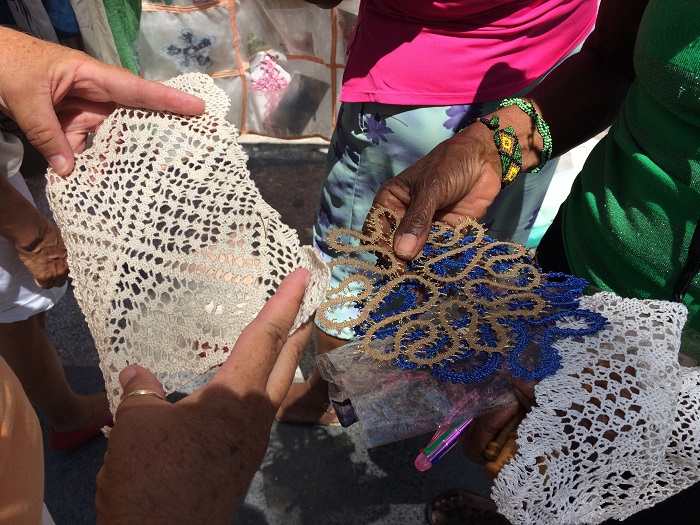
Instead I bought two beautiful pieces of tape lace and a small Torchon centerpiece.

4-25-16a 031

Adriana gave me a pair of tatted earrings done in navy and pale blue with fire polished crystals! I treasure them!

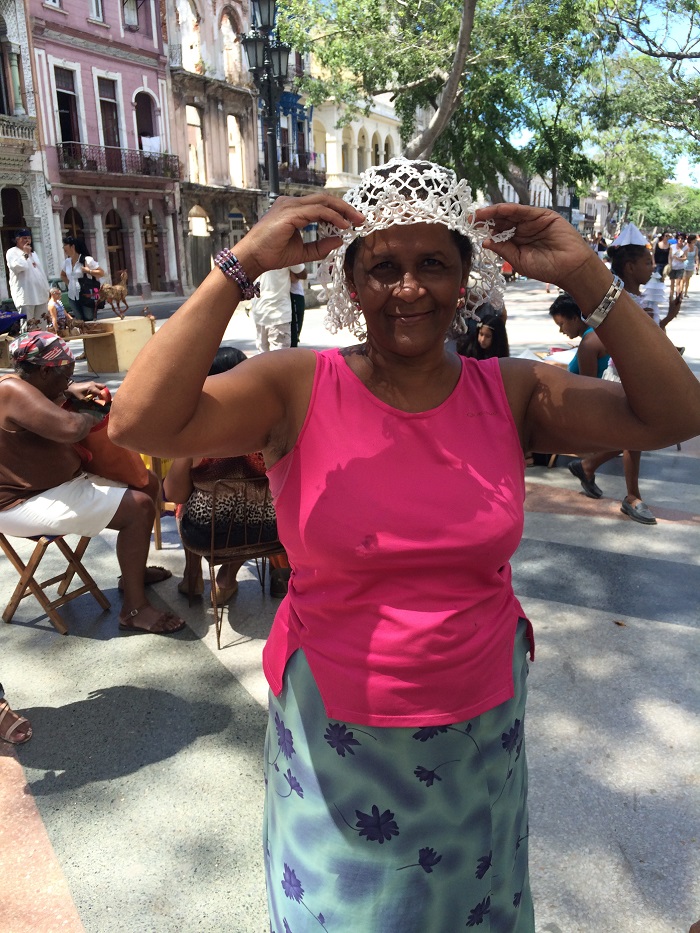
I don’t remember this woman’s name, but she turns out a lot of elaborate tatted projects. She made the interesting green and white beaded sleeves, and here she is modeling (against her will) a lacy tatted hat that has not been starched yet. It will be such a frivolous and fun accessory when it’s finished.

4-25-16a 037

The materials available in Cuba dictate the projects these women make. Most of the cotton threads are thicker than we are familiar with for doing tatting or bobbin lace. If I’d known so many of these women tat, I would have brought much more of that. Ah, well.   The tatting projects and bobbin lace projects are done with cotton that is considerably thicker than what we use in the US. Some of it looks like cotton floss, but even thicker—almost like a 12 strand floss. I can see it is NOT easy to work with in tatting because it splits so easily. Still, these women manage very well.

Adriana believes that they can now receive mail from the US. Boy, I hope so. I will send them more fine threads to work with. They oohed and ahhed over the threads I brought with me, and of course you can fit a lot of thread in a small package. The problem will be with mail service between the US and Cuba, and hopefully Adriana is right that things have already changed.

Internet in Cuba is challenging since it is rationed, so although there is plenty of information online these women cannot access it.   I bet it will be at least a month before I settle back into taking internet access for granted when I get home. It’s been highly frustrating here!

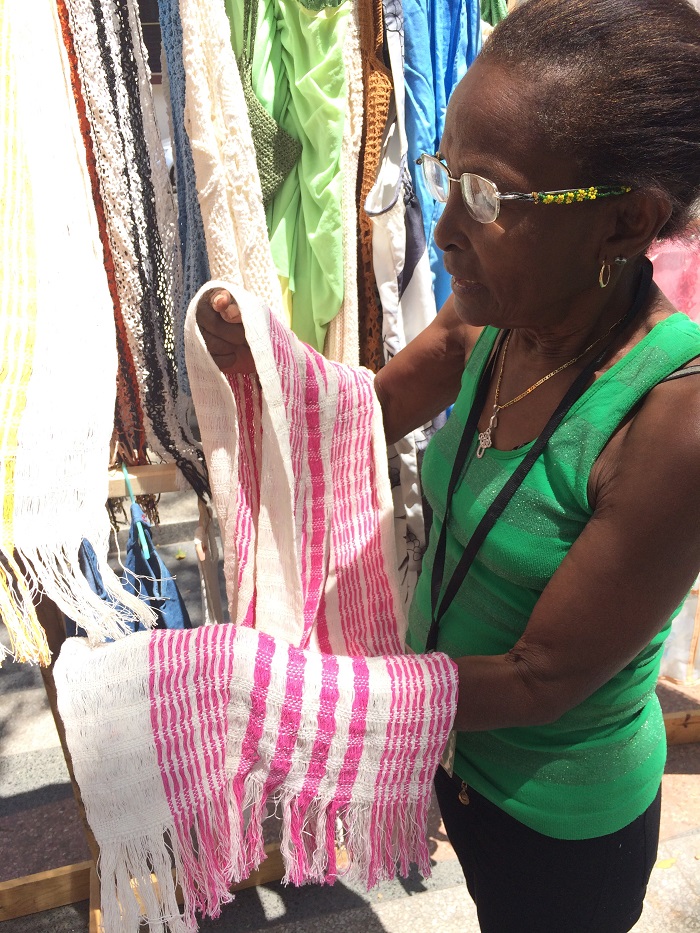
There were two handwoven scarves on Adriana’s display. When I questioned her about them she told me they had been woven by a man. I made all kinds of motions to describe a rigid heddle loom, and she was nodding her head through my whole pantomime, so I think that’s what was used to weave these scarves.

4-25-16a 023

Adriana is very interested in having instructions to make a simple floor loom, so I will be on the lookout for that when I get back home. I have not found any handweaving in Cuba, and she confirmed that herself. She did not know the word for handwoven in Spanish, nor the word for ‘loom.’ She was calling it the ‘machina por maya,’ the machine for fabric, until I wrote down the word ‘loom’ for her in her notebook.

Hidalgo joined us again, and Adriana teased him that he already knows so much about handwork he should start crocheting himself! And that’s when I learned that he paints, and sculpts and does woodworking in his free time. The people who have booths on the Paseo del Prada are very interesting, and I know I would enjoy getting to know them better! I hope we can stay connected through email…we have all exchanged email addresses.

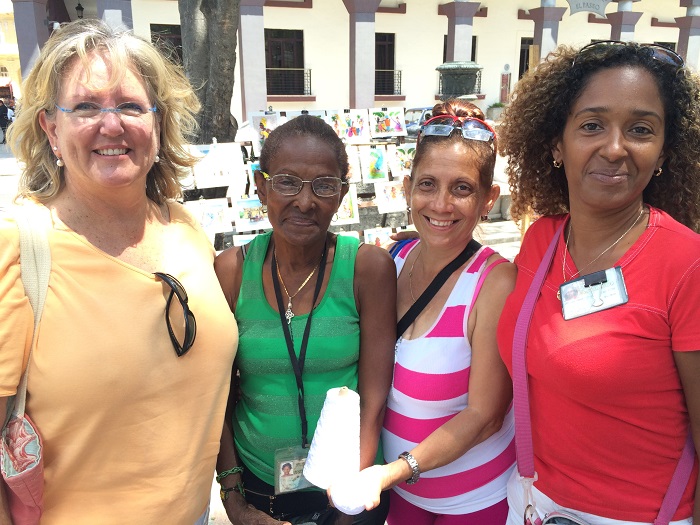
In the end we discussed the value of handwork. When I said that not many women do handwork in the US, and that when they see it for sale many women are shocked at the price we ask for handwovens, lace, knitting…etc. These Cuban women agreed. They said young women in Cuba want inexpensive, manufactured garments. We agreed that in both the US and in Cuba women who do handwork are the biggest supporters of textile handwork! We buy from each other! In the photo below, from left to right: me, Adriana, Nancy, and Dazmira.

4-25-16a 020

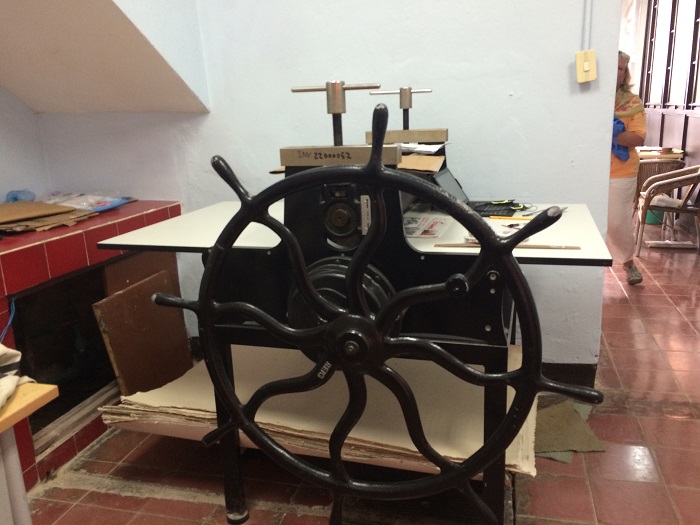
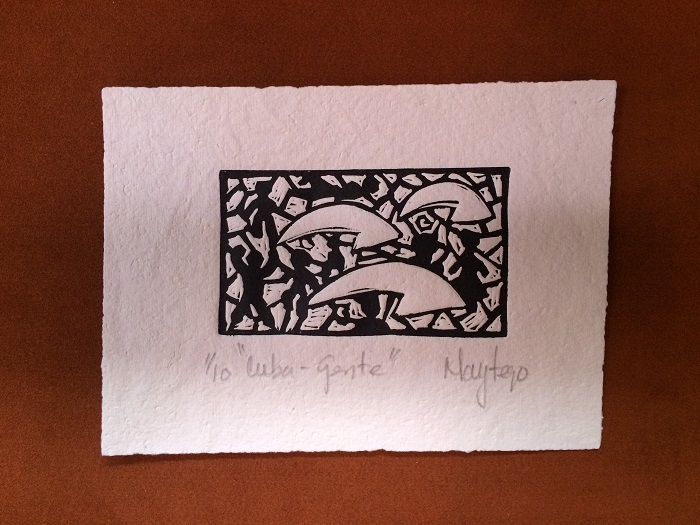
Later in the day, near the restaurant we enjoyed on Mercederes we found a small gallery of woodcut prints. A group of artists were working together, sharing a printing press that had been donated by Unicef.   The gallery itself was part of a beautiful historic building.

4-25-16a 039

4-25-16c 002We ended the day with an early dinner at an outside café called Dominica, where the music was more intoxicating than the mojitos! First a band of men playing xylophone, bongos, guitar, saxophone and string bass, followed by a ‘girl band’ playing keyboard, saxophone, bongos and string bass, with a wonderful female lead singer. Beyond mariachis there are some other interesting percussive instruments, including a hollowed out gourd that has grooves incised along one side. You play it by rubbing a stick across the grooves, and it adds a wonderful rhythmic nuance to bongos and mariachis. I don’t know what it’s called—maybe it’s just called what it is!—a gourd. I love the rhythms of Cuban music— samba and bossa nova. Fantastic! You cannot sit still to this music, which must by why Cubans, and many tourists, are always dancing!


Magical Havana

What else could I possibly say about a first visit to Havana, where Bob and I found everything we’d hope to find and more that we didn’t expect, other than it was magical?

Saturday morning we took a cab from Marina Hemingway to Havana Viejo. Months ago I posted information about a woman named Adriana Martinez who teaches bobbin lace and tatting and other lace making techniques in an outdoor setting called the Paseo del Prada. This is also the area where you can find well maintained American cars from the 1950s on display.

Our taxi driver dropped us near the Capitolio (currently under renovation that will make this landmark look positively new), and I struggled to find the Paseo del Prada on our map of Old Havana. I was looking at all the little green squares that signify a ‘park,’ but in fact as we wandered, we found it before I ever located it on the map. We saw a lot of art and handwork on display on the park-like median between two large boulevards that starts right at the capitol.

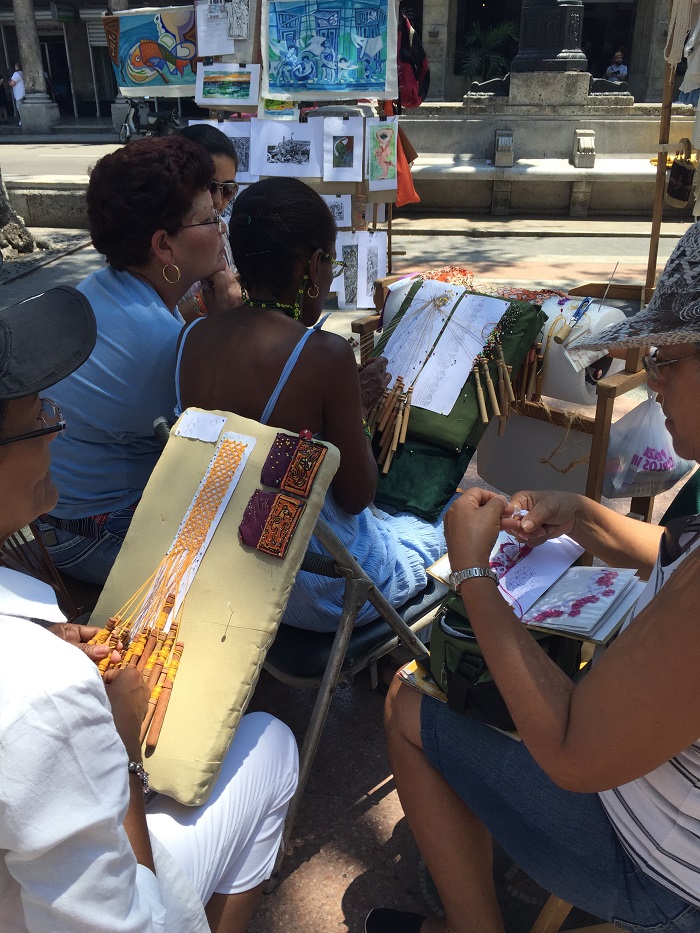
There were brightly colored paintings on display and several ‘workshops’ set up for children to try their hands at painting. But there were just as many women with handwork on display, mostly crochet. I was impressed to see so many women sitting on portable chairs in front of their displays, watching the crowds walk by while their hands were literally a blur, turning out crochet projects at impressive speed. The crochet work is really fine and beautiful. Cotton blouses with lace crochet insets, crocheted shawls and dresses, many dresses for little girls—all of it done in ecru cotton.

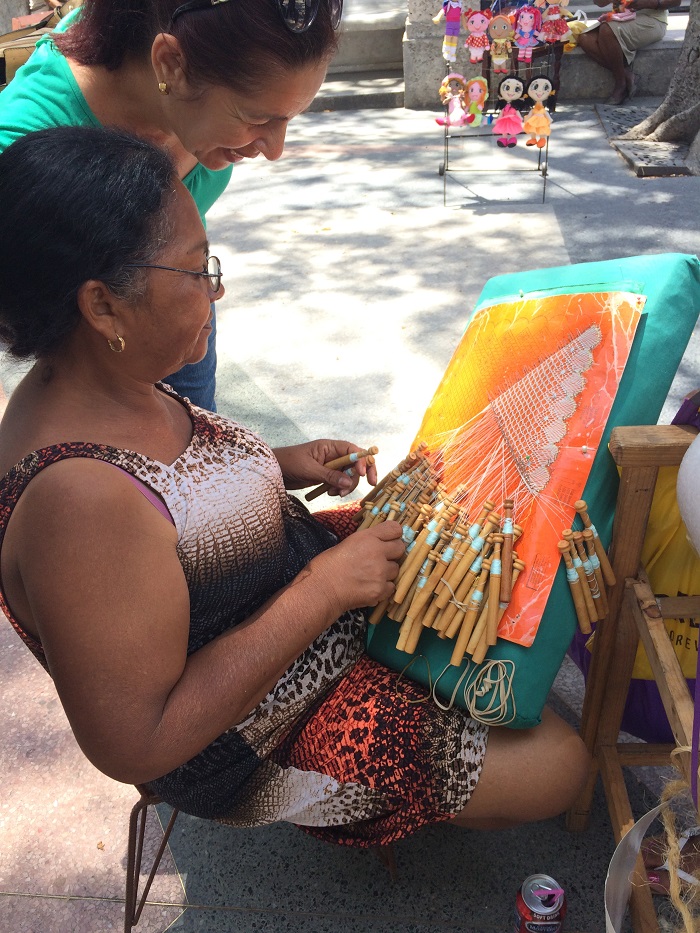
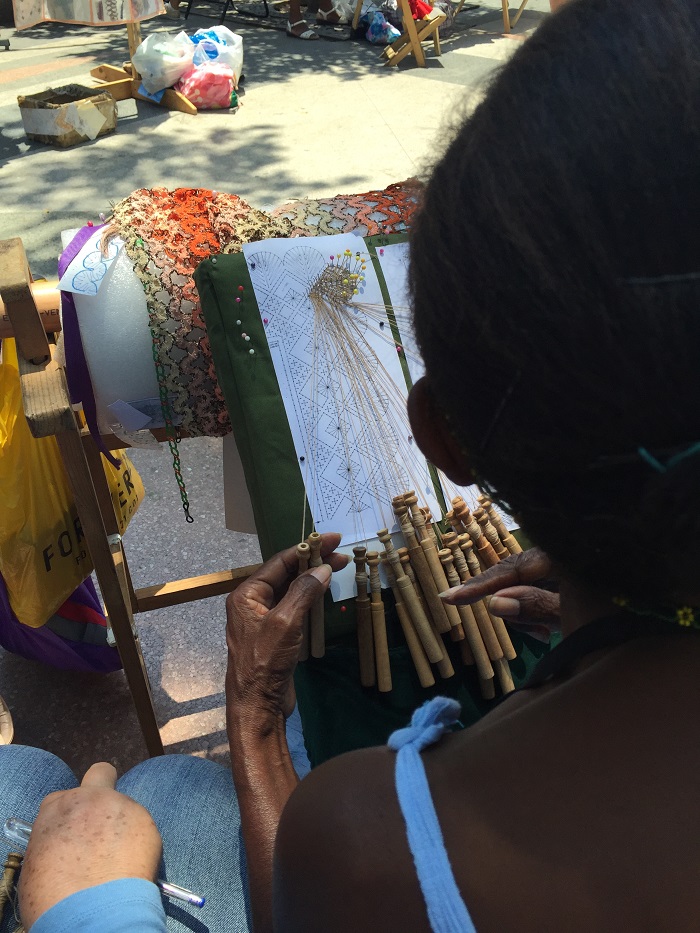
And then, before I recognized what I was seeing, there was a group of women clustered around one woman, and about half the women were working on lace pillows while the other have were tatting or crocheting. Moments later when I took my eyes from the bobbin lace work and the tatting, I recognized Adriana Martinez from the link I had found last summer about the arts of Cuba and Joan Sperans’ photo of Adriana.

IMG_2113

Can you imagine hearing about an artist who has a display in a park in New York (or any major city in the US) and going there and finding that very artist within moments of arriving? Maybe it could happen, but I can’t tell you how shocked I am to find the very woman, the only woman, I’d heard of doing bobbin lace in all of Cuba. I am stunned!

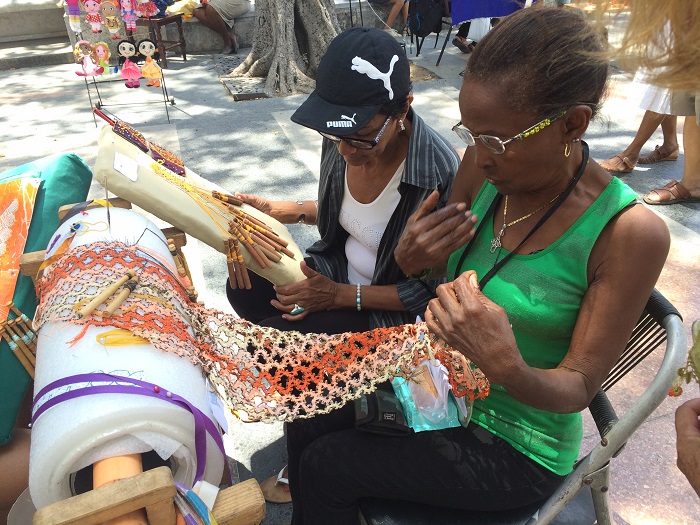
In this photo Adriana is helping a student with their bobbin lace project (bolillo).  Under the student’s pillow is Adriana’s project: a blouse made entirely of bobbin lace!

IMG_2114

While I talked to Adriana and a woman named Nancy who knew a bit more English, Bob took my phone and began showing photos of my own work to the other women: tapestry, knitting, bobbin lace. I gave Adriana and Nancy my card, and then all the students wanted cards as well. I was so touched that these women were interested in me, but naturally we were all interested in each other. It is thrilling to find people in a distant location doing the very thing you love to do so much! We were all quite intrigued with each other! At one point Nancy called a man over to interpret for us, and I was shocked at how many textile words he knew. I don’t know if he was related to one of the women doing lace or if he was just someone with his own artwork on display nearby. He was a young man named Hidalgo, rather macho looking, wearing a muscle shirt and smoking a cigar, and he knew all the English words for the techniques and materials the women were using.

And speaking of men, I have to mention that every time an official has come onboard Pandora, either from the Guarda Frontera of the Health Department, or even the fishermen who have rowed these officials out to inspect us, all these men have known that the pile of yarn and needles laying about our cockpit is called ‘tejer.’ Every time, no kidding, one of the men will point to my knitting and say ‘tejer.’ Presuming I might not know what they’re saying they will often put up both their hands and make a pantomime of knitting. There’s no mistaking their pantomime for crocheting or any other handwork. And I can’t help but think of all the American men who always assume I’m quilting, whether I’m sitting in front of a loom or a spinning wheel, or holding knitting needles or have a lace pillow in front of me. When I tell them the name of what I’m actually doing, the standard response is “Quilting…knitting…whatever.” How refreshing that Cuban men know the difference!

Here is a photo I meant to use weeks ago, on my first trip into Cienfuegos. Again, one of the Guarda Frontera had seen my knitting and correctly identified what I was doing. I already knew that many women in Cuba crocheted. I had made a joke to Bob that I could not imagine what women might knit or crochet in such a hot climate. And then I saw this!

3-23-16a 012 - Copy

The day only got more and more magical. Bob found lots of wonderful antique cars all along the Paseo del Prada and along the road that edges the coast and the Havana harbor. I found the location of the Quitrin shop that sells traditional clothing. I asked if the school of handwork was nearby, and they told me where to find it, although it is closed on the weekends. I hope to visit on Monday.

Every aspect of the day had a touch of magic to it. Walking through the pedestrian only, cobbled streets, we came to the privately owned restaurant (called a paladar) that was written up in the Lonely Planet Guidebook as the best restaurant in all of Havana. We were wilted from the heat and not feeling appropriately attired for such a nice restaurant. But we both felt that since we’d found it would be a shame to pass up such a chance. Paladars are a recent business venture in Cuba, a chance for Cubans to own their own business. Almost all businesses are owned by the government. There are lots of rules about running a privately owned restaurant, from how many tables you can have to who can be hired for staff. Just a couple of years ago the restaurant staff had to be family members of the owner. This restaurant, Paladar los Mercaderes, had quite a large staff, and clearly were not related.

I was asking our waiter for recommendations and also explaining that we’d like to try some traditional Cuban items when man seated at the adjacent table, having dinner alone, introduced himself as the owner of the restaurant and began making recommendations of what we should try.  After we ordered, he also insisted that we try a glass of the French Medoc he was drinking, and it was delicious, of course! Yamil Alvarez Torres and his wife and one of his cousins are partners in this venture.

Yamil owns two fishing boats, one on the north coast and one on the southcoast, which supply all the fish for the restaurant. Yamil used to live in this beautiful space with his wife and daughter, and he says he did all the renovations himself to turn it into a stunning setting for his restaurant. When you arrive you walk up a staircase strewn with red and white rose petals to a beautiful dining room appointed with ornate colonial furniture. Our dinner was octopus boiled and then grilled (very tender!) served with two sauces: one was lightly sauteed onions and the other a house-made pesto. Our main course was braised lamb with green olives, onions and small red and green peppers in a bittersweet dark sauce. The flavors were wonderful together! Tangy olives and pungent peppers in a mysterious dark, bitterweet sauce. Dessert was a layered chocolate confection with a torched sugar topping (like the topping on a crème brulee) that I simply cannot describe! It was all excellent, and momentarily after arriving both of us had lost our wilted, bedraggled feeling and were thoroughly enjoying ourselves!

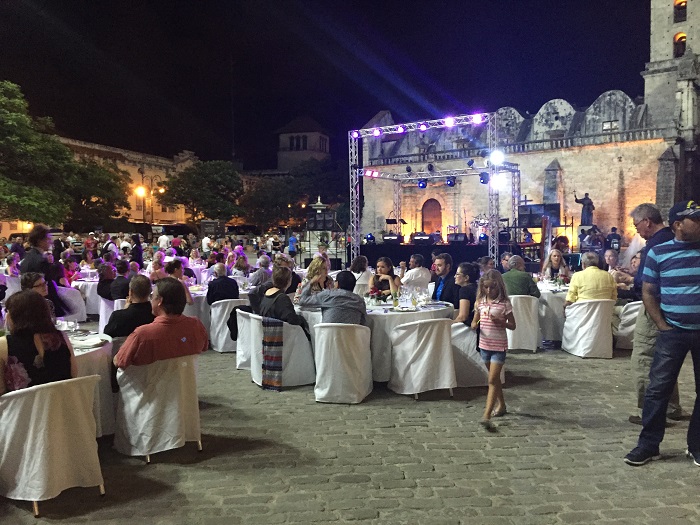
Perhaps the end of the evening was the most magical part of the day. Earlier we had noticed a large park being set up for a dinner. Tables and chairs draped in white cloths (what do you call those covers for chairs?) with centerpieces of red roses filled this square near the San Francisco ship terminal. There was a stage being set up and some dancers were milling about wearing angel costumes. We enjoyed the scene and then wandered on our way. At the end of the evening we found the event in full swing. It turned out to be an American tour group. While I stood in the square transfixed by a harpist playing Debussy’s First Arabesque, Bob began chatting with a couple who’d stepped away from their dining table.

IMG_2231

On the one hand, I could not believe I was standing in a square in Old Havana, listening to a harpist play one of my favorite pieces of music, while Bob was learning about the tour group who was having such an extravagant event on the square. It was a large group of people from the AIA, the American Institute of Architects, a group that Bob’s father was closely involved with during all the years he was publisher of “Progressive Architecture.” When I joined the conversation, the man speaking to Bob was saying that he read “Progressive Architecture” for many years.

Bob has moments almost every day when he thinks of his father and wishes he could make a quick phone call to his dad, even though it’s now been over two years since his dad passed away. We were both pretty stunned to find that this extravagant event that we’d watched being set up earlier in the day and that was now in full swing, brought Bob’s father back to us so intensely. It ended our evening in Old Havana perfectly.

Finding a cab back to Marina Hemingway late at night was not quite as easy as we’d imagined. All the taxis wanted more than twice the fare we’d paid earlier in the day. In the long run we found a taxi willing to take us back for only a little more than we’d paid in the morning.

Our driver calls himself Shrek and has a well-preserved red Chevrolet convertible with an almost spotless white interior. It was a terrific ride along the coast back to the marina.

IMG_2238

He’d never been to Marina Hemingway before so we had him deliver us right to the side of Pandora tied up along a bulkhead. I tried to get photos of the car and Pandora together—not too easy late at night! And Shrek took photos on his phone while Bob and I did the same.

IMG_2243

It was a fun ending to a magical day!


The Democratic Women’s Federation for Handcraft

Does that sound like a bureaucratic department in a communist state? Bingo. I am sorry to report that my visit to the Women’s Federation was a bit different than I expected. Yes, it was exciting…but it was also heavily overshadowed by some restraint on the part of the women I met. They had a reserve that was a bit unnerving to me, and none of them showed the enthusiasm for the handwork we had in common that I expected.

I met Noelis at the shop where the traditional clothing is for sale. Maria Estar was again on ‘display’ in a window making a small crocheted embellishment that would be attached to some item of clothing when finished. Noelis was happy to see me and led Bob and me on a walk for several blocks to the building of the Women’s Federation.

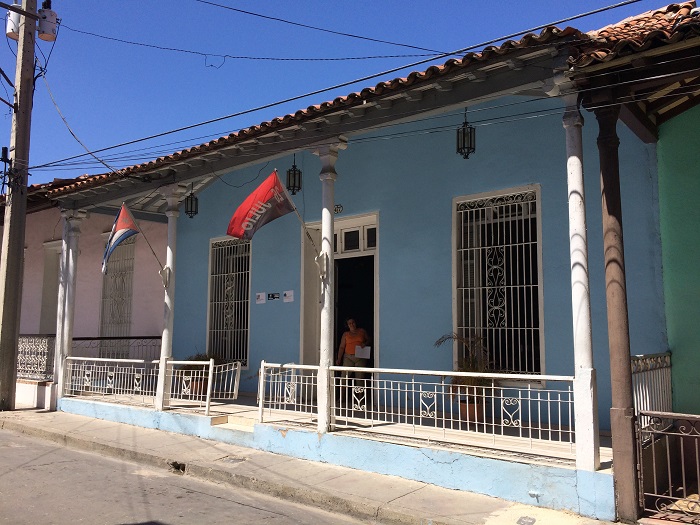
The building was a lovely old thing—I’d guess it was once a 19th century residence, one storey with a lovely front porchl.  From the street entrance we cold barely see into a large, dark front room with a hallway running back. Beyond this was a wonderful view of the inner courtyard that had a lathwork ceiling draped in a bounty of magenta bougainvillea blooms.

3-10-16b 006Noelis took us in to the first room where about a dozen women were sitting in a circle practicing their crochet. There was a man who was monitoring who came and went from a desk at the entrance. Noelis asked us to sit down near the desk while she got the ‘manager’ to come out to meet us.

Some of the women looked up from their work and smiled at me. I was very excited at the prospect of getting to see what they were doing! I was right near them, but I already had the sense that I needed to stay in my seat as Noelis had instructed.

The manager was a woman about my age. She looked very approachable, and I think we could have had a great conversation if we had not needed a translator. Noelis was our translator, and I trusted her, but she had such a deference for the manager that I think she translated my words very formally. Certainly what she told me the manager was saying was also very formal. I was not speaking formally to these women, and I have a feeling from the friendliness in the manager’s eyes that she was not speaking formally to me either. I think a LOT was lost in translation.

They told me the purpose of the federation was to keep the techniques used in traditional textiles alive and make sure the traditional garments of Cuba continued to be valued and worn, if not for everyday use, at least for use in life’s traditional ceremonies, such as weddings and other religious events. The women pay to go to this school (60 pesos for 3 months of study and including a hot lunch), and then have the opportunity to make money with their handcrafts after reaching a certain level of proficiency.

There was a class going on in the lush courtyard and there was a large studio with sewing machines where women were sewing various items of clothing. The machines were all Jukis. The only clothing being made that I recognized with certainly was the men’s wedding shirt, called a guayabera. Noelis told me there are many traditional women’s costumes that have the same details as the guayabera.

The manager’s office was a cramped space with no window. The four of us—Noelis, the manager, Bob and I—were quite challenged in the space. At one point another woman came in and joined us. I know that Bob and I created some curiosity, but it seemed that most of the women did not feel comfortable showing it.

While I could see that all the sewing was being done with commercial white fabric (and I had felt the shirts in the shop, and they were not traditional 100% cotton, but some kind of cotton/polyester blend), I still felt compelled to ask if anyone in Cuba was weaving traditional fabric. Noelis did not recognize words ‘weaving’ and ‘loom’ so while we chatted Bob searched the photos on my phone for images of my looms and some of my handwoven fabrics. Once he found these both the manager and Noelis confirmed that no one is weaving in Cuba. They do not have the equipment, but they said some women ‘do this with a needle.’ Hmmm…. I wonder if they meant some kind of needle lace. They saw some photos of my tapestries (tapisaria) and said that is not done in Cuba either.

We talked for a while about bobbin lace, tatting, knitting and crochet. Bob asked if we could take some pictures, and this is when things got noticeably awkward for the women. The manager said (through Noelis) that we would have to go to the Federation headquarters in Havana to ask for permission to photograph. Hmmm… They seemed a bit leery of us from that point on. I tried to explain that women in the US who do handcrafts are very interested in knowing what women in other parts of the world do. That did not go well either. The manager gave me a brochure about the Federation and told me to visit Havana for permission. Bob attempted to tell them that we are living on a boat ….that this method of travel means we will not get to Havana until mid April and we will not get back to Santiago de Cuba, but they said they could not do anything without permission from their headquarters. So, very sadly, that photo at the beginning of this post is all I have to show.

Noelis took me on the rest of the short tour. It was afternoon at this point and almost all the women were sitting together in the courtyard, all eating the exact same lunch on plastic trays with molded dividers to separate the food items—very 1950s. Lunch was white rice, some kind of meat, and some vegetables. As I looked to the side of the courtyard, along the hallway we were walking down, I saw there was a large kitchen where lunches were prepared. So some women work at the Federation as kitchen staff.

Noelis took me to a group of women at a small table just at the back of the large front room we had entered first from the street. Behind a room divider separating them from the space where the crocheters had sat in a circle for their class was a large Spanish carved colonial dining table (and large, ornately carved Spanish china cabinets along that back wall) where women were sitting practicing their tatting…or frivolite. Noelis introduced me to the teacher and then asked me to show her my tatting. I was a bit horrified because of all the textile techniques I do this is the one I am most UNproficient at doing! I did not want the teacher to think that my work represented the quality of work done by women in the US! I asked Noelis to explain to her that I am very much a beginner, that I only started doing this when we left on our trip a couple of months ago, and that this was my second attempt at a trim of rings and chains for the neckline of a blouse.

Naturally, the teacher found all my mistakes in a moment! She had Noelis tell me that I didn’t always have the same number of stitches between my picots, and I must strive to always have the same number. Well, yeah… I do know that even though I haven’t managed it yet. Wish I could have explained that I did this work while bouncing about on a sailboat, usually sailing in gale force and near gale force winds…but I realize that would have been just looking for reasons to explain my faults! Then she said my picots were rather good but there were still tiny differences in sizes, and I needed to get more consistent with that as well. At the end she said that if I was a beginner I was doing very well. Still, I left feeling pretty mortified that of all the things I could have shown a teacher in this school, wouldn’t you know it would be the one thing I barely know!

Noelis escorted us out of the building, and as she left us to return to the shop where we met her (in the historic district) once again she said that she hoped we’d come back with permission from Havana, and that she ‘would be waiting for me.’

This incident put a quite a damper on my enjoyment of the rest of the day, I must say. I always get so excited to meet other textile makers, and I usually feel that it is a language we all share and a place where we can all have the same enthusiasm and ability to teach and to learn from each other. The whole proletariat attitude really took the wind out of my sails–sorry for the dumb pun–but I really felt deflated. Here were a group of women I would love to communicate with about subjects near and dear to all of us, and there was this terrible pall over the whole thing. There was a definite sense of propriety that these women exuded, and they seemed to be weighing their interest in talking to me against the rules of what was expected of them in representing this federation.

After a short walk back to the historic district, we were standing in the main parque when we were approached by someone who said he knew we were staying at the marina… I did not recognize him, although he said he works for the customs department at the marina. He remembered us from when we checked in, but I knew I had not seen him. He offered to show us some sights and find a place for us for lunch. In my newly deflated state I wondered if there was some agenda to his offer….

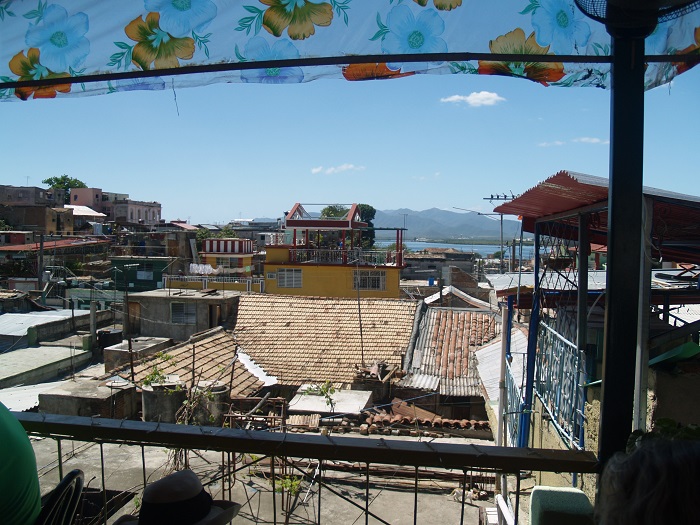
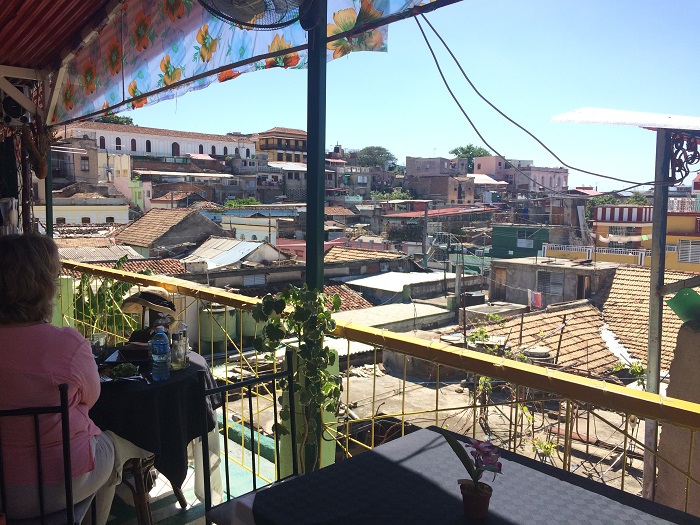
Well, there was, of course, but also he was generous with his knowledge. He took us to a local restaurant that I’m sure was owned by his family or friends. That was okay because it was a great place, and we would have no idea of how to find such a good local place on our own. ‘Paladares’ are family owned restaurants that the Cuban government has now sanctioned. There are many rules for running one of these: a limited number of customers may be served (I think it is 12), and they cannot serve foods that are reserved for gov’t run hotels and restaurants which includes lobster and the better cuts of chicken. Paladares may serve pork, some chicken, and local fish. We let the waiter choose our meal for us, and it was excellent! This particular place was on the 3rd floor balcony of a small residential building (typical Soviet block cement structure), and up on the balcony was an amazing view of the decayed apartment buildings all around that could have been anywhere from Kabul to Cairo with a backdrop of the stunning harbor.

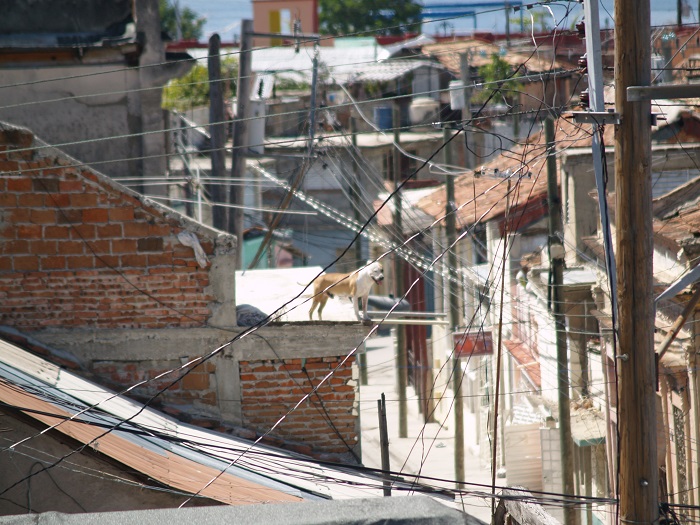
OLYMPUS DIGITAL CAMERA3-10-16b 012Some of the surrounding buildings had no roofs, or had makeshift roofs of corrugated tin with many holes and many repairs. All the buildings had windows with no glazing. On one rooftop balcony near us there was a dog that looked very much like our son’s dog Bobi. This gave me a little tinge of homesickness on the very day I was missing my son’s birthday. Well, I was certainly thinking of him.

OLYMPUS DIGITAL CAMERAOur customs official cum tour guide offered to get us things—cigars, rum…from places that tourists cannot visit and therefore much less expensive. He admitted that he had some ‘relationships’ with these places that would give him a commission for what he sold. It was all a bit overwhelming for me. He said he got his very good job working for the state because of who he knew. He used the phrase “Who you do, who you know,” which sounded like everything was based on what you do for someone and who you know that can improve your own situation. I got that, but he must have wanted to make certain I understood because he added, “one hand washes the other.” –he could not possibly know that I learned this phrase in Latin in high school, about a million years ago! I guess I was too hot and too disappointed in my visit to the handcraft school to enjoy this information. Now, a day later Bob and I have discovered that he does not work for customs at the marina. He’s not the first person to recognize downtown in Santiago de Cuba—every seems to know who we are. I think we were had, but it was kind of fun anyway. Boy, these people know how to turn a trick.

The day was hotter than the previous day, and when we returned to Pandora we had a very cold gin and tonic and a simple dinner of cheeses from France and Italy, and crackers from the UK , that we bought in Nassau. After washing a local mango in a basin full of water mixed with hydrogren peroxide, we ate it. No ill effects today. I might also add that I had a mojito at the paladar and a lemonade at the Casa Granda Hotel, both with ice cubes, and I am still alive. Whew!

Scroll to Top