ArgoKnot

Author name: ozweaver

NEWS Exhibits

These didn’t get posted as quickly as I intended….I made the mistake of tackling some boxes in a room off my studio, and now I am buried in stuff that I have no idea where to put!

I have opened Pandora’s box, and now my carefully organized studio is a sea of knitting, spinning and weaving materials that is far vaster than I can handle!  There just isn’t enough storage room for all this stuff!  What to do?

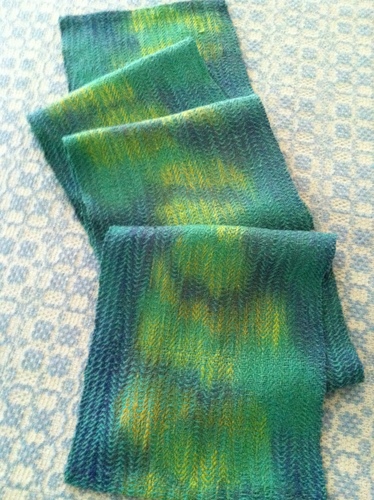
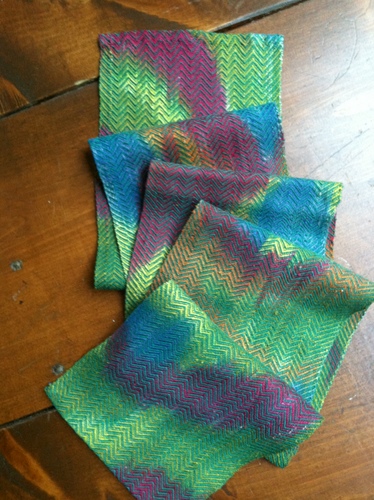
Meanwhile, my two scarves are finished and cut from the loom.  I decided to hem them rather than have fringe, and now I’d like to do a little beaded embellishment at the hem….for this I need to find a local bead store, and I need time to do the beading. Here they are after a hand wash, hanging to dry from a birch tree in my front yard.  I wonder what the neighbors think when I dry handspun skeins and dyed projects.

It feels like it will take months for me to unbury myself from the chaos I’ve unleashed by opening all those boxes!

In fairness, it’s not all fiber related.  The chaos includes a lifetime of printed music from my performing days, a set of dishes that I could not squeeze into the kitchen or dining room when we moved in last year, several lifetimes of photos that include our kids plus both sets of parents’ photos (they have both moved into assisted living facilities and now there stuff resides with us!), my father’s ridiculous collection of DVDs and our collection of music CDs which are no longer necessary.  I’d like to give Bob the task of dealing with the DVDs and CDs, but his plate is already laden with other chores.  I think it’s all up to me, and there will be no weaving or knitting until I get to the bottom of all this stuff!

And, naturally, all I want to do is weave!  I’ve come home from NEWS so inspired!  My dyes have arrived and I’ve made plans for the last of the warp I made for trying this technique!

During the conference I bought the book Custom Woven Interiors by Kelly Marshall.

I want to weave almost every item in the book, but I’d like to start with this rug!….as a runner in the kitchen and a smaller version for the two Dutch doors in my family room.

And meanwhile…. there is all that inspiration I got from the exhibits at NEWS.  Oh yeah, that was the point of this post….  here are the photos.

From the Instructors’ Exhibit, this is Dianne Totten’s wonderful collapse weave jacket.  It is done in the manner of ‘shibori on the loom’ with extra warp and/or weft threads that get pulled to create the pleats.  Then the fabric is treated with something that keeps the pleats in even after washing.  I hope to take a workshop in this technique someday!

This is the back of Barbara Herbster’s large wrap.  I have done a lot of scarves and shawls in this technique of supplemental warp with ribbons.  I wouldn’t mind getting back to it!

I thought this was a great combination of items together!  A  matching set of double woven blanket and pillows with the wonderful ply-split woven vessel.

There were wonderful household linens in the static juried show!  These were the items that inspired me most!  Look at the dragonfly inlay in this tablecloth!  It is a picnic set with wine bottle holder, silverware wrap, and matching napkins!

I love the overshot inlay on the corners of the napkins to match the table cloth!

The colors in this rep weave table runner and placemats are terrific….better than this photo shows.  They were woven by Barbara June Gordon.

A loom woven shibori hand bag!

This transparency of a lady slipper is a gem.  There was a larger transparency that won an award, but this small work is the one that won me over!  Look at that great woven border!

And THEN there was the fashion show!

I am intrigued with this beautifully woven and assembled handbag!

Great use of color and stripes in this vest.  It looks like it would be flattering on almost anyone.

This is an amazing piece, woven with horsehair and feathers and attached to a leather strip which fastens around the neck.

This jacket was woven from some lovely materials that I have now forgotten!  Hemp perhaps?  and linen?  It is called “Birch Bark Jacket” and the materials and woven technique make it a perfect match to its name!

It was woven with an undulating reed!

And this is the piece de resistance, designed and woven by Barbara June Gordon! The woven structure creates all the fitting in this top, and trust me, it fit the weaver perfectly!  She was brilliant to model it herself so we could all marvel at her skills.  It is an amazing feat of color, structure and fitting perfection!

Now you can see why I wish I’d never opened that first box.  I’d rather be weaving!
NEWS Exhibits (and 2nd Painted Warp Scarf)

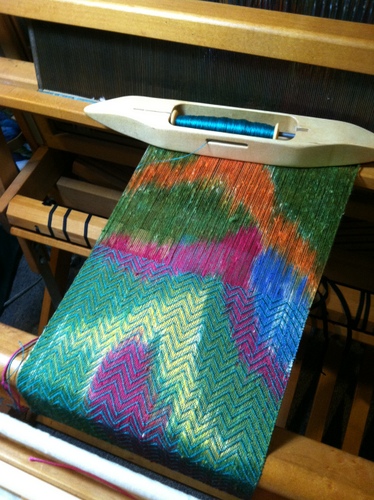
Yesterday I began weaving the second painted area on my workshop warp.  I did not finish this scarf although I was able to finish the first scarf in one day.  After experimenting with various weft colors and weave structures, I found that either plain weave or a straight 1 through 8 treadling sequence looked the best on my brightly colored warp.  I knew I probably couldn’t stand to weave two yards of plain weave.  Now I realize that I could just barely stand to weave two yards of straight treadling!

The first scarf was woven in an advancing twill treadling that had a 72 treadle progression.  This kept me on my toes!  I found I was soon yawning through the simple    1 – 8 repeat of the second scarf….  I ended up watching streaming episodes of “Call the Midwife” to keep myself awake!….and still, I didn’t finish.  Hopefully today!

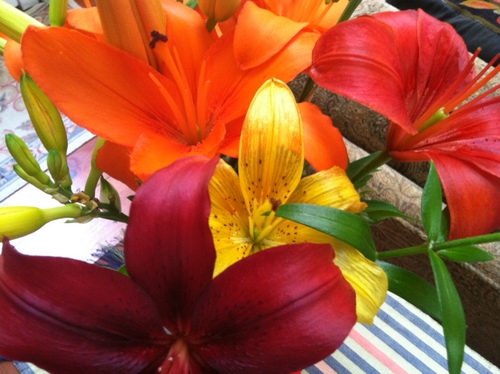
By the time I was painting the second scarf on this warp during the workshop, time was getting very short!  I opted for my simplest photo of a vase of various lilies that I had cut from my son’s garden.

Here is a little tour of some of the NEWS exhibits.  First, the guild exhibits:

The Rhode Island Guild did an entire exhibit related to books.  The pieces on display were either inspired by literature or had to do with book making.

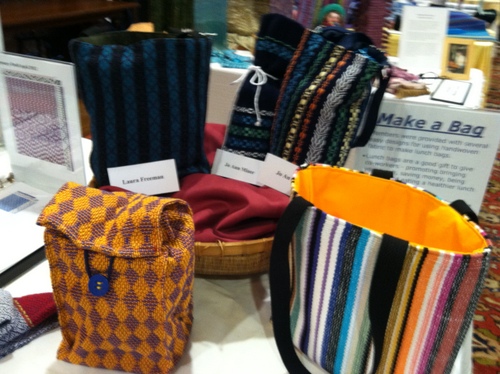
Sorry the focus is a bit off in this photo.  Still, I had to include it because it gave me such inspiration for making bags! Part of the Connecticut Guild’s display was a handbag making project that one of the area groups had completed

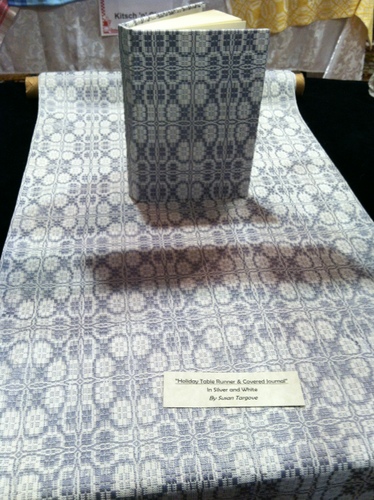
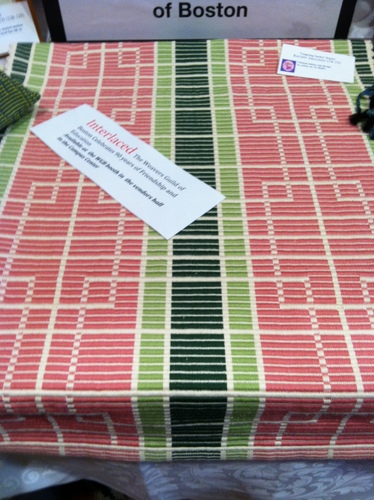
The Boston Guild has published a book of weaving patterns to celebrate their 75th anniversary.  Their exhibit showcased the projects from the book against a backdrop of pages from the book.  This may be my favorite project from the collection!  Certainly it will be the one I tackle first from this terrific book!

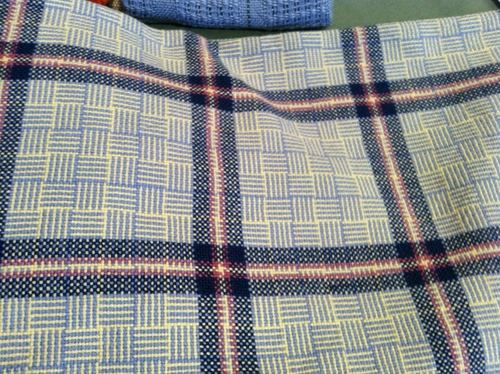
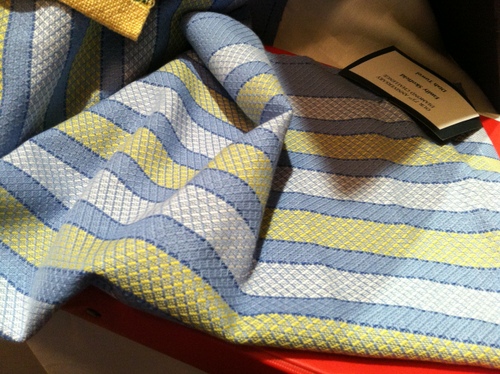
This is a stunning towel woven by my friend Emily from the New Hampshire guild.  Perfect color and structure choices!

I think there was a year’s worth of inspiration in the guild exhibits alone!

NEWS Cont’d, Margo Selby Address

I’m skipping to the end here to describe the keynote address given by Margo Selby on the final night of the NEWS Conference.  She is so young to have made such great strides in handweaving and in founding a commercial textile design business.  She is an enthusiastic speaker with a great deal of positive energy that emanates from her.

Her presentation was focused on the phrase she uses on her website (and is the title of the video that follows): “Beauty is the First Test.”  She does wonderful work with color and texture, and it was particularly compelling to me since I’d just spent the weekend in Sarah Saulson’s class creating cloth that would balance the colors of our painted warps with the various weave structures we had threaded on our looms.

Margo brought lots of items from her commercial textile line: scarves and wraps, small zippered bags, and lovely jackets and tops, all made from her lively fabrics which have silk warps woven with synthetic wefts that create a stretchy, bouncy fabric.  I was completely enthralled with her use of color and stretch and texture and asked where I could find her line in the US, to which she replied that the very things on display were for sale!  It was hard to choose, but when I am in the presence of such beautiful textiles I cannot walk away empty handed….

Margo ended her talk with a video that included her and several other textile artists (and one woodworker). This video includes a bobbin lace maker!!… and how often do you see any attention given to lace makers? The take away message in this video is this: “There is no place in the world for ugly mathematics.”  Clearly, Margo’s motto that ‘beauty is the first test’ demonstrates what we all know, that the mathematic proportions of size, color relationships, use of texture and smoothness,  is the basis of beauty in everything made by hand.

NEWS Conference, in segments

My first NEWS Conference has come and gone.  It was a whirlwind!  There were some great moments and some not so great moments!

My class with Sarah Saulson was titled “Freedom of Expression: Painting Your Warp,” and this is a technique I dabbled with more than a decade ago in a workshop with Betty Vera.  I wondered what might be different about Sarah’s process.  Much was the same, of course, but the smallest alteration can make a huge difference in the final outcome, as well as in one’s ability and confidence to attempt a technique at home, without the safety of a teacher and a roomful of helpful students!  Betty’s class so was wonderful and memorable to me that I was thrilled to try this technique again, and Sarah’s instruction helped me gain the confidence I need to attempt this on my own.  It was a combination of doing the process for the second time and tweaking at the some of the small, but very important details of the technique!  I’m thrilled to try this again as soon as I weave off the warp from this project!

The Process:

Make a warp and dress the loom according to what your finished project will be.  In our case we have put on enough warp at 8″ wide to weave two scarves.  Our guidelines were scarf weight materials, such as 10/2 or 8/2 cotton or tencel, or anything of a similar weight that would produce a drape-y fabric suitable for a scarf.  I have plenty of unlabeled medium-fine silks in my stash so I chose one of those which I documented in my earlier post.  I set it at 30 epi since it seemed slightly finer than 10/2 cotton.

For my first painted scarf warp I chose this image as my inspiration….sunlight on water.  I planned to change the color way to be something representative of light on water in the Bahamas….more aquamarine and periwinkle blue than this image.

The process involves weaving in a stick as tightly as you can once your loom is dressed.

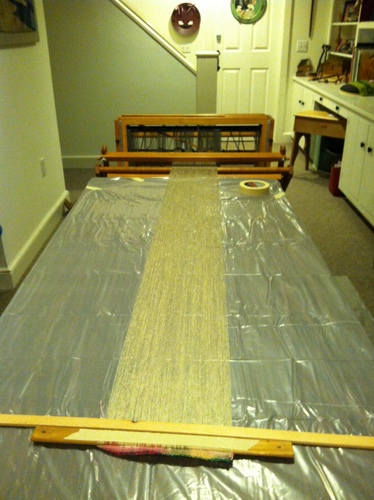
Next, we cut off the bit of weaving with stick from the front beam and used that stick to pull off one scarf’s worth of warp, which happened to be the same length as our painting tables which were covered with plastic drop cloth.  Here is Sarah demonstrating that you want your beater leaning against the breast beam, with your brake released,  as you use the woven-in stick to pull the warp off the front of the loom.   Notice the table has been covered with plastic.

Once you have pulled your warp to the end of the table, you clamp the stick to the table and re-set the brake on your loom.  Then you crank down the tension on your loom so that the warp is stretched tautly from the back beam to the clamp at the other end of the table.  Ready for painting!

Mixing the dyes is no small feat!  This time around I found the process far less intimidating.  It’s still hard for me to get the colors that I have in my head, but of course that is going to take lots and lots of practice.  There is just no substitute for experience.  We were lucky to have Sarah’s guidance on mixing colors.  If you could name the color, she could help you get quite close to it.

So here is the beginning of my sunlight on water. As you can see from the photo, we mixed our dyes in little plastic cups and are using small foam brushes to paint. We are using Procion MX dyes which do not require heat, only a moist environment and time, to set.  MX dyes require mixing in water that has been enhanced with urea as a humectant.  We heavily spritzed our warps before starting to paint.

Into the final dye color combination in our little cups we added two very important ingredients!

1.  Dye activator, which only lasts about 4 hours, so we did not add that until we were absolutely ready to paint. Activator can be either soda ash or ProChem’s special powdered activator which is what we used.  I mixed up three colors I thought would get me started on this image, and I did not add activator until I had gotten all three colors to the hue and saturation that I wanted.

2.  The other ingredient is printer’s paste which thickens the dye solution enough to keep it from puddling and spreading as you paint shapes on your warp.

We were all a bit worried that the clock was ticking faster than we could paint when we added the activator, but Sarah was right when she assured us that painting would be the fastest part of this process.  We all got two scarves painted within the four hours of dye activation time.

The second color going on my warp

Fellow student (and Connecticut Guild member) busy painting her first scarf!

Connie Gray’s floral warp

Sarah demonstrated how to roll up the first painted scarf and prepare for the second.  You cover your painted warp with a layer of plastic film, then using the stick, roll up the painted warp as tightly as possible.  The plastic separates the layers of warp from each other, and by rolling as straight as possible, the edges of the warp should not fall in on themselves.

When you have rolled all the way back to the front of your loom, take some time to thoroughly clean the plastic draped table to get rid of all dye from your first painting session.  Then you release the brake on your loom, rest the beater against the breast beam, and begin pulling out the next scarf’s length of blank warp to paint.  When you have pulled out new warp to the extent of your painting table, clamp the sticks with the rolled up painted warp to the table, similarly to the first time. Time to start painting the second scarf!

When you have painted your last scarf, there is no need to roll it up.  Just cover with plastic and begin timing your 4-hour, dye-setting time.  The only exception to this is if you have used turquoise #410 which requires 12 hours to set.  Sarah did not bring that color since this class did not allow for such a long setting time.

Sarah and a few helpers came back to class about 9pm that evening to unwrap our warps from the plastic.  This is necessary because we planned to wind our warps back on first thing on the second day of class.  At this point there was no tension on the warps, and this was the moment I had dreaded!

But what an explosion of color greeted us for the second day of this workshop!  Sarah had found as many easels as she could and had draped our warps on them! The warps came off the looms,  and up in the air onto the easels!

The morning began with rewinding our painted warps onto our looms.  This was the moment I dreaded.  I just did not believe that these warps, now lightly coated in dye, and now without tension, would wind on smoothly.  But they did.

Best tip ever: From Allan Fannin,  begin winding with absolutely no tension on your warp.  Wind only 2 revolutions of your crank, then stop and go to the front of the loom to grab your warp.  Make a smooth hard tug on the loose warp that extends at the front of your loom to tighten down the warp you have just wound on.  Go back and wind on two more revolutions and then go tighten the warp again from the front of the loom.  Repeat this process until the entire warp is back on the loom.  It was a dream to beam this way!

Second Best Tip Ever, which works like a charm on a Baby Wolf (you’ll have to try it yourself on other types of portable floor looms):  when you are ready to tie up your treadles, tip the front of your loom forward and rest it on a chair or weaving bench.  Go the back of the loom and see if the treadles are now at easy an easy to reach height for you to stand or sit in a chair to work with them.  Do you tie ups from this comfortable position!  This gem of advice was given to me by Emily who learned it from someone else.

The second day of the class was experimenting with weft color and weave structure.   There were amazing changes in our painted warps due to the weft colors we chose and whether we wove with some simple or complex structure.  My loom was threaded with an 8-shaft advancing twill.  I had the option of weaving it in a straight twill treadling, or point twill, or a very long repeat of advancing twill.  I also had the option to weave plain weave.  So I experiemented with all those possibilities as well as weft color.  I tried yellow, hoping to bring out the sunlight areas of my painted warp, but as I expected, a yellow weft was too garish.  I then chose four different watery colors ranging from medium aqua to emerald green, to a deep periwinkle…..all colors I remember vividly from my Bahamian winter.  In the long run the medium aqua won.  It was in the mid range of the colors used in my warp, and it worked well with all the warp colors without dominating or drowning out any of the other colors.  It also worked well with the structure.  The color I liked almost as much was a purple weft.  The drawback to purple was that suddenly the advancing twill structure was more obvious than the painted warp.  It’s a delicate balance between the two and the aqua did it best!

Some people found that plain weave worked best on their warps, so in spite of having threaded more complicated patterns and having tied up their treadles for some interesting weaving, they really had to make peace with plain weave.  It was a dramatic choice for some of the warps.  Most of us felt that if the warps that were painted with fairly realistic images, in our case mostly floral type painting, plain weave was the best choice.

Here are some examples.  The choice of weft here does a great job at subduing the strong colors of the dye.  The twill structure on this warp just did not work, but plain weave is stunning!

While this is also a large floral looking image, it is not quite as realistic and her choice of twill looks wonderful on this warp!


Putting Inspiration to Use

Today I am working on the warping assignment for my upcoming class at NEWS (New England Weavers’ Seminar).  The class is called “Freedom of Expression,” and it will be taught by Sarah Saulson from Syracuse, NY.

Here is the class description from the NEWS catalogue:
In this dyeing and weaving workshop, we will have lots of spontaneous fun painting warps with fiber reactive dyes, after the loom is warped. This wonderful technique allows weavers to work with color and pattern in a loose, free, expressive way, creating large-scale abstract forms and opens the door to a variety of surface pattern techniques, including stamping and stenciling. We will paint enough warp to explore the possibilities of the technique, and for a scarf. We will learn how to mix our own colors working from primary colors/hues.”

The class materials include bringing an image to serve as the cartoon, or at least as the inspiration, for our warp painting.  I am having trouble narrowing down my images to one or two.

I have been taking lots of photos of my garden recently, but I would NEVER think roses should be my design inspiration.  All that pink and green would surely set my teeth on edge….far too cloyingly sweet for a  handwoven fabric! Then I happened to see this fabric on Cally Booker’s blog.  Just goes to show that I should never say ‘never.’

Here are some of the images that I may try to explore in dyeing a warp.

A Kasuri dyed panel that I’ve had for years

A large painted plate

Several wood block prints, including the nasturtiums I’ve been playing around with for a tapestry design

It might be quite nice to have bright blue and dull blue/green mixed with saturated oranges and golds.  But what would I use for weft??

The purples, greens and golds in this image really appeal to me.


Clearly, I’m intrigued with the possibility of combining blues with a range of orange/golds.

My warp is a natural colored silk from my stash.  It is has a beautiful sheen and a slight slub, and it is somewhat finer that 20/2 silk.  I am hoping that 30 epi will be a good sett for it.  If not, well….. I may have an unfortunate experience. There is not time to sample!….and I realize that is a BIG risk.

I was not able to get good lighting in my studio when I took this photo.  The silk is not this golden.

I am taking a break at the half way point in making the warp.  Now I can get back to it.

Scroll to Top