ArgoKnot

Author name: ozweaver

So Much to Tell, So Little Time!

Unbelievably wondrous knitting and weaving things have occurred since my last post.  Now that I’m sitting here at my computer I don’t know where to start!  I guess I’ll just take a deep breath and tackle things one at a time…maybe this will end up being more than one post.

So, why don’t I start with today.  It’s fashion week in New York, and that is a guaranteed siren call for me to read the NYTimes.  Today was my lucky, lucky day because there was even an article about knitting:  “Grandma Never Knit Like This” is an article about Josh Bennett, who has a line of knitwear for men. He has designed knitwear for Tommy Hilfiger and Michael Bastion, and he has a pattern book of his designs published by Rowan and using their yarns.  In his Rowan designs, he designed sweaters that evoked the flavor of various New York neighborhoods.  This one is Hell’s Kitchen.

The article referenced SamuraiKnitter’s online brouhaha with Josh, so of course I had to check that out.  But really, who cares about that, when there is a world of fun on this site! What cave have I been living in??  Ms Samurai Knitter is the perfect anitidote to dearly missed You Knit What?  I could barely tear myself away, and had a good half hour of gut busting laughter reading the author’s insightful reviews of various issues of “Vogue Knitting.”  There’s nothing like  laughter to start a day!

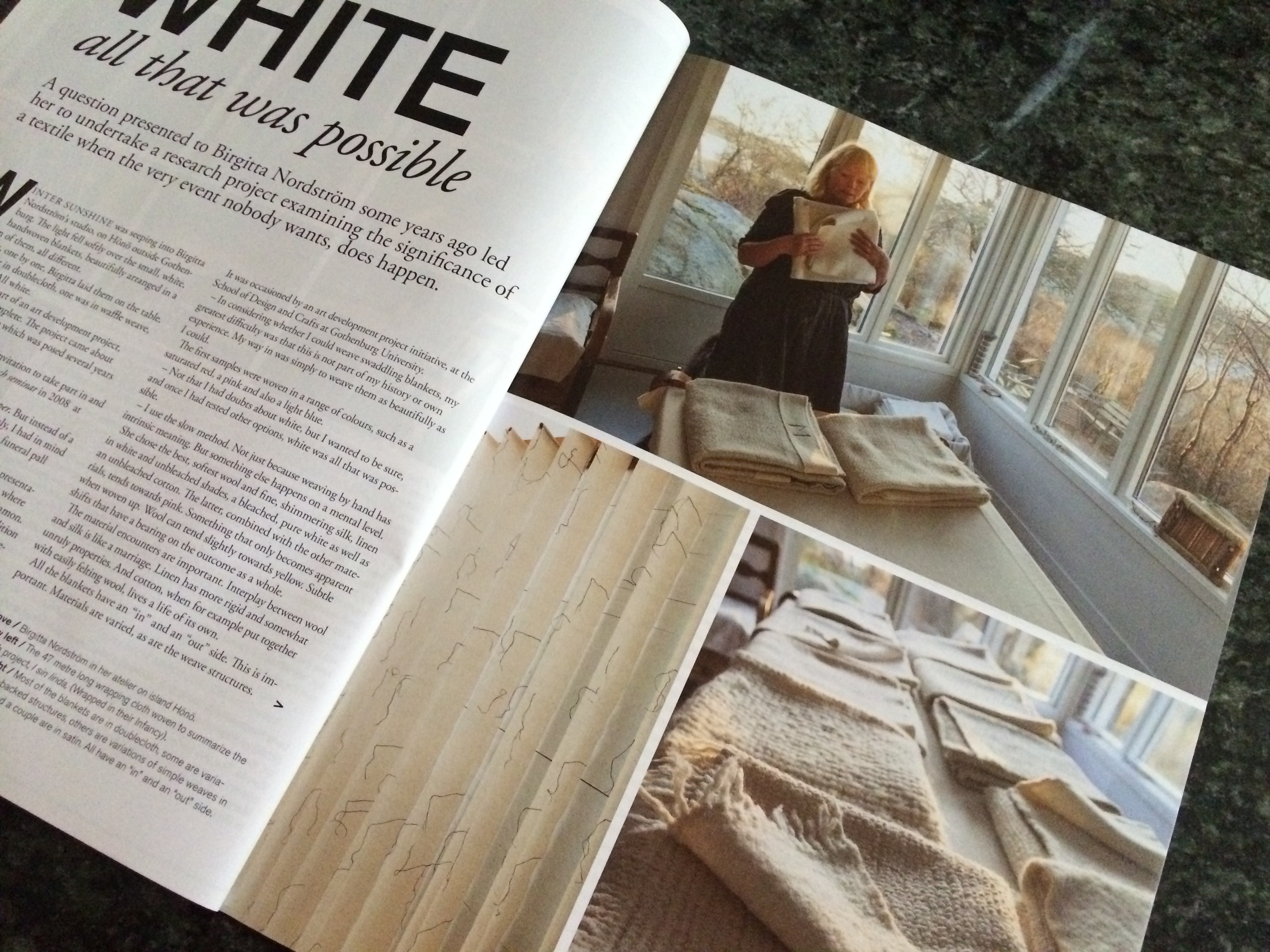
And speaking of publications (as I think blogs are firmly in that category), earlier this summer I got to catch up on all the periodicals I missed while we were off sailing.  In this year’s issue #1 of “Vav Magazinet,” which was entirely devoted to the color white, I read quite a moving article by Birgitta Nortstrom.  Ms. Nordstrom is Senior Lecturer in Textile Art at University of Gothenburg, Sweden, where she received a grant to design baby blankets, with an outside layer  that would be a visually pleasing weave structure and the inside layer would be fulled to create the softest fabric to touch a newborn’s skin.

This alone would be such a beautiful idea for a project, but her idea went further.  Hang on to your hat…..  these blankets would be available at hospitals to be given to mothers whose newborns did not survive birth.  These blankets would actually be shrouds.

2014-09-11 15.06.39

The moment I finished reading the article I wrote an email to Ms. Nordstrom, telling her how moving I found her project and that this project that should be done everywhere.  I asked if she might consider writing a book about the blankets.  It was late July before I heard back from her (she was away in the remote north for a holiday), and it turns out she did write a booklet as part of the process.  She asked for my address so she could send me one.

2014-09-11 15.15.41

So now I feel quite driven to do something with this marvellous idea.  Anyone want to join me? Stay tuned….

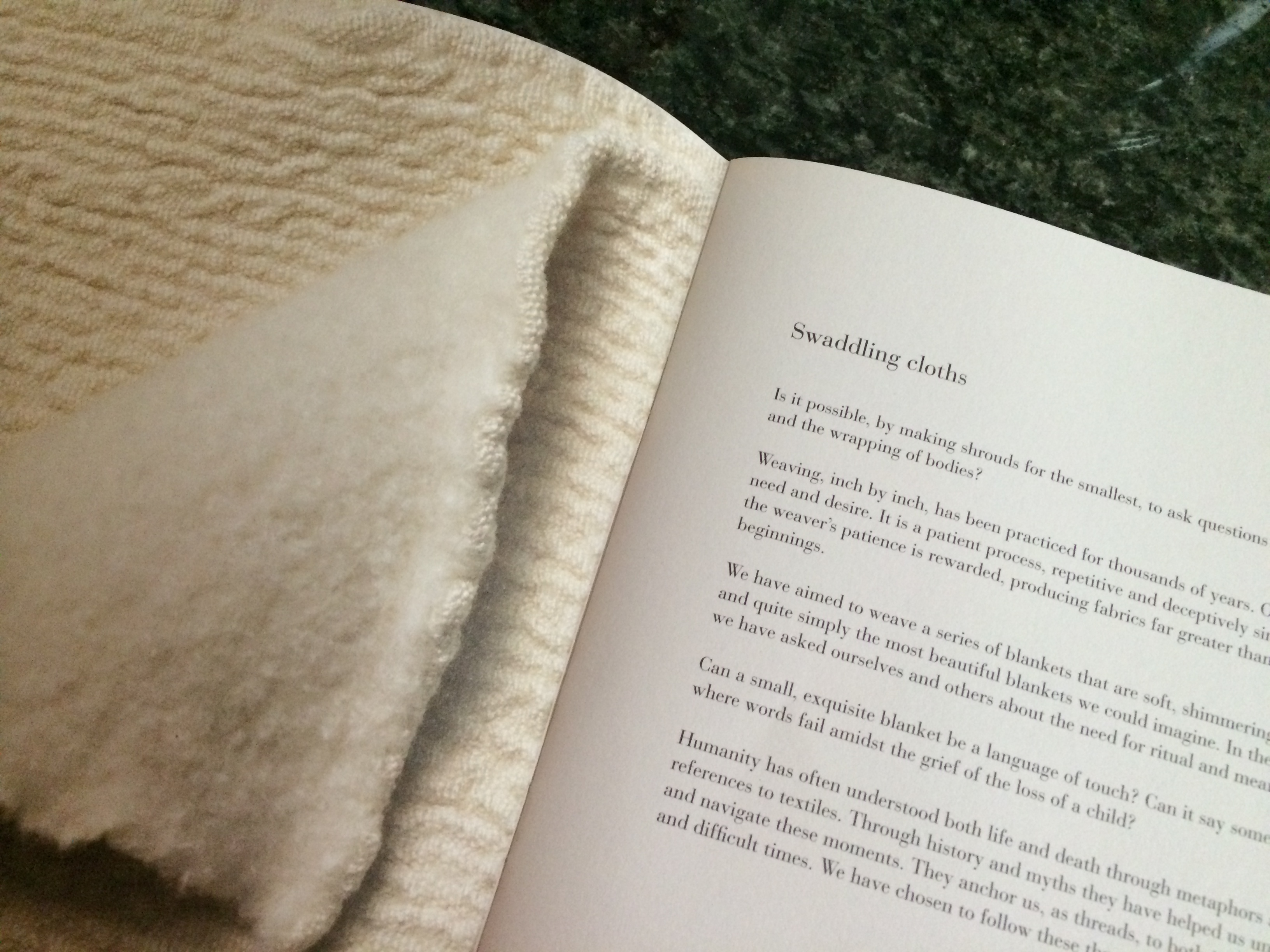
Here is Birgitta’s description of her project:

Is it possible, by making shrouds for the smallest, to ask questions of grief, touch, and the wrapping of bodies?

Weaving, inch by inch, has been practiced for thousands of years.  Out of both need and desire.  It is a patient process, repetitive and deceptively simple.  In the end the weaver’s patience is rewarded, producing fabrics far greater than their humble beginnings.

We have aimed to weave a series of blankets that are soft, shimmering, unique, and quite simply the most beautiful blankets we could imagine.  In the process we have asked ourselves and others about the need for ritual and meaning.

Can a small, exquisite blanket be a language of touch?  Can it say something where words fail amidst the grief of the loss of a child?

Humianity has often understood both life and death through metaphors and references to textiles.  Through history and myths they have helped us understand and navigate these moments.  They anchor us, as threads, to both joyous and difficult times.  We have chosen to follow these threads.

I think I’ll stop here, except to include a bit of our lovely Connecticut River scenery.  I know this post has been a bit weird, going from snarky knitting reviews that had me rolling, to the subject of grief and loss…. well, maybe I’m thinking of summer turning to autumn….There are only 10 days left in summer, but since school has started, and since it’s past Labor Day, most people think it is already fall.

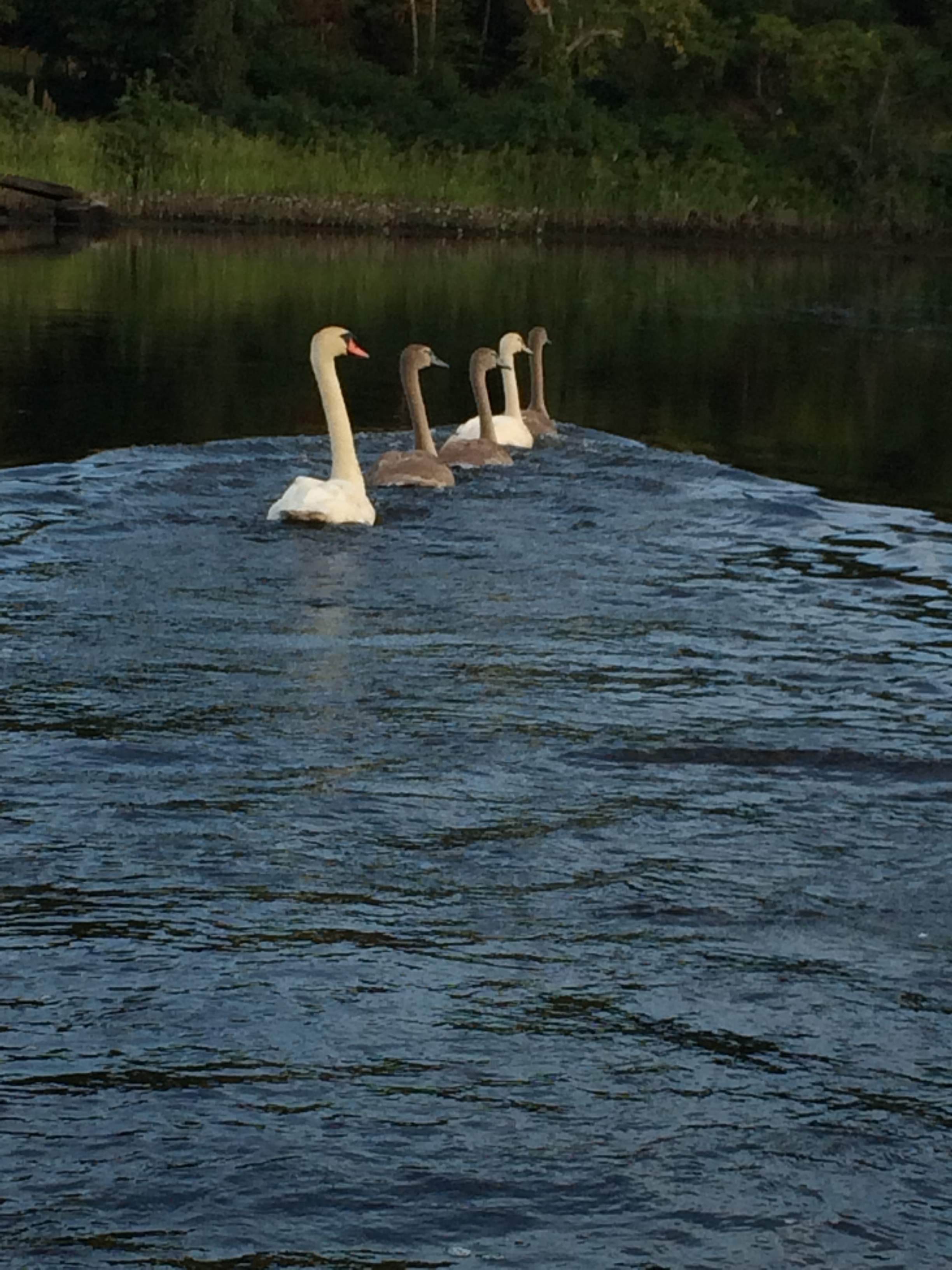
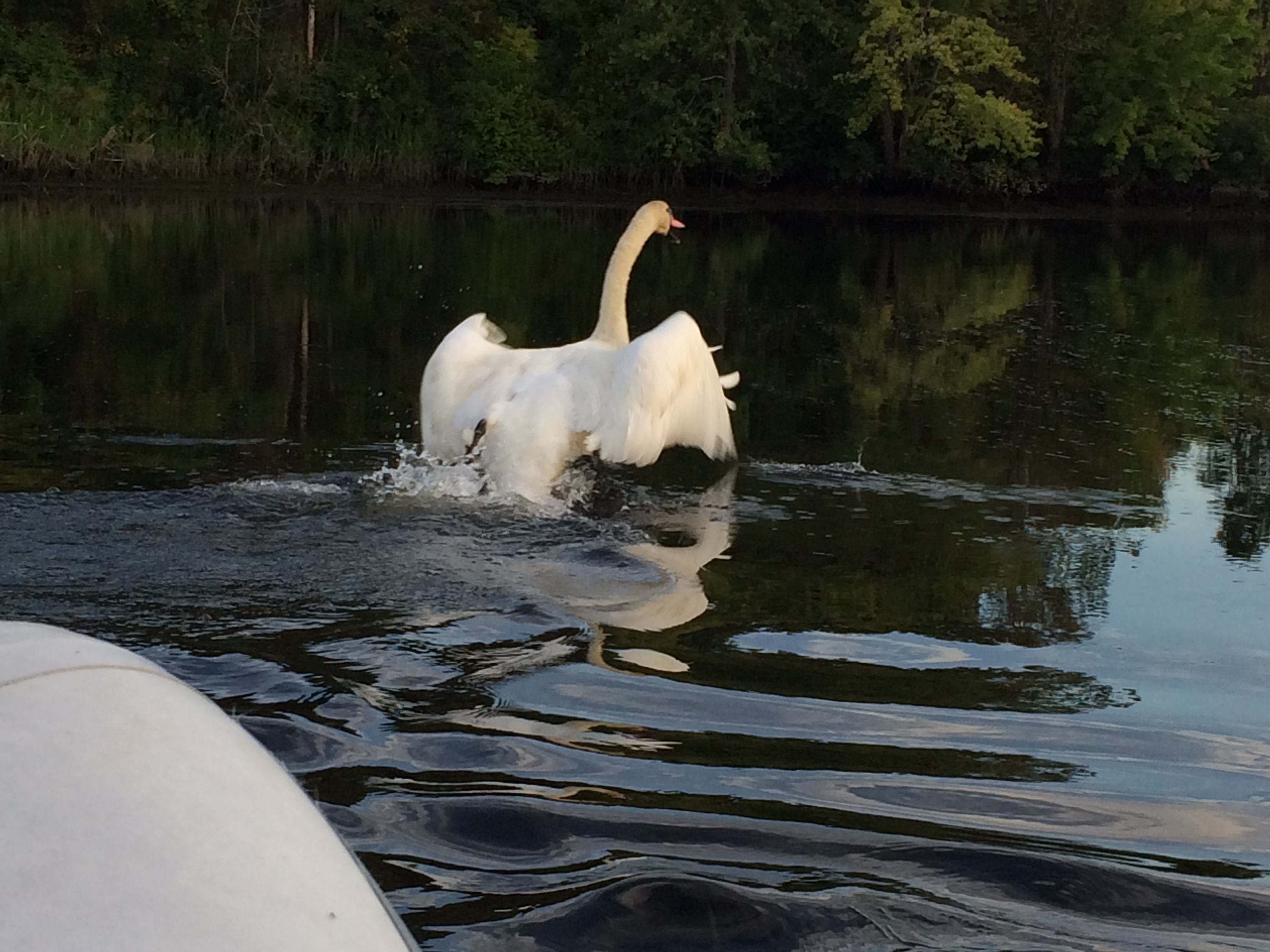
2014-09-10 18.33.21Yesterday evening, Bob and I took a dinghy ride up one of the estuaries near where we live on the Conneticut River.  It’s a narrow and winding stream with water hyacinth and tall grasses on both sides.  The grasses were full of red winged blackbirds that all took flight as we passed.  This swan family opted not to fly away….maybe the younger ones aren’t good flyers yet.  So their tensions were mounting as we all headed up this little estuary.  In the end the mother and cygnets turned a corner too shallow for our dinghy, but not before the father tried some diversionary tactics to lure us away from his family.

2014-09-10 18.34.13And didn’t it become obvious to me that we are all more similar than not.  The family made a phalanx as best they could to protect the cygnets, and when that failed the father tried to draw us away.

Along with the swans and the red winged blackbirds, we saw a great blue heron fly low and slow right above us to land at the edge of the marsh grasses.  It was a beautiful evening.  It’s almost time for our boat to head to warmer waters, so it will be another spring and summer before we see sights like these again.


Directions for a handwoven tote bag

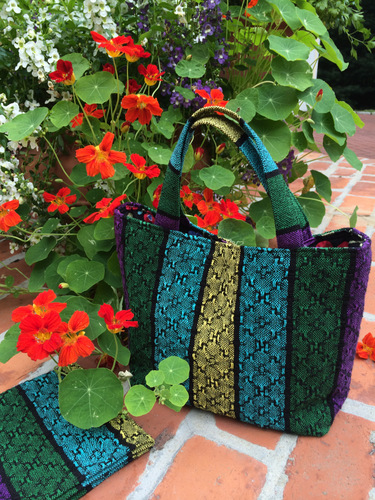
8-SHAFT HUCK LACE TOTE BAG

IMG_1480

 This fabric is based on a well-known huck lace pattern that is available in a number of places.  It is included in the The Best of Weaver’s Huck Lace, edited by Madelyn van der Hoogt, on page 12 in the pattern section (by Ruth Morrison), and in the project section starting on page 51.  This pattern is also used as the end plate on the right-facing page at the beginning and end of the book.

 You can also consult Madelyn van der Hoogt’s informative digital workshop on lace weaves which you can preview here: http://www.interweavestore.com/weaving-lace-with-madelyn-van-der-hoogt.

Here is my version of this project:

Warp:  16/2 linen (Bockens Lingarn) in five colors:  1 spool each, 125 grams
# 522 black
# 485 purple
# 4060 dark green
# 40 bright turquoise
# 2030 lemon yellow

The tote fabric requires about a yard of fabric, and each napkin requires ½ yard of fabric, so plan your warp length accordingly.  I wove one yard for the tote and 2 ½ yards for five napkins.  I put on a 5 yard warp to allow some sampling and loom waste.

Weft:  16/2 linen in #522 black, 2 spools (in addition to the one used for warp)

Sett:  20 epi, width in the reed about 17.5” (finished width about 16.5”)

Threading:  There are 7 repeats of the huck pattern with 4 extra plain weave threads in black at each selvedge.  I also threaded two threads together for the first thread at each selvedge.  Total warp threads:  365 ends

Weaving:  to balance at 20 epi

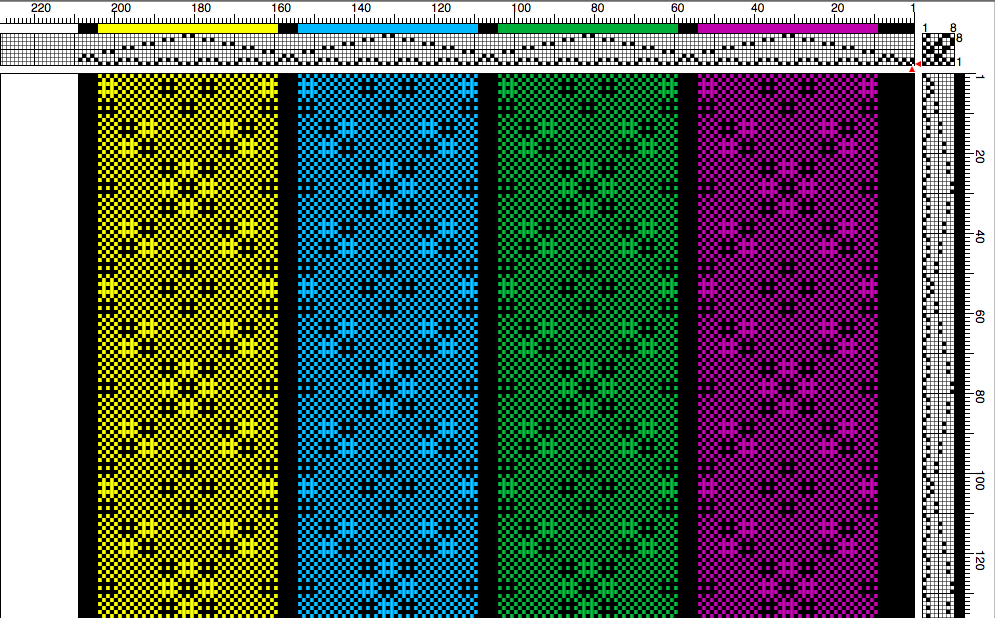
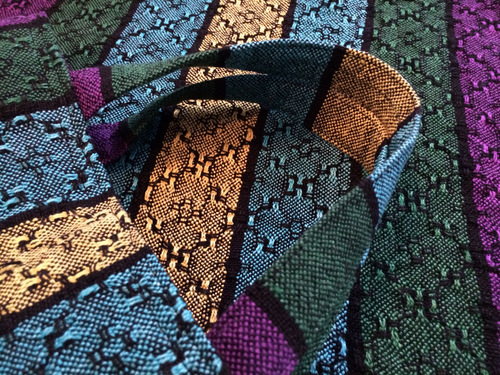
The full pattern repeat is 50 threads.  Each color stripe is 45 threads with 5 black threads at the beginning of each pattern. I placed a stripe of five black threads at the beginning of each repeat to emphasize only one column of the flower motif, as in reality there are two columns of staggered flowers.  (Unfortunately, all huck looks geometric until it is wet finished.  So my flowers look like diamonds in the drawdown.  Consult the detail photo at the end for what happens after wet finishing.)  By having a small black stripe of 5 threads, I minimized the appearance of the staggered flowers so that one straight column of flowers would stand out.  I chose to do this in order to better coordinate with the mug I was using as inspiration for the tote.  At finer setts the staggered floral motif shows up well, but not at the sett I needed for fabric that would be sturdy enough for a tote bag.

Finishing: Off the loom, I machine washed the entire length of fabric in the washing machine on ‘normal’ setting, warm water.  After smoothing the fabric by hand, I let the fabric air dry and then steam pressed it before serging the edges between all the cuts.

Huck Lace Lunch tote final as woven (this link will bring up the pdf file)

Screenshot huck lace tote bag final as woven

In this drawdown I have also included 4 extra plain weave threads at each end of the warp. You might add even more. Huck lace gives a lovely scalloped edge to fabric when it is not bordered by plain weave; however, at such a loose sett of 20 epi I found that the scallops look rather clumsy.  They are lovely at finer setts, but for this project I wish I had used a plain weave border, so I’ve included that here.

The drawdown should be followed until the end of the yellow stripe, then worked in reverse color order back through the blue, green, and purple.

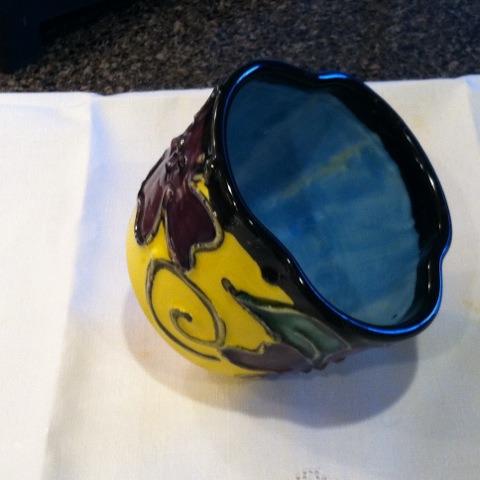
The mug that inspired the tote bag:

Weaving mug exchange

 SEWING THE TOTE BAG

 Materials Needed:

 Tote bag fabric:  15” x 27” plus extra for straps if using this fabric
Lining fabric:  15” x 27” plus more for pockets and possible straps
Pockets from lining:  2 pieces, 7” x 15”
Light Weight fusible interfacing:  14” x 22”
Fusible Fleece:  14” x 22”
Cotton webbing straps if you don’t wish to use handwoven or lining fabric for this

  1. Cut pieces to size.
  2. Fuse the light weight interfacing to the wrong side of your handwoven tote fabric, centering the interfacing so that there is ½” margin on each long end, and 2 ½” margins at the short ends.
  3. Fuse the fleece to the wrong side of your lining fabric, centering the fleece as you did with interfacing on the main fabric.
  4. Sew the pockets:  place right sides together and sew around pieces leaving one short edge open.  Turn right sides out and press, pressing under ½” seam allowance that did not get sewn.  Top stitch around all 4 sides, which will close and finish the edge that was left open for turning. Place the pocket on the right side of the lining fabric about 4” down from the raw edge of one of the short sides.  Sew along the outer edges and bottom of the pocket, attaching it to the lining.
  5. Then top stitch a pocket divider, either by sewing directly down the center of your pocket, or by sewing 1/3 in the distance on the long side.  I opted for the 2nd choice so that one pocket would be larger than the other.
  6. Fold the lining (with attached pocket) in half along the long edge, right sides together, and sew the side seams.
  7. Make a flat bottom for the lining as follows:  with the wrong side of lining facing out, position one side seam so that it is in the center of the fabric, and so that the end of the seam forms a triangle at the bottom of the tote:

tote bag square bottom Measure 2 ½” up from the point and draw a sewing line across the bag that should be 4” across.  Sew across this line.  Repeat this on the other side seam.

8.  Repeat this process of folding the long edges of the main fabric in half (right side together) and sewing the side seam.  Then repeat the process for making a flat bottom for the main fabric.

9.  Put the lining inside the bag, with the right side of the lining facing inward and the right side of the main fabric facing outward.  Turn the triangle flaps on both lining and main fabric so that they face into the bottom of the bag.

10. Fold down the top edges of the lining and main fabric toward the inside of the bag, and so that each fabric is now folded along the edge of either the interfacing or the fleece.  Match the edges and pin.

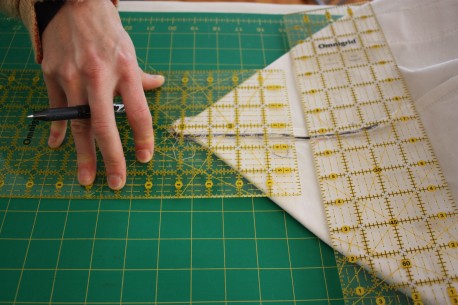
11. Make your handles.  If you are using the handwoven fabric your handles will only be about 16” long.  Take the hand fabric and press ½” in on the long sides.  Fold in half and top stitch along the pressed edge and then around the entire handle to finish.

12. Insert the handles into the pinned top edge of the tote bag so that each end of each handle is about 1/3 in from the end of the bag.  The finished bag is about 13” wide.  Divided in thirds (4 1/3”), you would place your handles to center on 4” and 8 ½” roughly.  Pin the handles in place with at least 1 ½” down in the seam.  Top stitch around the top of the bag.

FOR NAPKINS:

I wove 18” of huck lace pattern with 2” of plain weave at the end of each napkin.  I wove two picks of a contrasting color of weft in plain weave between each napkin. I turned under a hem at each end so that the plain weave was not showing on the face of the napkin, and hemmed the napkins by hand with black thread.

IMG_1477

Summer on Narragansett Bay

What a beautiful place to be this summer, especially by boat…..a coastline of bridges and windmills everywhere you look!  I spent almost a week in Providence during July, and now we are floating by many of the other wonderful towns along this coast.

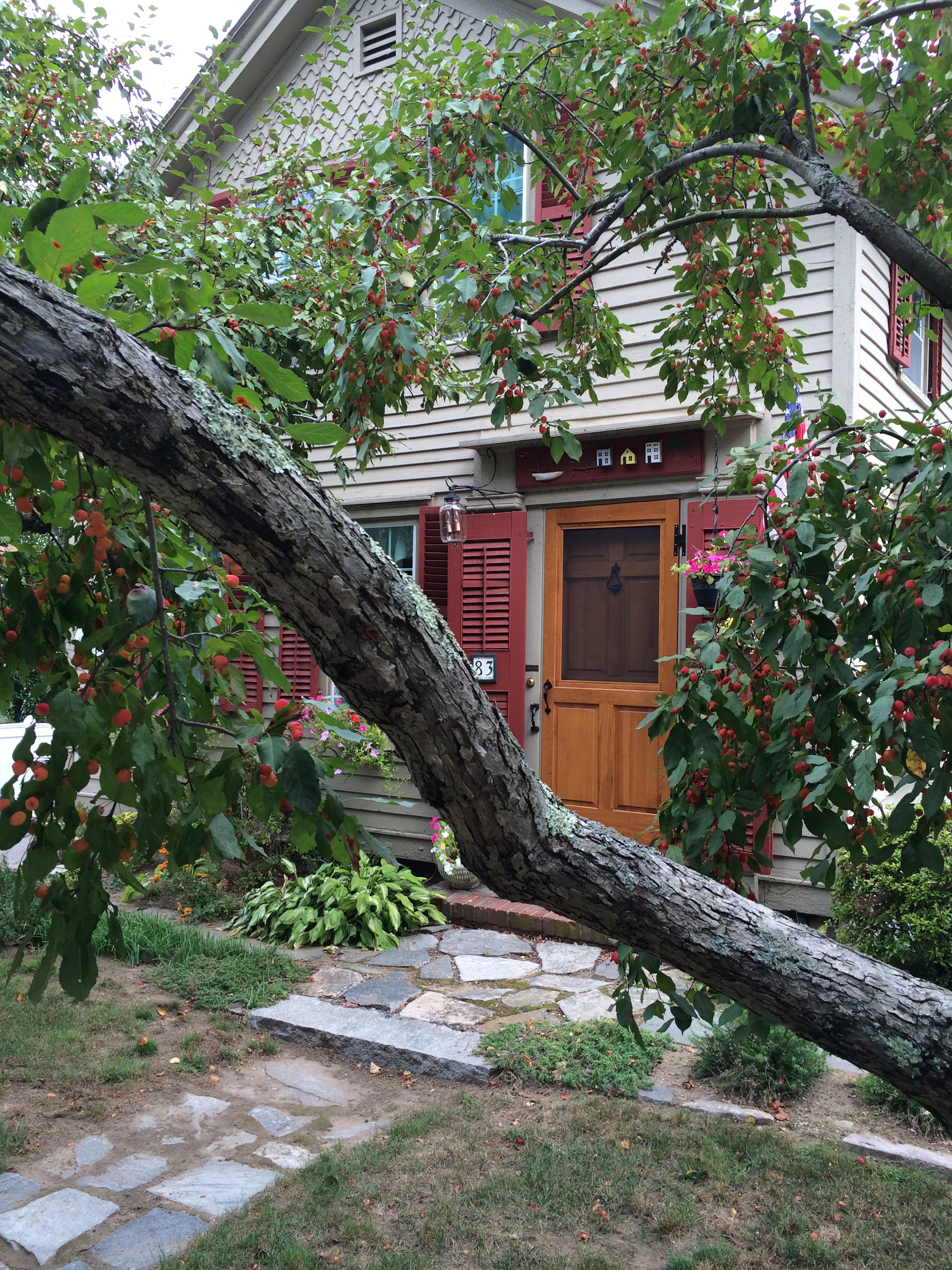
So here is my vignette of sights.  No surprise that it is mostly gardens and doors! Here is a colorful door in Bristol.  There are numerous streets in Bristol with lovely, old homes.

IMG_1493


Lots of historic houses with beautiful gardens…

IMG_1494

And then there is Blithewold, the fairest of them all.

Blithewold slide1

Not only is it an amazing house that can still boast its original furnishings, the gardens are superb……and most with a view of the bay!

IMG_1523

Here is Bob walking under the garden arch toward the house.

IMG_1522

IMG_1520IMG_1535IMG_1538IMG_1540IMG_1544IMG_1545

When you’re not admiring the bayviews from the gardens, you can admire a different kind of water view.

IMG_1551

We passed this last gem of a house on our way back to the dinghy after finishing up at Blithewold….although you can never really ‘finish up’…..you can only force yourself to leave with a promise to come back and spend more time.

IMG_1557

On our way back to the dinghy at the Herreschoff Museum docks, we stopped for lunch at The Lobster Pot.  We had a great view from our table!

IMG_1560

Finished Lunch Tote!

In spite of the bad lighting at the Rhode Island Convention, and perhaps because of the smaller exhibitions of HGA events, I came back quite inspired to get down to work.  I had the much-awaited black 16/2 linen spool in hand to finish weaving the napkins on my lunch tote warp, and I got right down to it!

IMG_1464

This was really a fun project!  Yes, there were comprises.  I needed to design a fabric that would be sturdy enough for the exterior of a tote bag, but also be soft enough for a napkin.  I thought I had struck a middle range by adding interfacing to the wrong side of the tote bag fabric for a little sturdiness.  Well, that worked out quite well…..but the napkin is a bit firmer than I’d like to use myself.  Hmmm…. they do say that linen softens over time with repeated washings, and the napkin will get washed a LOT more than the tote bag.  I guess that’s what I’ll mention to the recipient.  I am pretty certain she’ll like the tote, but maybe not so much the napkin!  I now have a set of four napkins myself, and I’m not sure what to do with them!

IMG_1477 Once again, here is the mug that this project was designed for:

Weaving mug exchange

I promised the 8-shaft group on Facebook that I’d share what the draft for this project was and how the bag was sewn.  Here goes!

Huck Fabric for Mug Lunch bag napkin 2

IMG_1480 At the moment, I am writing this while onboard Pandora in Narragansett Bay.  To say that there have been distractions does not begin to describe it!  First, we are having the mildest summer of my entire life!  Beautiful weather greets us everyday with cool breezes and deep blue  skies with giant cumulus clouds.  Then there are all the beautiful sights along this bay…. I plan to do a post in a few days that will have a smattering of the lovely sights we’ve seen.

I will try to post the actual wif file for the drawdown when I return home in another week, as well as some info on making a tote bag with a flat bottom.  Wordpress doesn’t like .wif files!

And the Fun Continues!…

It’s a month later, and the summer has only gotten better!  I have been to Convergence in Providence, RI;  I have finished weaving and sewing the lunch tote and napkin for my guild project, and I have started a tapestry class for some of the members in my state guild.  All good!

Unfortunately, I have very few photos of Convergence.  Photos weren’t allowed at the HGA exhibits.  The photo I regret NOT getting most is me standing in front of my tapestry in the gallery exhibit.  In hindsight I’m certain the powers-that-be would have let someone take a photo of me in front of my own work, but I didn’t ask.  Sigh…

Here is my favorite piece from the gallery exhibit:  “She Can’t See the Forest for the Trees”  No, I did not take this photo since photos were not allowed.  But I can usually find images online, and this image is from Jenny Schu’s blog, where you can read about the processes she used to make this incredible wall hanging! (Wed. grouper’s first reaction being:  “after all these years of weaving on copper looms, why didn’t any of us think of hanging our tapestries from copper pipe???”)

Weaving She cant see the forest for the trees

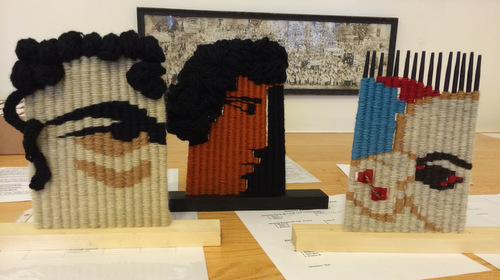
Along with the HGA sponsored exhibits in the Rhode Island Convention Center, there were numerous outside exhibits to see throughout Providence.  The Complex Weavers’ exhibit at Brown University was quite a highlight for me.  And the best exhibit of the whole conference for me was the ATA sponsored “Small Format/Unjuried” show on the Feinstein Campus of URI.  Such wonderful small tapestries that covered the gamut of every subject imaginable!  Pure fun….there were small tapestries of bugs, small self portraits, small landscapes….if you can imagine it, it was probably there!

Small Format Unjuried 2014

Two friends from the Wednesday Group came to stay with me during Convergence and we made the daily drive to Providence.  On the last day we drove to Brockton, MA, to the Fuller Craft Museum to see the two shows on display there.  First was “Game Changers:  Fiber Art Masters and Innovators.”  What an impressive list of well known fiber artists were on display.  It was a brilliant show!  And so was the other exhibit on display, “Small Expressions.”

Archie Brennan’s “The Lady and the Gypsy” greets you at the entrance to the “Game Changers” exhibit.

2014-07-18 15.24.08

Susan Martin Maffei’s Silk Worm tapestry actually has golden silk cocoons woven into it and is embellished with crocheted caterpillars.  …so naturally, the weft is silk.

2014-07-18 15.24.43

I have some great photos from “Small Expressions” as well, but I neglected to get the names of some of the artists!  So I will just share Barbara Heller’s recent work, which has a very interesting mix of techniques.

2014-07-18 15.40.48

All in all, Covergence was quite an inspirational event.  There are always hitches to having a conference setting in a convention center, but I would still say the outcome of this year’s event was positive!


Scroll to Top