ArgoKnot

Author name: ozweaver

Magical Havana

What else could I possibly say about a first visit to Havana, where Bob and I found everything we’d hope to find and more that we didn’t expect, other than it was magical?

Saturday morning we took a cab from Marina Hemingway to Havana Viejo. Months ago I posted information about a woman named Adriana Martinez who teaches bobbin lace and tatting and other lace making techniques in an outdoor setting called the Paseo del Prada. This is also the area where you can find well maintained American cars from the 1950s on display.

Our taxi driver dropped us near the Capitolio (currently under renovation that will make this landmark look positively new), and I struggled to find the Paseo del Prada on our map of Old Havana. I was looking at all the little green squares that signify a ‘park,’ but in fact as we wandered, we found it before I ever located it on the map. We saw a lot of art and handwork on display on the park-like median between two large boulevards that starts right at the capitol.

There were brightly colored paintings on display and several ‘workshops’ set up for children to try their hands at painting. But there were just as many women with handwork on display, mostly crochet. I was impressed to see so many women sitting on portable chairs in front of their displays, watching the crowds walk by while their hands were literally a blur, turning out crochet projects at impressive speed. The crochet work is really fine and beautiful. Cotton blouses with lace crochet insets, crocheted shawls and dresses, many dresses for little girls—all of it done in ecru cotton.

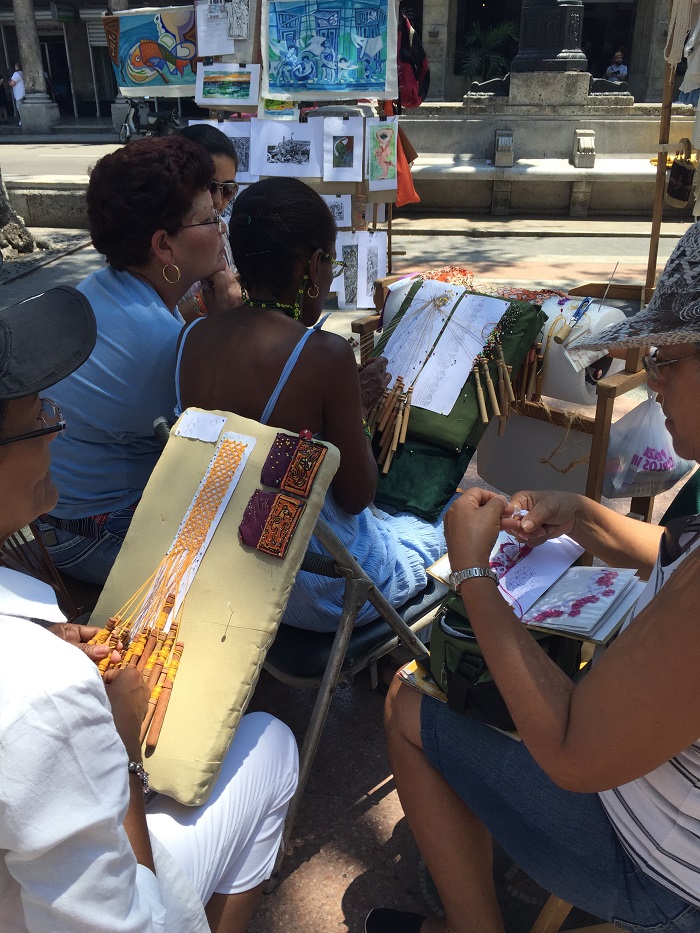
And then, before I recognized what I was seeing, there was a group of women clustered around one woman, and about half the women were working on lace pillows while the other have were tatting or crocheting. Moments later when I took my eyes from the bobbin lace work and the tatting, I recognized Adriana Martinez from the link I had found last summer about the arts of Cuba and Joan Sperans’ photo of Adriana.
IMG_2113

Can you imagine hearing about an artist who has a display in a park in New York (or any major city in the US) and going there and finding that very artist within moments of arriving? Maybe it could happen, but I can’t tell you how shocked I am to find the very woman, the only woman, I’d heard of doing bobbin lace in all of Cuba. I am stunned!

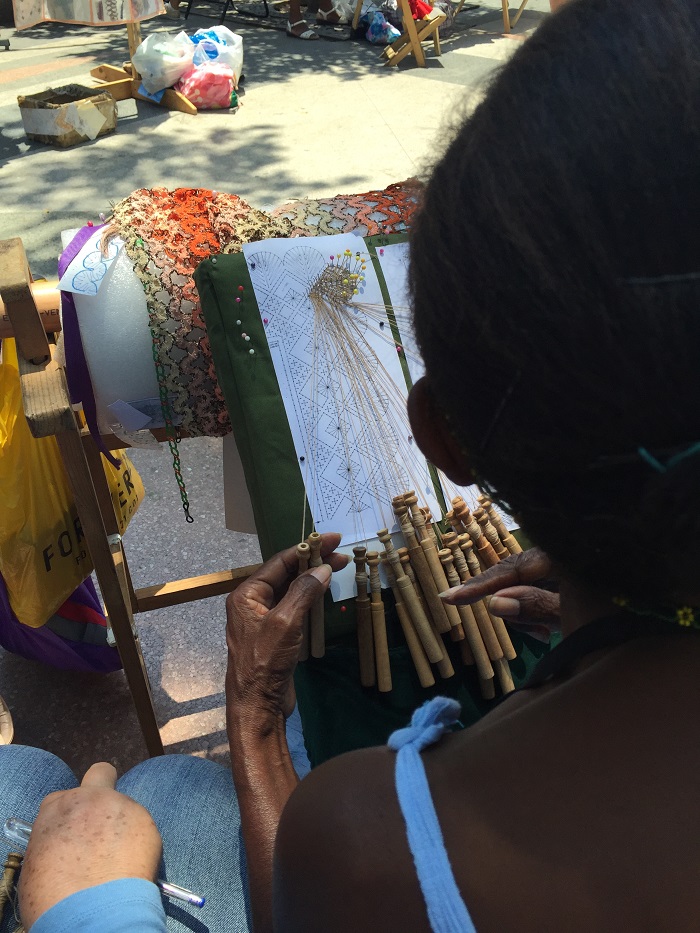
In this photo Adriana is helping a student with their bobbin lace project (bolillo).  Under the student’s pillow is Adriana’s project: a blouse made entirely of bobbin lace!
IMG_2114

While I talked to Adriana and a woman named Nancy who knew a bit more English, Bob took my phone and began showing photos of my own work to the other women: tapestry, knitting, bobbin lace. I gave Adriana and Nancy my card, and then all the students wanted cards as well. I was so touched that these women were interested in me, but naturally we were all interested in each other. It is thrilling to find people in a distant location doing the very thing you love to do so much! We were all quite intrigued with each other! At one point Nancy called a man over to interpret for us, and I was shocked at how many textile words he knew. I don’t know if he was related to one of the women doing lace or if he was just someone with his own artwork on display nearby. He was a young man named Hidalgo, rather macho looking, wearing a muscle shirt and smoking a cigar, and he knew all the English words for the techniques and materials the women were using.

And speaking of men, I have to mention that every time an official has come onboard Pandora, either from the Guarda Frontera of the Health Department, or even the fishermen who have rowed these officials out to inspect us, all these men have known that the pile of yarn and needles laying about our cockpit is called ‘tejer.’ Every time, no kidding, one of the men will point to my knitting and say ‘tejer.’ Presuming I might not know what they’re saying they will often put up both their hands and make a pantomime of knitting. There’s no mistaking their pantomime for crocheting or any other handwork. And I can’t help but think of all the American men who always assume I’m quilting, whether I’m sitting in front of a loom or a spinning wheel, or holding knitting needles or have a lace pillow in front of me. When I tell them the name of what I’m actually doing, the standard response is “Quilting…knitting…whatever.” How refreshing that Cuban men know the difference!

Here is a photo I meant to use weeks ago, on my first trip into Cienfuegos. Again, one of the Guarda Frontera had seen my knitting and correctly identified what I was doing. I already knew that many women in Cuba crocheted. I had made a joke to Bob that I could not imagine what women might knit or crochet in such a hot climate. And then I saw this!
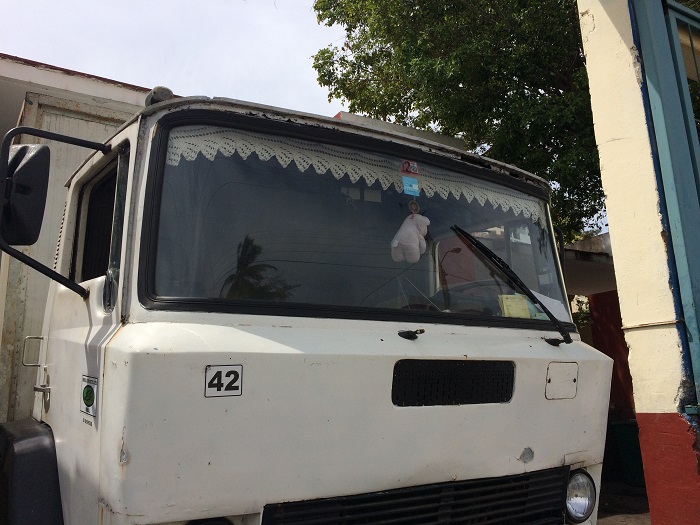
3-23-16a 012 - Copy

The day only got more and more magical. Bob found lots of wonderful antique cars all along the Paseo del Prada and along the road that edges the coast and the Havana harbor. I found the location of the Quitrin shop that sells traditional clothing. I asked if the school of handwork was nearby, and they told me where to find it, although it is closed on the weekends. I hope to visit on Monday.

Every aspect of the day had a touch of magic to it. Walking through the pedestrian only, cobbled streets, we came to the privately owned restaurant (called a paladar) that was written up in the Lonely Planet Guidebook as the best restaurant in all of Havana. We were wilted from the heat and not feeling appropriately attired for such a nice restaurant. But we both felt that since we’d found it would be a shame to pass up such a chance. Paladars are a recent business venture in Cuba, a chance for Cubans to own their own business. Almost all businesses are owned by the government. There are lots of rules about running a privately owned restaurant, from how many tables you can have to who can be hired for staff. Just a couple of years ago the restaurant staff had to be family members of the owner. This restaurant, Paladar los Mercaderes, had quite a large staff, and clearly were not related.

I was asking our waiter for recommendations and also explaining that we’d like to try some traditional Cuban items when man seated at the adjacent table, having dinner alone, introduced himself as the owner of the restaurant and began making recommendations of what we should try.  After we ordered, he also insisted that we try a glass of the French Medoc he was drinking, and it was delicious, of course! Yamil Alvarez Torres and his wife and one of his cousins are partners in this venture.

Yamil owns two fishing boats, one on the north coast and one on the southcoast, which supply all the fish for the restaurant. Yamil used to live in this beautiful space with his wife and daughter, and he says he did all the renovations himself to turn it into a stunning setting for his restaurant. When you arrive you walk up a staircase strewn with red and white rose petals to a beautiful dining room appointed with ornate colonial furniture. Our dinner was octopus boiled and then grilled (very tender!) served with two sauces: one was lightly sauteed onions and the other a house-made pesto. Our main course was braised lamb with green olives, onions and small red and green peppers in a bittersweet dark sauce. The flavors were wonderful together! Tangy olives and pungent peppers in a mysterious dark, bitterweet sauce. Dessert was a layered chocolate confection with a torched sugar topping (like the topping on a crème brulee) that I simply cannot describe! It was all excellent, and momentarily after arriving both of us had lost our wilted, bedraggled feeling and were thoroughly enjoying ourselves!

Perhaps the end of the evening was the most magical part of the day. Earlier we had noticed a large park being set up for a dinner. Tables and chairs draped in white cloths (what do you call those covers for chairs?) with centerpieces of red roses filled this square near the San Francisco ship terminal. There was a stage being set up and some dancers were milling about wearing angel costumes. We enjoyed the scene and then wandered on our way. At the end of the evening we found the event in full swing. It turned out to be an American tour group. While I stood in the square transfixed by a harpist playing Debussy’s First Arabesque, Bob began chatting with a couple who’d stepped away from their dining table.
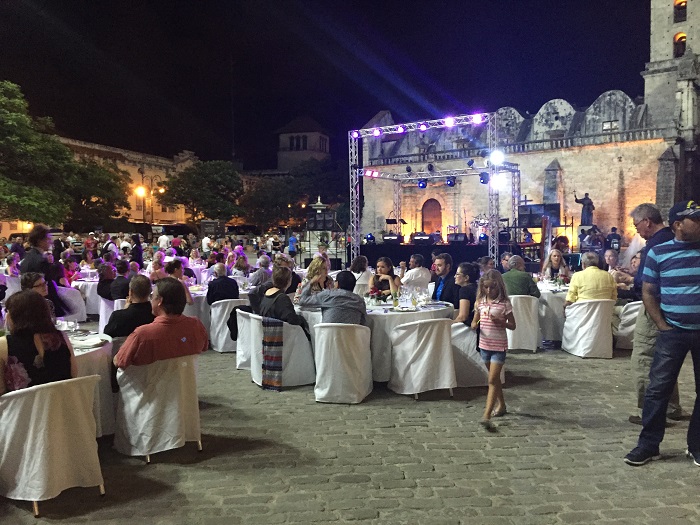
IMG_2231

On the one hand, I could not believe I was standing in a square in Old Havana, listening to a harpist play one of my favorite pieces of music, while Bob was learning about the tour group who was having such an extravagant event on the square. It was a large group of people from the AIA, the American Institute of Architects, a group that Bob’s father was closely involved with during all the years he was publisher of “Progressive Architecture.” When I joined the conversation, the man speaking to Bob was saying that he read “Progressive Architecture” for many years.

Bob has moments almost every day when he thinks of his father and wishes he could make a quick phone call to his dad, even though it’s now been over two years since his dad passed away. We were both pretty stunned to find that this extravagant event that we’d watched being set up earlier in the day and that was now in full swing, brought Bob’s father back to us so intensely. It ended our evening in Old Havana perfectly.

Finding a cab back to Marina Hemingway late at night was not quite as easy as we’d imagined. All the taxis wanted more than twice the fare we’d paid earlier in the day. In the long run we found a taxi willing to take us back for only a little more than we’d paid in the morning.

Our driver calls himself Shrek and has a well-preserved red Chevrolet convertible with an almost spotless white interior. It was a terrific ride along the coast back to the marina.

IMG_2238

He’d never been to Marina Hemingway before so we had him deliver us right to the side of Pandora tied up along a bulkhead. I tried to get photos of the car and Pandora together—not too easy late at night! And Shrek took photos on his phone while Bob and I did the same.
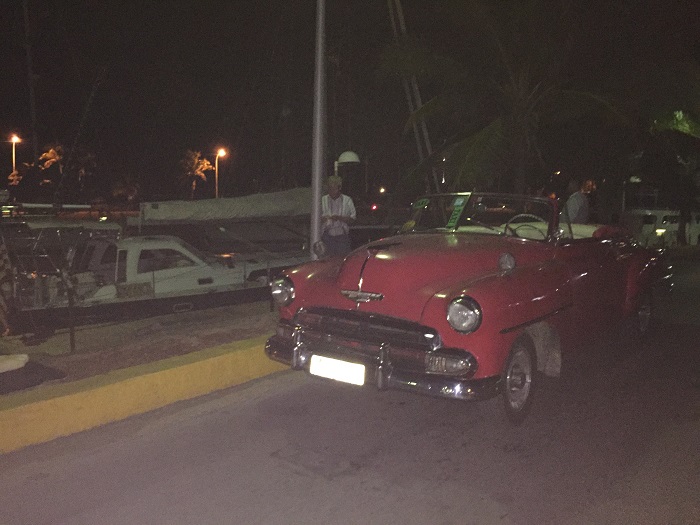
IMG_2243

It was a fun ending to a magical day!


An Embarrassment of Generosity

Before we started sailing long distances, someone (who shall not be named) gave me the book An Embarrassment of Mangos, in preparation for the tropical destinations Bob and I were planning to visit. It’s a well-known book among cruisers.

While we have found a lot of mangos here in Cuba, what I find even more in abundance is generosity. Starting with our driver Noel, in Santiago de Cuba, I began to notice that getting supplies is almost impossible in this country, and people have to rely on serendipity. They give generously of what they have and sometimes they get just what they need in return. Mostly though, they have to be exceedingly industrious to make or fabricate what they need out of the random things that come their way—like those fishermen we encountered in the inner-tube boat with rag bag sail. Still, they have a generosity of spirit that compels them to share what they have no matter what comes back to them. It’s quite astonishing.

So we had a very gentle sail to Cayo Levisa today, which might be our last stop before arriving in Havana. I don’t know how long we’ll be in Cayo Levisa because we chose this spot to wait out a cold front that should arrive at any moment. Cold fronts always have strong, northerly winds, and since we are on the north coast of Cuba that can mean some pretty rough conditions.   Where we are tucked in, we have reefs and some little cayos for protection, and we are a ways out from the mainland, which would be a dangerous lee shore in northerly winds. A ‘lee shore’ means that the winds are blowing you toward land, never a good thing in strong winds. After just hearing Bob’s conversation with our weather router, the venerable Chris Parker, it looks like we may here for a full week! Sheesh! Chris is calling this the never-ending winter because cold fronts, which should be done in March, are still making a weekly appearance. I wonder what is going on in the northern US, where most of these fronts originate.

About midday during our sail, I was startled to see a little brown bird fly right into our cockpit and right down the companionway into our cabin! Bob went down below to check on him and get him outside again. Bob opened a hatch and the little bird flew right out again. I think Bob has had a bird onboard during every long passage he has taken over the past few years….but we were not offshore today! We were only a mile or so from land! Little bird didn’t fly away but landed on our foredeck. He did not appear tired or injured; he did not appear the least bit frightened. He marched up and down the decks, looking, as all birds do, a bit like some kind of military officer. All he needed were some gold stars on his shoulders to complete the look. He perched on some of the lines, and as Bob was constantly tweaking at our sails, which meant some of the lines started moving, he would calmly just hop to a different line.

OLYMPUS DIGITAL CAMERA

We don’t know what kind of bird he is. He was bigger than a sparrow, but smaller than a robin, with a black, finch-type beak. He had a dull golden/olive breast and was blotchy brown over the rest of his body, similar to a cowbird’s coloring. I think he was about 6” tall.

He checked out the entire boat, coming back into the cockpit with us for a while, even flying down below again. Bob had to go down and open a hatch for him again. In spite of the fact that Bob was in close quarters with him down below as well as being the giant who originated all the noise of the electric winches moving lines and sails, the little bird was not the least bit intimidated by being close to Bob. Bob put out some crumbs of my somewhat stale homemade whole wheat/rye bread. He seemed to enjoy that! Bob also put out a small plate with a puddle of water on it, and although the bird perched on the plate a couple of times, he did not actually drink any water. He spent a lot of time preening, and I could only imagine that he didn’t like feeling salty anymore than we do! He spent about two hours with us, and he was very curious about us and about the whole boat. He spent some time in the dinghy investigating my window box full of herbs and the pink geranium. At one point he was perched right beside me looking at my legs quite intently. I really thought he was going to hop on my legs, and I was willing myself not to flinch or shriek if he should do it. He looked me in the eye for a moment and then hopped elsewhere. I swear he could tell I was fearful!

Most of the time when a bird takes refuge on our boat it is exhausted and more often than not these birds die onboard. It is very sad. We always think they have gotten lost from their migrating flock and become too exhausted to finish the trip. It was wonderful to have a curious, healthy bird on board. When he’d had enough of a visit he took off.

The other highlight of today is the focus of my thoughts –our encounter with the generous Cubans on Cayo Levisa. The Guarda Frontera does not have an office on this island, so when a cruising boat comes in, the dive boat captain goes to the mainland to pick up an officer of the Guarda Frontera. When they return you are expected to take your dinghy ashore to pick up the GF officer to bring him onboard your boat for the paperwork and inspection.

When we saw the dive boat arrive with the officer Bob headed to shore. As Bob picked up the officer, the dive boat captain handed Bob a big papaya! After doing the paper work with the officer, Bob returned him to shore with the daily dispatch of bars of soap, one for the officer and one to thank the captain for the papaya. Well! The dive boat captain had more gifts for us — an abundance of wonderful vegetables! Two small heads of bok choi, a large head of leafy lettuce, and some interesting long beans that look similar to green beans or pole beans! It was such a generous gift!

4-16-16b 010

Like the woman in Marea del Portillo, who gave us all her eggs (13!) and 8 tomatoes and even all her coffee, this man gave freely of what he had that he thought we might want. It wasn’t exactly what we would have bought if we’d had access to a store. But this is a culture where there is not access to stores and he knew it was very likely we were in need of fresh green veggies not easily found.   Both these people gave freely of what they had without knowing if we could give them anything in return, much less anything that would be useful to them. The woman in Marea del Portillo asked for clothes and shoes, and I have a feeling she would have preferred childrens’ sizes of these items, while I could only give her adult clothing and shoes. Still, she had generously offered up what she had, hoping she’d get something useful in return.

That’s just what the captain did. After giving us the wealth of his fresh food, he asked Bob if we had an extra screwdriver. Bob said he’d check in his tool box. Mostly, we do not have extras of any tools, so we are disappointed that we do not have a screwdriver for him. Although it is our natural reaction to hand him our only screwdriver, it would be a potentially dangerous situation for Bob to make such a long passage home without a full tool box. Bob has found that he has an extra vice grip wrench (bought in Florida when he couldn’t find the one he already had), and we certainly hope that the captain will be happy to get one.

Dinner last night was memorable, but I’m not sure if was truly the taste or the immense gratitude of having fresh ingredients. I sautéed a little bacon and then used the bacon fat to sauté some small local onions that look like cipollini to me, green beans, a head of bok choi, and plenty of garlic right at the end. Then I added a health splash of balsamic vinegar and let it reduce to a syrup. I stirred in bow tie pasta with a little of the starchy cooking water. We grated lots of parmesan on top and it was very a memorable dinner. Thank you, Captain!

It’s still a bit mind boggling to me that you can’t just go to the nearest big town and find a hardware store or even a market. A major aspect of life here is giving what you can and seeing what comes back to you. In our experience, the Cubans do this very well.

A Couple of Perfect Days

Bob’s mother was notorious for invoking the saying “It’s always darkest before the dawn,” whenever anyone needed some cheering up. It’s uncanny how often that saying is true.

We’ve now had three very easy days of sailing and peaceful evenings at remote anchorages along the reefs and cayos in the Archipielago de los Colorados.

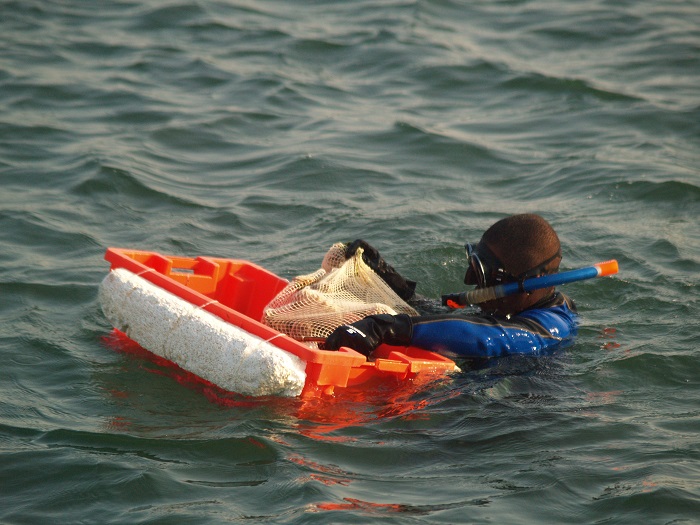
The morning after Bob’s visit with the fishermen we were all up about the same time. By the time Bob and I decided to up anchor, the crew, minus the captain, had donned full-length wet suits, and were jumping in the water with plastic bins tied to their waists on a long tether of wire. Considering what we’ve seen of fishermen, it has to be unusual for these men to have wet suits. The bins had a bit of Styrofoam on each side to help them float, and each man had his own bin. They made a circle around our boat, so that we could not leave. It was fascinating to watch them. They were picking up something that definitely wasn’t lobster or conch. Eventually one of the men’s bins was very close to us, and we could look down into the bin to see a healthy catch of sea cucumbers. Based on how often the men surfaced and threw a pile of these into their bins, they were having a very good catch of these creatures. We are guessing that these might get shipped to Japan. Still, I’m sure it’s the Cuban government who makes a good profit on these delicacies—not the men.

OLYMPUS DIGITAL CAMERA

When the men moved off a bit we were able to up anchor and head out. Our destination was another Cayo Levisa, about 30 miles east. At the end of the day we stopped at Punta Alonso Rojas, which I thought was a cayo, but which turned out be a large clump of mangrove in the middle of the longest run of mangroves I have ever seen. It was most of our horizon! It looked like a series of islands, but on closer inspection each ‘island’ was a massive grove of mangroves. In fact, some of these mangrove areas looked like hills, but it turned out that there were very large mangroves in the middle that had to be over 75 feet tall with younger smaller mangroves growing outward from the giants. I had no idea they got that tall!

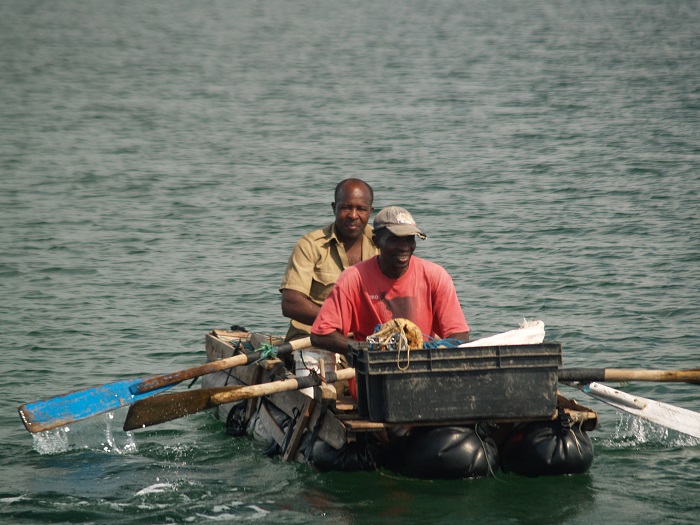
Just as Bob was putting the dinghy in the water so we could go ‘exploring’ a very small homemade fishing boat approached. Two men were rowing with homemade oars (I should mentioned that every row boat we’ve seen has had very rudimentary, homemade oars) on a boat made out of wooden slats, like a raft, with truck tire inner-tubes for floatation. The inner-tubes had been cut and straightened, then somehow tied closed at each end and filled with air. They must leak and need re-filling all the time, yet these guys had been out on the reefs all day and were returning home as the sun got lower. We bought two big lobster tails from them—again $5 CUC for both. Bob threw in a bar of soap –boy, was that the dumbest thing we brought along, based on very outdated advice from someone. So every day from now on we are giving out at least one bar of soap.

OLYMPUS DIGITAL CAMERA

I happened to read The Boys in the Boat earlier during this trip, and I cannot help but compare the local fisherman here to the men who race rowing shells. I am convinced this sport must be about the hardest thing a body can do. When I see how far these fisherman row, in boats that do not skim the water easily, and with oars that are far from sleek, all the way out into ocean waters, no matter what the weather…well, I’m speechless. Crew is an amazing sport, but what these men do is just beyond comprehension to me.

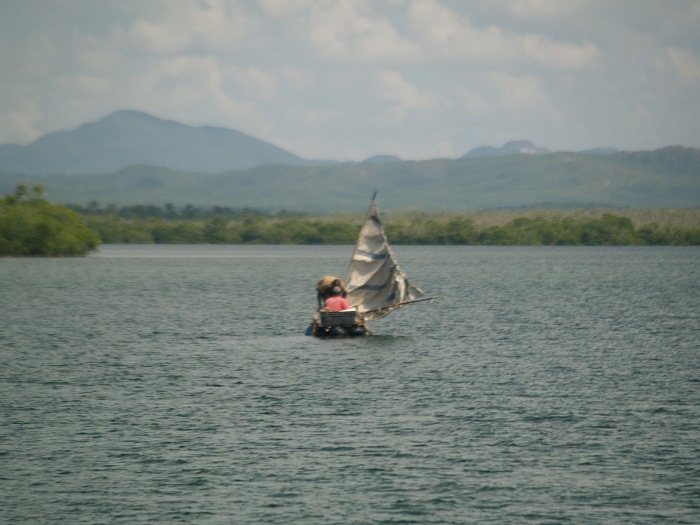
Then the most amazing sight occurred. We were so impressed by the ingenuity and industry of these two men who fashioned a fishing boat out of a wooden raft with tire inner-tubes, yet that was nothing compared to what they did next. They raised a gaff rig sail made of dozens of pieces of scrap fabric. And I’d bet money those scraps had been sewn together by hand…it was an impressive sail made of years of leftover fabric scraps. They were running downwind on two inner-tubes with a sail from the rag bag, and it was quite a vision.

OLYMPUS DIGITAL CAMERA


We took the dinghy to inspect the maze of little waterways between these mangrove ‘islands,’ and saw that the older plants in the center had huge trunks, as big as any maple or oak we’ve got at home. How old is a mangrove that big?? We threaded our way through lots of estuaries. It was fascinating how many mangrove ‘islands’ there are here. Each time we headed toward what we thought was finally going to be real island, perhaps even the place where the fishermen had returned home, but as far as we went it was all mangroves. There were miles and miles of shallow water supporting this mangrove forest. I don’t know how far those fishermen had to go to reach real land.

Since finishing the cabled sweater I’ve been inundated with ideas for projects. In one case I think I’ve improved on a project already underway. I’ve got yarn onboard that I was using to make a shadow knit sweater for one of my nieces. I was knitting the shadow stripes so they’d sit vertically on the sweater, and I was just beginning a funnel neck collar for the back when I set it aside a few weeks ago. Suddenly I just wasn’t that enthralled with my design. Then just after cabled sweater completion I had what I hope will be a brilliant idea to make an Einstien jacket (Sally Melville) out of the two yarns I was shadow knitting. I think that will be quite effective – vertical stripes below the empire waist and horizontal stripes for the bodice and sleeves, with fun buttons to gild the lily! It will be a classic shape, executed in a fun to knit structure. The bad news is that I don’t have the Einstein pattern onboard with me! Drat!

Big and Little Cables Finished as Cyclone Subsides

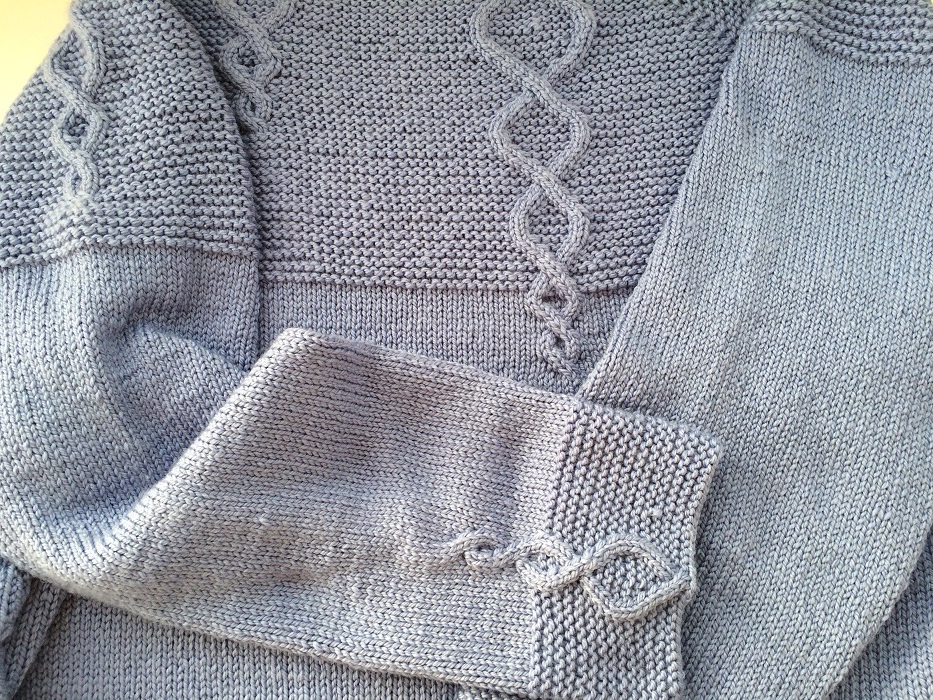
Today I cast off the last stitches on the Finnish Sweater with the asymmetrical cables, and racing down the last sleeve, the bind off came as a shock to me. I had no idea I was that close to done. I must’ve been knitting with blinders on.

4-16-16b 011

I haven’t been doing so well the past week. Every time we’ve sailed I’ve been seasick, violently and gently. Gently is better, but let me tell you it’s still NO fun. Days are so long and mind-numbingly boring when I am seasick. I cannot knit or read, and although this seems odd, it feels better to have my eyes closed rather than open and looking at a horizon. So, for almost a week I spent most of each day looking at the images on the inside of my eyeballs. Really, really boring.

The night before last we had to make an overnight passage to get the to the western tip of Cuba, Cabo de San Antonio. We arrived there in the mid-afternoon yesterday, to find the dock where the Guarda Fontera expects everyone to tie up for signing papers, to be too rough for our tired and bedraggled souls and too risky for Pandora’s nice paint job. The dock is a big cement pier jutting straight out into the unprotected waters of the Gulf of Mexico, and choppy waves were crashing against this dock. Anchoring is dicey in this area because it is all rock–bad holding. But anchor we did, and Bob took the dinghy ashore in the rough chop. He did not want the Guarda Frontera coming to us in their typical scruffy skiffs, possibly banging into Pandora in the chop. Of course, they wanted me to come in, and they wanted to come out and see the boat. In Bob’s firmest voice, and with what Vulcan-mind-probe abilities he could muster, he said that I had to stay onboard to make sure we didn’t drag in the bad anchorage (real reason being that I had been seasick for more hours than either of us could count and was in no shape to take a rough ride in the dinghy) and that he’d rather not have them visit in such choppy conditions. They acquiesced.

My mood has been deteriorating for about a week. Most likely due to not feeling well every time we pull up the anchor, and frankly, not even feeling all that well at anchor. Yesterday I decided to try to knit, and it wasn’t going well as I could feel myself getting queasier and queasier. Those of you who knit will understand that I was just trying to get to a good stopping place. I have been redesigning a few things about this sweater to suit me, and the sleeves have the most changes. I was in the cabled area of the first sleeve and just wanted to make it to a place where I’d be able to pick it up and easily know where I’d left off.

Suddenly I’d had enough. Not only was I not at my best, I was pretty clearly very near to being at my worst. I had a meltdown of epic proportions, and the almost sleepless night of our passage added to days and days of mal de mer really sent me off the deep end. I felt volcanic, cyclonic, tectonic. I flung the sweater away from me, and that didn’t feel nearly violent enough for my mood, so I flung it around a bit more. I flung it at every hard surface I could find. I knew I’d done a fair bit of damage to the knitting, including breaking one of the various circular needles in use. I had a mad moment when I wanted to chuck the whole thing overboard. Luckily, it was remembering that some of my favorite stitch holders were in that sweater that kept me from deep-sixing the thing.

And now, just 24 hours later the whole sweater is finished. I really don’t know how it happened. Yesterday, in my fit, I was thinking that the whole thing was a miserable experience and that it would never be finished. And yet, this morning, I made repairs to the damaged knitting that came apart during its beating, and Bob repaired the broken needle, and suddenly that first sleeve was done. We had not even raised anchor by that point.

The sailing today was as easy as it ever gets. Instead of being buffeted about, Pandora sliced through the small waves like she was on a track. She also didn’t wallow side to side. She just made a bee-line for our destination, about 5 hours of sailing. I knit the whole time, and voila! Second sleeve finished. This sweater has no sewing or assembly. When you cast off that second sleeve you are ready to wear it. I have to say I really like it, although that’s really no surprise since I’ve been trying it on through the whole process. Sadly, I will always think of my crazy outburst when I wear it. Hopefully that will become funnier with time.

Yesterday, at Cabo de San Antonio, the marina manager was disappointed to learn that Bob and I did not intend to tie up at the exposed dock. He was hoping for our business and looking forward to having us visit the attached restaurant. That’s the thing we keep finding here in Cuba. There are some facilities where a lot of thought and planning and care has been taken to make something that will attract cruisers, but the big thing, the fact that the harbor is not protected enough to actually stay there, is something beyond their ability to tackle. Everything is owned by the government, and there is no money for building a sea wall or even improving the dock. It is rather sad.

We motored a couple of miles to a safe anchorage, and shortly afterward we were approached by the skiff from a larger fishing boat, likely government owned and manned by numerous fisherman. Did you know that Cuba owns all the fish in the waters and that the fisherman must deliver all their catch to Mother Cuba in exchange for their salary? From what we’ve seen, I doubt there is any morehard-working group in Cuba than fisherman. That saying about ‘the workers pretend to work, and the government pretends to pay’ does not apply to fishermen. These guys deserve much, much more from Mother Cuba.

So, even though all the fish belong to the Cuban government, it’s very common for fishermen to approach sailors and offer to sell or trade something with us for lobster or fish. Yesterday evening, two of the fishermen rowed over to us, offering us four large lobster tails for $5CUC. That’s an amazing price…but that’s what they asked for. When Bob paid them, they began to ask for something else that he couldn’t quite understand. Then one of the fishermen pulled off his baseball cap and showed Bob a playing card, the Queen of Hearts. They wanted a deck of cards! No problem. I sent them our newest deck, still in it’s blue and white Hoyle box. I had used them a few times, and I knew that some of the cards had stuck together from humidity. At some point, when I pulled them apart, some of the cards got abrasions from being separated. But still, that was our best deck. When Bob handed over the box, both men clapped their hands and whooped! I was down below laughing at how happy they sounded to get this deck of cards.

Later the man with the Queen of Hearts in his cap came back with the deck and returned it. He could not explain why, but I’m certain it was because some of the cards were marked. I imagined how much he was looking forward to a game of cards with his cohorts, likely involving betting. Marked cards just would not do. So I gave him an older deck that didn’t even have a box, and were the small bridge size cards that I imagine Cuban men might find too ‘sissy.’ There were probably small marks on these cards too since they are not new…but I hope they found them usable!

These small interactions illustrate how enlightening it is for me to see how simply these people live, and to experience how friendly they are. When they approach our sailboat they are very cautious. They never let their rowboats touch Pandora. They seem happy to make contact with us, beyond just selling us fish, and they seem to enjoy our clumsy attempts at Spanish. We have stopped in some pretty remote places along this trip, and quite a few times we’ve been the only boat in the area. I don’t think meeting cruisers is a daily event for these fishermen.

Today when we anchored at the outskirts of a long maze of mangrove estuaries, another government fishing boat arrived and anchored nearby. Bob and I took off in the dinghy to explore the mangroves, which were delightfully full of herons, ibis and frigate birds. We chased a group of spoonbills, photographing them each time they landed and each time they took flight as we followed them down the winding maze of water and mangroves.

OLYMPUS DIGITAL CAMERA

When we came out of the estuaries and were headed back to Pandora, one of the fishermen was waving madly to us from the bow of his boat and motioning for us to come to them. I thought it prudent that Bob go by himself, since—rightly or wrongly– I have a strong sense that I was not the proper company for a group of Cuban fishermen. It seemed like a ‘guy’ gathering. Bob went to visit and they were very excited to meet him. They invited him onboard and showed him around their very basic boat. Bob described it as looking like someone made a frame of bent rebar and then slapped on some cement by hand. One man showed Bob the shaved ice that the catch was layered in and a giant fish that they’d caught today. They did not try to sell Bob any of the fish, and they did not ask for anything. Their living conditions were very rough, but they seemed happy and were very friendly.

While I can’t imagine the life they must lead, I can also see that they probably have a good life that is rich in things I’m not even aware of. I wonder how much this will change, and how quickly when (if?) trade with the US starts up again. I keep referring to this because I cannot get it out of mind. On the one hand, it makes me sad how much the past two (at least) generations of Cubans have suffered and sacrificed. On the other hand, those who have lived well on so little might not be ready or willing for the culture shock that could be headed their way.

In Cheryl Barr’s guidebook, we read that the peninsula going out to Cabo de San Antonio does not even have paved roads. We read that we should keep a watch for a bi-plane that flies over about once a week to drop mail in a local field. There are no stores other than one shelf at the marina that mostly holds bottles of rum. Bob did buy one of those before leaving.

Accident in Cayo Largo

Yesterday afternoon we were shocked to learn that one of the Russian men was stabbed by a stingray while swimming off one the beaches. The stingray pierced completely through his upper arm. I don’t know if the ‘blade’ remained lodged in his arm or came out when the ray swam away. I don’t even know what the stingray’s weapon is called. It was a crisis here, trying to find a way to get this man to a bigger hospital on the mainland.

There is a clinic here where the doctor decided the Russian needed more medical help than he could provide here. Because there had been some mechanical issues with a charter flight yesterday, there were more people than seats available on the one plane that was leaving the island. At first the Russians were told that their friend could not go on that plane, but luckily a spot was found for him. You simple cannot leave behind a person with such a terrible wound and poison running through his body! The flight was to Cienfuegos, but the man needs to get to a hospital in Havana. There was no guarantee that he’d get a flight to Havana.

The remaining Russians were back on the dock yesterday, very subdued and waiting for news of their friend. After talking to them a bit I said that I ‘hoped’ their friend would be okay soon. One of the men who does not know English seemed to startle at that word. The Russian who was talking to me translated for him, and he turned to look at me intensely and repeated ‘hope’ a couple of times while still looking at me. I said it back to him again. Hope.

In ancient Greek ‘hope’ is ἐλπίς ….elpis.  Only in hindsight did I wonder if he might have recognized that word–if I’d thought to say it.

This morning when I got up the Russian boat was gone, so I’m hoping that means they got news of their friend being flown to Havana and are now heading there themselves.

Scroll to Top