An amazing thing happened to me on Saturday while Bob and I attended a huge party of several hundred people that was a celebration for sending off the crews of various large yachts, from mega yachts to large yachts, for the Caribbean 600 Race. That’s a race that starts and ends in Antigua, with a 600 mile course that circumnavigates a number of islands in this part of the Caribean. First of all, the music was amazing, but prevented conversation with anyone, yet I still met someone quite incredible!
Here is a short video of the steel drum band. I didn’t arrive in time to catch the beginning of one of my favorite songs from my youth—the Turtles “You and Me.”
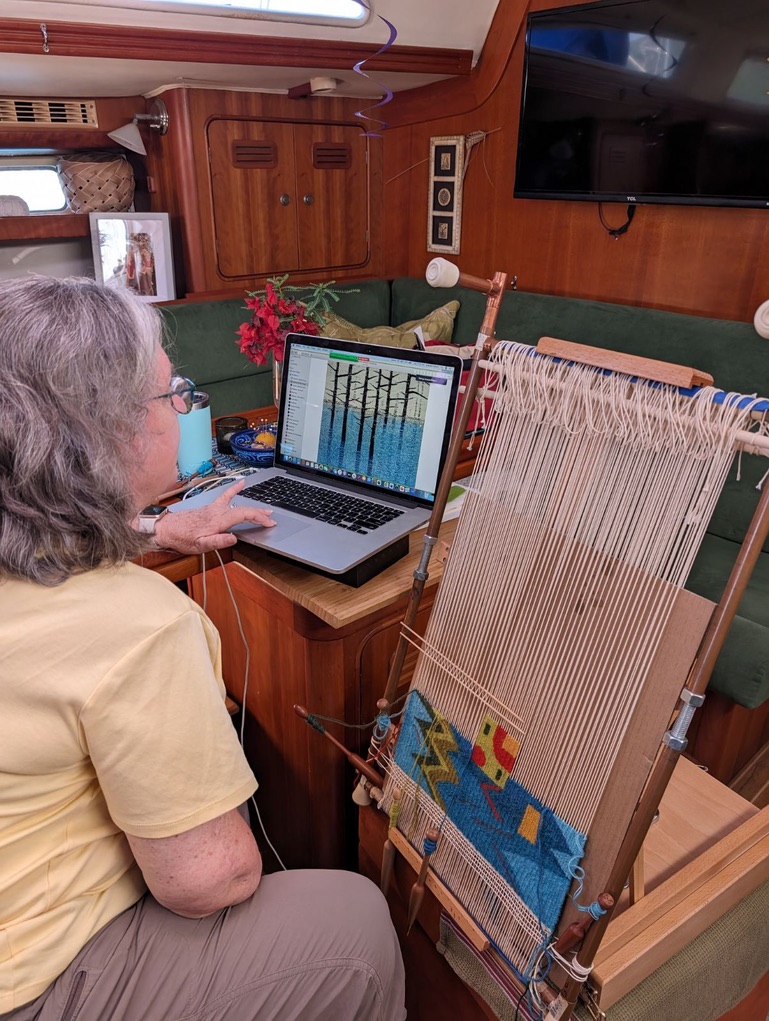
The real excitement of the evening was that I met a woman living aboard her boat in English Harbour, where she has a Harrisville 22” folding loom onboard. When I asked how she set that up down below, she informed me that she weaves in the cockpit.
We met a couple of evenings later when we could actually talk. Her name is Helen, and she lives part of year the in Minnesota, and part of the year here in Antigua, on her boat.
Right now her loom is set up with an 10/2 Tercel warp. I’m not sure if she has decided what she’ll weave. She may have a plan by the time I see her again in a few days. Like me, she gathers her materials at home and brings them with her. Here is one of some photos she shared with me. I don’t know what she does when the tropical showers start with no warning. Her loom would definitely get wet because here doesn’t come without wind…usually lots of wind.
Sorry that the image is blurry. I couldn’t pass up using it because it’s such an incredible feat to meet a weaver while sailing, especially a weaver who manages to weave onboard. I have never attempted to bring any loom onboard except a copper pipe loom. In order to weave I put a table easel on a folding table and then set up my loom.
I have been considering table looms even though I don’t like them! Is that the voice of desperation? (yes) I was quite intrigued with Jane table looms, but wherever I might set it up I would have to stand to use it. If I bought a stand for it, or had Bob make one, it wouldn’t fit onboard. Oh, the hindrances of living in such a small space while trying to weave.
The only other weaver I’ve met who weaves aboard is Doris Florig, and we didn’t actually meet in person, just online. At the time, 2015, she was aboard her sailboat in Guatemala and had set up a large tapestry loom where her dining table is in the main saloon. I wrote about her here. Currently I believe Doris mostly weaves somewhere in the Rocky Mountains. Here is the photo of her loom she sent me back in 2015. Again, not a crystal clear photo, but impressive, yes?
So it goes to show that I should never say ‘never.’ I have spent 13 years lamenting that I have never met a weaver during our sailing adventures. I have now met Helen, in real life (IRL), who weaves on a pretty large loom on her boat. No, it’s not a large loom by weaving on land standards, but I doubt I’ll meet anyone else who has a floor loom on a mono-hull sailboat. (I refrain from saying never.) Bob would never agree to Doris’ solution, and I actually don’t blame him. I know I can’t get even the little Harrisville onboard Pandora. If you’ve got advice for me please get in touch!
Meanwhile, life goes on doesn’t it? And those of us with hurdles try to figure out how we can keep weaving.
I now have a few projects in Notion somewhat under control. I absolutely could not set it up myself, so my younger son came to my rescue. He loves Notion. He says you can create any kind of system for keeping track of things with it, from spread sheets, graphs, tables, or even ‘cards’ with info. And you can add photos and notes. You have to know how to do this yourself though; there are precious few tutorials. It’s a tracking app for people who are already computer savvy, and that is not me. I have a lot more data to put into my Notion file, but I’m off to good start.
This week I am in an online class with Cally Booker on Doubleweave Huck. The Michigan League of Handweavers is hosting this class. They are in Michigan, Cally is in Scotland, and I am in the Caribbean. What a world. There are three class days, and we’ve already had two of them. Cally gets online mid-afternoon, while the Eastern US folks (including the Michiganders) get online at 9:30 am, most of them with coffee cups in hand. I am on Atlantic time and have finished my coffee and breakfast by the time class starts for me at 10:30. An old acquaintance of mine, from my first guild in central New Jersey, whom I’ve thought of fondly over the decades since I moved away from NJ, is taking the class from Arizona. She has to be ready to participate at 7:30 am. When we finish, Cally is ready for tea, and I am ready for lunch. My friend in Arizona can still get some breakfast! Indeed, what a world.
I don’t have a loom onboard, so I am weaving virtually, as well as being virtual myself. I have put a standard 8S huck threading in Fiberworks, and I copy it into new drawdowns to change the lift plans to get different weaving effects. Everyone else gets to go to their looms and actually weave. I look forward to seeing what they’ve woven at our next class. I won’t have anything to show. This is my set up for class. Tech on tech, with tech….I’m in the zoom class on my ipad while making drawdowns on my laptop.
My mind is focused on the incredible trajectory of weaving history as I participate in things this week. Through Marta Cucchio’s facebook page, I learned that the documentary film about her atelier, that my La Romita group visited in October, would have a free screening on the website for Hollywood Short Fest. The film recently won an award from this organization and was offering the free screening until last night. Over the past week I watched it twice. This atelier and museum has been on my mind constantly since I was there. Marta is the 4th generation woman to continue the revival of very old Perugian weaving designs. She moved the atelier to a very appropriate site outside the medieval of walls of Perugia in 1996. It is now housed in the de-sanctified church of San Francesco delle Donne, St. Francis of the Women, and Marta’s workshop employees are all women. The building originated as a hermitage where St. Francis and his disciples stayed when it was built in 1212. The name came when the Franciscan monks gave the church to Benedictine nuns in 1252. Being outside the city walls it was abandoned numerous times, since there were many battles and wars fought in this area, where being outside the city walls would make this building indefensible. The salt wars greatly diminished Perugia’s economy so this building was abandoned. In the early 19th c it was a spinning mill for a short period.
Before Marta Cucchio took possession of this site for the atelier, four generations of her mother and grandmothers had run this business at other locations. Marta is the first of these women to learn to weave and participate fully in the business.
What has been on my mind since visiting her atelier is, of course, the fabrics. We cannot know the woven structures that Mary actually wore, or the fabrics with which she may have wrapped the baby Jesus. What we know are the fabrics painted by the great artists of the Middle Ages. From those paintings and the historic records of woven patterns created and executed in Perugia, we know a great deal about the fabrics woven in medieval Perugia and can identify them in paintings. As it is, the patterns depicted in medieval paintings and frescos would have been woven entirely by hand-manipulation which would have made them incredibly valuable. For many centuries it was customary for wealthy families to have an inventory of the textiles they owned along with inventories of jewelry, silver and other precious household items. I think most non-weavers would be surprised to learn how valuable fabrics were in earlier times.
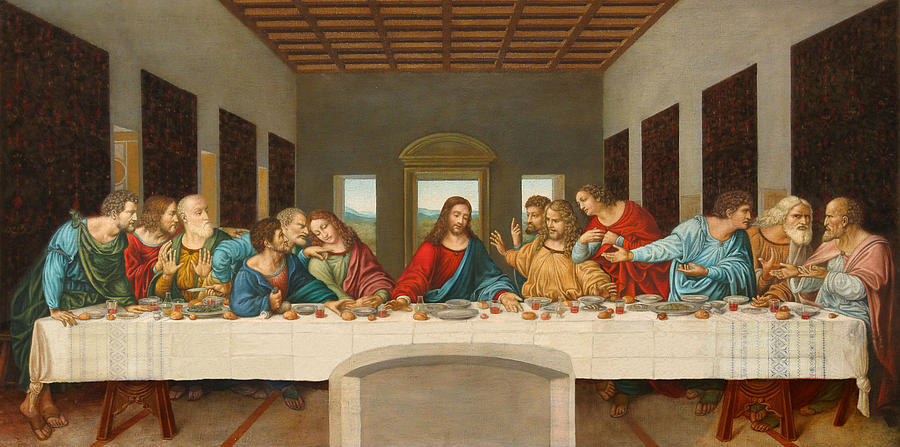
Marta and her colleagues weave on manual jacquard looms, a technology that was invented in the early 19th c. Her looms date to the late 19th c. It’s a more-high tech way of producing these fabrics from the Middle Ages, but it is far from the technology we have today. It took two years for the Giuditta Brozetti weavers to plan and execute a reproduction of Leonardo da Vinci’s tablecloth from the “Last Supper.” Some of that was research, certainly, but the whole process of making the warp, dressing the loom, which included attaching the many jacquard ‘mail eyes’ or ‘hooks’ to the warp threads, even punching the jacquard cards, took most of that time. I wonder what it felt like to throw those first dozens of weft passes and watch the patterns emerge.
During my visit in October, Marta mentioned that someone had made a short documentary about her project. The film was shown at Cannes, and then this week, she posted that it had won an award at the Hollywood Short Fest. The Short Fest group posted a free screening of the film for six days. I watched it twice. I could watch it a dozen more times. The breadth of history shown in a skill that I love spans most of human time. In this instance, Marta’s great grandmother started this atelier 100 years ago. Marta wanted to mark this historic moment by weaving something far older that celebrates the weaving history of Perugia. I marvel that women have taken this skill from the most basic materials, both in fiber and equipment on which to weave, all the way to the space age, where computers weave fabrics that are not only used in space, but in human bodies to replace vital body parts.
When I return home I will weave my double huck samples on one of my two computerized dobby looms. I will be part of the long chain of women who have expressed themselves through fabric with whatever is at hand, in my case fairly advanced technologies, like machine-spun yarns and a computerized dobby loom. Then I will sit and hand-hem my fabric. From the space age to the Stone Age. It’s all good. I don’t understand much about computer tech, but I am glad to now be able to track my weaving projects in Notion, and even weave some of my projects via computer driven looms. I still make the warps by hand, and dress the loom by hand, winding the warp onto the back beam, threading the heddles, and tying on to the cloth beam, all by hand. I still throw the shuttle that creates the cloth. What a world.
It’s January, the first month of the new year as well as my birth month. It’s the month when the ancient god Janus for whom the month gets its name, compels us to take stock of where we’ve been and what we’ve done as we look to the future for where we’re going and what we’ll do. He is the god with two faces, looking forward and looking back. He predates the Roman gods and is likely a god from Etruscan origins. The Etruscans are near and dear to me, in spite of what little is known of their culture. Their artwork is glorious and is seen in subsequent centuries in Roman culture. I visited Tarquinia in the late 1970s, in college, where there are many Etruscan tombs with artwork still intact. I had the thrill of being there again a couple of months ago, in October. The images of Etruscan artwork are prominent in my mind this month as I plan for the future.
This is my last year in my 60s. This is a year where I want to pay particular attention to looking back so I can determine where and how I want to go forward Into what will hopefully more than a decade of continued creativity. I know I have to keep de-stashing and even more importantly, I want to create things. I realize I must clear some space both physically and mentally in order to create. I am becoming bogged down in my own stuff. Someone else, younger, with more years of creativity in their future, needs to take some of this burden off my hands.
I’ve been in Antigua for 6 days now. I was treated to a quick tropical squall on the morning of my birthday, followed by a beautiful rainbow.
Then the day progressed with getting a cooking/baking lesson with the French chef of La Brasserie in English Harbour, Antigua. Eric gave me a lesson in making macaroons with fillings. He made me a large macaroon cake which is called an ‘Ispahan’ in French. My macaron cake was scented with rose water, and the filling was a butter cream/custard mixture which I also learned to make, raspberry jam, and fresh raspberries. It’s wonderful to have a beautiful dessert that tastes as good as it looks.
It’s been a rather busy few days since we arrived in Antigua. We’ve met up with cruising friends who have either returned here or stayed here through the holidays. Some non-sailing friends visited during their winter vacation here. It’s their first time in Antigua, and setting aside the Christmas winds that have arrived bringing high winds and rain, I think they are enjoying the island.
Today is our first day with no scheduled events, so we took our dinghy to a new breakfast place called You and Me. It has well shaded outdoor seating area with great views of the head of Falmouth Harbour.
After I finish this blog post I intend to knit for most of the day. My older son gave me a wonderful selection of yarn for Christmas. It’s from a local shop near him, and the yarn is “Yarn Citizens Luxe.” He bought five colors: Pearl (close to white), Heather (barely lavender), Jasmine (medium lavender), Ocean (medium indigo), and Coal (medium charcoal grey). The yarn is 49% baby alpaca, 39 % mulberry silk, and 12% cashmere. I can barely feel it as I knit, and it looks like a cloud.
My goal this year is to concentrate on finishing many UFOs, but this gemlike yarn obviously took precedence. I’m knitting a simple top/down raglan sweater and will use the colors from palest at the neckline to darkest at the hem. Even with our busy schedule, I’ve made sure to have relaxing knitting time part of every day.
Looking back, I am more satisfied than I expected with my projects this year. I should make a record of them, and to help me accomplish that my younger son introduced me to the app called Notion a couple of years ago. Notion allows you to keep track of projects in motion, to keep track of the order in which one needs to tackle projects, and to keep a record of things accomplished. I still haven’t managed how to include photos with this work tracking app, so I haven’t used it to its best potential. On the other end of the organized spectrum, I have an older friend who records all her finished projects in a regular notebook with a printout of the photo she takes when she finishes something. I have not resorted to that method because I have a basic dislike of having a lot of notebooks taking up precious space on my shelves. The notebooks I already have are burdensome enough, not to mention the many decades of periodicals I have kept and the books I own. While these are all precious possessions to me, the lack of space is getting worrisome. Sometimes I feel I might get buried in my workshop and never escape. Learning how to better use Notion this year is pretty high on my list.
In November I was invited to participate in a textile arts exhibit at a private club in Hartford. I think there were only eight invitees, and two of us were new to this event. The exhibit will be on display for the months of January and February. The club held a lovely opening reception a couple of days before Bob and I left to come back to Antigua. I invited a good friend to join me, and when I arrived I realized I knew quite a few of the attendees, but only one of the other artists. It’s always inspiring to see what other textile artists do, and I came away with wonderful images in my head. I was the only tapestry artist on display.
I thought above the fireplace was a prime place for artwork, and I was honored to have a piece there. On the left are two felted landscapes done by the only other artist I knew from the group, Diane Cadrain. On the right is my tapestry “Sunset on Wilson Cove.”
To list the things I feel are accomplishments I’ve made this year, I might put this exhibit at the top of the list. It’s not often that textile artists have a venue to show their work, and I’m very glad I was asked and glad that I managed to pull some works together before leaving the country. I participated in two other shows during this year, and while that’s not much, it makes three events that brought tapestry weaving to the public.
I did a lot of weaving this year. I finished half the warp of woven sashiko, and I made a number of sakiori samples which led to a vest that actually fits me and a tote bag I’m enjoying using. I have the tote bag with me now on Pandora.
Jody captured the best view of the vest which is from the back (althought it’s quite wrinkled from a long car ride!). There are side gussets of sakiori and two sakiori pockets on the front, but the back is almost entirely sakiori. Here’s the front—a photo also taken by my friend Jody.
The fabric for the trim on this vest is what I used as the fabric strips for weaving.
I wove my first wedge weave tapestry, wove half the warp of my sashiko project and gave away four of the finished squares.
At long last I finished the Caribbean tapestry that I began during the pandemic. I can’t post a photo of it because I plan to submit it the Connecticut biennial when I return home. What I can show is the wonderful frame Bob built for the tapestry. This is our best attempt so far at having the back be as neat and tidy as the front.
This fall I made some fabric trays for a party favor for an upcoming event I will not be able to attend, and I made three lace flowers that I included in a fascinator that was made from various pieces of antigue machine lace I have and several ribbon embroidered flowers that I’ve made over the years. That was a fun project initiated by my lace group to become a new category of lace at the Big E Arts and Crafts exhibition. The fascinators are now on display at a local library.
And then there was a little weaving and a LOT of dyeing in Umbria, Italy, which I wrote about here and here. In December my friend Jody and I put some of our new knowledge to work during a two-day dyeing session in my kitchen—right after the new year. We used indigo, weld, madder, and olive leaves and branches from my olive tree. It was hard to stop, and it’s one of the first things I want to do when I return home. The circle of colors starting on the lower right is 3 shades of maddder, , weld, olive leaves, weld with a short dip in indigo, two skeins in indigo (the first one is very blotchy, not sure why), and the last two are indigo dipped in madder. The last skein is close to a color I wanted to recreate from one of the skeins we dyed in Italy. I look forward to attempting that again at home this spring.
I also finished two knitted items this year: a vest with the yarns I got from the 2023 Kate Davies advent yarn box. It is tunic length and has a shadow knitting pattern running through it. The 2nd project is a sweater from a Kate Davies pattern called “Auchnaha.” I used her beautiful ooskit yarn in a natural grey/brown. I’ve enjoyed wearing both these sweaters before leaving New England for the tropical weather in Antigua.
Just before I left home I stopped at Hartford Artisans for a short meeting. It’s impossible to go there without being tempted by any number of wonderful handwoven/handmade things. This time I succumbed to this charming little pouch. It had a rather sad plastic button that imitated bronze. That just would not do! I changed the button to a shell, and added a shell to the plain commercial fabric at the top. I also added a piece of kumihimo from my stash of samples to turn the pouch into a wristlet purse. I’ve got it with me now in the Caribbean, and it is perfect here!
I’m pretty sure I have accomplished significantly more this year than in previous years. While it feels awkward and quite self-absorbed to list all my finished projects, I am trying to understand how I did these things, and how I can maintain this surge of work in 2025. It takes luck, of course, since we need good health to be productive, and that’s something none of us can predict. It’s time to knuckle down to learn more about Notion so I can keep better records, to de-stash my extensive work space, and get down to the business of doing what I love. Forward ho!
Here I sit in English Harbour, Antigua, thinking about my recent return from Umbria, Italy, and the highlight of my time there: a visit to a jacquard weaving museum and atelier in Perugia that is housed in a 13th c. Franciscan church.
Perugia became a walled city in the Middle Ages, prior to the building of this church in 1212. It was originally a simple hermitage that was founded by St. Francis of Assisi when he and his followers stayed here together. By 1252 the monastery was ceded to Benedictine nuns and given the name San Francesco delle Donne. St. Francis of the women—for the women? It was abandoned numerous times through the centuries, and I don’t know those stories. Our host at La Romita, the art school where we were taking a workshop on tapestry weaving and natural dyeing, mentioned that Perugia defended itself many times over the centuries. Most of the conflicts had to do with the vying city states and their status in the Catholic Church, and throughout the Middle Ages Perugia was an impoverished place, in spite of their reputation for excellent craftsmanship in pottery and textiles, and probably other fine crafts that I haven’t found in my searches. There is some great information on the Giuditta Brozzetti website.
The Brozzetti family started the weaving museum and atelier in 1912, but not in its current location. The museum is named in honor of the current owner’s great grandmother, Giuditta Brozzetti. Giuditta started an atelier to bring back the historic handwovens of Perugia, especially the “Perugian tablecloths” that were often used as altar cloths in churches, as well as being tablecloths in the homes of the very wealthy. Textiles were far more valuable throughout history than they are today and were always listed in the inventories of wealthy families. The atelier and museum moved to this magnificent site in the church in 1996. I believe it took a lot of work to bring the church into state we see it today. It is magnificent!
Here is an excerpt from an interview with Marta Cucchia, the great granddaughter of the founder and current owner:
“My studio is one of the last weaving ateliers in Italy – and the only one that reproduces medieval Perugian Tableclothes using Jacquard looms from nineteenth century. Furthermore, with the pedal looms, typical of the Umbrian countryside, we create fabrics using millenary techniques passed down orally from generation to generation. My great-grandmother, Giuditta Brozzetti, founded this Laboratory in 1921. From then on, the passion for hand-weaving was passed down from mother to daughter, each woman bringing her own experience according to her personality and studies.”
Marta has four women who assist her in the studio, and they have all come out of textile schools to make this field their livelihood. What an exciting place to work!
Some of the projects that Marta oversees are replicas of actual textiles in paintings from the Middle Ages and the Renaissance. During our visit Marta showed us a couple of impressive replicas. She had high resolution images taken of Leonardo da Vinci’s “Last Supper,” and she had small areas enlarged so she could study the tablecloth. In hind sight, why didn’t I think to ask her if she thought that cloth had been woven in Perugia?
Even in this low resolution image of the fresco, taken from the intenet, you can see that the tablecloth is highly figured at each end, but also there is a hint that the white on white areas also have interesting weave structures.
Detail of a similar fabric from a different painting:
Here Marta is showing us some of the images she used to design the tablecloth. Clearly I am scratching my head in amazement!
Photo by Jody Brewer
And here is the finished cloth, woven at the Giuditta Brozzetti Atelier:
The jacquard looms in this studio are all from the 19th c except one that is older from the 18 c. These are hand manipulated looms, where the process of weaving involves attaching every thread in the warp to a jacquard attachment that has a series of cards that control the patterns. The weaver stands at the front of the loom and depresses the one treadle (a heavy one that sits rather high off the ground!) with her right foot —yes, they are all women at this atelier. Depressing the treadle opens the shed, and the weaver pushes a lever that is above the beater that engages one of the jacquard cards, then she pulls a cord that sends the fly shuttle through the shed of the open warp. Here is a video of the process, although at this point the weaver is weaving some plain weave between the designs, rather than the more interesting pattern.
Here is Marta showing us one of the many charts of jacquard designs in her collection. These graphed charts are used to make the cards which will control the weaving patten on the looms.
And here is my best attempt at getting a shot of the entire loom. The warp on the loom will be obvious to most of you. The yellow cords anre atracked to each warp thread and are running vertically to a loft area where you just see a bit of the roll of cards used to weave the design. There are other ‘chains’ of cards being stored on the railing of the loft.
I neglected to count how many jacquard looms are in this large studio, but here’s a photo of the long row of them in the museum.
Many traditional Perugian designs can be woven on regular shaft looms with floor treadles. Marta demonstrated this on what looks like an equally old loom to the jacquard looms.
Here is particularly stunning tablecloth woven on a shaft loom in a traditional woven structure with luscious colors. I tentatively asked if it was for sale (and the price) and learned that Marta wove this tablecloth for her wedding. What a treasure…
During the time when Marta’s mother led this studio they produced some designs for clothing. During Marta’s tenure she has also had commissions from Italian haut couture houses.
Photo by Jody Brewer
These dresses were designed and woven here, and I’m guessing this occurred in a past decade, perhaps the 1960s? 1970s?
There are other modern designs available here. This is quite a striking pattern that was for sale as a shawl or a cushion.
While we were there one of the weavers brought out this tiny gem woven in the same structure. They are not yet available, but as soon as they are I need one! I’m sure they will be popular. When I posted a photo of this Facebook some of my friends immediately asked how to get one.
This is my prize purchase from the day, a gem that gives me a little shiver of thrill whenever I take it with me somewhere. It is equally beautiful on the inside, lined in a fine silk fabric from Fendi.
Marta and I also discussed some of the fine finishing that goes into many of the pieces they make. In particular, Marta’s mother adds a beautiful bullion edge to some of the table runners. I must give this a try on some of my handwoven projects. I bought a small runner that I cannot show you because it is at home, and I am writing this in Antigua. Mine is off white on white, with jacquard designs at each end, and the point twill design in the middle. This one is far more elaborate, but I want you see the bullion stitch edges.
Each one of the pieces woven here are exceptional examples of textile skill. In many parts of the US, textiles are no longer valued as they deserve. I hope we can bring some of that respect and awe back into our lives. My house is full of my own handwovens, and sometimes I marvel that many of my guests don’t realize that. I’m not sure people even see textiles anymore, beyond noticing someone in a beautiful dress. There is so much to marvel at in the world of handmade cloth. The Giuditta Brozzetti Museum and Atelier has to be one of the best places to go and relish the beauty of handwoven goods. Get there if you can! If not, there are beautiful images and descriptions on the website.
Recently one of my oldest friends starting seeing a life coach. In one of the sessions the coach asked if she’d rather work or go on vacation. My friend answered that she’d rather work! She is a sculptor and painter. When I gave this a mere moment of thought, I realized I would answer the same. So, here I am in the depths of winter, living on a boat while visiting numerous Caribbean islands, and what I want to do everyday is work!
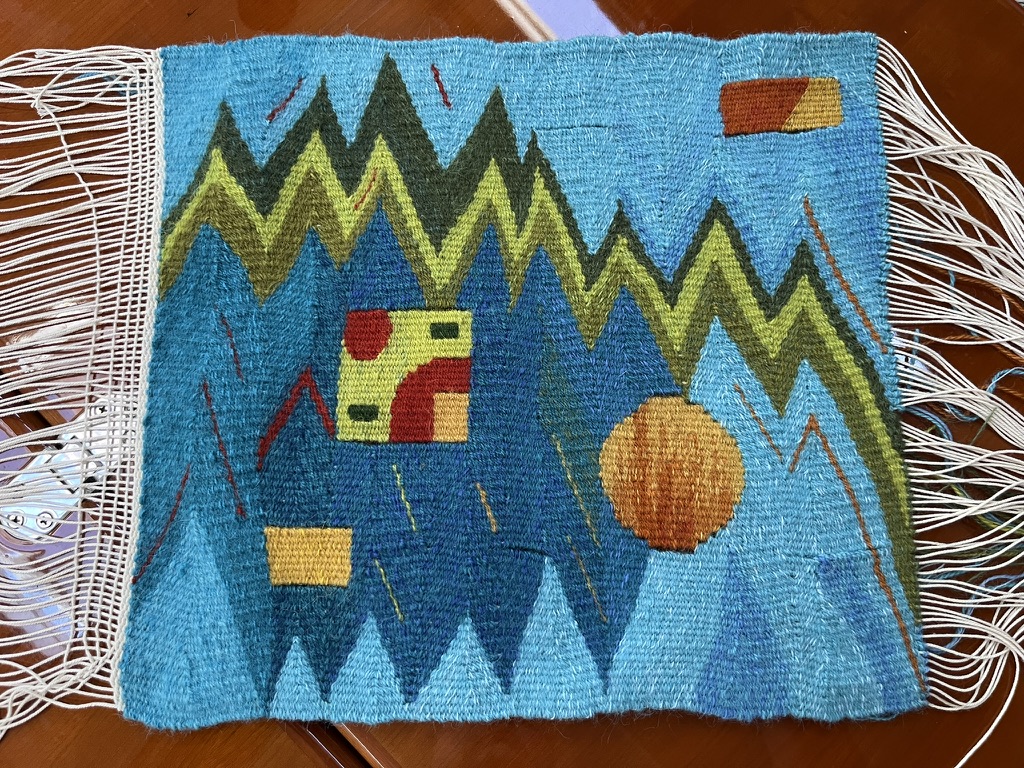
I have more projects onboard than I can possibly finish in the 3+ months I’ll be down here, but each year when I promise myself I’ll only bring what I can actually accomplish, I break that promise. This year is no exception. Somehow I want to finish one tapestry and start and finish a second one, quite small, but still. I brought 8 oz of merino/silk to spin (so far the only finished project!); three sweaters, two to continue and one to make from start to finish (half done with that one); two embroideries, and a basket to start (and finish, of course). I couldn’t complete these projects at home in three months, even if I worked 12 hours a day! But it’s hard to choose what to bring. And don’t you know, even with all I brought, I pine for the things I didn’t bring!
One day recently, when I was recuperating from the seasick meds I take, I lay on one of our settees watching a couple of hours of youtube videos on various techniques in bobbin lace. I know I cannot do bobbin lace on this boat–but that doesn’t mean I can’t wish I had a pillow here to try.
This year, since we have starlink to stay in contact, I have also started a tapestry study group with six of my students from previous live classes. Setting up the scene for doing these zoom meetings is a little more challenging on a boat than at it is at home.
It’s a feat of Rube Goldberg-ness. I have my computer on our dining table, sitting on both a cutting board and a box in order to get it at the right height to see more than the top of my head. My tapestry in progress, which has some bamboo skewers inserted in an empty space in order do demonstrations of techniques, if needed, is sitting on a table top easel on top of an ottoman. In this photo I haven’t yet set up the cable to my mobile phone on a reticulating arm that faces the tapestry as a 2nd camera for when I might need to do demos. Bob had a big hand in gathering all these random props to get things just the way I needed.
Tomorrow is our second session. I am now in a less protected anchorage, and we are rolling sideways quite dramatically. I will try to set up in the cockpit so I don’t get seasick down below. Meanwhile I am a little worried that the students may not feel good themselves watching the horizon roll side to side behind me. Fingers crossed….
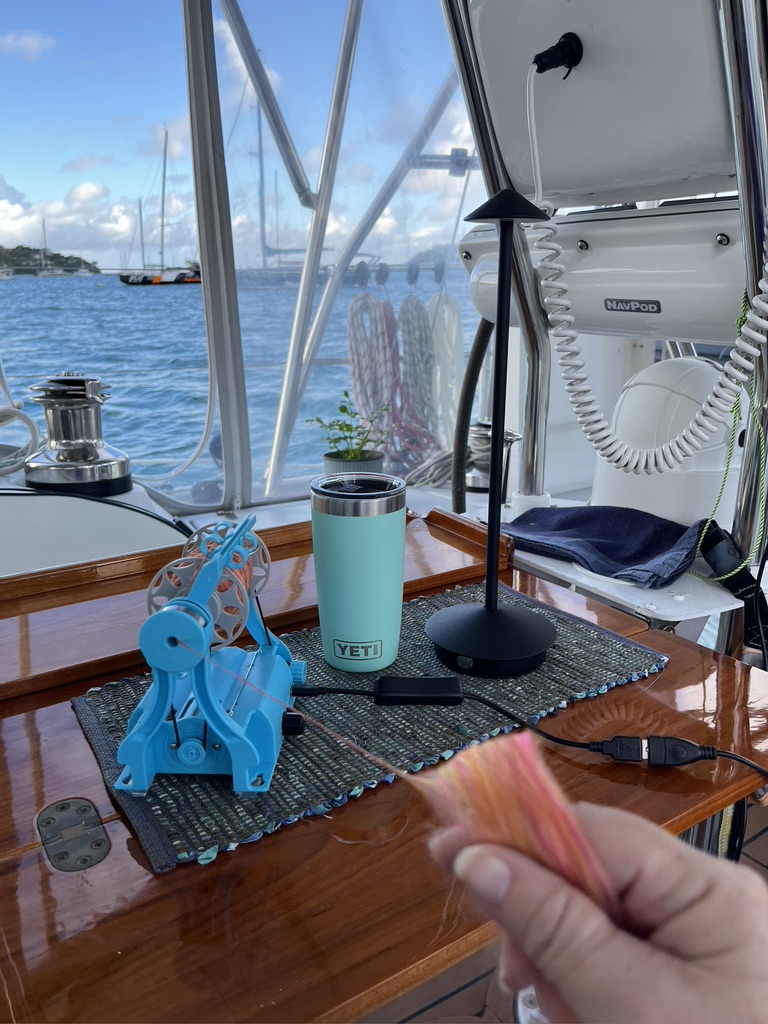
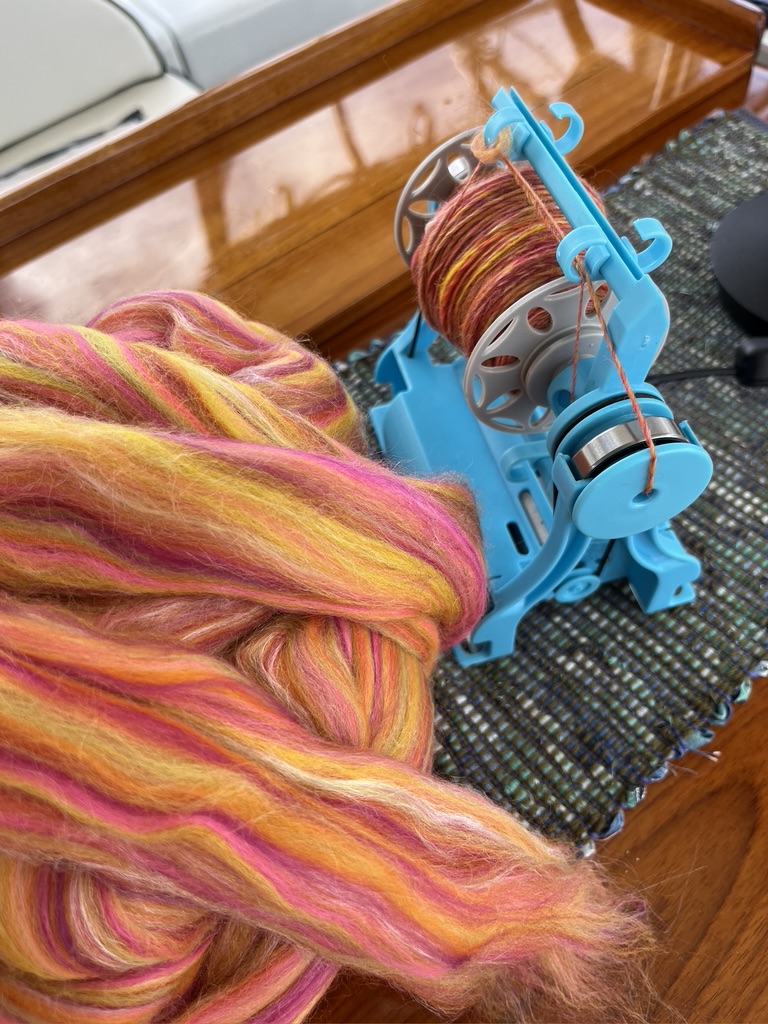
Spinning onboard is the easiest activity. I can look out at the horizon and keep myself oriented. I’m using an EEW Nano 2 from Dreaming Robots. It’s hard to believe that something so tiny and lightweight could work so well, and it doesn’t slide around as I draft out the fibers.
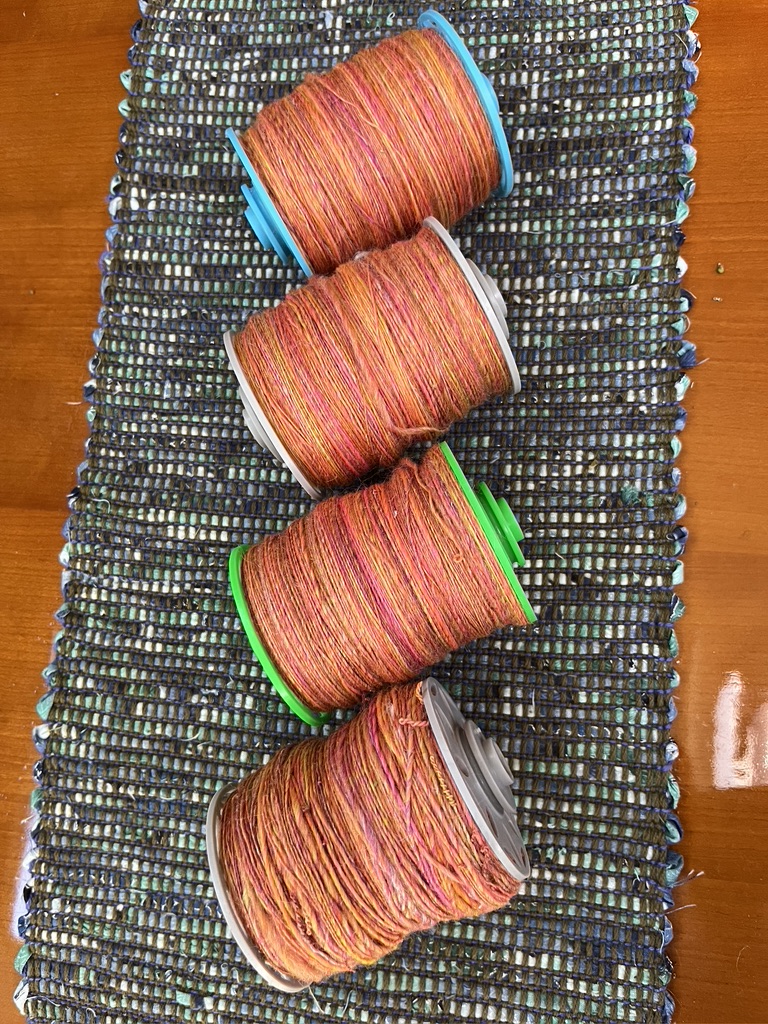
I did a poor job winding on my first bobbin. I forgot that I need move the hooks often when I’m spinning without a Woolee Winder which does the winding automatically. My next three bobbins got a lot better!
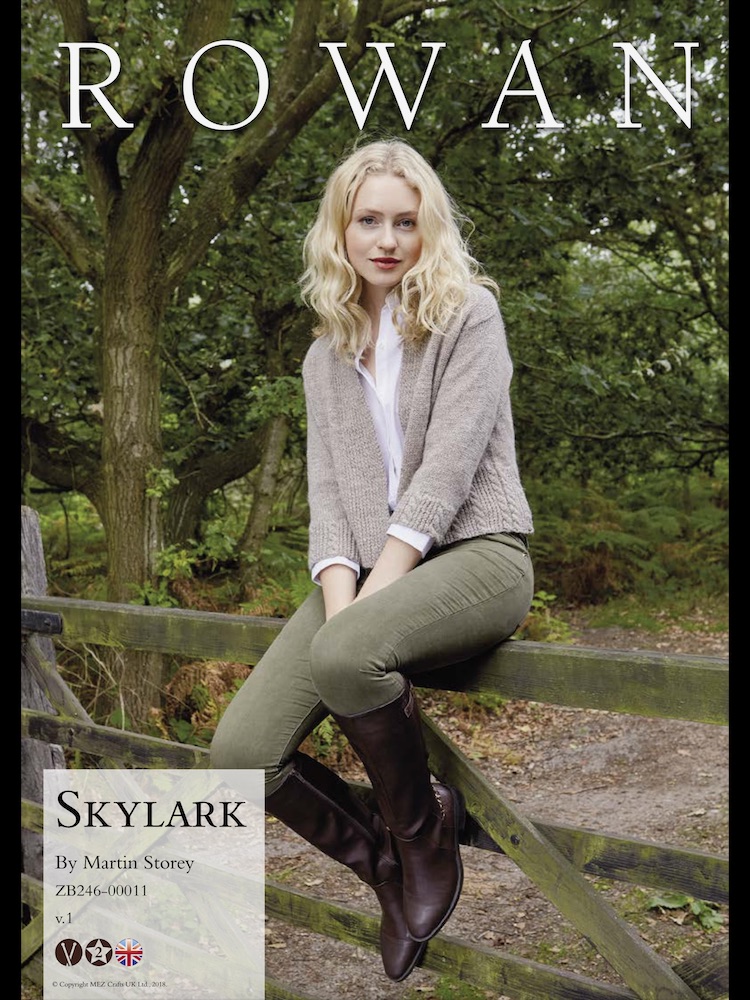
And those three sweaters onboard… I’d like to finish one of them! The two that were in progress when I put the materials onboard are a design by Martin Storey, which is a summer loose wrap type sweater made with two yarns held together–one linen and one cotton–called “Skylark.”
The other is a Kate Davies design called “Auchnaha,” also a loose wrap type sweater.
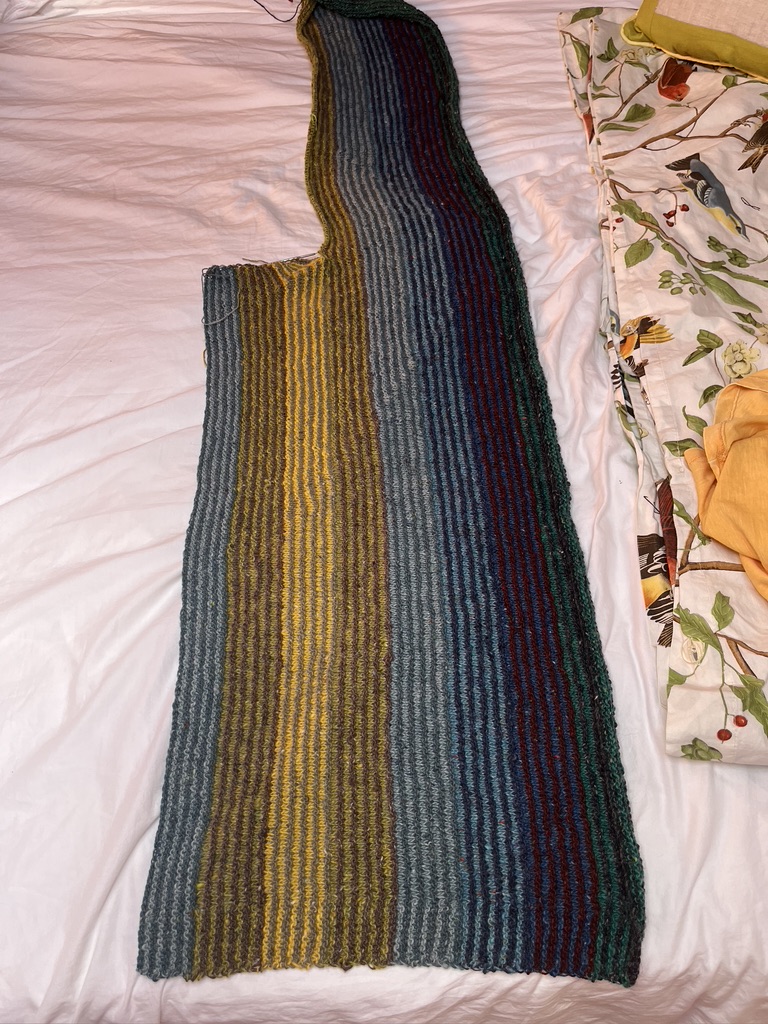
It would be wonderful to finish one of these to wear in spring when I return home to New England. On the other hand, it would also be great to wear this vest which I started onboard with my advent yarn from Kate Davies. Can you see the faint ‘shadow’ work in this? This is the left front/back, so I’m half finished with the vest, which is closer to completion than the other two sweaters. The right side of this vest has entirely different colors in it. What you see on the left side of this photo is not the armhole. It’s the neck opening with the collar already knitted into it. It’s a clever design, inspired by a design from one of the most clever knitters–Vivan Hoxbro.
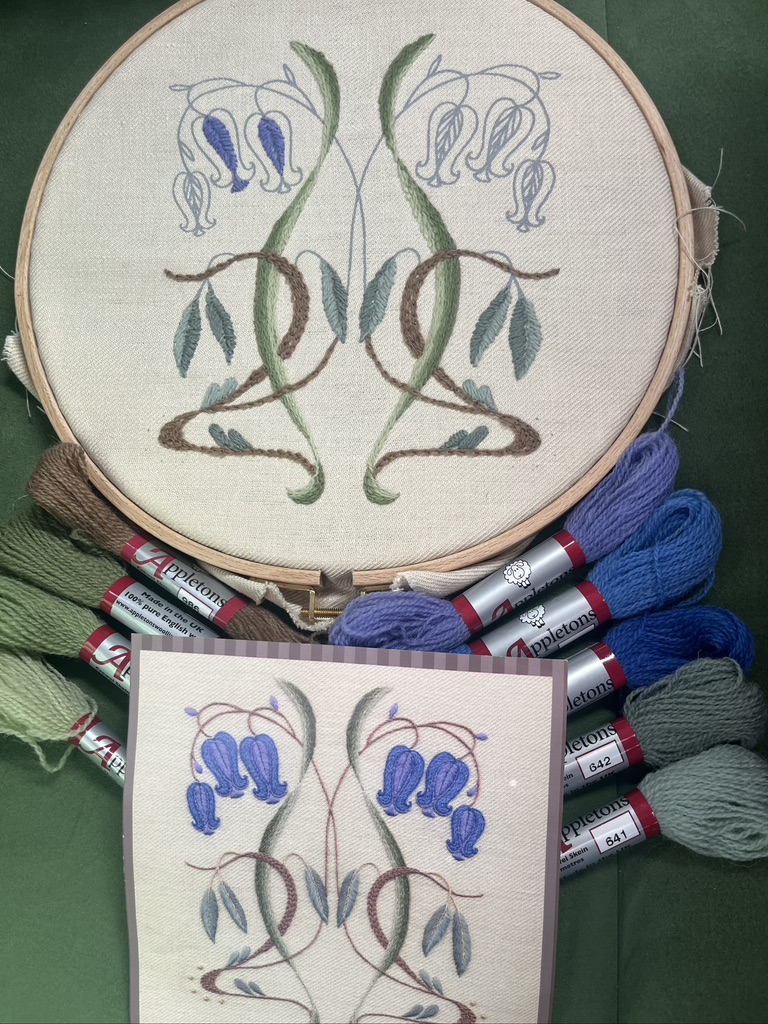
Recently I returned to embroidery, which I haven’t touched in years. When conditions are calm I can do close work. This is a kit from Melbury Hill in the UK. Years ago when I bought this kit I could have chosen any of their designs, which are all Arts and Crafts inspired. I guess I settled on bluebells because I got to see a ‘bluebell wood’ the last time I visited England to see my friend Lesley. A truly amazing sight! I may finish the flowers today. Then I’ll have another completed project under my belt.
As I write this Bob is ashore checking Pandora in to Dominica. We spent almost a week in Deshaies, Guadeloupe, after about 3 weeks in Antigua, in English Harbour, Falmouth, and Jolly Harbour. I miss the calm harbors of Antigua. No wonder the English were so successful there. Calm harbors with great defenses against attackers. I’ve been onboard exactly a month today.
I have done a few things in the category of sightseeing, but since this is our 7th winter down here, I don’t feel compelled to revisit everything. We see rainbows multiple times a day, and Bob records all of them with his camera. We spent a delightful day at the botanical gardens in Deshaies, Guadeloupe. This year I only took photos of birds and fish. I took the bird photos for my friend who has had a Nandico parrot for more than 30 years. If we rent a car while here in Dominica, we will visit the Kalinago community, and I will enjoy seeing their stunning baskets. Hopefully I’ll bring a few home to give to my basket making friends. There is a lot to do here, in the depths of winter, but I’d always rather be making something with my hands most days. I’d rather work!