ArgoKnot

tapestry

Can I Please Stop the Clock?

Today is December 6, and my last post was written on October 5, which is far too long to be out of touch on a blog. A lot of good work, good ideas, and great camaraderie with my fellow weavers have taken place over the past two months, along with feeling that I cannot dance fast enough to accomplish the things that are my highest priority. Are you feeling this way too?

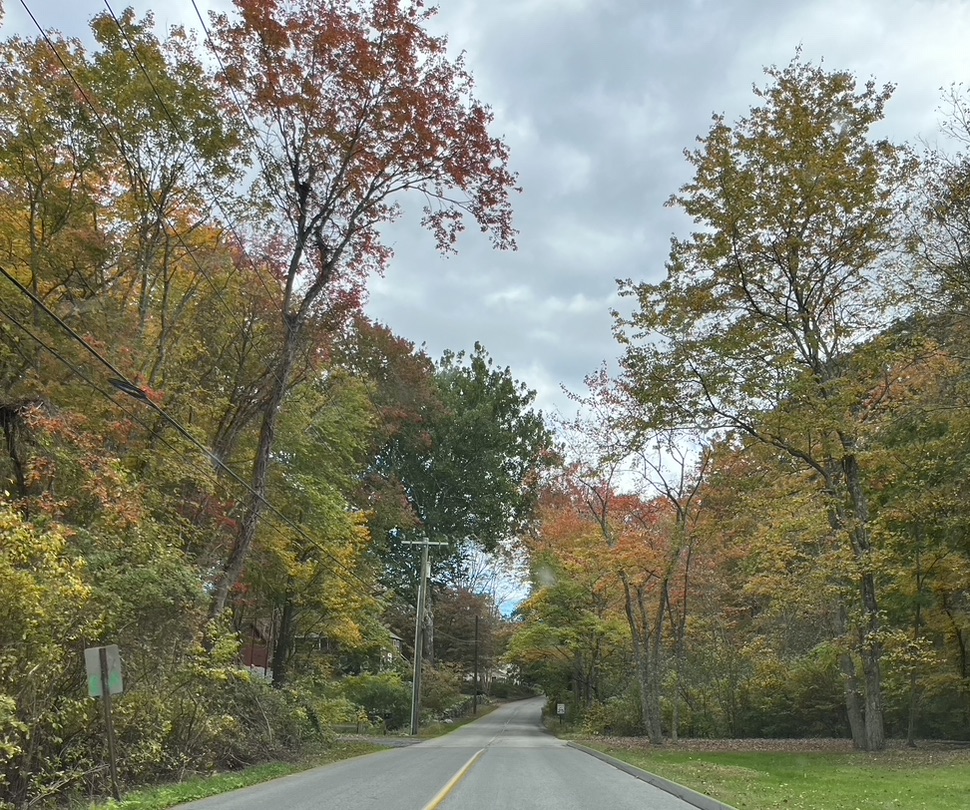
Two months ago I was at a friend’s house with other weavers to spend the day in her beautiful setting mixing and using natural dyes. It was the perfect October day, with the autumn color just beginning to light up the landscape. On the way home I had to stop the car to take a photo of sunlight coming through newly turned golden leaves.
I only brought tiny, 30 yard skeins of 30/2 cotton to dye for use in bobbin lace.
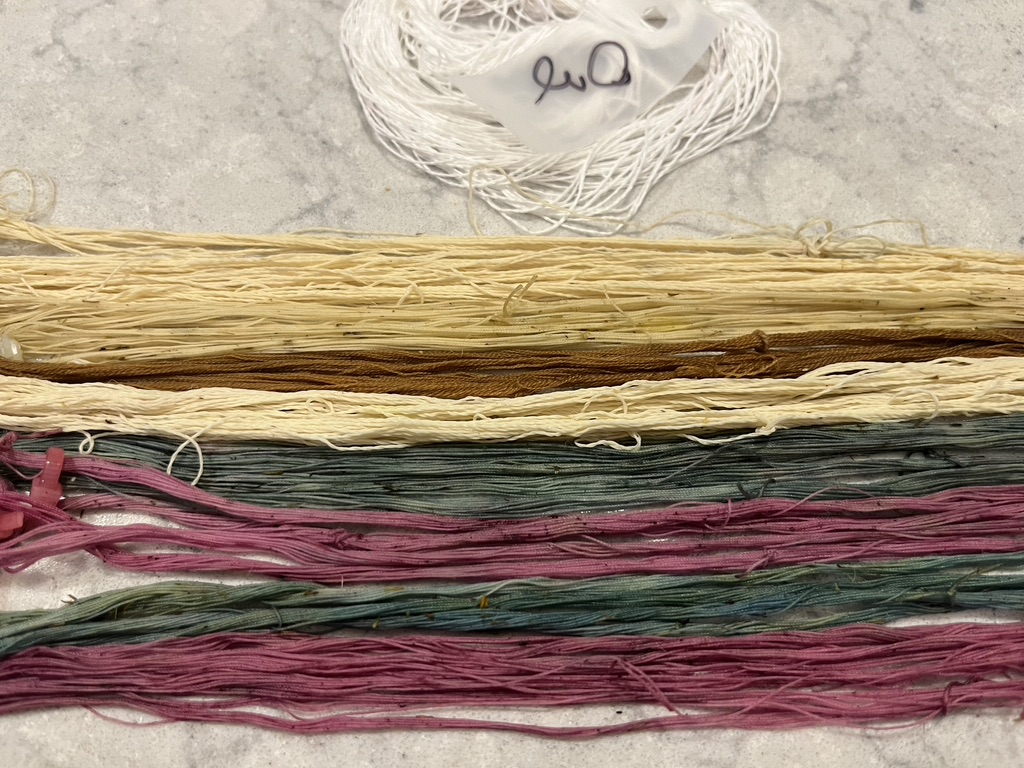
I used indigo and onion skins to make the greens. There is an interesting brown that I now don’t remember. Maybe a mushroom dye? I know it was not black walnut. The red violets are cochineal.
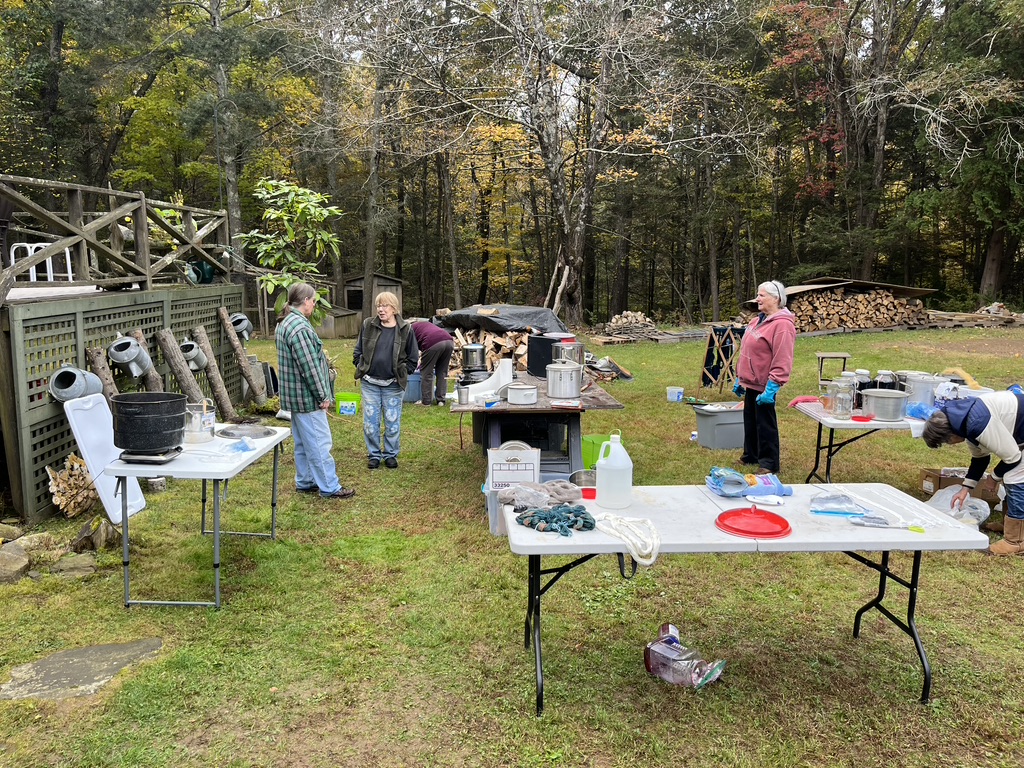
My friend Cindy’s bucolic setting always makes me feel like I’ve entered a fairy tale. She has a huge vegetable garden, and as you can see in the background, a large supply of wood to heat her house. Off in the distance, just to the left of center, is a chicken coop, which supplies her with eggs for a good part of the year. I’m sure it’s hard work to live so simply. I enjoy being in her environment.

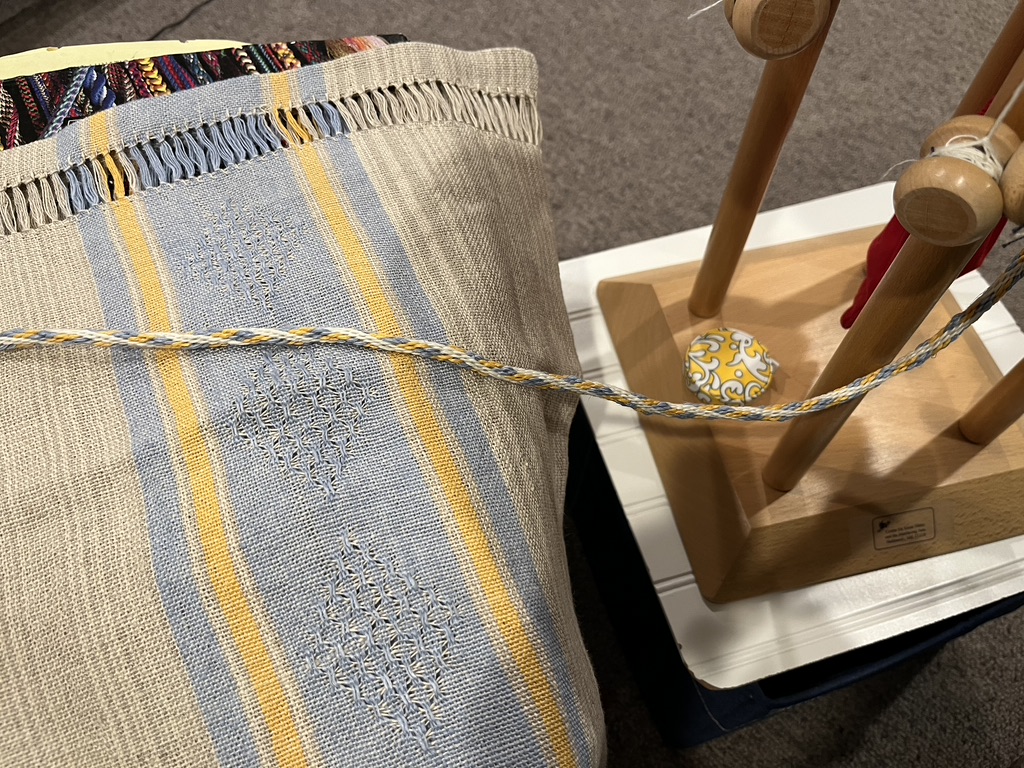
I finished the linen bread bags I’ve shown in previous posts, and made a braided cord for one of them. I have a partially made cord for the next bag–each braid will be different. I am happy with the bags. It was an easy project that almost seemed to weave itself.
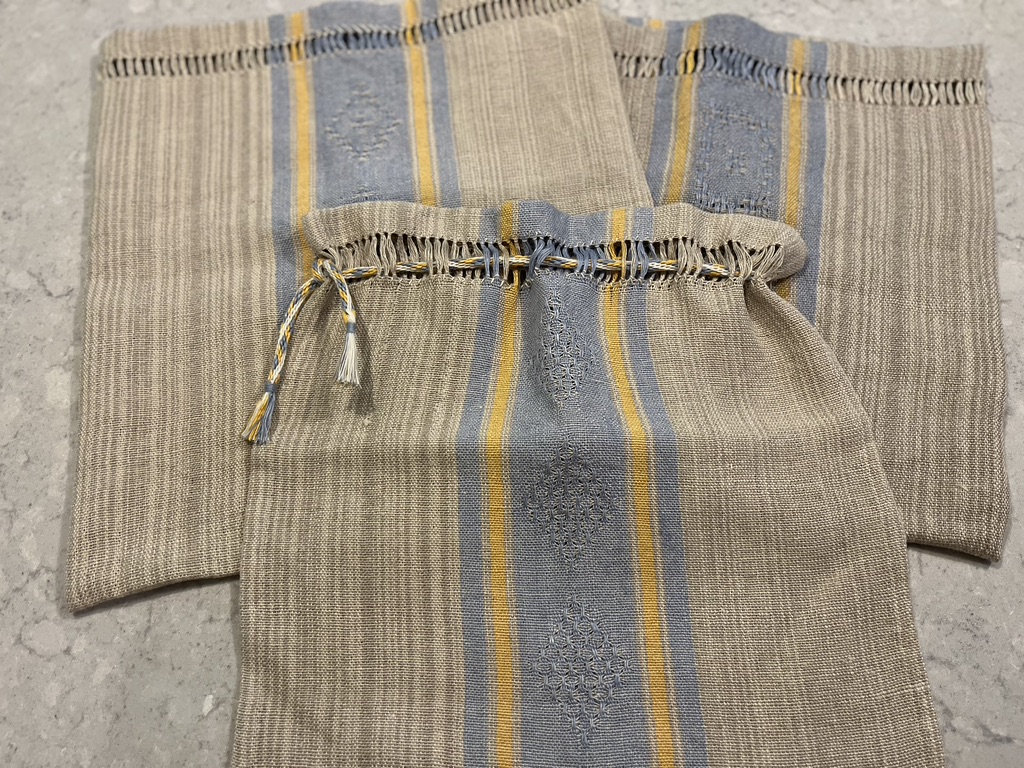
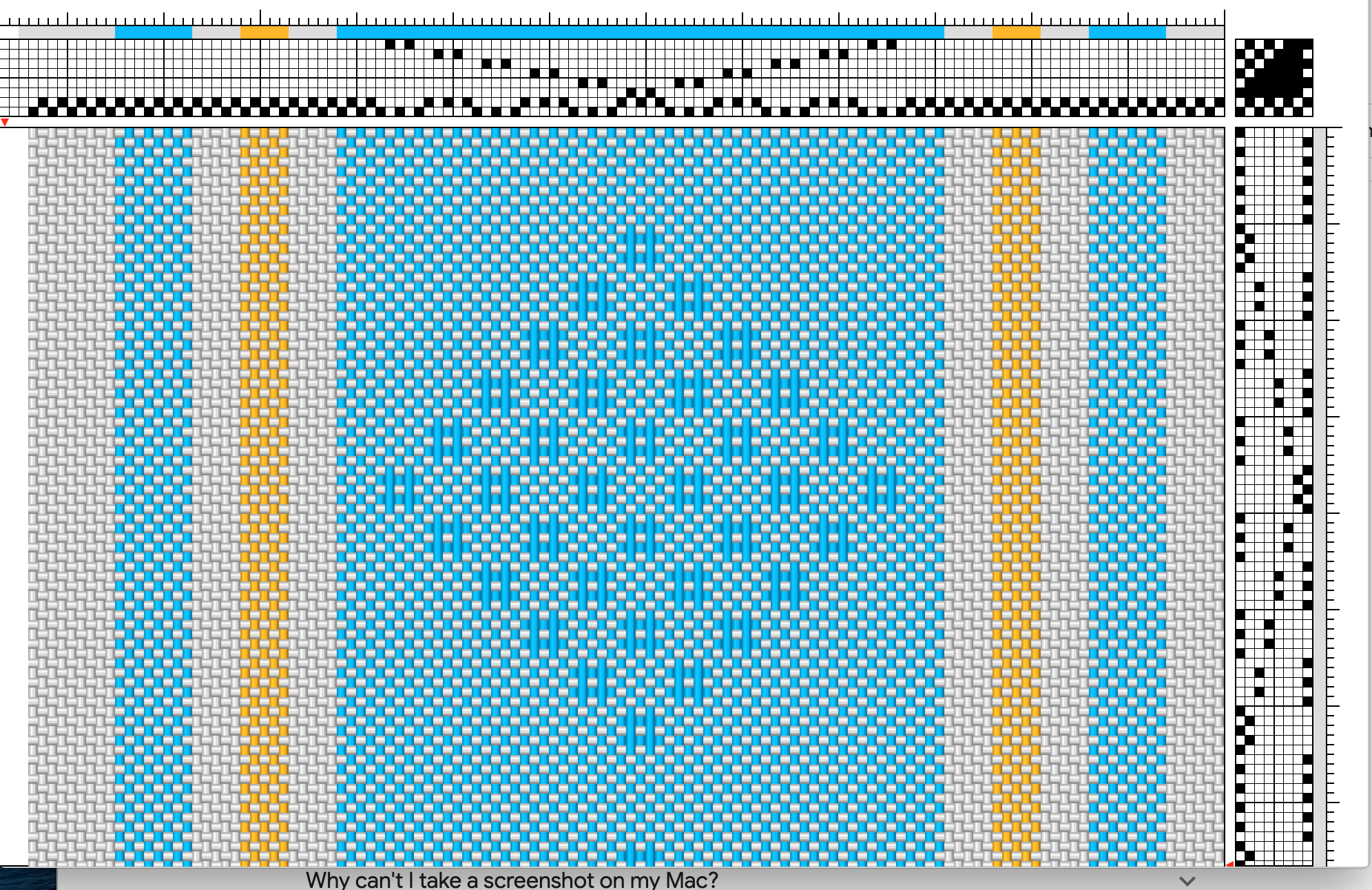
Since I finished these bags before the linen class was half through, I put on a new warp for napkins based on a design by Lisa Hill that she calls “Metaweave.” They are Brassard 16/2 cottolin set at 24 epi, and the pattern weft is 8/2 cottolin, also from Brassard.
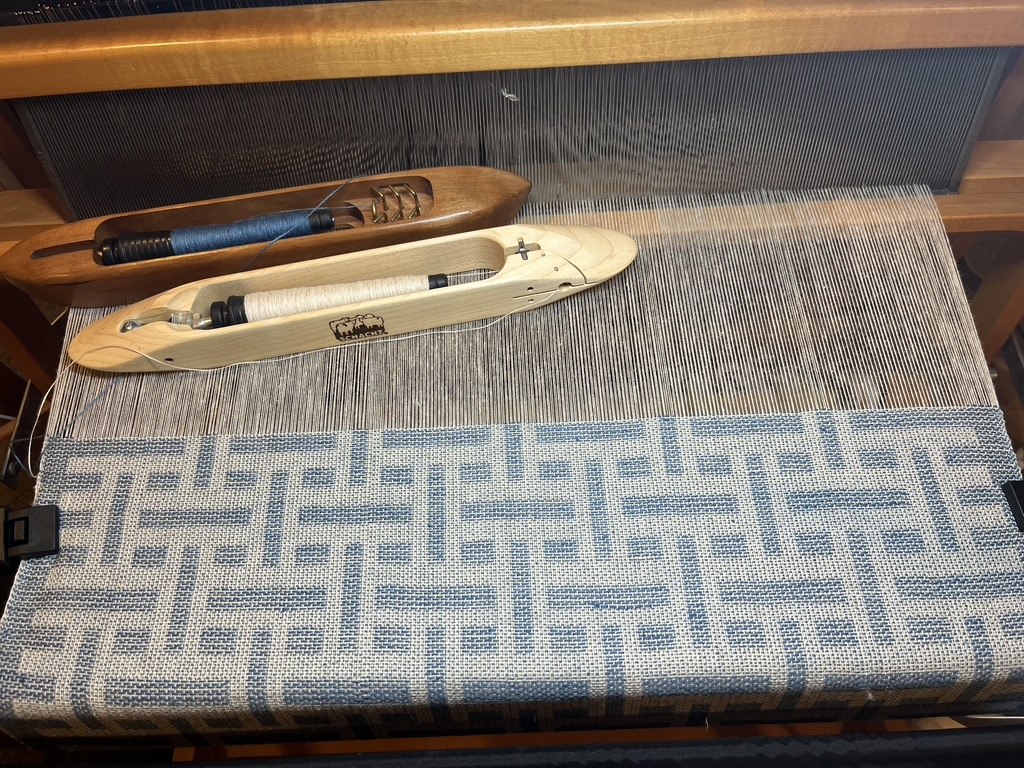
I prefer the underside of this pattern to the front.
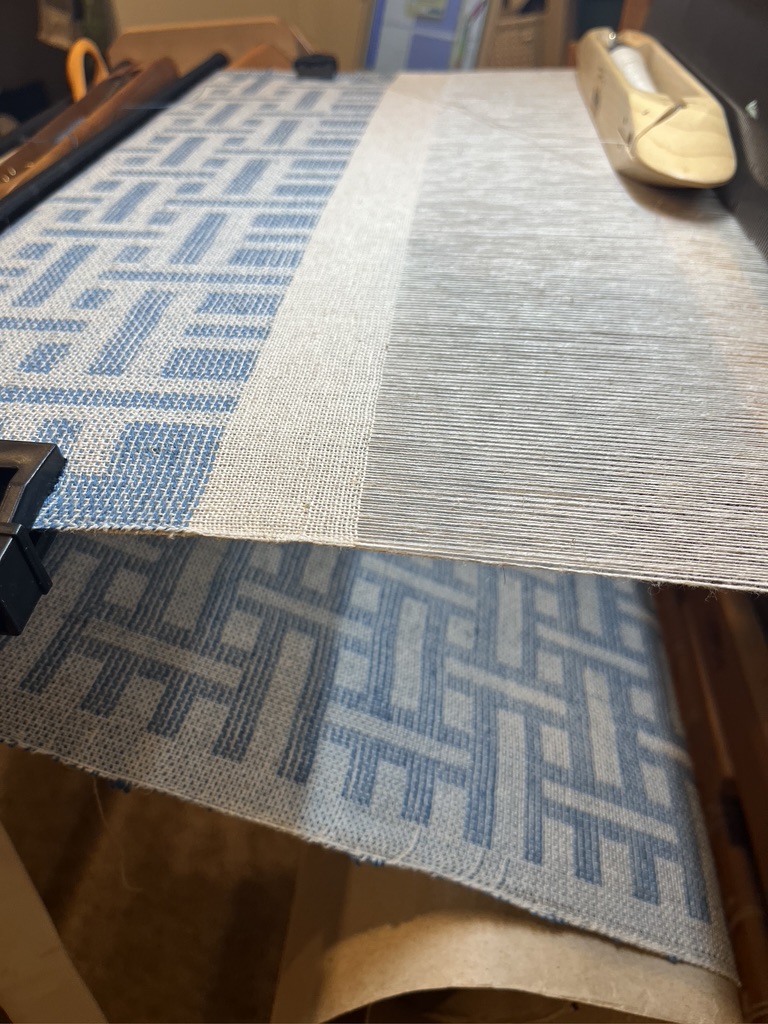
I put on enough warp to make 6 napkins, plus sampling. The sampling turned out well on the first try, so I expect I will get a 7th napkin. There will be two each: blue, red, green, and one yellow. The weaving is easy and so enjoyable!
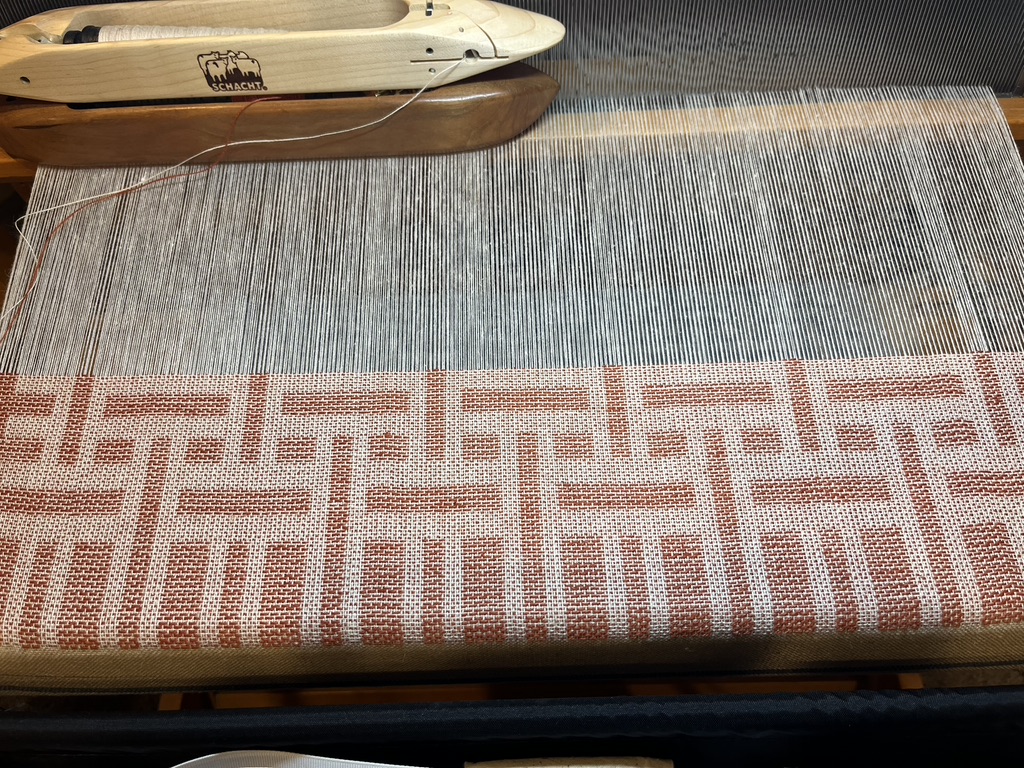
I am ready to start napkin #5, which is the first green. The green I’m using is a great color–sort of kiwi meets avocado. Maybe I can get started on that napkin today.

At last month’s local guild meeting (Area 4, CT state guild) one of our members showed a rag woven holiday table runner that made me want to go straight home and put it on a loom. The problem is that I now only have two looms for weaving fabric and both have projects on them. That led to another member offering me a small 8S table loom–not to borrow, to have! It’s quite a little gem that may need its own post to fully describe and admire. When I picked up the loom I found it already had a warp on it for a small rag woven project. Wasn’t that serendipitous? I wove off that warp with fabric strips that were included, and that gave me a good sense of how the loom works. I now have three small runners, one to use on Pandora and two to give as gifts.
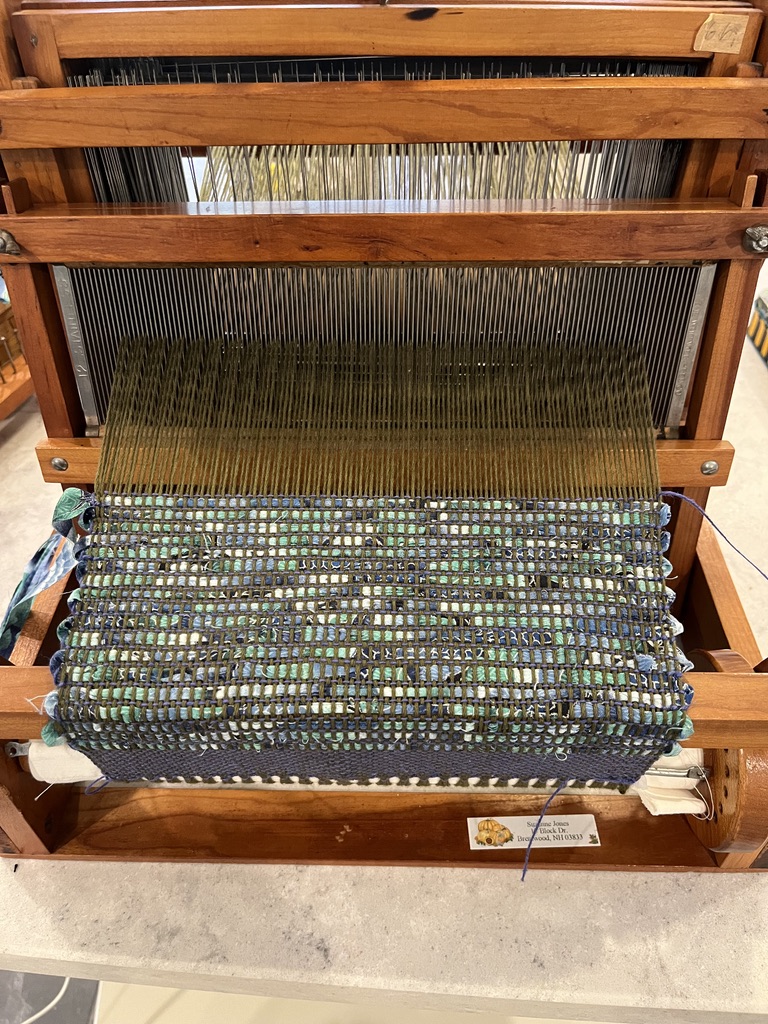
Here is the fabric and yarn I plan to use for the holiday runner. Time is so short now that I doubt I will be able to warp this until I return in the spring. I have high hopes for the fabric strips looking somewhat like the sakiori weaving I did in Japan–little dots of color on a cream/beige background.
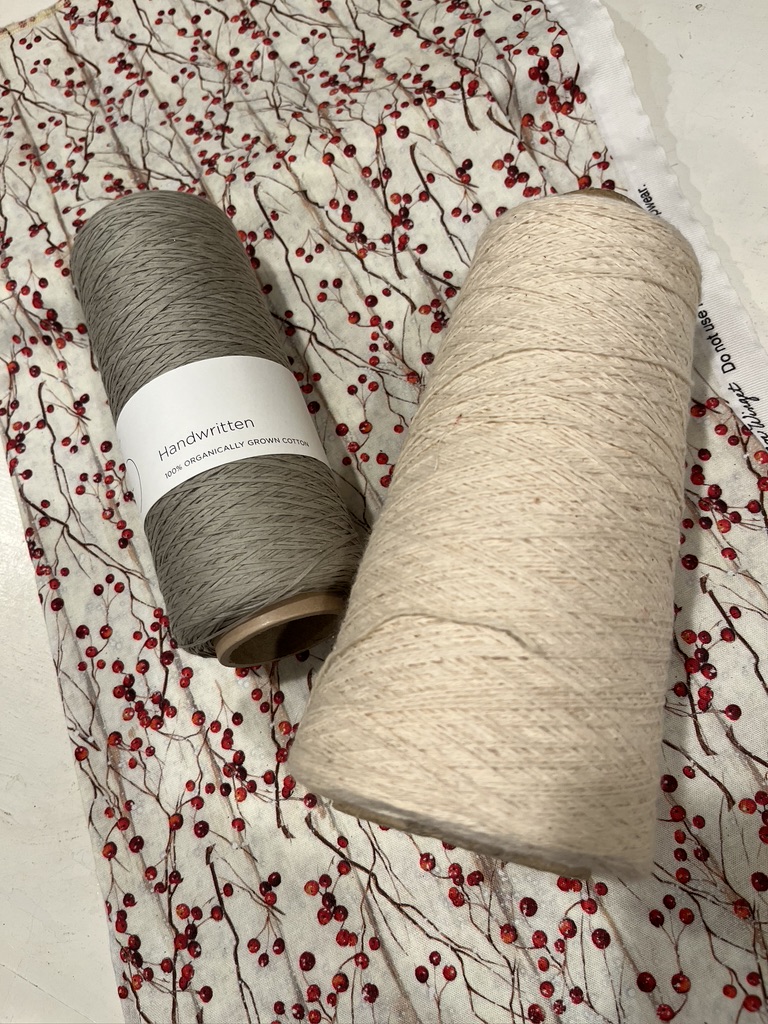
The off white yarn is 8/2 unmercerized cotton; the darker spool is a cotton tape. I will either use the 8/2 as warp and the tape yarn as weft, or I’ll blend the two in the warp and use the 8/2 for tabby weft. I have to figure out how to estimate the yardage for the fabric strips, and I’m hoping the runners I made on the previous warp will help me do that. I’ll cut the strips 1/2″ wide, as the strips were that came with the loom. I can then use the woven sett of the rags to determine the sett I’ll weave for this project, adjusted for the width of my project. The fabric was an interesting find. I found about 1/2 yard of it at a fabric remnant shop called Swanson in Turner Falls, Massachusetts. It looks like they will soon have online shopping. I knew I needed more fabric so I googled “Winter Berries” by Susan Winget and found more fabric on Etsy. It’s a win! Now if only I had time to weave it!

This evening I will present a program about Archie Brennan to the Michigan League of Handweavers. I love talking about Archie, and I hope my presentation will spark some weavers to try their hand at tapestry. I’ll be giving a tapestry workshop in Michigan next spring for their annual conference in June. It will be my first time to teach outside New England and the tri-state area–a big deal for me!

As we all get swept full force into the holiday season I hope every one of us can make time to weave, time to reflect on what brings us fulfillment and what projects will best do that, and time to share with others without having our hair on fire. It’s a tall order. Good luck. I’m heading downstairs to start that first green napkin.
Projects Big and Small

It’s now October. I continue to procrastinate on that tablecloth on my Big AVL. I don’t quite know what’s wrong with me because I was on fire to get it on the loom. I was 7/8’s done with the threading in August, and now it’s October and it hasn’t been touched in more than a month. Maybe I’m worried that after all this work it won’t weave well. Yep, definitely worried about that.

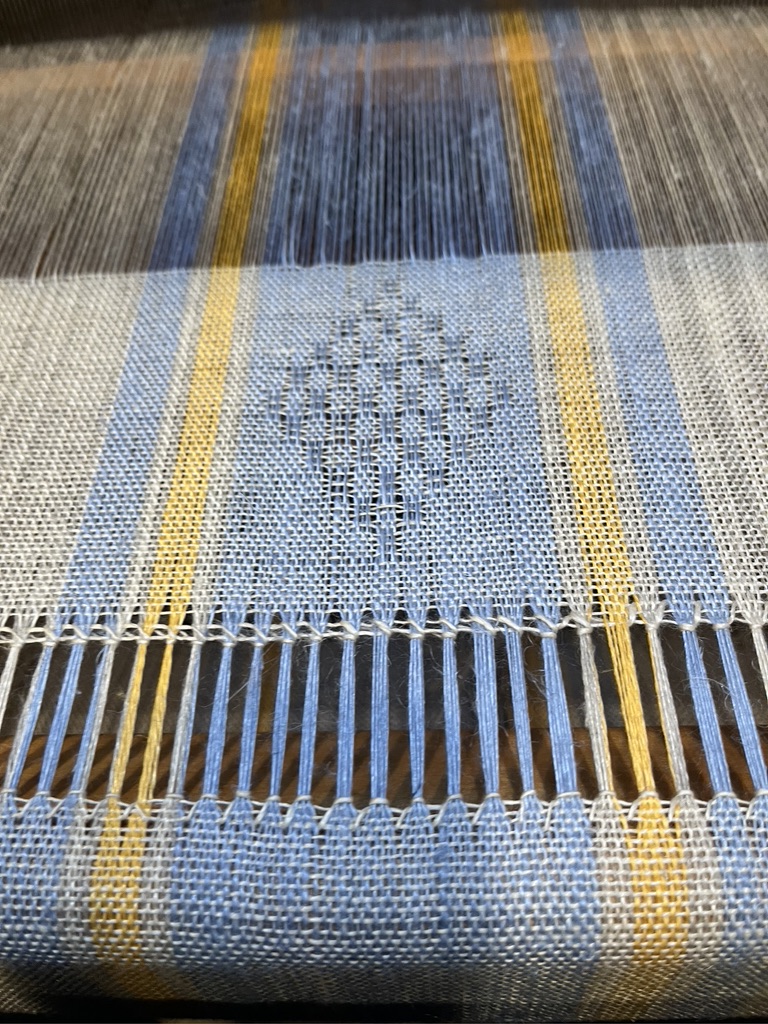
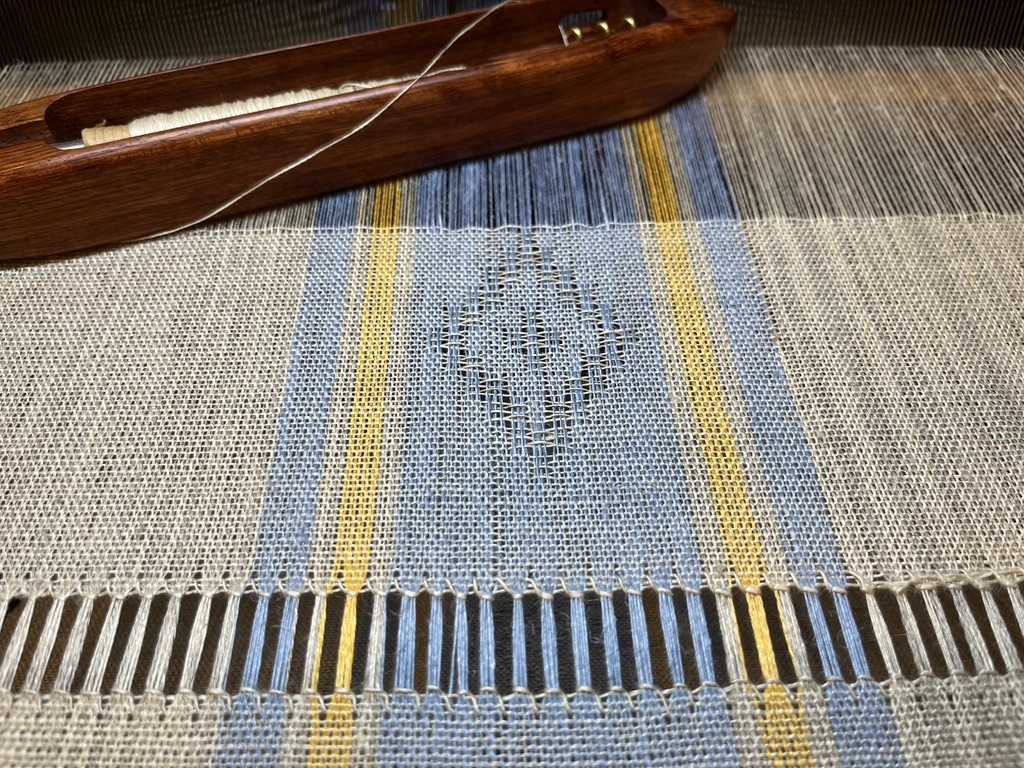
On a better subject, I have been weaving my linen project for the class with Fran Curran. I’m more than half done with the 2nd bread bag, and I’ve started the braid for the drawstring. Here is the first design, showing the hemstitching which will be the casing for the drawstring. I designed a diamond with warp-only floats so the blue warp would show up strongly on the surface of the huck lace.

The 2nd bread bag has warp and weft floats. It will be interesting to me to see how they differ after I wash the fabric.

Of the two sweaters I found that I’d like to a) alter, and b) finish, I have started on the blue cabled sweater that was designed by Elsbeth Lavold. I am adding a gusset to each underarm that will continue down the side seam, which I have opened, to create an A-line silhouette. I’m not happy with how the gusset looks. It’s messy. I’ve started over again and am still not happy. Part of me thinks, well, it’s the underarm, so it will rarely show. But…. I know it’s messy! This nagging disappointment keeps me from working on it. It’s not worth a photo at this point.

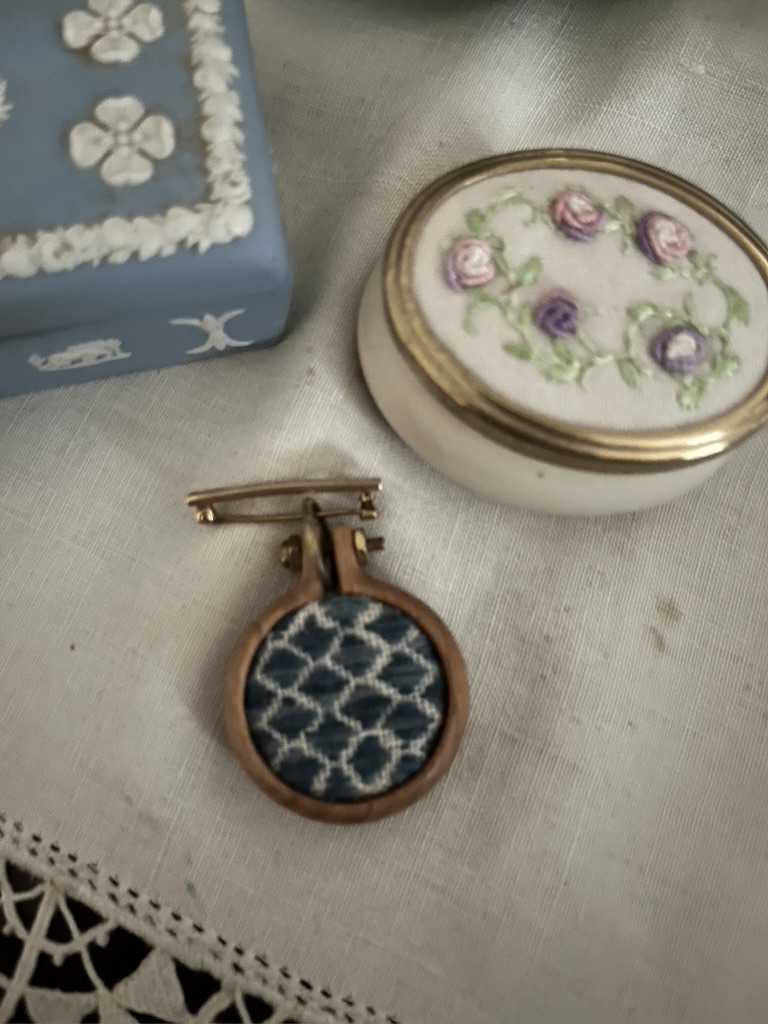
I tried a tiny bit of Japanese Hogin embroidery and loved it. The fabric I had on hand was finer than what was called for, and I felt I was going blind trying to do these tiny stitches. I love the technique, which is counted running stitches that create simple designs that can become quite complicated in appearance when they are done on a larger scale. I saw so many tiny bits of textile mounted in wooden frames while I was Japan. I bought a tiny temari pin cushion at the Cohana store in Tokyo. There are wonderful sashiko pin cushions mounted in wooden bowls, and there are embroidered brooches mounted in wooden frames to be worn. I was smitten with those. I found someone on Etsy (Artbase) making some pretty brooch frames in cherry.

I’ve already ordered a larger brooch frame for my next embroidery, and I’ve visited my not-so-local needlework shop to buy a slightly coarser woven linen. The one above was embroidered on 32-count linen. Next time I’ll try 28-count. I enjoy doing this!

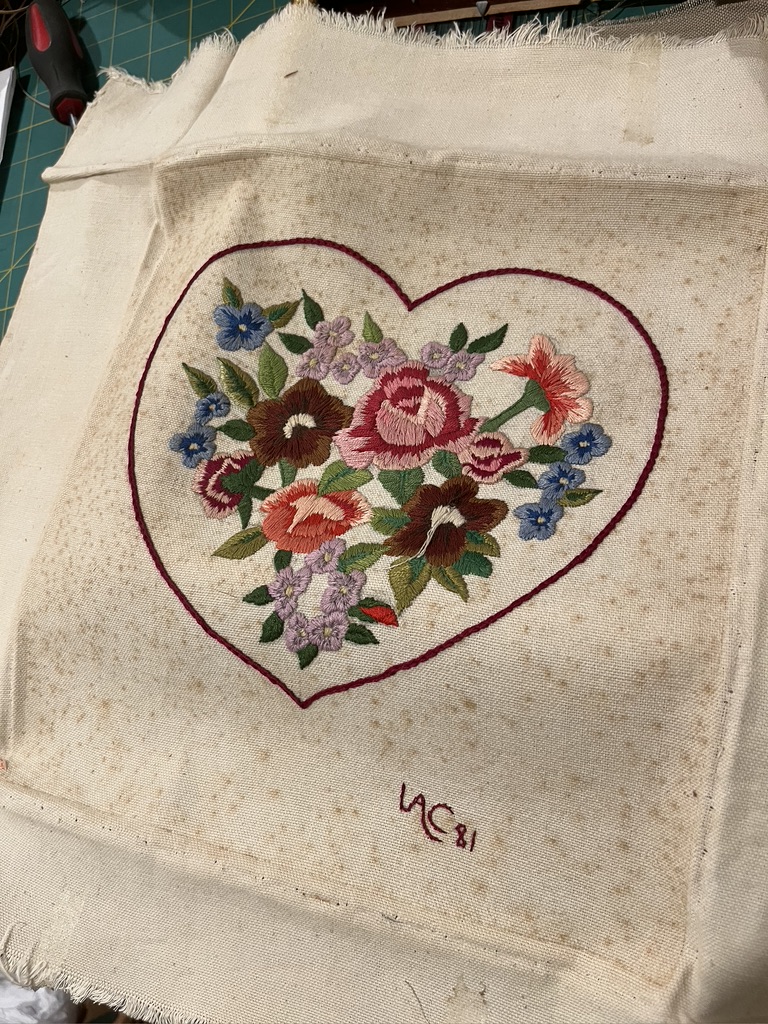
My next project, which feels both big and small, is cleaning and re-framing a beautiful crewelwork embroidery made by my oldest friend, back in 1981. This gem of a piece is over 40 years old now. It got lost for several years when we made our last move, so when I finally found it in a box in the attic, wrapped in tissue and packing paper, it had suffered some. I don’t know if these brown blotches are mildew, but I hope I can get them out. I am using Orvus paste, recommended by the women at Thistle Needleworks, my not-so-local shop. I was anxious removing this gem from its frame. It’s heartbreaking to see the stains on the fabric.

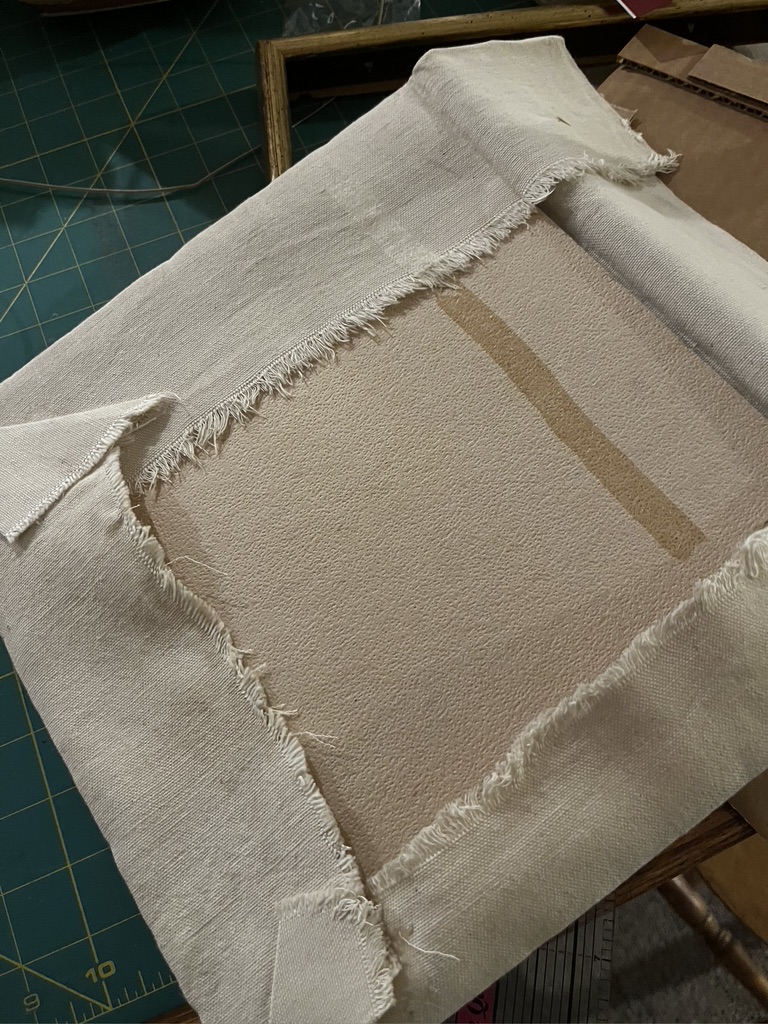
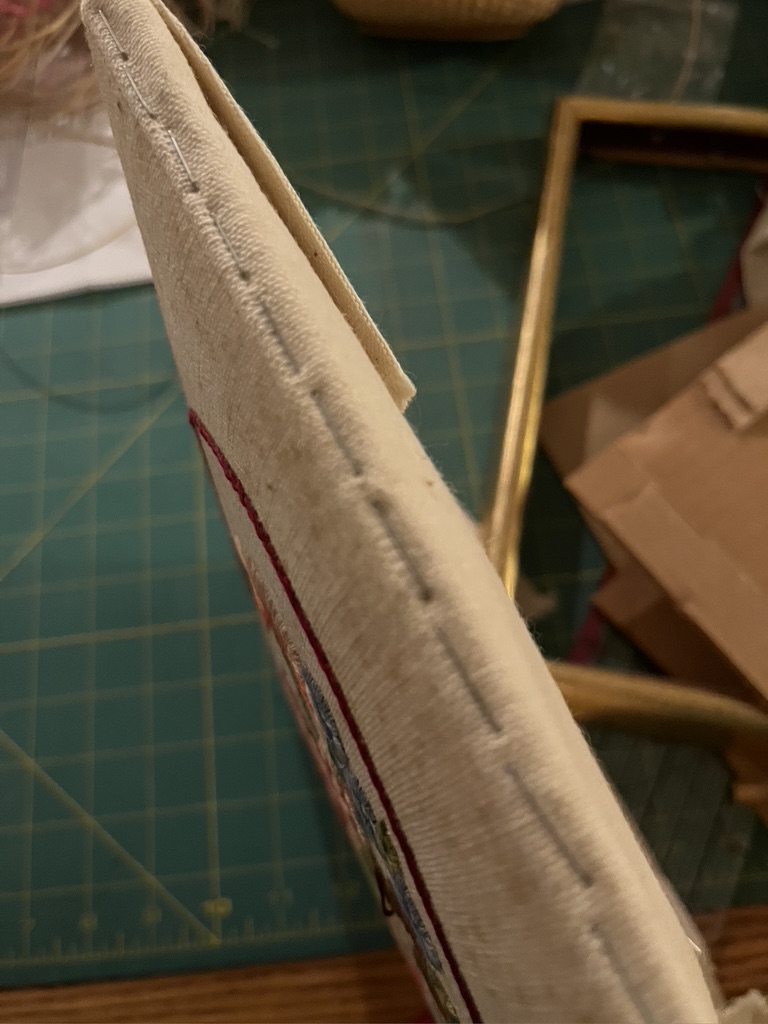
It looks like the framer used double stick tape to stretch the fabric on the backing. I hope to sew it in place when I re-frame it.

I took out about 50 staples on the sides. I hope I can make this as beautiful as it originally was. Then I’ll feel like a pro and I’ll tackle some other things from my stash.

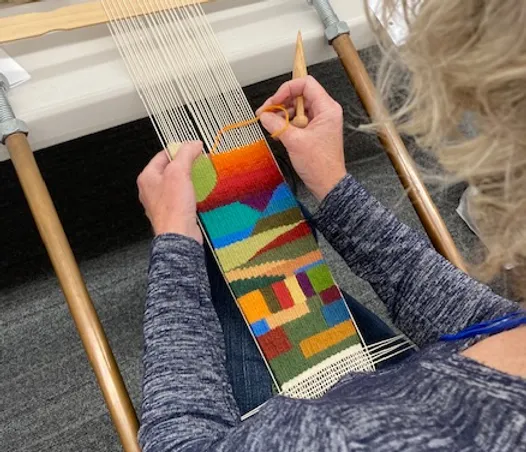
My new tapestry students are doing a great job. Every class seems to show me new ways that a class can have a group personality and an interesting trajectory. This class is moving quickly, so I think they’ll be doing some of their own designs soon, when we are barely at the half-way point of the semester. I love seeing the colors that students choose. It’s always a visual feast to see all these colors become something real. Students keep me endlessly excited!

I hope I get most of my big and small projects done. There is energy in the air. I just need to harness it!

Rabbit Holes are Really Just Procrastination

For the past several weeks I’ve been deep into some interesting rabbit holes. There are so many compelling things to learn, tips to explore, and amazing images to see. That means I have not touched my tablecloth warp in three weeks. I do feel a little guilty. I am at the point of threading the final border, and it’s the hard part, considering whatever I thought I was doing 12 years ago that I now cannot remember or understand. I will tackle that final area of threading soon, but in the meantime I’m enjoying my rabbit holes.

I went looking for a stranded sweater pattern that I started quite a few years ago. I did not find find it on the first or second go-round, but it finally turned up late last week when I was looking for something else. Isn’t that always the best way to find something? A few months ago I came across this sweater and decided I ‘needed’ to finish it. That’s when I learned I don’t seem to have the pattern! I searched through my Ravelry library, my emails, and even through the printed patterns I’ve collected in two huge notebooks. No luck.

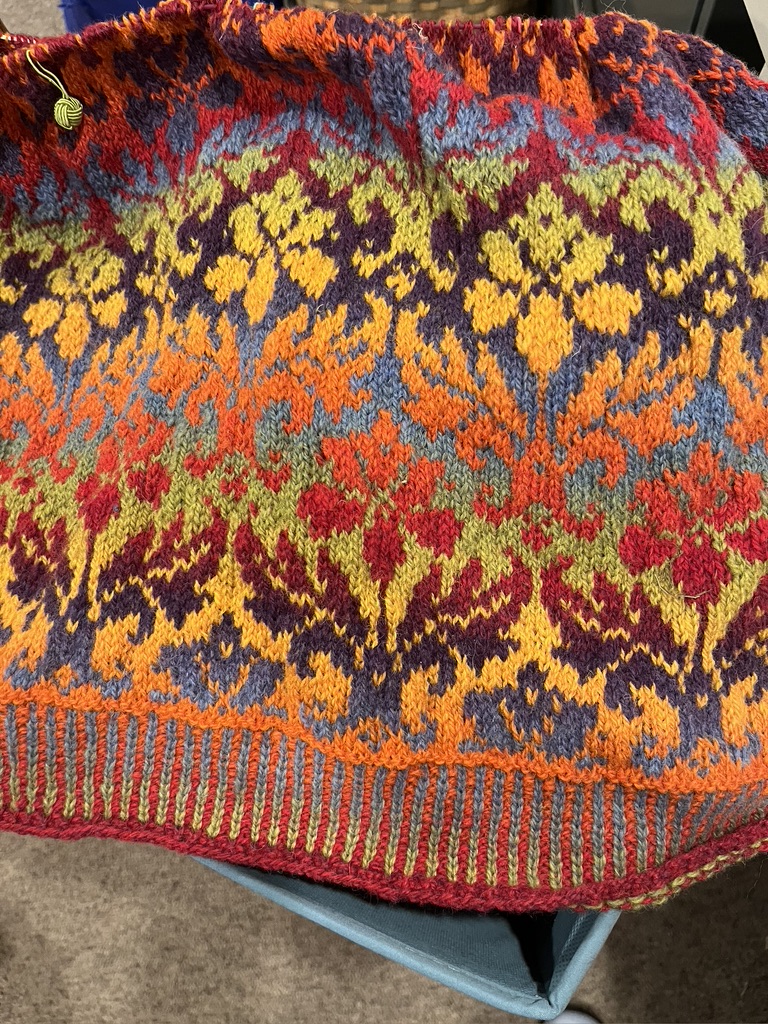
Do you see why I want to finish this? The yarn is a Finnish brand called “Kauni Effect.” I am using two different colorways. One is called ‘rainbow’ and the other is something like ‘autumn.’ Sorry I’m not sure of the second colorway. I’m knitting with one yarn as color A and the other as color B, and the yarn does all the work to create this amazing, glowing, beautiful effect! I know, I’m gushing.

I could not figure out what happened to the pattern. I posted a photo on Facebook, and many people began responding to help me retrieve the pattern. After more than a hundred responses I began to remember a few things about this design. The sweater pattern was designed by Ruth Sorenson, but the stitch pattern was from Dale of Norway. Someone whose name I don’t know put the two together to create this stunning sweater. It was easy to find the stitch pattern on Ravelry. It’s in quite a few people’s stitch libraries…but the sweater is no longer available, and for some reason I have lost it.

When I started googling various ways to get in touch with Ruth Sorenson or to see all of her designs, one of the top hits in my search was my own blog. Seriously? It turns out I wrote about my plans for this sweater here. That was March of 2014. That sweater has been laying in a canvas bin in my wall unit for almost 10 years. Yikes!

One of the 100+ people who responded with help on Facebook contacted Ruth Sorenson and got permission to share the pattern with others. She sent it to me, and by now I’m sure others have it too. Thank you, Ruth! Between the sweater directions and my own notes I plan to get cracking on this sweater again. I won’t be wearing it this fall, but hopefully in fall of ’24.

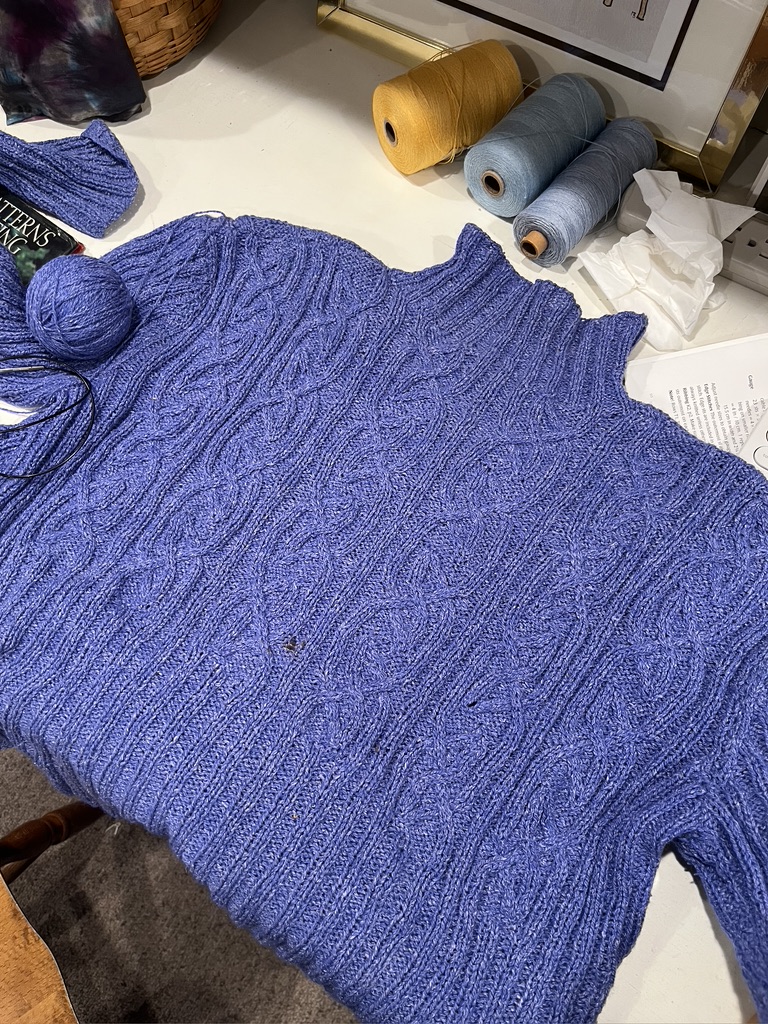
In the sweater department, there is also this: “Hild” by Elsbeth Lavold, from her Desinger’s Choice, Book 9. I made this years ago and have worn it a few times. It no longer fits, but I still love it. Last week I un-sewed the side seams and am adding gusset to each side. I hope that gives it enough flair for me to enjoy wearing it again.

The sweater bug has definitely bitten me. I haven’t been knitting much over the past several years, but clearly I’m back in knitting mode now.

I’ve started a class with Fran Curran at the Weaving Center of Hartford Artisans. She is leading us in designing a project using linen. We had a short presentation on designing huck lace by Jill Staublitz, and I decided that would be the weave structure I’d use for my project. I’ve woven a lot of linen projects over the years, and a lot of huck lace too. It was hard to decide what my project would be since I have plenty of napkins, placemats, even a couple of linen tote bags with huck lace. Then one evening I remembered that I’ve wanted to make bread bags for a couple of years now, ever since Handwoven Magazine featured a linen bread bag pattern. I fear my bread bag may be a bit over-designed, but I will have fun with it.

I will have a center diamond motif on the bag fabric, surrounded by plain weave stripes and a mix of natural and half bleached linen for the background fabric. The stripe colors are in the photo of the sweater above. They happened to be laying on the counter in my studio where I took the photo. I wanted the huck diamond look particularly blue, so I’ve made sure the huck floats are in the warp, which will be blue in that section. I’m looking forward to this!

Lastly, I have started teaching another 9-week tapestry class, also at Hartford Artisans. I’m intrigued by this new batch of students and hope they will enjoy tapestry weaving enough to continue to pursue it.

My son Chris calls this kind of distracting activity “bike shedding.” He says this phrase came about when a group of engineers were ‘stumped’ on a building design. They decided to design a bike shed for the building before working on the building itself. Who knows if this is true, but it seems to be something I’m rather good at…bike shedding, procrastinating, and going down rabbit holes. I could do worse!

Working Remotely in Remote Places

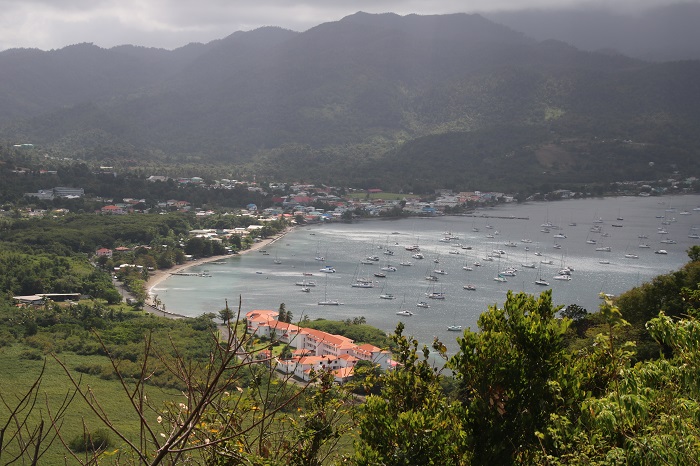
A couple of weeks ago Rebecca Mezoff’s email newsletter mentioned that since she traditionally works at home, when she works ‘remotely’ it means that she has traveled somewhere. It’s the first time that I realized I work remotely every winter. Many people think Bob and I are on vacation when he sails south for the winter, but it’s really our ‘other’ home. We live our every day lives, full of chores and responsibilities, from our 2nd home, which happens to float. I always bring ‘work’ with me, and am often disappointed that I’m missing some vital color for a tapestry, or a particular size of knitting needle, or some other item that derails for my plans for work. At my first home I can quickly go online and replace almost anything I’m missing within days. That is never the case here. This is a view from Shirley Fort overlooking Portsmouth Harbor. Pandora is out there!

We are in Dominica now, and have been moored in Portsmouth for the past four days. Bob’s sailing group has arranged for an impressive number of outings on this island, known as ‘the nature island.’ Most of Dominica is rain forest. Most of the hikes here involve hiring a guide. Perhaps the most intensive hike on this island is called the ‘hike to the boiling lakes.’ This hike, which I have not done and Bob regrets not doing, takes people to the edge of the volcanic caldera where the sulfur lakes are literally boiling. It’s not easy getting up to those heights, and this week’s trip was particularly hard for the hikers because it rained most of each day in heavy downpours, which made the paths and rocks quite slippery in addition to being quite steep. The hikers walked along the steep rock walls of three caldera that looked down into the boiling lakes.

From Wikipedia: The Boiling Lake is a flooded fumarole located in Morne Trois Pitons National Park, a World Heritage Site on the island of Dominica. The lake, located 6.5 miles (10.5 km) east of Dominica’s capital Roseau, is filled with bubbling greyish-blue water that is usually enveloped in a cloud of vapour. The Boiling Lake is approximately 200 to 250 feet (60 to 75 m) across and is the second-largest hot lake in the world after Frying Pan Lake, located in Waimangu Valley near RotoruaNew Zealand.

In the rainforest people clear small plots to grow all kinds of veg and fruit, and the rest of the West Indies is indebted to Dominica when the supply boat arrives in the other islands carrying produce grown here. They even grown coffee here in the higher elevations. The melons and bananas are unbelievable! I’d forgotten what non-GMO avocados taste like, and these bring back memories of the first avocados I ever tried, as a teenager, years before Haas avocados had been developed. I’m a big fan of the real ones now. And, as it happens, there are numerous varieties of avocados. We’re about to try some that are quite tiny. The one thing I cannot find–and don’t even seem to know how to ask for–is cilantro! There is an herb grown on some of the islands called “chadon beni” that’s pronounced more like “shadow benny.” It does not look anything like cilantro, but it tastes like it! It roots easily, so I was able to grow my own the only year I found some to buy.

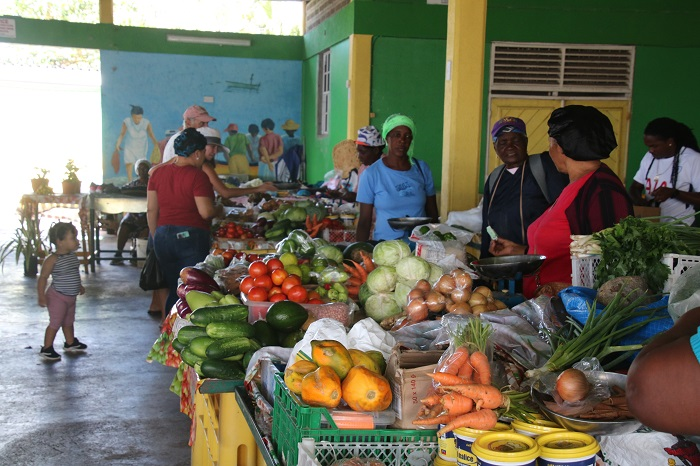
I know that some cultures call cilantro ‘coriander,’ which is what I call the seeds of the cilantro plants. At the local Saturday market here in Portsmouth, I tried asking for cilantro, coriander, and ‘shadow benny,’ but I got no hits. I even had an image of chadon beni open on my phone for clarification. The only response I got was an offer of some flat leafed parsley! Oh well. I can’t make the guacamole of my dreams, but I am enjoying eating avocados in other ways, including the way I first ate them in junior high school, with canned tuna salad stuffed into the place where the pit was removed in the big avocados! And when you root one of these avocado plants you will get fruit on your tree, unlike Haas, which are sterile. I am making do quite well with a healthy, rooted Caribbean version of basil which is growing like it’s on steroids.

The Saturday Market in Portsmouth, Dominica

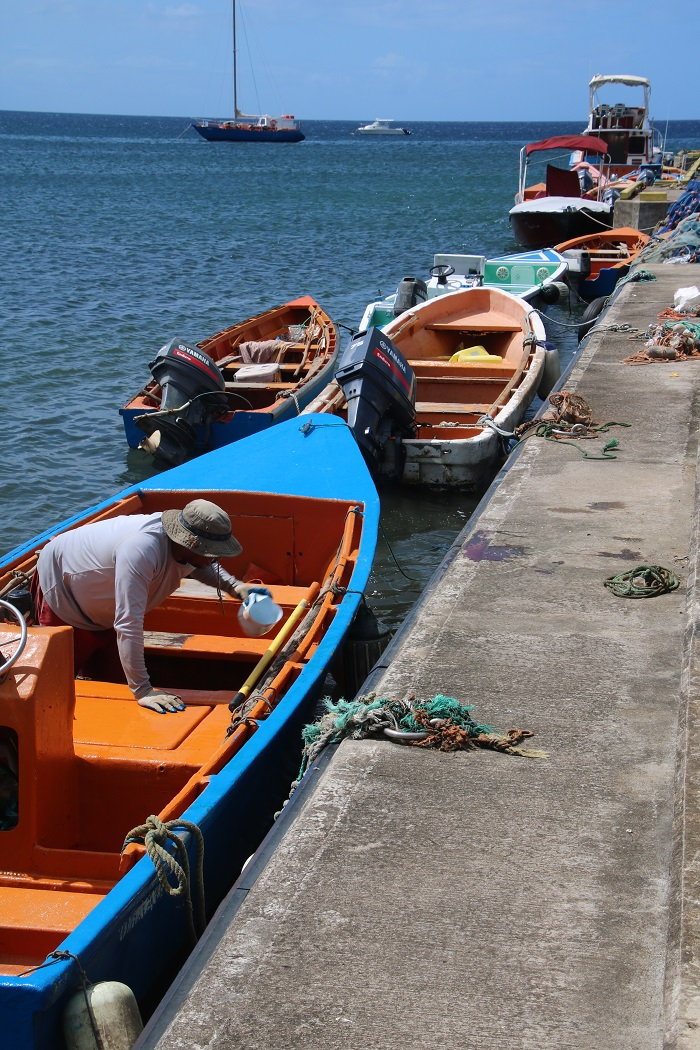
The entire Caribbean is a colorful world, as Bob captured in the fishing fleet on the dock.

At the moment I am licking my emotional wounds that I have a major set back on my Caribbean ‘postcard’ tapestry. I don’t have any white or cream weft yarn to weave the iconic church in Deshaies, Guadeloupe. I have other options, you know, necessity being the mother of all mislaid plans. I can weave a different scene from Guadeloupe to eliminate this church entirely. I’m feeling a bit negative about that since drawing the rough cartoon was quite an effort for me, with no option to resize some of my images with a printer, or even stopping into a Staples store for help. In the end I have four pieces of paper glued together to create my cartoon, and it has angel fish and turtles swimming around the postcard of the church. I just continue ‘to sleep on’ the idea of tossing out this idea.

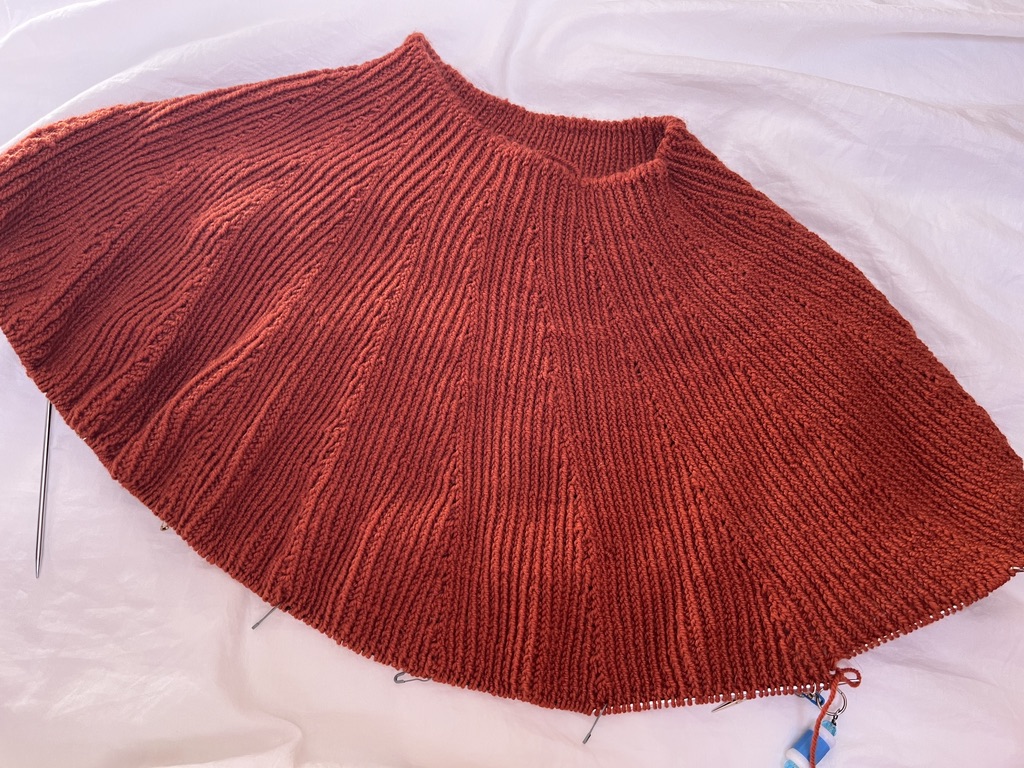
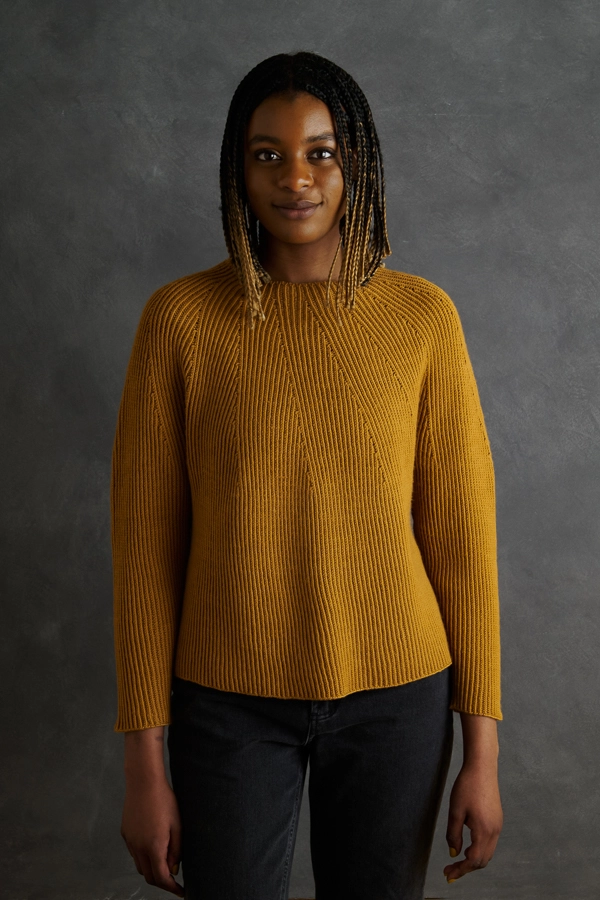
So I’ve turned to my current sweater in progress, a design by Ainur Berkimbayeva for Purl Soho called “Amphora Pullover.” It is a top/down sweater with fun increases through the neck and shoulders that create swirls. Quite attractive on the model! Now that I have put the sleeve stitches on holders and am about to continue on the body only, I am going to test some ideas of continuing some of the swirls to create a swing style body. I can never just knit a design as instructed. Patterns are jumping off places for adding our creativity to a garment! I hope my idea works.

The “Amphora Pullover” by Ainur Berkimbeyeva for Purl Soho.

Looks like I have an opportunity to start my own small business here in Dominica!

During the past week I have been challenged by an exceptional idea that is currently keeping me awake at night, with all kinds of possibilities running wild through my mind. If you don’t know me, you may not know that I have recently begun teaching tapestry at a non-profit organization in Connecticut that is near and dear to my heart. The organization is Hartford Artisans, and their mission statement is what captured my attention: The Hartford Artisans Weaving Center is committed to being a welcoming, accessible community that actively works to create a kinder and more equitable world for everyone. Our diverse community unites people from different backgrounds and experiences to learn from each other and uncover their own unique skills. We challenge assumptions about disabilities and aging and show that everyone deserves an opportunity for creative expression. We recognize we have a responsibility not only to open our doors wider, but also to understand and work to change the racial and gender inequities that hurt us all. 

The director of this organization recently got a letter from a blind weaver in the Southwest, asking if there were any audio sources for learning to weave tapestry. I have done a preliminary search and found nothing. Yet there is one weaver out there who wants to do this. There is, or was, a weaver at the Artisan Center who wove a tapestry that hangs on display in the hallway. I don’t know whether that weaver is still with the Center, but if so, I’d like to her/him. The piece is more texturally interesting and is not based on imagery. It has striking merits. As we all know, there is no one way to describe or view tapestry, and no one correct way to achieve an idea. While I was thinking through ideas, Bob googled textured tape to see if there is a tape that has bumps or some kind of measurement device done in texture rather than in visual marks. By Jove! There is! I thought about how to describe the process of making an Archie Brennan copper pipe loom without any visuals, how to describe the seine twine I’d recommend for the first few warps, and at some point, how to describe various techniques. I thought about describing the warping process in words only. Are you now thinking too? If so, I hope you’ll get in touch. Creativity should be accessible to all people, and it falls to some of us to make this happen. In the meantime, I’m going to proceed, hopefully talking to some of the visually impaired artisans about what kind of instructions make the most sense to them. I am hopeful.

I’m looking forward to getting back to my ‘real’ home, my first home, where I can be more connected and less remote! I’m halfway there: six weeks to go! And it will be almost time to garden again.

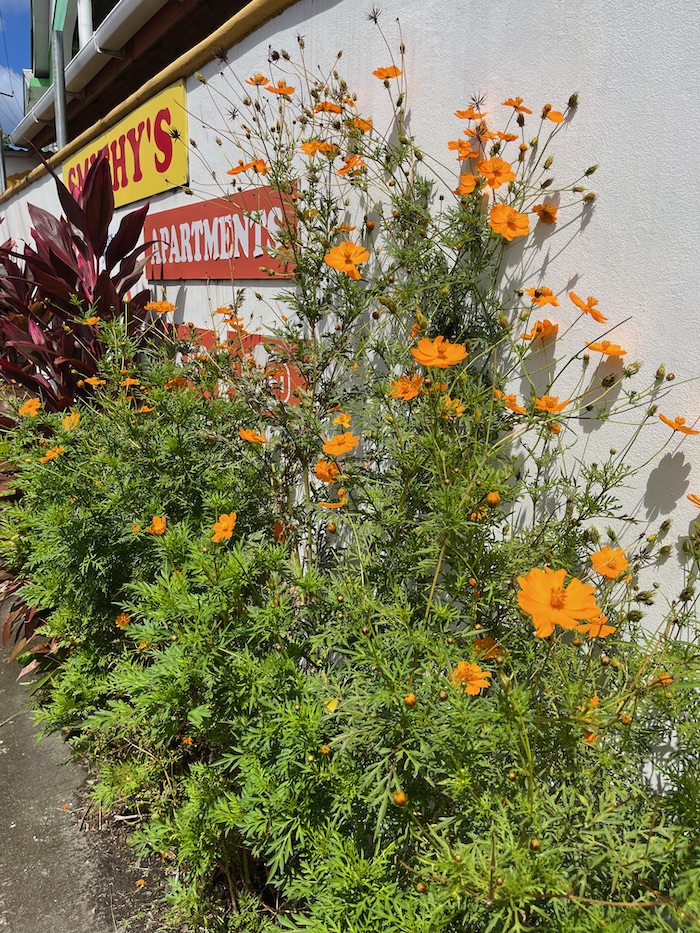
species cosmos in bloom against a wall in Portsmouth, Dominica

Weights and Measures Onboard

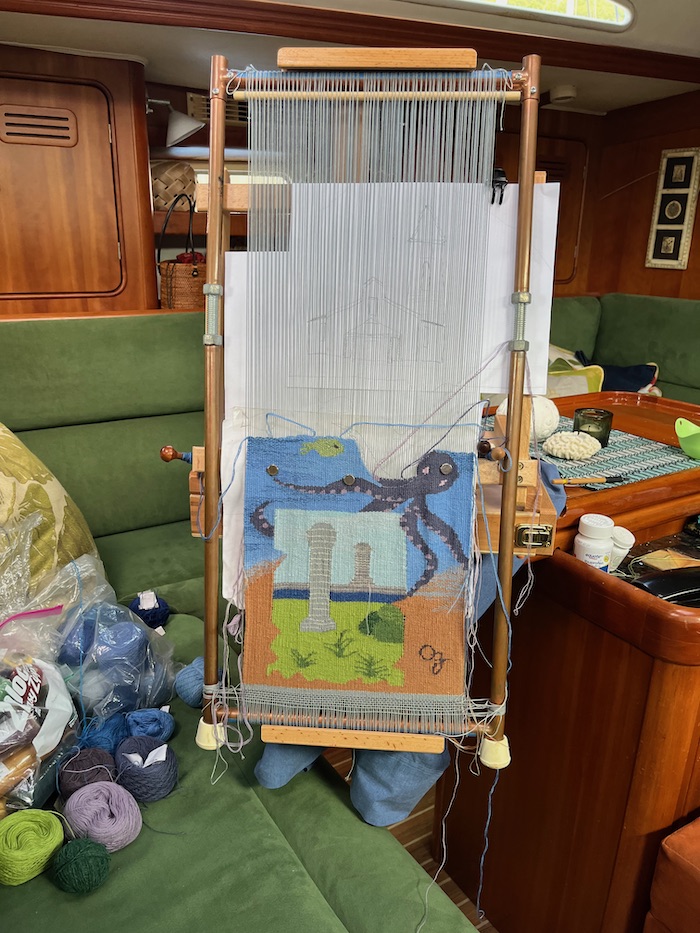
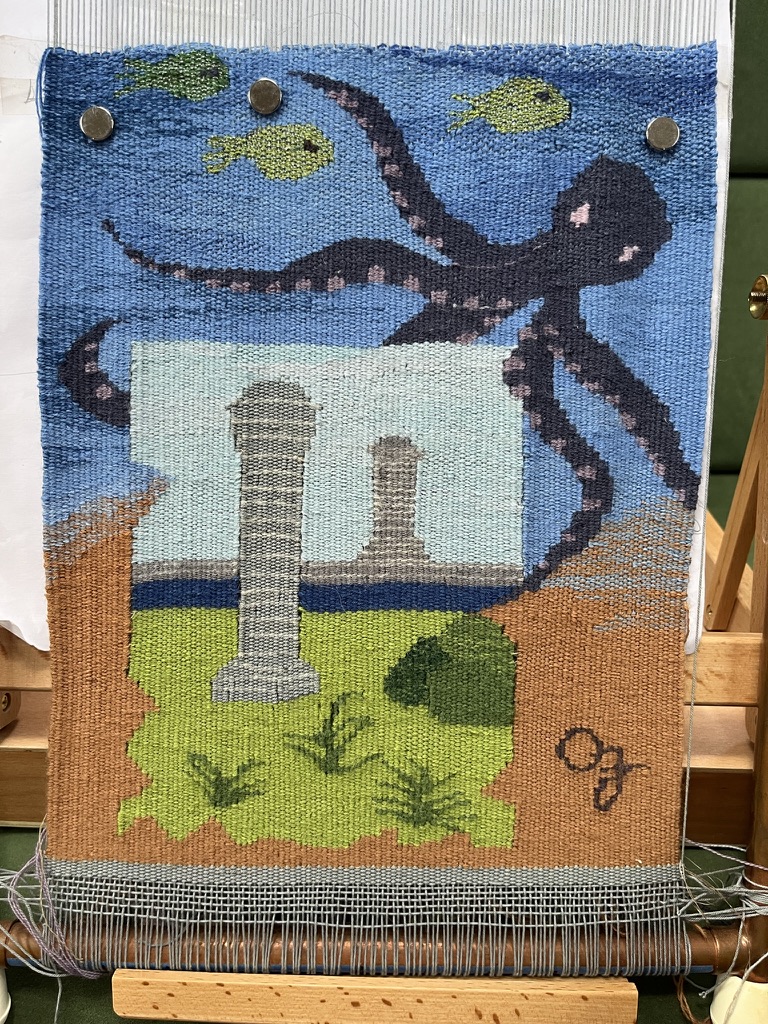
Here is my working space onboard. In yacht parlance it’s called the main saloon (I have always pronounced that ‘salon’), and it is the main living space down below on Pandora. It is connected to a small galley, and there is an aft cabin toward the stern, and a ‘main stateroom’ forward of this room. That’s a glamorous phrase for where we sleep. It doesn’t seem ‘stately’ at all.! I am very good at making a huge mess of our limited living space. We had a couple of days of calm conditions in Deshaies, and I took good advantage of it to finish the first part of this tapestry that I started in May of 2020–more than 2 1/2 years ago. My heart has not been in it, perhaps because of some bad memories of that year. The odd thing is, when I sit down and work on it, I enjoy it. Go figure.

Now I am ready to slide the woven section partially around to the back of the loom in order to keep weaving. I hope to do that today, when I finish this post. The conditions in Les Saintes are not nearly as calm as they were in Deshaies, and that is why I have not gotten back to work on this piece. I’ve been lucky to knit, which was only once. Otherwise, I’m just trying to keep my balance onboard!

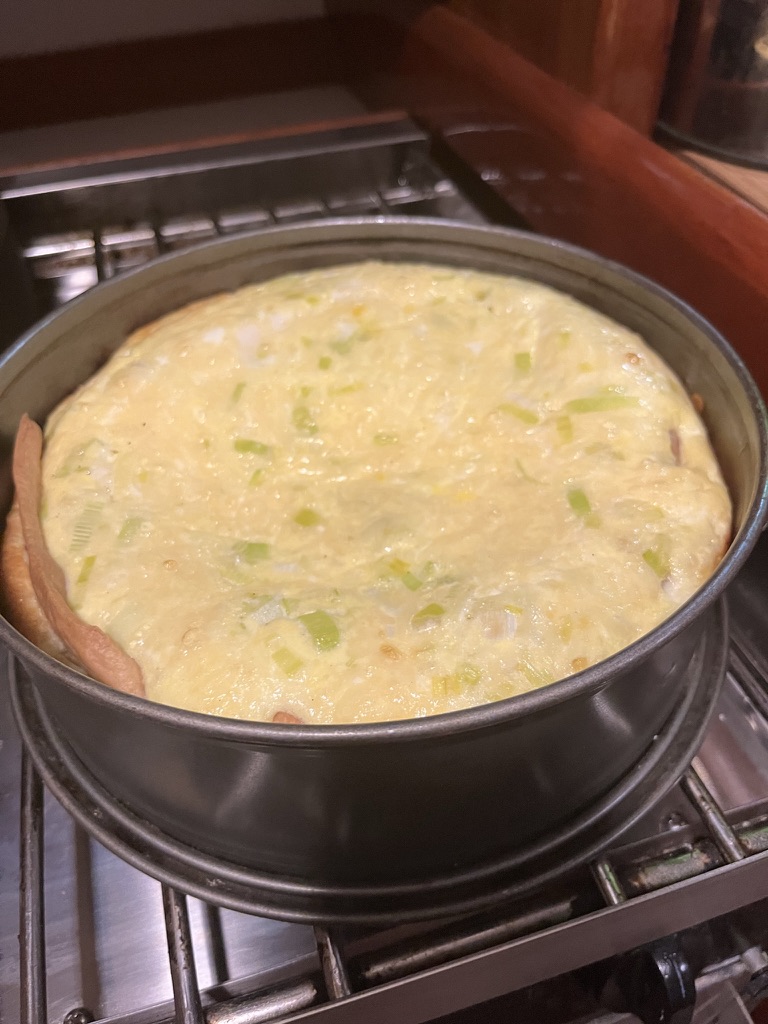
Weights and measures have factored rather significantly over the past few weeks. First I attempted to weight the merino/silk top I was spinning because I wanted to have an equal amount of singles spun on each bobbin in order to have equal amounts to ply together into finished yarn. Have you ever tried to weight something on a boat? The gentle, and not so gentle, up and down movements on a boat raises havoc with a scale. On the scale the read out for my merino/silk to cycled up and down by about 10 grams. I usually just try to pick the number in the middle. When baking a cake it’s far more important to get it right! Here was my guess for baking a quiche. It was not perfect, but we certainly thought it was good.

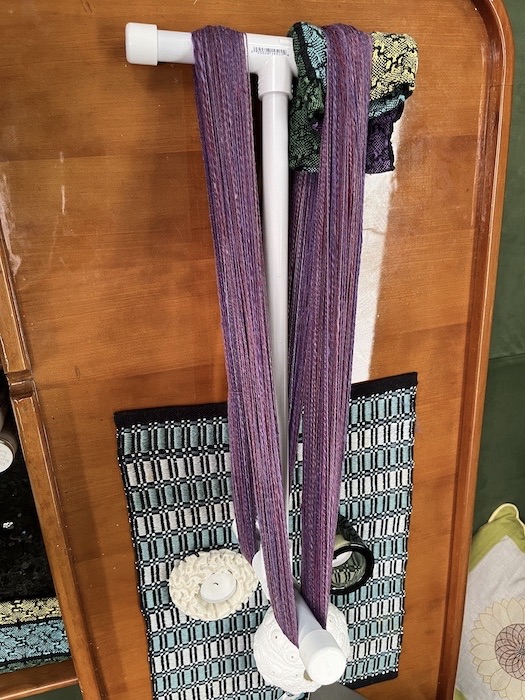
I also wanted to measure the length of that newly spun and plied yarn. Luckily Bob found PVC pipe at a hardware store just outside Falmouth, Antigua, and he made one that has a central arm of 18″. The yarn winds four times around that central core, for a total of 2 yards per single go ’round. I was able to measure that my merino/silk skein is 840 yards, plus or minus probably 10%. I can’t measure this accurately until I get home. Winding on a niddy noddy, or anything else, depends on the tension you use to wind. Too tight, and you’ve got quite a bit less yardage than you think. It’s hard to wind too loosely because of the nature of this repeated action. In general, we all tend to get tighter and tighter even when we are trying to avoid that. I took my time and tried to ‘stay loose.’ We’ll see.

This niddy noddy absolutely will not come apart, even though it is not glued. I wonder if that is due to the heat and humidity of the tropics. I padded one of the arms with a folded napkin, hoping that would give me some ‘wiggle room’ to get the yarn off when I finished winding. It worked.

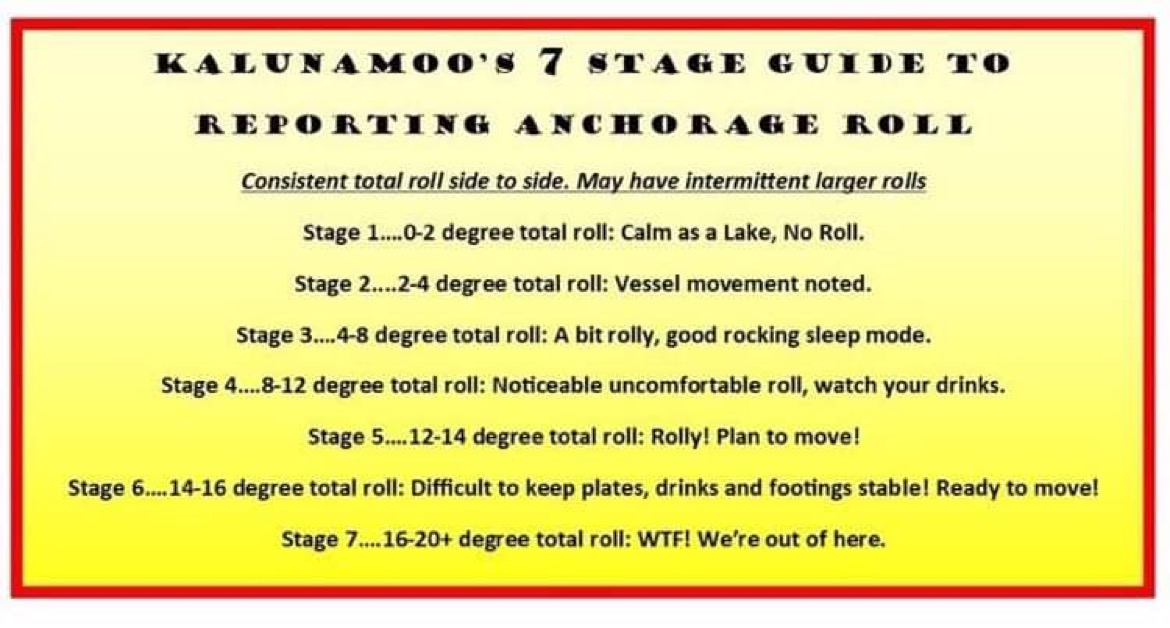
We’ve been in Les Saintes for three days. The conditions here are rough, but the place is scenic. You can’t have everything. Below is a chart that our good friend aboard Kalunamoo created to measure of how UNcomfortable the ‘harbors’ down here can be. Most places are not harbors at all, simply coves or bays in which you can throw down your anchor, but there is no protection from the sea conditions. In Antigua, we were in real harbors, both in Falmouth and English Harbour. That’s a great way to start a winter of sailing, and really quite a come down for the rest of the trip. Deshaies, Guadeloupe is between a 3 and a 4 on Bill’s chart. In Les Saintes, we rarely get a mooring ball right near the village on our arrival, so we have to spend at least one night anchored between the islands of this archipelago. The roll conditions are consistently between stage 5 and stage 7. It’s awful. One night while I was sleeping a book jumped right off the shelf above me and clobbered me in the head! It was a rude awakening. The next morning I discovered that my glasses came down with the book, and I had fairly mangled them by tossing and turning all night on top of them. Bill Woodroffe writes a great blog about the lifestyle of living on a boat here.

Luckily we only spent one night on anchor, and early the next morning we were ready to head closer to shore in the village (Haute de Terre) to grab a mooring from anyone who was heading out. We were on a mooring by 7am.

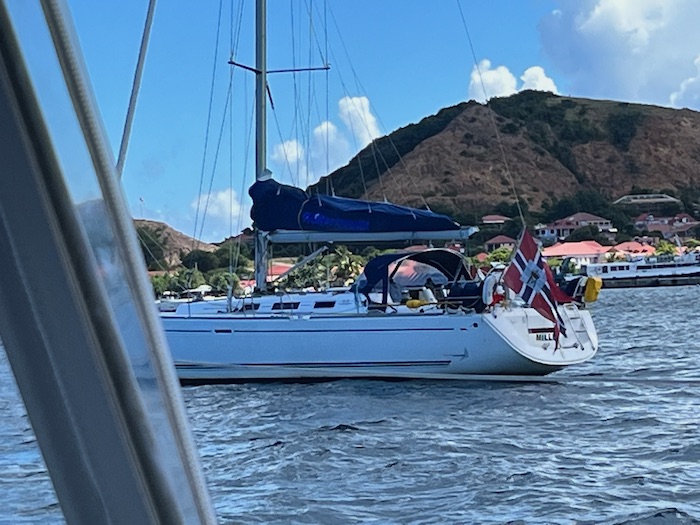
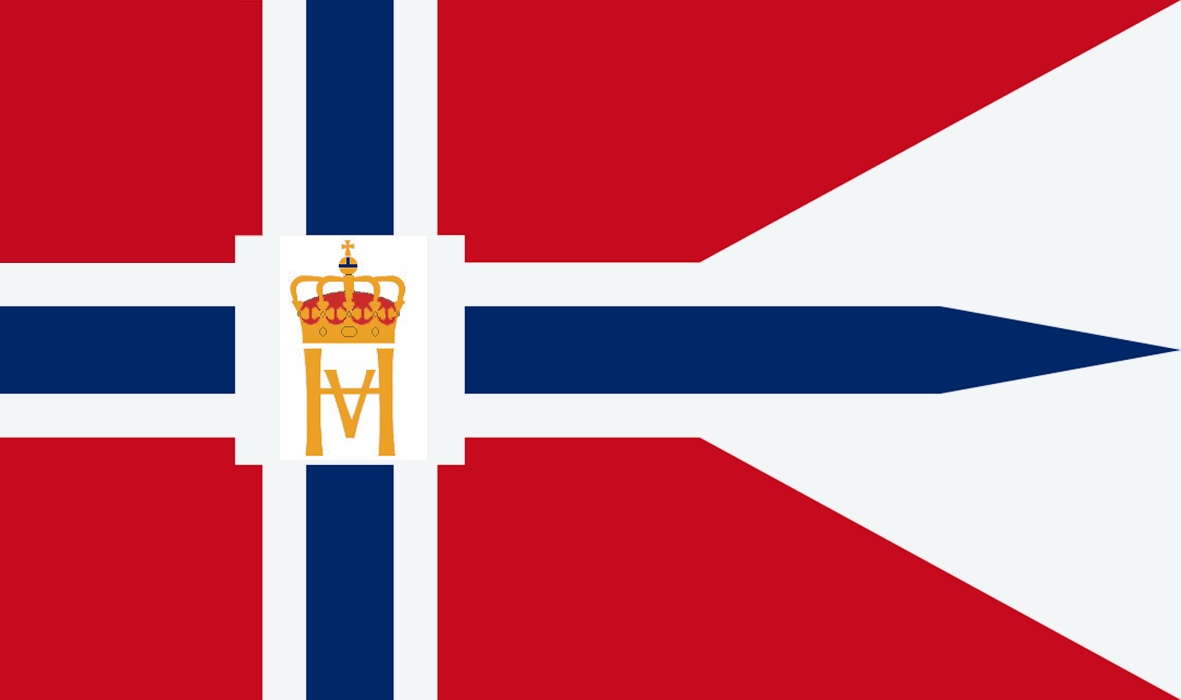
One thing I measure while we are traveling aboard each winter is the home ports of all the boats that are anchored or moored nearby us. Antigua had a predominance of Union Jacks, in all the varieties that signify the colonies and protectorates of the UK. There were some number of French flagged boats, as well as Canadian, and Norwegian/Swedish/Danish, with only a few Dutch flagged boats. I saw a few Swiss and German boats in the mix. The past decade of sailing in the Caribbean has honed my flag recognition abilities. In the French islands, the French flags outnumber the British, as do the Scandinavian boats. I’m used to looking up the variations of the Union Jack when I’m curious about exactly where some of these boats call home. Yesterday I saw a variation on the Norwegian flag that caught my eye. It is currently the most beautiful flag I have seen!

I know it’s hard to see the detail on the flag. It was waving in a fairly strong breeze, as I attempted to catch it mostly open. It’s a Norwegian flag with a triple swallow tail, something I’ve never seen before. Usually swallow tail flags are associated with yacht clubs. This flag is the ensign of the Royal Norwegian Yacht Club. It’s a beauty, even though the boat is not.

The beautiful center crown and IVI design was Haakon II’s royal emblem, which he granted for use to yacht club members starting in 1906. This image shows a standard flag. The triple swallow tail has the two red points and center blue point with a narrow white outline. This image is from wikipedia.

Identifying the flags of countries in all the places we visit keeps me entertained. In these islands not many natives speak English, so using my almost non-existent French keeps me on my toes, and is something I am attempting to improve–therefore, another form of measurement. Food words are somewhat easier than everything else, since I have a moderate familiarity (and love) for French food! Everything outside of food is quite a challenge for me!

Bob measures more things than I do. He’s constantly tracking how much electricity we have made with our solar panels and wind generator, and when we are motoring, how much power the engine made. He weighs that constantly against our usage. We now have a star link gadget for the internet and that is big energy guzzler. We need to make hot water for showers, we need to make that water (!), and we need lights at night and energy to run our gas stove to cook. It all adds up, and Bob spends a lot time measuring the input and output of energy. He says he enjoys living off the grid. I say give me a light switch and instant access to heat and electricity. It’s quite a process to start cooking on Pandora, not to mention taking a shower or any of the many things we want to do daily. I am not an ‘off the grid’ kind of girl.

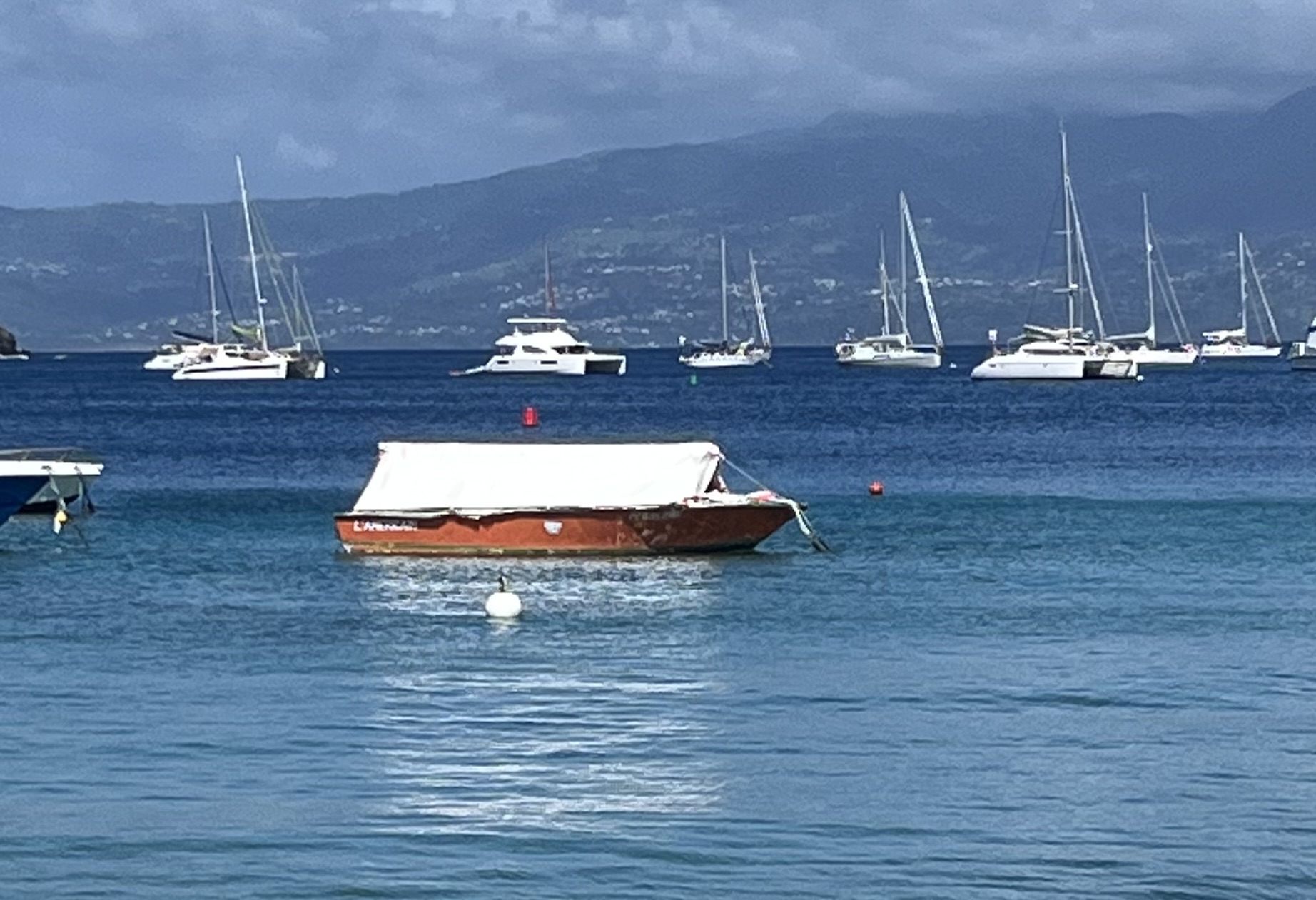
Here are some scenes from Haute de Terre, in Les Saintes. This was the view from our table at breakfast this morning.

Pandora is out in the distance. She’s light grey and just forward of the bow of the boat in the foreground

How about a close up?

Pandora has a light grey hull, in the distance, just forward of the bow of the boat in the foreground.

This is an idyllic place, and it would be perfect without the wind and the rolling conditions. Photographs are also a measurement of sorts. We take the ones we love, and sometimes we share them. Au revoir for now.

Scroll to Top