When we left Bosa, Sardina, we sailed about 30 miles south down the coast to a bay near Cabras which has the ruins of several ancient cities on one site, known as Tharros. This area was first inhabited by the Phoenicians in the 8th c BCE. Later the Egyptians and Romans were here, then the Saracens, then the Spanish. Each time another invader took over they tore down the existing buildings and re-used the stone to build their own monuments and buildings.
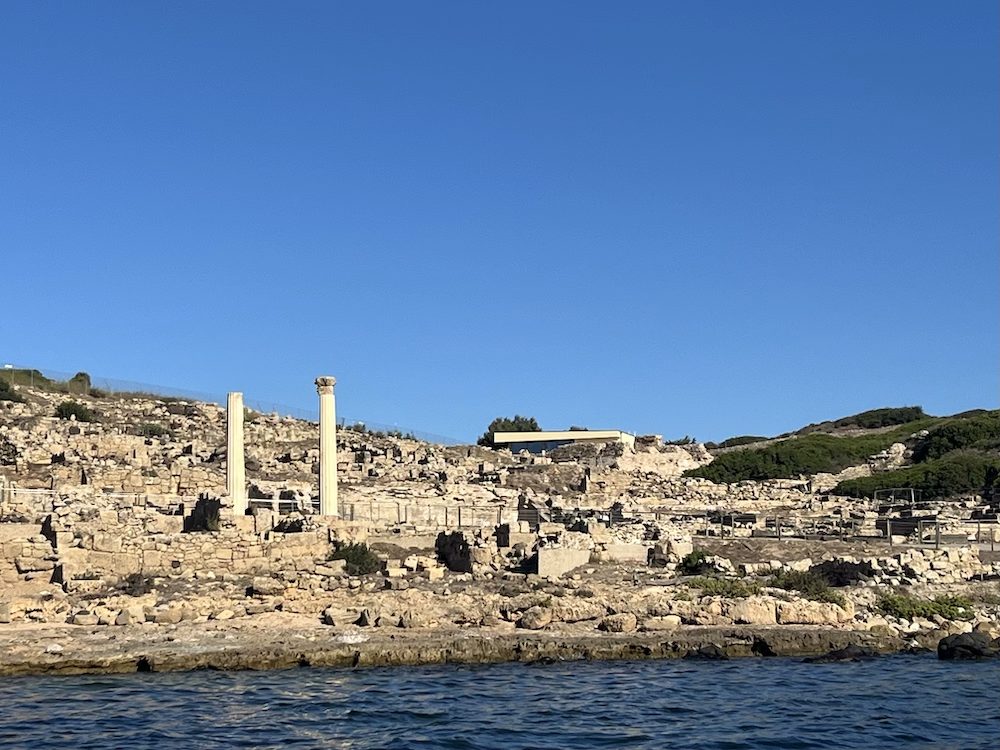
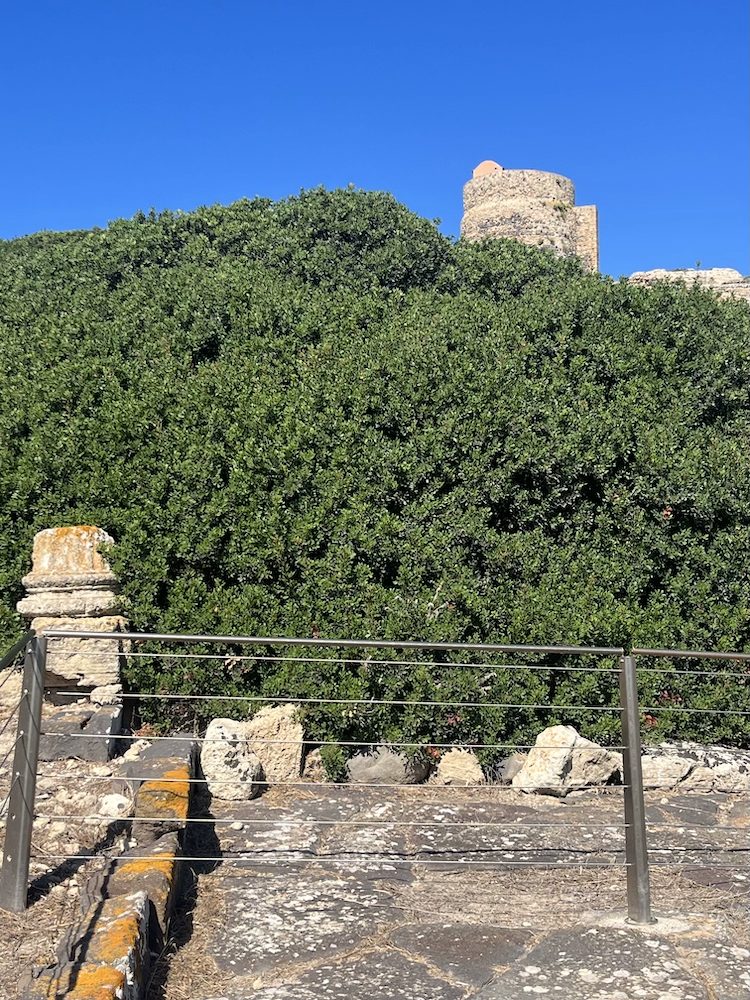
We arrived here in the late afternoon, with a low sun shining on both the Spanish tower and two Roman columns that were re-constructed in the 1950s using only a bit of the original stone found nearby, all that was still strong enough to use, and lots of modern cement and steel rods to support the columns. They are an impressive sight, and they sparked a resurgence of a former self–from about 50 years ago. A young adult that I barely remember took up residence in my head and brought me back to a very different time in my life.
I started studying Latin as an adolescence of 12, and I continued it through high school and college. In college I added Greek to the mix, and got a degree in both languages. It was Greek that brought me to weaving, and it was serendipitous that my college happened to offer semester long weaving classes that started in the fall of my sophomore year, taught by Candiss Cole, as an “artist in residence” opportunity. She ordered a dozen Harrisville Design folding looms–the well known 22″, direct tie-up looms. My not-yet-husband Bob assembled them all for Candiss, and even took the class with me. In ancient Greek there is so much overlap between “text” and “textile” that I knew I’d found my “calling” when I learned to weave. I thought I was going to be an academic and a weaver. That’s not how life played out, and for decades now I’ve barely thought about ancient languages and the cultures I once spent all my time studying.
This is the scene that greeted me when we arrived in the Bay of Oristano, where ships from Phoenicia, Egypt, the Roman Empire, and the Saracens have also anchored. Pretty sobering to think of 3,000 years of ships arriving here, battles fought and lost, new cultures taking possession of this place.
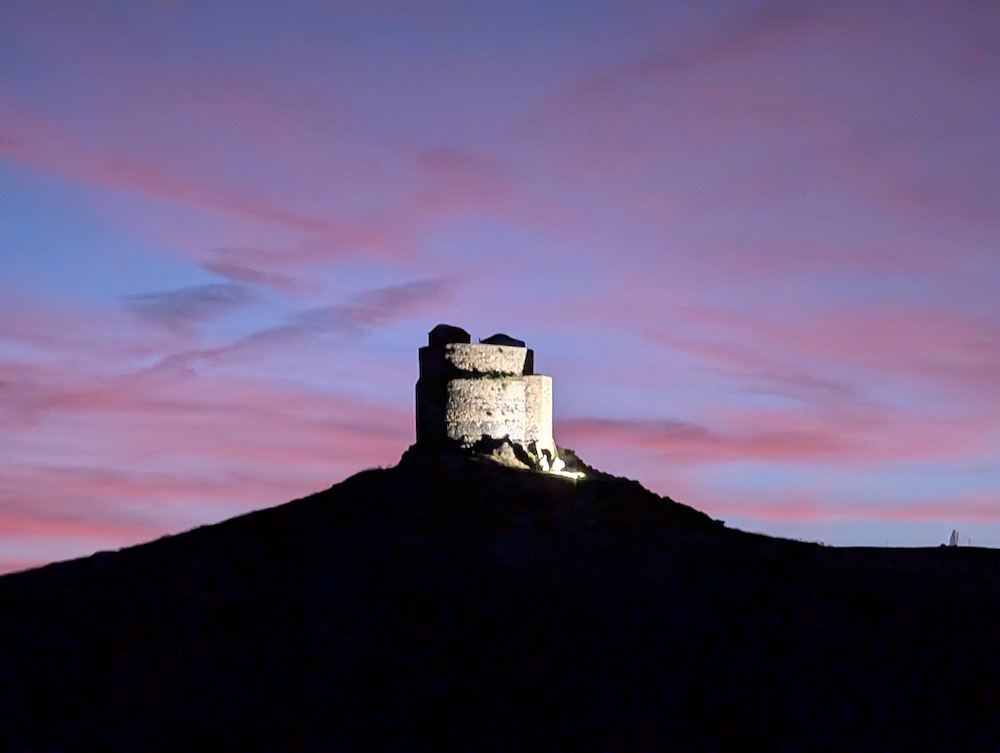
Our first sunset here was quite dramatic with a spotlight on the Spanish lookout tower.
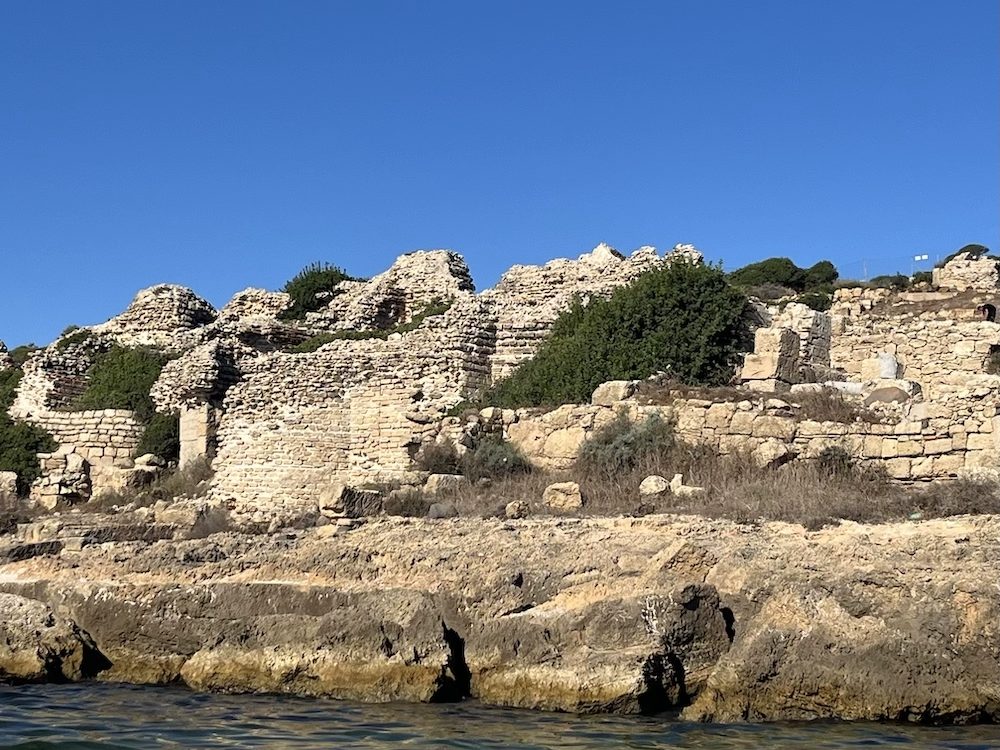
The following morning we went ashore to visit this archeological site. With so many invasions over the centuries, the mix of buildings is quite a jumble. Whoever laid claim to this land took apart exisiting buildings from the previous inhabitants and used them to rebuild the place. Any valuable finds, and there are plenty, are now housed in two museums that are not on the grounds of the archeological site. The museums are in the towns of Cabras and Oristano. If we could stay here longer we might take a taxi to these museums, but we can’t seem to make this work. We must push on.
Walking through the ancient site of Tharros, my head was flooded with words I haven’t thought of in decades…. metopee, capitol, Ionic, pediment, and the names of deities for which temples were built all over the Roman Empire. The stone used in this area is sandstone. It can be “tufo” which contributes to the golden atmosphere of most of Italy. I struggle with the difference between limestone type “tufo” and volcanic “tufa.” I’m never going to remember which is which if I couldn’t do it 50 years ago, but I can enjoy the golden look of much of Italy’s ancient sites, especially against a deep blue sky and the color of the Mediterranean.
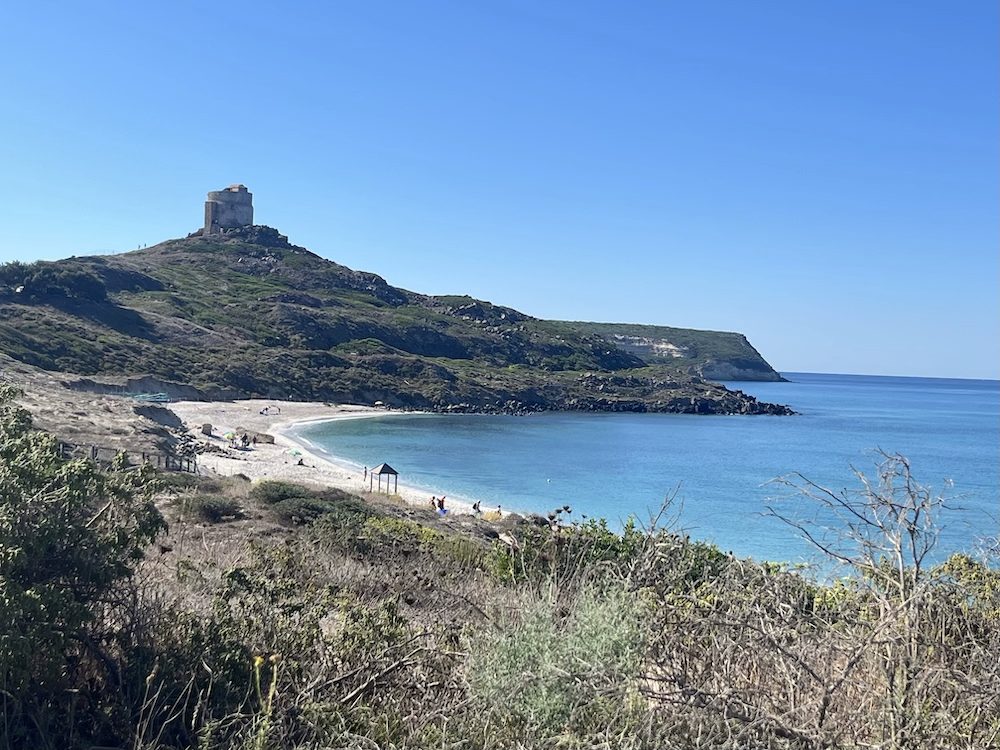
Walking to the site we saw the other side of the narrow peninsula. This is the Mediterranean, with a popular beach. In ancient times the bay was known as Mare de Morte (or ‘di’), the sea of death, because no matter how rough the Mediterranean might get, this bay is always calm. That is exactly why we chose to come here since at this time of year there can be strong north winds.
Imagine our excitement at seeing Pandora framed between the columns. Even if there is little original material in these columns, it’s still an impressive sight!
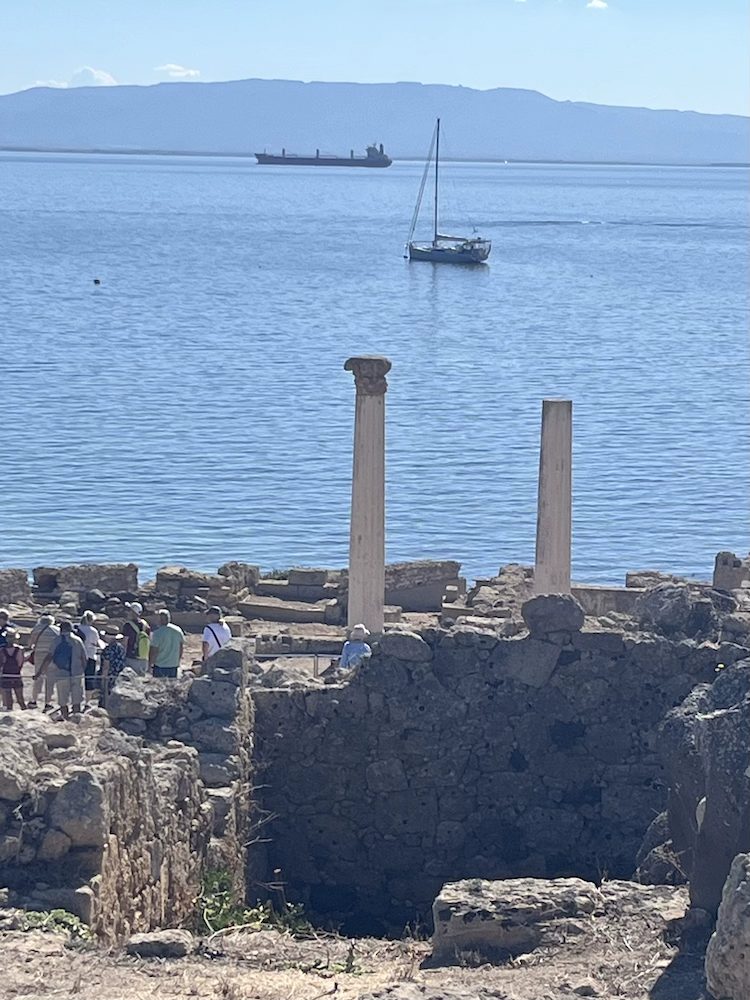
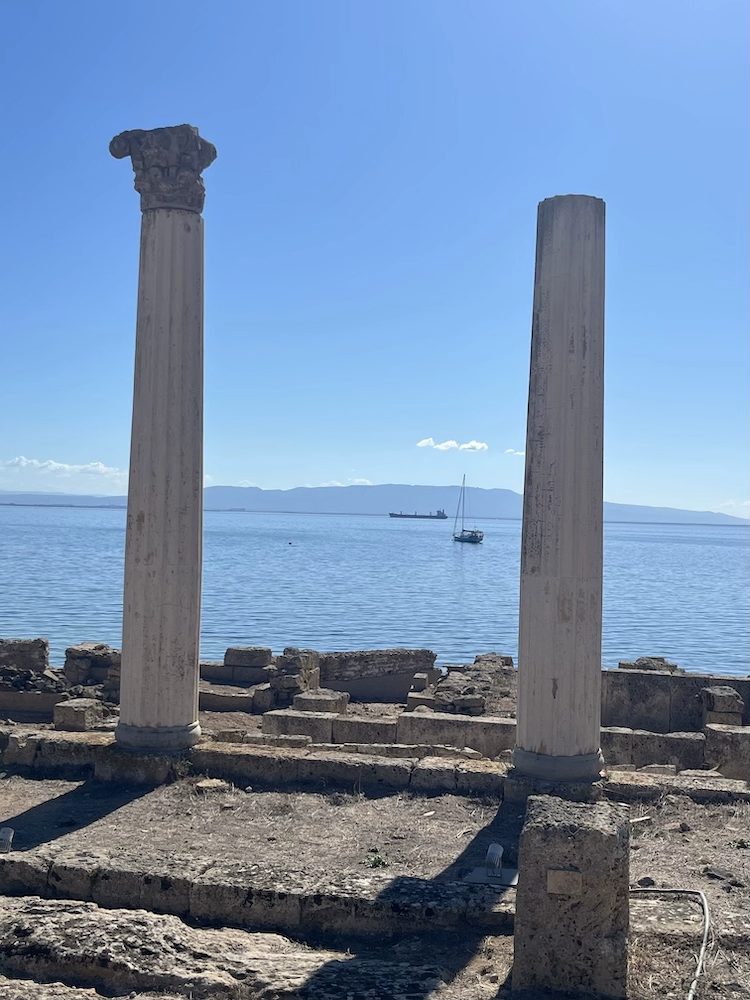
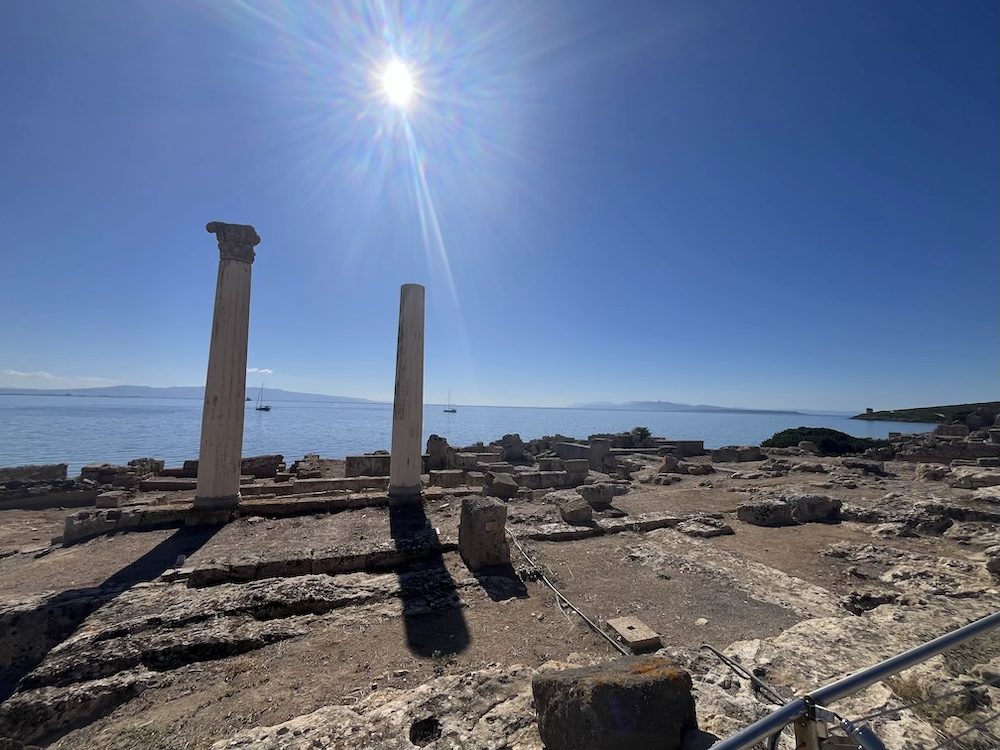
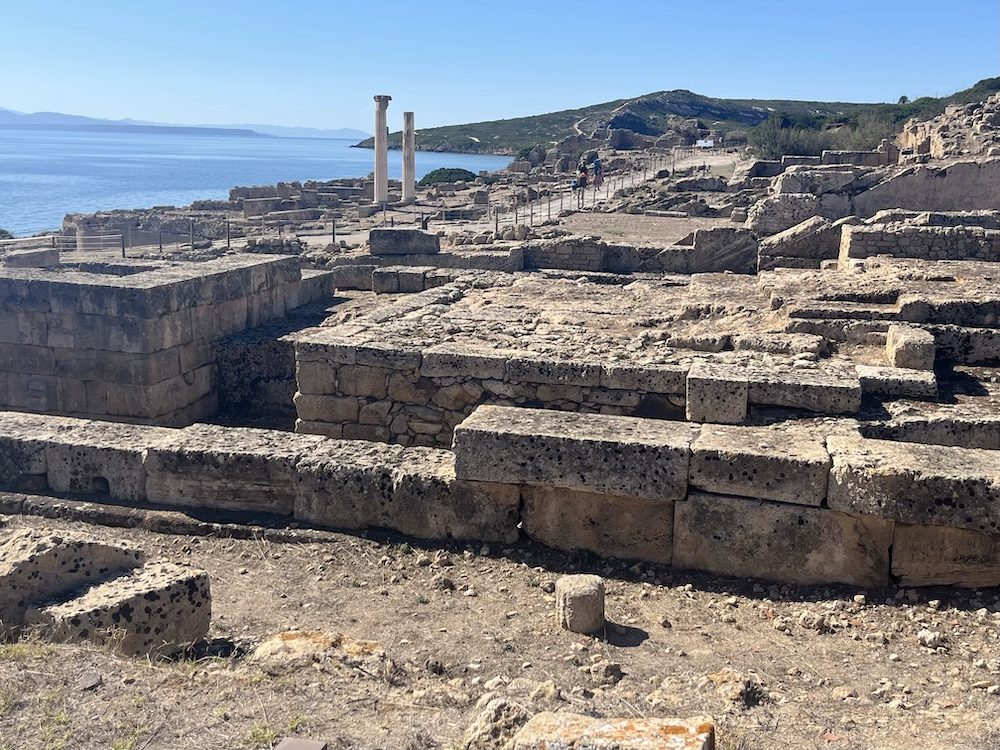
There are the remains of baths here where the foundations of the bathing rooms are still intact, and a large cistern for water further up the hill. There are foundations for a couple of temples; one is a temple to Demeter. There is nothing left but foundations, and you can see that one had the standard “porch” where the columns would have supported the roof and there would have been a pediment.
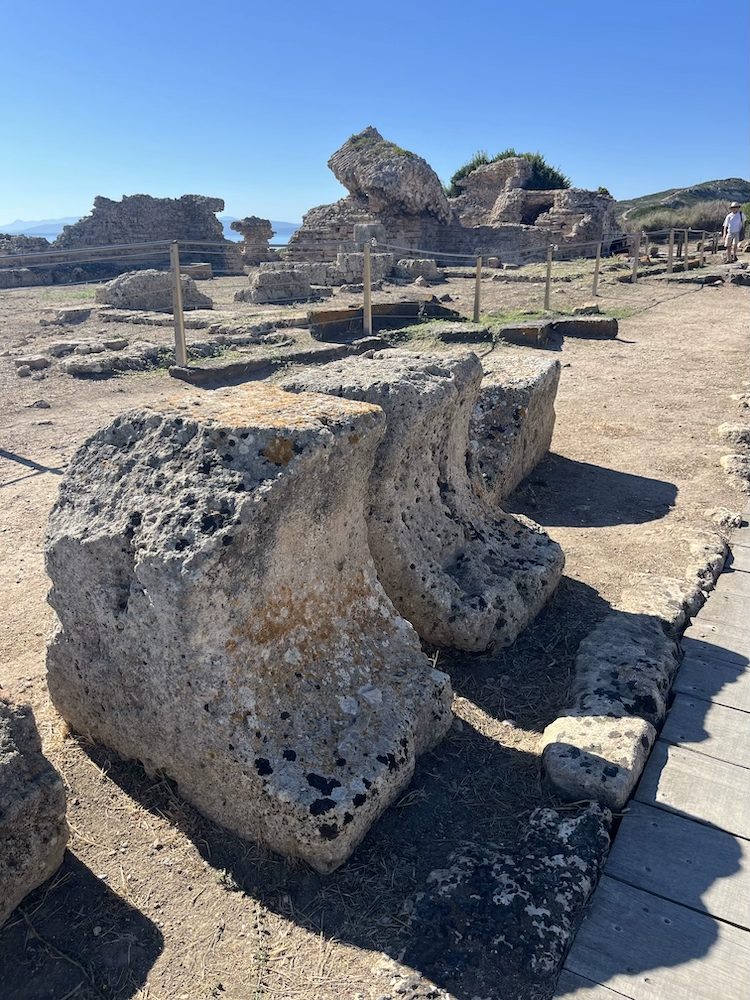
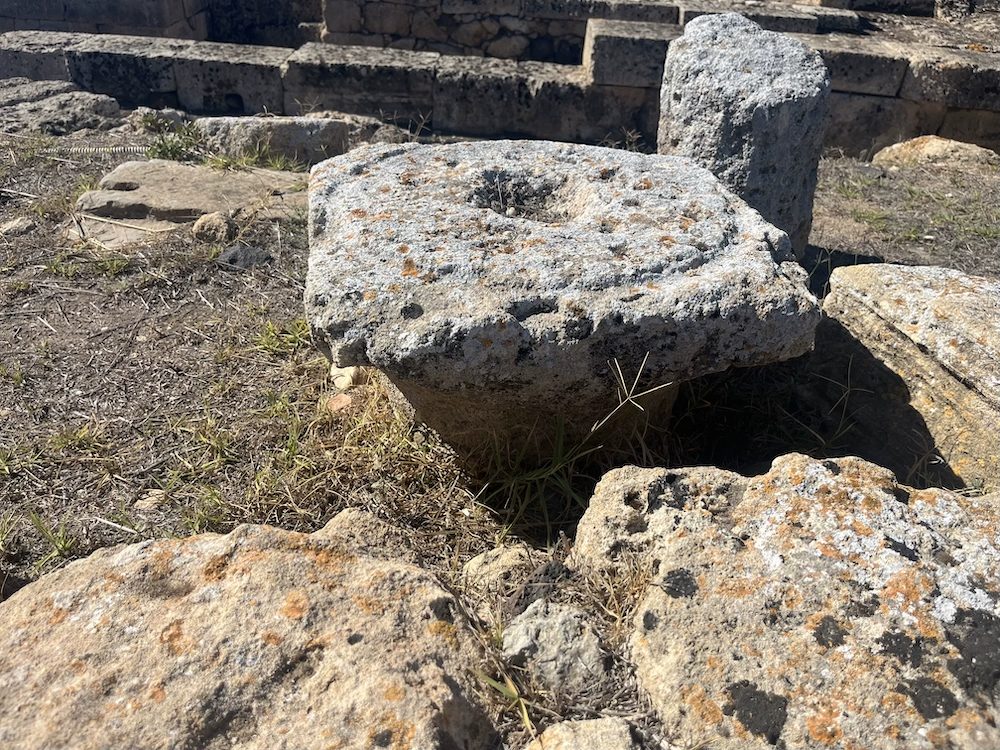
Carved stones for some architectural use. The stone in the center of the right photo might be a base or a capitol for something… I wish I knew more
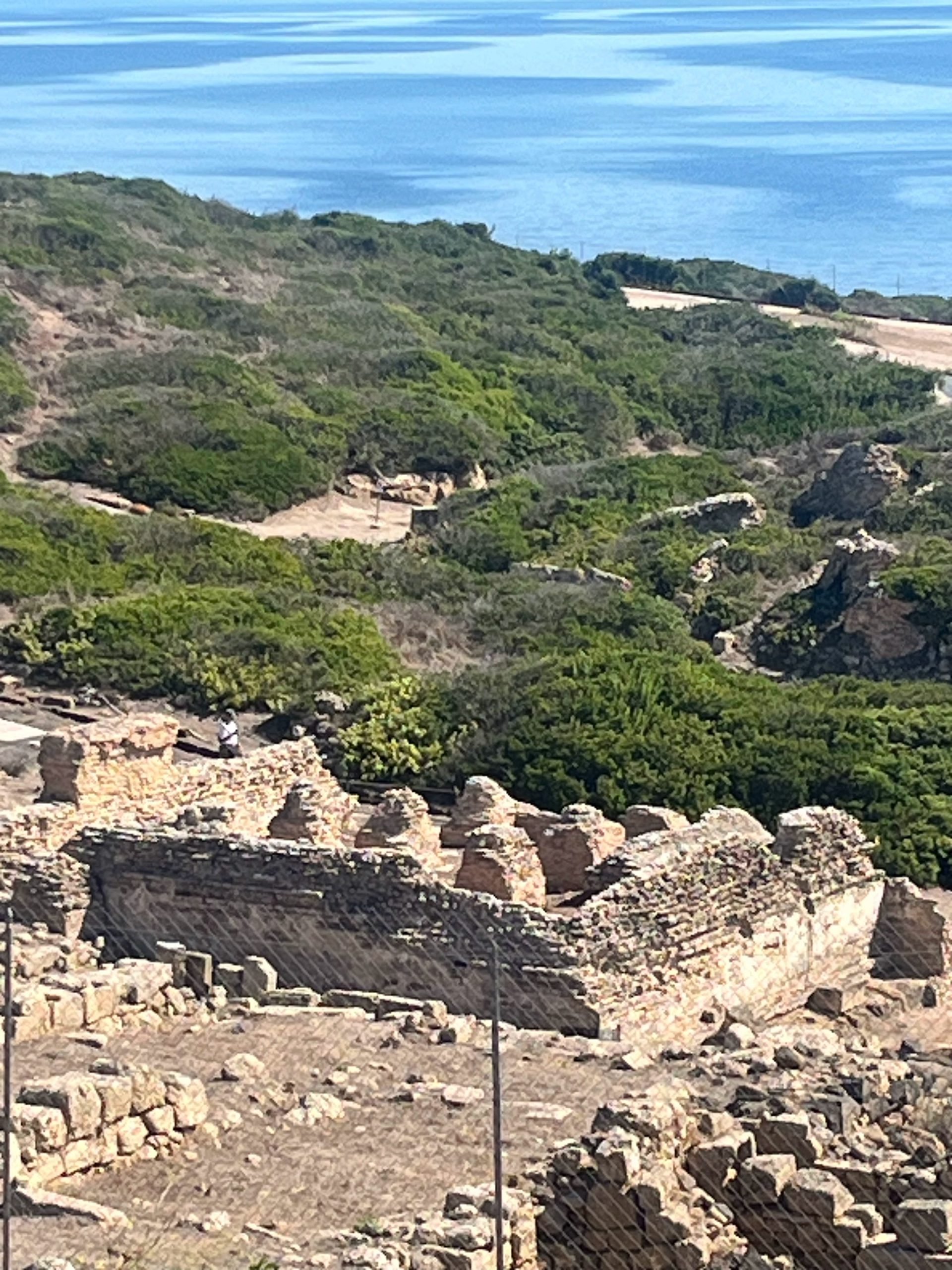
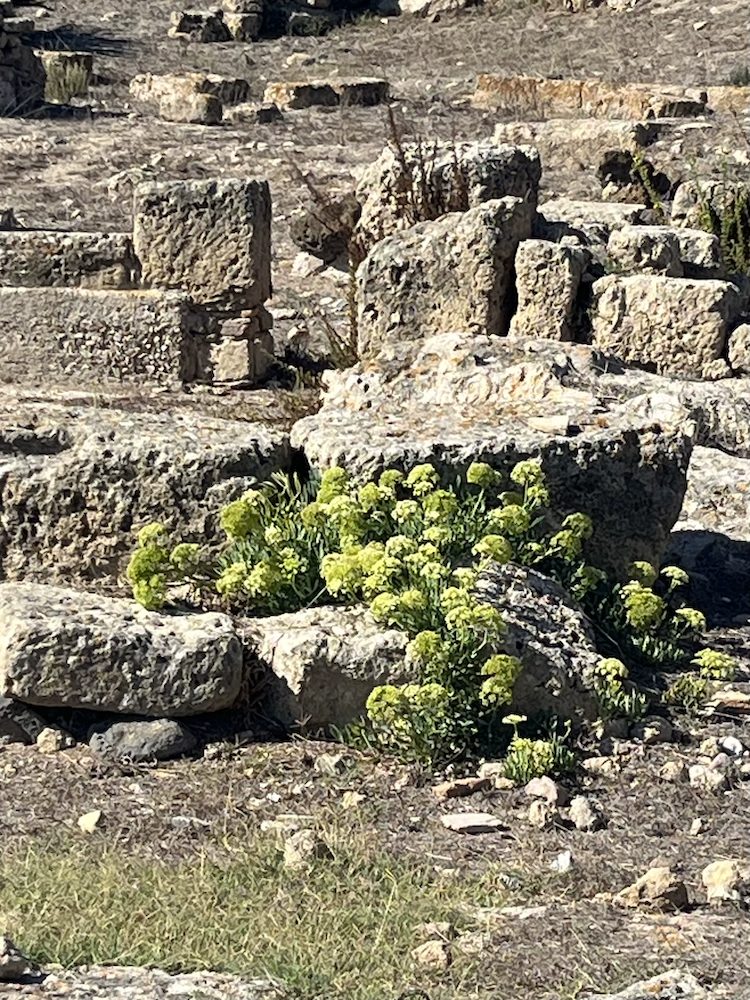
This area will soon pass out of the dry season into the more arable seasons of fall/winter/spring. Still, there are plants here thriving in the dry season of summer. As a young adult I was surprised to learn that Persephone went down to Hades in summer, not winter. Being a young North American, I was not familiar with summer being the harsh time of year when little grows. Along the road to the archeological site we saw lavender, rosemary, and artemisia, with lavender still in bloom. I know the Sardinians are known for using a different combination of herbs in their local vermouth than mainland Italy uses. We’ve got a bottle, but we haven’t opened it yet. I know there will be rosemary in it for sure.
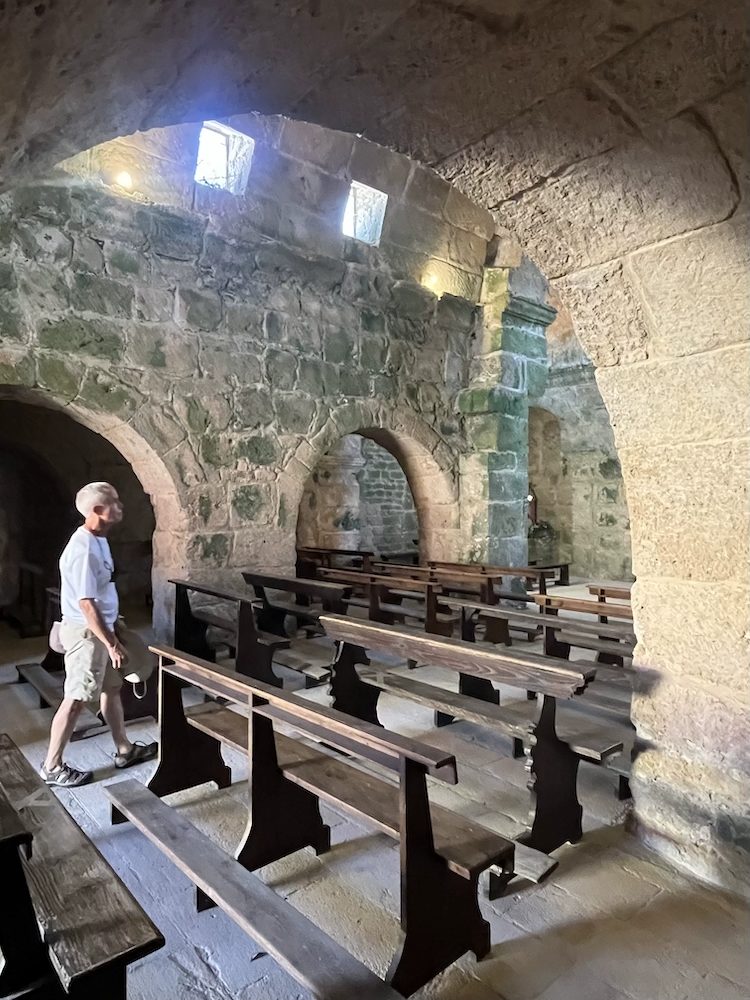
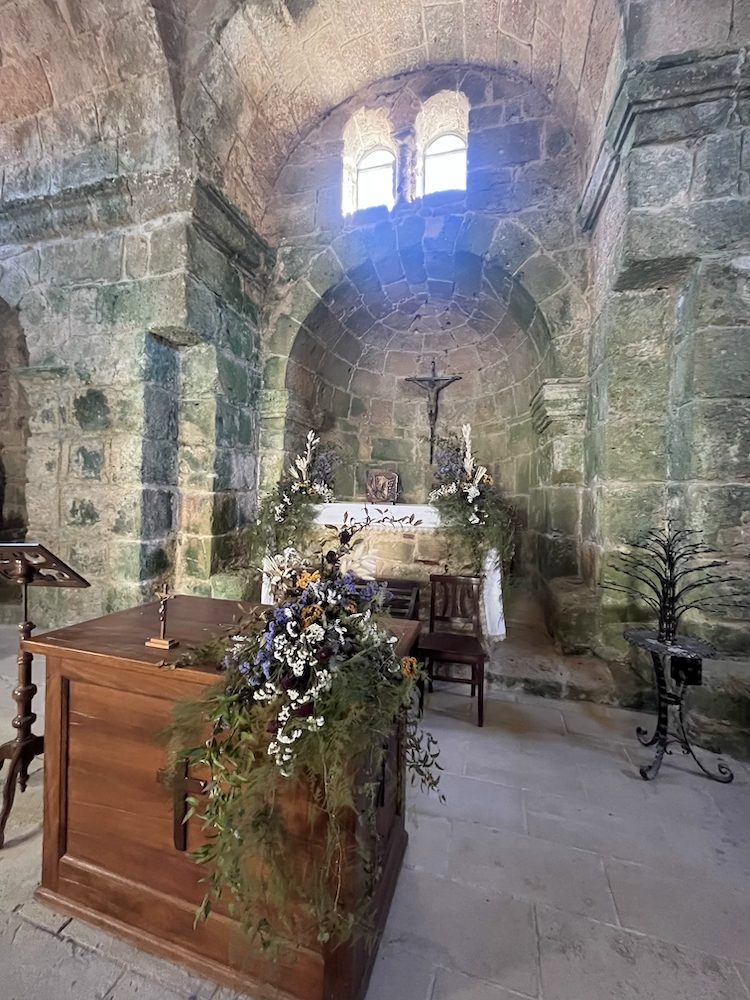
When we left in the afternoon we stopped into the Byzantine period church right near where we docked our dinghy. It’s just outside the ancient archeological site. The church is Chiesa di San Giovanni di Sinis (the Church of St. John of Sinis, Sinis being the name of the peninsula that creates the Bay of Oristano. This church was built in the 6th c CE, and the stones were taken from Tharros. It has barrel vaults and a very early baptismal font. The flowers on the altar were fresh and had now dried beautifully into preserved arrangements.
I had to revisit the ticket office where there was a small gift shop. Every gift shop everywhere has some woven items. It’s such a joy to see that woven goods have a following.
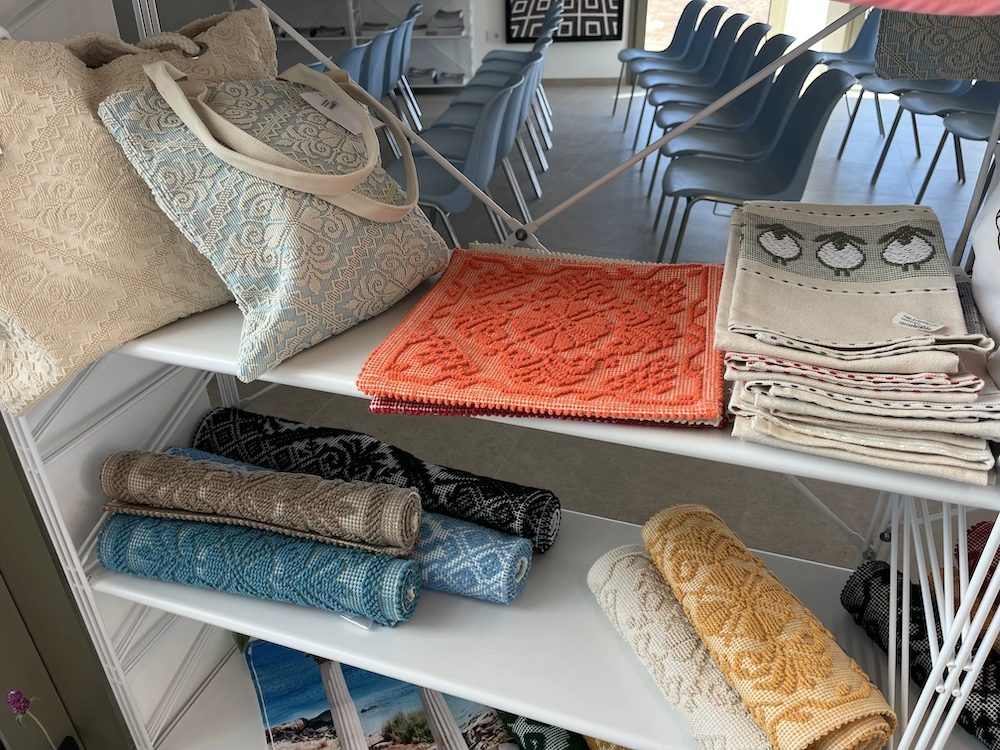
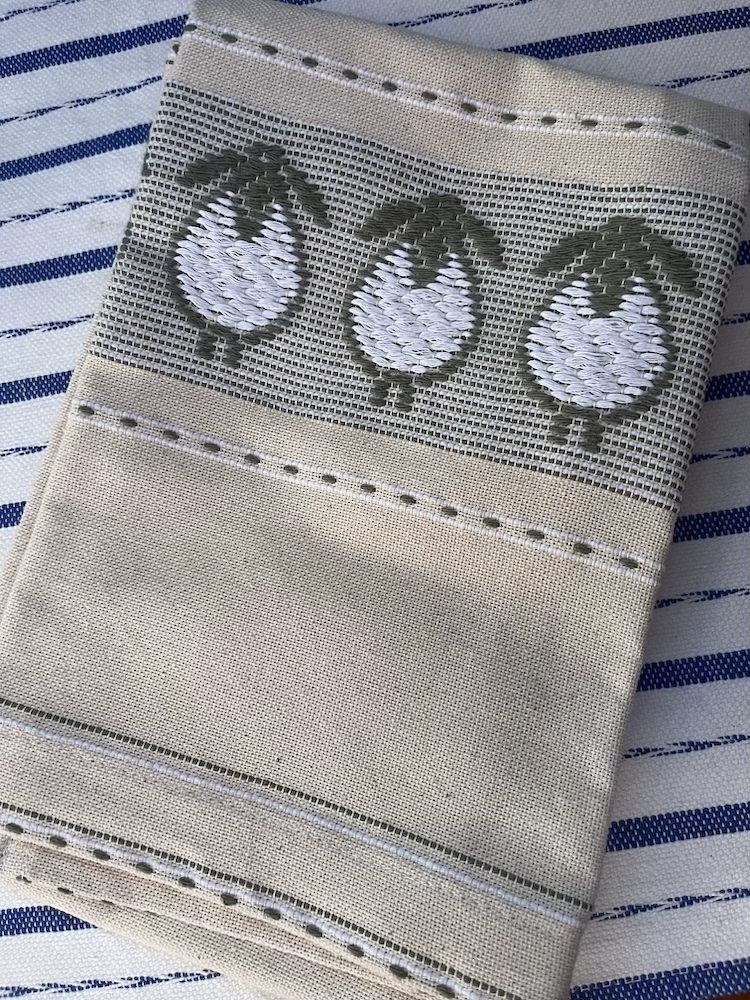
And this little gem came home with me.
It’s quite something to visit old passions. I don’t regret not continuing my studies, even though I still have a great love for the ancient world, when so many ideas were developed in science, art, and literature. I’m enjoying this short jaunt into the past, and into my own past. I know there will be more, and that’s the main reason I thought we should sail the Mediterranean before we are too old to sail at all.