ArgoKnot

sewing

Traveling with Friends

It is early February, and I am writing from Simpson Bay Lagoon on St. Martin in the Caribbean.  We are later this year in slipping our moorings in New England and moving aboard Pandora.  Lots of things contributed to the delay, but we are here now, anchored near some dear sailing friends who are introducing us to others who will become friends as the months and years pass.

After entering this harbor on the first bridge opening this morning, we anchored near the ketch Kalunamoo, whose owners are friends who took us under their wings five years ago to lead us through the Bahamas on our first trip down there.  Now they will surely be our tour guides though the Windward and Leeward Islands.  We see each other each summer when our boats are back in north Atlantic waters, but this is our first winter rendevous in three years.  It’s so comfortable being together again by water.

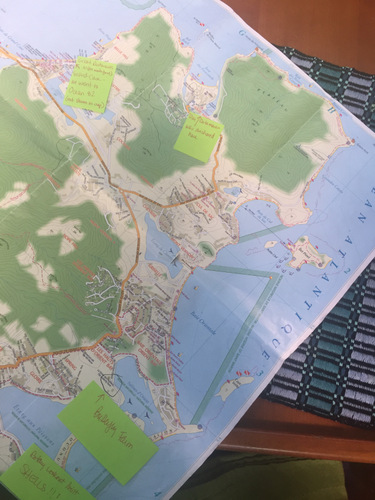
Before I left home another dear friend, one I’ve known as a weaver and land-based friend, sent me her map of St. Martin.  She and her family spent a couple of weeks here only a month ago, and she wanted to share with me a map highlighted with the things they enjoyed doing, the restaurants they visited, the boat excursions they took.

2-IMG_3187-002

Now that I’m here and am beginning to get my bearings, it’s wonderful to see the places she visited and know that I will follow in her footsteps.  It’s going to be a fun part of this trip, finally visiting places that some of my friends have been before, even if they traveled very differently than Bob and I are doing.  It should help me feel less isolated this year than I have in the past–especially last year, in Cuba.  That was a wonderful trip in many ways, but it was also the most isolated place I have ever been, since at the time, the US allowed no communications with Cuba.

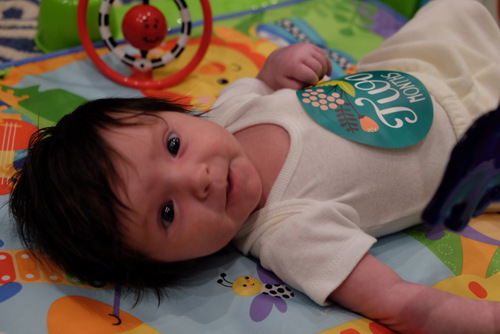
We left home a week ago, and already I get daily photos of my new granddaughter, the Tiny Super Moon named Tori.  She is such a joy to both Bob and me.  He still gets teary every time he sees a new photo of her.  I get the lightest feeling in my chest….such happiness!  Here she is beginning to celebrate her 2nd month birthday, although she won’t actually be 2 months old for another week!  I guess it was a great photo op for her parents. 1-IMG_0293 Before I left I tried my hand at a bit of embroidery that I found on Facebook.  It’s astounding to me what I stumble on perusing fb.  I’m glad to know this technique–I think it will come in handy for all kinds of projects.  I embroidered this little onesie as a practice, and clearly I need more practice.  But I’ll get it eventually.  I’ll do some spring colored onesies in this technique soon.  Hmmm….no photo.  Where did it go?

I have started a little sailor sweater for Tori.  It is one I made a few years back for my niece.  It’s a design by Debbie Bliss and uses her soft eco cotton.  This time I am using a soft green/blue color that I call faded robin’s egg, with cream.  I love it.  I’m still stumped by what I feel is a bad design for the collar.  Sorry Ms. Bliss, especially since I love your designs! It’s the focal point of the sweater and I still cannot make peace with wrong side of striped garter stitch showing.  For my niece I knitted the collar in a single color.  I am debating what to do for this version.  I have time to decide.

After 4 days in the BVI, making very quick visits to West End, Jost Van Dyke, and Bitter End on Virgin Gorda, we have made the long, 100-mile passage to St. Martin.  The weather has been challenging for the past month (since before I got here), and our weather router suggested that it is quite UNlikely that there will be a good time to head east for the next several weeks.  So we took the lesser of bad weather days to slog eastward yesterday.  It took us 15 hours to travel 100 miles, in fairly rough conditions.  They were very rough for me, but nothing like what Bob and his crew endured getting down to the BVI.  I was very sick for the full 15 hours.  We anchored out in Grand Case Bay on St. Martin, which I understand can be very lovely in calmer weather.  Last night there was quite a swell rolling in there that kept us rolling side to side.  We entered Simpson Bay Lagoon on the first bridge opening this morning….not a moment too soon.

We have reconnected with our good friends and will join them for dinner tonight at a Middle Eastern restaurant called Little Jerusalem, where we will start to meet people we’ve heard of many times through various groups, and whom we’ve spoken to on the radio.  The beginning of new friendships.  I wonder if I’ll meet a knitter or a weaver.  You never know.

Promises Made

It may be the dawn of a new year, but I am not writing about resolutions.  I am writing about promises. These are the promises I made during the past year.

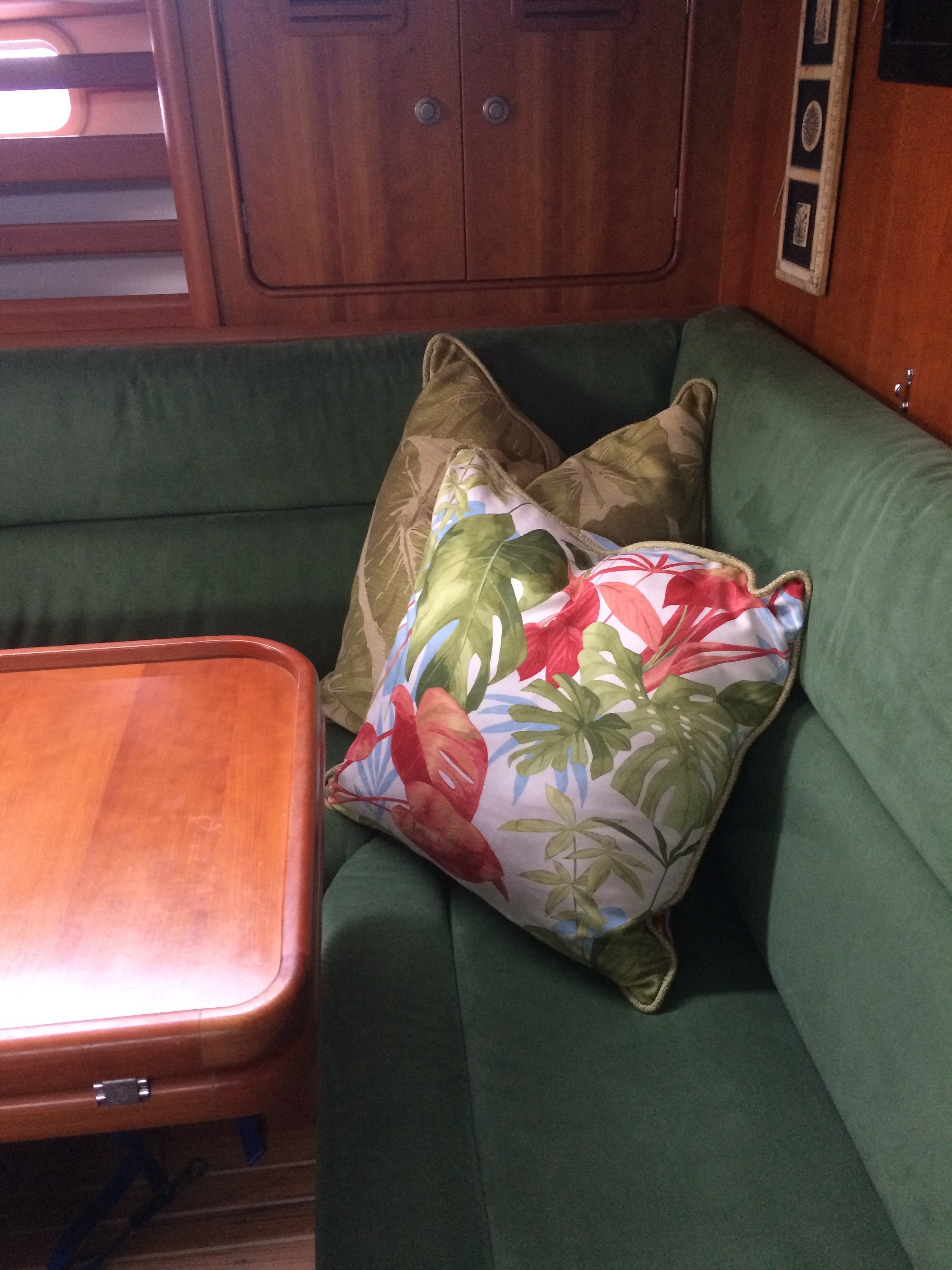
The first was a rather casual statement I made to my husband, Bob, after finding out that it would cost over $200 each for simple throw pillows for the main salon of our new boat, about a year and a half ago.  In spite of the fact that I’m not the best seamstress, and my blood pressure goes up whenever I plug in that sewing machine, I offered to decorate our main salon with pillows that I would make myself…. because for that price I was willing to endure the possibility of  having a stroke to make our our own decorative pillows for about 1/4 the price.  Early this year I found great fabric choices at Mac’s in West Palm Beach.  It’s great town to visit, and for me, a dip into Mac’s is the pinnacle of all the wonderful things to do in West Palm!

Time flew by and suddenly–during the week between Christmas and the new year– it was time for Bob to start packing for his long voyage to the eastern Caribbean.  I have to admit that I had not given those pillows much thought in the months since I’d bought the fabric.  It was time to get sewing.

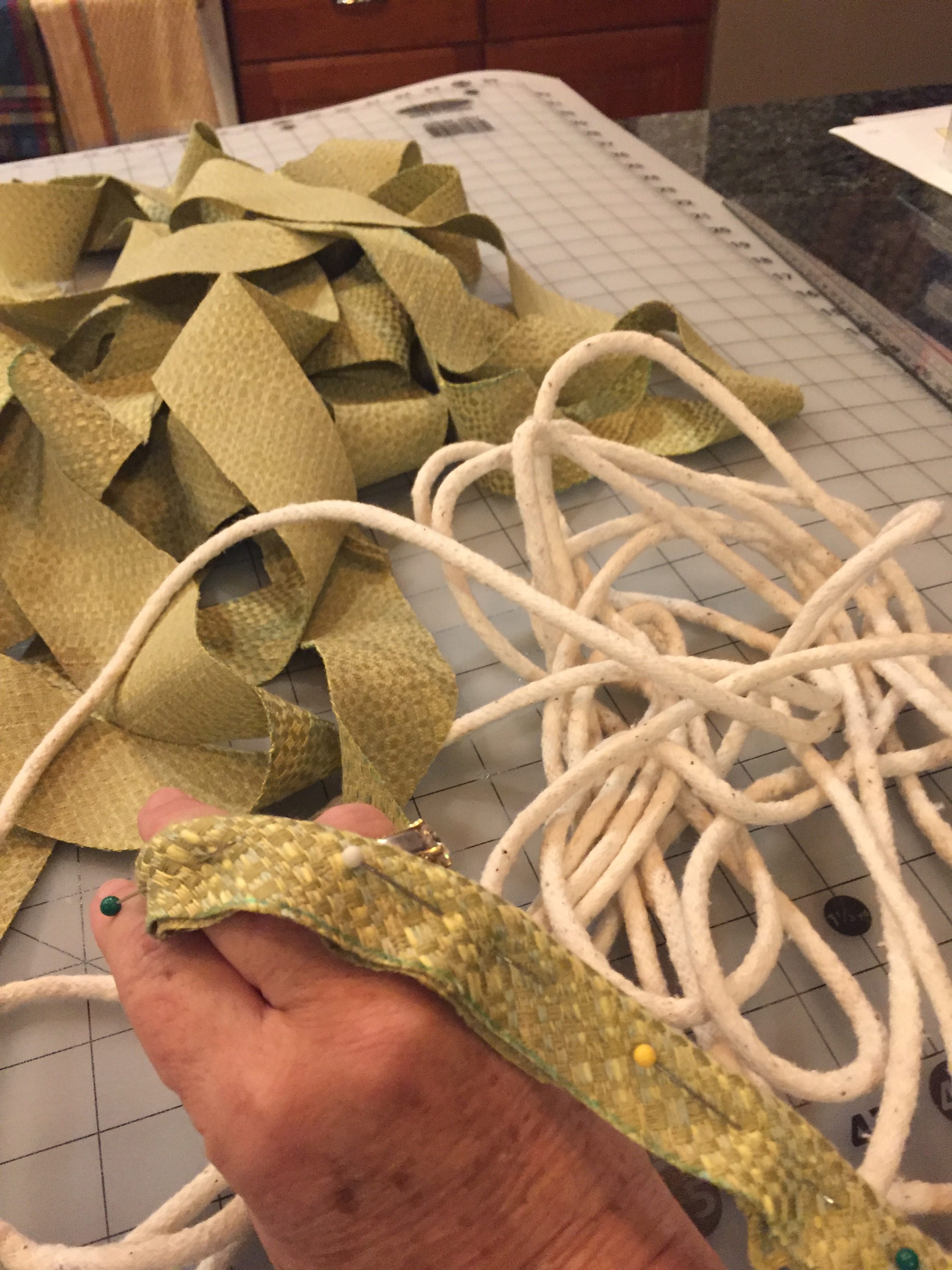
The first hurdle was making the bias cut binding for the welting that would go around the pillows.  There is an efficient way of cutting bias binding that I can never quite grasp.  I may never get this down, so thank heaven for YouTube where I can find almost anything right when I need it.

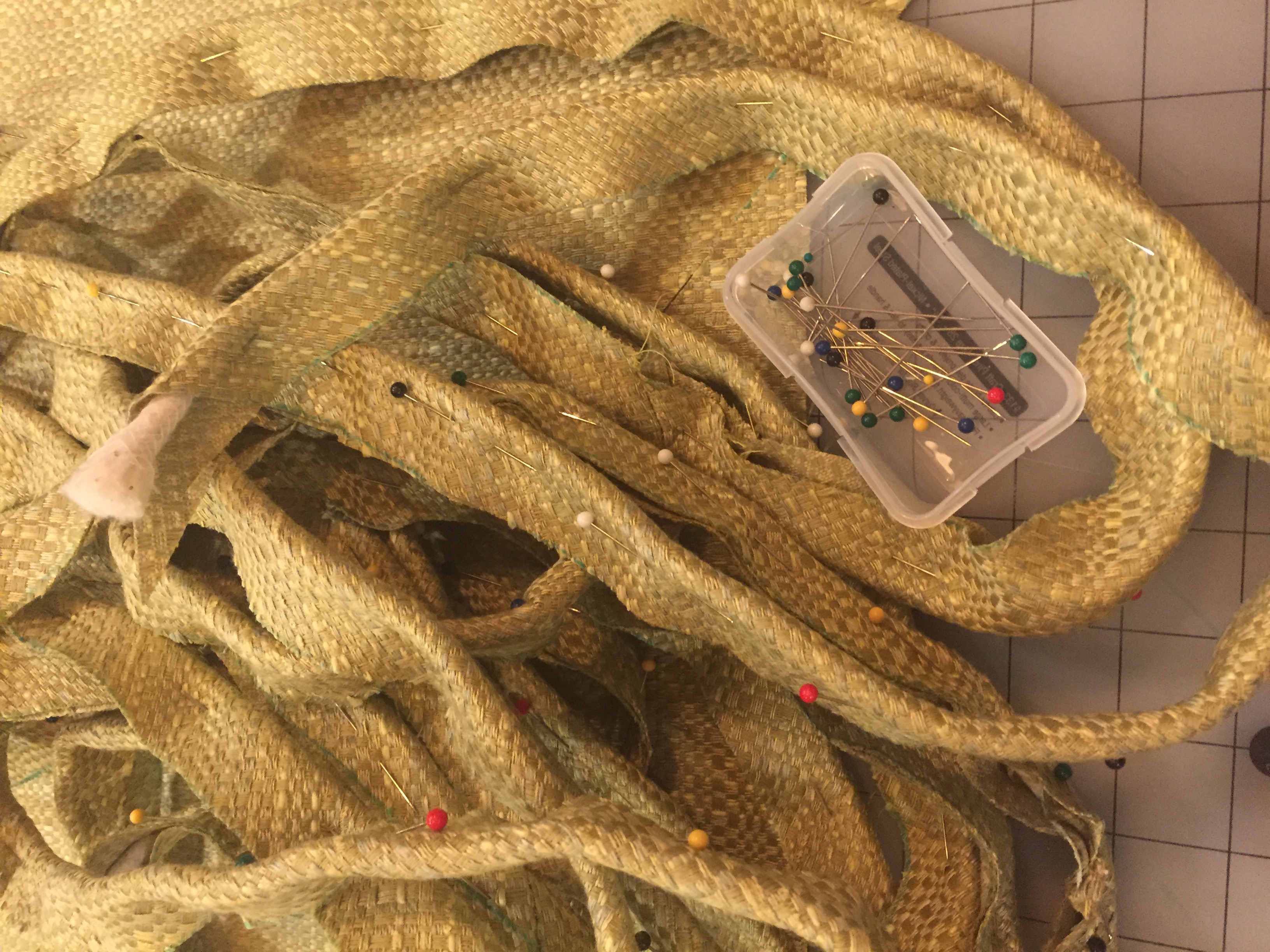
My four pillows needed 11 yards of bias binding that would then turn into cording.  I need to hear gasps here….puh-lease11 yards.  It was a LOT of sewing, and it was daunting for me.

Just pinning the 11 yards of binding around the cording took an age.  I really need some shout outs here for enduring this effort…. And, just so you know, that box of pins was full to overflowing before I started pinning the 11 yards of binding.

img_3051

img_3052

YouTube to the rescue again on how to make a pillow with a bias binding welted edge AND a zipper.  Yep….that was no small feat for me, the intrepid and not so dexterous seamstress. You really can learn almost anything on YouTube, thanks to the efforts of countless folks who are so willing to share their expertise.  Here is my source for inserting a zipper into a welted edge.

img_3061

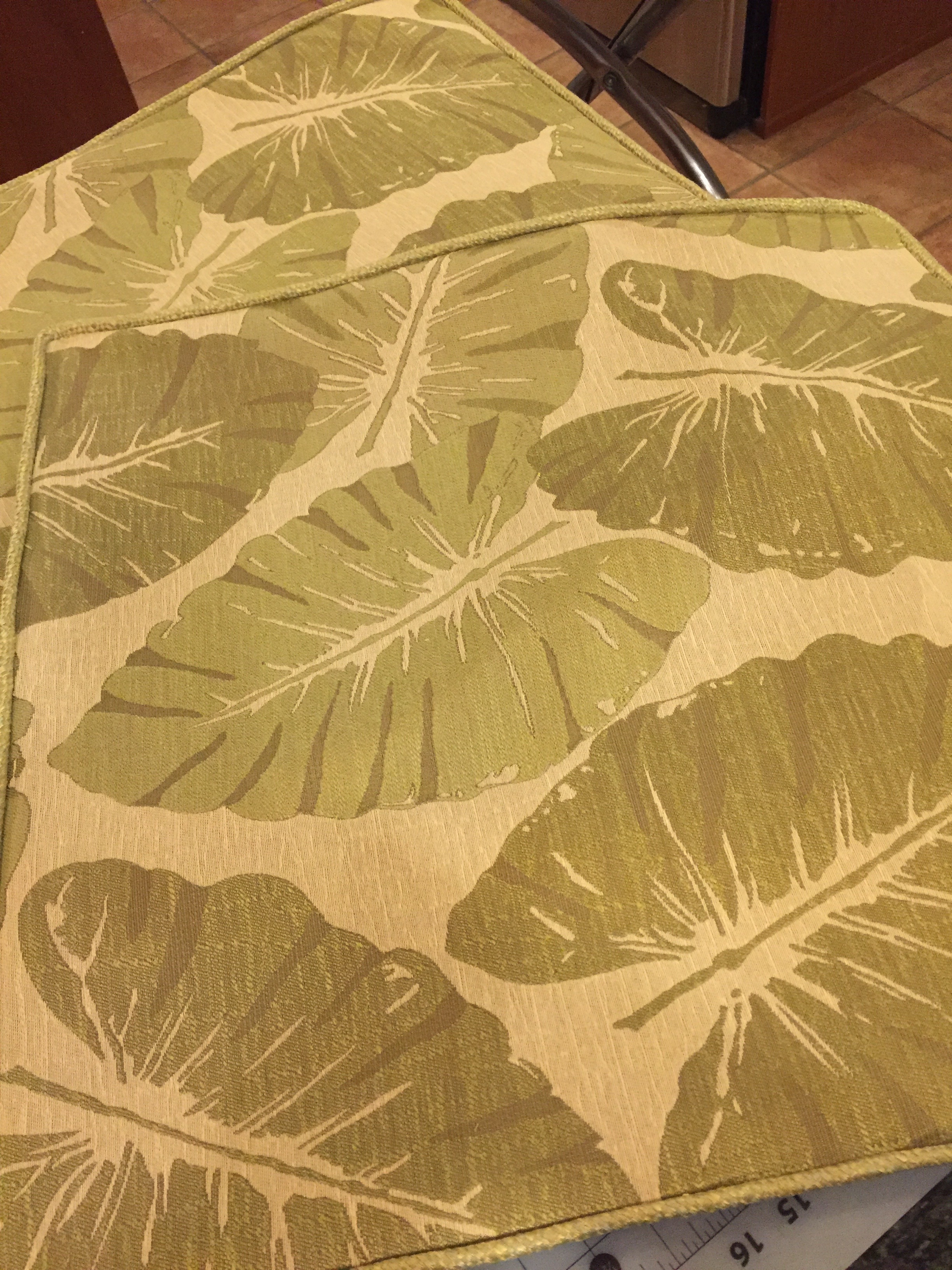
Happily, the pillows are now adding a touch of elegance to Pandora–two of the four.

img_3112

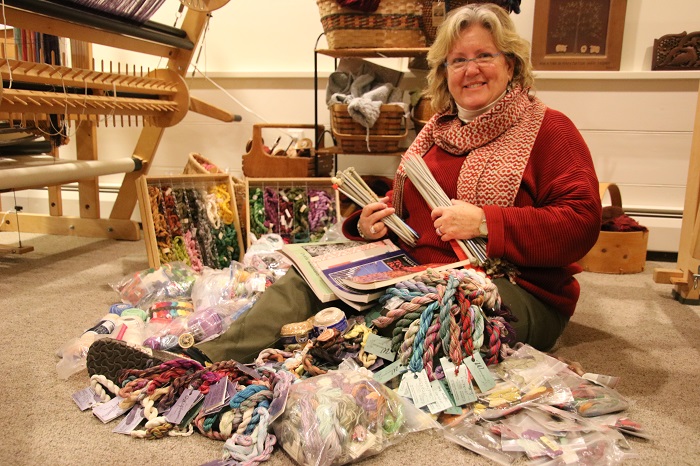
On to my next promise….made more recently in time.  In fact, it was April, in Havana, when I had the thought that I knew plenty of bobbin lace makers, tatters, knitters, and embroiderers who would be thrilled to share their excess stash with women in Cuba who love to work with their hands, but have so few choices of materials to use.  The generosity of the women I know through various groups was quite astounding.  The most touching incident happened during one our Cuba talks which were mostly geared to sailors.  Diane was in the audience at a local yacht club for one of Bob’s talks, and she approached me to say that her sister had once owned an embroidery shop.  When it closed Diane had offered to store some of the excess embroidery threads for her sister– beautiful threads, such as Danish flower thread, hand-painted embroidery cottons and silks from Watercolors by Caron Threads, and a treasure trove of other exquisite threads for handwork.  Huge thanks, Diane, for letting these treasures go. The New England Lace Guild also contributed fine lace threads, books on bobbin lace, tatting shuttles and threads, and even a large stash of knitting needles.  The bounty just bowls me right over.

Where’s the photo?  Well, right now it’s on the camera that is traversing the north Atlantic with Bob who is on his way to the Caribbean!  What a snafu!  He took a fun photo of me siting on the floor ensconced in piles of beautiful lace and embroidery threads.  He is out of internet range for the next 10 days, so I just have suck it up that there is no photo.

Well, now Bob has landed in Tortola (1.11.17), and is enjoying soft tropical breezes under thatched pavilions, drinking fruity concoctions with little paper umbrellas in them.  And he has sent me the photo.

1-12-17 004r

Bob packaged up all this swag in vacuum seal bags that are now aboard Pandora on their way to the Caribbean, where they will then get transferred to other sailboats that are headed for Cuba in the spring.  Mail to Cuba is not yet an option since I’ve been warned that packages get opened and raided.  These packages will get delivered directly to Adriana in Havana by various sailing friends.  I know she will share them generously with other women.  All good! A promise well kept.

I am in the midst of my most recent promise, so I cannot yet tell how well I will fulfill it.  I never made this promise out loud, but in the depths of my heart I made it, which is perhaps a more binding place for promises.  My father died over 5 years ago and left my mother in the care of my sister and me.  He died with his whole family surrounding him, including four grandchildren.  My mother has not been well since long before he passed away, and she has endured the past 5 1/2 years mostly alone….not so much in actuality, but certainly in her soul.  She was not an easy person to care for, and my father’s death was in part due to the heavy burden of caring for her. She has been hurtling toward death for the past few months.  Although she and I were not close, I felt a strong desire to help her– to be whatever she might need to me to be, in order to help her make this transition. Over the past weeks I have touched her –held her hand, stroked her hair, rubbed her shoulders– more than I remember her ever touching me or my sister.  I hope it gave her solace.  I hope she felt comforted.

Her time came this afternoon.  It is so fresh I am probably rash to write of it so soon.  It’s certainly too soon to say if I’ve kept my promise.  Neither my sister or I was with her, but perhaps that is how she wanted it.  Her favorite nurse was with her, and that means a great deal to me.  In the coming days of this new year we hope to honor her memory and scatter her ashes as she would want.

Only today I realized what I might miss most about her — her whistling.  It was a brilliant feat of delicacy and finesse. It was a mystery of nature–of human dexterity.  I hope I will always be able to hear her trilling the piccolo part of “Stars and Stripes Forever” in my memory.  I hope she’ll be whistling for others wherever she is–they will love it!


The Democratic Women’s Federation for Handcraft

Does that sound like a bureaucratic department in a communist state? Bingo. I am sorry to report that my visit to the Women’s Federation was a bit different than I expected. Yes, it was exciting…but it was also heavily overshadowed by some restraint on the part of the women I met. They had a reserve that was a bit unnerving to me, and none of them showed the enthusiasm for the handwork we had in common that I expected.

I met Noelis at the shop where the traditional clothing is for sale. Maria Estar was again on ‘display’ in a window making a small crocheted embellishment that would be attached to some item of clothing when finished. Noelis was happy to see me and led Bob and me on a walk for several blocks to the building of the Women’s Federation.

The building was a lovely old thing—I’d guess it was once a 19th century residence, one storey with a lovely front porchl.  From the street entrance we cold barely see into a large, dark front room with a hallway running back. Beyond this was a wonderful view of the inner courtyard that had a lathwork ceiling draped in a bounty of magenta bougainvillea blooms.
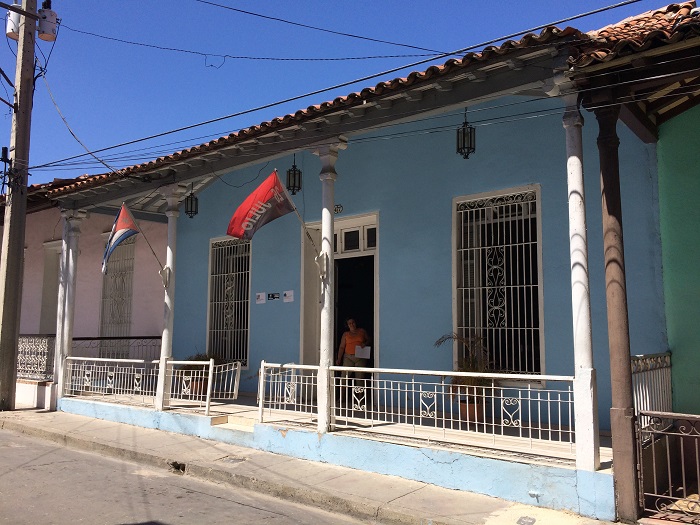
3-10-16b 006Noelis took us in to the first room where about a dozen women were sitting in a circle practicing their crochet. There was a man who was monitoring who came and went from a desk at the entrance. Noelis asked us to sit down near the desk while she got the ‘manager’ to come out to meet us.

Some of the women looked up from their work and smiled at me. I was very excited at the prospect of getting to see what they were doing! I was right near them, but I already had the sense that I needed to stay in my seat as Noelis had instructed.

The manager was a woman about my age. She looked very approachable, and I think we could have had a great conversation if we had not needed a translator. Noelis was our translator, and I trusted her, but she had such a deference for the manager that I think she translated my words very formally. Certainly what she told me the manager was saying was also very formal. I was not speaking formally to these women, and I have a feeling from the friendliness in the manager’s eyes that she was not speaking formally to me either. I think a LOT was lost in translation.

They told me the purpose of the federation was to keep the techniques used in traditional textiles alive and make sure the traditional garments of Cuba continued to be valued and worn, if not for everyday use, at least for use in life’s traditional ceremonies, such as weddings and other religious events. The women pay to go to this school (60 pesos for 3 months of study and including a hot lunch), and then have the opportunity to make money with their handcrafts after reaching a certain level of proficiency.

There was a class going on in the lush courtyard and there was a large studio with sewing machines where women were sewing various items of clothing. The machines were all Jukis. The only clothing being made that I recognized with certainly was the men’s wedding shirt, called a guayabera. Noelis told me there are many traditional women’s costumes that have the same details as the guayabera.

The manager’s office was a cramped space with no window. The four of us—Noelis, the manager, Bob and I—were quite challenged in the space. At one point another woman came in and joined us. I know that Bob and I created some curiosity, but it seemed that most of the women did not feel comfortable showing it.

While I could see that all the sewing was being done with commercial white fabric (and I had felt the shirts in the shop, and they were not traditional 100% cotton, but some kind of cotton/polyester blend), I still felt compelled to ask if anyone in Cuba was weaving traditional fabric. Noelis did not recognize words ‘weaving’ and ‘loom’ so while we chatted Bob searched the photos on my phone for images of my looms and some of my handwoven fabrics. Once he found these both the manager and Noelis confirmed that no one is weaving in Cuba. They do not have the equipment, but they said some women ‘do this with a needle.’ Hmmm…. I wonder if they meant some kind of needle lace. They saw some photos of my tapestries (tapisaria) and said that is not done in Cuba either.

We talked for a while about bobbin lace, tatting, knitting and crochet. Bob asked if we could take some pictures, and this is when things got noticeably awkward for the women. The manager said (through Noelis) that we would have to go to the Federation headquarters in Havana to ask for permission to photograph. Hmmm… They seemed a bit leery of us from that point on. I tried to explain that women in the US who do handcrafts are very interested in knowing what women in other parts of the world do. That did not go well either. The manager gave me a brochure about the Federation and told me to visit Havana for permission. Bob attempted to tell them that we are living on a boat ….that this method of travel means we will not get to Havana until mid April and we will not get back to Santiago de Cuba, but they said they could not do anything without permission from their headquarters. So, very sadly, that photo at the beginning of this post is all I have to show.

Noelis took me on the rest of the short tour. It was afternoon at this point and almost all the women were sitting together in the courtyard, all eating the exact same lunch on plastic trays with molded dividers to separate the food items—very 1950s. Lunch was white rice, some kind of meat, and some vegetables. As I looked to the side of the courtyard, along the hallway we were walking down, I saw there was a large kitchen where lunches were prepared. So some women work at the Federation as kitchen staff.

Noelis took me to a group of women at a small table just at the back of the large front room we had entered first from the street. Behind a room divider separating them from the space where the crocheters had sat in a circle for their class was a large Spanish carved colonial dining table (and large, ornately carved Spanish china cabinets along that back wall) where women were sitting practicing their tatting…or frivolite. Noelis introduced me to the teacher and then asked me to show her my tatting. I was a bit horrified because of all the textile techniques I do this is the one I am most UNproficient at doing! I did not want the teacher to think that my work represented the quality of work done by women in the US! I asked Noelis to explain to her that I am very much a beginner, that I only started doing this when we left on our trip a couple of months ago, and that this was my second attempt at a trim of rings and chains for the neckline of a blouse.

Naturally, the teacher found all my mistakes in a moment! She had Noelis tell me that I didn’t always have the same number of stitches between my picots, and I must strive to always have the same number. Well, yeah… I do know that even though I haven’t managed it yet. Wish I could have explained that I did this work while bouncing about on a sailboat, usually sailing in gale force and near gale force winds…but I realize that would have been just looking for reasons to explain my faults! Then she said my picots were rather good but there were still tiny differences in sizes, and I needed to get more consistent with that as well. At the end she said that if I was a beginner I was doing very well. Still, I left feeling pretty mortified that of all the things I could have shown a teacher in this school, wouldn’t you know it would be the one thing I barely know!

Noelis escorted us out of the building, and as she left us to return to the shop where we met her (in the historic district) once again she said that she hoped we’d come back with permission from Havana, and that she ‘would be waiting for me.’

This incident put a quite a damper on my enjoyment of the rest of the day, I must say. I always get so excited to meet other textile makers, and I usually feel that it is a language we all share and a place where we can all have the same enthusiasm and ability to teach and to learn from each other. The whole proletariat attitude really took the wind out of my sails–sorry for the dumb pun–but I really felt deflated. Here were a group of women I would love to communicate with about subjects near and dear to all of us, and there was this terrible pall over the whole thing. There was a definite sense of propriety that these women exuded, and they seemed to be weighing their interest in talking to me against the rules of what was expected of them in representing this federation.

After a short walk back to the historic district, we were standing in the main parque when we were approached by someone who said he knew we were staying at the marina… I did not recognize him, although he said he works for the customs department at the marina. He remembered us from when we checked in, but I knew I had not seen him. He offered to show us some sights and find a place for us for lunch. In my newly deflated state I wondered if there was some agenda to his offer….

Well, there was, of course, but also he was generous with his knowledge. He took us to a local restaurant that I’m sure was owned by his family or friends. That was okay because it was a great place, and we would have no idea of how to find such a good local place on our own. ‘Paladares’ are family owned restaurants that the Cuban government has now sanctioned. There are many rules for running one of these: a limited number of customers may be served (I think it is 12), and they cannot serve foods that are reserved for gov’t run hotels and restaurants which includes lobster and the better cuts of chicken. Paladares may serve pork, some chicken, and local fish. We let the waiter choose our meal for us, and it was excellent! This particular place was on the 3rd floor balcony of a small residential building (typical Soviet block cement structure), and up on the balcony was an amazing view of the decayed apartment buildings all around that could have been anywhere from Kabul to Cairo with a backdrop of the stunning harbor.
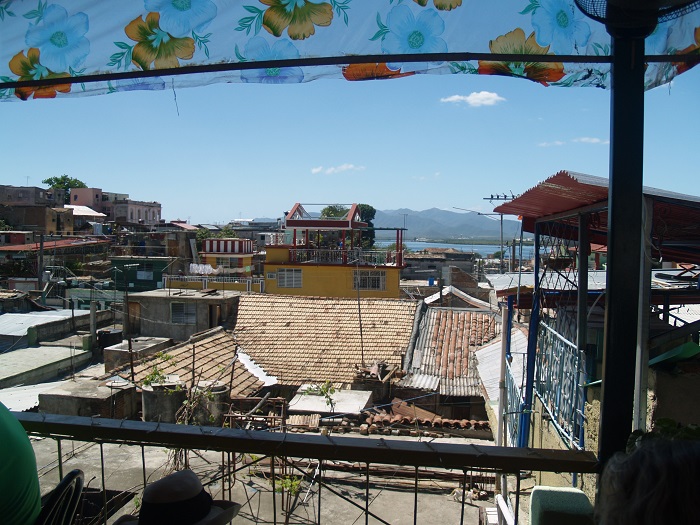
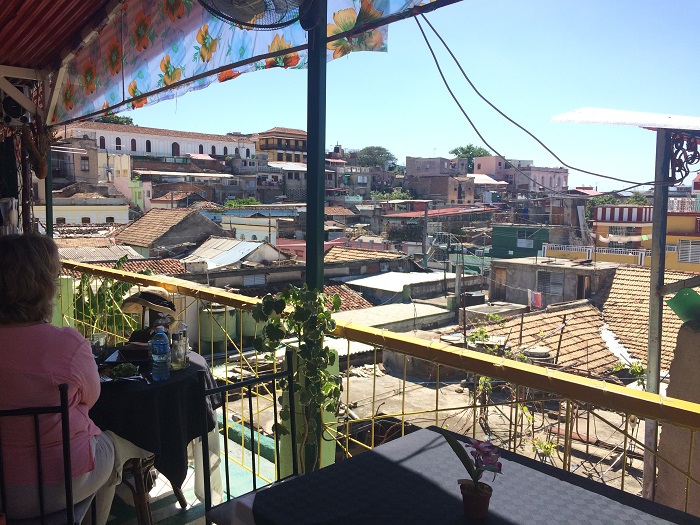
OLYMPUS DIGITAL CAMERA3-10-16b 012Some of the surrounding buildings had no roofs, or had makeshift roofs of corrugated tin with many holes and many repairs. All the buildings had windows with no glazing. On one rooftop balcony near us there was a dog that looked very much like our son’s dog Bobi. This gave me a little tinge of homesickness on the very day I was missing my son’s birthday. Well, I was certainly thinking of him.
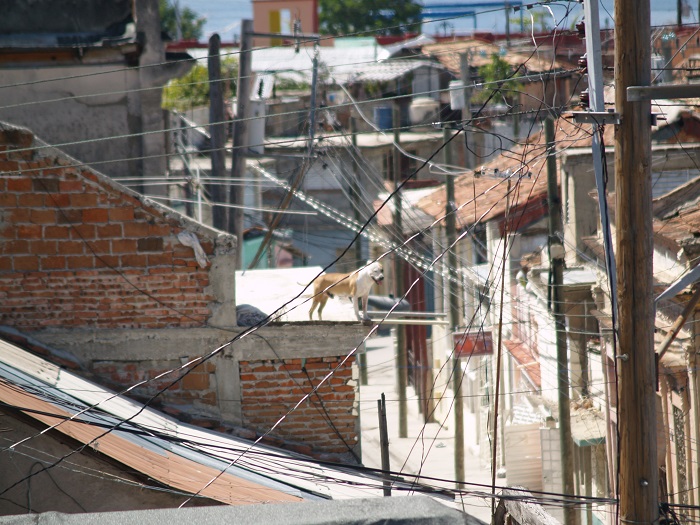
OLYMPUS DIGITAL CAMERAOur customs official cum tour guide offered to get us things—cigars, rum…from places that tourists cannot visit and therefore much less expensive. He admitted that he had some ‘relationships’ with these places that would give him a commission for what he sold. It was all a bit overwhelming for me. He said he got his very good job working for the state because of who he knew. He used the phrase “Who you do, who you know,” which sounded like everything was based on what you do for someone and who you know that can improve your own situation. I got that, but he must have wanted to make certain I understood because he added, “one hand washes the other.” –he could not possibly know that I learned this phrase in Latin in high school, about a million years ago! I guess I was too hot and too disappointed in my visit to the handcraft school to enjoy this information. Now, a day later Bob and I have discovered that he does not work for customs at the marina. He’s not the first person to recognize downtown in Santiago de Cuba—every seems to know who we are. I think we were had, but it was kind of fun anyway. Boy, these people know how to turn a trick.

The day was hotter than the previous day, and when we returned to Pandora we had a very cold gin and tonic and a simple dinner of cheeses from France and Italy, and crackers from the UK , that we bought in Nassau. After washing a local mango in a basin full of water mixed with hydrogren peroxide, we ate it. No ill effects today. I might also add that I had a mojito at the paladar and a lemonade at the Casa Granda Hotel, both with ice cubes, and I am still alive. Whew!
Sericulture in Connecticut and a Workshop with Sarah

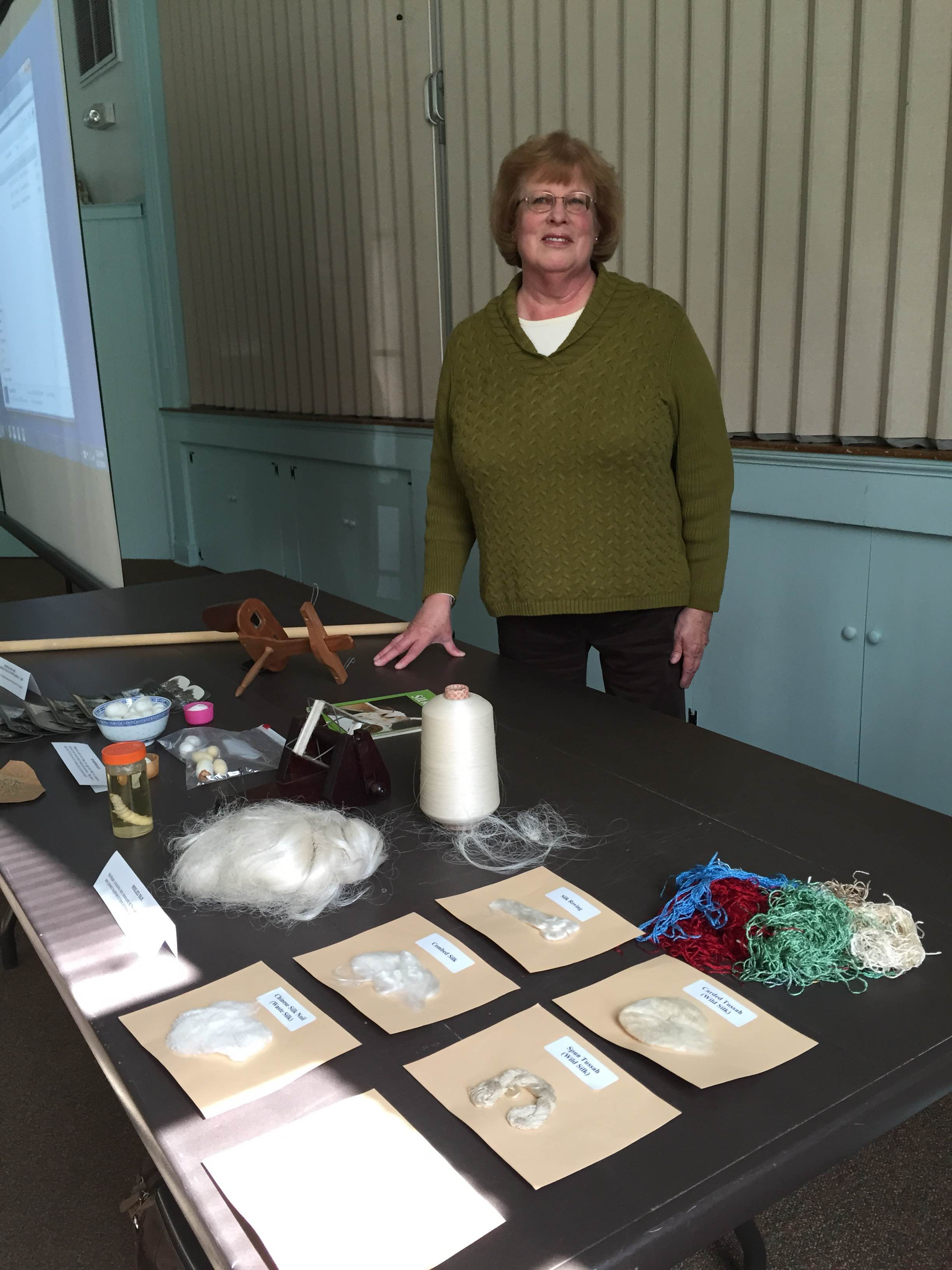
That title is a mouthful.  Initially, I just liked the sound of “Sericulture in Connecticut,”  but I could not write about that when I’d also just spent a fabulous three days sewing with Sarah Fortin!  Some week!   I guess if all weeks were as educational and productive I’d be wiped out all the time. Who knew there was a silk industry in Connecticut?  I did not.  I certainly knew that China and other Asian countries have had  silk production since the dawn of time.  And I knew that by the Renaissance, European countries wanted to grow their own silk worms so they could stop buying costly silk from China that involved the long and treacherous journey on the silk roads.  Well, it turns out that the English wanted to see if silk could be successfully cultivated in the American colonies.  The experiment started in the area from Virginia to Georgia, around 1650.  This is the same period in which the English experimented growing indigo in the southern colonies as well.  A century later the southern colonies were focused on cotton and tobacco, and an experimental silk culture had started in Mansfield,  an area east of Hartford.  This was a cottage industry in which farmers were encouraged to plant black mulberry trees in their orchards, and their wives raised the silkworms and learned to reel the silk. The program was presented by Ann Galonska from the Mansfield Historical Society.  She has been researching the silk industry in this part of Connecticut for a number of years and she also decided to try her own hand at raising silk worms.  She was able to feed the caterpillars on the leaves from the few remaining black mulberry trees in the area.

1-IMG_1551

Interestingly, Ann told us that silk worms put on 80% of weight during the last week of their caterpillar cycle.  They go through so many mulberry leaves that she has to replenish the leaves multiple times a day.

Ann brought silk cocoons, silk worm eggs, a silk worm preserved in a jar (formaldehyde?), and various samples of different silk preparations.  She showed slides of the various silk mills that cropped up in the area.  Hanks Silk Mill ws the first mill in the US, established in 1810.  As time went by more mills were established:  Chaffee Silk Mill and Mansfield Silk Company, until by 1869, there were eight mills in the area. She showed bills where farmer were paid for the silk they delivered, as well as ledgers of bartering with silk as payment for household goods.

She showed an adverstisement from 1834, urging farmers to buy mulberry trees to add to their orchards: 100 black mulberry trees for $3 – 5.  Hard to imagine, even given the cost of things back then.  By the end of that decade the same 100 trees cost $500.  And that is even harder to imagine!  Silk was a profitable industry in this area for a couple of decades, but the decline began when people started buying saplings of the white mulberry tree, which was known to be preferable to black mulberry.  Ann said these trees survived the first couple of winters in Connecticut which happened to be mild, but when a more typical New Engalnd winter ensued the white mulberries were not hardy enough to survive.  And most of the farmers had cut down their black mulberry trees in order to plant the white version.  While raising silk worms swiftly declined at this point, the mills hung on well into the 20th century using imported silk.  You can find more information, along with early  20th c. photos of some of the mills at the historical society’s website.  And there are tours of the mills at certain times of the year.  Now that would be a treat!

Much of last week I spent at a workshop with Sarah Fortin, learning to sew a garment from handwoven fabric.  This is far from my forte (ha ha!)–so far that I would say I am completely inept at making a flattering garment.  So to cut into precious handwoven fabric for a likely-to-fail attempt at making a jacket made me pretty uncertain about taking this workshop.  I brought a nice selection of commercial fabrcis to choose from:  a length of Harris Tweed, two lengths of wool melton, and a selection of other wool crepes and one chenille that I thought might work up as something interesting.   Somehow, in the tote bag of fabrics I also included a very precious length of wool fabric that Rabbit Goody wove, and that I bought from her as a remnant, about 20 years ago.  This piece of yardage was far more precious to me than any of my own handwoven fabric, and I cannot explain why I took it with me to the workshop!

Naturally, when I showed Sarah my fabric choices, I began listing all the reasons why I would not consider cutting into the Rabbit Goody fabric.  And naturally, Sarah listed all the reasons why I should.  In the long run, Sarah (with enthusiastic support from the rest of the workshoppers) won this debate.

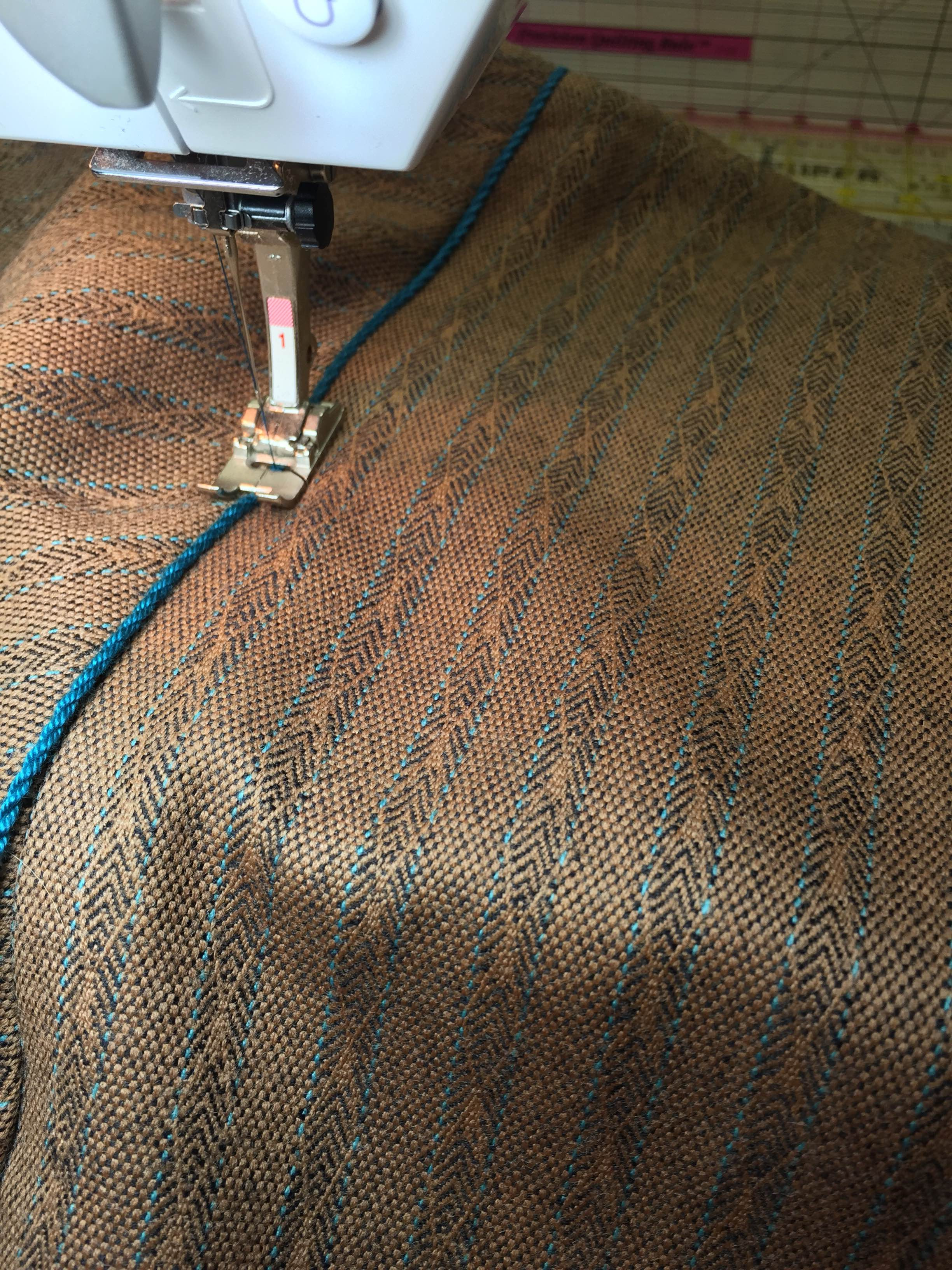
1-Sewing with Rabbit Goody fabric

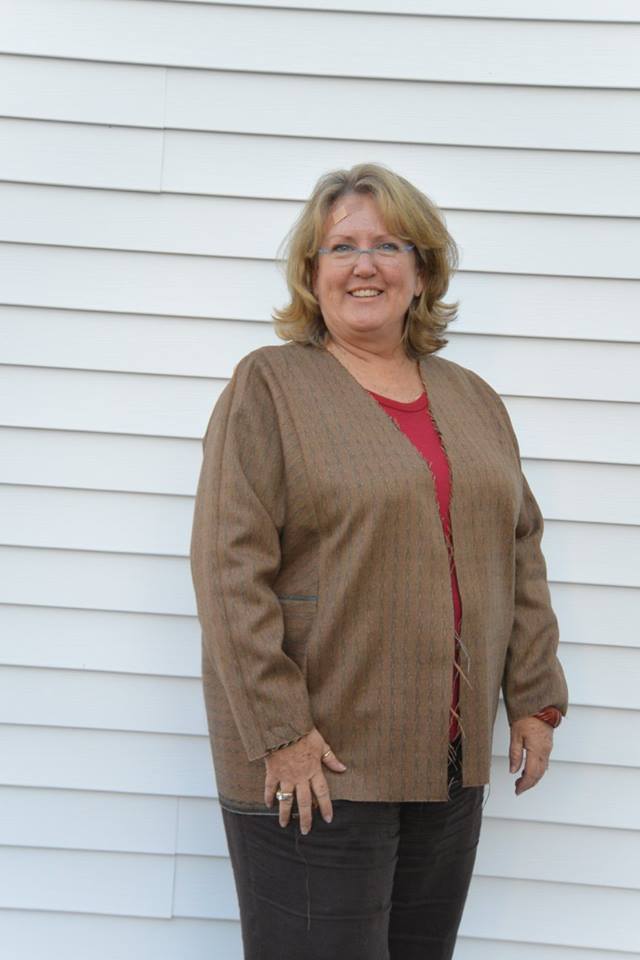
I have to say it was not easy to cut into that beautiful fabric.  The sewing was enjoyable and ate up most of the workshop time.  When I reached the last seam in assembling the jacekt I suddenly got very anxious.  I knew it would be time to try it on.  It still had a lot work to do–all the embellisments I’d planned as well as all the finishing for the sleeves and the hem and attaching a front band.  But it was at this point, when all the pattern pieces were together, that I could try on the jacket, and I did not want to do it!  Sarah came with me to a more private area where the others could not watch, and I put it on.  I was very shocked to find that I loved it!  ….and that it fit so well.  Whew!  All credit for this  goes to Sarah, of course, for helping me size the pattern before cutting it out.  And of course she was right– better to enjoy this fabric as a garment– the very reason I bought it in the first place, rather than hiding it away in my stash.

Sarah Fortin workshop me

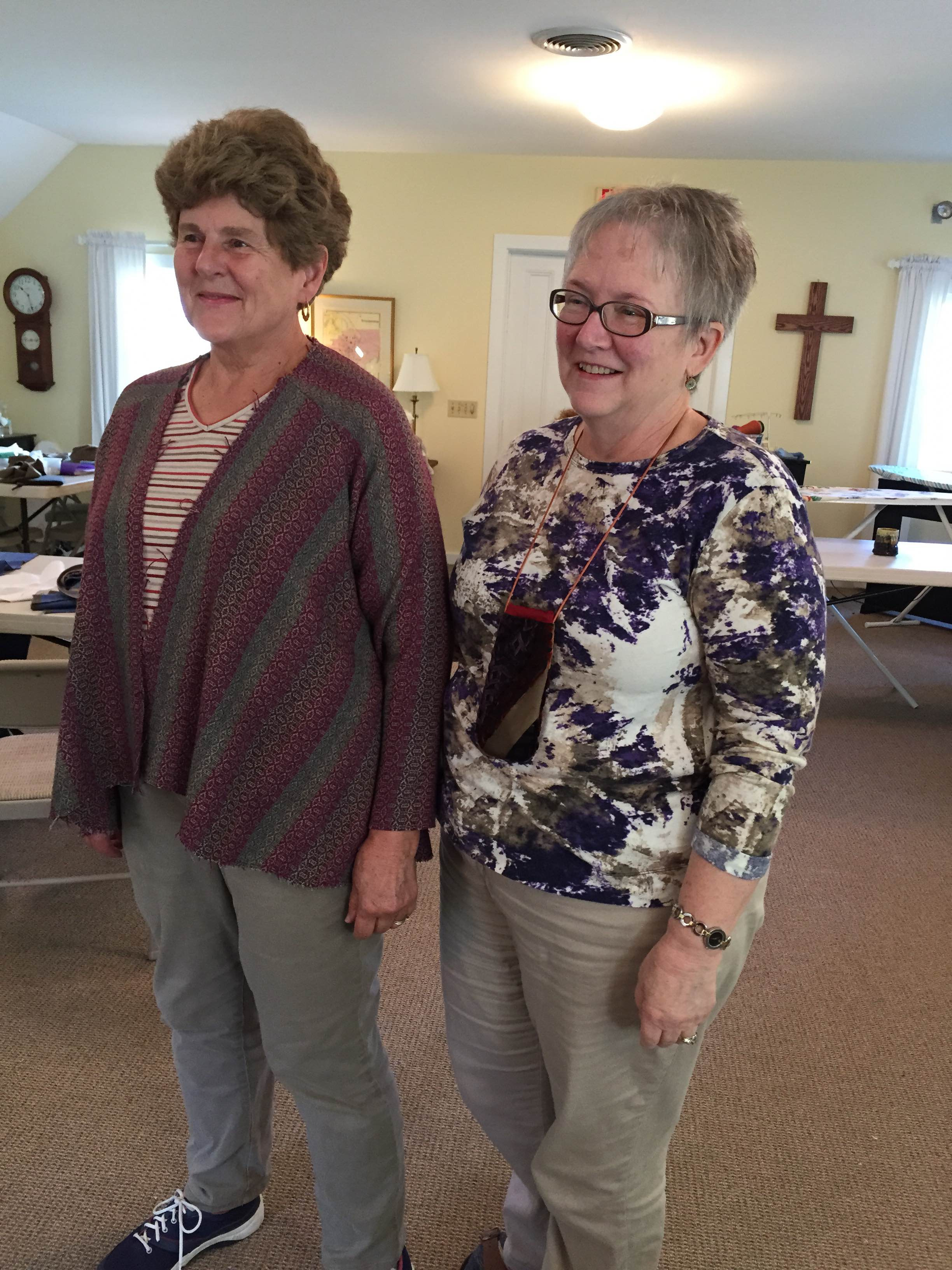
Everyone made a successful jacket during our workshop.  Marjie, who is likely our most accomplished seamstress, finished her jacket first. The pattern she used is called the ‘swing’ jacket. Look how pleased both Marjie and Sarah are with the outcome!  The rest of us are are sighing over this and hoping ours will turn out as well!

3-Sarah Fortin workshop

Last day of class, more people are approaching the finishing! This is Jody’s jacket, a wonderful fabric woven on a warp at Vavstuga. The coloris quite off–it’s actually a great mixture of two greens and brown.  Jody made the same pattern I did, called the “bias sleeve” jacket. I think Jody’s jacket is the most successful combination of weave structure and garment design.  It’s a beauty and it looks fabulous on her!

2-Sarah Fortin workshop Jody

One more finished swing jacket with terrific color placement!

4-Sarah Fortin workshop swing coatSome of us will be getting together again this week to continue to work on our finishing.  I’m now a bit confused about my sleeve finish and how to put on the front band.  I’m hoping some of the more experienced sewers (that would ALL of them!) can give me some pointers.  Also, Sarah has offered to answer any questions so I think I will email her.  I’d better get to it!

Scroll to Top