ArgoKnot

travel

Fullness

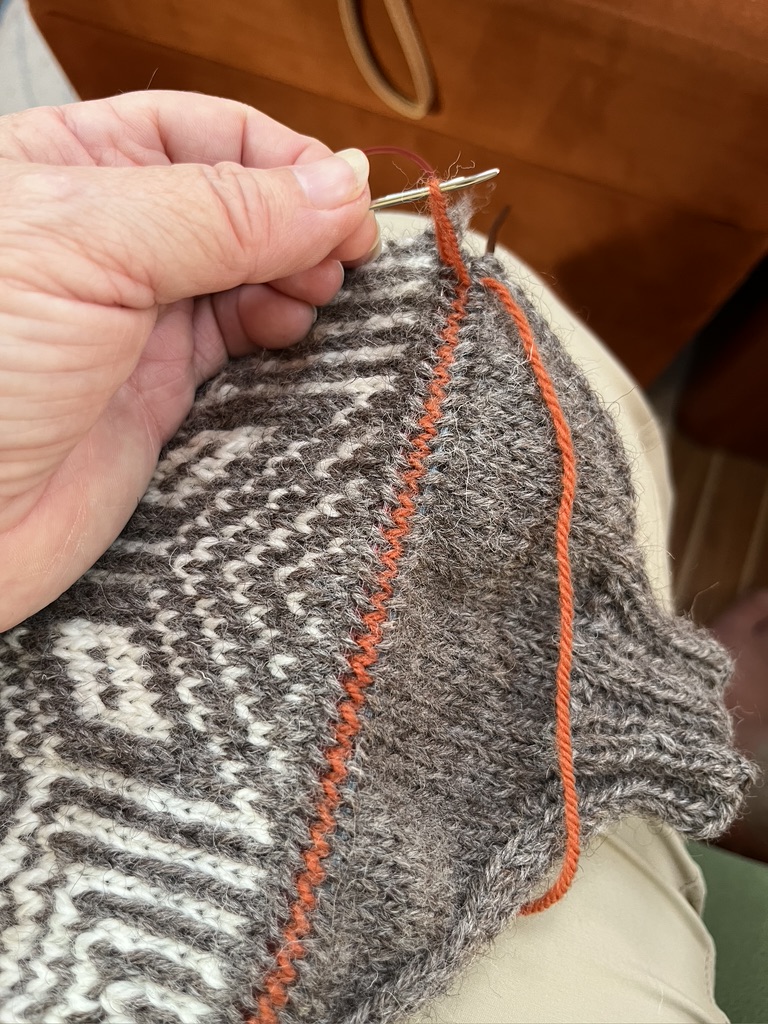
This morning I am sitting in my favorite chair knitting. There is coffee. The sun is brilliant in spite of the low temperatures. Last night we had a hard frost. Time to finish harvesting lettuce and cilantro.

I have only written blog posts in my my mind for the past couple of months. Life has been exciting and full in ways I’ve haven’t experienced before. I have dreamed of being my own person for decades, when the kids were independent, when I was not tied to Bob’s working schedule. That time seems to have arrived!

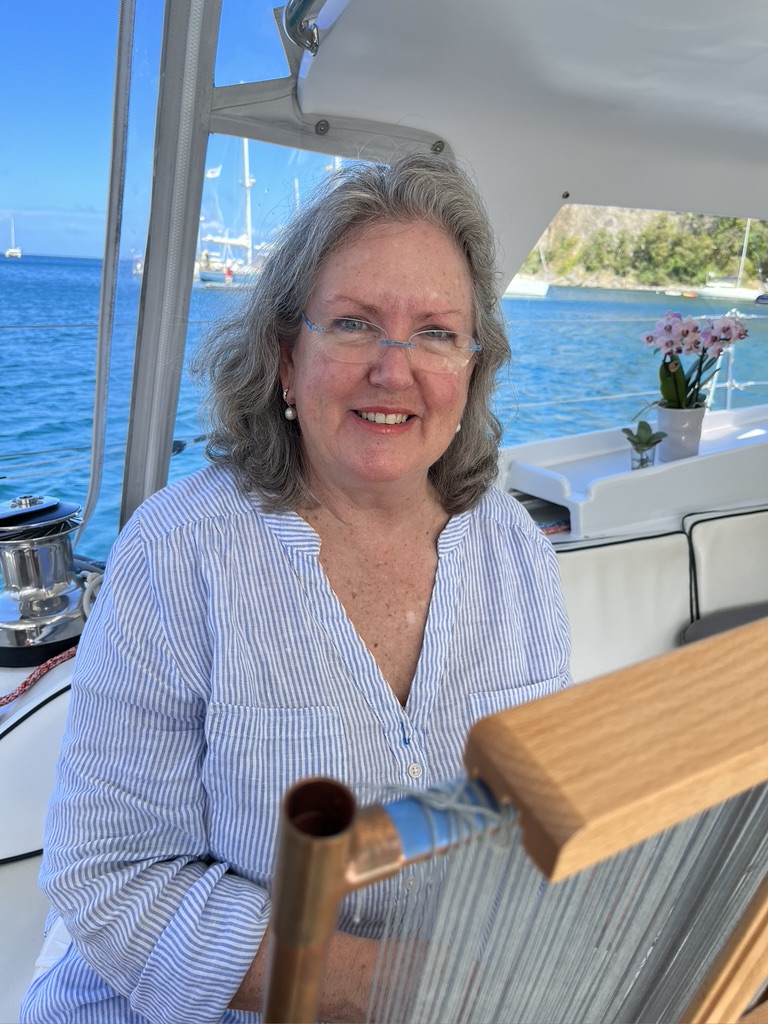
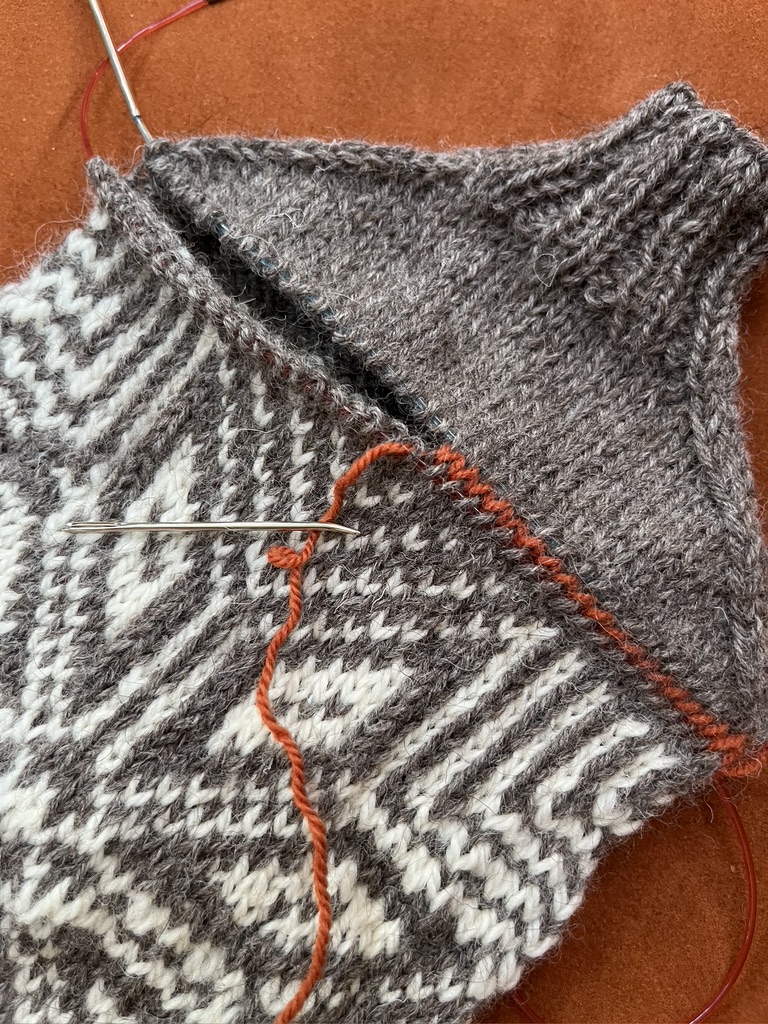
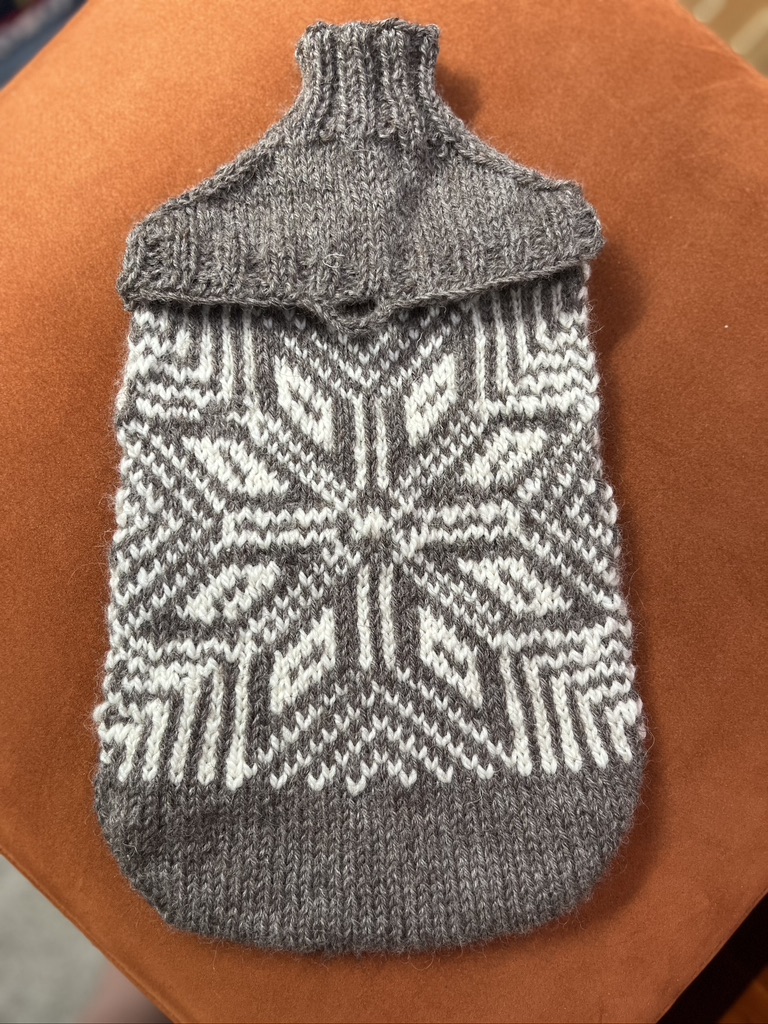
In the photo above I am working on a hot water bottle cozy. I’ve never had a hot water bottle before, but now I do. I’ve been thinking about all the people in the world who will be cold this winter, far colder than I ever am. I wonder if any of us will ever have the luxury of constant heat and endless water again. Even though I know that I still live in the incredible lap of luxury, I want to ensure that I am warm in bed at night…at least for a short while, until the water bottle cools. A hot water bottle seems just the ticket, and this cozy, designed by Kate Davies, caught my eye. I am using her yarn as well. The natural grey is “Ooskit” in colorway “Horkel.” (Don’t ask me to translate. I have no idea!) The white is “Schiehallion” in colorway “Crowdie.” You can find the cozy pattern and the yarn on Kate’s website, KDD&Co.

I’ve spent a lot of time traveling during the summer and fall, and I’ve been teaching tapestry classes and giving talks about the book I published about Archie Brennan. It’s been an exhilarating time for me. At the moment I have a few days to relax before the holiday chaos begins. It’s almost Thanksgiving and I am counting my blessings from the past two seasons.

I went to Convergence in July for the first time in what feels like a lifetime. I connected with some old friends and finally met some friends I’ve only known through the internet. I got to spend some private time with Robbie LaFleur and Katherine Buenger, and I had a wonderful sprang class with Carol James. I traveled by car all the way from Connecticut to Tennessee with an old friend, and that gave us time to catch up with all the things we’ve missed about being together since before the pandemic. It was all good!

Schiffer Publishing had a booth in the vendor’s hall, and they sold out all their copies of the book I wrote with Archie Brennan!

This is Carol James wearing one of her amazing sprang woven designs. I don’t think I’ll ever figure out how to make clothing out of sprang, but I am trying to learn these color manipulations.

I came home with a lot of ideas and inspiration from everything I saw at Convergence, and I gave a short program on it to one of my smaller weaving groups in October. It helped me keep the embers burning on my own ideas.

I drove straight to Massachusetts when I got home from Convergence, in order to take a workshop with Fiona Hutchison. Her wonderful ideas and techniques have got me going in a new direction. I have wanted to meet her, and I got way more than I expected!

I taught four tapestry classes over the summer and fall. Two of them were 8-week classes, and two were 3-day workshops. One of the workshops was the first time I have taught at someone’s house. That was a great experience, all of us being in the comfort of someone’s home which lends itself to a more personal experience for both students and teacher. It was late September, the weather was delightfully mild, and the colors in this part of Connecticut were already blazing (although not in this particular photo.). What a lovely setting to teach a class!

During one of my classes in Hartford I also hosted Katherin Weber when she gave a workshop for my guild. It was a busy time, with me leaving for my class while another house guest and good friend drove Katherin to the guild class each day. I never turn down an opportunity to host a teacher because it’s the best way to learn more about weavers and what makes them who they are. Katherin was no exception.

Some of you may remember that I have been struggling to weave paper placemats after having a successful experience weaving ‘paper towels.’ The warp for these projects have been a mix of natural and bleached linen. The weft is paper yarn from Habu. For the towels I used a pale green paper yarn that was interesting and did not break my weaving budget. When I planned the placemats I was pulled to the indigo paper yarn that was a bit dear for my comfort level. The first round did not make me happy. Remember this?

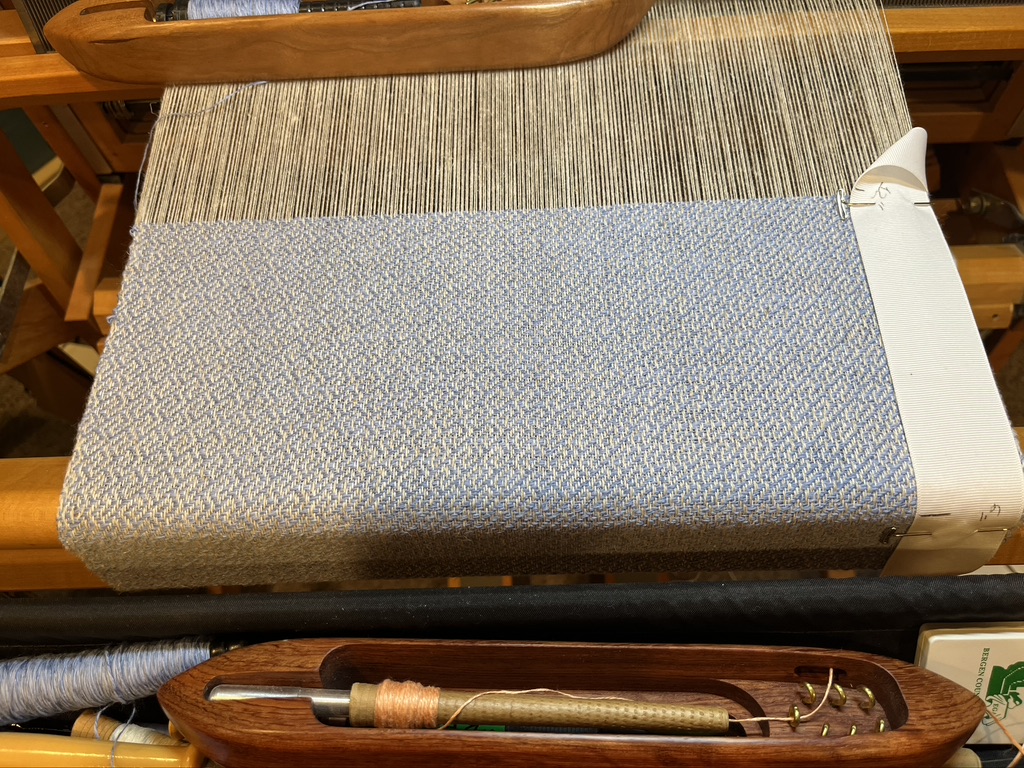
After two placemats where I could not see the Greek Key pattern unless I had just the right light and held the camera on just the right angle, I dug through my stash to find something else. I have a ton of linen yarn, and this seemed a perfect blue. In the back of my mind I wondered about dyeing the rest of the paper yarn a slightly darker blue with indigo. This is better obviously, but I was disappointed not to be using my precious indigo dyed paper yarn.

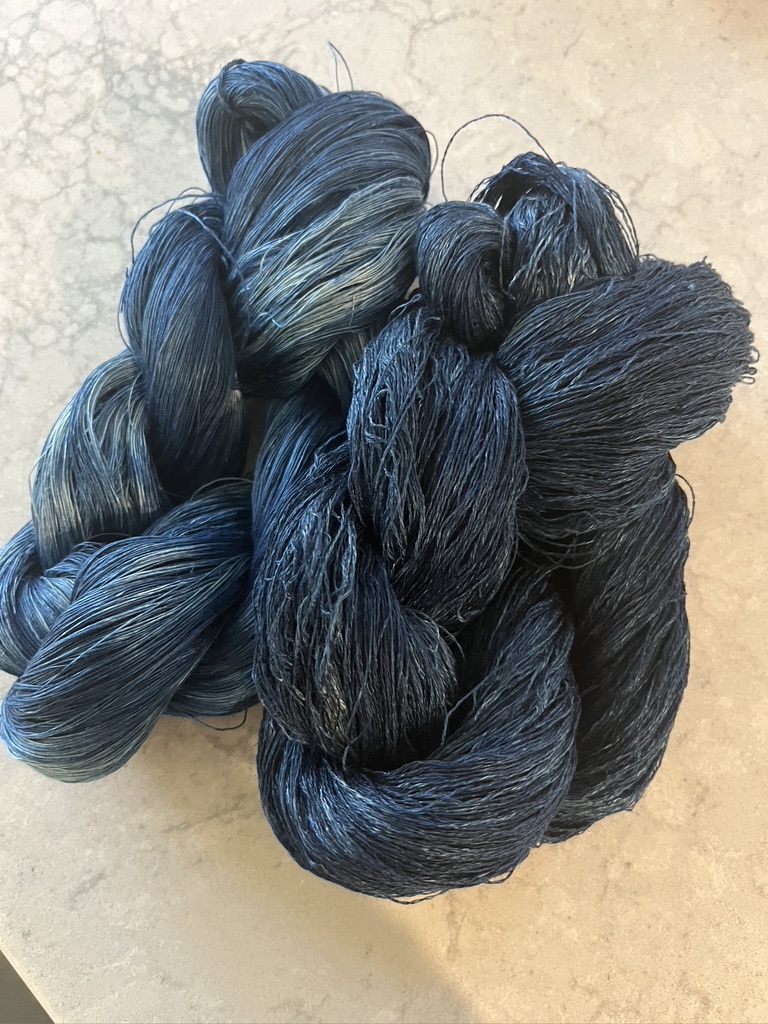
Then in October my smaller weaving group had a dye day. They used MX dyes on cellulose fibers, but they also had an indigo vat going. Yippee! I brought the remains of my paper yarn and gave the vat a try. My yarns were the first ones in the vat that day, and the color was strong. I only left the yarn in for five minutes, and I got a much deeper color than I wanted. Hey, that’s life when you’re not an experienced dyer!

And here is my third attempt at the placemats I’ve been envisioning since I wove the ‘paper towels’ over two years ago. Some things take time. At this point I had to make a new warp and tie on to the old, not my favorite exercise! They are not the color I’ve seen in my head for a long time now, but they are interesting. I love the inconsistency of the color most of all, which is traditionally called “abrash,” from Farsi, meaning “rainbow.” Sometimes you don’t get what you want, but I am happy that I got something interesting.

A lot has happened over the course of the summer and fall–half a year! I’ve had two surgeries (both successful), we have a newly renovated kitchen, I’ve taught and traveled and spent time in the gardens and with my grandchildren. Along the way I’ve done a little lace, some basketry and some knitting. It’s been a very full time, and I feel very blessed. Of course, I’d always like to have more finished projects to show for my time. Pipe dreams for sure.

Back to School and Projects

That’s rather misleading since most weavers go to ‘school’ more in the summer than the rest of the year. I went to Convergence and to a tapestry workshop in July. In August I taught a workshop. Summers are usually quite busy for weavers.

And now it’s September, so although it is technically late summer, that sense of ‘back to school’ and autumn is quite firmly in our heads. I have only two short months before I’ll be living on a boat again, and the urge to finish projects and get some new ones started (and finished!) is strong.

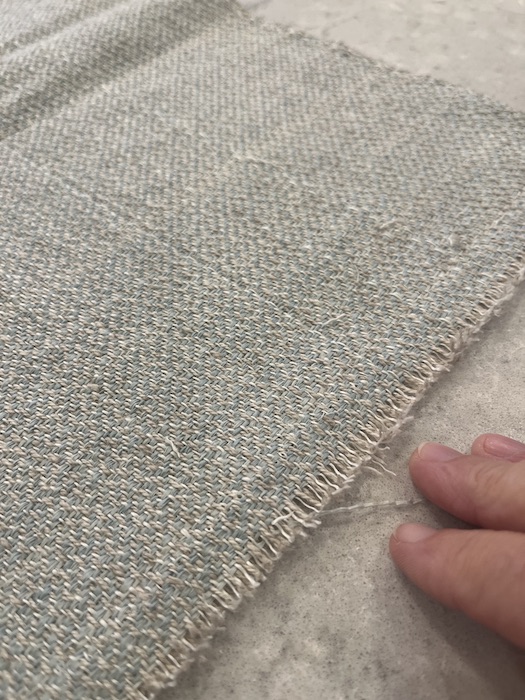
If only I’d gotten Bob involved in my loom problems earlier I would be much farther along on my fabric projects. I still have all that glorious pale indigo paper yarn from Habu that needs a mission. I resorted to a linen/cotton blend for those no-longer-paper placemats, and the pattern is showing up nicely. I’m just disappointed about them not being paper.

The weft is now Duet from Gist. The color is Chambray. It’s left over from a couple of previous projects, including napkins for our son and his partner a couple of years ago.

It’s 55% linen and 45% cotton. It works beautifully for these placemats, but I am still wishing they could be woven with paper. The important thing is that they work, and I like them! The downside is that of course I didn’t have enough weft, which was one partial cone and one full cone. Now I’m waiting for the arrival of another cone, and it’s a holiday weekend. Ugh. I ordered on the 2nd and got a message that shipping usually takes one day to my address. But as of today my order has not been ‘fulfilled.’ I guess that means it won’t go out until tomorrow, and then it won’t get here in time to meet my self imposed deadline. I hoped to take them to my small area guild meeting on Thursday for show and tell, and then I wanted to use them next week when I have two weavers staying with me. Oh, fate.

It’s lovely, right? I’m gradually coming to the conclusion that I have to tackle making my indigo kit from Maiwa because I want to use this yarn, and it needs to be just a tad darker. I can’t use this color. So I decided to dip my toes in the dyeing process by using a kit I got from Abundant Earth Fibers. They carry acid dyes rather than natural dyes, but they say their ingredients and their process for dyeing is organic and vegan. I bought two colors: sugar snap and moonbow. I decided to try sugar snap first, on some singles wool that I spun for tapestry. It was an easy project and enjoyable on a late summer morning when I was home alone. I started by wetting my wool. No need to mordant ahead of time in this process. The kit comes with a tea bag of dye and a pouch of citric acid.
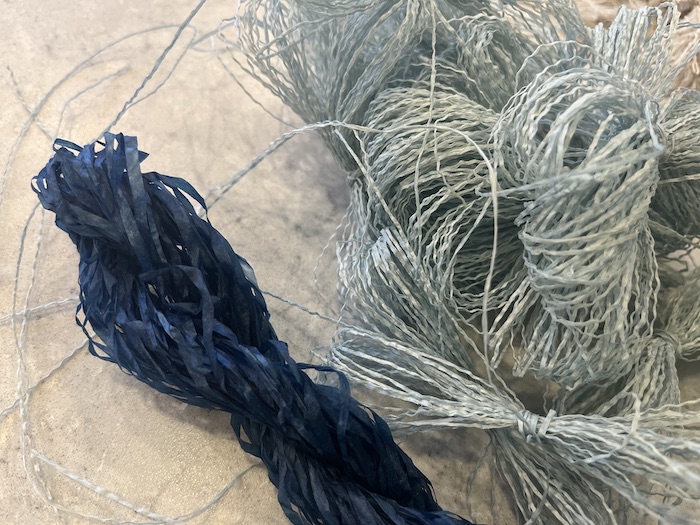
I used my pour over kettle, which has a built in thermometer, to heat water to 185 degrees F. I heated a bit higher since this kettle does not hold the 10 cups required. I poured the first overly hot water into a big measuring cup while I heated the second batch. I took a video of adding the water from my kettle to the glass jar with the tea bag of dye floating in it.

The second short video is adding the wetted wool skeins to the jar of dye. I had two 50 gram skeins to dye, and each tea bag will dye 100 grams of yarn or fabric.

Someday, if I ever get smarter, I will combine these two videos into one. I enjoyed the process! How could I not? It was simple and watching the color transfer to the yarn was magical, as always. The instructions say to add the packet of citric acid after the yarn is in the jar. Swirl things around to get the citric acid well distributed. That was quite magical because I could see the yarn bind with dye. Suddenly the water in the jar barely had color. The yarn had all of it.

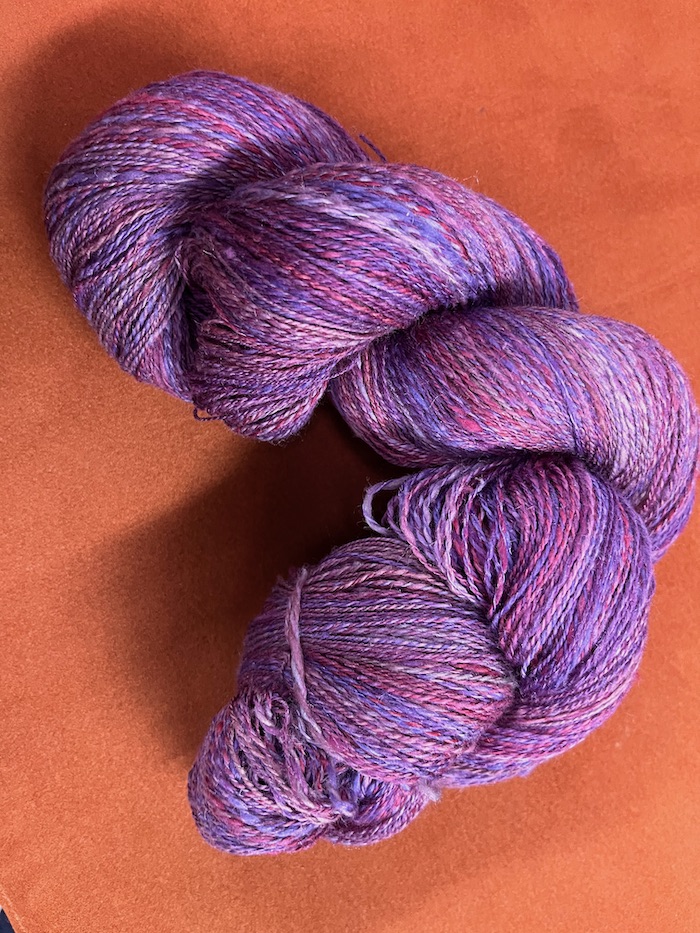
The color of the yarn is hard to show. It’s not the color of young sugar snap peas that I see in my mind. It’s almost as dark as pea soup on the first day you make it. It’s an interesting color, quite complex. Here are my attempts to capture that color.

This is closer.

I also happened to watch a video from Botanical Colors about their new easy to use alum mordant. It requires no heat and can be re-invigorated several times. You have to leave your materials in overnight since it works at room temperature. The upside is there is no trying to keep a pot at an optimal temperature, and you don’t dispose of the mordant liquid until you’ve used it a number of times, adding just a bit more alum each time. I ordered some liquid madder so I can dye something with the new alum product.

I want to ‘up’ my dye game. After I try the aluminum triformate and madder I hope to have the courage to tackle the indigo vat supplies I bought from Maiwa.

Who knows when I’ll get to do this, but I do hope it’s in September or October. After that I will be a sailor’s wife living onboard. I have quite a busy schedule this fall, all of it I am very much looking forward to doing. I am giving a short talk about Archie Brennan on Thursday this week. It will focus on his ability to find solutions. Our afternoon project will be to weave portraits on chopstick looms. This is a project near and dear to me, because all of us in the Wednesday Group were surprised when Archie presented us with little looms he’d made from all the chopsticks we’d used over the years of having Chinese take out together after our Wednesday classes. He was so very clever. We all gave our chopstick portraits to Archie, and he had planned to find a venue where they could be displayed. That never happened, and sometime before he died all our chopstick portraits came back to us. Now I want to keep that wonderful idea of Archie going. So, onward to a new batch of potential weavers.

A fellow weaver has commented on my last post with suggestions for me to consider about how make that paper weft I abandoned work. I’m excited and plan to look into that this morning. I can pursue some alternative treadlings for my Greek key twill and possibly make use of such a subtle color difference between my warp and weft. Thank you, Valerie! Meanwhile, I also want to try dyeing that yarn just a couple of shades darker.

There is a certain energy at this time of year, isn’t there? It’s the beginning of winding down to the end of the year, but it seems that most of us face that with renewed energy to make something, do something, be something. Let’s all get going!

When It Rains on My Parade

There is a drought throughout most of the East Coast (US) right now, but it’s raining buckets on my parade of projects. Ugh. I know these are supposed to educational moments, but they are still annoying!

When I returned home back in April my combby (read computerized dobby head) on my Baby Wolf malfunctioned. I assumed it had to do with the dobby head not recognizing my laptop because I have this problem often. I have a notebook for this loom with lots of little tips for what to do when things aren’t working. None of those tips worked. I figured the loom was just being cranky from disuse over the winter months when I was away. It definitely has a hard time starting to work whenever I return home from long periods elsewhere.

I tried weaving on this loom in April when I returned, then in May, then in June. I wasn’t home in July, but about 10 days ago I tried again–in August. I am not a techie type problem solver, so at long last I asked my husband to take a look. The first thing he checked was the plug. Whew! Yes, it was plugged in. Still, he didn’t think there was any electricity going to the dobby head. But I did have a little blue light on the connector to my laptop that flashed every time I depressed the treadle to advance the pattern. Bob got out his ohm meter and sure enough, the plug to the dobby head was dead. Well, huh! He said I shouldn’t have left the dobby plugged in for the winter, even though the dobby head was turned off. I’ve never considered this before.

After a search for the proper plug with the correct fitting that goes into the dobby head, he found one by asking our electronic guru, John Acord, where to buy the thing. The plug arrived and I am now weaving. I was beginning to panic because once September arrives it is a non-stop carnival ride to the moment we head south again on our boat Pandora. I have a lot projects in queue and nothing is getting accomplished!

All along I’ve had doubts about my project for new placemats that is currently on the Baby Wolf. The blue Japanese paper weft is very pale. Will the pattern actually show up in the finished cloth? It’s a Greek key sort of pattern.

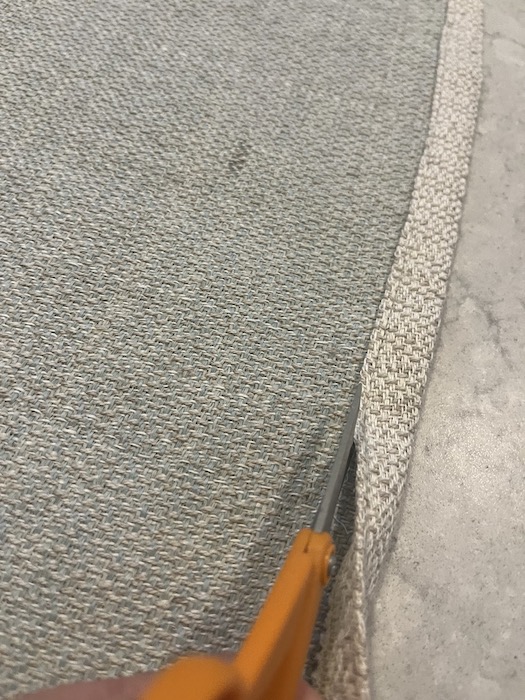
Now that my loom is working again, I wove the 2nd of six placemats and I’ve become more convinced that the pattern does not show in my choice of warp and weft. Yesterday I cut off the two placemats and serged the ends. To keep from having to retie the warp to the front cloth roller, I have woven a bit of plain and inserted a bar and more plain weave so I can just cable tie the bar with the rest of the warp back onto the cloth roller. Today I hand washed the two placemats since I didn’t have any clothes or towels to wash with it in the machine, but I did spin the placemats in the machine and then dried them in the dryer. I wanted to see the outcome of the fabric in the method that I will likely wash them in the future.

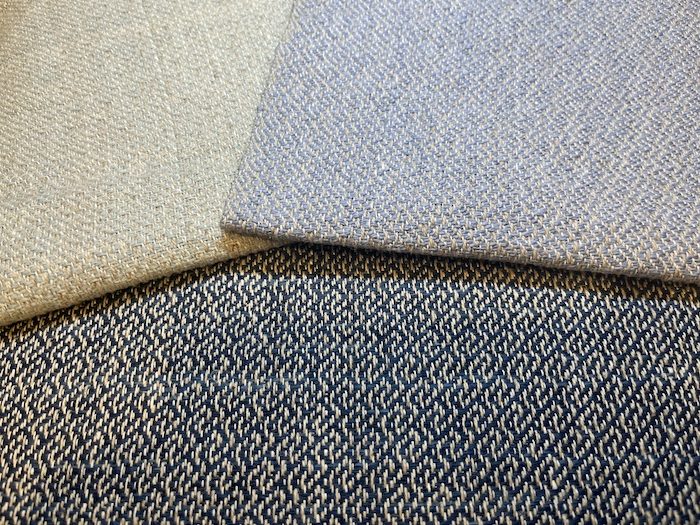
Boy, I am so disappointed that the pattern does not show up, except when viewed from a certain angle with just the right light! Ugh! I am not in love with this!

And yet the fabric is lovely–just like the Japanese paper towels I wove a couple of years ago, when Tom Knisely first tried it himself and wrote about in Handwoven Magazine.

I don’t want to weave another goose eye project, but the pattern certainly shows up on these. They wash and dry by machine wonderfully, and still have a beautiful hand after regular use for the past 18 months. So one option is to rethread the warp in this pattern and continue.

Or… I could take the rest of my Japanese yarn that is such a pale blue and dye it darker in an indigo vat. I haven’t had much success with indigo in the past, but I have an indigo ‘kit’ from Maiwa waiting for me to get the courage to try again. I could also just try to find a darker blue linen in my stash–I know I have some–but I really wanted paper placemats since I’m so happy with my ‘paper’ towels. I’m in a quandry!

Another current project that is challenging me at the moment is a garment that I’m sewing. Every year I try to make one or two sewing projects because someday I hope to have the skills to sew something to wear out of my handwoven fabrics. I’m still not there. I am seriously bummed that I still struggle to do some pretty basic garment sewing. My most obvious problem in my last few projects is attaching a bias binding to the neckline. I don’t know if I’ll live long enough to master this. So, at the moment I have painstakingly picked off the binding and am now hand sewing it in place. I may look up youtube videos to see if I can learn how to do a better job there. Fingers crossed. Whenever I make a garment I think of an upcoming event where I’d like to wear my new outfit. This time that event is on Tuesday! And now I’m hand sewing the binding along the neckline and then I have to hand sew the hem. That’s a lot for me to accomplish by tomorrow. Monday and Tuesday I cannot sew.

The pattern I’ve made is from 100 Acts of Sewing; it’s called Dress #2. I bought the pattern and the fabrics at Clementine in Rockland, Maine. What a beautiful shop! I wish I could go there more often.

The dress is done! I’m not fond of the neckline, and maybe…maybe…think I should shorten the length. Otherwise, I like the fit of this dress/tunic! I still might add the pockets in the contrasting fabric I used on the sleeves and neckline.

Oh! And I never mentioned that I finished my espadrilles. I actually wore them at Convergence in Knoxville and showed them to Suzi Ballenger who taught the technique to my local small group of weavers. She gave me a thumb’s up! I had some mishaps along the way because that’s what happens when I sew, but in the long run I now have a pair of handmade shoes! And they’re comfortable!

The ups and downs of projects. Sometimes things go well on the first try; sometimes they don’t. I don’t like rain on my parade, so I hope I’ll figure out something for my paper placemats.

Weaving Circles

Such adventures I am having this summer! The entire month of July was focused on weaving, and a lot of it was tapestry. Lucky me! I am indulging in a couple of weeks of recuperation right now, because last winter while I was far from home and missing all my weaving compatriots, I signed up for everything I could find online–and it all happened in July. Now I realize that I no longer have the energy of a 30-something so I need a bit of down time to recharge my batteries!

Yesterday I saw Rebecca Mezoff’s most recent blog post. It’s about weaving circles in tapestry. It was perfect timing for me to see since I’d just finished teaching a beginning tapestry class at the Weaving Center at Hartford Artisans, and we ended the course by weaving part of a circle. I think Rebecca’s idea would work well for weaving a small circle on just a few warp threads. In the long run I think weaving angles, curves, and circles involves a lot of attention to the turns made to create the shape. Turns that occur on low warps, ie an uncovered warp where the turn happens, will make a smoother line.

Some of these circles ‘read’ better than others, and those are the ones that had more turns on a low than on a high. Rebecca also talks about weaving a rather long straight area at the sides of a circle. This is what we Wednesday Group weavers call the ‘ears’ of the circle. If you don’t weave enough of the flat side you’ll end up with an oval when you have woven further up the circle. On the other hand, sometimes those long runs turn into something that looks like ears! Here is a close-up of the ‘ears’ on the pink circle from the photo above.

There is a lot to consider when weaving angles or curves. During my tenure in the Wednesday Group, Archie Brennan made a diagram of the process of weaving a circle for us. I now share it with my students, knowing he’d want it passed on to others. It’s complicated and takes quite a bit practice, but ultimately it’s worth putting in the practice time in spades!

The key to reading this diagram is that a minus sign before the number (-4) means how many warp threads to move over for the next pass. A positive number (+3) describes how many passes to make turning on the same warp thread before moving to the next warp for the next pass.

For beginning students this exercise serves two important purposes. This is the first time students ink on to their warps. Archie always recommended using a Sharpie pen called “Rub a Dub,” which only comes in black. That can be a bit worrisome if you are weaving with a white weft, but I’ve never had any bleeding of ink occur, althought I haven’t woven much white. Archie did use a lot of white and off-white, and that is why he recommended this particular pen. Students learned to ink on in the Gobelins manner, which is to place the warp on a flat surface to bring the warps into one plane, such as placing the portable loom on a book or a piece of wood, with the cartoon situated where needed behind the warp. The process is then to lift each warp thread individually and mark however many dots on that thread are indicated by the cartoon. Then move to the next warp thread. The technique of making the dots is to hold the pen still against a warp thread while twirling the warp thread with the other hand in order to make a small mark that encircles the warp. This way, if the warps should begin to turn during weaving you will still see a clear mark.

The second part of the exercise is to weave the partial circle that is now inked on the warp. You weave the background first, and each turn you make involves a choice of turning on a high or a low. Mostly you’ll be turning on every warp in this example, which has a warp sett of 4 epi. For the flat bottom I’d be sure to turn on a low, and if possible I’d try to move over by an even number of warps for the second turn, so it would also be on a low. That will give the flat bottom that Rebecca mentions in her post. After that I’ll mostly likely be turning on every warp thread, and as the curve gets steeper I’ll be making multiple turns on each warp thread. This is where I will want more turns on the lows than on the highs, as they build. So after a warp that I’ve chosen to weave two passes on a low, I would never weave more than two passes on the adjacent high. Once I’ve got a low that needed three passes I would then be open to weaving three passes on a high. And so on…

This is a lot of information, given quickly. There is always more than one way to accomplish something, but since I value Archie Brennan’s suggestions above most others, I wanted to share this! It does require practice! Have a go!

Summer of Weaving

Through all of July I was focused on weaving. What an extraordinary time it was! After a winter of missing weaving and all my weaving friends, I signed up for everything that crossed my path on the moments when I could be online in tropical ports. First I went to Convergence in Knoxville, Tennessee. My friend Kari and I went together by car, doing a fun bit of sightseeing along the way. We traveled via Skyline Drive and the Blue Ridge Parkway, stopping to enjoy the views along the way. We spent a day at Monticello. It was a hot one. We would have explored more if only it had been a few degrees cooler. We had some adventures along the way, such as when we were stuck on Skyline Parkway with an overheated radiator. It took about four hours to get help from AAA and get some coolant added to the engine, but during that time we met a lot of travelers who stopped to talk and offer us water and food while we waited. The world is a much friendlier place than shown on the news. But you knew that, didn’t you?

Harpers Ferry
Shenandoah National Park

We left from the Baltimore area and arrived in Knoxville four days later! Hello Convergence!

I registered for three classes–beginning sprang, a lecture on Frieda Hansen by Robbie LaFleur, and a ‘make and take’ Dorset button project with Denise Kovnat. My publisher had a booth in the vendor hall so I was asked to give a short talk there.

Although my talk was not well attended, all the copies of Archie’s book had sold by Monday morning! And the talk gave me excellent practice for an upcoming short talk and chopstick loom workshop I’ll give in early September. All good.

Here Susan Wilson (author of Weaving Crackle and More) and I are petting the Schiffer Stork–an interesting mascot since publishing a book is a bit like giving birth. The gestation period for the Archie Brennan book was more than 12 years.

The sprang class sent me down a rabbit hole I did not expect to go. I just wanted to understand it as an historical artifact and technique. Now I’d like to make things, which will involve learning and practicing–I’m sure a lot of practicing. Carol James makes such lovely clothing in this technique. In September I will start a six-week online course with her in beginning sprang. Sprang rabbit hole, here I come!

Her work in the juried show was so delicate and drape-y and elegant!

She also had work in the yardage show in which she wove the entire alphabet in sprang. It was hard to see, but here is her touchable sample.

The lecture and slide presentation that Robbie LaFleur gave on Frieda Hansen gave me more intriguing ideas to pursue! We had three hours to learn about Frieda and see many images of her tapestries, which are unique for leaving so much warp unwoven. Excuse those bright white dots. They must be a reflection from the screen.

Robbie LaFleur has done quite a bit experimenting with this technique. I thought each woven shape must have been soumaked to hold it in place, but no! Wool warp and wool weft are just clinging to each other in their inherently wooly way. Seeing actual tapestries done in this technique showed how beautifully supple the fabric can be.

Knoxville is a charming city, part of a larger area that includes Ashville, NC, and Gatlinburg, TN, that have many galleries focused on fine craft and art. Walking to Market Square was easy from the conference hotel, and there was much to see! The exhibits that were related to Convergence were “Small Expressions,” hosted by HGA; “Tiny but Mighty,” hosted by American Tapestry Alliance; “Complexities,” hosted by Complex Weavers; and a lovely show works from members of the seven weaving guilds throughout Tennessee. Kari and I spent a wonderful day touring these exhibits. I have loads of photos, but I bet you’ll see a lot of these in the upcoming issue of “Shuttle, Spindle and Dyepot.” I can’t resist a photo of Kari and me having a cool adult beverage on a very hot Knoxville afternoon!

I knew that Scottish tapestry weaver Fiona Hutchison was at Convergence, but I never bumped into her during the conference. In March I had entered a lottery to take a workshop with her just three days after Convergence ended–in Massachusetts. It was a hurdle to drive home–not to Baltimore where my friend and I started our journey–but to Connecticut! I had only 36 hours to unpack, do laundry, and gather all my materials before heading out for a 3-day workshop with Fiona at Rolling Ridge Conference Center in North Andover.

Here is our group of twelve lucky participants. Fiona is in the second row, second from the right.

Fiona’s work is so interesting! It was a challenging and inspiring three days making samples of just a few of her many techniques to bring tapestry off the grid and create such interesting fabrics.

Here are some of Fiona’s woven samples of techniques. Here she has taken one warp and woven separate small sections of differing lengths and differing numbers of warp threads. She has left the linen weft ends exposed for a textural effect. Off the loom she pulls the warps to create all these small undulations.

This is my sample of what the weaving looks like before being cut from the loom and manipulated into undulations.

Here are a number of different techniques woven by Fiona, displayed together for us to see.

Twisted warps and supplemental warps make this very interesting sample.

At various points during the day we had time to explore the grounds. We all loved the views of the reservoir.

The Center used to be a Methodist retreat center (perhaps it still is), and there is a chapel at the water’s edge. The workshop was a magical three days of hard work and terrific inspiration, with good food and a picturesque location thrown in for good measure.

Back at home, exhausted from so much artistic exposure, I had only a few days to get ready for my own class on beginning tapestry. I had eight students who stuck with me on the roller coaster ride to learn some fiddly techniques that I call a ” tapestry weaver’s toolkit.” We focused on opposing sheds, making lots of small shapes and adjusting the tension at those little selvedges, then headed into angles, curves, and circles. The students worked hard to get all that info in three long days. On the last day we had a tour of the historic mill where Hartford Artisans has class space full of light and beautiful views out the huge mill windows in Manchester. It’s a room full of floor looms with a great view!

As I’ve been writing this I have received an update from Robbie Lafleur about our Frida Hansen class. She calls it ‘Borders and Edges.’ I’m off to read that and learn more. It’s been a whirlwind, especially during July, but I’m living the experiences I dreamed about last winter!

Scroll to Top