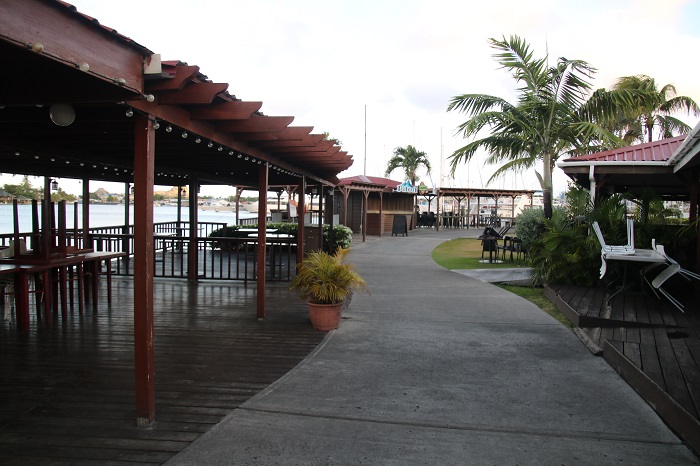
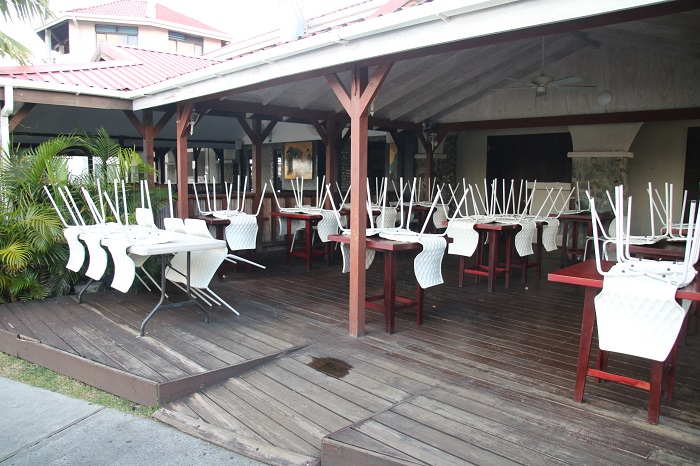
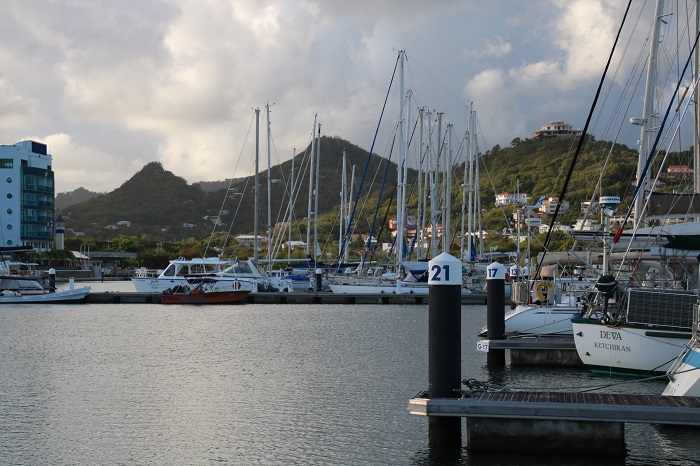
There are new restrictions here in Antigua that took effect at midnight. There is a 24 hour curfew every day, and anyone seen outside will be arrested and fined. For boaters, who now cannot go ashore, there is an added confinement. We are not allowed to get in our dinghies. We must stay confined on our boats. This large harbor has become truly silent this morning.
Recently I read an article in the NY Times about getting at least 4,000 steps a day during this mandatory confinement time in the US. I am feeling quite antsy from this new restriction, so I decided to count the steps from the cockpit of Pandora which is at the back of our boat, to the bow. 22 steps. That is 44 steps round trip. I also thought I should count the steps from the bottom of our companionway stairs to the bow, which is our living space down below. 11 steps. I’ve never counted this before, so even when I’ve complained about how small living on a boat is, I didn’t actually know that Bob and I live in a space that I can walk in just 11 steps. Bob would do it in less than 11.
That means in order to get 4,000 steps in a day, I would have to make 100 revolutions around the deck of the boat. I guess I’d get an added benefit for the deep squat and twist I’d have to maneuver to get under the Hoyt boom up on the bow. I’m feeling rather depressed about this today, but I better suck it up because I can’t do anything about it. This is my new confinement. I can also swim around the boat when it’s not overly windy.
I may try to use the dining table as a barre for doing stretches. Meanwhile, our world is already so small that I don’t know I will maintain sanity. The hard part is feeling so unwanted. I know these island nations are trying to deal with us, but it is clear that they wish we would go away. I wish we could go away too. It’s natural to want the safety of our own country, and own own houses, during these trying times. I don’t disagree with all the islands’ needs to keep us in containment. Look at the containment going on in the US with immigrants. I agree that the islands’ first concern should be for their own citizens.
What I fear is that at some point these islands will kick out the cruisers. If we are evicted there is no other island to take us. They’ve all closed their borders. I still think about the French war ship that chased us away from the coast of Guadeloupe. Of our 2,000 mile trip home, we have only covered 250 miles. We are unwanted here, and other boaters are unwanted in the islands where they are sheltering. I regret that we are putting a burden on these islands. If we could get home I’d be happy to oblige. The North Atlantic will not be safe for sailing until May. We have to stay someplace for the next month, and I just hope that other cruisers will carefully abide by the new rules so we all don’t get evicted. I don’t have a lot faith in that because I’ve already heard so much grumbling about how unfair this situation is. Well, it’s unfair for everyone, isn’t it?
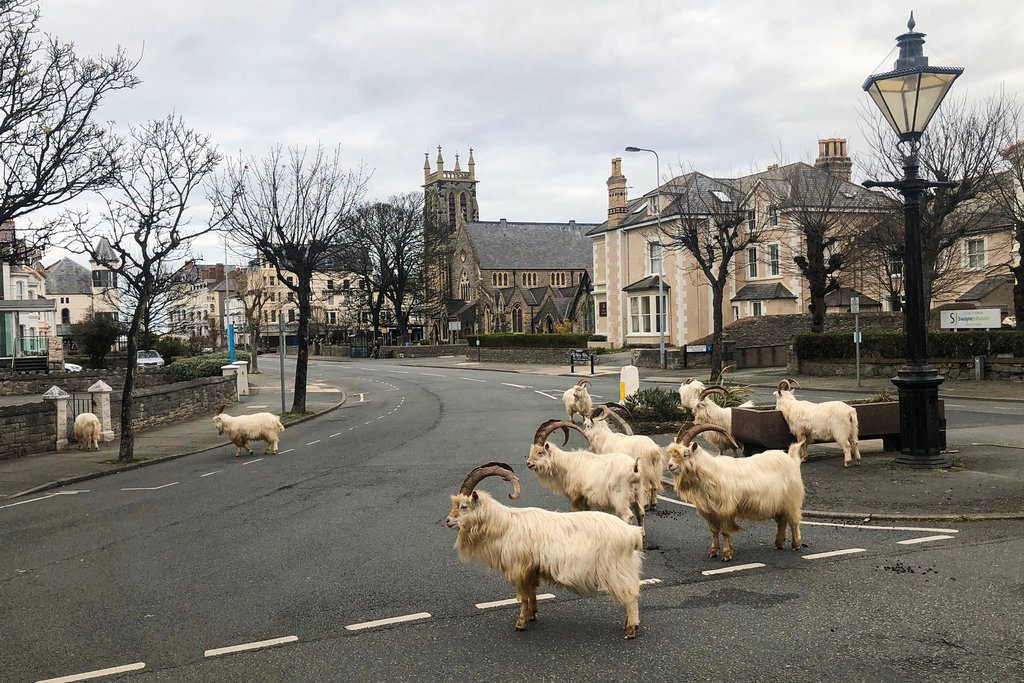
Yet, what’s a blog post without an image? I found a great one today in the New York Times. As people all over the world are confined at home, animals that normally don’t mingle with humans are checking out the empty streets of cities and towns. These are cashmere goats exploring a town in Wales. Here’s the article.
It’s a sparkling, calm morning. Time for a swim before I face this first day of confinement in a space that really is the size of a prison cell.
While I’ve been pining for home the past few weeks, friends and acquaintances have sent me such encouragement and sympathy! How can I ever thank all of you? I promise to try to uplift you, should you ever need it, as much as you have cheered me during this time.
In spite of the fact that nothing has changed in our situation, being cast offs in strange lands, not permitted ashore in some of the islands, actually being chased away from an island by a French war ship when we had no intention of stopping there, for the moment I feel calm. A line from Van Morrison comes to mind: “People are strange when you’re a stranger.” Bob and I now often feel alone in strange lands.
But all things have an ‘upside,’ and I need to find it. The scenery is beautiful (if only the wind would stop howling!). Some of my ‘home’ friends have written to tell me they are enjoying how quiet things are now that planes are not flying overhead and cars and trucks are not constantly rumbling by their houses. One friend lives near Bradley airport outside of Hartford, and she said there are no contrails in the sky now….just clear blue skies. I woke to a stunning silence this morning. The wind had finally stopped. Pandora was no longer straining and rocking at her anchor, and the silence was so therapeutic. On Sunday I sent a text to the boat next to us at anchor: “Someone PLEASE turn off the wind!” She wrote back wishing the same!
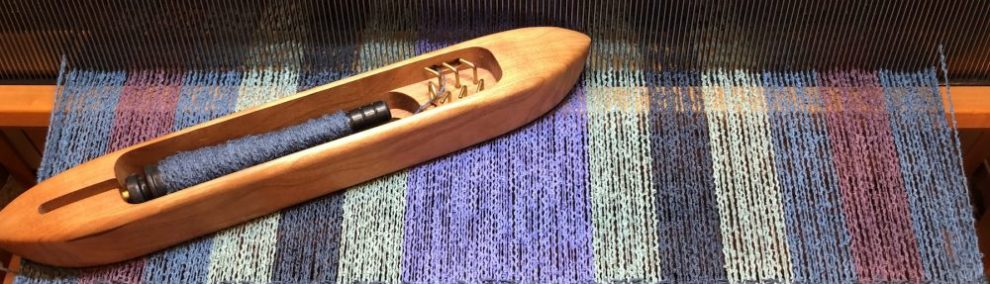
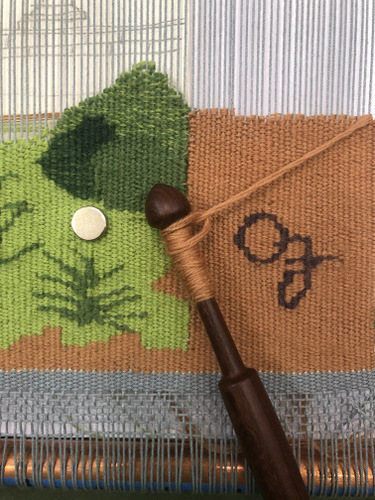
So, in the new calm, I have gotten out my copper pipe loom. I’m working on the frustrating stone pillar from Nelson’s Dockyard, and although it’s not great, I am content with it. I will continue. Sometimes (well, many times) I have to realize that it’s not about making the perfect image, the image I have in my head; it’s about trying different ideas to convey an image and learning what I can from from the endeavor of making. I can at least admit that I learned something about depicting stone columns at 12 epi, with no good options of weft yarn!
I’m starting to make peace with not making a plan for getting home. This is a big hurdle for both of us, and I’m probably less ‘at peace’ with it than Bob is, possibly because he could live this rather hard, inconvenient life forever. I can’t wait to get back to all my modern conveniences! But in the meantime, I am lurchingly accepting my lot here.
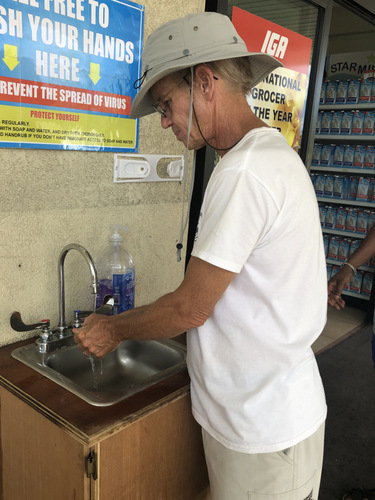
On our last trip ashore, to one of the only American-style stores anywhere down here (it happens to be Jolly Harbou, Antigua), two wash basins had been installed at the entrance. Only in a tropical setting.
Some old phrases that I’ve heard almost all my life have cropped into my thoughts over the past few days.
If you want to make God laugh, tell him about your plans. Boy, that’s been my biggest problem over the past month. Whenever March 1st rolls around I start making plans about what I’ll do when I get home. I start placing online orders to greet me at my door on my return to my favorite place in the whole world–my little cottage near a river in a quaint New England town. Do I sound homesick? Well, anyway, I’ve given God a good laugh over the past few weeks. Ouch.
These are the two sayings about being seasick that I’ve heard since I first got sick as a kid.
The best cure for seasickness is sitting under an apple tree. Oh, I’d love to try that remedy right now. I’ll take any tree; I am not particular!
Seasickness: At first you fear you might die of it, then you’re afraid you won’t. Absolutely true!
There are so many sayings about sailing, but this one was an eye opener for me. Living onboard is like being sentenced to a jail cell, with the added possibility of drowning. Of course the scenery is way better, but the longer I’m onboard the more I begin to feel imprisoned. This year’s sentence will be harshly long.
This is how my thoughts are running this week. Anything repeated often enough becomes the new habit, the new normal. It’s boat life for me right now, and I have no idea when it will end. The islands all around us have closed, so we can’t leave, but we are here; we are a allowed to stay here as long as we isolate and follow the restrictions. When we run out of provisions, I have to believe these island nations will not let people starve in their harbors. Nothing is black and white; I’ve always believed this. Somehow lately, I’ve only been able to see in sharp contrasts. I need to find myself again.
I’ve been following the “Daily Respite” of a well known knitting designer, Clara Parkes for the past week. She has contributed to my lighter mood. Today’s respite from Clara is a quote from CS Lewis: “The future is something which everyone reaches at the rate of sixty minutes an hour, whatever he does, whoever he is.”
Isn’t time strange? It passes quickly when you are engaged in something you love, but in actuality the future comes to all of us at the same rate. How many times has 10 minutes felt like an hour when I’m doing something I don’t want to do–like standing watch in the middle of the night (admittedly I don’t do this as much as I should. Poor Bob)? And how often do entire days fly by in a fleeting breath when I’m weaving? Time seems torturous right now because many of the things I love are not available. But there are still 60 minutes in an hour and 24 hours in a day. The future is coming. In about two months, at most, I will hopefully be home, doing what I love. I just have to get through this time first, while trying not to make definite plans. Ha!
Lastly, I followed a trail to a wonderful poem through a link in my inbox over the weekend. I get a monthly newsletter from a Scottish woman named Kate Davies who writes poetry and designs knitwear and publishes books. The words in this poem are so compelling. I can see in my mind a beautiful image from these words. I’d like to weave it. Someday. No definite plans.
Stones cast on the tide of songs long before ours. In speaking, we’ll turn them smooth in our mouths.
Thank you, wonderful friends, for all the encouragement!
Not a photographic collage, although that would speak a thousand words. This will be a collage of the stories I’ve heard over the past two weeks, as things have changed on a daily basis, sometimes on an hourly basis.
Deserted Rodney Bay Marina on Wednesday, the day we left. The Customs Office was closed so we could not clear out of the country. Even the marina was closed so we left without a bill for their services. They promised to email the bill, which we now have.
When we got up on Wednesday morning, planning to sail to the USVI, things had changed enough overnight for us to reconsider that plan. We decided rather last minute that it might be better to stay in St. Lucia another few days or week to let things ‘finish’ playing out in this scenario. By noon, things changed enough for us to feel that we’d better get on our way to Antigua, not the USVI.
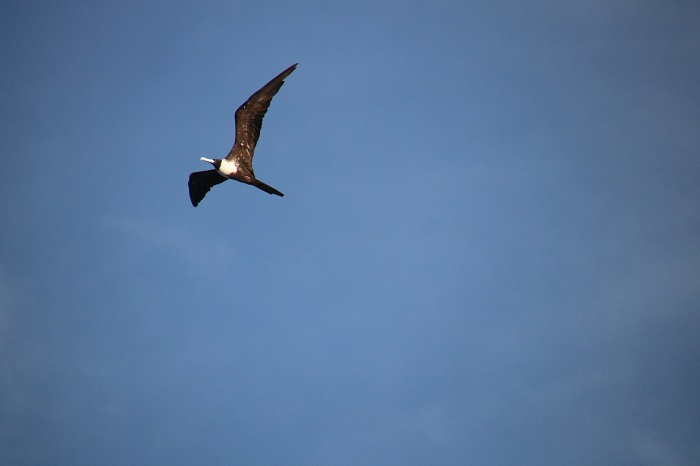
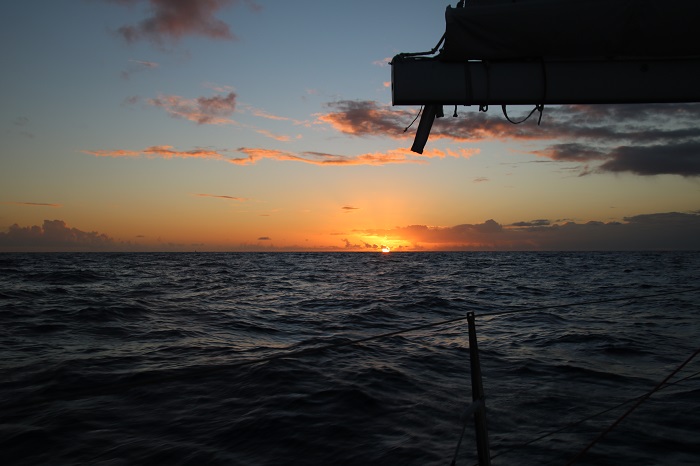
Sights along the way. Lots of frigate birds, always soaring above us.Sunsets on passage.
Antigua was going to shut down in some form, by midnight Friday. Today is Friday, and we cleared into Antigua this morning. We sailed through the night both Wednesday and Thursday to get here. We haven’t heard definitely if the island will close its borders tonight, we haven’t heard for certain whether enforced quarantines will begin to take place. All we know is what happened to us. We were cleared in this morning without quarantine.
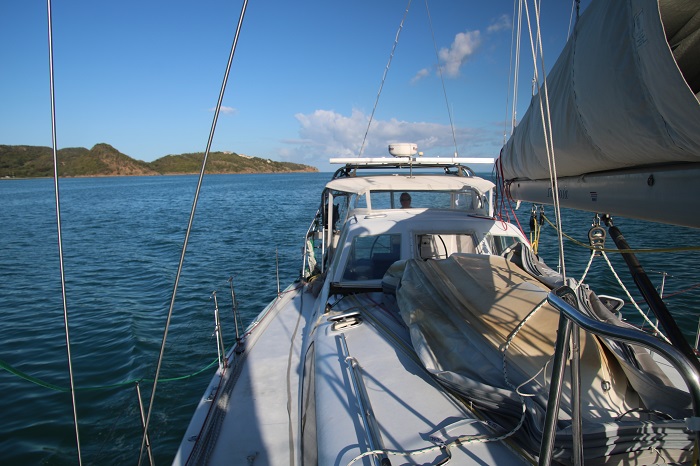
Bob took this photo from the bow. I am steering us Pandora into St. John Harbour, where we will clear in to Antigua.
Although the exact details of what restrictions each island is enforcing right now is often inaccurate, here are some of the real stories, both heartbreaking and inspirational. These are my friends and acquaintances, so I am not going to use their names.
One of our good friends got Dengue fever while we were all together this winter. She was probably bitten in Guadaloupe, but her symptoms became obvious once we’d all sailed to Domenica, the island with the least services. She was sick for a month, anchored in Portsmouth Harbor, Dominica. It was scary to watch her go through this without medical attention. I don’t know if she could have been helped. She did not feel normal again for 6 weeks. By that time, the covid 19 virus was spreading down here, and she was in a compromised state due to being so sick already. She and her husband made plans to get to Grenada as soon as possible, hopefully before those borders closed. They have yearly storage for their boat there so they would have gone there at the end of the season anyway. They cleared in to Grenada on the last day Grenada was open with no restrictions. They moved their haul-out and storage date up so they could close things down and get a flight back to the US. The boat came out of the water on Monday, a week ago, but their Friday flight home was canceled. After a few scary days wondering what to do, almost putting their boat back in the water to sail home, they were able to get a flight to Toronto this week (possibly today). They got a second flight into the US from there. When they arrived at the airport in Grenada today, they learned their flight from Toronto to somewhere in the US had been canceled. The last I heard was that they found a flight to get back in the US. I don’t know where and I don’t know how long they will be in Toronto before getting that flight. I’m relieved they will soon be home, and I hope that they are able to stay well during all this travel. I hope I hear they are safely home (mandatory quarantine) by the end of the weekend.
This is the most heartbreaking story I’ve heard. One of the men who had done the fall rally to Antigua with Bob has gotten into quite a desperate situation. At some point after the rally, the man’s wife flew home, and he has been single-handing their boat for the winter. His last port was St. Martin, where he began to feel quite ill. As of a few days ago, he realized he had become to ill to take care of himself. Either he contacted authorities on shore, or nearby boaters made the contact for him. The authorities came to get him off his boat in Simpson Bay, St. Martin. After checking his symptoms he was found to be quite sick with Covid 19, so he was air lifted to a hospital in Guadeloupe. Why Guadeloupe? Most likely because St. Martin could only send him somewhere French. His wife was on her way to meet him in Guadeloupe, but once there, the doctors found that his condition was critical, and he has now been air lifted to Florida, followed by his wife, who now also has the virus. He is in a Miami hospital, in ICU. This is a story so sad, it’s hard to get my head around it. How tragic that both of them were so far apart, and he was so far from home. Maybe we’ll get the amazing news that both of them recovered, but deep down I fear it all played out too late.
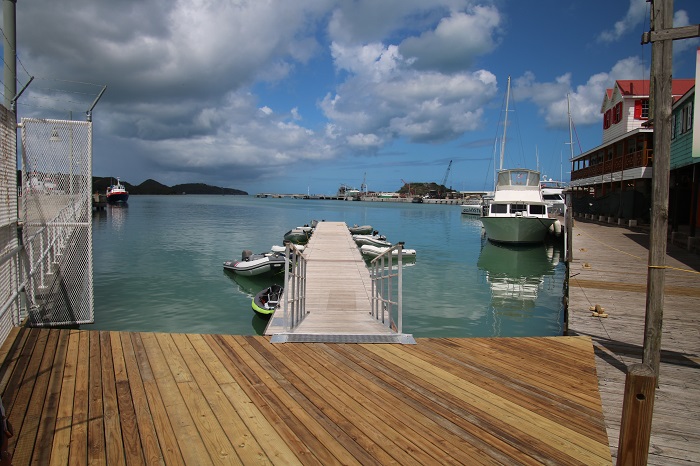
Today at the immigration office in St. John, Antigua, we listened to the stories of others who were attempting to find shelter here. First, I want to note that the Antiguans did a terrific job of making us all as safe as I can imagine being outside of a hospital. We arrived just after Immigration and Customs had opened, so there were already a few people going through the process. The government has installed a new floating dock and ramp for people on private boats to land their dinghies. The ramp leads straight to the immigration building, and access to the rest of the city is roped off. Guards greet you at the ramp to tell you how to proceed.
As each of us arrived, we washed our hands with real water and soap, in a large basin with faucet. After that we got in line, 6 ft. apart from strangers. Captains and crew were kept together and entered the building for the medical check. Bob and I did that together. The table where we sat was sanitized between each visitor or group. The nurses who checked us wore full disposable gowns, masks and gloves. Even the pen we used to fill out the forms had been sanitized between uses. The only thing that the customs official touched that was not sanitized was our actual paperwork. Once this was finished, I was sent to a large waiting area, or I could wait outside, while Bob went into the office to clear in. The officials at both immigration and customs were behind glass walls. At one point I was asked to join Bob because he was having trouble hearing the questions through the glass partitions. The problem was that we did not have proper paperwork for exiting St. Lucia, which we knew. The customs office in St. Lucia was closed indefinitely when we left, and we were told that a copy of our marina bill which showed when we checked in and when we left should be good enough. In the long run it was. The official behind glass just wanted me to write a handwritten statement to the Controller of Customs about why we did not have the proper paperwork. About half an hour later, we were done with the process ( 2 hours in total) and were cleared into Antigua with no quarantine. I think the mandatory quarantine for boaters will start tomorrow.
During the clearing in process, the only problems I heard were from people who had been in any of the French islands during the last 2 weeks. Our last visits to both Guadeloupe and Martinique had taken place more than a month ago. What luck. I think I will always wonder about the Carnivale in Fort de France. The virus was already there then, but no one was aware. We spent days in the biggest crowds I’ve been in since my young adulthood. Still, I found myself listening intently to the others who were not so lucky. The saddest story I heard was from a family who was just sailing into St. John Harbour shortly after we did. There was a man onboard with his wife and two young children. They had spent a few weeks in St. Martin and were now bringing their boat to Antigua for it to be shipped back to Europe on a ship. The last I heard he was being denied entry. But I had the sense that the process was not yet final. He was describing his situation that the boat would get put on a ship, and he and his family would fly home. He was offering to quarantine his family on the boat until the day the boat would be shipped. Atlhough the official kept saying no, she also continued to listen to his plight and his offers to make this sitaution work. I do not know the outcome, but I hope it worked out for that family.
Also during our time in immigration process, I heard a young couple beginning their paperwork after the medical check. They were both from Italy. I have no idea if they had already been sailing in the islands for months, rather than just arriving from Italy. Perhaps they were just stating their nationality. Like us, as US citizens, we would not be allowed in directly from the US, but we were admitted since we’ve been down here for the whole winter. I hope all went well for them. I couldn’t help but wonder about their families and friends in Italy.
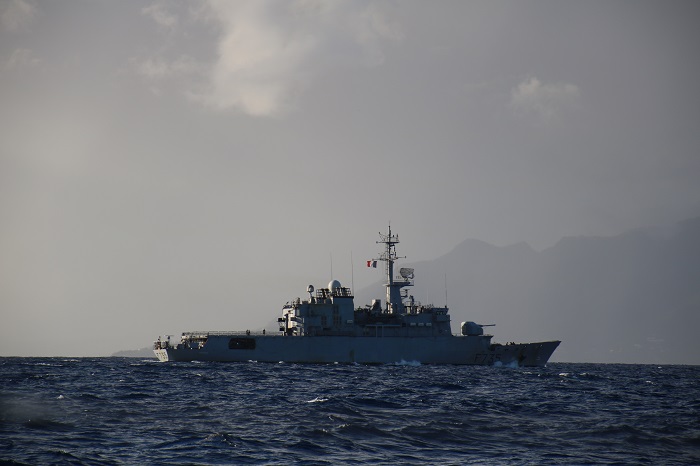
While making plans to sail north we had heard that not only was Guadeloupe closed but that they were policing the harbors to make sure that no vessels tried to shelter there. We’d heard that vessels on passage should not get closer than 12 to 15 miles offshore. We presumed this was hype, but in fact we experienced it last night. As we approached the southern end of Guadeloupe, heading north, we saw a French war vessel. Bob thinks it was a frigate. Slowly it began heading toward us, and night was falling. We had our AIS turned on, and I was hoping they would call us on the VHF radio if they wanted to shoo us away or ask our intentions. But there was no communication from them, and they just kept getting closer. My fear was growing. I did not want this ship to come close and blast a horn at us and threaten us over a loudspeaker. It was almost fully dark, and I knew I’d freak out to have a ship screaming at us with a bullhorn in the dark. So Bob called them. He told them we were passing through on our way to Antigua, that we had no intention of entering a harbor on Guadeloupe. Yes, they wanted us to move further offshore. They told us to cross their stern. We did, and promptly. It was a tense moment for me.
The French war ship that was stalking us. It’s info was not on AIS so we don’t know the name of this ship.
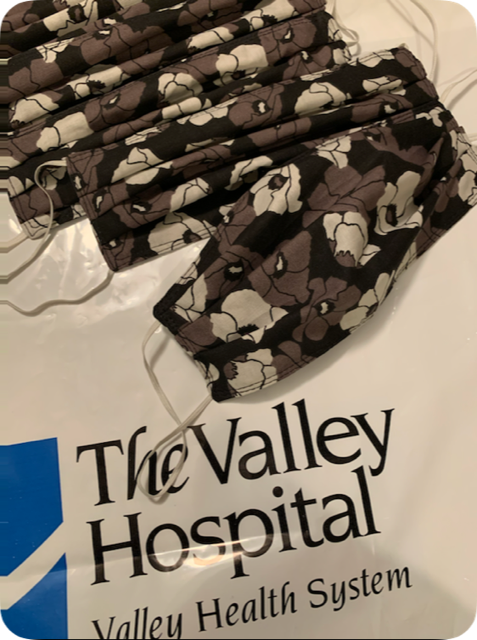
At home I am hearing stories of friends making masks for local hospitals. One of my friends said the local New Jersey hospital was giving out kits complete with everything needed to make the masks. Others in Connecticut and Rhode Island are supplying their own materials. One of my friends could not find 1/4″ elastic anywhere and had found that she could substitute cut t-shirt fabric for the elastic bands. Ingenious!
The sweetest story I’ve heard is from home. One of my friends has a granddaughter who turned seven this week. She cannot have a party. She cannot even see her local grandparents. What a sad memory this birthday would be. But her local friends made a plan to give her birthday parade! They drove by in cars, some of them decorated with birthday wishes for her, and she stood in her driveway to watch all these friends remember her special day. Even the police and the firemen made an appearance for her! I wonder if this will the best birthday of her whole childhood! What a terrific community!
Bob and I are feeling a bit lost. We’ve made it to Antigua, which suddenly looked like the place to be in order to keep our options open. But what are our options? It’s too soon to know, and things everywhere are changing too rapidly. We would like to get to the USVI. We’d be on US soil there, maybe we can get some money because we are almost out. Today they would only take Eastern Caribbean cash from us, and we are almost out of all currency. In the USVI I have an absurd dream that Bob’s crew might be able to get down there and allow me to fly home. I am trying to wean myself off this pipe dream, but I haven’t quite given up. Our 2-overnight sail to Antigua was about as calm as these waters ever get, and yet I was miserably seasick for most of the 48 hours. I’ve been sailing for a bit over 45 years. I am not going to miraculous get over this just because I have long journey ahead. Meanwhile, the harbors in the USVI are over crowded at the moment and there is mandatory quarantine. I don’t mind the quarantine; we had begun doing that in St. Lucia and will definitely do it here. Although I’m not anywhere near home, I am now on the crazy emotional ride of trying to get home. I don’t want anything to stand between me and home now.
In a short while we will have a phone call cocktail hour with a dear friend from NY who is currently living in the midwest. I think he is in a much safer place in the midwest, and I am thankful for that. We’ll have a nice chat. Almost every day we speak to both our boys and their families, and most of the time it is by video chat. Sometimes there’s a lot of dropped calls during the process. At home this would be frustrating, but here it’s the best connectivity we’ve ever had. These islands have upped their game in connectivity. This would be unbearable if we could not talk to our family. Bob’s mother is in a nursing home in Connecticut, and the staff call us now and then to update us. The facility has been closed to outsiders for almost a month, so we would not see Mom, even if we were home. They’ve made an extra effort to help her have phone calls with us. She had an ‘episode’ this week, but it had nothing to do with the virus. We hope to get to see her by sometime this summer.
So this is our diaspora. It’s not like war, and we are not starving or lacking for any necessities. We just miss home and friends and family. A LOT. I don’t know how we’ll get home, or when. We rely on foreign governments for shelter in their countries, and I hope to allow me to get a flight home. I can’t even imagine what people in less fortunate situations are feeling because I’m rather fragile just wishing I could get back to my ‘land’ life. I hope all our water friends make it to their own safe harbors. Many of our friends live onboard year round, and they need to get to safe harbors out of the hurricane zone during the next two months. At the moment the safe harbors where they need to be are closed. I want everyone to be safe and well. It’s what all of us want for our family and friends. It’s a lot to ask, and we won’t all get it. All we can do is take care of those we can. All we can do is ‘go with the flow’–something I could be better at doing. Good luck wherever you are and whatever you are going through with your loved ones.
The best made plans… We were set to leave St. Lucia today to anchor in the outer harbor, and in the pre-dawn tomorrow begin our journey to the US Virgin Islands, where we would shelter until there was a plan for sailing back to somewhere on the East Coast of the US. Things are changing faster than I can keep up with, especially emotionally.
This morning Bob found the customs and immigration office closed. He came across a customs officer while walking and asked what we should do to check out of St. Lucia; the officer said, ‘just leave.’ Wow. Not getting officially cleared out of a country can make checking into the next country problematic, even impossible. We had considered stopping in Antigua on our way to the USVI, but that is the very place that would not look kindly on us leaving St. Lucia without checking out. These are unprecedented times, and maybe rules will be bent. It’s a long way to sail without knowing if we’d be allowed to shelter in Antigua.
Two other factors have come to light: the Bahamas is now closed, so our “Plan A” of sailing through those islands, which would afford me a chance to stop at night, is now off the the plate. Worse news is that the USVI may close tomorrow. We’ll have to wait and see. Perhaps it was a godsend that we could not check out of St. Lucia this morning. So…. we wait and see. Our weather router wasn’t too enthusiastic about the weather for the next four of five days either. The first two days would be would be fine, but after that we would have what he calls good weather for ‘salty’ sailors. He knows me well enough to know that I would be miserable. Bob called him with me in mind. So perhaps this is all working out in a way that will give me a better trip and better timing for getting back to the US. Who knows? If only we could tell the future. I feel displaced.
The marina where we are docked is closed. When we inquired about paying our bill and leaving, one of the few dock masters on duty said that they would have to send us a bill when the marina reopens–no clue when that will be. So far we still have electricity and fresh water. That is a big blessing. We cannot make our own fresh water in this harbor because the harbor water is too dirty. We could likely make our own electricity as our dock space gets full sun most of the day to fuel our solar panels.
Over the past few days I have turned my attention back to a small tapestry I intended to weave during this winter away. I got a good start in January, and then let too many ‘conditions’ drain my excitement through all of February and most of March. I don’t like the yarns I brought. Why didn’t I bring cottons? When I weave I enjoy it, but most days I talk myself out of weaving because I don’t like my constrictions. Why didn’t I bring more choices of grey? Well, because I didn’t know I’d want to weave the pillars in Nelson’s Dockyard, that’s why! I am so weary of the little voice in my head.
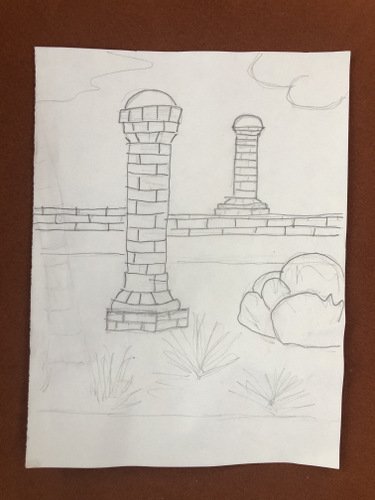
Here’s the sketch I made back in early January. The Pillars are a significant landmark in English Harbor. They were part of a sail loft during Lord Nelson’s command of Antigua. The two rows of pillars, about a dozen in total, supported a wooden sail loft that has not survived the centuries. While in English Harbour, a ship’s sails could be lowered into a smaller boat, such as a gig. The gig would be rowed into the channel between the two rows of pillars, and a derrick would lift the sails up into the sail loft through a large hole in the floor.
As of a couple of days ago, I am weaving again. Once I finish the little image of the pillars, I have entirely new ideas for the rest of this woven diary. It’s been a memorable winter, so now there are more ideas than I ever imagined.
Every year as my departure date for home approaches I begin planning my spring and summer activities, mostly centered around weaving. This year I signed up for a long weekend workshop in Vermont with Rebecca Mezoff. The workshop was to be on designing for tapestry. Did you catch that verb tense?–was. Yes, it’s been canceled. The tapestry class I teach at a craft school in Connecticut has been canceled. As you well know, everything is canceled indefinitely. On the bright side, I learned that Rebecca offers that design class online. I’ve thought about the pros and cons for me. The pros are all obvious, having to do with learning. The cons are these: I’d need access to the internet. I would not have that at any point when we are making passages, but I might have it in certain harbors. I have no extra loom here to do any weaving exercises that might be required. I don’t have a lot of design tools with me, such as a color wheel, colored pencils or pens, tracing paper; all these are at home. I only have one pencil and a small sketchbook. Still, this morning I felt certain there would plenty of good ideas in this course, and I felt the contact with with other weavers just might save my sanity. I signed up this morning and have done the introduction and the first module of the lessons. The community of weavers is just what I needed. I feel slightly less displaced.
Now I’m ready to get back to my own little Caribbean diary piece-in-progress. I did some UNweaving yesterday, tried something new, didn’t like it. I’m not showing the trouble I’m having with those pillars! Too embarrassing! I am also going to re-work the dark green area as well as the columns. About the only thing I’m happy with at this point, is my maker’s mark! That’s rather sad, but now I have some enthusiasm, and that is more than half the battle going in my favor. Today I will unweave the bit I reworked yesterday, along with that deplorable green shrub. (I’m cringing a bit that I’ve even let you see it, so please don’t judge! It’s got to get better on the next attempt!) Hopefully, after the unweaving I’ll make forward progress. The best forward progress I can make is in attitude. I may be displaced temporarily from home, but I have found a weaving family online.
A brief update, sort of a post script at the beginning rather the end:March 22 All islands are now closed. We plan to begin this long journey home on Wednesday (Mar. 25), with a first destination of USVI. One of our small flotilla contacted the consulate there to ask to be admitted. The consulate believes we can clear in. At the moment, in many of the islands, legally cleared in cruisers are being forbidden from going ashore to provision, even after finishing a mandatory 2-week quarantine, in order to protect the locals. In Martinique, legally cleared-in cruisers are being evicted if they are not a EU registered boat. All American flagged boats will be evicted with no ability to clear into any other island. That seems unduly cruel. Once we leave St. Lucia, we cannot make landfall, even for a night of rest onboard, even without going ashore. So we will sail directly the to USVI and hope we’ll be admitted. We’ll rest and do the larger jump to the US, wherever we will be allowed to enter. We have plenty of provisions to make it to the USVI, and perhaps even enough to make it to the US. We don’t yet know where we can clear in on the East Coast, but one of our volunteers will start working with the State Dept. tomorrow. We are low on cash and no way to get more here. I am hoping, hoping, hoping for calm seas for this 2000 mile journey.
My good friends will know that I am not living at home at the moment. My husband and I spend our winters onboard our sailboat and travel through the Leeward and Windward islands of the Caribbean. Some people imagine us living a dream, floating about in calm waters with umbrella drinks amongst tropical scenery. For brief moments that can be true! The reality is that the sea conditions down here can be quite “sporty” since we are sailing in open ocean between islands, and those ocean swells have come non-stop all the way from Africa! Most of these islands do not have protected harbors, so we anchor in bays that have some ocean swell rocking the boats at anchor. Life on a boat is a step back in time. Things we take for granted at home, especially modern plumbing, is a distant dream onboard. Toilets, showers, laundry are all BIG issues on a boat. We ration fresh water and electricity, so anything having to do with water, and especially hot water is not a given. By the time I return home each spring, I am deeply in need of homelife! This year will be even more so.
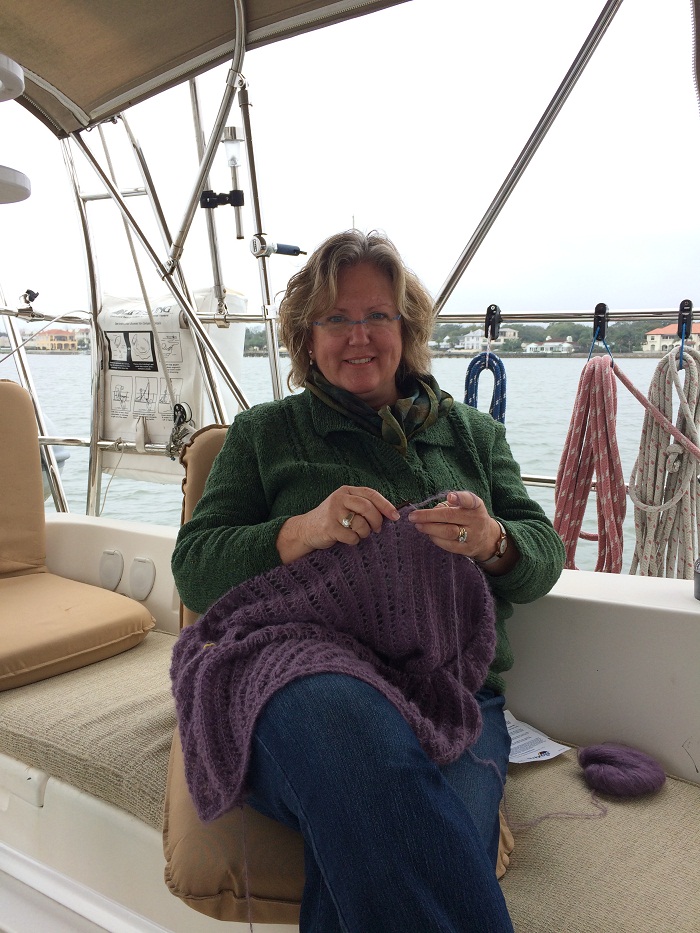
I have always felt my own homes to be good shelters, safe havens from the outside world. I have relished those safe havens and perhaps taken some of the conveniences there for granted. For some time now I associate this word–shelter– with yarn. Yes, yarn….specifically Brooklyn Tweed’s yarn called ‘Shelter.’ I made a sweater once with a beautiful color of green Shelter called ‘Bottle.’ I knitted it one fall while Bob and I were making our way down the ICW (intra coastal waterway) in mid-autumn weather. I finished it and got to wear it when we arrived in chilly St. Augustine.
Actually, this shows the color more accurately–a lovely, beer-bottle green.
Now our boat is looming large–actually, looming smaller and smaller– as our shelter. Sorry for the pun. Can you tell I miss my looms? I admit I am a bit envious of my weaving friends who are sheltering at home. I know they are weaving. Sigh…
I don’t often talk about sailing because this blog is not a travel blog, and it’s certainly not a sailing blog. That would be my husband’s domain, and you can find him here. I stick to textile techniques, and I try to search them out wherever the wind takes us while we are living aboard. But today I need to talk a bit about sailing.
Yesterday we learned that the Secretary of State announced that all Americans currently out of the country have to get home immediately, or shelter in place wherever they currently are. He said this situation could last a long time, perhaps 18 months. That narrowed our decision about whether to stay down in the Caribbean to wait out the pandemic or sail almost 2,000 miles to get home We were lucky to check in to St. Lucia before they closed the island, but now we see that we must begin the long journey home unless we are prepared to stay here for an indefinite amount of time. We are not. Most of the islands in the Windward and Leeward chains are now closed to visitors, and some of them have implemented severe rules that cruisers may not come ashore to provision, even if they have cleared in with immigration. They are protecting their own citizens from exposure to us who have been visiting many islands countries over the past few months, and they are ensuring that their own citizens have access to the limited food and supplies in the shops. All good. We, on the other hand, cannot live somewhere indefinitely without the ability to restock our provisions.
The list of islands now closed to visitors is almost all of them. The few that are still open, either require quarantining visiting cruisers onboard their boats, or rejecting them due to the places they may have visited before arriving. Because the incident of the virus has risen dramatically in the US, boats from the US are being excluded from some of the few islands still accepting visitors. I feels a bit like a diaspora, although I know we are so much better off than people left homeless on land.
This is the marina tucked inside Rodney Bay, St. Lucia. We are so lucky to have gotten here before the island closed. The marina is full at the moment. The water is too dirty for swimming, and we cannot make fresh water here. But there is good water on the dock, and we have electricity!
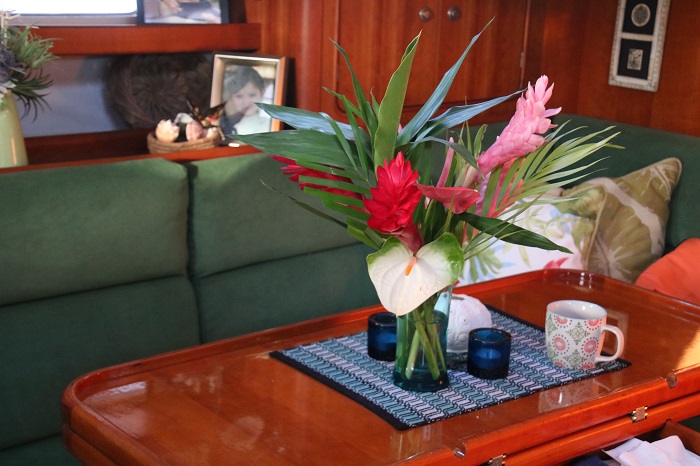
Bob knows my level of concern. A good deal of it is based on the kinds of malfunctions and near-disasters he has encountered during his and others’ past few voyages to and from the Caribbean. Amidst all the prep he is doing to get us ready to leave, mostly involving the water maker and the new fridge unit, he bought flowers! Yes, that went some measure to making things feel normal for at least the next few days. To quote the Queen, “Stay Calm and carry on.” Flowers onboard do lend a sense of calm!
Here is our current plan. I apologize in advance for getting into more sailing jargon than any non-sailor should have to endure. We will sail up the chain of Windward islands, starting sometime next week, when the winds and sea swell should be down a bit. We will rely on our excellent weather router, Chris Parker, to advise on the calmest time to leave. Although all these islands are closed to us, for the sake of my inexperience, we will stop each night in a bay on some island to anchor. We will be on our way again the next morning. This is technically illegal, and some islands, like St. Lucia, are policing their bays and shooing away visitors. If this should happen, we plan to plead my lack of qualifications for this journey and our need to rest.
Our first destination is St. John in the American Virgin Islands. We should be able to get there in 10 – 14 days. Before we arrive there we hope that land-based volunteers from our several blue water sailing groups will be working to get the State Department to understand our plight and designate some American ports where we can shelter. We have heard that harbors along the East coast are closing. We need to have some places open for our arrival. We need to know where we can go. Our land-based volunteers also plan to ask the Coast Guard for help in tracking our routes, or keeping track of us in some way. We will have a list of boats making this journey to give to both the State Department and the Coast Guard. Most of us have transponders onboard for keeping track of our location.
Because of my lack of experience (frankly, I am so unqualified for this journey it is frightful), we will be taking a route that keeps us relatively close to islands where we can bail out as necessary, even though these islands will be closed to us. We don’t have an exact sail plan yet, but it’s likely that we will go to Puerto Rico (closed for entry) and possibly through the Bahamas (also closed). Then perhaps to Florida or Georgia. From there we can go up the Intra Coastal Waterway. The only remaining ocean passages would be the coast of NJ, always horrible, and perhaps the outside of Long Island. I cannot think about that part of the trip now. It’s a long way off, and who knows how things will be by then.
My worries are: –Normally Bob would sail home with two or three experienced crew members, but no one can get to us right now. –We are currently in St. Lucia which is part of the forbidden hurricane zone, starting on June 1. Our insurance will be voided if we don’t get north of Cape Hatteras or south of the Grenadines by that date. Considering how slow travel by sail is, we need to get out of here soon, either north or south. –since we will not be permitted ashore during our travels, we need to make sure we are completely self sufficient in food, water, and mechanical necessities onboard. We have just had a new refrigerator/freezer installed since our original one died in Dec. It took all this time — 3 months! — to get the new equipment shipped and installed. In order to fit this new appliance onboard we had to move our water maker. The installation of both these items is still not complete, so we have not been able to test that they are in good, working condition. I am very worried about this. We need to make our own water and we need to keep some of our food cold…..for quite a long time. –I will be out of meds in April, so I hope I can get help with that in St. John since we’ll be on American soil. Fingers crossed. I also do not have reliable seasick medicine, and as the only crew member I need to be able to do my share.
We hope to be home by mid-May. I have never been at sea for such a long time. This will be very different than the island hopping we’ve done in past winters. We should have moderate connectivity through our trip to St. John in the USVI, but after that I have no idea. It’s hard to be so far from home with little or no ability to keep in touch. So, fingers crossed and holding my breath that I’ll get home and be weaving in a couple of months’ time.