ArgoKnot

travel

Life after Archie’s Book

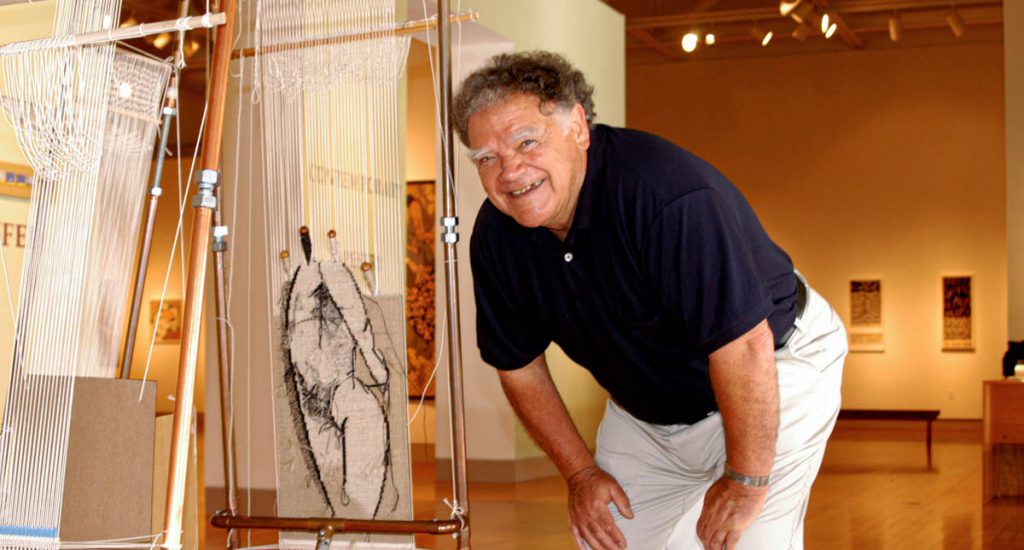
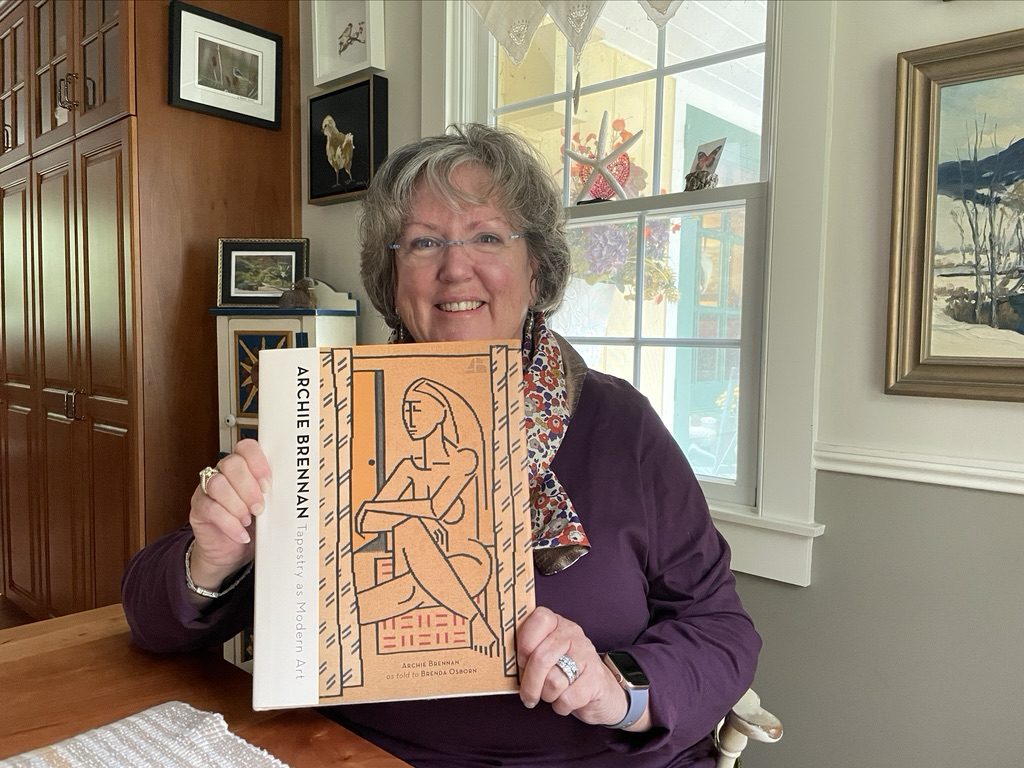
For those of you who got here early you may now see that I’ve changed the title. I thought better of my choice of words almost immediately! Archie Brennan and I started down a path more than a decade ago to create a book chronicling his fascinating life, and that path has reached its destination. Based on what little I knew about him in 2002, when I joined the Wednesday Group, I thought he had lived quite an exciting life. I saw him as someone who took chances, loved adventures. As he hand-wrote his memoirs and gave them to me to transcribe, I realized how limited my idea of adventure was. He led a most adventurous life!

A love of adventure and the unknown is probably a good ingredient for living an examined life. Examining life is a good ingredient for having an open mind while also developing strong opinions about what works in your own life. This is exactly how I view Archie. He was easy to talk to because he was genuinely interested in others, not just artists, not just tapestry weavers. He was fascinated to learn about whatever motivated another person to live the life they lived. Since he felt that his chosen profession was no different, and certianly no less important, than being a farmer or a mason or anyone else who worked with their hands, he was able to listen to others and know them on a level that most people just don’t ever reach.

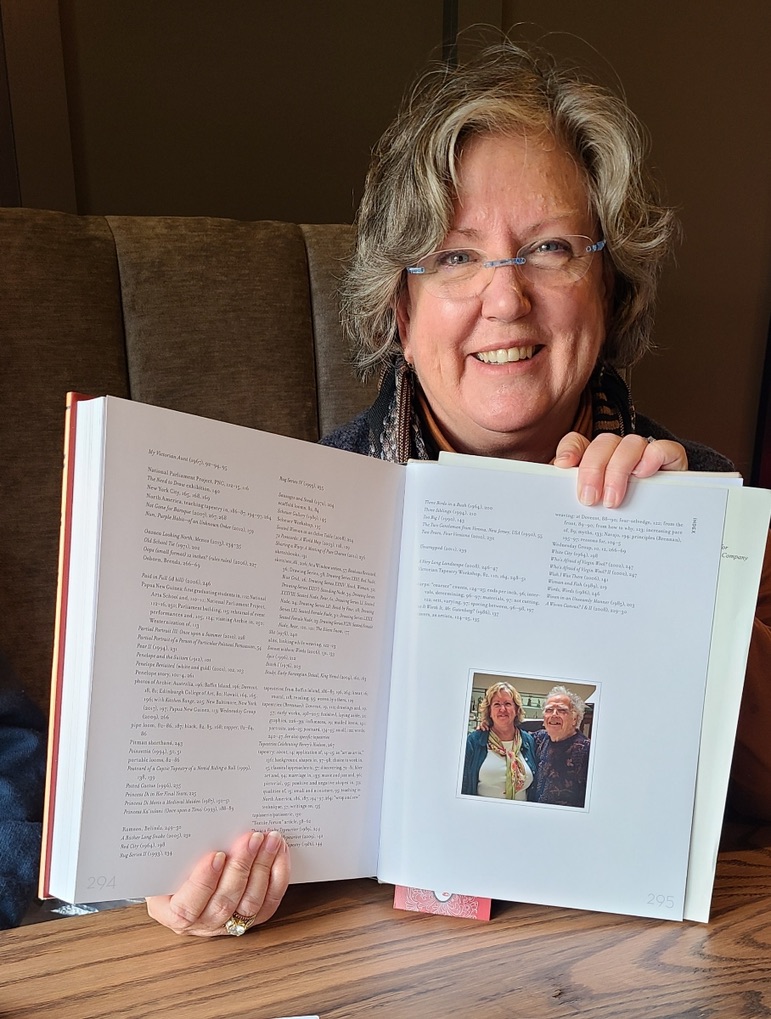
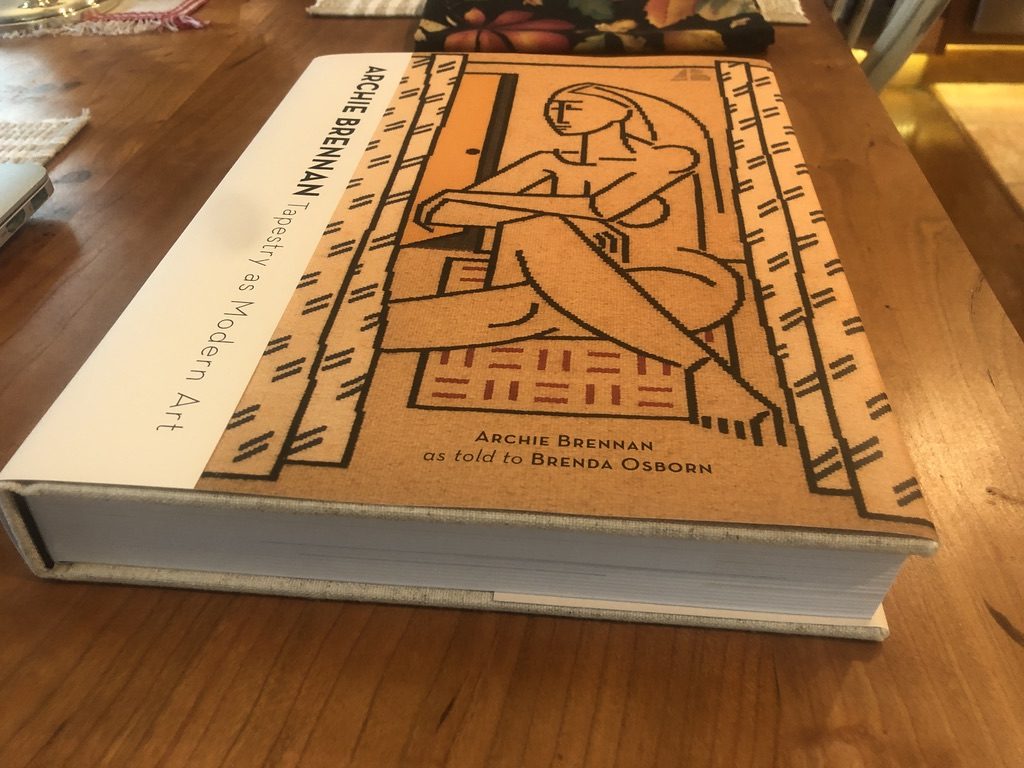
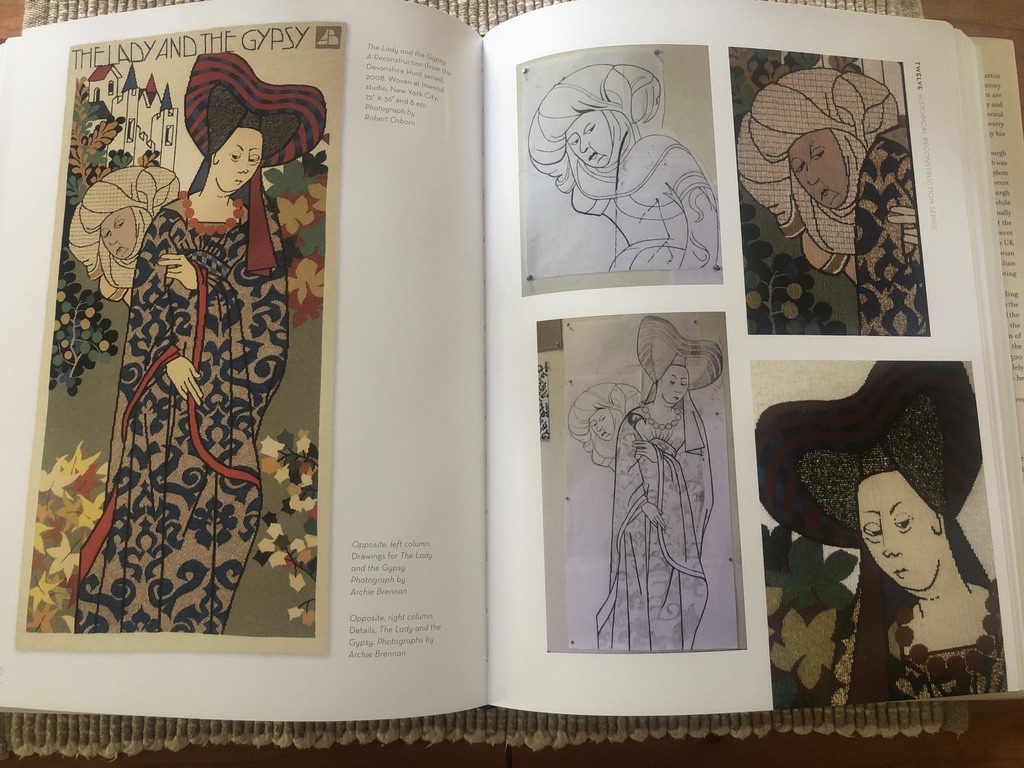
My journey with Archie to produce his book is coming to an end. In terms of the actual, physical book, it’s done. It went to the printer in late August. The publisher expects it to be available in December. I don’t know what the future may hold. Of course I hope to talk about the book in any setting that might occur. There are over 300 images in the book and wonderful stories. I always knew that this book had to be an autobiography; no one could tell Archie’s story as well as he could. Along with being such a great visual artist that man could tell a good story. He was Scottish, after all.

Now my own future is wide open. I have neglected my own tapestry weaving, along with the fabric woven projects, spinning projects, and countless knitting ideas, braiding ideas and other handwork projects that have defined my adult life. While Archie’s book progressed and stalled over the years, I could not focus on my own work. Today I will sit at my spinning wheel with some natural black Shetland that I’ve wanted to spin toward a sweater that has lived in my mind for too many years.

There are three sweaters taking hold of my imagination, and memory. Two are about 10 years old and are neglected “works in progress.” I began both of them with the idea of celebrating my knitting jubilee. Now I’ve been knitting for another 10 years since then–60 years. It’s time to make those celebratory sweaters. They were featured here in my blog almost 10 years ago.

This is Alice Starmore’s Tudor Rose design. In my own project, I am just above the armholes.

This next sweater is the one that is calling to me to finish first. It’s based on a design by Ruth Sorensen, but I no longer know who might have tweaked the version I was knitting…maybe Ruth herself. It’s been 10 years, and the pattern is now gone from my Ravelry library and gone from my computer files. I’m a bit stumped at how that happened. The pattern is no longer available, so I can’t just buy it again. It’s a dilemma.

I bought Danish yarn called “Kauni Effekt” to use for this design. The brilliance of getting these amazing colors together is buying handpainted yarn and then using it as yarn A and yarn B. I just needed to make sure that each skein started in a different part of the color sequence. No need to change colors every two rows, as in a standard Fair Isle design. The yarn does all the work, and I just knit. I sure hope I can recover the pattern somewhere in my files. There is a slim chance that I printed it, but it is not with the sweater materials. I will have to excavate my knitting notebooks, and that is no small feat.

The third sweater is a new pattern from Sunday Knits called Tia Teva. I really splurged and bought the yarn for it as well. Go me! My sweater will be a medium and light grey/blue.

This is SO totally clever! Don’t you agree? Stripes that undulate to allow for stranded work insertions. Carol Sunday is so creative! I hope I can finish the other sweaters before I start this one.

Oddly, that brings me back to Archie. He had so many ideas in his head at all times, yet he never worked on multiple tapestries at once. He might be drawing sketches for several ideas he wanted to pursue, but he didn’t warp up a new tapestry until the current one had been cut off the loom. I need to do that. I really do. Thinking about that reminded me of a question someone once asked him after a presentation he’d given. The person asked what was the most difficult tapestry he had ever woven. He replied, “It’s always the one on the loom right now.”

I’m excited for this book to become a reality–at long last. I’m also excited to now have time for my own work, with Archie’s wise words scrolling through my head after years of reading and re-reading them, arranging them and rearranging them into chapters. I cannot count how many times I’ve read the manuscript, but his words have continued to remain as fresh as the first time I transcribed them. Now I am free to implement his wisdom into my own work.

Still Playing with Paper

There is more paper yarn to choose from on Habu Textile’s site. I wanted to see what an indigo dyed paper yarn might inspire. With all the colors on the site, Takako Ueki, the owner, warns that the colors I might choose may not actually look like they do on my monitor. That’s a worry, but unavoidable for online purchases.

Another paper yarn on the site is called “Shigoki” (n-14 Shigoki paper) which comes in some interesting colors including a pale blue called ‘water.’ It is also 100% linen paper, and the put up is 1.7 oz, and the yardage is 285 yards. That seems too heavy for what I hope to do with it. It does not look any heavier in the photo from the website, but I have to trust the yardage.

In the long run I ordered two skeins of n-73 indigo linen paper. The color is “mizu.” I wonder what that means in Japanese. It is dyed with natural indigo, and the put-up is 476 yards for 1.7 oz skein. That’s twice as fine as the n-14, and the color is closer to the blue I envision…at least on my monitor! (Ha! I just googled ‘mizu,’ and it means ‘water.’)

I have to wonder why Shosenshi (n-60), which is 100% linen paper with the same yardage per ounce as Indigo Linen Paper (n-73), is less than half the price. Could it be the dyeing process? Shosenshi is $29.50 per 1.7 oz skein, and Indigo Linen Paper is $67.00 per 1.7 oz skein. My placemats will be very dear, indeed! I justified this by noting that my current blue linen placemats were made in the mid 1990s and still look new. I hope I get as many decades out of this set of placemats!

After quite a bit of thought, which mostly occurred in the wee hours when I can’t sleep, I am going to make the warp out of cottolin again, sett at 24 epi, just like my paper towels. I love the hand on those towels and how well they come out of both a machine wash and machine dry. They will be easy care. This time I will mix the natural colored cottolin with a fine white linen to give some energy to the warp color. The weft will be the paper. I want to make six placemats. If I have more diners at the table I will add in my aging blue linen placemats. I like the idea of a coordinated table more than a perfect match of place settings anyway.

Here are the materials I’ve gathered for this project. The blue is not as pale as it looks here–must be that dark blue background, but I couldn’t resist using an old sashiko embroidered runner that I made almost as long ago as my blue placemats. I have twisted a bit of the white and natural warp yarns together to give a sense of how the colors will blend in the warp.

And here is the draft. I did a bit of searching for a Greek ‘meander’ pattern, without much luck. And I tried designing my own, but found I needed more than 8 shafts, and I had uncomfortably long floats. When I get this excited to begin a project I am not one for sticking with the design process. I want a solution right now! In the long run, I’ve found something in Strickler (#365). The Greek key is on an angle because the structure is a twill. The pattern requires 16 treadles, which is not a problem since I’ll be using the Baby Wolf combby to weave. If I could have designed a Greek meander pattern that didn’t have such long floats, I would have been willing to put this project on my 16S AVL. But to find an 8S pattern with short floats is the better choice.

Here is my draft:

If you are tempted by this pattern and don’t have 16 treadles or a desire to figure out a skeleton tie-up, take a look at #367 which is quite similar and only requires 8 treadles.

I don’t know when I’ll make the warp. I am tentatively planning a week or two away at the beginning of next week. This week I am supposed to be putting final edits into a book I volunteered to produce years ago. It’s been a long project that is finally reaching its end. I need to discuss that in another post. Yet I’d love to have a new paper yarn project on the loom before I leave, waiting for me to begin weaving when I return. Wouldn’t that be nice?

Weaving Paper! It’s fun!

Did you see Tom Knisely’s article about weaving with paper in the March/April 2021 issue of Handwoven? It certainly caught my attention, as I mentioned in the last post.

Yesterday I finished weaving my own version of paper towels, and I’m very happy with the outcome. In fact, I am smitten with the lovely paper yarn “Shosenshi” from Habu Textiles.

Here it is underway back in May or early June.

Here is the fabric coming off the loom, quite stiff. I love the crispness of the fabric.

The hems are woven in a fine white linen to minimize bulk in this area. I tried plain weave at the beginning of the warp for the first hem, and did not care for it, so I continued weaving the twill for the rest of the hems. You can see my cutting lines for separating the towels in this photo.

It took a leap of faith for me to weave a first attempt at paper yarn in a twill pattern when Tom had wisely tried plain weave for his towels. The 8S goose eye twill I chose has mostly 4-thread skips in the design with a couple of places that have 5-thread skips, and one place in the pattern where the skip is 7 threads. I just held my breath about that. The warp is cottolin from Camilla Valley, and I set it at 24 ends per inch. Those 7-thread skips are between 1/3″ and 1/4″ long. Once I was weaving I began to think that this would not be a problem. Whew!

I have had some distractions this summer (frankly, for years!) that keep me from the loom. Over time I’ve developed the habit of getting projects prepared to go so I can walk away from them for any amount of time. It seems to me that getting a project ready to go, whether weaving or any of the other textile projects I enjoy, is the more challenging part of ‘making a thing.’ If the project is ready to go, I can return to it when I have time and just knuckle down to the process of making.

But back to my paper towel project. I had to set it aside for about a month as I spent time editing the text of a book which will finally get published, and captioning over 300 images. There will be more info on that shortly. I had all of last week to get back to weaving for myself, and I was thrilled! Right as I turned on my ancient (10 years old!) laptop to sync with the combby on my Baby Wolf, I discovered a horrific situation. My computer was bulging like a balloon. Have you ever seen this? Now I wish I had thought to photograph it. The metal case of the laptop was completely distorted. It turns out that Apple used some batteries from 2008 to 2011 that begin to swell with gas over time. Since I had not used the loom in over a month, it had begun to swell quite dramatically, while I never even looked at it since I was busy with other things. The track pad was unusable since it was recessed by the swelling computer case. Apple said they could not fix this problem and offered to dispose of the laptop for me. I refrained from that because I thought I’d better wipe the computer before turning it over to anyone. Then my husband thought we should check with the local computer shop he uses for his PCs. And voila, only four days later, I have a new battery in my laptop, and the swelling is gone. I can’t believe that the computer case ‘deflated’ back to normal! And it synced with the combby the moment I reattached it. I often wonder about my decision to put this combby attachment on the Baby Wolf, but that’s a subject for another time.

I finished weaving the paper towels last night. It was late, but I had to serge the ends and get the fabric in the washing machine. And then, of course I had to wait up and put the fabric in the dryer. After a month’s hiatus from weaving, I didn’t want to wait even one more night to see the outcome of this project. It was 11pm when I took the fabric out of the dryer, and I was so happy with it. Tom Knisely says he washed his paper towels in hot water and then dried them in the dryer, so I did the same. He said the towels softened up dramatically, but somehow I thought he meant after many washings. So I was shocked and pleased to see how soft my fabric became after only the initial wash. Amazing.

I wish this photo conveyed the softness better. I wish you could touch them. All I can say is try it yourself. None of these photos quite shows the lovely spring green of the paper yarn.

I was so pleased with this fabric even as I was weaving, that I ordered another kind of paper yarn from Habu to make some new placemats. I am going to try a somewhat different paper yarn, n-73 indigo linen paper, in a lovely blue called kamenozoki, which should coordinate with my much older linen placemats for those times when I need to seat a small crowd. Remember those times? In the meantime I’ll have a new set to use for our daily meals.

Here is a recap of the paper towel project:

Warp: Camilla Valley cottolin in natural. Warp sett is 24 epi and 20″ wide= 480 warp ends x 4 yd length for two kitchen towels and some practice warp. The Goose Eye twill requires 46 ends per repeat , so I had 10 repeats with an extra 20 threads. I used the extra 10 threads at each end to have one floating selvedge thread, and 9 threads that I threaded in a straight twill.

Pattern: 8S Goose Eye twill:

Weft: Two hanks of “Shosenshi” linen paper yarn from Habu Textiles (item a-60 on the website) in color “Tea Green.”
Fine white linen singles from my stash for the hems.
I woven two inches of hem for each towel with the fine linen singles, and 27″ of twill with the paper weft for the body of the towels. On the loom my towels are 19″ wide by 27″ long, with additional 2″ of hem at each end.
The finished size after washing is 18″ wide by 24.5″ long. The shrinkage in length was more than I expected.

Give it a try in your own combination of yarns. The cottolin and fine linen singles were from my stash. See what you have on hand that will work for you. You will have fun, and you’ll have some luscious paper towels!

I rushed to publish this earlier today, and now I have hemmed the towels. Here they are–finished!

The color is not quite true on this close up image.

The Thrill of the Finish!

There’s nothing like finishing a weaving project, from cutting it off the loom, to wet finishing, to seeing what the cloth truly becomes when it’s all done. There is a saying about handwoven cloth– it’s not finished until it’s wet finished!

I’ve had a lot going on over the past few months that prevented me from weaving this project on a regular basis. When that happens the long awaited finish is even sweeter. Here is Tori’s blanket.

Some of the details…
–I wanted bigger circles than was possible in the original draft from Handwoven, written by Susan Poague (that would be Handwoven, May/June 2019). That draft used 8 shafts in a structure called ‘turned taquete.’ I enlarged the circles from about 1″ in diameter on 8 shafts, to somewhat bigger than 2″ in diameter by expanding the pattern to 16 shafts. You can find the drawdown here.
–I wanted the blanket to be machine washable and dry-able, so that eliminated the possibility of using wool. Wool would have been my first choice, but I did not want to use super wash wool for a number of reasons. For one thing, I have not found a super wash wool fine enough for what I wanted to do with this project. I used 6/2 unmercerized cotton (Valley Cotton, from Webs) sett at 20 ends per inch. It washed and dried beautifully, and became quite soft to the touch. All good!
–I debated on size. Making it the size of her full bed would have been cumbersome, although doable. I opted for a large throw so she could use it in a number of ways. On the loom it was 45″ by 66″. After wet finishing it is now 40″ x 58″. I love the way it feels!

Circles are terrific fun! I hope you will check out Susan Poague’s article in the Handwoven issue above, or use the link to my draft for larger circles if you have 16 harnesses. I would still love to try this in wool…maybe 18/2 merino, in colors that would work in my den. I am dreaming of this as a throw for winter nights in front of the fire, in various autumn golds and ochres with a few circles of red and deep green.

Next up on my weaving list is Tom Knisely’s idea for “paper towels” from Handwoven, March/April 2021. The article is titled “Redefining the Paper Towel.” He used 8/2 cotton for the warp sett at 20 ends per inch. He used the 8/2 for most of the weft as well, with a few stripes of paper yarn at regular intervals. The paper yarn he used is “Shosenshi” from Habu Textiles. It is a 100% linen paper….fascinating. Tom used white. Here is the image from Habu’s website.

Since I prefer linen, I have made my warp in natural colored cottolin from Camilla Valley Farm. I am threading the warp in Goose Eye, and I will use a very fine white linen weft as tabby between my paper pattern weft. Habu carries Shosenshi in a lovely spring green which I couldn’t resist.

Tom played it safe weaving his towels in plain weave stripes, and I know I should follow his lead. I wonder if my Goose Eye floats will end up snagging and tearing…but I can’t resist the idea of concentric diamonds in paper, hopefully held well in place by fine linen. I’ll have 4-thread floats all over, with a few that are longer. At 24 epic, the 4-thread floats will only be between 1/8″ and 1/4″. Still, that could be troublesome for the Shosenshi. Here is my draft.

The warp is made and now wound on my smaller loom–the 8S Baby Wolf. This warp is 20″ wide and sett at 24 ends per inch. I am about 2/3’s done threading as I write this. I know this will be a fun project; I just hope that the paper towels will hold up to washing and drying and doing duty in the kitchen! I’ll do a sample at the start and cut it off to wash and use in the kitchen to test the fabric. Stay tuned, and if you also give this project a try, please let me know!

Did you notice that placemat in background of my photo of the yarns for the paper towels? That’s a very old project for placemats made in single ply blue linen with a bit of honeysuckle patterning at both ends in a fine white cotton. These placemats are about 30 years old now, and I only made four back then. I have recently realized that they are the only placemats I ever made in blue! I’m not sure how that happened since my everyday dishes are blue. I guess whenever we’ve had more than four people at the table I have used a tablecloth. Various other placemats I’ve made over the years coordinate with blue or go with my various holiday china patterns, but are not blue themselves. Now I am positively committed to having blue placemats on the new cherry table that Bob made. I want some of that beautiful figured cherry grain to show, no matter how many people we have at the table.

That means I’ve been looking at new ideas for placemats. I would love to weave these again, as they were an enjoyable project all those years ago. I know I would not get the same yarn, and I’m not sure how I feel about trying to find something to coordinate with this linen. It was linen from Finland, possibly Vaxbo, but I didn’t keep a record. I believe it was an 8/1 linen that I used for both warp and tabby weft. I have some thinking to do about this project, but one of the patterns that is quite tempting is from Webs. It’s called “Summer Elegance Runner” that is an 8-shaft overshot in multiple colors sett at 24 ends per inch. It uses 10/2 cotton in various spring colors. I bought the drawdown a while back, and this week I set aside some linen yarns from my stash to consider. It’s a hard decision because I still love my blue honeysuckle mats. I’m sure there will be more ‘thinking out loud’ on this here in the coming weeks.

My possible yarn choices…. the middle color is really a pale green. My main color will be blue.


Got any advice or preferences? Please get in touch!

The Circle Craze

Did it start in spring of 2019, with the May/June issue of “Handwoven” magazine? That was the first time I saw Susan Poague’s tempting pattern for woven circles. It only took 8 harnesses to make a row of circles offset by the next row of circles. I was crazy for them, and it seemed that everyone else was too! These dishtowels were showing up in guild show and tells and on social media everywhere.

There they are, in the lower left corner of the cover. Around that time I also found them on Etsy, woven by the author of the article herself. I bought them to use onboard Pandora because the colors were perfect for that setting. Here they are on the table of our outdoor dining room.

My friend Marilyn weaves things so quickly she’s done with a project before I finish reading the source where she got the idea. That was the case with her version of dishtowels with circles. She had a whole set coming off her loom while I was still gazing at the photo on the cover.

Susan Poague’s towels on the cover of “Handwoven” and her placemats that were for sale on Etsy are a structure called taquete that she has turned, so that the colors for all those circles are in the warp, and the weaving is done with just the one background color.

When I saw this project for turned taquete I immediately thought of my grandchildren and a blanket. Wouldn’t those circles look terrific bigger and in lots of bright colors? Oh, yeah! It’s hard to make things for three grandchildren who all live in the same family. I generally make just one and hope they’ll share until I get to the next project. Our oldest is four years old, and she deserves the next handmade thing, especially since her first blanket in knitted lace accidentally turned into a doll’s blanket (about the size of a placemat) when it got thrown in the dryer after washing. This blanket will be easy care.

Before I began to work on designing a draft for the larger circles, I thought I’d better learn a bit about taquete. I just happened to have a book on weft-faced pattern weaves in my library, and it just happens to be the best resource on this subject.

The author describes Taquete as a weft-faced compound tabby weave. I often find descriptions and definitions of weave structures hard to understand before I’ve actually made a warp and woven the structure. That was certainly the case with taquete. One surprose for me was that although every other shed in the treadling looked like plain weave, raising all odd shafts, then a pattern shed, then raising all odd shafts, those odd/even sheds were not the plain weave. Plain weave occurred when I raised shafts 1-8 and then shafts 9-16. It was a head-scratcher.

When I looked at a number of drawdowns for this structure I saw parallel threadings. In fact, when I wrote the draft for my circles, I used parallel threadings with one set of circles based on shafts 1 – 8, and the other based on shafts 9 – 16. Hoskins explains the structure further here. Examples of taquete textiles were found in Coptic Egypt from the 2nd century BCE, and in other sites in the Near East. Eva Stossel has a good description of the structure here, as well as photos of her designs. It’s a treat to see what she’s done with this weave structure, for which she credits Bonnie Inouye, and her scarves are far more adventurous than my circles!

So, circles. I wanted them to be bigger than what I saw people weaving for their kitchen linens. I had two options for bigger circles: heavier materials and more shafts. I decided to take advantage of both. Of course I should have sampled, but I don’t have heavy cotton threads in my stash. I had to order a ton of colors for this project, so I jumped in and figured I’d do some sampling at the beginning of the blanket warp. I ordered eight colors of 6/2 cotton, seven bright colors for the circles and a medium grey for the background. I planned to set the warp at 20 ends per inch. The 6/2 cotton (from WEBs) comes on giant cones that weigh more than a pound each, so I am well stocked in bright colors. Next came resizing the circles on 16 shafts. That took some trial and error, and I am so thankful I could do this with software on my computer rather graph paper. I use Fiberworks PCW. The pattern published in “Handwoven” uses 10/2 cotton set at 24 ends per inch. Each circles takes 24 threads, so the resulting circles are about 1″ in diameter. Each of my circles takes 50 threads, and at 20 ends per inch, my circles are 2 1/2″ in diameter. I have 19 circles going across the warp for a total of 950 threads. I had a plan.

Here is the draft I settled on after some trial and error.

The last thread on the warp drawdown is a background color (grey in my design), and the first thread of this drawdown is also a grey on shaft 9. Do not repeat that thread! I didn’t know how to remove it from the document! Mea Culpa!

When I checked my photos I discovered that I warped the loom back in January. It sure took me a long time to get this project going.

Then came threading the pattern through the heddles on the 16 shafts during some snowy days in February.

Next came sleying the 950 threads through the reed, two threads per dent in the 10 dent reed.

And on the very last days of February I started weaving. Voila! Circles.

I am quite happy with this project. Today is March 1, the snow has begun to melt, there is a full moon at night, and I am on cloud 9. I may be the last to arrive at the circle party, but I am a happy to be here. I am a happy weaver.

Scroll to Top