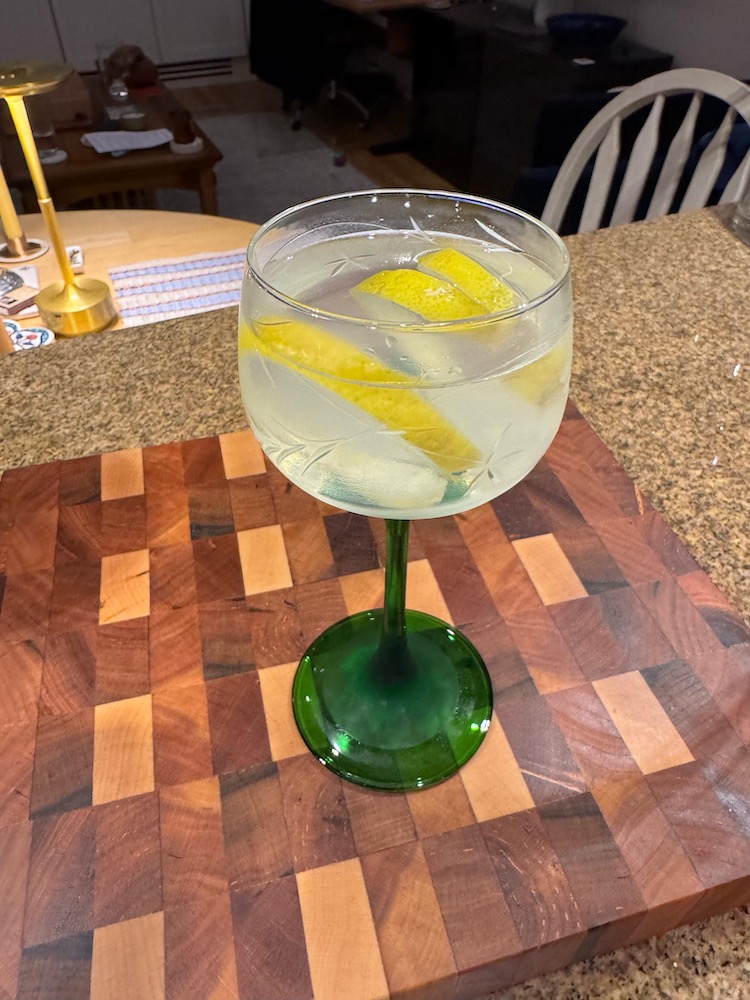
We seem to be living on tapas and small bites here in Almerimar since we don’t want to eat dinner at 9pm. In that vein I have two of my own small bite creations to post here.
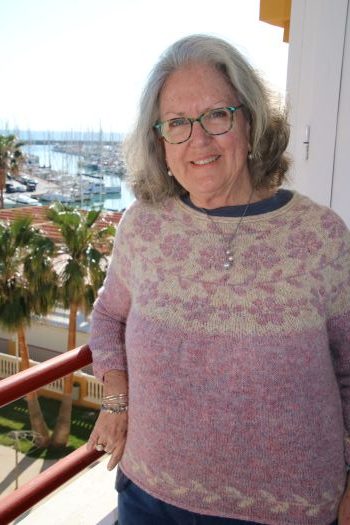
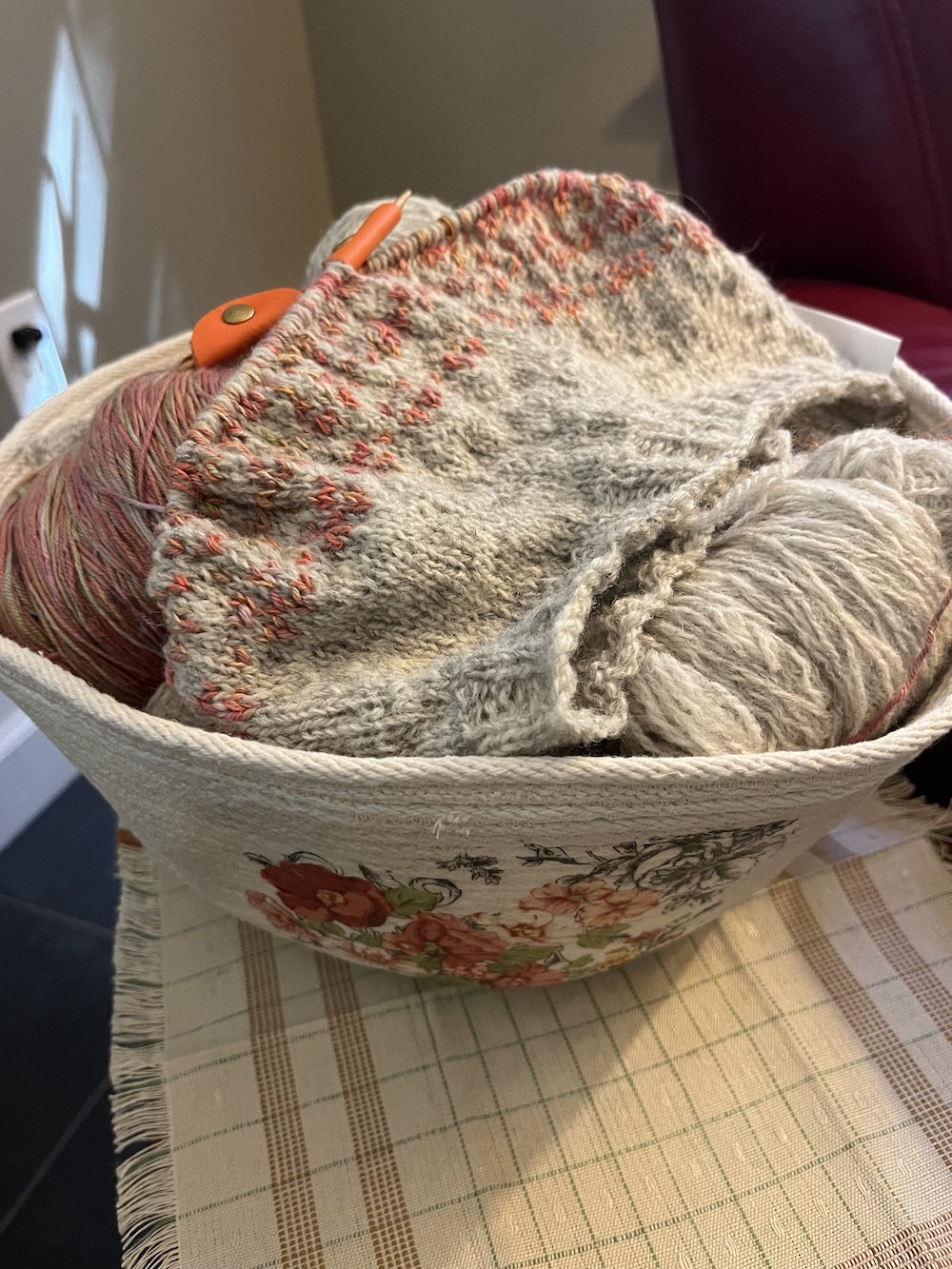
I have finished the “Sonann” sweater with time to spare before the deadline for test knitters. Hooray! It is a design by “Journey through Wool” on the Isle of Uist in the Outer Hebrides. The suggested yarn is from Uist Wool, which I was not able to get in time, nor did I want to deal with our unfair tariffs. Instead I have used Jamieson’s “spindrift,” which is also a yarn from the Outer Hebrides, that I could buy through various US distributors. Of course that meant I paid the tariffs anyway, but the shipping was faster. My colors are “Sand” and “Wild Violet.” The sweater pattern will be released in mid-April on Ravelry. I enjoyed test knitting this design.
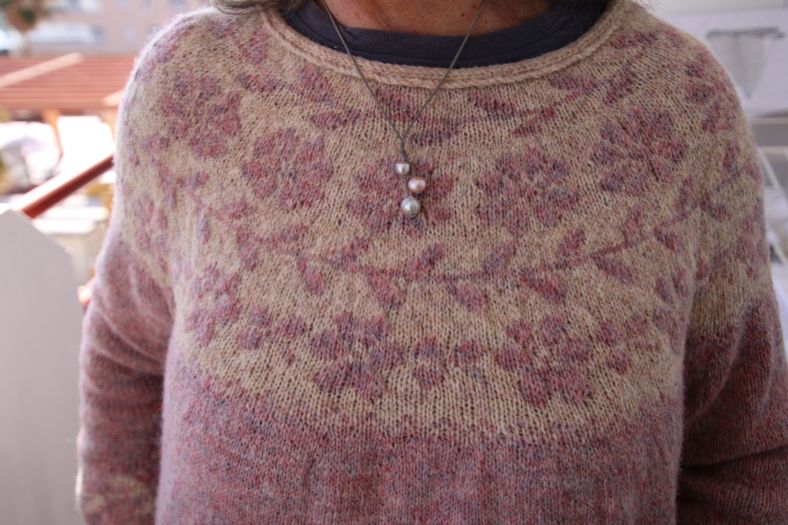
Here is a close up of the stranded pattern on the yoke. I am posting this on my ipad which doesn’t seem to allow me to re-size the photos. Since my computer will not connect to the internet I am attempting to use an ipad. Mysterious electronic glitches always occur when I am out of the US. I know it’s user error.
I may decide to rip back a good deal of this sweater, now that I’ve finished in time for the deadline for test knitters. I’m not entirely happy with the shaping, and I need to dive back into the instructions to see if I made an error in the increases or if it was in the pattern. It’s a big job, ripping all the way to where the sleeves get put on holders, but since I love the design and my yarn choices, I must do it!
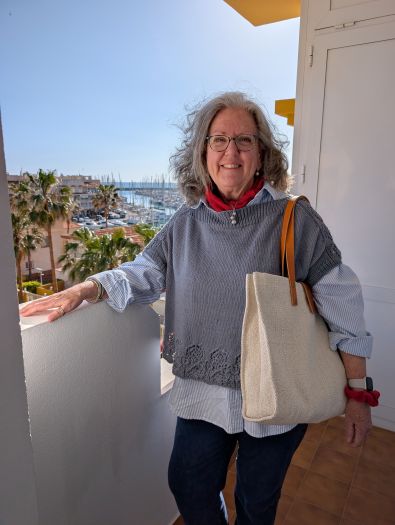
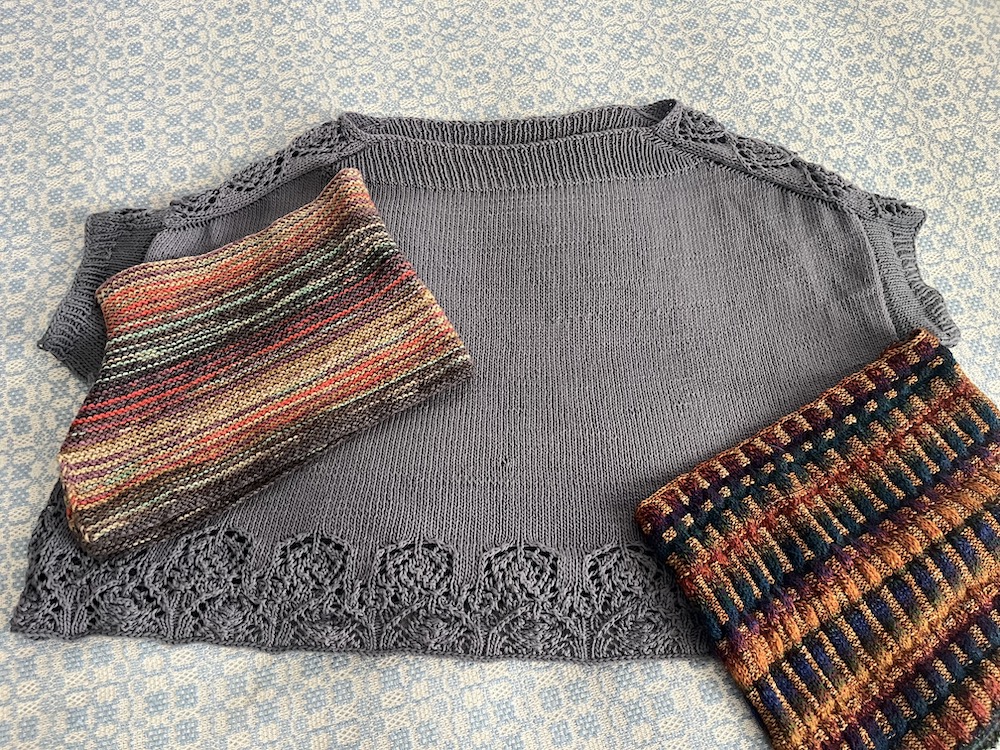
My new tote bag is a gem. I am on cloud 9 that I found it almost a year after I first saw it. And I am notorious for getting my photo taken in windy places so that my hair is winging out like it’s going to sail away. Just look at the gorgeous tote bag and ignore the model. Please also notice the cute sweater on the hair-challenged model. The vest pattern is by Elenor Mortensen, and you can find her on Ravelry. This pattern is called “Eowyn Tee,” and it is knitted in the round from the top down with a clever boat neck that morphs into lace on the shoulders. I enjoyed knitting it, and enjoyed using cotton yarn (Rosario) that I bought in the Açores last summer. I certainly love knitting with yarn from places I visit. It’s the highlight of traveling for me!
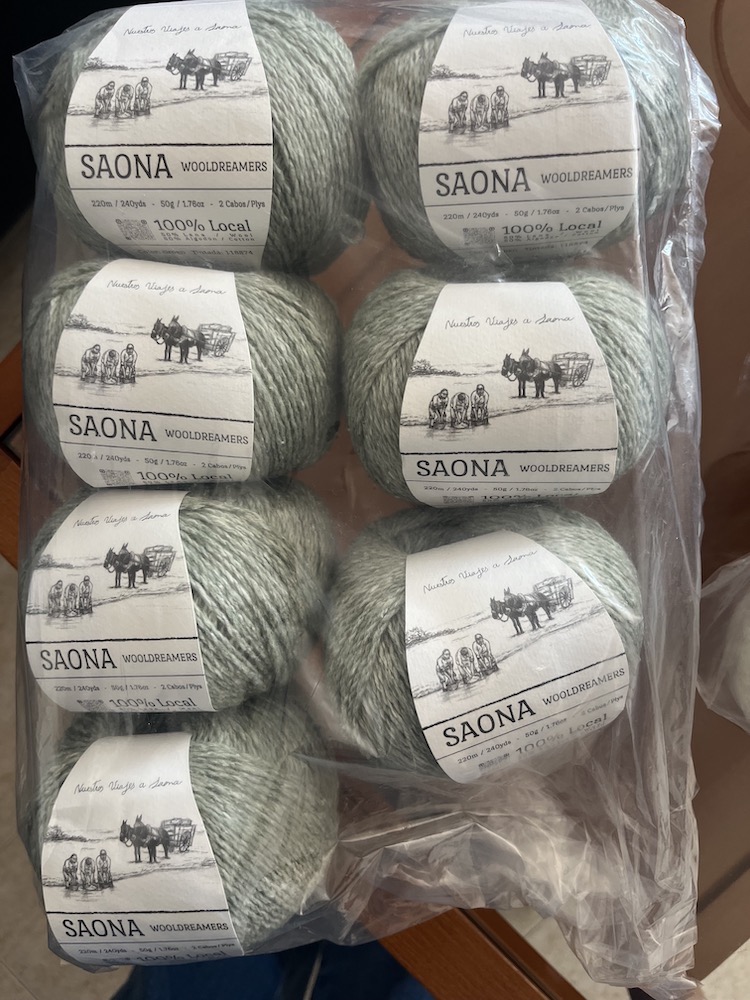
The next project on my needles also uses locally sourced yarn. I saw the pattern and the yarn on a US website for the yarn store Wooly Thistle. They are carrying a variety of Spanish yarns from a company called Wool Dreamers. The yarn for this sweater is “Soana,” a 50/50 blend of Spanish merino and cotton grown in Spain. I couldn’t order it in time to get it from the Wooly Thistle before we left, and then I realized I would be in the country where this yarn is produced. So I looked at Google Maps to see how I might buy this yarn in person. No luck there as most of the yarn shops were a lot further north. Even though we had a car for a few days, it would be a really long drive to Barcelona or to Madrid. So I ordered it online and had it shipped to a local shop in Almerimar that offers package deliveries. I’ve never heard of this before. Boy, was I happy when I walked to the shop to pick up my package!
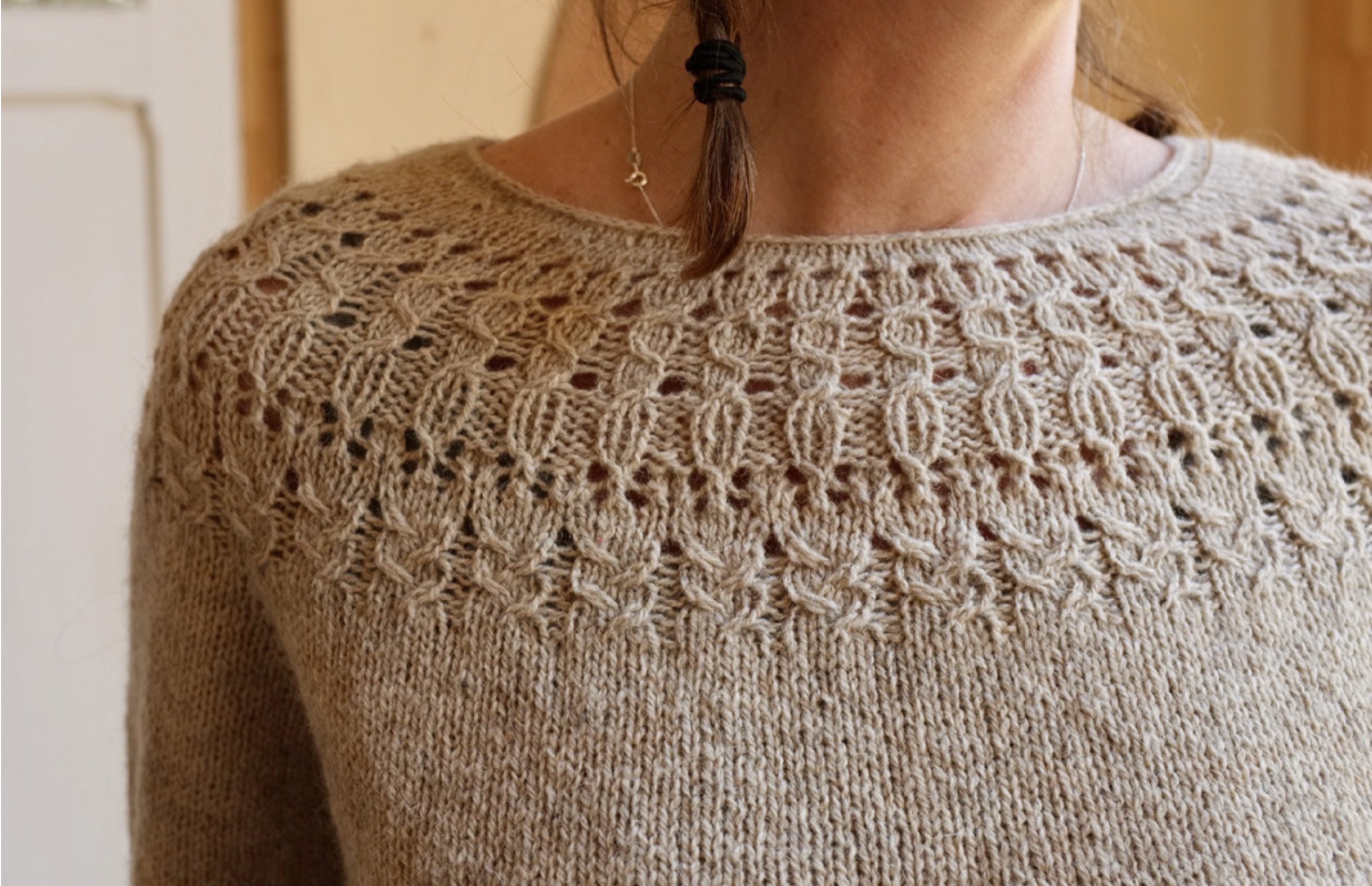
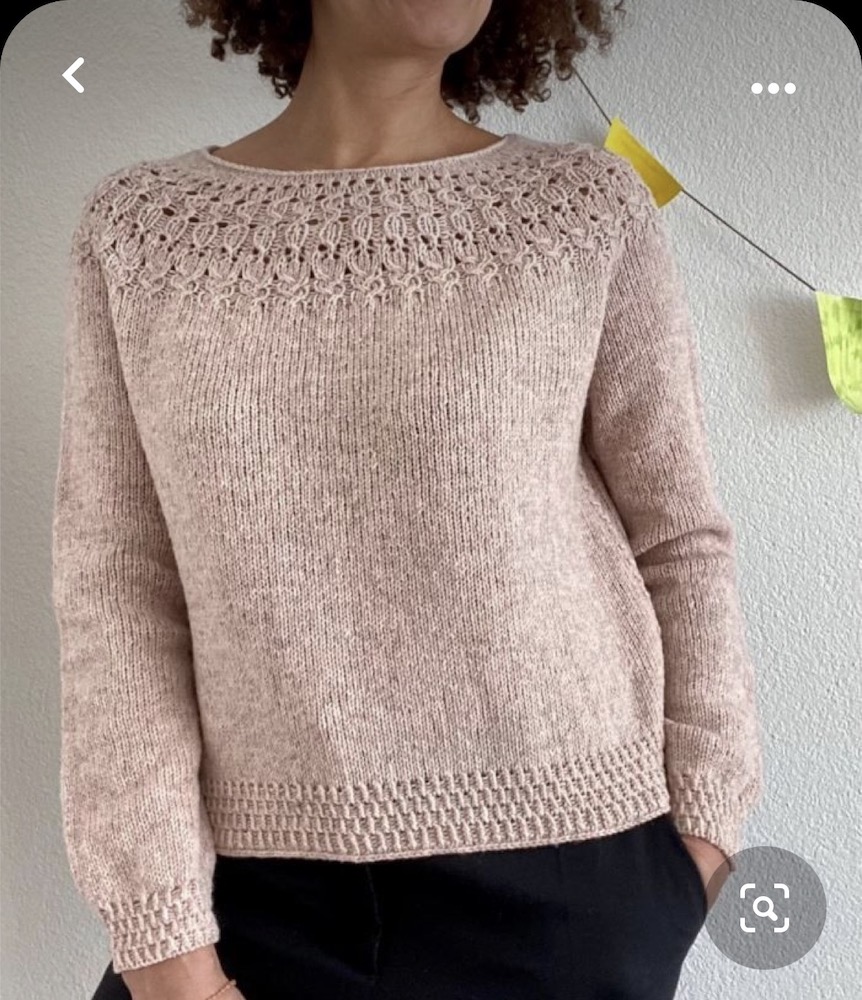
I am knitting the pattern that Wooly Thistle recommends for this yarn, and I’ve chosen a muted celadon green because I am thinking “spring.” It’s a design by Tete Beche (Orlane Sucche) called “Ilha.” I’m particularly enthralled with this design because it is supposed to evoke the baskets that are made on the islands off Portugal. What a wonderful idea, and the designer has done a very clever job of creating cabled and eyelet patterns that are quite like the wicker woven baskets from these islands. The name “Ilha” is Portuguese for “island” and is pronounced “ilyah,”. Since I enjoyed my time in the Açores so much last summer, this sweater will bring back sweet memories from that adventure.
At the moment my knitting looks like a blob. The cable and eyelet yoke will need a good wet blocking to bring out the pattern. Here is an image of the finished yoke that comes with the pattern.
Screenshot
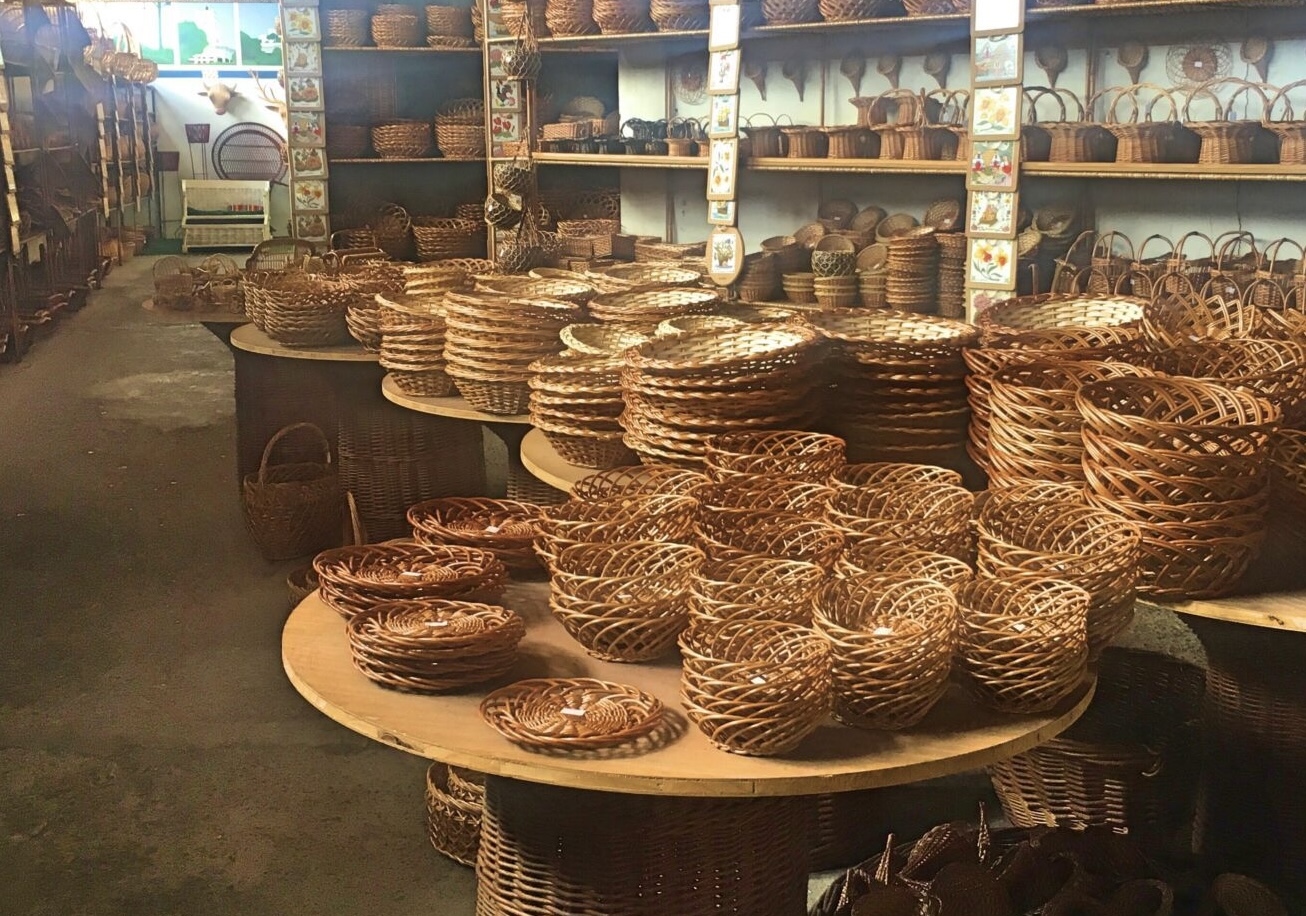
And I want you to see some of the baskets that inspired this design. The open designs on some of the baskets and the braided edges on others are so well translated into knitting by this clever designer.
We have not yet moved aboard Pandora because it’s been too windy to put her in the water and move to a slip. Bob is also deep into cleaning and doing some repairs himself. Luckily the prickly man who was to rebuild Pandora’s rudder sent over a small crew to make it better. It looks quite good now. Thank heaven because a boat needs a straight rudder to steer properly! The current plan is to move aboard on Tuesday, March 31. We’ll start a new month aboard, and as soon as Mother Nature gives us a weather window we will sail to Cartagena, where I”m sure there will be more delights.
Time to knit. As always, thank you for following me!
Before I left home I searched onlinr to see if there were weavers in southern Spain as well as the Balearics, Corsica, and Sardinia. I got a long list of weavers keeping traditional patterns alive, and where to find them. I was excited to find so many possibilities of seeing the textile treasures of these places as well as connecting with weavers. Yesterday was the first adventure on the journey to meet local weavers.
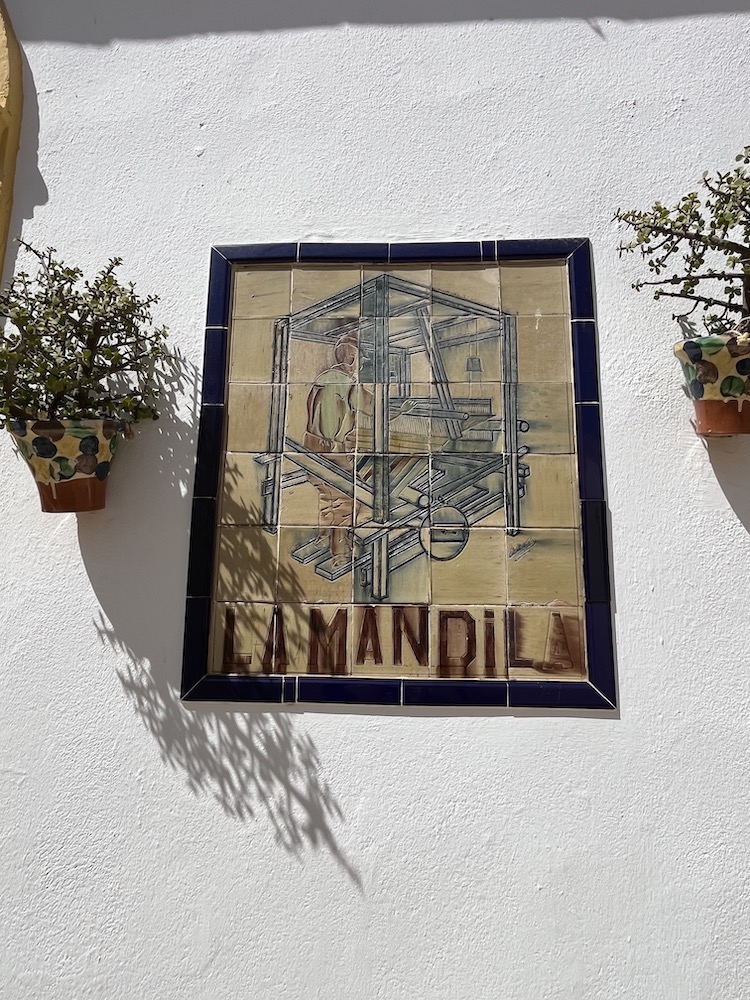
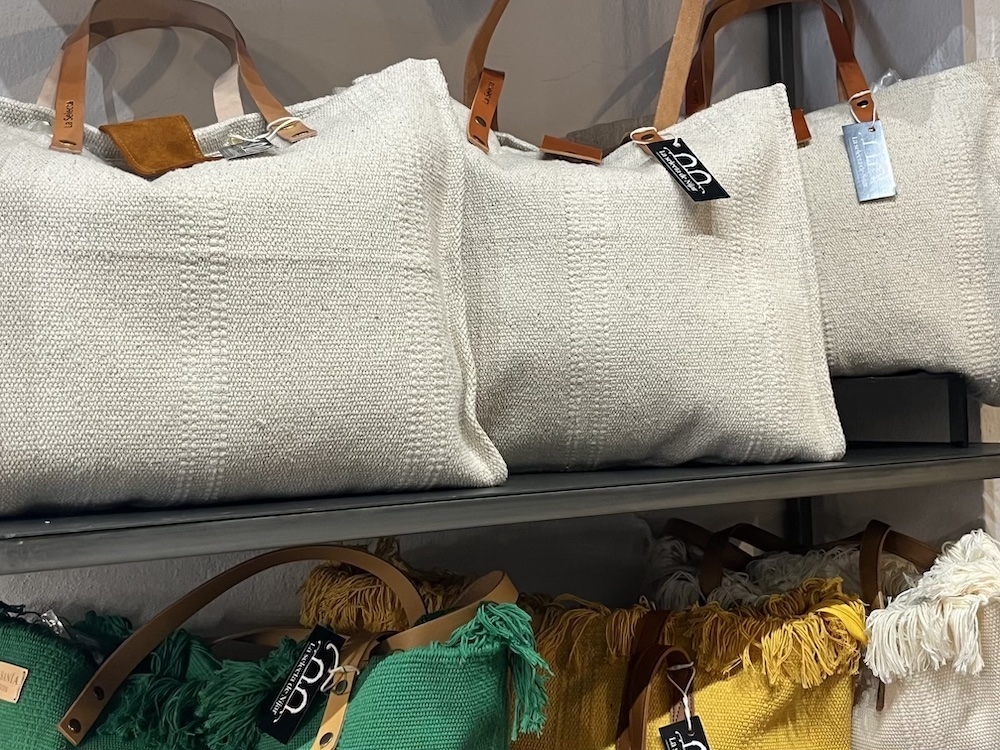
Last year Bob and I had driven to Nijar, a bit east of Almeria to look for weavers. Yesterday I found all the same places! Last year I regretted not buying a handwoven tote bag from one of the shops in Nijar, and I was hoping to find it again, still full of choices. And we did! I remembered an entirely different shop, but Bob was convinced it was a place I don’t even remember seeing last year–that is until I walked inside. Then I was certain we’d found the place, and what a thrill that was. The same tile work outside the shop.
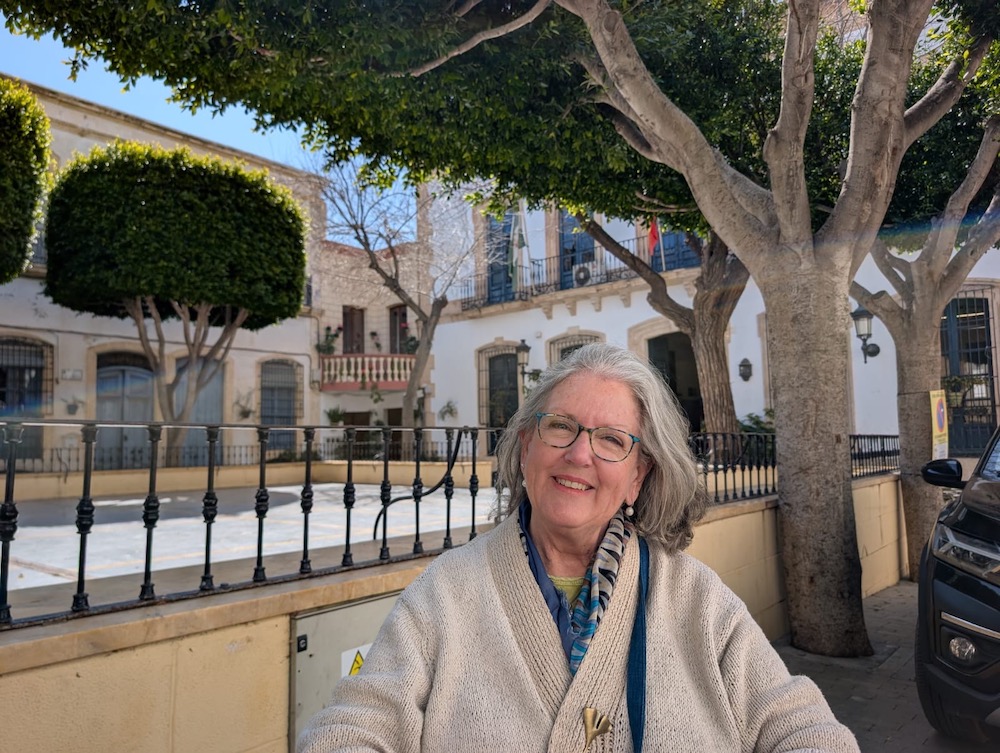
The very bag I wanted to buy last year….so I bought two in order to bring one to a weaving friend. I hope she loves it as much as I do. I will be carrying it today.
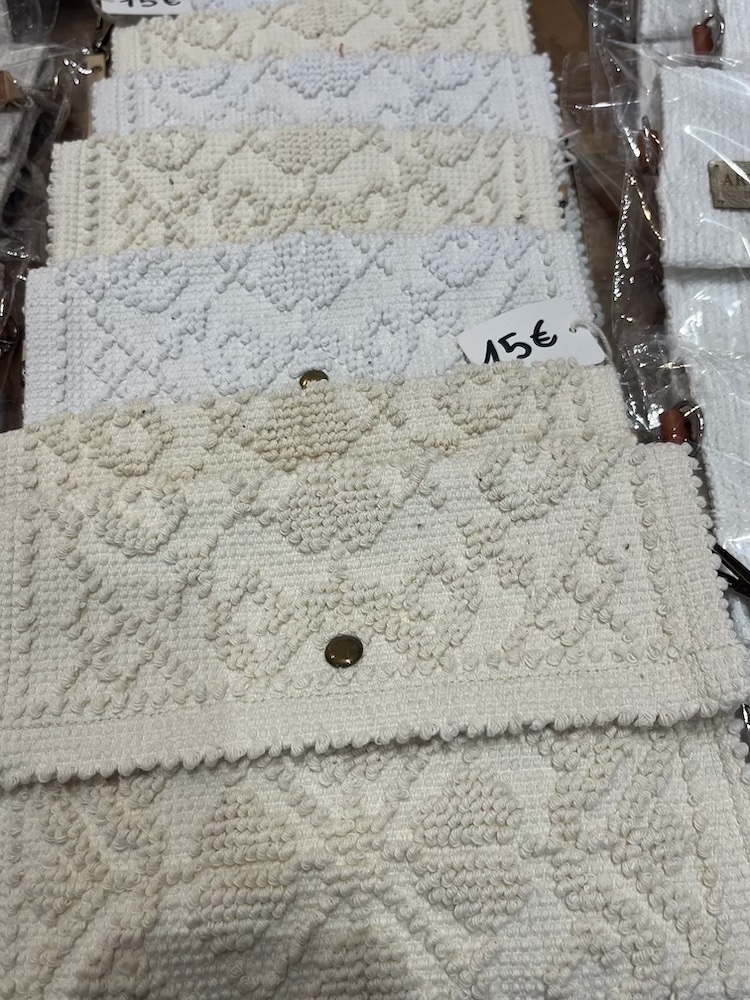
çThese were the other temptations. This wonderful loop work seems to be prominent in this part of the world. I bought a table runner in the Açores, on the island of Sao George done in this technique. I decided that as a table runner it would likely cause mishap with things falling over that I might place on it. Instead I intend to make into a long bolster pillow for our bed at home. It’s not done yet! While these bags were so tempting due to the skillful work involved, I went with my first love from last year–the simpler tote bag.
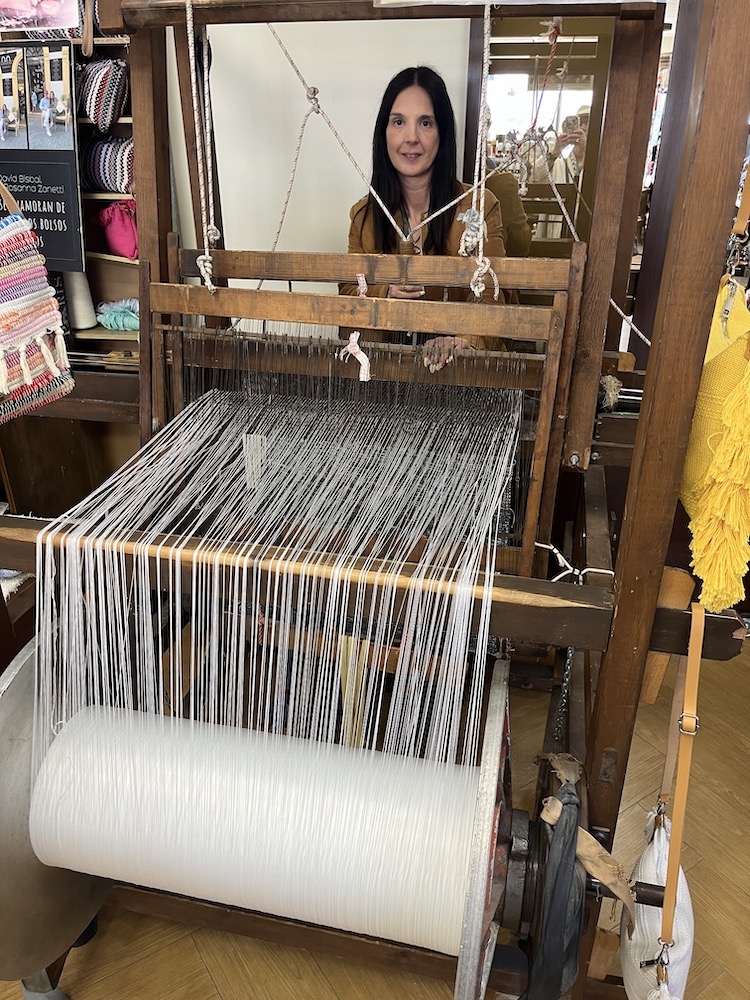
Here is the woman who was manning the shop during my visit, sitting at the loom demonstrating for me. The loom is only 2 shafts, and looks to have about a million meters of pretty fine cotton on it. The weft is heavier cotton, and she uses a fly shuttle to weave. At the moment she is weaving a rug, also a prevalent item for sale in this area.
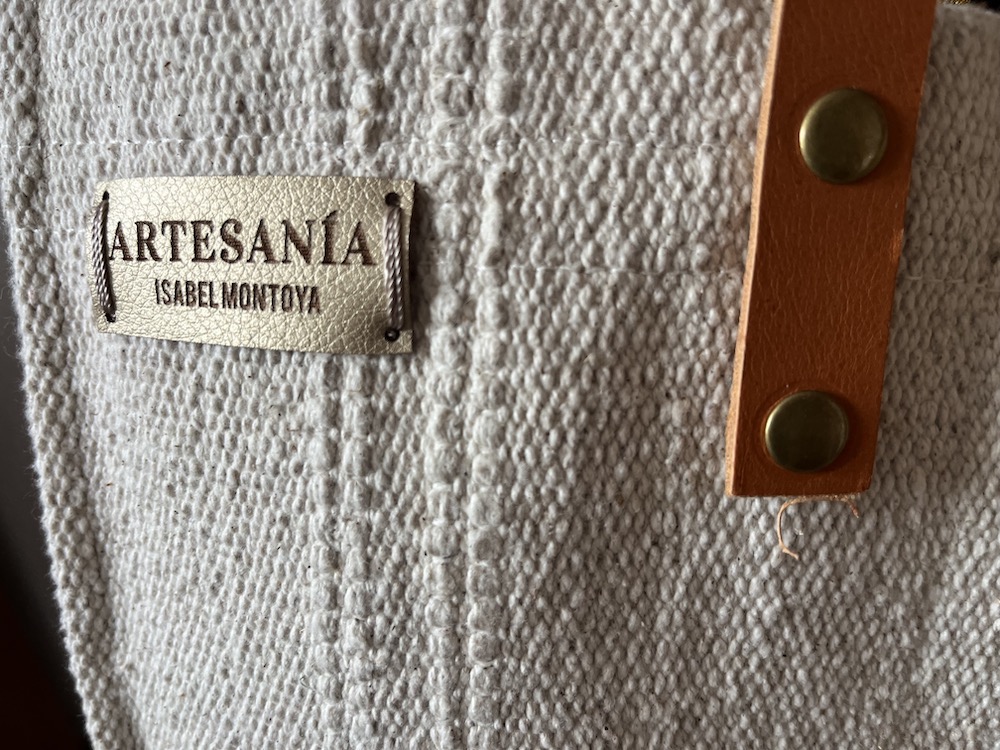
There are tags on the tote bags I bought, so I asked the woman waiting on me if she is Isabel. She showed me a group photo on the wall and pointed to Isabel. Why didn’t I ask her name? I learned that she weaves the many handbags and tote bags that have the loop weave, yet I didn’t think to get her name. Hugely disaapointed about that.
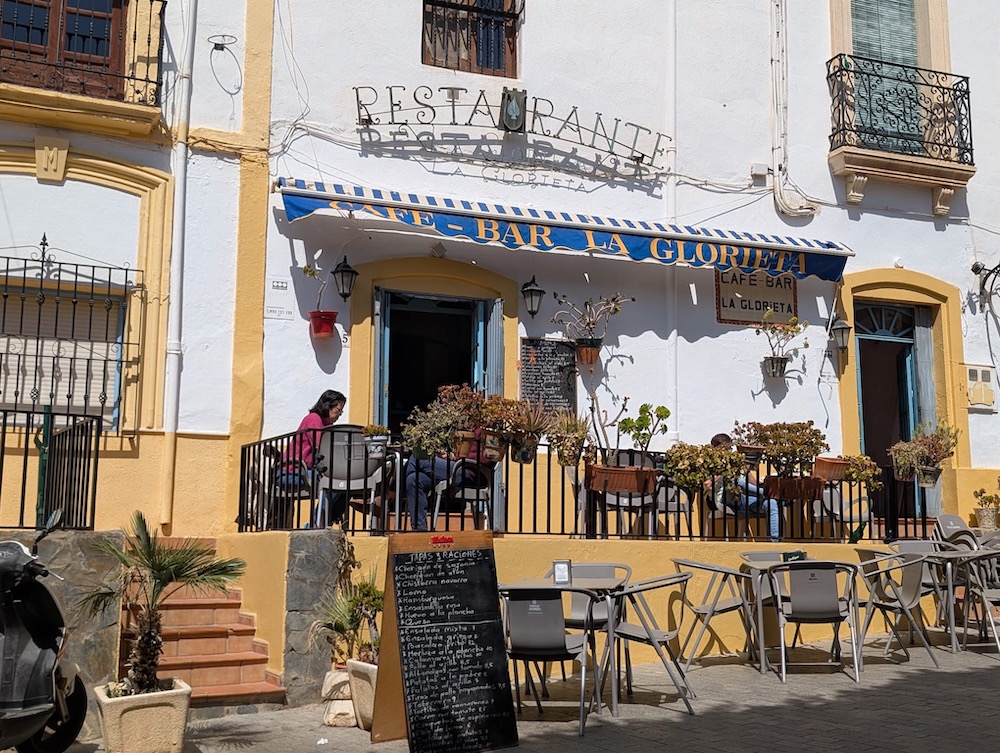
Last year we found a cafe where we wanted to have an afternoon glass of wine and some food before driving back to Almerimar. It was just after 4pm, and they were closing until dinner at 8pm. They could not give us any food, but they did pour us two glasses of wine and asked us to leave our glasses on their door step when we left. They closed the restaurant and left while we had our wine in their scenic spot near the courtyard of a historic church. This year we arrived in time to have wine and a several tapas for lunch.
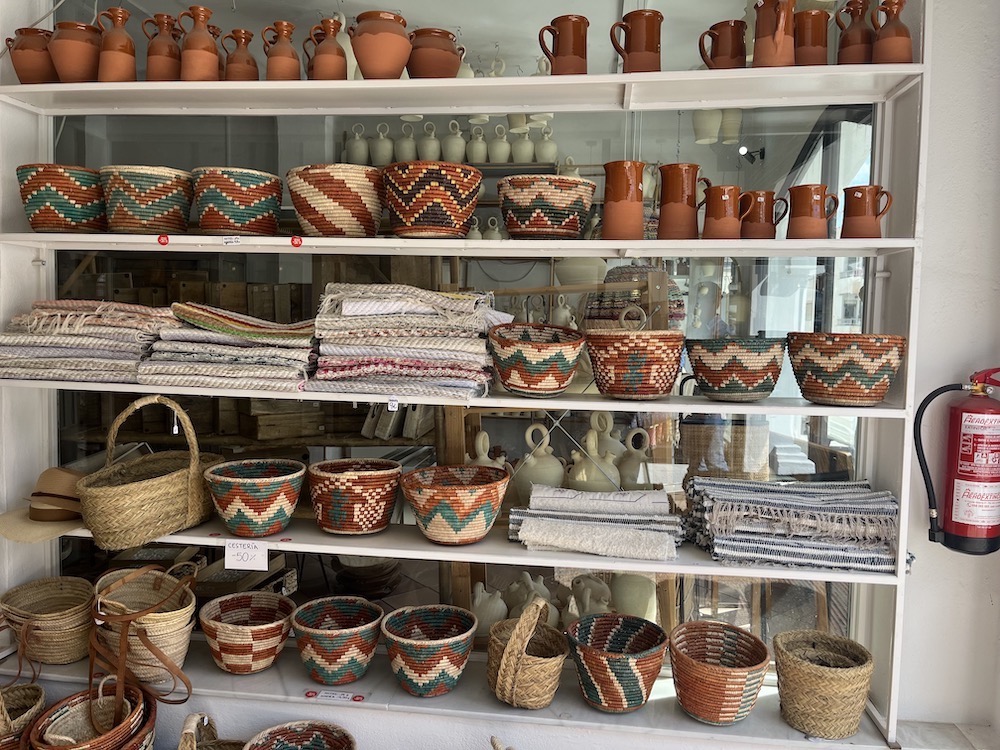
After lunch we walked through the town where I revisited a number of shops from last year. There are handwoven rugs and blankets in many of the shops, along with baskets, which this area is also known for making.
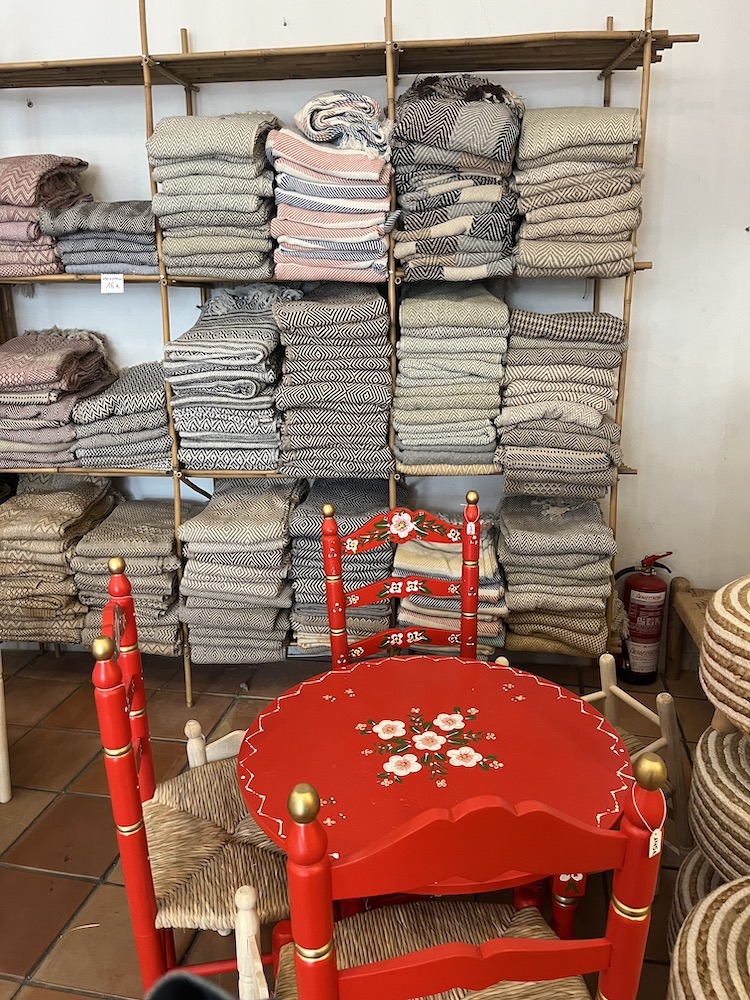
I bought a cotton blanket for Pandora, for those nights when I can’t sleep and end up in the main saloon reading or knitting. I bought a moss green twill patterned blanket like the one on the top shelf at the right of this photo. I wish I could get the table and chairs home somehow, but this photo will have to do.
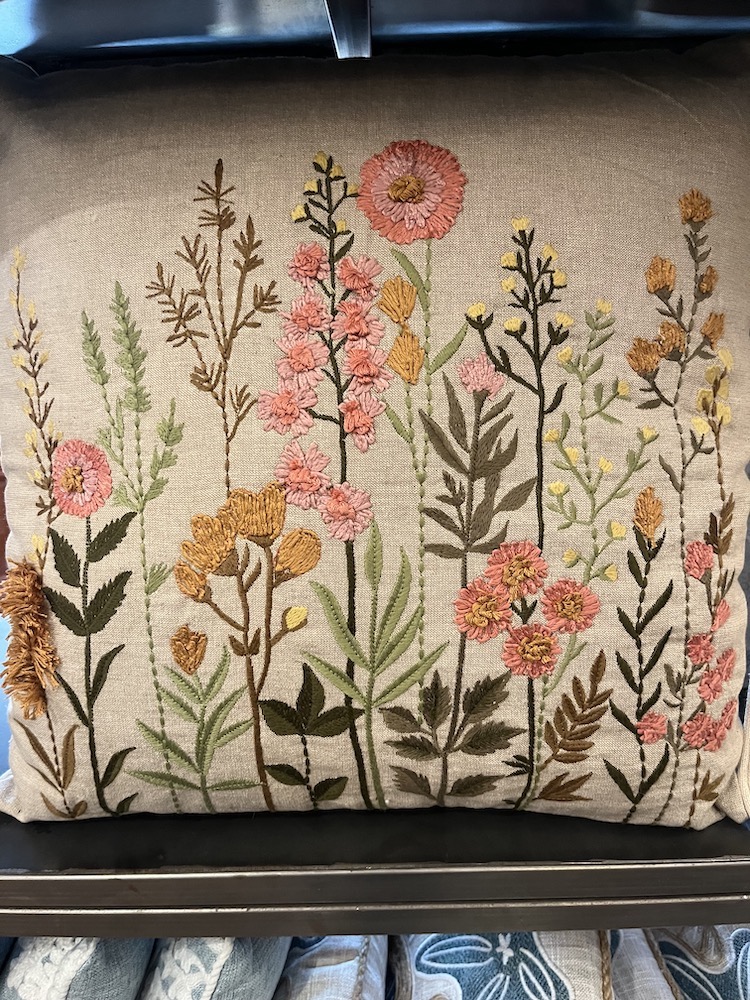
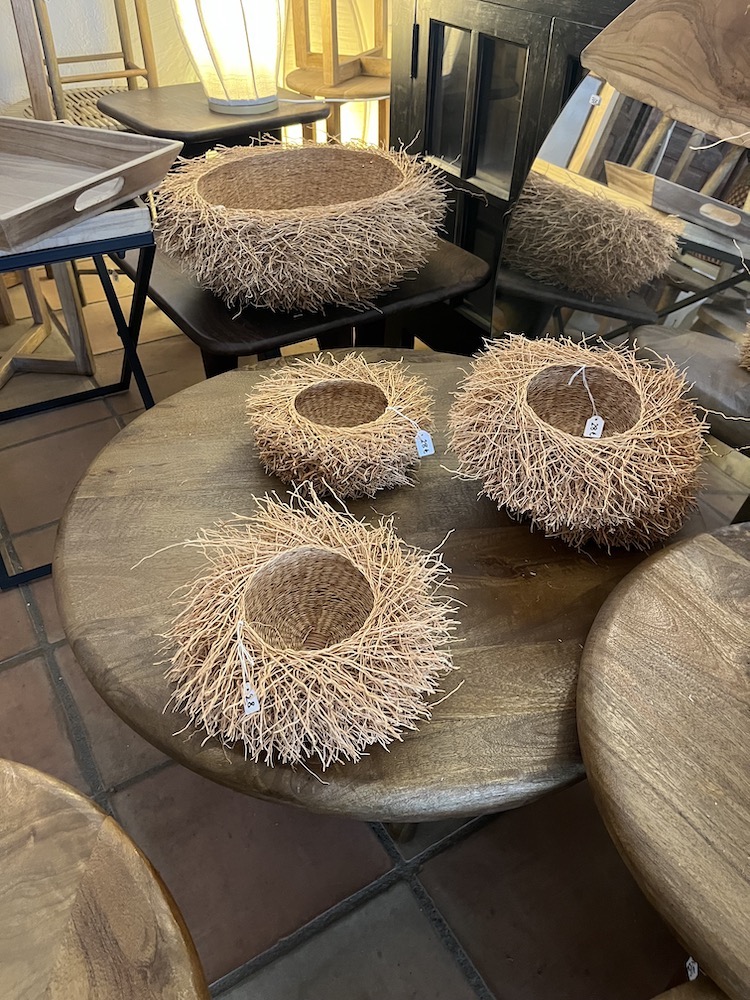
There were also lovely hand embroidered pillows, and a remarkable collection of baskets. Just a reminder–both baskets and handwoven tapestry can still only be made by hand. There are no machines that can weave tapestry or baskets.
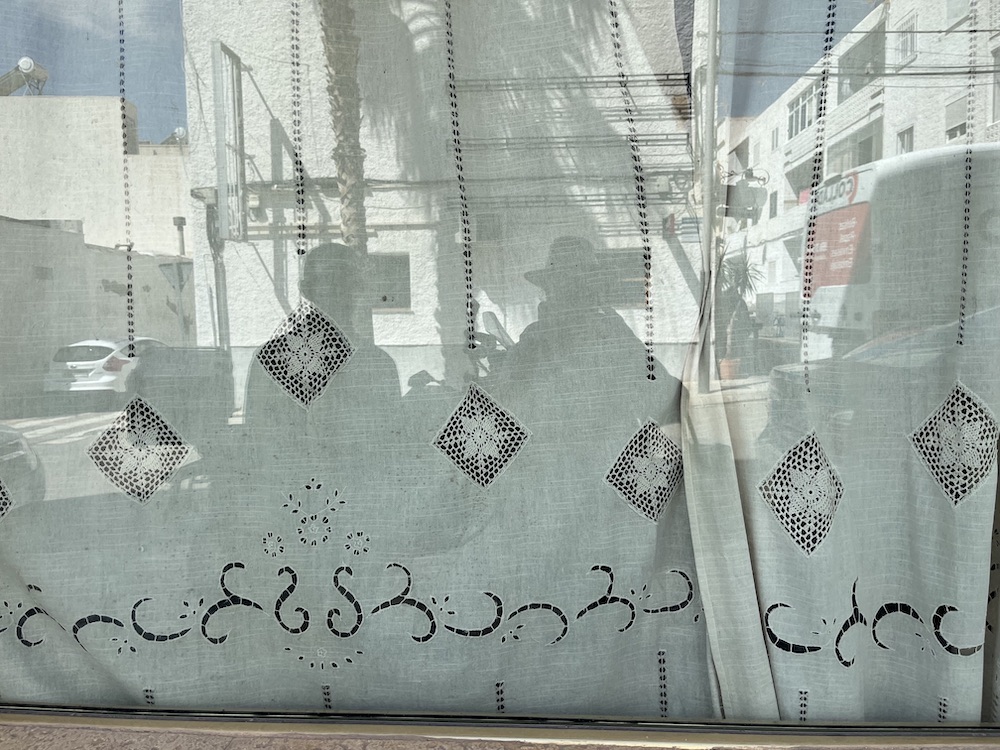
In taking a walk through the town I found this beautiful cutwork embroidered curtain. Too bad about the reflections, but I hope you can tell how well it is made.
We arrived here on Monday, where Pandora has been waiting for us since August. The repairs are not done to Bob’s hopes, which is something we always face when having things done at a long distance. The man managing our repairs did not stay on top of things, so the big inverter never got diagnosed to be either repaired or replaced, and the man who was doing the repair to our rudder from the orca attack, did a less than stellar job. He is quite prickly and declared that Bob is too much of a perfectionist (not his exact words–he used more colorful language) to appreciate the work that was done. Hmmm….
But on more positive subjects, this is almost a perfect time to be on the Costa del Sol. The sun is brilliant, while the temps are quite cool, so I am wearing sweaters every day! At this time of year–late winter/early spring– the winds are very strong, coming down from the mountains. Since this is desert, there is fine sand everywhere. Sometimes the mountains are shrouded in a cloud of sand somewhat similar to fog.
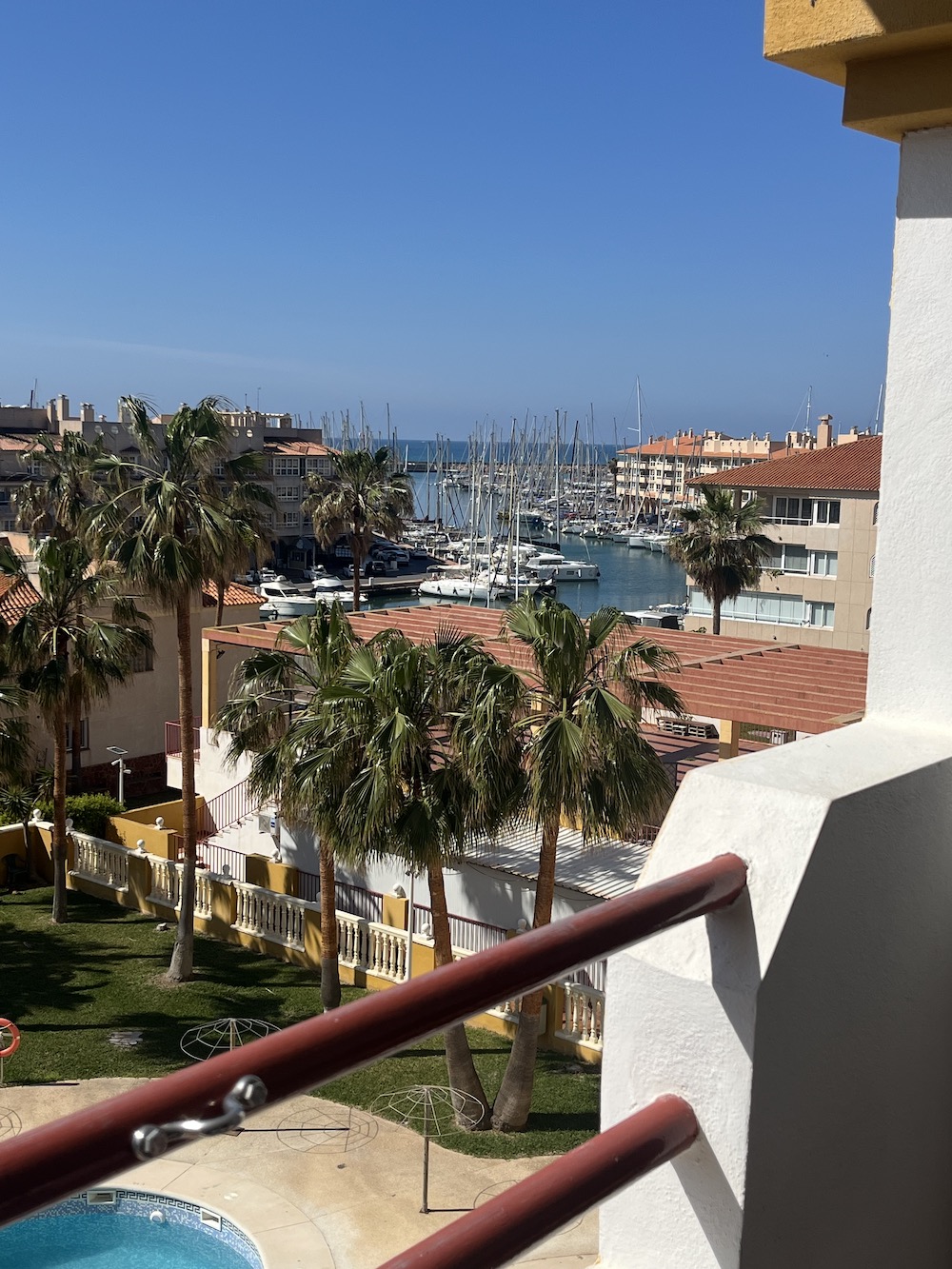
We have rented an Air BnB in a condominium complex. It is quite nice, and gives us a way to relax in comfort while Bob deals with various things to get Pandora ready to sail. It is too windy to launch her into the water at this point. On top of repairs and replacement of the inverter, we have to put all the sails back on her. We have a new Code 0, our biggest sail, but as I understand it, it’s the main sail that takes the longest to put back on. We haven’t tackled any of the sails yet because of the strong winds.
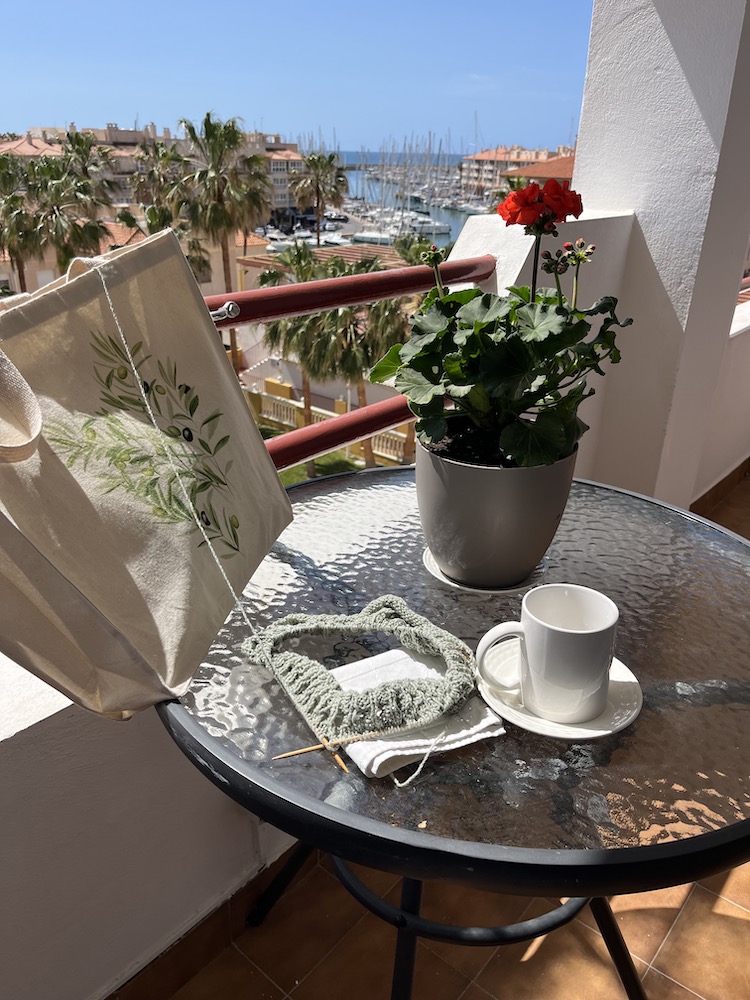
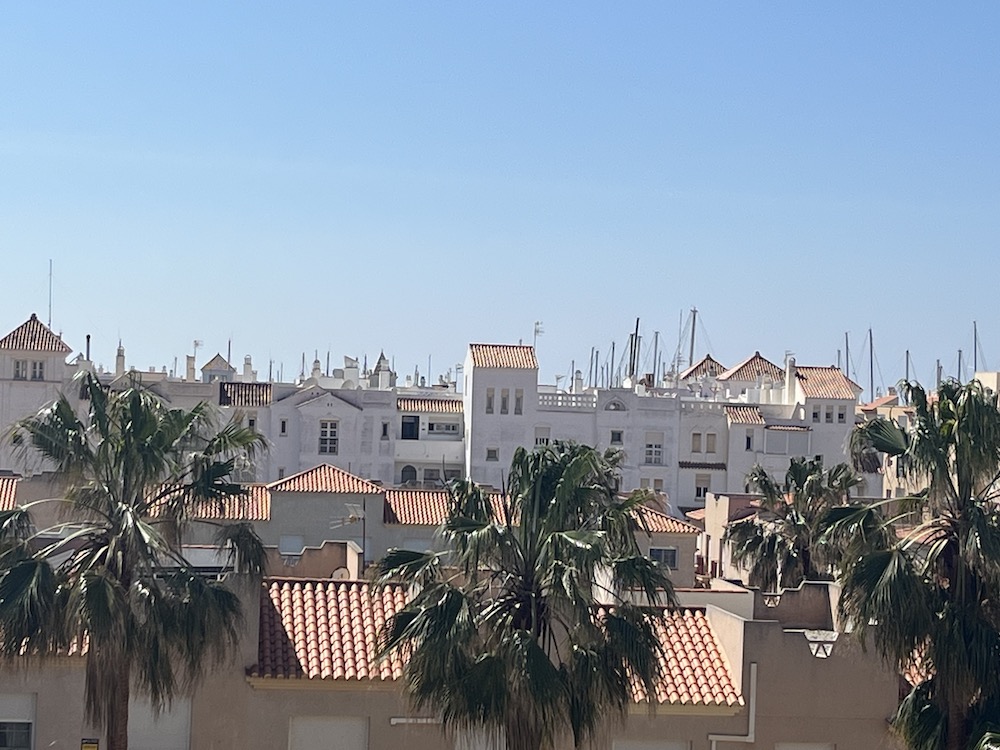
In the evenings we have a glass of wine on the balcony overlooking the rooftops of other dwellings and the boats in the habor. It’s quite magical. I should finish the Sonann sweater today and hope to get photos of me wearing it on this wonderful balcony with a view. The residences are low enough (right hand photo) that you can boat masts beyone the rooftops.
It will feel great to finish the Sonann sweater (photos soon), and even greater to move on to my next knitting project. From one of Wooly Thistle’s newsletters I learned of the Spanish yarn company, Wool Dreamers. They use locally sourced wool and cotton to make their line of yarns. Soana (not to be confused with the Sonann sweater name!) is a 50/50 blend of local merino wool and locally grown cotton. Wooly Thistle carries this yarn, but how could I NOT try to buy it in Spain?? As it turns out, I could not get it within a reasonable driving distance of this area. However, I could order it and have it delivered to a postal receiving place right here in Almerimar. So that’s what I did. Here are photos of the yarn and the pattern I will make with it.
Screenshot
I’m happy to be here, encountering weavers and seeing the skills of locally made textiles and baskets, not to mention pottery and other wares. It’s a great start to our season sailing in the Med. I just need calm seas to move to our next destination, and only the wind can decide when and where we’ll head next.
There are no bilges in a house, but often I think of the creepy, under-the-stairs closet in my studio (basement) as pretty bilge-like. It is dark, sometimes there are dead spiders in there, and I’m always reluctant to open the door.
When we moved here 14 years ago, I put bins in this closet filled with things I made decades ago. Mostly Bob packed these things for me because I was busy saying goodbye to the various groups I had been a part of over the 30+ years we lived in New Jersey. It wasn’t easy to leave. I put those bins in the creepy closet and haven’t dared look in any of them since.
But lately there are things I’ve remembered that I’d like to see…sweaters, for one. I am missing some sweaters I wouldn’t mind seeing again, if only to look at the designs for possibly knitting them again, or getting some new idea based on these past designs. I spent much of the 80s and 90s engrossed in Elizabeth Zimmerman’s ideology of knitting your own way through your own ideas. For a while Alice Starmore was encouraging this, and Meg Swansen still does. So I wondered where those sweaters had gone, when I thought all my sweaters were in the blanket chest at the end of my bed. I’ll spare you photos. Some of those sweaters were so trendy at the time, but could not stand the test of time. I did find a few that were truly classic. I’m glad to have them again.
I’ve been curious to find a woven jacket I made in the distant past, when I was a new weaver, and Anita Mayer gave assurances that you could make good looking clothing out of simple rectangles. I wove some Harrisville Designs shetland in two colors that conjured up raspberries and blackberries. I loved that fabric, but not the ill fitting jacket it became! That was likely 1979 or 1980.
In the 1990s I learned to spin, and got a Jacob fleece that I washed and carded and spun without separating the colors. I wove that fabric with the Jacob in both warp and weft. It looked like a crazy plaid, and I loved it. I always envisioned it as a boiled wool vest with a zipper in the front. So I lightly fulled it, and the plaid got even muddier. I did not have the courage to sew it. Now I wanted to find it.
I made a set of cotton placemats for myself and for my oldest friend before either of us had children, and my children are now in their 40s. It was an interesting overshot pattern, based on honeysuckle, that had a white warp and white as the pattern thread. The tabby was the color. What an interesting take on overshot that was. I think it came from an early Handwoven Magazine.
Then some of us in my very first guild — Shore Fiber Arts on the New Jersey shore — decided to make placemats and exchange them. We chose four colors that we all bought together, and we could make any woven structure we chose. I chose waffle weave, not realizing that when the mats were washed they’d look like rags if I didn’t press them with starch. I was so embarrassed by this project, but the placemats I got from the other three weavers were well done. I could never part with them even though I haven’t seen them in decades. They all had fringe–another requirement of the project, and I don’t like fringe on table linens. So, 40+ years later I have unearthed them and christened my new walking foot to sew hems on these. There are only three mats, since I must have thrown mine out. I’ll use them this summer. I remember two of the three weavers, and I hope to remember or find out who I am missing.
You know how things always get better in memory when you cannot find them? Well, some of these things are as good as I remember and some are definitely not!
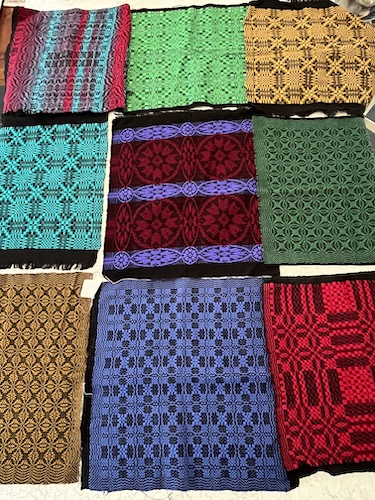
At some point in the 90s I joined an overshort exchange. We were to use a black 10/2 cotton warp and then pick any overshot pattern and use any color for the pattern weft. I think the goal was to sew them all together into some kind of throw or blanket. They are a frightening group of overshot squares that would give me nightmares! Still, it was fun to find them and lay them out for a garish photograph. My square is the green ‘Orange Peel” on the right in the 2nd row.
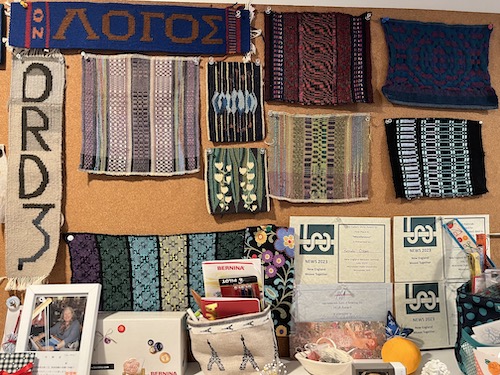
I found some of my first tapestry exercises when Archie suggested I try letters. I’ve gotten much better at this, but I’m happy to see these awkward attempts after so many years, so I added them to my bulletin board yesterday.
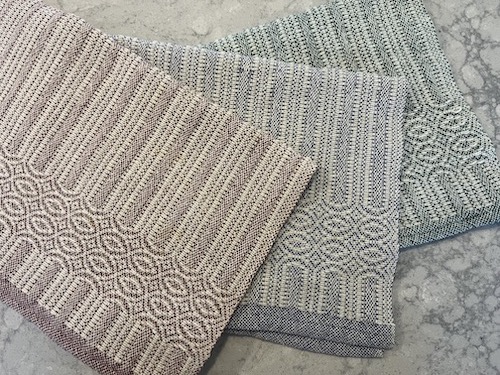
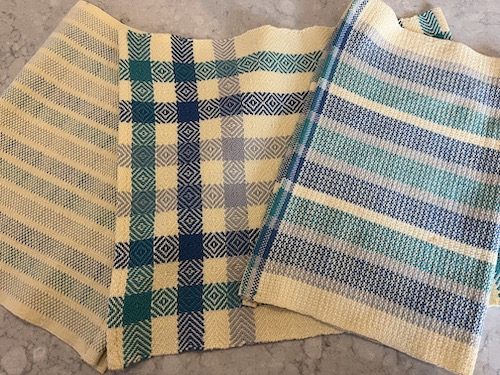
Along with the Greek word Logos and some letters I wanted to use in the border of a piece I never wove, I found some samples of scarves I wove in the 90s to sell at local craft fairs, and a sample from from a set of placemats I wove for my older son when he got married (middle right in the photo). I also found two small tapestries I bought on ebay, that were kit designs sold in Sweden. Then there is just the general chaos of my wall size bulletin board.
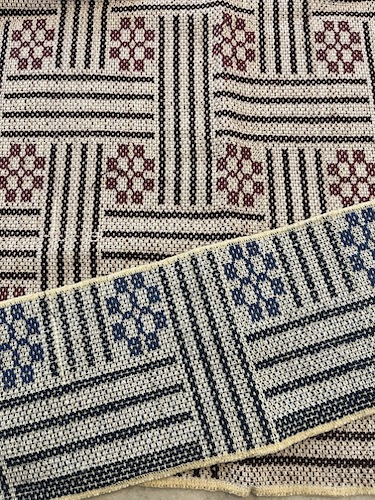
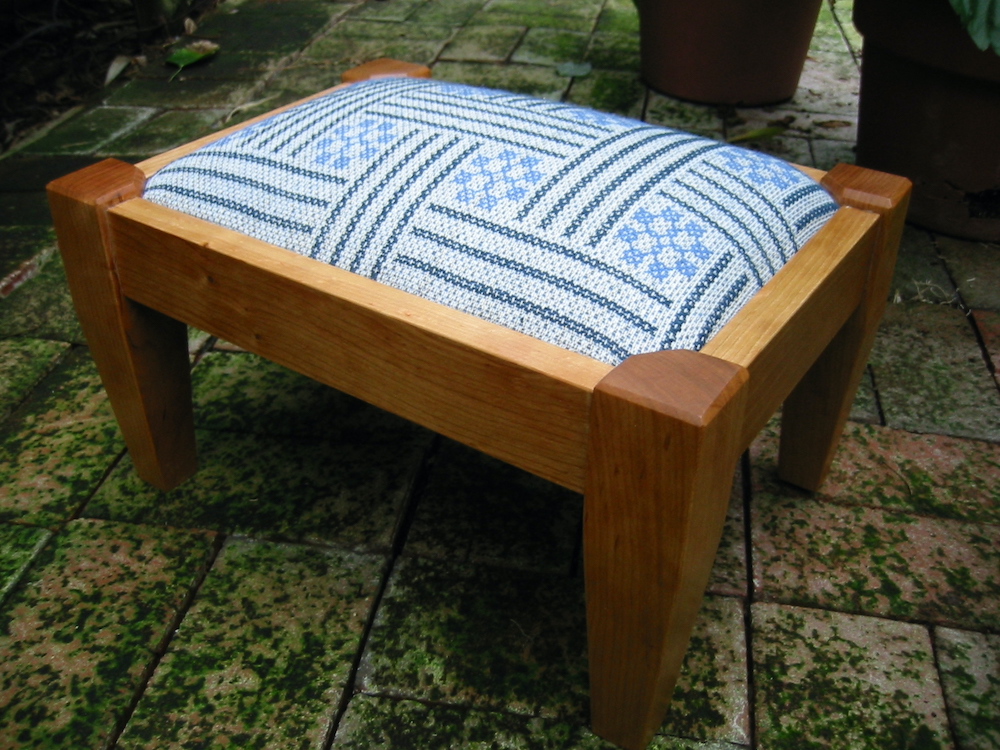
Both Bob’s parents and mine had their 50th anniversaries in early 2000s, and I wanted to make something for both couples. What can you give couples who have been married so long they have just about everything? Bob and I decided for a joint project. He’d make footstools and I’d weave the fabric. I wanted something that looked like weaving to symbolize their long lives woven together. This was a draft from the book The Shuttle-Craft Book ofAmerican Handweaving by Mary Meigs Atwater. It’s called polychrome summer and winter, and I wove it on my then new 16S AVL mechanical dobby. There is a fine gold thread in the tabby to commemorate their golden landmark. I had enough fabric for a footstool for Bob and me, and we will soon have our 50th anniversary–in one more year. I now have all three footstools since our parents are now gone.
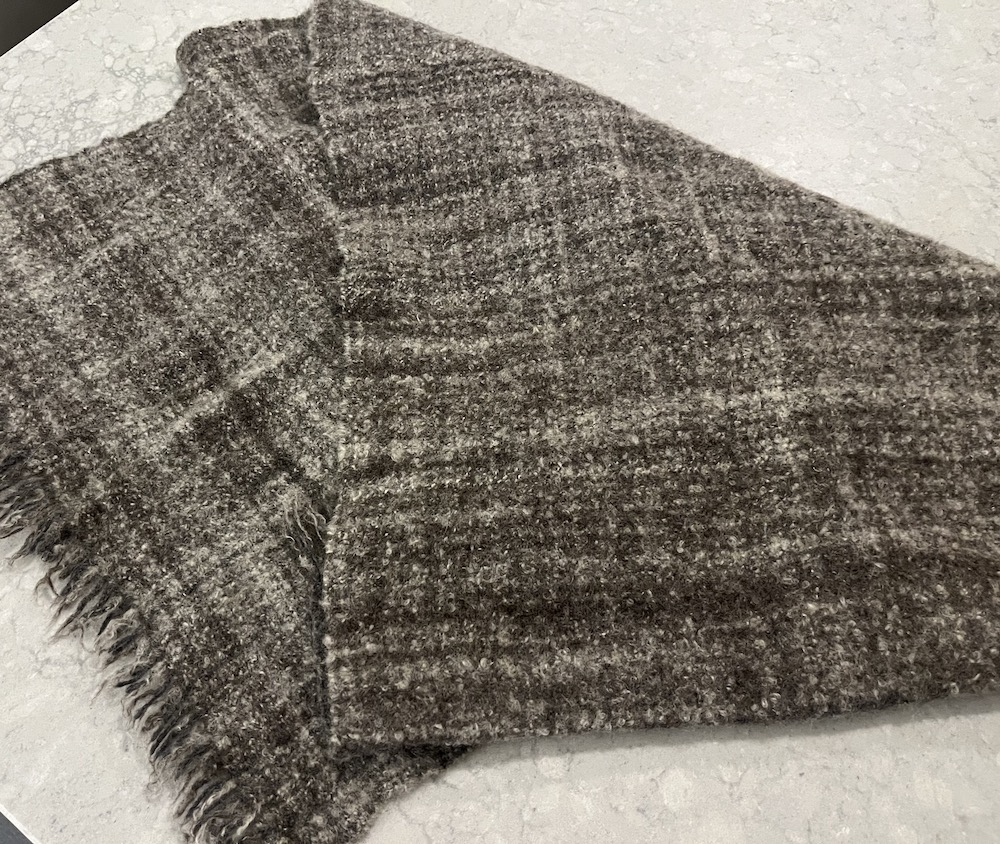
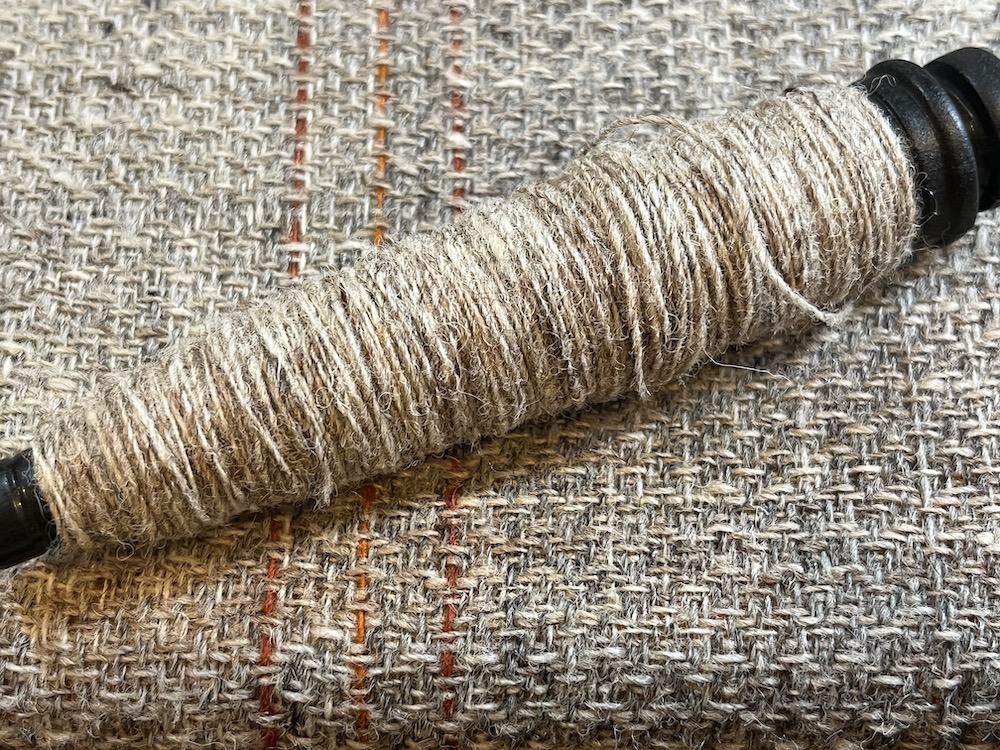
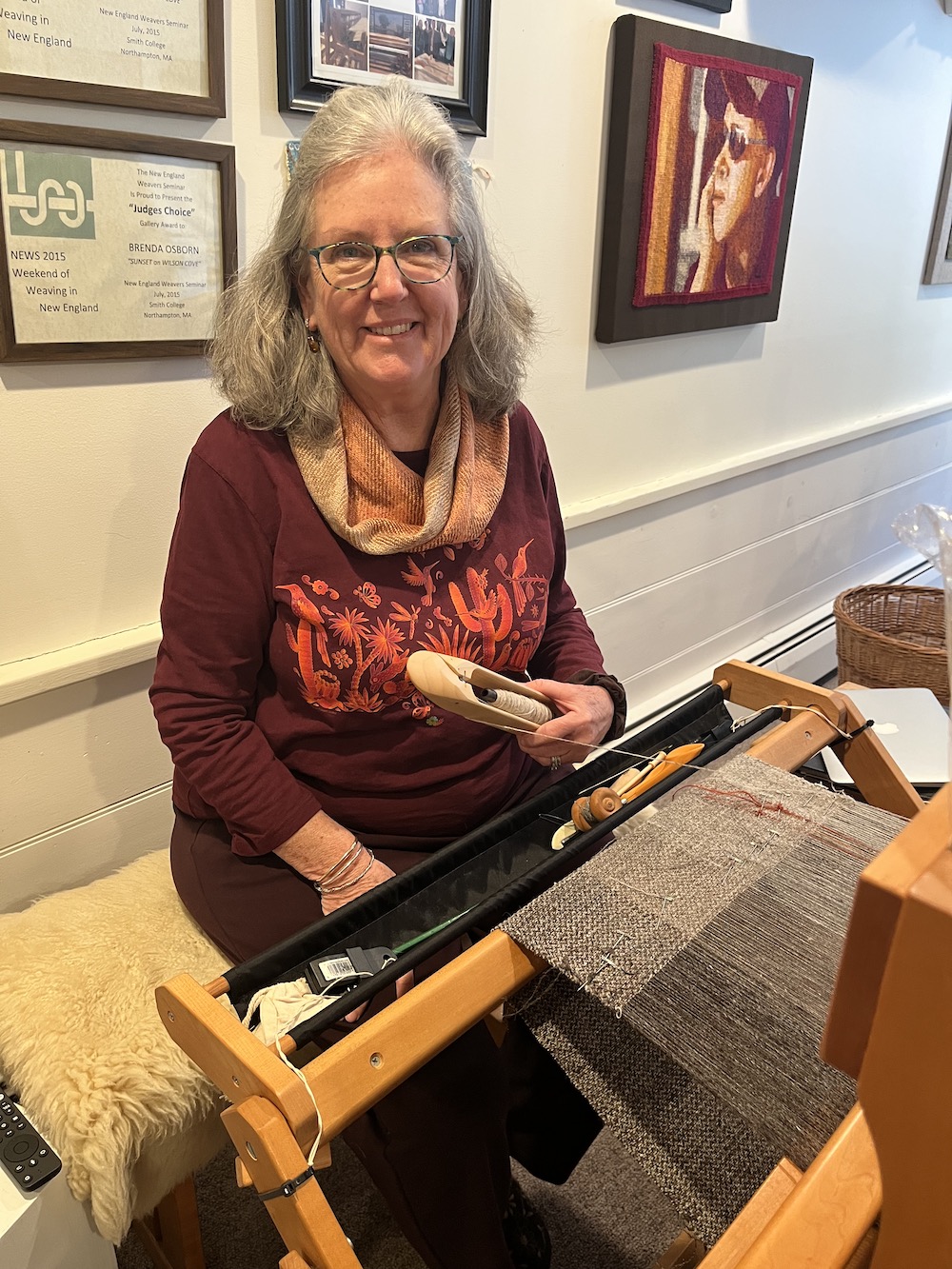
Today I wove for a couple of hours on my current project, Hebridean wool for fabric that I’d like to use to make a ruana. I’m almost done, 18″ to go, and it will be a game of chicken to see if my weft will last another 18″. I have no idea how many projects I’ve woven of the past 51 years. Too bad I didn’t keep better records, but it’s been a fun and surprising adventure to unearth these ‘ancient’ projects from my youth. Onward!
The year 2025 has been twirling around in my head for a couple of months now. I don’t think of myself as goal oriented (although my husband declares I am), but I do feel it helps me if I take inventory of what I made in the past year. It’s taken a me a few weeks to get around to this, and I found that I needed to document some things with photos.
The main thrill of the past year for me was travel! I have never managed to go so many places in one year as I did in 2025. Bob will take all the credit for that since he sailed our boat Pandora to the Açores and then on to the Mediterranean, enduring an attack by orca whales to get to his destination, knowing that his trip made it possible for me to see a bit of Europe. Being in the Açores for a month, Scotland and the Outer Hebrides for two weeks, and finally southern Spain and Madrid for another two weeks was such an eye opener for me, being immersed in the many kinds of handwork done in these richely cultural places. I’ve written about the Açores and Scotland in previous posts. I’d like to write about Spain, but not today. I have developed a new tapestry talk about the many tapestries I saw at Galeria de las Colectiones in Madrid, and I will try to cover that here sometime soon.
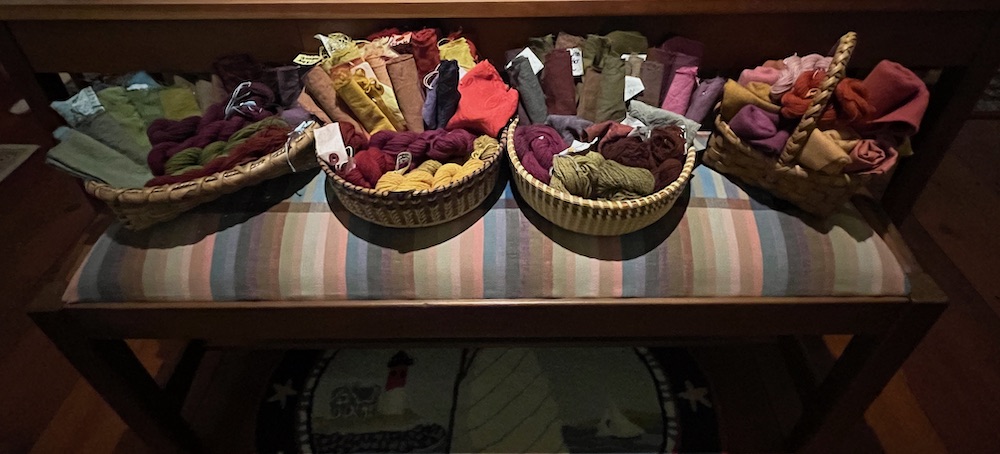
From September until just before Thanksgiving in November, I took the Maiwa Natural Dye Worshsop, led by Charlotte Kwon and her daughter Sophena. Every week of the 10 weeks I spent 5 days dyeing, usually about 4-5 hours a day. The workshop came with new videos each week as well as PDFs to print and put in a notebook. The instructions were thorough. I got fabulous colors that led to dreaming about future projects. I gained so much knowledge after decades of fumbling around with dyes and taking short classes at various conferences. This workshop is incredibly in-depth, and I now feel I have a reasonable amount of knowledge, and even better, confidence!
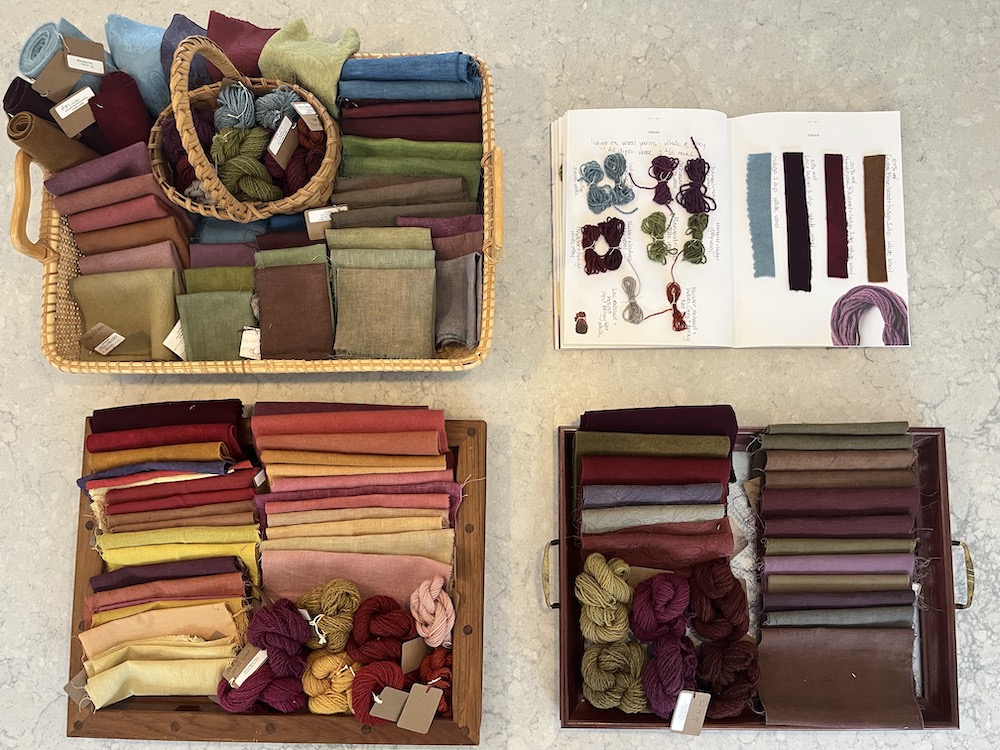
Yum, right? I thought all these samples would go in a notebook, but it turns out we only had to cut a small bit off each skein of yarn or length of fabric, so I have plenty to plan to use in some small projects. Whatever I end up making will be such treasures from this workshop. I have spent about 10 hours cataloguing everything in the journal that came with the class. That’s on the upper right below. The lower left shows all the original dyes done on white and grey yarn, white wool fabric, white silk fabric, natural and white linen fabric, and cotton and cotton/hemp fabrics. Above it on the left are all the original yarns and fabrics dipped in indigo to change the colors. The lower right shows all the original shades dipped in a 2% iron solution to darken the colors. This is a tremendous cache of color on beautiful fabrics. Now that it’s all safely documented in the journal I want to start making things with these bits of fabric.
The notebook was rather a lot of work–far more tedious than dyeing! So I thought I should make a short video describing it.
I’ve been feeling rather UNsuccessful in my weaving projects this year. I am making almost no progress on the ruana fabric made with single-spun Hebridean wool from the Isle of Uist. All the yarns are the natural colors of the sheep, and I arranged them in a gradation on the warp. The one color that I had the most of is the weft. I wish it were off the loom already so I could put the ruana together. Oh well. I feel a bit better about my lack of progress when I realized how much time I devoted to dyeing right up to the holidays.
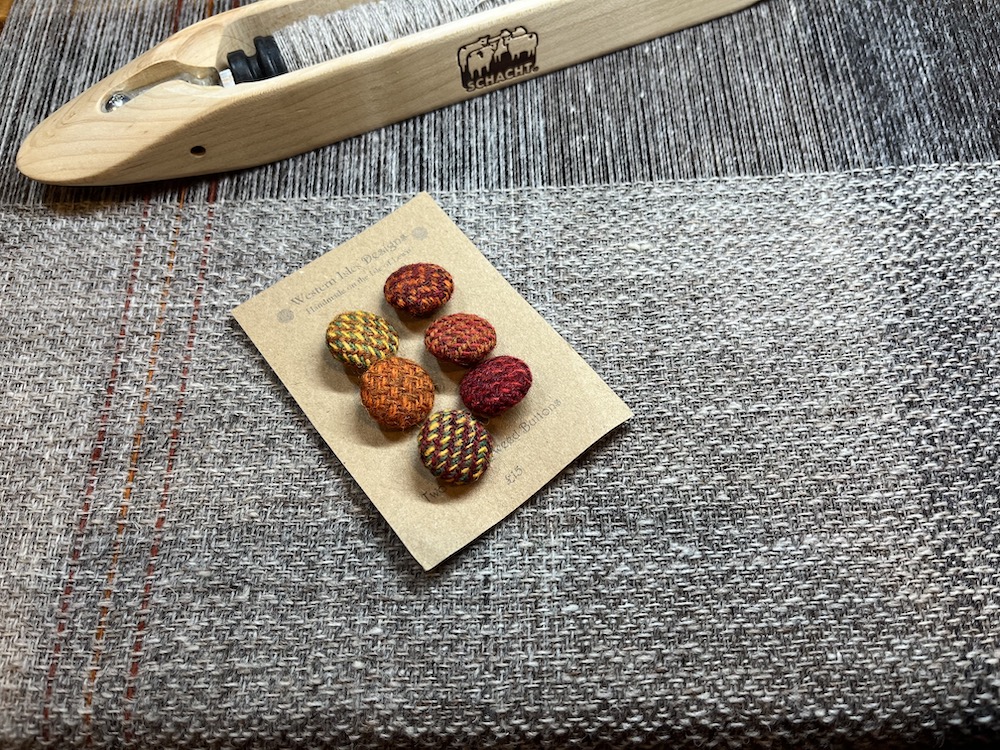
Aren’t these buttons sweet? I also bought them in the Outer Hebrides, at a shop called the Weaving Shed on the Isle of Lewis.
I grow older in the first month each year, and this year I have entered the next decade…70. Whoa. That’s a hurdle for me emotionally. A number of my friends (and Bob too!) are ahead of me, looking great and still in full control of their faculties, mentally and physically, so I am trying to believe I can do that too!
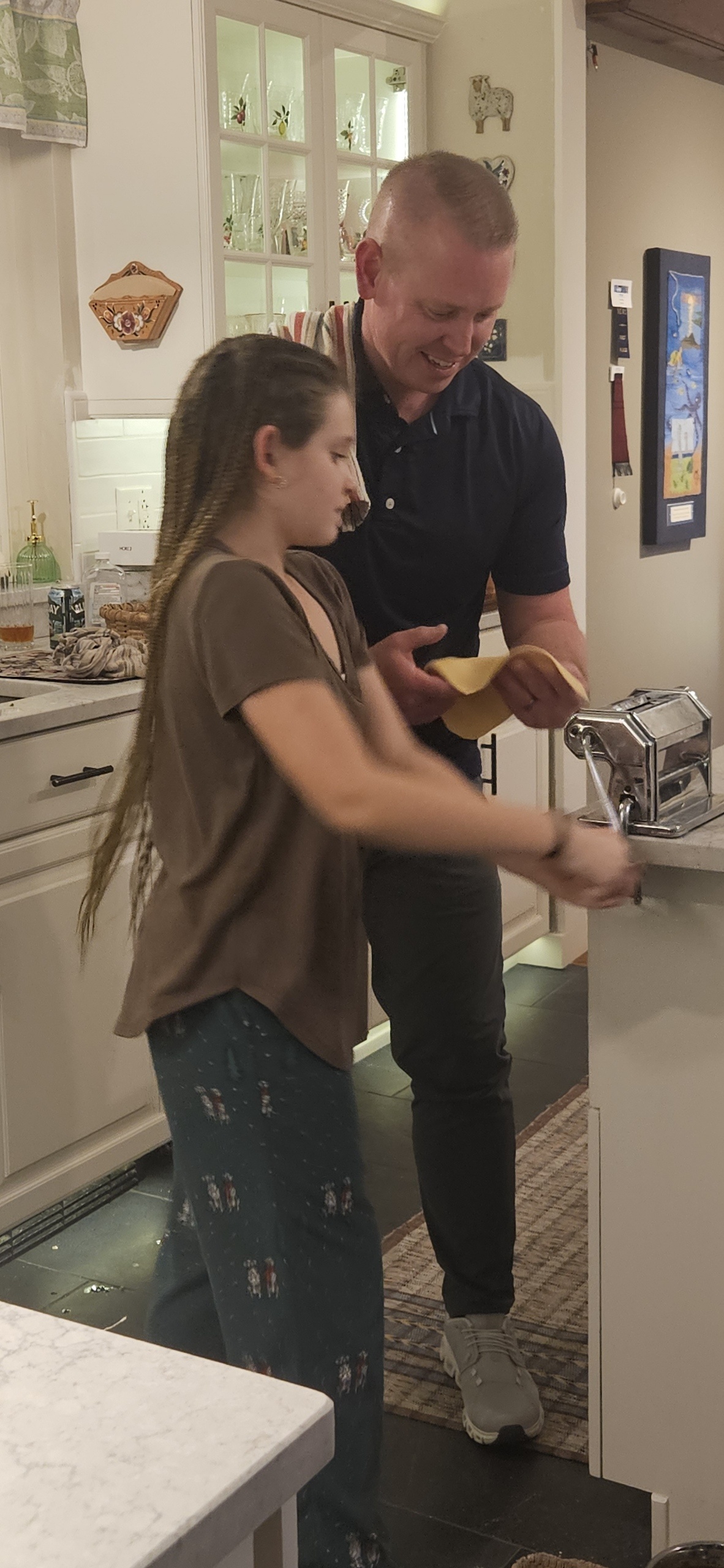
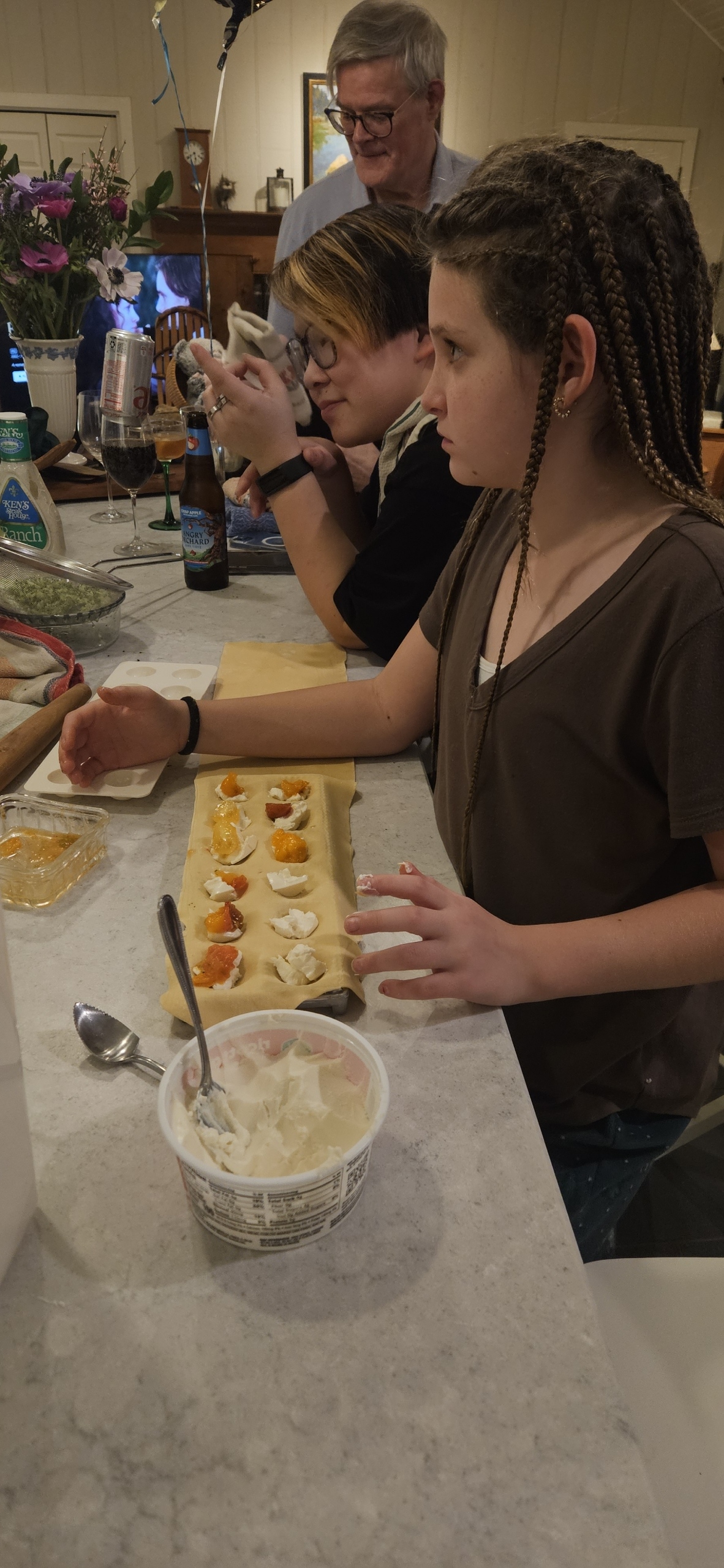
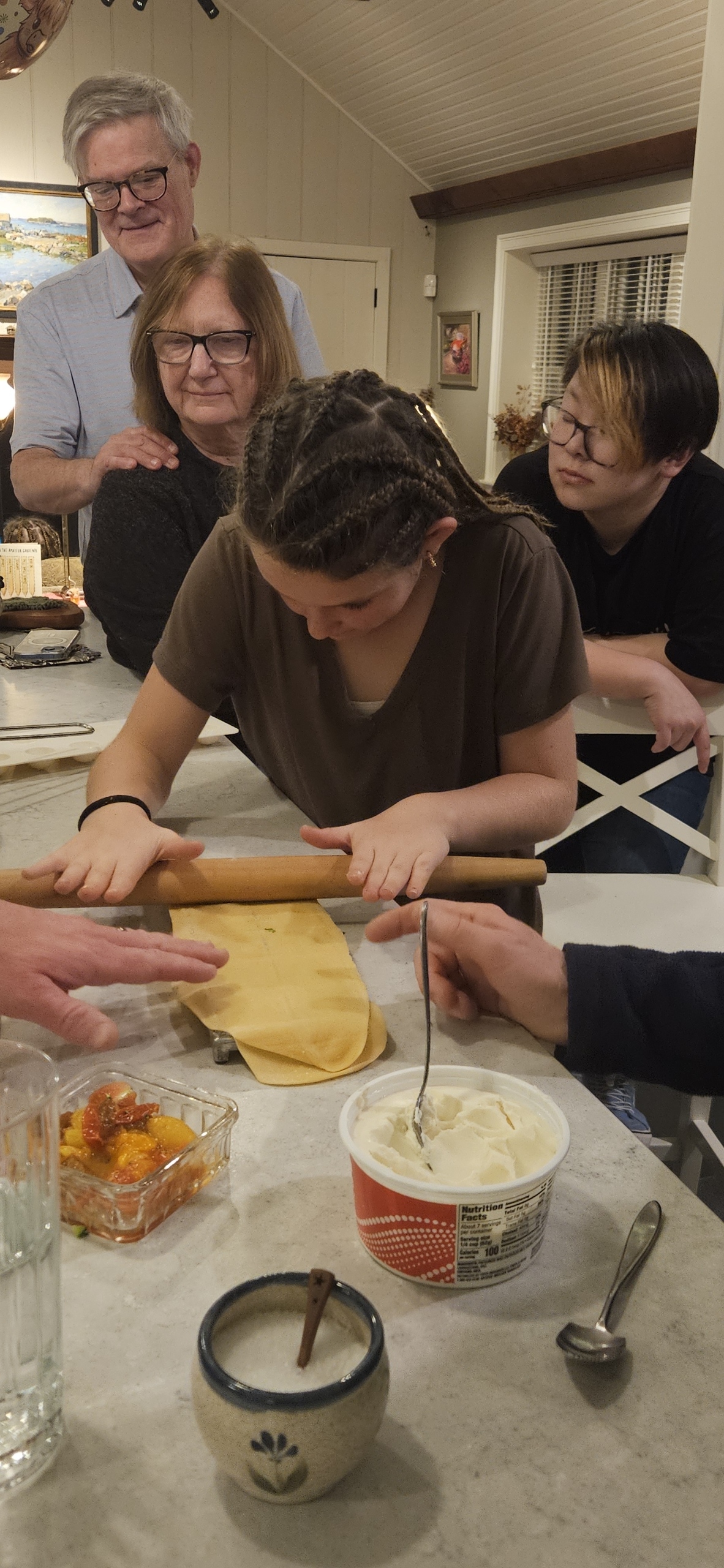
My children and grandchildren, and one significant other spent a long weekend with me to celebrate this landmark birthday. Tori, our oldest granddaughter (of three) made pasta and then turned it into ravioli….and she did it in front of an audience. She’s a natural!
And we had some great relaxation time in between cooking and being outside in our biggest snowstorm, walking in the woods and building two snowmen.
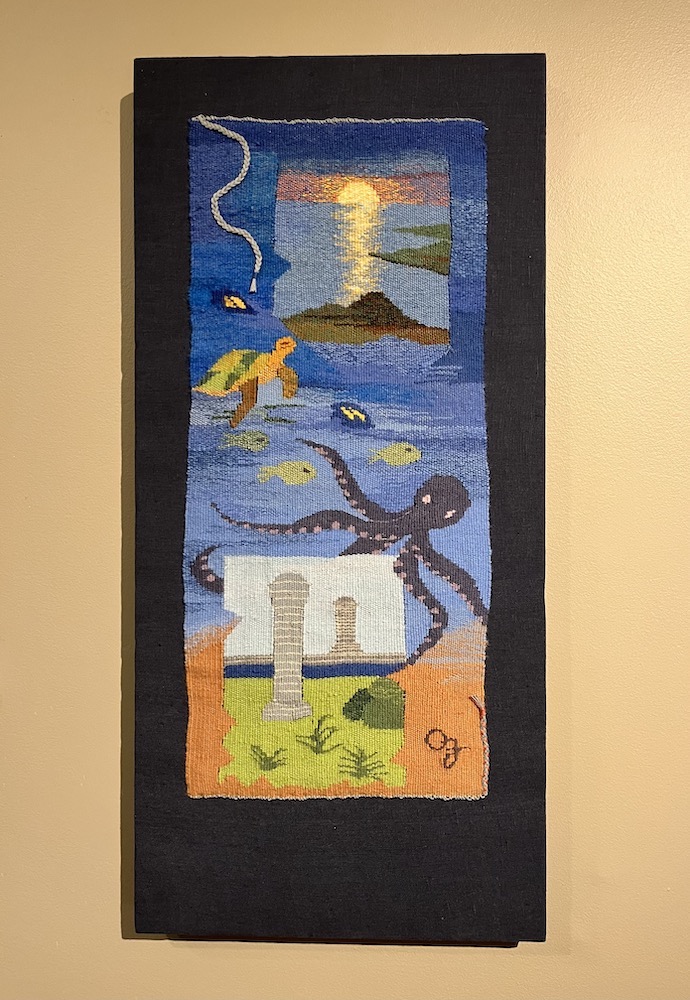
t was a year ago that I finished this tapestry. Hard to believe. It seems like more than that. Again, this is a realization that helps me make peace with the fact that my current tapestry has barely 1″ woven. Where does the time go?
This afternoon I took stock of the knitting I did last year. I had such a great time buying yarn in the Açores, in Scotland, and in Spain. I actually did something with a fair amount of it. Go me! The grey cotton yarn is from Horta, on Faial, in the Açores. The cowl on the left is a free pattern on Ravelry, and the cowl on the right is “Inspira,” also on Ravelry.
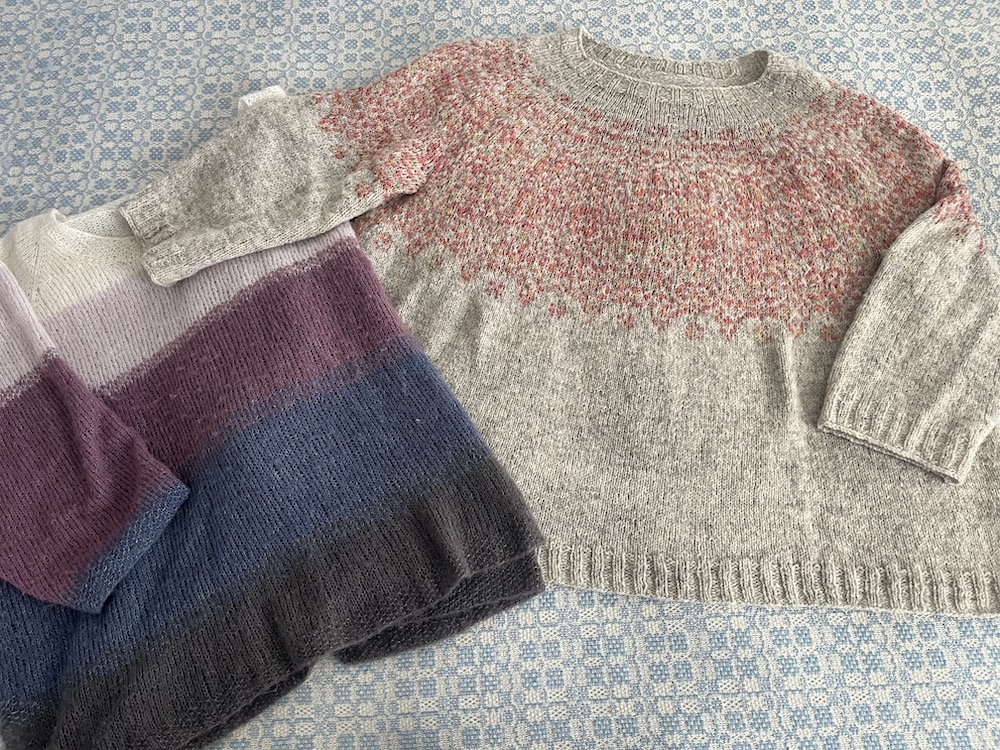
The pattern yarn in the stranded knit sweater is from the Weaving Shed, mentioned above. It’s a blend of merino and silk that is probably not from the Hebirdes, but it was dyed by one of the sisters at this company. The other sweater is 100% cashmere yarn that my son Rob gave me for Christmas in 2024. I wasn’t sure how to best use it, so I just made a simple top/down, raglan sleeve striped sweater in the round. I don’t think it weighs more than an ounce, yet it is SO warm.
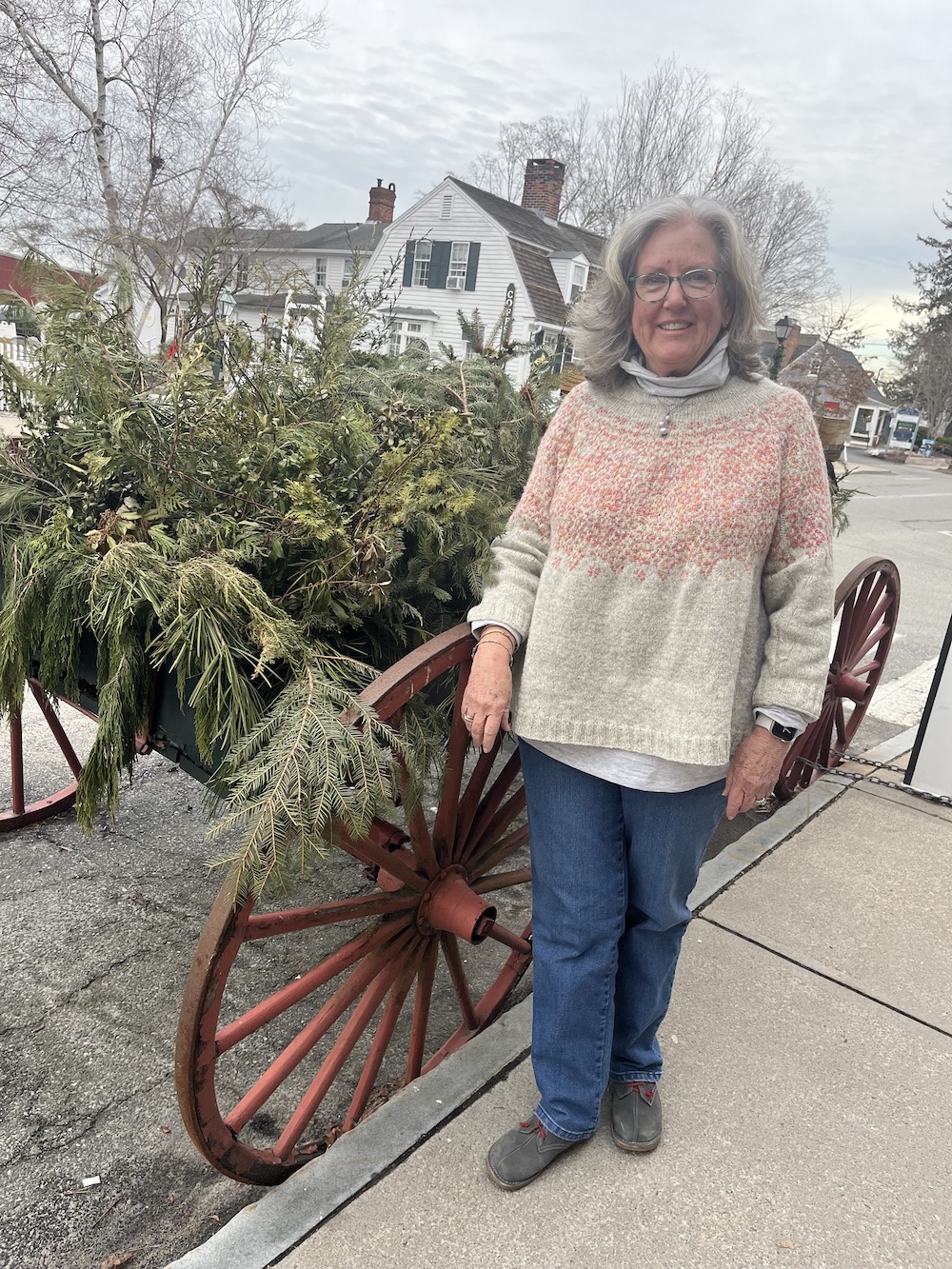
My friend Jody took a photo of me wearing my new Scottish sweater, which is entirely Scottish yarn but a design by German designer Elenor Mortensen on Ravelry. I am standing outside the iconic Griswold Inn in Essex, CT.
Not too bad a rearview assessment of making things last year. I feel better now. Bob has been busy as well during our months at home. He made a couple of cutting boards, done with end grain, a rather complicated desk for our son Chris who wanted a pull out tray underneath for his keyboard. Now he is making good progress on an “L” shaped desk for his office.
Finally, i want to mention a book I’ve just finished reading: With Her Own Hands by Nicole Nehrig. It has given me some clarity in looking back at my last year of working in textiles, as well as my long history of doing so. I have been knitting for over 60 years now, and weaving for 50. Weaving tapestry for just over 25. Spinning and kumiho are also reaching the 30 year point. The author describes things in life that are beyone words, that some people can only respond to life visutally, not with words. I have always turned to words, but this book made me see that there are times when events and life experiences cannot be contained or described by words. Sometimes those of us who work with our hands can only respond in the ways we are comfortable expressing ourselves visually. This has been a year like that.
“Counting stitches or holding a complex pattern in mind may distract a knitter, crocheter, or weaver from worries. We lose self-consciousness through absorption in the activity. The repetition involved can lead to a hypnotic, calm state, a kind of meditation through motion. Textile work confers a sense of control and mastery that can counter balance the lack of control we may experience over what is happening in our larger world.” –Nicole Nehrig
Whatever you are currently working on, I hope it gives you this sense of calm, of meditation, and a strong sense of balance. Onward we go.
On the penultimate day of 2025 I find myself thinking about the Outer Hebrides and what the weather is there at this darkest time of year. They seem to have stunning sunsets and sunrises, and rainbows. Somehow I’ve gotten myself connected to more facebook sites about Scotland than I ever imagined. The images of these northern places in December has been thrilling to see every day. I dearly hope I can make another trip to Scotland in the next year or two.
The second half of my visit to Scotland in July was a private tour of the Outer Hebrides. My friend Kari found the tour service that we chose. The tour was just for the two us, with sites chosen by us. The tour company (McKinley Kidd) made all the train and ferry connections for us, all the lodgings, and most of the meals. On each island we had a driver who had a list of sites that we had chosen to see as well as a list of sites we shouldn’t miss. I had seriously considered the idea of visiting the islands on our own. I’m relieved that I got onboard with having the luxury of this tour company taking care of almost our every need. We took a train from Glasgow to Oban to board a ferry to the southern most island of Barra. I had no idea that the ferry alone would be five hours. The map made the trip look like a mere hop and skip. From there we went to South and North Uist, then Bernaway, and lastly the combined island of Lewis and Harris.
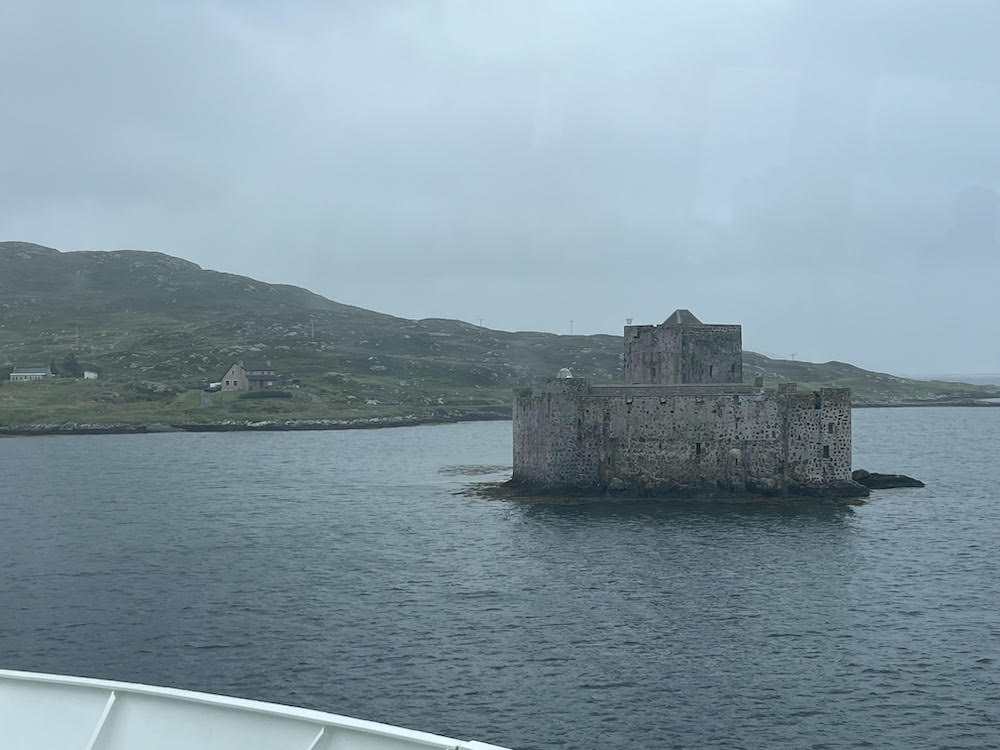
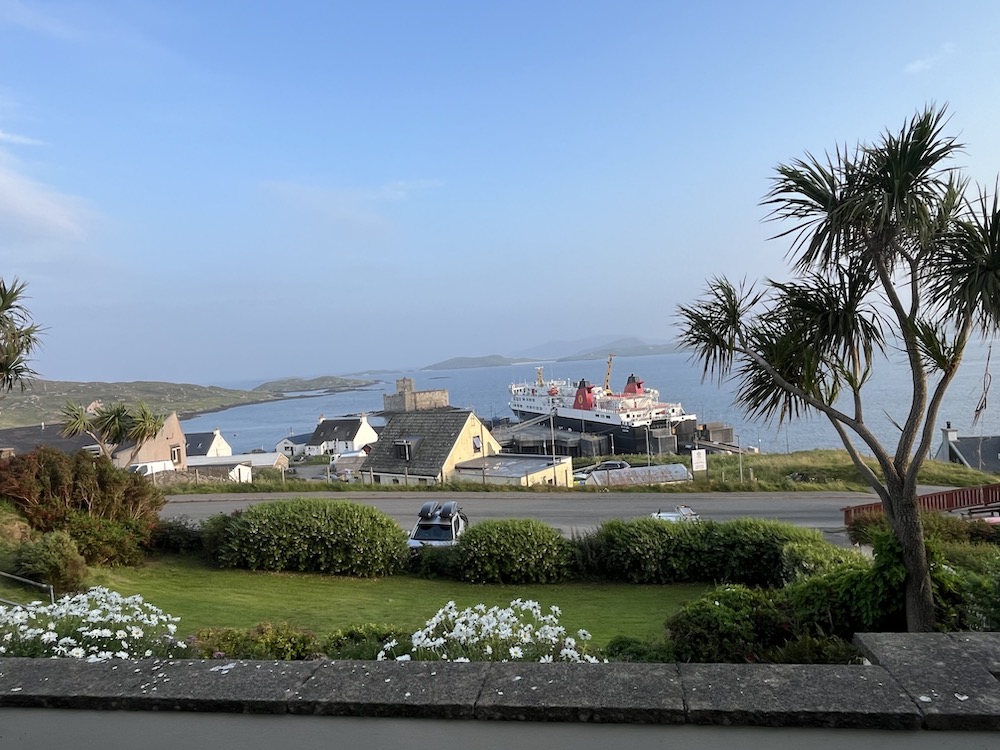
Here is our ferry arriving on Barra after the five hour trip from Oban
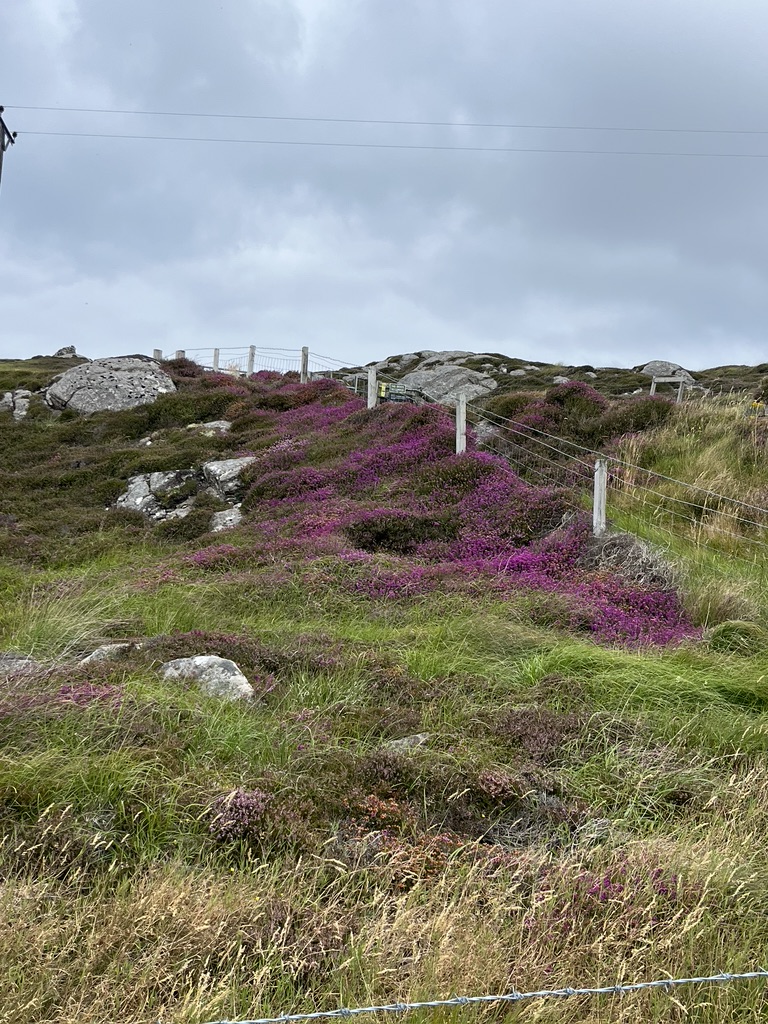
The heather was just beginning to bloom in souther part of the islands.
The ferry terminal in brighter weather.
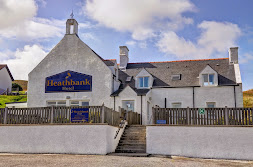
We stayed here at Hearthbank, where we were unfortunately not able to get dinner! The owner was leaving for the mainland and would have to close and lock the dining room. On the other hand, she arranged for a chef to make breakfast for us the next morning, which was memorable! Perfectly poached eggs on toast.
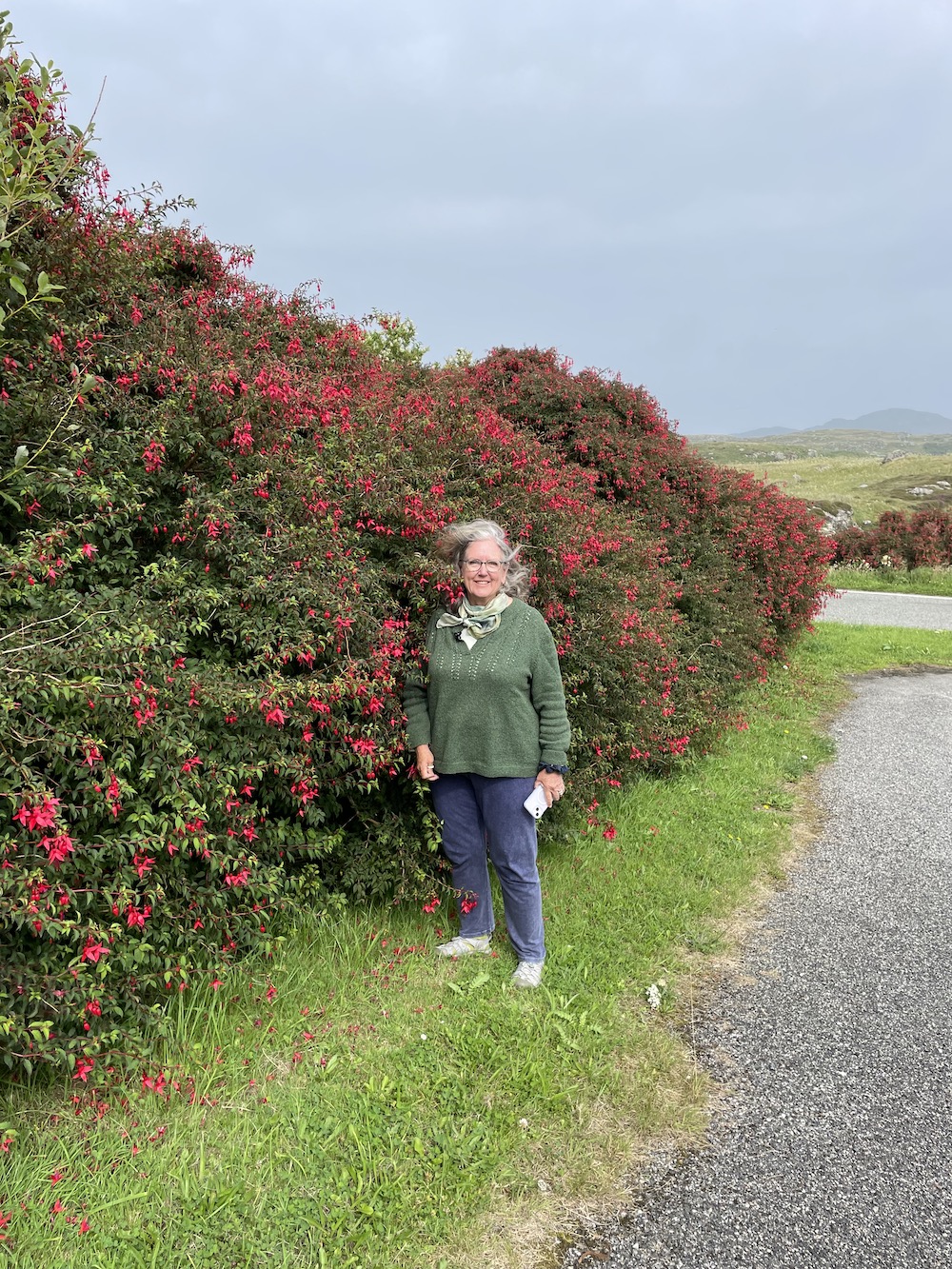
There was a massive hedge of fuschia long the driveway just outside the right side of this photo. Yes, it was windy!
Barra’s airport is on the beach, and the planes take off and land at low tide. That is something to see! We saw both this landing and then the next take off. It was truly something to see passengers deplane onto the sand.
While I didn’t see any wool related things on Barra, this was quite an exciting way to start our week in the Outer Hebrides. From here we went to South and North Uist (is that Grimsay?) I can’t manage the names of towns vs islands. Maybe both islands together are known as Grimsay. Feel free to enlighten me!
We had a wonderful driver/tour guide on South and North Uist. He was keenly aware that I wanted to see sheep and wool production on these islands. He also wanted us to see the mostly buried standing stone sites on these islands, as well as a couple of monuments. He is a budding bagpiper, while his brother is well established and plays at all the local festivals. During one of our walks off the beaten path he picked a handful of locks from the local white sheep. The locks were caught in brambles. They are still in the pocket of my raincoat.
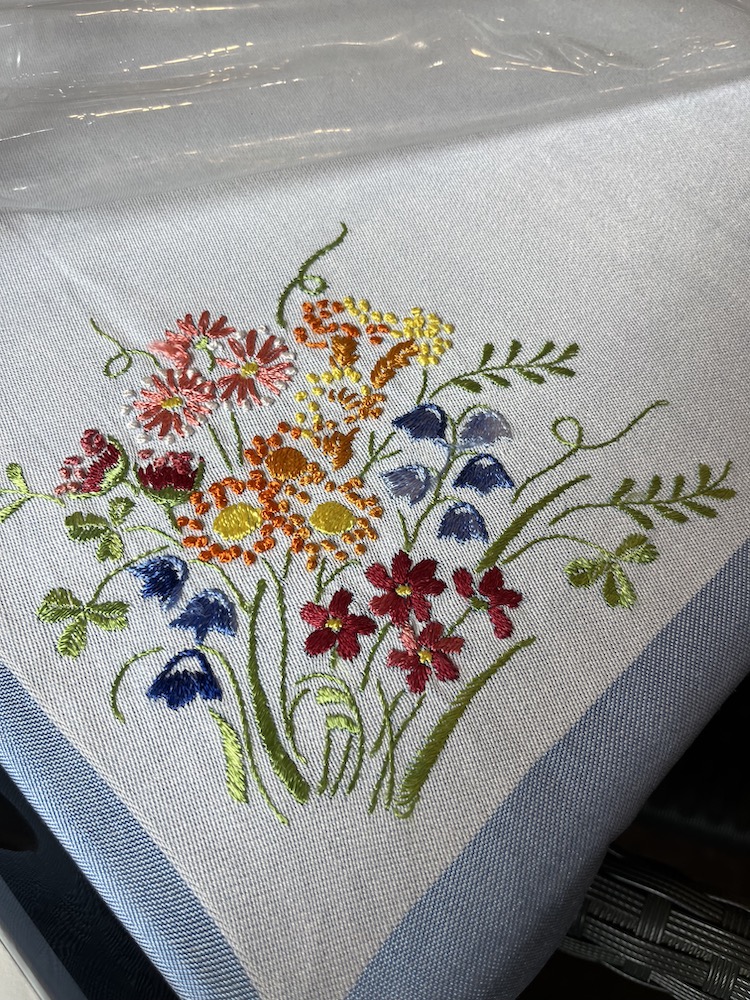
He took us two wool producing places, and equally impressive was the scandinavian bakery near Scotvein where Kari and I had lunch. Every table had an embroidered tablecloth on it, covered in plastic to protect the lovely handwork. I couldn’t care less about the cake! I just want you see the bit of embroidery at the borders of the photo!
Here is our table. I pulled aside the plastic cover to better enjoy the embroidery that was done on each corner of the cloth.
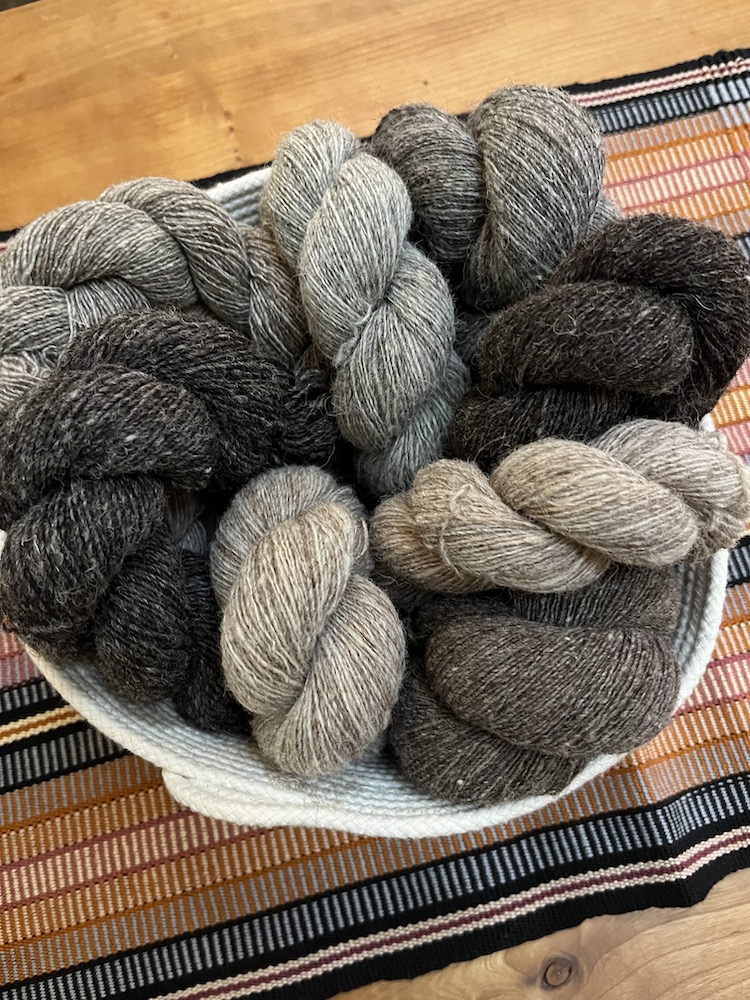
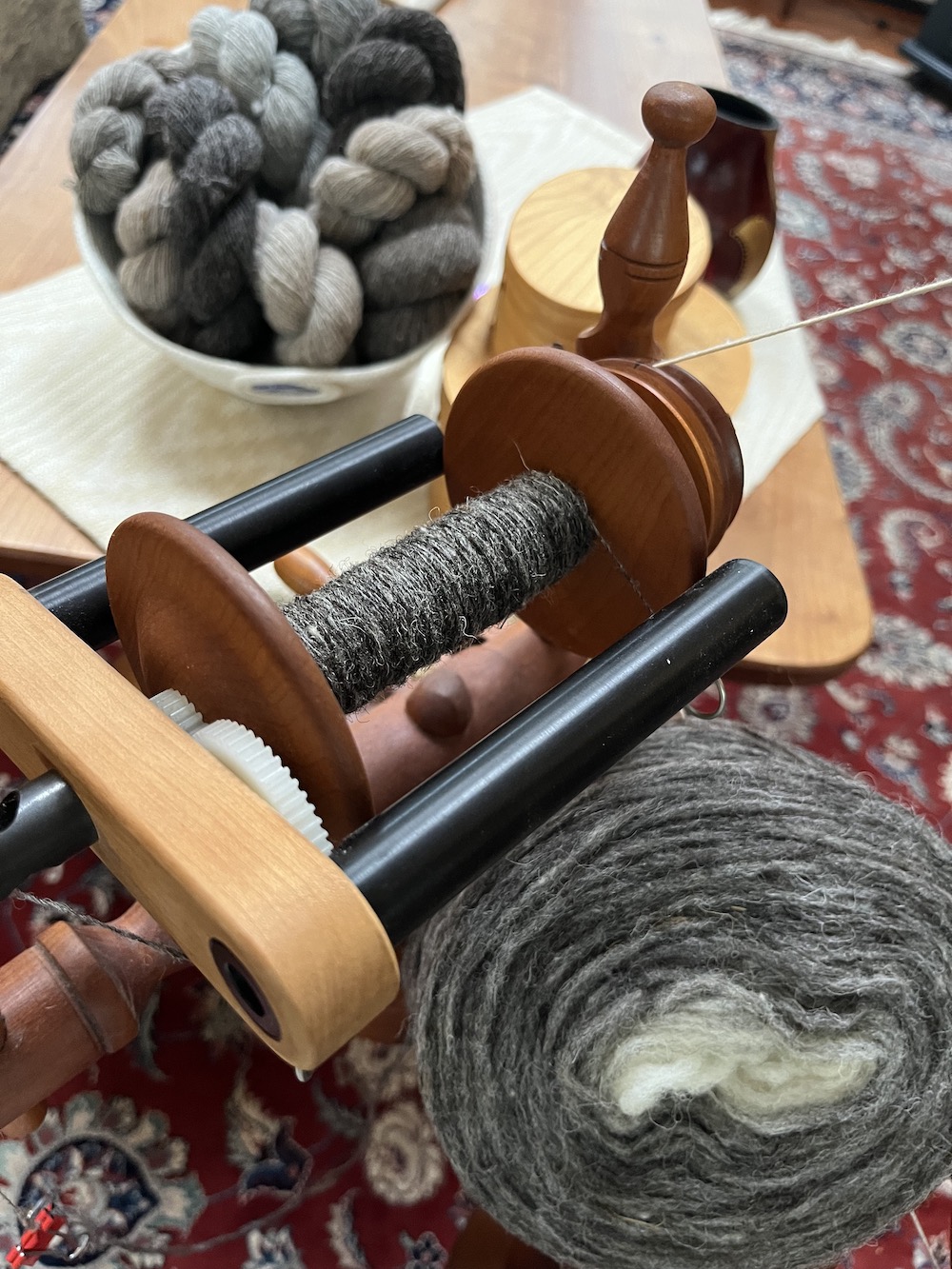
We had two days on South and North Uist, and we saw a wool spinning mill where I bought some exciting things, including a batch of single spun Hebridean wool in natural colors. They spun this wool for someone’s specific project, and what I bought was all there is. I am planning the warp right now, which is pretty prompt of me, only five months after buying it! I also bought three ‘cakes’ of pencil roving that shades from the darkest natural to almost white. I gave away one cake and have spun the other two….not sure what that will become.
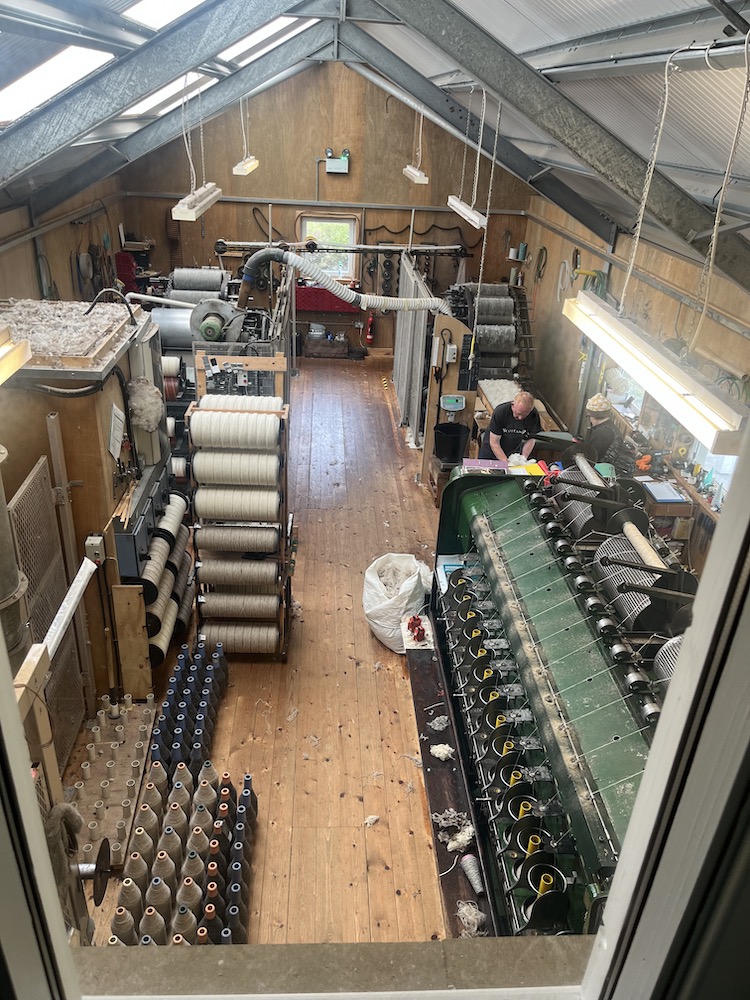
We were not allowed into the spinning room at Uist Wool, so we looked down through a large glass window. The website is stunning.
My treasures. I plan to weave fabric for a lightweight ruana.
Here is one of the wool cakes I spun, possibly to add to the project.
Our guide on the islands of South and North Uist took us to a museum, an historic boatworks location, as well as beaches with cows (and no people!), a somewhat submerged standing stone site, and a couple of monuments. He was thorough and understood exactly what would appeal to any visitor as well as to those of us who love history, and in particular the history of sheep raising and wool culture. I had never heard of Uist (and struggle a bit pronounce it still), and now it is high on my list. I hope to go back someday.
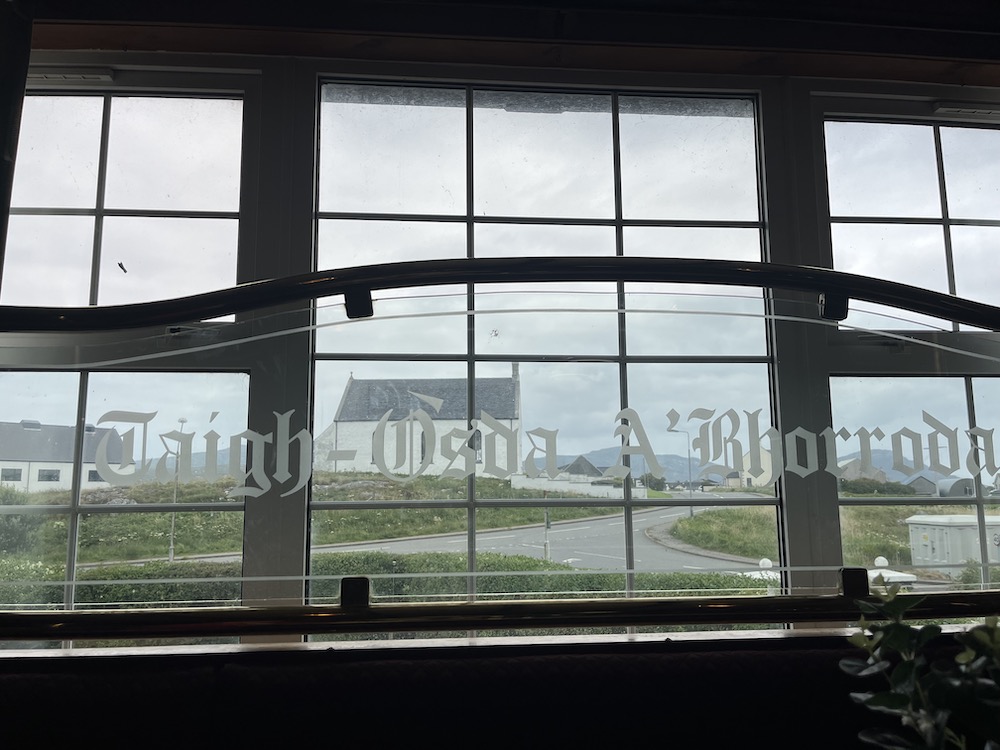
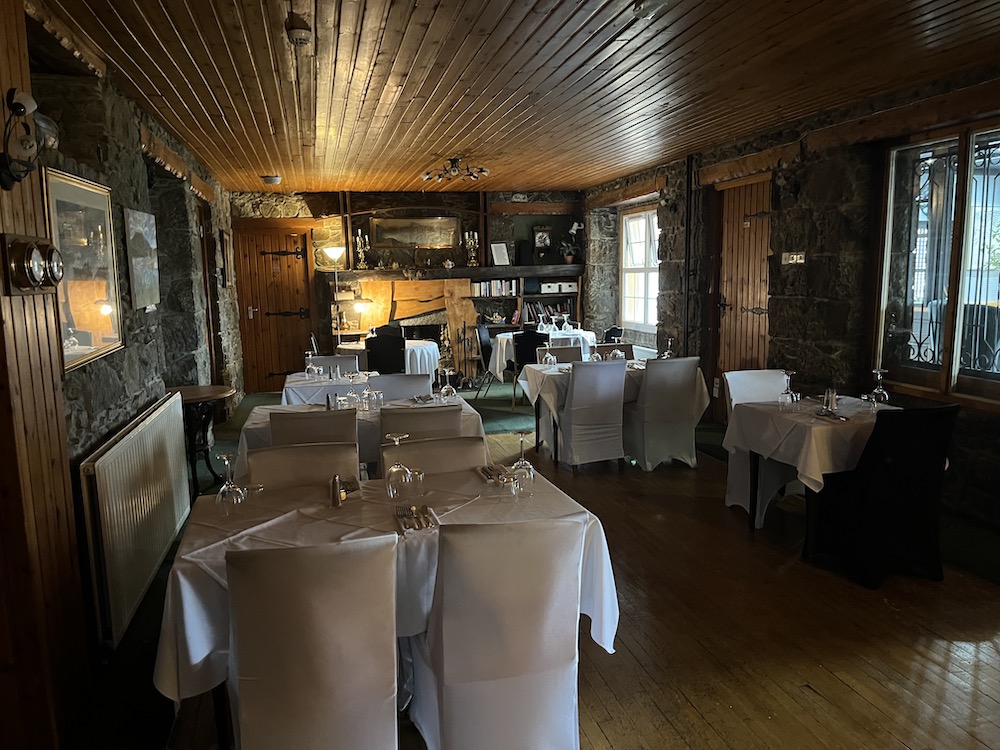
Welcome to Bhorrodale on Uist. This is the window in the pub. The dining room was closed while we were there, but the pub was a charming spot for our dinners.
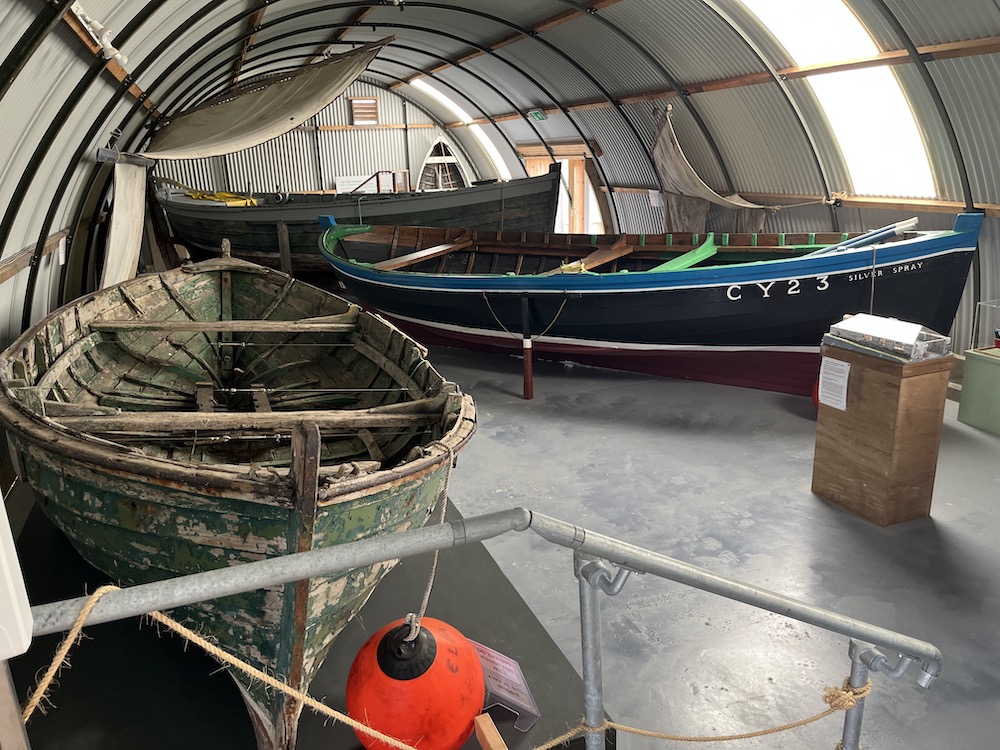
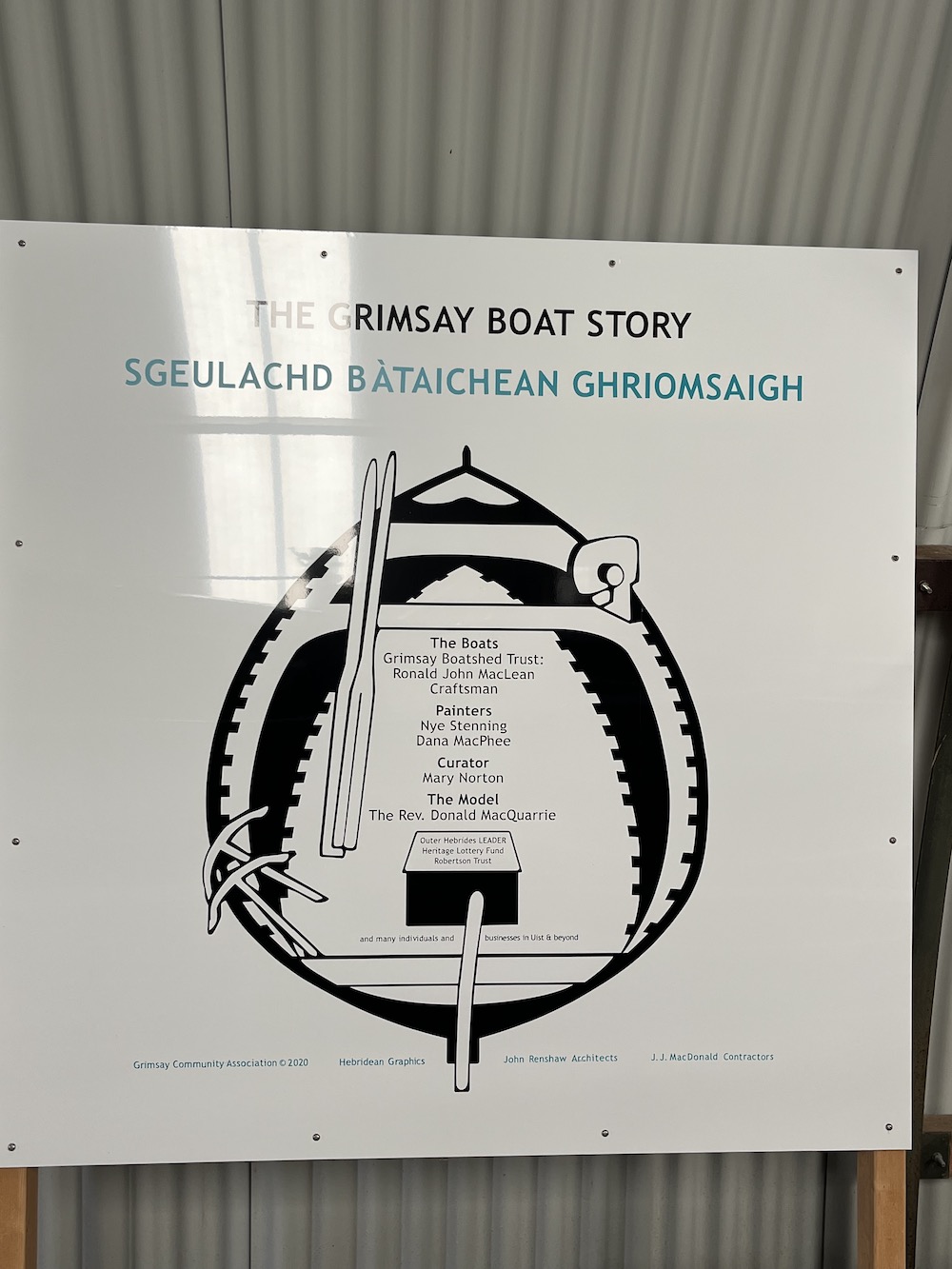
A small museum devoted to the history of small boats in this area.
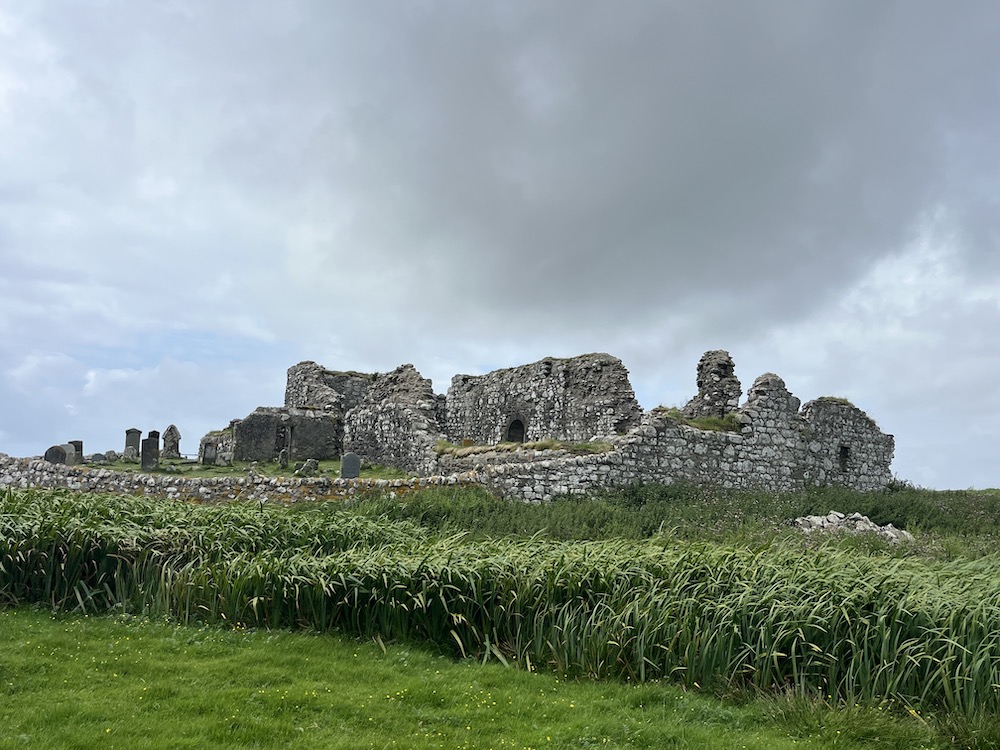
The round houses predate Viking settlements that were long houses. An entire community plus animals lived in these round houses.
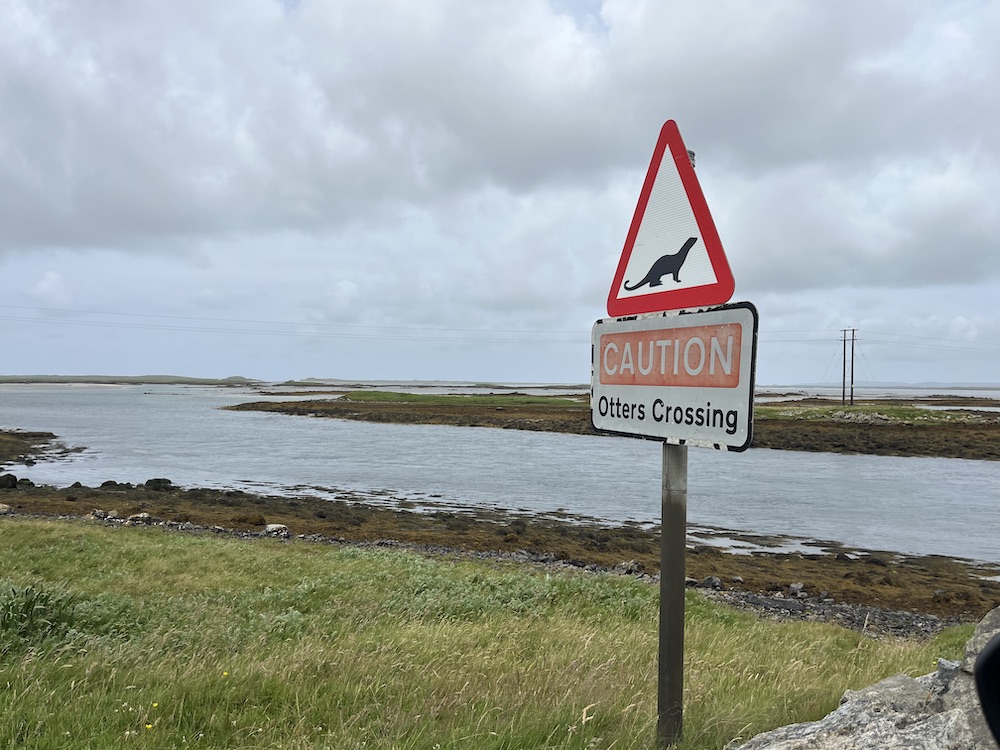
Driving across causeway between South and North Uist. Didn’t see any though.
And then it was time to visit Berneray, where the Berlinn Wool Company was closed. I was sad, but I also knew we’d been awfully lucky with what we did see.
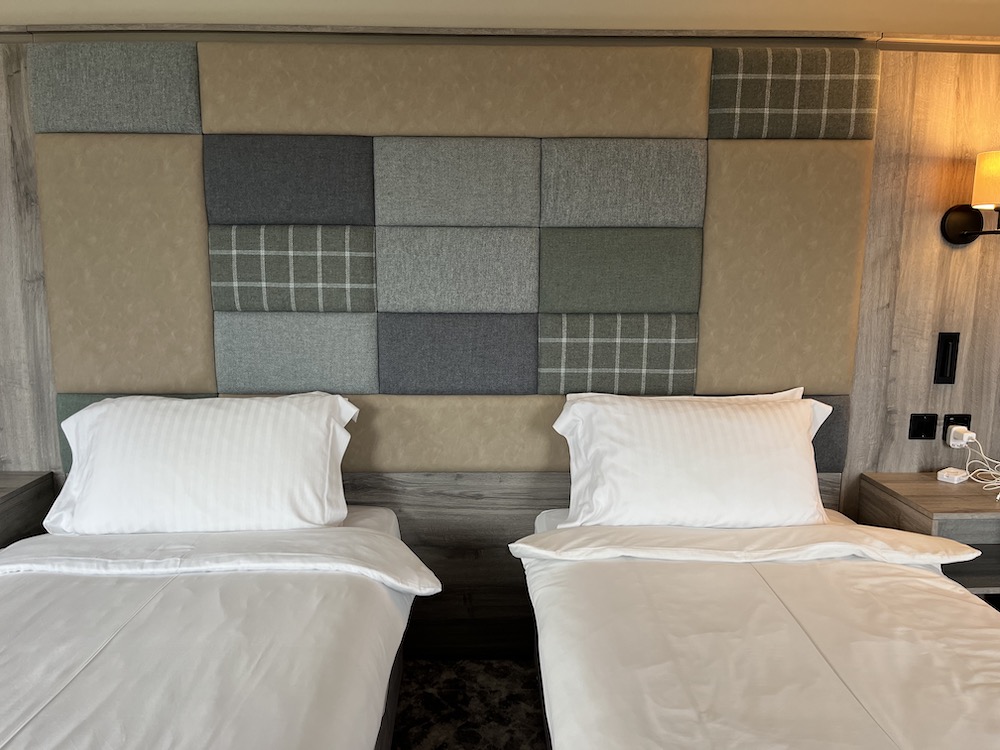
Off we headed to our last island destination, the dual island of Harris and Lewis. If ever there was a celebration of Harris Tweed, this is the place to enjoy it. Now you might well think I’ve taken leave of my senses. I went a bit overboard taking photos of Harris Tweed on every chair and wall that I came across during our stay! This is the wall in our room at the Hotel Hebrides.
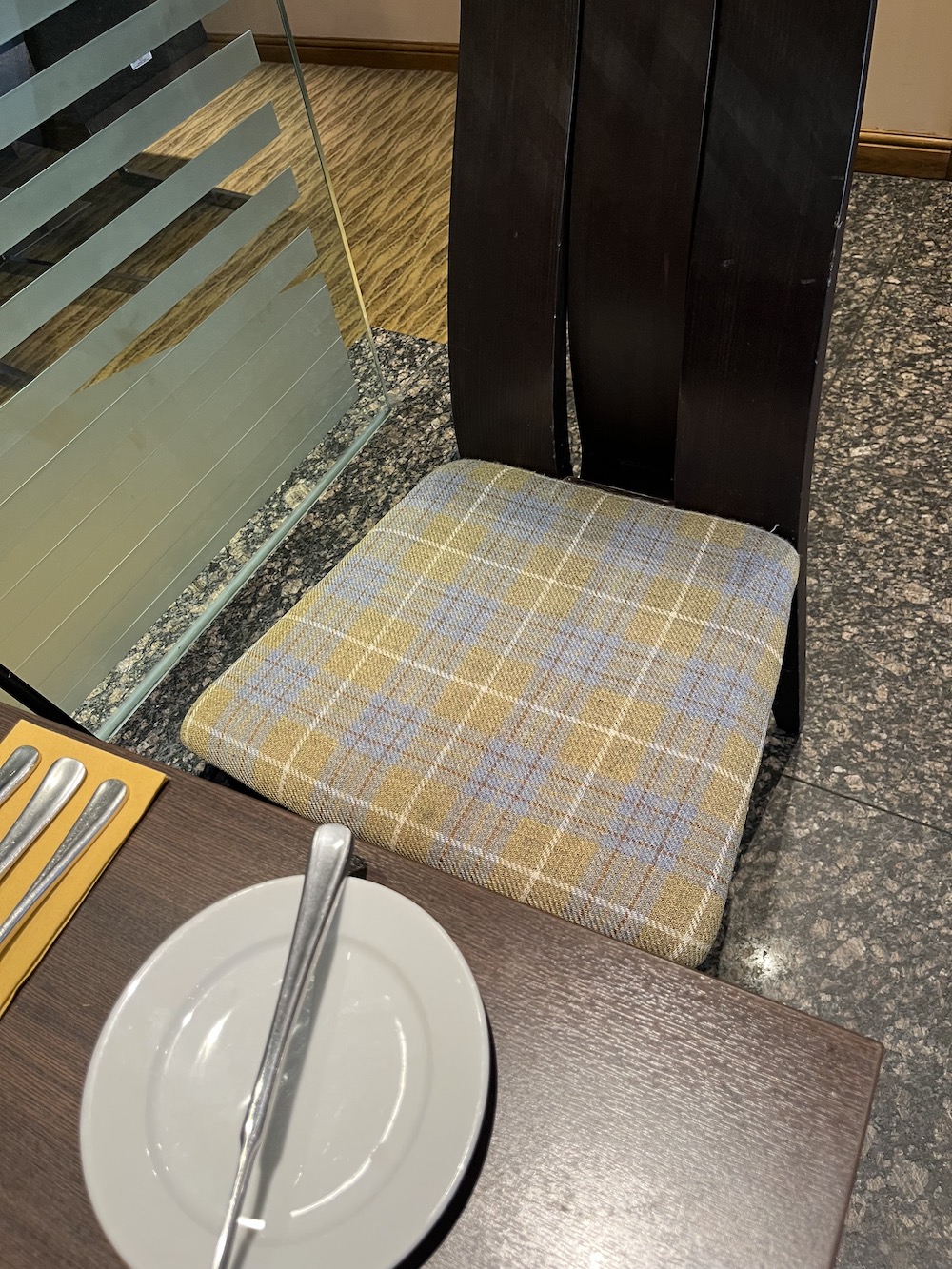
Breakfast and dinner at this hotel featured dining chairs with Harris Tweed fabrics, as well as handwoven napkins (although not wool).
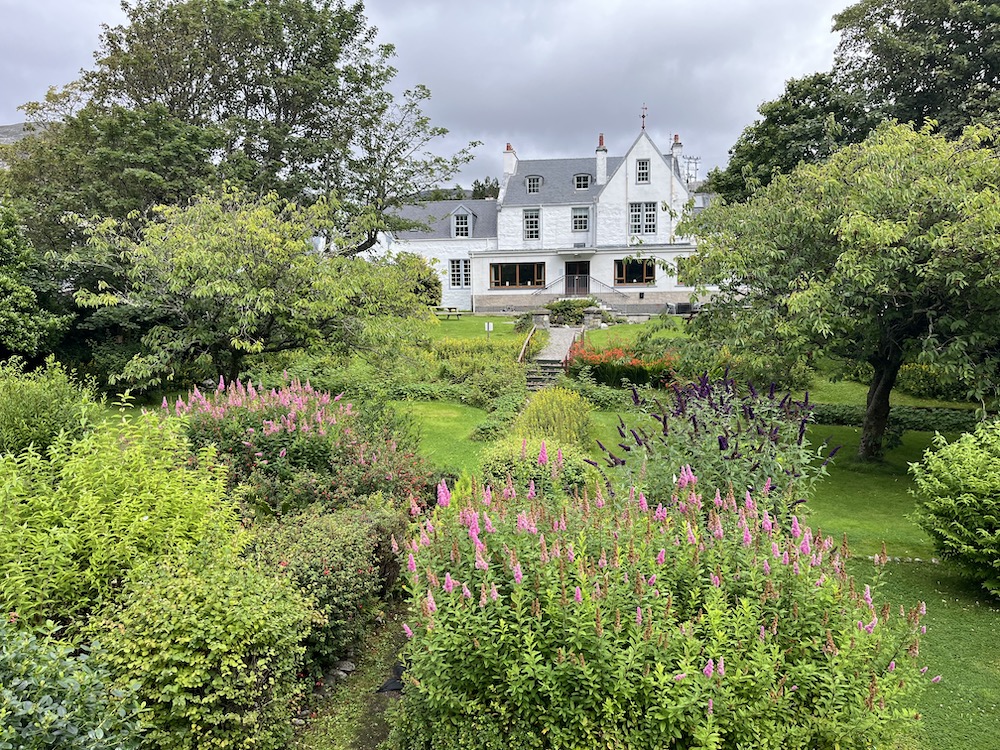
When we arrived we decided to have afternoon tea at a lovely spot within walking distance of our lodging. This is the Inn at Harris. We enjoyed the gardens along with Harris Tweed decorated dining room.
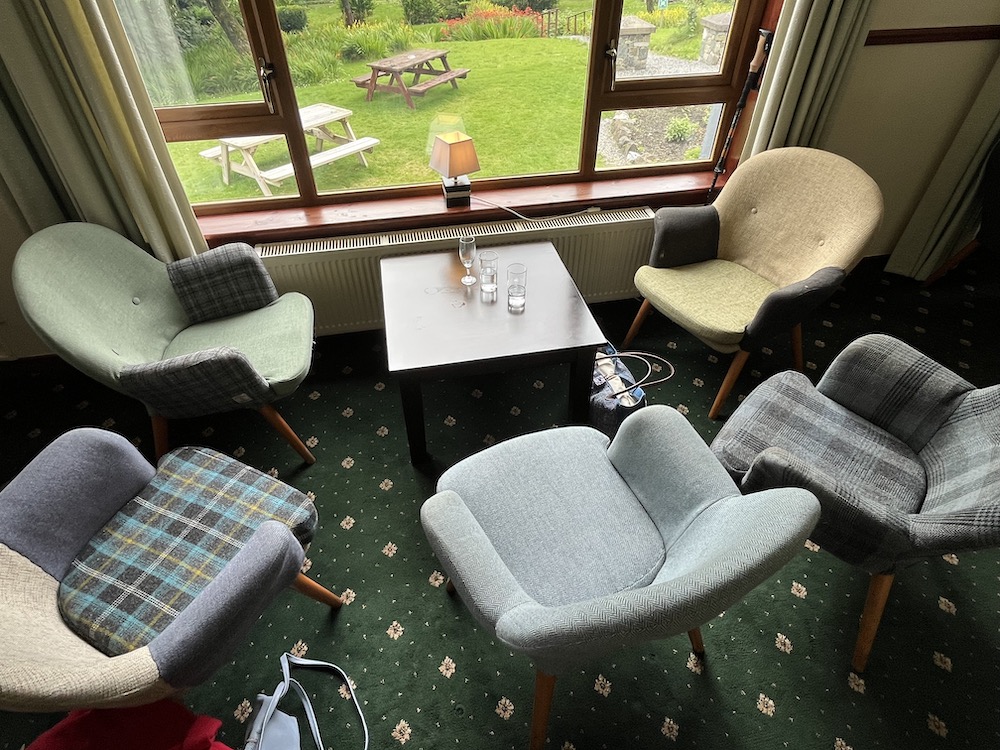
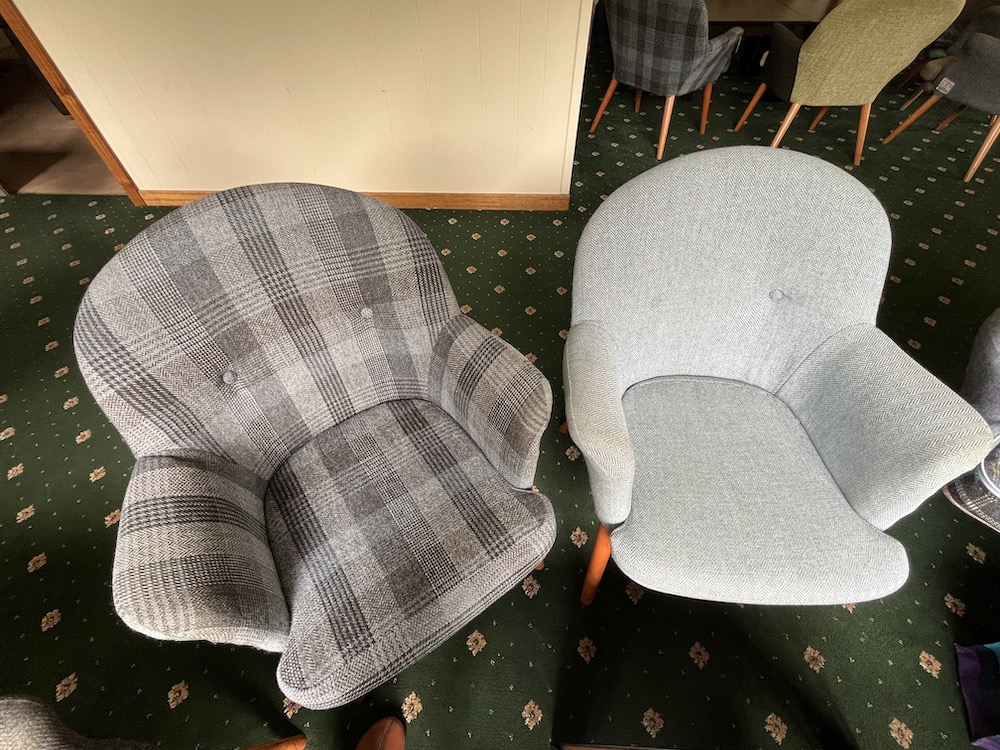
I know some of you will believe how it was for me to choose a chair to enjoy my tea!
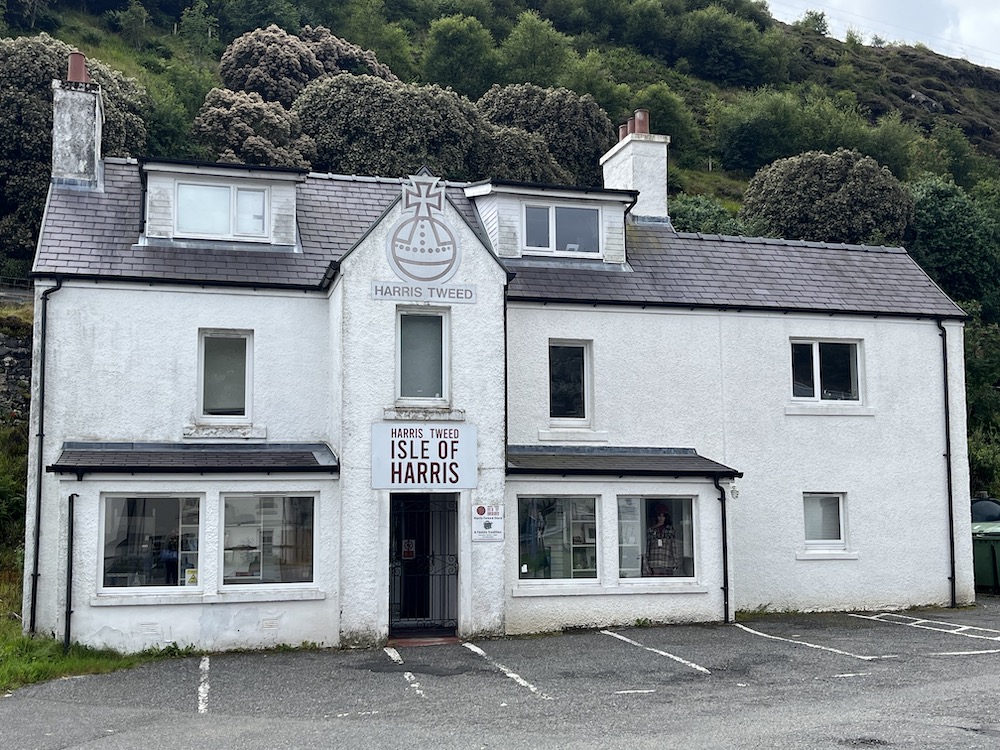
And then a stroll back to our hotel took us by Harris Tweed company. This is the building that houses nothing but bolts of fabrics. It was hard to choose, but I managed to buy two lovely tweed fabrics.
Across the street from the fabric shop was the gift shop. I had waited to visit this shop in order to choose a Harris Tweed handbag. I had seen one in Edingburgh that I loved, but I needed to make sure there wasn’t something even more entrancing at the actual shop in Harris. As it turns out that bag in Edinbtugh won my heart. Even though I had taken a photo of the bag, I neglected to note which shop had it! I was lucky to find it quickly when we returned to Edinburgh for only half a day.
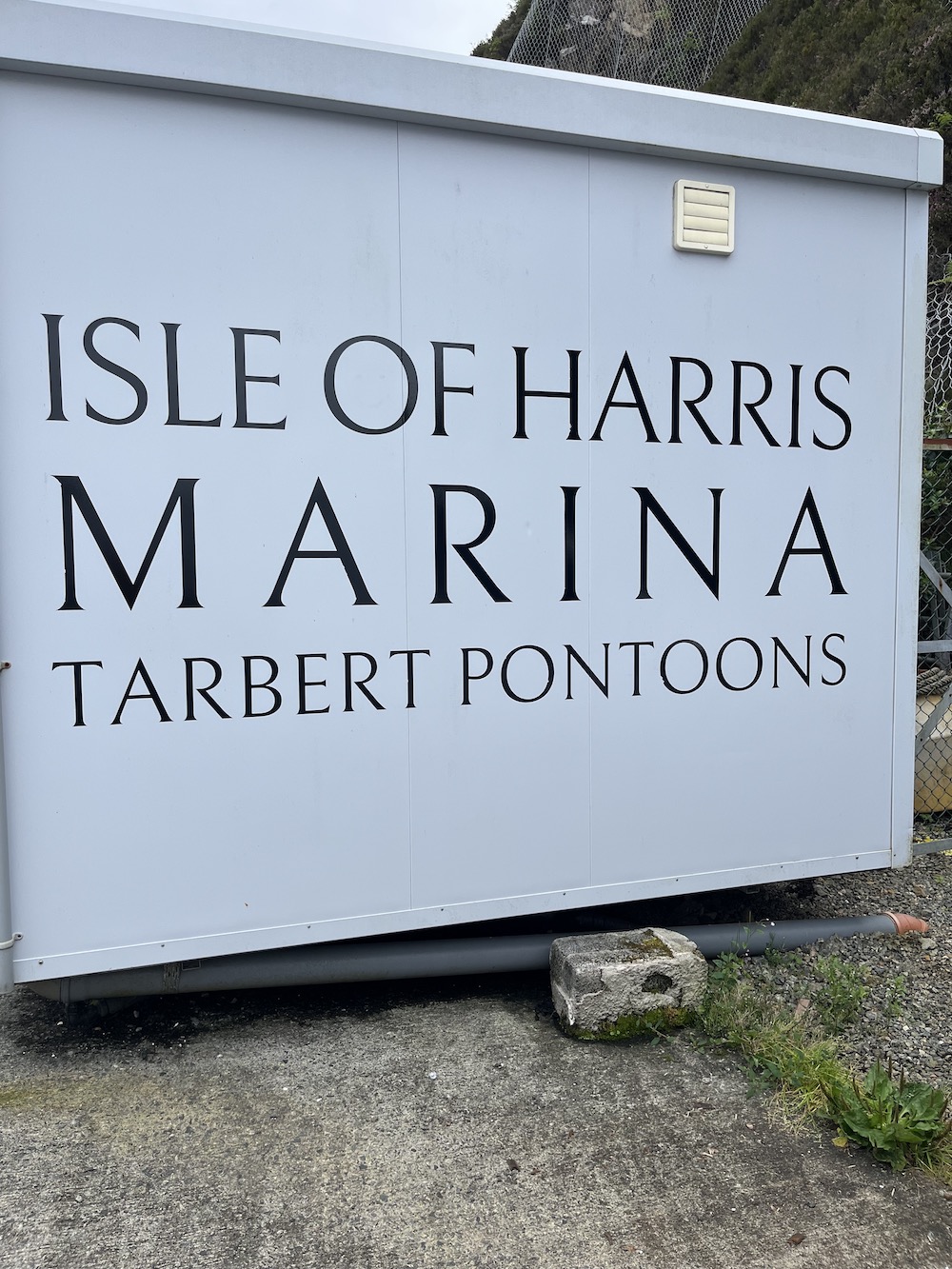
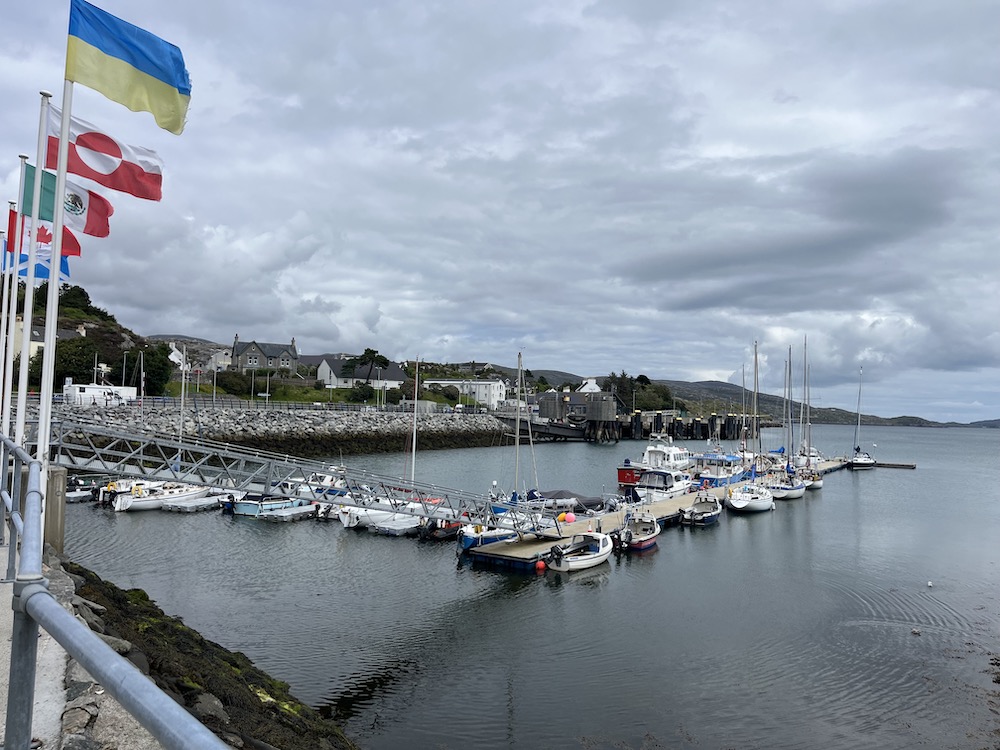
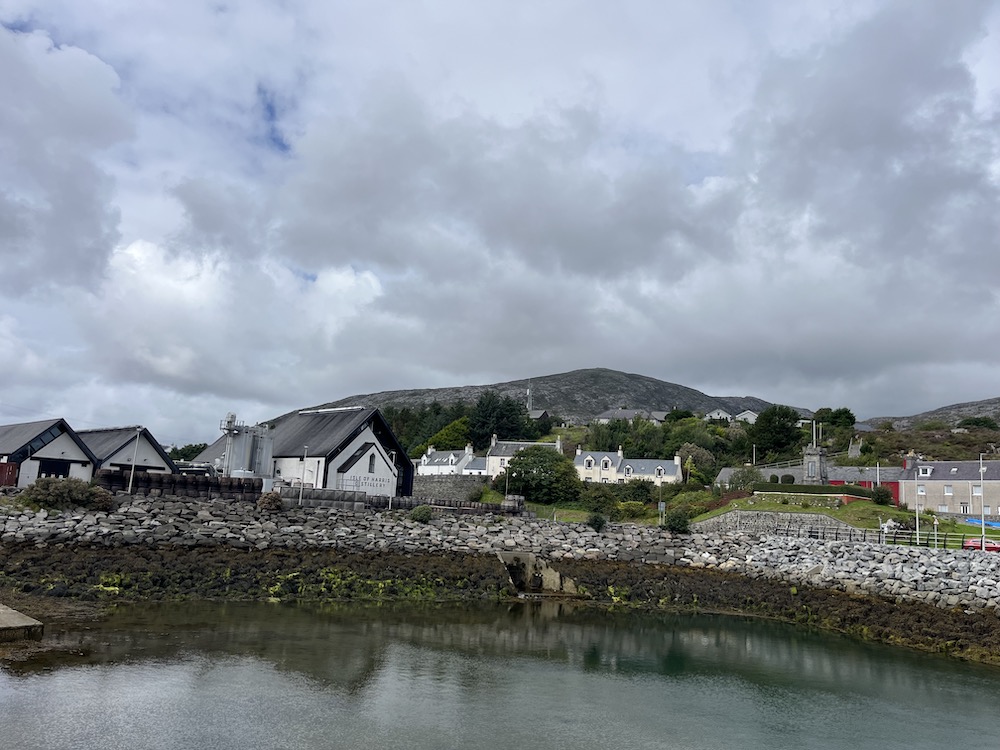
I took a walk along the harbor on my way back to the Harris Inn. There is a very small marina. It is a late July day, and it’s quite chilly. I really cannot imagine visiting here by boat, but clearly a few other hardy souls are doing it. I wish Bob could have joined me here. He would have gone straight down onto the dock to meet some of these sailors.
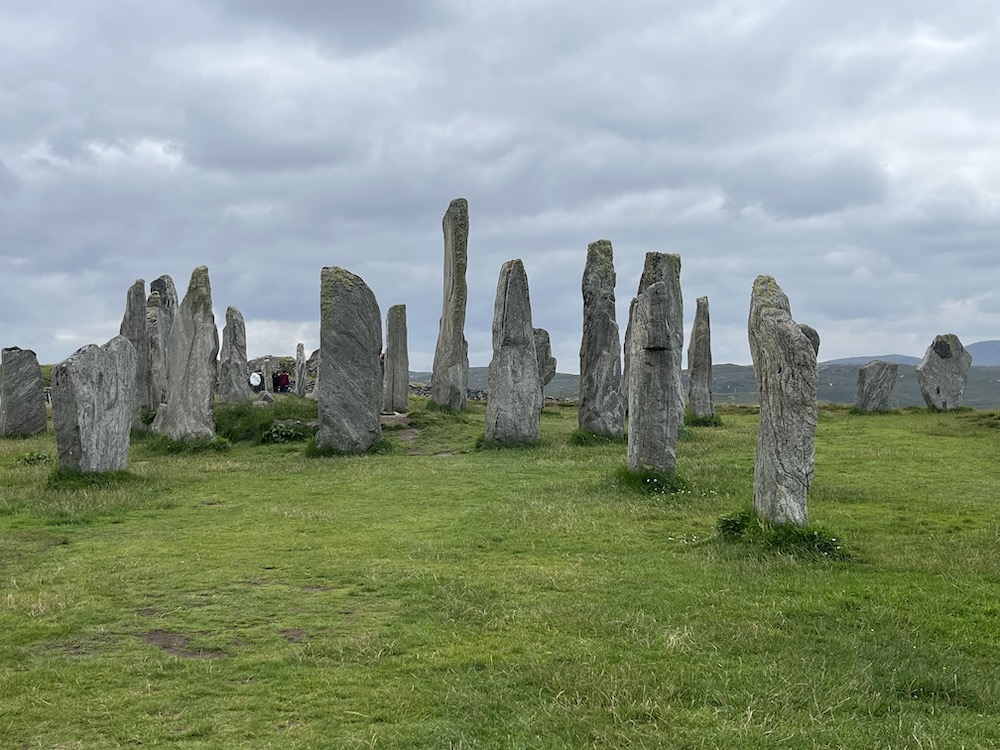
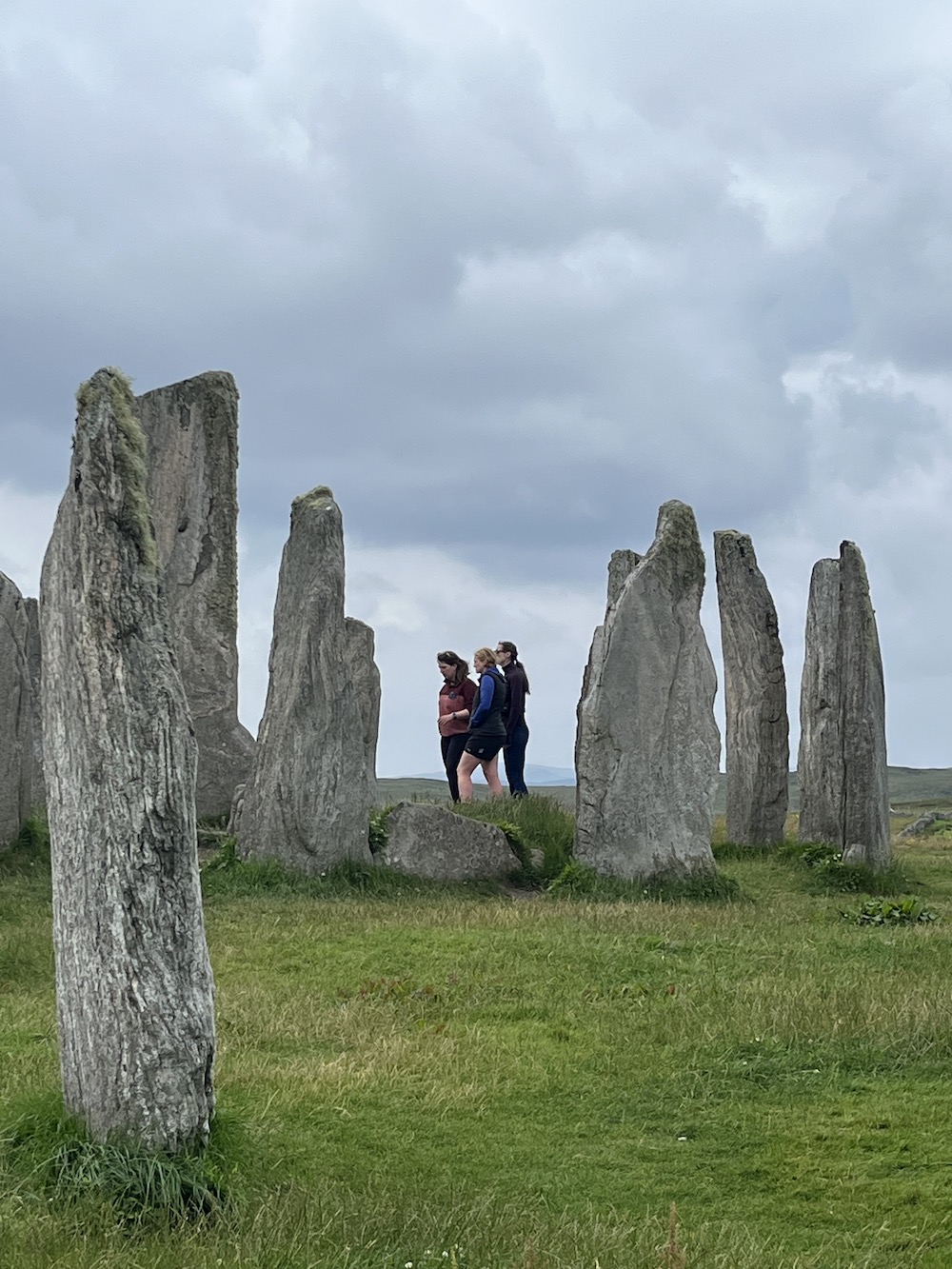
The rest of our visit to Harris and Lewis was quite dramatic. We saw the Callenish standing stones and our guide was well versed in telling us the history of that place. It is supposedly older than Stone Henge, and is roughly the age of the pyramids. I was fascinated by the stones that were chosen. They are metamorphic rock, which is the hardest hardest. Somehow the ancient people here moved these stones and set them up so that once a year on the winter solstice the sun moves straight down the path between the stones that run north/south and east/west. Several times a year the sun has a different interesting path through the stones. There is an altar at the north end of the standing stones. The patterning in these hard stones is magnificent, almost like petrified wood grain.
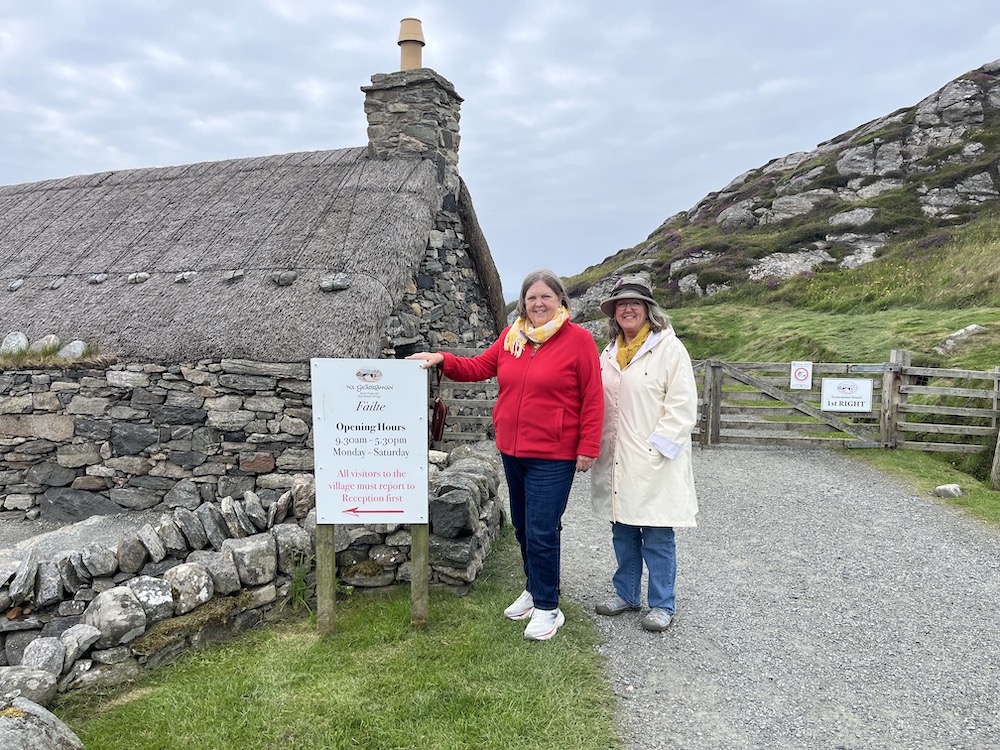
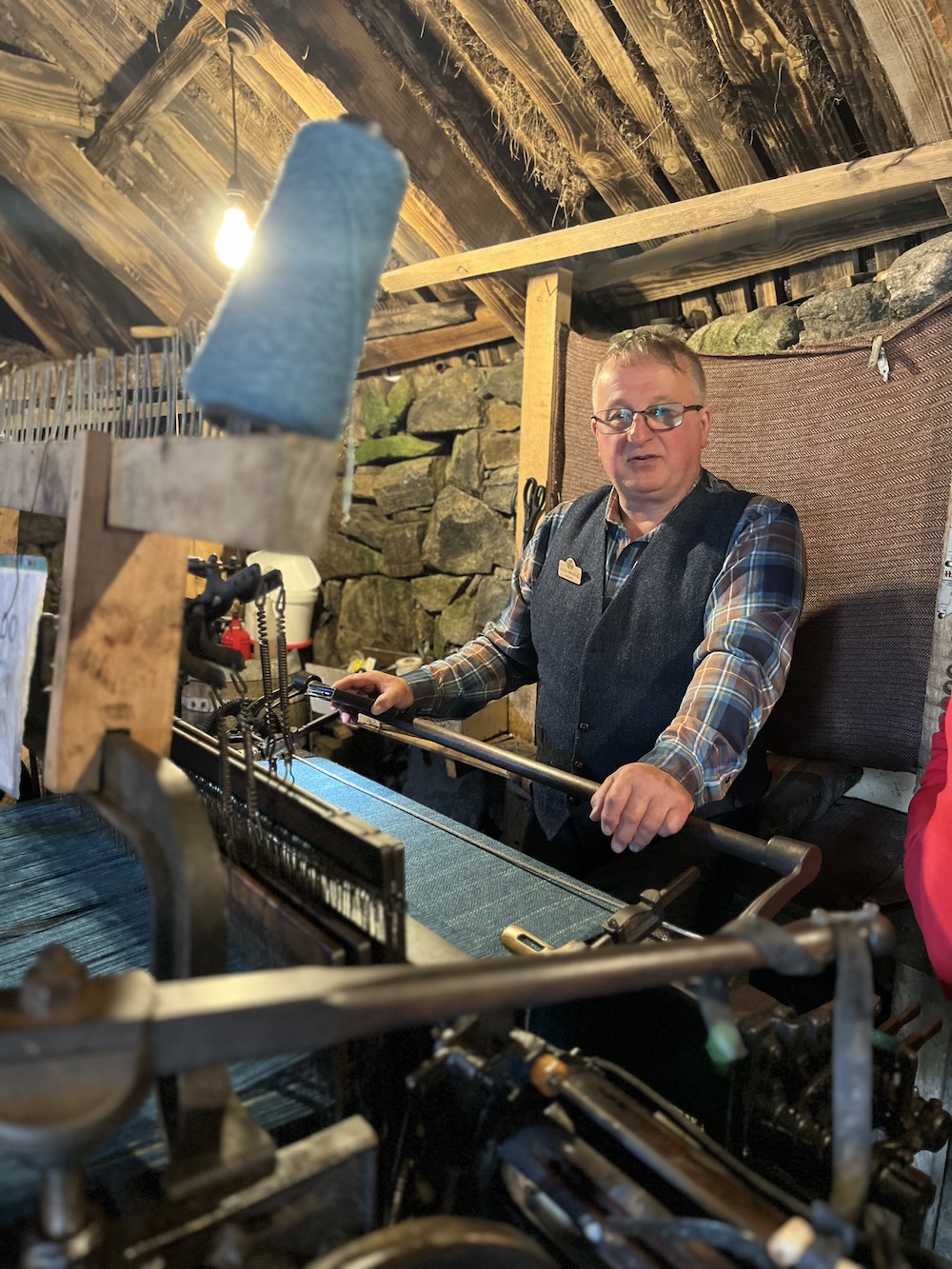
We visited a round house and an entire village of black houses that has been conserved as a museum. They have been well cared for over the centuries, and still have their stone walls and thatched roofs. Our guide is a Harris Tweed weaver, and the loom he uses is in this black house village. These are the style of buildings brought here by the Vikings. They are called ‘black houses’ because they generally had a central hole in the roof for the smoke from the fire to rise, and had no windows so the inside walls turned black over time.
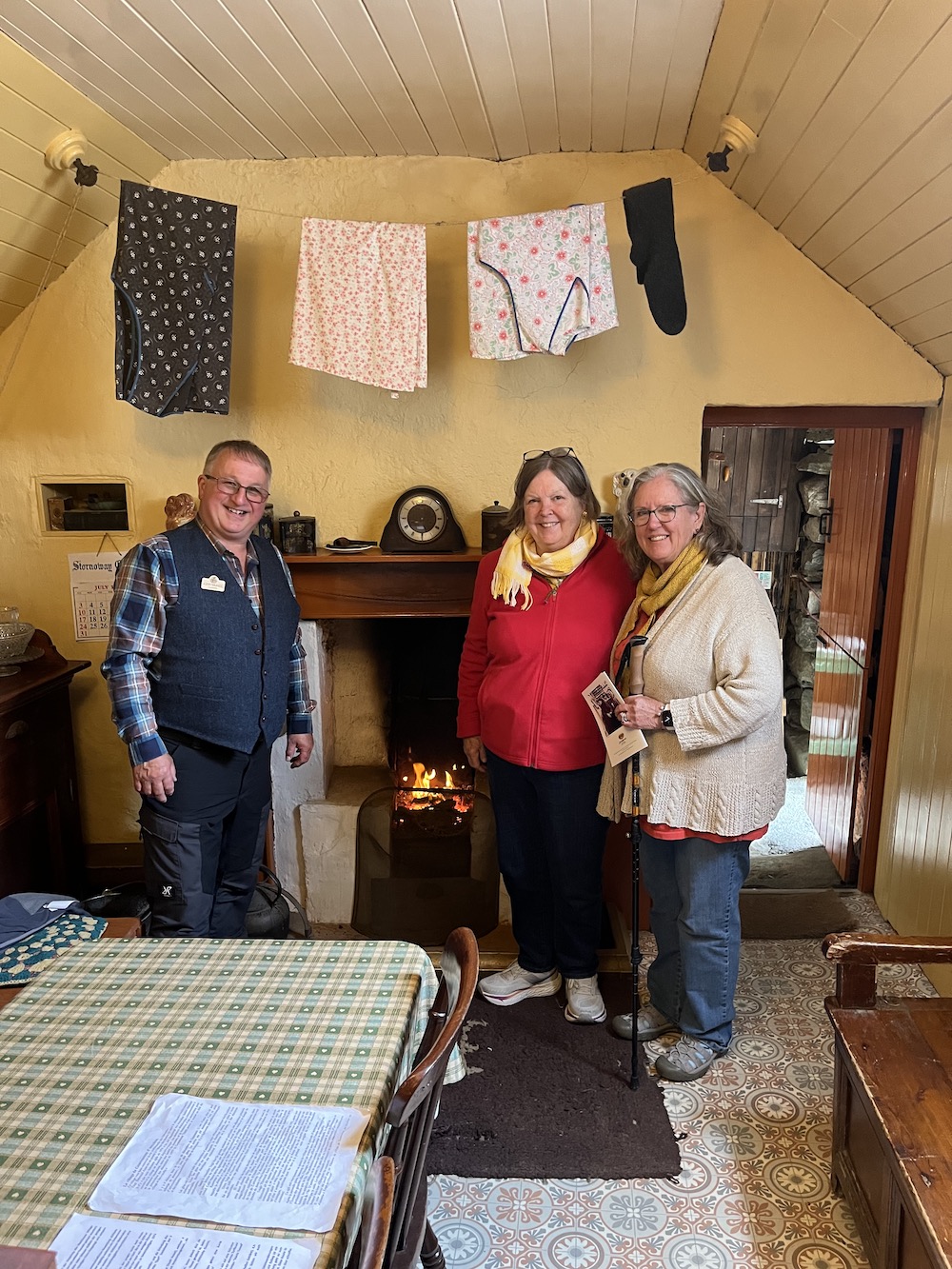
We are inside the black house where there are several docents who are friends of our guide (Tom MacMurray), and where his loom resides in a separate building. This particular house has been left with items from its last occupants, in the 1950s. These houses date much earlier but were in continuous use for centuries.
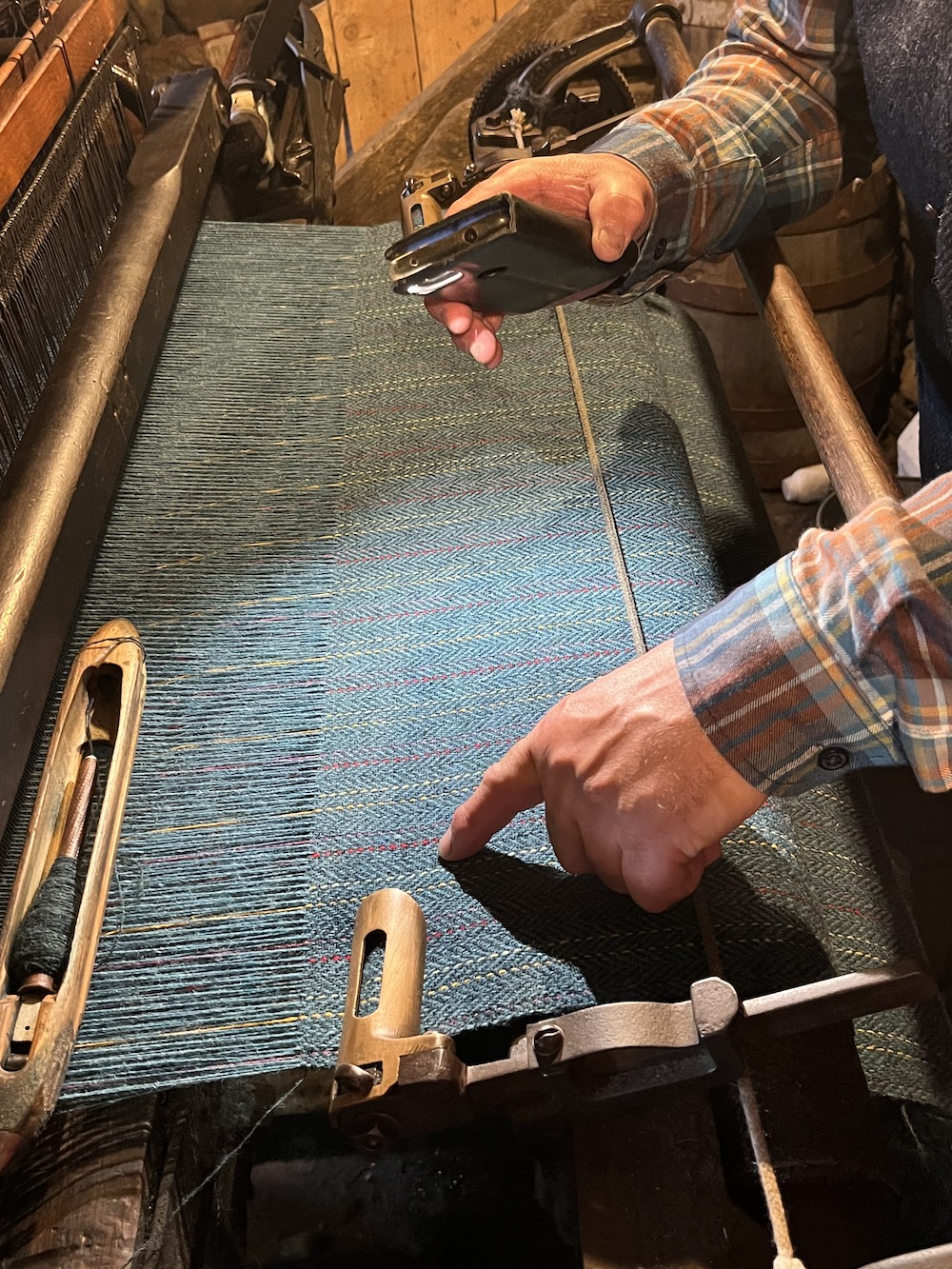
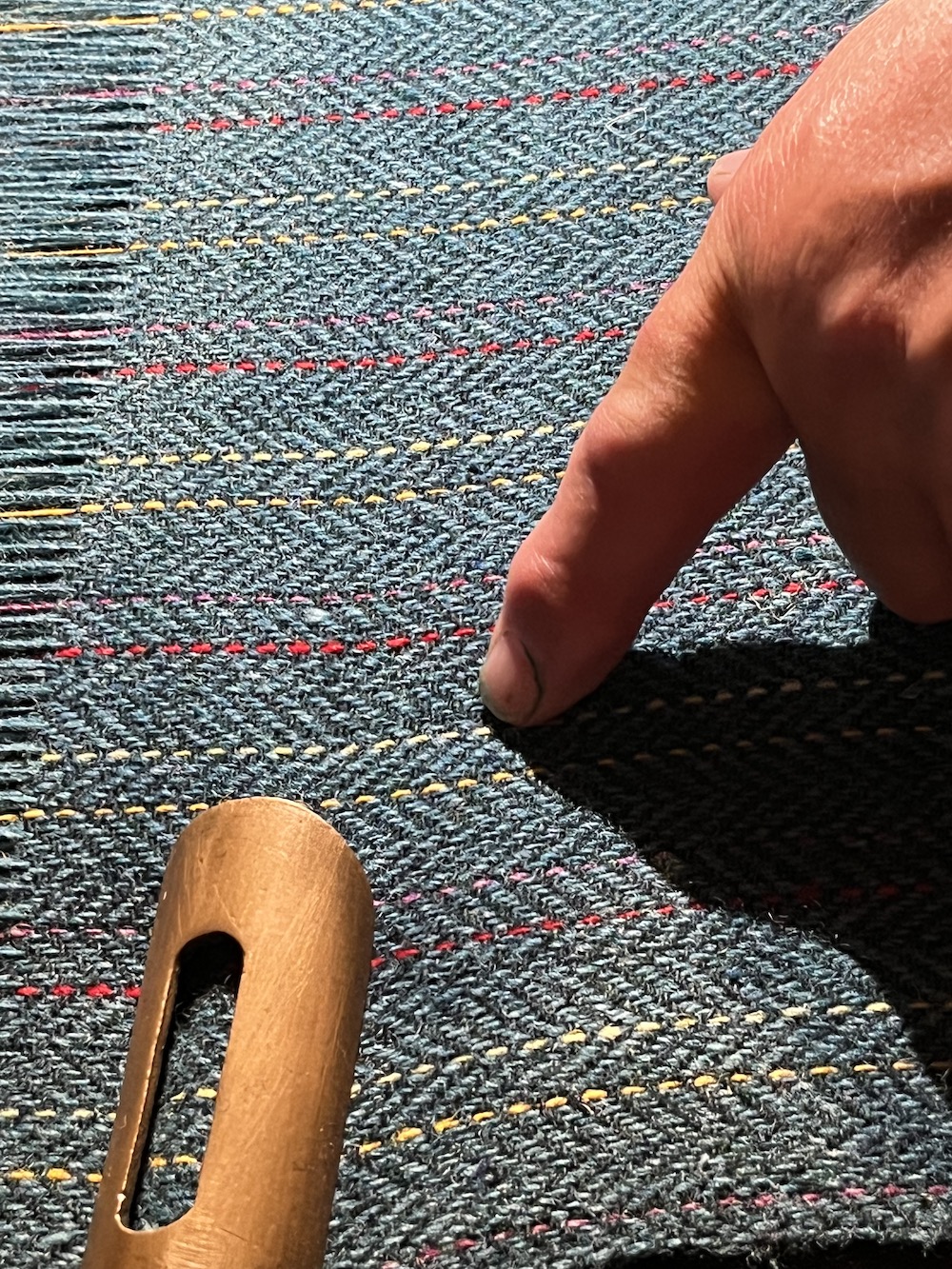
I’m giving this fabric serious attention while I attempt to design the fabric for my Hebridean ruana.
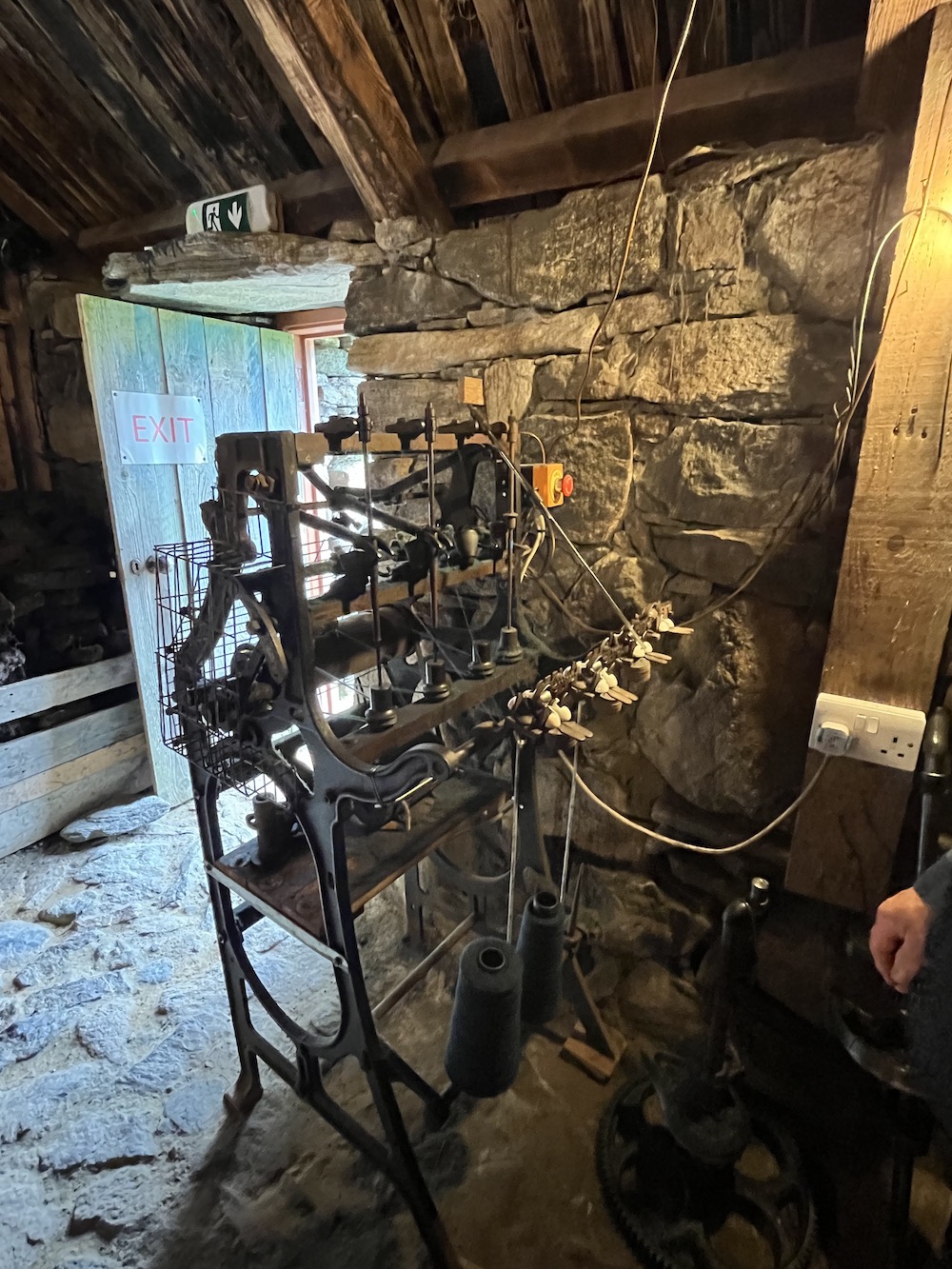
This is John’s bobbin winder. His recently deceased wife used to wind the bobbins for him. She could wind a whole set of bobbins in about 10 seconds. Hard to imagine (but yes, it is electric).
Tom wanted us to meet another Harris Tweed weaver who has left the company to start her own business, Three Sisters’ Weaving Shed. Since I’ve been home I’ve enjoyed following these three sisters, one husband, and one small daughter through the photos they post on Facebook. I bought a hand painted merino/silk skein dyed by the sister in this photo, who is also the mother of the little girl and the wife of the man in the group. I’m using it in a knitting project, “Golden Poppy” by Elenor Mortensen. I’m almost finished (not obvious in the photo) which will make another project bought and executed in a rather brief space of time! The rest of the yarn is Jamieson “spindrift.”
For those of you who have made it to end of this post, I sincerely thank you for sticking with me on this trip down memory lane. I hope the photos made up for my longwindedness! If you’ve been to this part of Scotland I hope I’ve brought back some good memories for you. I’d love to hear about them. For those of you who have never been to the Outer Hebrides, I hope this whets your appetite for going. My friend Kari had been in Scotland 50 years ago, and her plans to get to these islands did not happen. Never too late. We both loved every minute of our visit.
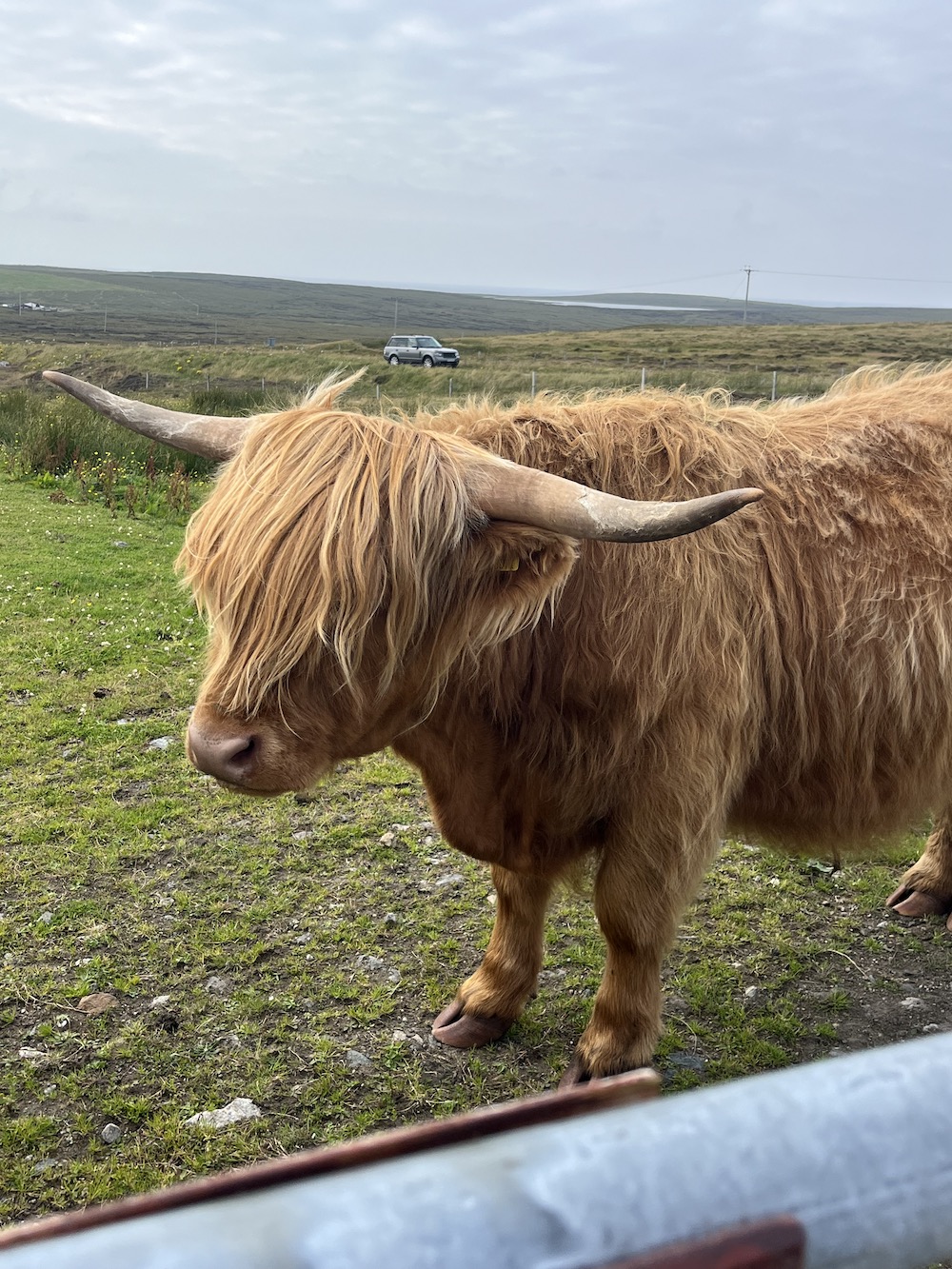
I’ll leave with with an image of a highland cow that I took on Harris.
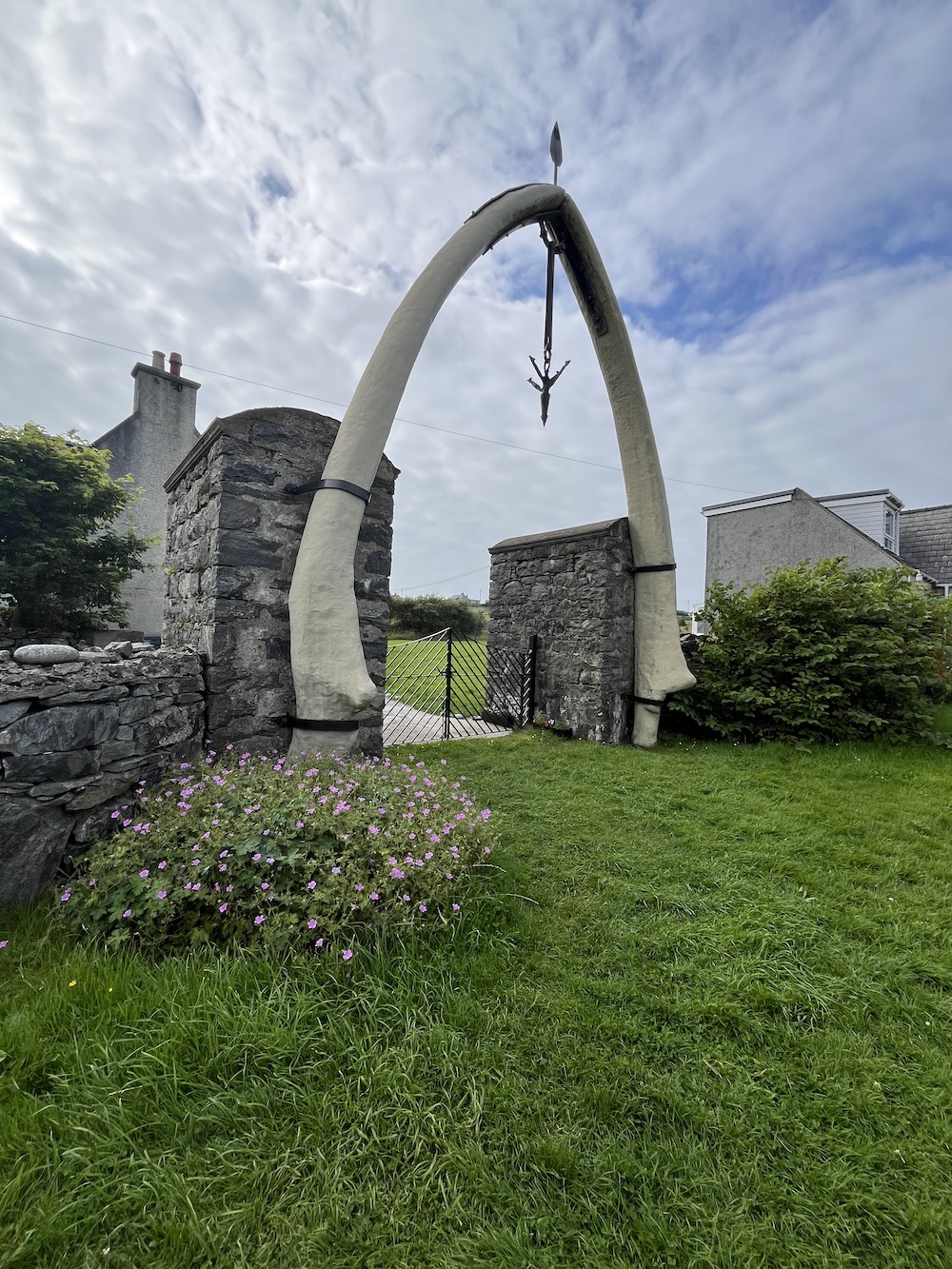
…and two of Kari and me visiting the large whale jaw bone installed in the village of Bragar on the Isle of Lewis.
Be well, take time to work with your hands, and enjoy the new year.