Well, you knew (didn’t you?) that I’d have to find those two Connecticut houses that are older than the house at Bushnell Farm….
The oldest house (and it’s magnificent!) is the Henry Whitfield House in Guilford. That’s just down the road a bit so I am looking forward to a visit! According to Wikipedia, it is not only the oldest house in Connecticut, built in 1639 right near the town green in what would shortly become Guildford, it is also the oldest stone house in New England. This house was opened to the public as a museum in 1899.
Maybe my dear friend, who loves old houses and lives in a 1795 house on the river about an hour north of here, will join me for the visit. Well, I’ve done a bit more ‘googling’ to find the 2nd oldest house, and instead of getting an answer I’ve just become confused. If this sort of thing interests you, take a look at this. So, who knows…. there are several houses on that list even older than the Henry Whitfield house, and more than two that are older than the Bushnell house.
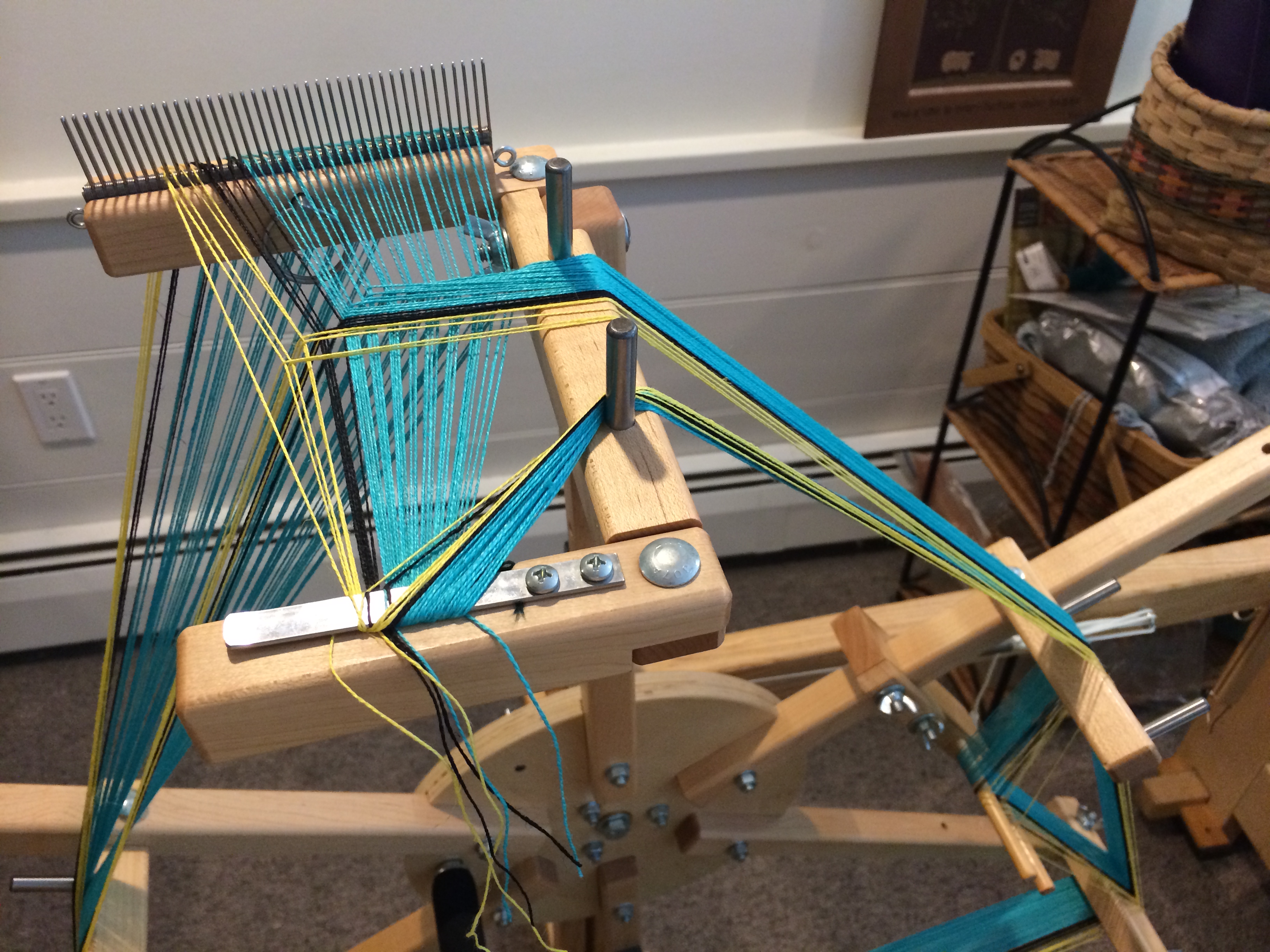
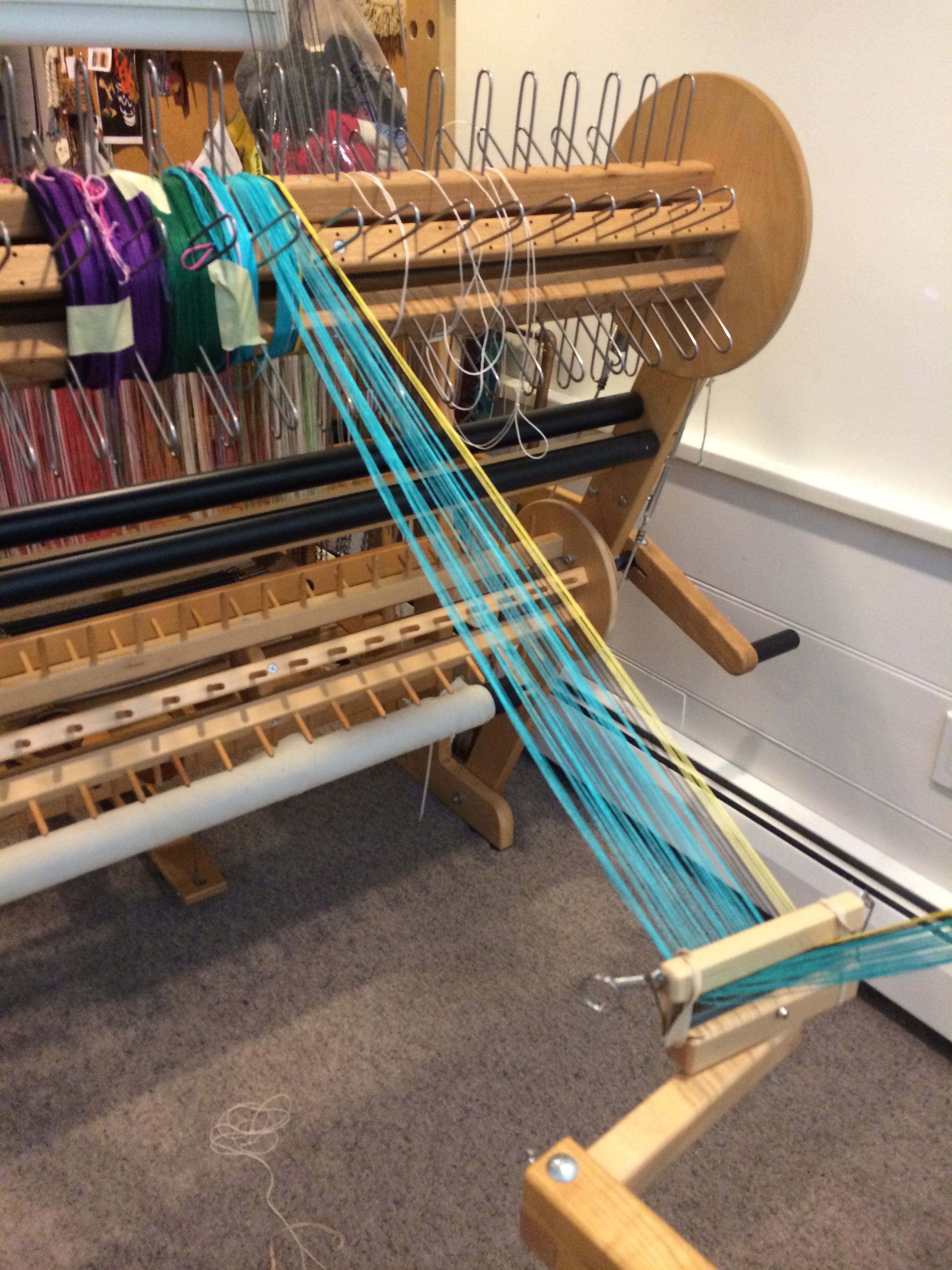
Back to weaving! Here are a couple of photos of my linen warp in progress. This is one section of warp (2″ width) wound on my AVL warping wheel. I had no idea how much this section would look like the Bahamian flag!
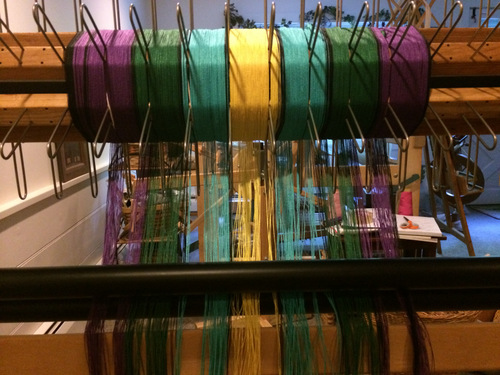
Ask me if I’m a bit nervous about these bright colors! (yes!) But…. I forge ahead. Hopefully the black linen weft will tone it down a bit. Here, I’m winding on section 4 out of 9 sections that will make up my 18″ wide fabric.
Right now my studio is about as messy as it’s ever been, so I was careful to exclude as much of the mess as possible when I took these. Normally I make a huge mess when I start a project…..all kinds of materials are out for consideration, lots of things get tossed about. But by the time I get down to work I need everything back in its place so I can work in visual peace. Whew, boy! Not this time! I’m feeling such time pressure to get going on this that I’m just trying to wear virtual blinders while I’m here. I’ll get to straigtening things up as soon as I can!
The sections are all different since the number of threads per inch does not match the number of threads for a repeat of the huck pattern. I had to be more careful than usual with my counting to make sure that each stripe has 45 threads in it no matter how it fits into the 2″ warp sections. Now I’m ready to start threading!
Yesterday there was a lovely event at a local historic farm in Old Saybrook. It was a wonderful way for me to celebrate being home and to enjoy the glories of spring!
The house at Bushnell Farm was built in 1678, and is the third oldest house in Connecticut (now I want to find the two older homes!). Isn’t it a beauty?
It is privately owned by a couple who live in my town, and they are doing a fantastic job of maintaining this property as well as continually bringing various areas of the farm back to the conditions of its early history.
Several times a year they open the property to the public free of charge. The spring opening celebrates the farm’s production of textiles which was such a vital part of life at that time.
One of the barns has a large loom in it dressed with linen toweling. There are a number of flax wheels, lots of tools for spinning and weaving, along with all the other tools and equipment that would be in use on a farm of this age. The Clarks have done a stellar job of collecting the daily items that would be in use on this farm.
For yesterday’s event the Clarks had arranged for two spinners from New Hampshire to come demonstrate at the farm. The first demonstration was on processing flax into linen, and it was the main event for me.
Gina Gerhard does 18th century textile demonstrations throughout New England and she certainly knows a great deal about growing flax, harvesting it and processing it for spinning into beautiful line linen. While I know the various stages of preparing flax stalks for spinning, I had never seen the entire process done live, right before me! Gina made it look easy, but she has had a lot of experience, and she was only processing one bundle for us. I’m sure an entire harvest would be a huge undertaking.
Amazingly, she grows her own flax, starting with about 5 lbs. of flax seed. In her area of New Hampshire an historic flax pond has been identified, and she hopes to use it in the future to rett (or rot) her flax bundles. At the moment she uses a large outdoor tub to rett her flax, and it takes about 4 to 6 weeks. Having a pond that can be dammed with shallow, still water with a bed of stones at the bottom gets the job done much faster, perhaps only 4 to 5 days if things are perfect.
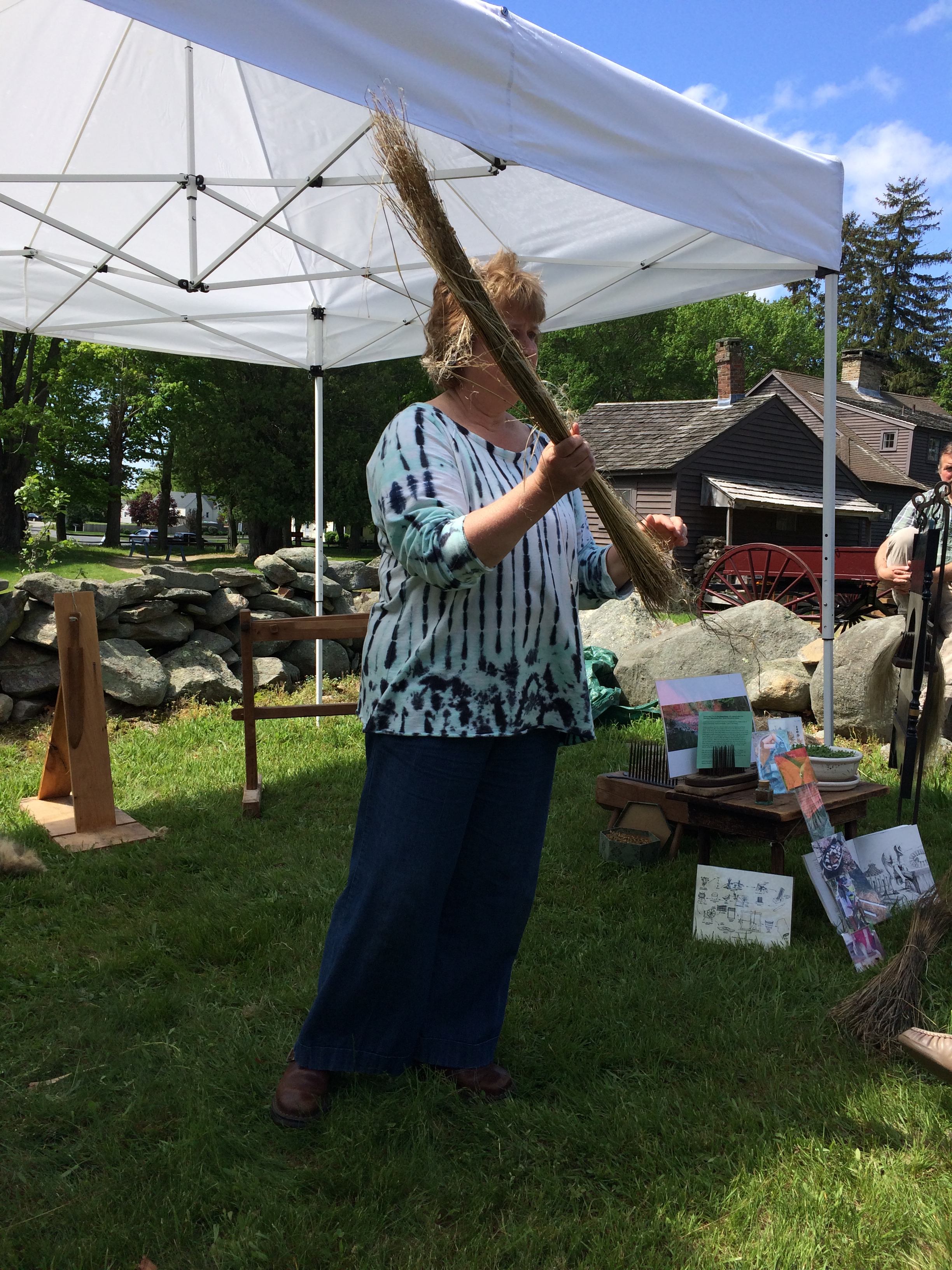
Here is Gina holding one of her flax bundles. First the bundles were dried and then retted and then dried again. In her northern climate she harvests the flax in late Sept or Oct. Since that is not a great time for beginning the retting (rotting, and it does get stinky as it rots!) process, she lets the bundles dry over the winter and begins the retting process when the weather gets warm, like now!
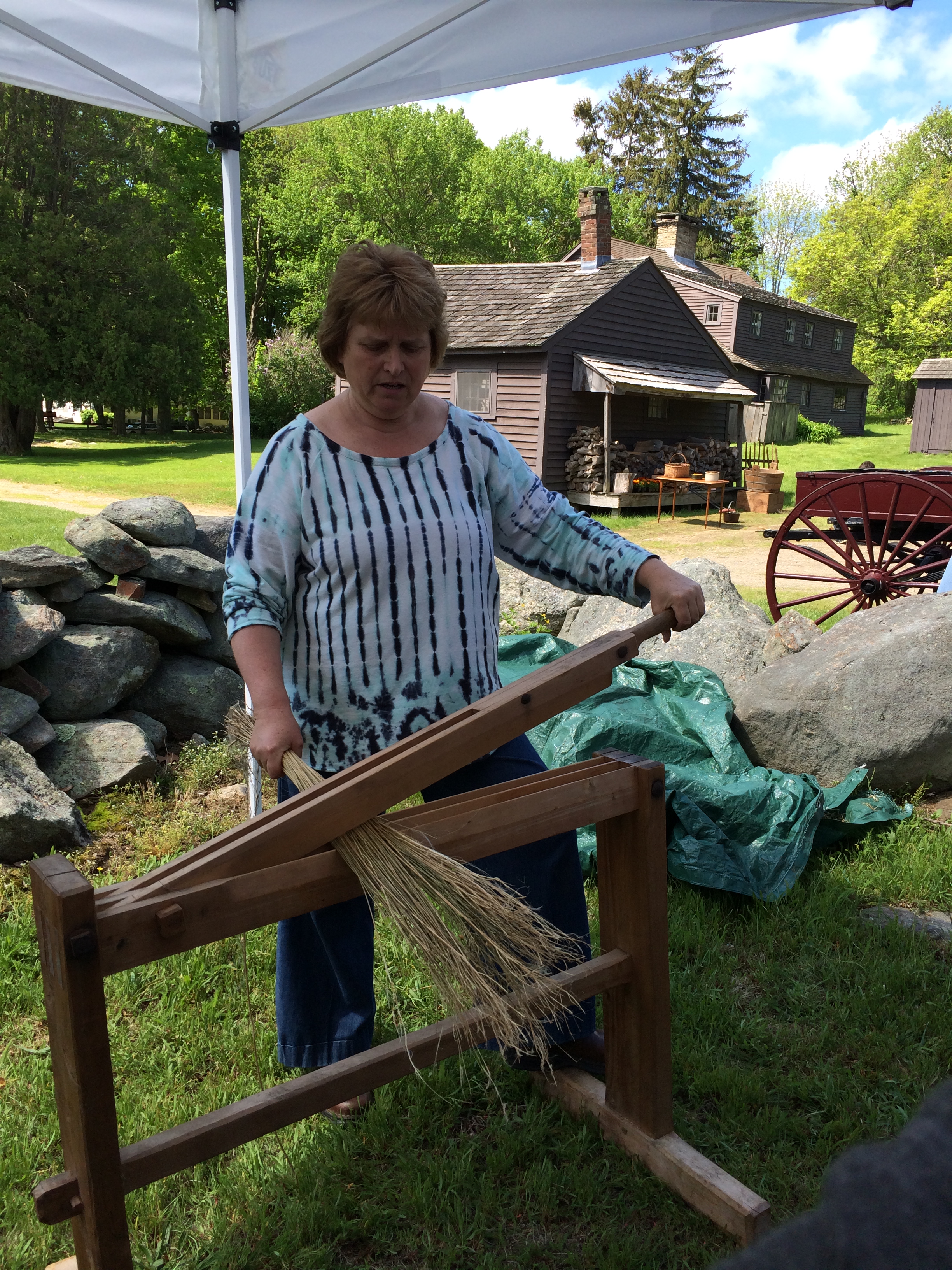
The first step in preparing flax for spinning is breaking the flax stalks, which removes the outer and inner harder ‘straw’ that protects the fibers.
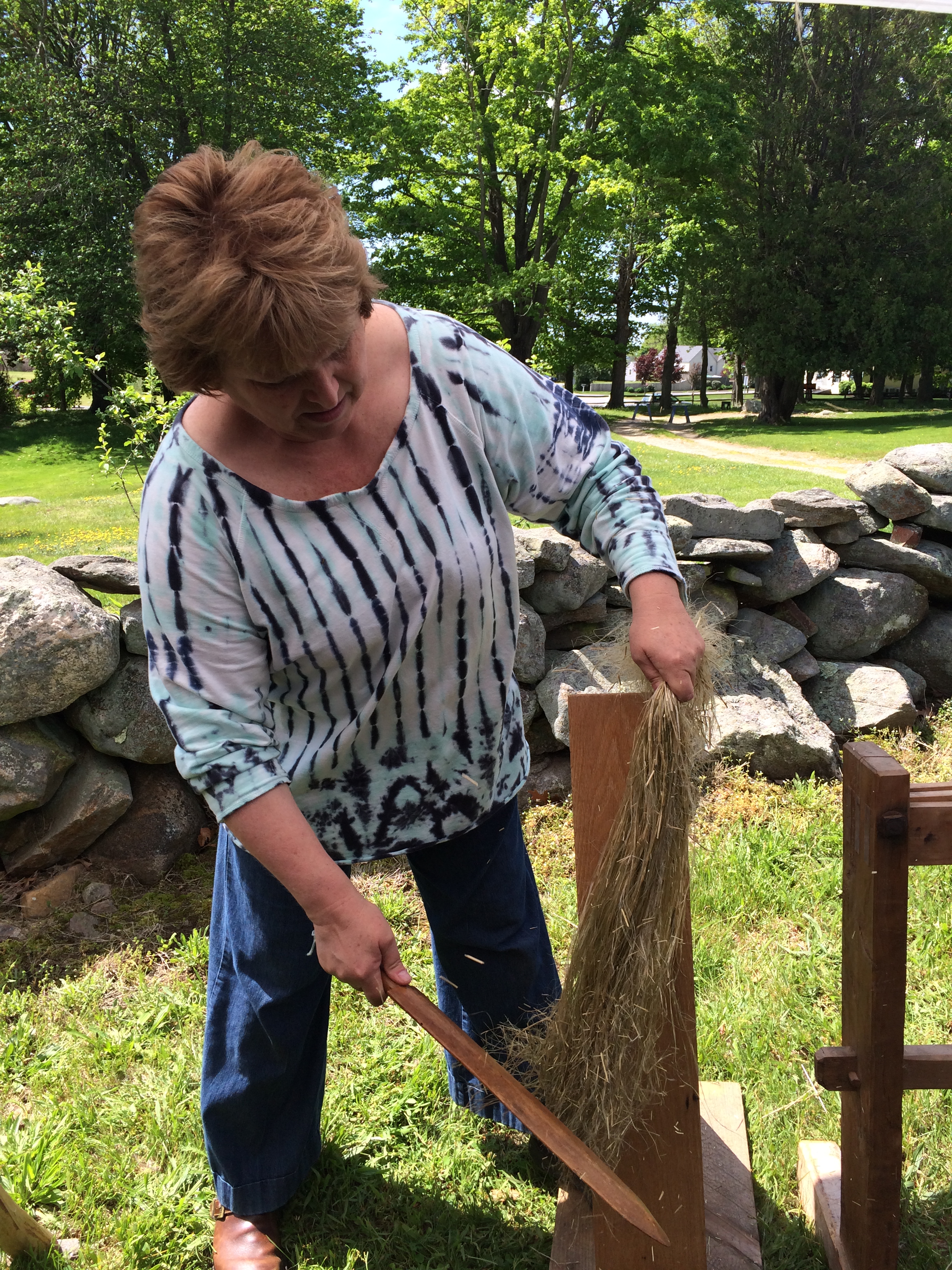
The next step is scutching which also removes more of the tough casings that protect the flax fibers within. Gina is standing next to a scutching board with her wooden scutching knife. The technique is to lay the bundle against the board and beat the bundle in a downward motion with the knife. It is a motion of beating and scraping down the stalks. She mentioned how often she sees these tools mislabeled in antique shops. She said the scutching knife is often labeled a toy sword!
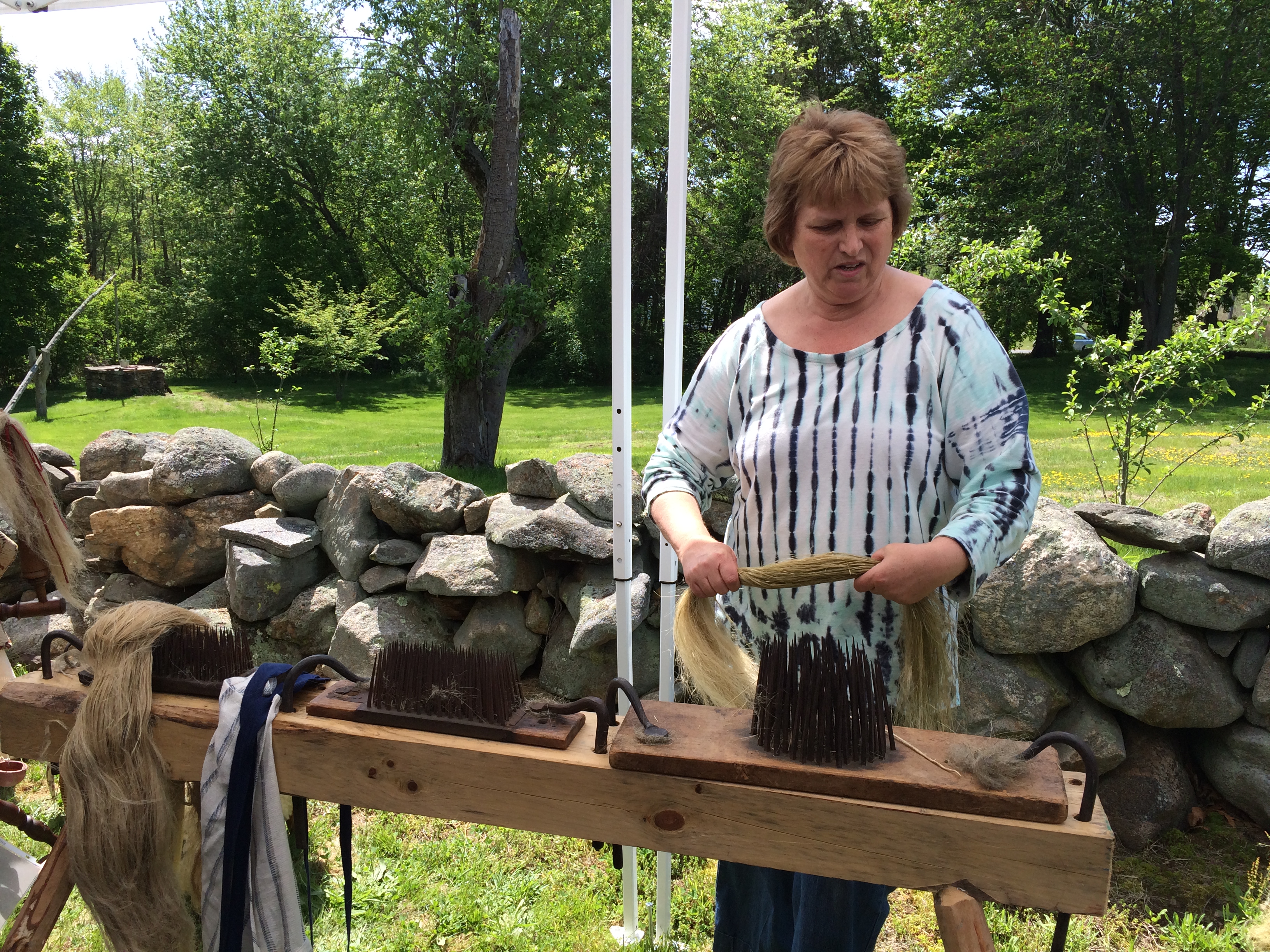
Then she moved on to her hackle stand, a saw horse with three hackles attached to it (with bench dogs, my first exposure to these marvelous tools. Why has the modern world switched to C-clamps when bench dogs are so much faster to use and so much prettier too?). The first time I saw hackles I understood our phrase “getting one’s hackles up!” Sometimes an image is worth more than a thousand words!
This photo shows Gina’s three hackles (all up!), getting finer as she progresses through the hackling. Aren’t her bench dogs great?? I talked to the blacksmith in one of the nearby barns about getting a set.
When Gina was done hackling, she had a beautiful linen strick to spin. She could twist it into a bundle and continue processing other flax bundles, or she could put the the strick on her distraff and begin to spin.
The great take away lesson for me during this demonstration came now, dressing the distaff. I have never understood how to dress the ‘birdcage distaff’ that we see all the time. It just seems to me that after preparing this perfectly combed strick of linen putting it around the birdcage just gets too many of the fibers out of alignment. Then spinning only messes up the aligment further. Well, clearly I don’t understand it because it is the traditional way of preparing flax to spin. Luckily there are other traditions, and Gina uses a straight distaff on which she ties her strick so that it stays in a straight bundle.
Here are the two distaffs: birdcage on the left, straight on the right
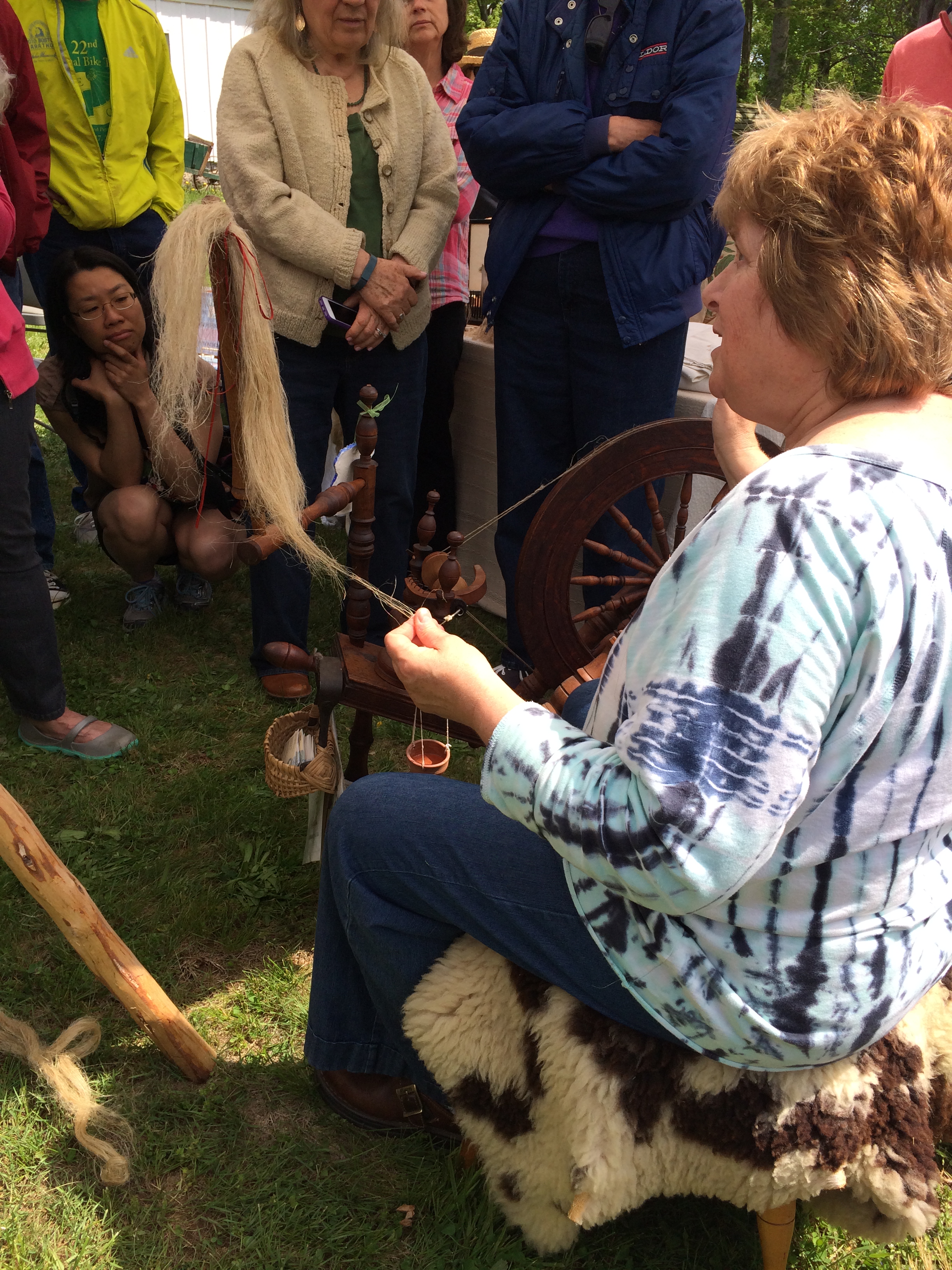
Here you can see how she has tied her strick to her simple distaff and is preparing to spin by pulling out just a few fibers.
Gina describes her flax as good quality (and that is easy to see!), but not as fine as the linen grown in Belgium or northern France. She says farmers there have mastered what is necessary for producing the finest flax fibers, which includes sighting the flax field in a very sheltered place, safe from wind. Flax plants have very shallow roots and the plants can get knocked down by wind or driving rains. Once they are down they cannot be staked up again. In general, in northern Europe, summer weather is mild and rains are not violent in the way that our summer thunderstorms in New England can be!
Gina spins a yarn that would make a wonderful heavy weight smooth linen fabric. You can see just how few fibers she draws in to her yarn.
Along with her demonstration she had a lovely display of linen items. It was such a treat to see her working, to see her display and to get to know her. I hope our paths cross again!
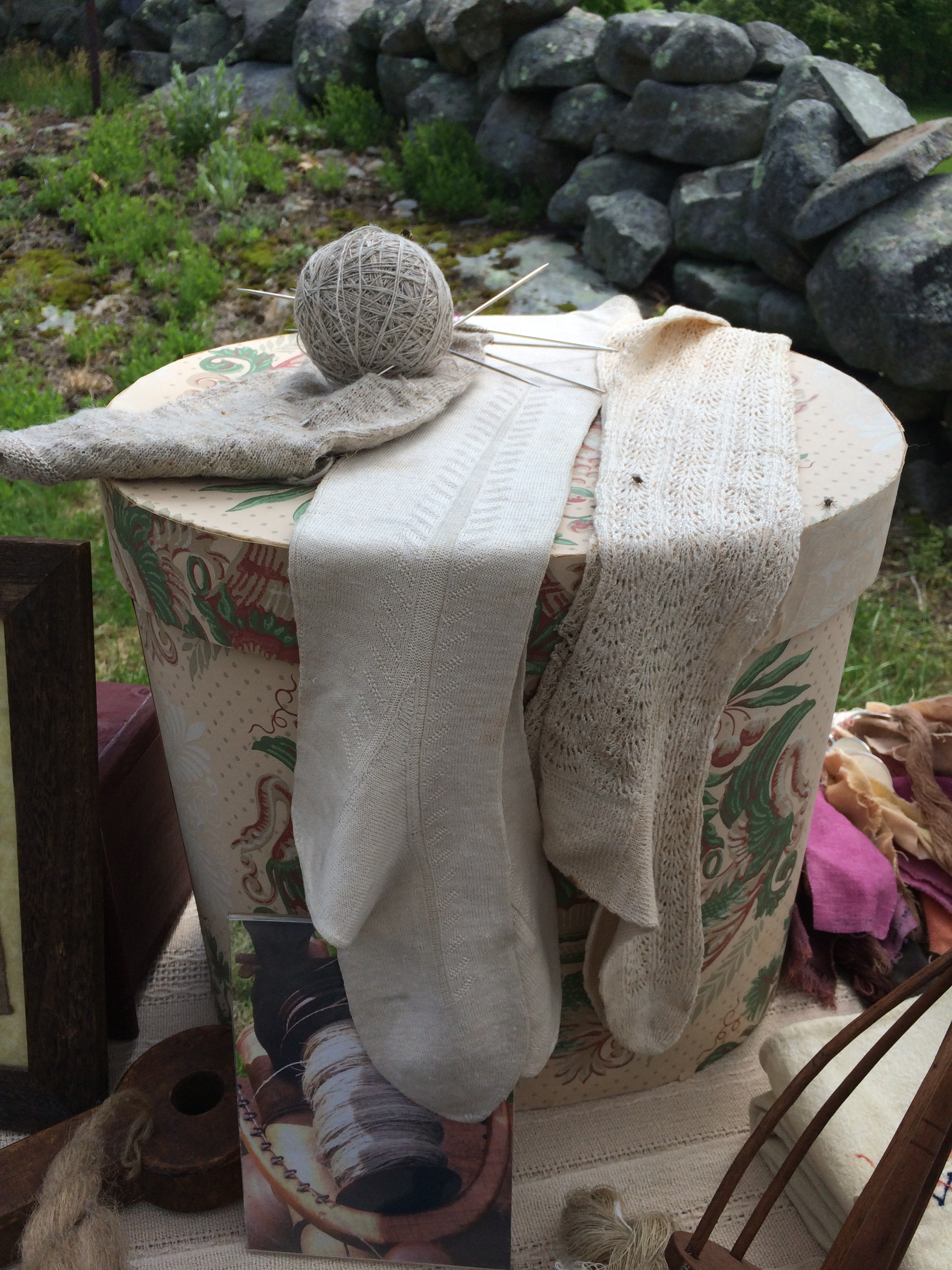
Linen socks! I’m not sure I believe these are handknit!
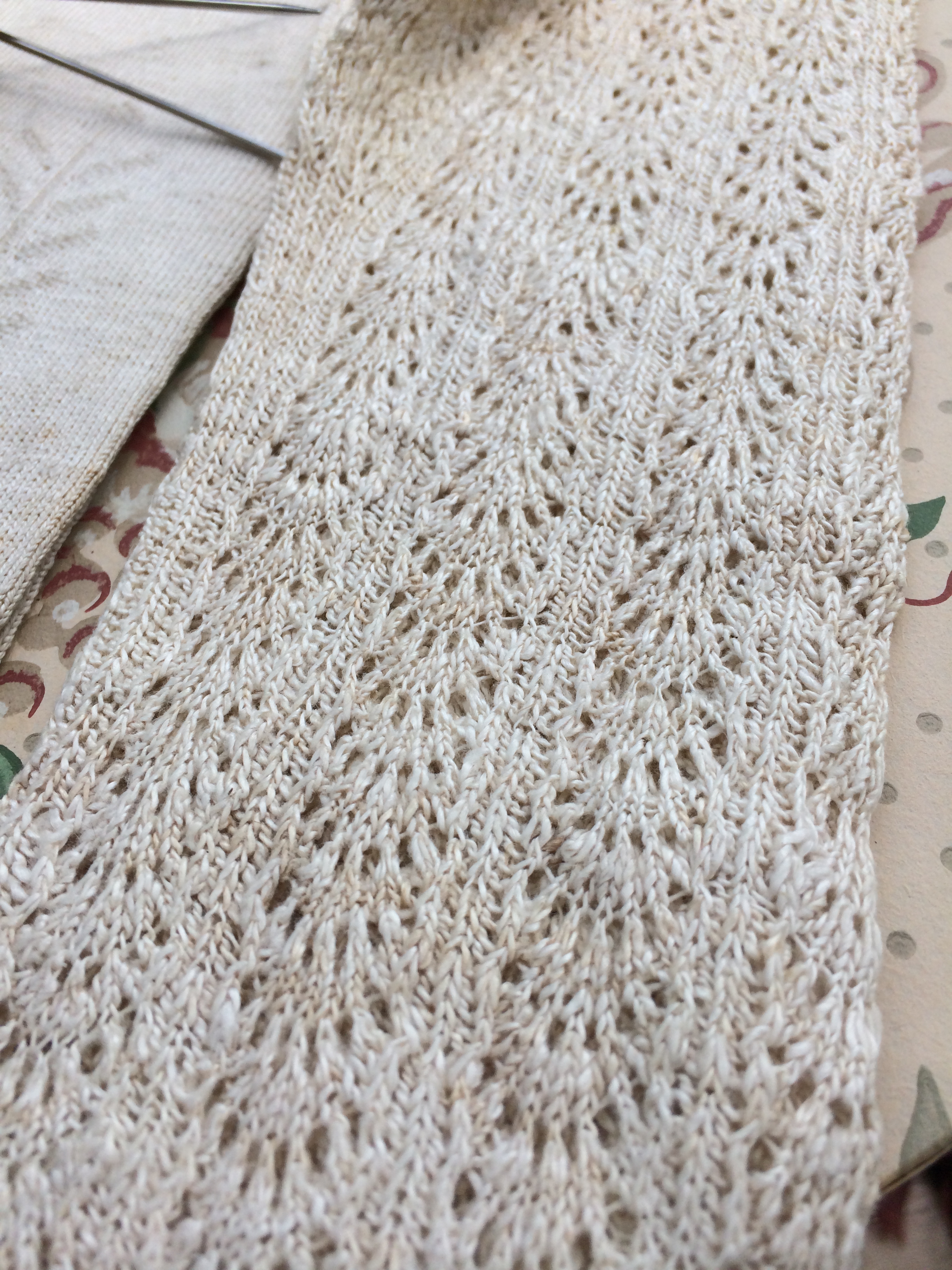
And a close up of each of these beauties! First, feather and fan (okay, close up I can believe this was handknit):
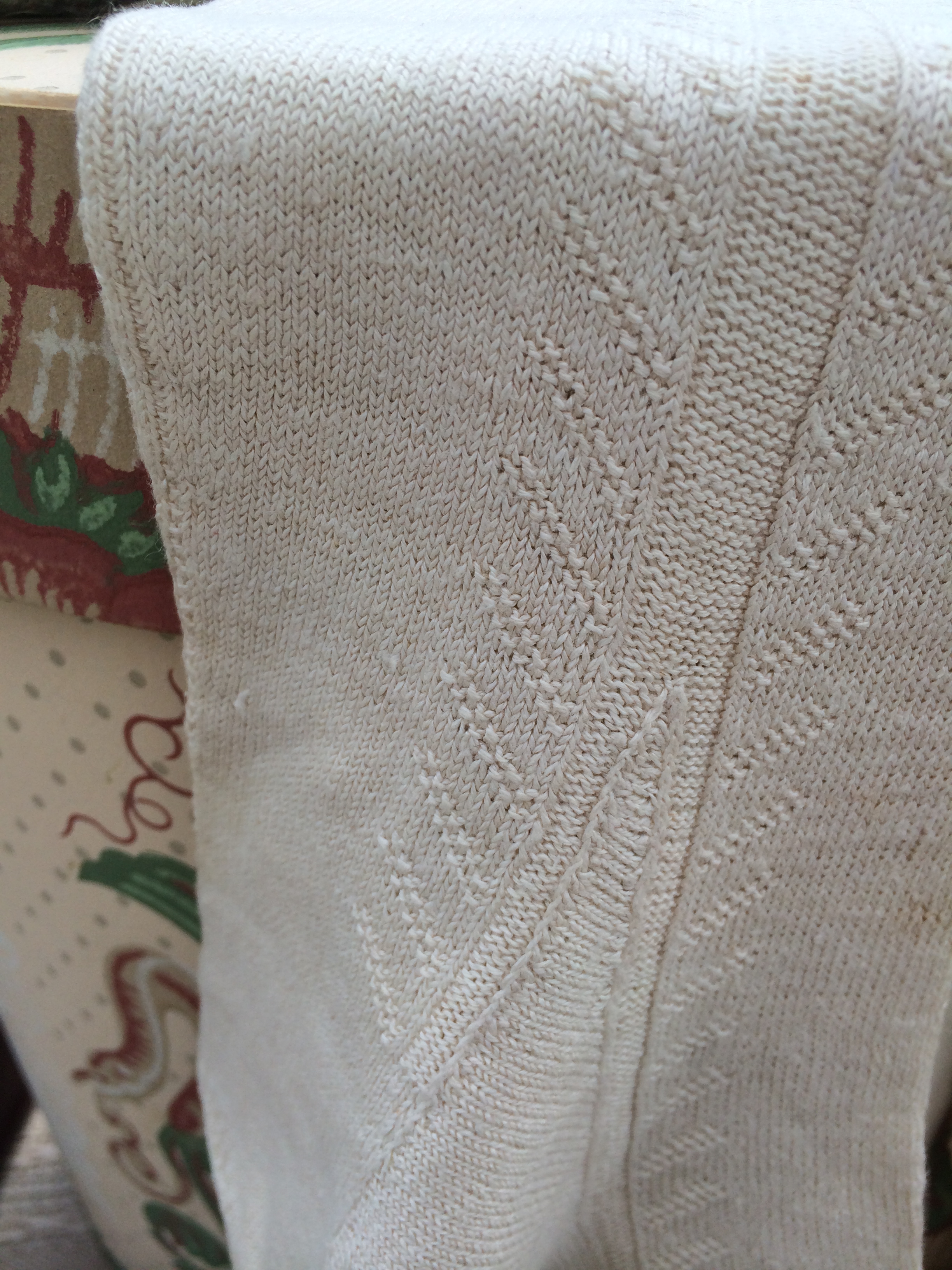
…but not this one! Boy, I would love to try these on!
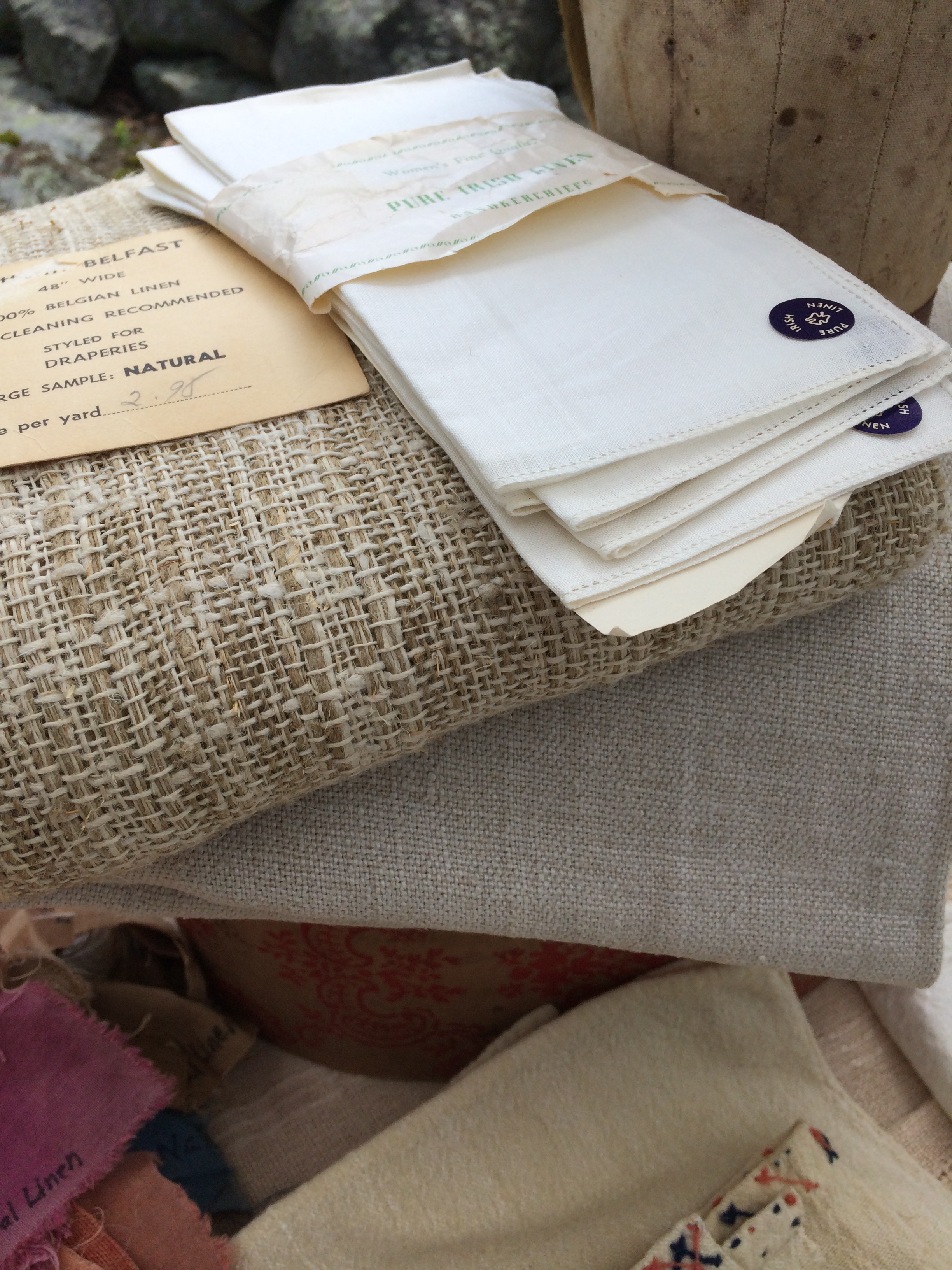
She had a plenty of linen fabrics to see and touch to show the difference in fineness and color. In the stack of three fabrics at the top of this photo, you can see a set of very fine, bleached linen handkerchiefs, followed by quite a coarse fabric woven of linen singles (perhaps tow linen), and last a heavy weight fabric of line linen which I believe is very similar to what Gina was spinning for us during her demonstration.
At the very bottom of this photo you can just see a bit of embroidery and the folded part of the fabric behind the embroidered edge. This fabric was wonderfully soft to the touch; it is a length of antique linsey woolsey. Wow!
So, that was the highlight of my visit! And of my Memorial Day weekend. I just want to get back to my linen spinning project! Gina has given me some great ideas on how to improve, and I’d like to get to it!
Meanwhile, other things were going on on the farm. Wool preparation and spinning, horsedrawn wagon rides, sheep shearing. Most of the out buildings on the propery were open. One of them has been set up as a general store, which is not original to the farm, but makes an intriguing display of 18th century items that the owners have collected.
Some of my fellow guild members were on hand demonstrating and showing their wares. It was great to catch up with them and watch them talk to onlookers. There was a great turn out for this event.
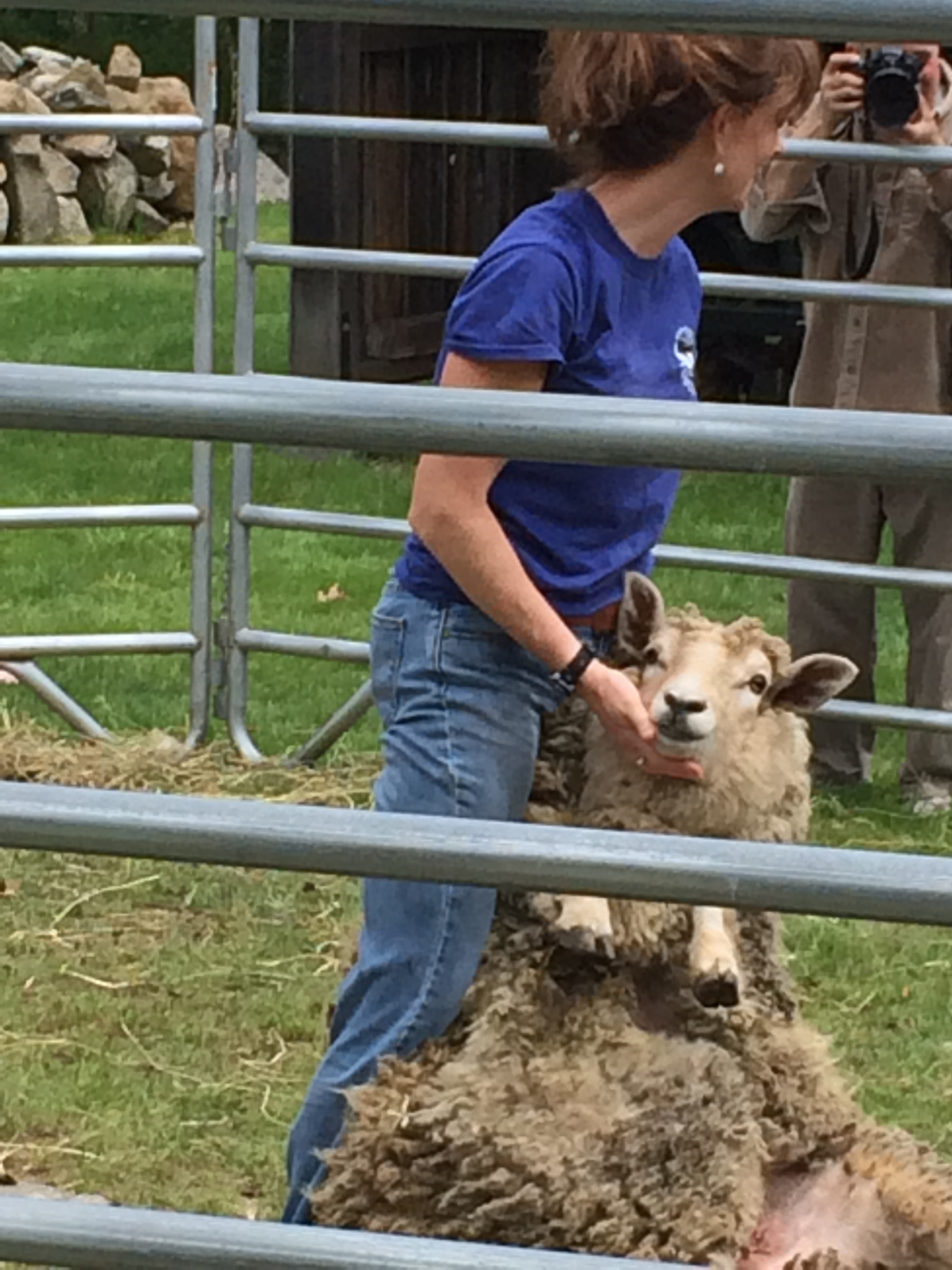
The sheep shearing was almost as thrilling as the flax demonstration. Certainly it was very thrilling for the sheep….they did their best to avoid it. The shearer was a woman, of very slight build, and rather young it seemed to me. She handled herself with such confidence, the sheep never gave her a moment’s trouble once she corralled each one. She sheared all the sheep, but I only documented the first one. She never made a knick on the sheep, and the two year old ewe was perfectly calm. Who wouldn’t love a face like this?
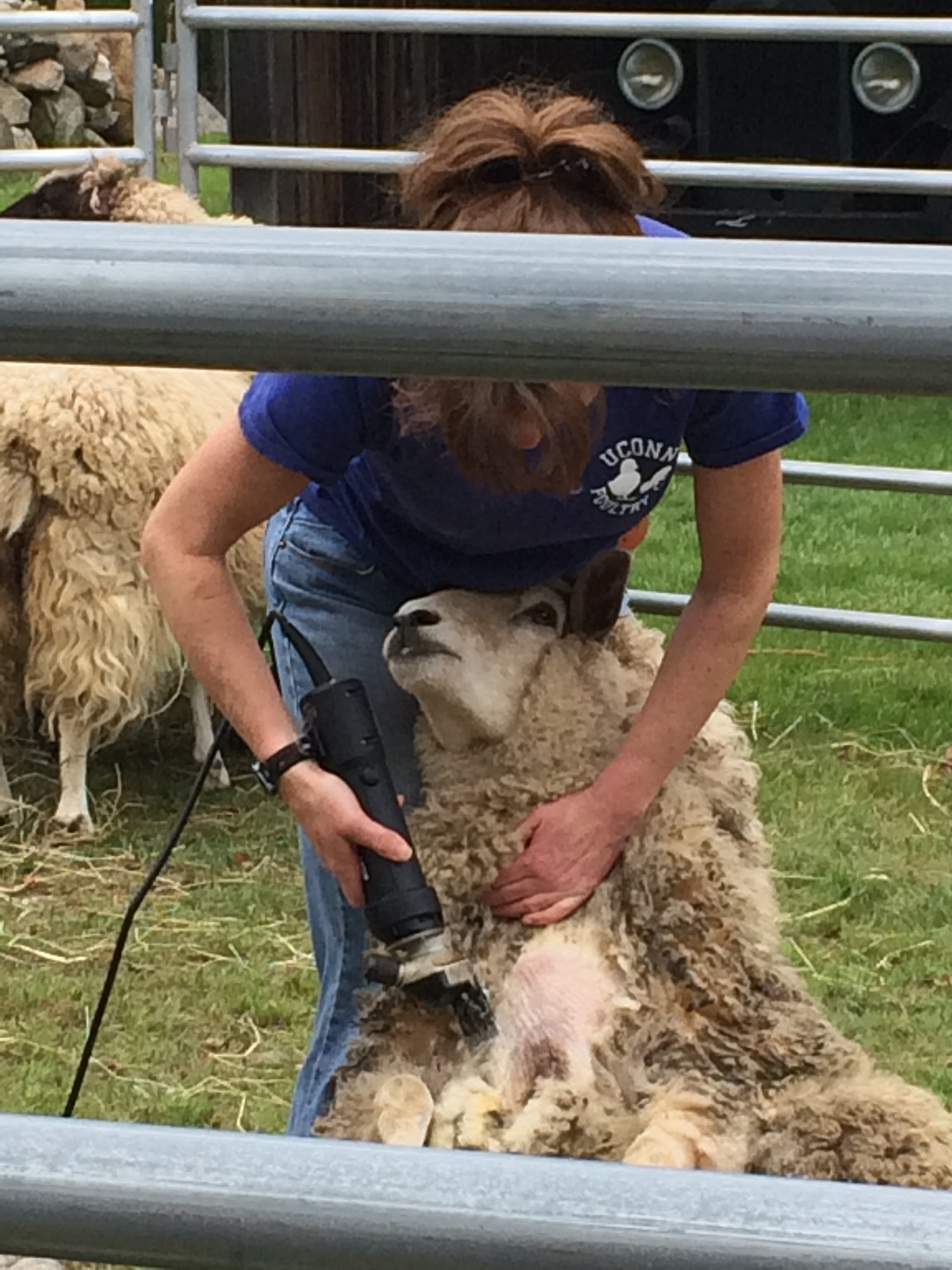
And so the shearing begins….
Moments into the shearing I realized I was watching a master, so I had to tape it!
Now it’s Sunday morning and I am full of ideas and inspiration from my day on the farm…. although I want to spin some flax, I am partway through making that colorful warp for yardage for the napkin and lunchbag fabric that is due at next month’s guild meeting. I’d better stick to that today!
It’s nice to have enthusiasm for so many fun textile projects! See you later, hopefully with photos of my finished warp!
Isn’t that an odd saying? If you do bobbin lace perhaps you’ve heard it before. Although I have heard it before, I did not heed it. I did not even remember it!
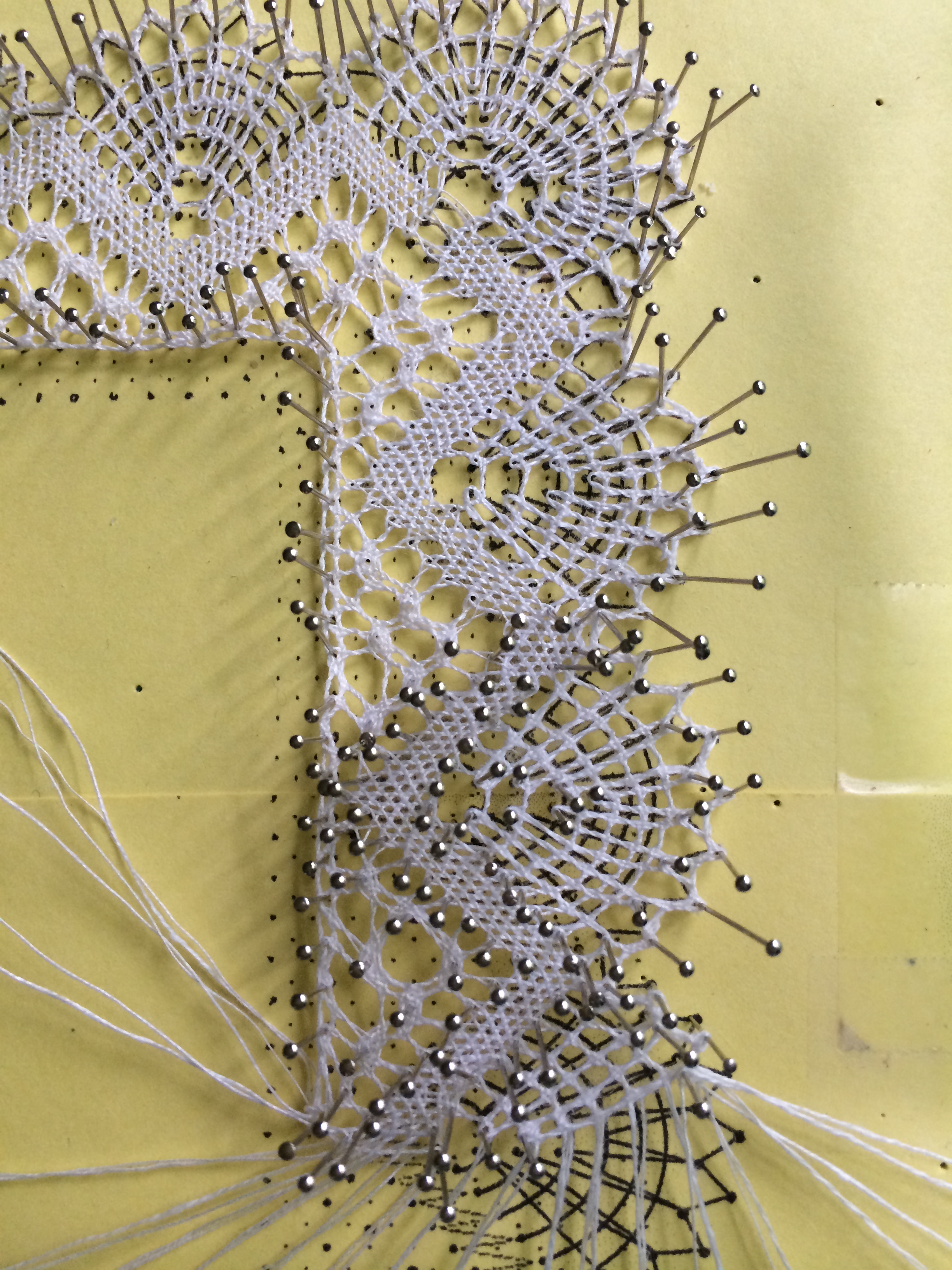
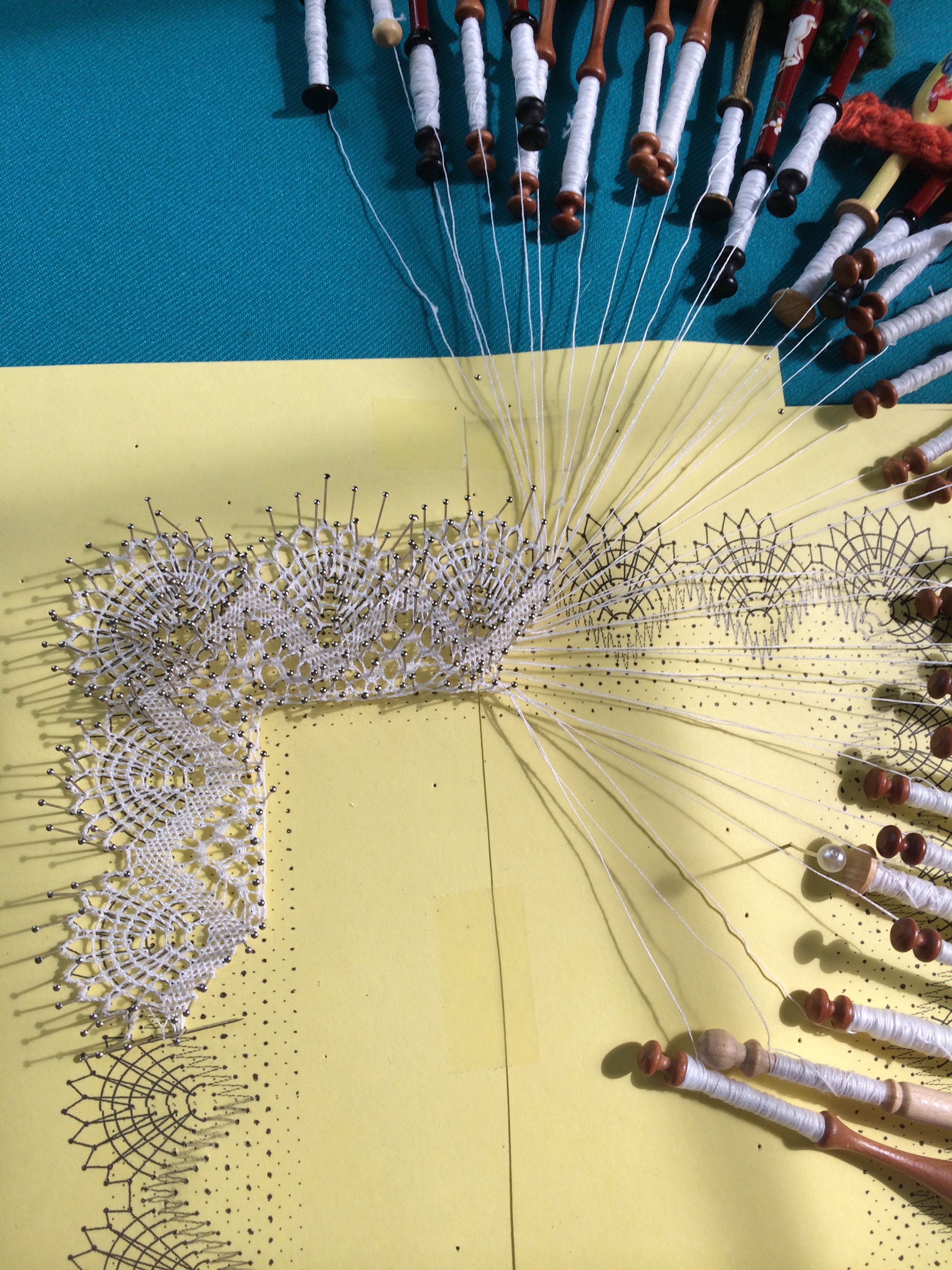
I had finally gotten to the point in my current lace project where I believed I had made all the mistakes possible to make. Ha! I had gone backwards and forwards, and backwards again so many times, and had solved problems in all the segments of this pattern: from being short a pair of bobbins in my half trails which then gave me problems in my braided edge, to then ending up with too many pairs of bobbins for my sewing edge. It was an embarrassingly long process which could have been shortened if only I’d had access to some experienced lace maker…..but impatience and stubborness always drove me on!
Finally, just when I thought that forward was the only direction for me now, one of my threads broke right at the edge of the weaving so there was no tail to use to tie the bobbin back on. Ugh! The break definitely happened because of all the weaving and unweaving I’ve been doing. Twisting and untwisting caused this fine linen thread too much stress.
Along came my wonderful lace mentor and dear friend Micheline, who heard of my dilemma and called to ask me if I remembered the phrase “milking the faerie cows.” Well, yes I did…..but I had no memory of what it meant. Micheline credits Christine Springett with this bit of sage advice, which is: when you are making a braid you must tension it as if you are milking faerie cows; i.e, very, very gently.
Bingo! (On top of everything else!) That is exactly what I was doing wrong. I was really giving my edge bobbins a good strong pull to get my braid threads to tension evenly. And on top of all that forward and backward weaving….well, that fine linen just could not take any more. It doesn’t solve the dilemma I’m in now, but it sure will help me not to do it again.
So….alas….yet another bit of unweaving. Micheline says I need at least 1/2″ of unwoven thread to make the mend in this thread. I believe the mend is called a ‘lace knot.’ It’s the knot you make to connect two bobbins of thread together. It involves making a slip knot in one thread, then putting the other thread through the loop of the slip knot (in this case my tiny 1/2″ bit of somewhat shredded linen) and closing the slip knot while pulling on the thread in the loop so that the slip knot transfers onto the thread in the loop and so that slip knot no longer slips. It’s the very thing you do not want to happen when you are tatting.
Instruction from my beginner’s lace notebook by Lynda Barber
Since I’m dealing with such a short bit of linen where the break occurred, I plan to enlist Bob’s help (I can hear him returning home just now!) to hold the little bitter end of broken thread with a tweezer while I attach the longer thread from the bobbin with this technique. Wish me luck!
….no luck on having the third hand for help. I released Bob from bondage and managed to do the knot by myself on the first try. Even at this magnification, I cannot see the mend….I hope you can’t either! Forward again!
It is spring in the Connecticut River Valley, and the lush greeness of everything is such a startling contrast to the desert islands of the Exuma chain in the Bahamas. I love all this green!….not to mention daffodils, tulips, hellebore, and bleeding hearts. In just the five days I’ve been home the trees have leafed out so much that the canopy of leaves must be at least three times greener. I love it!
Like last year, I made it home in time for the Essex Village May Market, an event that the local garden club hosts. If you arrive early enough, and I did (!), you can buy some of the garden club members’ choice plants from their personal gardens. I got a bleeding heart, some English bluebells, a forget me not, a pink fall anemone, and a helianthus. The plants from the members’ own gardens are HUGE, and cost far less than smaller plants at the local nuseries. It’s the biggest attraction of the event, and I did well to arrive as early as I did! I was not too far from the front of the line.
It was also Mother’s Day weekend, and our younger son came out to visit from New York. He also invited a group of his undergraduate friends and a couple of their significant others to visit. It was a very festive Mother’s Day, even if only one of these young people was actually related to me! They made a lovely dinner for all of us, and they did all the shopping, the prep, and cleaning up! Wish I’d thought to take a photo of them!
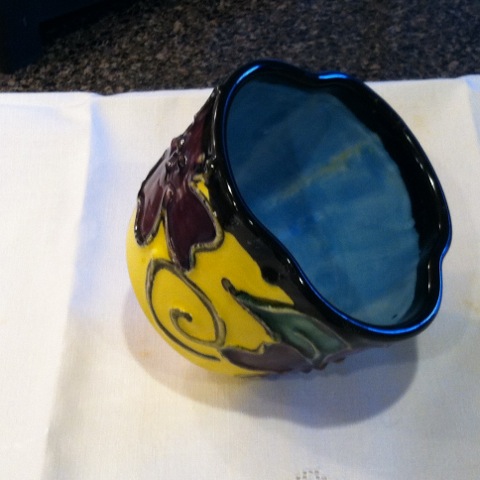
I am about to go down to my studio and begin a rather involved stash search for a project I need to get started on soon. My local area guild is doing an exchange where each of us makes fabric for a drawstring lunchbag and napkin that will coordinate with a coffee mug that belongs to another guild member. We all got a photo of someone else’s mug and began designing a fabric to go with it. Here’s the mug I got, a lovely handmade ceramic design by the owner’s daugher!
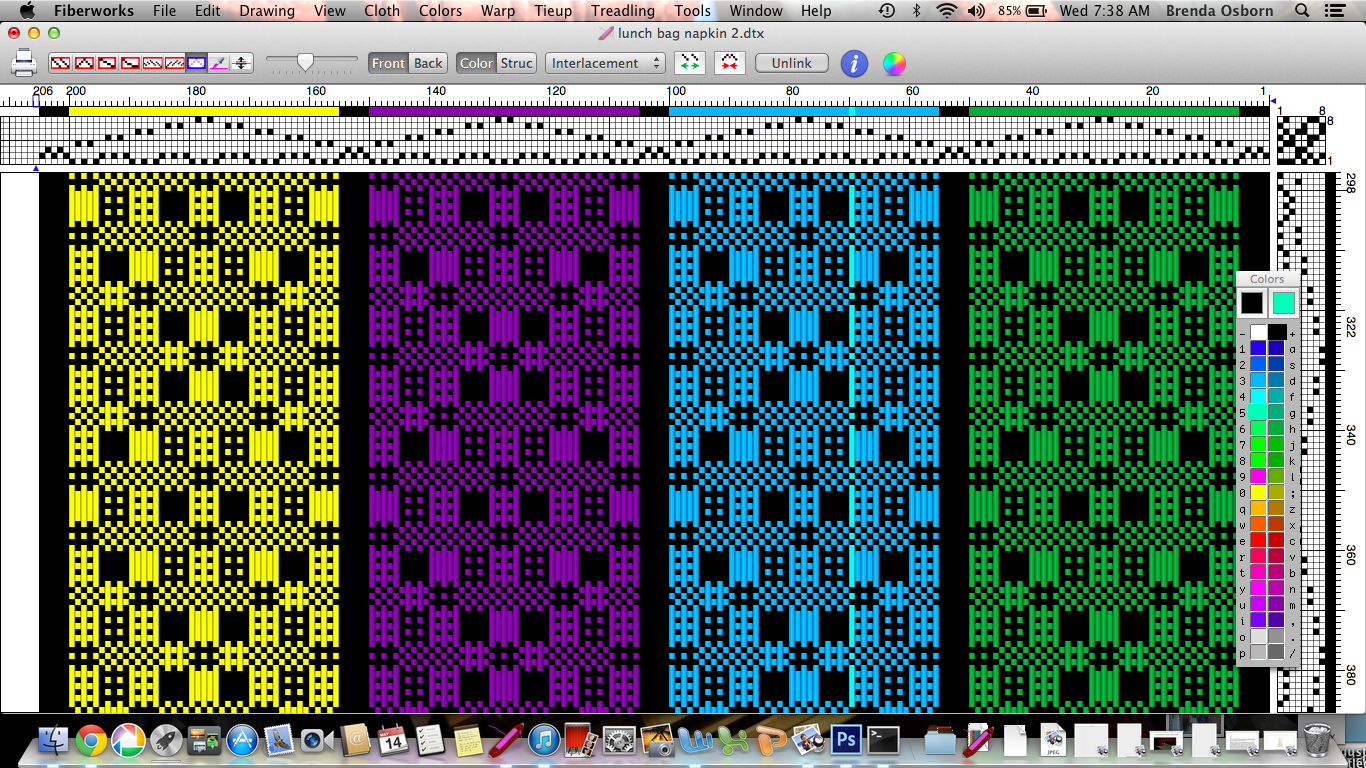
Hopefully in the next day or so I will have my yarn picked for the fabric. While I was away this winter I used my Fiberworks program to design a huck structure to mimic the flowers on this mug:
Hmmm…unless you are familiar with looking at huck weave drafts you probably cannot see the flower motif. Huck ‘blossoms’ when it is cut from the loom because the warp and weft floats can relax into curves. Wet finishing gives show this fabric off even further!
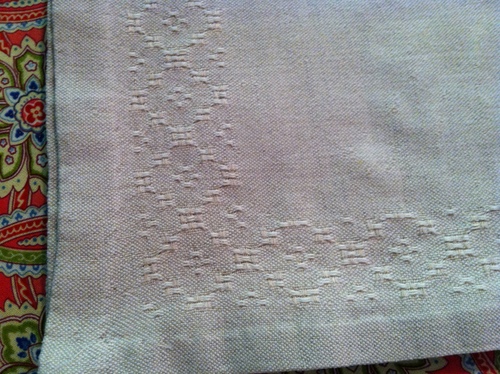
Here is a photo of linen napkins I wove in basically the same structure, although the huck pattern is just along the edge in my napkins and the linen is far finer than the current fabric will be. The fabric I’m designing now will have the huck ‘flower’ all across the width and in stripes of varying colors with a small black stripe between the color changes and woven with a black weft.
Also, I have had some quiet moments to sort through my bobbin lace project. It involved more going backward than I expected! Backward….forward …. further backward….a number of times. In the end I went all the back to the corner, but luckily no further! And now I am happily going forward. It is very calming and therapeutic to do bobbin lace, especially going forward!
Bob is almost home….so close, and yet so far! He is only about 50 miles away, which is only about a 7 or 8 hour sail from here. BUT, the winds have turned against him so that even motoring would be difficult. The winds are a bit strong and right on the nose. I hope he will have his big homecoming tomorrow evening.
That’s a phrase I hear every morning when we listen to the Cruiseheimer’s net on our sideband radio. Boats on the move to new destinations….some heading north to get above the Florida border before hurricane season starts on June 1….or people headed ahsore for provisions and/or sight seeing.
One week from today I will be winging back to the US for a visit with my older son and his girlfriend at their home on the outskirts of Baltimore for a couple of days. In the meantime, we have a full week of beautiful destinations planned as our final week aboard and as a tour of the Exuma chain for Rob and Kandice.
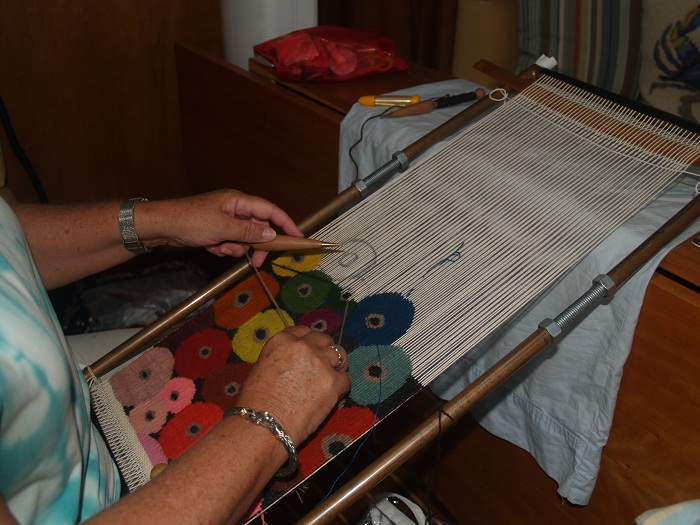
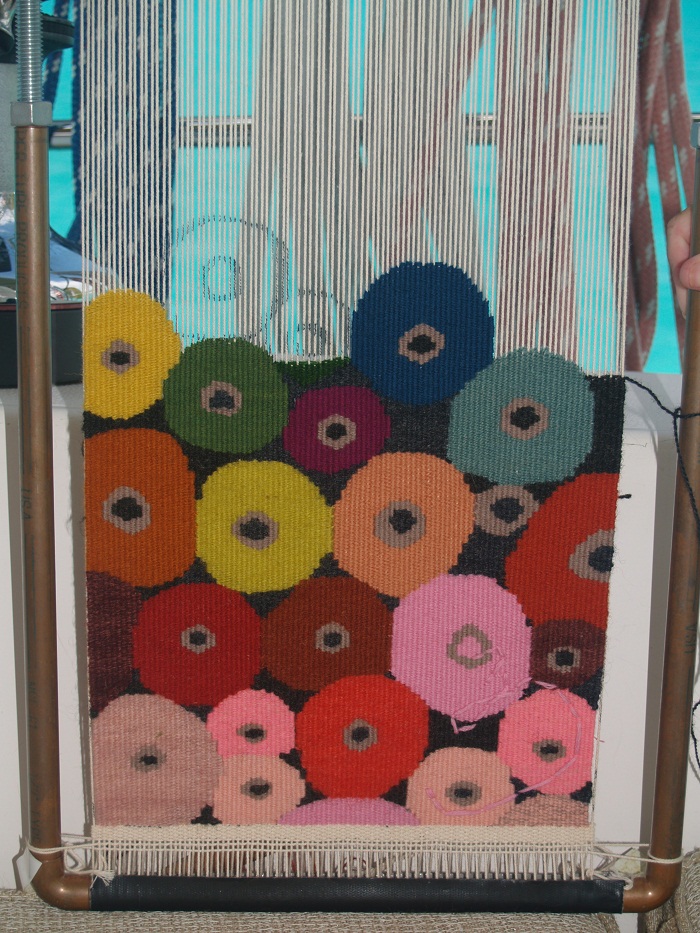
Before they arrived I tried to finish up on my small tapestry exercise of circles within circles….didn’t quite make it!
The piece will end in the area where the threaded bar is so I’m not too far from the finish line. It’s been a fun project, but I guess I will have to spend some time on it at home. I cannot bring it with me, so it will sail home with Bob.
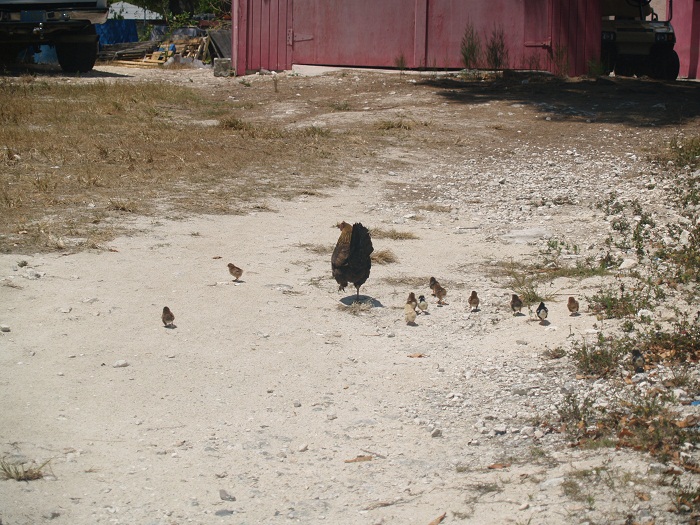
On our walk to the airport to meet Rob and Kandice, we passed lots of roosters and chickens with their chicks. There were big black roosters and white ones, and lots of colorful chickens. The roosters are very good at avoiding our camera, and the chickens are pretty good too, although they are encumbered by their brood of little chicks following them around. The best shot we could get was the backsides of a retreating family!
A very different kind of trip to the airport than what we normally experience! At the airstrip we sat in a gazebo to await Rob and Kandice’s arrival!
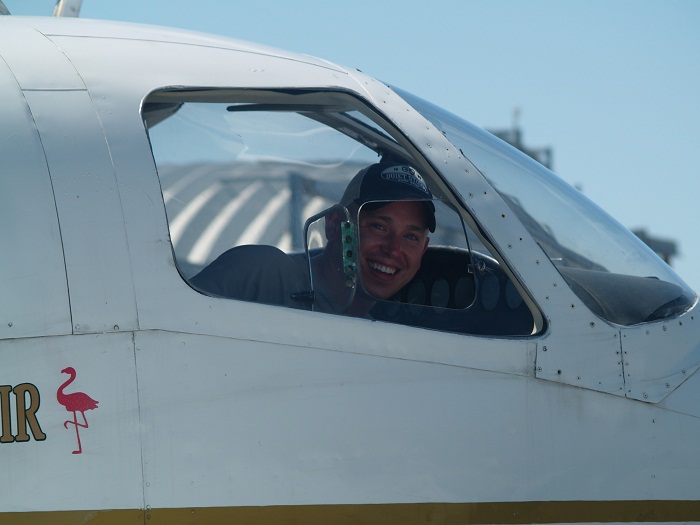
And then there was Rob, waving to us from what should be the co-pilot’s seat! He had a wonderful time sitting next to Chester the pilot. Rob took some amazing shots of the flight and videos on his Go Pro of the flight and the approach to Staniel Cay. He even saw Pandora at anchor as they made their final approach.
The kids have played with the pigs on Big Major’s Spot, and we’ve seen just how quickly little piglets have grown! Bob probably could not pick up that little pink pig anymore! Rob and Bob went snorkeling in Thunderball Grotto at low tide yesterday, and Rob took a lot of video of the fish and a sea turtle that he swam with for a while outside the far end of the grotto.
We’ve seen some wonderful sunsets, some shooting stars, and some amazing clouds…
Today we will have a short sail to Over Yonder Cay. This is a private island, beautiful beyond belief, and entirely self-supporting with their own energy. There are three large windmills on this island….later today we will get a guided tour from the island manager, Ethan, and I’m sure we’ll learn a lot more about how this stunning place operates.
The rest of our final week will include time at Warderick Wells, Compass Cay, and Shroud Cay.
My shawl is on the final repeat of the lace pattern….now what am I going to work on during my flights home? Wondering if it’s still cold enough in Connecticut to wear wool/silk socks…