It is early February, and I am writing from Simpson Bay Lagoon on St. Martin in the Caribbean. We are later this year in slipping our moorings in New England and moving aboard Pandora. Lots of things contributed to the delay, but we are here now, anchored near some dear sailing friends who are introducing us to others who will become friends as the months and years pass.
After entering this harbor on the first bridge opening this morning, we anchored near the ketch Kalunamoo, whose owners are friends who took us under their wings five years ago to lead us through the Bahamas on our first trip down there. Now they will surely be our tour guides though the Windward and Leeward Islands. We see each other each summer when our boats are back in north Atlantic waters, but this is our first winter rendevous in three years. It’s so comfortable being together again by water.
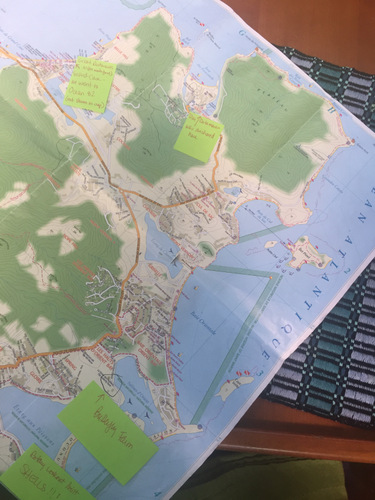
Before I left home another dear friend, one I’ve known as a weaver and land-based friend, sent me her map of St. Martin. She and her family spent a couple of weeks here only a month ago, and she wanted to share with me a map highlighted with the things they enjoyed doing, the restaurants they visited, the boat excursions they took.
Now that I’m here and am beginning to get my bearings, it’s wonderful to see the places she visited and know that I will follow in her footsteps. It’s going to be a fun part of this trip, finally visiting places that some of my friends have been before, even if they traveled very differently than Bob and I are doing. It should help me feel less isolated this year than I have in the past–especially last year, in Cuba. That was a wonderful trip in many ways, but it was also the most isolated place I have ever been, since at the time, the US allowed no communications with Cuba.
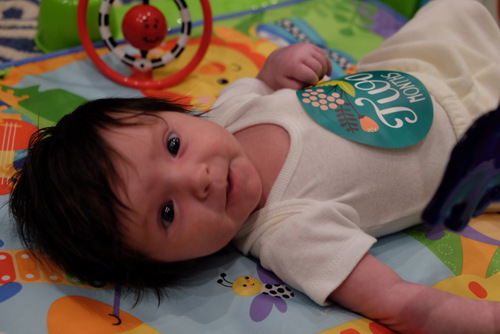
We left home a week ago, and already I get daily photos of my new granddaughter, the Tiny Super Moon named Tori. She is such a joy to both Bob and me. He still gets teary every time he sees a new photo of her. I get the lightest feeling in my chest….such happiness! Here she is beginning to celebrate her 2nd month birthday, although she won’t actually be 2 months old for another week! I guess it was a great photo op for her parents. Before I left I tried my hand at a bit of embroidery that I found on Facebook. It’s astounding to me what I stumble on perusing fb. I’m glad to know this technique–I think it will come in handy for all kinds of projects. I embroidered this little onesie as a practice, and clearly I need more practice. But I’ll get it eventually. I’ll do some spring colored onesies in this technique soon. Hmmm….no photo. Where did it go?
I have started a little sailor sweater for Tori. It is one I made a few years back for my niece. It’s a design by Debbie Bliss and uses her soft eco cotton. This time I am using a soft green/blue color that I call faded robin’s egg, with cream. I love it. I’m still stumped by what I feel is a bad design for the collar. Sorry Ms. Bliss, especially since I love your designs! It’s the focal point of the sweater and I still cannot make peace with wrong side of striped garter stitch showing. For my niece I knitted the collar in a single color. I am debating what to do for this version. I have time to decide.
After 4 days in the BVI, making very quick visits to West End, Jost Van Dyke, and Bitter End on Virgin Gorda, we have made the long, 100-mile passage to St. Martin. The weather has been challenging for the past month (since before I got here), and our weather router suggested that it is quite UNlikely that there will be a good time to head east for the next several weeks. So we took the lesser of bad weather days to slog eastward yesterday. It took us 15 hours to travel 100 miles, in fairly rough conditions. They were very rough for me, but nothing like what Bob and his crew endured getting down to the BVI. I was very sick for the full 15 hours. We anchored out in Grand Case Bay on St. Martin, which I understand can be very lovely in calmer weather. Last night there was quite a swell rolling in there that kept us rolling side to side. We entered Simpson Bay Lagoon on the first bridge opening this morning….not a moment too soon.
We have reconnected with our good friends and will join them for dinner tonight at a Middle Eastern restaurant called Little Jerusalem, where we will start to meet people we’ve heard of many times through various groups, and whom we’ve spoken to on the radio. The beginning of new friendships. I wonder if I’ll meet a knitter or a weaver. You never know.
It’s Labor Day, the first truly chilly morning of the season, and I LOVE it! There will be a few more days of summer heat before we hit the equinox, but summer is winding down. I can feel it in the air and see it in the trees. In spite of hurricane Hermine heading northward, I feel autumn coming.
The month of August has hurtled by me. I had lots and lots of doctor appointments, and in between them, I tried to very hard to enjoy one workshop on ec0-dyeing and as many days of weaving and lace making as I could manage. Looking back, I feel fairly productive!
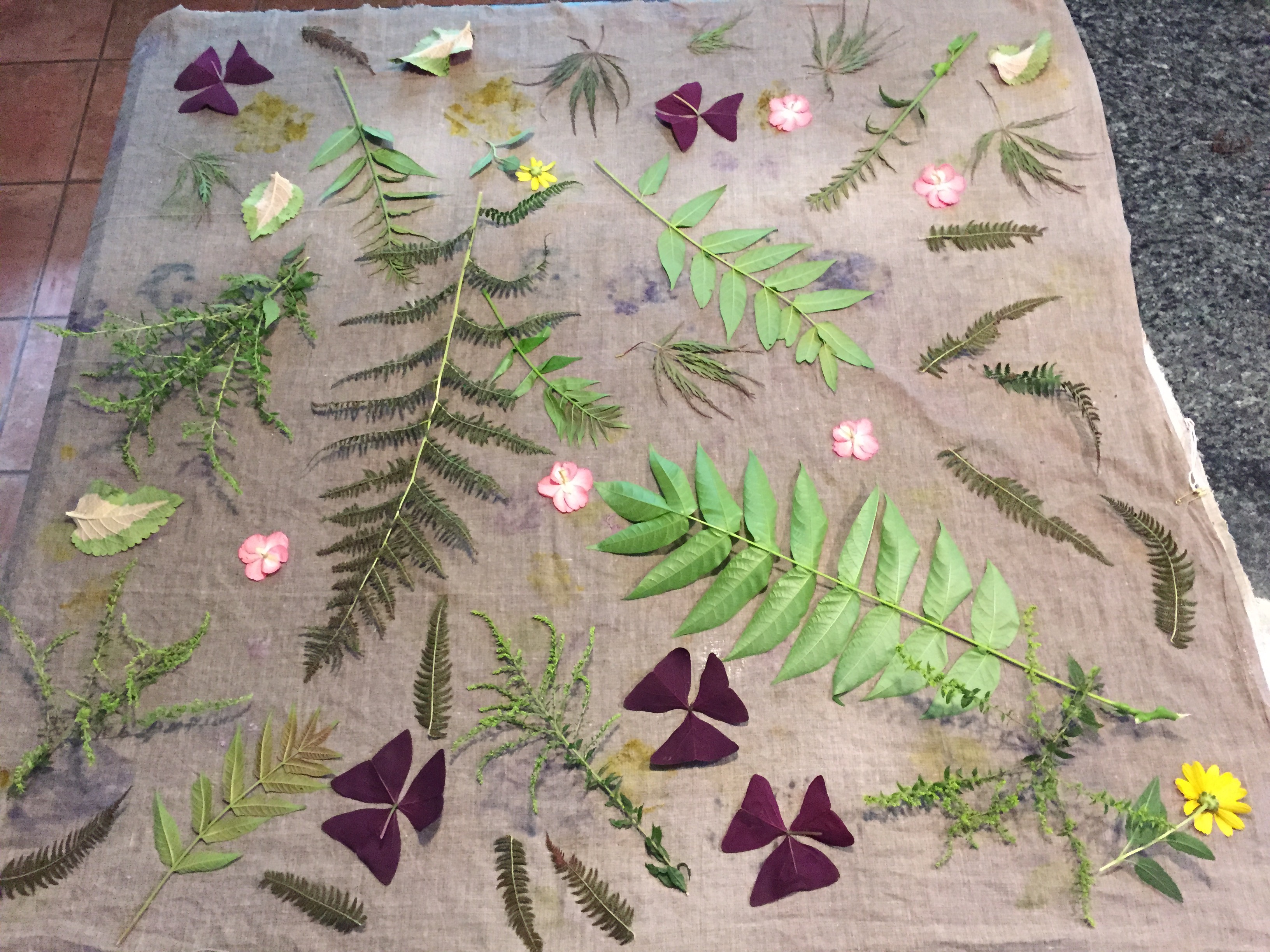
If you haven’t tried Eco-dyeing, give it a whirl! There is nothing like unwrapping a scarf or fabric to find some lovely imprints of leaves and flowers. If your first attempt doesn’t suit your taste just put the fabric/scarf away and try it again on another day. That’s what I’m doing this morning as I write this. I have a 1-yard length of lightweight linen and one silk scarf steaming. I used the rinse and spin cycle of my washing machine to re-wet them, and I just collected a few leaves on my morning walk: one small branch of Japanese maple with about a dozen leaves on it, some golden rod fronds with buds ready to open rather than in bloom, and a few fronds of sumac.
When I got home I spread out my damp linen fabric and silk scarf and placed my plant materials on half of each length of fabric or scarf, because I will fold the other half over to cover the plant material. To the things I gathered on my walk I added a few gems from my garden. Today I am trying tall ferns that I hope are ostrich ferns, since I read that those work well in eco-deying. I have a few dark purple oxalis leaves, some purple cranesbill flowers as well as leaves, some coleus leaves, and one small spray of red flowers from a dragon wing begonia. As I write this I realized I meant to to pick some hyacinth bean leaves and flowers. The leaves of the purple hyacinth vine have such dark veining, it might work very well in this technique. Drat! My fabric is already in the steamer.
Here are a couple of sites that I found very helpful in trying this technique. Sherry Harr did her doctoral thesis at Kansas State University on various textile dyeing techniques, and her article is quite thorough. There are several blogs where the authors have documented their plants and techniques rather well. Take a look at Threadborne and Obovate Designs.
In mid-August a few people from my local area guild got together and shared lots of plant material and had a go on our various fabrics and scarves. None of us had ever done this before, but we shared the internet info we found, and a couple of us had talked to others who had taken a workshop with Amelia Poole, whose work in this technique is stunning.
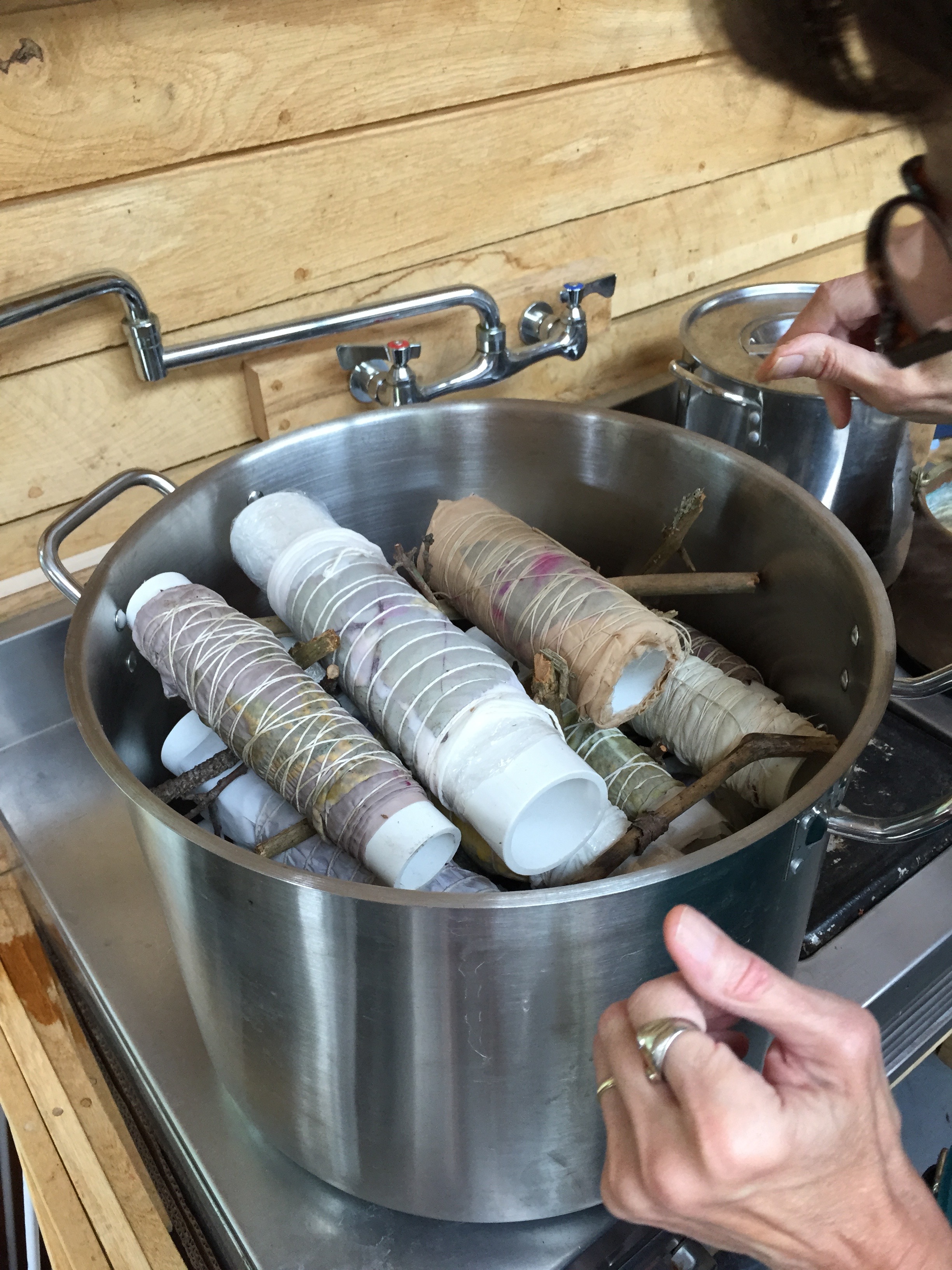
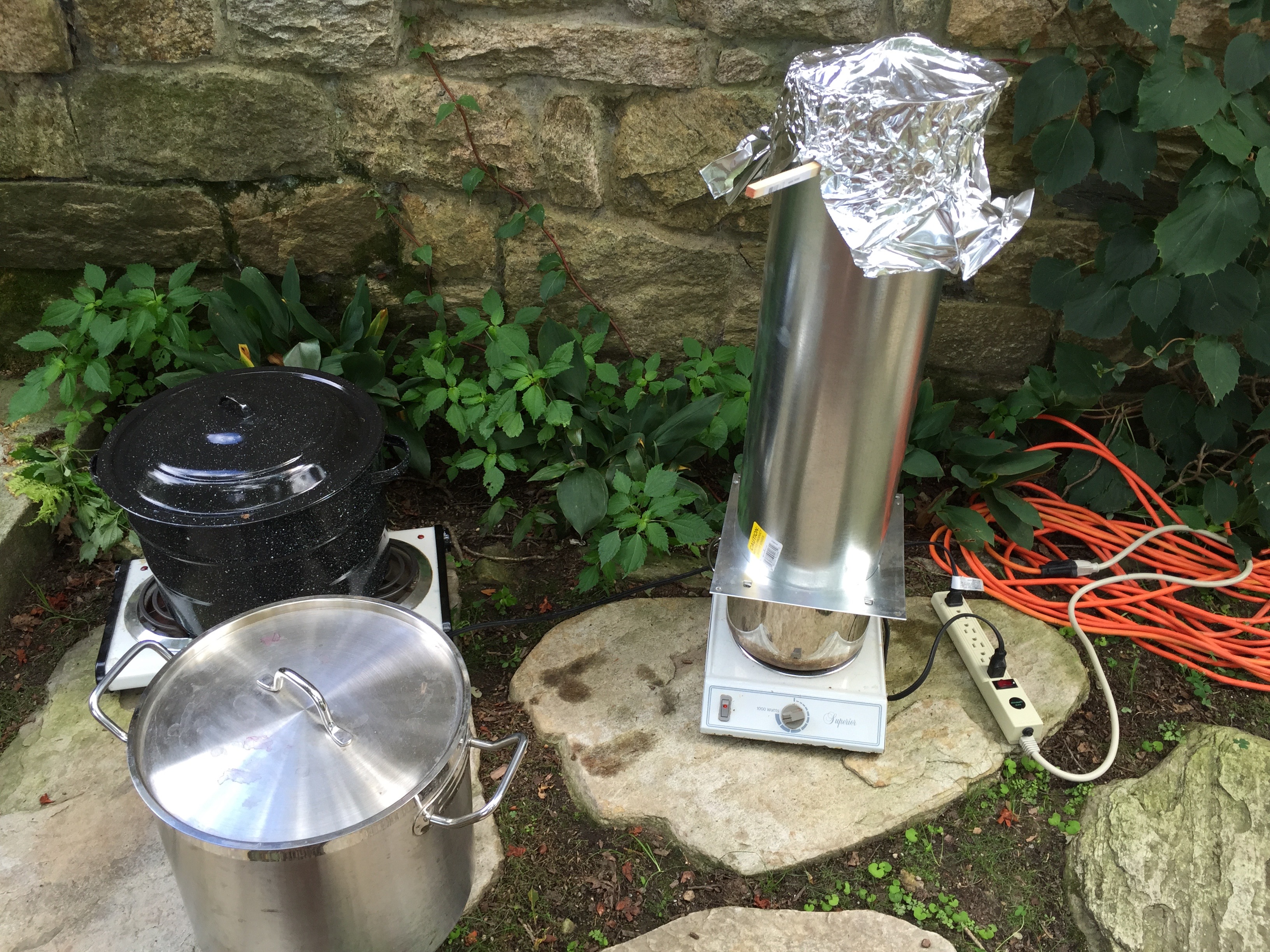
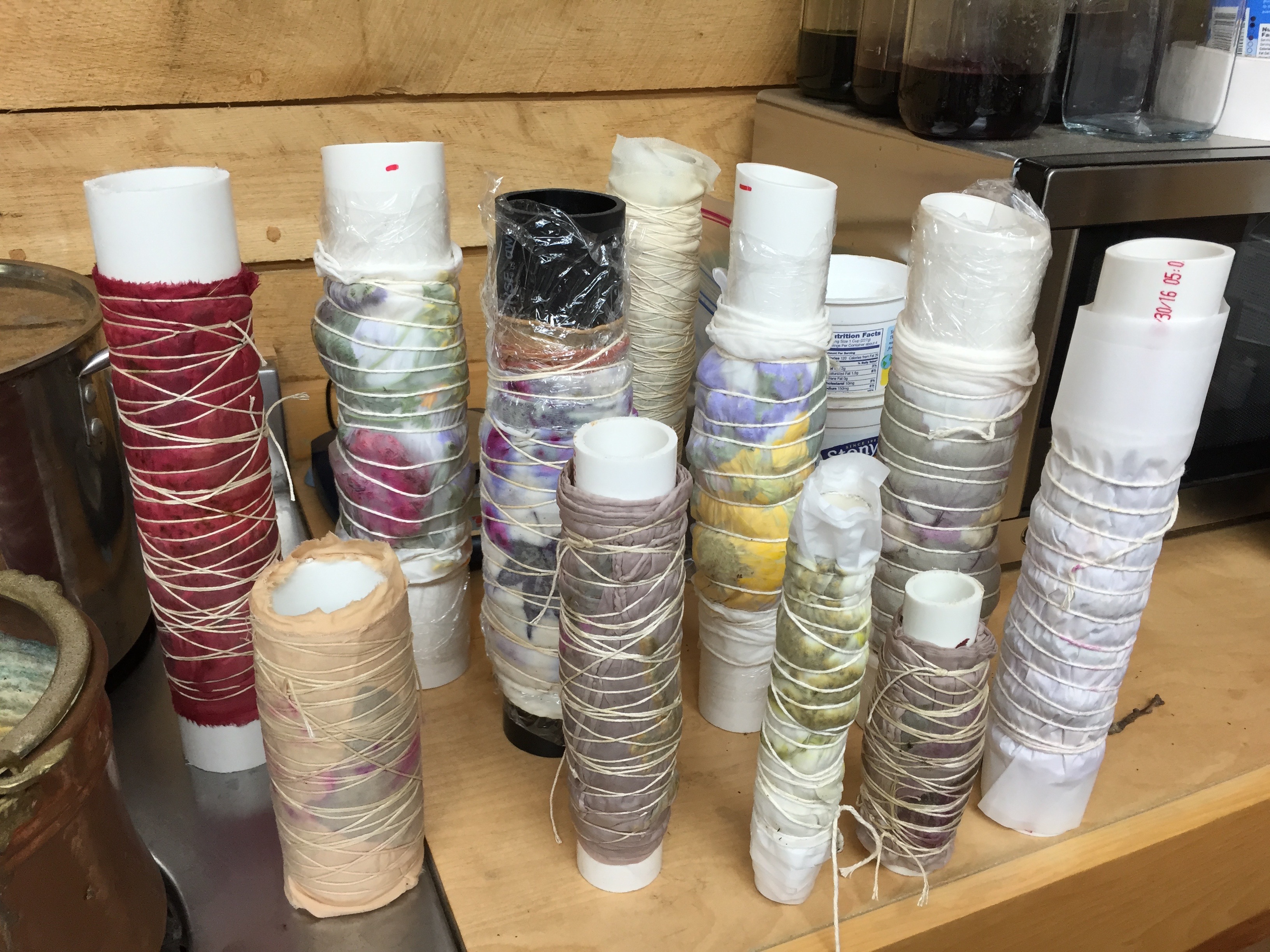
With a bit of info and a LOT of enthusiasm, we plunged ahead. We were quite lucky to have the use of Kate’s wonderful weaving/dyeing studio for this project. Here you can see how we layered the tubes of fabric with sticks to keep them from touching. To make the steamer there are some rocks and sticks at the bottom of the pan to keep the tubes of fabrics above the water level.
The taller tubes of fabric went in this make-shift steamer.
After 30 minutes of steaming and a little time cooling down, our tubes came out of the pot.
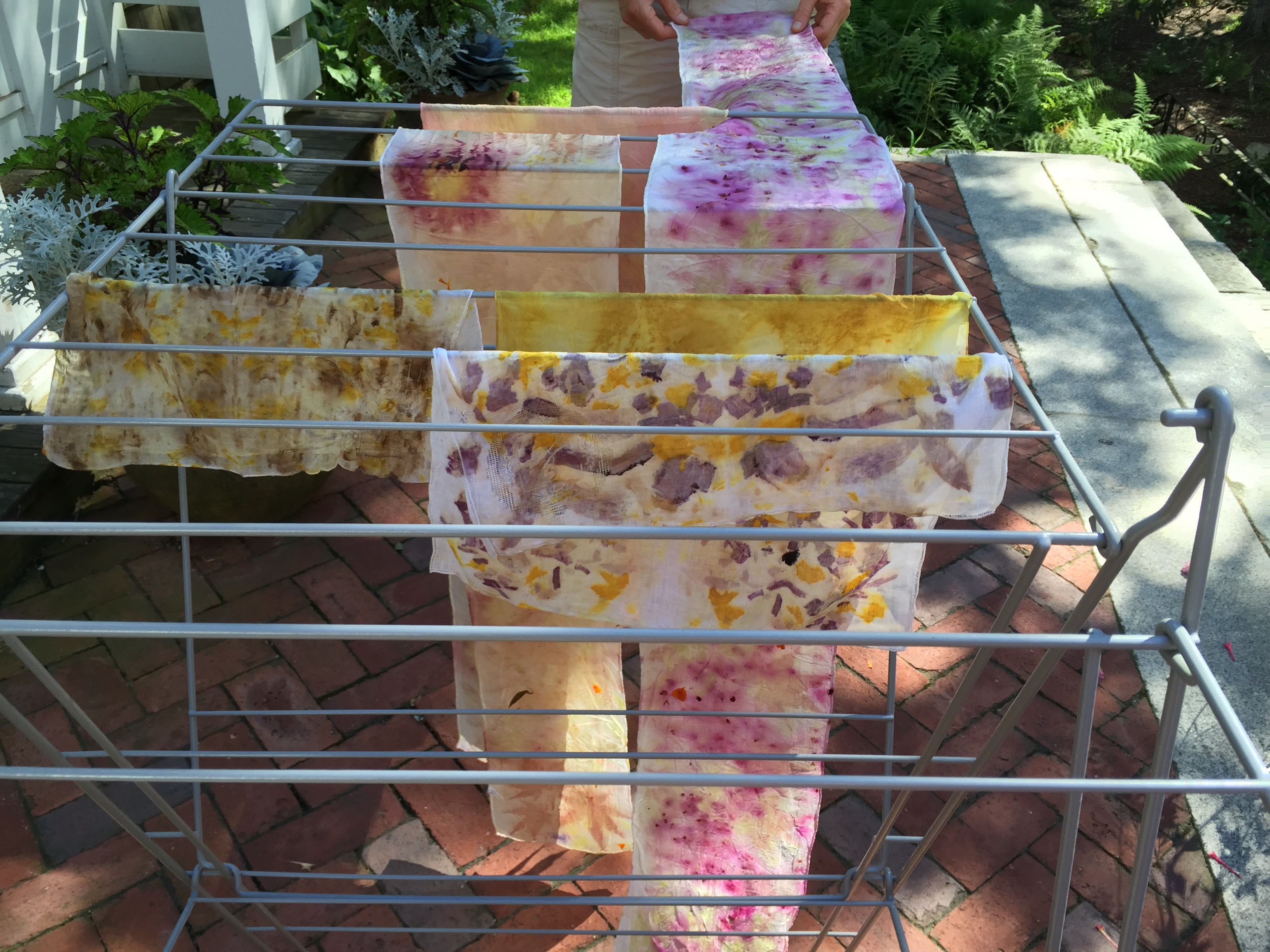
Unwrapping and hanging our scarves and fabric to dry on a rack. We were pretty thrilled with our results.
My first scarf turned out better than the other things I tried that day.
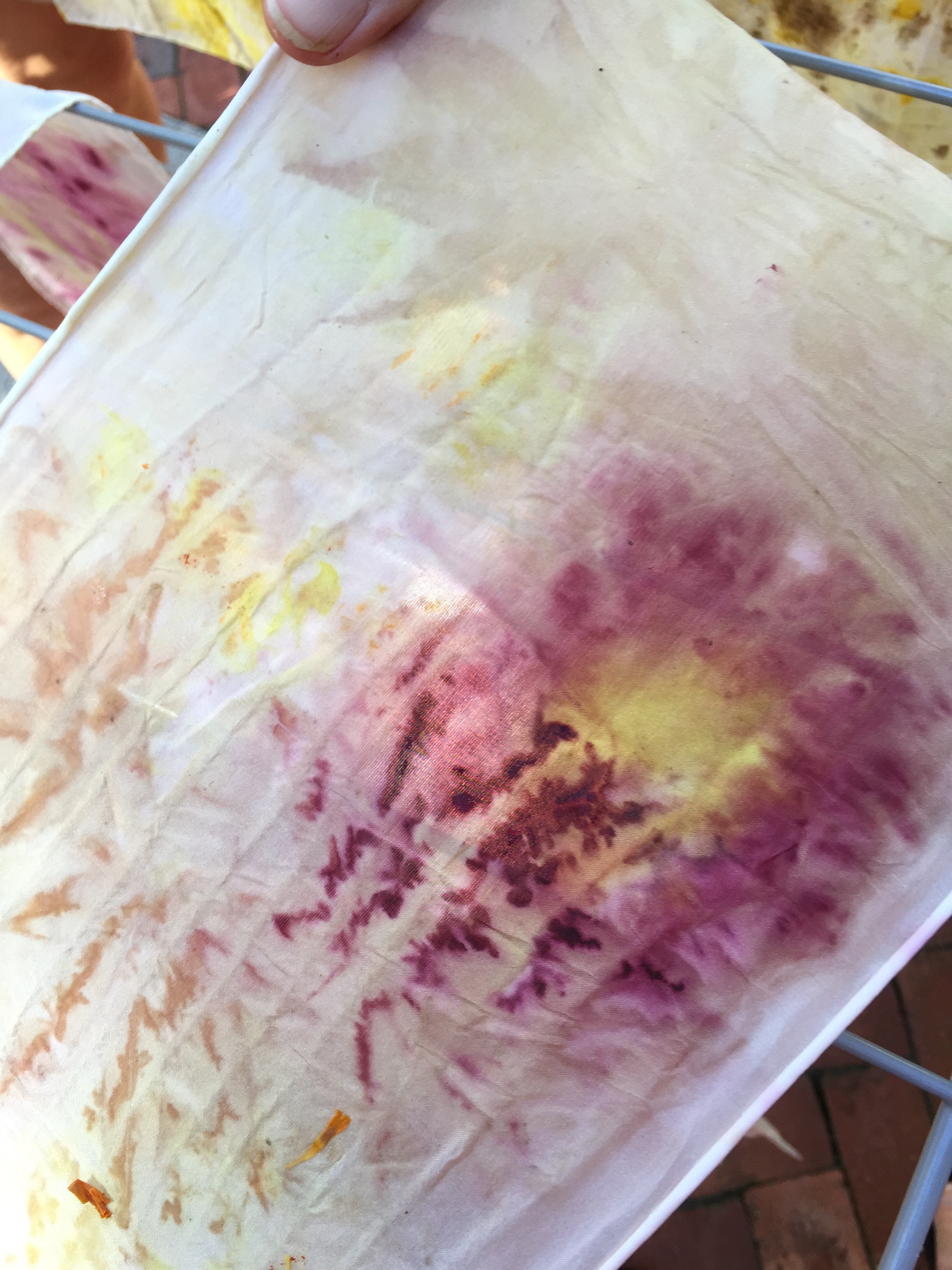
Look at the imprint from this giant dahlia.
I hope to compile a list of the plants and flowers that work best for me. Some things leave behind wonderful colors, but the imprint is just a blob. I’m more interested in the things that leave an actual impression of the leaf or flower. So far, this is my list of A plants and flowers:
Japanese maple leaves–great leaf definition
coleus leaves–faint leaf definition and pastel colors, lovely on silk
golden rod–great definition for leaves and flowers
purple oxalis–great definition
black hollyhock flowers–a wonderful, deep purple ‘blob’
cranesbill, purple–nicely shaped ‘blob’ somewhat recognizable as a flower silhouette
One of the perks of visiting the studios and houses of other weavers, is seeing the lovely details in their living and work spaces. Weavers usually have such a eye for beauty.
It was a glorious day for our project.
Fast forward to the beginning of September, and on this stunning weekend I spent a wonderful day at the monthly meeting of bobbin lace makers in Connecticut. You can find us here.
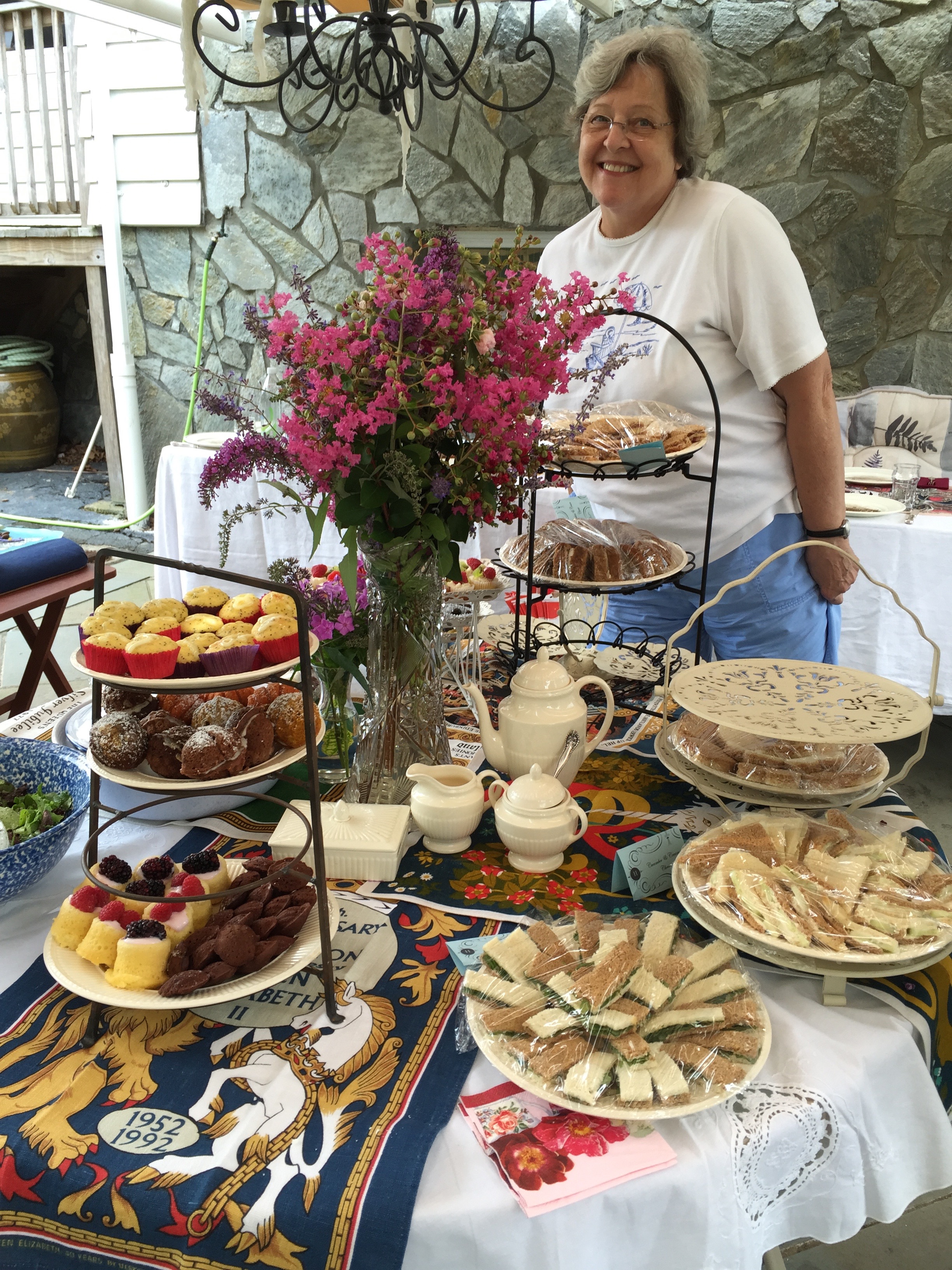
We met outside in a member’s garden under a canopy of billowing, striped canvas. Her terrace was surrounded by flowers–black-eyed Susans, phlox, and other late season bloomers, with a view of her large vegetable garden nearby, and in the distance her bee hives. She made an English cream tea for us that we had to share with the bees. Her tables were covered with vintage white on white embroidered cloths, topped with vintage linen tea towels that commemorated Queen Elizabeth’s reign–going back as far as her silver jubilee. I think we all felt a bit regal.
I hope Mary won’t mind that I shared this photo. Her expression is a mirror of how much we were all looking forward to having these treats!
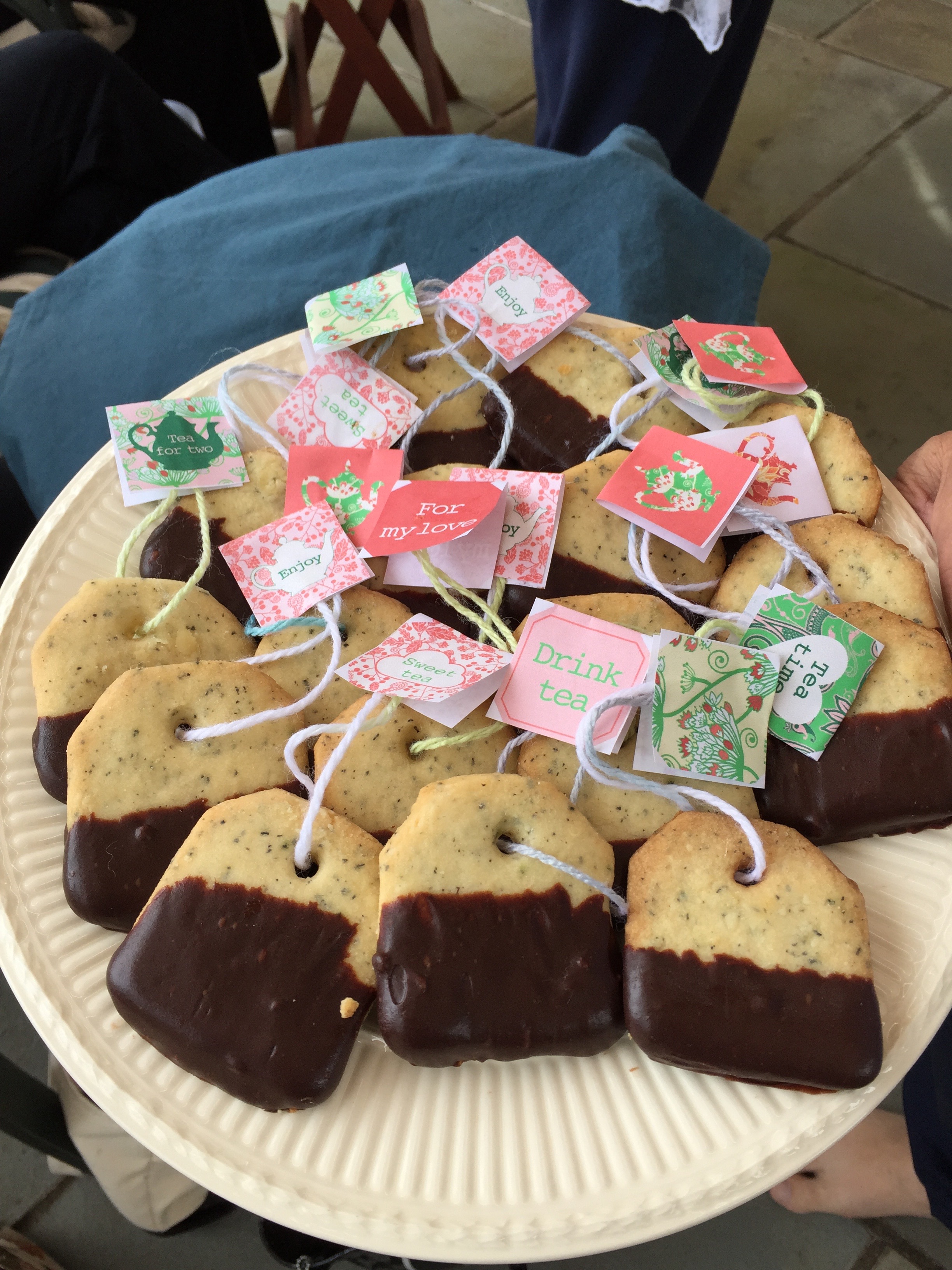
Our hostess made Earl Grey tea biscuits dipped in chocolate that were off the charts!
On top of this wonderful tea we all actually spent time making lace, too!
This is also the weekend of the Haddam Neck Fair. Late summer is the time for all kinds of festivals that celebrate farming and animal husbandry. I have never been to this particular fair before, and it was a wonder.
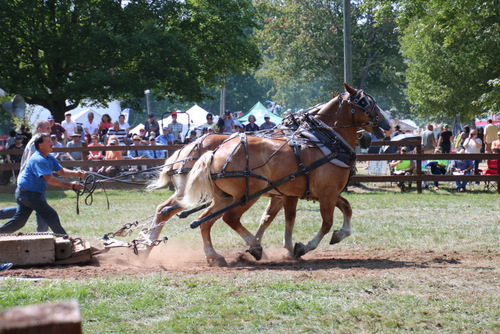
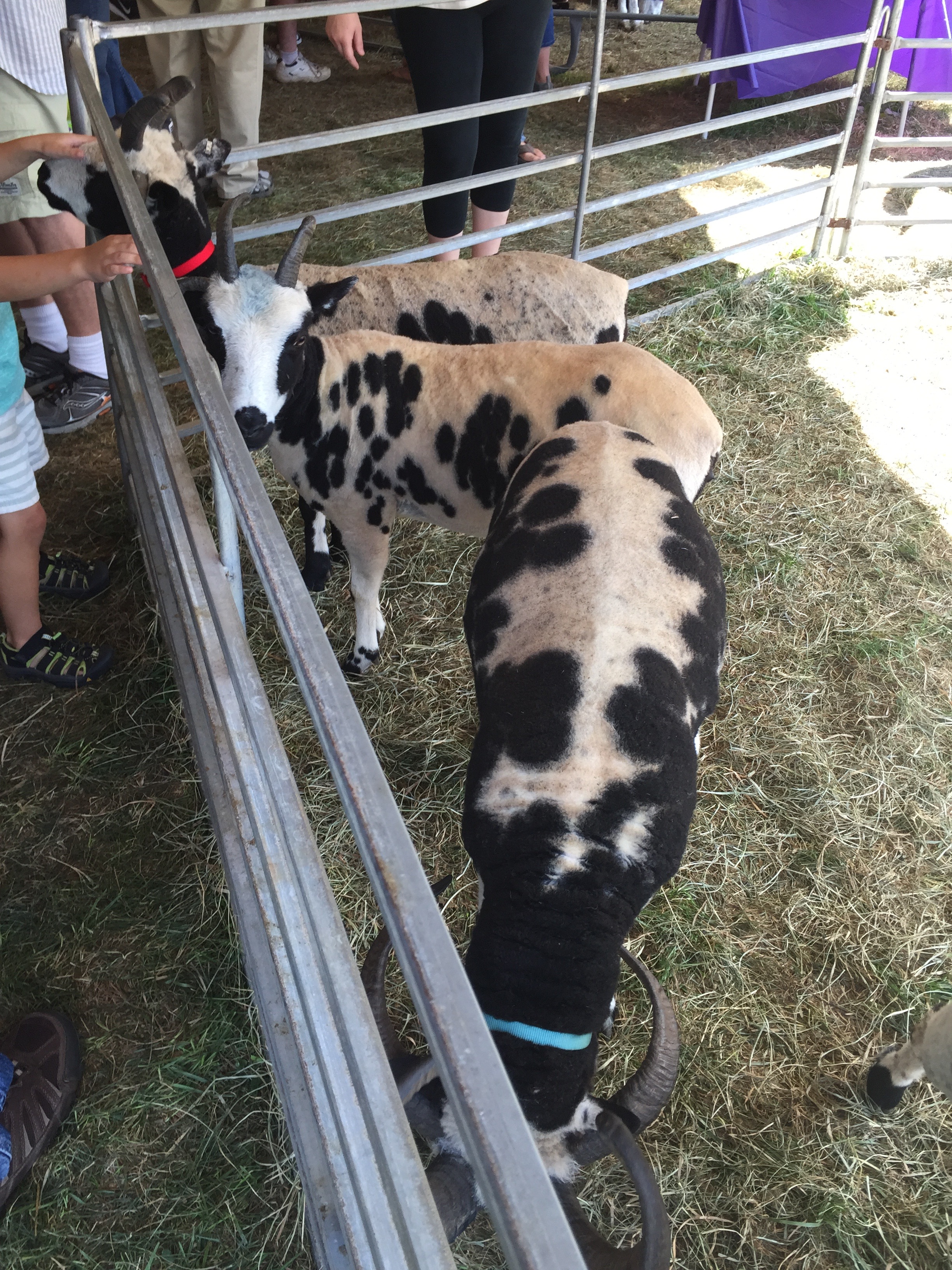
First there were the animals. We watched a draft horse pulling contest, visited the goats and sheep, cows, chickens and rabbits. The textile displays were very small, but I met a woman on the fair committee, doing a spinning demonstration, and she hopes to grow the textile area of the fair in coming years.
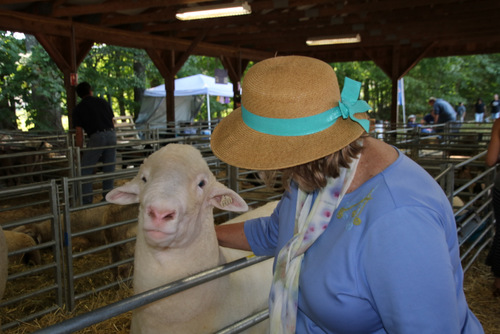
Look at this beautiful Dorset sheep. Her new fleece growing back was as thick as felt and she loved attention.
Multi-colored Jacobs.
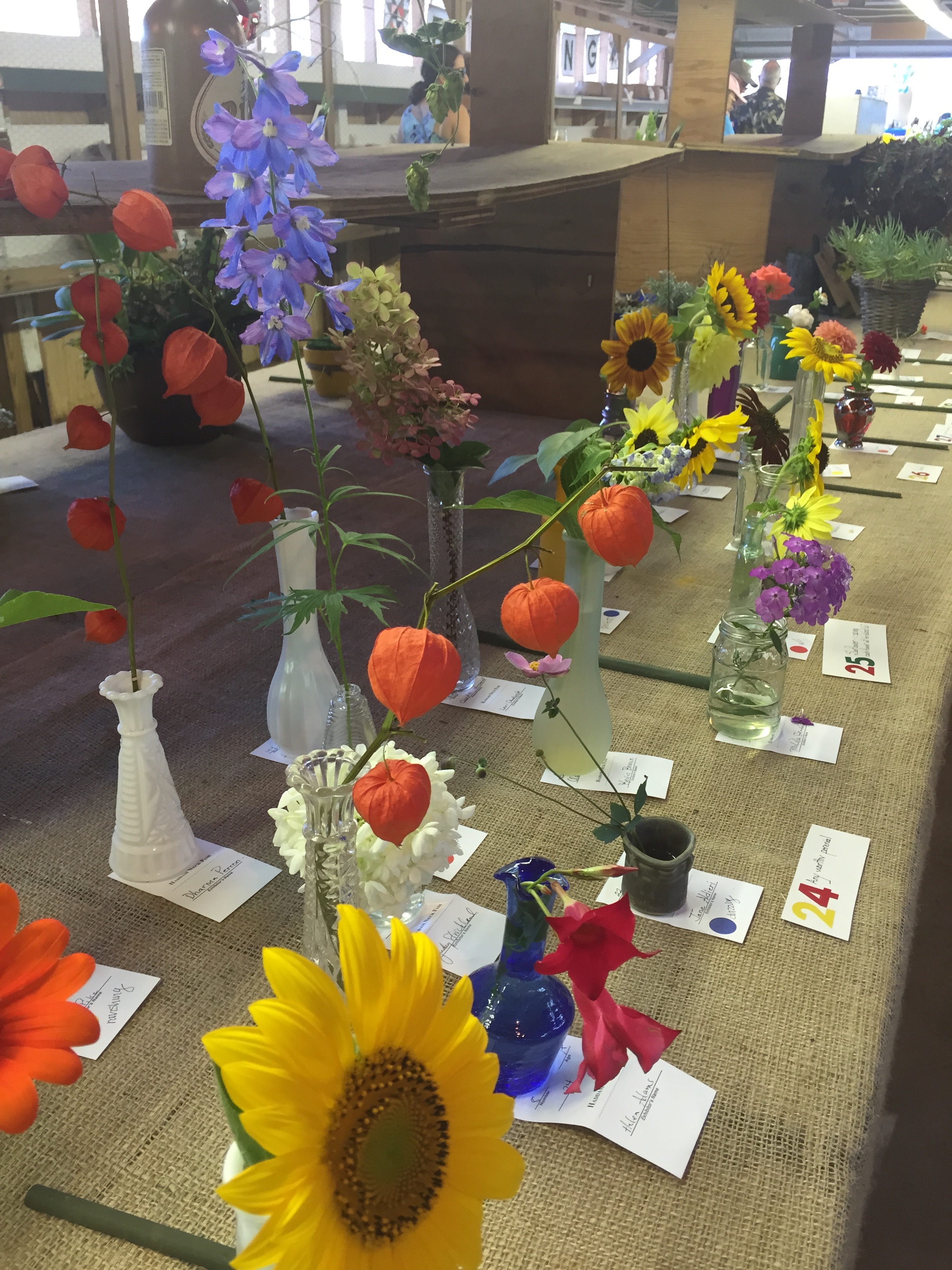
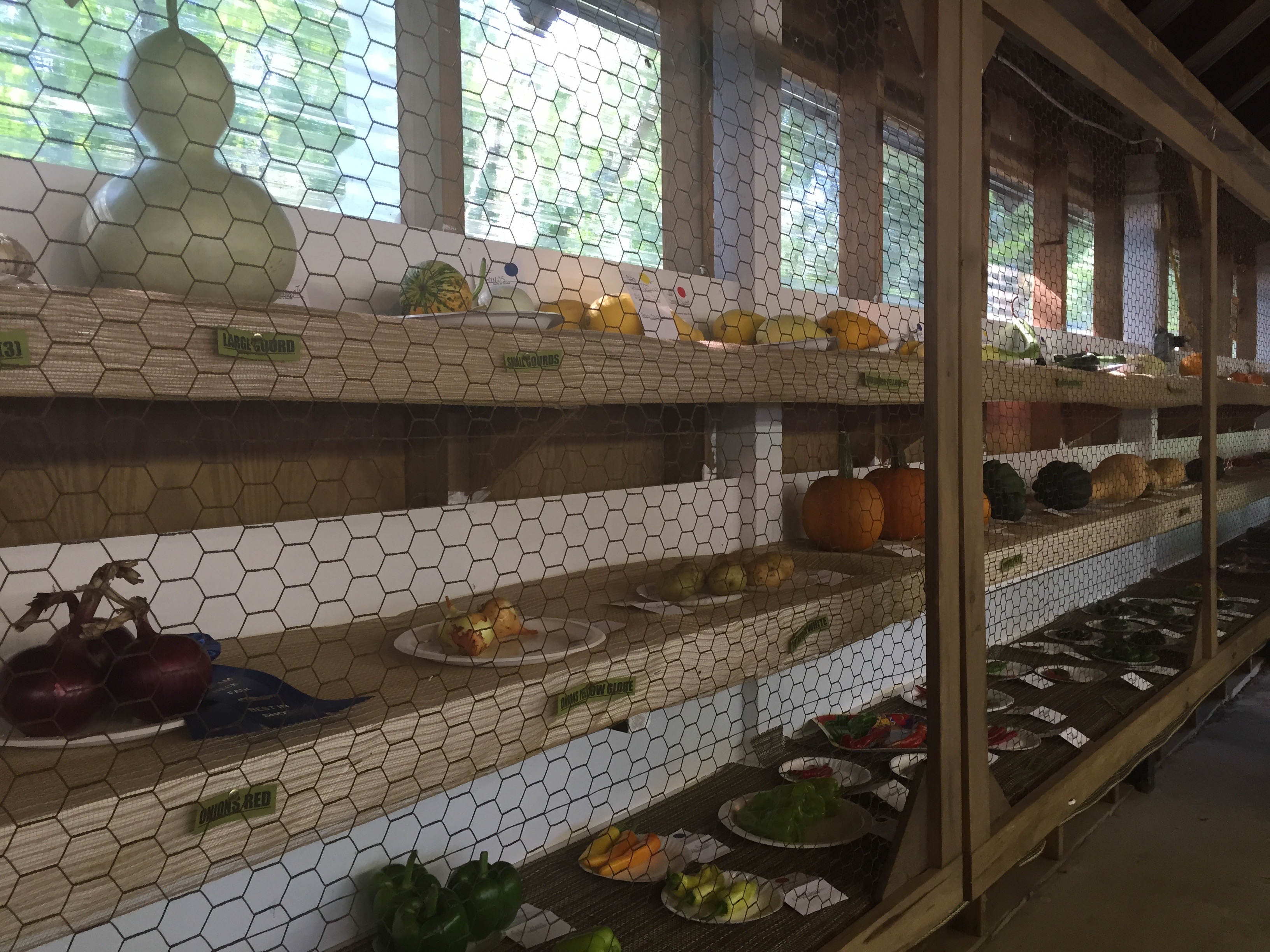
Seeing all the awards for best sheep or cow, all the way down to best cakes, and cupcakes, best flower arrangements, and best single flowers, or best zucchini, made Bob exclaim, “No one can possibly doubt humans’ need to compete!” Along a row of bud vases that showcased individual marigolds, the judges had written such poetic comments as: “As beautiful as a sexy, 1940s film star!” And, one a rose that no longer had a single petal left, “A stunner! Well done!”
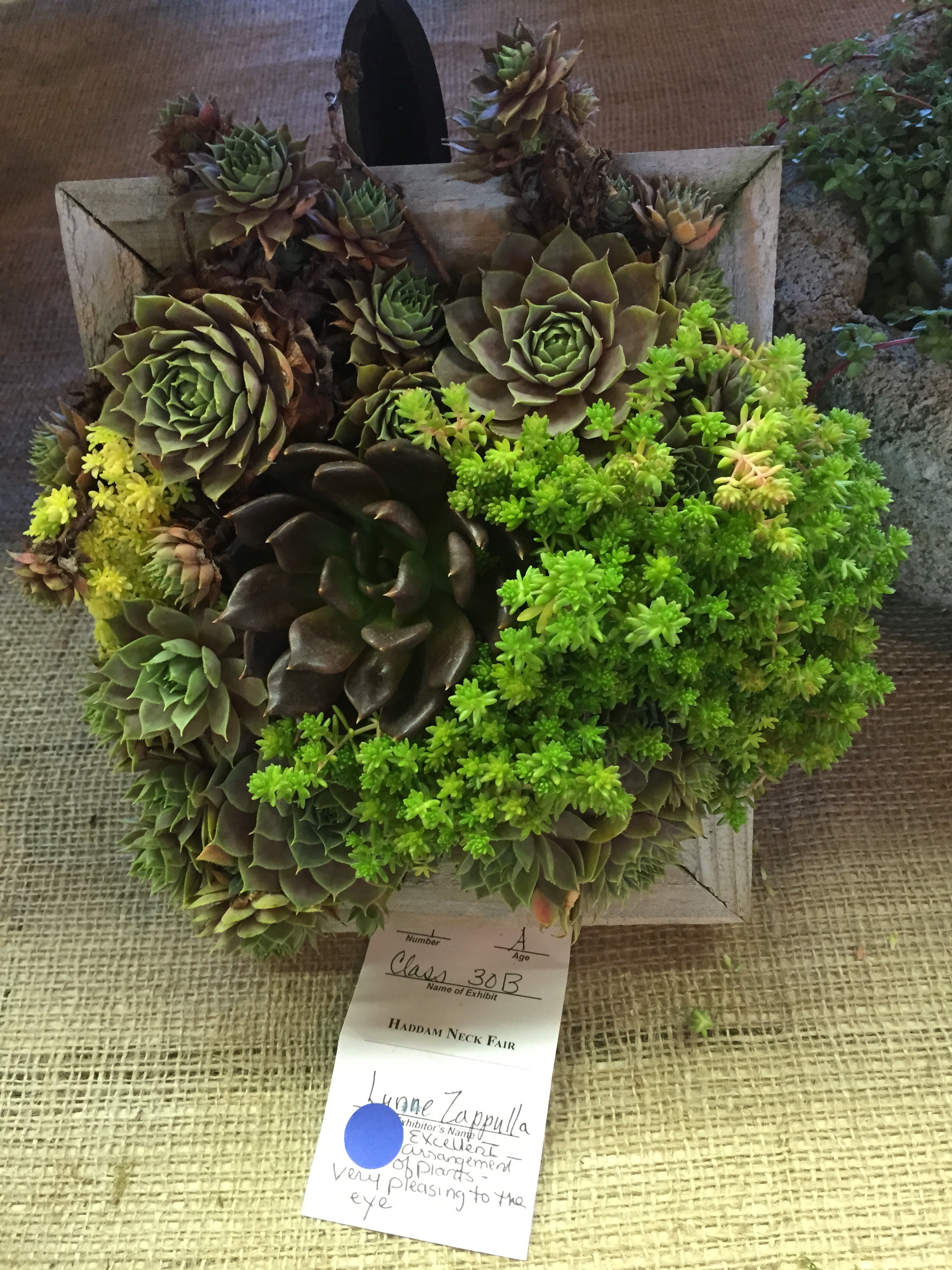
I particularly like this arrangement of succulents in a well used frame. Clearly the judges did too.
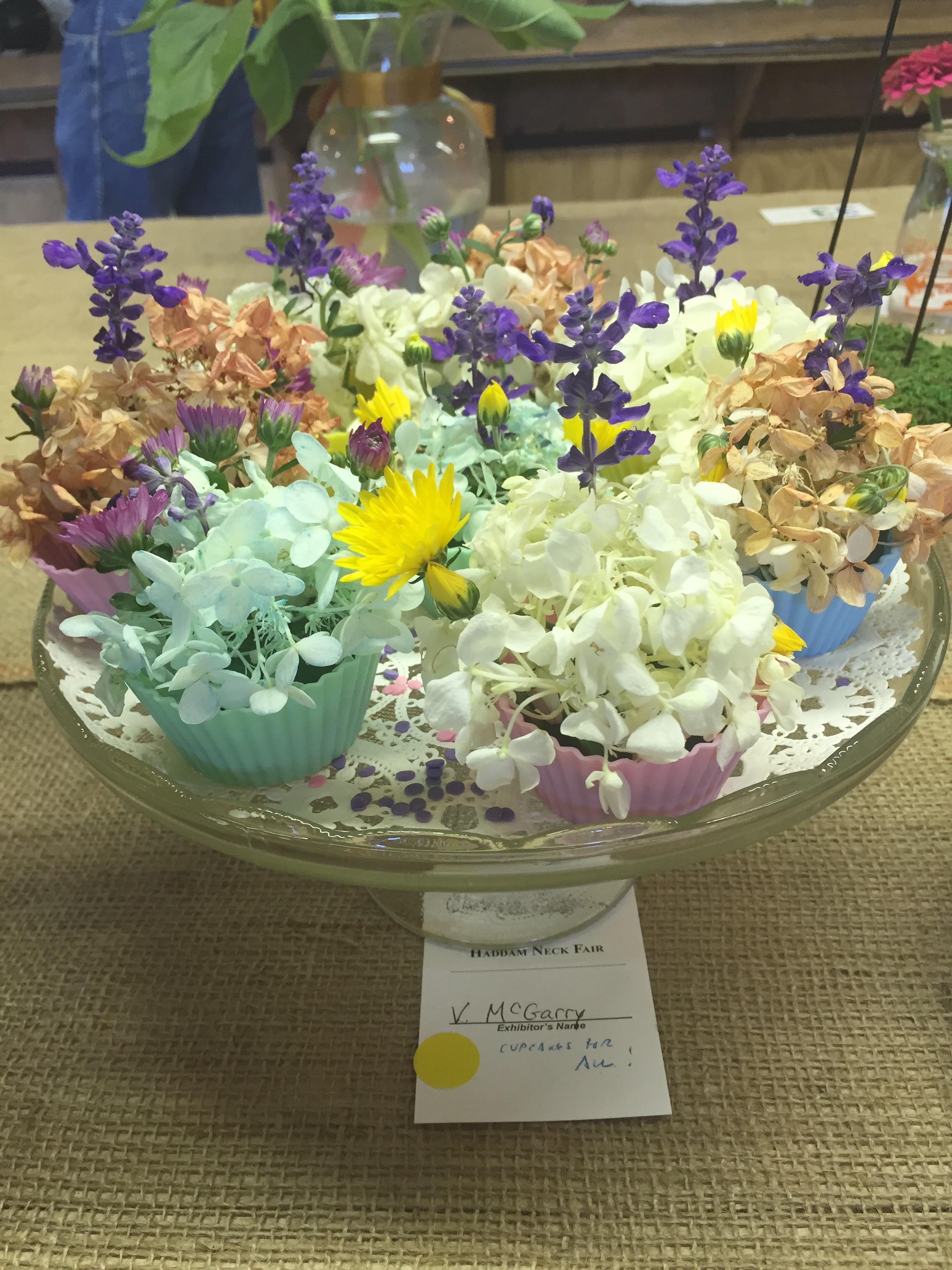
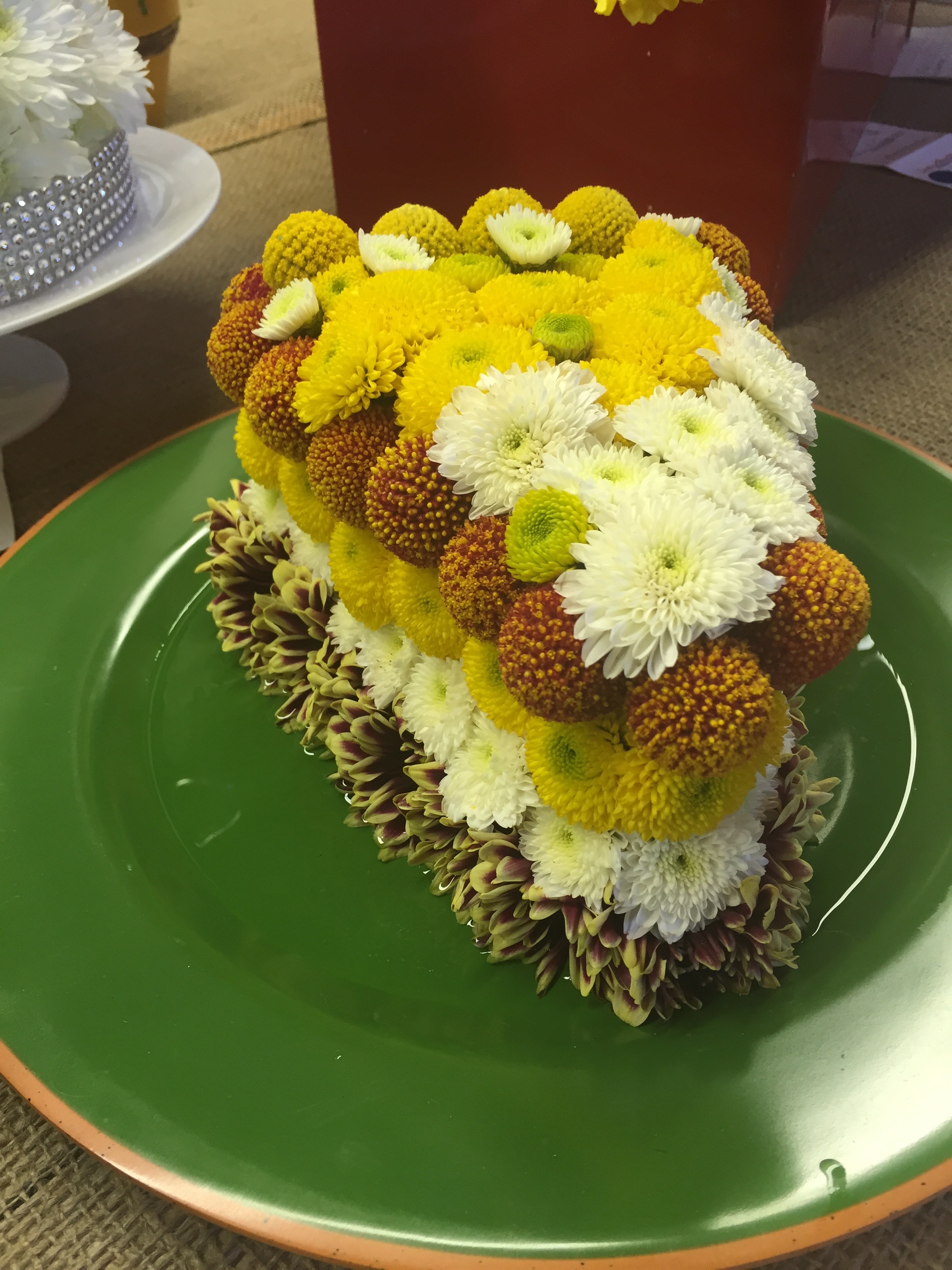
Some whimsical flower arrangements. There were lots of categories for flower arrangements, and these were two in the category inspired by food. A tray of floral cupcakes!
And a slice of mum cake! The same kind of judges’ comments showed up on all the individual vegetables, from tomatoes to summer squash, to cucumbers. If you can grow it or make it, you can compete with others at some local fair!
It was a beautiful day, and it was quite lovely to see how much care and attention can go into growing a zucchini or a marigold!
Sadly, the textile area could not hold a candle to the livestock or the flowers and veggies. Maybe that will change in the future. All it will take are a few textile people who want to compete!
The day is getting away from me, and I should turn my attention to Archie’s book and to that never-ending boundweave project.
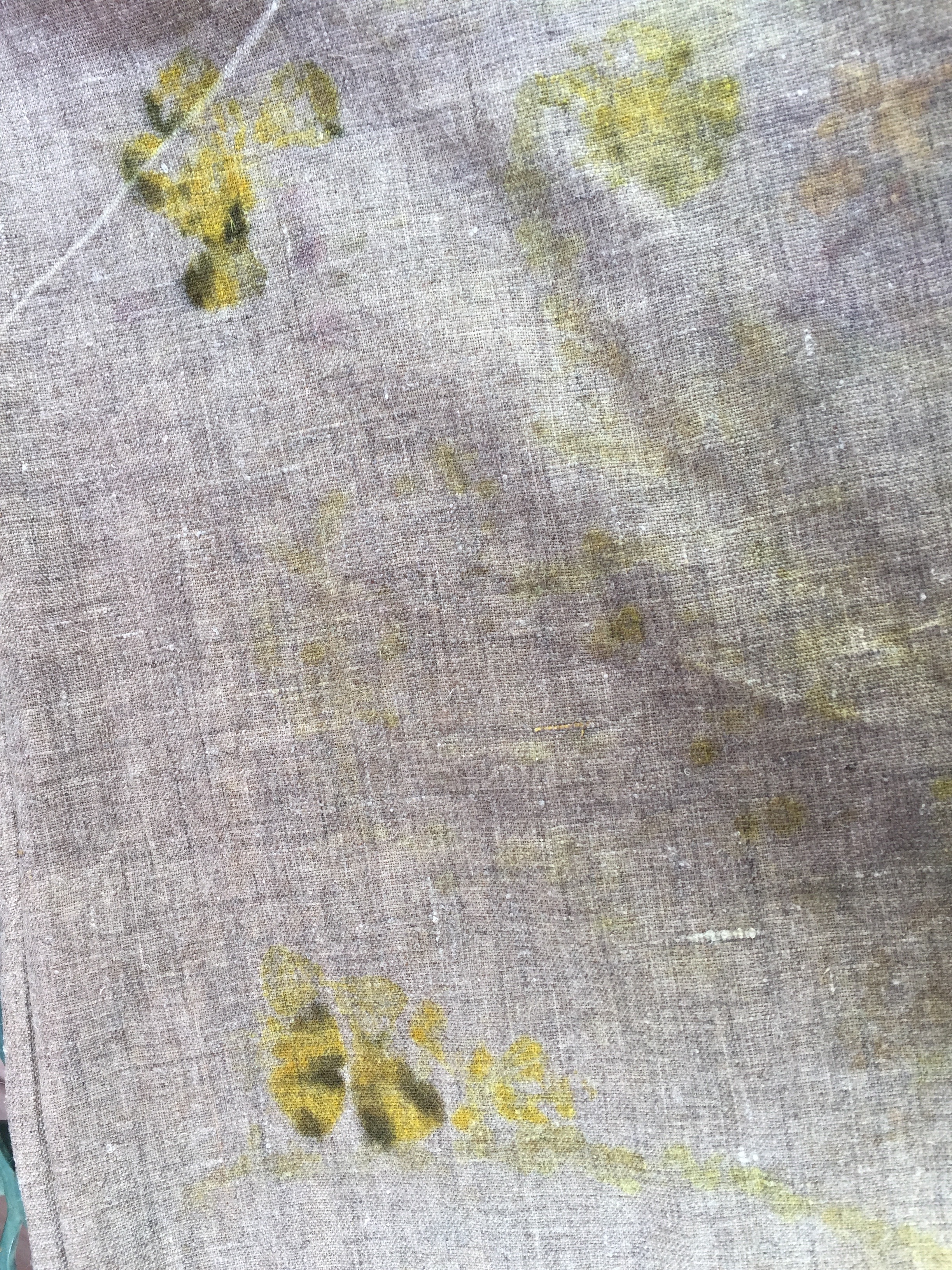
I’ll end with a recap of what I learned today. The tall ferns in my garden must not be ostrich ferns since they left no color. I did add some hyacinth bean vine, both leaves a clusters of flowers buds, but they also left no color or imprint.
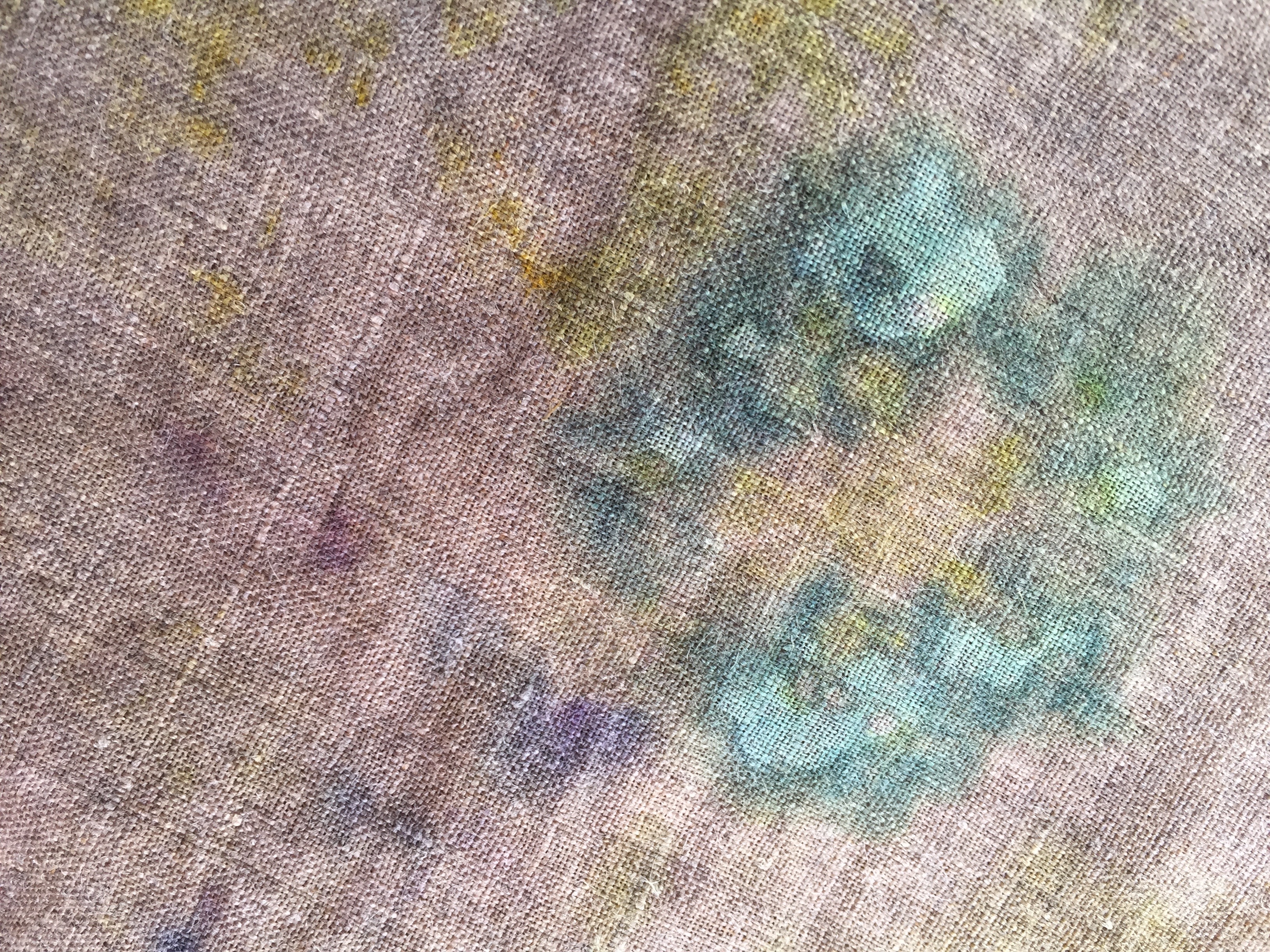
Clusters of purple verbena flowers are interesting–they turn turquoise!
And signet marigolds left an interesting imprint. The red stripes turned black.
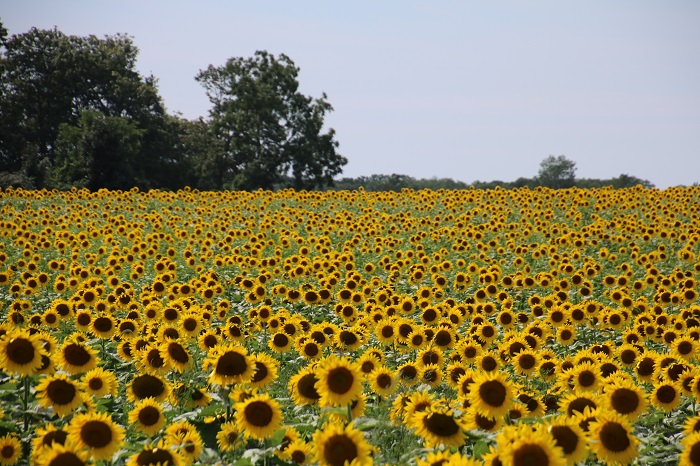
And speaking of flowers, I have to share one last image. The well known, oft-photographed field of sunflowers on the north fork of Long Island. Bob and I sailed to Sag Harbor and stayed for almost a week back in the middle of the month. Even when compared to an amazing dinner at the American Hotel, and wine tastings along the North Fork, seeing this field was the highlight of that trip!
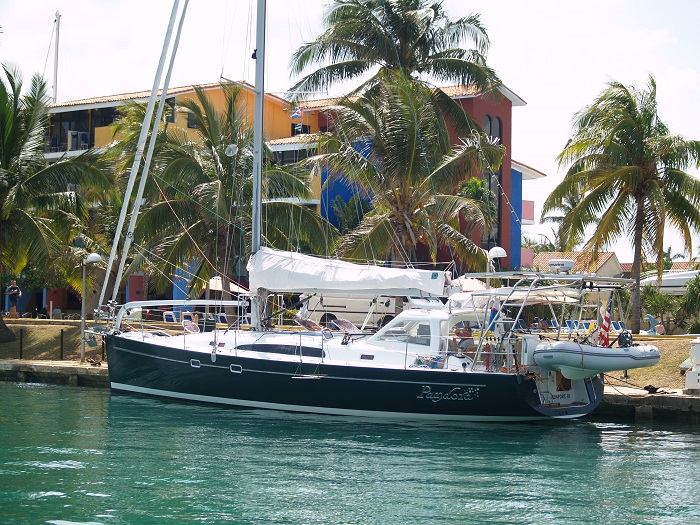
Our final day in Cuba – Pandora on the dock at Marina Hemingway. Isn’t it a lovely spot? Most days were a bit too hot, but our last day was picture perfect.
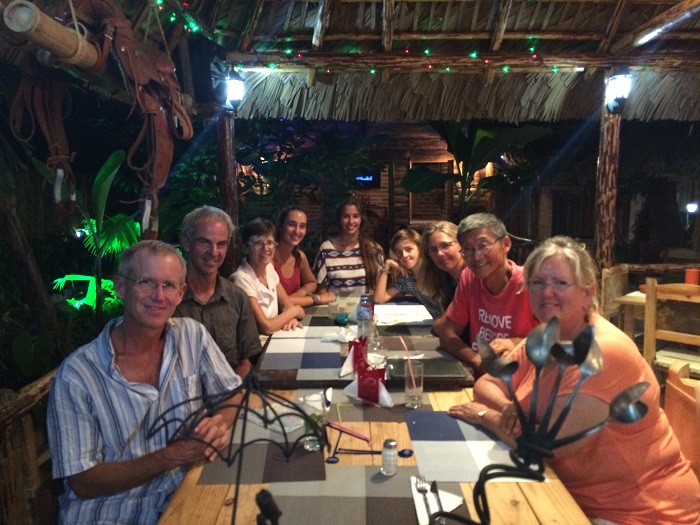
We made plans to meet with a number of our new cruising friends for a goodbye drink—Anne and Christian aboard Tidom (France), Lars aboard Luna (Norwway), and the Trudel family (Silvain, Natali, Romane, Elisa, and Victor) aboard Masqueret (Quebec), and Addison and Pat aboard Three Penny Opera (Ontario). Some of us made plans to walk into Jaimanitas for dinner at a paladar that has a great reputation.
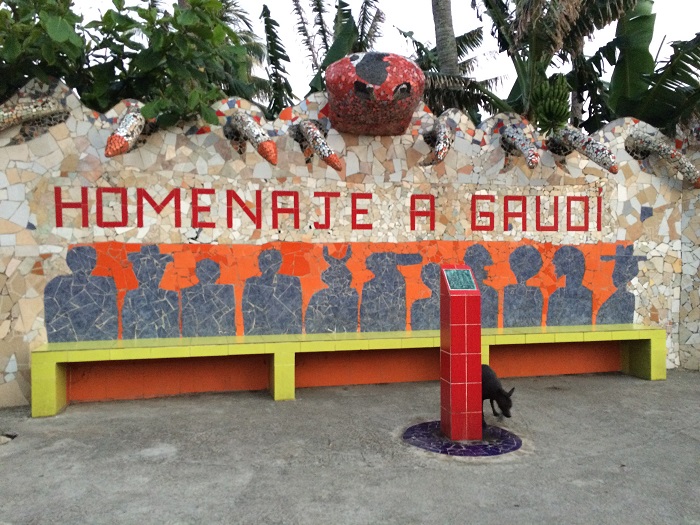
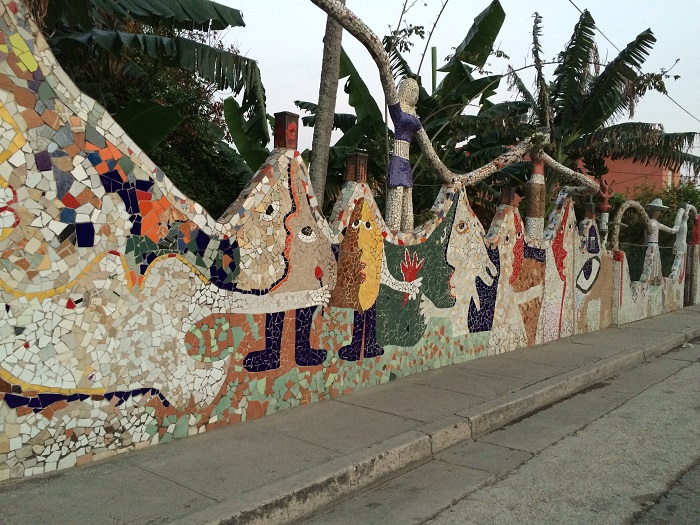
Jaimanitas has a section that is done in Gaudi-style mosaics, and it is a wonderfully colorful place. The mosaicist lives in the neighborhood and continues his homage to Gaudi with ongoing projects.
The paladar was also wonderful. I did not get the name, shame on me! Beautiful ambience, room after room of open air seating and terrific food. Our two best meals of the trip took place here and at the paladar in Old Havana—Paladar los Mercederes.
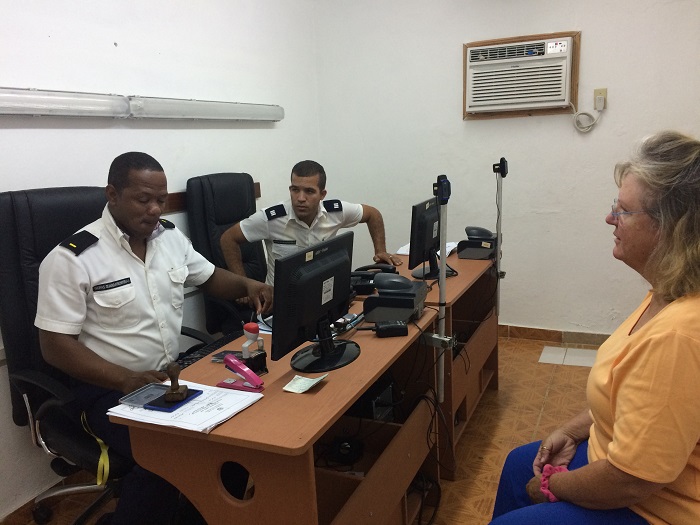
Early the next morning (April 29), we rose at 5.30 to head to the Guarda Frontera office to check out of Cuba. Bob took this photo of my exit interview with the Guarda Frontera before they warned him that photos are not permitted.
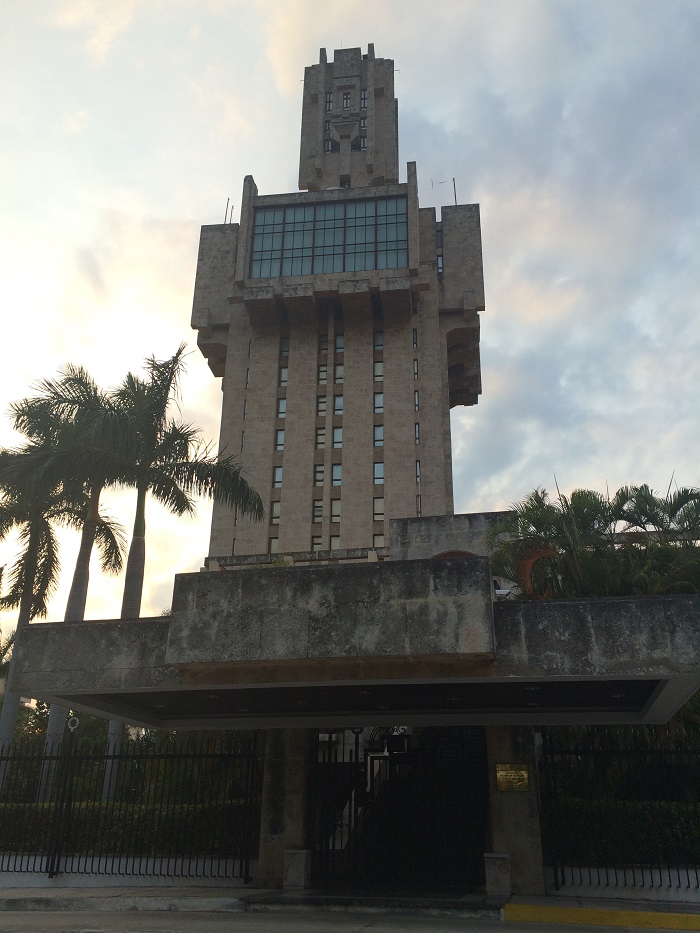
What a sight to see the sunrise over Havana as we headed north for Florida in the early morning. The odd shaped tower that gets a bit wider at the top on the right side of the photo is part of the sprawling Russian Embassy.
It was a rough crossing, and I did not fare well. I had about 30 hours of mal de mer on the journey to Ft. Lauderdale, and that meant that poor Bob had to stay awake and do all the navigating during the trip. He was really tired when we finally arrived.
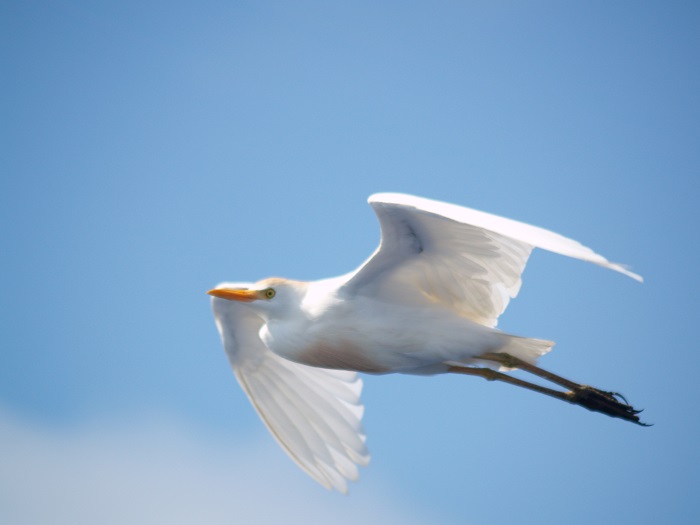
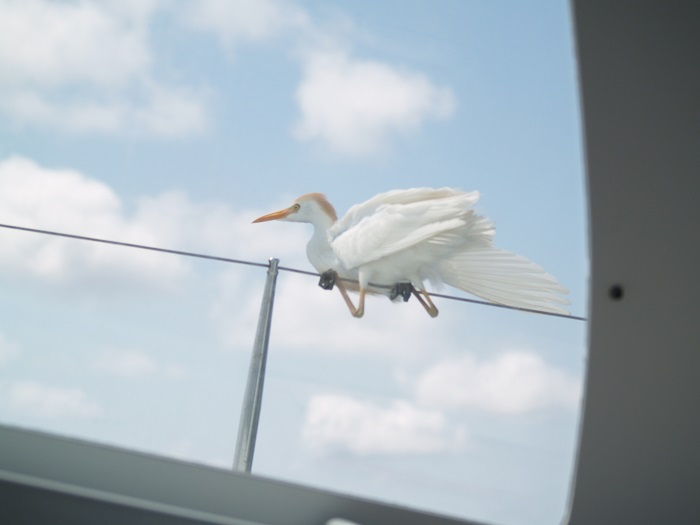
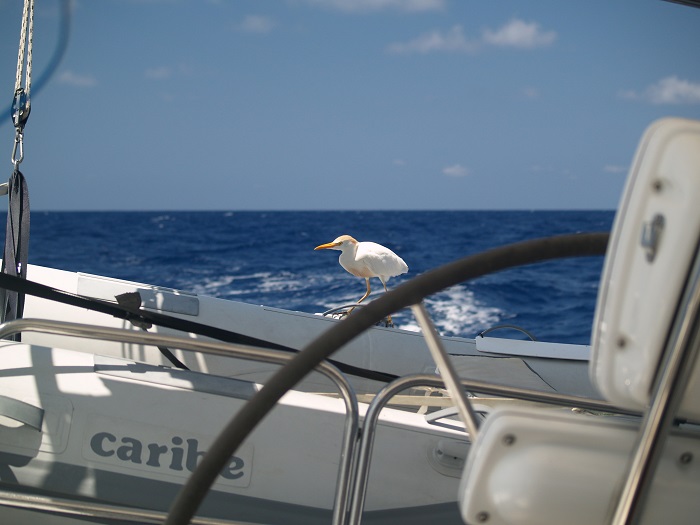
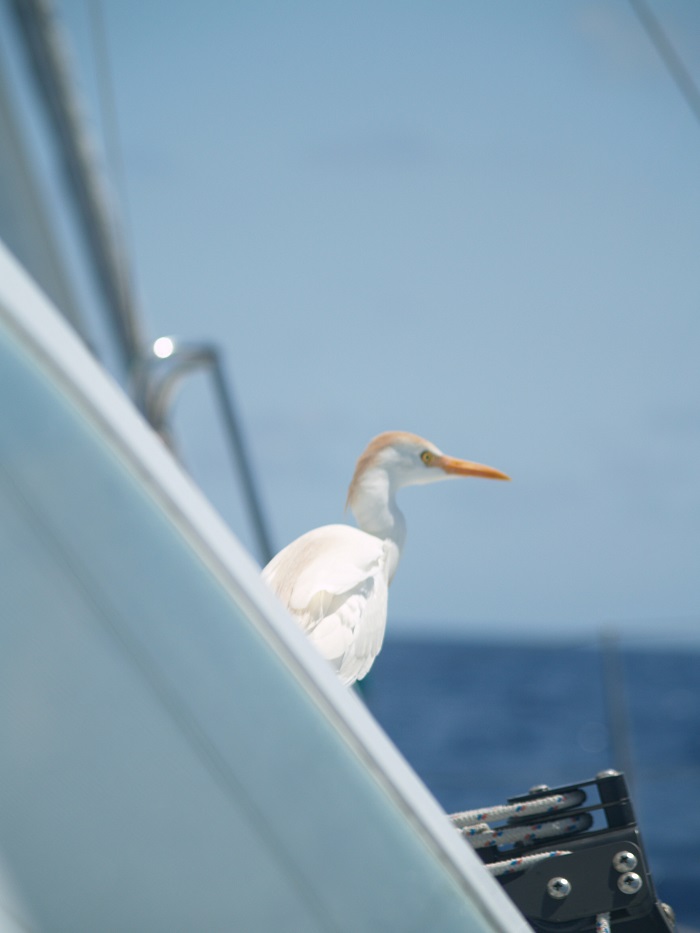
A couple of hours after leaving we noticed a snowy egret flying very close to us. He was very far from shore and was clearly getting tired. He made quite a few attempts to land, but he was having a lot of trouble landing onboard, both because he feet are not made for perching and the wind was quite strong.
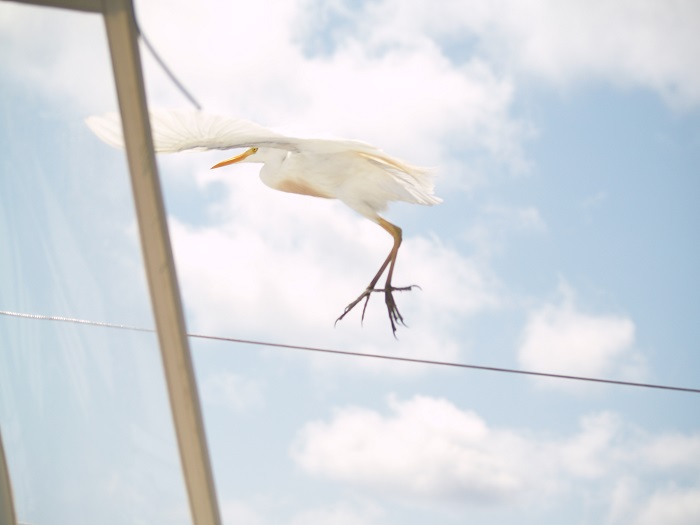
He tried several times to land on the lifelines near the stern of our boat, and he attempted to land on the dinghy up in davits a few times.
Finally he made a successful landing up on the traveler, on the windward side. He stayed with us for the entire day, and luckily we stayed on the same starboard tack for most of the day. Whenever Bob adjusted the traveler or the sails the egret got very nervous, but he did not fly away. I felt terrible for him.
Later, just a short time before sunset, we needed to tack to head up the coast of Florida. We knew it would startle our Cuban stowaway into taking flight, but we hoped he would return once the boat settled into its new course. The egret took flight and appeared to head right back for Cuba. He never even looked back. It was getting dark, and now Cuba was more than 60 miles away. As a wading bird, egrets cannot land on water. We had already watched him try to land and flounder a bit as he struggled to ascend again.
I had imagined that this bird, like all birds, must have some inborn navigation sense, and I thought there’d be a good chance that this bird knew we were sailing northeast. He might not know that there would be land to the northeast, but I was hoping he’d want to stick with us to find out. Certainly it would have been an easy trip for him if he could make peace with confined so close to us. But he headed right back to Cuba once we frightened him by changing tack. I was heartbroken by this. He had almost no chance of making it all the way back.
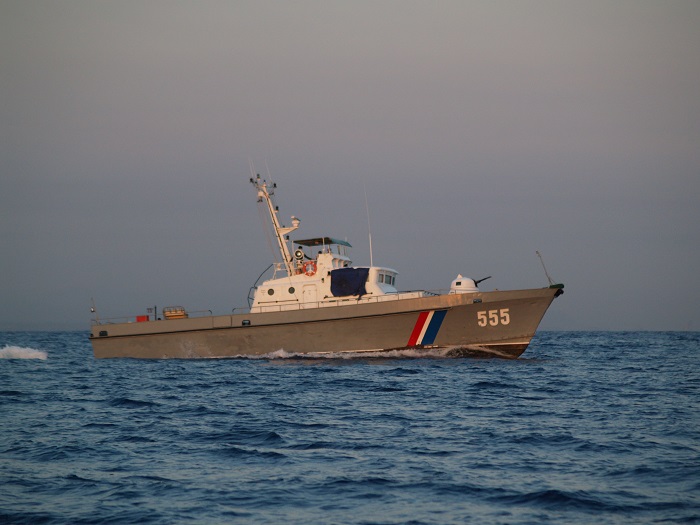
And speaking of stowaways…. as we left Marina Hemingway and entered the Straits of Florida, we heard the power yacht that had cleared out of Cuba just before we did, call Marina Hemingway to report what they thought were two boats in trouble: a small fishing boat far offshore, and a small sailboat. The sailor immediately answered the call to say that he was not in trouble. No info on the fishing boat–most likely because they didn’t have a radio. We saw a large Guarda Frontera cutter (possibly an ex-US Coast Guard cutter?) come out from the harbor to check things out. Look at the gun on the bow!
Moments later a bright red Donzi-type speed boat joined the cutter and both boats circled the small sailboat for quite some time. The sailboat lowered its sails and drifted as the two Guarda Frontera vessels checked things out. In the end, both Guarda Frontera boats went back to the harbor, which means they never did check out the report of a fishing boat in trouble. Hmmm….
Clearing in with Customs and Immigration in Ft. Lauderdale was quite an experience. With the quickly changing rules about US citizens visiting Cuba, no one really knows what the procedure should be right now. We expected to be visited by the health department and immigration to check for stowaways and rum and cigars, and any forbidden food items in our fridge/freezer. When Bob called to find out where we should go, he was given numerous phone numbers and no one at the other end of the line at any of these numbers knew what to do with us! In fact one phone number gave us nothing but a recorded message saying that this office is now officially closed and no one would be checking messages henceforth! 24 hours after arriving we got a phone call from one of our previously called contacts asking us to present ourselves at the immigration office at the ship terminal. We only needed to present ourselves, not Pandora, so we rented a car to get there, which allowed us the ability to do some shopping and dining afterward. When we arrived they did not look at all the papers we brought with us— such as our Commerce Dept. form that allowed us to sail Pandora to Cuba. They only looked at our passports, and asked us if we had a good time in Cuba.
Yesterday may have been our last day to visit Old Havana, and I’m so glad I didn’t know it then because I would have felt a need to rush about more. Luckily we had a relaxing day and enjoyed some kind of holiday celebration that was happening.
We are trying to figure out the best ‘weather window’ for leaving Cuba. We knew we’d get the window some time this week, and now it looks like tomorrow is the day. So, here is our loose game plan. The winds are opposing the gulf stream a good deal of the time right now, but for the next couple of days those winds are pretty mild from pre-dawn until midday. So we will leave early in the morning, and sail in the gulf stream until the afternoon, when hopefully we will be near Key Largo. At that point we’ll head toward shore, out of the stream, and sail near the Florida coast until early the next morning when the winds die down again. We’ll head back into the Gulf Stream to Ft. Lauderdale, where we hope to clear in. By doing this we get a boost of speed from the northbound currents in the Gulf Stream while the opposing winds are mild, and when those opposing winds are stronger during the afternoon and evenings, we’ll slip out of the stream into the calmer waters outside the stream. I’m sure I’ll be sick, but hopefully less so than during some of our passages this winter.
The US Coast Guard sent us an email the other day (right after Bob had just composed a message to them) to ask if we were still on schedule for returning to the US by May 1. Bob responded, and we are hoping to hear back on whether we can clear in to Ft. Lauderdale. I have my fingers crossed about this because it will be more convenient for us to arrive in Ft. Lauderdale than in Miami. My flight home is Tuesday morning, out of Ft. Lauderdale.
Bob has just heard that the no-anchoring bill in Florida will indeed go into effect on May 1, so our plans for arriving in Ft. Lauderdale have to be adjusted. We will go to Miami instead, not a first choice for either of us. I guess we will rent a car to get to my Ft. Lauderdale flight. That’s boat life for you….you can make all the plans you want, even at the last minute, when you think you’ve got everything in hand, but the powers that be just laugh and laugh.
Yesterday we went back into Old Havana to look for the headquarters of the Women’s Federation for Handwork. Over the weekend we found the retail shop where the garments are sold, but the workshop where women take courses and make things for the shop is closed on the weekends. Yesterday we had a bit of a run around trying to find the workshop. When we did find it, we learned that all the ‘professores’ were gone since classes only take place in the mornings, while we arrived in the early afternoon. Maybe it’s just my imagination, and a leftover feeling from my visit to the workshop in Santiago, but I got the distinct impression that there would be complications trying to get anyone to see me. Yesterday I got to speak to a custodian and a language teacher, but when I asked for a ‘manager’ they both responded that ‘this was not possible.’ After meeting the open and generous women on the Paseo del Prada, and sharing such an excitement for handwork in spite of our communication barriers, I just couldn’t muster enough energy at this point to care if I met the administrators of this federation. I don’t think their goals are quite the same as mine. Admittedly I do not have the ‘whole picture,’ but from my limited perspective I believe their goal is to promote traditional clothing and make a successful business training women to keep these techniques alive and make the garments ‘saleable.’ It is a business venture that needs to succeed, and I hope it does succeed because that just makes handwork more valuable to everyone. But my mission is to meet women who love handwork and want to share what they do. I found that in spades with the group of women who surround Adriana Martinez.
It was some kind of holiday yesterday, but I never understood what! Several people wished us a ‘happy holiday,’ and museums were open in Old Havana that had been closed during our previous visits. While we were in the ceramic museum, I asked our guide what holiday was being celebrated, and she replied that it was the national holiday for ceramics. Bob and I are not at all sure we understood this properly. All kinds of museums were open that have been closed during our previous visits…maybe the holiday was really about Cuban heritage. Anyway, our guide still maintained that it was a ceramics holiday.
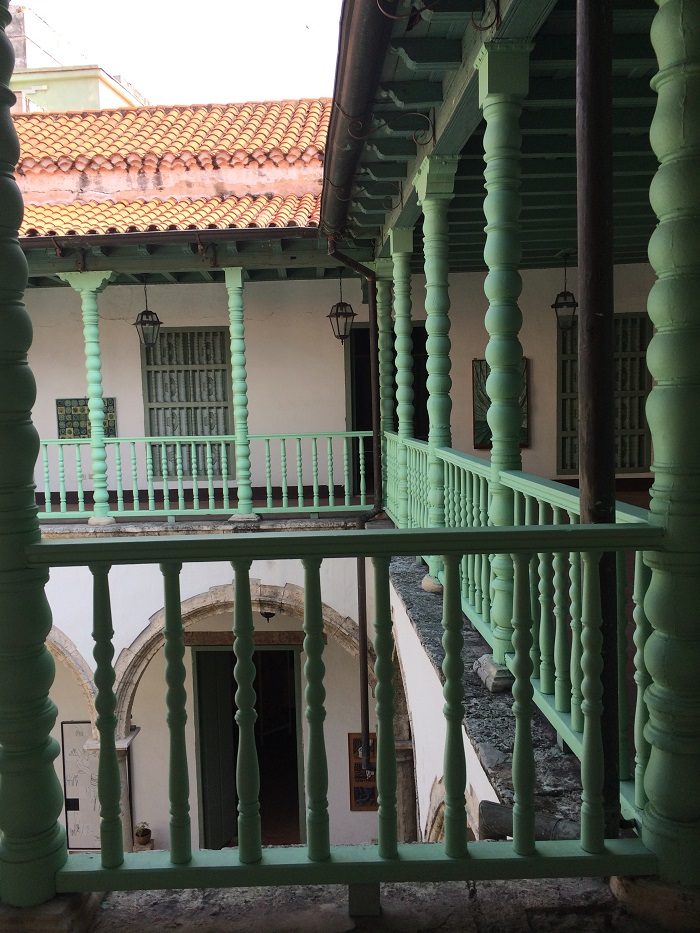
The ceramic museum was in the home of an historic ceramic artist who had a workshop and shop on the ground floor and living quarters for his family on the upper floor. The building was from the late 19th century with a central courtyard, and it made a wonderful museum for a history of Cuban ceramic artists. Each room featured a different time period of artists’ works. The courtyard was devoted to vessels and large figures.
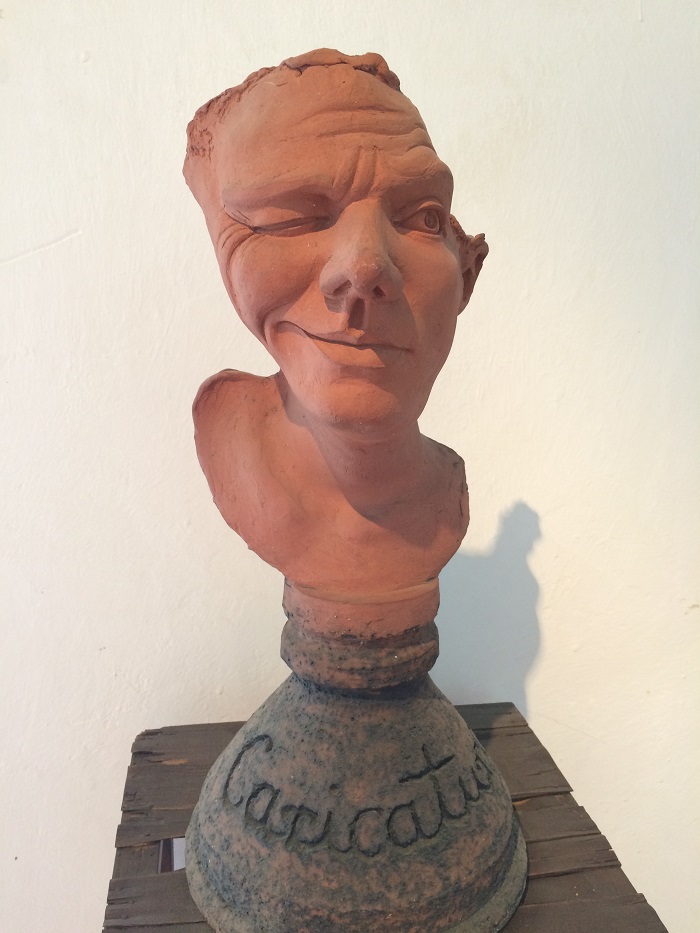
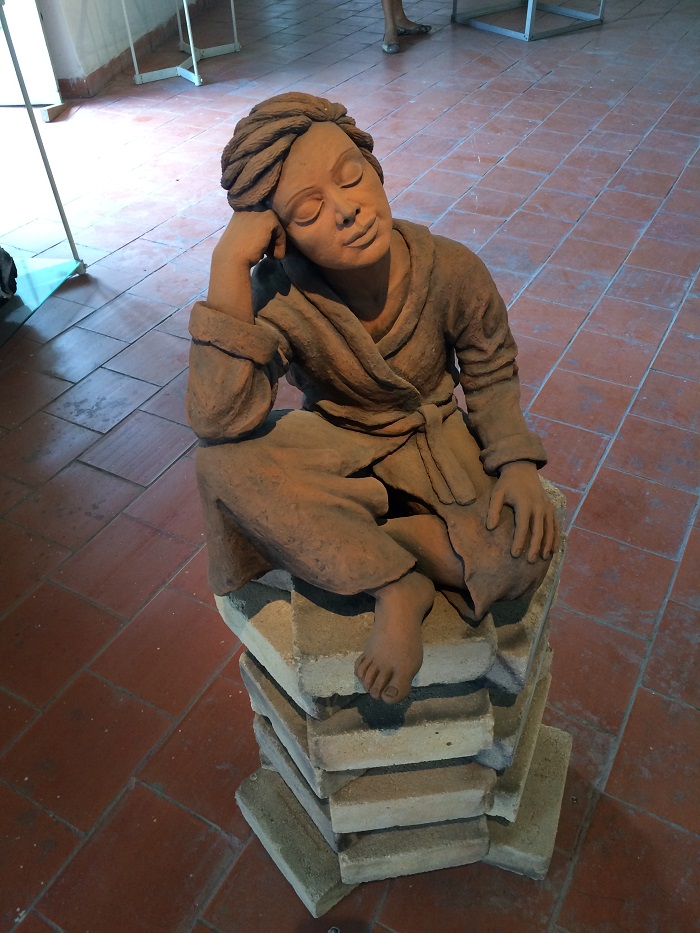
Our guide understood enough English for me to tell her that one of my good friends is a ceramics artist who does large figures in terracotta. I took these photos for her.
Somehow in our conversation it came about that our guide loves to knit. She took us to the entrance of the employees lounge and asked us to be very quiet since her boss was in there. She went in and came back moments later with a little bag of her knitting. It was the same ecru cotton floss type thread that the women on Paseo del Prada were using to crochet and make lace. I wonder where they get this material. Our guide told us she’d like to knit all day long, but can only find a few minutes here and there during her breaks at work. She said she never gets any time to knit at home because she has to cook and take care of her family. Sound familiar?
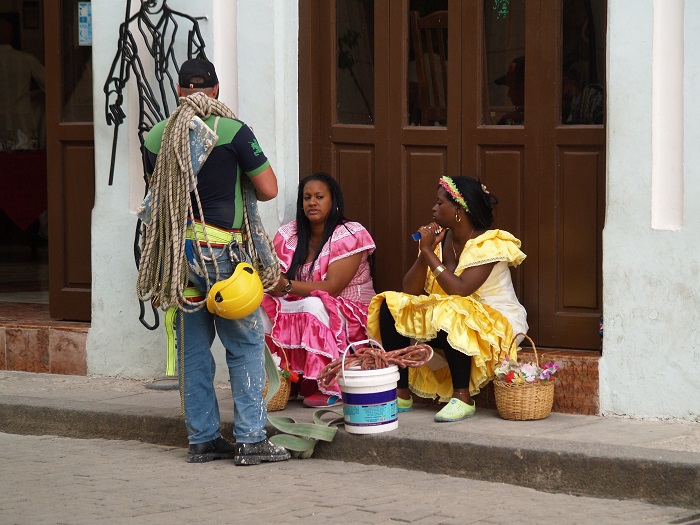
There were so many places open for touring or for business that had not been open all weekend long. It was a festive day, and there women dressed in traditional costumes on many street corners. You could take a photo of there for $5 CUC, which seemed a bit dear to us. Near the end of the day, Bob managed a discreet photo from a distance.
OLYMPUS DIGITAL CAMERA
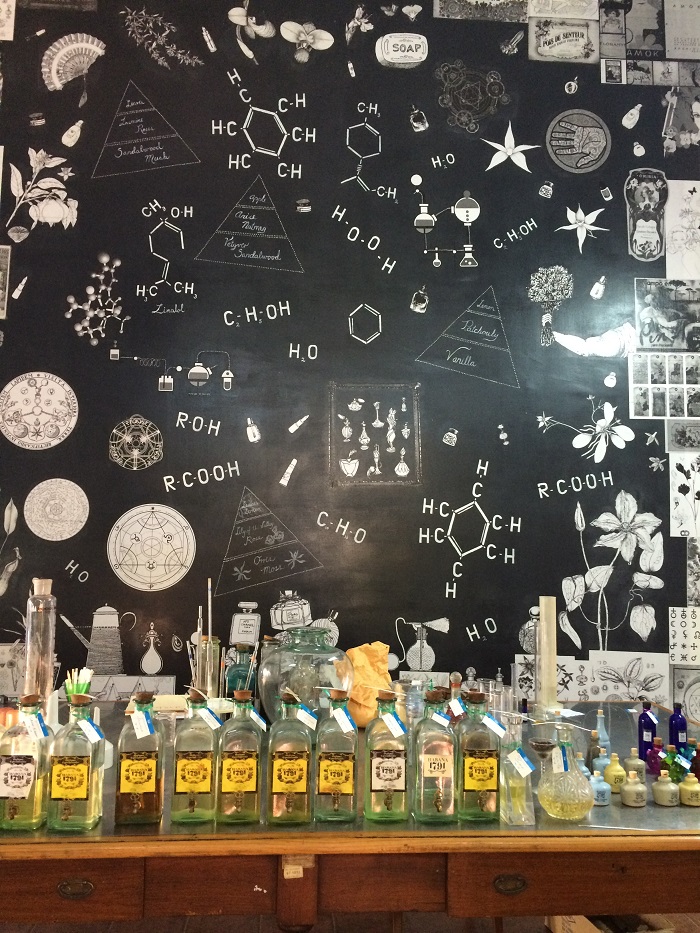
One of the places that had been closed over the weekend was a perfumerie. We had looked through the windows of this museum/shop and admired the antique brass containers used for distilling fragrances, the wonderful colonial furniture and display cabinets, and the glass apothercary jars that held the fragrances. I was thrilled to get into this shop to see things at close range! Bob took some photos while I smelled the fragrances and bought a ceramic jar of violetta for myself and lavender for my sister.
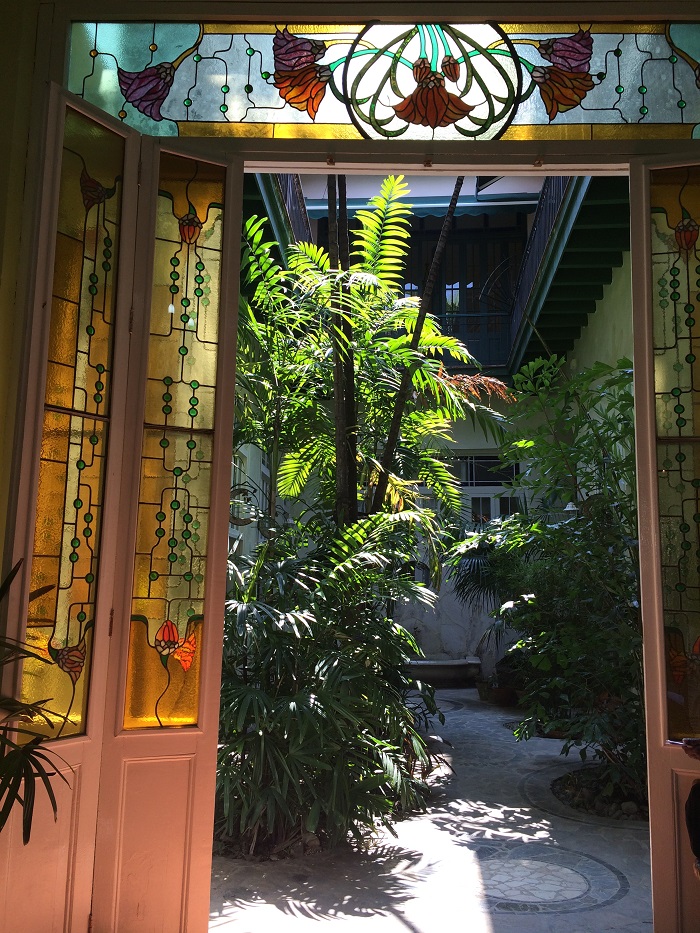
Every store has a beautiful courtyard since they are housed in historic buildings. This is the courtyard of the perfumeria. Bob and I had been admiring the stained glass every time we walked by this building over the weekend.
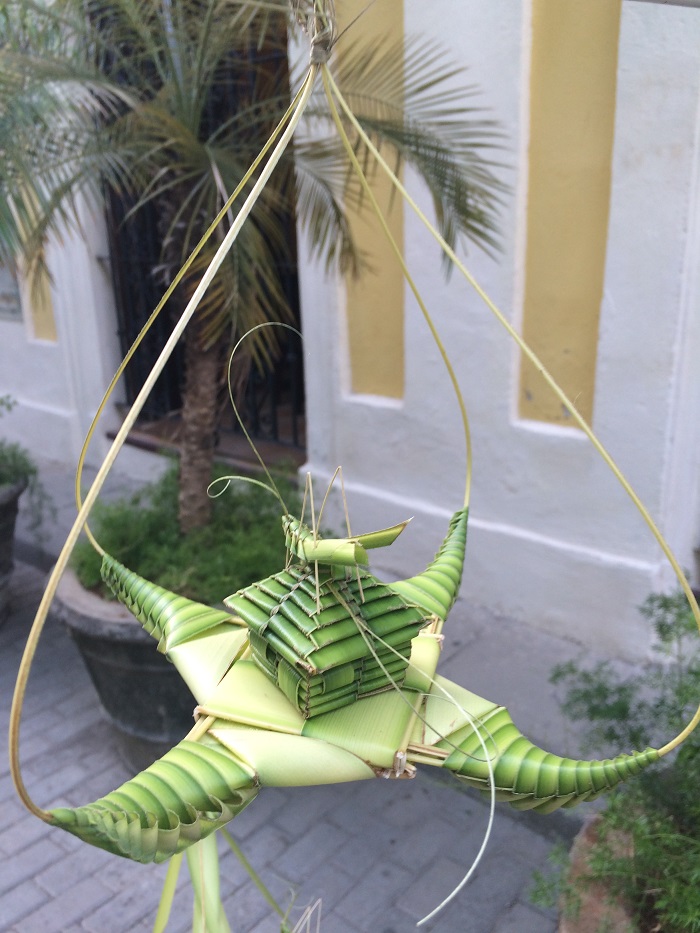
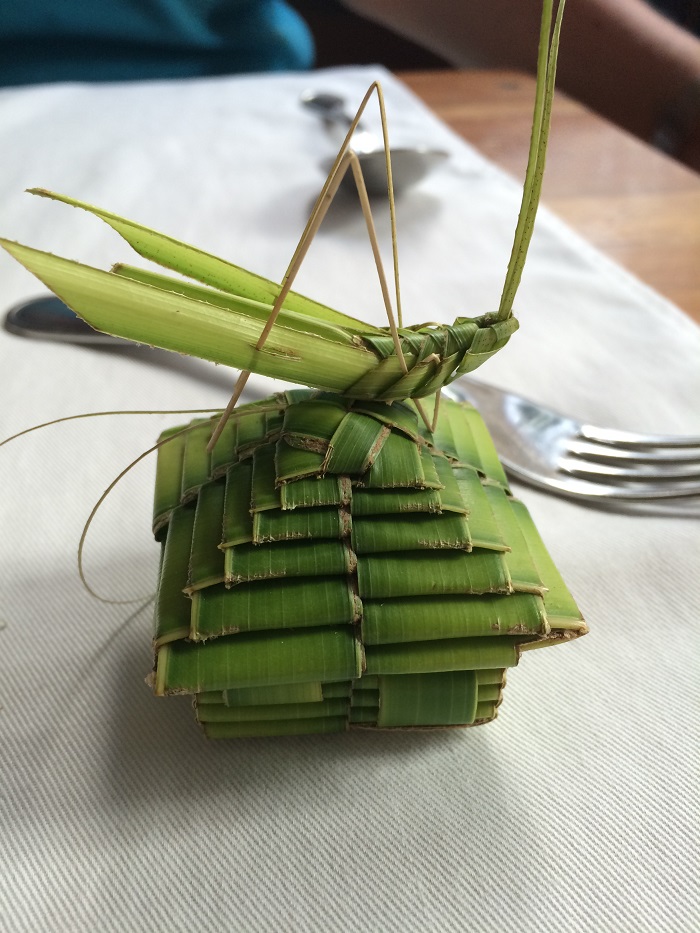
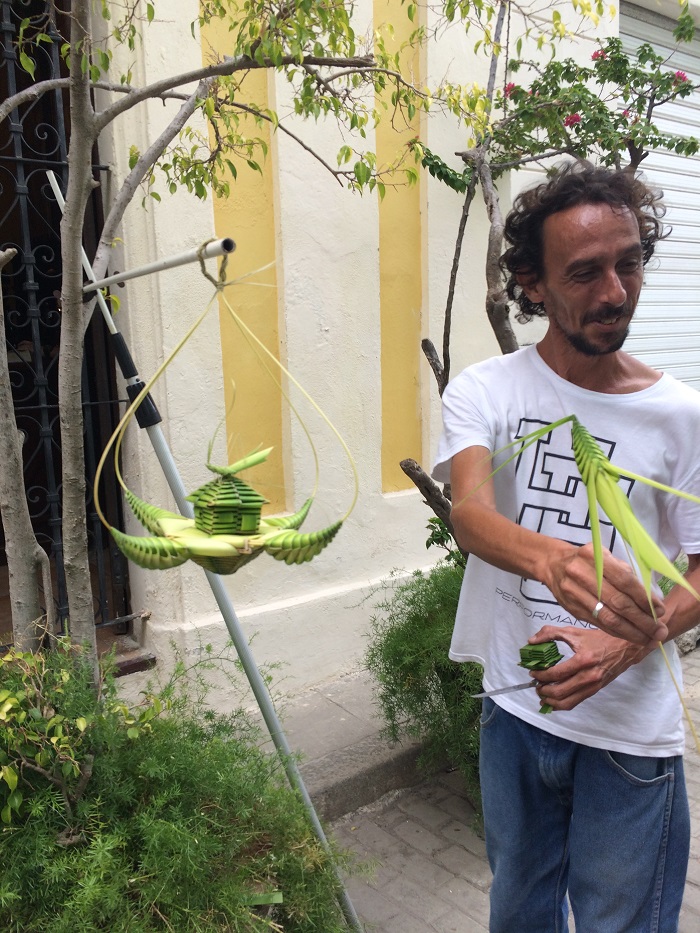
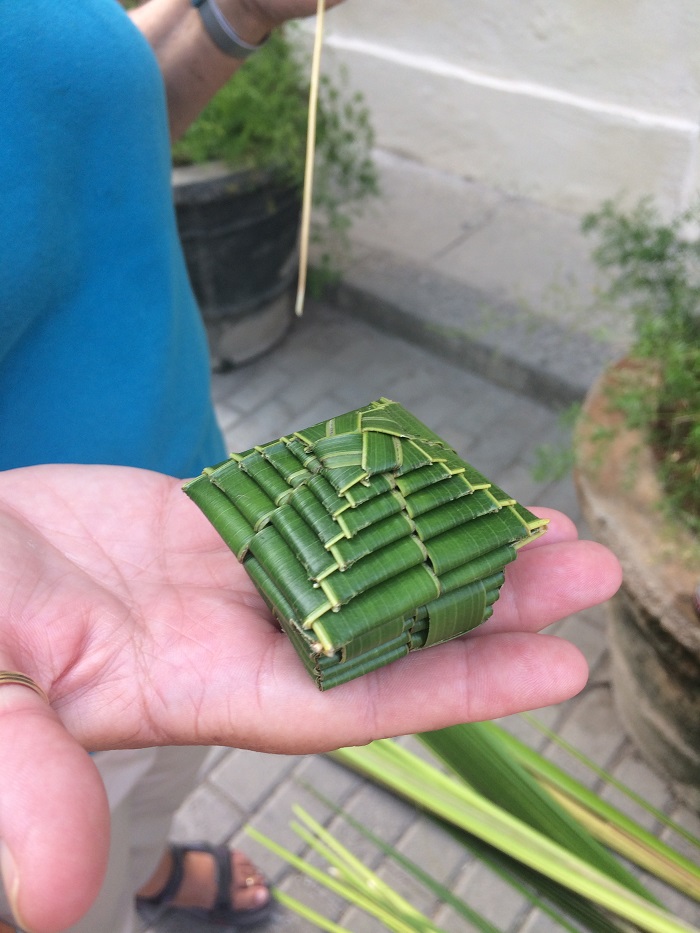
In the late afternoon yesterday, Bob and I happened upon a young man making baskets from palm fronds. In his large basket he had a number of exquisite, small items made from the fronds….birds, and a little house with a cricket on top.
He was easy to talk to and knew enough English that we could communicate quite well. As Bob and I were marveling at the fineness of these tiny basket creations, he offered me one of his ‘birds.’ It appeard that he was giving me a gift, but I wasn’t entirely sure. Here again was someone offering a gift and letting fate take his generosity where it would. I put the bird back in his large basket and asked him for the little house with a cricket on top. Buying that took a bit more time and frustration than we’d anticipated! First, Bob could not find his money, and as he searched we had the sickening feeling that maybe we’d lost all our money. After a few heartstopping minutes he did find his stash of money, but then we did not have exact change to buy the little cricket. The basket maker could not make change for us. So Bob went in to the local bar to ask for change, but they did not have it either. Then the basket maker left his spot to go buy a beer which would give him change. (You can walk about the streets in Havana with alcohol). He came back smiling, and yet he still did not have the necessary change! In the end, laughing, he accepted somewhat less than his price, and he still handed me the little bird as a gift.
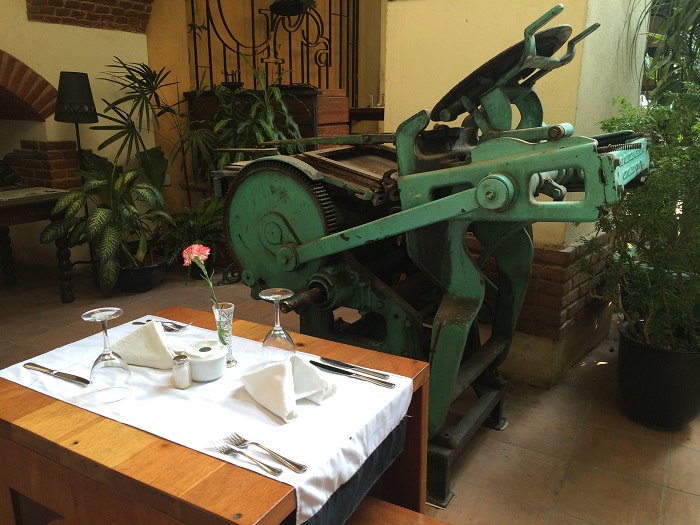
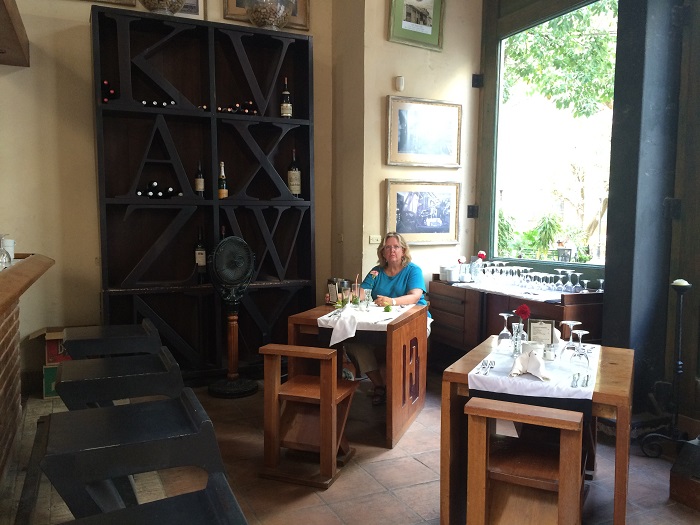
Bob and I went to dinner with my little house with cricket and my birdie sitting on the table before us as a quirky centerpiece. We kept admiring both these baskets, and I decided I had to have another little house with cricket as a present. I hoped we’d still find our basket maker on the street where we left him by the time we left the restaurant—which was a beautiful courtyard that had once been a print shop.
Restaurant Imprenta:
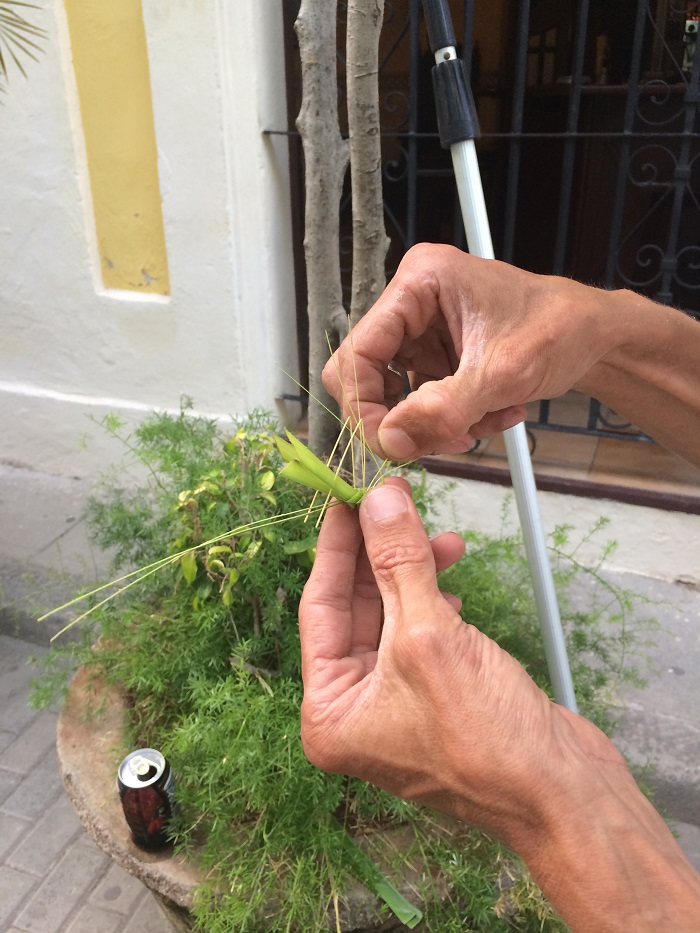
When we got back to the spot where we’d seen the basket maker, the other street artists had just finished packing up their wares and were headed home. Likely the basket maker would soon be doing the same. But we’d gotten there just in time to ask if we could watch him make a little house with cricket on top, and he seemed happy to oblige even though he still had one already made. It took about 20 minutes for him to make, and we had a wonderful conversation with him as he worked.
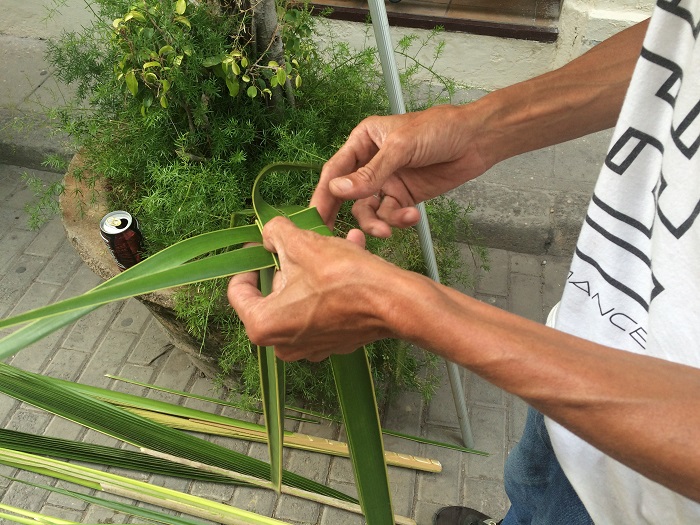
He started with two long palm fronds and crossed the fronds (north/south/east/west) over each other in the middle of the frond lengths. Starting with the ends that taper down to points, he began to fold each frond over the other in a consecutive direction. Since the fronds were tapering down to their outer ends the little box he was making got smaller and smaller, tapering like the fronds themselves. This made the roof of the house.
Then he went back to the other half of the fronds that led to the base of where they’d been cut from the tree, and he made the same consecutive folds for making a square. This made the house itself. Very clever. He cut some frond strips to insert into the box for doors and windows.
The exquisite litte cricket!
As he worked we talked…. He loves to make baskets and these little figures are things he ‘invents’ himself. He is always thinking of ways to make some kind of little structure or animal out of the traditional basket making techniques that he uses to make regular baskets. He took out his phone and showed us photos of his baskets. If he’d had any of these with him I would have bought some too! He does careful work that results in beautiful baskets!
I told him that I sometimes make baskets too, but not from palm fronds since there are no palm trees where I live. Bob took my phone and began showing photos of my weaving and bobbin lace since he could not find any photos of my baskets. When Bob showed a photo of my tatting the basketmaker’s face lit up and he said his wife does this! I asked if his wife also does crochet and ‘tejer,’ and of course he said yes! He said she loves these techniques and loves to work with her hands. We had a little discussion of how it feels to let our hands work the repetitive motions of these crafts while our minds are free to ponder. Making things with our hands allows our brains time to contemplate many things. He also told me he plays the piano and the violin. Someday he’d like to have a cello. He loves the cello most of all.
After giving me the little house with cricket he’d just made, he asked if I’d like him to make a snake. Naturally I said yes. I was curious to see what other techniques might be used to make these little figures, and the snake involved a different kind of manipulation of the fronds. When he finished he gave me that too. He really was most generous!
The only downside of our visit with him happened when a woman stopped for a moment to watch while he was making little cricket on top of the house for me. He offered her the one that was already completed. When he told her the price ($3 CUC) she said, “Big city prices….no thank you!” and walked away. We were all stunned. Yes, there are vendors who have high prices for things and who expect you to bargain, but these are mostly vendors who sell things that they have bought to sell. The artists we’ve encountered sell their work for very little, and I cannot imagine haggling with them. Perhaps I’m wrong about this, but how can you expect to pay even less for such an exquisite concoction of creativity? $3 Cuc for 20 minutes of work? Also, as a craftsman myself, I have stood in my own booths over the years and overheard people say that handwoven items are too expensive—that you can buy something just like it in a store for far less.
Well, you cannot buy a little basket woven house with a tiny cricket on top in any store that I know of. I was disappointed in this exchange. It would have been better for her to acknowledge what a little gem he’d just handed her, but that she could not spare the money at this time. It’s such a sad commentary that she felt she had to devalue his work in order to get away.
During all our cab trips to and from Old Havana we drive through modern Havana, including Embassy Row. The US Embassy is newly opened and has never been on the avenue where all the other embassies are. Most of the embassies are in historic colonial buildings and are quite a sight. The Russian Embassy is the exception, although it too is quite a sight! It is an wonderful example of Soviet architecture.
Tonight we’ll have drinks around the pool here in Marina Hemingway with some of the other cruisers we’ve met in the last few weeks, along with Lars whom we met as we arrived in Cuba two months ago. Some of us will walk to a local Spanish restaruant in the nearby town (Jaimentio?–something like that) to have a final dinner together. Then is farewell to Havana and to Cuba. It’s been great, but home is beckoning. Bienvenidos Florida by this time on Friday!
What else could I possibly say about a first visit to Havana, where Bob and I found everything we’d hope to find and more that we didn’t expect, other than it was magical?
Saturday morning we took a cab from Marina Hemingway to Havana Viejo. Months ago I posted information about a woman named Adriana Martinez who teaches bobbin lace and tatting and other lace making techniques in an outdoor setting called the Paseo del Prada. This is also the area where you can find well maintained American cars from the 1950s on display.
Our taxi driver dropped us near the Capitolio (currently under renovation that will make this landmark look positively new), and I struggled to find the Paseo del Prada on our map of Old Havana. I was looking at all the little green squares that signify a ‘park,’ but in fact as we wandered, we found it before I ever located it on the map. We saw a lot of art and handwork on display on the park-like median between two large boulevards that starts right at the capitol.
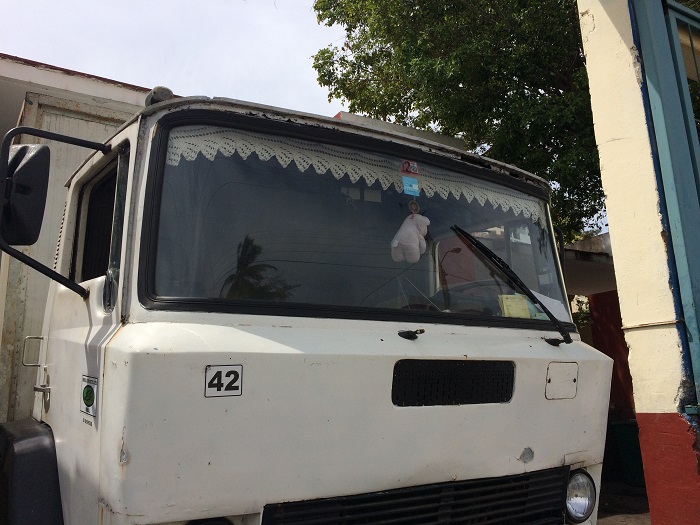
There were brightly colored paintings on display and several ‘workshops’ set up for children to try their hands at painting. But there were just as many women with handwork on display, mostly crochet. I was impressed to see so many women sitting on portable chairs in front of their displays, watching the crowds walk by while their hands were literally a blur, turning out crochet projects at impressive speed. The crochet work is really fine and beautiful. Cotton blouses with lace crochet insets, crocheted shawls and dresses, many dresses for little girls—all of it done in ecru cotton.
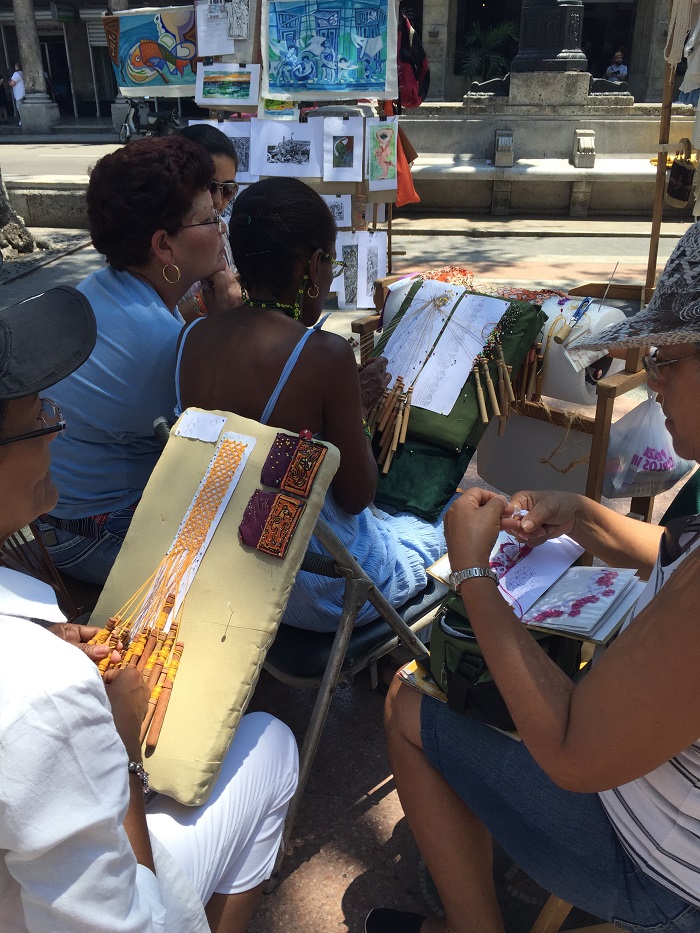
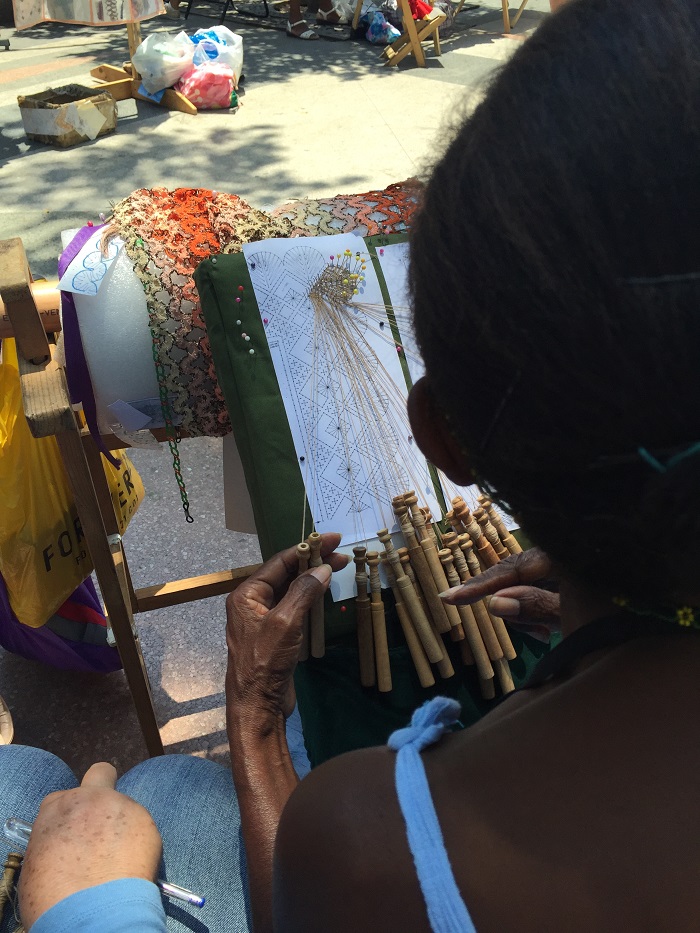
And then, before I recognized what I was seeing, there was a group of women clustered around one woman, and about half the women were working on lace pillows while the other have were tatting or crocheting. Moments later when I took my eyes from the bobbin lace work and the tatting, I recognized Adriana Martinez from the link I had found last summer about the arts of Cuba and Joan Sperans’ photo of Adriana.
Can you imagine hearing about an artist who has a display in a park in New York (or any major city in the US) and going there and finding that very artist within moments of arriving? Maybe it could happen, but I can’t tell you how shocked I am to find the very woman, the only woman, I’d heard of doing bobbin lace in all of Cuba. I am stunned!
In this photo Adriana is helping a student with their bobbin lace project (bolillo). Under the student’s pillow is Adriana’s project: a blouse made entirely of bobbin lace!
While I talked to Adriana and a woman named Nancy who knew a bit more English, Bob took my phone and began showing photos of my own work to the other women: tapestry, knitting, bobbin lace. I gave Adriana and Nancy my card, and then all the students wanted cards as well. I was so touched that these women were interested in me, but naturally we were all interested in each other. It is thrilling to find people in a distant location doing the very thing you love to do so much! We were all quite intrigued with each other! At one point Nancy called a man over to interpret for us, and I was shocked at how many textile words he knew. I don’t know if he was related to one of the women doing lace or if he was just someone with his own artwork on display nearby. He was a young man named Hidalgo, rather macho looking, wearing a muscle shirt and smoking a cigar, and he knew all the English words for the techniques and materials the women were using.
And speaking of men, I have to mention that every time an official has come onboard Pandora, either from the Guarda Frontera of the Health Department, or even the fishermen who have rowed these officials out to inspect us, all these men have known that the pile of yarn and needles laying about our cockpit is called ‘tejer.’ Every time, no kidding, one of the men will point to my knitting and say ‘tejer.’ Presuming I might not know what they’re saying they will often put up both their hands and make a pantomime of knitting. There’s no mistaking their pantomime for crocheting or any other handwork. And I can’t help but think of all the American men who always assume I’m quilting, whether I’m sitting in front of a loom or a spinning wheel, or holding knitting needles or have a lace pillow in front of me. When I tell them the name of what I’m actually doing, the standard response is “Quilting…knitting…whatever.” How refreshing that Cuban men know the difference!
Here is a photo I meant to use weeks ago, on my first trip into Cienfuegos. Again, one of the Guarda Frontera had seen my knitting and correctly identified what I was doing. I already knew that many women in Cuba crocheted. I had made a joke to Bob that I could not imagine what women might knit or crochet in such a hot climate. And then I saw this!
The day only got more and more magical. Bob found lots of wonderful antique cars all along the Paseo del Prada and along the road that edges the coast and the Havana harbor. I found the location of the Quitrin shop that sells traditional clothing. I asked if the school of handwork was nearby, and they told me where to find it, although it is closed on the weekends. I hope to visit on Monday.
Every aspect of the day had a touch of magic to it. Walking through the pedestrian only, cobbled streets, we came to the privately owned restaurant (called a paladar) that was written up in the Lonely Planet Guidebook as the best restaurant in all of Havana. We were wilted from the heat and not feeling appropriately attired for such a nice restaurant. But we both felt that since we’d found it would be a shame to pass up such a chance. Paladars are a recent business venture in Cuba, a chance for Cubans to own their own business. Almost all businesses are owned by the government. There are lots of rules about running a privately owned restaurant, from how many tables you can have to who can be hired for staff. Just a couple of years ago the restaurant staff had to be family members of the owner. This restaurant, Paladar los Mercaderes, had quite a large staff, and clearly were not related.
I was asking our waiter for recommendations and also explaining that we’d like to try some traditional Cuban items when man seated at the adjacent table, having dinner alone, introduced himself as the owner of the restaurant and began making recommendations of what we should try. After we ordered, he also insisted that we try a glass of the French Medoc he was drinking, and it was delicious, of course! Yamil Alvarez Torres and his wife and one of his cousins are partners in this venture.
Yamil owns two fishing boats, one on the north coast and one on the southcoast, which supply all the fish for the restaurant. Yamil used to live in this beautiful space with his wife and daughter, and he says he did all the renovations himself to turn it into a stunning setting for his restaurant. When you arrive you walk up a staircase strewn with red and white rose petals to a beautiful dining room appointed with ornate colonial furniture. Our dinner was octopus boiled and then grilled (very tender!) served with two sauces: one was lightly sauteed onions and the other a house-made pesto. Our main course was braised lamb with green olives, onions and small red and green peppers in a bittersweet dark sauce. The flavors were wonderful together! Tangy olives and pungent peppers in a mysterious dark, bitterweet sauce. Dessert was a layered chocolate confection with a torched sugar topping (like the topping on a crème brulee) that I simply cannot describe! It was all excellent, and momentarily after arriving both of us had lost our wilted, bedraggled feeling and were thoroughly enjoying ourselves!
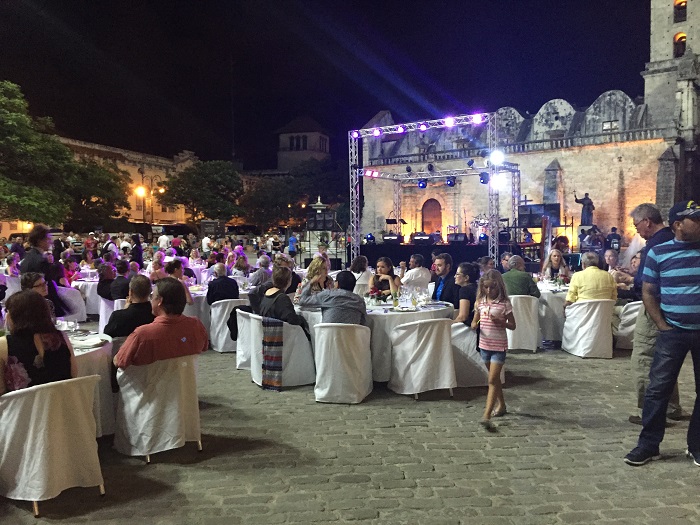
Perhaps the end of the evening was the most magical part of the day. Earlier we had noticed a large park being set up for a dinner. Tables and chairs draped in white cloths (what do you call those covers for chairs?) with centerpieces of red roses filled this square near the San Francisco ship terminal. There was a stage being set up and some dancers were milling about wearing angel costumes. We enjoyed the scene and then wandered on our way. At the end of the evening we found the event in full swing. It turned out to be an American tour group. While I stood in the square transfixed by a harpist playing Debussy’s First Arabesque, Bob began chatting with a couple who’d stepped away from their dining table.
On the one hand, I could not believe I was standing in a square in Old Havana, listening to a harpist play one of my favorite pieces of music, while Bob was learning about the tour group who was having such an extravagant event on the square. It was a large group of people from the AIA, the American Institute of Architects, a group that Bob’s father was closely involved with during all the years he was publisher of “Progressive Architecture.” When I joined the conversation, the man speaking to Bob was saying that he read “Progressive Architecture” for many years.
Bob has moments almost every day when he thinks of his father and wishes he could make a quick phone call to his dad, even though it’s now been over two years since his dad passed away. We were both pretty stunned to find that this extravagant event that we’d watched being set up earlier in the day and that was now in full swing, brought Bob’s father back to us so intensely. It ended our evening in Old Havana perfectly.
Finding a cab back to Marina Hemingway late at night was not quite as easy as we’d imagined. All the taxis wanted more than twice the fare we’d paid earlier in the day. In the long run we found a taxi willing to take us back for only a little more than we’d paid in the morning.
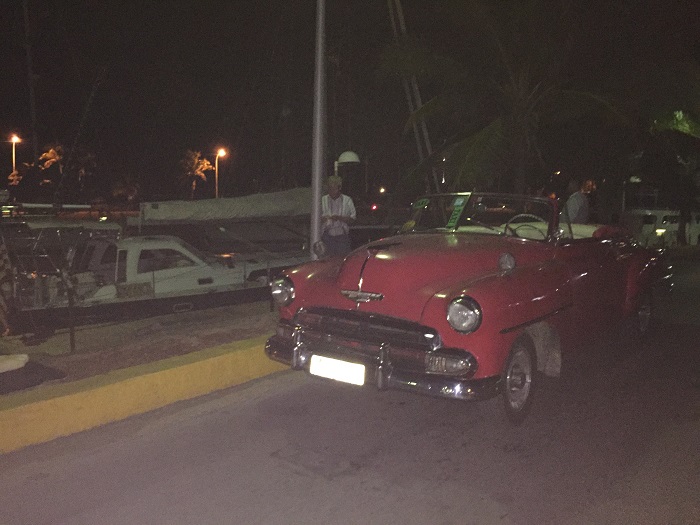
Our driver calls himself Shrek and has a well-preserved red Chevrolet convertible with an almost spotless white interior. It was a terrific ride along the coast back to the marina.
He’d never been to Marina Hemingway before so we had him deliver us right to the side of Pandora tied up along a bulkhead. I tried to get photos of the car and Pandora together—not too easy late at night! And Shrek took photos on his phone while Bob and I did the same.
 Before I left I tried my hand at a bit of embroidery that I found on Facebook. It’s astounding to me what I stumble on perusing fb. I’m glad to know this technique–I think it will come in handy for all kinds of projects. I embroidered this little onesie as a practice, and clearly I need more practice. But I’ll get it eventually. I’ll do some spring colored onesies in this technique soon. Hmmm….no photo. Where did it go?