ArgoKnot

Author name: ozweaver

As Summer Wanes

It’s Labor Day, the first truly chilly morning of the season, and I LOVE it!  There will be a few more days of summer heat before we hit the equinox, but summer is winding down.  I can feel it in the air and see it in the trees.  In spite of hurricane Hermine heading northward, I feel autumn coming.

The month of August has hurtled by me.  I had lots and lots of doctor appointments, and in between them, I tried to very hard to enjoy one workshop on ec0-dyeing and as many days of weaving and lace making as I could manage.  Looking back, I feel fairly productive!

If you haven’t tried Eco-dyeing, give it a whirl!  There is nothing like unwrapping a scarf or fabric to find some lovely imprints of leaves and flowers.  If your first attempt doesn’t suit your taste just put the fabric/scarf away and try it again on another day.  That’s what I’m doing this morning as I write this.  I have a 1-yard length of lightweight linen and one silk scarf steaming.  I used the rinse and spin cycle of my washing machine to re-wet them, and I just collected a few leaves on my morning walk:  one small branch of Japanese maple with about a dozen leaves on it, some golden rod fronds with buds ready to open rather than in bloom, and a few fronds of sumac.

When I got home I spread out my damp linen fabric and silk scarf and placed my plant materials on half of each length of fabric or scarf, because I will fold the other half over to cover the plant material.  To the things I gathered on my walk I added a few gems from my garden.  Today I am trying tall ferns that I hope are ostrich ferns, since I read that those work well in eco-deying.  I have a few dark purple oxalis leaves, some purple cranesbill flowers as well as leaves, some coleus leaves, and one small spray of red flowers from a dragon wing begonia.  As I write this I realized I meant to to pick some hyacinth bean leaves and flowers.  The leaves of the purple hyacinth vine have such dark veining, it might work very well in this technique. Drat!  My fabric is already in the steamer.

IMG_2630

Here are a couple of sites that I found very helpful in trying this technique.  Sherry Harr did her doctoral thesis at Kansas State University on various textile dyeing techniques, and her article is quite thorough.  There are several blogs where the authors have documented their plants and techniques rather well.  Take a look at Threadborne and Obovate Designs.

In mid-August a few people from my local area guild got together and shared lots of plant material and had a go on our various fabrics and scarves.  None of us had ever done this before, but we shared the internet info we found, and a couple of us had talked to others who had taken a workshop with Amelia Poole, whose work in this technique is stunning.

With a bit of info and a LOT of enthusiasm, we plunged ahead.  We were quite lucky to have the use of Kate’s wonderful weaving/dyeing studio for this project.  Here you can see how we layered the tubes of fabric with sticks to keep them from touching.  To make the steamer there are some rocks and sticks at the bottom of the pan to keep the tubes of fabrics above the water level.

IMG_2526

The taller tubes of fabric went in this make-shift steamer.

IMG_2528

After 30 minutes of steaming and a little time cooling down, our tubes came out of the pot.

IMG_2524

Unwrapping and hanging our scarves and fabric to dry on a rack. We were pretty thrilled with our results.

IMG_2535

My first scarf turned out better than the other things I tried that day.

IMG_4624

Look at the imprint from this giant dahlia.

IMG_2536

I hope to compile a list of the plants and flowers that work best for me.  Some things leave behind wonderful colors, but the imprint is just a blob.  I’m more interested in the things that leave an actual impression of the leaf or flower.  So far, this is my list of A plants and flowers:

Japanese maple leaves–great leaf definition
coleus leaves–faint leaf definition and pastel colors, lovely on silk
golden rod–great definition for leaves and flowers
purple oxalis–great definition
black hollyhock flowers–a wonderful, deep purple ‘blob’
cranesbill, purple–nicely shaped ‘blob’ somewhat recognizable as a flower silhouette

One of the perks of visiting the studios and houses of other weavers, is seeing the lovely details in their living and work spaces.  Weavers usually have such a eye for beauty.

IMG_2529

It was a glorious day for our project.

IMG_2545

Fast forward to the beginning of September, and on this stunning weekend I spent a wonderful day at the monthly meeting of bobbin lace makers in Connecticut.  You can find us here.

We met outside in a member’s garden under a canopy of billowing, striped canvas.  Her terrace was surrounded by flowers–black-eyed Susans, phlox, and other late season bloomers, with a view of her large vegetable garden nearby, and in the distance her bee hives.  She made an English cream tea for us that we had to share with the bees. Her tables were covered with vintage white on white embroidered cloths, topped with vintage linen tea towels that commemorated Queen Elizabeth’s reign–going back as far as her silver jubilee.  I think we all felt a bit regal.

I hope Mary won’t mind that I shared this photo.  Her expression is a mirror of how much we were all looking forward to having these treats!

IMG_2581

Our hostess made Earl Grey tea biscuits dipped in chocolate that were off the charts!

IMG_2582

On top of this wonderful tea we all actually spent time making lace, too!

This is also the weekend of the Haddam Neck Fair.  Late summer is the time for all kinds of festivals that celebrate farming and animal husbandry.  I have never been to this particular fair before, and it was a wonder.

First there were the animals.  We watched a draft horse pulling contest, visited the goats and sheep, cows, chickens and rabbits.  The textile displays were very small, but I met a woman on the fair committee, doing a spinning demonstration, and she hopes to grow the textile area of the fair in coming years.

5-IMG_0752

Look at this beautiful Dorset sheep.  Her new fleece growing back was as thick as felt and she loved attention.

4-IMG_0741

Multi-colored Jacobs.

IMG_2590

Seeing all the awards for best sheep or cow, all the way down to best cakes, and cupcakes, best flower arrangements, and best single flowers, or best zucchini, made Bob exclaim, “No one can possibly doubt humans’ need to compete!”  Along a row of bud vases that showcased individual marigolds, the judges had written such poetic comments as: “As beautiful as a sexy, 1940s film star!”  And, one a rose that no longer had a single petal left, “A stunner!  Well done!”

IMG_2625

I particularly like this arrangement of succulents in a well used frame. Clearly the judges did too.

IMG_2626

Some whimsical flower arrangements.  There were lots of categories for flower arrangements, and these were two in the category inspired by food.  A tray of floral cupcakes!

IMG_2592

And a slice of mum cake!IMG_2593 The same kind of judges’ comments showed up on all the individual vegetables, from tomatoes to summer squash, to cucumbers.  If you can grow it or make it, you can compete with others at some local fair!

IMG_2627

It was a beautiful day, and it was quite lovely to see how much care and attention can go into growing a zucchini or a marigold!

Sadly, the textile area could not hold a candle to the livestock or the flowers and veggies.  Maybe that will change in the future.  All it will take are a few textile people who want to compete!

The day is getting away from me, and I should turn my attention to Archie’s book and to that never-ending boundweave project.

I’ll end with a recap of what I learned today.  The tall ferns in my garden must not be ostrich ferns since they left no color.  I did add some hyacinth bean vine, both leaves a clusters of flowers buds, but they also left no color or imprint.

Clusters of purple verbena flowers are interesting–they turn turquoise!

IMG_2633

And signet marigolds left an interesting imprint.  The red stripes turned black.

IMG_2632

And speaking of flowers, I have to share one last image.  The well known, oft-photographed field of sunflowers on the north fork of Long Island.  Bob and I sailed to Sag Harbor and stayed for almost a week back in the middle of the month.  Even when compared to an amazing dinner at the American Hotel, and wine tastings along the North Fork, seeing this field was the highlight of that trip!

sunflowers long island

Now to work!


Weaving Connections

Today is Tuesday, August 2nd, and Convergence, the biggest gathering of weavers in the US,with lots of attendees from overseas as well, began over the weekend.  Facebook is full of posts from the many participants.  Do I feel left out?  Well…..maybe… just a little.

My tiny part of the world had its own weaving weekend though. On the hottest Saturday of the summer (so far!) members of Area 4 of the Handweavers’ Guild of Connecticut had a beautiful display and did demonstrations of weaving and spinning at the Historical Society during Old Lyme’s 30th annual Old Lyme Festival.  It was steaming hot, but we all had a great time.  We heard that we were the most popular event at the festival, and I have to admit that I’ve never seen such a crowd at any of my past demonstrations in New Jersey.  Although the historical society headquarters are not yet air conditioned (supposedly next summer it will be), I wonder if being in an historic grange building with lots of fans (that would be rotating, air circulating fans–not enthusiast fans!) was still more enticing to the hordes than being outside in the 90-degree sun.  Or maybe we just really were a compelling option for visitors.

The local online newspaper, The LimeLine, covered our event and got a shot of our group working on the behemoth, 9-ft Clemens loom.  I think this may be the moment when Jody (in the b&w stripes) began the tedious process of mending broken warp threads. She generously allowed visitors to try a bit weaving at the loom, and there was an incident of over zealousness that led to some broken warps.

These photos of our exhibit are pretty pedestrian.  I’ll just whine and say that I was very busy spinning!  It’s not a real excuse, but I hope you’ll accept it. This is just part of a display of our members’ work.

2-IMG_2421

Stephanie has a business making rugs and blankets of all sorts and teaching classes in both techniques.  She brought a loom to demonstrate weaving and had a lovely array of rugs for sale.  Right next to her is a rack of her indigo dyed shibori silk scarves.

3-IMG_2422

I know there are lots of better photos taken by others, but I haven’t see them yet, so these will have to suffice for now.  It was a very worthwhile event.  The folks who run the festival said we were the most popular participant, and they hope we will continue to be involved in the future.  And knowing this building will be air conditioned next year makes us all think, oh yeah, we’ll do it!

The next day a few of us drove together up to Kingstown, Rhode Island, to take a look at the extensive weaving stash of our dear friend, Kathi Spangler, who passed away a few weeks ago.  She has been on my mind so much this summer.  When I went to see Kate Barber’s exhibition in Providence, I realized we were so close to the convention center where the last Convergence was held.  When I left the gallery where Kate’s work was on display, the first corner I walked to had the building where ATA housed our tapestry exhibition two years ago.  Kathi wanted to make sure that visitors to Providence would know they had reached a building with a weaving exhibit inside, so she filled all the large main floor windows with works by Rhode Island weavers.  It was quite dramatic and such an undertaking to gather all the woven items and display them so creatively.  I had a strong sense of her presence as I stood at that corner remembering the scene from two years ago.

Screenshot 2016-08-02 18.53.12

At Kathi’s house, Susan, Sandy, and I spent a couple of hours looking through Kathi’s handwoven fabrics.  Some things were finished items, like hand towels, scarves and shawls, and table runners.  I was intrigued with several lengths of fabrics woven for samples of techniques.  This one in particular caught my attention.

1-IMG_2432

Sharon and Jan who had organized all of Kathi’s stash and who were on hand to let friends in to look through Kathi’s treasures, said this piece was called the ‘chicken project.’  Boy, I am SO curious about that.  What comes to mind is that the color of golden yellow is rather like a baby chick.  Sometime I’ll have to ask Jan how this project got its name.

I took a wonderful table runner in natural linen with a bit of overshot in red at each end.  I found two more runners in the same pattern with forest green at both ends that I took for Jody.  Kathi had a lot of beautiful sample pieces, and I wonder how many of them became finished projects.  The red runner underneath the overshot runner has Christmas trees in huck lace.  It just needs hemming.

2-IMG_2433

I was so moved to see that she had finished her wonderful jacket from Sarah Fortin’s workshop.  Jan and Sharon had thought to put it on a dress form for visitors to see.  Why didn’t I photograph it?  Of course, it turned out beautifully, and I hope Kathi wore it a few times before she got too sick.

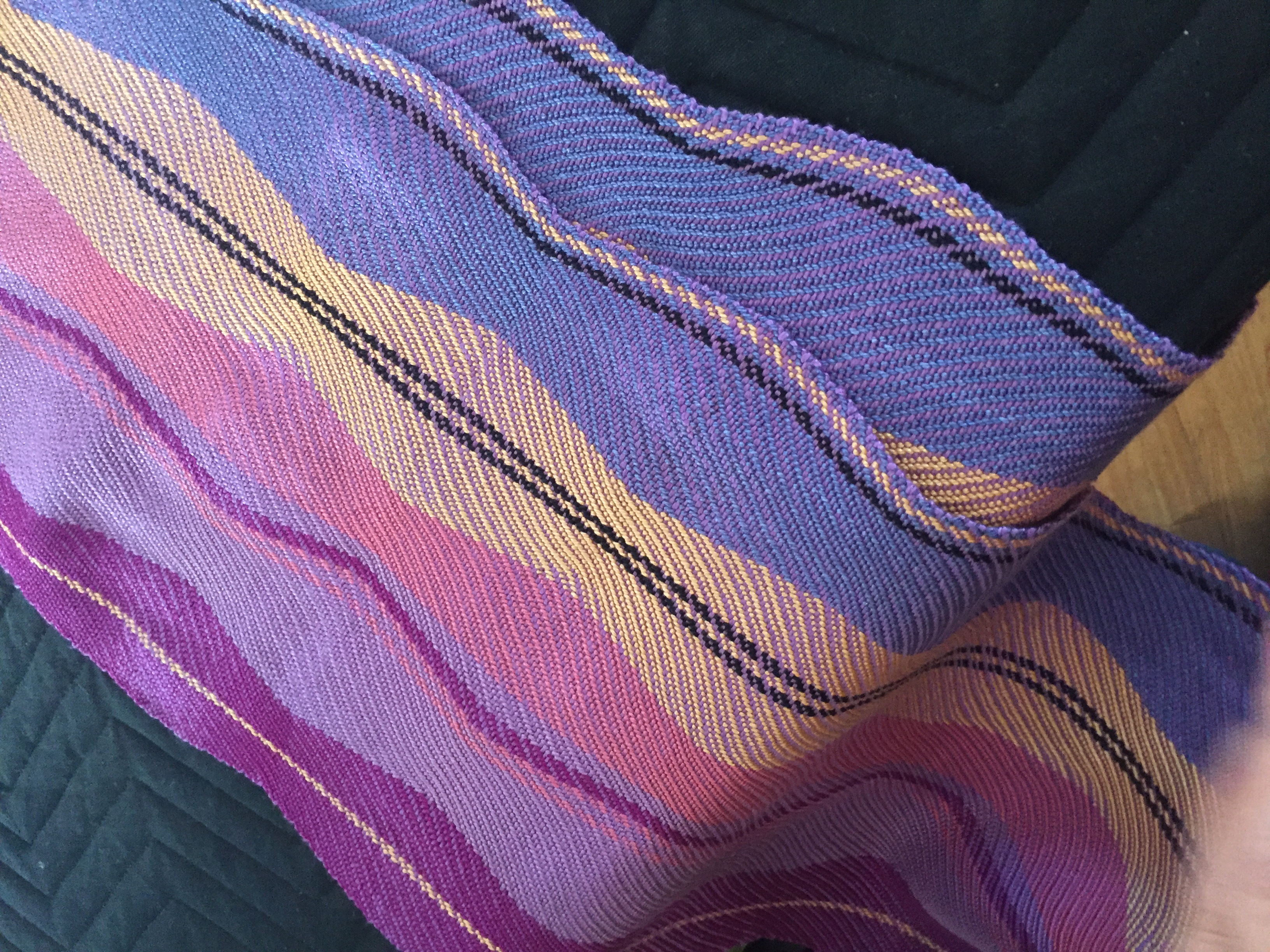
Speaking of yardage, I am very close to finishing my JOY project.  I rewarded myself with about an hour of weaving today after working on Archie’s book.  It is really stunning fabric, and I will cherish it even if it never turns into a garment. Those JOY women, Diane and Cathy, have really created something wonderful with their line of handpainted tencel, and using these yarns as both warp and weft is amazingly dramatic!  Weaving it has been very therapeutic, as weaving should be.

I neglected to mention what I’m dreaming up for my next project!  Sharon has shared with me all the details that her Rhode Guild has discovered about weaving and constructing an origami top based on Virginia West’s examinations of garments constructed from narrow widths of cloth used diagonally.  I have an assortment of fine silks that I will soon make into a warp.  Photos to come.


8S Advancing Lace Yardage Using JOY Almaza

This is an advancing lace structure on a plain weave ground that I found in the Greater Baltimore Weaving Guild’s book Sixty Scarves for 60 Years.  The pattern was designed by Carol Bodin, and it is called “Raku.”

Warp:
JOY “Almaza”
Length: 6 yards,  35 epi, 16: wide= 560 ends + 8 ends for selvedges.  Total 568 ends

Click on this image for a bigger version:

Screenshot 2016-07-26 08.55.21

I threaded right to left and had 2 floating selvedges on the right side, then ended with threading 1,2,3,4 and two floating selvedges.  That used the 8 extra threads I assigned for the selvedges.

As you can see there are little huck interlacements on a plain weave ground.

Here is the warp.

The weft is Almaza in a different colorway.

1-IMG_2401

I wove 3 1/2 yards of the lace pattern and 1 1/2 yards of plain weave for fabric to make a jacket.

Weaving and Dreaming

I’m dreaming about my next project as I zoom along on the current one.  There are always surprises, and this yardage has had its share.  Last fall I decided to make the warp a yard longer than I’d figured when I bought the materials.  Yeah, so, it should not have been a surprise when I ran out of warp and had to fudge a second warp out of a solid grey to blend into this handpainted warp.

Then, for some reason, I neglected to make the mental leap to realizing that if my warp is now a yard longer than planned I might not have enough weft!  That only occurred to me after I started weaving, about 2 weeks ago.  Really, I amaze myself sometimes.

So I’ve spent this morning thinking about what I might use as weft for the rest of this yardage.  I have not yet run out of handpainted JOY weft, but it was time to decide if I should switch to a solid color now so I had enough yardage that is clearly different to make a significant part of my garment–like sleeves or front bands.

I spent some time this morning digging through bins stacked pretty high, looking for a bin of tencel.  Luckily most of these bins are clear so I can what’s in them.  But wouldn’t you know the bins at the bottom of my various stacks are not clear so I had to unload everything to check out what is in those bins at the bottom of each stack.  No luck in finding any tencel.  I have lots of tencel, but at the moment I have no idea where it is!

So I moved on to looking at color cards for tencel, and found that there is no coral shade that comes even close to what I want.  That led me down the rabbit hole of looking through my silk bins and silk color cards.  I have the perfect shade of coral that I’d love to use, but not nearly enough of it!  So I called Treenway and have placed an order for two 1000-yard skeins of a loely coral color #27.  Those skeins will not arrive for almost three weeks.  Sigh…Does this happen to you?  Please say it does!

Fast forward to the end of the day. I wove another half yard today, in plain weave now, with the handpainted weft. Just moments ago, when I advanced the warp, I saw that I am only about a yard away from the end.  That means I will have 5 yards of fabric instead of 6.  The mistakes just pile up faster than I can keep track of them!  I could swear I made a 7 yard warp and that’s why I ran out of materials.  I have no idea what happened last fall, and I don’t know where my notes are!  I hope this sounds familiar to you.  Now I think I need to call Treenway and cut my order in half!

Luckily there have been some marvelous experiences lately to balance the derangement going on in my weaving.  While others are busy heading off to Milwaukee for Convergence,  I have gotten to enjoy some inspiring events much closer to home.

First is an exhibit in Providence that will be closing soon.  I wish I’d seen it sooner so I could have spread the word earlier.  I believe it closes this weekend.  There is a small gallery called The Reading Room of the AS220 gallery, on Matthewson St. where Kate Barber has a wonderful exhibit of her recent work, called “Forward Folding.”

This postcard image is a detail of one her works on display, and it is stunning.  Her exhibit is in an intimate setting with beautiful lighting.  I stayed longer than I would have imagined to view her 22 pieces.  There was such zen in the room I could not tear myself away.  Kate is doing wonderful things with shibori on the loom which she uses to create crimped cloth. Some of the works are also dyed and embroidered.

There is a wonderful mascot at the gallery who watches for visitors and then greets you at the entrance.  I’ve now forgotten her name.  She is so calm that I almost mistook her for a ceramic dog!

1-IMG_2388

Across the river, in Old Lyme, my local area weaving guild members are hard at work getting ready for the annual town festival where some of us will demonstrate various textile techniques.  The big Clemens loom is ready for demonstrating the weaving of a traditional Canadian rag coverlet bed covering.  Jody will the be first weaver, although she needs three helpers to do this.  This is her coverlet that will be woven first.  It will be 9 ft. wide by 9 ft. long.  It’s a big undertaking!

This Saturday, July 30, Jody and her crew will be weaving on this behemoth loom, and others in our guild will be demonstrating various textile techniques.  I plan to bring my spinning wheel to spin some lovely tussah silk sliver that a Connecticut woman who calls herself HoneyBuns prepares and dyes.  I am spinning a wonderful colorway of rosey coral and gold.

Yesterday Jody and I went to see a wonderful film about an exhibition that is currently traveling through Europe.  It was a stunning film and almost made up for the fact that I  won’t get to see this exhibition in person.  The exhibition is called “Painting the Modern Garden: Monet to Matisse,” and the film has the same name.  The Royal Academy of Art put this exhibit together.  It was quite moving, and I enjoyed sharing it with Jody and two other weavers from my local guild who also attended.

There were scenes of the exhibition itself, including a large room where Monet’s waterlily triptych has been displayed together for the first time ever, since each of the three pieces is owned by different museums.  There is current footage of the gardens where each of the artists painted a century ago, and there are wonderful old photographs of the artists.  The best image was Renoir’s portrait of Monet in the garden at Giverny, doing a painting of his own.  I did not know that this portrait is owned by the Wadsworth Atheneum, so sometime in the future I will be able to view it in person!

Here is a short excerpt from the film:

Here is one more video with the curator discussing Monet’s Agapanthus triptych.

To all of you heading off to Convergence, have a wonderful time!  I’ll be thinking of you and what I’m missing. Meanwhile, I am enjoying the down time of being at home in the studio.  Maybe I’ll soon get to start the next project I’m dreaming of–I didn’t even tell you what it is!


Finally Weaving

After a winter of dreaming about weaving, it was hard not to get right down to it when I returned home.  During the 8 weeks of waiting for surgery, then recovering and waiting for the pathology reports I distracted myself with knitting.  Last week I finished the warping process and got down to weaving!  Boy, it feels great!

Some weavers have asked for more info on this project, so here it is.  The warp and weft are two entirely different colorways of Just Our Yarn “Almaza,” which is an 8/2 tencel thread.  One colorway is a bit on the cool side, with blues and purples, jazzed up with a bit of acid green and soft roses.  This is my warp.

1-IMG_1753

1-IMG_1758 (1)

The weft is a rather bright analogous colorway of watermelon, coral, pale peach, and cream that is very slightly yellow.  It looks like candy.  It’s NOT a colorway I would ever buy on purpose!  And yet I did, at the suggestion of Cathie and Diane from JOY.

1-IMG_2401

Here is a bit of plain weave showing the color interactions.

3-IMG_2394

The weave structure and the two very different colorways are creating an amazing fabric!

4-IMG_2396 5-IMG_2400

I planned the fabric at 35 ends per inch to weave a fabric with enough body for a garment.  If I were weaving a scarf I would have used fewer ends per inch.  My weave structure is a blend of plain weave with lace floats in the warp and weft.  I am using one of the designs in the book Sixty Scarves for 60 Years that the Greater Baltimore Weaving Guild published a few years ago.  The name of this pattern is “Raku” by Carol Bodin.  I am sorry to learn that this book is now out of print.  Time to consult your guild library!

Carol Bodin describes this structure as a lace overshot.  I can’t follow that.  To me it seems like a lace structure with advancing lace modules of 1-2-1, 2-3-2, 3-4-3, 4-5-4…etc with a plain weave structure surrounding the lace elements.  Make sense??

I put the basic weave structure into my PCW program which I wrote about here.  Then I had to make the BIG decisions.  The pattern moves across the warp in one direction only.  Did I want that or did I want a mirrored repeat at the halfway point across the warp?  Did I want to mirror every pattern repeat?  After sampling these ideas in PCW, I decided to leave the structure in its simplest form.  Mirroring every repeat made a very busy fabric that looked like a headache waiting to happen!

The width I have on the loom is 16″ which means I’ll be using two lengths of fabric for fronts and backs.  I can mirror the weave structure when I put the garment together.  To make any mirrored design elements in the fabric would have made the overall design too fussy.

Screenshot 2016-07-23 18.51.47

This is less fussy:

Screenshot 2016-06-27 07.48.25

I’ve woven 3 1/2 yards of the lace structure, and now I think I’ll switch to plain weave for the next 2 1/2 yards.  This way I’ll have some complex fabric for the body of a jacket and some plain weave for front bands and sleeves.  It would have been so smart of me to choose a garment pattern before I began to weave, but that’s just not the case.  This is a case of wanting to weave the fabric and the devil make care what it becomes!

When I’m not weaving I’m enjoying the garden.  August is almost here, and the heat is starting to build.

1-IMG_2378 2-IMG_2381

I’ve had a couple of wonderful experiences that have inspired my weaving ideas lately.  More on that next time!


Scroll to Top