It’s the last weekend in March. We fly home on Monday, April 1st. It’s been a difficult winter season in a number of ways, and weather has been part of that. This part of the world is in the trade winds where the winds are predictably East. To have West winds at all used to be quite rare. This year it was a regular thing. And then there were tragedies: three deaths of sailors in the space of only three months.
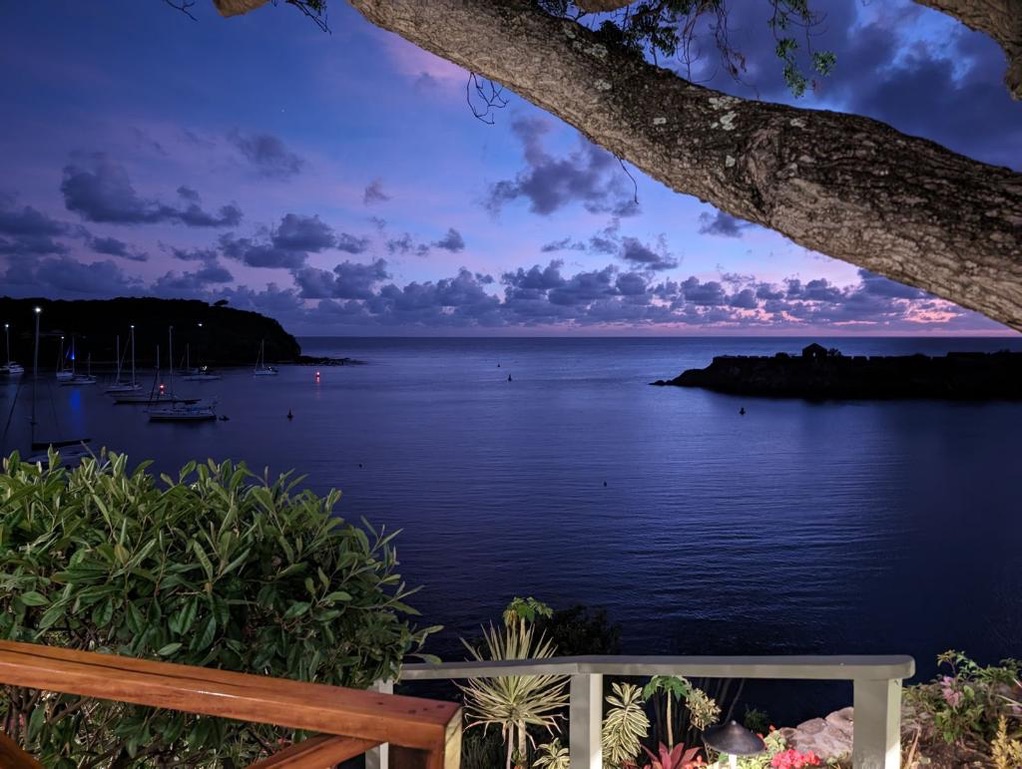
But whatever the weather and whatever other circumstances block our path, the Caribbean is always colorful. Beautiful dawns and sunsets greeted us every day, with daily rainbows after the rain showers. Twelve years ago when we returned from our first passage to The Bahamas, an old friend asked me if my color palette had changed based on spending so much time in tropics. All these years later, I can answer that Caribbean colors have definitely found their way into my palette–clothing, tapestry, fabric weaving and yarn spinning, knitting.
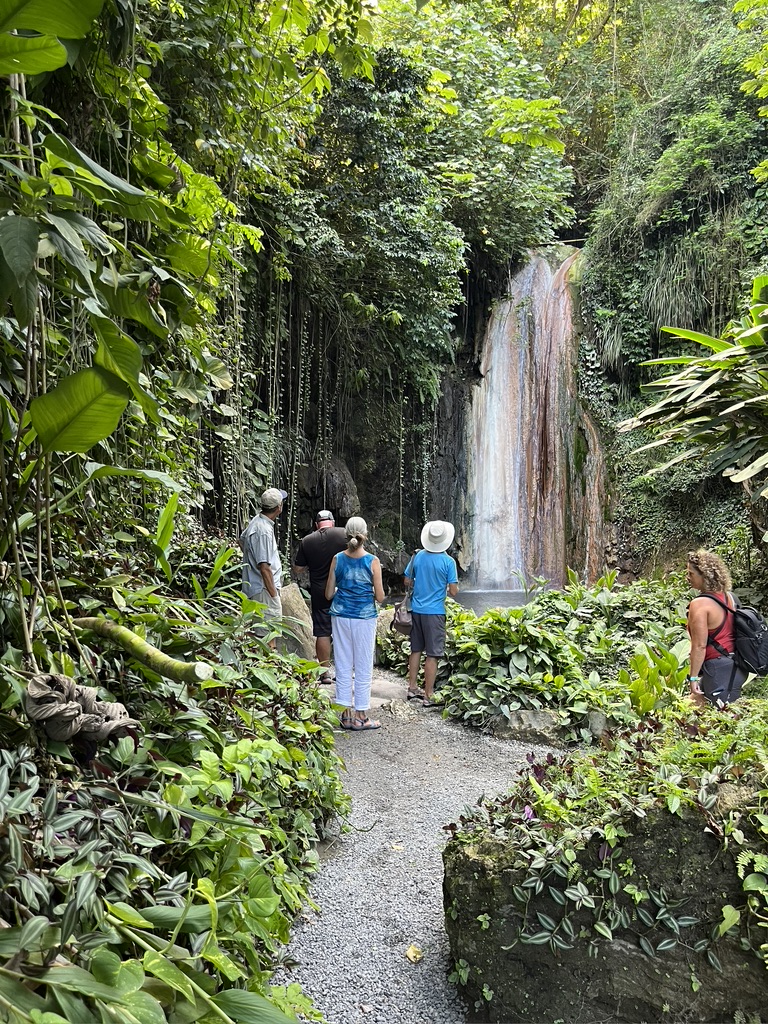
Here is a particularly lush image from Martinique. We are in the rainforest, but also note the colors in the mineral water flowing over that cliff. There are hot springs here where you can ‘bathe’ for a fee. We are with two couples, one we’ve known for years, and other new cruisers this year.
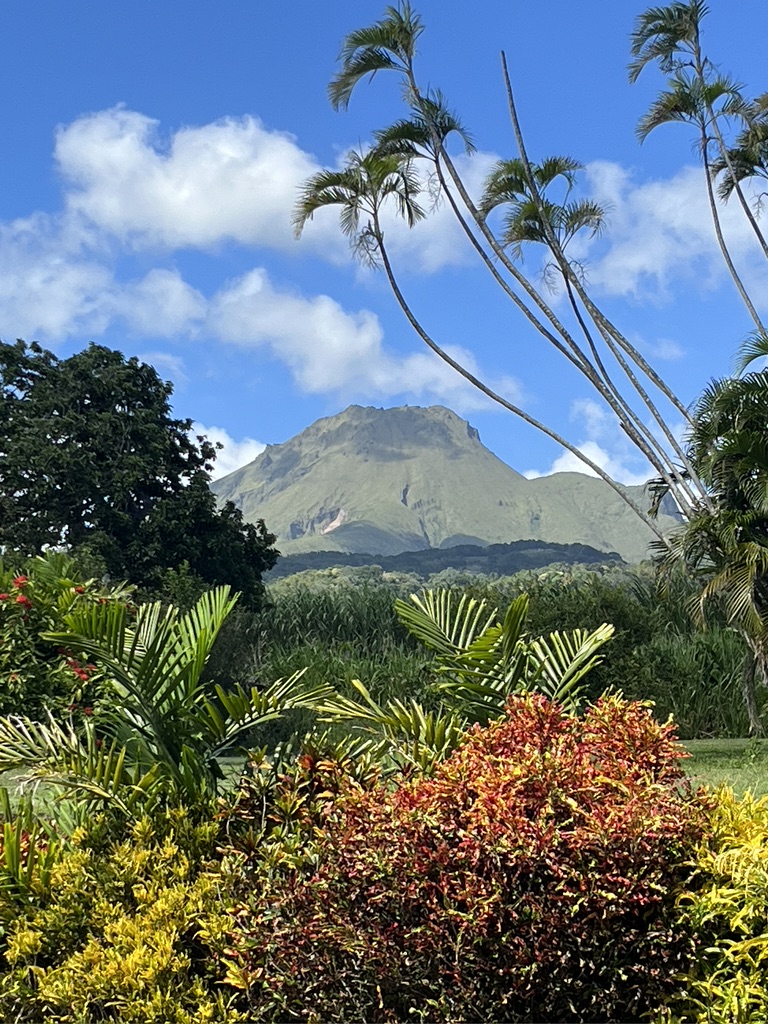
Here is a rare moment in St. Pierre when the summit of Mount Pelee is visible. It’s normally always hidden in the clouds, one of the iconic places that gave credence to the phrase that these islands are “the islands that kiss the clouds.”
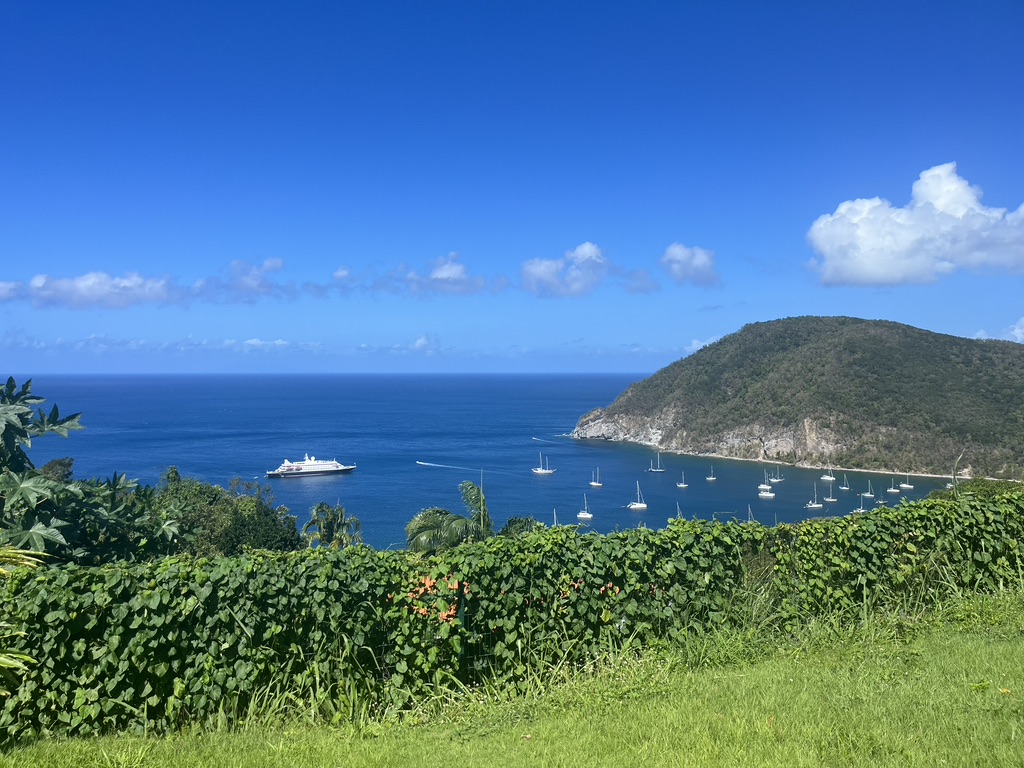
A view of the harbor in Deshaies, Guadeloupe, from the botanical gardens. Pandora is
somewhere in the mix.
Sunsets and last light are always a beautiful time of day, everywhere in the islands. Bob took all these photos because it’s his favorite time of day and A favorite pastime to record it.
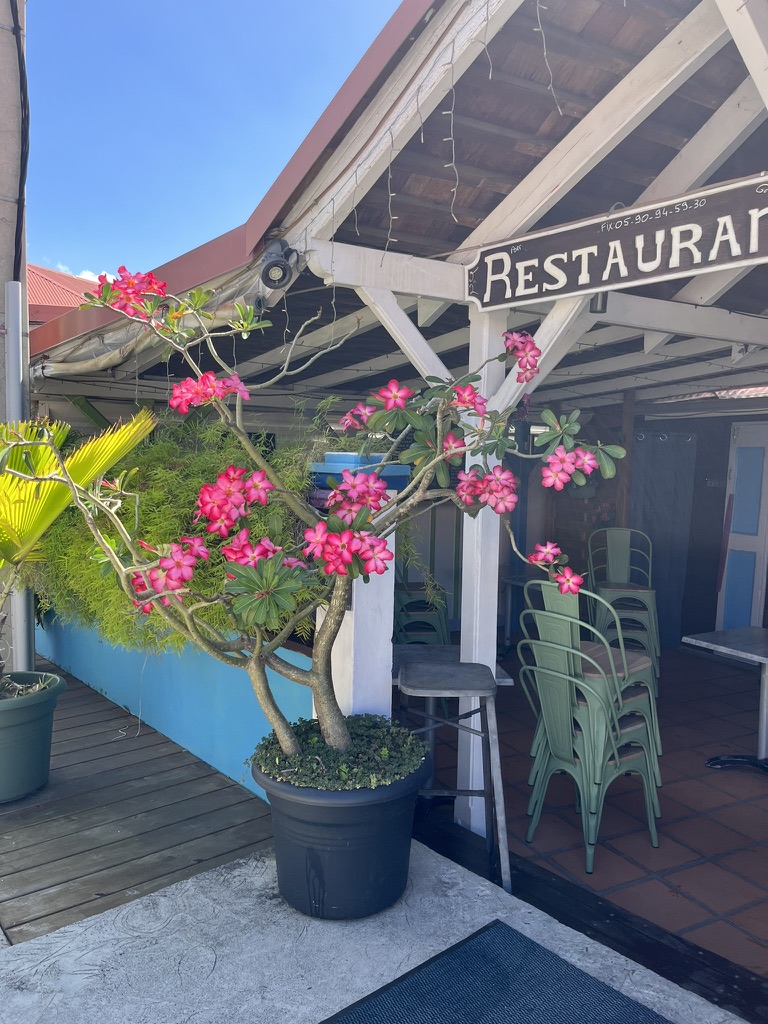
I have an endless number of photos of houses, doors and windows in beautiful Caribbean colors, but WordPress won’t let me post them. I haven’t confronted this before. I’ve spent years posting images of private houses on my blog, so I don’t know what has changed. So I’ll only post one of this beautiful flowering plant.
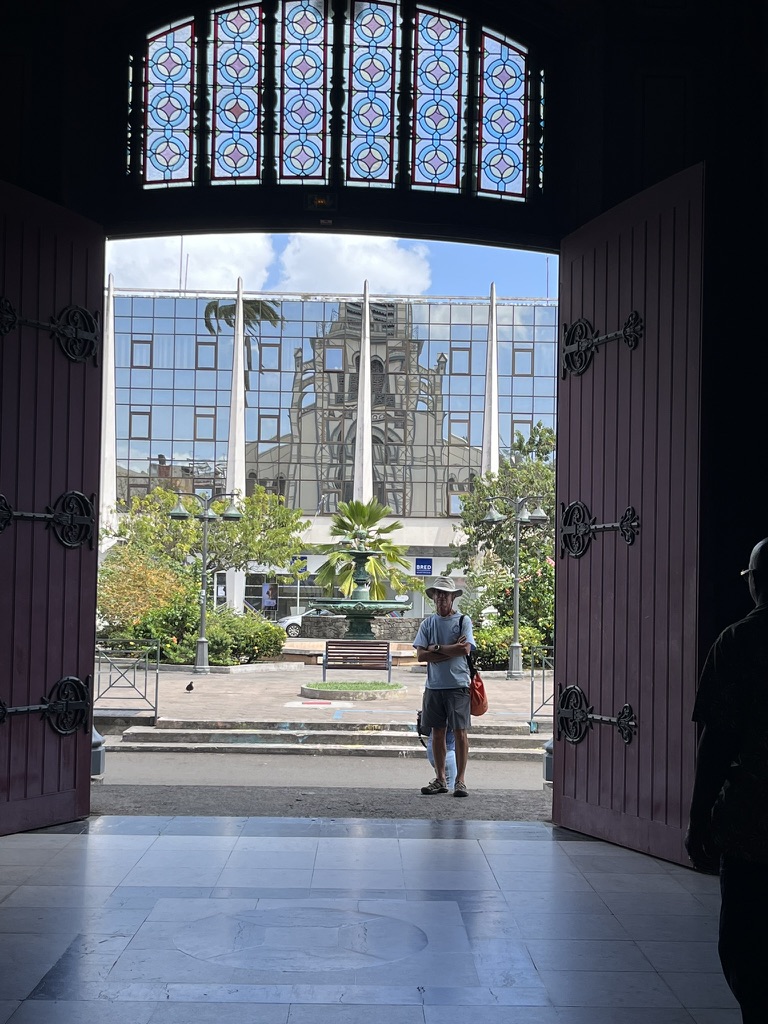
This is the church in the center of Fort de France, Martinique. It’s brilliant to me that the building across the square has mirrored glass that reflects the front of the church. Stunning! The church is one of the iconic buildings designed by Pierre-Henri Picq, a student of Gustav Eiffel.
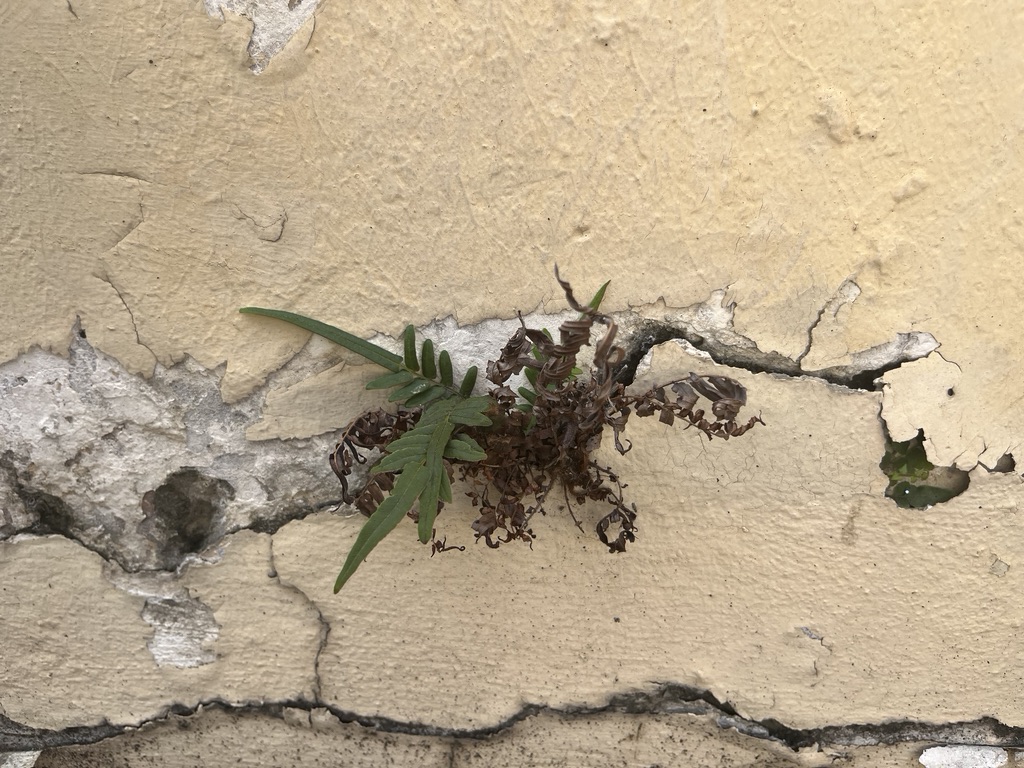
Plants grow everywhere there is bit of water and space, even a tiny space.
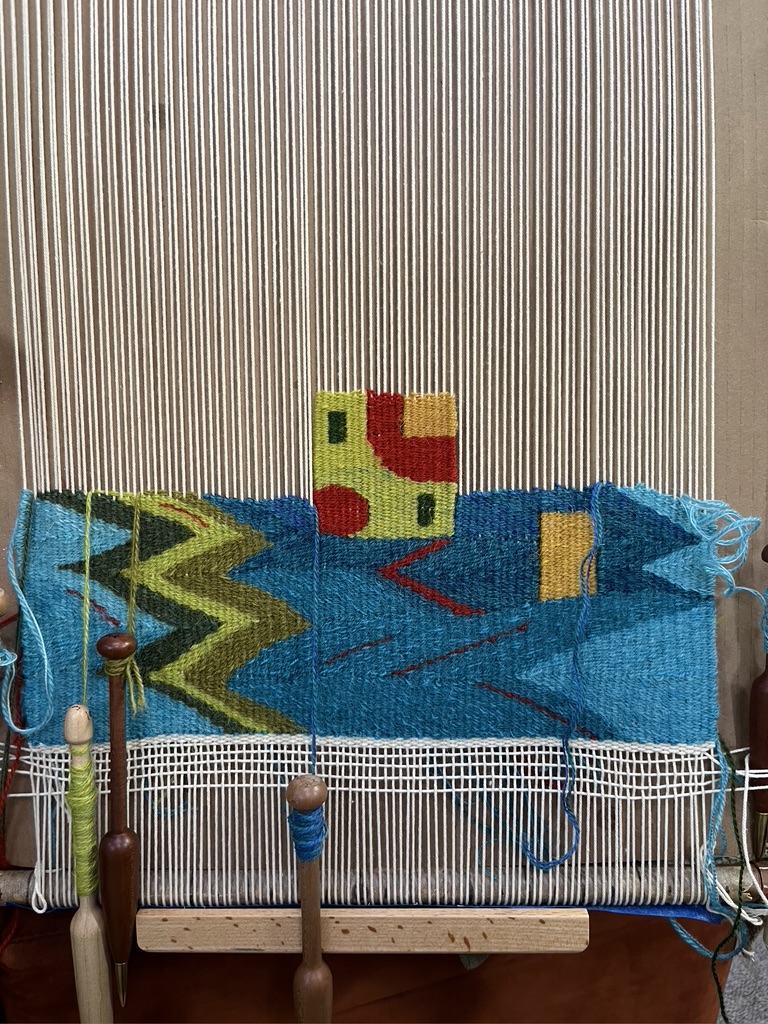
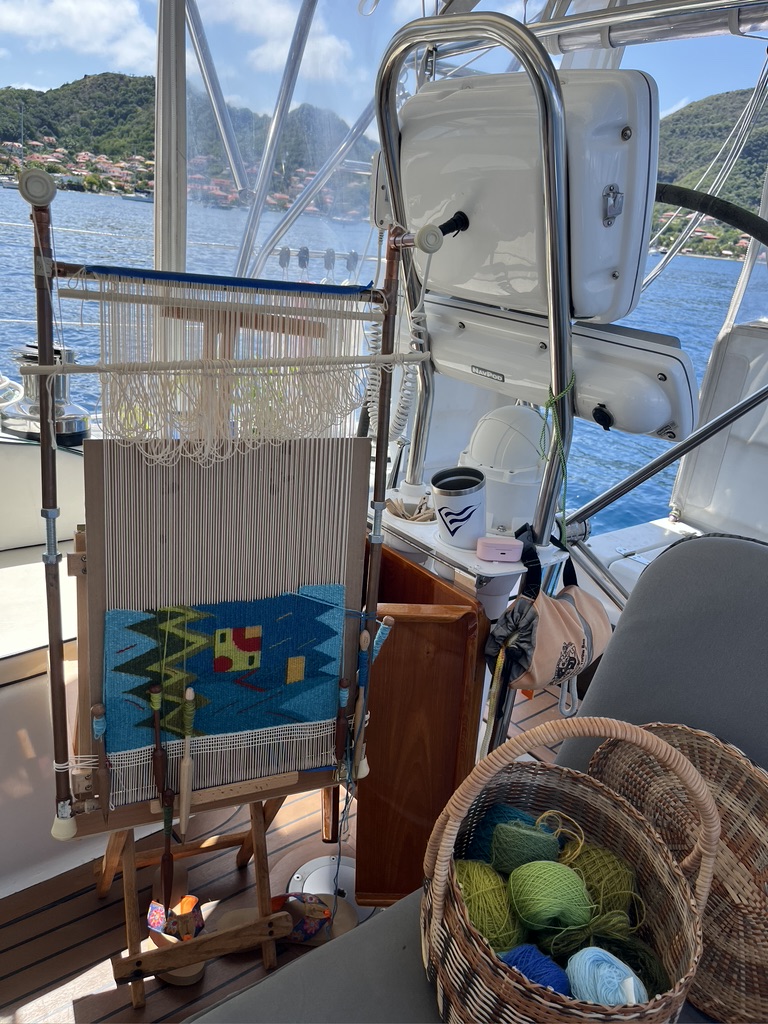
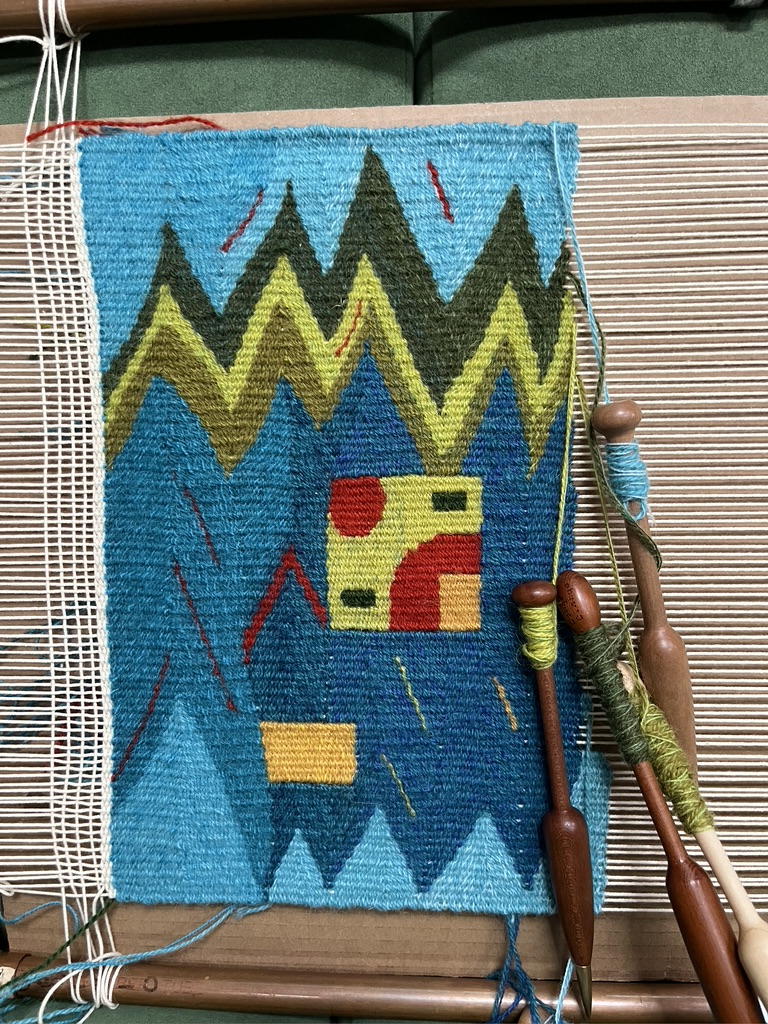
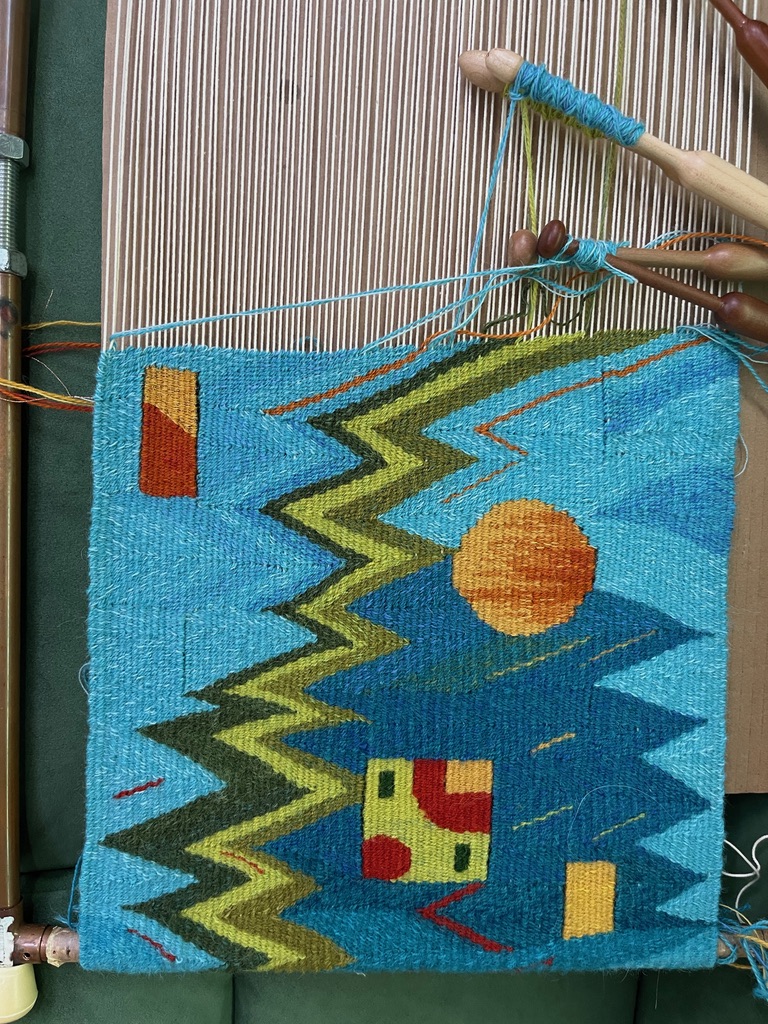
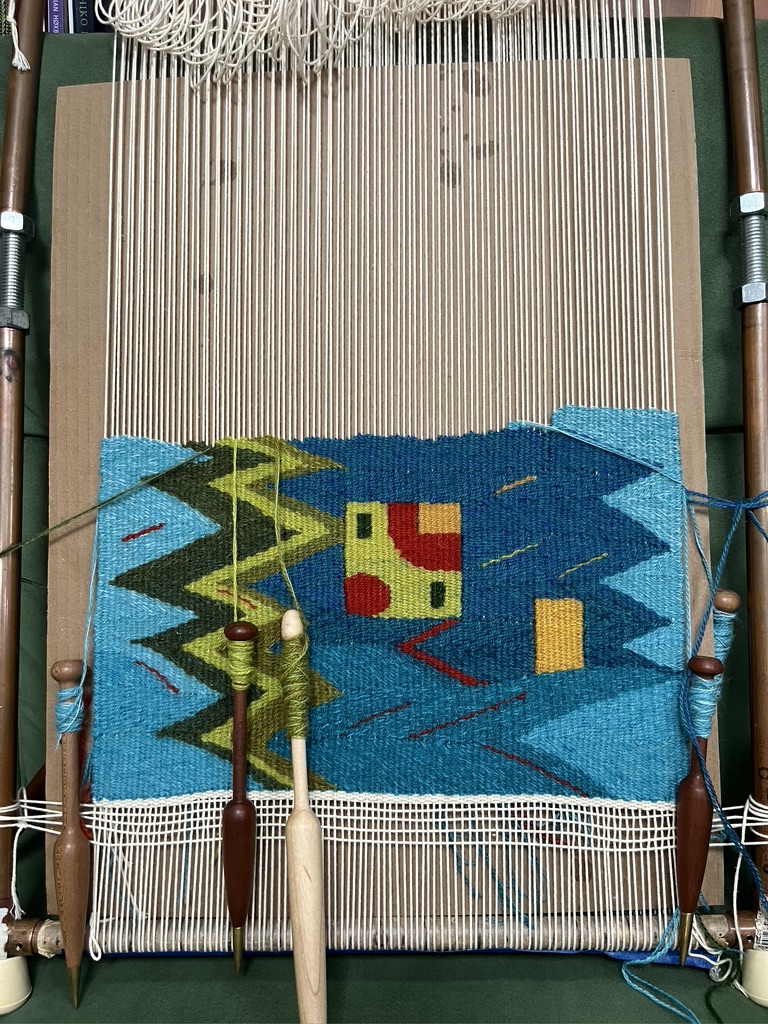
When I arrived in the Caribbean this winter one of my goals was to finish this tapestry that I started back in July, in a workshop with Connie Lippert at the regional New England Weavers’ Seminar (NEWS). I wanted to insert some areas of ‘standard’ weaving, or Gobelins style weaving, into the wedge weave background. I wove the small green square with the internal shapes while onboard.
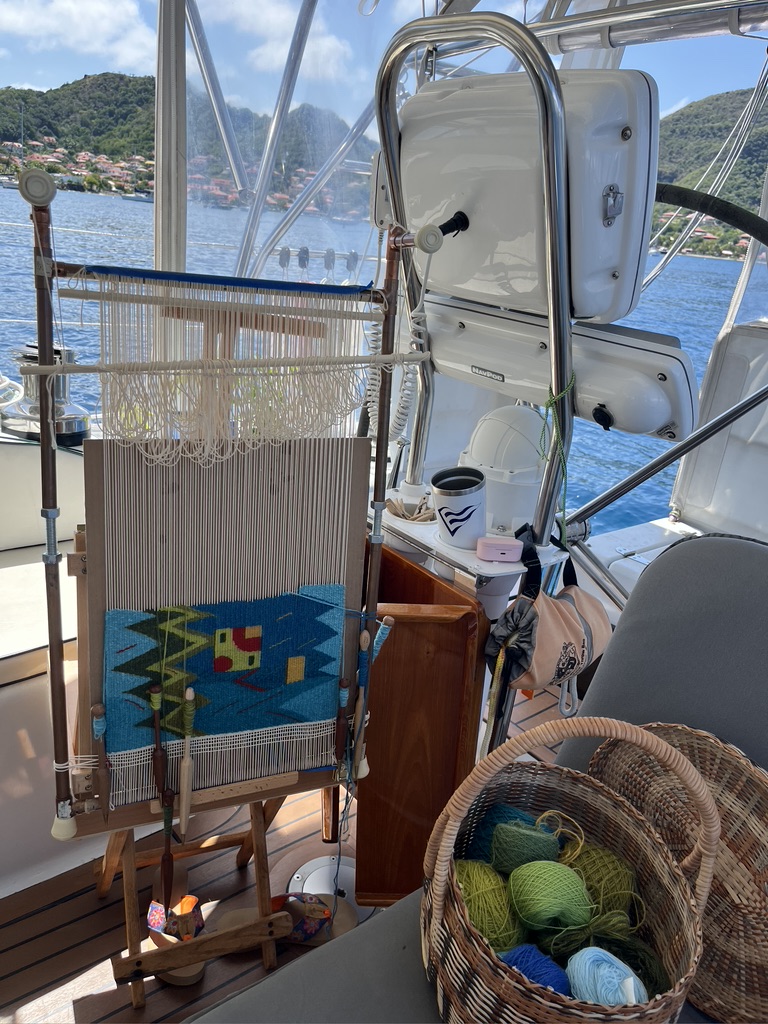
Some days I wove out in the fresh air.
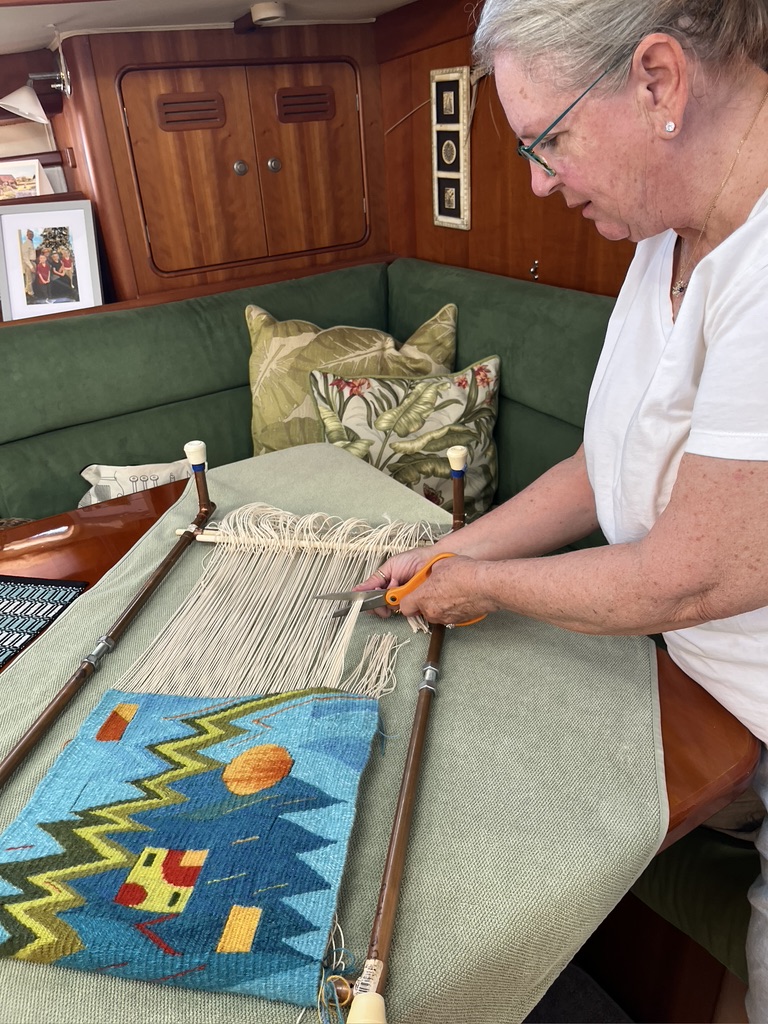
About a week ago I cut the piece from the loom.
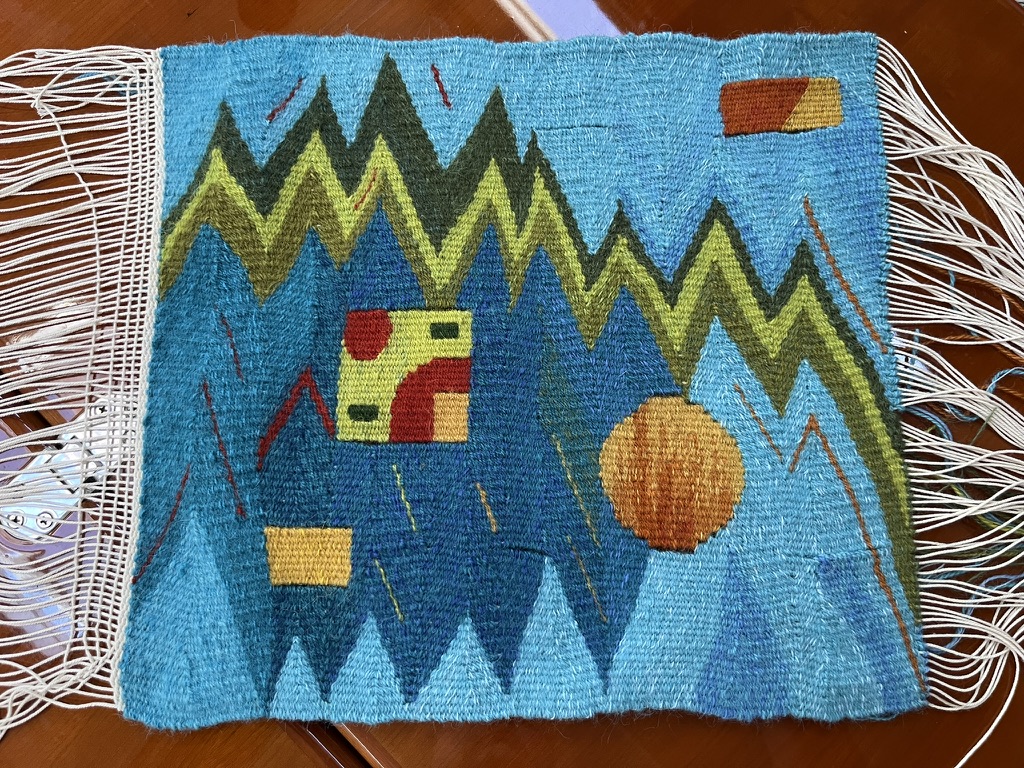
My first wedge weave experiment
I’ll do the finishing work at home. Connie recommended I place a wet cloth on top of this piece for 24 hours to bring out the wedge weave undulations. I’ll do that home next week!
A few weeks ago I had quite a bad moment of anxiety over this piece and the knitting I brought with me. I put this piece away for several days, and one day I woke up with the energy to undo some of it and try to get it finished. Maybe all I needed was a few nights’ sleep away from the daily thinking about and looking at this piece. I needed a break! But with two of the three sweaters I brought onboard, that same break only showed that they were ‘no-go.’ I managed to make peace with that and begin the process of unraveling, perhaps as a metaphor for this strange winter. I restarted the biggest of the sweater projects and am now happy to realize that I have passed the place where I began the unraveling. Now it’s forward motion toward a finished piece!
Typical of life in general, I take two steps forward and at least one step back. But there is progress in general, and a feeling of good work is the more important thing to realize. Projects onboard are either finished now or well underway. It’s time to wind down this journey and head home, where a number of new ideas are waiting for my attention, like sashiko-ori. I’m ready!
Things changed rapidly between my last post and now. This season has had some cruel surprises. I have struggled to process these, so I felt silenced, not only from writing but also from other things. Bob has done an exceptional job not only handling these situations, but also writing about them.
In my silence I have been weaving, and knitting, and even making a couple of small basket projects. It has all been somewhat disappointing and frustrating. I guess I was expecting more….and better. I’ll get to that momentarily.
Meanwhile, there are always scenes. Caribbean colors, sunrises and sunsets, moon rises and moon sets, rainbows, all daily. We’ve been lucky to spend some great time with friends who have now become old friends. The years have flown by and friendships deepen. My land friends have rallied around me with great care. I thank each of you beyond words. I don’t mean to be secretive. Bob has said it all so well there is nothing for me to add.
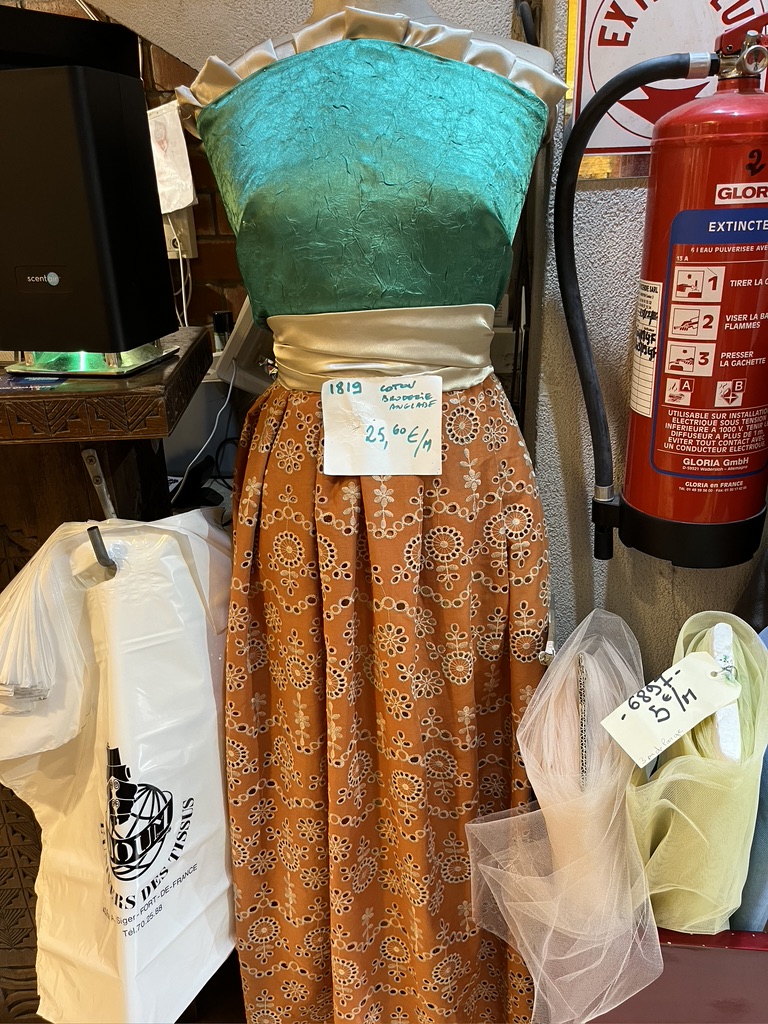
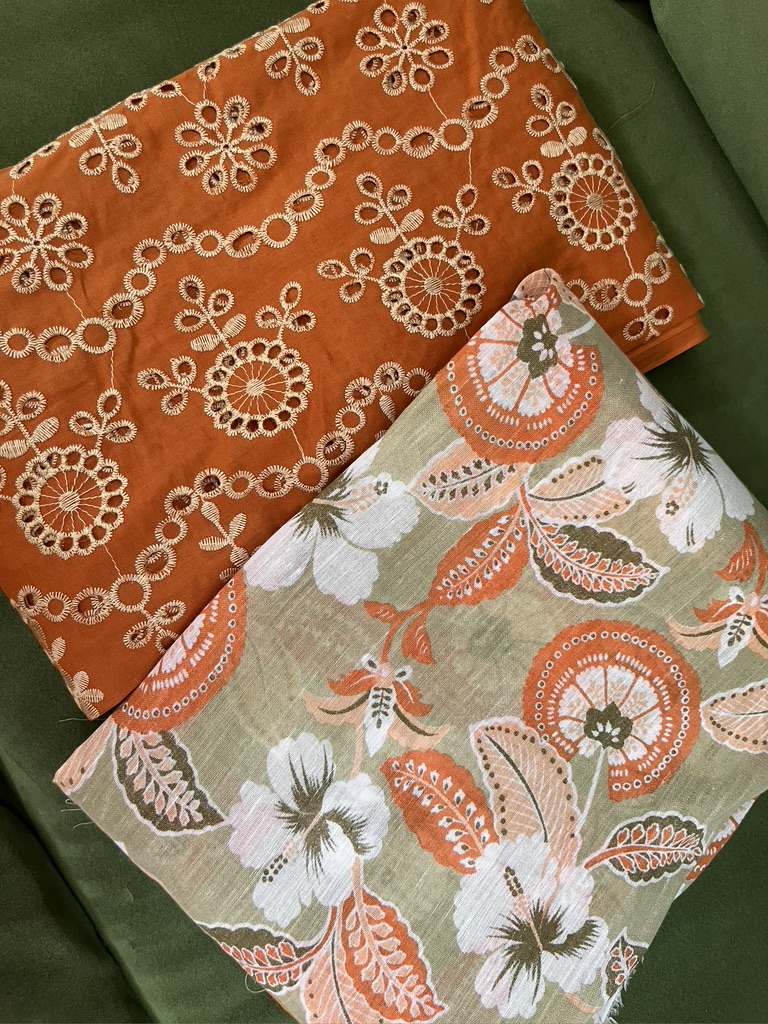
Before the couple aboard Simplicity were attacked, we were in Fort de France, where I always visit a fabric store called Doum 2000, and where I look for linen fabrics from France. This year I found this wonderful eyelet fabric (cotton) in a glorious orange. While this display shows how well it would look as a skirt, I am planning a jacket.
Doum 2000 never disappoints in tempting me with wonderful linens. I must be in an orange mood this year. The printed linen fabric is very sheer. Perhaps a floaty top of some kind?
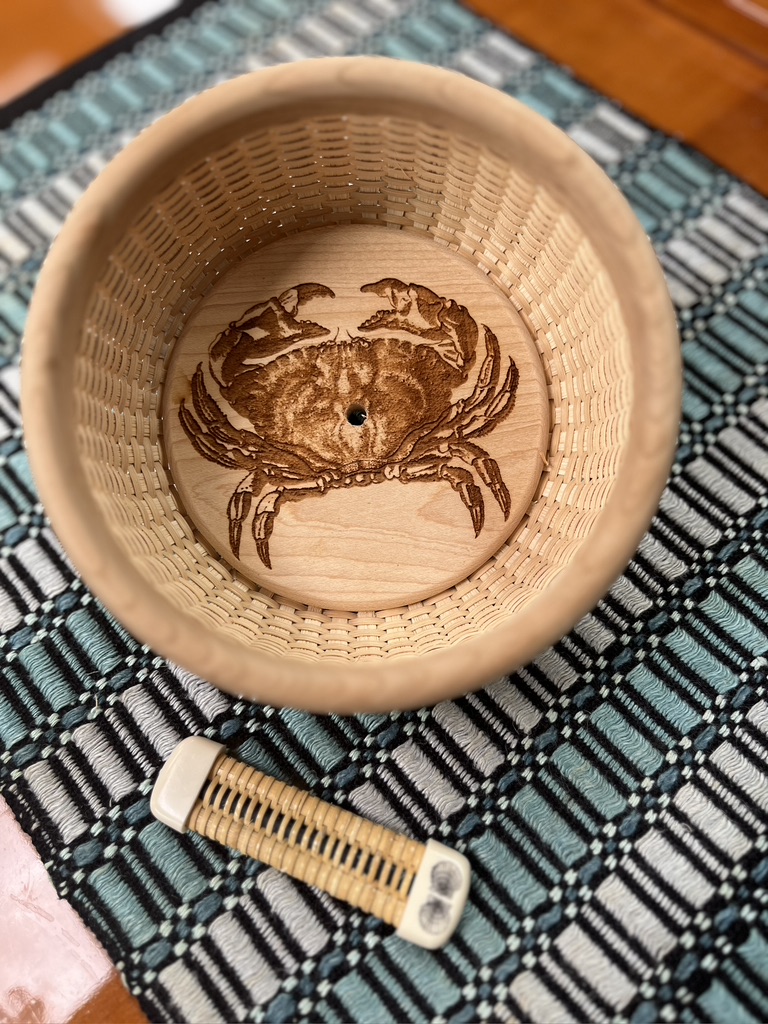
Here is the small basket. It’s going to be a birthday present for my older son, whose birthday was just over the weekend. Somehow he has now turned 40. This is supposed to be a wine bottle coaster, but it can surely be used in lots of other ways too. The maple base has a crab lasered onto the inside, and since our son lives in Maryland, it seemed the right base to choose. I will make another basket for our younger son, who also has a birthday approaching, when I get home. It has a horse shoe crab lasered design. Neither son ever looks here, so the baskets will be a surprise! This basket needs sanding and varnishing and the hole in the bottom gets a tiny corian plug instead of the traditional ivory plug. The key fob is for me!
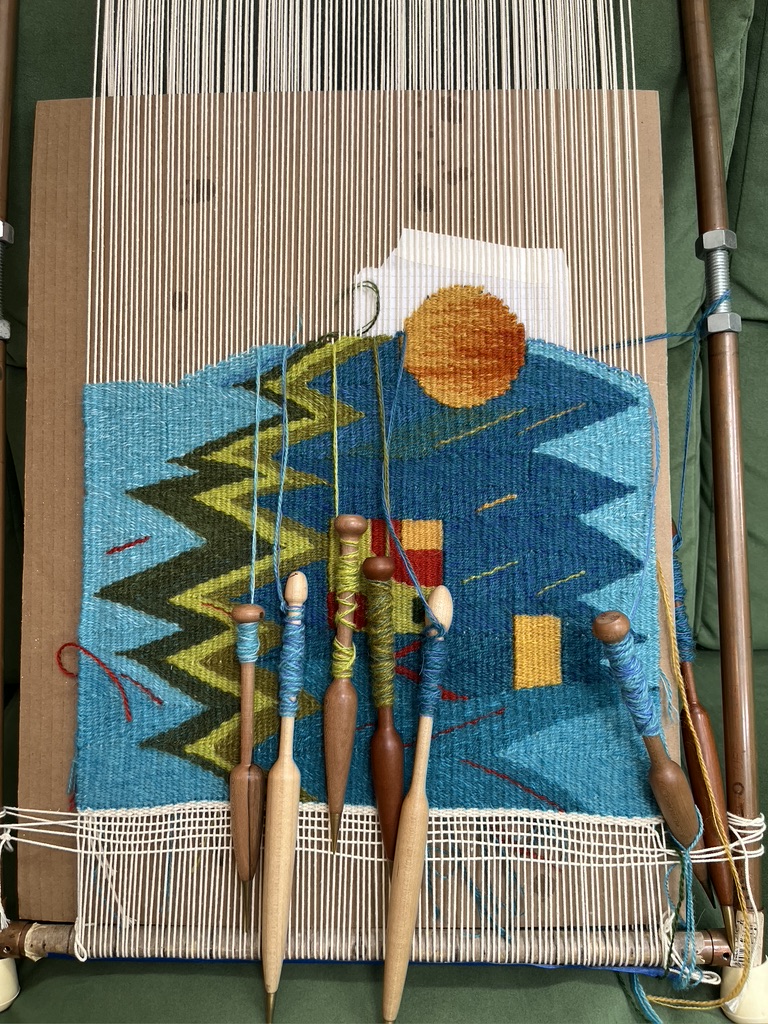
There is progress on my first wedge weave tapestry, but I am not happy with it. It seems like I’ve put a ton of time into this for no good reason. I am trying to change my attitude to one of thankfulness for the experience of learning this technique, and also managing to weave some Gobelins style figures into the wedge weave. I have learned a lot, but it’s a bitter pill to work on something and decide it’s a failure. I know I should be thinking that disappointing outcomes lead to better understanding of where I’d like to go next time I sit down to weave. But….still….this is disappointing. Here are a few images to show how this piece came to fail.
If only I’d paid more attention to how wonky my green wedges had become right here. I was just so happy with my inserted squares.
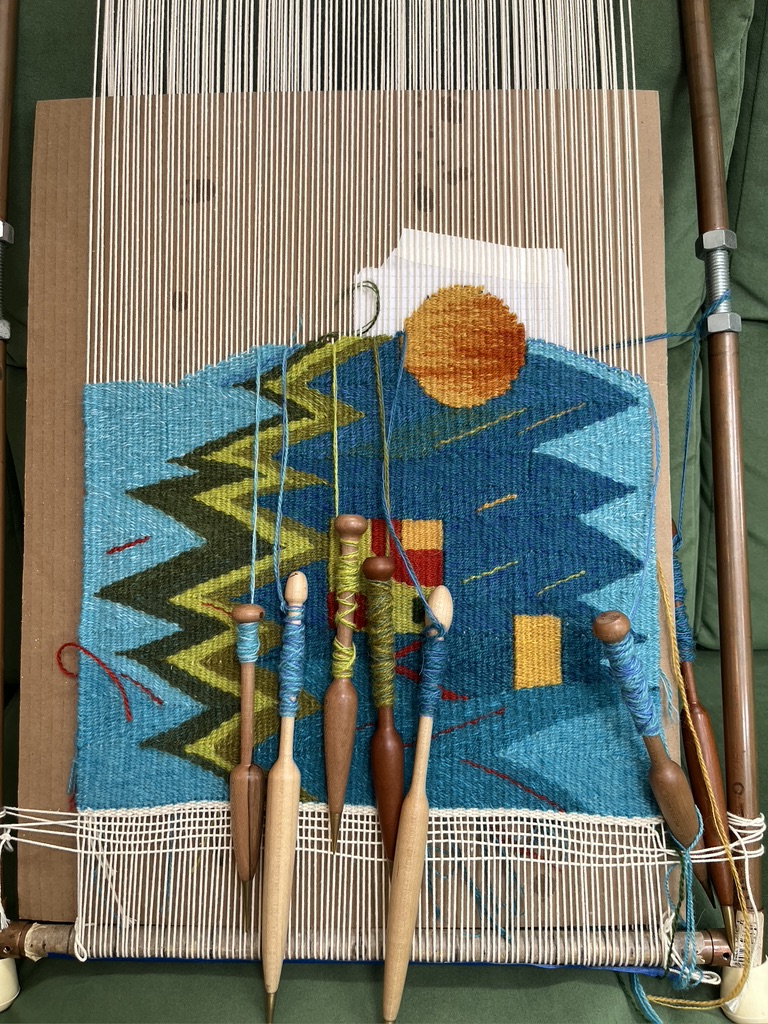
And then came the circle. I was quite happy with that. The thing is, I know how to weave shapes in standard tapestry. The point of this was to learn wedge weave.
A couple of days ago I reached the point where I could no longer weave without shifting the warp downward so I could have more weaving space. I’ve done this on Gobelins style tapestries before, but never on wedge weave. Have you done it? I feel like I lost control of the tension when I moved the warp. Another disappointment. I won’t do that again. Bigger piece, bigger loom, next time. And when you cannot see the whole piece it’s hard to decide if it’s done. Since I’m rather disappointed with this piece, I’m going to level it off and call it done even if I can’t see the whole thing to make a decision. When the fell is level I will do a row of knotted soumak and cut it off. Then I can transport it home without the loom. One good thing.
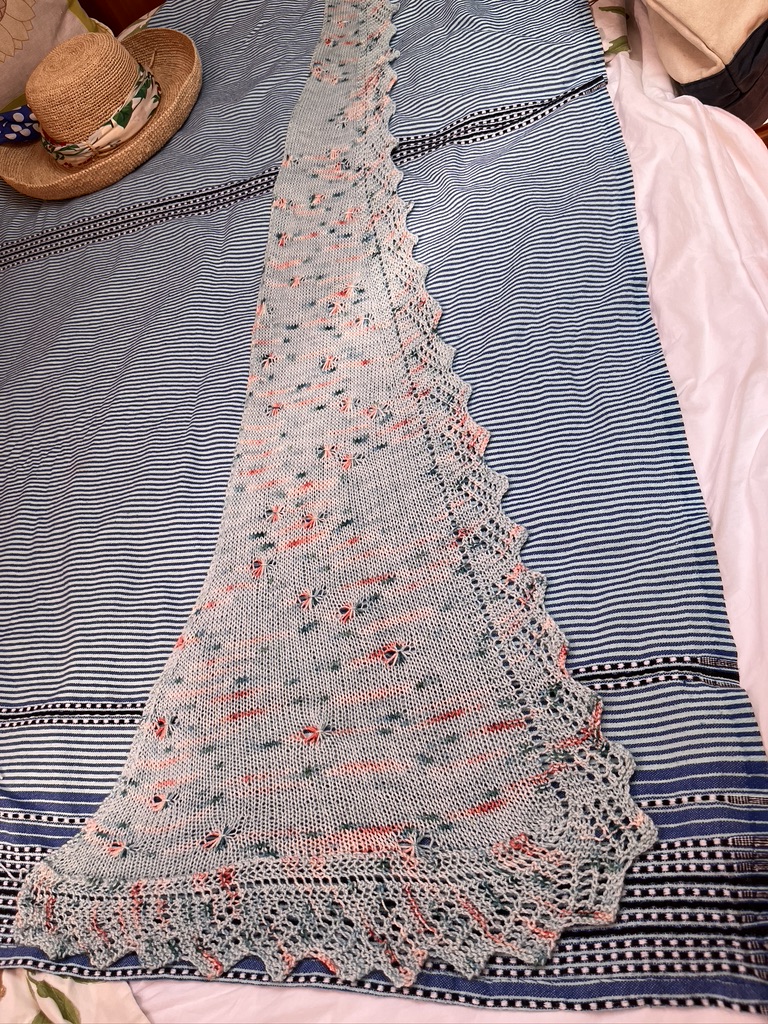
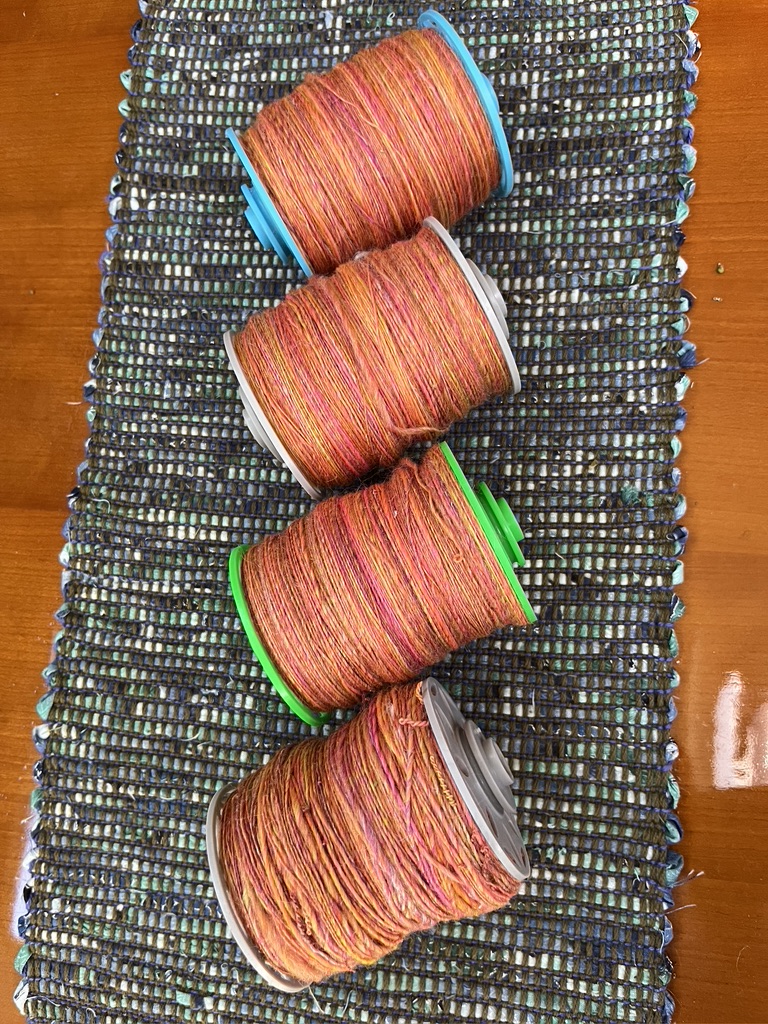
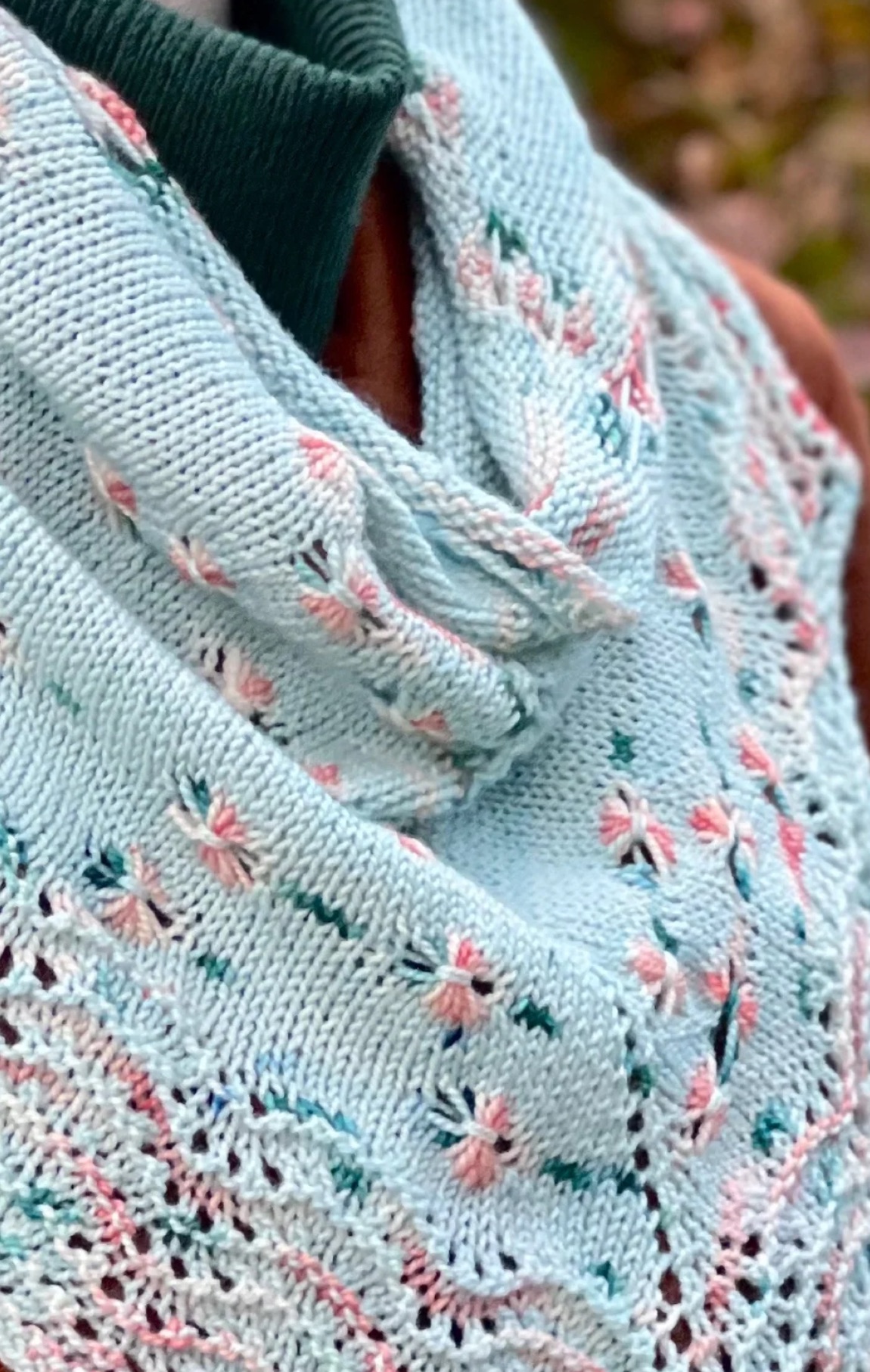
I have three unfinished sweaters onboard. I cannot even bring myself to describe them, and my waste of time in not knuckling down on the right one to finish. Boy, I have wasted time on these sweaters! But I did finish spinning some lovely merino/silk and now have five full bobbins to ply at home. And I made a small shawl with an intriguing stitch design that looks a bit like butterflies. I will soon get some wear out of this on cool April days in New England. It needs better blocking when I get home. I did not have nearly enough pins to block the lace points.
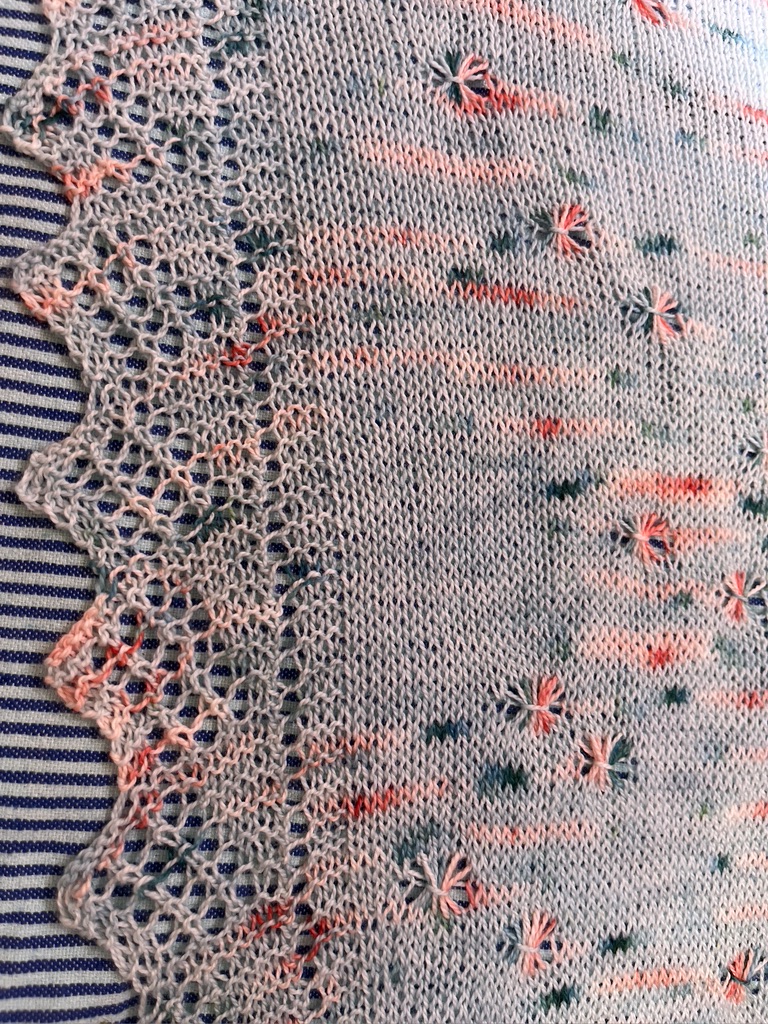
Here is detail of the little butterflies (sideways).
And speaking of April, we have made our flight reservations home for April 1st–from Antigua. We are at the southern end of Martinique right now, in a village called Ste. Anne. It’s now time to start retracing our steps north to make that flight. I feel like I need a week to corral all my supplies into vacuum bags to shoe-horn them into our not-very-big duffle bags. We may need to find a giant box, or rent a car to drive to St. John to buy a big suitcase. Considering how disappointed I am with most of my work at this point, I sure wish I hadn’t brought all this stuff onboard.
I’ve put off writing for at least a couple of weeks due to my dark mood. I probably should have waited longer. I always think silence is best when I can’t be enthusiastic or positive. I am counting on a change of scenery–to New England spring!–to help my outlook. There should be daffodils by then. Fingers crossed.
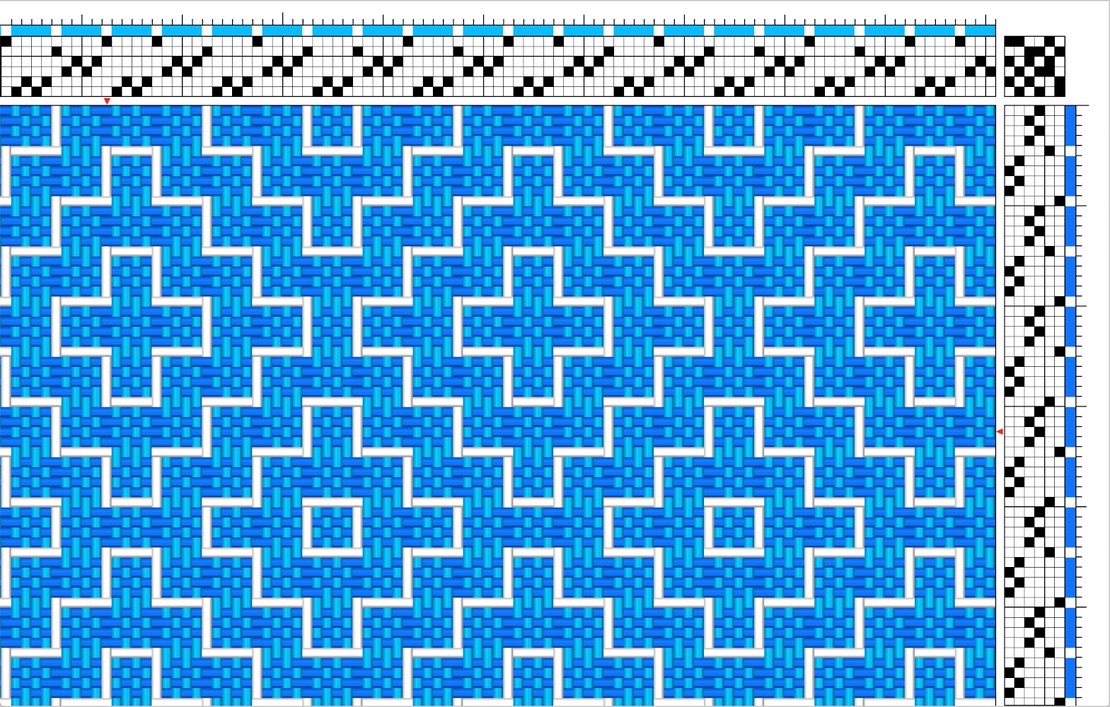
And just to prove I am not completely in a funk, I will show you the rabbit hole that has drawn me in this week. I’ve just learned that there is such a thing as sashiko-ori. Woven sashiko. How about that? I’ve seen some lovely examples, and I even learned that someone in my guild is currently weaving this technique. I got in touch with her, and she has offered to get together and show me how to design in this technique. It’s basically supplemental warp and weft, and I’ve done a lot of supplemental warp scarves in the decades when I sold my weaving. Here is my current drawdown of an idea. It’s not quite what I want but I’m sure my friend Julia will set me straight when we meet.
I’d like to use my hand-dyed indigo linen yarn that is fairly fine, and the supplemental warp and weft will be natural sashiko embroidery thread. I can’t say more because some people might look at this post and then their future gifts won’t be a surprise! Mums the word.
I look to the work I do with my hands to keep me in balance, to get me through good times and bad. When multiple things go wrong just when I need a break from other things, it’s difficult. But that’s how it goes, doesn’t it? Ups and downs. The sons of the couple who died last month wrote a beautiful tribute to their parents, and this quote comes back to me every day over the past month:
We live in a world that at times can be cruel, but it is also a world of profound beauty, wonder, adventure, love, compassion, caring, and faith...
We are having a rip-snorting winter season in the Caribbean. I would prefer a gentle season, but there is no bargaining with Mother Nature. Actually, I know this weather is not her fault. It’s humanity’s fault, so I am partly to blame. I won’t go into the weather here, but you can see some pretty frightening images and videos on my husband’s recent post on SailPandora. We moved to the mooring field in Les Saintes one day before this storm hit, and it was a good choice for staying safe.
Not many days have been calm enough for weaving onboard, but I am trying. I brought so many projects onboard, and I feel compelled to make progress and even finish a few of them. If I finish two tapestries I won’t have to cart the looms home with me when I fly home in April. That’s a pretty strong reason to get them done!
I am trying my hand at wedge weave, and I started this project back in July under the tutelage of Connie Lippert at the NEWS conference in Worcester, Massachusetts. For some reason my brain gets confused on which direction the wedges travel and when to continue on the diagonal or move across the warp to create a horizontal section. I may have unwoven almost as much as I’ve woven, and I don’t seem any closer to making sense of the angles. Old age? I hope not!
During the July class I added the little gold rectangle woven in Gobelins style. While onboard I wanted to add a more complex bit of Gobelins style, so I wove the square that has a couple of shapes inside it.
Here is the one glorious day when I was able to weave in the fresh air in Pandora’s cockpit.
I have consulted Connie a couple of times along the way recently. Being outside the US makes me feel a bit disconnected which can also make me wonder if I’ve taken a detour away from where I need to go to acquire some skills at wedge weave. I’ve had an impulse to add a circle to the wedge weave. I pondered this, wondering if I’d have to weave an easier shape, like a square, in order to put the circle inside it. But that is not what I envisioned. I wanted a circle with the wedges abutting the edges of the circle. Connie thought I should give it a try.
I now have my circle!…but, my wedges are going in opposite directions. I’m not sure what will happen when the wedges meet above the circle. These wedges are confusing me!
In other news I’ve made some wonderful textile purchases. Bob and I took a day trip with friends while in Dominica, to visit the private lands owned by the Kalinago nation. They are not the original inhabitants of Dominica, but they certainly predate the European settlers. The European explorers named these people the Caribe. Naturally, they prefer the name they call themselves, Kalinago. Bob and I have visited here in past years. I’m intrigued by their lifestyle which makes such good use of plant life for food, remedies, and building materials. They are well known for their baskets, and this is my third time to collect more of their beautiful baskets, which are made from a reed like plant. They condition the reeds in different ways to give color the material. To make black they bury the reeds in a pit where the minerals in the soil darkens the reed. Our friend Bill got this photo of Bob and me trying to decide what to take with us.
Here we are sitting in the shade of the beautiful community where the Kalinago live. Oops! Actually, this is another day we spent together in Deshaies, Guadeloupe! We are with Bill and Maureen from Kalunamoo.
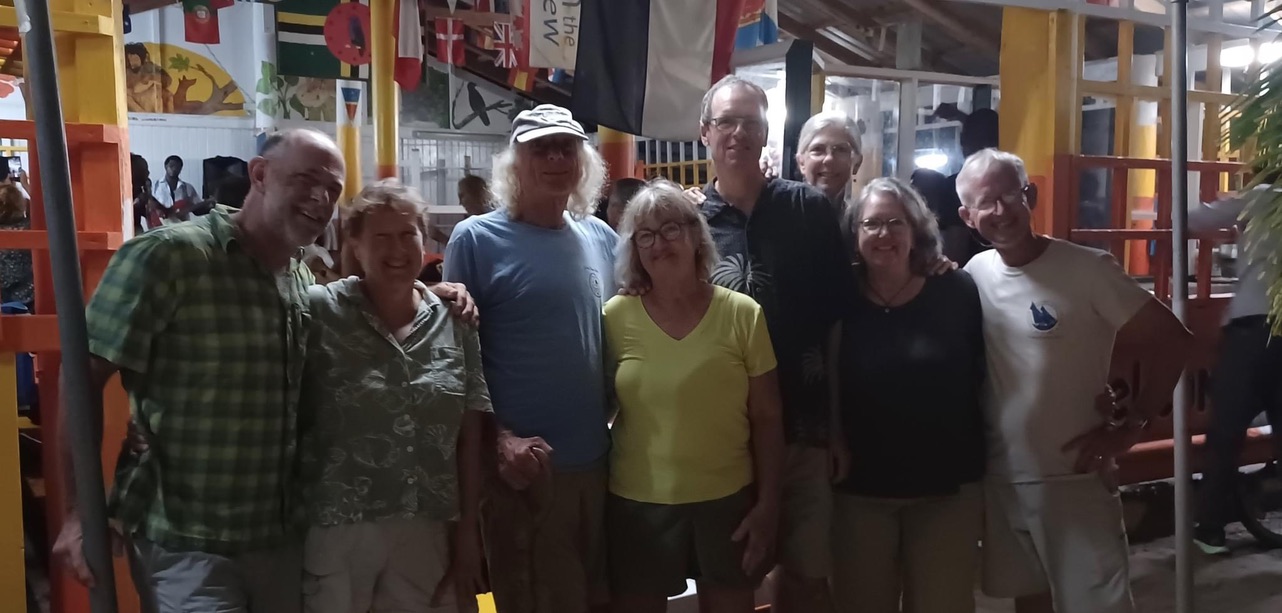
And since I’m adding photos from other days, here is one of my favorites with a number of our sailing friends who gathered for dinner that night.
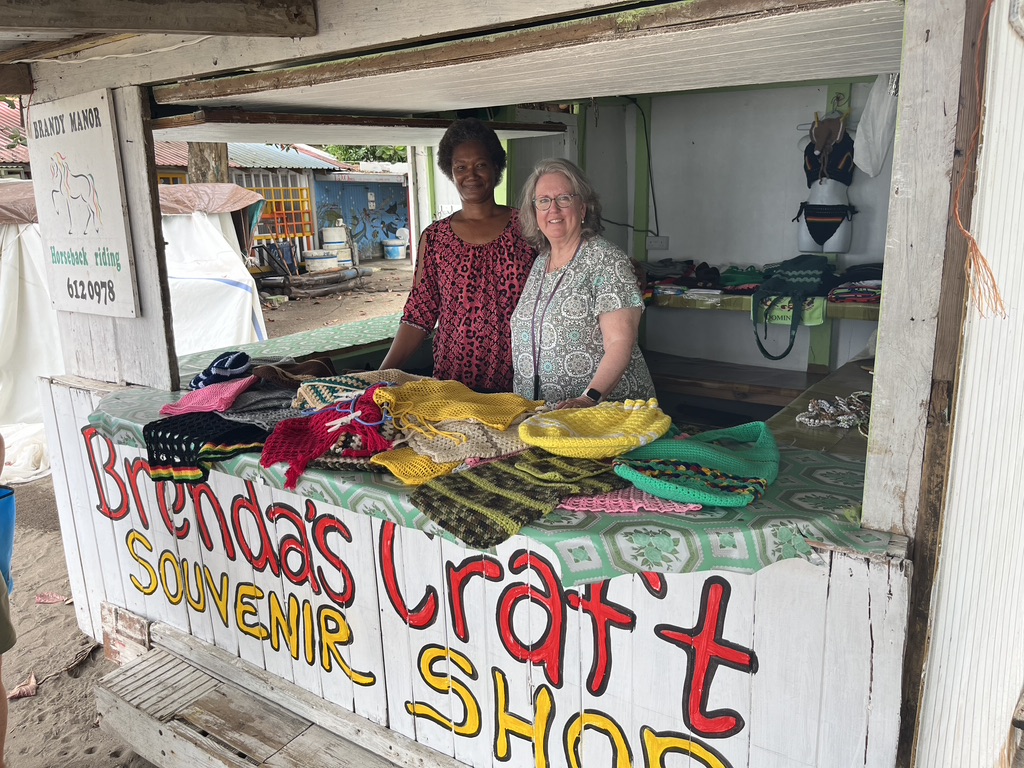
On several visits to Dominica I’ve had my photo taken in front of a vendor’s stall called “Brenda’s Craft Shop.” This year I got meet Brenda! I bought a finely crocheted wrap skirt to give as a present. I can’t show you because it’s to be a surprise for a dear friend.
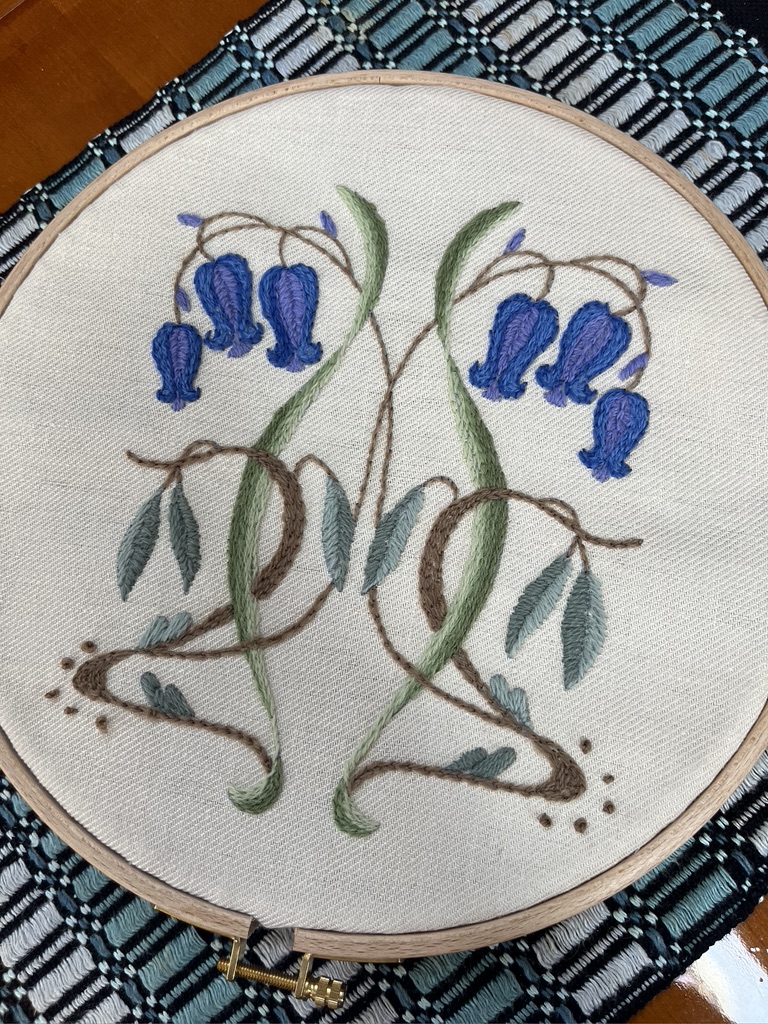
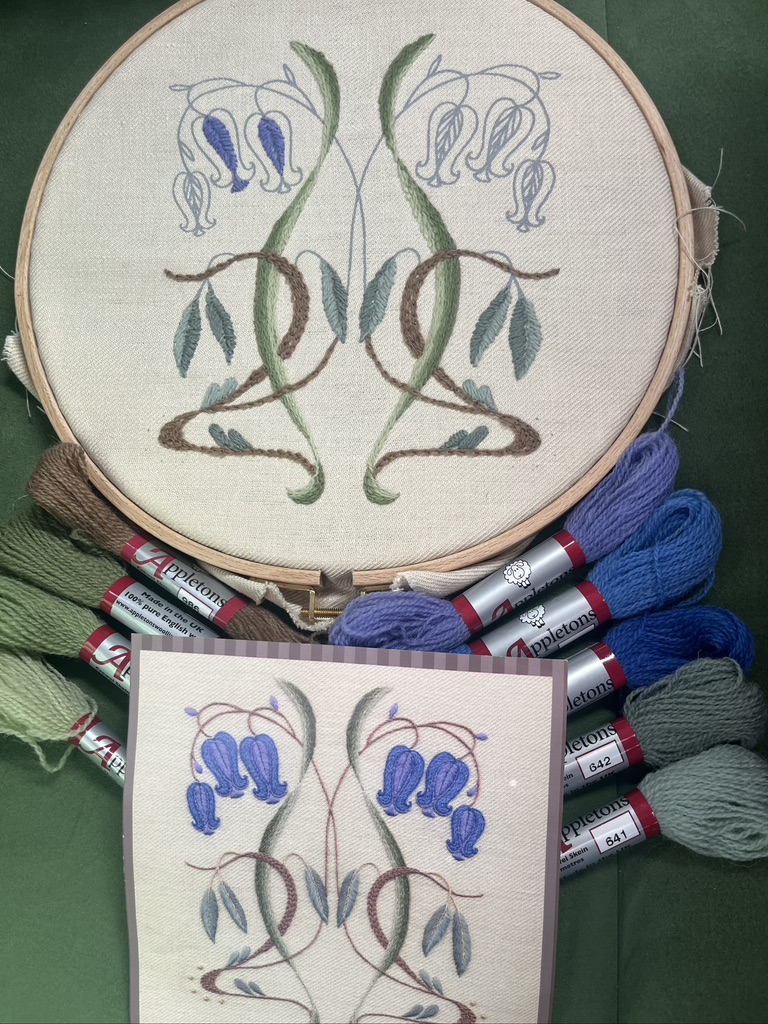
I tried my hand at an unfinished embroidery project I brought with me this year. On some days I simply could not line up the needle with the place I needed to insert it because of the rolling waves coming into our anchorage. It was daunting, and I often felt I might become crosss-eyed, but now I am happy to report that this project is finished! At home I hope to try my hand at framing an embroidery myself. This embroidery design is from an English company called Melbury Hill. They have some coordinating designs that go with these bluebells, but for now I need to stick to weaving those two tapestries.
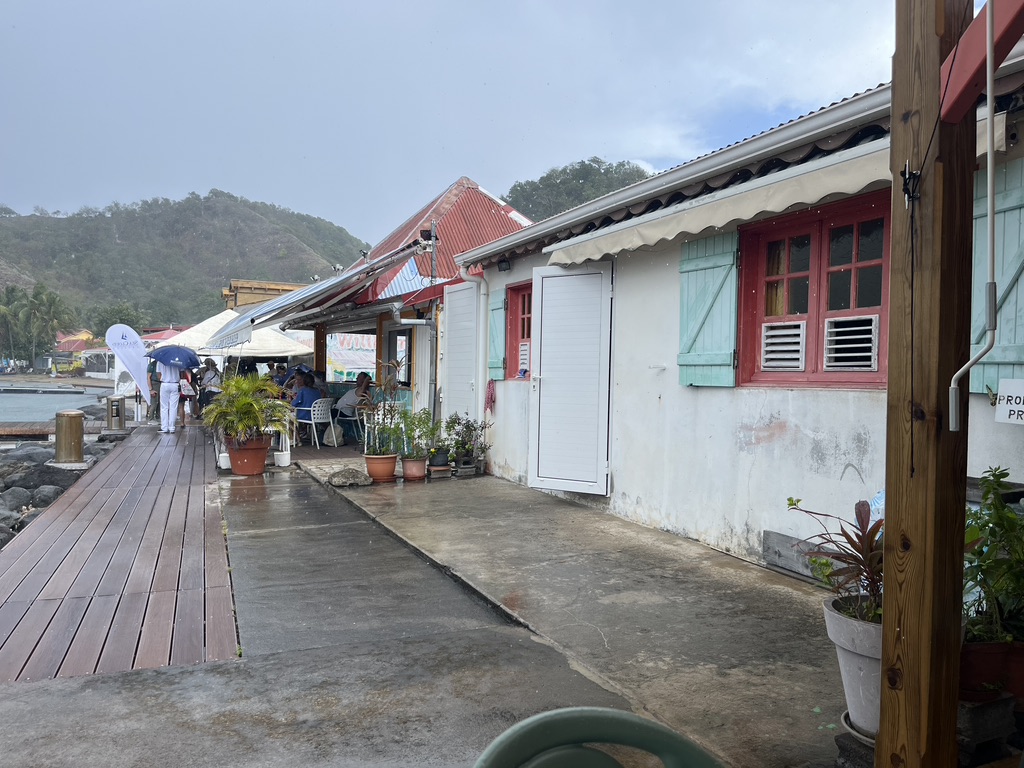
As I write this we are on a mooring in the small archipelago of islands at the bottom of Guadeloupe. The main island is called Terre de Haute, and it has a charming village that entices many French visitors who arrive multiple times a day by ferry from Guadeloupe. There are some wonderful shops and many restaurants.
I must be getting tougher, or perhaps just more determined (desperate?) as I age. I am working on days I could never have worked in previous years. It’s good, and bad, in equal measures. I hope I will be taking a home a number of finished items in April.
Recently one of my oldest friends starting seeing a life coach. In one of the sessions the coach asked if she’d rather work or go on vacation. My friend answered that she’d rather work! She is a sculptor and painter. When I gave this a mere moment of thought, I realized I would answer the same. So, here I am in the depths of winter, living on a boat while visiting numerous Caribbean islands, and what I want to do everyday is work!
I have more projects onboard than I can possibly finish in the 3+ months I’ll be down here, but each year when I promise myself I’ll only bring what I can actually accomplish, I break that promise. This year is no exception. Somehow I want to finish one tapestry and start and finish a second one, quite small, but still. I brought 8 oz of merino/silk to spin (so far the only finished project!); three sweaters, two to continue and one to make from start to finish (half done with that one); two embroideries, and a basket to start (and finish, of course). I couldn’t complete these projects at home in three months, even if I worked 12 hours a day! But it’s hard to choose what to bring. And don’t you know, even with all I brought, I pine for the things I didn’t bring!
One day recently, when I was recuperating from the seasick meds I take, I lay on one of our settees watching a couple of hours of youtube videos on various techniques in bobbin lace. I know I cannot do bobbin lace on this boat–but that doesn’t mean I can’t wish I had a pillow here to try.
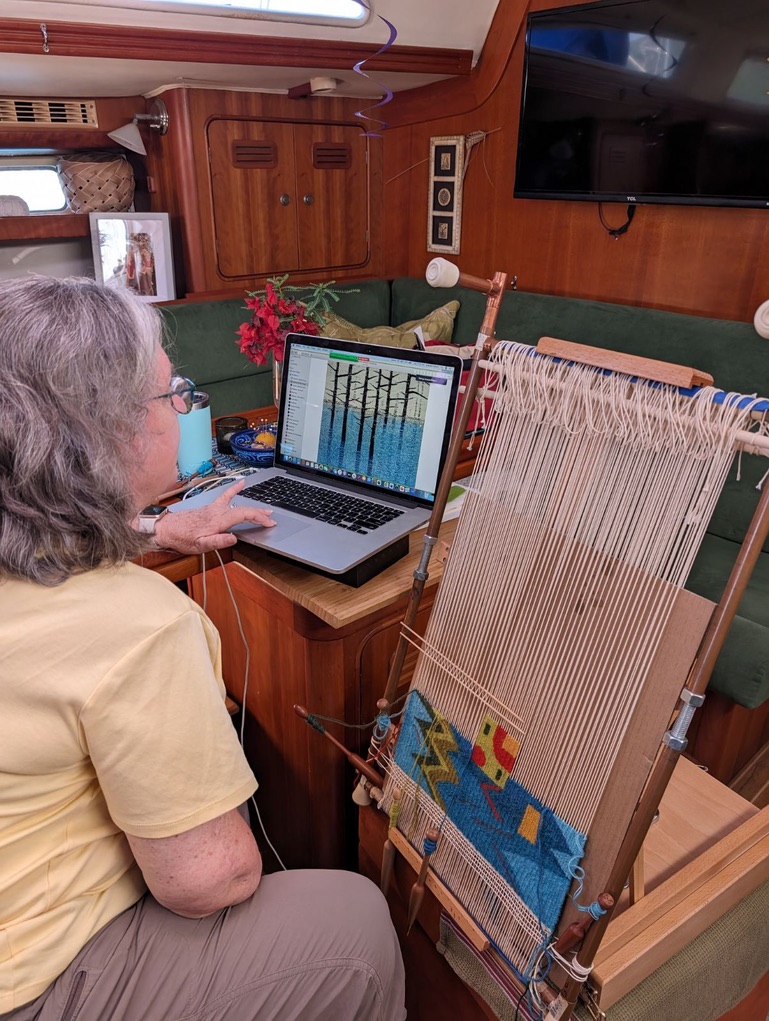
This year, since we have starlink to stay in contact, I have also started a tapestry study group with six of my students from previous live classes. Setting up the scene for doing these zoom meetings is a little more challenging on a boat than at it is at home.
It’s a feat of Rube Goldberg-ness. I have my computer on our dining table, sitting on both a cutting board and a box in order to get it at the right height to see more than the top of my head. My tapestry in progress, which has some bamboo skewers inserted in an empty space in order do demonstrations of techniques, if needed, is sitting on a table top easel on top of an ottoman. In this photo I haven’t yet set up the cable to my mobile phone on a reticulating arm that faces the tapestry as a 2nd camera for when I might need to do demos. Bob had a big hand in gathering all these random props to get things just the way I needed.
Tomorrow is our second session. I am now in a less protected anchorage, and we are rolling sideways quite dramatically. I will try to set up in the cockpit so I don’t get seasick down below. Meanwhile I am a little worried that the students may not feel good themselves watching the horizon roll side to side behind me. Fingers crossed….
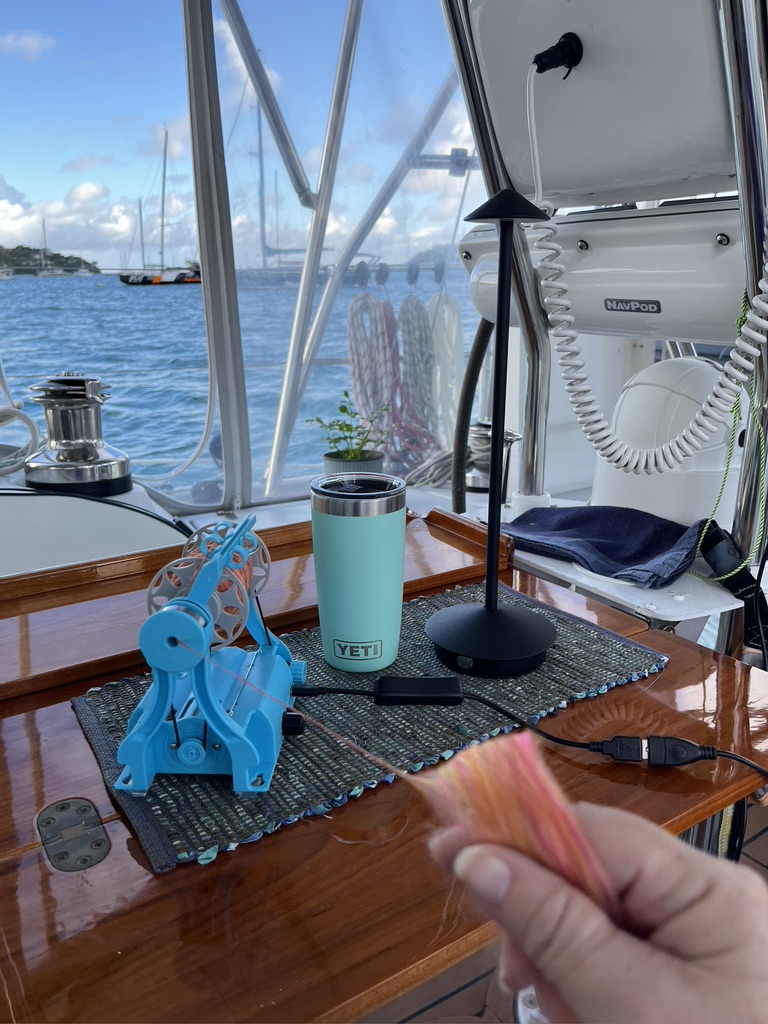
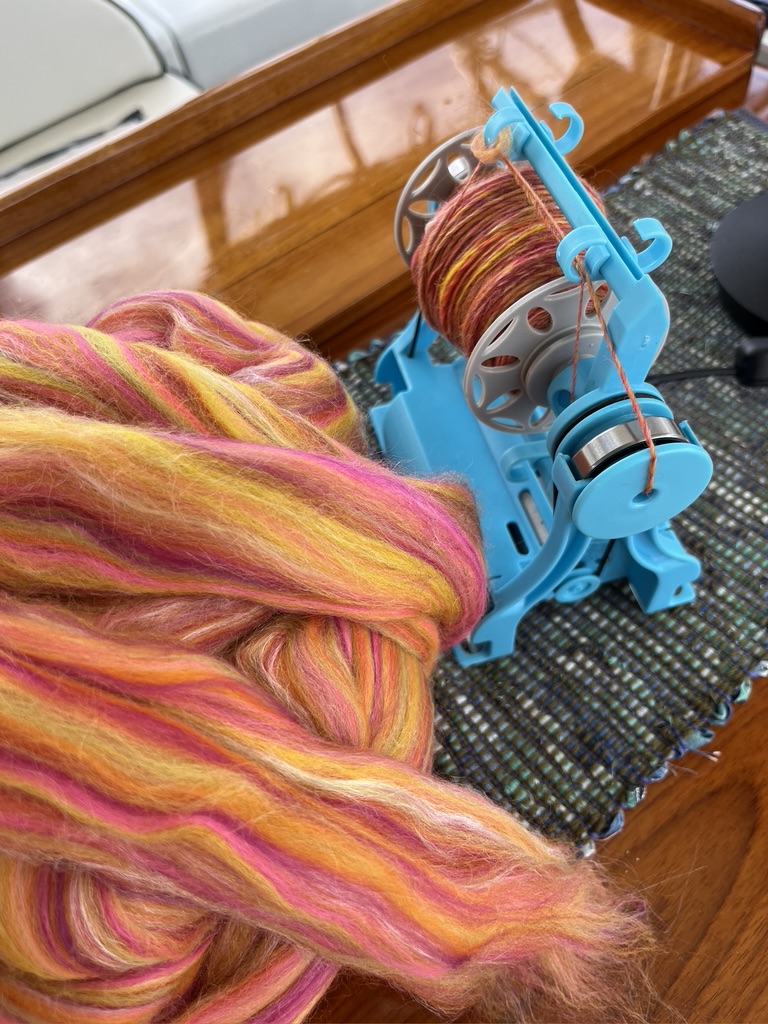
Spinning onboard is the easiest activity. I can look out at the horizon and keep myself oriented. I’m using an EEW Nano 2 from Dreaming Robots. It’s hard to believe that something so tiny and lightweight could work so well, and it doesn’t slide around as I draft out the fibers.
I did a poor job winding on my first bobbin. I forgot that I need move the hooks often when I’m spinning without a Woolee Winder which does the winding automatically. My next three bobbins got a lot better!
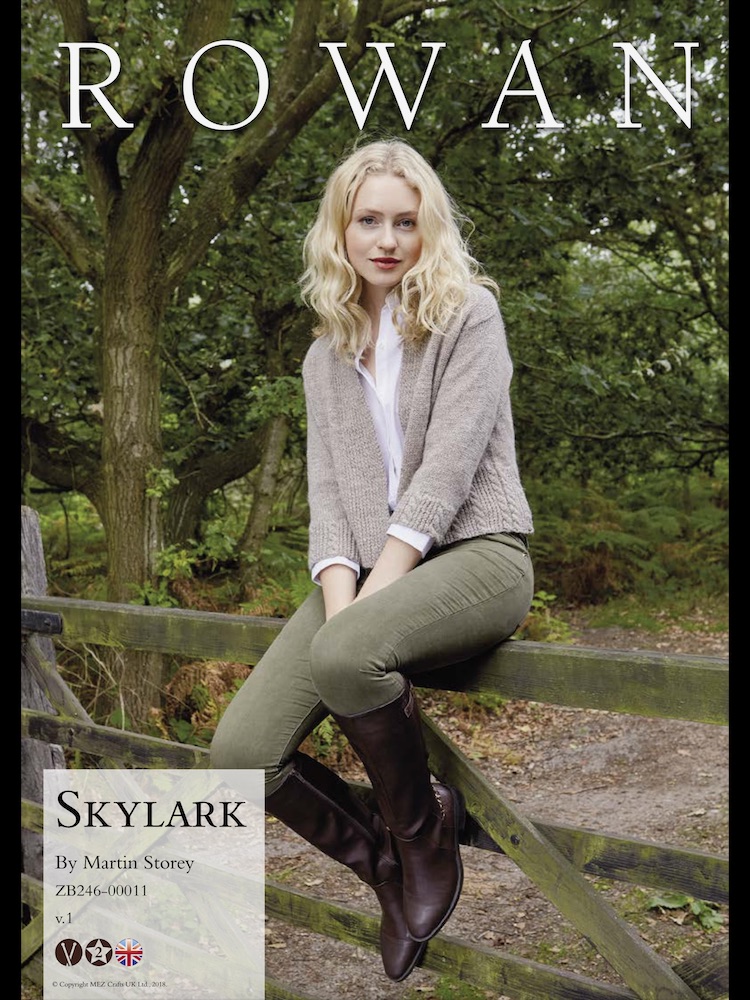
And those three sweaters onboard… I’d like to finish one of them! The two that were in progress when I put the materials onboard are a design by Martin Storey, which is a summer loose wrap type sweater made with two yarns held together–one linen and one cotton–called “Skylark.”
The other is a Kate Davies design called “Auchnaha,” also a loose wrap type sweater.
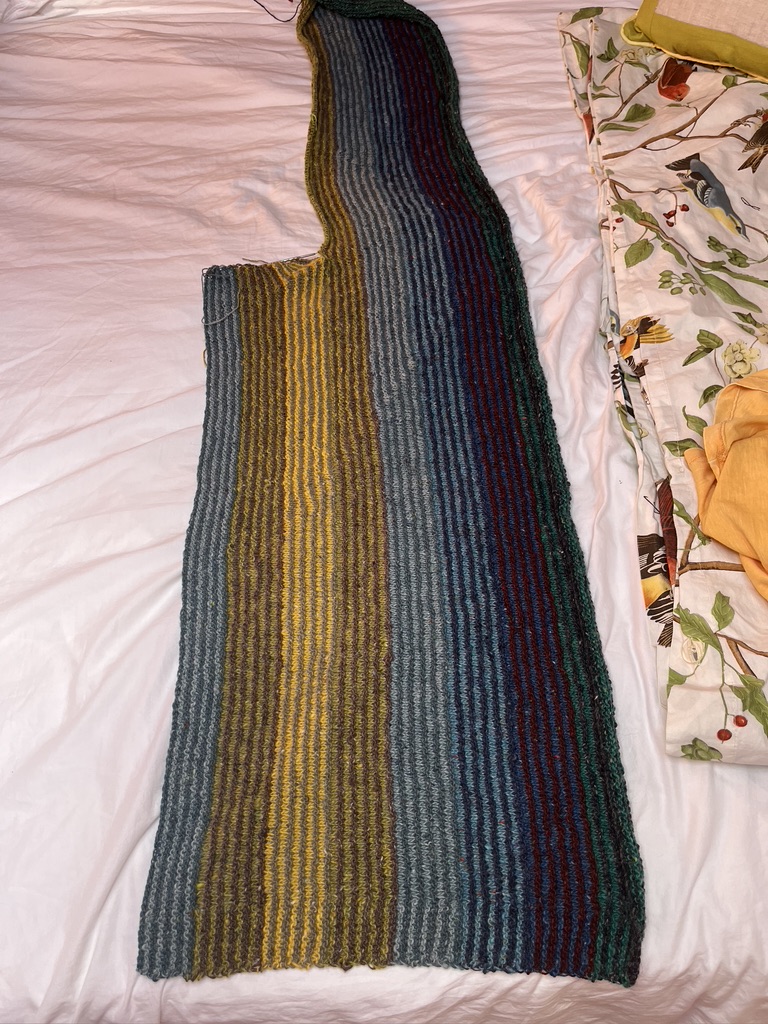
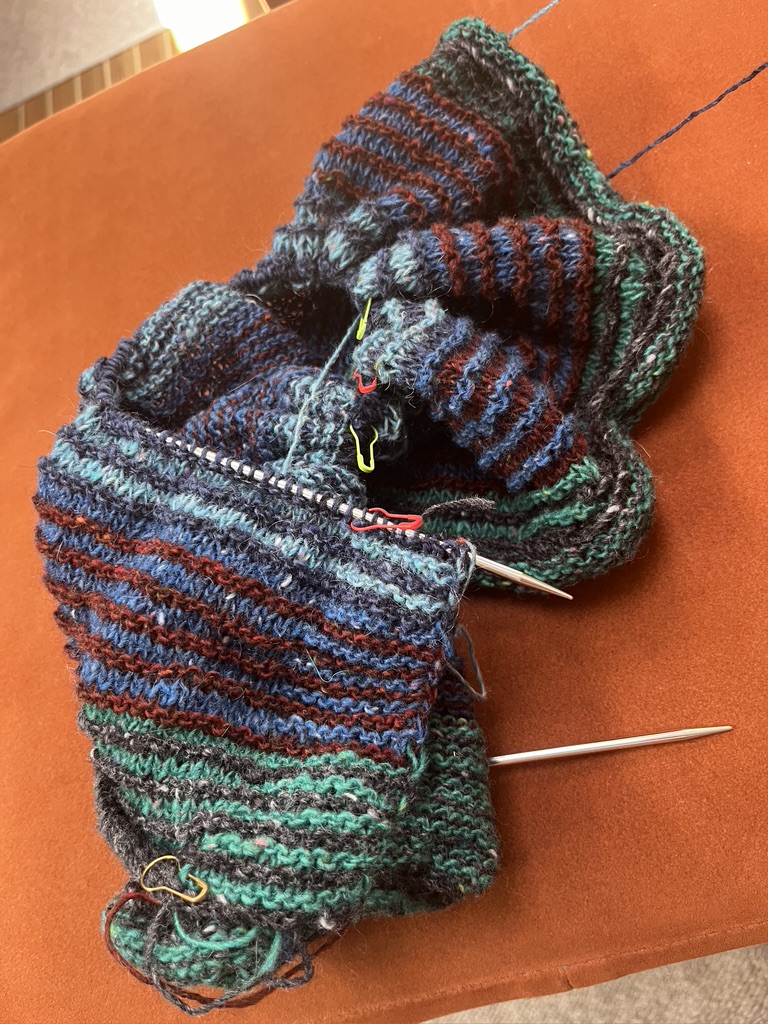
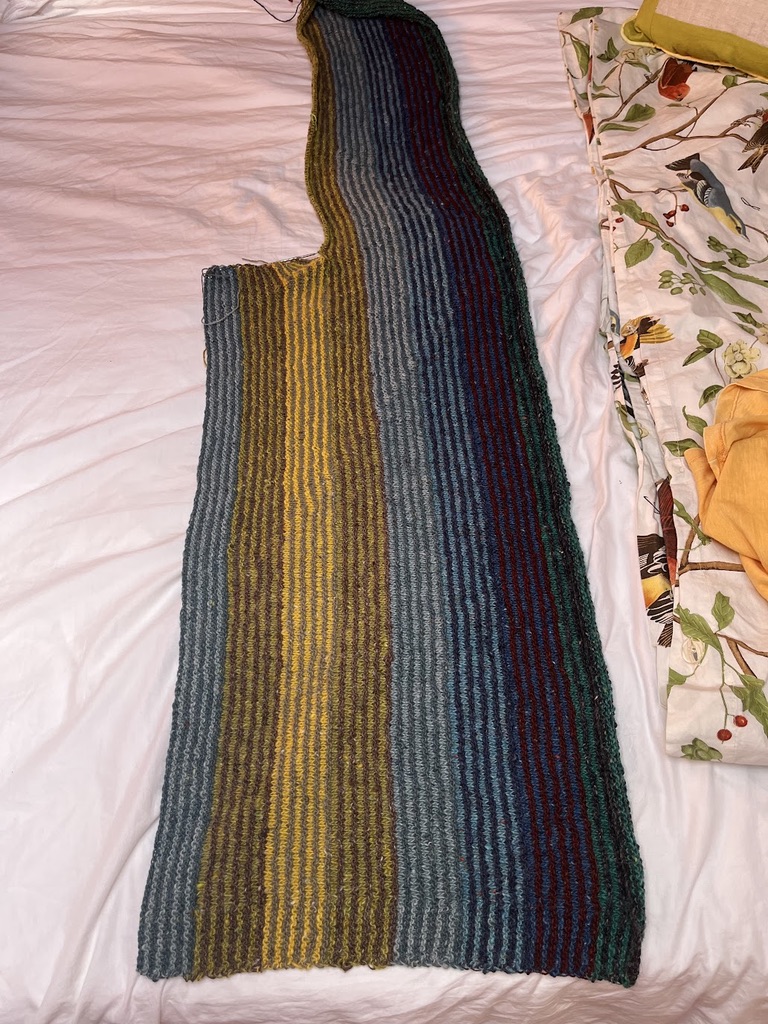
It would be wonderful to finish one of these to wear in spring when I return home to New England. On the other hand, it would also be great to wear this vest which I started onboard with my advent yarn from Kate Davies. Can you see the faint ‘shadow’ work in this? This is the left front/back, so I’m half finished with the vest, which is closer to completion than the other two sweaters. The right side of this vest has entirely different colors in it. What you see on the left side of this photo is not the armhole. It’s the neck opening with the collar already knitted into it. It’s a clever design, inspired by a design from one of the most clever knitters–Vivan Hoxbro.
Recently I returned to embroidery, which I haven’t touched in years. When conditions are calm I can do close work. This is a kit from Melbury Hill in the UK. Years ago when I bought this kit I could have chosen any of their designs, which are all Arts and Crafts inspired. I guess I settled on bluebells because I got to see a ‘bluebell wood’ the last time I visited England to see my friend Lesley. A truly amazing sight! I may finish the flowers today. Then I’ll have another completed project under my belt.
As I write this Bob is ashore checking Pandora in to Dominica. We spent almost a week in Deshaies, Guadeloupe, after about 3 weeks in Antigua, in English Harbour, Falmouth, and Jolly Harbour. I miss the calm harbors of Antigua. No wonder the English were so successful there. Calm harbors with great defenses against attackers. I’ve been onboard exactly a month today.
I have done a few things in the category of sightseeing, but since this is our 7th winter down here, I don’t feel compelled to revisit everything. We see rainbows multiple times a day, and Bob records all of them with his camera. We spent a delightful day at the botanical gardens in Deshaies, Guadeloupe. This year I only took photos of birds and fish. I took the bird photos for my friend who has had a Nandico parrot for more than 30 years. If we rent a car while here in Dominica, we will visit the Kalinago community, and I will enjoy seeing their stunning baskets. Hopefully I’ll bring a few home to give to my basket making friends. There is a lot to do here, in the depths of winter, but I’d always rather be making something with my hands most days. I’d rather work!
Ready or not, it’s 2024. I romped through the fall like a woman with her hair on fire, and I did manage to complete the loom woven projects I was determined to finish. I never managed to touch a tapestry loom. I’m not one who likes to look back and list all the things I didn’t accomplish, but every year I work hard not to do that. Here are some images of what I did finish! And I am celebrating!
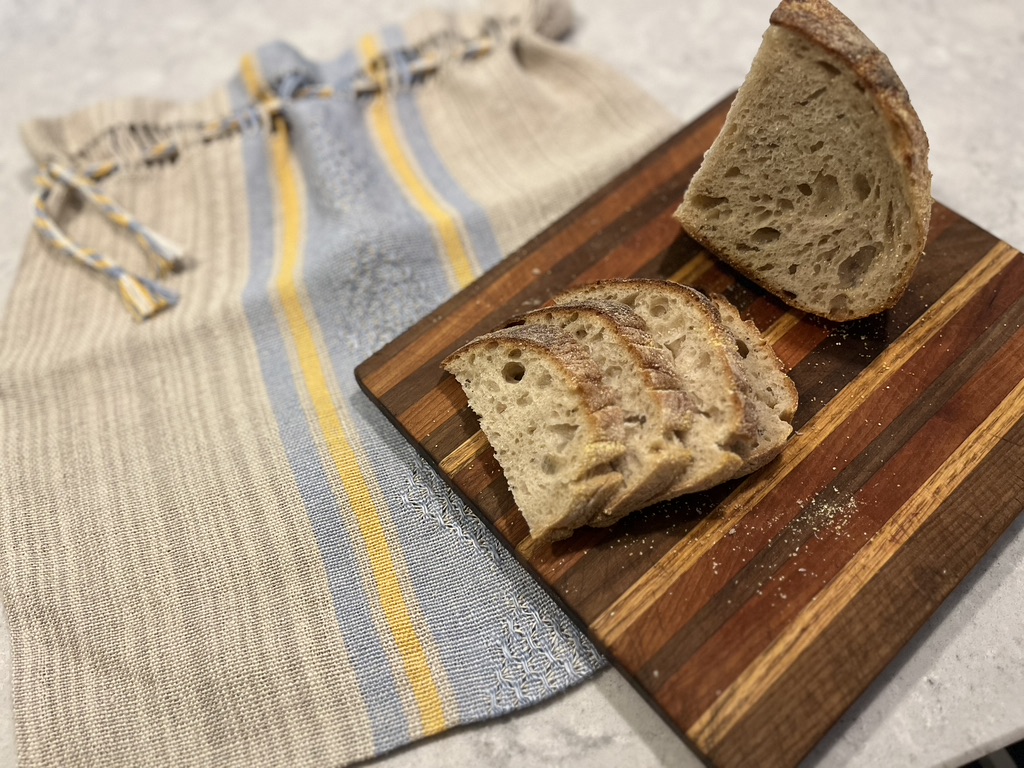
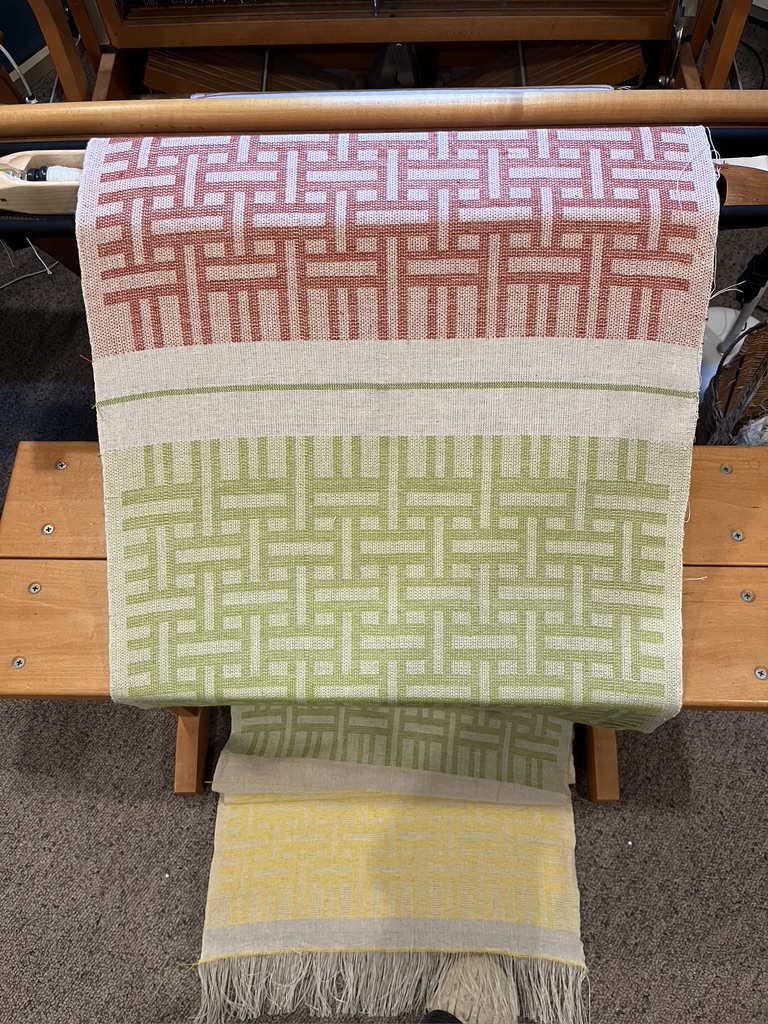
For most of the fall I was in a class with Fran Curran to design a project entirely in linen. While thinking about napkins or curtains, or even just kitchen towels I remembered that I’ve wanted to weave some bread bags for a couple of years. Here was the opportunity, which I wrote about in my last post!
I love using these for my sourdough bread loaves.
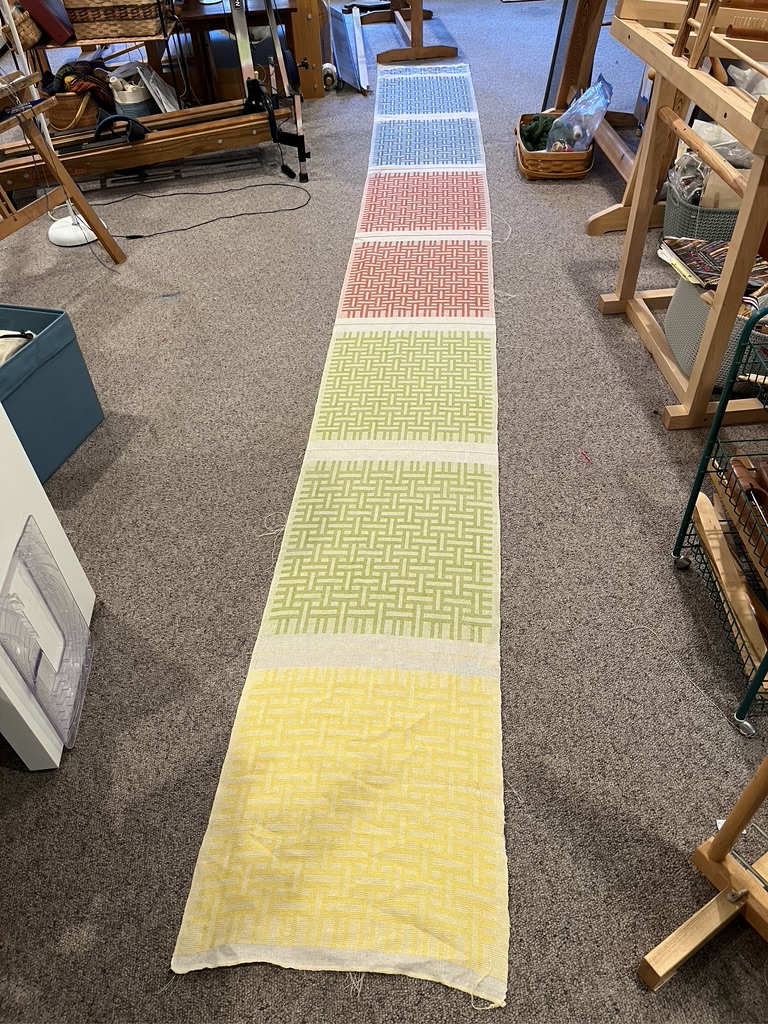
Since I wove my project at home rather than at the Weaving Center where Fran’s class took place, I finished before the class was half done. So I started another linen project, which is also in my last post. This is a wonderful design called “Meta Weave” by Lisa Hill, which you can purchase her Etsy site. I don’t know any weavers who don’t love a design that looks like weaving within weaving! Her instructions are for kitchen towels, but I decided to make 6 napkins in sets of two colors each. I used blue that you can see above, before switching to red, then green, and I managed to get a 7th napkin in yellow. I also found that I preferred the underside of the design.
Five yards and seven napkins!
Okay! Enough of that. It’s been a long time since I’ve woven a project so quickly. It was amazing to zip through this project, especially after the drawn out experience of weaving the paper placemats that required dyeing twice and unweaving two placemats after they were cut from the loom in order to get back some of the paper weft in order to dye it! That was almost the limit of my patience, but not the limit of my stubbornness, which may actually know no limits!
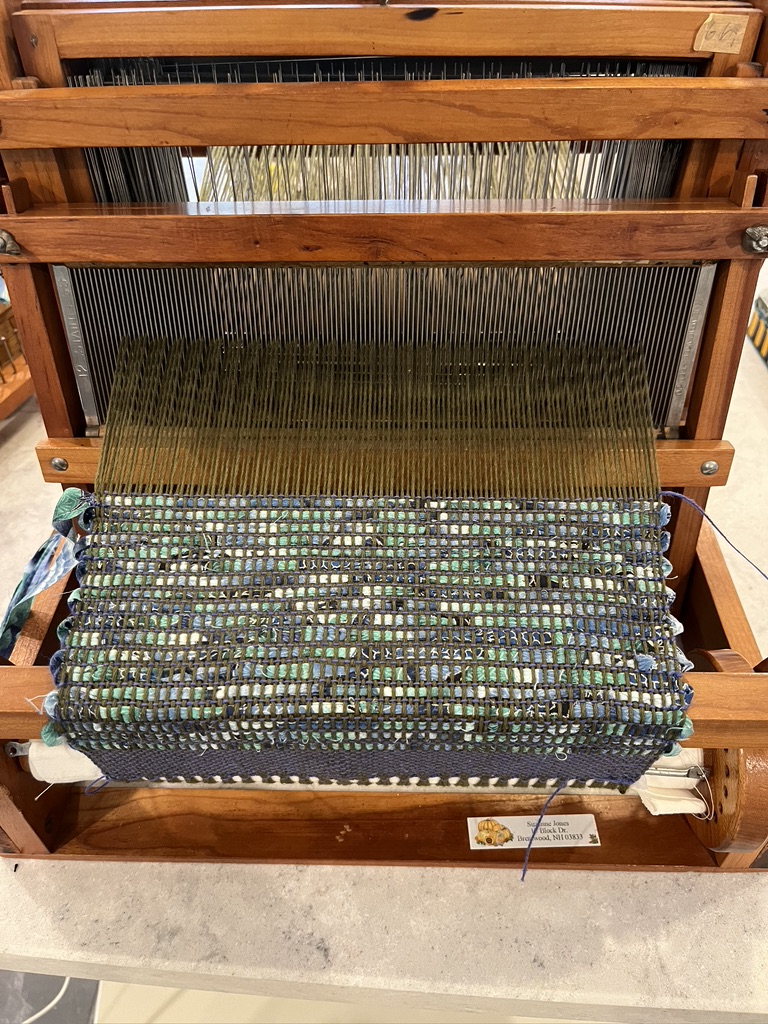
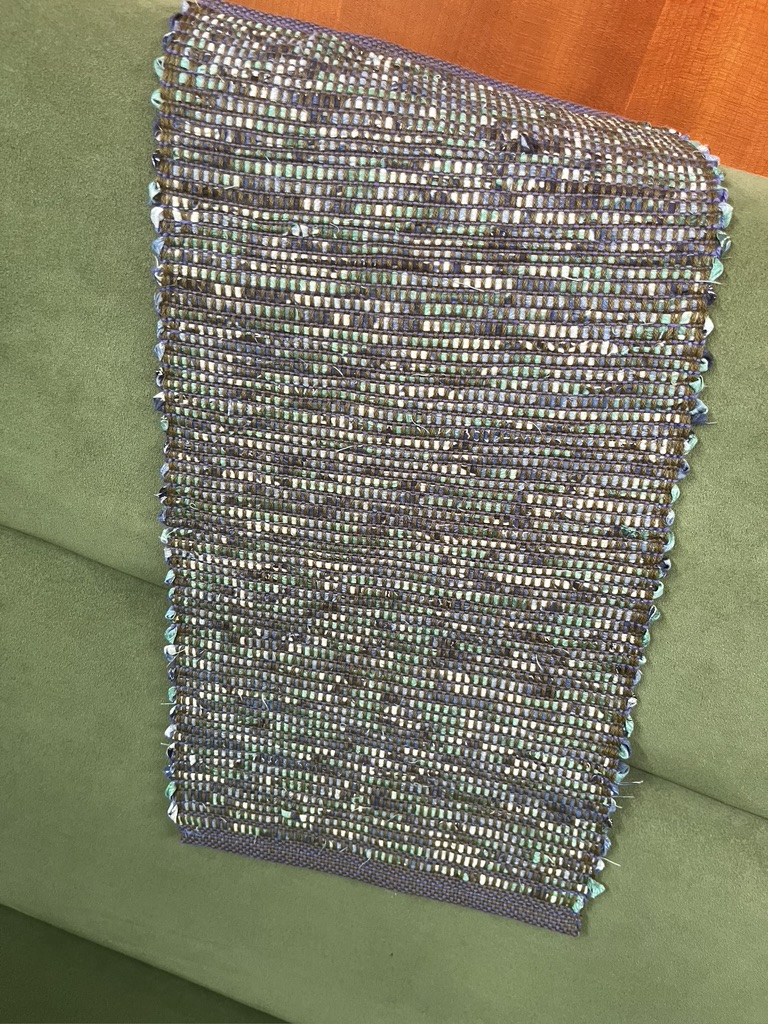
Then, in mid-November, a good friend gave me a table loom dressed with a sakiori project, also known as ‘rag’ weave. She gave me the loom because she thought I might be able to shoe-horn it onto Pandora. It’s a special loom. It belonged to the oldest current member (96!) of our state guild, whose father made several of these looms for her mother. Sue, our member, had dressed this particular loom with a loosely sleyed cotton warp which she intended to weave with 1/2″ strips of quilting cotton. The loom came with a large stash of cut cotton strips. I didn’t know how long the warp was, but I didn’t want to just cut it off. In fact, I didn’t want to lose all those cotton strips she had cut either. So I felt incredible time pressure to weave it off. And it was enjoyable, especially after I learned the interesting quirks of this little loom. When the levers are up the shafts are at rest. When I depressed the levers the shafts raised. It’s the opposite of any table loom I’ve ever used, and it took me some time to get used to that. In the long run the warp was enough for 3 runners, each about 20″ long by 10″ wide.
I gave away two of the runners, one to the woman who passed the loom to me, and the other to a friend whom I learned had helped Sue dress the loom and cut all the fabric strips. Sometimes things work out just as they should. I have my small runner aboard Pandora now. And how serendipitous it is that the color of the weft cotton strips goes quite well with our onboard decor. I couldn’t be more pleased.
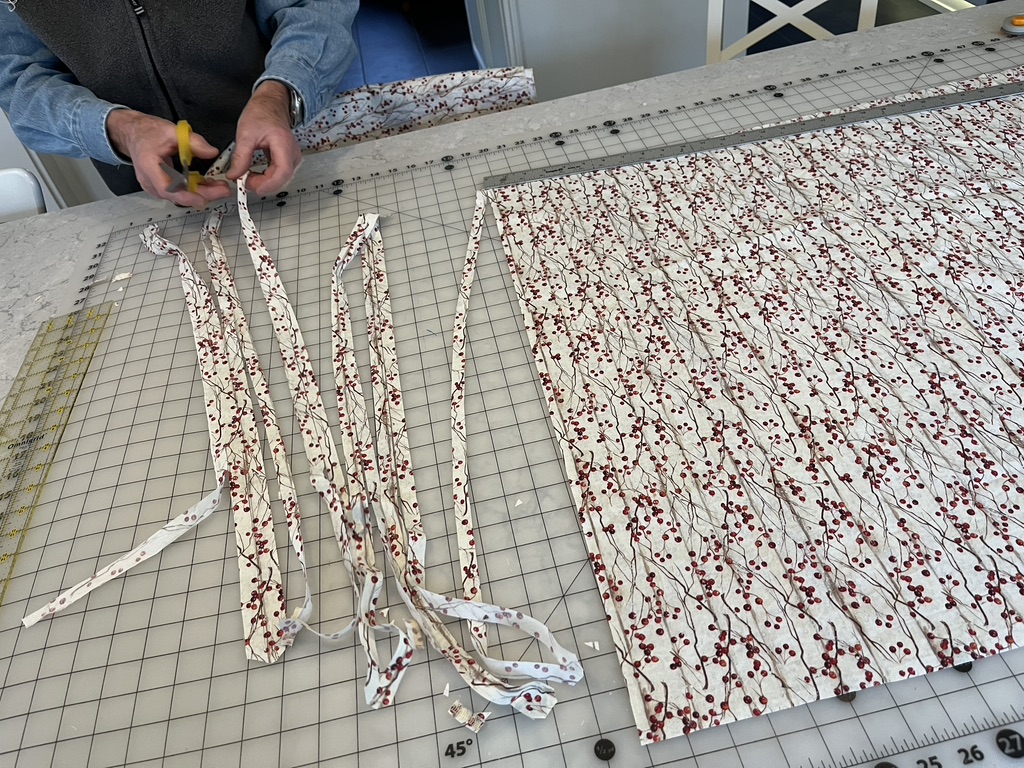
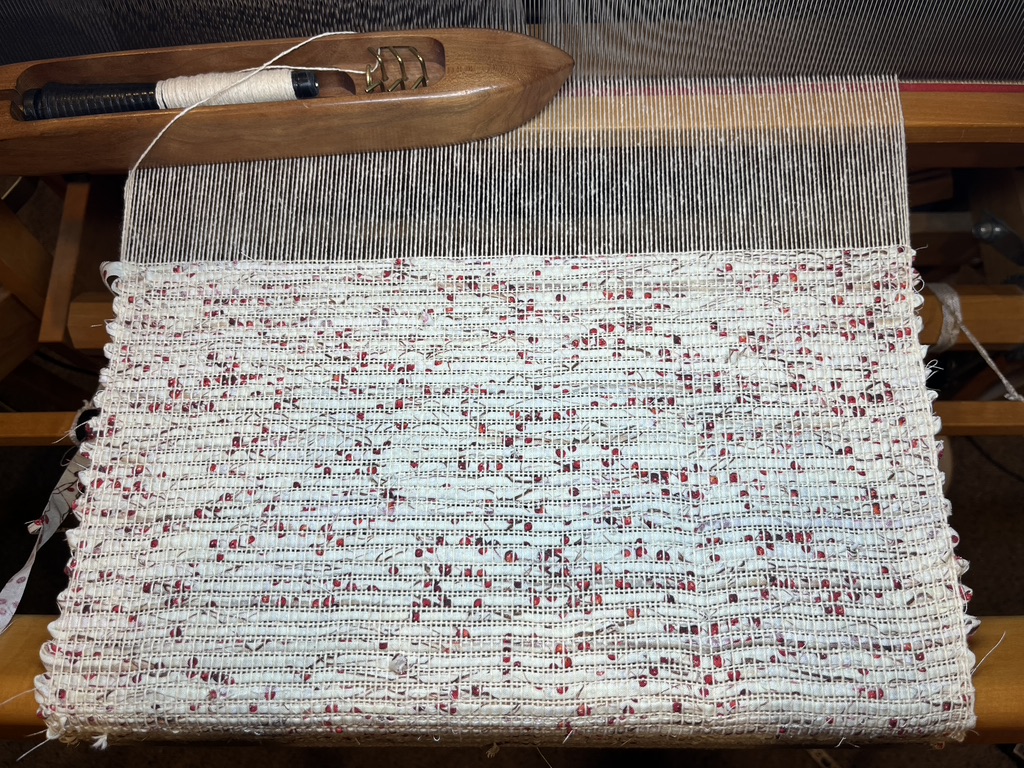
Then, lo and behold, I had the intense desire to weave another sakiori design with my own fabric. Now it was truly approaching time to gather our family for Christmas and get packed to depart. I found some wonderful Christmas-y fabric at a fabric thrift shop while traveling with a friend to see an exhibition in Vermont (Salley Mavor). I wasn’t sure it would be enough, and fate led me to find it on Etsy. Also, it was a stroke of luck that my husband offered to cut the strips! Three yards of 1/2″ strips was no easy feat.
I loved every minute of the weaving. It flew by like skating on smooth ice.
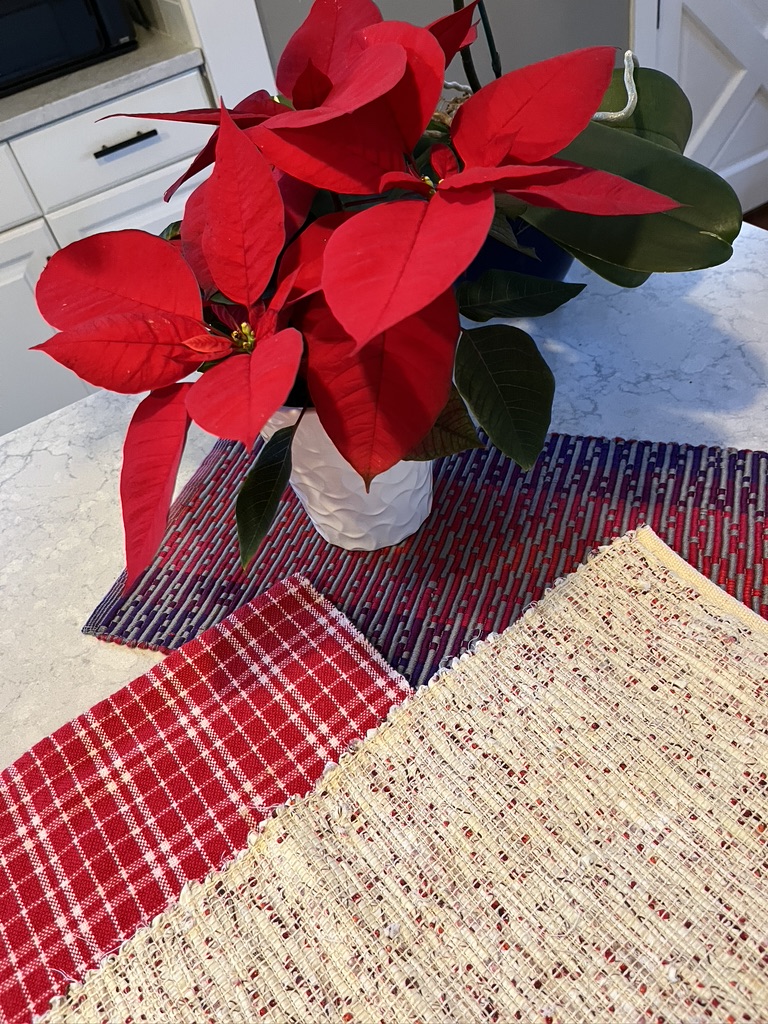
It also worked well with a few of my Christmas runners. Win! Win!
We had a simple Christmas with our younger son and a local family and some of their adult children. Holidays have certainly morphed in new directions since our kids have grown and grandchildren have joined the family, sadly not nearby. It was suddenly time to take down our few Christmas decorations and get packed for the flight to Antigua where Pandora was waiting. That deadline threw me into thinking about what I’d accomplished in three months of weaving, and a temptation to look at the things I didn’t accomplish.
That’s when I thought of Janus and the new year. He is the Roman god of beginnings, hence his placement as the first month of the year. He is depicted as two-headed, each of his two faces looking the opposite direction. This is my Achilles heel (sorry for analogy, but it fits so well). I want to take stock and see my accomplishments measure up to my aspirations. But since they never do….what weaver ever finishes all the projects she plans?….it’s not necessarily healthy to go down this path.
My younger son uses an app called “Notion” in his start up business. I am now trying to learn it because I think it will change my attitude about taking stock. It’s an app for tracking projects and goals, mostly for businesses, but I think it could help me realize that I get a great deal done every year. I’m struggling with the app a bit, but in the long run I think it’s going to be a positive thing– a wonderful way of keeping track of all my aspirations, my progresses, and my accomplishments. Every year there are projects I lose track of, and can’t find, in my over-stuffed work space. This app will remind me of things I started and eventually forgot. If I can just learn the nuances of this application I think I will be thankful to use it. Fingers crossed.
Meanwhile, it’s the new year, I am now onboard living a very different kind of lifestyle, with scenes like these…
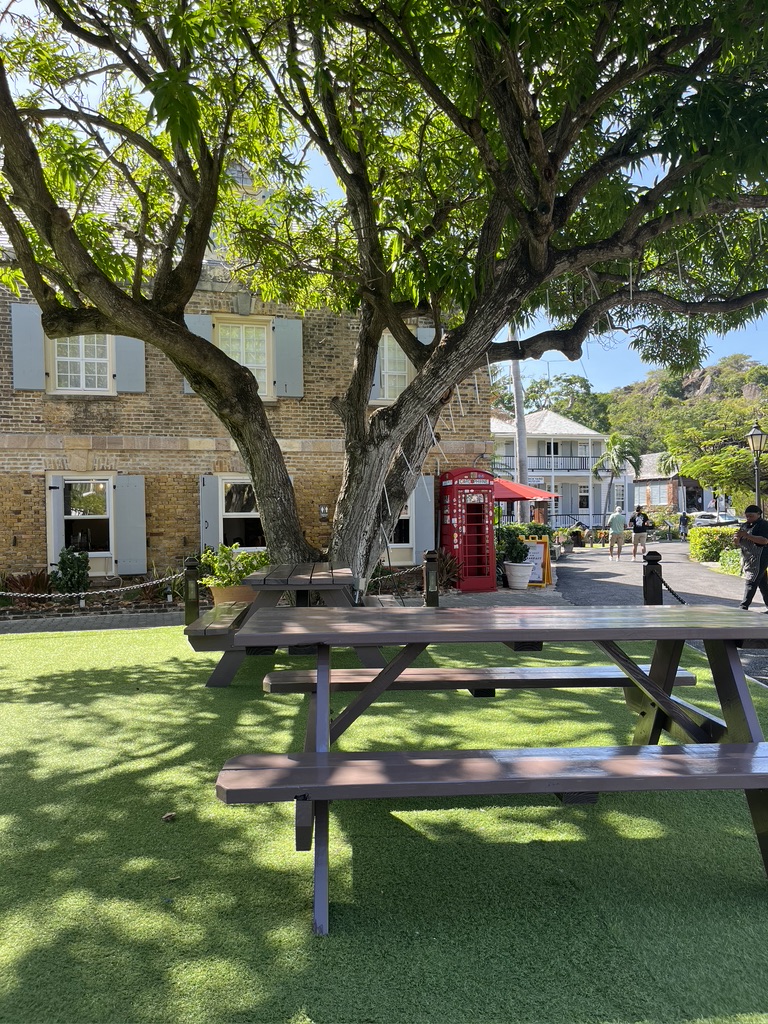
This is the giant mango tree in English Harbour, where people usually meet because it’s such an iconic place to gather.
I have started two knitting projects. The first is a shawl, which typical of me, has already been set aside due to more tempting projects! The yarn is what makes this project a zinger. It is handpainted with long runs of the background color and short spurts of the contrasting colors. The pattern calls for knitting the background color in stockinette, then when you see the contrasting colors approaching the needles, you make a little motif by putting five yarn overs on the next three stitches. On the next row you let the yarn overs drop and take the working yarn to wrap those long stitches, creating a little ‘star’ or ‘butterfly.’ I decided to make an asymmetrical shawl shape with a small Shetland lace border called “iron brand” on one side to continue the asymmetrical effect. I was thoroughly enjoying it until bigger thing stole my attention!
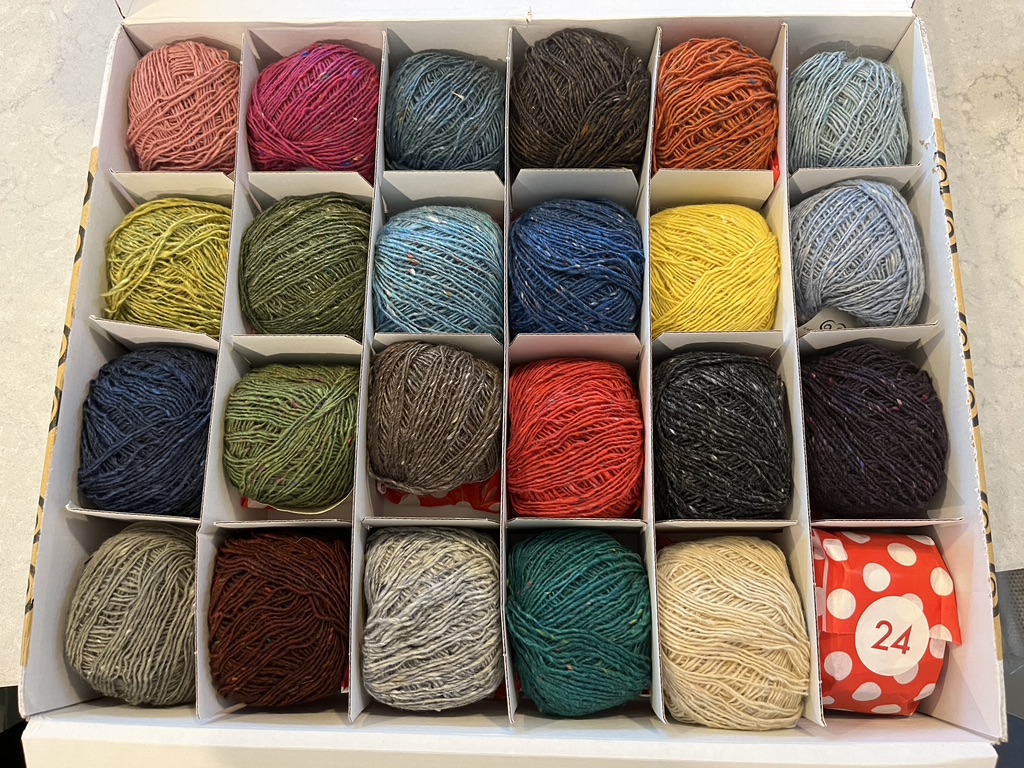
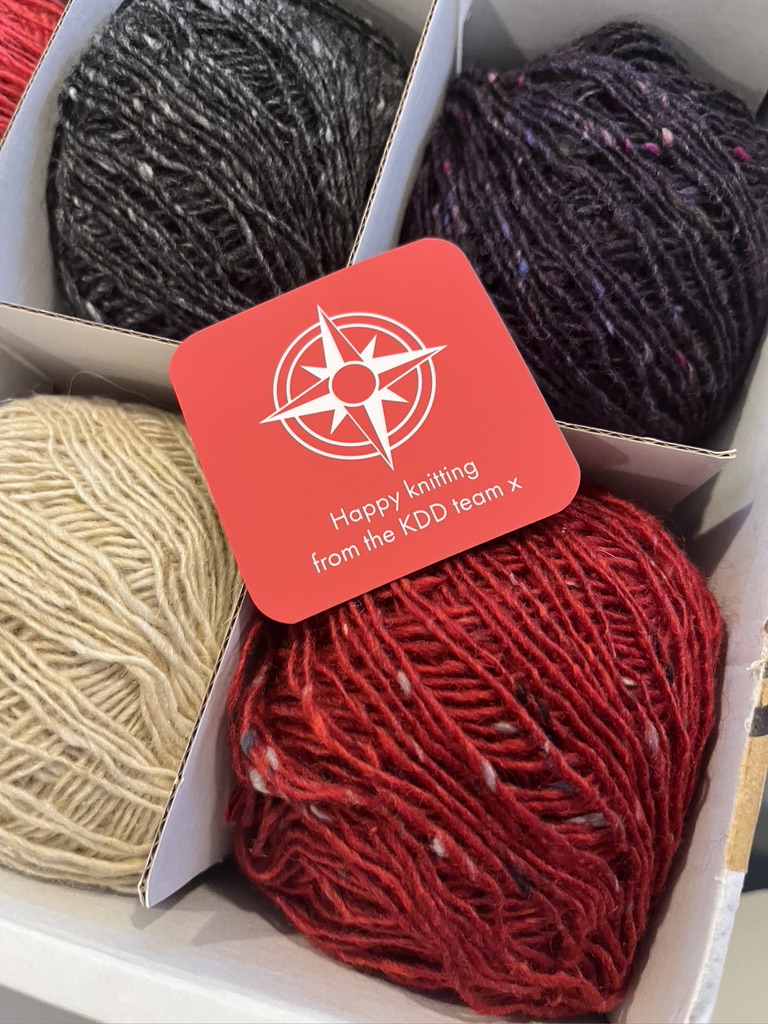
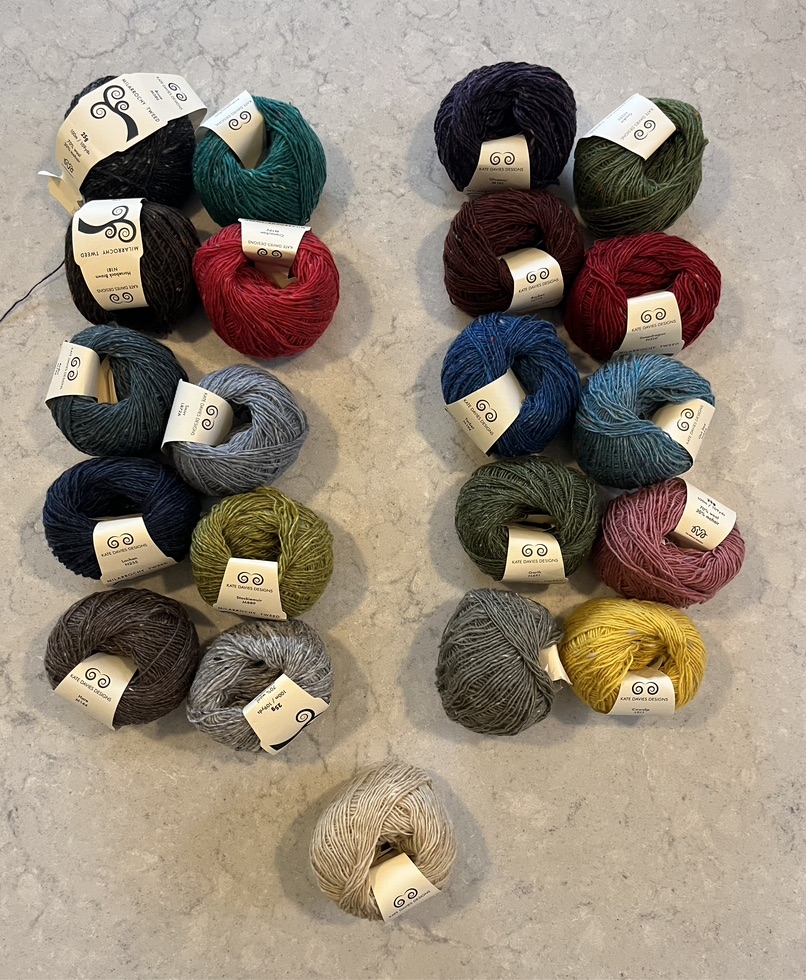
The project that took me away from this shawl was an advent calendar of yarn from Kate Davies Designs in Scotland. She has a yarn called “Milarrochy” that is a single ply, 70% wool, 30% mohair blend. I have used it to make her “Con Alma” vest a couple of years ago. The mohair blooms nicely when wet finished. Well, imagine my excitement when she announced that she’d made up boxes that held 24 small balls of “Milarocchy” for an advent calendar! I could not resist. So fun. The box arrived in early November, and it was hard to wait until December 1, but I did it. Here is a photo of the most exciting day for me. On the last day, the little bundle also held a card with a link to an e-book full of patterns for using this yarn.
Drumroll! I love that last color, a perfect Christmas red.
After a good deal of thought, and a fair amount of arranging the yarns into colorways I might knit, I decided to make a vest using Vivian Hoxbro’s ideas for shadow knitting. I am enjoying the process.
I was quite challenged at first because the only needle I had in the appropriate size was only 24″ long. My idea was to knit sideways, a left side front and back, then a right side front and back which would give me vertical stripes with shadows. That’s why I have the yarns gathered in two sections. The right and left sides of the vest will not match. What a struggle to knit that long run of stitches on a 24″ needle!
I was thrilled to discover not just one but two (!) #3 US circular needles that are 40″ long that I’d already stashed on Pandora earlier in the fall. The knitting is so much easier now. Can you see the shadow effect moving diagonally across the knitting? I am almost done with first left side front/back and am looking forward to starting the 2nd colorway for the right side of the vest.
So, here we all are at the open gate of the new year. Let’s all concentrate on looking forward, shall we? Not only about ourselves and our work, but also everything, from family, to community, to global issues. Let’s make this a banner year in as many ways as possible. That’s my wish for all of us.