ArgoKnot

Projects Big and Small

It’s now October. I continue to procrastinate on that tablecloth on my Big AVL. I don’t quite know what’s wrong with me because I was on fire to get it on the loom. I was 7/8’s done with the threading in August, and now it’s October and it hasn’t been touched in more than a month. Maybe I’m worried that after all this work it won’t weave well. Yep, definitely worried about that.

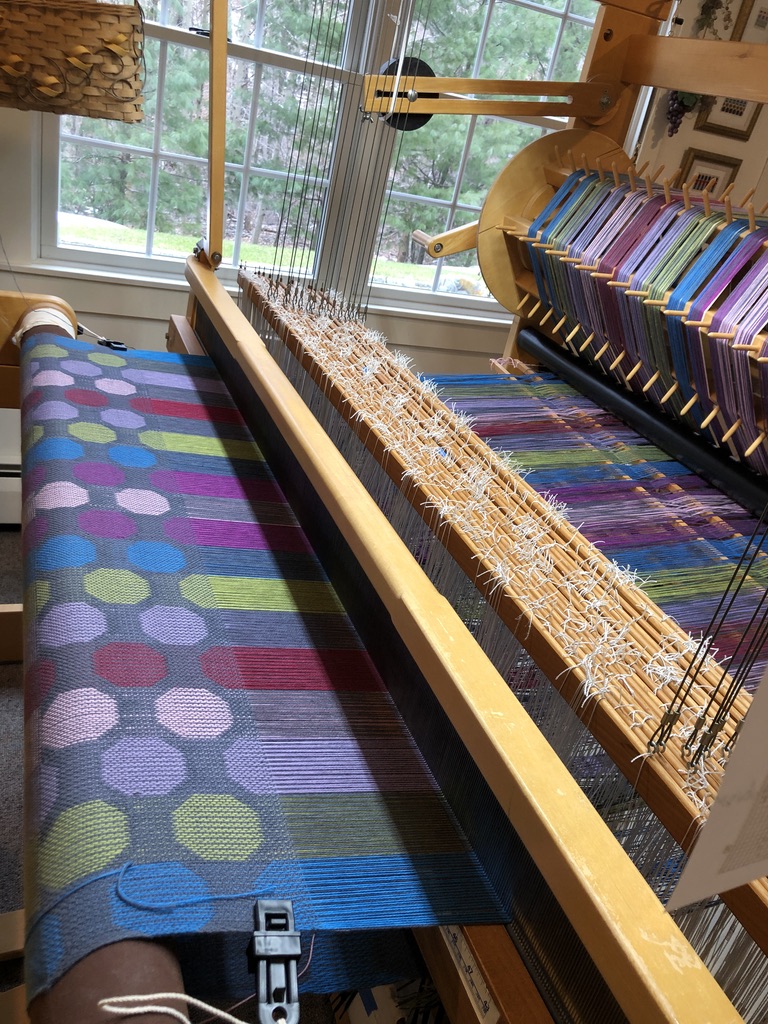
On a better subject, I have been weaving my linen project for the class with Fran Curran. I’m more than half done with the 2nd bread bag, and I’ve started the braid for the drawstring. Here is the first design, showing the hemstitching which will be the casing for the drawstring. I designed a diamond with warp-only floats so the blue warp would show up strongly on the surface of the huck lace.

The 2nd bread bag has warp and weft floats. It will be interesting to me to see how they differ after I wash the fabric.

Of the two sweaters I found that I’d like to a) alter, and b) finish, I have started on the blue cabled sweater that was designed by Elsbeth Lavold. I am adding a gusset to each underarm that will continue down the side seam, which I have opened, to create an A-line silhouette. I’m not happy with how the gusset looks. It’s messy. I’ve started over again and am still not happy. Part of me thinks, well, it’s the underarm, so it will rarely show. But…. I know it’s messy! This nagging disappointment keeps me from working on it. It’s not worth a photo at this point.

I tried a tiny bit of Japanese Hogin embroidery and loved it. The fabric I had on hand was finer than what was called for, and I felt I was going blind trying to do these tiny stitches. I love the technique, which is counted running stitches that create simple designs that can become quite complicated in appearance when they are done on a larger scale. I saw so many tiny bits of textile mounted in wooden frames while I was Japan. I bought a tiny temari pin cushion at the Cohana store in Tokyo. There are wonderful sashiko pin cushions mounted in wooden bowls, and there are embroidered brooches mounted in wooden frames to be worn. I was smitten with those. I found someone on Etsy (Artbase) making some pretty brooch frames in cherry.

I’ve already ordered a larger brooch frame for my next embroidery, and I’ve visited my not-so-local needlework shop to buy a slightly coarser woven linen. The one above was embroidered on 32-count linen. Next time I’ll try 28-count. I enjoy doing this!

My next project, which feels both big and small, is cleaning and re-framing a beautiful crewelwork embroidery made by my oldest friend, back in 1981. This gem of a piece is over 40 years old now. It got lost for several years when we made our last move, so when I finally found it in a box in the attic, wrapped in tissue and packing paper, it had suffered some. I don’t know if these brown blotches are mildew, but I hope I can get them out. I am using Orvus paste, recommended by the women at Thistle Needleworks, my not-so-local shop. I was anxious removing this gem from its frame. It’s heartbreaking to see the stains on the fabric.

It looks like the framer used double stick tape to stretch the fabric on the backing. I hope to sew it in place when I re-frame it.

I took out about 50 staples on the sides. I hope I can make this as beautiful as it originally was. Then I’ll feel like a pro and I’ll tackle some other things from my stash.

My new tapestry students are doing a great job. Every class seems to show me new ways that a class can have a group personality and an interesting trajectory. This class is moving quickly, so I think they’ll be doing some of their own designs soon, when we are barely at the half-way point of the semester. I love seeing the colors that students choose. It’s always a visual feast to see all these colors become something real. Students keep me endlessly excited!

I hope I get most of my big and small projects done. There is energy in the air. I just need to harness it!

Rabbit Holes are Really Just Procrastination

For the past several weeks I’ve been deep into some interesting rabbit holes. There are so many compelling things to learn, tips to explore, and amazing images to see. That means I have not touched my tablecloth warp in three weeks. I do feel a little guilty. I am at the point of threading the final border, and it’s the hard part, considering whatever I thought I was doing 12 years ago that I now cannot remember or understand. I will tackle that final area of threading soon, but in the meantime I’m enjoying my rabbit holes.

I went looking for a stranded sweater pattern that I started quite a few years ago. I did not find find it on the first or second go-round, but it finally turned up late last week when I was looking for something else. Isn’t that always the best way to find something? A few months ago I came across this sweater and decided I ‘needed’ to finish it. That’s when I learned I don’t seem to have the pattern! I searched through my Ravelry library, my emails, and even through the printed patterns I’ve collected in two huge notebooks. No luck.

Do you see why I want to finish this? The yarn is a Finnish brand called “Kauni Effect.” I am using two different colorways. One is called ‘rainbow’ and the other is something like ‘autumn.’ Sorry I’m not sure of the second colorway. I’m knitting with one yarn as color A and the other as color B, and the yarn does all the work to create this amazing, glowing, beautiful effect! I know, I’m gushing.

I could not figure out what happened to the pattern. I posted a photo on Facebook, and many people began responding to help me retrieve the pattern. After more than a hundred responses I began to remember a few things about this design. The sweater pattern was designed by Ruth Sorenson, but the stitch pattern was from Dale of Norway. Someone whose name I don’t know put the two together to create this stunning sweater. It was easy to find the stitch pattern on Ravelry. It’s in quite a few people’s stitch libraries…but the sweater is no longer available, and for some reason I have lost it.

When I started googling various ways to get in touch with Ruth Sorenson or to see all of her designs, one of the top hits in my search was my own blog. Seriously? It turns out I wrote about my plans for this sweater here. That was March of 2014. That sweater has been laying in a canvas bin in my wall unit for almost 10 years. Yikes!

One of the 100+ people who responded with help on Facebook contacted Ruth Sorenson and got permission to share the pattern with others. She sent it to me, and by now I’m sure others have it too. Thank you, Ruth! Between the sweater directions and my own notes I plan to get cracking on this sweater again. I won’t be wearing it this fall, but hopefully in fall of ’24.

In the sweater department, there is also this: “Hild” by Elsbeth Lavold, from her Desinger’s Choice, Book 9. I made this years ago and have worn it a few times. It no longer fits, but I still love it. Last week I un-sewed the side seams and am adding gusset to each side. I hope that gives it enough flair for me to enjoy wearing it again.

The sweater bug has definitely bitten me. I haven’t been knitting much over the past several years, but clearly I’m back in knitting mode now.

I’ve started a class with Fran Curran at the Weaving Center of Hartford Artisans. She is leading us in designing a project using linen. We had a short presentation on designing huck lace by Jill Staublitz, and I decided that would be the weave structure I’d use for my project. I’ve woven a lot of linen projects over the years, and a lot of huck lace too. It was hard to decide what my project would be since I have plenty of napkins, placemats, even a couple of linen tote bags with huck lace. Then one evening I remembered that I’ve wanted to make bread bags for a couple of years now, ever since Handwoven Magazine featured a linen bread bag pattern. I fear my bread bag may be a bit over-designed, but I will have fun with it.

I will have a center diamond motif on the bag fabric, surrounded by plain weave stripes and a mix of natural and half bleached linen for the background fabric. The stripe colors are in the photo of the sweater above. They happened to be laying on the counter in my studio where I took the photo. I wanted the huck diamond look particularly blue, so I’ve made sure the huck floats are in the warp, which will be blue in that section. I’m looking forward to this!

Lastly, I have started teaching another 9-week tapestry class, also at Hartford Artisans. I’m intrigued by this new batch of students and hope they will enjoy tapestry weaving enough to continue to pursue it.

My son Chris calls this kind of distracting activity “bike shedding.” He says this phrase came about when a group of engineers were ‘stumped’ on a building design. They decided to design a bike shed for the building before working on the building itself. Who knows if this is true, but it seems to be something I’m rather good at…bike shedding, procrastinating, and going down rabbit holes. I could do worse!

Stretching the Rules or Just Stubborn?

Early last week I spent the better part of three days determined to get a standard warp onto the sectional beam of my BIG AVL (aka BIG ALVIN). The warp is 12 years old! You must be thinking why on earth would I save a warp for that long, and why, oh why, would I then try to put that warp on a loom not meant for it.

A conservative guess on the time I’ve spent so far on this might be 12 hours. And, if you consider that I needed an extra set of hands for some of this (i.e., patient husband) the total hands-on hours is probably 15 or 16. That is just to get the warp onto the beam.

My first attempt involved winding on one of the two warps, using my trapeze (made by my husband). Bob helped with this process, and we had to stop at every set of section dividers to get each section of warp into the proper divisions on the beam. It was slow going, but luckily it’s short warp.

But doing this a second time seemed more challenging for the 2nd warp, so we undid everything and took the two warps together. I divided the whole warp into 2″ sections in order to wind them on one at a time. This horrible sight would give most weavers the heebie jeebies. It certainly felt Herculean to me. It’s two 30″ wide warps that needed to be separated into 2″ sections for the sectional beam.

Why am I doing this? Twelve years ago in May I had a most unique experience–both good and not so good. Some months earlier I had signed up for Vav Stuga’s basic class. I envisioned May as the most perfect time of year for seeing the Bridge of Flowers in Shelburne Falls, Massachusetts, while immersing myself in full days of weaving all week long at Vav Stuga. It should have been one of the most fulfilling experiences. But just a short time before my class began, my father died. It was not expected. It left my mother, who needed full time care, alone. The entire family showed up to be with my father as he was removed from life support, and then we gathered around my mother to care for her and make decisions about her future. I called to cancel my class at Vav Stuga, but it was too late to get a refund. We worked hard to get my mother moved back to New England, where she stayed with me for two weeks before we found a comfortable and safe place for her to live. I took off to Shelburne Falls! During my week in class my mother called me between five and six times a day. She was bereft. She was angry. She was somewhat unhinged. Over time I began fully understand her mental state, but at this time, so early in the process, I was overwhelmed. I could not concentrate.

And yet… I was an experienced weaver of 40 years by the time I attended the basic class, and I had benefitted from some amazing teachers along the way. I completed the various projects in the class in time to be offered the ability to make a warp to take home. My sights were set pretty high! I had seen a tablecloth project in one of the Vava med Hemslojden issues in the Vav Stuga library, and of course, I didn’t want a medium sized, 45″ table square. I wanted a tablecloth to fit my dining table. After all, I had a big 60″ wide Toika that was calling me to make a tablecloth!

I love monk’s belt, and the idea of it running both weftwise and warpwise was a thrill. In the book the colors were all in shades of red and rose with cream monk’s belt, while this photograph shows it in blues and cream. I had big plans for a spring colorway in pale green and soft yellow, with coral monk’s belt and fine stripes between the squares. Sometime in the last decade I sold that Toika and replaced it with big BIG ALVIN, hence the dilemma about how to get the warp on my loom.

All I can say is when I get an idea in my head it is hard to let it go. It was a lot of warp to make in the short time I had left at Vav Stuga, back in 2011. I wasn’t at my best mentally, so I have now discovered that I made a few mistakes in the part of the warp that has the monk’s belt supplemental warp threads. I added those in during my beaming process.

I am quite sentimental about this project. It was a difficult time of my life, and yet this escape to an idyllic location, spending a week with like minded weavers in a wonderful setting, is a memory I cherish. This tablecloth warp is a significant part of that memory. My roommate from that week is someone whose friendship has deepened over the past 12 years. And she is somehow also tied up in my need to make this project a reality. It’s complicated, for sure–both emotionally and technically.

Here are Bob and I, feeling somewhat relieved that the winding-on is done. However, I am now faced with the not-insignificant worry that those sections do not have consistent tension.

At the end of last week, before leaving for a long weekend in Maryland with our grandkids and kids, I began threading. There are 1300+ warp threads. I have made it past the right hand border and the right hand monk’s belt pattern in the warp. I now have a long stretch of the stripes in the middle threaded with monk’s belt as well, but not the double warp threads required in the warp patterned area. Whew!

But other things are now demanding my attention. At the end of the month I will begin teaching two tapestry classes each week through early November. I need to get organized for that. In my own work, I want to try my hand at Helena Hernmarck’s tapestry techniques on a twill ground. I am trying to wrap my head around the instructions she sent me, and I’ve decided to tackle this on a floor loom. Since BIG ALVIN and Baby Wolf have other projects on them, I have rented a small Dorset floor loom from my guild.

To balance the chaos I’m feeling in these projects, I try walk several times a week. My smarty-pants watch keeps reminding me to ‘take time for mindfulness.’ That only makes me feel more frantic! It’s not helpful at all. I feel like a woman with her hair on fire, and that may be why I noticed a sign for a hair salon recently: “Hairdresser on Fire” Would someone, other than me, really go inside that place?

There is a local walk that does seem to take me down a notch in anxiety. I love passing by this house, and think of it as the ancestor of my house. My house is a Dutch colonial with a cedar roof like this one, and lucky for me, better porch railings. My house has a room, our den, that is really the ‘breezeway’ between the house and the garage. I don’t think this house has a garage in that area to the right in the photo, like my house does. My house is also yellow, but with green shutters and door. Anyway, this housenfeels like the more perfect version of my house (aside from those railings, easily fixed). And why not? It was built in 1766. My house was built in 1976, 210 years later with some very nice reproduction touches to make it feel like an 18th c. house. I have sea stars in my windows too! My house is a wannabe of this house. And this house has a beautiful barn in the back and less property to maintain.

This house may be the smallest house in town. Isn’t it sweet? When I pass by I think of sitting in those wicker chairs myself sometime, maybe with a glass of lemonade and my knitting.

And this shed! Whoa! It’s not big enough to be my weaving studio, but I do daydream of spending time in there, doing something creative. It must be that jolt of red in a such a lush green environment that calls to me.

And then there is this big, rambling farm house….sans farm at this point. There is bound to be space in there for an amazing weaving studio. I’d love to get inside to find out where.

And so I’d better get myself downstairs to find the things I need for class and maybe get another inch or so threaded on my tablecloth. I feel the summer starting to wane, and I have much left to accomplish. Soon I’ll know if I’ve successfully bent the rules in putting a standard warp on a sectional beam, or if I’m just hopelessly stubborn. I am hoping for the prior!

NEWS!

It’s summer in New England in an odd numbered year, which means that regional weaving conferences are taking place throughout the US. NEWS is an acronym for New England Weavers’ Seminar. I haven’t attended this conference since 2017. Can you imagine how much I regret not going in 2019, since 2021 was canceled? I could not have predicted what would happen so soon after that 2019 summer conference that I missed.

It was invigorating to reconnect with weavers throughout New England after a six year hiatus. I had five wonderful days of inspiration from other weavers and teachers and vendors! The conference took place at a new location this year. The conference has long been held at Smith College, but this year it moved to Worcester State University. It was a bit longer drive for me, but it had so many pluses. All venues have their pluses and minuses, but I think the pluses at WSU outnumbered the minuses, and I cannot say that about Smith College.

The campus was easy to navigate, even when toting a floor loom with equipment; the food was quite good, and the weather was simply perfect–warm days with breezes and low humidity, cool nights. It was a stellar five days!

The coordinators arranged for a tour of Old Sturbridge Village for those of us not in classes on Thursday. I took advantage of that. We first had a tour of the stored collection of historic textiles. They have a trove of handwoven household items from well known New England weavers, such as Peace and Patience, a mother and daughter whose last names I neglected to learn! There were items from other early colonists as well, but I was too busy gazing at the beautiful fabrics to retain any names. Clearly, I cannot be trusted to listen when in the presence of handwoven goods.

The linen towel on top is woven in twill which was known as diaper cloth, and no!–this does not mean it was a diaper. This is the name given to utilitarian fabrics that were used in household situations, which does include diapers as we think of them today. They are hard wearing and absorbent, as well as beautiful. The wool blanket behind it is wool with natural dyes.

When first entering the storage facility at Sturbridge, we were confronted by high shelves loaded with historical weaving and spinning tools. Swoon!

There are handwritten records of weaving drafts, often written on the backs of paper that had been first used for other purposes.

This towel has an attached fringe. Elaborately knotted fringes were quite popular in the mid-19th c, and they were added on rather than done with warp threads. Since they had been added, if the fringe began to deteriorate, it could be removed, leaving the hemmed towel in good condition.

The museum has record books of payments for woven goods. The weavers were not always paid in currency at this time. This pitcher was payment for the blanket in the background, and there is a record that weaver was not happy with this outcome for her work. The blanket is all wool, with indigo dyed stripes. It is quite large, and pitcher is not!

We also saw a marvelous quilt made to accentuate a beautifully embroidered purse. Purses from this time period were usually drawstring bags that were worn inside a skirt with a slit that allowed access to the purse. Our guide explained that this particular purse may have been a treasured memento to the woman who designed an entire quilt around the purse.

The purse is the slightly more discolored rectangle in the center of my photograph. The quilter has matched the embroidery for the center of the quilt and added borders. I don’t remember the date of this quilt (mid to late 19th c), but it is in terrific condition. It was definitely treasured.

And then there were all the handwoven coverlets, of which we only saw a few! They are stored on rolls on rolling shelving, and there are a lot of them.

For every coverlet and counterpane there is an identifying card.

Upstairs in the collections building were lots of spinning wheels, wool winders and other tools. Our guide was particularly enthusiastic about a flax spinning wheel made by a man named Higginbotham who was from Pomfret, Connecticut and Cranston, Rhode Island, born in the mid 18th c. It is a still a beauty!

A shelf of band looms and a yarn swift.

Our guide told us that most of the textiles seen in the museum are reproductions, not the actual historical pieces. This is due to the fragility of textiles. Many of the reproductions are woven by the weavers at the village. This woman is weaving a patterned linen cloth that can become serviettes (napkins) as well as being pieced together to make a tablecloth. It’s a brilliant idea to warp a loom for the napkins and then piece the tablecloth in three sections. With a warp 24″ wide you can hem for 20″ dinner napkins and then piece three longer lengths together to get a tablecloth in the 60-64″ width.

It was lucky that some of the enactors were also dyeing on the day I visited. Logwood and madder.

After lunch and a time for exploring on our own, we had a tour of the ‘herb’ garden, which is quite large on three terraced areas. The garden includes dye plants, as well as plants that were used in finishing clothing (teasels and soapwort), and plants to be made into cloth, like flax.

Our guide has been working in the gardens of Sturbridge Village for over 40 years. She has been instrumental in changes to the gardens during this period, and since she is also a spinner and dyer she is knowledgeable about gardening as well as how these plants were used. Her name happens to be Higginbotham, perhaps not spelled quite that way. I wish I had asked her if she was related to the man who made that flax spinning wheel.

One thing I saw in the museum that she later talked about was milkweed silk. During this time period women with the luxury of time, or who could sell this product, made elegant wraps out of the fibers found in the seed pod of milkweed. You had to use it before the pods opened so that the silky fibers were still neatly nestled in the pod. Our gardening guide is making one herself. The fibers are bound together with sewing thread in little bundles and then attached to handwoven fabric.

Here are some scenes from Sturbridge Village that captured my attention. It is a beautiful place.

And interior views of the exhibits.

And then the formal events at NEWS started. I took one class that covered the rest of the days at the conference. I had trouble finding enough time to visit the exhibit halls and the vendors. My class was so wonderful that I didn’t mind too much. It was Wedge Weave with Connie Lippert. More on that shortly.

One of the memorable exhibits at this year’s conference was titled “Legacy Weavers,” and it honored the women of guilds in New England who have left us such a wonderful legacy of instruction, woven fabrics, and the memory of their unique personalities. Here is the tribute to Connecticut weaver, Mary Elva Erf. I remember being so thrilled that a member of my guild had published a book (Weaving Shaker Rugs). Now there are quite a few published weavers in the Connecticut guild, including me!

The most moving tribute (for me) was to Sarah Fortin. She passed away far too soon, and she left me marveling at many of the techniques she used. I didn’t know her well, but one workshop I took with her will always be a high spot in my weaving history. I regret that I don’t have a photograph of her tribute board. I guess I was too busy reacting to the loss of her. But here is one of her wonderful dimensional fabrics. She was also a talented sewist.

All the exhibits were well done. It’s been six years since I’ve been exposed to so many wonderful woven items. There were two handbags that I hope will lead me to some good ideas for making one of my own. One member of my Connecticut guild made a dress, handbag and shoes out of her handwoven fabric. It should have gotten an award! Another guild friend got first place in rugs for her rya knotted rug depicting flowers in a friend’s garden.

One of my baskets got three awards: 1st Place in Miscellaneous (I guess that’s the category for baskets!), and two special awards for ‘best historical inspiration’ and ‘best off-loom weaving.’ I am thrilled!

With the ribbons we each get buttons made from handwoven fabrics. It is such a wonderful memento to have.

My wedge weave class with Connie Lippert was a great choice. I’ve got so many ideas swimming around in my head at this point. It is quite dizzying. Not only did we all learn wedge weave, but also how to insert some ‘normal’ tapestry weaving into a wedge weave design, along with a few other intriguing techniques. I now know I can spend the winter aboard Pandora trying out some of these ideas. I am indebted to Connie for her generosity in showing us so many techniques, and even delving into the details of finishing.

This is my piece in progress. It’s not a fast technique, but I’m impressed with how much I managed to do in 2 1/2 busy days. The warp is 12″ wide and I’ve woven about 6″ in height.

In the space of five days I visited airports three times. I’ve never gone to an airport so many times in such short period without taking flight myself! I dropped Bob at Bradley on Wednesday so he could fly to Florida to visit his brother. Later that day I picked up Connie Lippert at Logan. Then on Sunday, I picked up Bob from Bradley as I drove home. What a whirlwind! It was all great. And, returning home I am enjoying the bounty of July in New England. The sunflowers are from a friend and the zinnias and peaches came from our local farm stand that Bob visited this morning.

Now to make use of the many inspirations from NEWS. I hope I can be productive for the rest of my time on land.

Will It EVER End???

It’s those placemats woven with Japanese paper yarn. I’ve hit yet another hurdle. It took me three different dye sessions to get all the paper yarn dyed to a color I like. That means there are three different dyelots, but since each batch was UNwoven from a single placemat I naively thought I would get a new woven placemat out of each batch. I did happen to notice that the yarn was compressed a bit when I unwove it. I didn’t really unweave it; as I showed in at least two previous posts, I cut it out of the warp since the placemats had already been cut off the loom.

It was such a pale, boring blue against the white/natural warp. I was very happy with the newly dyed indigo paper yarn. When I wet the yarn before dyeing it fluffed up again. I’d say it UNcompressed itself, or so I thought.

I began weaving and was zipping along nicely. I allow 1 1/2″ at the beginning and end of a placemat for a turned hem. That is 3″ total. Sometimes I weave the hems with a different weft, but not usually. I did give that a moment’s thought, but I was pretty sure the weft from each placemat would weave a full placemat. Well, it didn’t. And the worst part is that when I ran out of weft I was exactly 3″ short. Just the amount I could have woven as hems with a different weft! Poor me!

Now I’m faced with UNweaving this placemat and starting again with a different weft for the hems. It’s laborious. I think I am about 4 hours into it, and I have only UNwoven half the placemat. I’m treadling backwards, throwing a shuttle, and winding the yarn onto the pirn after every four picks. It’s the most efficient way I could think of, but if you know a better way, please give me a shout–soon! I hope to finish today. So that’s how I’m spending my day before Independence Day. Hmm…

I realize that I am stubborn and refuse to be defeated by this project! The kitchen (paper)towels were a cinch to weave, but that was because the paper yarn was a perfect color for what I wanted. This has been quite the opposite–a nightmare for sure!

But it’s summer and June offered so many pleasures to balance my weaving debacle! My hollyhocks are huge this year! They seem to have taken some kind of steroids over the winter. I don’t know how they got so big. They are same ones I replant every year. I just take the seeds from the current flowers.

The lamppost inside the hollyhocks is six feet tall. The hollyhocks must be nine feet tall! When the flowers began to open I had just discovered ‘the dogwood dyer’ on instagram. She uses flowers to create sharp images on cloth through eco-dyeing. I am intrigued. She suggests drying the flowers first to get sharp images. I have a flower press, but when I couldn’t find it I began to think I may have loaned it to someone–decades ago? So, Bob to the rescue. I now have a new flower press with several hollyhock leaves and flowers being dried. My vision is to have a line of flowers and leaves running up one side of the front of a t-shirt. I’ve got the t-shirt, and I used Botanical Colors no-heat aluminum triformate for a mordant–for the first time. I’m ready to try this technique! I sure hope it’s more successful than my placemats!

Bringing flowers into the house is one of my joys of summer.

This week I cut all the flowers from the nepeta (catmint) and the lavender, hoping to get another flush of flowers in August. The bees were working just ahead of me as I cut the nepeta, and the scent was luscious. Lucky bees!

I saved the lavender and have made little bouquets for the guest bathroom and powder room, and I made a little wand to decorate a birthday present for a friend. It smells great right now, so I hope I see my friend soon.

Ten days ago I gathered my dearest weaving friends together to celebrate our long weaving history, both each person’s weaving history and our history together. Friends came from New Jersey, New York State, Connecticut, and Rhode Island. It was a beautiful day. I loved every minute of it. Personally, I was celebrating my almost-golden-jubilee of weaving. I started weaving in fall of 1975. Struggling with these torturous placemats seems ridiculous after that much weaving history. After half a century things still don’t always go as planned!

Here is most of the group.

I gave books to the two newest weavers in my circle of friends. This is Melody!

My editor at Schiffer Publishing is the other newest weaver. She arranged for Schiffer to send six books for me to give away. Below my friend Judy just got a book on making paper baskets.

Melody took this wonderful photo of my book, which also was given away, with the various bouquets that were about to get placed around the seating areas before guests arrived.

We also had a show and tell. This is Janet who makes bobbin lace and often creates her own patterns.

And Gretchen who wove this overshot shawl

Bob took a photo of most of us gathered on the steps that lead down to the terrace off my studio. What a wonderful bunch of women who have nurtured me over so many years!

I had party favors! Key fobs made from ribbon and webbing from Renaissance Ribbons, cute stork scissors donated by Schiffer, and some bookmarks. Of course I looked for ribbon with weaving images, but this was the closest I could get. Everyone went home with some goodies.

So it’s time to get back to UNweaving. With a lot of luck I might finish today. Then I’ll move forward hopefully for the last time on this project!

Scroll to Top