Imagine my excitement when I saw a recent post on facebook that some large scale lace I admired from images on the internet is coming to the US! — Not only to the US, but within driving distance for me!
These were the images that piqued my interest in large scale lace installations in the environment.
This is a large crocheted piece based on a traditional Dutch head bonnet. Delicate lace made on a huge scale to interact in the environment. Hanging over a canal, in Amsterdam, it reflects on the water beneath, whether ruffled by wind or calm and still. It casts shadows day and night on its surroundings. When I saw this online I dearly wished I could see it in situ. There is an excellent description of how this piece was made and assembled.
It has two sister pieces called the Urchins, and these will be part of the exhibition at the Hunterdon Museum in Clinton, NJ, that opens in late September. These two urchins will hang over the Toshiko Takaezu Terrace at the museum, which overlooks the waterfall on the South Branch of the Raritan River. It will be their first trip to the US. They will only be on view during the first two weeks of this exhibition. Inside the museum will be many other pieces of lace, including bobbin lace and needle lace, done on large scale. I can’t wait to see them!
So, the big decision is….. do I go for the opening? The pluses of that would be getting to hear two lectures on the lace exhibit — one by the curator Devon Thein, and another by the creators of the Urchins, Jin Choi and Thomas Shine. Afterward, at dusk, the Urchins will be lit. Those are big pluses. The downside? Well, I never fully enjoy the artwork at an opening. It’s crowded, I can’t fully see the pieces on display, it’s noisy….it’s a party. The likelihood of me getting to this exhibit twice is pretty slim. I have to choose. What would you do?
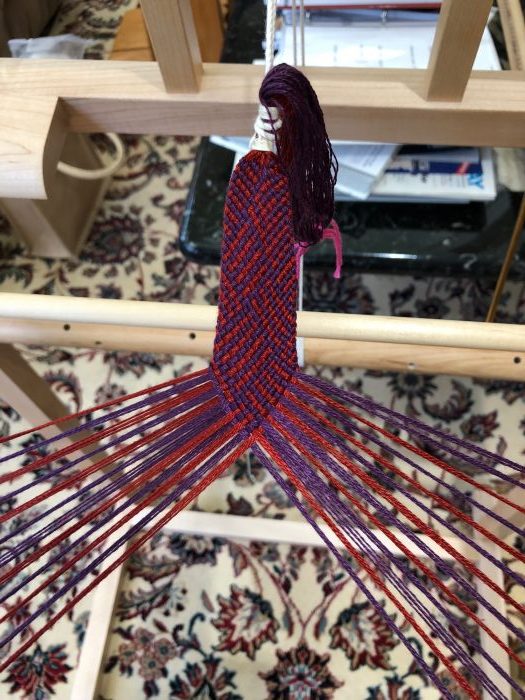
My friend Clare is letting me use her taka dai once again, so I have put on a warp for a 2/2 twill design out of Rodrick Owen’s book. I dressed the taka on Thursday and will spend some time at her house tomorrow weaving. I almost live there now….not sure what her partner thinks of always finding me in their sunroom. Here’s a look at the first braid in progress. I’ll take photos tomorrow of my twill attempt.
With luck, my next post will have photos of the finished mounting of the little Portuguese Man of War tapestry and maybe a new flat braid from the taka dai. Oh yeah, and the last of those lace blankets I’ve knitted for my three tiny grandchildren. Don’t you want to see them? (the grandchildren, that is, not the blanket)
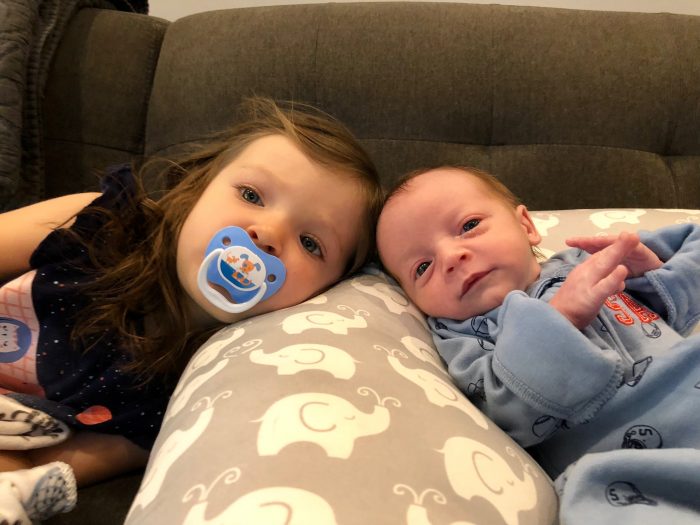
This is just pulls my heartstrings! Rhett is holding Emme’s hand in his sleep. I wonder if he did this in utero as well.
And here is big sister Tori with little Rhett. I just love being their YaYa. I hope I get to see them in September. They are growing up so quickly!
It must have been moments after my last post that summer’s heat arrived with a vengeance. Ouch! We’ve had a full week now of temperatures close to 90 and even a little higher. I’ve been hiding inside my climate controlled house. I miss fresh air, but it’s hard to breathe 90* air with an equal amount of humidity. Boy, have we had some impressive thunderstorms.
Hiding out from the heat is a great way to get things done. I finished my first attempt at weaving on a taka dai, thanks to my friend Clare allowing me to use hers while I wait to for mine to arrive. It’s an 18 month wait, so I won’t be holding my breath.
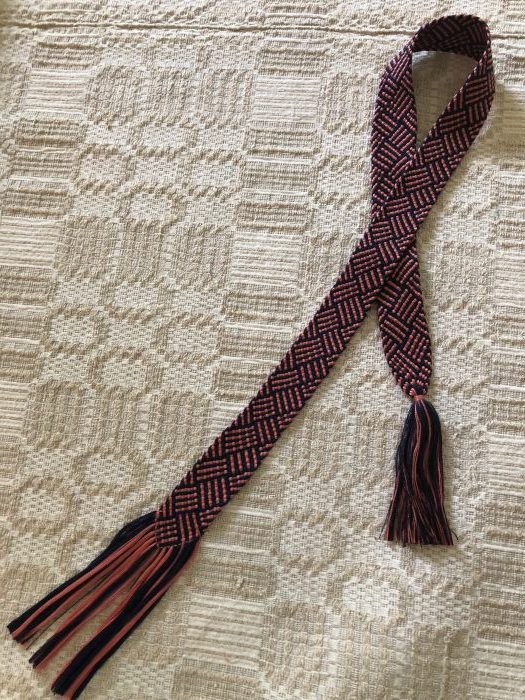
This is the standard first braid that almost everyone makes. I used 60/2 silk from WEBs. There are 12 strands on each tama, and a total of 25 tama make this pattern. It is just plain weave, and therefore it’s relaxing to weave. I twined the fringe that comes to a point at the end of the braid.
It’s been a good week for doing a little re-organizing. Bob built some shelves for me in our den where we had a useless closet that had only one shelf and a horde of items we need on occasion. I wish I had taken a before photo. In a closet with 8 feet of height there was only one shelf at the halfway point. Now it holds an array of things, neatly organized.
You must be thinking I’ve lost my mind to take a picture of a closet! Well, that’s how excited I get when chaos is momentarily curbed by order. Thank you, Bob!
This little activity sent me down to my studio to re-organize some of my cabinets and drawers there. I won’t bore you with more photos. My studio is still quite a mess at the moment, but it’s comforting to know that my cabinets look a lot better and are more useful. Once I knuckle down on some projects I’m preparing I can straighten up the studio–just in time for fall.
The Big E is coming in about a month. For those of you outside New England, this is a nickname for the Eastern Exposition, a mammoth country fair that includes all of New England. There are all the traditional country fair events on a large scale–livestock judging, baked items and canned items judging, dairy judging, butter sculpting competition, handwork competitions in various categories, and of course there is a midway. Members from my bobbin lace guild always submit an arry of entries in order to educate the public on what bobbin lace is and to demonstrate that there are people who still make lace by hand. I’ll be demonstrating there on Sept. 19th, which is Connecticut Day this year. I thought that was a good day to be on hand. If you’re in the area, please stop by and say hello! I’ll be in the building that has displays of handwork.
I’ll be submitting the christening dress I made for Tori last year. It has about 2 1/2 yards of lace on it, and I made the dress to boot. I’m no seamstress so making the dress was a bigger hurdle than making the lace. Also, I’m far from the best lace maker in CT, much less in New England, but I’m submitting the dress anyway. It’s not about getting an award; it’s just about showing that it’s still possible to make enough lace for a garment. Even a clumsy newbie can do it!
I still haven’t mounted my little Portuguese Man of War tapestry, but I have got all the mounting materials gathered in one place now. I just need to do it. Perhaps today.
While escaping the heat I’ve been googling around. Did you know that Jean Pierre Larochette and Yael Lurie have a daughter, Yadin, who weaves tapestry? She wrote a brief post about her family tradition of weaving related to the exhibition “Woven Gold: Tapestries of Louis XIV.” You can scroll through photos of this exhibition on the Getty site.
I’ve watched this 10-minute video before, and may have posted it here in the past. It’s worth a re-visit if you have a few minutes. It makes my fingers itch to be weaving!
But first I need to mount that little Portuguese Man of War tapestry. It’s certainly too hot to do anything but gaze out at the garden!
And speaking of heat, someone came to clean our cedar roof this week. It was a hot, hot job. I’m glad he had an umbrella!
Are you old enough to remember this lyric? “July, she will fly”… That’s what this month has been doing. It’s been a month jam-packed with the fullness of a summer on steroids. (By the way, that phrase is from “April, Come She Will“). And ha! It’s now August 3rd.
First, there are the gardens and the farmers’ market. I’ve waited almost a year for cukes to be ready for making pickles again. This year I’m starting pickle season with sweet pickles spiked with hot, dried piquin peppers from France. It’s my version of hot pepper jelly in a pickle.
The gardens are flourishing in the mild summer. We seem to have stolen all the best qualities of summer from England and left them parched and dry as our Arizona desert.
I’m picking bouquets of daisies and globe thistle now, instead of roses. And tiny bouquets of Legion of Honor poppies.
Yet no summer is complete without its downside. Last year it was voles. This year the deer are getting a bit too comfortable coming right up to the house, eating my window boxes!
Two are unharmed and looking great!
While the other two have been a great treat for deer. Grrr….
A few weeks back, I celebrated finishing two tapestries that have been languishing in my stash for a couple of years–one actually longer than that. Well now they are ‘finished.’ If you’re a weaver you know the adage, “it ain’t finished ’til it’s (wet) finished.” In tapestry, there is no wet finishing, but there is a tedious process that needs to happen before the piece is truly finished. Here are a few photos of my process.
First you have to tack all those lose warp threads to the back. This is my least favorite task.
Then the piece can be mounted. I plan to write up a little tutorial on this shortly. Full credit to Susan Martin Maffei who taught this to the Wednesday Group.
Saving the best for last! The height of July brought the birth of our twin grandchildren on Tuesday last week. A tiny girl named Emmeline, and a tinier boy named Rhett, have joined the family. They are preemies, and there were some hurdles, but all is going quite well for both of them. Here are a couple of close ups and then a family shot with their big sister, who is only 18 months. Three under two. Whoa. Our son now writes his last name O5born.
Emmeline Audrey
Rhett James
Rhett and Emme
And here they are with the big sister, who now looks SO big to me!
And so goes the summer. I have splurged on some new equipment in my studio! I have a new loom. It’s a Baby Wolf with what must be all the bells and whistles. It has a second back beam with sectional warping capability. It has a compu-dobby. It can be returned to its traditional weaving function with treadles. It can do anything! I have a deflected double weave warp waiting to go on, but at this point I can’t envision when that will happen. And my 8S Baby Wolf has gone to live with a member of my current guild. I hope she will enjoy using for years.
I have a Jensen 30″ Norwegian style wheel on order. I might have it by early fall. In anticipation of getting that gem, I have been spinning through some stash and dreaming about weaving with these random bits I’ve collected over the years. Surely there is a project waiting to be born amongst some of these yarns.
And there are evenings in the garden. Summer is often too long, but not when the weather has been this mild. Keep it coming!
Whenever I visit a gallery of paintings, the works that depict textiles grab most of my attention. Bob and I visited the New Britain Museum of American Art last week. It was our anniversary, and I could picture us wandering the galleries together and talking about what we liked. In reality, we were hardly in a room together. He lingered over the landscapes, while I was drawn to portraits and landscapes studded with people captured in the daily work of living.
This is the prize winner. I had to go back twice and look again. It is a stunning landscape with the fog and the sheep in the background, and the spent flowers in the foreground. But these two girls are show stoppers! I can feel the chill in the air, the blush on their cheeks from hard work, the roughness of their clothing. And look! One girl is knitting! Daniel Ridgway Knight, The Meeting. 1888.
I know you want a closer look, as I did.
And here, Thomas Eakins has captured an elderly woman doing handwork. He called this painting Old Lady Sewing. Perhaps she was younger than I am now when he painted her, although I’d at least like to think I look younger than she does. At any rate, even 10 years ago, I could not do fine work by such light.
Closer, you ask? My phone brightened the colors too much.
Whenever I visited the Metropolitan or the Frick, when I lived nearby, I would get pulled into the paintings that depicted lacework. New Britain had a few examples. This is John Singer Sargent’s Miss Cara Burch, 1888. While everyone else admires this young girl’s porcelain complexion, I am studying crispness of her silk dress and the frill at the edge of her ruffled neckline and bodice.
This painting was a pleasure with its riot of textiles. Woman before a Mirror, 1918.
Louis Ritman
I recently saw this image connected to an Augusten Burroughs quote. Some things are so awkwardly true.
Earlier this week, my English friend Lesley sent me this photo. She was staying at an inn in Belgium, where the innkeeper teaches lace techniques during the day and runs the inn in the evenings. That would be a terrific get away for a few people I know!
This afternoon, as I write this, I have a pot of finely chopped carrot tops simmering on the stove. I’m waiting for them to give up their color, which could take another hour or so. When they do, I’ll add some alum mordanted, white wool yarn from Weavers’ Bazaar. I believe it is mostly Leicester Long Wool, spun for tapestry. Fingers crossed that I’ll get the lovely spring green that Jenny Dean got in one of her books. If there’s time, I’ll continue doing the finishing work on my little Portuguese Man of War tapestry.
And June is calling…. I want to get outside for a bit!
Although I was curious about weaving throughout my childhood, it was while I was studying ancient history in college that I finally pursued learning to weave. I happened to be in the right place at the right time because my tiny college in the middle of New York state just happened to hire a weaver for one year of their artist in residency program. That weaver was Candiss Cole.
I continue to be most fascinated with what we can learn about the earliest textile remains, so I was mesmerized by this article from Science Nordic that I found on facebook yesterday.
You can read the full article here. This is a wall hanging from the late 12th c. that was embroidered on handwoven red fabric. Most of the fibers used are wool, with some linen used in the embroidery stitches. Back in its heyday it was full of brilliant blues, greens, yellows and white against the red woolen cloth. At some point, perhaps around the Reformation, this wall hanging got rolled up and stored in the loft of the church, and forgotten, which saved its life for someone to discover and for us to learn about.
And what can we learn? For one thing, that there were some talented embroiders in this area who were spared some of the drudgery of farm work in order to be allowed to work on this piece. It tells us that they must have lived on farms that were prosperous enough to spare these few women to do this handwork. It shows that while making ends meet from year to year was not easy, beyond that there was a call to make objects of beauty. It shows that these women knew a wealth of stitches, and one in particular that is found only in Norway. This piece tell also tells us what dyes they used at that time. Like woven medieval tapestries, it confirms the tradition of telling a story through imagery in a manner similar to today’s cartoon strips. This piece is on display at the Norwegian University of Science and Technology in Trondheim.
And to achieve such a beautiful feat, these women had access to finely woven cloth on which to embroider. They had colored threads to use in their embroidery. They had needles. They had the skill to envision the objects they wanted to depict and the skill to embroider them. This is what always pulls me down the rabbit hole of history: these women are still speaking to us from another millennium.
Years ago Bob and I visited the Metropolitan Museum in New York to view the exhibit of Leonardo DaVinci’s drawings. It was frustratingly crowded, but there was still that sense of being pulled back in time, to be a witness to Leonardo’s hand making marks on paper. There weren’t even pencils as we know them, or paper as we know it, back then. He was using silver wire on linen paper. The drawings and sketches were as personal as handwriting, and as close as yesterday, or today.
About a week ago, Bob and I visited two galleries on the Yale campus to view an exhibit called “Text and Textile.” You can see it yourself, at the Beinecke Rare Book and Manuscript Library, through August 12.
This was a printed work on cotton of a jacquard weave pattern. The printing process took numerous layers of printing to complete. I enjoyed this piece, with its printed original pattern for weaving, being printed again in layers on woven cloth. There were plenty of clever and interesting things to see in this exhibit, which extends to another building on campus–the Haas library that is part of the Architecture School.
The curator summed up the theme of this exhibit so well:
Even as the Fates spin the thread of our lives, text and textile enshroud the body in the fabric of myth, the costume of the domestic or the exotic, the imperatives of the industrious or the industrial. This exhibition draws on Yale University’s extraordinary collections to explore the intersections of text and textile in literature and politics, from Eve spinning in a thirteenth-century manuscript to the mill girls of New England in the nineteenth century. Particular highlights include: Gertrude Stein’s waistcoat; manuscript patterns and loom cards from French Jacquard mills; the first folio edition of William Shakespeare’s plays; the “Souper” paper dress by Andy Warhol; American samplers; Renaissance embroidered bindings; Christa Wolf’s “Quilt Memories”; Zelda Fitzgerald’s paper dolls for her daughter; Edith Wharton’s manuscript drafts of “The House of Mirth”; an Incan quipu; poetry by Langston Hughes, Emily Dickinson, Susan Howe, and Walt Whitman; and the Kelmscott Chaucer by William Morris.
What moved me from this exhibit? Seeing a vest made for Gertrude Stein by Alice B. Toklas. Now why didn’t I take a photo of it? I guess I was struck dumb by seeing it! It glowed with love from Alice’s hand stitches.
This little book which includes the image of a Flemish spinner (attributed to Boccaccio) that I currently have on my Shannock tapestry loom, barely started.
This lace panel with an accompanying poem gave me such a sense of the passage of time, of women’s hands carefully and lovingly making these pieces that have long outlived their makers.
This display was particularly poignant–a cloth book made for recovering soldiers who fought in WWI. They used these books to embroider their feelings and experiences. The slow process of embroidering their thoughts must have been therapeutic on a number of levels.
It was a remarkable spring day in New Haven. I couldn’t resist trying to catch it….I was about to write ‘on film.’ But that’s no longer the case.
And it was a perfect day for looking at windows and roof lines that always catch my eye!