Tomorrow we may sail to São Jorge, an island near Faial. I’ve been in Azores for more than two weeks, on the islands and Faial and Pico. Here’s a little photo journal of what I’ve seen on these two islands.
Flowers! The Azores are famous for having miles and miles of hydrangeas. They were introduced here centuries ago and have thrived. You can drive for miles with lace caps and mopheads lining the roads in all the shades of hydrangea–pinks, deep purples, a mix of pink/blue purples, and of course, blue. We were a little early for the full show, but you can see how many buds are on the verge of opening.
This is a wall of deep blue morning glories on Pico, with my friend Lynn standing in awe of the display. She lives here part of every year and told me that people are now encouraged not to plant morning glories. They do appear to be rather invasive, but what a breathtaking view.
And then there are fields and fields of lantana, nasturtium, and purple clover. These have been the source of our bouquets onboard.
June is a month of festivals throughout the islands. We got to participate in one on Faial and one in a small village on Pico near our friends’ house. The first festival we saw took place in Horta and was called “Maravilho,” which means “wonder.” The word is a combination of the word for sea (mar) and the word for island (ilhos); together they create the word “wonder.” It was a grass roots kind of festival with people selling handmade wares and food, and there were free rides on homemade creations like a bathtub swing, a stuffed chair swing, and best of all (!), a bamboo contraption that was a kind of rudimentary whirl-a-gig!
One of the vendors was screen printing tote bags from his small booth. I bought this one fresh off the press.
They spent a good deal of time balancing the size of the kids on this homemade whirl-a-gig, otherwise the ride would not twirl. Note the smallest child is in a bucket!
A week later we went to a festival on Pico. People brought food to share, and there was music planned but it was too windy to play Azorean guitars which are quite fragile instruments. They are shaped a bit like a mandolin and have 12 strings, although this one appears to have 8.
Instead they played recorded folk music and performed some of their folk dances, which include a caller to guide the dance. The wind was howling. Notice how lightly dressed the women are. I was wearing long sleeves, long pants, and a sweater. No was chilled except me!
While we were visiting Pico another festival took place on Faial, in Horta. It may have been Semana do Mar, Sea Week. The fish decorations were in the air, on the ground, and on walls. The day before we left for Pico I watched a crew of men drive a cherry picker down the road to get all these decorations up on the power lines.
Did you know that Portugal is paved in mosaic walkways? I learned this when we visited mainland Portugal about a decade ago. I did not know I’d find more of them in the Azores. It’s mesmerizing to walk the streets seeing so many different designs. Here are a few. Even the simplest designs are a delight to see.
My favorite!
Sometimes the designs are white on black, sometimes black on white.
There is so much to celebrate here: food, art, fine craft, museums, boats in the harbor, including whaling boats that are no longer used for whaling but get launched often for rowing and sailing practice. We will not be able to take advantage of everything here before we leave for the next island, São Jorge, probably tomorrow.
This is my last week in Antigua, and the week is shaping up to be memorable. It’s our last year down here, so good byes are somewhat bittersweet. We’ll miss the friends we’ve made here, especially the locals. The future is full of possibilities with our travels to the Azores for part of June and July, and then my adventure in Scotland in the second half of July.
Bob is about to have a very exciting week. He has volunteered to greet some of the arriving mega yachts on a night this week. His watch time is 2am – 6am on Monday. His ‘job’ is to greet the yachts on arrival with a large banner, then photograph the crew standing onboard with the banner. And most importantly he will be delivering some number of cases of beer (Caribe, I think) to each yacht based on how many crew are on each boat. Here is the cast of volunteers getting their instructions.
Why is everyone looking up? There is a drone taking the photo from above. Hopefully the drone caught everyone, which I could not from where I was standing. I didn’t find Bob, but hopefully the drone did!
Antigua seems to have some kind of yacht event every week during the late winter and into spring. Right now the Caribbean 600 is about to start. Everyday we’ve watched boats go out for trials in the morning, returning in the afternoon. They motor right past us and then begin hoisting their sails. After I return home Bob will be crew on one of these behemoth vessels during the next big yachting event. He’ll be in sailing heaven. Last evening, after the volunteer event, we went to a reception for the sailors participating in the Mini Globe Race. This is an arount-the-world race of 15 very small boats, about 18 ft. long, that will be single-handed. What an interesting group.
The setting for the reception was the Sailing Academy, quite a stunning spot to spend an evening. Aside from the power boat on the left of the dock, the rest of the boats are the Mini Globe sailboats.
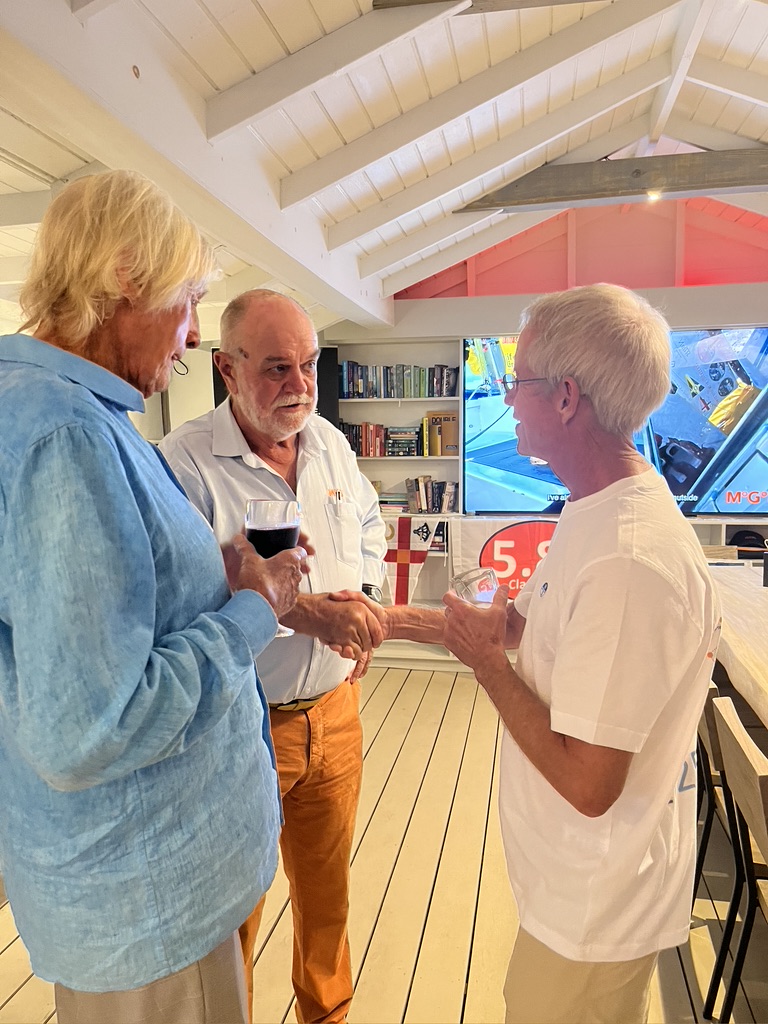
The founder of the Mini Globe Race, Don MacIntyre, designed the boat and then sailed around the world in it himself. He is in the center of this photo with Bob on the right and a local man from the Antigua Yacht Club on the left. Don held a reception where each sailor got to talk about what has drawn them to participate in something like this. I thought I would think they are all unhinged, but surprisingly I didn’t. Not that I would ever want to do this when I don’t even enjoy sailing between the islands down here. But, I’m amazed to say that in most cases I understood their reasoning. There are two women in this year’s race, an older woman from Spain, and a young woman from the UK.
Here is Bob with a German sailor, Christian, whose boat is named “Argo.” Part of the rules of this race is that you have to build the boat yourself, or buy it from someone who has already done the race. There aren’t too many of these boats so mostly the sailors have to make their own, either from plans or as a kit. Most of the racers have spent about two years building the boat before they can do the qualifying event of sailing from Lagos, Portugal, to Antigua. The race then leaves from Antigua (tomorrow morning) and heads to the Panama Canal.
Of the 15 entrants in this race (which will take 13 months to complete, ending back in Antigua) most are Australians, including a father/son team. Since it’s a single-handed race the son built two boats, one for his father and one for him. That was a big commitment and a big challenge. Now they will compete against each other. There was an interesting Polish man who now lives in Ireland, so his boat flies the Irish flag, which is quite a contrast to his strong Polish accent. There is one American man, Josh, whom Bob and I enjoyed meeting. He used to be an extreme mountain climber. He says sailing is lot less dangerous. Well, if he says so. He gave us his card with his website listed on it so we can track his progress. I know Bob will be glued to that, as he was when Jessica Watson sailed around the world.
Tonight there is another gathering to celebrate yet another sailing-related thing. There will be drinks and grilled food on the terrace of the yacht club, where the volunteer crowd was photographed yesterday evening. Bob is loving all this. At some point this morning the 15 Mini Globe boats will parade through the harbor blowing their air horns. They should sail right by us. Did I mention that Bob is loving all this!
Meanwhile, I am knitting, and there is a glimmer of a chance that I might finish my current project before heading home one week from today. This morning I spilled black coffee the part I am currently knitting. Horrors! I gave it a soak in cold water, trying not to get the attached yarn balls wet, and it looks like I have avoided having a stain. I can’t continue knitting until it dries. In the photo below I am checking to see if the back panel matches the number of stripes and the measurement of the first front panel. I am also taking photos to record the project in my new organizational tool, Notion. The right front and the back are now finished, and I am working on the second front panel. One week to go, including the finishing work which has some i-cord embellishment as well as sewing the pieces together. Alas, I have no buttons! I’d like to wear it in New England before the cold temperatures give way to spring.
Knowing that I will not be back here for the foreseeable future I had to buy more of Nancy Nicholsen’s island pottery. She does not ship so I feel compelled to enlarge my collection on my last few days here. Actually, I bought 4 pieces that will all be gifts. I’m not sure how I’ll get home with them since they weigh more than clothing, and I have a fair amount of that to pack. Here are my pieces, which live on Pandora and get used almost every night at dinner.
The new things I purchased are heavily packed for travel, so I can’t photograph them. I love these designs and the colors Nancy uses in her glazes. She gathers the clay locally, and her blue on blue pieces really match the color of the water here–the aqua of shallow, coastal waters and the deep indigo of the sea. These are wonderful mementos of Antigua.
My time here is now short. One week from now I will be sitting in the airport awaiting my flight. The future is looming large with projects I want to start at home, some teaching engagements, and more travel! I will soon be catching up with friends and helping to hang an exhibit of woven works. It’s all great!
It’s January, the first month of the new year as well as my birth month. It’s the month when the ancient god Janus for whom the month gets its name, compels us to take stock of where we’ve been and what we’ve done as we look to the future for where we’re going and what we’ll do. He is the god with two faces, looking forward and looking back. He predates the Roman gods and is likely a god from Etruscan origins. The Etruscans are near and dear to me, in spite of what little is known of their culture. Their artwork is glorious and is seen in subsequent centuries in Roman culture. I visited Tarquinia in the late 1970s, in college, where there are many Etruscan tombs with artwork still intact. I had the thrill of being there again a couple of months ago, in October. The images of Etruscan artwork are prominent in my mind this month as I plan for the future.
This is my last year in my 60s. This is a year where I want to pay particular attention to looking back so I can determine where and how I want to go forward Into what will hopefully more than a decade of continued creativity. I know I have to keep de-stashing and even more importantly, I want to create things. I realize I must clear some space both physically and mentally in order to create. I am becoming bogged down in my own stuff. Someone else, younger, with more years of creativity in their future, needs to take some of this burden off my hands.
I’ve been in Antigua for 6 days now. I was treated to a quick tropical squall on the morning of my birthday, followed by a beautiful rainbow.
Then the day progressed with getting a cooking/baking lesson with the French chef of La Brasserie in English Harbour, Antigua. Eric gave me a lesson in making macaroons with fillings. He made me a large macaroon cake which is called an ‘Ispahan’ in French. My macaron cake was scented with rose water, and the filling was a butter cream/custard mixture which I also learned to make, raspberry jam, and fresh raspberries. It’s wonderful to have a beautiful dessert that tastes as good as it looks.
It’s been a rather busy few days since we arrived in Antigua. We’ve met up with cruising friends who have either returned here or stayed here through the holidays. Some non-sailing friends visited during their winter vacation here. It’s their first time in Antigua, and setting aside the Christmas winds that have arrived bringing high winds and rain, I think they are enjoying the island.
Today is our first day with no scheduled events, so we took our dinghy to a new breakfast place called You and Me. It has well shaded outdoor seating area with great views of the head of Falmouth Harbour.
After I finish this blog post I intend to knit for most of the day. My older son gave me a wonderful selection of yarn for Christmas. It’s from a local shop near him, and the yarn is “Yarn Citizens Luxe.” He bought five colors: Pearl (close to white), Heather (barely lavender), Jasmine (medium lavender), Ocean (medium indigo), and Coal (medium charcoal grey). The yarn is 49% baby alpaca, 39 % mulberry silk, and 12% cashmere. I can barely feel it as I knit, and it looks like a cloud.
My goal this year is to concentrate on finishing many UFOs, but this gemlike yarn obviously took precedence. I’m knitting a simple top/down raglan sweater and will use the colors from palest at the neckline to darkest at the hem. Even with our busy schedule, I’ve made sure to have relaxing knitting time part of every day.
Looking back, I am more satisfied than I expected with my projects this year. I should make a record of them, and to help me accomplish that my younger son introduced me to the app called Notion a couple of years ago. Notion allows you to keep track of projects in motion, to keep track of the order in which one needs to tackle projects, and to keep a record of things accomplished. I still haven’t managed how to include photos with this work tracking app, so I haven’t used it to its best potential. On the other end of the organized spectrum, I have an older friend who records all her finished projects in a regular notebook with a printout of the photo she takes when she finishes something. I have not resorted to that method because I have a basic dislike of having a lot of notebooks taking up precious space on my shelves. The notebooks I already have are burdensome enough, not to mention the many decades of periodicals I have kept and the books I own. While these are all precious possessions to me, the lack of space is getting worrisome. Sometimes I feel I might get buried in my workshop and never escape. Learning how to better use Notion this year is pretty high on my list.
In November I was invited to participate in a textile arts exhibit at a private club in Hartford. I think there were only eight invitees, and two of us were new to this event. The exhibit will be on display for the months of January and February. The club held a lovely opening reception a couple of days before Bob and I left to come back to Antigua. I invited a good friend to join me, and when I arrived I realized I knew quite a few of the attendees, but only one of the other artists. It’s always inspiring to see what other textile artists do, and I came away with wonderful images in my head. I was the only tapestry artist on display.
I thought above the fireplace was a prime place for artwork, and I was honored to have a piece there. On the left are two felted landscapes done by the only other artist I knew from the group, Diane Cadrain. On the right is my tapestry “Sunset on Wilson Cove.”
To list the things I feel are accomplishments I’ve made this year, I might put this exhibit at the top of the list. It’s not often that textile artists have a venue to show their work, and I’m very glad I was asked and glad that I managed to pull some works together before leaving the country. I participated in two other shows during this year, and while that’s not much, it makes three events that brought tapestry weaving to the public.
I did a lot of weaving this year. I finished half the warp of woven sashiko, and I made a number of sakiori samples which led to a vest that actually fits me and a tote bag I’m enjoying using. I have the tote bag with me now on Pandora.
Jody captured the best view of the vest which is from the back (althought it’s quite wrinkled from a long car ride!). There are side gussets of sakiori and two sakiori pockets on the front, but the back is almost entirely sakiori. Here’s the front—a photo also taken by my friend Jody.
The fabric for the trim on this vest is what I used as the fabric strips for weaving.
I wove my first wedge weave tapestry, wove half the warp of my sashiko project and gave away four of the finished squares.
At long last I finished the Caribbean tapestry that I began during the pandemic. I can’t post a photo of it because I plan to submit it the Connecticut biennial when I return home. What I can show is the wonderful frame Bob built for the tapestry. This is our best attempt so far at having the back be as neat and tidy as the front.
This fall I made some fabric trays for a party favor for an upcoming event I will not be able to attend, and I made three lace flowers that I included in a fascinator that was made from various pieces of antigue machine lace I have and several ribbon embroidered flowers that I’ve made over the years. That was a fun project initiated by my lace group to become a new category of lace at the Big E Arts and Crafts exhibition. The fascinators are now on display at a local library.
And then there was a little weaving and a LOT of dyeing in Umbria, Italy, which I wrote about here and here. In December my friend Jody and I put some of our new knowledge to work during a two-day dyeing session in my kitchen—right after the new year. We used indigo, weld, madder, and olive leaves and branches from my olive tree. It was hard to stop, and it’s one of the first things I want to do when I return home. The circle of colors starting on the lower right is 3 shades of maddder, , weld, olive leaves, weld with a short dip in indigo, two skeins in indigo (the first one is very blotchy, not sure why), and the last two are indigo dipped in madder. The last skein is close to a color I wanted to recreate from one of the skeins we dyed in Italy. I look forward to attempting that again at home this spring.
I also finished two knitted items this year: a vest with the yarns I got from the 2023 Kate Davies advent yarn box. It is tunic length and has a shadow knitting pattern running through it. The 2nd project is a sweater from a Kate Davies pattern called “Auchnaha.” I used her beautiful ooskit yarn in a natural grey/brown. I’ve enjoyed wearing both these sweaters before leaving New England for the tropical weather in Antigua.
Just before I left home I stopped at Hartford Artisans for a short meeting. It’s impossible to go there without being tempted by any number of wonderful handwoven/handmade things. This time I succumbed to this charming little pouch. It had a rather sad plastic button that imitated bronze. That just would not do! I changed the button to a shell, and added a shell to the plain commercial fabric at the top. I also added a piece of kumihimo from my stash of samples to turn the pouch into a wristlet purse. I’ve got it with me now in the Caribbean, and it is perfect here!
I’m pretty sure I have accomplished significantly more this year than in previous years. While it feels awkward and quite self-absorbed to list all my finished projects, I am trying to understand how I did these things, and how I can maintain this surge of work in 2025. It takes luck, of course, since we need good health to be productive, and that’s something none of us can predict. It’s time to knuckle down to learn more about Notion so I can keep better records, to de-stash my extensive work space, and get down to the business of doing what I love. Forward ho!
Here I sit in English Harbour, Antigua, thinking about my recent return from Umbria, Italy, and the highlight of my time there: a visit to a jacquard weaving museum and atelier in Perugia that is housed in a 13th c. Franciscan church.
Perugia became a walled city in the Middle Ages, prior to the building of this church in 1212. It was originally a simple hermitage that was founded by St. Francis of Assisi when he and his followers stayed here together. By 1252 the monastery was ceded to Benedictine nuns and given the name San Francesco delle Donne. St. Francis of the women—for the women? It was abandoned numerous times through the centuries, and I don’t know those stories. Our host at La Romita, the art school where we were taking a workshop on tapestry weaving and natural dyeing, mentioned that Perugia defended itself many times over the centuries. Most of the conflicts had to do with the vying city states and their status in the Catholic Church, and throughout the Middle Ages Perugia was an impoverished place, in spite of their reputation for excellent craftsmanship in pottery and textiles, and probably other fine crafts that I haven’t found in my searches. There is some great information on the Giuditta Brozzetti website.
The Brozzetti family started the weaving museum and atelier in 1912, but not in its current location. The museum is named in honor of the current owner’s great grandmother, Giuditta Brozzetti. Giuditta started an atelier to bring back the historic handwovens of Perugia, especially the “Perugian tablecloths” that were often used as altar cloths in churches, as well as being tablecloths in the homes of the very wealthy. Textiles were far more valuable throughout history than they are today and were always listed in the inventories of wealthy families. The atelier and museum moved to this magnificent site in the church in 1996. I believe it took a lot of work to bring the church into state we see it today. It is magnificent!
Here is an excerpt from an interview with Marta Cucchia, the great granddaughter of the founder and current owner:
“My studio is one of the last weaving ateliers in Italy – and the only one that reproduces medieval Perugian Tableclothes using Jacquard looms from nineteenth century. Furthermore, with the pedal looms, typical of the Umbrian countryside, we create fabrics using millenary techniques passed down orally from generation to generation. My great-grandmother, Giuditta Brozzetti, founded this Laboratory in 1921. From then on, the passion for hand-weaving was passed down from mother to daughter, each woman bringing her own experience according to her personality and studies.”
Marta has four women who assist her in the studio, and they have all come out of textile schools to make this field their livelihood. What an exciting place to work!
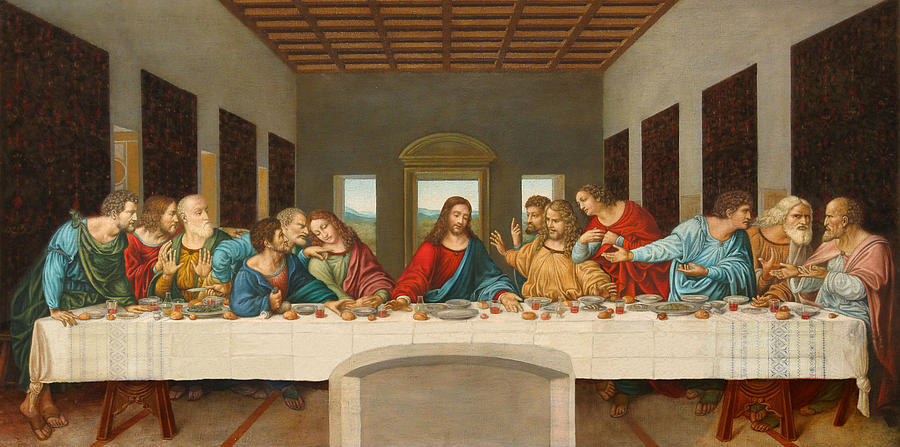
Some of the projects that Marta oversees are replicas of actual textiles in paintings from the Middle Ages and the Renaissance. During our visit Marta showed us a couple of impressive replicas. She had high resolution images taken of Leonardo da Vinci’s “Last Supper,” and she had small areas enlarged so she could study the tablecloth. In hind sight, why didn’t I think to ask her if she thought that cloth had been woven in Perugia?
Even in this low resolution image of the fresco, taken from the intenet, you can see that the tablecloth is highly figured at each end, but also there is a hint that the white on white areas also have interesting weave structures.
Detail of a similar fabric from a different painting:
Here Marta is showing us some of the images she used to design the tablecloth. Clearly I am scratching my head in amazement!
Photo by Jody Brewer
And here is the finished cloth, woven at the Giuditta Brozzetti Atelier:
The jacquard looms in this studio are all from the 19th c except one that is older from the 18 c. These are hand manipulated looms, where the process of weaving involves attaching every thread in the warp to a jacquard attachment that has a series of cards that control the patterns. The weaver stands at the front of the loom and depresses the one treadle (a heavy one that sits rather high off the ground!) with her right foot —yes, they are all women at this atelier. Depressing the treadle opens the shed, and the weaver pushes a lever that is above the beater that engages one of the jacquard cards, then she pulls a cord that sends the fly shuttle through the shed of the open warp. Here is a video of the process, although at this point the weaver is weaving some plain weave between the designs, rather than the more interesting pattern.
Here is Marta showing us one of the many charts of jacquard designs in her collection. These graphed charts are used to make the cards which will control the weaving patten on the looms.
And here is my best attempt at getting a shot of the entire loom. The warp on the loom will be obvious to most of you. The yellow cords anre atracked to each warp thread and are running vertically to a loft area where you just see a bit of the roll of cards used to weave the design. There are other ‘chains’ of cards being stored on the railing of the loft.
I neglected to count how many jacquard looms are in this large studio, but here’s a photo of the long row of them in the museum.
Many traditional Perugian designs can be woven on regular shaft looms with floor treadles. Marta demonstrated this on what looks like an equally old loom to the jacquard looms.
Here is particularly stunning tablecloth woven on a shaft loom in a traditional woven structure with luscious colors. I tentatively asked if it was for sale (and the price) and learned that Marta wove this tablecloth for her wedding. What a treasure…
During the time when Marta’s mother led this studio they produced some designs for clothing. During Marta’s tenure she has also had commissions from Italian haut couture houses.
Photo by Jody Brewer
These dresses were designed and woven here, and I’m guessing this occurred in a past decade, perhaps the 1960s? 1970s?
There are other modern designs available here. This is quite a striking pattern that was for sale as a shawl or a cushion.
While we were there one of the weavers brought out this tiny gem woven in the same structure. They are not yet available, but as soon as they are I need one! I’m sure they will be popular. When I posted a photo of this Facebook some of my friends immediately asked how to get one.
This is my prize purchase from the day, a gem that gives me a little shiver of thrill whenever I take it with me somewhere. It is equally beautiful on the inside, lined in a fine silk fabric from Fendi.
Marta and I also discussed some of the fine finishing that goes into many of the pieces they make. In particular, Marta’s mother adds a beautiful bullion edge to some of the table runners. I must give this a try on some of my handwoven projects. I bought a small runner that I cannot show you because it is at home, and I am writing this in Antigua. Mine is off white on white, with jacquard designs at each end, and the point twill design in the middle. This one is far more elaborate, but I want you see the bullion stitch edges.
Each one of the pieces woven here are exceptional examples of textile skill. In many parts of the US, textiles are no longer valued as they deserve. I hope we can bring some of that respect and awe back into our lives. My house is full of my own handwovens, and sometimes I marvel that many of my guests don’t realize that. I’m not sure people even see textiles anymore, beyond noticing someone in a beautiful dress. There is so much to marvel at in the world of handmade cloth. The Giuditta Brozzetti Museum and Atelier has to be one of the best places to go and relish the beauty of handwoven goods. Get there if you can! If not, there are beautiful images and descriptions on the website.
We are having a rip-snorting winter season in the Caribbean. I would prefer a gentle season, but there is no bargaining with Mother Nature. Actually, I know this weather is not her fault. It’s humanity’s fault, so I am partly to blame. I won’t go into the weather here, but you can see some pretty frightening images and videos on my husband’s recent post on SailPandora. We moved to the mooring field in Les Saintes one day before this storm hit, and it was a good choice for staying safe.
Not many days have been calm enough for weaving onboard, but I am trying. I brought so many projects onboard, and I feel compelled to make progress and even finish a few of them. If I finish two tapestries I won’t have to cart the looms home with me when I fly home in April. That’s a pretty strong reason to get them done!
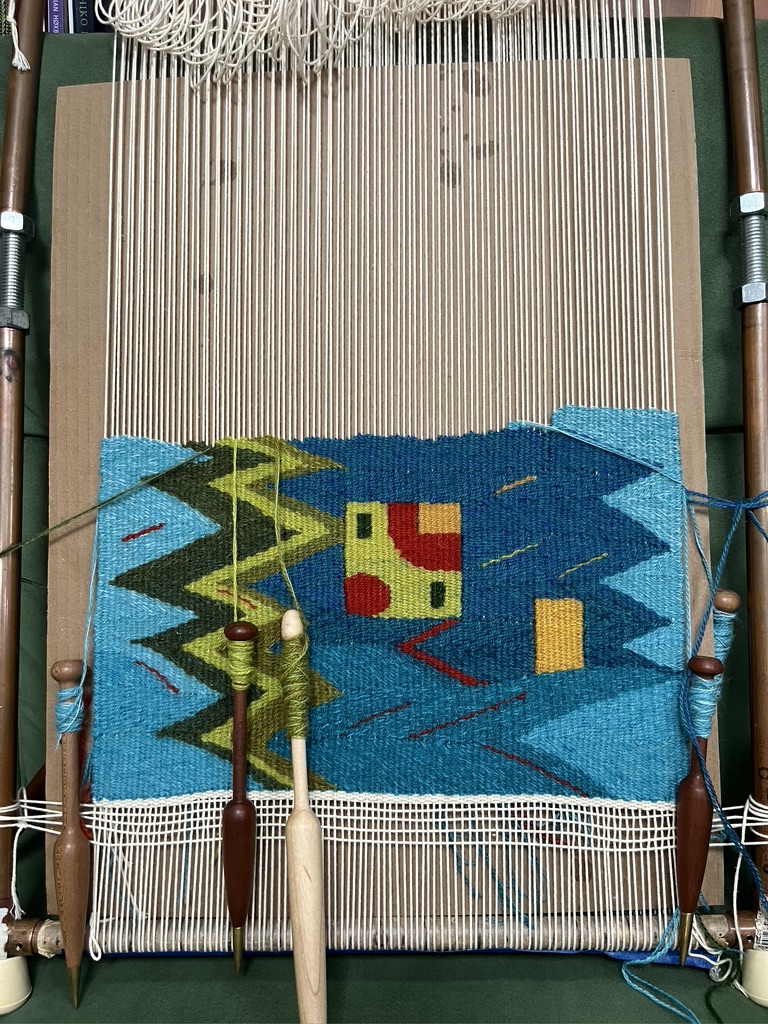
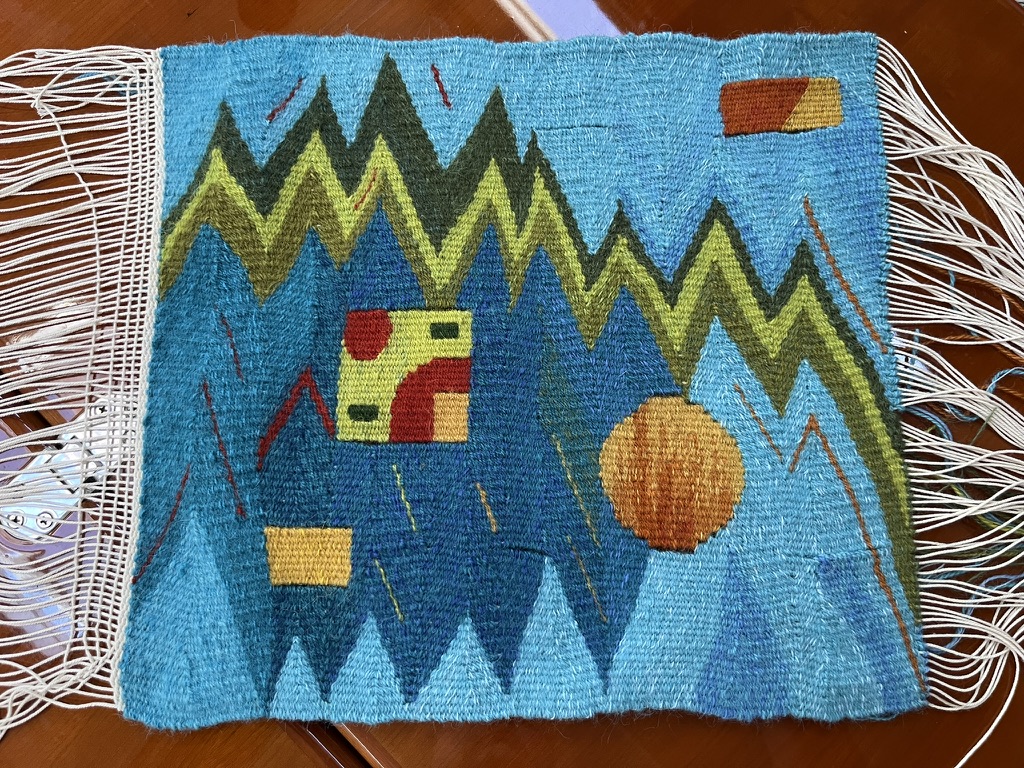
I am trying my hand at wedge weave, and I started this project back in July under the tutelage of Connie Lippert at the NEWS conference in Worcester, Massachusetts. For some reason my brain gets confused on which direction the wedges travel and when to continue on the diagonal or move across the warp to create a horizontal section. I may have unwoven almost as much as I’ve woven, and I don’t seem any closer to making sense of the angles. Old age? I hope not!
During the July class I added the little gold rectangle woven in Gobelins style. While onboard I wanted to add a more complex bit of Gobelins style, so I wove the square that has a couple of shapes inside it.
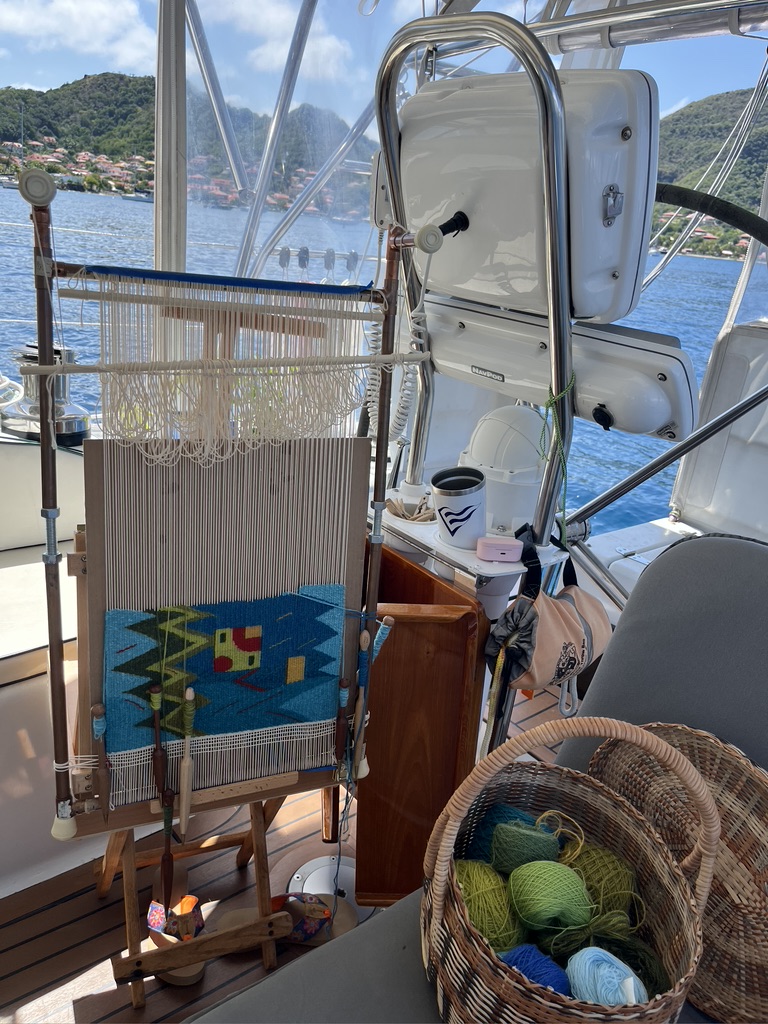
Here is the one glorious day when I was able to weave in the fresh air in Pandora’s cockpit.
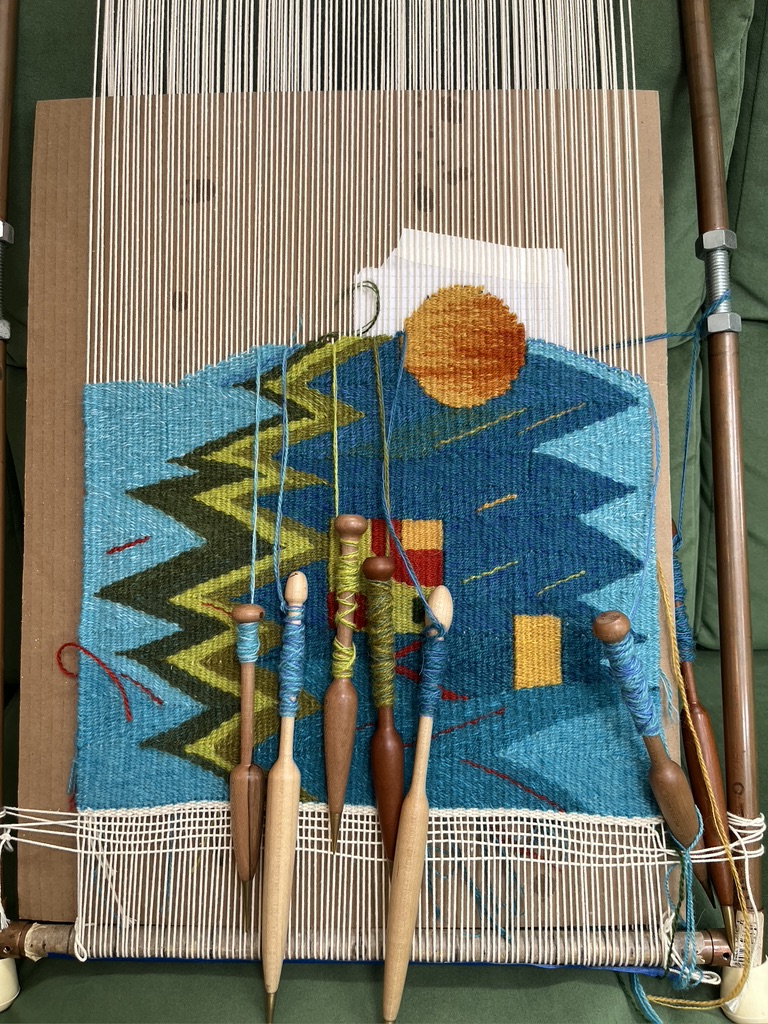
I have consulted Connie a couple of times along the way recently. Being outside the US makes me feel a bit disconnected which can also make me wonder if I’ve taken a detour away from where I need to go to acquire some skills at wedge weave. I’ve had an impulse to add a circle to the wedge weave. I pondered this, wondering if I’d have to weave an easier shape, like a square, in order to put the circle inside it. But that is not what I envisioned. I wanted a circle with the wedges abutting the edges of the circle. Connie thought I should give it a try.
I now have my circle!…but, my wedges are going in opposite directions. I’m not sure what will happen when the wedges meet above the circle. These wedges are confusing me!
In other news I’ve made some wonderful textile purchases. Bob and I took a day trip with friends while in Dominica, to visit the private lands owned by the Kalinago nation. They are not the original inhabitants of Dominica, but they certainly predate the European settlers. The European explorers named these people the Caribe. Naturally, they prefer the name they call themselves, Kalinago. Bob and I have visited here in past years. I’m intrigued by their lifestyle which makes such good use of plant life for food, remedies, and building materials. They are well known for their baskets, and this is my third time to collect more of their beautiful baskets, which are made from a reed like plant. They condition the reeds in different ways to give color the material. To make black they bury the reeds in a pit where the minerals in the soil darkens the reed. Our friend Bill got this photo of Bob and me trying to decide what to take with us.
Here we are sitting in the shade of the beautiful community where the Kalinago live. Oops! Actually, this is another day we spent together in Deshaies, Guadeloupe! We are with Bill and Maureen from Kalunamoo.
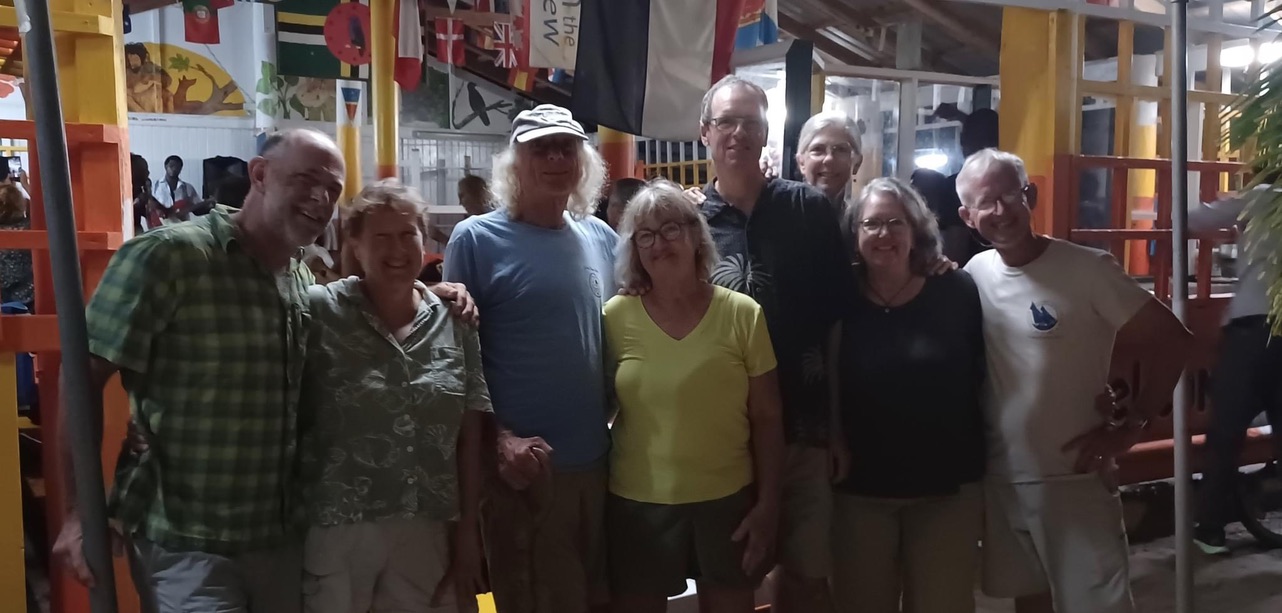
And since I’m adding photos from other days, here is one of my favorites with a number of our sailing friends who gathered for dinner that night.
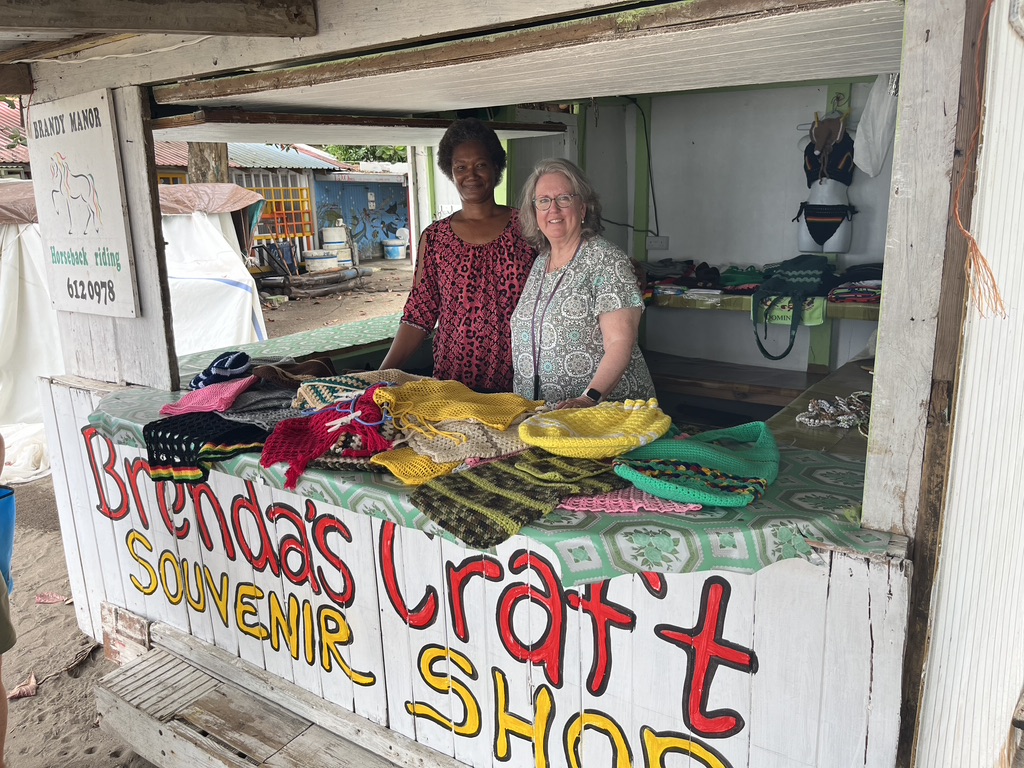
On several visits to Dominica I’ve had my photo taken in front of a vendor’s stall called “Brenda’s Craft Shop.” This year I got meet Brenda! I bought a finely crocheted wrap skirt to give as a present. I can’t show you because it’s to be a surprise for a dear friend.
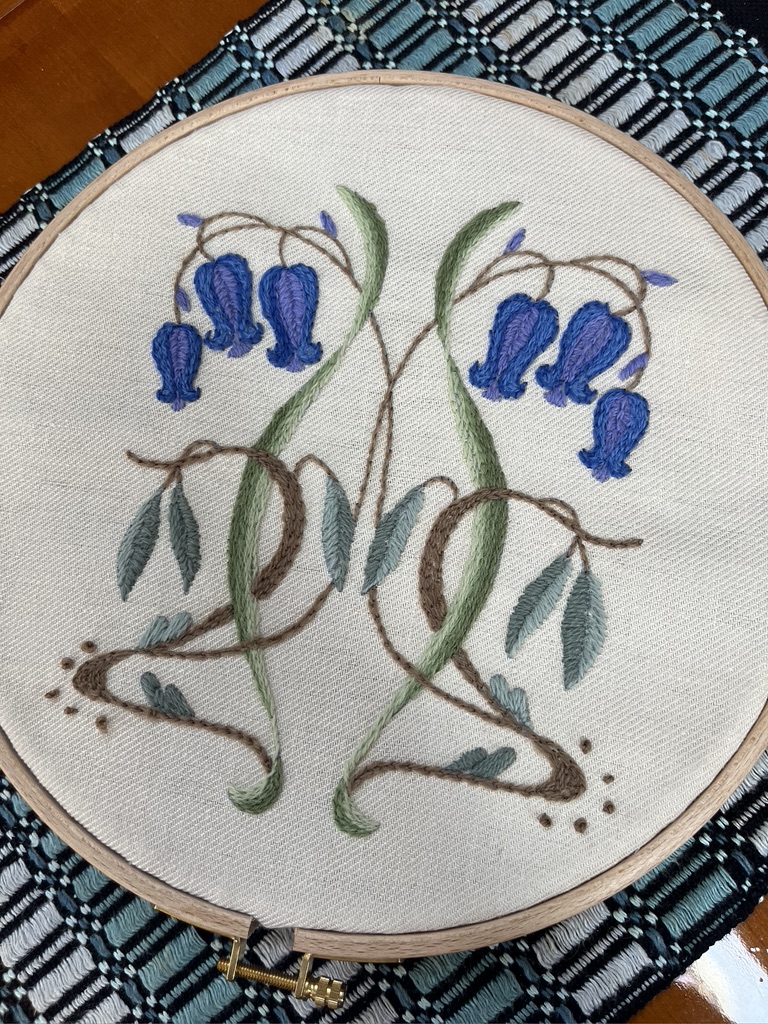
I tried my hand at an unfinished embroidery project I brought with me this year. On some days I simply could not line up the needle with the place I needed to insert it because of the rolling waves coming into our anchorage. It was daunting, and I often felt I might become crosss-eyed, but now I am happy to report that this project is finished! At home I hope to try my hand at framing an embroidery myself. This embroidery design is from an English company called Melbury Hill. They have some coordinating designs that go with these bluebells, but for now I need to stick to weaving those two tapestries.
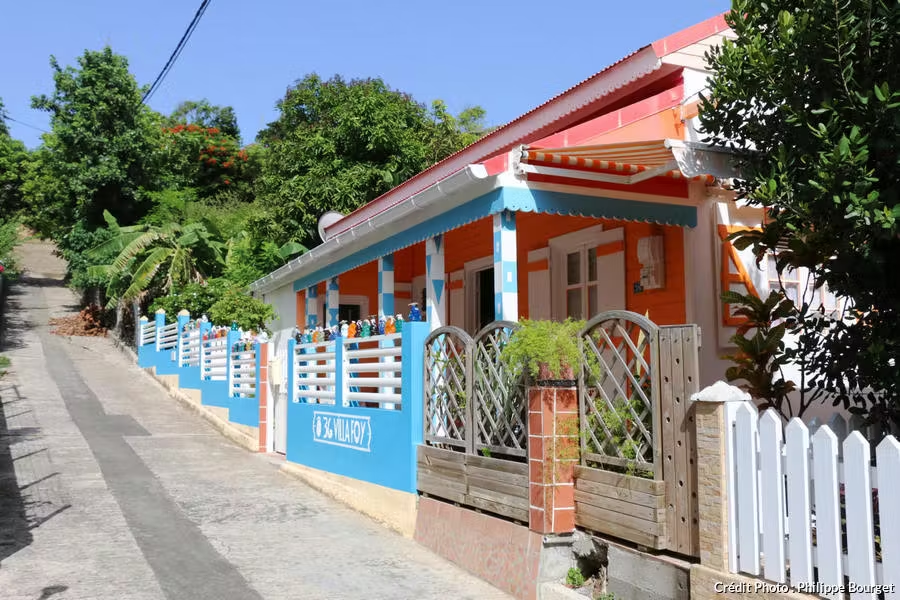
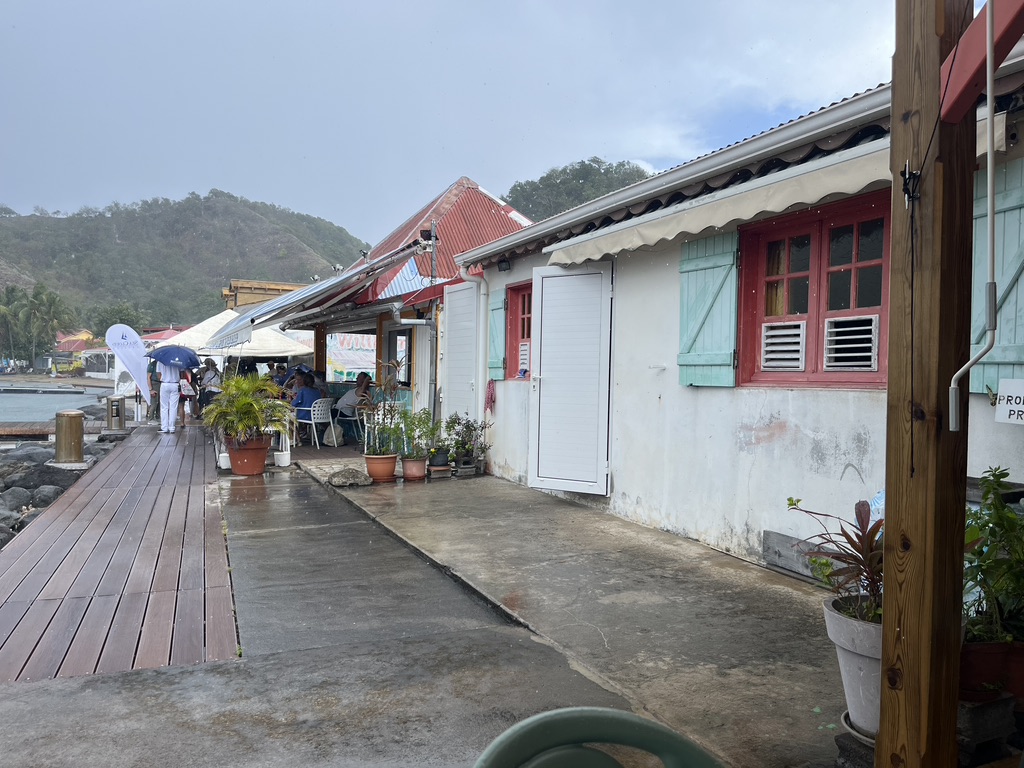
As I write this we are on a mooring in the small archipelago of islands at the bottom of Guadeloupe. The main island is called Terre de Haute, and it has a charming village that entices many French visitors who arrive multiple times a day by ferry from Guadeloupe. There are some wonderful shops and many restaurants.
I must be getting tougher, or perhaps just more determined (desperate?) as I age. I am working on days I could never have worked in previous years. It’s good, and bad, in equal measures. I hope I will be taking a home a number of finished items in April.