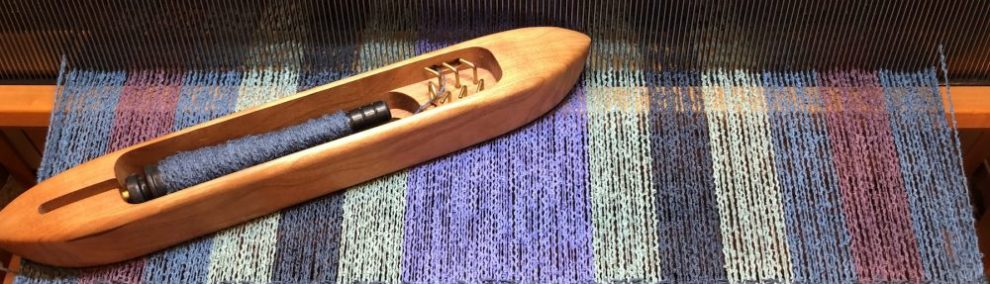
ArgoKnot

The Thrill of the Finish!

There’s nothing like finishing a weaving project, from cutting it off the loom, to wet finishing, to seeing what the cloth truly becomes when it’s all done. There is a saying about handwoven cloth– it’s not finished until it’s wet finished!

I’ve had a lot going on over the past few months that prevented me from weaving this project on a regular basis. When that happens the long awaited finish is even sweeter. Here is Tori’s blanket.

Some of the details…
–I wanted bigger circles than was possible in the original draft from Handwoven, written by Susan Poague (that would be Handwoven, May/June 2019). That draft used 8 shafts in a structure called ‘turned taquete.’ I enlarged the circles from about 1″ in diameter on 8 shafts, to somewhat bigger than 2″ in diameter by expanding the pattern to 16 shafts. You can find the drawdown here.
–I wanted the blanket to be machine washable and dry-able, so that eliminated the possibility of using wool. Wool would have been my first choice, but I did not want to use super wash wool for a number of reasons. For one thing, I have not found a super wash wool fine enough for what I wanted to do with this project. I used 6/2 unmercerized cotton (Valley Cotton, from Webs) sett at 20 ends per inch. It washed and dried beautifully, and became quite soft to the touch. All good!
–I debated on size. Making it the size of her full bed would have been cumbersome, although doable. I opted for a large throw so she could use it in a number of ways. On the loom it was 45″ by 66″. After wet finishing it is now 40″ x 58″. I love the way it feels!

Circles are terrific fun! I hope you will check out Susan Poague’s article in the Handwoven issue above, or use the link to my draft for larger circles if you have 16 harnesses. I would still love to try this in wool…maybe 18/2 merino, in colors that would work in my den. I am dreaming of this as a throw for winter nights in front of the fire, in various autumn golds and ochres with a few circles of red and deep green.

Next up on my weaving list is Tom Knisely’s idea for “paper towels” from Handwoven, March/April 2021. The article is titled “Redefining the Paper Towel.” He used 8/2 cotton for the warp sett at 20 ends per inch. He used the 8/2 for most of the weft as well, with a few stripes of paper yarn at regular intervals. The paper yarn he used is “Shosenshi” from Habu Textiles. It is a 100% linen paper….fascinating. Tom used white. Here is the image from Habu’s website.

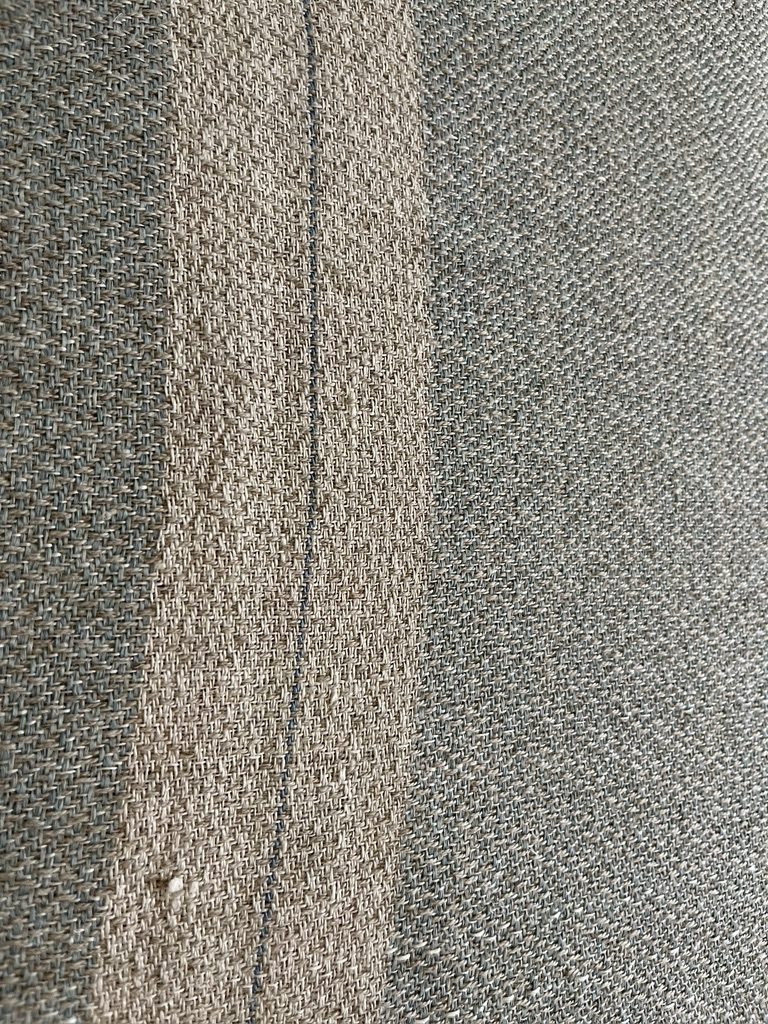
Since I prefer linen, I have made my warp in natural colored cottolin from Camilla Valley Farm. I am threading the warp in Goose Eye, and I will use a very fine white linen weft as tabby between my paper pattern weft. Habu carries Shosenshi in a lovely spring green which I couldn’t resist.

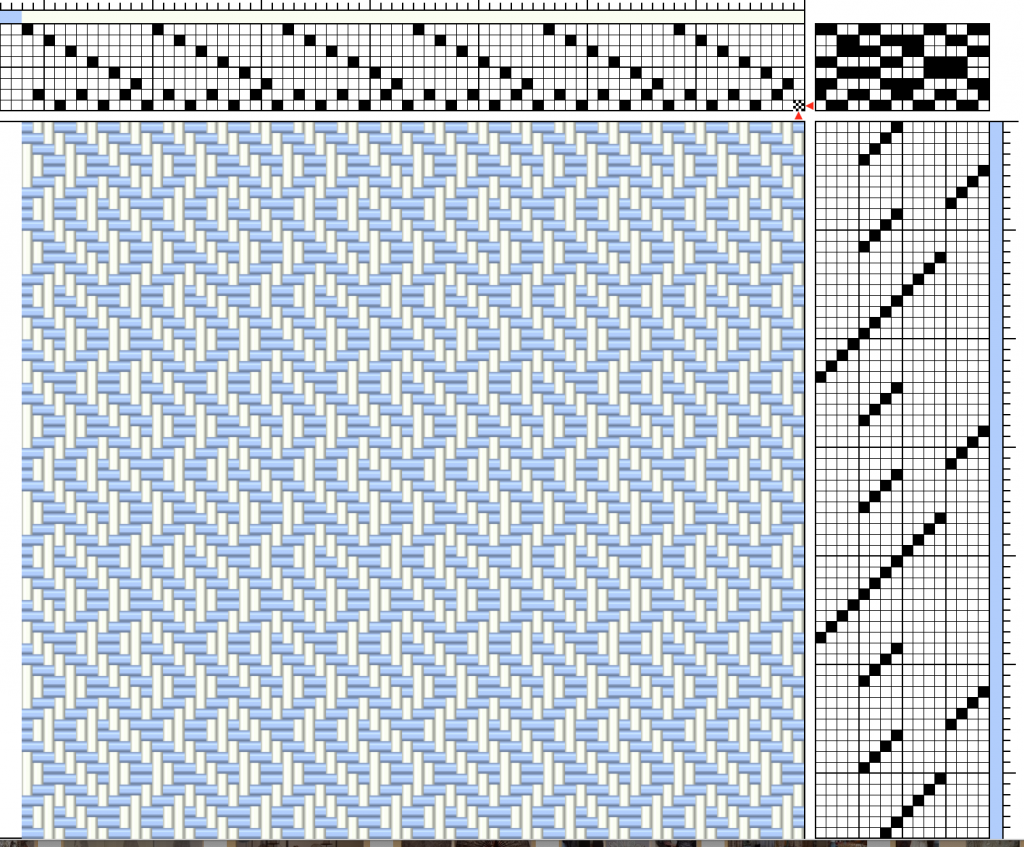
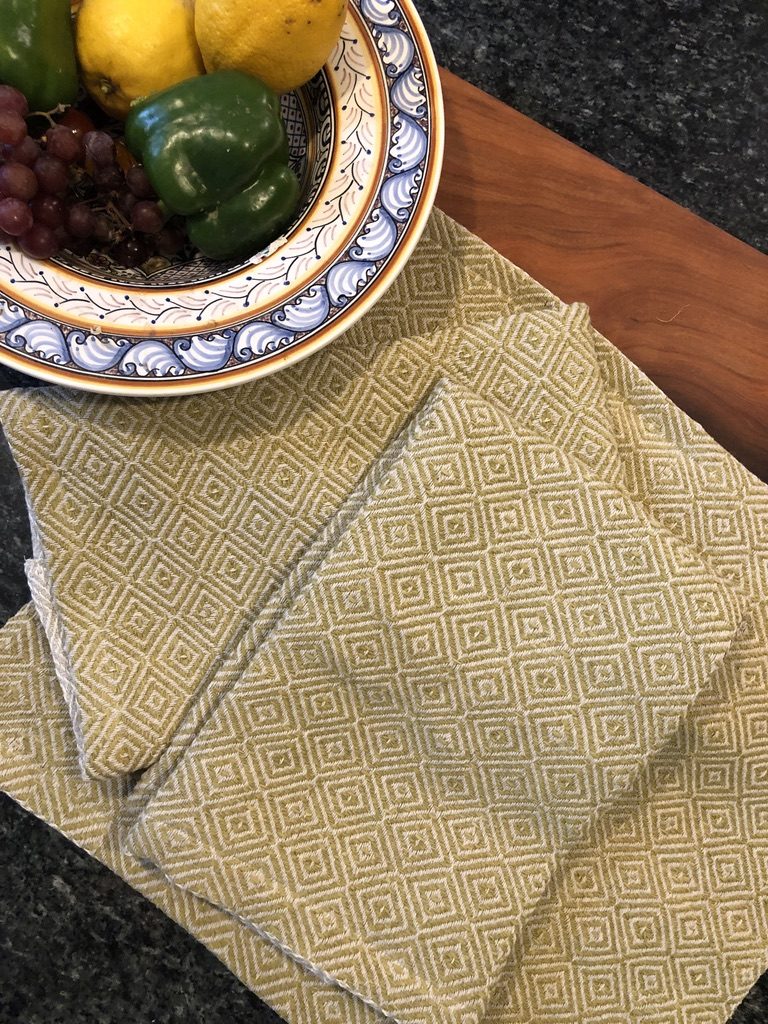
Tom played it safe weaving his towels in plain weave stripes, and I know I should follow his lead. I wonder if my Goose Eye floats will end up snagging and tearing…but I can’t resist the idea of concentric diamonds in paper, hopefully held well in place by fine linen. I’ll have 4-thread floats all over, with a few that are longer. At 24 epic, the 4-thread floats will only be between 1/8″ and 1/4″. Still, that could be troublesome for the Shosenshi. Here is my draft.

The warp is made and now wound on my smaller loom–the 8S Baby Wolf. This warp is 20″ wide and sett at 24 ends per inch. I am about 2/3’s done threading as I write this. I know this will be a fun project; I just hope that the paper towels will hold up to washing and drying and doing duty in the kitchen! I’ll do a sample at the start and cut it off to wash and use in the kitchen to test the fabric. Stay tuned, and if you also give this project a try, please let me know!

Did you notice that placemat in background of my photo of the yarns for the paper towels? That’s a very old project for placemats made in single ply blue linen with a bit of honeysuckle patterning at both ends in a fine white cotton. These placemats are about 30 years old now, and I only made four back then. I have recently realized that they are the only placemats I ever made in blue! I’m not sure how that happened since my everyday dishes are blue. I guess whenever we’ve had more than four people at the table I have used a tablecloth. Various other placemats I’ve made over the years coordinate with blue or go with my various holiday china patterns, but are not blue themselves. Now I am positively committed to having blue placemats on the new cherry table that Bob made. I want some of that beautiful figured cherry grain to show, no matter how many people we have at the table.

That means I’ve been looking at new ideas for placemats. I would love to weave these again, as they were an enjoyable project all those years ago. I know I would not get the same yarn, and I’m not sure how I feel about trying to find something to coordinate with this linen. It was linen from Finland, possibly Vaxbo, but I didn’t keep a record. I believe it was an 8/1 linen that I used for both warp and tabby weft. I have some thinking to do about this project, but one of the patterns that is quite tempting is from Webs. It’s called “Summer Elegance Runner” that is an 8-shaft overshot in multiple colors sett at 24 ends per inch. It uses 10/2 cotton in various spring colors. I bought the drawdown a while back, and this week I set aside some linen yarns from my stash to consider. It’s a hard decision because I still love my blue honeysuckle mats. I’m sure there will be more ‘thinking out loud’ on this here in the coming weeks.
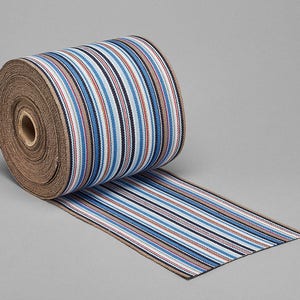
My possible yarn choices…. the middle color is really a pale green. My main color will be blue.


Got any advice or preferences? Please get in touch!

The Circle Craze

Did it start in spring of 2019, with the May/June issue of “Handwoven” magazine? That was the first time I saw Susan Poague’s tempting pattern for woven circles. It only took 8 harnesses to make a row of circles offset by the next row of circles. I was crazy for them, and it seemed that everyone else was too! These dishtowels were showing up in guild show and tells and on social media everywhere.

There they are, in the lower left corner of the cover. Around that time I also found them on Etsy, woven by the author of the article herself. I bought them to use onboard Pandora because the colors were perfect for that setting. Here they are on the table of our outdoor dining room.

My friend Marilyn weaves things so quickly she’s done with a project before I finish reading the source where she got the idea. That was the case with her version of dishtowels with circles. She had a whole set coming off her loom while I was still gazing at the photo on the cover.

Susan Poague’s towels on the cover of “Handwoven” and her placemats that were for sale on Etsy are a structure called taquete that she has turned, so that the colors for all those circles are in the warp, and the weaving is done with just the one background color.

When I saw this project for turned taquete I immediately thought of my grandchildren and a blanket. Wouldn’t those circles look terrific bigger and in lots of bright colors? Oh, yeah! It’s hard to make things for three grandchildren who all live in the same family. I generally make just one and hope they’ll share until I get to the next project. Our oldest is four years old, and she deserves the next handmade thing, especially since her first blanket in knitted lace accidentally turned into a doll’s blanket (about the size of a placemat) when it got thrown in the dryer after washing. This blanket will be easy care.

Before I began to work on designing a draft for the larger circles, I thought I’d better learn a bit about taquete. I just happened to have a book on weft-faced pattern weaves in my library, and it just happens to be the best resource on this subject.

The author describes Taquete as a weft-faced compound tabby weave. I often find descriptions and definitions of weave structures hard to understand before I’ve actually made a warp and woven the structure. That was certainly the case with taquete. One surprose for me was that although every other shed in the treadling looked like plain weave, raising all odd shafts, then a pattern shed, then raising all odd shafts, those odd/even sheds were not the plain weave. Plain weave occurred when I raised shafts 1-8 and then shafts 9-16. It was a head-scratcher.

When I looked at a number of drawdowns for this structure I saw parallel threadings. In fact, when I wrote the draft for my circles, I used parallel threadings with one set of circles based on shafts 1 – 8, and the other based on shafts 9 – 16. Hoskins explains the structure further here. Examples of taquete textiles were found in Coptic Egypt from the 2nd century BCE, and in other sites in the Near East. Eva Stossel has a good description of the structure here, as well as photos of her designs. It’s a treat to see what she’s done with this weave structure, for which she credits Bonnie Inouye, and her scarves are far more adventurous than my circles!

So, circles. I wanted them to be bigger than what I saw people weaving for their kitchen linens. I had two options for bigger circles: heavier materials and more shafts. I decided to take advantage of both. Of course I should have sampled, but I don’t have heavy cotton threads in my stash. I had to order a ton of colors for this project, so I jumped in and figured I’d do some sampling at the beginning of the blanket warp. I ordered eight colors of 6/2 cotton, seven bright colors for the circles and a medium grey for the background. I planned to set the warp at 20 ends per inch. The 6/2 cotton (from WEBs) comes on giant cones that weigh more than a pound each, so I am well stocked in bright colors. Next came resizing the circles on 16 shafts. That took some trial and error, and I am so thankful I could do this with software on my computer rather graph paper. I use Fiberworks PCW. The pattern published in “Handwoven” uses 10/2 cotton set at 24 ends per inch. Each circles takes 24 threads, so the resulting circles are about 1″ in diameter. Each of my circles takes 50 threads, and at 20 ends per inch, my circles are 2 1/2″ in diameter. I have 19 circles going across the warp for a total of 950 threads. I had a plan.
Here is the draft I settled on after some trial and error.

The last thread on the warp drawdown is a background color (grey in my design), and the first thread of this drawdown is also a grey on shaft 9. Do not repeat that thread! I didn’t know how to remove it from the document! Mea Culpa!

When I checked my photos I discovered that I warped the loom back in January. It sure took me a long time to get this project going.

Then came threading the pattern through the heddles on the 16 shafts during some snowy days in February.

Next came sleying the 950 threads through the reed, two threads per dent in the 10 dent reed.

And on the very last days of February I started weaving. Voila! Circles.

I am quite happy with this project. Today is March 1, the snow has begun to melt, there is a full moon at night, and I am on cloud 9. I may be the last to arrive at the circle party, but I am a happy to be here. I am a happy weaver.

And the Books Go on, and so does Weaving

It’s been a long New England winter, and all the new books of the past year are keeping me in good company. Have you read Threads of Life: a History of the World through the Eye of a Needle? The author, Clare Hunter, wrote with such personal passion about her various choice of examples. She has led many community projects in textiles that demonstrate how people from many cultures, male and female, young and old, have a visceral, often therapeutic, reaction to working with needle and thread. The book would be greatly enhanced with photos, but not having them forced me to search online for some of the projects the author covers. I savored the book and hated to finish it.

Now I am reading another book on a similar subject, that is handled so differently. It’s The Fabric of Civilization: How Textiles Made the World, by Virginia Postrel. It’s also a compelling read, from the point of view of a journalist. The stories of ancient textiles: making string and cord, the dawn of weaving, are subjects that I have loved since early adulthood. There is reasonable evidence that spinning thread and cord and rope is what ‘drove’ humans to invent the first drive band, which means that what the first wheel was used to accomplish. Thread!

It’s fairly likely that I won’t get through all the books I bought in 2020 until sometime after 2021!

I have spent some time over the past few weeks setting up my new-to-me AVL. A couple of years ago I sold my previous 16S AVL mechanical dobby, an FDL (folding dobby loom) with a 40″ weaving width, along with my 8S Toika (countermarche) that had a 60″ weaving width. I wanted to replace these two loom with one computer driven loom with a 60″ weaving width. All of this selling and buying went far more easily than I would ever have imagined. It all transpired in the course of about 3 months. Bob says I’m quite the pessimist, but I see my attitude as positive in a different way. I make peace with what I imagine might be the ‘worst case scenario.’ If I can do that, I can stay the course for however long something takes to achieve. And this whole process of getting rid of two looms to replace with one went surprisingly well.

My current loom has a fascinating history that I knew nothing about when I first pursued getting this loom. The loom does not have have an AVL plaque or a serial number, which means it is a very early model, perhaps from the late 1970s. Marion Scannell, from Waterford, Connecticut was the first owner. She had a weaving shop called Waterford Weavers, and many weavers in the state considered her a mentor. She was generous with both her knowledge and weaving supplies. She wove all the fabrics in her home, from draperies to tablecloths to upholstery fabrics. Boy, I wish I had known her and visited her house! At that point in my life I was living and weaving in New Jersey, so close but so far. She used Fiberworks to run the dobby head. She was instrumental in getting many of the weaving guild members excited about computer driven weaving. After Marion’s death this loom was given to the Blue Slope Museum in Franklin, CT. One of my friends in the guild used to volunteer at this museum and at one point noticed a shuttle with the “Waterford Weavers” label on it. When she inquired she learned that Marion’s daughter had donated a number of weaving tools as well as the loom to the museum. The loom had been disassembled and stored in a barn on the museum’s property. The compudobby box was being stored in the house. The museum personnel wanted to out-place the loom since it was far too modern for the museum’s time period. That’s when the loom came to studio of my friend Janney who just passed it on to me. Janney rebuilt it and tuned it up. She assured me it worked well even after the many decades of its life. She was right, and I am so thrilled to be weaving on it now.

These days my creative time is a balancing act. I have my fingers in a lot of pots. I’ve had to set aside a number of projects in order to get this loom up and running, over a year after I bought it. I’ll spare you the details of why that happened, but many of you know how much of each year I spend living on a boat without access to my looms! I designed the pattern that I’ve put on this AVL, and it has some glitches. Perhaps that was not the best choice for a first project to get acquainted with the loom, but my time at home for weaving is always shorter than I’d like so I thought I’d better jump into the deep end. I hope I’ll be posting photos of my turned taquete circles on 16 shafts soon. It will become a blanket for my toddler age granddaughter. Meanwhile, Mila the husky looks rather posh striking a pose at the loom.

A few of my favorite things!…Books!

During the year just past, 2020, I bought a record number of reference books on weaving, tapestry, and textiles in general. I started reading one, then another arrived in the mail so I started that one too. This went on until I had about six books partially read, and I realized that I’m not mentally agile enough to read that many books at once!

Threads of Life: A History of the World through the Eye of a Needle is not the first book that arrived in my mailbox, but now it is the one that I have focused on finishing ahead of the others. When I decided to set the others aside and read this one, I became enthralled. I can hardly put it down. The author covers some important historical events where needlework factored heavily, such as the Norman Conquest and its recorded depiction in the well known Bayeux Tapestry. Another chapter covers Mary, Queen of Scots, and her many embroideries used as pleas to those who might give her aid. But what makes this book a page turner for me are the everyday stories of women and men who find solace or find their voice through working with a needle and thread.

The chapter titles are compelling. “Unknown” is about the women (nuns) who worked on the Bayeux Tapestry and whose identities we’ll never know. Other chapters, with titles like “Frailty,” “Captivity,” “Loss,” describe the many ways that needle and thread have assuaged human suffering or given voice to those who felt unseen and unheard. You can imagine what some of these circumstances might be before even reading the book. Jews in camps embroidering messages and emotions on fabric as small and delicate as handkerchiefs, men in POW camps doing the same. Larger works, like banners, express political ideas and personal causes. In 1985, a massive banner of appliques and embroidered quilt blocks, was displayed in Washington, DC, to draw attention to the HIV/AIDS pandemic. It was meant to wrap around the Pentagon.

“The Ribbon didn’t just wrap around the Pentagon. It spread across the Arlington Memorial Bridge, around the Lincoln Memorial, down the Mall, around the Capitol, back up the Mall, back to the Lincoln Memorial and the Pentagon.. It was 15 miles long.”

These are just a few of the many stories that the author addresses with such sympathy and understanding. She herself has worked with people who have PTSD or who are imprisoned. She helps both men and women find a non-verbal way to express their emotions through applique, embroidery, and other needle and thread techniques.

The author is well traveled, and she discusses the textile traditions of a number of places throughout the world. In one chapter she describes the traditions of many cultures that save bits of fabric from the possessions of forebears or dear ones, that are then repurposed to make new garments or accessories that are precious to the one who gathered them. I could absolutely feel the truth of this in my own life, in the textiles I have saved from both my grandmothers. In another chapter she describes what clothing is chosen in various cultures to send their loved ones into the next life. Some cultures keep a bit of fabric or clothing to cherish the memory of the departed one, while other cultures hang the clothing of the dead near the grave, out in the elements, so that the clothes deteriorate similarly to the buried loved one.

In my own experience of gathered fabrics, I have almost all of my paternal grandmother’s quilts, and they are precious to me. As a child I have a sense of lying on at least two of the quilts I now have, poring over the many fabrics used in the patchwork. Even as a young child I wondered where all the many, many fabrics came from that contributed to these lively quilts. One quilt is a cacophony of pale floral calicos that were cut into elongated diamonds and sewn together. When I was quite a bit older I realized that this quilt’s pattern is well known, a six-pointed star. It’s a riot of diamonds, mostly in pastel colors that whisper to be noticed. I think I gazed at these fabrics for many hours when she put me down for a nap during the afternoons I stayed with her. This is my favorite quilt. It predates memory. At some point when I was still a young child my parents took the quilt. The last I remember of it before I took it into my own possession was that my parents kept it in the back of our family station wagon for use at the beach, where we lived on Long Island. Even as a child I knew that this was a travesty for such a wonderful piece of family history–all those small elongated calico fabrics that encapsulated an era, probably the 1930s and 40s, in the southern U.S. where my grandmother lived. I knew I had to save this piece of family history and take better care of it than my parents were doing. I still have it. I don’t have it hidden away in archival tissue, but I do treat it gently.

I have a set napkins and a couple of placemats that were most likely woven in the 1940s. There is a small tag on one of the pieces that identifies the piece as being woven in Berea, Kentucky. Although there are a couple of pieces that coordinate with the set of eight napkins, they may not have come from the same weaver or even the same craft school in Berea. They are also precious to me, although I don’t know who wove these. Several years ago I contacted Berea College hoping to learn some of the names of the weavers from those long ago decades, but no one wrote back to me. The lower two mats in the photo are woven in Dukagang, a woven structure that I am particularly fond of weaving myself. The upper most fabric is Monk’s Belt, another favorite! I always use these during the Christmas holidays.

Melody, who is spending the fall and winter with us along with our younger son, expressed an interest in weaving, and I was happy to oblige. This is a photo of her weaving two kitchen towels at the end of a long warp.

Next we may weave some linen bread bags together for our ongoing sourdough bread baking. This is the project I have in mind, from Handwoven Magazine.

Naturally I hope all my handwoven items become heirlooms to my family, although I know this is highly unlikely! With the optimism of a typical grandmother, I hope one–or both!–of my granddaughters will be drawn to my textiles as much as I was to my grandmother’s. Time will tell.

It comes as no surprise that I highly recommend Clare Hunter’s book, Threads of Life!

Silver Linings

Silver linings have been on my mind for some months now. In spite of the fact that I do not consider myself an overly optimistic person (I live with one, though!), I have found that the small mercies that occur quite often have been a significant factor in my outlook over the past year. I began to think of silver linings more and more as the new year approached. We’ve all got a long way to go before the restrictions we now live with will loosen, so it’s important that we stay the coarse however we can. For me, that will involve gratitude for silver linings.

I’m hesitant to list my silver linings. That doesn’t seem to be the point. The point is noticing them, being grateful for them, listing them privately to myself. Perhaps they have made the difference between madness and sanity.

During a year when I wasn’t certain I’d ever see my home again (perhaps a bit dramatic but definitely a worry), and during this time when my family grieves the loss of Bob’s mother in the last month of the year, there have been other moments that take some of the sting out of the hard things. Life has always been this way, but this year I’ve taken more notice of it.

After Bob’s mother passed he began to search through boxes and boxes of old photos. Together we’ve taken a wonderful trip down memory lane.

Our younger son moved back to the East Coast to live with us in September, after he had spent a long spring and summer isolating due to the pandemic, and being mostly confined indoors in the mildest part of the country due to the wildfires spreading through California. He came to us with his partner Melody and their Siberian husky, Mila. This is the first time in my adult life that here has been another female in the house. What a marvelous addition Melody is! She expressed interest in learning to weave, and since I had a very long warp on my Baby Wolf for making kitchen towels in an Ms & Ws threading from Strickler, I thought she might enjoy trying her hand weaving the last few yards of that warp. She made two towels: the first in plain weave and the second in a straight twill. Next time she’ll make the warp and dress the loom. She would like to weave a shawl while she is here.

I am nearing the end of winding a warp for what I hope will be a fun blanket for Tori, granddaughter #1. It’s a variation on Susan Poague’s draft for circles in turned taquete. I’ve expanded the draft to 16 shafts (Susan’s design is 8 shafts.), and I’ve chosen a heavier cotton yarn for this project to make it a better blanket weight. Or so I hope! My warp and weft is 6/2 unmercerized cotton from WEBs. I’m so excited to get this project going. If it works as I hope, I will post the draft here.

This is Tori, who will get this blanket. Her family is in our small bubble, but we don’t see them too often since they live so far away. They have a lake house that is halfway between their house and ours, so we’ve met there a couple of times. When we saw them last week we celebrated Tori’s birthday, Christmas, and my birthday. It was festive! In this photo she is playing with her first installment of her monthly activity box from Kiwi.

How has the year started for you? Now, more than ever, we need to stay connected and get excited and inspired by the new work that’s out in the textile world. This morning a friend sent a link to this article from Architectural Digest about a new tapestry by Helena Hernmarck. I hope you enjoy it! The photo alone should do that! I hope it gets your juices flowing. I’ve bought almost a dozen new books this year, and I’m so thankful for each of them. In the next post I think I’ll write a short review of each of them. Let’s keep each other engaged!

Scroll to Top