ArgoKnot

tapestry

Rearview

The year 2025 has been twirling around in my head for a couple of months now. I don’t think of myself as goal oriented (although my husband declares I am), but I do feel it helps me if I take inventory of what I made in the past year. It’s taken a me a few weeks to get around to this, and I found that I needed to document some things with photos.

The main thrill of the past year for me was travel! I have never managed to go so many places in one year as I did in 2025. Bob will take all the credit for that since he sailed our boat Pandora to the Açores and then on to the Mediterranean, enduring an attack by orca whales to get to his destination, knowing that his trip made it possible for me to see a bit of Europe. Being in the Açores for a month, Scotland and the Outer Hebrides for two weeks, and finally southern Spain and Madrid for another two weeks was such an eye opener for me, being immersed in the many kinds of handwork done in these richely cultural places. I’ve written about the Açores and Scotland in previous posts. I’d like to write about Spain, but not today. I have developed a new tapestry talk about the many tapestries I saw at Galeria de las Colectiones in Madrid, and I will try to cover that here sometime soon.

From September until just before Thanksgiving in November, I took the Maiwa Natural Dye Worshsop, led by Charlotte Kwon and her daughter Sophena. Every week of the 10 weeks I spent 5 days dyeing, usually about 4-5 hours a day. The workshop came with new videos each week as well as PDFs to print and put in a notebook. The instructions were thorough. I got fabulous colors that led to dreaming about future projects. I gained so much knowledge after decades of fumbling around with dyes and taking short classes at various conferences. This workshop is incredibly in-depth, and I now feel I have a reasonable amount of knowledge, and even better, confidence!
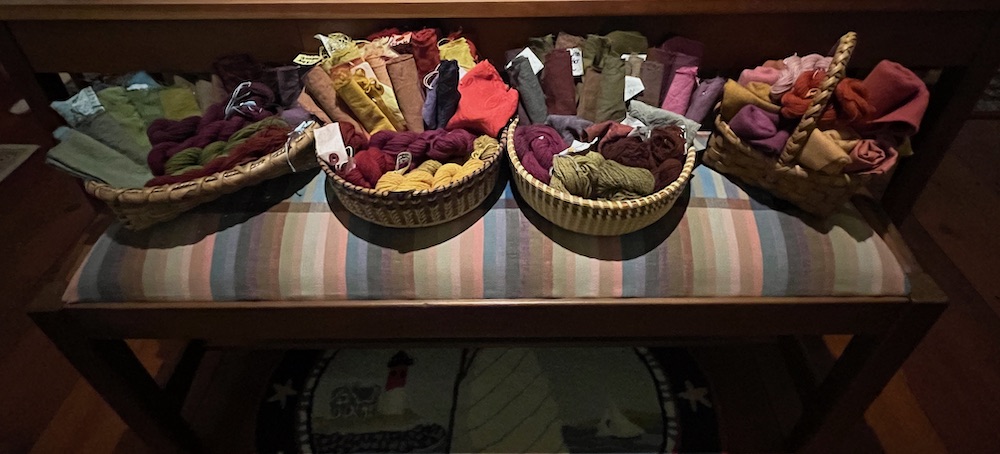
Yum, right? I thought all these samples would go in a notebook, but it turns out we only had to cut a small bit off each skein of yarn or length of fabric, so I have plenty to plan to use in some small projects. Whatever I end up making will be such treasures from this workshop. I have spent about 10 hours cataloguing everything in the journal that came with the class. That’s on the upper right below. The lower left shows all the original dyes done on white and grey yarn, white wool fabric, white silk fabric, natural and white linen fabric, and cotton and cotton/hemp fabrics. Above it on the left are all the original yarns and fabrics dipped in indigo to change the colors. The lower right shows all the original shades dipped in a 2% iron solution to darken the colors. This is a tremendous cache of color on beautiful fabrics. Now that it’s all safely documented in the journal I want to start making things with these bits of fabric.
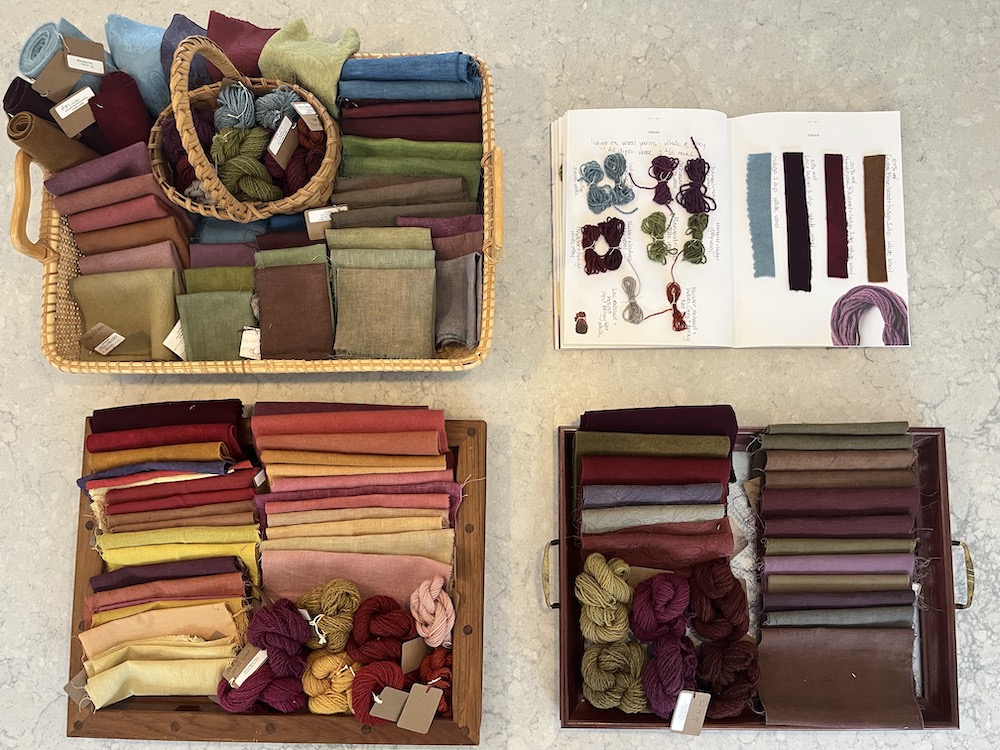
The notebook was rather a lot of work–far more tedious than dyeing! So I thought I should make a short video describing it.

I’ve been feeling rather UNsuccessful in my weaving projects this year. I am making almost no progress on the ruana fabric made with single-spun Hebridean wool from the Isle of Uist. All the yarns are the natural colors of the sheep, and I arranged them in a gradation on the warp. The one color that I had the most of is the weft. I wish it were off the loom already so I could put the ruana together. Oh well. I feel a bit better about my lack of progress when I realized how much time I devoted to dyeing right up to the holidays.
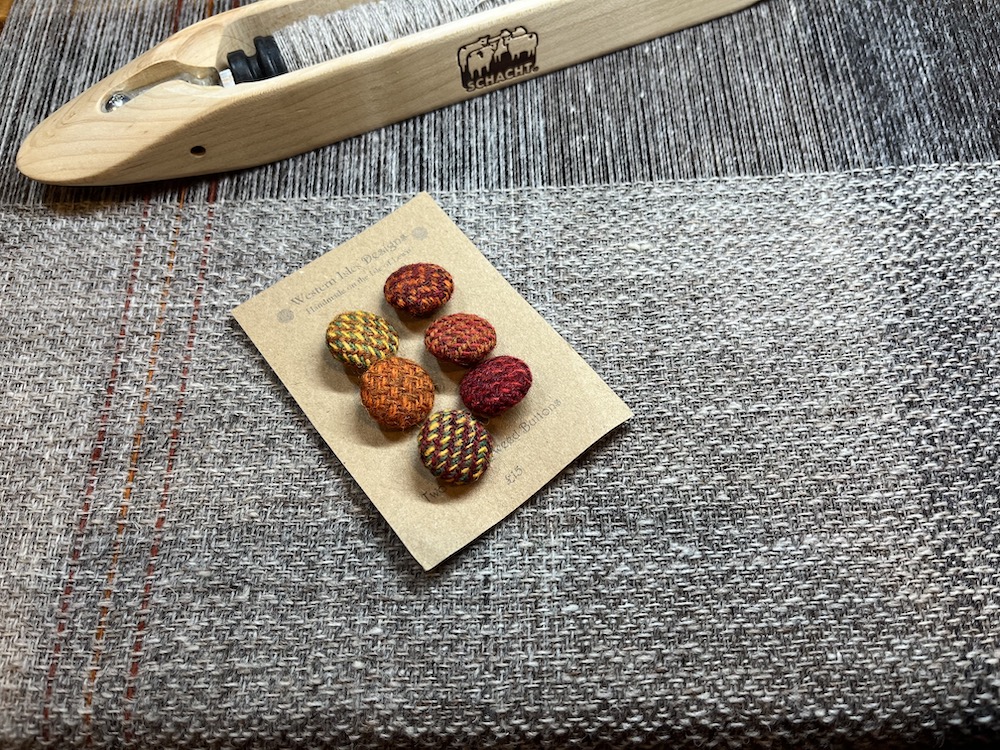
Aren’t these buttons sweet? I also bought them in the Outer Hebrides, at a shop called the Weaving Shed on the Isle of Lewis.
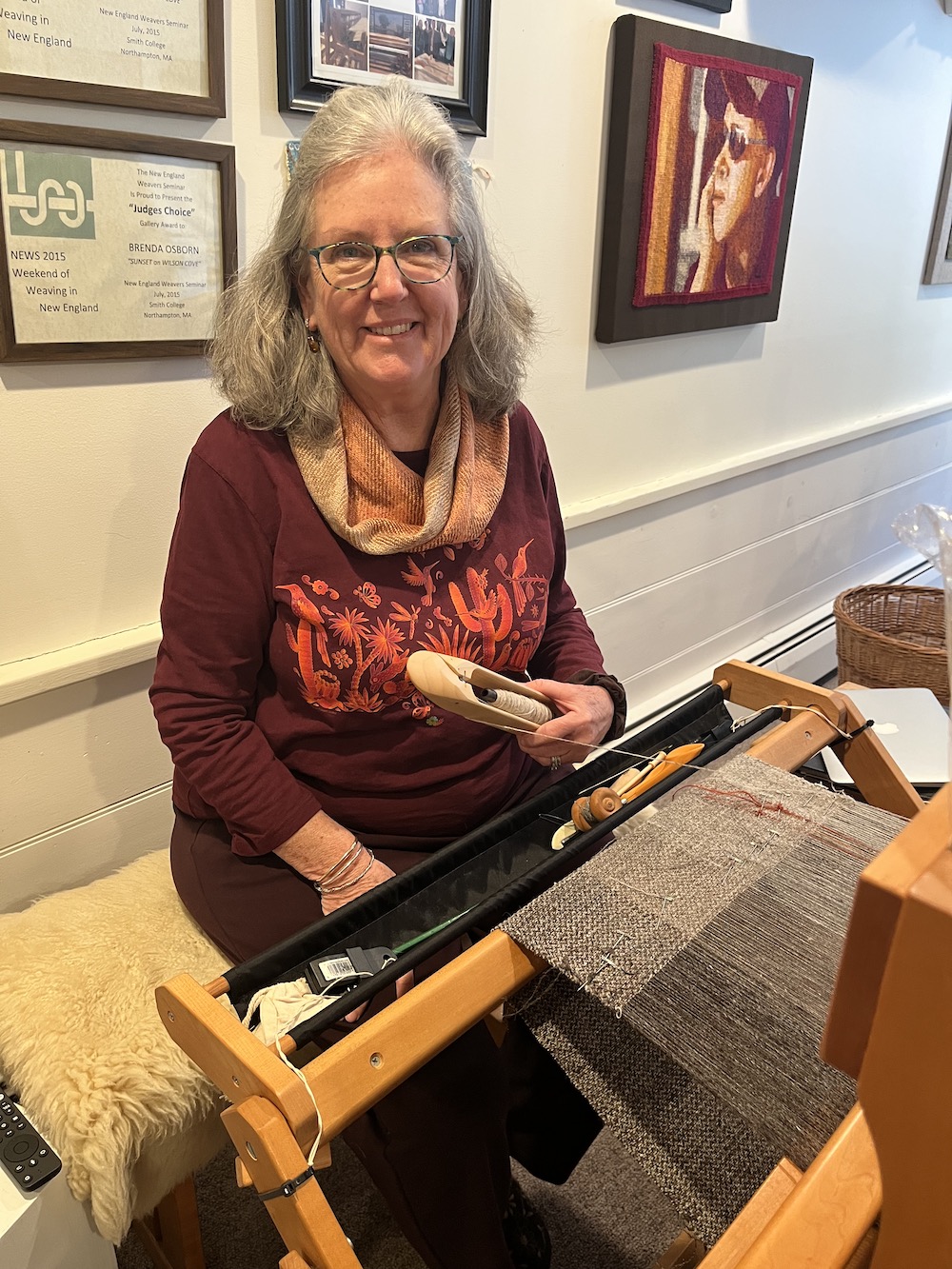
I grow older in the first month each year, and this year I have entered the next decade…70. Whoa. That’s a hurdle for me emotionally. A number of my friends (and Bob too!) are ahead of me, looking great and still in full control of their faculties, mentally and physically, so I am trying to believe I can do that too!
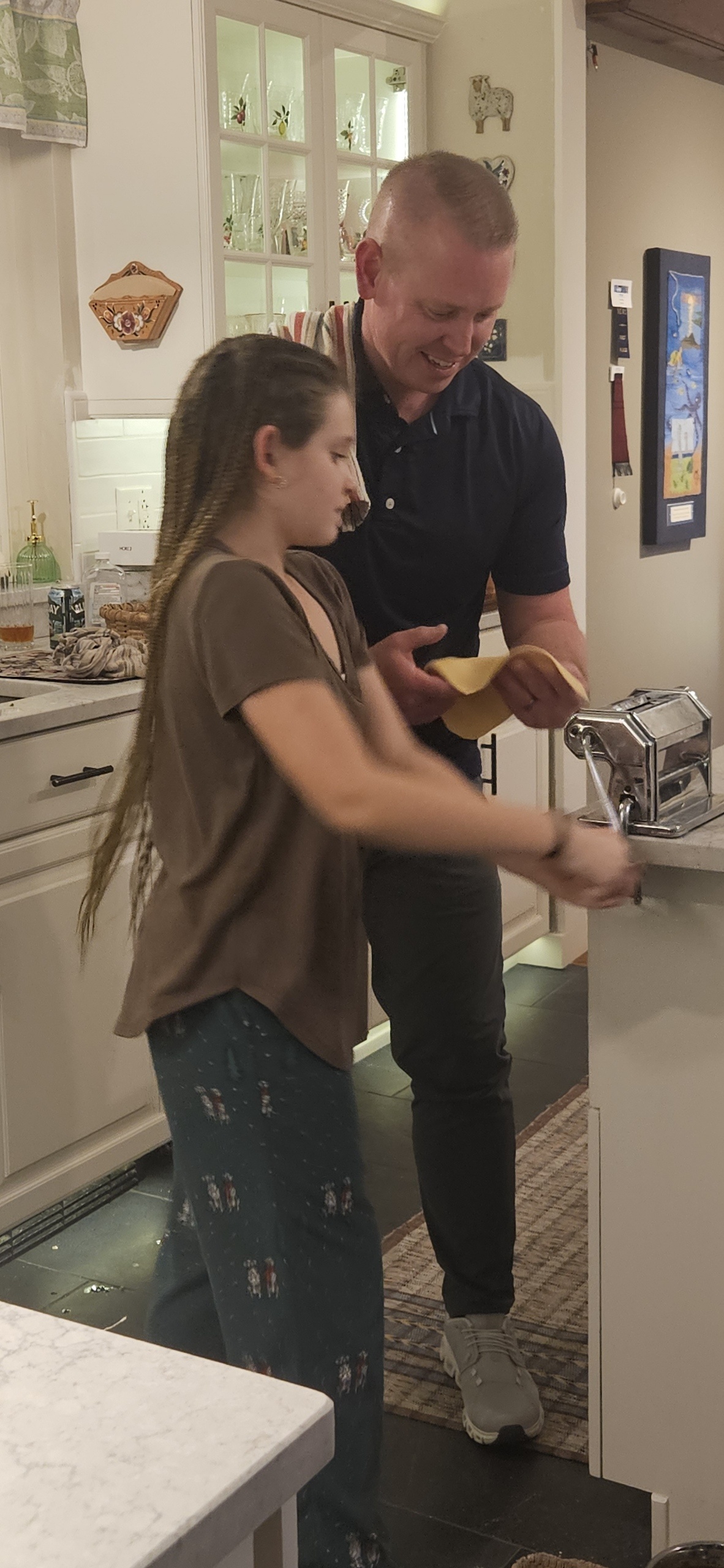
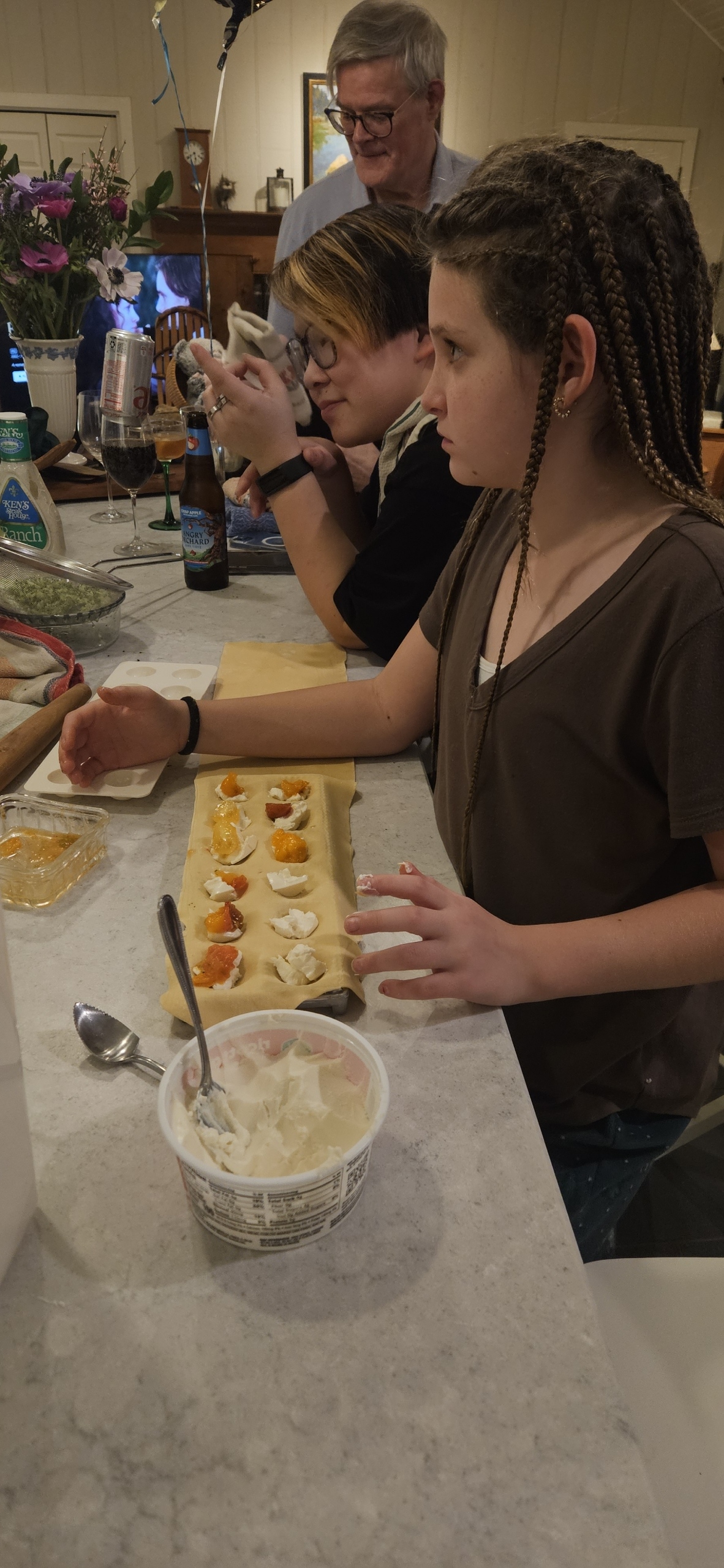
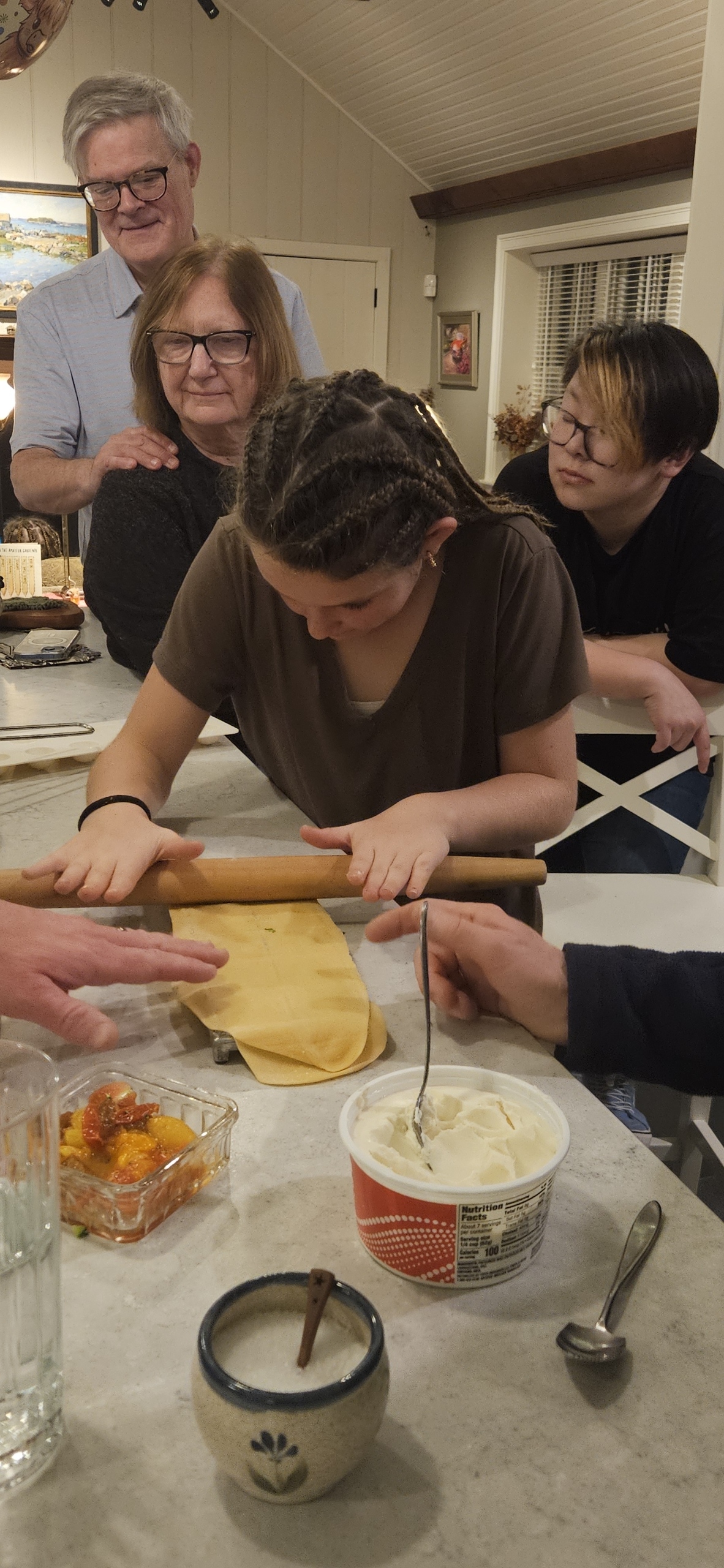
My children and grandchildren, and one significant other spent a long weekend with me to celebrate this landmark birthday. Tori, our oldest granddaughter (of three) made pasta and then turned it into ravioli….and she did it in front of an audience. She’s a natural!

And we had some great relaxation time in between cooking and being outside in our biggest snowstorm, walking in the woods and building two snowmen.

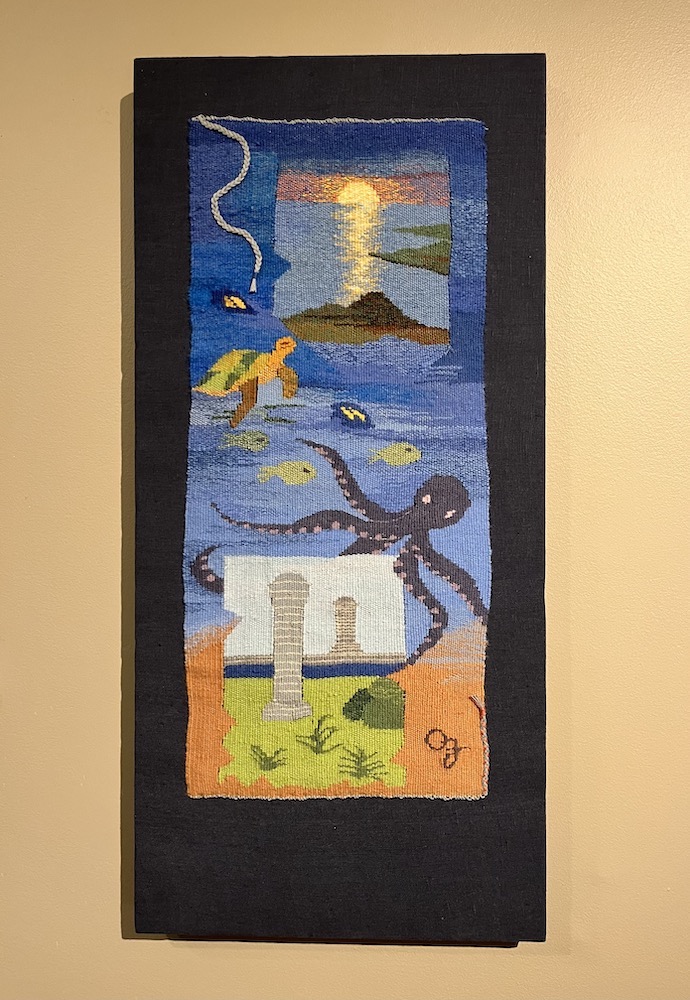
t was a year ago that I finished this tapestry. Hard to believe. It seems like more than that. Again, this is a realization that helps me make peace with the fact that my current tapestry has barely 1″ woven. Where does the time go?
This afternoon I took stock of the knitting I did last year. I had such a great time buying yarn in the Açores, in Scotland, and in Spain. I actually did something with a fair amount of it. Go me! The grey cotton yarn is from Horta, on Faial, in the Açores. The cowl on the left is a free pattern on Ravelry, and the cowl on the right is “Inspira,” also on Ravelry.
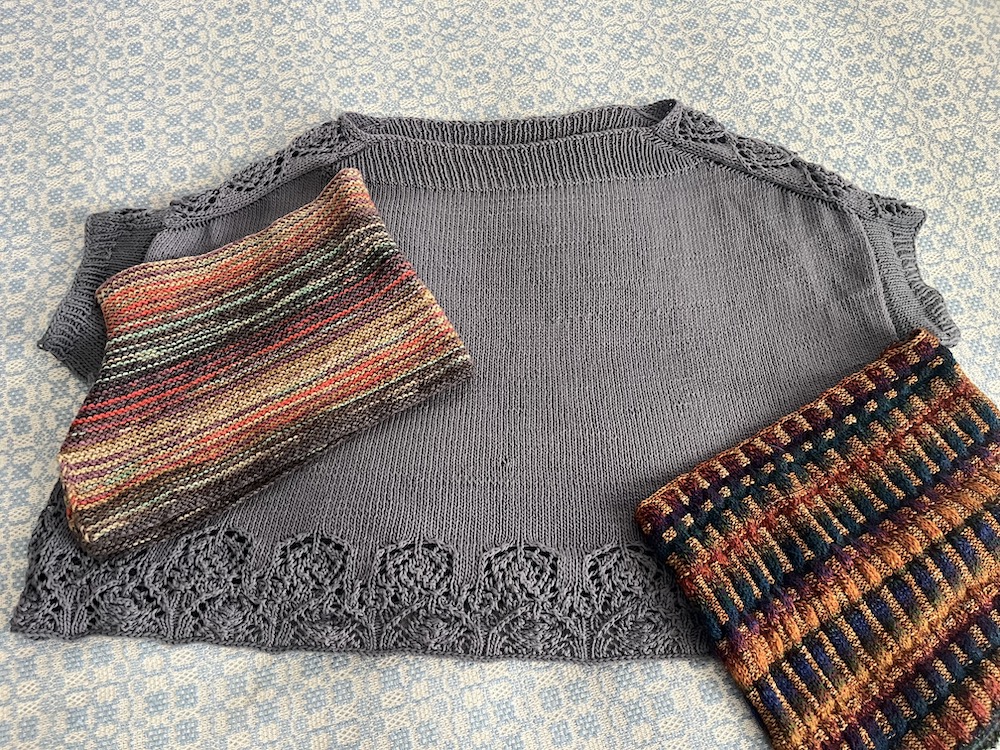
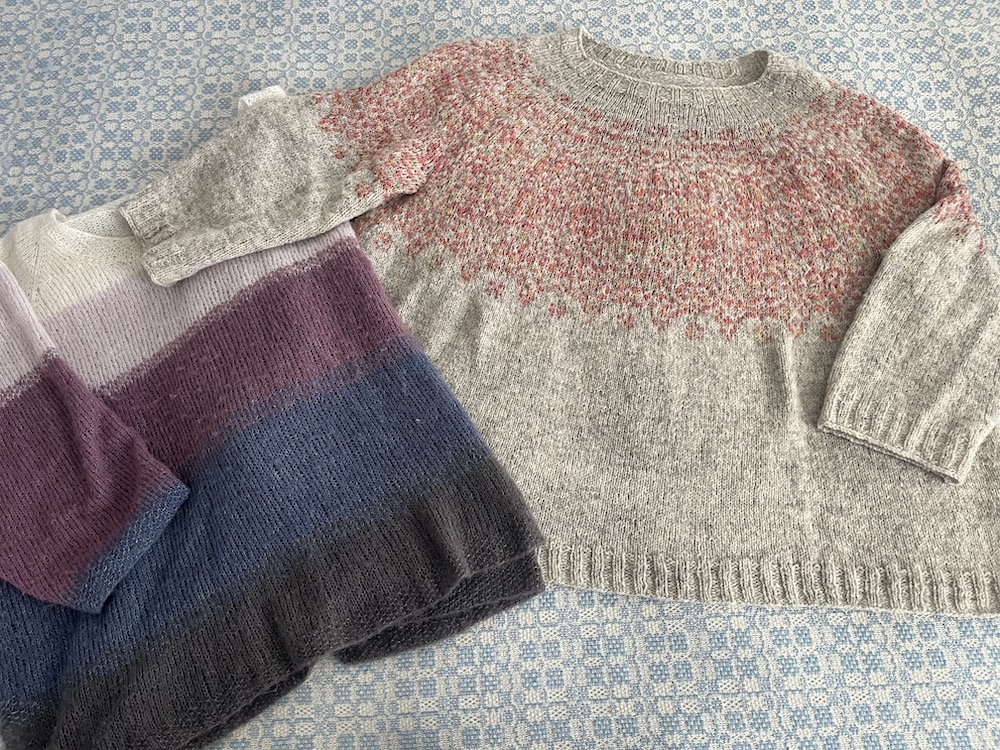
The pattern yarn in the stranded knit sweater is from the Weaving Shed, mentioned above. It’s a blend of merino and silk that is probably not from the Hebirdes, but it was dyed by one of the sisters at this company. The other sweater is 100% cashmere yarn that my son Rob gave me for Christmas in 2024. I wasn’t sure how to best use it, so I just made a simple top/down, raglan sleeve striped sweater in the round. I don’t think it weighs more than an ounce, yet it is SO warm.
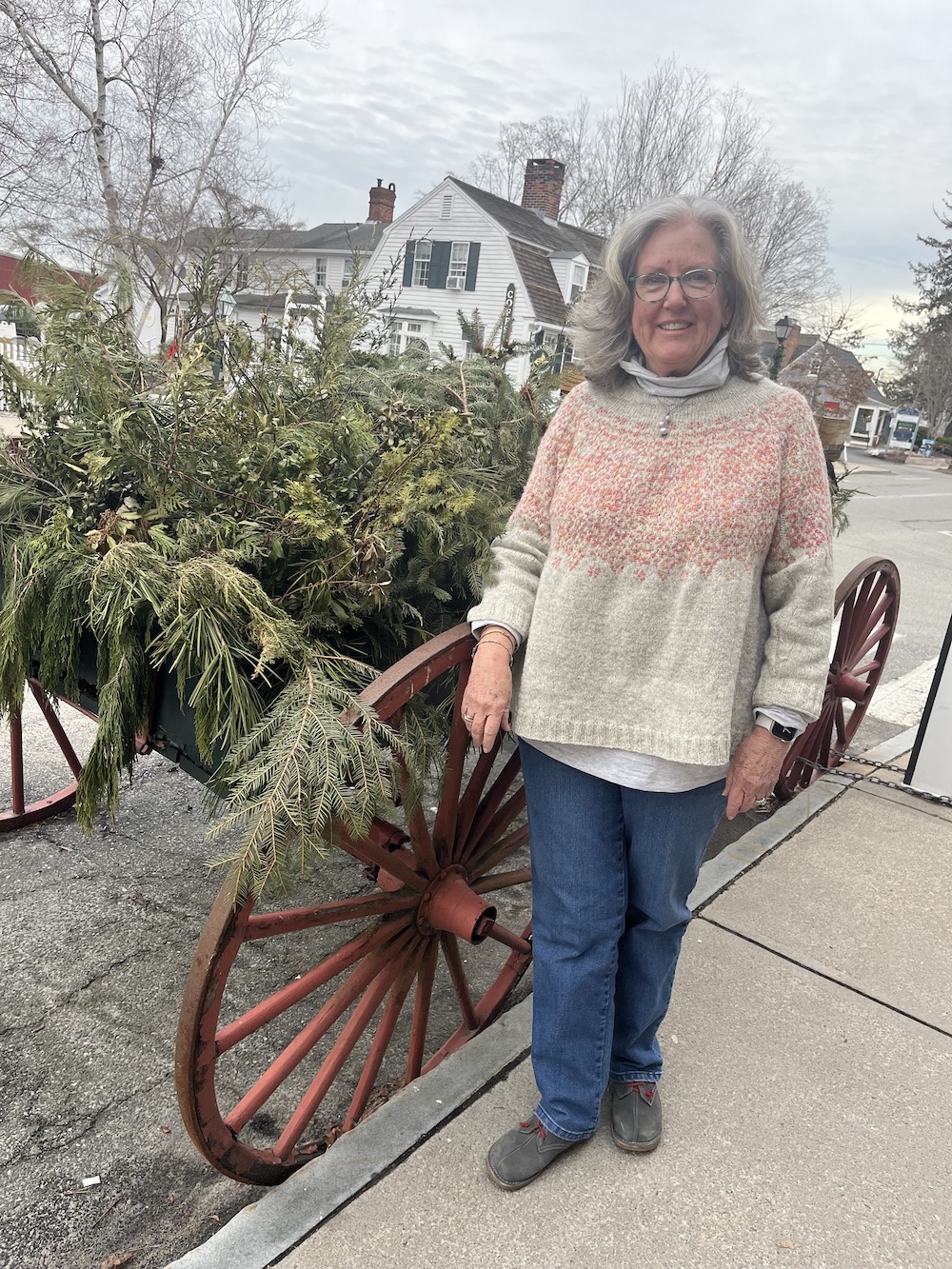
My friend Jody took a photo of me wearing my new Scottish sweater, which is entirely Scottish yarn but a design by German designer Elenor Mortensen on Ravelry. I am standing outside the iconic Griswold Inn in Essex, CT.
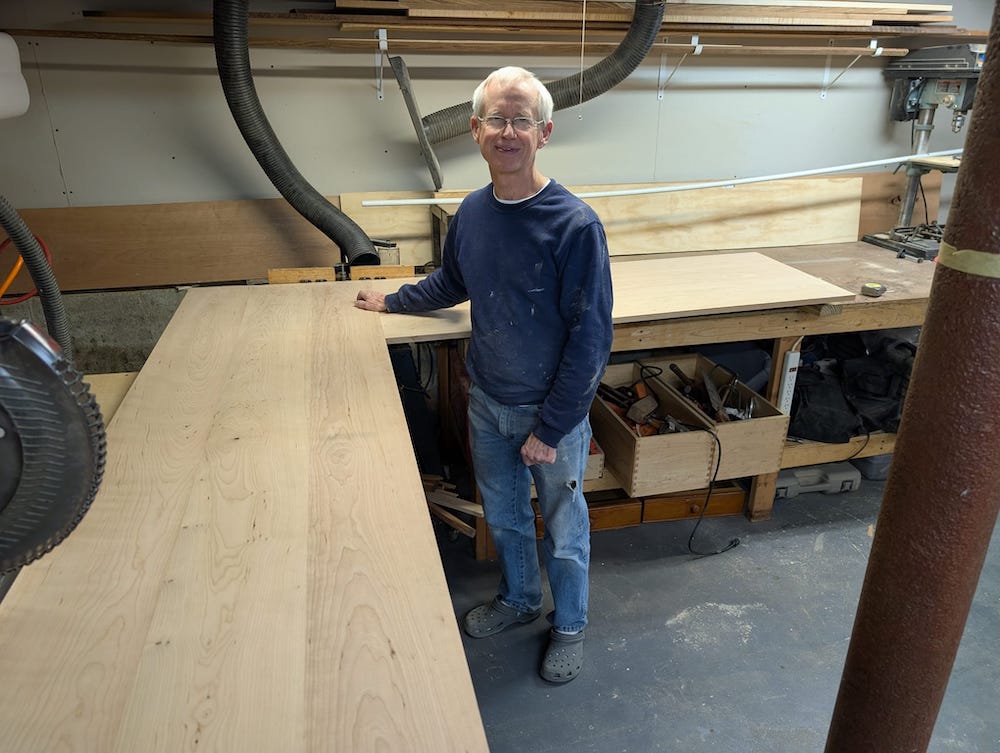
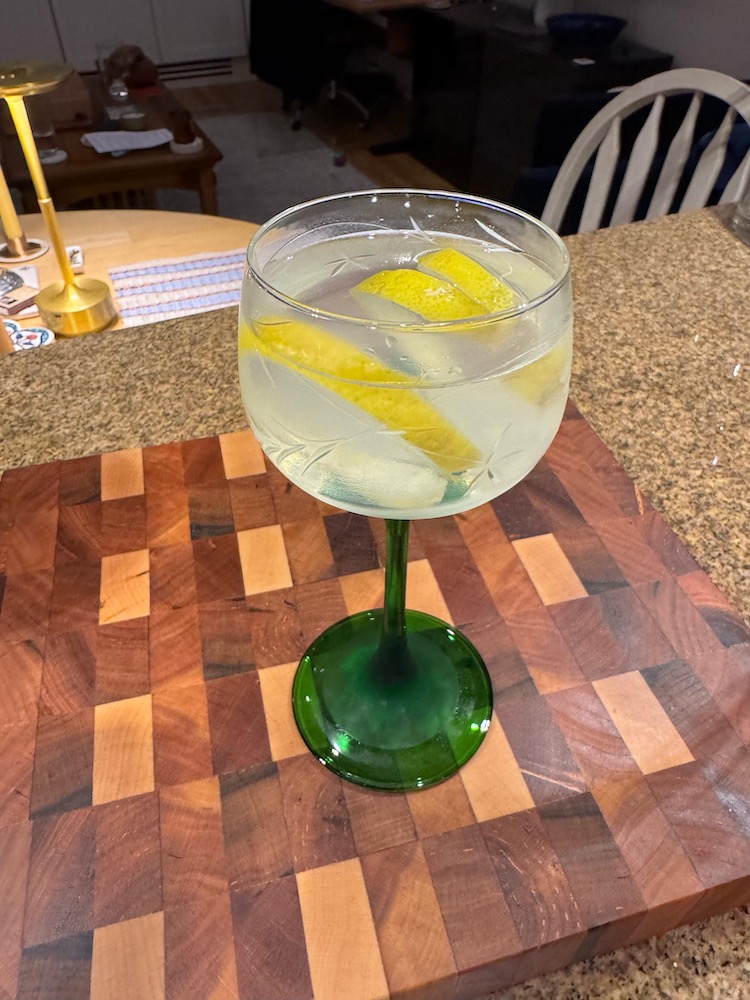
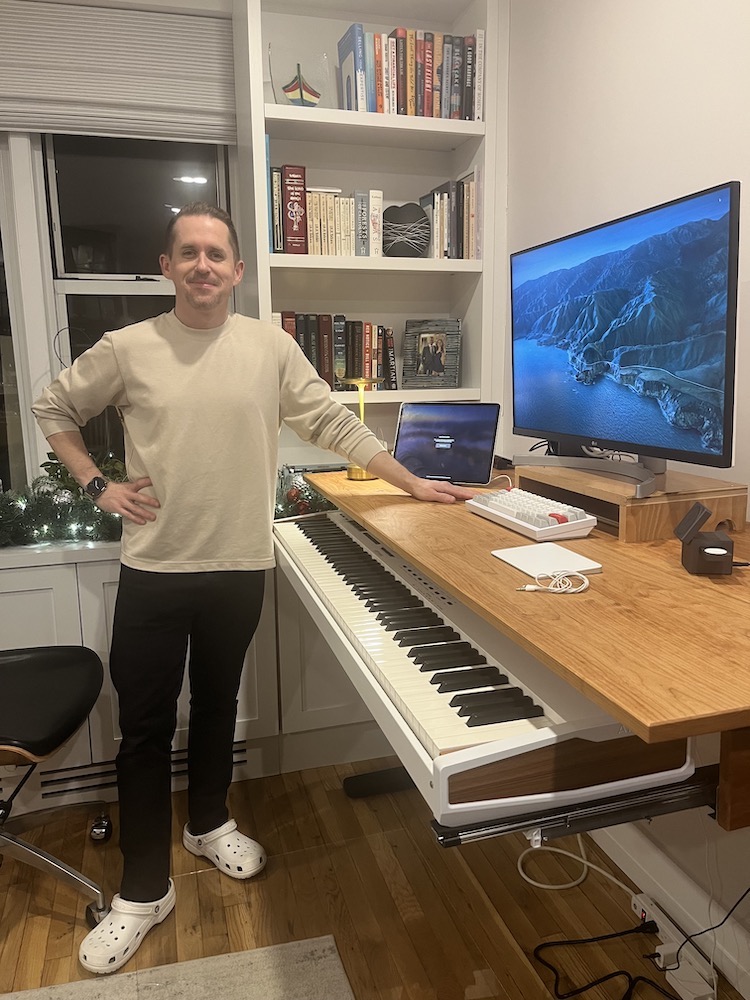
Not too bad a rearview assessment of making things last year. I feel better now. Bob has been busy as well during our months at home. He made a couple of cutting boards, done with end grain, a rather complicated desk for our son Chris who wanted a pull out tray underneath for his keyboard. Now he is making good progress on an “L” shaped desk for his office.
Finally, i want to mention a book I’ve just finished reading: With Her Own Hands by Nicole Nehrig. It has given me some clarity in looking back at my last year of working in textiles, as well as my long history of doing so. I have been knitting for over 60 years now, and weaving for 50. Weaving tapestry for just over 25. Spinning and kumiho are also reaching the 30 year point. The author describes things in life that are beyone words, that some people can only respond to life visutally, not with words. I have always turned to words, but this book made me see that there are times when events and life experiences cannot be contained or described by words. Sometimes those of us who work with our hands can only respond in the ways we are comfortable expressing ourselves visually. This has been a year like that.

 “Counting stitches or holding a complex pattern in mind may distract a knitter, crocheter, or weaver from worries.  We lose self-consciousness through absorption in the activity.  The repetition involved can lead to a hypnotic, calm state, a kind of meditation through motion.  Textile work confers a sense of control and mastery that can counter balance the lack of control we may experience over what is happening in our larger world.” –Nicole Nehrig

Whatever you are currently working on, I hope it gives you this sense of calm, of meditation, and a strong sense of balance. Onward we go.
High Summer in Scotland

Today is Hallowe’en, a far cry from July in Scotland. This morning I drove to the library to pick up a book I had reserved, and I encountered lots of preschool age children arriving for a holiday event. It was exceedingly windy due to the effects of the most recent hurricane, and leaves were whirling all around us. The children all had that exuberant bounce in their steps that is so iconic for children. They were hopping, and I couldn’t help think how many decades it’s been since my own kids walked with that joyful bounce, not to mention how long it’s been since I had that myself. When does that exuberance to get somewhere leave us? Now I feel that every joint in my body would cry out in pain. Ah well. It was wonderful to see all the children excitedly arriving at a Hallowe’en event. But I digress…

In July I visited Scotland for the 2nd time, but most of it was entirely new to me so there were a lot of ‘firsts.’ I had made an appointment with National Museum of Scotland to see the newly acquired tapestries of Archie Brennan. I had also been asked to give a talk about Archie at the Dovecot Tapestry Studio right after I arrived. These two opportunities by themselves would make the trip the highlight of my year…or decade. But Scotland has endless charms so I had two weeks of singular experiences that I won’t soon forget.

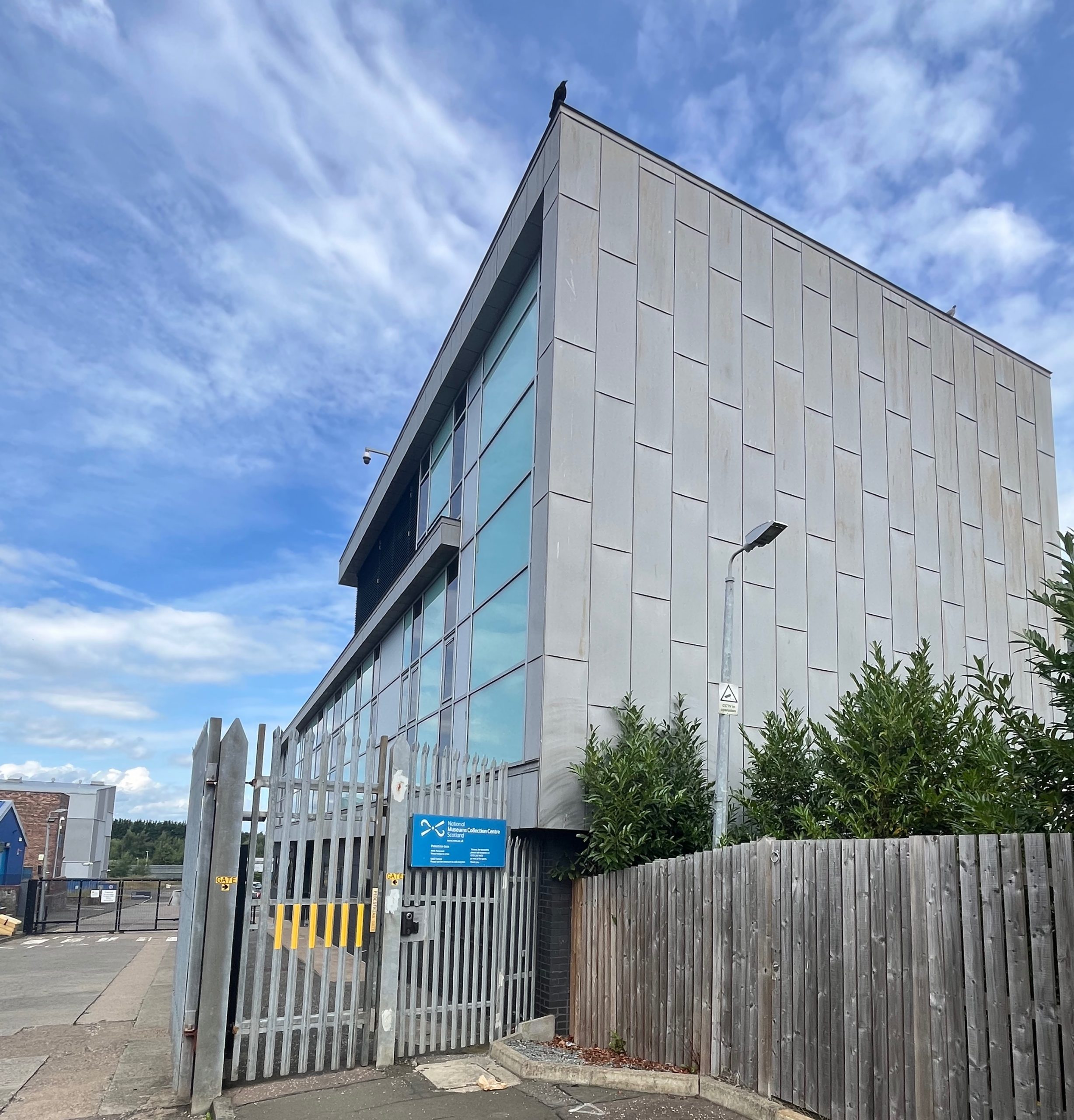
Cecilia Joicy, who is director of textiles at the National Museum, invited me into the storage headquarters of the museum, which is right on the shore of the Firth of Fourth, on the day after I arrived, along with my good friend Kari who was traveling with me.

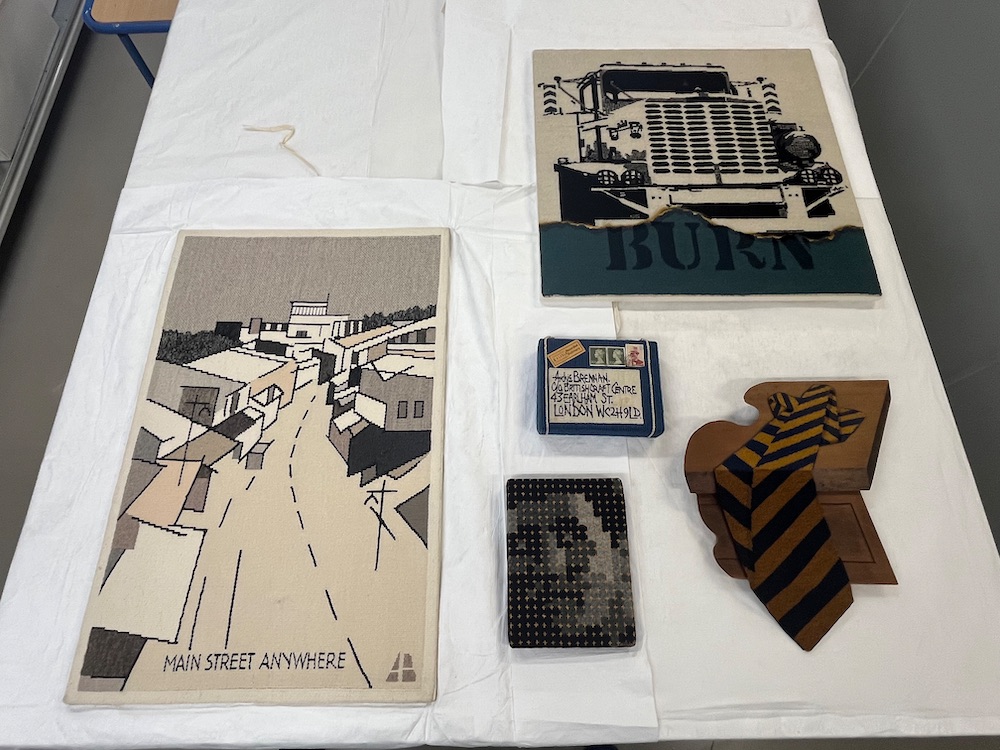
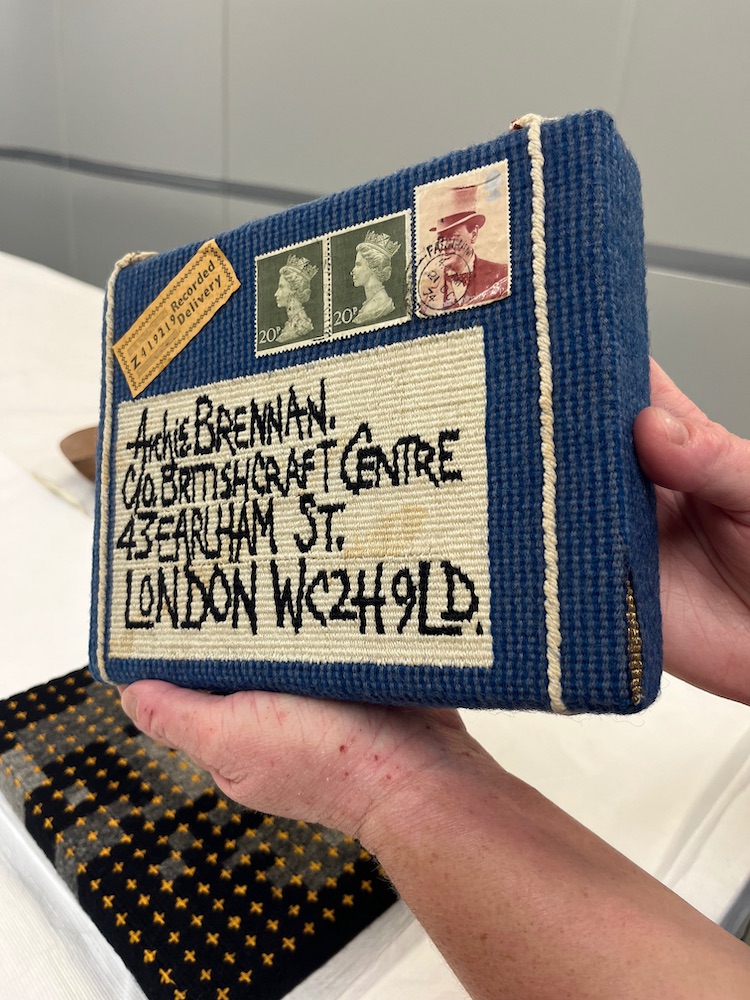
Here Cecilia is showing me how Archie wove the illusion of a tear in this piece. As you can see he actually mailed the tapestry without packaging it. It is a package itself afterall.

I thought the museum had acquired more pieces than seven, but that is all they have. They have one of my favorites, a piece Archie was weaving while the Wednesday Group was meeting with him in the 2000-teens. It’s called “Main Street Anywhere,” and it is a huge postcard. He covered the front of the piece with white paper before mailing. All his normal sized postcards were mailed without any protection, and he says none of them were ever lost or damaged, except the one he dropped somewhere on the streets of Manhattan on his way to the post office.

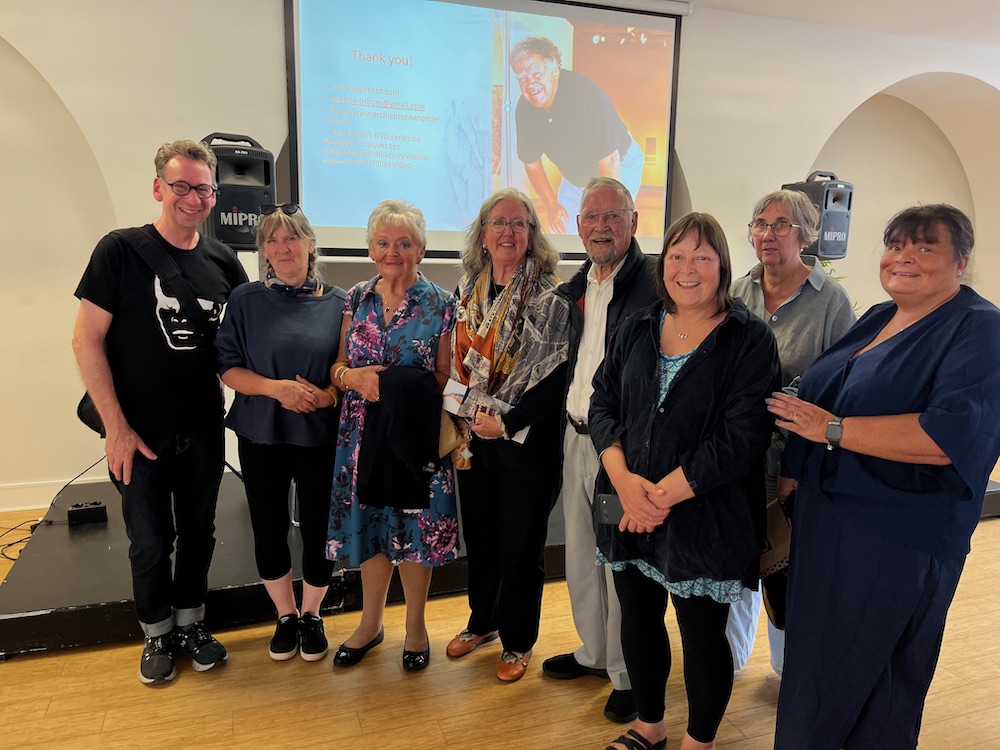
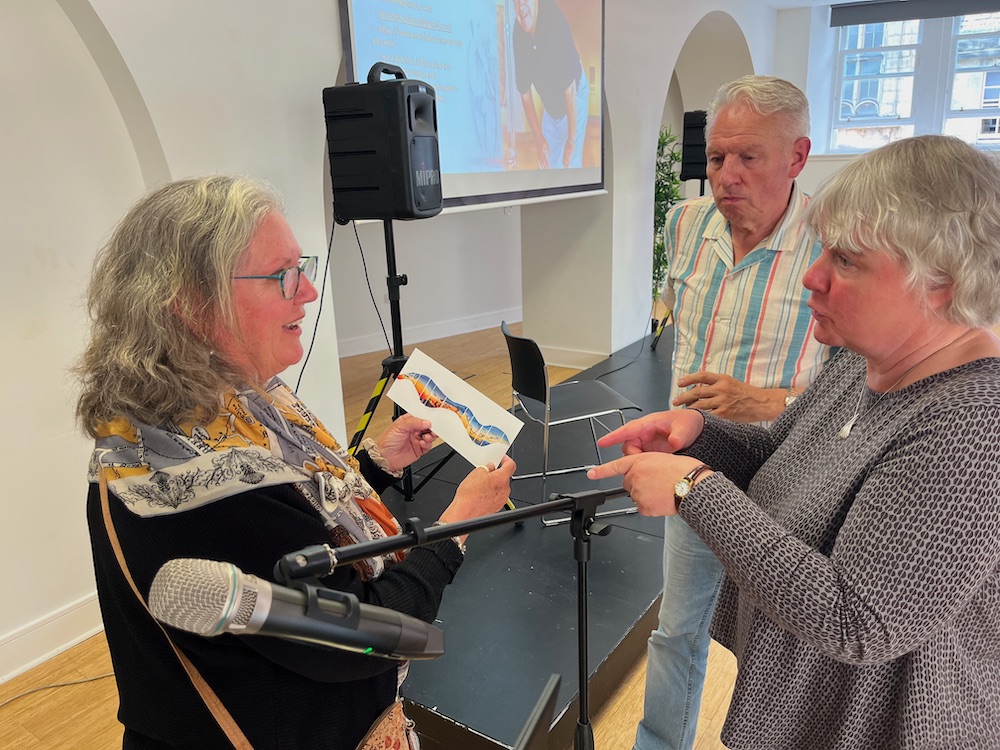
Two days later I gave my talk about Archie at the Dovecot Studios. As I was standing at the podium about to begin, a group of people walked in who had saved the front row for themselves. They were seven members of Archie’s family. Only one of his siblings is still living-his youngest sibling, Robert. One of Archie’s sisters in law was there, Elizabeth, and a number of his nieces who are the children of the sister in law. I even met Archie’s godson. And look at us all standing in front of one the slides from the presentation. Archie is looking down on us.

Not everyone made it into the photo. I am in the middle (with the big scarf) and Robert is on my right in the photo. To my left is Elizabeth, with her two daughters all the way to the right. On the very left is Archie’s godson. Standing somewhat behind the group (between the two nieces) is Elizabeth Radcliffe! She is one of Archie’s earliest students. I had asked her to join the group photo, but she stayed back a bit. It was such an honor to meet these wonderful relatives of Archie. I am still deeply moved when I think of it. Later, after I returned home in mid-August, I heard from one of Archie’s daughters, Sarah, saying she was on vacation out of Edinburgh when I gave this talk. I would love to have met her as well. Hopefully someday.

And another moving moment of this day was meeting John Brennan and Anna Wetherell. John was also one of Archie’s first students. I was one of his last, yet we are are rather close in age. John and Elizabeth and Anna have had a lifetime of weaving tapestry. I have had a lifetime of weaving, but I didn’t come to tapestry until just before the turn of the century–a mere 25 years ago or so. In the photo Anna is giving me a large format postcard of the Murmuration Collaboration which I have been following for some time now. I was able to buy the catalog, and the group has a substack site with detailed images and essays by the weavers who participated in this project.

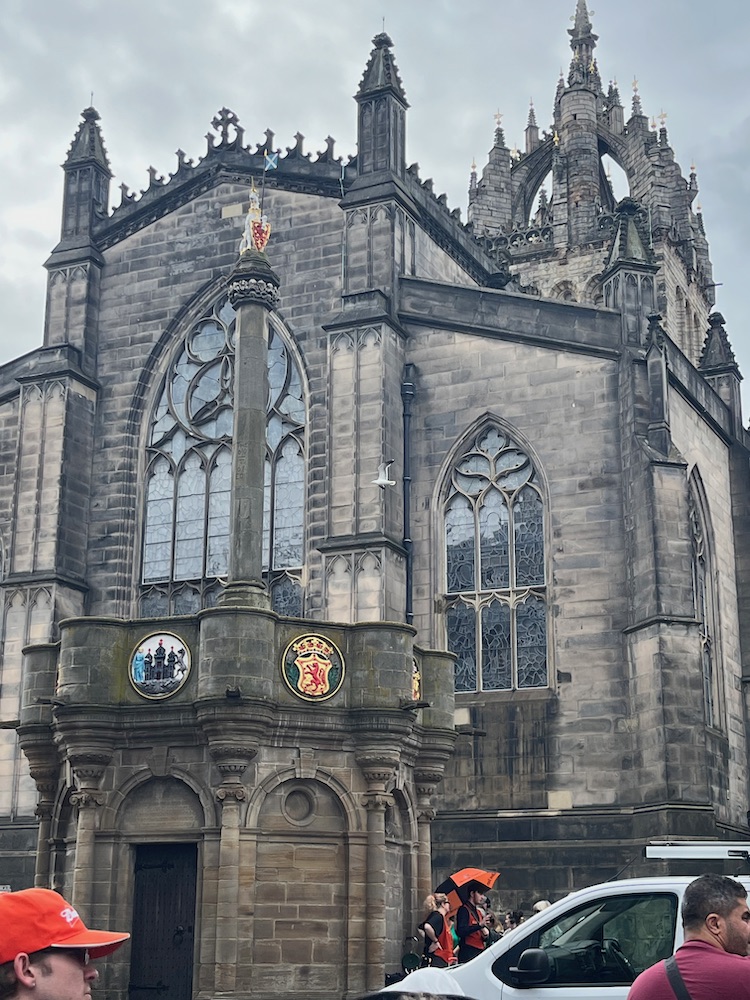
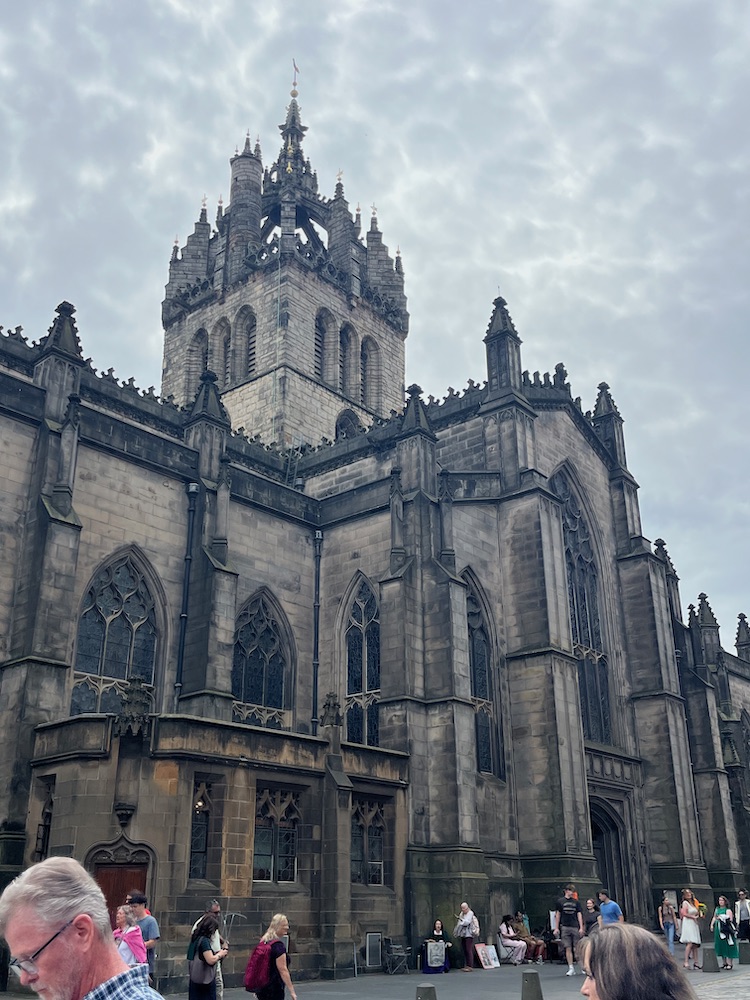
So it would be impossible to surpass these two experiences, but I have to say the rest of my time in Scotland was still a terrific experience. Edinburgh is so picturesque. There is so much Gothic architecture and the city is so steep that it is a bit of challenge to see the many facets of this place. I have not been in such a steep city before.

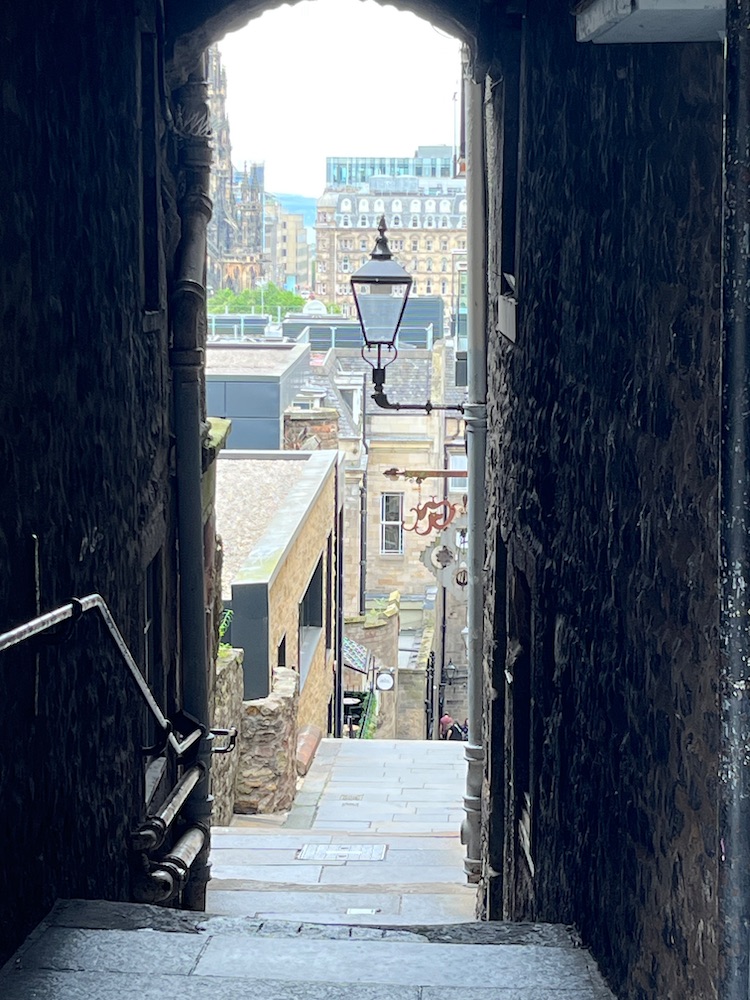
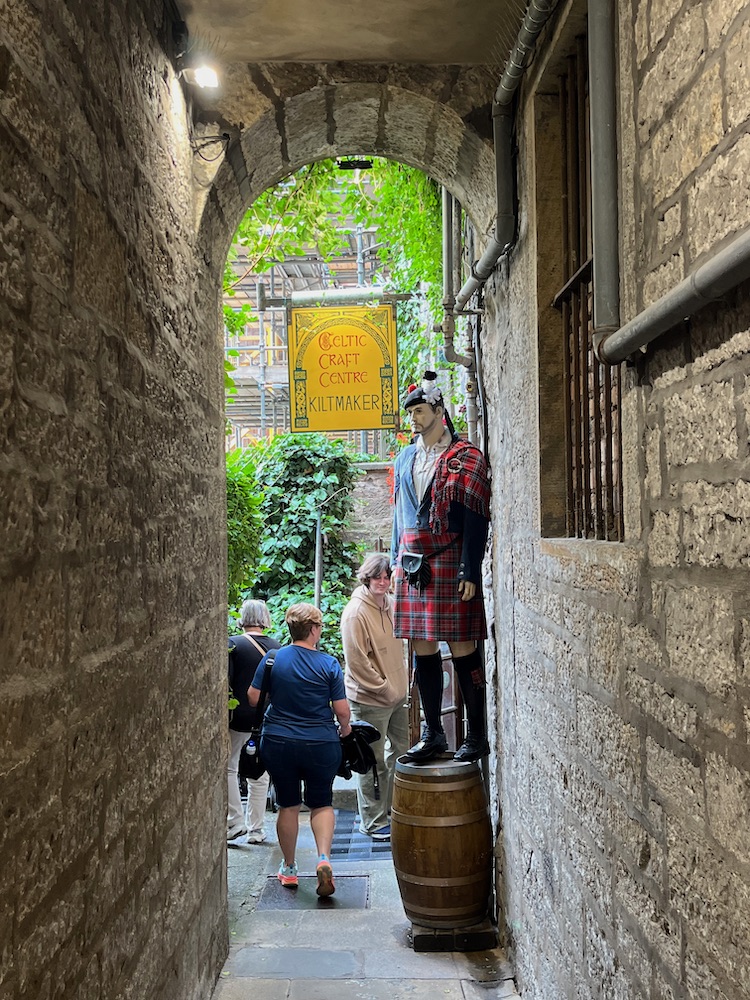
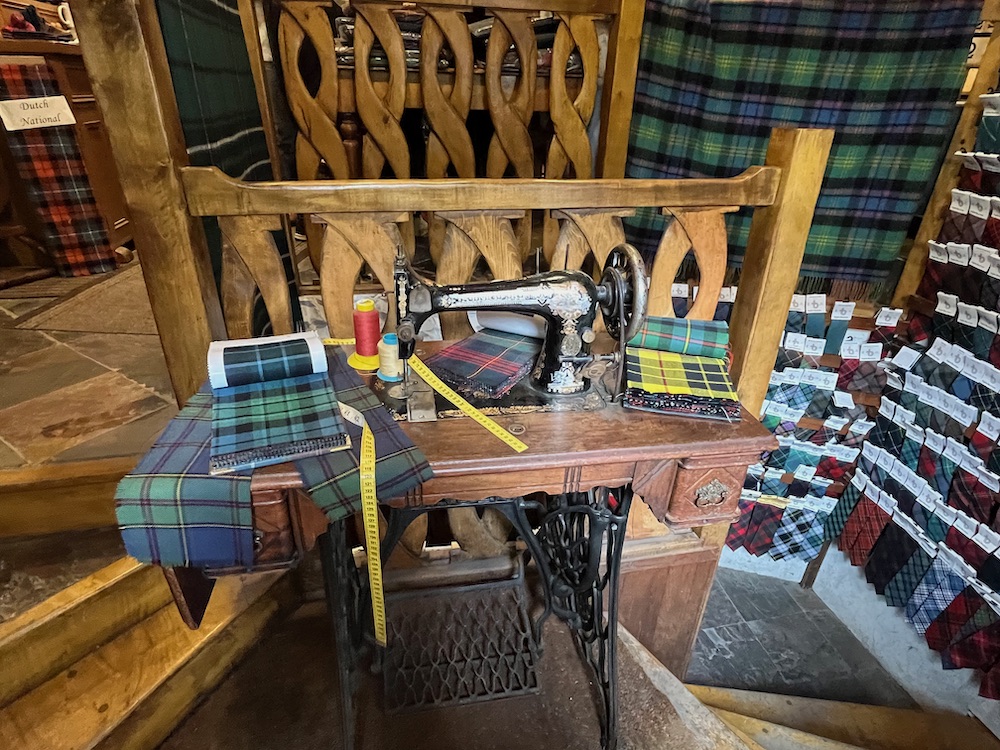
The alleyways are called closes, and there are many of them. I went down the rabbit hole of going into a shop that weaves tartans.

This shop was impossible to pass by.

They had a encyclopedic reference book of clan tartans. I looked up Brewer and Macbeth (both for a friend) as well as Bob’s Norse name Osborn that uses the Cameron tartan. I avoided committing to buying anything, but it was tempting. And speaking of tartans, two women have started a campaign for justice and a memorial for the thousands of women accused and executed for witchcraft. They now have a tartan for the Witches of Scotland. The podcast on this site is worth a listen.

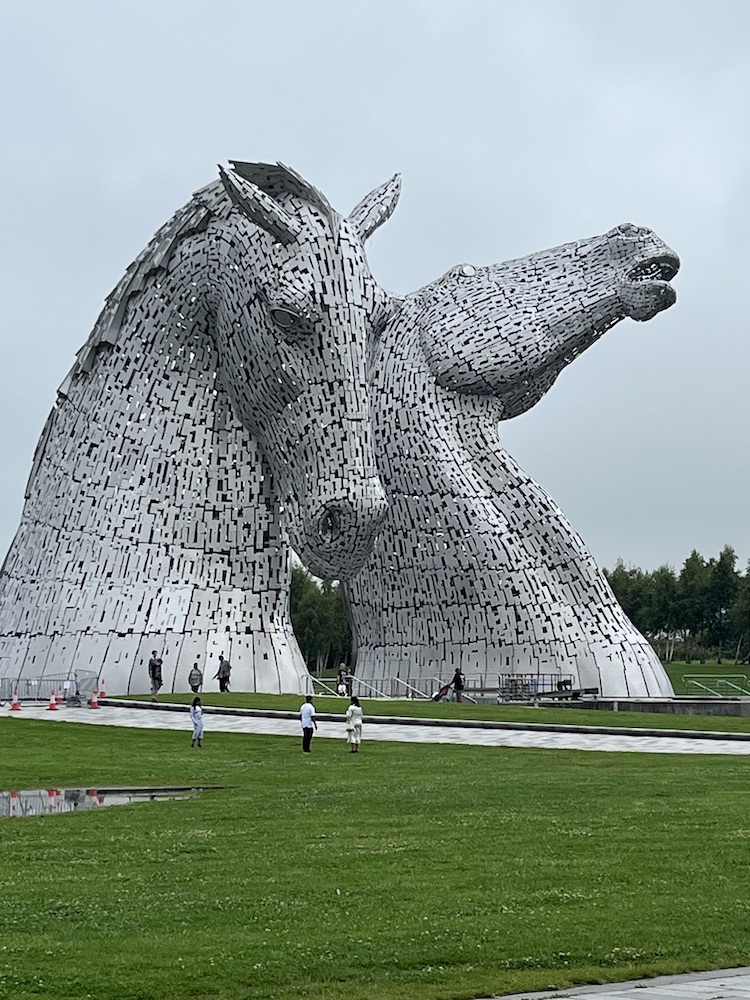
Heading out of Edinburgh toward Glasgow by train we stopped in Falkirk to make our way to see the Kelpies, and even better, to meet up with my dear English friend who joined us for this part of the journey.

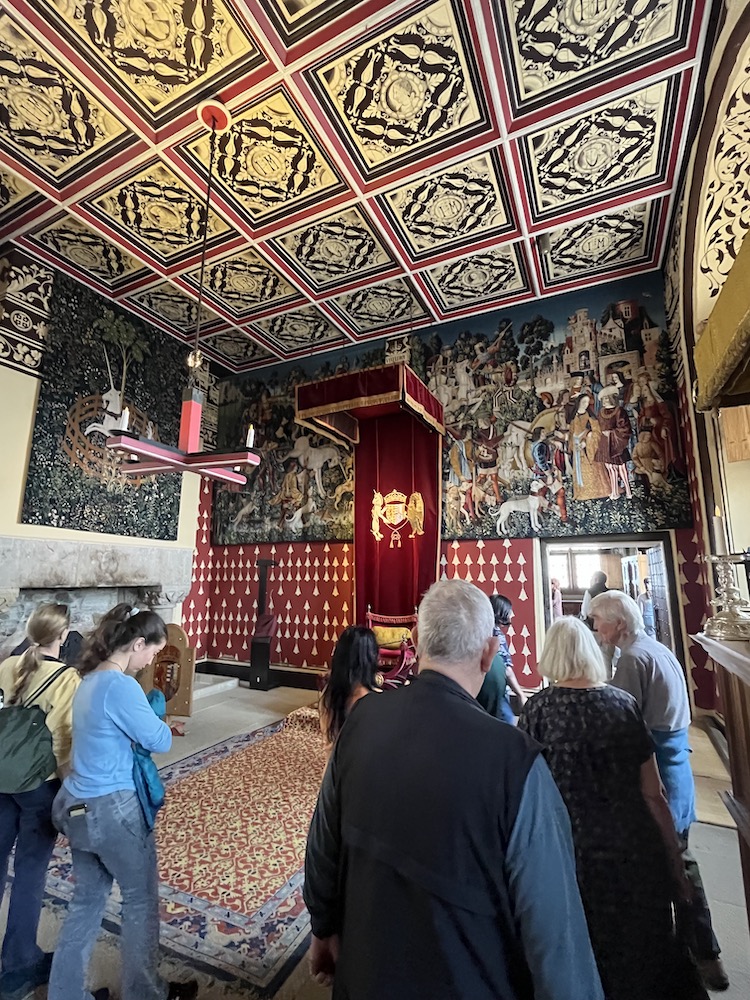
My goal during this short travel to Glasgow was to visit Stirling Castle for the sole purpose of seeing the reproduction tapestries of the “Hunt for the Unicorn” series based on the originals that are housed in the Met Cloisters. I had met the weavers of this daunting project in the mid-2000-teens when they visited the Cloisters to make decisions about warp sett and weft colors. For more than a decade I have hoped to see the finished tapestries. I was disappointed! The tapestries are stunning, and I actually prefer them at the coarser sett used for the reproductions. But…they have been hung so high in the Queen’s Quarters that it is hard to see them well. The walls were already decorated in the style of the period, which fights with the tapestries.

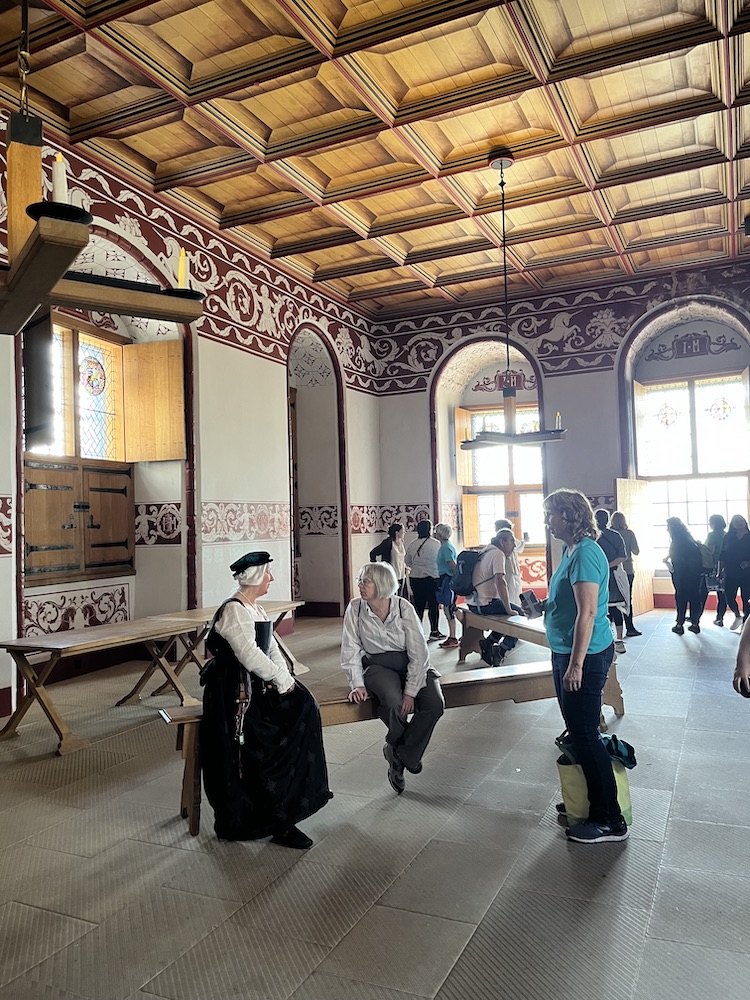
Although I took numerous close up photos of these tapestries, the perspective is odd because of the angle at which I had to take them. I enjoyed the docents who were dressed in period in the anteroom.

Most of all I enjoyed seeing the exhibit about the weaving process of recreating these tapestries, and the walk through the stone tunnel with Lesley to get to the exhibit.

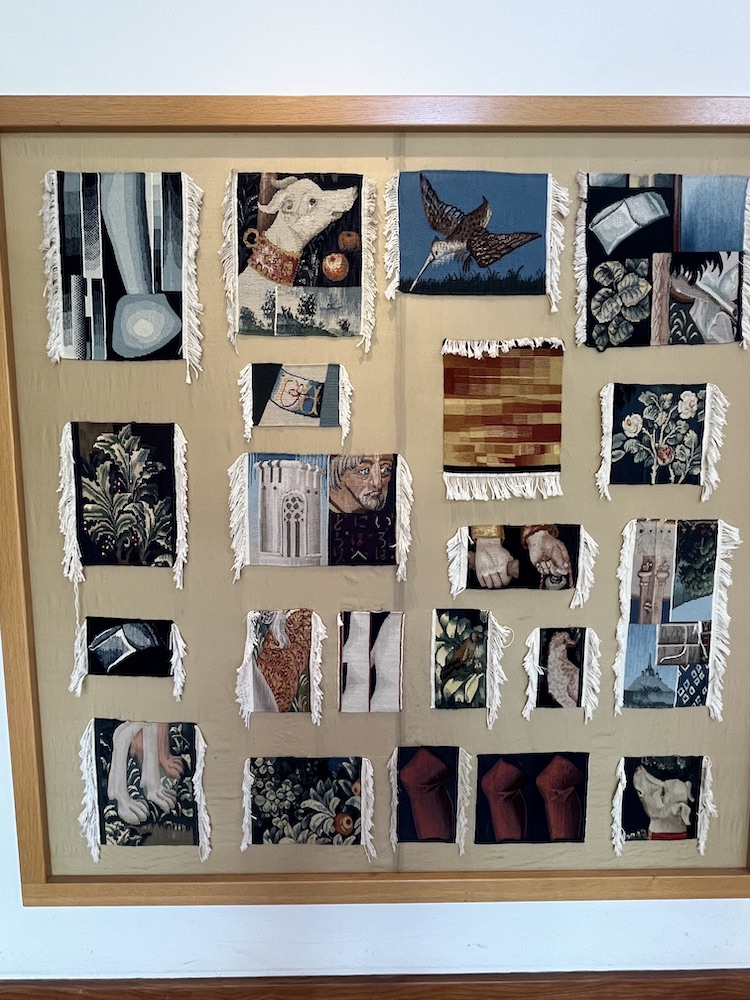
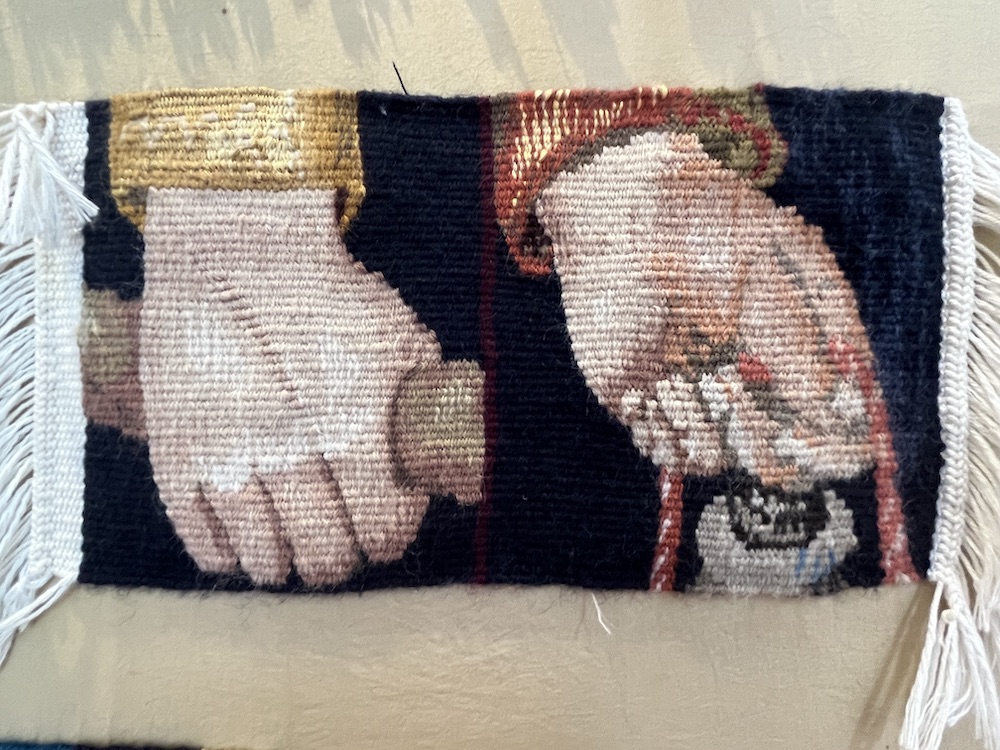
The best part of this exhibit was seeing the small trial tapestries woven to practice details from the original tapestries that would be translated at a coarser warp sett. While this display shows 21 small woven samples, the weavers actually wove over a hundred small samples.

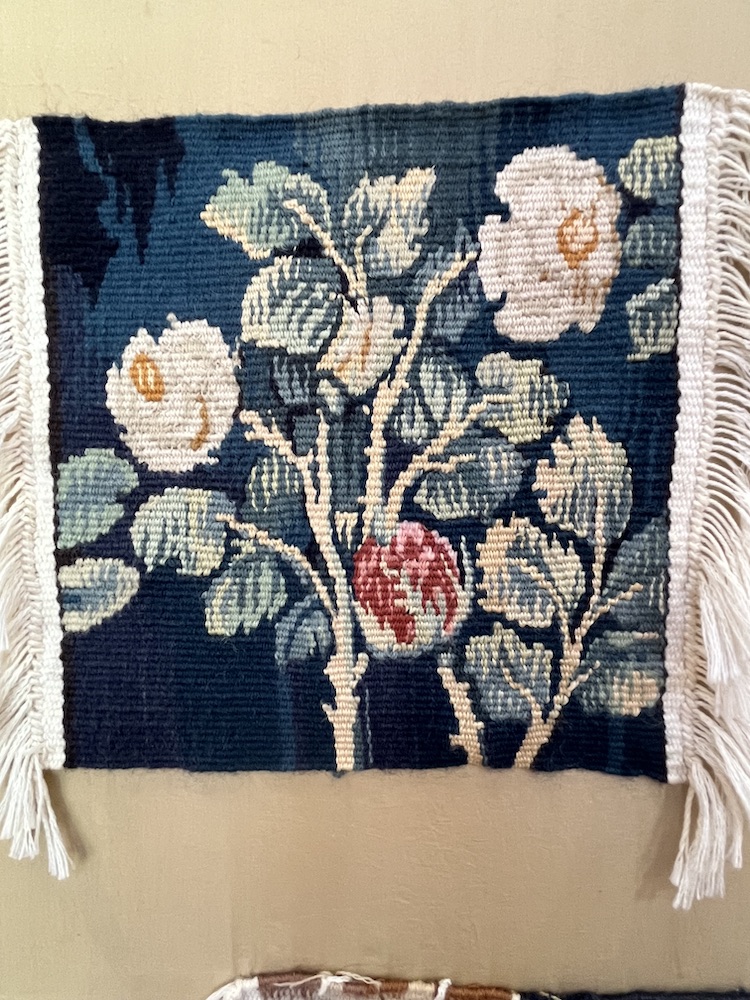
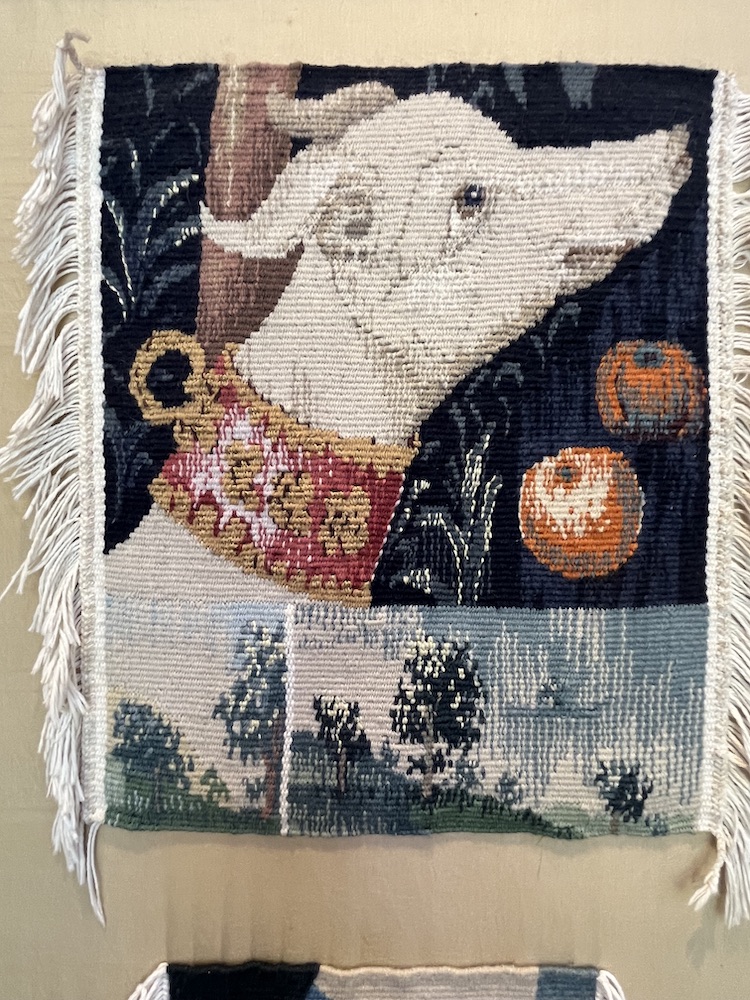
Here are some close ups of the samples

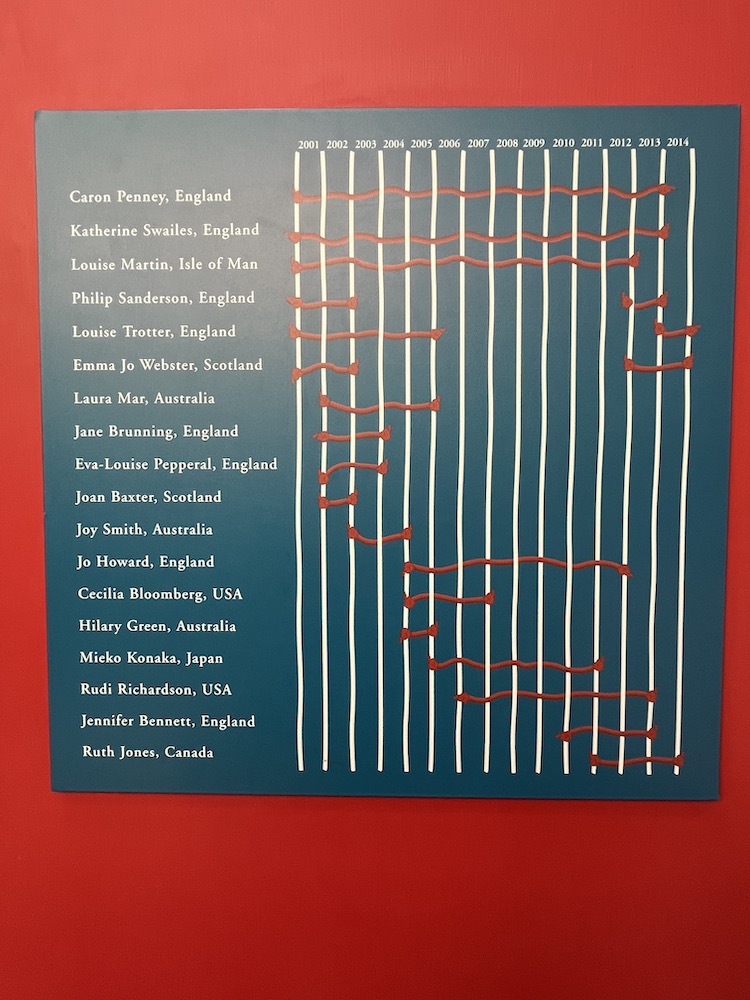
And lastly, it was touching to see this list of the weavers describing the time they each put into this massive undertaking.

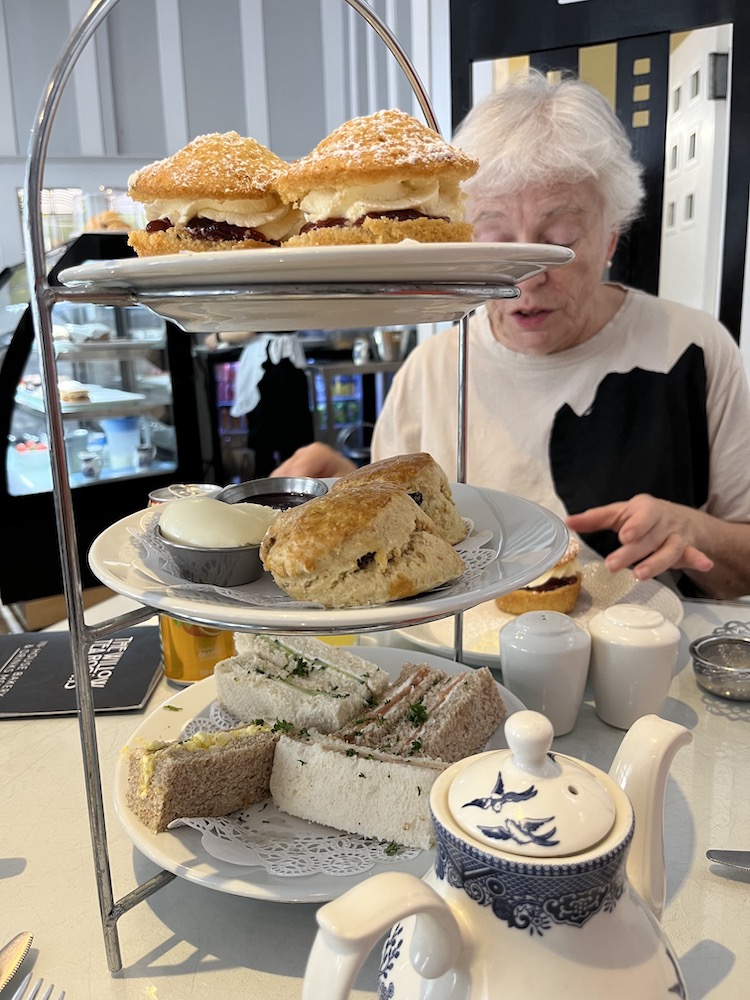
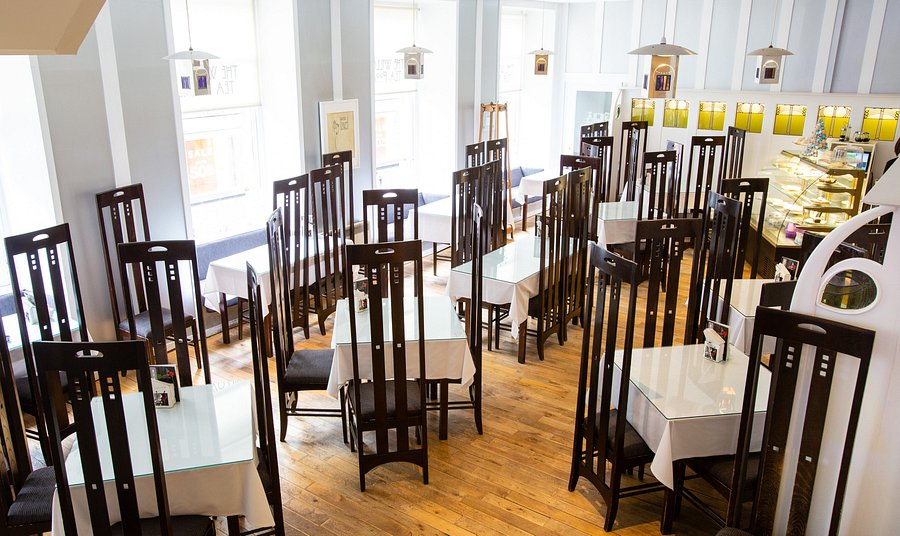
It wasn’t easy to get to the castle the day we visited. The parking on the castle grounds was completely full by late morning, and finding parking in the center of Glasgow was no easy feat. But after driving around a bit (thank you, Lesley!) we parked and made the steep trek up to the castle. Lesley, Kari, and I stayed in a charming small hotel that evening, just a short drive to the Charles Rennie Mackintosh Museum in Kelvinggrove Park. Lesley has visited Glasgow a number of times and recommended that no lover of Charles Rennie Mackintosh should miss having tea at one of his original tearooms.

My favorite part of a cream tea is the sandwiches, and these did not disappoint!

It was a short visit together, but in such iconic places! Lesley headed on for her holiday on the western coast, and Kari and I began our next adventure. We took a train to Oban where we boarded a ferry to the Isle of Barra in the Outer Hebrides. It was the beginning of a week long tour of the islands through the tour firm McKinley Kidd. High summer in the Hebrides was as glorious as on the mainland. When I look through these photos I don’t know how I didn’t hop and skip my way through this dazzling time. I must practice adding an exuberant bounce to my step, for the world is so full of places that require it.

An Abundance of Good

It’s almost June, and I have been writing blogposts in my head for about two months. None of them has made it to reality here on this site. I am approaching the end of my 3 1/2 months at home before leaving to go back to Pandora in mid-June. It’s almost time to go again. Somehow, when I am living aboard it seems that several months at home will allow me to get a lot of things done. I envision myself weaving, knitting, creating every single day, but life always has other plans. Still, there has been a lot good over the past three months. In 10 days I’ll be on a plane heading to the Azores, where I will wait for Bob to arrive, unless he beats me there. There is a slight chance for that.

In spite of never accomplishing what I hope to do in any given period of time, I have experienced a tremendous amount of productivity and inspiration. I attended all the meetings I normally miss, and what an exceptional treat that was to be with so many other weavers who all have ideas worth noting. I now have a longer list of things I want to weave and knit, spin and sew. But before I can plan new projects I have to finish the ones currently on my looms, currently on my knitting needles.

This is the project I put on my Baby Wolf shortly after I returned home after taking a zoom class on double huck with Cally Booker in January, when I was aboard Pandora with no way to weave. It’s Finnish linen, single ply #8, which I think is about 2400 yards per pound. To start I set my warp at 33 epi, which is only 16 epi for each layer of the double weave. I wove two samples and washed them. I think they are both too loose.

Cally suggested I try 1/2 units of huck alternating with 1/2 units of plain weave before I decided to re-sley. It didn’t help.

I re-sleyed at 40 epi (20 for each layer), and I like what I’m getting now.

So I’m on the real project now, a cowl, with 3-4 colors in both layers of the warp, but only two colors in the weft. I may add more colors in the next cowls after this one. Of course, now I’ve decided that I want to take this with me on my summer travels. So the heat is on! I leave in 10 days.

And of course I wanted a new sweater to take with me for the windy, chilly Outer Hebrides that I’ll visit in July. I have now finished the 2nd sleeve and will sew it in later today. This is a design by Martin Storey called “Skylark,” for Rowan yarns. I bought this yarn years ago for a different sweater which called for two versions of Shibui yarns, “Fern” which is a soft organic cotton yarn, and “Twig” which is a fine linen yarn. That sweater required holding the yarns together, and of course that made it quite expensive. I thought it would look better in this design, even though this sweater “Skylark” calls for a wool yarn from Rowan. So of course this meant I was play a game of ‘yarn chicken’ which I detest doing! And I knew I was going to lose, which is why I decided to do the front bands in three strands of 16/2 linen from my weaving stash. You can see the front bands are a darker color. Then came the mistakes! Although it doesn’t show (to me) there are significant decreases after the cabled ribs at the bottom of the sweater. When I knit the right front (on the left in the photo) I forgot to do that! When I was almost finished with the shoulder shaping I realized that this part of the sweater was WAY bigger than the other front. I had to rip all the way back to the top of ribbing. Not fun, especially since it’s all stockinette stitch. Then came the next big mistake: I did not notice that I accidentally carried the front band yarn all the way across that second front until I was sewing the body pieces together. Can you imagine how frustrated I was when I realized I had another major mistake? I decided I could not face ripping back and knitting again–all that stockinette stitch. This unsightly stripe is on my right, and since I usually wear a cross body bag when I am out and about, the bag will hide most of this problem. If I get really inspired (unlikely) I could duplicate stitch with the darker yarn in various other places to continue the look. I often find that if I wear something before I consider it finished I never go back to do the embellishments I’ve planned. I am going to wear this sweater on Friday, complete with the cross body bag disguise. I’ll probably never do the duplicate stitch. It is what it is. And I won’t even mentioned that in spite of using a different yarn for the front bands, I had to go on long, deep internet search to find one more skein of “Fern” to make the 2nd sleeve. This sweater had its challenges.

A few weeks ago I found some beautiful linen fabric on Etsy. It is printed linen from Finland. I seem to be on a roll with materials from Finland. How could I resist this?

I made a simple top, except that at my level of skill that neckline was not so simple. I didn’t get the two sides of the V-neck the same, even though I re-did it three times. When I tried this on the first time I realized it needed darts, and I did manage to put those in after the fact. One point for me!

I decided to ‘decorate’ the neckline based on sage advice a weaver once gave me: If you can’t hide it, decorate it! I made some crocheted cord that is used in Romanian lace, but that only accentuated the uneven neckline. Then I tried some decorative edge embroidery, but that also drew more attention to the problem. Last ditch effort was to go through my vast scarf stash. Bingo! I found a scarf made of manipulated ribbon that I made in a workshop with Sally Shore, almost 2 decades ago! I have never had just the right top to wear this scarf, so I am thrilled that almost 20 years later it’s just the right accessory.

I no longer have any clue how we made these ribbon scarves. They were entertaining to make, and I don’t think it required as much sewing as it looks like it did.

In 10 days I leave to meet Bob in the Azores. He left home in late April and has been sailing ever since. He started in Trinidad, which is spitting distance from Venezuela, and stopped in St. Maarten and Bermuda. He got a change of crew at each stop. On May 31, he left Bermuda with two new crew members to head non-stop to the Azores. He hopes to get there by mid June, which will mean he’s been sailing for 6 weeks with no rest. He’s had technical problems and health problems along the way. He has mostly taken it all in stride, but I have not. I have to admit that I seriously thought we needed to rethink these plans. But he’s on his way, and the passage is going very well so far. The prep for this passage certainly didn’t.

I will fly to the Azores on June 15th, and just in case Bob hasn’t arrived, I have booked five days in what i hope is very comfortable hotel, right on the harbor, walking distance from a scrimshaw museum, a knitting store, and a fine craft gallery. I hope I find something wonderful to buy for Bob’s 70th birthday which is Sunday. We are missing being together on both our 48th anniversary and his landmark birthday. But he chose to do this trip so I know he’s doing what he loves.

In mid-July I will fly to Scotland to spend 2-3 weeks doing some very exciting things with a good friend whom I have traveled with numerous times. We travel well together and always have a good time. And this is when the abundance of good is going straight into the stratosphere. I have an appointment to see the tapestries that Archie Brennan’s family has given to the National Museum of Scotland. I believe they have in the neighborhood of 100 of Archie’s tapestries. They are in storage now, but I hope there will be an opportunity to display them. We all got cheated for his retrospective exhibition when it took place in July-August of 2021, when it wasn’t yet safe to travel. Maybe there is another chance for a big exhibition of his work.

After that I have an appointment to meet the current director of the Dovecot Studios. The last time I was in Scotland, and so looking forward to visiting the Dovecot, it was closed for renovations. Now is the time. I am so thankful. I’ve been asked to give a talk about Archie, so I am preparing for that, and yes, I am very nervous. The Dovecot is where Archie learned to weave, and where he established his career as a tapestry designer and weaver. He is a legend there. Here he is, age 16, in the center front, with the other weavers from that time. It is 1947 or ’48.

It’s going to be an exciting summer, full of an abundance of amazing opportunities. When I leave Edinburgh, my friend Kari and I will visit Stirling Castle to see the reproduction tapestries of the “Hunt for the Unicorn.” While I was studying with Archie and the Wednesday Group, we met the weavers from the UK, who visited the Met Cloisters in order to study the originals. Now I will get to see their finished pieces. And we’ll visit Galashiels to see the “Great Tapestry of Scotland” which is an embroidery on a vast scale, like the Bayeux Tapestry. As luck would have it, earlier this year I met three women who either worked on this monumental piece or are related to someone who did. What serendipty. Then we’ll head to the West Coast to do a sightseeing excursion through the Outer Hebrides. I’ve got a few mills and other textile places on my ‘must see’ list. I have to wonder if I’ll ever have such a textile rich trip again. It’s an abundance of good.

Incredible Connections

One week ago yesterday I visited the Collections Department of the Cooper Hewitt Museum in New York City, to see the entire series of Archie Brennan’s “Dersu Uzala” tapestries. I have seen them before, both numerous times in Archie and Susan’s (Susan Martin Maffei) home studio, and the last time in an exhibit in Garnerville, NY. In the exhibit the 12 tapestries ran along one long wall in the large gallery. It was my first time to see them all together, and it was exhilarating. The gallery is in an old textile warehouse, a brick building that I remember having dark brick walls in the gallery. I might be wrong about that. Perhaps some of the walls were white plaster. Odd thing, memory.

Here are the tapestries, carefully wrapped in archival tissue with an outer wrapping in something that looked like acetate, nestled in two boxes. I’m not sure I can put words to the thrill of watching each one get unwrapped and laid out on the viewing table.

The light was bright and diffused, a combination I have rarely seen, before being in that room. Between the quality of light and seeing the tapestries laid out horizontally, it was quite a different experience.

Such a thrill to see his techniques up close, the letters, the shadows on each streak of falling snow.

Here is one of my favorite in the s eries. All that beautiful woven surface,the subtle color changes, the wonderful lettering and landscape turning green….the rain. Now let’s take a closer look.

I thought I’d go straight home and practice based on these techniques. Hasn’t happened yet.

Let’s take a moment to watch one the tapestries being unfurled from its protective coverings:

Here is the subtlety of “Dersu” woven into the snowstorm.

Are you feeling the enthusiasm? It is such a unique experience to see these tapestries at this vantage point. All credit for these images goes to my son Chris who is quite smitten with this series. We were both astounded that these pieces will stay in New York. Many of Archie’s other works have gone to Scotland, to the Dovecot Studios and to the National Museum of Scotland.

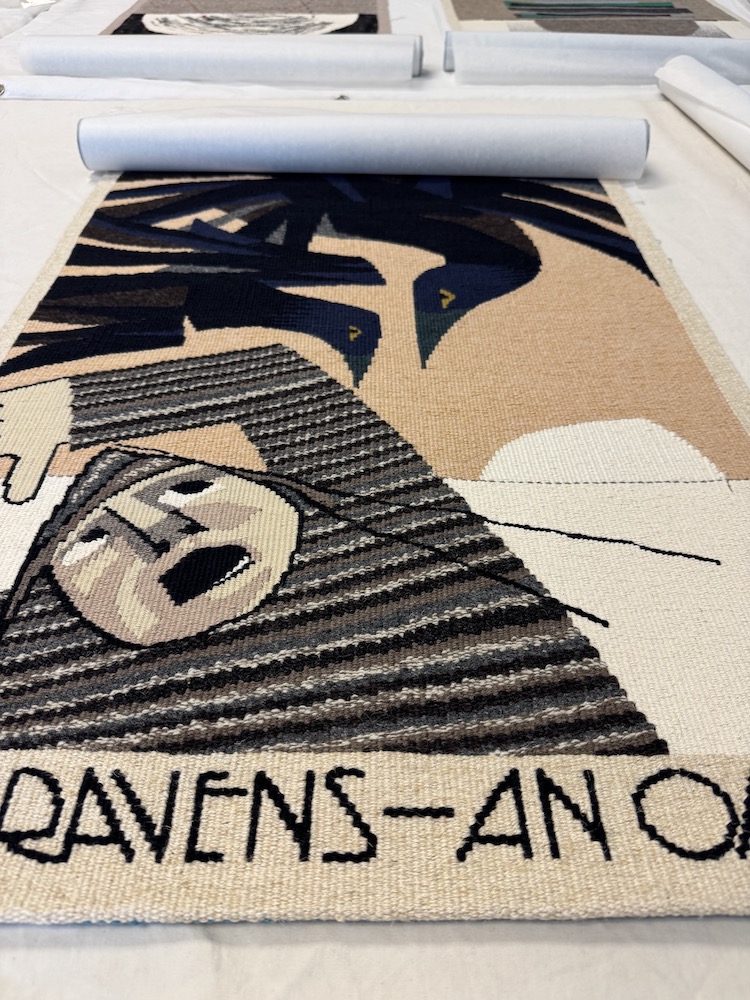
Let’s look at “The Ravens-An Omen,” which is certainly the most dramatically graphic tapestry in this series.

The imagery is so strong, the colors so saturated. The surfaces are so smooth, with perfect selvedges. Really, I almost needed a break to sit down and recuperate a bit! I was reminded of a statement by one of Archie’s early students, Cheryl Thornton, at the Victorian Tapestry Workshop in Australia (now the Australian Tapestry Workshop). She said, “I still think of him sitting at the loom and the ease with which he sat there. There was something about his presence sitting…there was no struggle.”

A piece with a meandering slit! How did he do that?

I’d place a bet that all of us want to give this a try. Like his Penelope postcard woven to look like it’s on an angle (Page 103 in Archie Brennan: Tapestry as Modern Art). Those selvedges on either side of the slit are a marvel. (The bit of weft showing near the bottom of the slit is just weft that needs to be pushed to the back.)

And here is a view from a different angle. Huge thanks to Christopher for getting these images with so many creative details.

Archie was one with the act of weaving. It seemed to be part of his body, part of his mind and soul. There certainly didn’t ever appear to be any struggle when he sat at the loom. Perhaps all that struggle took place when he thought about a new design, and when he did drawings to express his ideas. I just know that I feel such a sense of awe mixed with a calm contentment when I look at his work, especially at close range.

My son took more than a hundred pictures during our visit. I wish I could share all of them with you. But there is more to this story.

One week later, which was yesterday, I was at the Lyman Allyn Art Museum in New London, CT. My guild had an exhibit there for the past five weeks, and yesterday was the day that our hanging committee took down the works. We finished in record time, which gave me time to see another exhibit on view at the museum with a friend of mine from the committee.

This is an exhibition of artworks by the Inuit and Cree communities of the Arctic region of Canada in the far north of Quebec. The region includes Cape Dorset as well as Pangnirtung which sits right at the edge of the Arctic Circle, and is where Archie and Susan taught weaving at the Pangnirtung Weaving Center. Archie wrote a compelling essay about the life style of these people that you can read on page 186 of the book. Now, just one week after spending time with the very tapestries that Archie designed at this very spot, I was seeing all kinds of artwork done by the people of that area. Five weeks earlier I had helped hang our Connecticut State guild’s biennial exhibit without knowing what was on view in a nearby gallery of this museum. There were no tapestries on display in this exhibit, likely because weaving is not a traditional artform there. It’s a land without sheep, for one thing.

The exhibit has hand blocked prints, photographs, drawings, and carvings. I enjoyed all of it, and more so because of knowing that Archie had been in that very place in the early 1990s.

This is the only photo I’ll share from the exhibit. It’s a watercolor by the Canadian man who studied the works of this community, photographed them, and made a documentary about them. He very much reminds of the Dersu Uzala story, where Dersu was hired to be a guide in the Siberian forest for a Russian surveyor who was exploring the area on behalf of the Russian government in the first few years of the 20th century. It was a stroke of serendipity to find this exhibit so soon after visiting Archie’s “Dersu Uzala” at the Cooper Hewitt.

I find this painting particularly compelling. It reminds me of Archie’s “Spring Rain” where the landscape is turning green in blocky shapes, like the blocky shapes of this ice flow. And the mountains rise up as huge blocks of rock. I am pulled to weave this, but we’ll see.

On view in the gallery was one episode of a 7-part documentary called “Leaving None Behind.” You can read about it here. The documentary film was made by the Canadian man who contributed so much to this exhibit, John Houston. Here is a trailer for the series. The documentary is available to rent on Vimeo, which you can access from the trailer.

What a week! Bob and I are in the throes of getting him ready to fly to Trinidad to begin his long voyage north to St. Maarten and Bermuda, where he will meet up with the other sailors who are joining him to cross the Atlantic to the Azores. I have six weeks to get some weaving done before I join him, via TAPS airline (!), in Horta. I have a lot of fodder and good inspiration after the past week. Let me put these weeks to good use!

Back At It!–in Umbria, Italy

This is quite a thrill for me to access my website and write a new post. This site has been ‘sick’ for about six months, and I have not been able to access it.

It would be quite an epic if I tried to cover all the things that I’ve thought about, done, and struggled with over the past six months, so I think my best option is to just tackle a few vignettes, starting with my trip to Italy in October.

I went to Italy for a natural dyeing and tapestry weaving workshop at La Romita, which is in Umbria. I asked some of my students if they’d be interested in joining me, and my weaving friend Jody decided to go. The two of us quickly made friends with two experienced natural dyers, Yonat and Kris, from California. Part of the workshop description was that we would meet local dyers and weavers, but there were no dyers on our list of day trips. We decided to skip one of the trips and rent a car together to drive north to visit the workshop of Elena Villa in Castiglione del Lagos, a walled medieval town on the shore of Lake Trasimeno, where she sells her hand-dyed yarns and various finished items, like knitwear and dyed scarves.

We’d been warned that we’d probably have to take a car with manual transmission, and since I was the one who’d most recently driven standard cars, the driving fell to me. It had been about two years since I’d done that, although I’ve driven standard transmission cars for most of my driving life, so I was a bit nervous. A strange car with a standard transmission in a foreign country–but as luck would have it, we got a big American car with an automatic transmission. I have a sense that it was because Valerio, who took us to the Avis agency in Terni, pleaded our case with the staff there.

The trip was a cinch with Google maps, and we all had a terrific day. I think we were the biggest car on the road–not my first choice!

And here we are! Elena opened her shop for us that day although she is normally closed on Thursdays. Lucky for us.

Elena is in the foreground, with Kris (R) and Yonat (L) looking through yarns. Can you imagine how much we were swooning over all these wonderful items in such stunning natural colors?

Elena’s husband took a wonderful memento photo with the lake behind us. It was such an exciting experience to meet her and to see her work. Elena recommended we go to a certain restaurant before heading back to La Romita.

We left feeling inspired and ready to create things with the yarns that have such lovely blended gradations of color, as only natural dyes give. I found a whole shelf of merino yarn fine enough to use in tapestry.

The colors are:

  1. Solidago (golden rod) a bright gold on the merino yarn and softer yellows on the three scarves
  2. Solidago with “Robbia” (madder), the salmon/orange
  3. Solidago with “Cipolla (onion), the orange/rust/yellow/gold/green variegated yarn.
  4. Fitolacca (pokeberry!), which is havested more than once from spring through late summer, giving different colors as the season progresses.
  5. Noce (walnut, although I don’t think walnut trees grow in Italy), medium, warm brown.
  6. Galle di Quercia (oak galls), medium grey. I bought three skeins of this because I thought it would be a great neutral.

Lunch was another rare surprise for the day. When we entered the dining room we discovered the terrace overlooking the lake. Beautiful!

It’s so rare to have photos of myself because I am usually behind the camera. The photos that include me were all taken by Jody. It’s great to have a record of being here. Here is our terrace lunch with a view of Lagos di Trasimeno.
It was a magical day, the best any of us could have imagined. I bought some fiber from local Appeninica sheep that Elena had dyed with golden rod. I didn’t have a spindle with me, so Elena went home to get one of hers and delivered it to me while we had lunch. I will never forget that! Now I have to think of something remarkable to do with this yarn.

I spun this wool on both the spindle I got from Elena and, once home, on my Nano 2 e-spinner. The spindle spun yarn is on the right and is finer and more loosely spun than the skein on the left which is I what I spun on the Nano 2. I plied both these skeins on my folding Lendrum.

I just read about Appeninica sheep on Wikipedia. They are a modern breed, first established in 1970s, and based on quite a few other breeds. They are raised mostly in Umbria and Tuscany and were bred to do well in the Apennine mountains. Their wool is considered medium/coarse. That was not my impression of the roving I had. Perhaps the golden rod softened it a bit. Who knows?

It’s exhilarating to travel, and even more so when we can branch out and explore the exact thing we are most interested in experiencing. The four of us became good friends during the workshop, and we feel we made a great connection with Elena and her stunning shop.

Scroll to Top