ArgoKnot

travel

Weaving with Tori

We’ve had some whirlwind times since we returned from New Bedford — ten days on the West Coast, a week at home, and now a few days in Baltimore with our granddaughter.

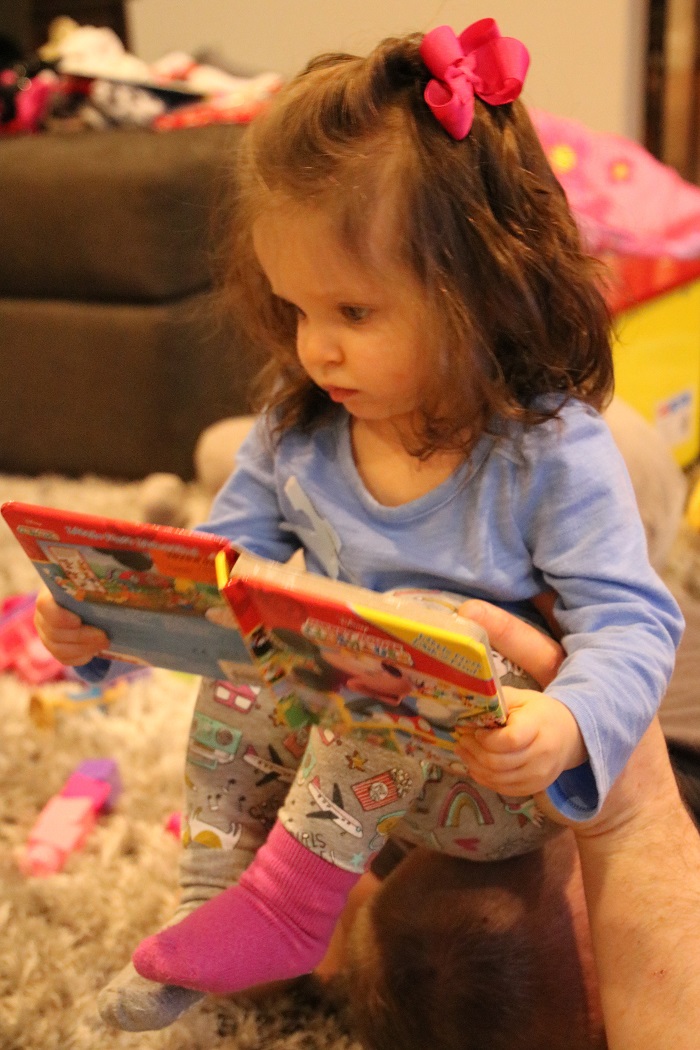
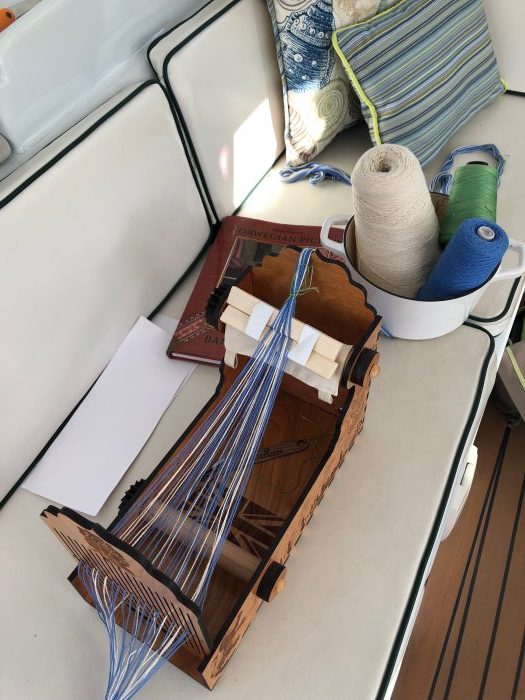
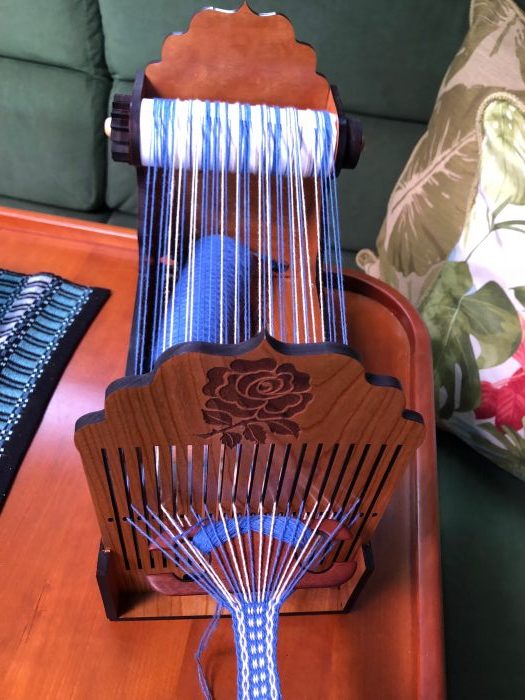
Tori is quite interested in the Harrisville Potholder Pro loom that arrived in the mail just before we drove down here.  I decided to bring it with me.

IMG_4263

She likes the colors and running her hand across the warp.  I think she’s got potential! Meanwhile, Bob is not so enthusiastic.  He burst out laughing when he saw the box.

IMG_4259

The first words out of his mouth were, “Potholder PRO??? Is it possible to be a ‘pro’ at potholder making? Does it come with a wheelchair?”  Funny guy.  I have no idea why I’m attracted to this thing, but if it will give me some pleasure onboard or while visiting family, that’s no joke!  I’ve been wondering how I’d ever bring a loom to either of our son’s houses.  Well, this is a start!  I’m making one a bit like the one shown on the box, since it came with the purple, aqua, and lime green loopers.  I also bought a gigantic bag of loopers in ‘designer’ colors.  There’s a lot of potholder possibilities in those looper bags!

Anyway, before I went down this path, I had 10 days in San Francisco and points north with our younger son.  In San Francisco I visited two terrific shops– ImagiKnit and Britex Fabrics.  I can’t think of a more creative name for a knitting shop than ImagiKnit!  Their summer window display lived up to their name.  There were knitted ice cream bars on sticks, knitted cupcakes with elaborate frosting decorations, and a box of knitted donuts!  There was too much afternoon glare on the windows for me to get good photos, but you get the idea.

IMG_4145

It’s a big store, with two long rooms divided by fiber.  One room holds yarns made from animal fiber and the other yarns made from plants fibers.  They’ve been around for about 15 years, and it looks like a successful venture!

Then there’s Britex in Union Square, another shop that is not to be missed on any trip to San Francisco!

Can you say ribbons and notions?  Oh my!

To say nothing of floors of fabric!  They have downsized a little (I think) since the last time I visited, more than 10 years ago.  They are downsizing more in November, when they will move to a smaller building, although they will still be in the Union Square area, and you can add on a visit to the Apple store while there.

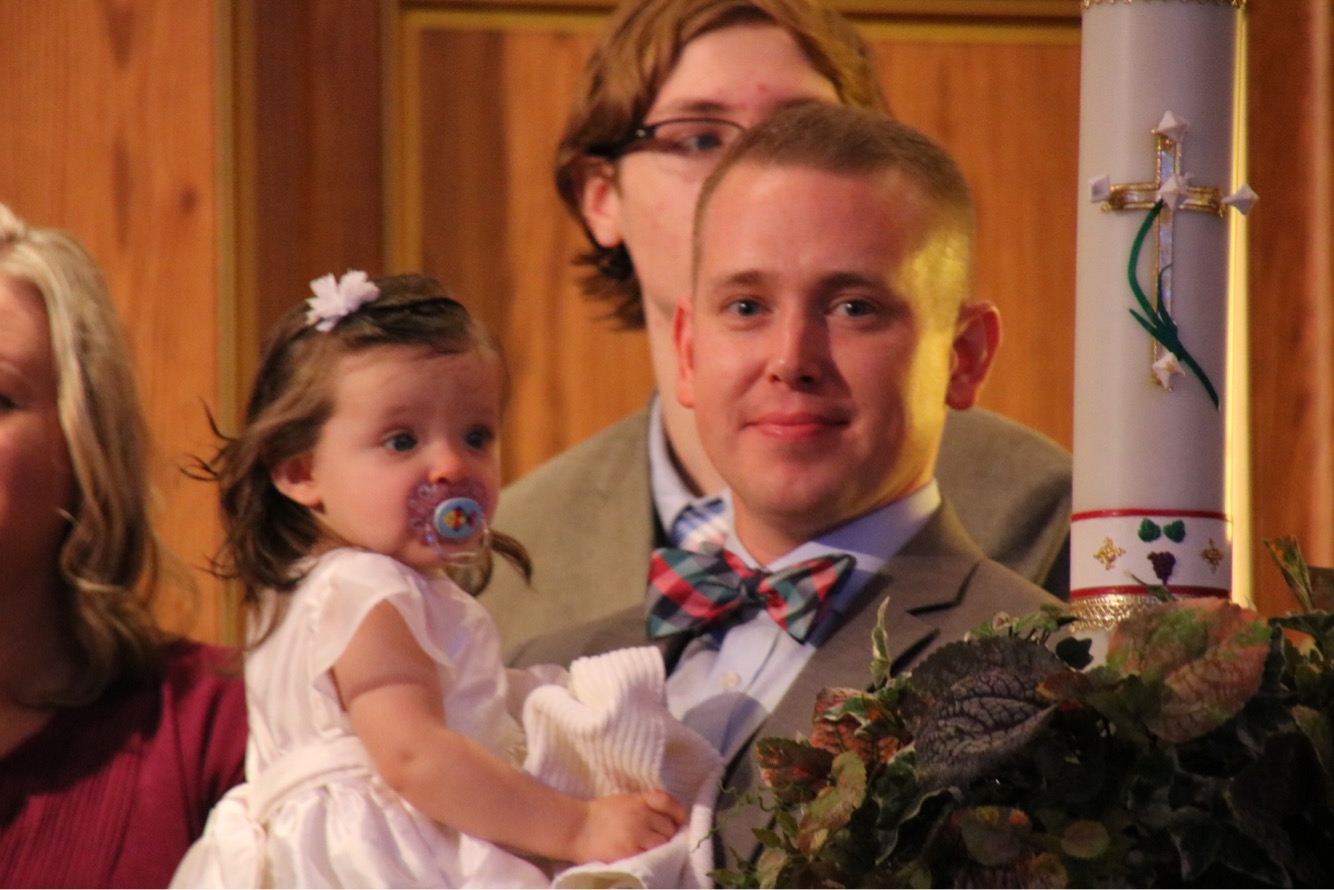
I got lovely white linen for Tori’s christening gown that will be accented with the two bobbin laces I’ve made.  I also got a fine white cotton batiste for the inner slip and some tiny buttons for the back of her gown.  Sewing will commence soon….

IMG_4006

During the week in between visiting the West Coast and now visiting Maryland, the first meeting of the year took place for the Connecticut guild.  The featured  speaker was Anastasia Azure.  I was lucky to get one of the last spots in her morning mini-workshop on weaving with paper.  She is known for her woven jewelry and larger woven pieces that are sculptural.  It turns out she knows how to have a lot of fun with paper too.  Check out the difference between her two renditions of the photograph below.

IMG_4239

IMG_4243

We had a great time making our own small paper weavings that can be mounted on a greeting card.  Anastasia’s afternoon presentation was about her jewelry and sculptural work.  You can learn a bit about her here.  I remembered her name from someplace, and by the end of our morning workshop, I realized she had been the juror for HGA’s gallery exhibition when Convergence was in Providence, where Anastasia now lives.  She was the juror who accepted my tapestry of “Sunset on Wilson Cove” into that show.

On the home front…. organization continues to be one my biggest struggles.  I am just not good at it.  I always have to rely on others to spark ideas for how I can organize my own space.  Recently I got just that when I visited a friend from both the weaving guild and lace guild.  Clare’s looms sit out in one of her living spaces, enhancing the room.  That could never happen in my house.  I asked her where all the ‘stuff’ was that you’d expect to be right near the loom.  She said she has converted one of her bedrooms into a stash room.  She then gave me a tour of the cabinets and shelving she uses to organize her stash.  Bingo!  I went right home and told Bob.  My stash is not yet under control but it’s a LOT closer!

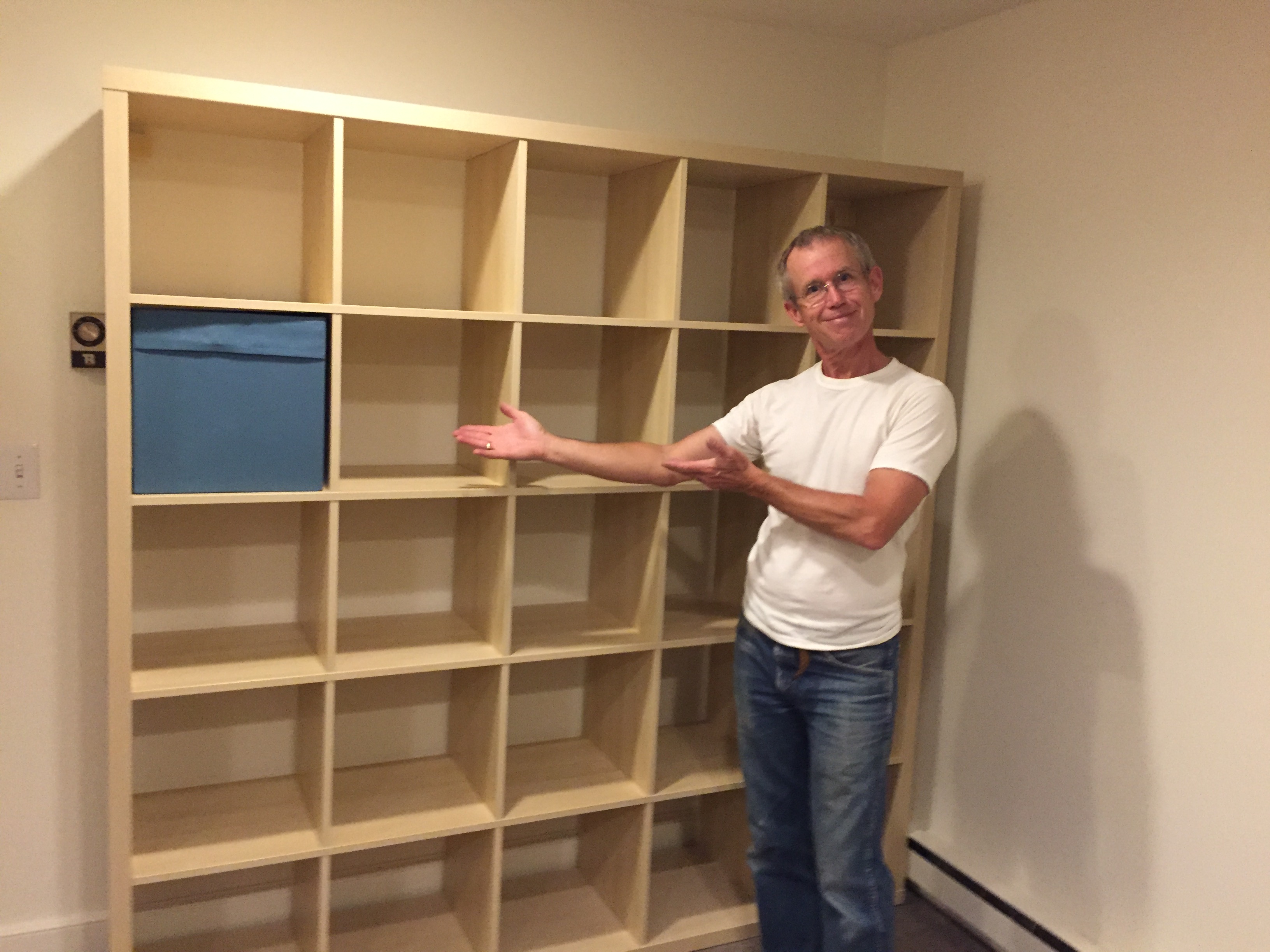
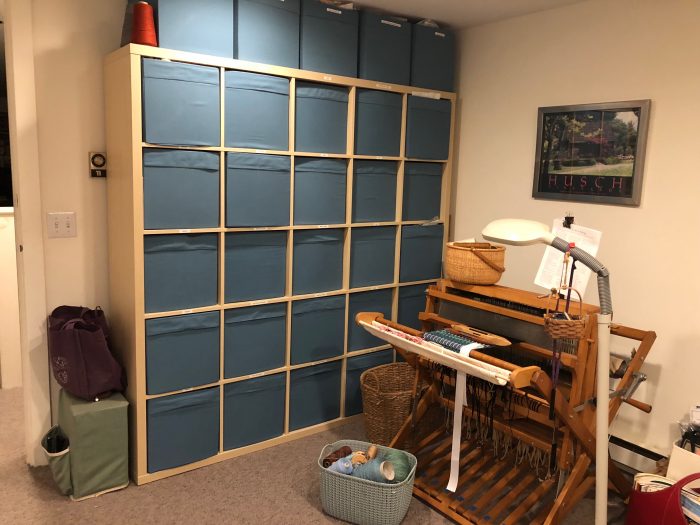
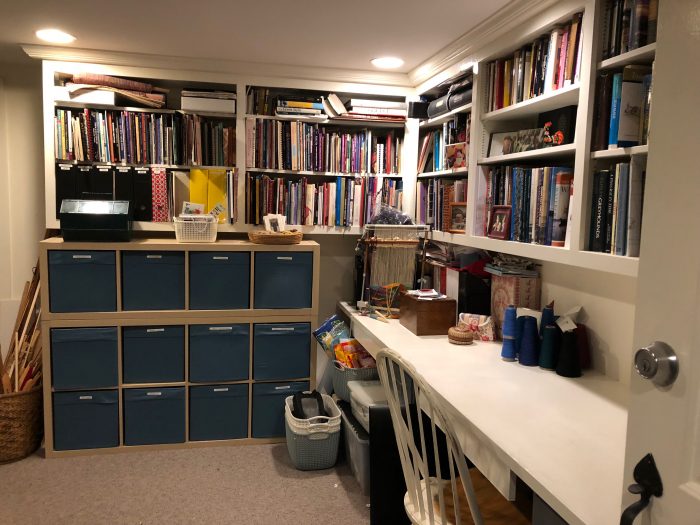
First, I got rid of the bins in my stash room and bought a wall shelf unit from Ikea.  These two walls had floor to ceiling mismatched, plastic bins that were quite an eyesore.  And even worse, whatever I wanted to access always seemed to be in the bottom bin, so I had to UNstack everything to get what I needed.

IMG_4223

Here are just a few of those bins piled up in the studio, waiting for the wall unit to be built!  You know the saying that to make things neater, you have to endure a much bigger mess.

IMG_4225

Ikea packages everything so concisely.  It’s to imagine that there is wall of shelving in those two boxes.  Actually, it was four boxes.

IMG_4224

Bob finished building this wall unit in less than an hour.  By the end of the day I had all the blue canvas baskets full of my stash.  I now have 25 canvas containers holding all the stash of wool, silk, cotton and novelty yarns that used to be in mismatched bins stacked to the ceiling.  My next purchase is going to be a flat file for all my shuttles and bobbins.  Thank you Clare for getting me motivated!

IMG_4229

Well, I want to get back to that potholder!  Tori has had a nap and an afternoon outing, so it’s time for both of us to get back to it!


Getting to “Plunge” and “Thou Shalt Knot”

Wedged between two trips that Bob and I have planned for a while now, we took a lightning speed trip to New Bedford to see two interesting exhibitions that are right down the street from each other.

The first was “Plunge: Explorations from Above and Below” an exhibit of artworks inspired by the sea that was curated by the couple who make up Brown/Grotta Arts.  It’s on view at the New Bedford Art Museum. There were a number of pieces done in fiber techniques, which is what intrigued me to visit.  Foremost is Helena Hernmarck’s large tapestry “New York Bay, 1894,” and joined by quite a few other works in fiber.  There is a beautiful catalog for exhibition that you can buy here.

Helena Hernmarck’s “New York Bay, 1894”

02-8-29-17a 049

The details are marvelous!

01-8-29-17a 048

There are a number of works by Karyl Sisson, and I was drawn to all of them.  In three of them she has used miles of zipper tapes to create organic, aquatic shapes.

“Reaching Out”

04-8-29-17a 053

Here’s a detail, so you can see the zipper tapes and more accurate color.

05-8-29-17a 054

“Growth II”

06-8-29-17a 055

“Opening Up,” made from cotton twill tape and wooden spring loaded clothespins.

03-8-29-17a 052

“Long Lines” by Annette Bellamy is a hanging created with twine and ceramic hooks.  It dangles over a plexiglass plate and the gentlest breeze makes the entire piece move.  I know, I blew on it ever so lightly.

08-8-29-17a 058

It worked well viewed with the piece behind it, and that was signature aspect of this exhibition.  Often the pieces enhanced the works around them.

10-8-29-17a 060

Behind “Long Lines” is Gretha Wittrock’s (Denmark) “Artica” made of sailcloth that has been dyed with indigo and cut and shaped.

There were quite a few works in fiber.  There was a large hanging made up of many silk threads that were hand painted with dye.  There were three marvelous little boat shapes made of plant paper and willow by Jane Balsgaard (Brooklyn, NY).

1-8-29-17a 061

The entire exhibition is beautifully displayed with spectacular pieces.  It is on view until October 8, so there’s time to get up there.  If you do, don’t miss a visit to the New Bedford Whaling Museum. Right now there is a temporary exhibit about Clifford Ashley, the master of knots who wrote The Ashley Book of Knots, a book you’ll find down below on almost any blue water sailboat.  We’ve had our copy since the late 70s.  It covers knots used in other applications (I’ve used it for tying interesting knots with my kumihimo), but it’s a knot bible for sailors.

It turns out that Ashley had about 7,000 knots in a collection he made for the book.  His daughter now has that collection and loaned it to the museum for this exhibition.  Ashley was also a painter, and I enjoyed seeing what a good artist he was.  He studied with Howard Pyle in Brandywine during the same period that N.C. Wyeth studied with Pyle.  The exhibit has photos of Ashley’s family life, his paintings, and lots of knots.

Quite a clever title for the show…and great graphics.

15-8-29-17a 101

Here’s the book.

4-8-29-17a 138

A photograph of Ashley standing in front of one his paintings

1-8-29-018

Just a few knots….along with harpoon.

2-8-29-018

And I could not resist a photo of some lace bobbins, tatting shuttle and lovely ivory fid displayed on a piece of machine made lace.

3-8-29-17a 131

Upstairs at the museum you can see a vast amount of ivory things. The walking canes alone must number in the hundreds!  There were no shortage of handwork tools and household items that men carved for their loved ones.  While I enjoyed looking at all the rolling pins and pastry cutters, I confined myself to photos of items for handwork.

A cabinet full of top shelf swifts!

6-8-29-17a 163

The crown jewel of sewing accessories….pin cushions, spool holders and lots of little drawers for supplies.

5-8-29-17a 160

My favorite– an ivory knitting basket, with ivory and ebony knitting needles.

4-8-29-17a 157

Into our 36 hour trip we also crammed in a visit to the well known Nantucket basket supply store called DELS, where I purchased some of the missing items from a Nantucket purse I started about 7 years ago.  Maybe I’ll be carrying it by next summer.  I’ve always wanted to see this shop in person.  It is a treasure trove of basket temptations.

The counter display of ivory, bone, and acrylic decorations could have entertained for me for an entire day….

There were shelves and shelves of basket molds to choose from and all the cane and staves you need to weave.  And all the tiny finishing hardware necessary for these baskets.  I thought I should make a plan for my next basket while I had the attention of an expert (Melanie) to guide me.  I settled for a small, narrow tote.  They will gather up the necessary items and ship them to me in a couple of weeks.  I’ll put it on Pandora to weave this winter.  And then I’ll be just like the real McCoy!–making a Nantucket basket aboard a boat!

So here’s the shape of my tote.  Just imagine it without the salt and pepper grinders and the center divider, and with  short leather handles for carrying.  It’s going to be just the thing! I’m making mine with a cherry base, rim, and staves.

This trip came about because of one thing Bob had scheduled to do– a tour of the Coast Guard air station on Cape Cod.  We had a 12.30 appointment to meet one of the helicopter pilots–a female lieutenant.  We met her earlier in the summer when she spoke at Bob’s SSCA event and we arranged this visit.  She is still in her 20s and has been a pilot for four years already.  Impressive!

When we arrived at the air station we learned that all the planes except one helicopter and two planes had been called to Houston to deal with rescue efforts in hurricane Harvey.  There was a pilot left on the station to man the remaining helicopter, and he graciously gave us the tour.  We have incredible armed forces, and it was fascinating to learn a bit about the Coast Guard.  Bob and I have seen two presentations on how the CG goes about search and rescue.  Visiting the air station and getting to see the actual equipment was really the frosting on the cake.  These guys can keep a helicopter level in order to lower a cable and a basket onto a boat that might be rocking to and fro and rising and falling in 50 foot waves.  That helicopter is experiencing the same wild winds, and yet the crew know how to keep control of the rescue procedure during all the uncontrollable elements in a bad storm.  The men who handle the rescue operation know how to do things that seem far beyond humanly possible.  Honestly, I don’t know how they can do it.  And what a nice bunch of people to boot!  There are quite a few women at the air station, but most of them had been called to Texas.

Lieutenant Podmore is showing me the remaining M60T helicopter that he flies.

1-8-29-17a 182

The hangars are ridiculously clean.  I’m not sure what this plane is…Bob and the Lt kept talking about C-130s…

3-8-29-17a 189

The rescue swimmers work out every day….as you might imagine.  Hard to see, but some of these guys were doing things that I (again) did not think humanly possible!

4-8-29-17a 191

It was a whirlwind trip–barely over 36 hours.  I have been worried about everyone down on the coast of Texas, but of course, worried about my own family most of all.  It was especially moving to me to meet these soldiers who have such an important role in the ongoing storm and will continue to help through the aftermath.  I don’t have a way to reach my relatives who live in Galveston, so it was very comforting to think that these soldiers are down there helping.  My relatives further east on that coast were managing at the end of the weekend, but have now just been hit by the 2nd landfall of Harvey, and again, I’m thankful to have seen first hand the kind of rescue and help that is down there.


Women’s Work

Today’s mail held a treasure I’ve been looking forward to seeing!  Last week on Etsy I found a vintage bedsheet with matching bolster pillow that had been embroidered in counted cross stitch and bordered with laddered hemstitch.  The sheet itself is a luxurious, heavy weight French ‘metis,’ which is 65% linen and 35% cotton. According the to vendor, Hanky Heiress, this fabric blend was developed to be an ‘easy-care alternative’ to 100% linen sheets.  Look how beautiful it is!

IMG_3512

Here it is opened up across my bed.  The blue and orange cross stitch look wonderful on my vintage, machine woven, overshot bedspread!  I’m thrilled!

IMG_3511

The seller of this sheet and bolster set believes it’s from the 1960s, and she speculated that that they have never been used.  Now that I’ve seen it firsthand, I agree with her.  Who knows where it originated; by the time I found it, it was residing with an Etsy vendor in Cheshire, England. What a sad thing that it may have spent 50 years in a drawer or closet.  I have been imagining various scenarios in which this might happen, and the only that makes sense to me is that someone made this as a gift for someone else.  Perhaps it was a wedding gift, with the two initials signifying the union of two different names.  I can only imagine that the woman who did this put so much love into this gift.  It is truly a treasure!  And I’d like to think that the woman who received it loved it so much that she was hesitant to actually use it.  Well, I intend to use it, and I intend to enjoy it.  I will always think of this story that I have created to go with it.  I feel it has good potential for being true!

It amazes and inspires me that women (and men too) have been making and embellishing textiles since the dawn of humanity.  There’s a reasonable chance that textiles are older than pottery, as Elizabeth Weyland Barber has speculated.  It seems we are hardwired to surround ourselves with the work of our hands.

In early April I learned that our friend Hank, had arrived in Havana on his boat and would soon try to deliver all the all donations of lace-making materials to the woman I met last year.  I wrote about the lace makers last year while Bob and I were visiting Cuba on our boat. Due to lack of communication in Cuba as well as while sailing offshore, I did not get confirmation of the delivery until mid-May.  What an emotional moment that was for me!  And I understand there were few tears shed by Hank and his wife, along with the women who received this bounty, and even the male interpreter!  I cried myself when I saw the photos and this wonderful video that Hank and Seale made for me.

When Bob and I first hatched this idea of sending materials to Cuba, neither we nor Adriana fully realized the effort involved.  I had been quite saddened to see the poor quality materials women had access to–sewing thread used in multiple plies for embroidery and crochet, and poor quality knitting and crochet yarns that looked like some Russian version of Lily’s “Sugar N Cream” yarn–and only available in one color  —  Ecru!  Mailing gifts is simply not possible, since all mail is opened and usually the contents are ‘re-purposed.’  Even making a face to face delivery had a high degree of risk for confiscation.  Adriana and Hank worked out the best plan they could come up with, and still both of them were worried about being discovered.   It is forbidden in Cuba to have guilds or groups, so the women who meet to do various types of lace together have to be quite careful.  I am so relieved that this venture was a success!

This is now my favorite photo of Adriana, where she looks like a young woman again, full of excitement for the many projects that lay ahead for her and all the other women she tutors in lace techniques. I can almost see the ideas starting to swirl in her head!

Screenshot 2017-06-01 12.50.07

Here is photo of the stash before Bob and I packed it up in four extra-large vacuum seal bags.  In early January, Bob sailed to the British Virgin Islands, where he transferred the stash to Hank’s boat.  In early April, Hank sailed for Cuba as the leader of a rally of sailboats that would spend two weeks in Havana.

1-12-17 004r

Best of all, here are some photos of Adriana’s lace work that I bought from her last April.  First a Torchon  doily that I gave as a present at my lace group’s annual holiday party.

1-IMG_2988 (1)

And two pieces of Adriana’s tape lace that I kept for myself.

IMG_3513

The work of our hands–across the decades– and across the world.  And this is just the tip of the tip of what is out there in the world.


Where in the World Have I Been??? Well, Beaver Brook Farm for Starters.

A lot of water has rushed under the bridge and over the dam, since I returned home more than 6 weeks ago.  A whole bunch of wonderful things have happened that I should have written about already.

Bob has had a hard time sailing the long distances this year, both going south and returning north, but he managed to get home just a few days before this holiday weekend.  He had to leave Pandora in Hampton, Virginia, and drive the rest of the way home. Hopefully he’ll make the last few hundred miles back home in late June.  It’s terrific to have him back!

For now, I’ll write about this holiday weekend.

Since we’ve moved to Connecticut it has been our new tradition to take a drive through the beautiful Connecticut River Valley each spring as part of our Memorial weekend festivities.  Yesterday was a glorious day, one of the first days without rain in about a month.  I put together a picnic, and we headed out in our toy car to visit a sheep farm/dairy and a local winery.

Only a week before I learned about this sheep dairy from a friend who traveled with me to a long weekend lace conference.  On the other side of the Ct River there are three dairy farms that make cheese:  a cows’ milk dairy called Cato Farms, a goats’ milk dairy called Beltane Farm, and a sheep and cow dairy called Beaver Brook Farm.  Imagine that! All three right within a few miles of each other!

Here is bucolic Beaver Brook Farm, owned by the Sankows.  The farm has been in their family since the beginning of the last century, and they’ve been raising sheep and making cheese since the current generation bought their first sheep in 1984.  I found some newspaper articles tacked up on the walls of their farm market that date from the early 2000s.  These articles came from the New York Times, “Saveur” Magazine, and several local publications.

5-28-17a 026

It was a stunning day for a visit.  First came looking at the new lambs.

5-28-17a 028

5-28-17a 029

Then we met Suzanne who gave us a tasting of fresh sheep’s milk cheese covered in herbs de Provence, feta, an aged cheese that she calls “Farmstead,” and even a fresh sheep’s milk cheese mixed with pesto.  All of it was delicious!

Here is Suzanne cutting some feta for us.

5-28-17a 014

And here is a counter of aged Farmstead ready to be cut and packaged. It is a semi-firm cheese with a LOT of great flavor.

5-28-17a 015

Suzanne gave us samples enough for a meal, and we enjoyed all of it.  Afterward we visited the small building next door called the Wool Shop.

5-28-17a 010

Inside the shop is more of an idea in progress than a fully functioning shop.  They are just now branching out with the idea of making and selling things from the wool of their sheep. (Did I ask what breed these sheep are??  How could I neglect to do that?)  The raw fleeces are sent to a mill in Massachusetts to be washed, then sent south for spinning at a mill in in either North or South Carolina. Some of the yarn is used to weave fabric that becomes blankets or clothing items, like capes and vests and sweaters.  But look at all those piles of socks!

5-28-17a 011

Recently Stan bought a sock knitting machine from China and is busily making hundreds of socks per machine knitting session.   Sometime back, I remember reading in the NY Times that there is one town in China that produces almost all the socks sold in the world.  Is that where Stan got his knitting machine?

5-28-17a 025

It takes only 3 minutes for this machine to knit a sock.  There are lots of choices of sizes and designs for the socks.  When the sock is finished it shoots out into the blue plastic bucket in the foreground.  I burst out laughing when the sock came shooting out!–sans toe because Stan has the toes done elsewhere and also has the socks washed elsewhere which makes them much softer than what we are holding here.

5-28-17a 022

Want one?  Here’s the info on that. The basic machine is about $6,000.  You’ll need to fork out more for all the design possibilities.

5-28-17a 021

A sock in progress down in the center.  That plastic tube is where the sock will get shot out of the machine and into the bucket.

5-28-17a 017

5-28-17a 020

Just a head’s up for friends and family.  There will be sheep socks coming your way this Christmas.  How can I resist?

5-28-17a 023

There are many to choose from!

5-28-17a 038

Then we went to take a look at the sheep in the field.  What a bucolic setting….

5-28-17a 039

The farm is in Lyme on Beaver Brook Rd, in Lyme.  Suzanne says they are open 7 days a week.  That’s hard for me to believe with all the chores that must keep them busy, but she says they always have time to greet visitors and give you a cheese tasting.  We went home with the fresh cheese covered in herbs de Provence, two hunks of feta and and some Farmstead.  Yum…

We capped off the day with a stop at Priam Vineyards in Colchester, just a bit north of Lyme, and a lovely drive too on a spring day in a very old MGA.  Cato Farm, where you can buy some wonderful cow’s milk cheese is just around the corner from them.

We sat on their shady terrace overlooking the vineyards and had a glass of  chardonnay with our picnic.

IMG_3495

What a way to celebrate the beginning of summer in New England.  It is the best time of year for remembering and acknowledging how lucky we are to have such freedom and so many opportunities to enjoy life.

Dominica, Our Final Destination

This is the final week of my Caribbean winter.  When we left home in January, we had no idea how many islands we’d get to visit.  As it turns out, it was less than we imagined, but what a trip it’s been.  We have only been through the Lesser Antilles, or Leeward Islands so far. Dominica is our final destination before turning north to return to Antigua in time for my flight home this Sunday.  It is magical place that has entranced both of us.  We will be back again next year.

In the past Dominica had a reputation as a trouble spot for cruisers.  A group of locals realized that Dominica is such a gem with so much to offer tourists, as well as so much of traditional island lifestyles that could support the locals, it was worth making an effort to make this island a safe place to visit.

Bob and I arrived just a day before the weekly Saturday market in Portsmouth.  We learned that almost everyone on the island has a little plot of land, a small ‘farm,’ that may be only a small fraction of an acre, but is bountiful in supplying so many crops and a few chickens.  The market is full of tropical fruits and veggies, like pineapples, bananas, sour sop, Caribbean pumpkins, coconuts, nutmeg, along with plenty of European vegetables like carrots, onions, corn, peppers, eggplant, and even some cold weather veggies like lettuce and cabbage.  Many people also have jobs in tourism or government offices, but they all get up extra early each morning to tend their farms.  It is quite impressive.

Look at all these coconuts!  There were several trucks like this at the market on Saturday morning. We learned that Dominica used to be the biggest exporter of coconut related things until coconut oil took a serious downturn years back during the ‘fat scare.’  Now there are more coconuts than the locals can keep up with, and every time a coconut falls to the ground it germinates into yet another coconut palm.

4-1-17a 018

The tomatoes and cucumbers here are beyond belief–even better than home grown.  How do they do it?

4-1-17a 015

4-1-17a 004

This woman was selling flowers along with food.  She would not allow us to pay for the flowers, and when we added a few ECs (Eastern Caribbean coins) to her total she threw in a few bananas.  She is stunning in the traditional madras head covering.

4-1-17a 007

The next day we hired Faustin Alexis to take on a river tour of the Indian River.  He is an excellent guide, so if you find yourself on Dominica you should ask for him.  All the guides through PAYS (Portsmouth Association of Yacht Security) get training, and in Faustin’s case, he has become very committed to the traditional way of life and wants to return to it himself while also helping others preserve it for future generations.  His enthusiasm for the plants and animals of the rainforest was moving, and it was impressive to see his knowledge of plant life, birds and bird calls, and fish.  He says he’d like to return to living in the rainforest when his children are grown.

4-1-17a 056

No motors are allowed on the Indian River, so after Faustin picked us all up from our boats (8 adults and 2 toddlers, plus Faustin which made 9 adults) he walked to the front of the skiff and began rowing into the river.  In spite of rowing upstream, he kept up an ongoing conversation, pointing out plants, birds, and bits of traditional lore.

4-1-17a 020

As we entered the river, another tour boat was exiting.  I think these tours are highly organized so that there are never more than two boats on the river at once.  We could not resist getting a shot of these adorable kids on the other skiff.

4-1-17a 044

We had our own adorable kids onboard as well.  They belonged to two Dutch families who happened to meet just before their Atlantic crossing in the Canaries.  I hope someday we can share this wonderful experience with our own granddaughter, Tori.

4-1-17a 097

These amazing trees were all along the river.

4-1-17a 062

4-1-17a 077

There was lots of bird life that we saw and sometimes only heard.  There were parrots in the upper story, although we could not see them.  But we saw the shore birds feeding along the river’s edge.  Here is a white heron looking at the little crayfish at the water’s edge.

4-1-17a 051

4-1-17a 022

And a green heron.  There is even a type of duck in Dominica, but I missed the name.

4-1-17a 101

And there were so many plants that Faustin identified for us that are used for food or medicine or for general health.  He often jumped off the boat to peel some bark from a cinnamon tree, or to pull a branch of bay for us to smell, or a nutmeg laying on the ground, or to show us plants used to make poultices to heal wounds, and the bright magenta leaves of another plant that would be used to wrap as a bandage around the poultice. His knowledge seemed quite encyclopedic.  He told us that the older person on record came from Dominica and was a woman who lived to be 127.  His own great uncle lived to be 115. Faustin showed us which trees are used to build the traditional houses and which trees are prone to termite infestations.

4-1-17a 036

At the farthest point of the tour upriver we stopped for a bit of a walk, and explored a set of traditional buildings where a couple of men served flavored rum to the tourists and demonstrated how they make it.  Here is a big batch of gooseberries being boiled down to flavor a new batch of run.

4-1-17a 080We all enjoyed the day’s drink offerings which were a coconut rum drink or an ‘ultimate’ rum drink.  I also had a small taste of the medicinal rum that Faustin had– flavored with ginger root, nutmeg, bay leaves (a very pungent type of bay that must not be bay laurel), a few ingredients I’ve now forgotten, and ganja!  What a surprise!

The next day we arranged for Faustin’s nephew Fitzroy to take six of us on a walk through the rainforest up to an impressive waterfall.  There were Carol and Bob from Oasis and Dave and Chisholm from Pantine, along with Bob and me.

Fitzroy had a similar respect for the wonders of Dominica as Faustin has.  He was an excellent guide.  He recognized many bird calls and pointed out to us that the main birdsong we were hearing was that of parrots.  They were all around us!  After straining and straining to see them in the canopy of leaves, two parrots took flight and shocked all of us with their bright flash of color.  No one got a photograph.

This is the forest we walked through.  Sometimes there were openings to the sky as here, and sometimes we were in deep shade with the canopy of the trees about 150 feet above the ground.

4-2-17b 154

4-2-17b 040

Looking up into the upper story where plants get the most light, we could see many orchids and bromeliads growing on the tree trunks, as well as huge vines.

4-2-17b 045

In the deep shade there was plenty of plant life too.

4-2-17b 160

4-2-17b 157

There were places with great vistas–

4-2-17b 077

4-2-17b 073

And places so deep in the understory that it drew our focus into the details.

4-2-17b 061

4-2-17b 078

4-2-17b 162

4-2-17b 026

4-2-17b 037

There are even wild amaryllis in the sunnier parts of the rainforest.

4-2-17b 070

Bob and I were particularly on the lookout to see orchids and tree ferns, and there were plenty of both.  There are traditional uses for tree ferns in Dominican culture.  What we know it best for is a planting material for epiphytic orchids.  Fitzroy was surprised to learn that is all we used it for back home.

4-2-17b 050

Tree ferns are very ancient plants, older than humans.

4-2-17b 163

There were plenty of orchids too.  Bob was thrilled to find a few brassavola nodosa in bloom on his previous walk, and plenty that would soon be blooming.  We saw lots of orchids on our walk to the waterfall, but none in bloom.  There were some very tiny orchids and some very large terrestial orchids.

The goal of our walk through the rainforest was a large waterfall.  The path we followed crossed the river several times, the final time involved swinging across the river on a large vine, Tarzan style.  Here is Bob swinging through the air.

4-2-17b 111

And we’re on our way to the waterfall along the relatively dry river.  The rainy season will come in another couple of months. That is our guide Fitzroy in the distance.

4-2-17b 086

You can see how high it is based on how small our fellow travelers are!

4-2-17b 088

Along the edges of the forest there are houses and small farms, places where the locals have burned a bit of the rainforest to create a small plot for growing their own food.  Here are lots of banana trees, coconut palms, and plots of vegetables.  This plot which was labor intensive to start is for a type of yam vine.   Each tuber was planted into its own mound of soil.

4-2-17b 018

4-2-17b 021

And the locals are growing coffee plants and cocoa plants.  This is a branch of unripe coffee beans.

4-2-17b 164

–and a branch of rather ripe cocoa seeds.  Inside these pods are strands of thick cocoa.  I bought some in the market and they have a deep chocolate aroma.

3-31-17b 055

At the end of the day Fitzroy asked me what I use all the plants for that I grow.  I was left a bit tongue tied by that.  Use?  I grow a few herbs and vegetables, but mostly I grow plants for the sheer enjoyment of it.  That is all I could tell him.  He was surprised by this.  What a very different culture we were experiencing here on Dominica.  This is my lesson from visiting this place.  Perhaps I can figure out how to be a bit more conscious how I can be more self sustaining.

Yesterday we began the trek northward so I can catch my flight home on Sunday from Antigua.  We have returned to Terre de Haut in the Saintes and treated ourselves to a wonderful dinner out last night at Bon Vivre.  We were happily surprised when Judie and Phil from Rum Runner walked into the restaurant shortly after we sat down.  We shared a table together, and tonight we will have them aboard Pandora for a last dinner before we each head our separate ways.


Scroll to Top