ArgoKnot

Fine Craft

Walking about Cienfuegos

Boy, my dogs are barking!  There is a lot of walking to do in this town.  Luckily the harbor where Pandora is anchored, called Punta Gorda, is a ‘short’ walk into Cienfuegos—only about 20 minutes.  However, day after day, that really adds up!  A couple of days we walked between 4 and 5 miles, and one day we walked over 8 miles.  And it’s hot!  Have I mentioned it’s hot??  Bob keeps asking me if I want a sweater. The answer is still YES!  And I want the weather to go with it!

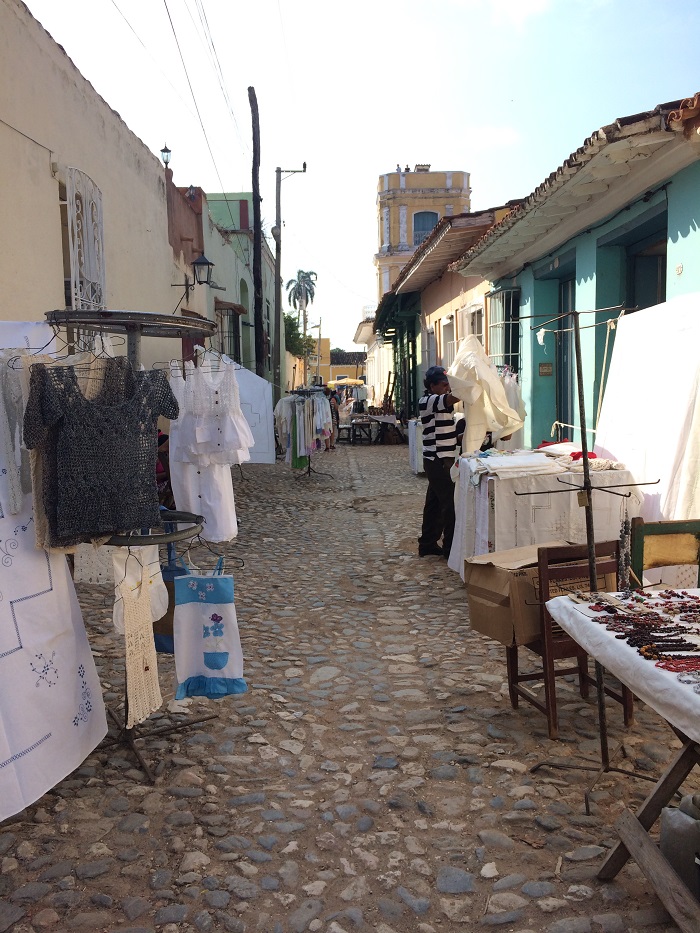
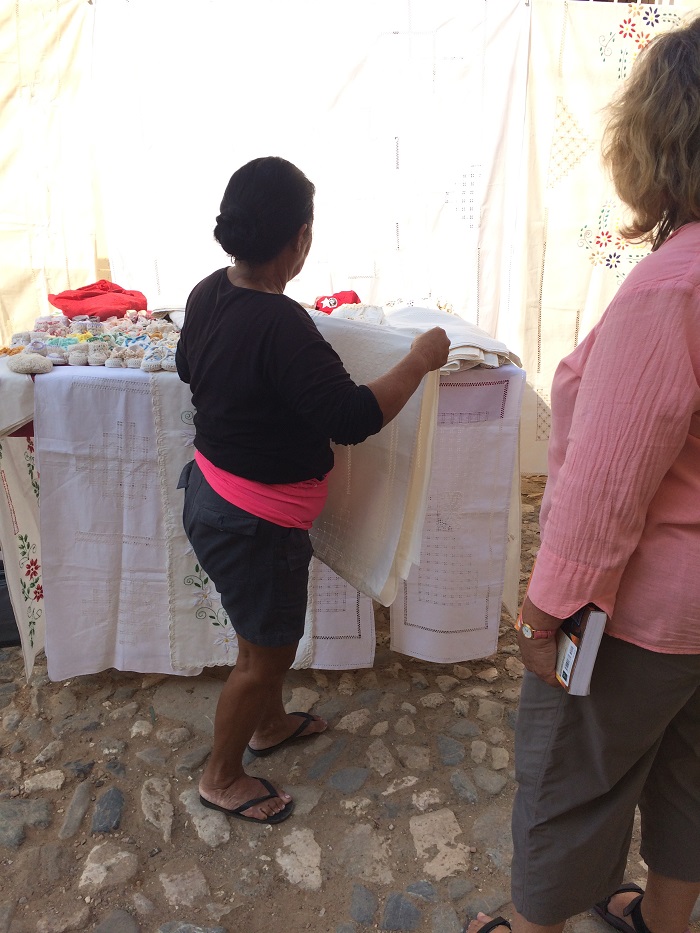
On the first day we found a small shop along the main street in Cienfuegos, where a woman (younger than I am) sells various items of handwork that include crochet and embroidery.  There were embroidered table linens and lots of crocheted sweaters and shawls.  There was a rack of sewn clothing, traditional Cuban guayaberra type shirts for men and some lovely women’s tops embellished with machine sewn tucks and hand embroidery.  It was a small shop, decorated like a living room in a house.  After talking with the owner for a bit we learned it is her house and the shop was most likely her living room.  At one point her elementary school aged son came out from an interior door, wearing a school uniform.  It was late afternoon, she kissed him goodbye, and he was off to some after school activity.  Bob happened to see through the door that there was a bed in that room.

The owner spoke English quite well and we were able to talk about a number of things.  She made some of the crocheted items herself, but many were done by other family members.  They were all lightweight pieces made with fine threads for wearing in the hot climate of Cuba.  The sweaters were all open work that would be worn over a tank top or camisole.  They were really lovely.  The owner—silly me!  I did not get her name—prefers knitting herself, and that launched us on a great conversation because we’ve both been knitting since we were very young.  She can knit carrying the yarn in either hand, as can I, and she can knit in either direction like I can.  I think I’d enjoy knowing her.


We stopped again the next day, when Bob wasn’t so hot, so he could try on some of the guayaberras.  We chose one, and I bought a small table square that had pulled thread embroidery in the center and a nice hemstitched edging.  I would love to have bought more, but there was no more to buy.  I was also hoping to find other handwork shops, but no luck on that!  We passed a window (open shutters, no glazing) where a woman was sitting at a sewing machine, sewing a garment out of white fabric.  Behind her on the back wall of this tiny room there were some traditional Cuban clothing for men and babies hanging on a rack.  She motioned for us to come in, but it felt so cramped in the tiny room that we passed on that.

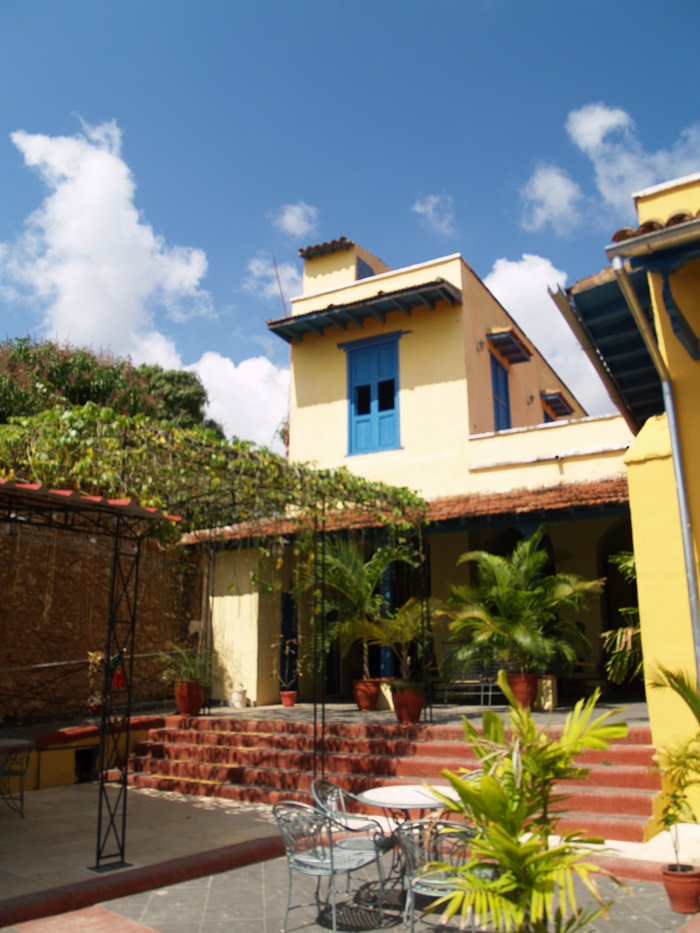
One day we had lunch in the Palacio de Jagua that is now a government owned restaurant and tourist spot.  Each day I think bus-loads of tourists are brought here for lunch.  We managed to find a table for lunch in between two bus tours.  A palacio is a large, ornate structure where government offices are on the lower floors and a residence for the higher-ranking government official is on the upper floors.  In this palacio the lifestyle was very ornate, Moorish Victorian.  It felt very strange to eat a meal in such a luscious Moorish setting. It felt like eating in a mosque, and that felt rather sacrilegious—even though this building had never beena mosque.  All the lacy cutwork on the walls was plaster.  It is a beautiful space.  The building is about 3 stories tall and there is a terrazzo bar on the roof.  We plan to visit there this evening.

The Palacio de Jagua


This is the entrance to the Palacio


The dining room:


We have tackled buying some food items in the local shops.  We’ve now bought several kinds of bread from a panaderia, and from street vendors on bikes with large boxes of pastries strapped on the back with bungy cords.  Yesterday we had an interesting experience trying to buy cheese and butter.  People kept getting in front of us on the cheese/butter line—at a counter in the back of the shop where cheese and butter are stored.  Finally when there was no one left to get in front of us I asked for ‘queso y mantequilla.’  The man motioned and said in ‘Spanglish’ that we had to pay for cheese and butter in the checkout line before we could get it from him.  Okay….we had waited a long time to get this info, and off we went to wait in the checkout line, where all those people who’d gotten in front of us were now waiting to pay for their cheeses that supposedly they had already paid for.  That did not make sense to me, but when I finally got to the cashier I told her that we wanted a kilo of cheese and a ‘brick’ of butter.  She looked at the empty counter –where are the goods?  I explained that the cheese counter man had told me to pay first.  This started a barrage of angry sounding Spanish between the two—the woman in the front of the store and the cheese man at the back of the store speaking very loudly and forcefully to each other across the space.    Anyway, it turns out that we had to pay for butter before getting it.  Who knows why?  We think maybe it is rationed from the lines we saw in Santiago of people waiting to get butter.  So we payed for the butter, went back to the cheese counter and got the butter and cheese and then went back to the cashier line to pay for the cheese.  Crazy!

We also saw a huge line of Cuban women waiting in front of a women’s clothing shop.  The glass door had a sign that said it was open (apierto), but the line was forming outside and no one was going in.  I think something of great value may have arrived in that shop and they were monitoring how many could enter at one time.  If I could communicate better I would have asked about this.

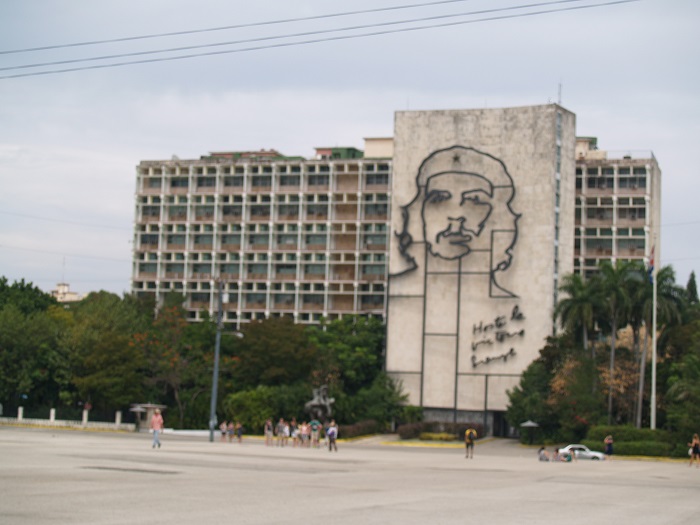
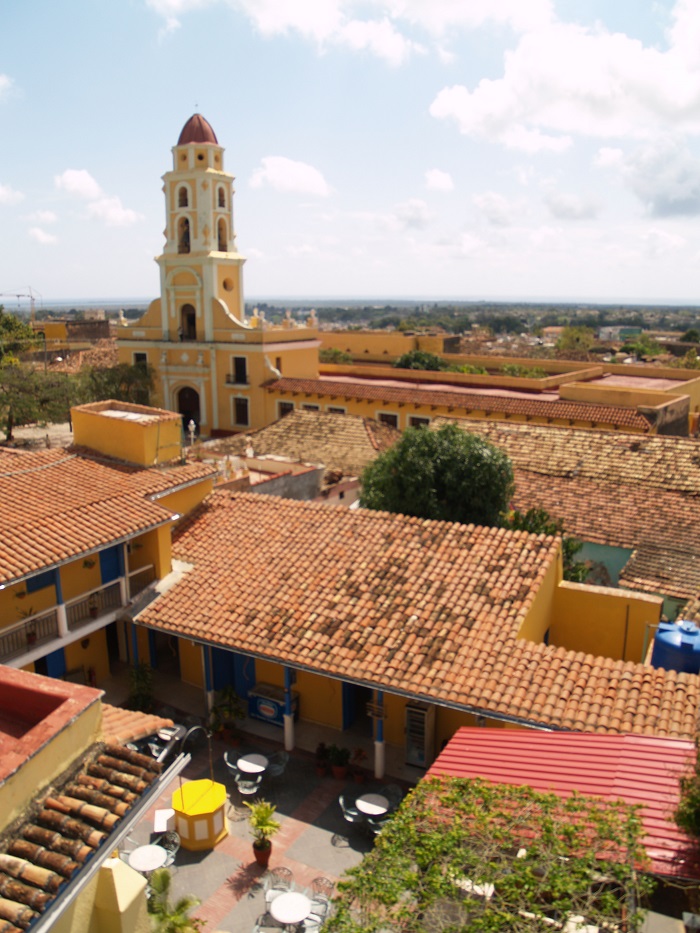
There is a center park surrounded by a parliament building, a beautiful theater, and church, all dating back to the Victorian era and therefore quite ornate.  It’s been a wonderful few days here, even though my feet are tired.

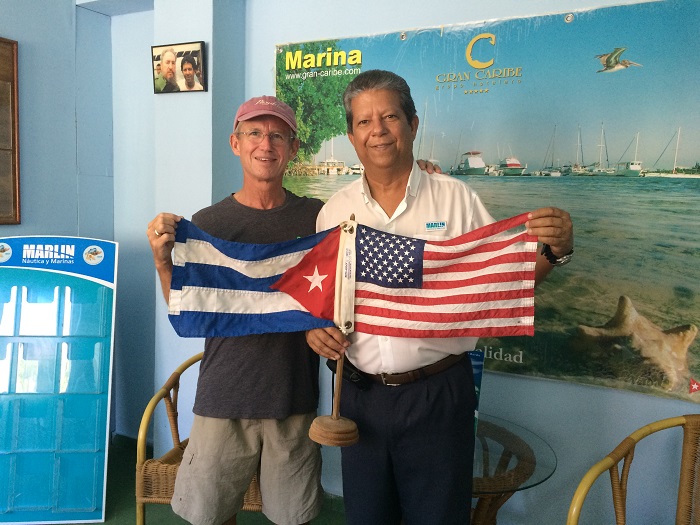
Here is Bob holding his Essex Yacht Club burgee in the park.


Although this photo is really all about the well preserved Buick (??), the theater is in the background.  We may try to catch a performance here on Easter Sunday of something we simply cannot fathom from the advertisements at the ticket office.


OLYMPUS DIGITAL CAMERA

For us, it will be more about being in the space than seeing the performance!


Before walking back to the marina we stopped for a cold drink and listened to local musicians.  The bongo/cow bell player, the mariachi player and the flutist were the singers and they were terrific!  They did a rendition of “Volare” that was fabulous! You can just barely see the string base player behind the bongo player.


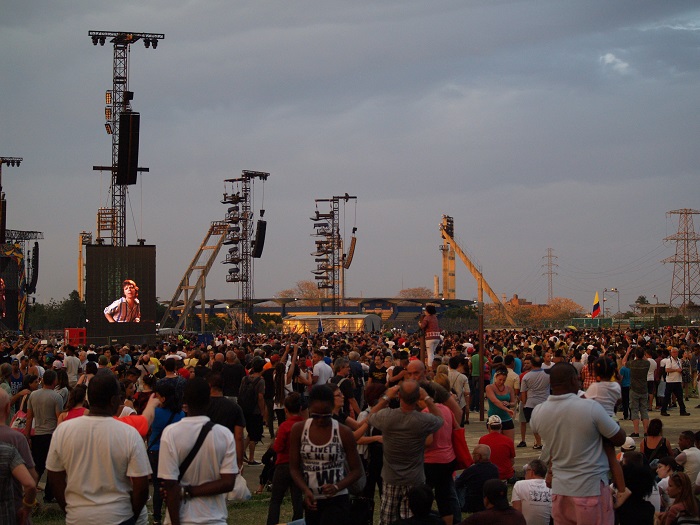
We have begun making plans for how to get to Havana by bus or taxi for the Rolling Stones concert.  Hopefully it will all work out and both of us will be writing about that early next week.  We will certainly be among the oldest people there.  If the audience is expected to be around 500,000, I wonder if we will even see the stage.  Wish us luck!

Vignettes of Cuba

We left the small fishing villages of Chivirico and Marea del Portillo several days ago to head further west to the point of the sourthern coast at Cabo Cruz, and then along the island chain of the Jardines.

Marea del Portillo turned out to be quite different from Chivirico, even though I lumped them together as ‘fishing villages.’ Chivirico had a main street with a park on the beach of the Caribbean Sea. When we arrived on a Sunday afternoon the beach was full of locals, and the small restaurant where we ate was doing a steady business of ‘take out’ even though we were the only ones ‘eating in.’ I should explain that ‘take out’ still meant you got your food on a stoneware plate and your drink in a glass. People took their food and drink to their picnic tables or to their beach blanket and returned them when they finished. Across the street from the beach was a little row of three shops, a Mercado where Monday morning I found a pile of ½ lb. bricks of butter in a refrigerated case and no line waiting to buy them up, an all purpose shop with everything from electric rice cookers to clothing for all ages. The last shop was called ‘Cimex,’ and looked like some kind of office like building.

Marea del Portillo was much, much smaller than Chivirico. There was a main road, but it seemed to be a just a bus stop. And buses seemed to stop there every 15 minutes or so it must have have been a main route to somewhere. There was a row of about 3 or 4 houses, but no shops. We went ashore where all the small fishing boats were tied to poles in a line along the brown sandy beach. There was a horse drawn carriage waiting at the beach and we asked the driver which way to town because the beach was at an intersection of three dirt roads. He told us which was to go, and then motioned to the carriage that he would be willing to drive us. How much? One CUC. Okay…

OLYMPUS DIGITAL CAMERA

It was a short ride. He dropped us on the main road in front of the little row of houses, and motioned that the entrance to the one where he had just stopped the carriage was a ‘paladar’ with very good food. It was early afternoon and we decided to eat there in the front garden that had a little tiki type roof over a sitting area. The garden was full of bromeliads and bougainvillea and even a large red rose bush in full bloom! Lunch was delicious! I had small shrimp (peeled) served over a pool of lemon, butter and garlic. Perfect!

OLYMPUS DIGITAL CAMERA

We have noticed that the salads served throughout our stops in Cuba are among the prettiest concoctions I have ever seen. We have been leery of eating most of them, but they are quite delectable looking. They are all composed salads, and so far none of them have had lettuce. Mostly we’ve seen a little pile of completely white cabbage, shredded and molded into a dome in the middle of the plate. Surrounding this are little composed lumps of other veggies—consisting of canned beets, canned corn, fresh carrots julienned with a little chopped herb on top. Herbs might be sprinkled over the entire plate with a drizzle of beautiful green olive oil. Sometimes there is no drizzle, but in that case a little cruet holder of oil and vinegar will be on the table. For such simple food, and some of it canned, it is a wonderful display.

When I looked deflated about the lack of food shopping in the town, the carriage driver asked me what we were hoping to buy. I answered ‘huevos y cafe,’ eggs and coffee. He made some kind of reply that made me think he would get them for me while we ate lunch. He was back again almost to the moment when we had finished. I swear these towns-people have some line of communication with each other—and it’s not by phone!

Anyway, he did not have the goods but he offered to drive us to the local hotel (outside of town) where we could get internet. We both wanted to post to our blogs so we took a horse drawn carriage to a hotel to get internet. What a contrast! Check out the sights along the route to get to a modern hotel…

OLYMPUS DIGITAL CAMERA

OLYMPUS DIGITAL CAMERA

The hotel was considerably bigger than the one we’d encountered up on the hill in Chivirico, and it was again geared mostly to Canadians. It looked like a nice place to escape Canadian winters, although quite rustic. The internet was spotty, and it took me more than half and hour on my limited one hour access just to get connected to my website.

And interestingly, again, our driver showed up just as we finished up using the hotel computer.   The ride back to the beach where our dinghy was tied up was the most interesting part of the whole day ashore. Along the dirt road that led to the beach were some very modest houses. He stopped in front of one and called out to the woman who lived there with her family.

OLYMPUS DIGITAL CAMERA

She came out with a well used cartoon of eggs, 13 in all, and a well used plastic container of ground, very black coffee. We asked how much and she said it was her gift to us. She then asked if we had anything she could use—clothing especially, or shoes…for her kids. Well, I don’t have anything on board for children, but since I saw no children I had no idea anyway what size children she meant.   She also sent us with a bag of 8 tomatoes in various stages of ripeness, and sold us a rum bottle full of honey from her bees—for 4 CUC. We felt we’d hit a treasure trove. Back on the boat I dug up what I could to give to her. I hope she can use what I gave her.

And this situation brought up an interesting subject for Bob and me, and generated a long conversation about the value of what she gave us versus what we gave her. I wanted to give her much more than Bob did. We actually had to compromise on what he took back ashore to her. In my mind the value of what she had grown and raised was higher than the value of what we’d bought at Walmart to bring as ‘gifts’ (read tips) to the various officials we’d encounter at each port. In this climate she had worked hard to grow those tomatoes (I haven’t smelled tomatoes with such strong tomato-ness even from my own garden! And they tasted as good as they smelled!), as well as to keep her chickens and keep the bees. Bob, on the other hand, was thinking what it cost us to buy coffee and tomatoes and eggs at home vs. the cost of the t-shirts and the shoes I sent to her (used shoes I might at, but new shirts). I still don’t think that is the way to look at this exchange.

And now I have to add that we have not actually tried the eggs yet, even though we have been out of eggs for some time now and I’ve been craving them. I can’t quite make myself crack one open. I need to face that fear soon. From what we’ve seen, chickens just roam all over the place, and roosters do too. How on earth do they know which eggs are not fertilized? I am quite worried about what I’ll find when I crack an egg, and I’m quite put off by that. Just the though of it has cured my desire for eggs. But we can’t just carry them around for the rest of the trip!

OLYMPUS DIGITAL CAMERA

After Marea del Portillo we stopped at Cabo Cruz, with its well known light house used n many guide books.  This is the point where the truly southern coast jogs northward a bit.

OLYMPUS DIGITAL CAMERA

This is the point where the scooped out portion of the southern coast begins. It’s really running rather northward at this point and is dotted with lots of cays and reefs. The cays are mostly uninhabited. We stopped at two. There are no harbors here. Like the Bahamas, you just anchor in the lee of an island, in this case with a reef to block the Caribbean Sea from bouncing you around too much. These are not calm anchorages like you get in a real harbor, but they are safe enough and very beautiful.

The first cay where we stopped was suggested by Frank Virgintino in his cruising guide to Cuba. Things have certainly changed since he was here last! The cay is a very small island with a coral reef running along one side of it. The entire perimeter of this little cay was surrounded by dead mangroves. It is beautiful in a desolate sort of way, but I know that is not why Frank recommended it in his guide. Bob and I think that a hurricane must have done all this damage here, after Frank’s visit. There were some stunning frigate birds all around us, and a small hawk or falcon perched in a large dead mangrove, and a large osprey. It was a lovely spot, until the sun went down, and then, in spite of being quite far from shore, we were inundated with no-seeums. And I mean inundated.

We put up our screens as soon as we noticed them, and we have very fine screens. But it was too late. Bob fought them off and on until we went to bed, but it wasn’t until the next morning that we realized the extent of the inundation. I am covered in bites everywhere that I didn’t have clothing. And since it was hot I didn’t have much on that night. I wonder when the itching will stop. Right now I can’t quite make it 24 hours on an antihistamine. The next morning we found a blanket of grey on all the ceilings of our cabin, the entire kitchen counter, and in the shower. It had to be 10,000 no-seeums. It took two days to finally win the battle. There are still a handful onboard, but hopefully their life cycle is short.

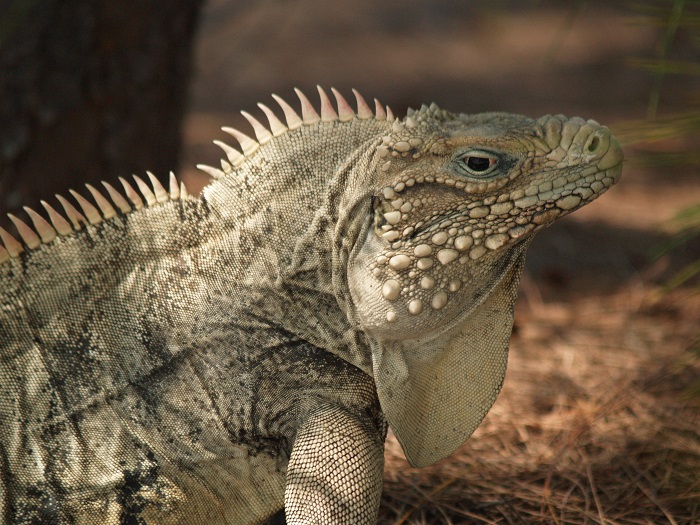
We spent the next night off another small cay, and we anchored even further from shore. Bob took a quick trip ashore in the early evening after we’d settled in. He found one small open air hut on the island where a single man was living. The island was overrun with iguanas, hermit crabs, and hootias (sp?—the little rodents that are causing such a problem in the Bahamas’ Land and Sea Park). The man in the shack with no walls runs a snack bar on this island, but I’d like to know who could possibly imagine eating something cooked by a man who doesn’t seem to have had a shower in decades and lives with nothing but the fresh water he can collect and the amount of electricity he can generate from the solar panels on his roof. No thank you!

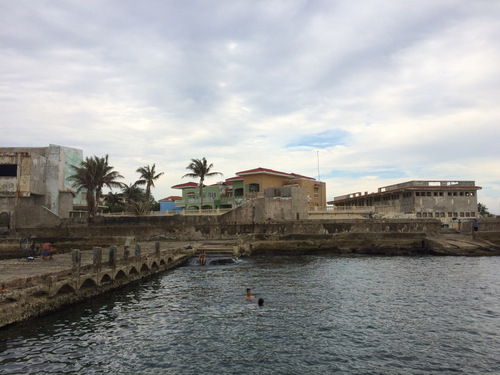
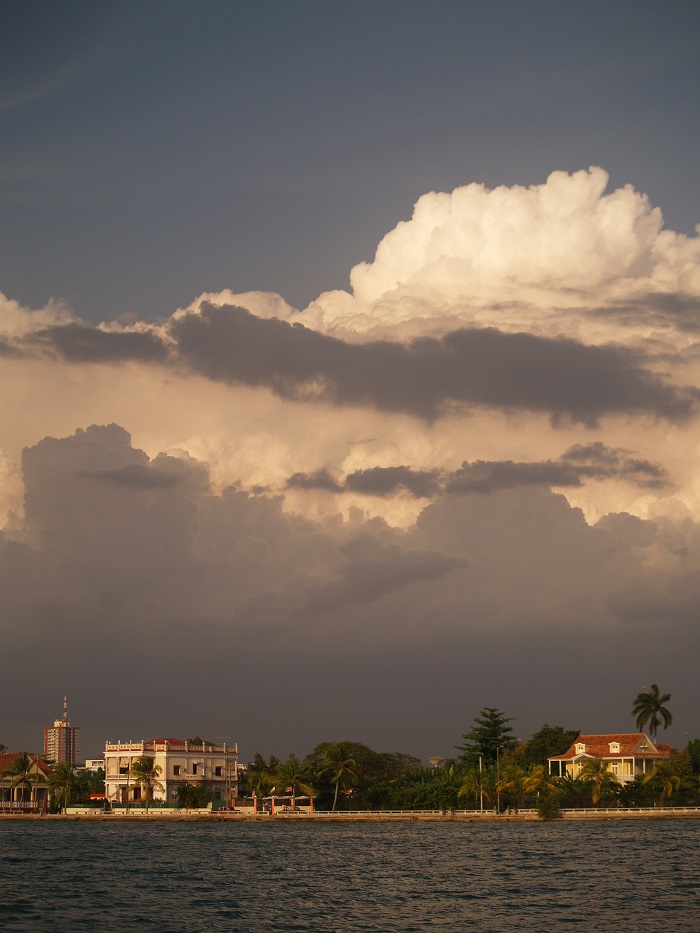
This morning we awoke in the next big town of our journey: Cienfuegos. It is a beautiful city! It was built much later than Santiago de Cuba, and has mostly Victorian looking buildings that we can see from the shore. The ‘yacht club’ is an amazing Victorian mansion that I’m looking forward to visiting as soon as we go ashore. It is a short walk to downtown Cienfuegos. We’ll head in shortly.

It was a long day getting here yesterday. Chris Parker predicted a cold front with very strong northwest winds that would arrive late yesterday, but it arrived a good 12 hours earlier and so made for a very rough passage to windward. The wind was sustained in the high 20s (mph) with gusts over 30 mps on a regular basis. I was quite seasick most of the day. It took us about 8 hours to get there and I was so thankful to get into a calm harbor!

This is the sign that greets you as you enter the harbor.  Welcome to Socialist Cuba! Can you see the big search light just in front of the word “Cuba?”  Quite cold war looking…

OLYMPUS DIGITAL CAMERA

Luna, whom we last saw in Chivirico,  arrived last evening, at dusk. I know Lars is going to leave his boat here and take a bus up to Havana to see the Stones concert. I have thought and thought how we might do the same—in a civilized manner!  Lars is not nearly as concerned with creature comforts as I am! I would love to see President Obama even more than the Stones, but I don’t think there is a solution! I want to take an air conditioned vehicle (not possible), and then stay in a 4-star hotel in Havana (also not possible with no internet to find one and little likelihood of one having rooms at this point since there are very few of them). I can’t believe we are here at such an auspicious time, with no way to get our own boat there in time.

Sailing  is such a slow mode of transportation!  But I’ve just learned that the Stones concert has been postponed in order not to conflict with Obama’s visit.  This is probably old news to anyone reading this because you certainly have more access to news than we do!


Rural Cuba

The south coast of Cuba is strikingly rural, and life in the few small fishing villages that dot the coast is a step back in time considerably further than the 1960s when we lost touch with this country.

Yesterday we sailed 50 miles (or rather I should say motored because there wasn’t a breath of wind all day) from the small village of Chivirico to the next small village of Marea del Portillo. In the 50 mile stretch between these two harbors was a vast uninhabited shoreline where the Sierra Maestro range drops straight into the Caribbean Sea. We passed the tallest mountain in Cuba yesterday, 2000 meters above sea level. The more impressive statistic about this mountain range is that as we sailed just a few miles off shore the depths are at least equal to height of that one mountain. We were passing through waters that were from 5000 ft to 10,000 ft deep. This is a very dramatic coastline and an impressive mountain range.

Bob has written apost that beautifully describes what we are seeing in these small villages, and surprisingly agrees with most of what I would have written myself! We always find it a little surprising when we agree so completely on certain things, and this is one of those times.

We have only seen one or two boats when we are out sailing, and it’s no surprise that we end up in the same harbor every few days. There are so few harbors along this coast it is inevitable. The boats we’ve seen are all flying Norwegian flags. Last night we invited our neighbor Lars to dinner, after a long hot day with no wind we were all too tired to make much of an effort for dinner, and I think he was happy to have me doctor up some leftover rice with a bit of vege and egg and cheese. Lars has been living aboard his very pretty double ender, Luna, for more than 12 years. He has sailed around the world and has been in the Caribbean several times.

I enjoyed our evening with him in particular because he is the first person on this journey with whom I could talk a little about weaving and know that he would understand! Isn’t it interesting that after 4 years of sailing about this area I encounter a man who knows enough about weaving to listen to me talk about what I miss from home! One of my dearest friends is Norwegian, and there were noticeable about Lars that reminded me of her. I don’t know if that is because they both come from the same area of Norway, or if I was just bound to find them similar because I’ve been away from home so long and missing dear friends…. Lars compared the solitude of weaving to the solitude of single-handing his small boat. Also , the amount of preparation a weaver has to do before beginning to weave is similar to preparations for a sailing journey, and the concentration required for both while allowing our minds to enter a zen-like state while weaving or sailing. He was an enjoyable conversationalist for both Bob and me. This morning he left early to keep heading west while we have chosen to stay another day…maybe two.

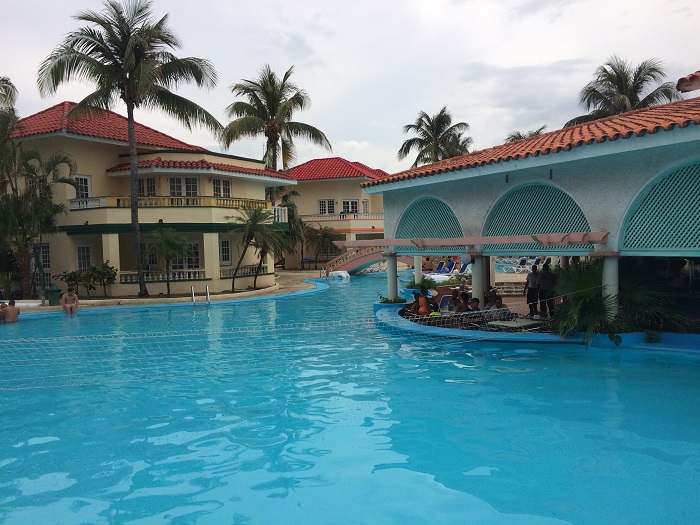
In both Chivirico and Marea del Portillo there are government owned resorts just on the outskirts of the town. These resorts seem to attract Canadians. When we visited Hotel Brisas a couple of days ago for internet, we noticed all the people lounging in the courtyard were northerners (pale and fair haired) and then noticed that everyone was speaking English. The entire guest list on hand that day were Canadians, and all of them had been coming back to this beautiful secluded spot for numerous years. One couple, who’d been coming here for 25 years told us that the rate at the hotel was $750 for two weeks and included all meals and drinks and even the airfare. Unbelievable!

Pandora at anchor from about half way up the hill at Hotel Brisas.

OLYMPUS DIGITAL CAMERA

On the one hand, while there are little window air conditioning units in each bungalow, there is rarely enough electricity to turn them on. That’s okay most of the time since there are ocean breezes to balance the discomfort from the heat. But the past week has had almost no wind, day after day. Still, the guests could float about in the pool or go down the 500-step stairway to the ocean and snorkel along the coral reefs, or just float in the water. The water is not quite cool enough to be refreshing at almost 90 degrees.

From our spot in the harbor we walked a bit beyond a mile to this hilltop resort, along a very steep, somewhat paved road with three switchbacks. Down in the village we asked one of the mule drawn cart drivers if he could take us up there, but he motioned that the mule could not make the steep climb. It was quite a trek. We were pleasantly surprised to learn that you can order as many things, including drinks, from the menu for one lunch fee. We had a number of cold drinks after that hot trek!

Water is also an issue everywhere in Cuba. Even in such a large city as Santiago de Cuba there are many days when the water system shuts down. As I understand it, it’s not they’ve run out of water but that the system has failed. The water system is from the 1950s and has had no updates or even repairs. The pipes are likely clogged with all kinds of debris, and the quality of the water is too poor for drinking. In the cities you can buy bottled water in large containers for drinking. In these little villages you have to boil your drinking water. I’m very glad that Bob and I are making water while we are out sailing. It is clean and clear and the color of deep indigo. Then our water goes through a number of filters before at last going into a Brita pitcher for drinking.

The sewars are in equally bad shape to the water system. The pipes have not been updated in the past 60 years either, so they also shut down often. You can never put toilet paper in the toilet. In many cases this means that there is no toilet in the bathroom, to prevent you from making that mistake! I knew before we left home that we would have to go ashore with our own. I was also warned that when the water system is shut down there would be no ability to flush toilets! And as I mentioned, this can go on for days—pretty horrible. For the most part we have only stayed ashore for the duration of time one can manage without a need for a toilet! I try not to drink so much water during the day when we are away from the boat, although that’s not easy in this heat!

So contrast these hurdles, which are admittedly rather large hurdles for me, against the dramatic landscape of mountains and pristine ocean, mostly unspoiled by any human habitation. It’s a rare and beautiful part of the world, but it does have it’s downside for a spoiled American like me who would prefer clean water and good toilets, and safe food!

A small house with tidy garden in Chivirico.

OLYMPUS DIGITAL CAMERA

And where there people and animals living in clusters, the lifestyle is so simple. Everyone keeps chickens, and even pigs. They wander around everywhere, along with goats and dogs. The roosters crow all day and all night, and it reminds me of communities at home where you can call the local police to make someone get rid of their rooster for an offense like crowing all night. Yesterday we saw a very large pig being led down a sidewalk in Chivirico—now that’s something I’ve never seen. I had to wonder if that pig was on his way to a pig roast… Hopefully he’d just wandered a bit too far and was being led home…but at some point I imagine he’ll supply an awful lot of dinners for some family. I know he’s not just a pet. The goats seem to travel together and I wonder how anyone keeps track of whose goat is whose.

The men all seem to fish. They fish from their docks with hand lines…. They wade in the shallows throwing round nets. We’ve never seen them catch anything that we’d consider big enough to eat. The most interesting fishing vessel we’ve seen is an intertube. The fisherman floats around in it, using his hands to paddle himself about, and storing his catch in a milk crate that he has tied to the intertube.

OLYMPUS DIGITAL CAMERA

No Cuban is permitted to own a boat longer than 20 feet. Hmmm…..is this to prevent them from going too far from shore? ….perhaps to another country entirely? Meanwhile, these small fishing boats all have inboard engines. I haven’t seen an outboard yet. I know the waters are full of fish here, so I think they get a good catch most days.3-16-16a 012

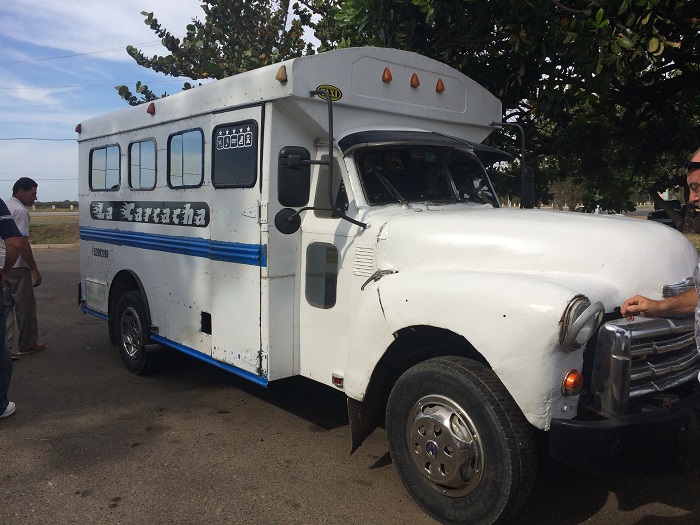
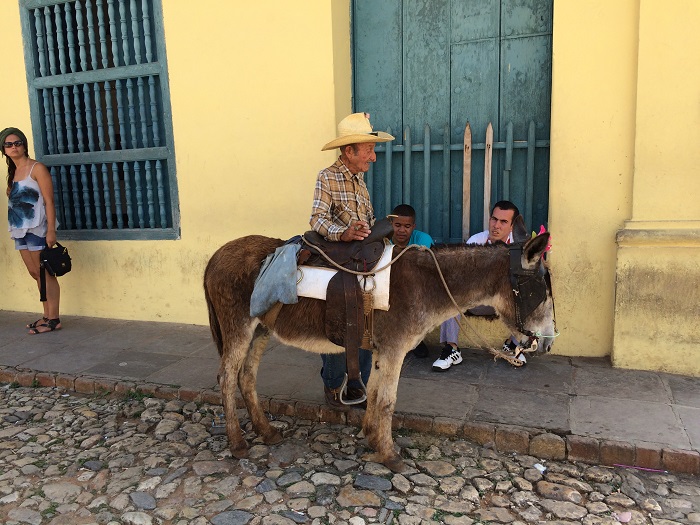
Along with big modern buses …alas, no AC…a very common mode of trasnsportation is mule or horse drawn cart. 

3-16-16a 001

As I write this I have to mention that Bob and came ashore toay in Marea del Portillo with a desperate need for internet.  Our sailmail which is a sideband radio software that allows us to get our email when there is not internet has been slowly failing for over a week.  As of three days ago it has failed.  Bob has spent part of everyday for the past week trying to diagnose and fix it, but no luck.  This is very dire to both of us since it is our only connection to our kids and to the facilities where both our mothers live.  So internet was a high priority today.  We had to get to a hotel just outside the village, a long hot walk.  So we opted to take a horse drawn cart to get our internet!  I don´t think I´ll ever experience that again!  I´ll post a photo sometime….át the moment it´s still on the camera!

Lastly, a small comment about our most recent encounter with the Guarda Frontera: the official who visited us yesterday looked younger than our two sons, and he constantly referred to the last sheet in his notebook that was filled with writing, so I think he was very new to the job and was checking his to-do list. He asked a lot of questions that just seemed so trivial to us: how much water does our boat hold? How much gasoline does the can in the dinghy hold? We found this all fascinating as he carefully wrote down answers to all these questions. The Guarda Frontera have no boats of their own so they always have to flag down a fisherman with a skiff to bring them out to visiting cruising boats. In yesterday’s case the poor fisherman had no motor in his little skiff, so he had to row out to us on such a stifling day. We gave them both cold cokes, and I hope that helped.

3-16-16a 011

Later, when we compared notes with Lars about the minutiae of questions asked by these officials, he a funny reply. He said that after all his experience with the Guarda Frontera you must simply go with the flow and answer their questions without giving it too much thought. They are not really looking for exact details anyway. They just need to fill out the forms. They have to write down something, it doesn’t much matter what. They will never check for accuracy. It’s all about filling out the form. He quoted what may be a well known saying in Cuba: “the people pretend to work, and the government pretends to pay.”


Bienvenida de Cuba!

We are here! We arrived in Santiago de Cuba early Sunday afternoon, a full day ahead of our plans. Plans are always a wish and a prayer on a boat. Our brilliant weather router, Chris Parker, warned us that we’d better get through the Windward Passage before mid-Monday, and now I’m so glad we tackled that nasty bit of water even earlier. The sea state in the passage reminded me of what you see when you lift the lid on your washing machine and watch it agitate your clothes, only on a far, far greater scale. As you can imagine, in the dark, this was a terrifying bit of the trip for me. Maybe it’s a good thing that our first night out was about as idyllic as any landlubber could wish. I spent a good deal of the first night watching the stars. For the first time in my life I followed the course of Sirius and Orion completely across the sky to watch them set in the west at about 3am, just a short time before the moon rose.

That second night, approaching the eastern coast of Cuba and then entering the Windward Passage was exactly what I’ve always tried to avoid.

When dawn arrived on Sunday morning we were awestruck by the huge mountain range on the southern coast of Cuba. It is monumental!…like some of the island chains in Greece, or in Southeast Asia. What a view to discover as dawn flooded the horizon.

OLYMPUS DIGITAL CAMERA

Passing Guantanamo in the morning kept me thoroughly riveted. It is a much more impressive compound than I ever imagined. It is far more than just a prison, and has large buildings dominating the shoreline, along with gigantic wind generators high up on the nearby mountains. Clearly, the US Navy has to supply all of their own needs here. As we approached the no-sail zone a high speed navy skiff rushed toward us. I was worried that perhaps we had crossed into the off limits area, but the navy boat stopped about half a mile inshore from us and then matched its speed to ours to shadow us all the way down that 100mile excluded zone of water. I wanted to wave to them, but wasn’t certain how they’d react. Surely they could easily our large American ensign flying at our stern, but still…. In the end I opted for not waving. The entrance to the harbor was quite amazing, a real natural wonder, being narrow and long and deep. All these mountains rise up for a couple thousand feet, and plunge into the water even deeper so that even a couple of miles offshore we were in very deep water. I guess I always imagined Guatanamo being a bit of backwater. If it is, the other US Navy outposts must really be something! When we passed the final border of the no-sail zone the navy boat stopped and watched us for a bit before returning to their post.

Finding Guantanamo so impressive should have prepared me for the first sight of Santiago de Cuba, but I was again unprepared for such a dramatic sight. This is one of the earliest settled areas of Cuba, and on the bluff that overlooks the entrance to the harbor is the thoroughly magnificent Castillo de Morro, built by the Spanish around 1587 to protect the settlement from invasions by pirates, who had sacked this city in 1554. Santiago de Cuba was the capitol of Cuba until 1607, when Havana took that role. In appearance, Castillo de Morro is the big brother of that fort in St. Augustine, Florida. In modern history, this is where Fidel launched revolution.

OLYMPUS DIGITAL CAMERA

OLYMPUS DIGITAL CAMERA

Santiago de Cuba was founded in 1510 and became the capitol of the Spanish settlement around 1515, after Barracoa had been the capitol for some years. Santiago de Cuba is actually closer to Haiti (across the Windward Passage) and to Jamaica than it is to Havana, so it has a mixed Caribbean culture that differs from other Cuban cities. I’m looking forward to discovering a bit about this.

Entering the harbor under the view of such a fort made me realize just how far we’ve come on this journey to visit the ‘forbidden gem of the Caribbean.’ It’s all been speculation and endless bureaucratic forms. Passing under that early colonial fortress suddenly made me realize that our long planning and speculating had become a reality! I’m really here!

This is a stunning harbor, with mountains rising on all sides of the harbor, mostly undeveloped. In the pleasure boat part of the harbor, which is the first part as you enter, there is a jolly sense of decayed luxury: a charming marina that must have once been quite a bit more than charming. The same kind of small mildly decayed hotel and two restaurants are adjacent to the marina. It is a lovely spot. Further down the harbor is a large commercial port that has more ships than I can count at any given time. These ships are constantly coming and going, so as we sit at anchor in our idyllic spot of the harbor with mountain views all around and just the few little vestiges of some previous luxury now run to disrepair, we’ll suddenly find our quiet view completely obliterated by some behemoth ship passing in or out. It is quite a sight!

OLYMPUS DIGITAL CAMERA

3-8-16b 008

The check in process was quite an experience. In one guidebook I read that Cuba is a very confusing place for Americans, and the best way to handle it is to just ‘go with the flow.’ Clearly that writer for Lonely Planet thinks this is a challenge for many Americans. Hmmm… Well, that has proven true on our first experience with dealing with customs and immigration. I did try to find out as much as I could before arriving so that we would have the appropriate things ready and not cause any concerns with officials. But of course I know that no matter where one travels, you simply cannot prepare for everything! So it is only a little surprising to me that nothing I read matched what actually happened! And it was a thoroughly enjoyable, albeit confusing, experience.

We’d read that dairy products and chicken are not allowed in Cuba. Some sources said that no meat of any kind could be brought into Cuba. We’d been told by some cruisers in the Bahamas that we’d also have to give up all our fresh produce. Great…I’d be trying out the procedure of washing the local veggies in silver nitrite, to avoid the possibility of Hepatitis A which we neglected to do, sooner than I had hoped. Well, we have a freezer full of meat! In preparation for at least having all our chicken confiscated, we have been eating nothing but for about three weeks! We’ve even had a couple of dinner parties onboard that featured chicken in order to get rid of as much of it as possible. We’d also read that in the larger ports the officials would speak English, so I was very glad that Santiago de Cuba would be our first stop. More time for me to learn Spanish in preparation for the rural stops in the future.

Our first guest onboard from the customs and immigration department was a woman who would check our general health and then go through our food. She was not in the least bothered by our frozen chicken. Perhaps she might have confiscated any fresh chicken if we’d had it. She barely spoke English, although her English was certainly far superior to my Spanish. With the assistance of the various Spanish books we have on hand I think we mostly understood each other. She was not concerned about our horde of cheeses or our two half gallons of milk (one in the freezer for future use).

We’d been told that no one asks for beer or alcohol anymore, but that we should have some soda on hand…there are no American products in Cuba, so having a Coke is quite a treat. We were ready with that, and when we offered our visitor a cold drink she promptly agreed. But then stashed the can of Coke away in her purse! Somewhat later she asked for us to “salut” each other, and although her attempt at describing what she meant sounded like we were going to take her to a bar on the dock, eventually it became clear that she wanted a beer onboard Pandora in order to welcome us to Cuba! She must have really wanted that beer because it took Bob and I an age to understand what she was trying to convey! So we gave her a beer and listened to her tell us about her family, show us photos of her young daughter who is her ‘princess,’ and answer her questions about our life in the US and our children. When she asked for a little money, we were happy to oblige. The whole process was rather enjoyable, and after all she’d just let us keep a staggering array of wonderful cheeses that we brought from the US and Nassau, milk for our morning coffee along with my precious herb plants and pretty pink geranium and my newly sprouting avocado seed!

We lowered our yellow “Q” flag (for Quarantine) and raised the Cuban flag on our starboard shroud and up anchored to head for the marina. There was no room for us at the dock –perhaps a good thing…time will tell—so we anchored yet again. We still had the young lady health official onboard, and she was surprised to see me take the helm while Bob dealt with the anchor. She asked me if I was the ‘Capitan,” and I laughed and said no! But I believe she may have said something the customs official when we all arrived onshore, because he had already put me down as the captain. I find this hilarious, and now for our entire stay in Cuba the officials will all be talking to me rather than Bob.

So it fell to me to be interviewed by the Customs and Immigration official while a tv in the background (hanging from the ceiling) played a Cuban soap opera and then an old episode of “Flipper.” Through that cacophony of noise I tried to understand his Spanish and attempts at English. He was far better understanding me than I was at understanding him! And he was clearly more used to the distracting tv noise than I was. After the interview and paperwork, he came onboard to inspect our boat and look for contraband –guns, drugs, pornography. But before he began the search (no dogs involved in this search, although we’d been warned that larger ports would use them) he sat down at our dining table and asked for a beer. Luckily we had one more chilled beer. (We will be challenged to have enough beer for all the ports we will be visiting….we certainly didn’t get accurate information about this!) He did not make as much small talk as his predecessor, but seemed to go into a relaxed state to enjoy his beer. It was a Yuengling, and he told us it was much stronger than what he was used to having. I asked him if knew of the US city Philadelphia, and when he said he did, I told him he was drinking a beer from that city. He recommended we try a very strong rum called Havana Cru. I guess Bob will be looking for that soon.

Once we were cleared in to Cuba we realized that no one had collected the fees for all the various things we’d heard would be charged. It should have cost us somewhat more than $25 for entering the country, and we’d read that we’d be paying $2.50/day for Cuban health insurance. But all we did was serve some beer and give a small tip.

So we awoke today, our first full day in Cuba, to a cool breeze coming down from the mountains and hot sun in this beautiful harbor. On one side of us is boat with a Norwegian flag, and on the other side is a boat flying a Swedish flag. The dock has several boats flying the French flag and one boat from Denmark. We do not see any US flags here, but then we are not flying our own. We’d been warned by the New Zealanders who gave us lots of information back in January, that a couple of ports, and Santiago de Cuba (the home of the Rebellion) for sure, would not be happy to see the US flag in their waters. If we had thought to bring along a small, discreet ensign we might have flown it, but what we have is an embarrassingly HUGE US flag given to us by our son Rob. It’s a wonderful sight flying off our stern, but not worth causing insult or injury here.

OLYMPUS DIGITAL CAMERA

OLYMPUS DIGITAL CAMERA

OLYMPUS DIGITAL CAMERA

What to do first??? See the castle? Go into the city of Santiago de Cuba, about a 15 minute cab ride from here? Time to immerse ourselves in the local scene. It’s hard to believe we are finally here.

Never Give Up!

The past few weeks have taught me just how determined Bob is to get to Cuba.  There have been a number of setbacks, and I thought the jig was up yesterday morning…and again this morning….but NO!  Yesterday morning we still had no boat insurance in effect, and I cannot possibly describe how persistent Bob has been at working through this.  Insurance is a long, boring story, so I’ll skip it.  I’ll only say that it was yesterday afternoon when things finally fell into place.

I will also skip the details of learning that we should have had a 6-month course of Hepatitis inoculations that would include Hepatitis A which can be a problem in Cuba due to bad water and fresh produce–along with a course of medicine to prevent cholera. The doctor at the Georgetown Clinic said her family goes to Cuba all the time and never takes these precautions.  Bob was just fine with that…  Me, not so much!

So, this morning was farewell to Georgetown!  Last night we enjoyed a gathering on Monument Beach, affectionately called ARG (alcohol research group) and said our goodbyes to cruising friends.  I sure wish someone were going with us, but no one got their paperwork in order like Bob…no surprise!

This is the sunrise panorama that Bob took on our penultimate day in Georgetown.  These last few days have been the calmest days I’ve ever spent anywhere in the Bahamas!  Almost like the gentle summer days on Long Island Sound.

3-3-16b 007

I took advantage of the calmness to work on my latest tapestry.  Bob took a photo of me working, but I cannot access it right now.  Just one of the many small frustrations of living off the grid!

So we left Georgetown at dawn this morning (about 6.15 am), and headed out the inlet toward the northern tip of Long Island.  It wasn’t long before our plotter which shows our charts, our location (GPS), and radar and AIS malfunctioned and quit!  Well, again, I tell you I gave up.  I thought for certain this was it and we’d be heading back into the harbor.

Not so for Bob.  He took apart the housing that holds these electronics and began to see if he could deduce what was wrong.  After a good hour’s effort he called Raymarine and spent another hour on the phone following a techie’s instructions.  Bingo!  We were back in business.  Now we are rapidly approaching sunset and have motor/sailed  70 miles, out of our 350 mile passage.  We are just off Clarencetown at the southern end of Long Island, and tonight we will head offshore to Great Inagua.  We need to maintain speed of 6.5 knots or more in order to get to Great Inagua before sunset tomorrow.  So far, so good.

Tonight Bob and I will spell each other in 2 hour watches, with some overlap time at each change.  There is a small swell this afternoon that is making me a bit green, and writing this post isn’t helping!  Hopefully I’ll do well overnight.

Our friends George and Nancy, aboard Trumpeter, say we must get to Great Inagua in time to go ashore tomorrow because there are so many parrots on the island!  They say that you hear lots of parrots calling when you go ashore and then soon after see them in all the trees.  There are also flocks of pink flamingos on this island.  That’s why we are determined to keep our speed up!  Next stop after that is Cuba!  Hoping for a gentle passage…

Scroll to Top