ArgoKnot

Fine Craft

A few of my favorite things!…Books!

During the year just past, 2020, I bought a record number of reference books on weaving, tapestry, and textiles in general. I started reading one, then another arrived in the mail so I started that one too. This went on until I had about six books partially read, and I realized that I’m not mentally agile enough to read that many books at once!

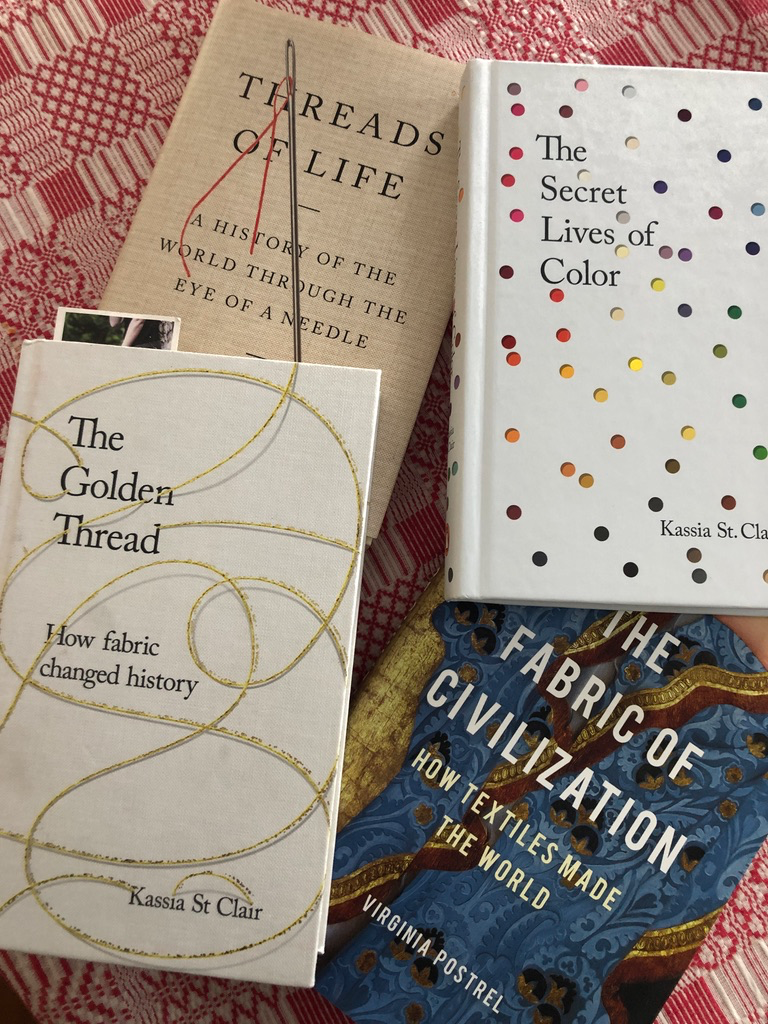
Threads of Life: A History of the World through the Eye of a Needle is not the first book that arrived in my mailbox, but now it is the one that I have focused on finishing ahead of the others. When I decided to set the others aside and read this one, I became enthralled. I can hardly put it down. The author covers some important historical events where needlework factored heavily, such as the Norman Conquest and its recorded depiction in the well known Bayeux Tapestry. Another chapter covers Mary, Queen of Scots, and her many embroideries used as pleas to those who might give her aid. But what makes this book a page turner for me are the everyday stories of women and men who find solace or find their voice through working with a needle and thread.

The chapter titles are compelling. “Unknown” is about the women (nuns) who worked on the Bayeux Tapestry and whose identities we’ll never know. Other chapters, with titles like “Frailty,” “Captivity,” “Loss,” describe the many ways that needle and thread have assuaged human suffering or given voice to those who felt unseen and unheard. You can imagine what some of these circumstances might be before even reading the book. Jews in camps embroidering messages and emotions on fabric as small and delicate as handkerchiefs, men in POW camps doing the same. Larger works, like banners, express political ideas and personal causes. In 1985, a massive banner of appliques and embroidered quilt blocks, was displayed in Washington, DC, to draw attention to the HIV/AIDS pandemic. It was meant to wrap around the Pentagon.

“The Ribbon didn’t just wrap around the Pentagon. It spread across the Arlington Memorial Bridge, around the Lincoln Memorial, down the Mall, around the Capitol, back up the Mall, back to the Lincoln Memorial and the Pentagon.. It was 15 miles long.”

These are just a few of the many stories that the author addresses with such sympathy and understanding. She herself has worked with people who have PTSD or who are imprisoned. She helps both men and women find a non-verbal way to express their emotions through applique, embroidery, and other needle and thread techniques.

The author is well traveled, and she discusses the textile traditions of a number of places throughout the world. In one chapter she describes the traditions of many cultures that save bits of fabric from the possessions of forebears or dear ones, that are then repurposed to make new garments or accessories that are precious to the one who gathered them. I could absolutely feel the truth of this in my own life, in the textiles I have saved from both my grandmothers. In another chapter she describes what clothing is chosen in various cultures to send their loved ones into the next life. Some cultures keep a bit of fabric or clothing to cherish the memory of the departed one, while other cultures hang the clothing of the dead near the grave, out in the elements, so that the clothes deteriorate similarly to the buried loved one.

In my own experience of gathered fabrics, I have almost all of my paternal grandmother’s quilts, and they are precious to me. As a child I have a sense of lying on at least two of the quilts I now have, poring over the many fabrics used in the patchwork. Even as a young child I wondered where all the many, many fabrics came from that contributed to these lively quilts. One quilt is a cacophony of pale floral calicos that were cut into elongated diamonds and sewn together. When I was quite a bit older I realized that this quilt’s pattern is well known, a six-pointed star. It’s a riot of diamonds, mostly in pastel colors that whisper to be noticed. I think I gazed at these fabrics for many hours when she put me down for a nap during the afternoons I stayed with her. This is my favorite quilt. It predates memory. At some point when I was still a young child my parents took the quilt. The last I remember of it before I took it into my own possession was that my parents kept it in the back of our family station wagon for use at the beach, where we lived on Long Island. Even as a child I knew that this was a travesty for such a wonderful piece of family history–all those small elongated calico fabrics that encapsulated an era, probably the 1930s and 40s, in the southern U.S. where my grandmother lived. I knew I had to save this piece of family history and take better care of it than my parents were doing. I still have it. I don’t have it hidden away in archival tissue, but I do treat it gently.

I have a set napkins and a couple of placemats that were most likely woven in the 1940s. There is a small tag on one of the pieces that identifies the piece as being woven in Berea, Kentucky. Although there are a couple of pieces that coordinate with the set of eight napkins, they may not have come from the same weaver or even the same craft school in Berea. They are also precious to me, although I don’t know who wove these. Several years ago I contacted Berea College hoping to learn some of the names of the weavers from those long ago decades, but no one wrote back to me. The lower two mats in the photo are woven in Dukagang, a woven structure that I am particularly fond of weaving myself. The upper most fabric is Monk’s Belt, another favorite! I always use these during the Christmas holidays.

Melody, who is spending the fall and winter with us along with our younger son, expressed an interest in weaving, and I was happy to oblige. This is a photo of her weaving two kitchen towels at the end of a long warp.

Next we may weave some linen bread bags together for our ongoing sourdough bread baking. This is the project I have in mind, from Handwoven Magazine.

Naturally I hope all my handwoven items become heirlooms to my family, although I know this is highly unlikely! With the optimism of a typical grandmother, I hope one–or both!–of my granddaughters will be drawn to my textiles as much as I was to my grandmother’s. Time will tell.

It comes as no surprise that I highly recommend Clare Hunter’s book, Threads of Life!

Silver Linings

Silver linings have been on my mind for some months now. In spite of the fact that I do not consider myself an overly optimistic person (I live with one, though!), I have found that the small mercies that occur quite often have been a significant factor in my outlook over the past year. I began to think of silver linings more and more as the new year approached. We’ve all got a long way to go before the restrictions we now live with will loosen, so it’s important that we stay the coarse however we can. For me, that will involve gratitude for silver linings.

I’m hesitant to list my silver linings. That doesn’t seem to be the point. The point is noticing them, being grateful for them, listing them privately to myself. Perhaps they have made the difference between madness and sanity.

During a year when I wasn’t certain I’d ever see my home again (perhaps a bit dramatic but definitely a worry), and during this time when my family grieves the loss of Bob’s mother in the last month of the year, there have been other moments that take some of the sting out of the hard things. Life has always been this way, but this year I’ve taken more notice of it.

After Bob’s mother passed he began to search through boxes and boxes of old photos. Together we’ve taken a wonderful trip down memory lane.

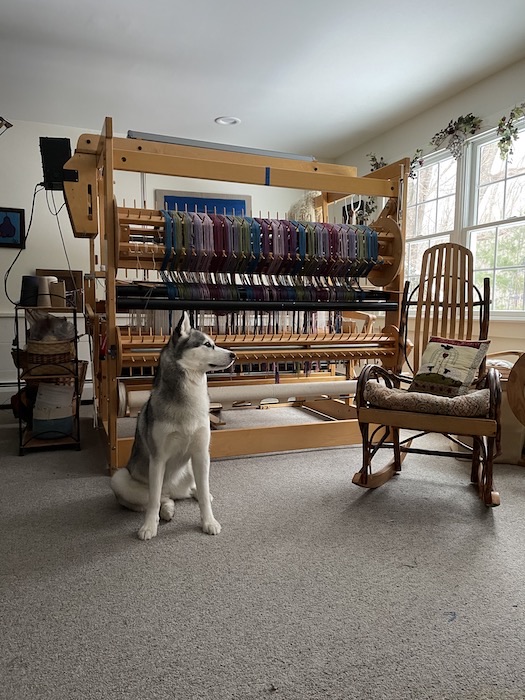
Our younger son moved back to the East Coast to live with us in September, after he had spent a long spring and summer isolating due to the pandemic, and being mostly confined indoors in the mildest part of the country due to the wildfires spreading through California. He came to us with his partner Melody and their Siberian husky, Mila. This is the first time in my adult life that here has been another female in the house. What a marvelous addition Melody is! She expressed interest in learning to weave, and since I had a very long warp on my Baby Wolf for making kitchen towels in an Ms & Ws threading from Strickler, I thought she might enjoy trying her hand weaving the last few yards of that warp. She made two towels: the first in plain weave and the second in a straight twill. Next time she’ll make the warp and dress the loom. She would like to weave a shawl while she is here.

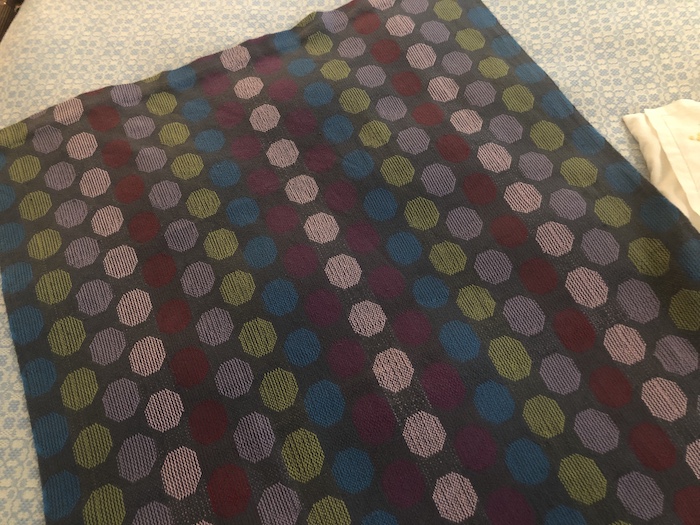
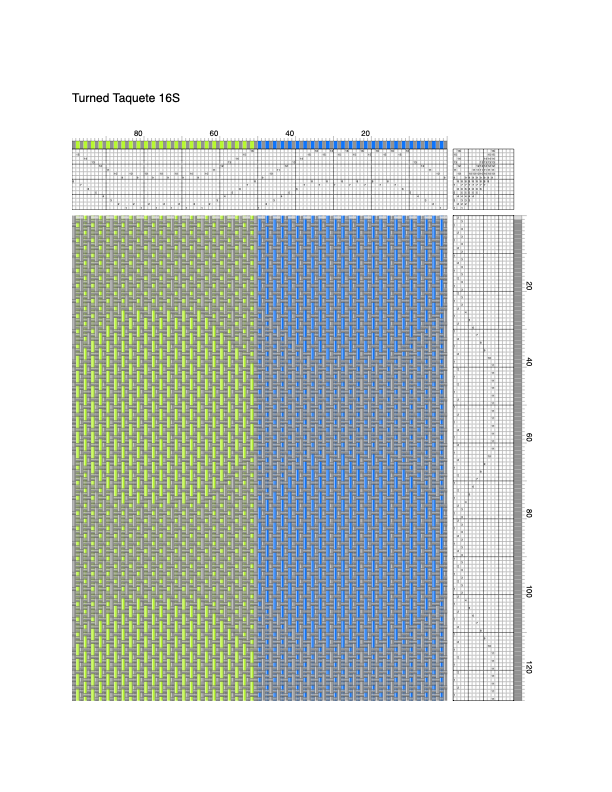
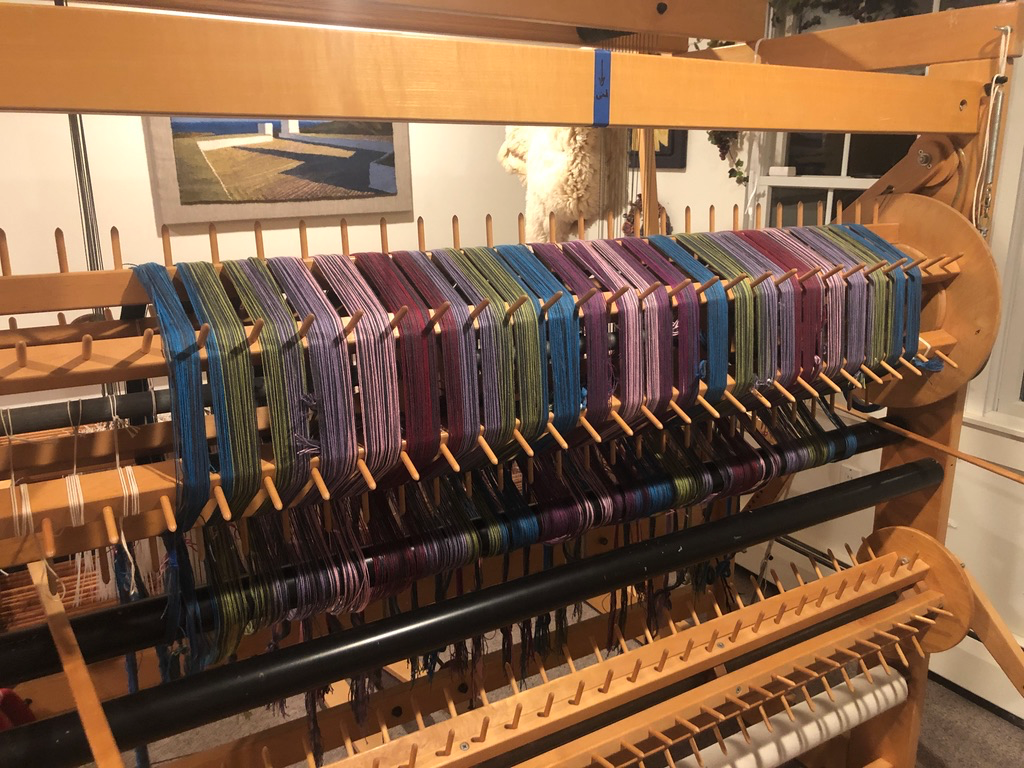
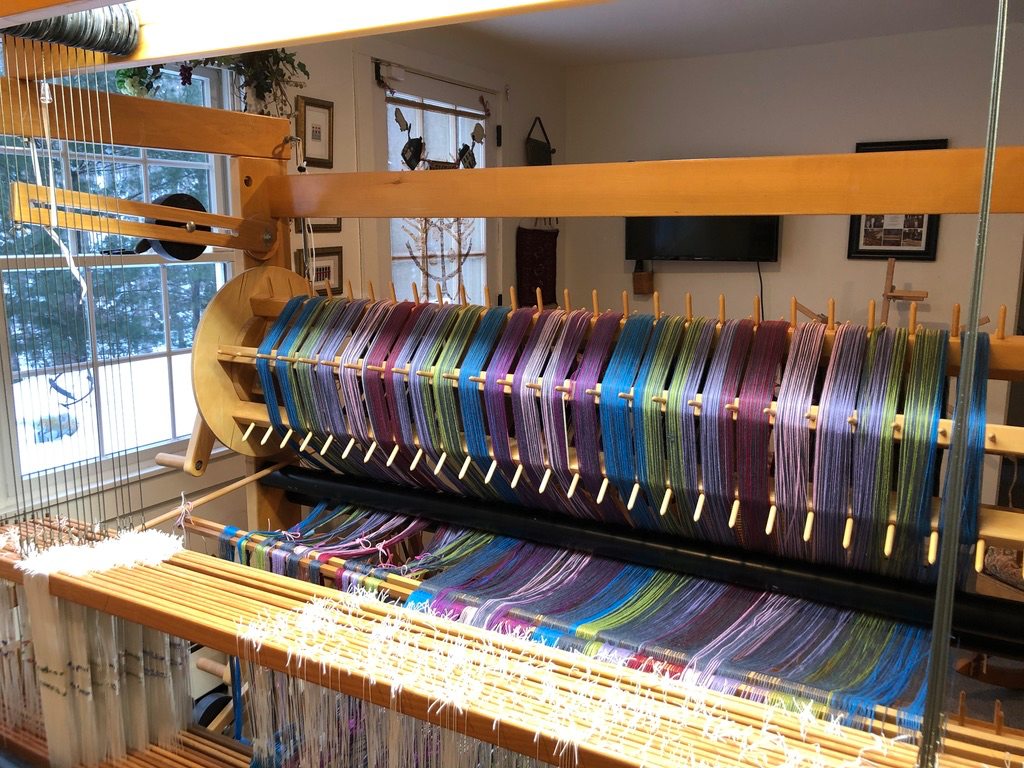
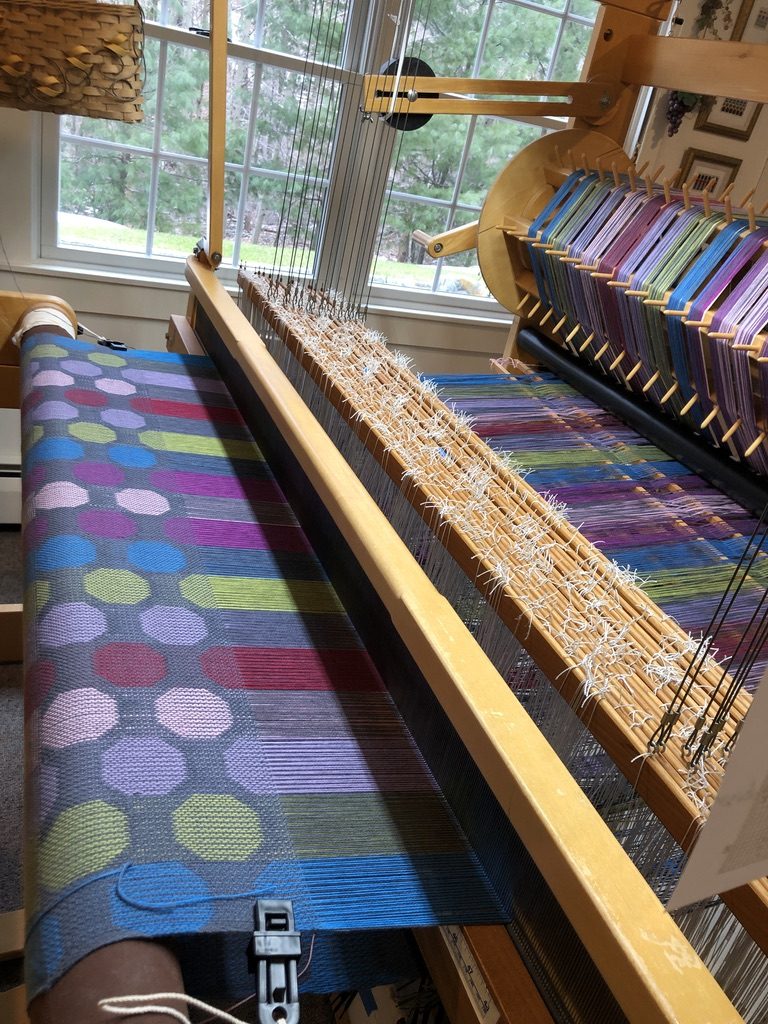
I am nearing the end of winding a warp for what I hope will be a fun blanket for Tori, granddaughter #1. It’s a variation on Susan Poague’s draft for circles in turned taquete. I’ve expanded the draft to 16 shafts (Susan’s design is 8 shafts.), and I’ve chosen a heavier cotton yarn for this project to make it a better blanket weight. Or so I hope! My warp and weft is 6/2 unmercerized cotton from WEBs. I’m so excited to get this project going. If it works as I hope, I will post the draft here.

This is Tori, who will get this blanket. Her family is in our small bubble, but we don’t see them too often since they live so far away. They have a lake house that is halfway between their house and ours, so we’ve met there a couple of times. When we saw them last week we celebrated Tori’s birthday, Christmas, and my birthday. It was festive! In this photo she is playing with her first installment of her monthly activity box from Kiwi.

How has the year started for you? Now, more than ever, we need to stay connected and get excited and inspired by the new work that’s out in the textile world. This morning a friend sent a link to this article from Architectural Digest about a new tapestry by Helena Hernmarck. I hope you enjoy it! The photo alone should do that! I hope it gets your juices flowing. I’ve bought almost a dozen new books this year, and I’m so thankful for each of them. In the next post I think I’ll write a short review of each of them. Let’s keep each other engaged!

Sheep and linen

A sheep farmer in Wiltshire left a message for me here, and when I contacted her privately, she gave me a bit more info about the sheep she raises. I hope we can continue our correspondence because I would love to know more specifics about her own sheep and the situation in the UK in general. It made my day be able to contact her!

The sheep on Margaret’s farm are related to the Wiltshire Horn breed which she told me are natural shedders. Her flock have been crossed now to shed more so that they don’t need to be sheared.

This is such a revelation to me. The earliest sheep were shedders. Women learned to spin wool by collecting the bits of discarded wool that might cling to things where the sheep had grazed. Fast forward many, many millennia to a time still in the distant past, where humans have been breeding sheep NOT to shed, to have many different kinds of fibers to be used by humans for many different products. Now look where we’ve gone–back to wanting sheep that lose their fleeces naturally. Margaret said that shearing her flock would cost three times what the fleece would bring at market. She also said that the cross she raises has coarse fibers which work well in the climate of Wiltshire. That surprised me. I can’t imagine a climate much worse than the remote islands off the coast of Scotland, where those sheep (Shetland and Ronaldsay come to mind) have wonderfully soft fibers for cold weather. There’s a lot to this that I clearly don’t understand. Margaret also told me that this fall has been exceptionally wet in her part of the world–cold and wet. Her sheep need their coarse coats in order to stay dry and warm. I am fascinated by this. If I learn more I’ll share it.

Meanwhile, if you want to read a bit about this history of Wiltshire Horn sheep, you can look here. I didn’t see anything about shearing vs. shedding there, but I intend to keep searching. I found that I could buy a little Wiltshire Horn stuffed sheep here. Tempting.

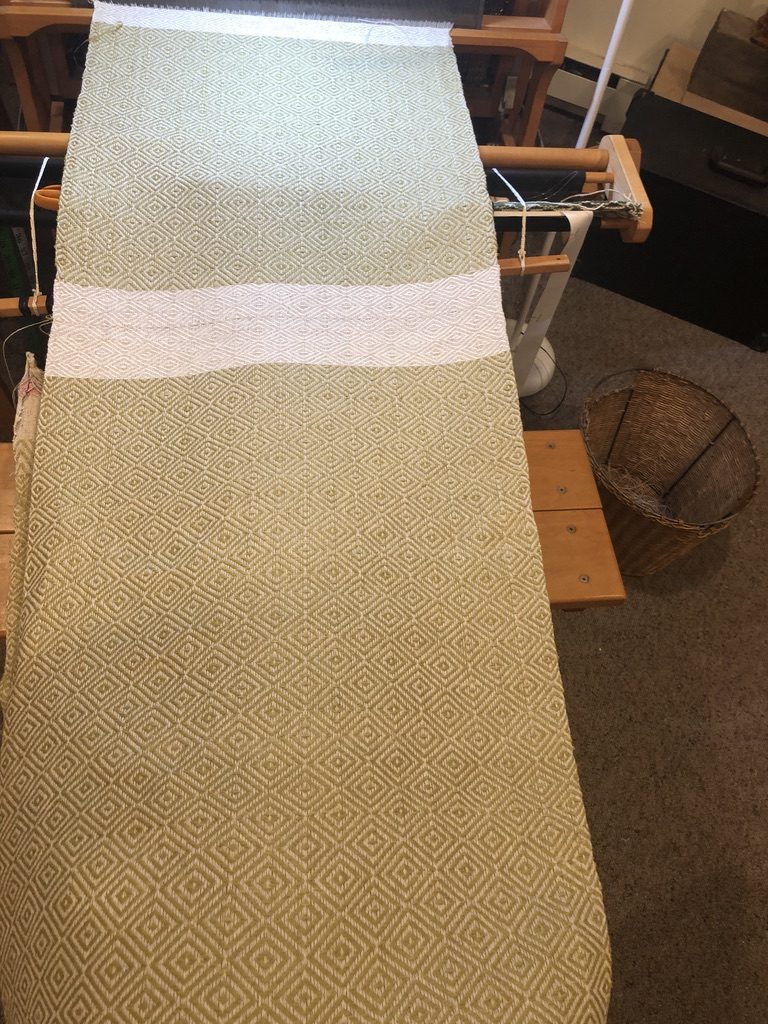
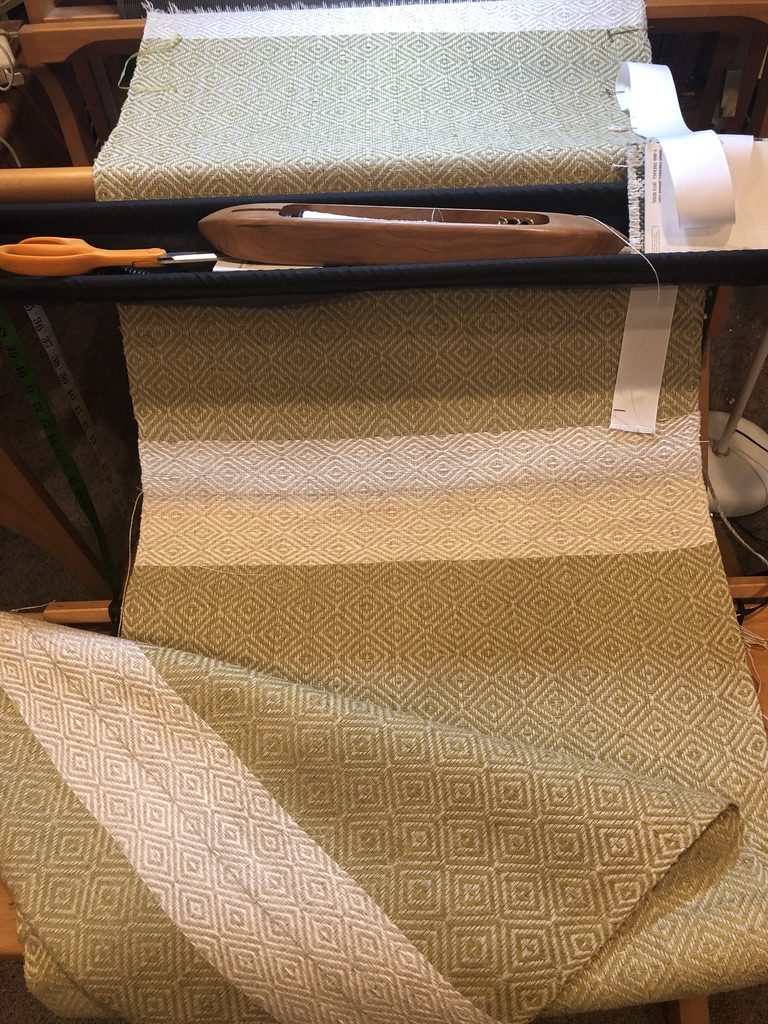
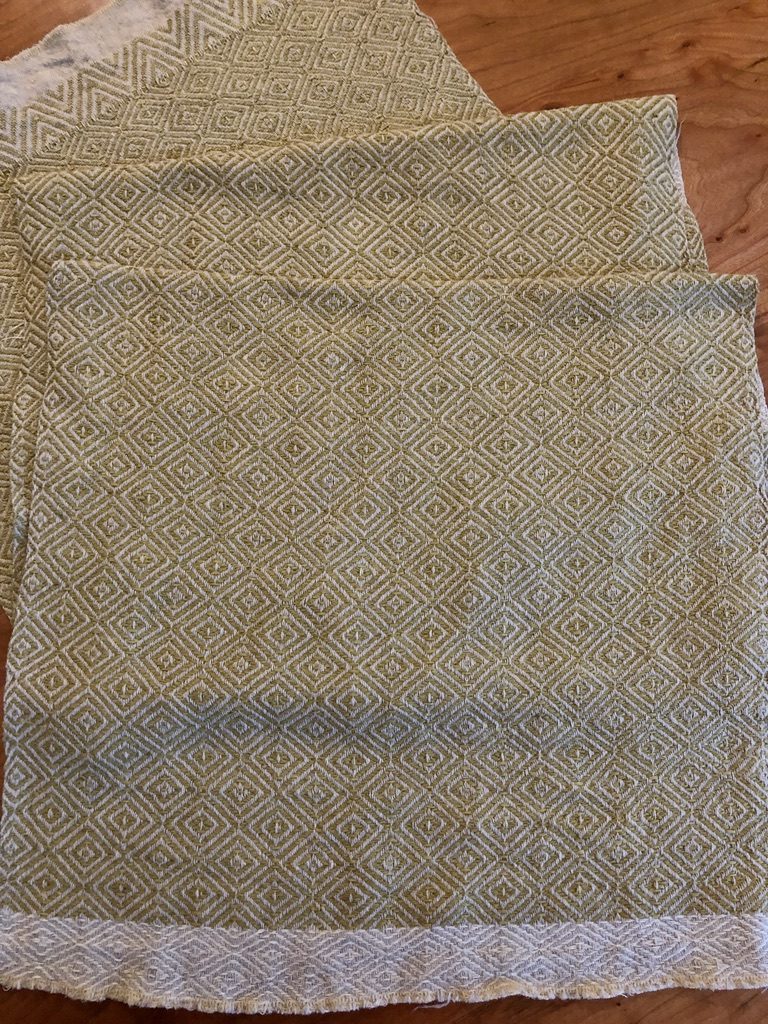
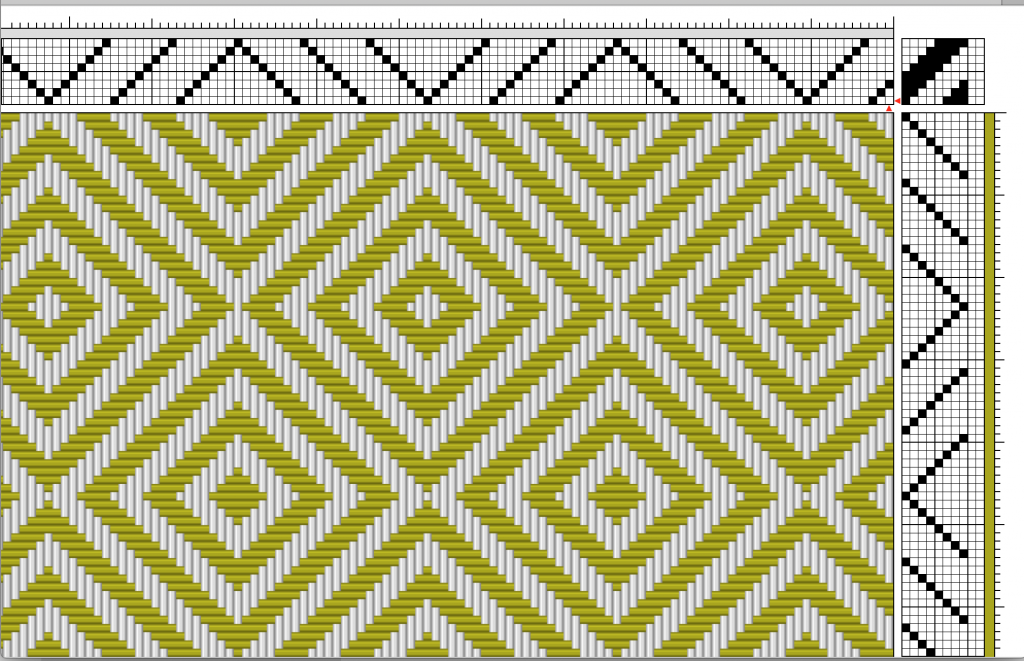
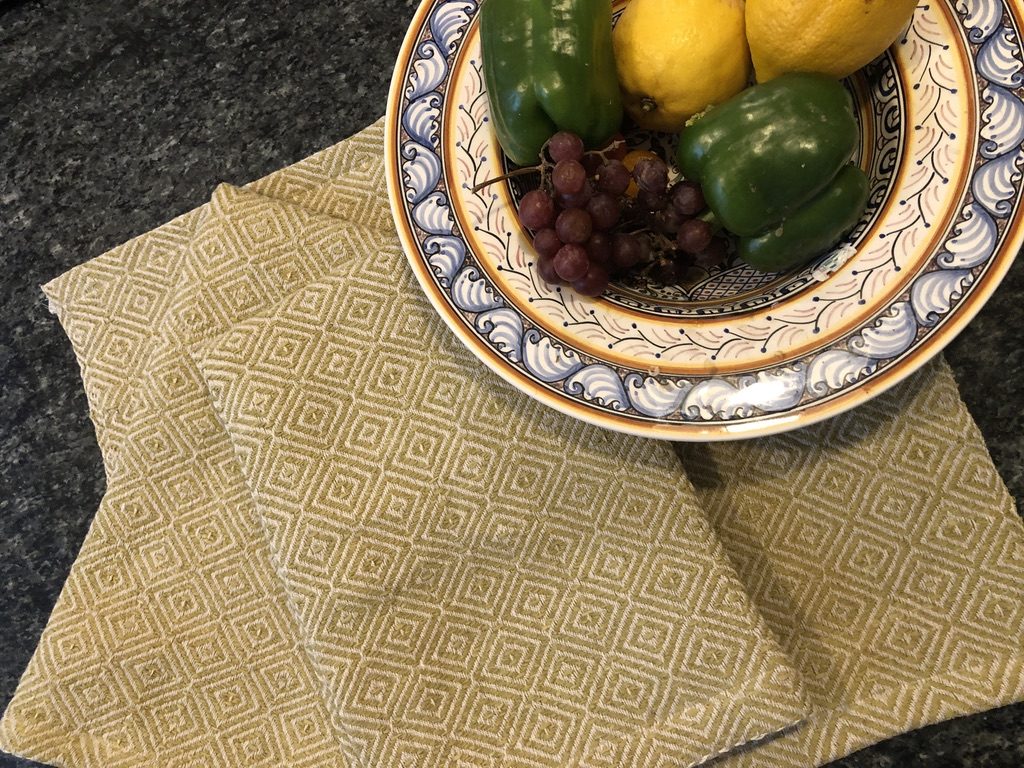
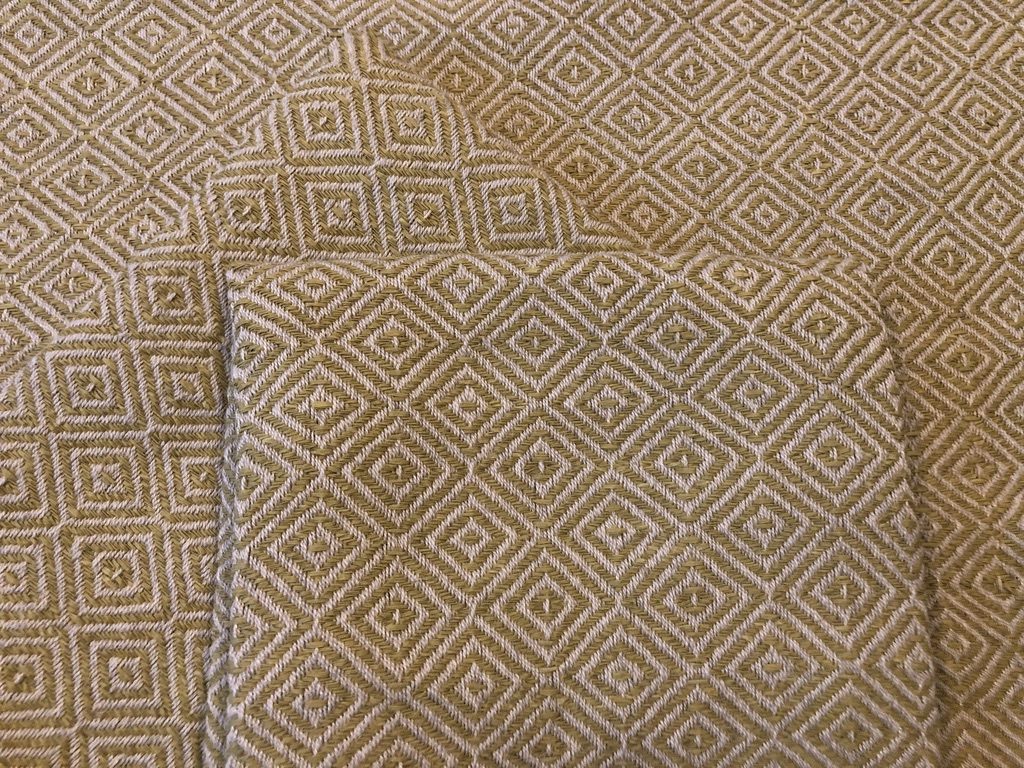
Meanwhile, my weaving feels like it is moving at a snail’s pace. On the bright side, just a few minutes ago I finally cut off 6 yards of cotton and linen blend fabric that is going to become six towels. The woven structure is in Carol Strickler’s A Weaver’s Book of Eight-Shaft Patterns. It’s #314. I used Jane Stafford’s cotton boucle for the warp and much of the weft. By the time I was truly bored with weaving, and my color options of the cotton boucle were dwindling, I switched to weaving with Gist’s cotton/linen called “Duet.” Maybe I was just so bored with the boucle, but the Duet cotton/linen seems a better look to me. I will keep that towel for myself. I don’t really know why I wove all of these! I don’t know anyone who has a kitchen that calls for out the colors I chose.

I was deeply in need of weaving when I returned home from a long winter away, locked down for months in foreign countries and feeling very much an outsider–an outsider not wanted due to the fear of pandemic we might bring to the small islands we visit each year on our sailboat. When I got home I couldn’t wait to just mindlessly sit at my small loom and weave. I wove off the napkin warp that did not get finished before leaving on the long voyage last November. Then I wove two linen warps dyed with indigo for waffle weave face cloths. Then came the warp for nine (yikes! nine!) kitchen towels with JST cotton boucle. Who will want these somewhat odd colored towels? I’ll keep two, but that leaves another four! Ah well, I needed to make them for sanity, for therapy. Now I can move on.

Next on my list is a variation of the popular turned taquete circles that Sue Poague developed and showcased in Handwoven in one of the issues from 2019. I actually bought a set of placemats from her because I was so intrigued with this weave structure and yet would not be home to weave any for myself. They cheered me up every night at dinner on our boat while we were in far away places. Back home I wanted to plan a blanket for my older granddaughter in this structure, but I wanted the circles to be bigger. I have a larger loom with 16 shafts, so I started trying to expand the pattern to more harnesses. I think I have it sorted and hope to start winding the warp soon. I’ll share the pattern when I can determine that it weaves well. I’ve bought a large selection of 6/2 cotton in eight colors so the threads will be thicker for blanket weight. I’m excited to get started! I have spent more time than I care to admit on color arrangement. I have seven colors for the circles, and the background warp and all the weft will be a medium grey. I need 19 color stripes across my warp and I’m having a devil of time arranging them in what I hope will be a pleasing order. Ugh! Isn’t it the smallest details that cause the greatest delays? I’ve taken multiple photos on my phone of color arrangements, and then I’ve edited those photos to be black and white so I can assess the values of the circles going across the warp. I’m not happy yet.

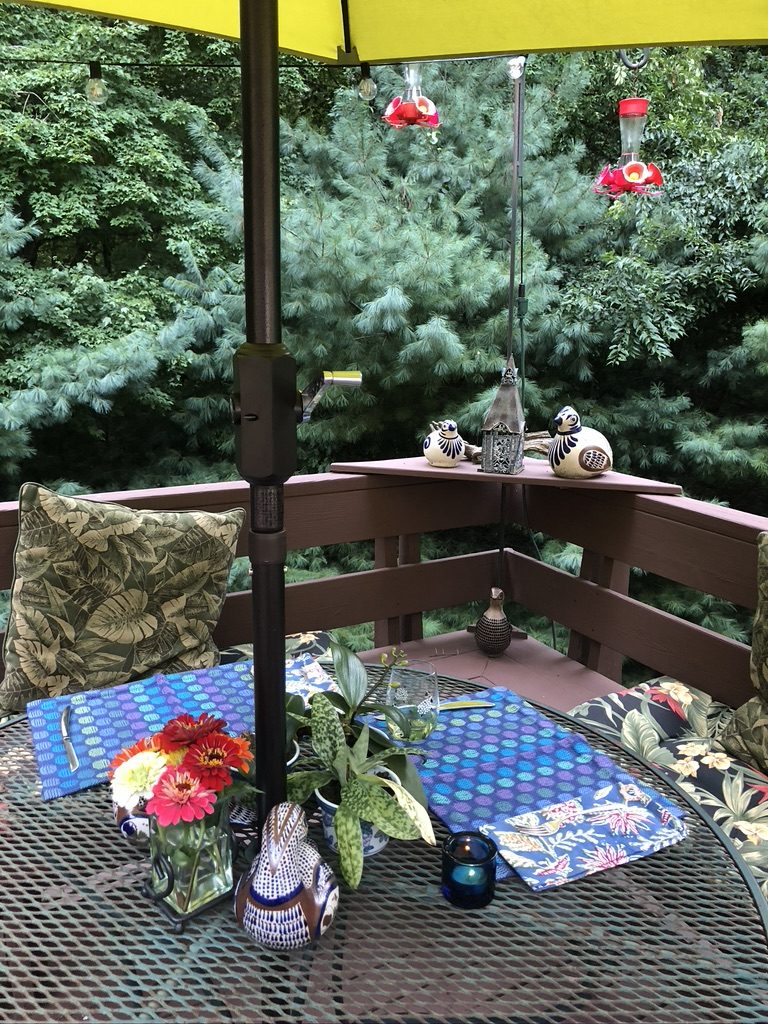
Looks like summer, right? I now use these when eat outside at home. Well, I hope my blanket will look as pretty as these placemats. I’d better get to making that warp!

Let Me Get Out My Soapbox

Oh, boy! Last night I got quite riled up about people’s attitude toward wool. Bob sent me this article from the Times of London. It’s called “Shear Waste,” and it covers the dire situation of sheep farmers across the UK. This year many farmers burned their fleeces or added them to their compost. For years I’ve heard that farmers expend more energy and money in caring for sheep than they get when they sell the fleeces at market. This year the new low was 33p per kilo, which I learned does not even cover the expense of shearing. This is heartbreaking. Seriously, I am crestfallen by this situation.

From the Times of London, Fleeces being composted at Stuart Fletcher’s Sussex farm

I went looking for more information, and I started with the Campaign for Wool. I had no idea this endeavor is now 10 years old. Time flies. How have things gotten worse instead of better? It seems that many people in the UK feel that wool is only useful for rugs these days. Whoa! I have had the pleasure of spinning some wonderfully soft wools from the UK, and nothing–absolutely nothing!–gives me more pleasure than knitting or spinning Wensleydale or Shetland wool. Am I mistakenly under the impression that everyone in the UK knits? …at least for a few years as a child? Don’t they need fresh supplies of wool and the ability to try the many breeds that are grown all around them? Aren’t designers, especially of men’s suiting, always in need of wool?

A few months ago I read the book Wild Dress: Clothing and the Natural World, by Kate Fletcher. The author is Professor of Sustainability and Fashion at the University of the Arts London. She has written other books, but in this one her writings are autobiographical. She explores the relationship between garments and our human connection to nature. The chapters read like essays to me, and in one she marvels at people who spend time in nature by hiking through the landscape. She notes that nowadays, you have to dress the part of someone who spends times in nature by wearing the most unnatural clothing. If you aren’t wearing a polyester fleece made from recycled plastic bottles and elastane-nylon pants, you must not be a serious outdoorsman. Kate Fletcher writes, “As garments go, there are few pieces less natural than a polyester fleece pullover. Nor are there many pieces that act to distance the world outside more than those made from filaments of hydrocarbon with their high resistance to micro-organisms, poor heat isolation and low water absorbency. The things we are wearing to arrive in nature do not, cannot, let nature in… We keep her at arm’s length, or more literally at sleeve’s length, with hydrophobic fibres, an impervious fabric membrane and garments so durable they will outlive us all.”

Wool has so many uses. It can keep you warm and is fairly water resistant. Through millennia of sheep breeding wool can be soft enough for undergarments and tough enough for weatherproof yurts. It can insulate houses, hang on the wall as a beautiful way to keep out drafts. It can become stunning clothing and household items when knitted or woven or felted. I thought there were many millions of people clambering to have excellent sources of wool. So how can these farmers be in dire straits right now? I am worried that they will soon give up sheep farming and turn to something else. What will I do? I can’t possibly be the only one who fears this.

I own exactly one polyester fleece pullover which I bought at least 30 years ago to support a non-profit group I had joined. I still have it, and I wear it only occasionally, although never out in public. I have a wardrobe of sweaters I knit myself that I love to wear out in public. Most of my friends and acquaintances also love the sweaters and other garments that they have woven or knitted. Even if you yourself do not knit or weave, I bet you know at least a handful of people who do. We are everywhere.

About a decade ago I joined the Association of Guilds of Weavers, Spinners and Dyers in the UK. Ten months of each year there are online workshops to take. One month we focused on breeds of sheep that are not well known. Each participant got a small amount of fleece directly from the farmer to comb or card and then spin. I got some Ronaldsay fleece from the Orkney Islands off Scotland. I got some Bowmont-Merino fleece from Leslie Prior’s farm in Devon. That was an amazing bit of fleece to spin. She has the only Bowmont sheep farm in the world, and at one point there were only 28 sheep at her farm. I felt so lucky to get a bit of this wonderful fiber to spin. Since then I believe she has prospered with this breed. She has an outlet for getting the yarn spun in the UK, and made into garments and household items that are manufactured in the UK.

When we had the fleece workshop through the UK Guild, those of us outside the UK did not know for certain if we’d ever receive our fleece samples, or how long it might take to receive them. The ones I chose all arrived at my house, and I think the longest delivery time was only three weeks, which is fast considering these packages had to go through the Animal Plant Health Inspection Service of the United States Department of Agriculture. The inspectors have the right to send back anything they deem unsafe. After playing with various fleeces from the around the UK, I ordered a kilo of Ronaldsay from Orkney. I washed the wool, combed it and spun it before knitting it into a sweater for my younger son Chris. I’d love to spin some more Bowmont now!

This is my long winded way of saying that I hope there is some way to save the wool industry in the UK. I read that half the wool stays in the UK, but the other half gets exported throughout the world. One quarter of the wool goes to China, and this year, due to the pandemic, no wool could be sent there. In the article I linked at the beginning, I also learned that British wool is used in carpets on airplanes and cruise ships, and those industries are certainly suffering at this point in time. To me, wool can be such a luxury item that we should all cherish it. I don’t want to lose that. What can I do?

I’ll end this with some stunning wool products and some links.

This is the story of a student design project for Campaign for Wool to create new designs for Holland and Sherry, a well known Saville Row shop known for their use of high end wool fabrics.

The Campaign for Wool is making a good argument for using wool to insulate dwellings.

And no post about British wool from me would be complete without a mention of the wools grown and spun and woven on the Hebrides Islands for Harris Tweeds.

Stay well, pick up some wool, and get busy knitting….or weaving….or felting…or spinning.

Down the Comfort Knitting Rabbit Hole

Dear Reader, are you a knitter? Were you shocked when you learned that the most creative knitter of all time, Cat Bordhi, passed away in September? I did not know she had been living with cancer for some time. I did not know that she was 69. She’s the most youthful 69 year old I’ve ever seen, and I think that must be because of her inquisitive nature, her drive to find new ways to achieve results in knitting. Her creativity makes my brain hurt, but I’m always so happy and intrigued to try her techniques.

Cat Bordhi

Recently, I got another shock from the knitting world. Annie Modesitt also passed away, on October 1. I knew she’d been dealing with overwhelming health issues for many years, both her own as well as her husband’s. Two knitters of such immense creativity are gone.

This year has been stressful for everyone between the pandemic, the world political situation, advancing climate change issues, and our own presidential election. My best stress reliever is always doing something textile-related, having thread or yarn in my hands–weaving, knitting, embroidery. That’s the main reason I wove two sets of waffle weave face cloths, and now have a set of eight kitchen towels on my small loom. On Monday I saw Amy Singer’s tweet about having a knit along to relieve our election anxieties. She offered a choice of three knit designs or mentioned that any of us could just knit something, anything, together. And that’s when I knew I had to knit at least two of Cat’s ‘anemone hats.’ The first two would be for my granddaughters, Tori and Emme. Maybe I can even knit one for Rhett without the moebius brim. Outrageously cute, right?

I ordered lots of yarn for these hats because I also want to knit two adult hats, even though I have no particular recipients in mind.

The yarns I’ve ordered so far are from Lorna’s Laces, called “Shepherd Worsted.” The yarn for the adult hat, pictured on the left, is a color called “black pearl.” It will be hard to give that hat to anyone but me! Can you see the little amethyst stitch markers on the needles? They are from Twice Sheared Sheep, my favorite source of stitch markers and row counters. They came in the adorable tin on the right side of the photo. I have a couple colorways of Malabrigo yarn waiting in a shopping cart for a few more hats.

So knitting has been my ‘go-to’ for a good deal of each day this week. Most of the reason for that is there is a mistake on the kitchen towels I’m weaving! It’s a weaving mistake, so all I should have had to do is UNweave by treadling the sequence backwards. But life can be full of limiting conditions, and here are mine:

–My Baby Wolf has the combby dobby head attachment, and the reverse button does not work, and supposedly cannot be fixed.

–I use Fiberworks PCW, and I should be able to ask the program to weave in reverse, but I haven’t had luck with that. So I have looked for the place in the pattern where I can weave forward and yet be UNweaving what I did. I am using an Ms & Ws pattern (Strickler 314.5) that reverses, so as long as I’m weaving forward in the part of the pattern that is the reverse of my problem area, this should work. And it does work. I’ve now UNwoven twice without a hitch. It’s when I begin to go forward again, finding the place that goes forward from where I left off, that hasn’t worked.

After two reversals and two botched forward attempts, I walked away from the loom in a snit. That was about 2 weeks ago now. With all the other anxiety-producing stuff going on, I was not in a good place for tackling this. I think I’ve recovered sufficiently, mostly from knitting all those squiggly anemones, to tackle this again. I’m headed to the loom shortly. Wish me luck!

I must share a perk from this week of stress. A friend gave me a big treasure box of antique and vintage linens. Oh my, oh my! I’ve been swooning over the contents for two days now. I’ve dealt with the stains that mostly came from years (and decades) of being stored on wooden shelves that allowed tannins to migrate into the linen. So I have soaked some of the items in Oxyclean and then washed them in the machine. There are tablecloths and napkins, large linen bath towels, handmade bobbin lace edgings on doilies, and even linen bedsheets embroidered in pulled thread designs with satin stitch monograms. Three of the bedsheets are a stunning peachy-pink. I feel weak every time I look at these treasures!

This looks like Portuguese embroidery to me. Want to weigh in? — please get in touch! I have two of these tablecloths, and 12 coordinating napkins. One cloth is sized for a small table (72″), and the other is probably good for sitting 10 or 12, at 120″. I hope I get to try the large tablecloth someday. I wonder if we will ever have large dinner parties, or holiday dinners in the future. I hope so!

There are eight of these beautiful placemats. They have no stains, so all I had to do was iron them.

There are three of these large linen bath towels. There are tannin stains on at the folds. I have soaked them in a mild solution of Oxyclean and warm water overnight, and then run them through the normal machine cycle on warm wash, cold rinse. They are significantly better, but not yet perfect. Maybe ‘perfect’ is not attainable; maybe that’s okay.

Keeping my hands busy is definitely helping this week, especially learning the wonderful moebius cast on, knitting, and binding off, of Cat Bordhi’s fun anemone hat. I hope your hands are busy too! — in a good way.

Scroll to Top