ArgoKnot

Author name: ozweaver

Another Day, Another Exciting Technique to Learn!

This fall I’ve participated in three workshops, more than I’ve ever done in such a short time!  Last week I spent three terrific days with members of my local guild, learning crimped cloth with Dianne Totten!

Weaving crimped cloth uses the techniques of woven shibori, but instead of dyeing the cloth (or in addition to dyeing the cloth!), you tighten the pull threads and steam the woven cloth.  Whether these pull threads are in the warp or the weft determines the direction that must also contain some thermoplastic fibers.  In this class we used orlon or polyester sewing thread.

Here is Dianne wearing one of her beautiful vests.  This is an advancing twill on 16 shafts, woven in a straight draw.

2014-10-08 10.36.59

Since I haven’t been home long enough to actually warp a loom, I decided to be a virtual weaver by bringing my computer with Fiberworks software.  I’m so glad I participated this way!  I got to photograph Dianne’s samples, try on the clothing which mysteriously seems to fit everyone , take copious notes, and watch what the others were weaving.  I did a few drawdowns and have made a plan for my own crimped cloth warp.  I hope to get going on it the moment I return in mid-November!

This is one of Dianne’s finished pieces called “Garden Party.”  The fabric looks like Fortuny himself pleated it!….and the warp is a luscious blend of three different tencel colorways of Just Our Yarn’s “Almaza.”  I have my own stash of “Almaza” which has been ‘aging’ (as veteran stash collector and weaver, Kathi called it!).

2014-10-08 10.29.07

Here is a detail of the sleeve that shows the weave structure used for the pull threads that created the pleats.

2014-10-08 10.29.29

I’m very intrigued with inserting zippers into the front opening!

2014-10-08 10.34.59 2014-10-08 10.36.09

Several women in my area guild had taken this workshop with Dianne last spring when it was offered to the statewide guild.  They arrived at this class with finished cloth and spent days 2 and 3 begining to fit and sew their garments.  This added such excitement to atmosphere in class!

2014-10-09 13.39.50

2014-10-10 13.56.47

2014-10-10 14.42.52Dianne is an excellent teacher!  She is ingenious, creative, and completely open to sharing.  She spends plenty of time answering questions and listening to ideas from the students.  She’s not afraid to admit what she doesn’t know, and she’s not afraid to problem solve on fitting questions.  I think the best part of the class was fitting and constructing the garments for the women who had already woven their yardage.  There was so much to consider during that stage, and Dianne gave us all plenty of food for thought!

Tomorrow Bob and I are off to Portugal….for a month!  Lots of wonderful textile adventures to have while there.  I’ll be going to the tapestry workshop in Portalegre, as well as looking at handmade bobbin lace and embroidery in all the towns we visit.

And speaking of bobbin lace, I was very surprised to get a red ribbon (2nd place) for my little lace edging on my linen top at the Big E!  Wonders never cease sometimes.

2014-10-13 09.58.31

And my wonderful lace mentor, Mary, has really helped me make progress on the never ending handkerchief edging.  I really intend to have this finished before the end of the year.

2014-10-13 10.40.22

Time to get packed!  Hopefully I can post some wonderful textiles from Portugal!

On This Crisp October Day…

Let me recount the amazing experiences of the past 3 weeks before they disappear into distant memory!

In the past 3 weeks I have had the good fortune to spend a week….YES! a WEEK….studying with Joan Baxter, who came all the way from Scotland to share her knowledge and her wonderful sensitivity in tapestry design with a handful of very lucky students across the US.  I was part of her first workshop in Rockport, Massachusetts.  Then she headed off for a week of teaching in each of three additional locations:  Santa Fe, San Francisco area, and the Atlanta area.  Lucky weavers all!

On the first day we spent the afternoon getting inspirational shots of Cape Ann to develop a design for a tapestry with images of the sea and/or the coastline.  This is the quarry at Halibut Point State Park.  You can see the Atlantic in the distance.

2014-09-15 15.00.45

I took a lot of wonderful images that day….including some shots of the women in my class.  We are all members of TWiNE (Tapestry Weavers in New England).  I had not met any of them before so it was also a good experience getting to know women I’ve only seen as names on email lists.

2014-09-15 15.16.42

Someday maybe these images will inspire something, but my tapestry design was already chosen before I got to class.  For me, this class would be about honing what I wanted to say with an image I already had in mind.

Joan certainly knows how to design works with multiple layers of images that create an entire story in one tapestry.  You can see her work here.  These are some of the samples she wove to blend colors for ideas for her designs.

2014-09-19 15.18.50

She generously brought lots of yarn for us to try,  7/2 wool that she had dyed herself and every color of 18/2 wool that Weavers’ Bazaar carries.  It was a terrific way to get familiar with their yarns.

I started a little sample of a Portuguese Man of War.  I’ll explain why I’m intrigued with this in a future post, when I have more to report.

2014-09-21 13.57.18

Less than a week after Joan’s class, I headed up the Hudson almost to Albany for the last regular meeting of the Wednesday Group.  It was a bittersweet gathering of the entire group.  Some people really had to jump hurdles to get there, but we all managed it.  Archie made a very touching farewell to all of us, but I don’t think most of the group realized what he was doing.

He brought in one of his recently completed tapestries, one that we’d all seen in progress some months ago.  Typical of Archie, this tapestry is an experiment in meaning….woven in code.  He was testing the human ability to read many different fonts and handwriting styles. He wondered if we could as easily translate letters into colors, so he wove a poem with a coded color scheme. I think he wondered how many of us could decipher the poem….or would even bother to try.  Naturally, this brought out the puzzle solver in me and in one of my good friends in the group.  In the long run, I had to take a photo of it after Archie had wrapped it up to take it home. Hence the very bad image! Just a few minutes after class, two of us decoded the poem almost simultaneously! Then three of us got busy checking to see if we were right…and we were!  And it was a sweet farewell message from Archie to all of us!

2014-10-02 15.10.50

I would love to tell you what the poem is, but I know he wants you to see this tapestry in some venue down the road.  He wants you to have a go at figuring it out, so I’d better not spoil it!

Meanwhile, our little band of friends wanted to let him know how touched we were, so we decided to sing our own version of farewell to him at dinner that night.  I know it’s corny….when we arrived at our favorite sushi restaurant, four of us surrounded him and sang a little  farewell poem back to him.  It was clear that he knew we had broken the code, and he was very touched!  Our goodbyes could not have been any sweeter!  All things must pass, and I’m very thankful for these last wonderful days together.

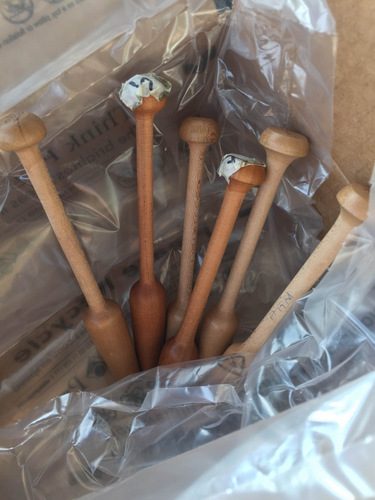
The Wednesday Group also had a final project. Almost everyone has now delivered their chopstick weavings.  They are a terrific statement of each person’s weaving style!  For the most part we could all identify who wove each one!

2014-10-02 13.45.44

2014-10-02 13.44.57

This was Archie’s ingenious idea.  For several years now we have all stayed together after class on Wednesdays to order Chinese take-out to share.  The number of chopsticks used on these occasions was rapidly growing, and Archie wanted to find a creative way to recycle them.  He devised a little loom with 15 chopsticks for warps, and he challenged us to weave a face.  He made a loom for each member in the group, and some of us had so much fun that we made a few on our own in order to weave more chopstick portraits! This is my “Chopstick Triptych.”

2014-10-01 14.39.40

One member did a series of six maneki nekos (or maneki neki?  Who knows Japanese?).  Are you wondering what they are?  Well, you can read the official report here on Wikipedia, or you can take my word for it.  If you go to any Japanese restaurants or sushi bars, you’ve seen them.  They are good luck charms, or talismans, in the form of little kitties, and they have one paw raised in a gesture of beckoning.  They are beckoning all sorts of good fortune for those who pass by.  How apropos that one of our group wove a set of them on chopsticks! (Now don’t you hope we display these treasures in public sometime?)….

On the morning after I returned home I had to get out early for my monthly lace meeting.  I’ll save writing about that…as well as describing my upcoming workshop with Diane Totten for another post.  It’s been crazy around here, and I have loved every minute of it!

Summer’s Swan Song

A few images from our morning walk into Essex to have coffee at our favorite spot.

Today really feels like autumn, and I wore long pants for the first time this season.  All the gardens along our way are bursting with everything they’ve got in the last weeks before frost.  It is a breathtaking time of year!

2014-09-13 10.34.29

Sunflowers in a long border of sunflowers, zinnias, and roses.

2014-09-13 10.39.43 HDR

One of my favorite houses where the Kousa dogwood berries are framing a view of the front door.

2014-09-13 10.51.13

And right next door is my friend Jane’s house.  She has beautiful gardens, and at this time of year the focus is purple Russian sage and bright yellow sunflowers along her picket fence.

2014-09-13 10.54.36

Right near Jane’s house is a house where the older residents grow a very large vegetable garden.  To me it verges on being a farm.  They have pole beans, various types of squash, corn, tomatoes, and in late summer the pumkin vines grow almost out to the street.

2014-09-13 11.51.43

Clever Mr. Farmer has trained the longest vine onto his big apple tree.

2014-09-13 11.51.48

2014-09-13 11.52.04

While having coffee we met a man who just returned from Portugal, where he and his family have a house in Nazare.  His wife was born there, so they visit each year, and he had lots of good advice for us.  I will get busy honing the details for our trip…

And on this first crisp day I will warp my new copper loom for the upcoming Joan Baxter workshop.  I am leaving tomorrow for a whole week at an inn in Rockport, Massachusetts, where 12 of us will spend time with Joan developing our individual cartoons for tapestries about the sea and the shoreline.  More on that when my idea gains some clarity.

Also, today, I am making the second batch of baguettes from the recipe in the current issue of “Cooks Illustrated.”  (If you want the recipe you have to buy this issue!) The first batch was the best baguette I have ever made myself (thank you CI!!).  I reached my goal of making a baguette that could rival Balthazar’s Bakery in NY….a goal I’ve been heading toward for decades!

2014-09-12 16.57.19

And while I wait for next round of dough to rise, I’m having a fresh tomato sandwich with mozzarella and basil on day old, lightly toasted, leftover baguette.  Hard to imagine anything better!

2014-09-13 12.19.00

So Much to Tell, So Little Time!

Unbelievably wondrous knitting and weaving things have occurred since my last post.  Now that I’m sitting here at my computer I don’t know where to start!  I guess I’ll just take a deep breath and tackle things one at a time…maybe this will end up being more than one post.

So, why don’t I start with today.  It’s fashion week in New York, and that is a guaranteed siren call for me to read the NYTimes.  Today was my lucky, lucky day because there was even an article about knitting:  “Grandma Never Knit Like This” is an article about Josh Bennett, who has a line of knitwear for men. He has designed knitwear for Tommy Hilfiger and Michael Bastion, and he has a pattern book of his designs published by Rowan and using their yarns.  In his Rowan designs, he designed sweaters that evoked the flavor of various New York neighborhoods.  This one is Hell’s Kitchen.

The article referenced SamuraiKnitter’s online brouhaha with Josh, so of course I had to check that out.  But really, who cares about that, when there is a world of fun on this site! What cave have I been living in??  Ms Samurai Knitter is the perfect anitidote to dearly missed You Knit What?  I could barely tear myself away, and had a good half hour of gut busting laughter reading the author’s insightful reviews of various issues of “Vogue Knitting.”  There’s nothing like  laughter to start a day!

And speaking of publications (as I think blogs are firmly in that category), earlier this summer I got to catch up on all the periodicals I missed while we were off sailing.  In this year’s issue #1 of “Vav Magazinet,” which was entirely devoted to the color white, I read quite a moving article by Birgitta Nortstrom.  Ms. Nordstrom is Senior Lecturer in Textile Art at University of Gothenburg, Sweden, where she received a grant to design baby blankets, with an outside layer  that would be a visually pleasing weave structure and the inside layer would be fulled to create the softest fabric to touch a newborn’s skin.

This alone would be such a beautiful idea for a project, but her idea went further.  Hang on to your hat…..  these blankets would be available at hospitals to be given to mothers whose newborns did not survive birth.  These blankets would actually be shrouds.

2014-09-11 15.06.39

The moment I finished reading the article I wrote an email to Ms. Nordstrom, telling her how moving I found her project and that this project that should be done everywhere.  I asked if she might consider writing a book about the blankets.  It was late July before I heard back from her (she was away in the remote north for a holiday), and it turns out she did write a booklet as part of the process.  She asked for my address so she could send me one.

2014-09-11 15.15.41

So now I feel quite driven to do something with this marvellous idea.  Anyone want to join me? Stay tuned….

Here is Birgitta’s description of her project:

Is it possible, by making shrouds for the smallest, to ask questions of grief, touch, and the wrapping of bodies?

Weaving, inch by inch, has been practiced for thousands of years.  Out of both need and desire.  It is a patient process, repetitive and deceptively simple.  In the end the weaver’s patience is rewarded, producing fabrics far greater than their humble beginnings.

We have aimed to weave a series of blankets that are soft, shimmering, unique, and quite simply the most beautiful blankets we could imagine.  In the process we have asked ourselves and others about the need for ritual and meaning.

Can a small, exquisite blanket be a language of touch?  Can it say something where words fail amidst the grief of the loss of a child?

Humianity has often understood both life and death through metaphors and references to textiles.  Through history and myths they have helped us understand and navigate these moments.  They anchor us, as threads, to both joyous and difficult times.  We have chosen to follow these threads.

I think I’ll stop here, except to include a bit of our lovely Connecticut River scenery.  I know this post has been a bit weird, going from snarky knitting reviews that had me rolling, to the subject of grief and loss…. well, maybe I’m thinking of summer turning to autumn….There are only 10 days left in summer, but since school has started, and since it’s past Labor Day, most people think it is already fall.

2014-09-10 18.33.21Yesterday evening, Bob and I took a dinghy ride up one of the estuaries near where we live on the Conneticut River.  It’s a narrow and winding stream with water hyacinth and tall grasses on both sides.  The grasses were full of red winged blackbirds that all took flight as we passed.  This swan family opted not to fly away….maybe the younger ones aren’t good flyers yet.  So their tensions were mounting as we all headed up this little estuary.  In the end the mother and cygnets turned a corner too shallow for our dinghy, but not before the father tried some diversionary tactics to lure us away from his family.

2014-09-10 18.34.13And didn’t it become obvious to me that we are all more similar than not.  The family made a phalanx as best they could to protect the cygnets, and when that failed the father tried to draw us away.

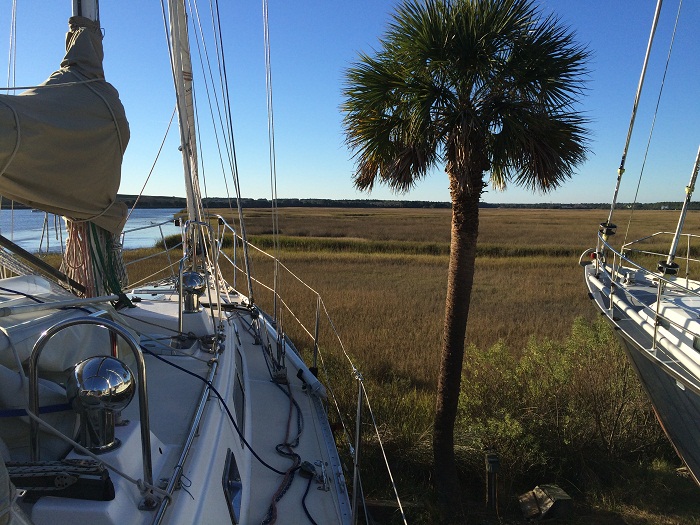
Along with the swans and the red winged blackbirds, we saw a great blue heron fly low and slow right above us to land at the edge of the marsh grasses.  It was a beautiful evening.  It’s almost time for our boat to head to warmer waters, so it will be another spring and summer before we see sights like these again.


Directions for a handwoven tote bag

8-SHAFT HUCK LACE TOTE BAG

IMG_1480

 This fabric is based on a well-known huck lace pattern that is available in a number of places.  It is included in the The Best of Weaver’s Huck Lace, edited by Madelyn van der Hoogt, on page 12 in the pattern section (by Ruth Morrison), and in the project section starting on page 51.  This pattern is also used as the end plate on the right-facing page at the beginning and end of the book.

 You can also consult Madelyn van der Hoogt’s informative digital workshop on lace weaves which you can preview here: http://www.interweavestore.com/weaving-lace-with-madelyn-van-der-hoogt.

Here is my version of this project:

Warp:  16/2 linen (Bockens Lingarn) in five colors:  1 spool each, 125 grams
# 522 black
# 485 purple
# 4060 dark green
# 40 bright turquoise
# 2030 lemon yellow

The tote fabric requires about a yard of fabric, and each napkin requires ½ yard of fabric, so plan your warp length accordingly.  I wove one yard for the tote and 2 ½ yards for five napkins.  I put on a 5 yard warp to allow some sampling and loom waste.

Weft:  16/2 linen in #522 black, 2 spools (in addition to the one used for warp)

Sett:  20 epi, width in the reed about 17.5” (finished width about 16.5”)

Threading:  There are 7 repeats of the huck pattern with 4 extra plain weave threads in black at each selvedge.  I also threaded two threads together for the first thread at each selvedge.  Total warp threads:  365 ends

Weaving:  to balance at 20 epi

The full pattern repeat is 50 threads.  Each color stripe is 45 threads with 5 black threads at the beginning of each pattern. I placed a stripe of five black threads at the beginning of each repeat to emphasize only one column of the flower motif, as in reality there are two columns of staggered flowers.  (Unfortunately, all huck looks geometric until it is wet finished.  So my flowers look like diamonds in the drawdown.  Consult the detail photo at the end for what happens after wet finishing.)  By having a small black stripe of 5 threads, I minimized the appearance of the staggered flowers so that one straight column of flowers would stand out.  I chose to do this in order to better coordinate with the mug I was using as inspiration for the tote.  At finer setts the staggered floral motif shows up well, but not at the sett I needed for fabric that would be sturdy enough for a tote bag.

Finishing: Off the loom, I machine washed the entire length of fabric in the washing machine on ‘normal’ setting, warm water.  After smoothing the fabric by hand, I let the fabric air dry and then steam pressed it before serging the edges between all the cuts.

Huck Lace Lunch tote final as woven (this link will bring up the pdf file)

Screenshot huck lace tote bag final as woven

In this drawdown I have also included 4 extra plain weave threads at each end of the warp. You might add even more. Huck lace gives a lovely scalloped edge to fabric when it is not bordered by plain weave; however, at such a loose sett of 20 epi I found that the scallops look rather clumsy.  They are lovely at finer setts, but for this project I wish I had used a plain weave border, so I’ve included that here.

The drawdown should be followed until the end of the yellow stripe, then worked in reverse color order back through the blue, green, and purple.

The mug that inspired the tote bag:

Weaving mug exchange

 SEWING THE TOTE BAG

 Materials Needed:

 Tote bag fabric:  15” x 27” plus extra for straps if using this fabric
Lining fabric:  15” x 27” plus more for pockets and possible straps
Pockets from lining:  2 pieces, 7” x 15”
Light Weight fusible interfacing:  14” x 22”
Fusible Fleece:  14” x 22”
Cotton webbing straps if you don’t wish to use handwoven or lining fabric for this

  1. Cut pieces to size.
  2. Fuse the light weight interfacing to the wrong side of your handwoven tote fabric, centering the interfacing so that there is ½” margin on each long end, and 2 ½” margins at the short ends.
  3. Fuse the fleece to the wrong side of your lining fabric, centering the fleece as you did with interfacing on the main fabric.
  4. Sew the pockets:  place right sides together and sew around pieces leaving one short edge open.  Turn right sides out and press, pressing under ½” seam allowance that did not get sewn.  Top stitch around all 4 sides, which will close and finish the edge that was left open for turning. Place the pocket on the right side of the lining fabric about 4” down from the raw edge of one of the short sides.  Sew along the outer edges and bottom of the pocket, attaching it to the lining.
  5. Then top stitch a pocket divider, either by sewing directly down the center of your pocket, or by sewing 1/3 in the distance on the long side.  I opted for the 2nd choice so that one pocket would be larger than the other.
  6. Fold the lining (with attached pocket) in half along the long edge, right sides together, and sew the side seams.
  7. Make a flat bottom for the lining as follows:  with the wrong side of lining facing out, position one side seam so that it is in the center of the fabric, and so that the end of the seam forms a triangle at the bottom of the tote:

tote bag square bottom Measure 2 ½” up from the point and draw a sewing line across the bag that should be 4” across.  Sew across this line.  Repeat this on the other side seam.

8.  Repeat this process of folding the long edges of the main fabric in half (right side together) and sewing the side seam.  Then repeat the process for making a flat bottom for the main fabric.

9.  Put the lining inside the bag, with the right side of the lining facing inward and the right side of the main fabric facing outward.  Turn the triangle flaps on both lining and main fabric so that they face into the bottom of the bag.

10. Fold down the top edges of the lining and main fabric toward the inside of the bag, and so that each fabric is now folded along the edge of either the interfacing or the fleece.  Match the edges and pin.

11. Make your handles.  If you are using the handwoven fabric your handles will only be about 16” long.  Take the hand fabric and press ½” in on the long sides.  Fold in half and top stitch along the pressed edge and then around the entire handle to finish.

12. Insert the handles into the pinned top edge of the tote bag so that each end of each handle is about 1/3 in from the end of the bag.  The finished bag is about 13” wide.  Divided in thirds (4 1/3”), you would place your handles to center on 4” and 8 ½” roughly.  Pin the handles in place with at least 1 ½” down in the seam.  Top stitch around the top of the bag.

FOR NAPKINS:

I wove 18” of huck lace pattern with 2” of plain weave at the end of each napkin.  I wove two picks of a contrasting color of weft in plain weave between each napkin. I turned under a hem at each end so that the plain weave was not showing on the face of the napkin, and hemmed the napkins by hand with black thread.

IMG_1477

Scroll to Top