ArgoKnot

Author name: ozweaver

Changing Gears

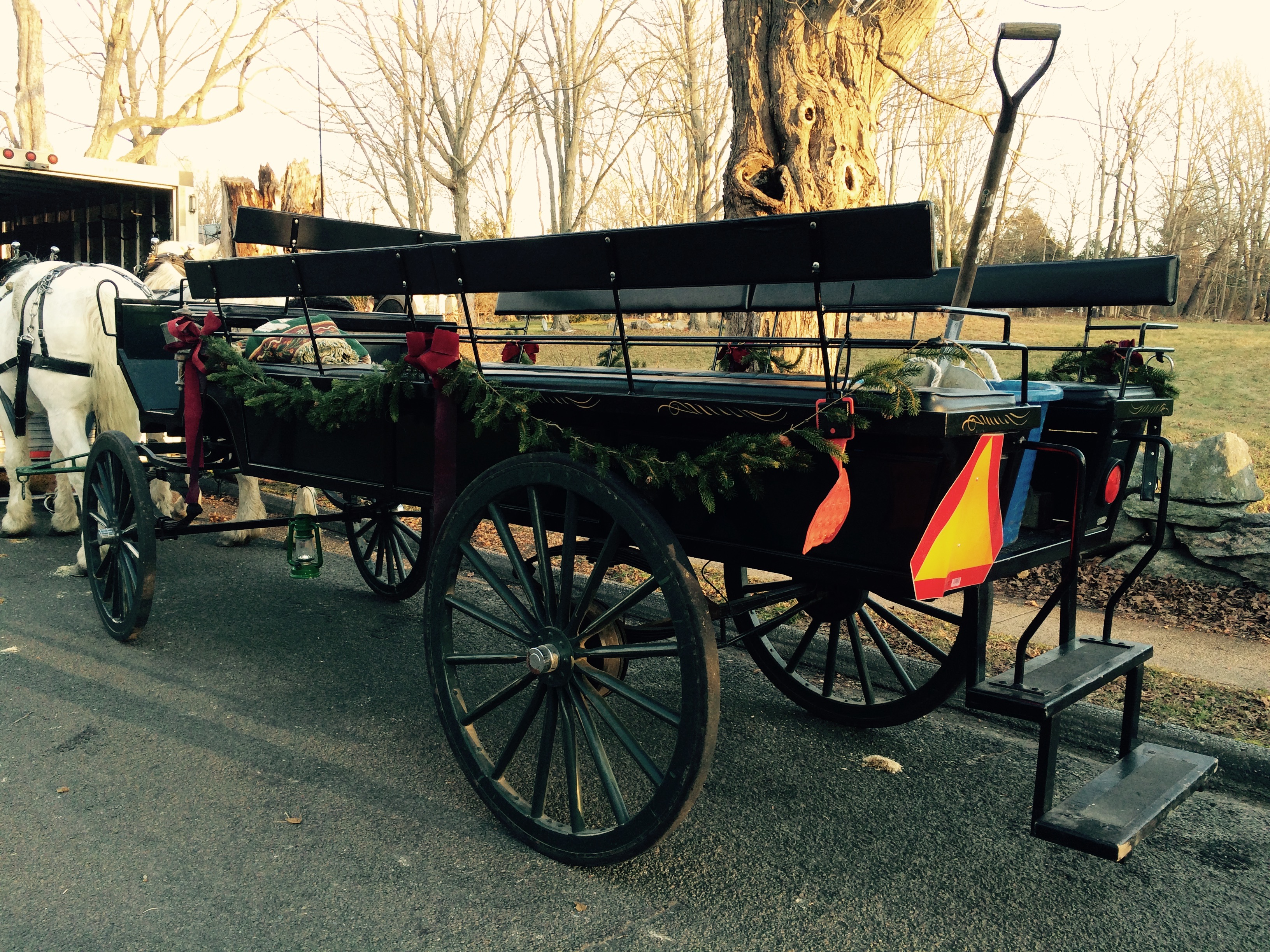
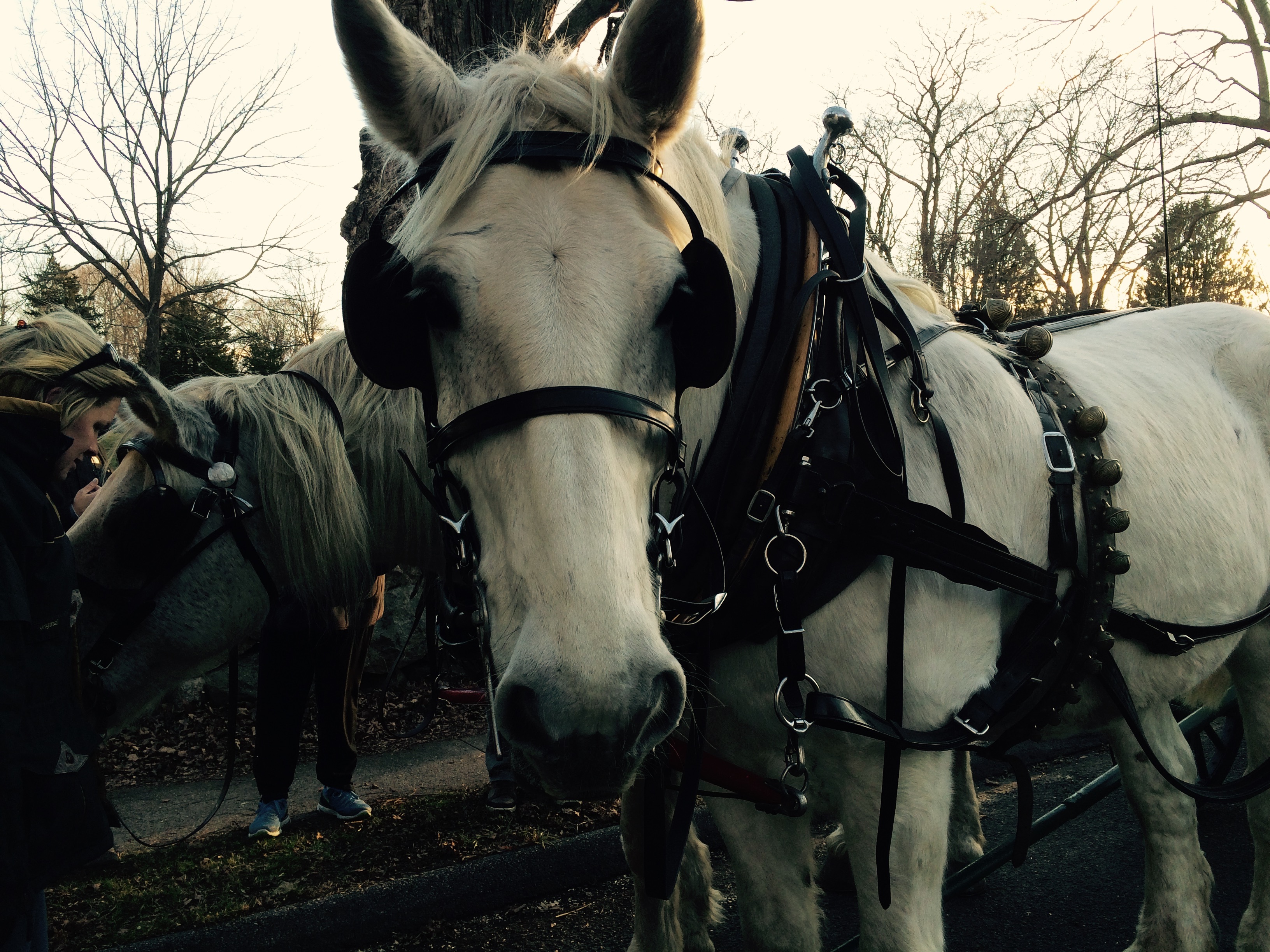
It’s that time of year again, and I don’t mean the holidays.  It’s the time of year when I have to shut down my house, walk away from my looms and leave behind my wonderful weaving friends,   I am about to get onboard our boat, as we do every winter, with only the most rudimentary equipment for weaving.  But since it is also the holidays, I will start with a few photos of what I love best about the holidays in New England!

Houses decorated for Christmas in Essex.IMG_1731IMG_1731 1-IMG_1732 2-IMG_1733 6-IMG_1722 IMG_17316-IMG_1722

4-IMG_1731The Connecticut River waterfront on a chilly December morning.

IMG_1731IMG_17314-IMG_1731

A sycamore tree against the winter sky.

6-IMG_17226-IMG_1722

St. Anne’s Church in Old Lyme, where we went to hear Elisabeth Von Trapp sing a holiday concert with my good weaving friend Susan.

FullSizeRender

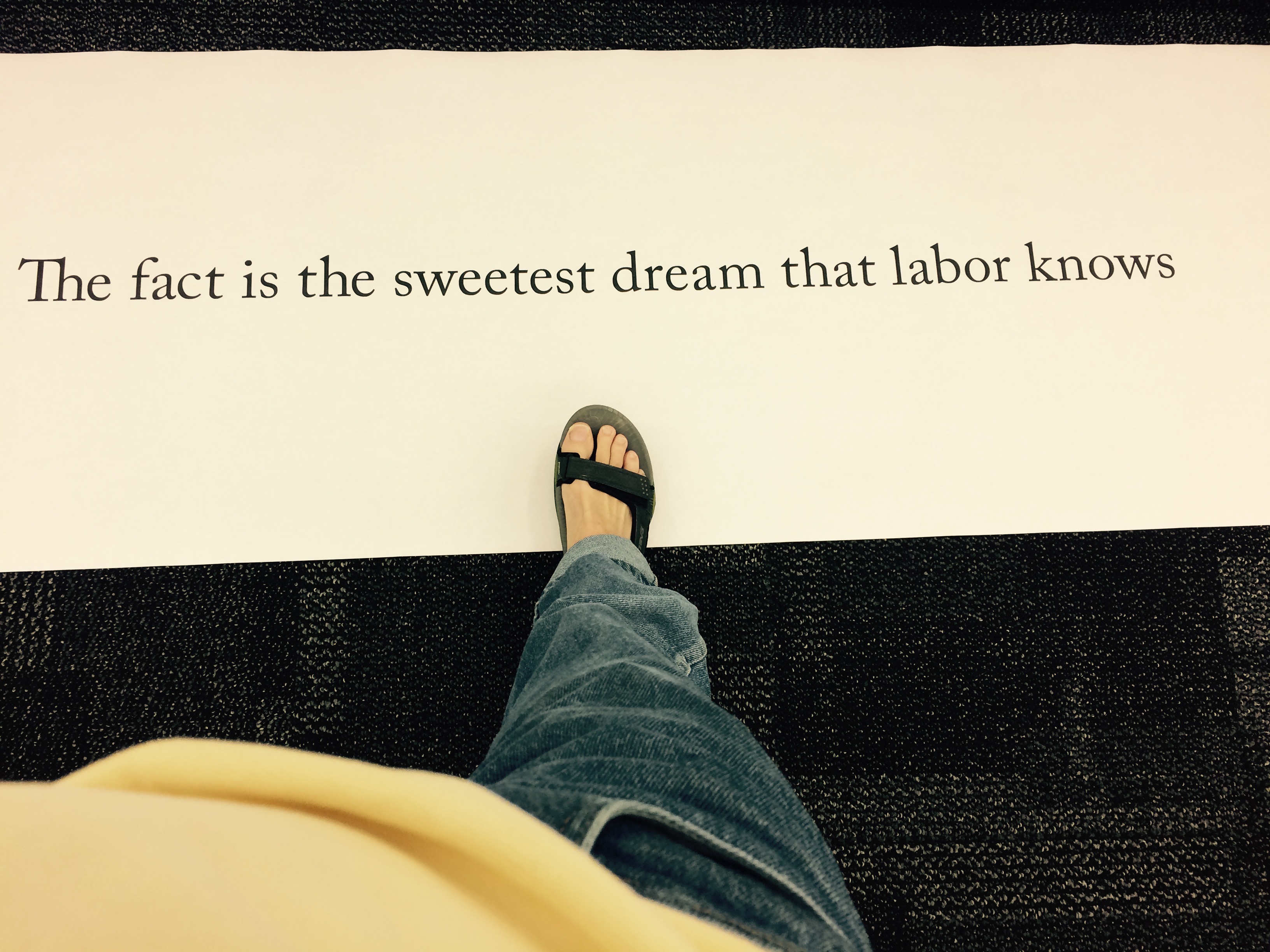
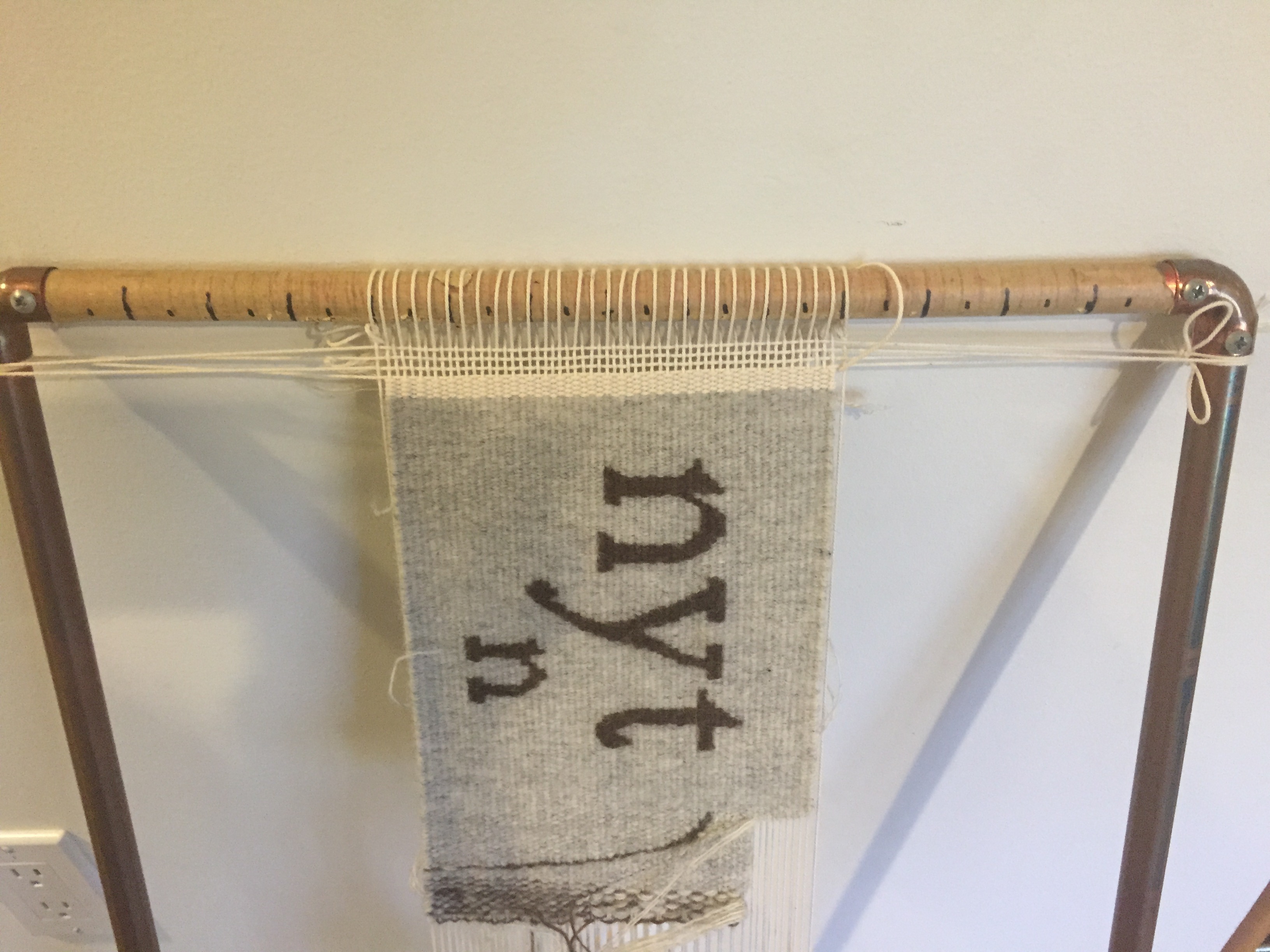
This winter we have a new sailboat that we bought last spring as we finished our 3rd winter sailing aboard our Saga 43′ Pandora.  Our new boat is bigger (an Aerodyne 47′), which means I can bring more stuff onboard!–and it is smoother sailing so that I should be more comfortable when we are underway.  I had to get all my ‘gear’ onboard in early October, and I put two copper pipe looms down below.  One is rather large and will be used to weave a stanza from a Robert Frost poem in a font chosen by our younger son.  The other loom has the still-unfinished small Portuguese Man of War.  I sure hope I finish it this winter.  I also have my bolster lace pillow in a cabinet that would normally store clothing.  There is so much storage on this boat that I hope I never fill it up with clothes.

We had planned to sail to the Caribbean so I had to get everything onboard in early October when Bob set off Hampton, Virginia, which is where one departs  in early November to sail non-stop for 1500 miles to reach the British Virgin Islands.  Bob would return before Thanksgiving so that we could have the holidays here and then we would fly to Tortolla in late December.  Well, that did not work out….. Since this is not a sailing blog I won’t go into the details, but it was a suprise to both of us and a difficult decision to give up our plans for the Caribbean.  Bob tells the whole story on his blog.

Now we will be getting onboard our new Pandora in Florida in late December.  Our revised plan is to sail to the Bahamas yet again, but to then head to Cuba if we can get permission from the State Department.  Bob has been working on this for the past several weeks, and we shoujld have an answer soon.  I am NOT looking forward to the long crossing — 350 miles — from either the far Bahamas or the Turks and Caicos to Cuba.  I’ve never done more than one overnight at a time.   Sailing westward from the far Bahamas will allow us to visit the southern coast of Cuba (about 600 miles long).  The prevailing winds and currents make it imperative to sail westward along that coast.  We will finish up in Havana in late spring with the short, 90-mile sail back to Florida.  So that’s the plan, but we don’t yet know if we’ll be allowed to do it.

If we do go there I’ll be looking for weavers!  I am always looking for weavers, bobbin lace makers, and any other textile makers.  While I have stumbled on a few sites that describe commercial cotton mills back in the early 20th c., I have found no evidence of current handweavers.  I have found several references to bobbin lace making, and I am quite encouraged by this.  In fact one story hits so close to home I am in shock!  A few decades ago a woman from the Westchester, New York, weaving guild traveled to Cuba and wrote about meeting a bobbin lace maker.  I was a member of the Westchester guild for several years in the 1990s, and I have friends who’ve been members of this guild for many years.  I’m certain that several of my friends must know the woman who wrote this article!  At the moment I cannot get back to the website where I read this.  It’s got to be there, and I hope I find it again soon.

Meanwhile, here are two other interesting stories about bobbin lace in Cuba.  In 2013, a group of photographers associated with Foothills College in northern California had an exhibition of photographs depicting modern Cuban culture.  There is a photograph of a Cuban woman, Adriana Martinez, doing bobbin lace taken by Joan Sperans. This what Sperans wrote about this woman making lace on a traditional bolster pillow: Adriana Martinez set up her Belgian lace exhibit on the Prado at the Sunday art fair. I stopped to admire her beautiful work and we started talking. She told me she was a professor of tatting and bobbin lace. Within an hour, several women who came to the art fair to learn how to make lace surrounded Adriana.

Adriana teaches lacemaking at a nearby school. These lace artists are in desperate need of thread for their art and trade. They often use string as a substitute. Despite the use of string, their work is still beautiful and of excellent quality. We talked and made tentative arrangements for a textile-based exchange when I go back to Cuba. I am hoping to encourage some textile artists to go on Ron Herman’s next trip. Before departing Havana, I received a surprise call from Adriana wishing me a safe journey. Adriana and the other women are so sweet.

I plan to bring a few spools of laceweight linen with me, and I will be thrilled beyond description if I can meet Ms. Martinez….or any of her students.  At least I know where to look, presuming there are still art fairs on the Prado. (And I know that “bolillo” is Spanish for bobbin lace.  Knowing the words “rendas de bilros” in Portuguese certainly helped me find the lace museum in Vila de Conde. ) I also found an article about a lace maker named Ana Blanco who left Cuba in 1962.  Since she was an adult at this point she may no longer be living.  She taught bobbin lace in the Jacksonville area of Florida for many years, and won the 1990 Florida Folk Heritage Award.

A quick look at Cuba.

In preparation for leaving, I am also putting a warp on my AVL mechanical dobby.  At the last meeting of the Connecticut weavers’ guild, the Just Our Yarn women gave a presentation on using their handpainted yarns in both warp and weft.  I was quite intrigued by the effect of using entirely different colorways together in both warp and weft and quickly worked up the yardage I’d need to make fabric for a lightweight jacket.

Their 10/2 tencel yarn, called Almaza, comes in 1000 yd hanks, and I bought three for my warp that will be 6 yards long, sett at 36 epi, and about 16″ in width on the loom.  I did not want to work from balls of yarn so I decided to wind each hank of Almaza onto a spool that could be used from my LeClerc spool holder.  Each spool just happens to hold the Almaza hank with very little room to spare.  How lucky is that?

3-IMG_1753

I am holding one end from each of the three spools to wind the warp on my AVL warping wheel.  I hope to finish winding on the warp today.

1-IMG_1759-002I doubt I’ll get through threading the heddles before we leave, but at least I’ll have a warp waiting for me all ready to thread when I return in May.

An Unexpected Day

A month or so ago I read this description on the website for the New Hampshire Weavers’ Guild:

The Telling Detail: Special Effects in Tapestry
Lys Weiss & Jeffrey K. Weiss

Museum exhibitions of historical tapestries can overwhelm us. Their huge size and display of magnificence can make it hard to focus on specific details. The overall effect is tremendous–but how exactly was that effect achieved?
This presentation will use examples from historical tapestries to train our eyes to see how those long-ago weavers created the remarkable special effects we marvel at today. We will examine striking details: plants and animals, flowing water, majestic buildings, and lively people with expressive faces, costumes of elaborate fabrics, sparkling jewelry, and all the material goods of daily life.

I’ve seen every blockbuster tapestry exhibition at the Met since 2002, and once I went to one of these huge exhibitions five times.  And even after viewing the same tapestries five times, I felt completely overwhelmed and lost in every single one. I know I’m not the only one!  Imagine this scenario:
Who wouldn’t be ovewhelmed at all the visual stimuli in these large pieces.  So, let me tell you–I want to meet this couple who can talk you through these mammouth works and break down the images into bite size pieces.
Their presentation is going on right now as I write this.  When push came to shove, I could not manage driving 3 hours each way to see their program.  And boy, am I disappointed.  Yesterday, when I faced the fact that I would not be going, I wrote to them to ask if they would consider giving the same program to my guild in Connecticut.  Fingers crossed….
Instead of driving to Concord, New Hampshire today, I drove to the border of Haddam and Killingworth, somewhat north of where I live on the Connecticut River.  The woman who runs our  guild’s “Weftovers” tables was given a large quantity of Paternayan Persian wool.  It’s about 12 lbs. worth of the large 4 oz. skeins and the smaller 8 yard skeins.  I don’t even use Paternayan for tapestry anymore, but I could not let it get thrown out.  I am hoping to pass it along to beginning tapestry weavers, for which it is a great yarn….easily unplied and re-plied to create endless color possibilities.  And at 8 epi it is perfect as one strand of weft.
Here it is in its new home–the storage room off my studio.
1-IMG_1715
According to KC, the guild member in charge of the “weftovers tables” at our guild, this yarn came from a church that had commissioned the recovering of its pews with needlepointed cushions.
So although it wasn’t a drive to New Hampshire, it was a lovely drive north along the river to a fairly rural area with a few farms.  The almost-winter sky was beautiful and the cows were out in the pasture today.
2-IMG_1713
After loading the boxes of yarns into my car KC took me for a walk in the woods behind her house. We crossed over the stream on this pretty bridge that she and her husband built, and walked toward the pond.
3-IMG_1704
It has been a lovely day in its own right, and I hope the Weisses will agree to give their presentation down here in Connecticut.  If they do, I’ll let you know!

Precious Gifts

The first thing on my mind for the past week is the lovely tapestry exhibit at LaGrua Gallery in Stonington, CT.  Dash over there if you can!  How many opportunities are there to see tapestry as the focus of a gallery exhibit?  And Mary Merrill’s tapestries are beautifully displayed in this space with it’s wonderful light.  Mary’s works have a lot to do with light since her works are all landscapes.

I was surprised and disappointed to find that no one from my Connecticut guild of weavers was present at the opening.  Mary Merrill’s daugher and son were there to speak about their mother and comment on the works chosen for this exhibit.  It was delightful to meet them and to learn some personal facts about the woman who wove these tapestries.

Mary Merrill  lived her life within the confines of most women of her generation, supporting her husband’s career and raising five children.  At the same time she pursued various weaving techniques and volunteered in several areas related to weaving.  She held numerous positions in the Weavers’ Guild of Boston, including president, and she volunteered and did research for Plimouth Plantation.  Later in life her tapestry work depicted her experiences traveling the world.  Her daugher Amy described their summer vacations at a cottage in New England.  Her mother would be make the meals and participate in some of the family outings, but a significant part of each day was spent at her large tapestry loom.

Here is Mary in front of her tapestry, “Kilauea.”

Mary Merrill seems just the kind of woman I would have enjoyed knowing–someone I probably would have emulated.  I only became introduced to her work this summer when I saw a display of her tapestries at NEWS (New England Weavers’ Seminar) in Northampton, Massachusetts. The works chosen for that exhibit were mostly tropical landscapes with the vibrant colors of a hot, sunny location.  There was one tapestry in the show that stood out for me with its intense colors of a sunet in a high latitude location.  It is a scene of from a Norwegian village.  Here are Amy and Paul posing for me in front of  “Primary North,” 1998 (copletted just a hear before her death).

1-IMG_1642

In the 15 years since her death, her family has taken care to have her work stored in places for safe keeping: first at the Fiber Arts Center in Amherst, Massachusetts, and now at Harrisville Designs in New Hampshire.  If you ask me, this has got to be the most endearing display of love I have encountered.  Hearing about her life through the eyes of two of her children added such depth to the woman I only know as a power house of hard work in the preservation of textile history.  Since not a single person from my guild came to the opening, I can truly say they all missed a wonderful evening.  However, you can still see the exhibit!–through early December.

And you’ll be able to see more of Mary Merrill’s work in March and April when she will have a retrospective at the Fuller Craft Museum.

The following day I attended one of my lace group’s monthly meetings, a somewhat rare treat for me since I am out of the area for a good part of the year.  This year while I’ve been home I’ve had some unfortunate conflicts with the dates for our lace meetings.  When I get to one of these meetings I am always stunned by the complex work the members do, and by how tolerant they are of my slow progress as a beginner.  Last month I admired a minature bolster pillow at Mary’s house.  It was a traditional pillow, only tiny!–in the style of the pillows from Slovenia, sitting in its tiny woven basket with an intricate piece of real Idrija lace displayed in miniature, including some miniature bobbins hanging from the lace!  It was a gem!  It was a gift to Mary from another member named Linda.

This month’s meeting happened to be at Linda’s house.  Linda and her husband made us a feast that was like Thanksgiving and Christmas rolled into one huge festive meal.  Shortly after I arrived and was returning to my lace after getting some morning coffee, I found this little gem sitting next to my lace pillow.  What a gift!

IMG_1644

Now if only my own attempts at Idrija lace looked as beautiful as this does.  Sigh….

For the final event of this special weekend I met my oldest friend at an opening in Windsor, Connecticut.  I was not particularly moved by the works in that exhibit, but we had a nice evening together.  She has been telling me about the wonderful scent from a Brugmansia Angel Trumpet that she is ‘plant sitting’ in her studio.  The fragrance was heavenly, and the plant is truly impressive.

IMG_1643

IMG_1643I’m about a week late posting this.  Life does get in the way sometimes….but sometimes it’s all really good stuff.  I’ve made some progress on the book about Archie Brennan.  (I hope whoever reads this jumps out of their seat and gives a cheer!)  And my sister and I have had some precious time together, although not under the best of circumstances.  She agreed to let me care for her after some rather scary surgery.  All went well, but her recuperation will be slower than we imagined.  I have enjoyed having here with me.  We’ve been two women alone together, watching movies, eating good food (I have to take good care of her, don’t I?–alone I would have been eating junk food!), and talking about everything under the sun.  Bob has been away sailing for almost 3 weeks so it’s been special to have this time with my sister.

And fall is quickly turning to winter.   Here is a beautiful photo taken near the Connecticut River by my friend Jody.

IMG_1613And the view out my kitchen window, just a day or two before the beeches turned brown and began dropping leaves.

IMG_1638IMG_1638

IMG_1638


Sericulture in Connecticut and a Workshop with Sarah

That title is a mouthful.  Initially, I just liked the sound of “Sericulture in Connecticut,”  but I could not write about that when I’d also just spent a fabulous three days sewing with Sarah Fortin!  Some week!   I guess if all weeks were as educational and productive I’d be wiped out all the time. Who knew there was a silk industry in Connecticut?  I did not.  I certainly knew that China and other Asian countries have had  silk production since the dawn of time.  And I knew that by the Renaissance, European countries wanted to grow their own silk worms so they could stop buying costly silk from China that involved the long and treacherous journey on the silk roads.  Well, it turns out that the English wanted to see if silk could be successfully cultivated in the American colonies.  The experiment started in the area from Virginia to Georgia, around 1650.  This is the same period in which the English experimented growing indigo in the southern colonies as well.  A century later the southern colonies were focused on cotton and tobacco, and an experimental silk culture had started in Mansfield,  an area east of Hartford.  This was a cottage industry in which farmers were encouraged to plant black mulberry trees in their orchards, and their wives raised the silkworms and learned to reel the silk. The program was presented by Ann Galonska from the Mansfield Historical Society.  She has been researching the silk industry in this part of Connecticut for a number of years and she also decided to try her own hand at raising silk worms.  She was able to feed the caterpillars on the leaves from the few remaining black mulberry trees in the area.

1-IMG_1551

Interestingly, Ann told us that silk worms put on 80% of weight during the last week of their caterpillar cycle.  They go through so many mulberry leaves that she has to replenish the leaves multiple times a day.

Ann brought silk cocoons, silk worm eggs, a silk worm preserved in a jar (formaldehyde?), and various samples of different silk preparations.  She showed slides of the various silk mills that cropped up in the area.  Hanks Silk Mill ws the first mill in the US, established in 1810.  As time went by more mills were established:  Chaffee Silk Mill and Mansfield Silk Company, until by 1869, there were eight mills in the area. She showed bills where farmer were paid for the silk they delivered, as well as ledgers of bartering with silk as payment for household goods.

She showed an adverstisement from 1834, urging farmers to buy mulberry trees to add to their orchards: 100 black mulberry trees for $3 – 5.  Hard to imagine, even given the cost of things back then.  By the end of that decade the same 100 trees cost $500.  And that is even harder to imagine!  Silk was a profitable industry in this area for a couple of decades, but the decline began when people started buying saplings of the white mulberry tree, which was known to be preferable to black mulberry.  Ann said these trees survived the first couple of winters in Connecticut which happened to be mild, but when a more typical New Engalnd winter ensued the white mulberries were not hardy enough to survive.  And most of the farmers had cut down their black mulberry trees in order to plant the white version.  While raising silk worms swiftly declined at this point, the mills hung on well into the 20th century using imported silk.  You can find more information, along with early  20th c. photos of some of the mills at the historical society’s website.  And there are tours of the mills at certain times of the year.  Now that would be a treat!

Much of last week I spent at a workshop with Sarah Fortin, learning to sew a garment from handwoven fabric.  This is far from my forte (ha ha!)–so far that I would say I am completely inept at making a flattering garment.  So to cut into precious handwoven fabric for a likely-to-fail attempt at making a jacket made me pretty uncertain about taking this workshop.  I brought a nice selection of commercial fabrcis to choose from:  a length of Harris Tweed, two lengths of wool melton, and a selection of other wool crepes and one chenille that I thought might work up as something interesting.   Somehow, in the tote bag of fabrics I also included a very precious length of wool fabric that Rabbit Goody wove, and that I bought from her as a remnant, about 20 years ago.  This piece of yardage was far more precious to me than any of my own handwoven fabric, and I cannot explain why I took it with me to the workshop!

Naturally, when I showed Sarah my fabric choices, I began listing all the reasons why I would not consider cutting into the Rabbit Goody fabric.  And naturally, Sarah listed all the reasons why I should.  In the long run, Sarah (with enthusiastic support from the rest of the workshoppers) won this debate.

1-Sewing with Rabbit Goody fabric

I have to say it was not easy to cut into that beautiful fabric.  The sewing was enjoyable and ate up most of the workshop time.  When I reached the last seam in assembling the jacekt I suddenly got very anxious.  I knew it would be time to try it on.  It still had a lot work to do–all the embellisments I’d planned as well as all the finishing for the sleeves and the hem and attaching a front band.  But it was at this point, when all the pattern pieces were together, that I could try on the jacket, and I did not want to do it!  Sarah came with me to a more private area where the others could not watch, and I put it on.  I was very shocked to find that I loved it!  ….and that it fit so well.  Whew!  All credit for this  goes to Sarah, of course, for helping me size the pattern before cutting it out.  And of course she was right– better to enjoy this fabric as a garment– the very reason I bought it in the first place, rather than hiding it away in my stash.

Sarah Fortin workshop me

Everyone made a successful jacket during our workshop.  Marjie, who is likely our most accomplished seamstress, finished her jacket first. The pattern she used is called the ‘swing’ jacket. Look how pleased both Marjie and Sarah are with the outcome!  The rest of us are are sighing over this and hoping ours will turn out as well!

3-Sarah Fortin workshop

Last day of class, more people are approaching the finishing! This is Jody’s jacket, a wonderful fabric woven on a warp at Vavstuga. The coloris quite off–it’s actually a great mixture of two greens and brown.  Jody made the same pattern I did, called the “bias sleeve” jacket. I think Jody’s jacket is the most successful combination of weave structure and garment design.  It’s a beauty and it looks fabulous on her!

2-Sarah Fortin workshop Jody

One more finished swing jacket with terrific color placement!

4-Sarah Fortin workshop swing coatSome of us will be getting together again this week to continue to work on our finishing.  I’m now a bit confused about my sleeve finish and how to put on the front band.  I’m hoping some of the more experienced sewers (that would ALL of them!) can give me some pointers.  Also, Sarah has offered to answer any questions so I think I will email her.  I’d better get to it!

Weaving Vignettes

Over this summer I have stumbled on some wonderful weaving videos, everything from an historic reenactment of working with flax and wool in the Bronze Age to a number of videos showing tapestries in progress, to a Google video about high tech weaving with threads that have conductivity and can be attached to a very small computer chip imbedded in the cloth.  Huge thanks to everyone who makes these terrific videos–sharing their knowledge and their weaving talents and information on such fascintating endeavors with the rest of us.

Here’s the video about conductive threads that have been designed for use in weaving fabrics for clothing, upholstery, and other applications where the cloth will then be compatible with any computer device.

So now it might be fun to see the other end of the weaving spectrum:  Bronze age flax and wool processing and weaving in northern Europe during this time period.  The Center for Textile Research, which I believe is associated with a university in Denmark,  has documented this period of history so beautifully!

Here is a great stop action video of weaving one of  the “Hunt for the Unicorn” tapestries that were re-interpreted and woven by weavers from West Dean College in Sussex for Stirling Castle in Scotland. The original tapestries (from around 1500 which were woven in Flanders)  are hanging in the Cloisters in New York.  This project of recreating the seven tapestries in the series began in 2001, and was not finished until 2014.  The last tapestry in the set was hung at Stirling Castle this summer, 2015.  The weavers made a number of trips to the Cloisters to study the originals.  I met a few of them on one of their trips, and it is something I’ll never forget!

Isn’t it wonderful to watch the unicorn’s horn get woven?  On that note, I’d better get back to weaving myself!

Scroll to Top